




Abstract
How important were manufacturing and heavy industries to the economic integration of twentieth-century immigrants in Western societies? This article examines how macro-social change in Germany since the height of manufacturing has affected the socio-economic integration of male immigrants. We develop an analytical framework to assess how educational expansion among natives, deindustrialization, and the increasing importance of formal qualifications shape male immigrant-native gaps in labor-market outcomes over time. Empirically, we focus on first-generation male Turkish immigrants in Germany and use micro-census data spanning almost 40 years. Through a novel empirical quantification of key theoretical arguments concerning immigrant economic integration, we find growing inter-group differences between the late 1970s and mid-2000s (employment) and mid-2010s (incomes), respectively. The growth of differences between the immigrant and native income distributions was most pronounced in their respective bottom halves. Our analysis shows that these trends are linked to the increased importance of formal educational qualifications for individual labor-market success, to educational expansion in Germany, and to deindustrialization. Employment in Germany shifted away from middling positions in manufacturing, but while natives tended to move into better-paying positions, Turkish immigrants mainly shifted into disadvantaged service jobs. These results provide novel evidence for claims that the economic assimilation of less-skilled immigrants may become structurally harder in increasingly post-industrial societies. We conclude that structural change in host countries is an important, yet often overlooked, driver of immigrant socio-economic integration trajectories.
Introduction
Until the 1970s, industry, manufacturing, and heavy industries composed the single largest sector of employment in Germany and in other European and North American countries (e.g., Oesch 2013). Proponents of different models of immigrant adaptation agree that this economic environment played a central role for lower-skilled immigrants’ economic integration, particularly in the United States, during the middle of the last century (Portes and Rumbaut 2001; Alba and Nee 2003). An open question in scholarship on immigrant integration remains, however, as to what degree historical patterns of assimilation during the twentieth century depended on the unique set of favorable structural conditions brought about by the centrality of manufacturing (Perlmann 2005; Waldinger 2007). More importantly, there is no consensus as to whether similar adaptation outcomes can be expected in modern economies that revolve around services and put a higher premium on skill (Portes, Fernández-Kelly, and Haller 2009).
The research question pursued in this article is, therefore, what implications de-industrialization, shifting skill demand, and educational expansion since the height of the manufacturing economy in the second half of the twentieth century had for (lower-skilled) immigrants’ economic attainment. The pessimistic answer to this question, often associated with proponents of segmented assimilation theory, is that economic adaptation becomes harder for less-skilled immigrants in modern service-oriented economies (Gans 1992; Zhou 1997). Proponents of mainstream assimilation models, by contrast, expect that mid-twentieth-century immigrants’ experience will be repeated by more recent cohorts of newcomers (Alba and Nee 2003). In spite of this question’s relevance for understanding the perspective current immigrants face, there are few direct empirical tests of what role longer-term de-industrialization and educational upgrading play in lower-skilled immigrants’ labor market attainment (c.f., Reitz 2001; Lubotsky 2011; Moreno-Galbis et al. 2019). This article aims to fill that important gap.
Drawing on official microcensus data from the 1970s to the mid-2010s, we provide a detailed empirical assessment of the implications of de-industrialization, shifting skill demand, and educational expansion for lower-skilled immigrants, using first-generation male Turkish immigrants in (West) Germany as our test case. Concretely, we analyze historical time trends in male first-generation Turkish immigrants’ relative incomes and employment probabilities in West Germany between 1976, when the structural changes we describe started to unfold, and 2015, when a service-centered economy had been firmly established. To quantify the respective contributions of different facets of macro-structural change, we rely on a longitudinal decomposition approach. Our methodology provides empirical estimates of the importance of German educational expansion, of the growing importance of qualifications, and of de-industrialization for immigrants’ socioeconomic adaptation at different points of their income distribution and for their probability of employment.
This article contributes an empirical assessment of host-country macro-structural drivers of changes in immigrant-native differentials to the literature on immigrant economic attainment. It constitutes an important advance over previous studies on longer-term trends in immigrant economic attainment, which are often largely descriptive (e.g., Bevelander 2001; Gustafsson and Zheng 2006; Rosholm, Scott, and Husted 2006; Dustmann, Glitz, and Vogel 2010) or employ statistical approaches that obstruct conclusions about the role of structural change in receiving contexts (Borjas 1994; Kalter 2002). Focusing on Turks in Germany, we add to the literature that seeks to explain trends in immigrant-native differences in structural terms (Reitz 2001; Lubotsky 2011; Moreno-Galbis et al. 2019) and provide the first assessment of drivers of longer-term trends in the integration of a large guest-worker group. Our analysis considers heterogeneous developments along the distribution of incomes and provides simulation-based estimates of the effects of endogenous sample selection that have often gone unaddressed in previous work.
In the next section, we review the available evidence on longer-term trends in immigrant economic integration in (post-)industrial countries. Drawing on more general labor-market scholarship, we, then, identify three arguments about why immigrant-native differentials are likely to grow as employment shifts from manufacturing to services. In the third section, we introduce the data and decomposition approach we use to quantify the importance of the three different arguments. The fourth section presents the results of our analysis. We start with a descriptive presentation of immigrant men’s relative employment and income trends and then analyze how educational expansion, de-industrialization, and the increasing importance of formal qualifications have contributed to growing gaps in Germany. In the fifth section, we summarize our findings and discuss their implications for scholarship and policy.
Technological Change and Labor-market Restructuring Shape Immigrant Economic Adaptation
Our principal concern is whether relatively equitable economic integration of lower-skilled immigrants has become structurally harder since the middle of the last century. Traditional “straight-line” models of immigrant assimilation predict the uniform blending of groups of initially disadvantaged newcomers into the native mainstream through upward mobility (Gordon 1964). However, as growing income inequality in post-industrial receiving societies became apparent, scholars of immigrant integration started to reject some of the optimism of conventional assimilation models (e.g., Portes and Rumbaut 2001). They argued that newcomers’ historical adjustment to native levels of income and occupational attainment was only possible in an economic environment marked by plentiful blue-collar factory jobs that offered decent wages and predictable avenues to upward mobility: past immigrant upward mobility was in part due to “manufacturing exceptionalism” (Gans 1992; Portes and Zhou 1993; Zhou 1997). An important implication of this hypothesis is that mid-twentieth-century immigrants’ experiences of relatively successful economic integration are less likely to be repeated today (Portes, Fernández-Kelly, and Haller 2009; c.f., Waldinger [2007] and Alba, Kasinitz, and Waters [2011] for contrasting assessments).
In the following, we review existing empirical studies for evidence as to whether broad trends in immigrant attainment over historical time are compatible with this argument. Since few studies provide an account of the different mechanism at play, we, then, review explanations for rising inequality more generally to identify three historical forces that should come with negative implications for lower-skilled immigrants: native educational expansion, growing importance of educational qualifications, and de-industrialization.
De-industrialization and Immigrants’ Economic Adaptation
Has immigrants’ economic attainment become harder in a service-centered economy? Unfortunately, prominent studies of historical trends in immigrant economic adaptation do not allow inference about the role of historical labor-market change in these trends. In a widely cited paper, Borjas (1994) provides econometric analyses of the growing immigrant wage gap in the United States. Because his analyses concentrate on changes in immigrant composition, Borjas’ estimates are deflated for changes in the labor-market returns to human capital. It is exactly this latter dimension, however, that is indicative of the kind of structural change at stake in the controversy on the role of manufacturing. Similarly, Kalter and Granato (2002) report historical trends of increasing “net assimilation” of immigrants to Germany. This finding might be taken to indicate a minor role of de-industrialization for integration trends. However, because their estimates are (like those of Borjas) statistically purged of the effects of labor-market change, such inference is impossible. These studies, thus, do not allow conclusions about structural change’s independent role for immigrants’ changing prospects.
More informative are analyses that, among other results, provide descriptive assessments of immigrant labor-market outcomes over time. Such studies, mostly from Scandinavian countries, report growing unemployment risks and falling relative earnings for non-western immigrants between the 1970s and the 1990s (Bevelander 1999, 2001; Bevelander and Nielsen 2001; Blom 2004; Gustafsson and Zheng 2006; Rosholm, Scott, and Husted 2006). Similarly, Herwig and Konietzka’s analysis of immigrants’ class attainment (2012) shows that in Germany, Turkish immigrants’ access to higher class positions deteriorated relative to natives between the 1970s and 2000s, while Dustmann, Glitz, and Vogel (2010) document increasing unemployment rates and wage differentials between Germans and immigrants since 1980, which are somewhat attenuated when controls for education are introduced. Results of these studies are consistent with the conjecture of mainstream assimilation theory’s critics that sectoral restructuring has resulted in growing immigrant-native differences (Gans 1992; Zhou 1997). However, these studies do not directly test de-industrialization’s role in immigrants’ changing prospects and, hence, afford only limited insights into why economic gaps between the immigrant and native populations have changed.
Evidence on this question of the effects of labor-market change on the evolution of immigrant-native differentials exists only for Canada (Reitz 2001), France (Moreno-Galbis et al. 2019), and the United States (Lubotsky 2011). The results of Reitz (2001) and Lubotsky (2011) suggest that structural change in the liberal market economies they studied has turned against immigrants. The factors that explain the dynamic of immigrant-native gaps in economic outcomes identified by Reitz (2001) in Canada include native educational expansion and an increasing discounting of foreign education. Lubotsky’s (2011) results document clearly that changes in the US wage structure linked to the growth of overall inequality have made earnings assimilation harder for more recent immigrants. Nevertheless, given the exceptional extent of increases in income inequality in the United States, it is unclear whether these findings also apply to less unequal societies. Such doubts are reinforced by Moreno-Galbis et al. (2019), who document that labor-market change since the mid-1990s — however long after the onset of the manufacturing economy’s demise — has benefited recent immigrants to (low-inequality) France.
In sum, then, available evidence on trends in immigrant-native gaps in economic outcomes is largely compatible with the manufacturing exceptionalism thesis. However, very few studies attempt explanatory decompositions of such trends, and their results are not entirely consistent. In the following, we aim to provide an assessment of the drivers of immigrant-native gaps. To identify the relevant mechanisms, we review some of the insights social scientists have produced about rising inequality generally and then discuss their implications for immigrants.
Growing Skill Demand and Educational Expansion
A prominent group of explanations for the growth of income inequality in developed countries argues that changing technologies alter the relative demand for different kinds of labor (Katz and Murphy 1992). According to this argument, technological change has led market forces to shift against lower- and medium-skilled workers in modern economies (for a review, see Acemoglu and Autor 2011). Proponents of the skill-biased technological change (SBTC) hypothesis argue that recent technological innovations have increased higher-skilled workers’ productivity while simply replacing lower-skilled jobs (Katz and Murphy 1992).
While technological change affects the relative demand for skill, the relative supply of skill is mostly determined by the education system (Goldin and Katz 2009). Thus, labor-market equilibria could stay dynamically stable if educational expansion advances at the same rate as relative skill demand. In this case, returns to education would not change, although the average education among workers would increase. Empirical analyses show that this situation can, to some degree, be found in many European countries (Nolan et al. 2014). In Germany, the overall wage premia to education stayed relatively stable, at least until the mid-2000s, as tertiary education has expanded significantly (Boockmann and Steiner 2006; see also Sections B.1 and B.2 of the Online Appendix). However, at the same time, the prospects for dropouts and for workers without vocational training have continuously decreased. Studies show that the demand for untrained workers in Germany has decreased more rapidly than the number of such workers (Dustmann, Ludsteck, and Schönberg 2009; Giesecke, Heisig, and Solga 2015). As a result, relative wages and employment prospects for lower-skilled workers have decreased, suggesting that negative effects of changing skill demand have been felt most harshly at the bottom of the income structure.
What does this development entail for (less-skilled) immigrant groups? As a first approximation, less-skilled immigrants can be expected to share the experience of lower-skilled workers generally. The growing importance of formal qualifications should, therefore, result in increasing stratification between immigrants and natives to the degree that human-capital differentials correlate with immigrant status. Such a process is in line with the pessimistic perspective in segmented assimilation theory (Gans 1992; Zhou 1997). Technological change affects all less-skilled workers, but due to the higher prevalence of this group among immigrants, its consequences are heightened for immigrants. We, thus, propose the first dimension of structural change that may have carried negative implications for lower-skill immigrant groups:
Growing importance of qualifications
Less-skilled immigrants increasingly fall behind the native majority in their labor-market outcomes, as they hold less valuable (host-country) qualifications, which puts them in an increasingly disadvantaged position, the more skill b(i)ased the economy becomes.
Not only may existing group differences in human capital become more consequential, they may also widen over time (Kalter 2002). At the same time as the labor market grew more skill intensive in Germany, the native population underwent significant educational expansion (Mayer et al. 2009). As younger and better qualified cohorts enter the labor market, immigrant and native less-skilled workers’ relative position becomes increasingly marginal.
These processes likely put immigrants already in Germany at a disadvantage. But what about newcomers? Does the population of new immigrant arrivals undergo educational upgrading at the same rate as the native population? While Turkey engaged in a substantial expansion of its education system during the period under study (1976–2015), this process was very uneven across regions, ethnicities, and skill levels (Williamson 1987). It is, therefore, not clear a priori how the skill composition of the emigrant population from Turkey has changed over time. Our data from the German micro-census suggest that the upgrading of Turkish immigrants’ qualification structure was substantially slower than that of native Germans (see Online Appendix B.1). What should be noted in any case, however, is that immigrants are aiming at a moving target: since higher qualifications have become more widespread in receiving societies, immigrants need ever-better training just to stay on par with the majority (Borjas 1985). If, as we have argued, Turks in Germany fall behind natives’ educational upgrading, we assume the following second dimension of structural change to take effect:
Educational expansion
Less-educated immigrants lose relative to natives in terms of labor-market outcomes, insofar their levels of (host-country) education fall behind those of natives who participate in educational upgrading.
Labor-market Structure and Closure Dynamics
Meso-level social structures — organizations, occupations, and unions — shape workers’ outcomes over and above their individual human capital, sometimes creating rents, which are the returns to a position over and above its market equilibrium price (Sørensen 2000; Weeden 2002). In Germany, collective bargaining and state interference often lead to a situation where such positional premiums accrue to less-skilled workers, too (Hassel 1999; Dustmann, Ludsteck, and Schönberg 2009), and lower-skill employment has partially shifted from unionized manufacturing and heavy industries to lower-tier service jobs (Fernández-Macías 2012). Industries where wage compression through collective bargaining (i.e., offering significant wage benefits also to less-skilled workers) was particularly strong have seen their share of employment reduced dramatically (e.g., steel and mining) (Giesecke, Heisig, and Solga 2015). Lower-skill workers that have worked or would have worked in the jobs that fell victim to sectoral change often either became unemployed or entered industries where wages and chances to create rents were lower (e.g., the low-end service sector) (Eichhorst, Marx, and Tobsch 2015).
We claim that immigrant workers were hit particularly hard by these dynamics (see also Section B.3 of the Online Appendix for an empirical appraisal). In Germany, guest workers were historically concentrated in the labor-market segments that came under most pressure from shifts in production technology and off-shore competition (Herbert 2001). These sectors were classic examples of high industrialism, with relatively high wages and traditionally strong organized labor (Hassel 1999). In addition, German unions had succeeded early on in ensuring guest-worker coverage under collective bargaining agreements (Trede 2012). Thus, early immigrants probably profited from premiums in large unionized industrial corporations in a similar way to native workers.
While the core of our argument is compositional (immigrants were simply more affected by trends that, in principle, affected all lower-skill workers), the decline of manual jobs arguably had different effects for natives and immigrants. Native blue-collar workers, or at least their children, were supposedly better equipped than their foreign peers to find new and better work, given the latter’s lack of host-country language skills and educational credentials (Aldashev, Gernandt, and Thomsen 2009; Kanas and van Tubergen 2009). On average, then, industrial restructuring should lead to native workers moving up, and immigrant workers moving down, relative to the factory jobs of post-war industrialism. We, thus, propose a third dimension of structural change, which describes the effect of the decline of lower-skill/high-rent employment in manufacturing on less-skilled immigrants:
De-industrialization
Positions in manufacturing and industry that combined relatively decent pay levels with few qualification requirements have seen a strong decline. As a result, less-skilled workers, particularly immigrants, who were overrepresented in these sectors shifted to jobs of lesser quality. Sectoral change means that in comparison to natives, as well as to traditional immigrant positions, immigrants work increasingly worse jobs.
Turkish Immigration to Germany
To demonstrate the relevance of these three dimensions, we focus on male first-generation Turkish immigrants in Germany. Three reasons make this group a suitable test case of our framework. First, Turkish immigration was, and to a large degree still is, predominantly lower skill (see Section B.1 of the Online Appendix). It is, thus, representative of the kind of immigrants that our argument expects to come under pressure from structural change.
Second, Turkish immigration started in the 1960s, when post-war manufacturing and the upward mobility chances it supposedly implied for lower-skilled newcomers were at their height. As Turkish immigration continues to date, we are able to contrast immigrants’ relative position then with that of their successors, who were increasingly exposed to a new economic context. Note, however, that the period we examine was not only one of technology-induced economic change, as, for instance, the Iron Curtain’s fall and several waves of EU enlargement also fall into our period of investigation — historical events that affected labor-market equilibria, too. 1
Third, as a classic example of a so-called guest worker program, Turkish immigration to Germany was, in its beginning, closely linked to the dominant labor-intensive mode of industrial production, which forms the basis of the comparatively optimistic assessment of the mid-twentieth century past by migration scholars (e.g., Gans 1992). In the 1960s, foreign workers were recruited to stabilize the prevailing low-skill equilibrium in the labor market, where firms required more manual workers than the West German market could provide. When economic conditions started to change in the early 1970s, foreign recruitment was halted in 1973. However, high levels of Turkish migration continued (see Section B.4 of the Online Appendix), as underage children joined their parents and spouses joined their partners in Germany (Herbert 2001). In the 1980s and 1990s, there were also a significant number of humanitarian migrants, often from Turkey’s economically least developed Kurdish regions (Sirkeci, Cohen, and Yazgan 2012). While in its beginning, Turkish immigration to Germany was assumed to be strictly temporary, by both migrants and authorities, stays in Germany turned out to be long term or even permanent for a large proportion of immigrants (Herbert 2001). Still, as we document in Section B.4 of the Online Appendix, there has been substantial return migration to Turkey by former guest workers and their kin. Return migration poses a serious methodological challenge to research on immigrant assimilation (Dustmann and Görlach 2015), a problem we need to address in our empirical analyses (see below).
Data and Methods
Harmonizing Mikrozensus Data for Longitudinal Analyses
We base our empirical analyses on the scientific-use files (SUF) of the 31 official German micro-censuses (MZ) between 1976 and 2015, each of which is a 0.7 percent sample of the population in (West) Germany consisting of roughly 500,000 respondents per round. Completion of most items in the MZ is mandated by law. Realized response rates are reported to be around 96 percent (Thirolf et al. 2010). The questionnaire’s basic contents have remained the same since 1976, which makes cross-temporal harmonization and analysis possible.
The population analyzed in this article consists of all male Germans and male first-generation Turkish immigrants between the ages of 20 and 60, who had their residence in West Germany between 1976 and 2015. To allow for consistent identification across different MZ rounds, we rely on respondents’ nationality to determine group membership. We define “Germans” as those who held German citizenship and, if they held another citizenship, did not move to Germany after 1949. This definition includes “ethnic” Germans, as well as (the children of) immigrants insofar as they only held a German passport. “Turkish immigrants” are those who moved to Germany from abroad after their 18th birthday and held a Turkish passport. We are forced to restrict our sample to men because the longitudinal analysis of Turkish immigrant women’s labor-market behavior is plagued by additional methodological problems (small numbers of employed women; strong and time-variable family-cycle related selection in and out of employment; the fact that Turkish women tend to be marriage, rather than labor, migrants) whose adequate consideration goes beyond this article’s scope. Unfortunately, we are also restricted to an analysis of the first generation because the second generation cannot be identified with precision in the MZ prior to 2005.
Employment and incomes
Harmonization of our first dependent variable, employment, is straightforward, as it is consistently collected in the various MZ. A respondent is counted as employed if he/she reported paid work in the reference week, while the non-employed are those who either were unemployed or had dropped out of the labor market. The second dependent variable in our analyses is net (i.e., post-tax/post-transfer) monthly personal income. Respondents were asked directly what their personal net income was during the reference month. We assume that working respondents’ income was largely labor income. Note that by using monthly figures, our results reflect changes in wages and in hours worked. Since we only look at men, we assume that shorter working hours reflect involuntary underemployment and are, thus, appropriately treated as part of the group differences to be explained. Monthly net figures, then, are the best income-based indicator of workers’ social standing. All figures reported in the text pertain to the purchasing power of 2010 Euros. The MZ’s questionnaire records income information as an interval-censored variable. Incomes in the top category are right censored. Since we focus on the median and on quantiles, our results are robust across different imputations of top-censored values. We treat the remaining interval censoring as a missing data problem. From this perspective, the uncensored income variable is missing on all observations, and all that we have are good predictors (the income bands) of this variable. We can, then, use a multiple imputation (MI) framework and its well-established procedures to simulate plausible values for this variable and draw statistical inference from them (Rubin 1987). Specifically, we draw five different imputations from a non-informative uniform distribution between the respective upper and lower bounds, calculate all statistics using these five imputations, and derive reported estimates and standard errors by applying Rubin’s rule. This approach leaves us with a continuously distributed variable and variance estimates that also reflect the additional uncertainty introduced by imputation.
Independent variables
We use a categorical indicator for the highest qualification attained to capture respondents’ education. We combine the variables for general and vocational education into a single measure of eight levels. 2 We use two variables to represent respondents’ structural position in the labor market. To capture skill and task differences between occupations, we resort to Blossfeld’s classification of occupations (1985), as adapted to the MZ by Schimpl-Neimanns (2003), which distinguishes among 12 skill/task groups. The industry of an employee’s company is classified according to a simplified and time-consistent version of the Federal Statistical Office’s classification of industries, where we distinguish eight different economic sectors.
Analytic Strategy
We proceed in several steps. First, we visually report trends in Turks’ and Germans’ employment and incomes. Second, we engage in a formal decomposition exercise. The goal of this exercise is to provide estimates of the importance of different dimensions of structural change for immigrants’ relative standing. Throughout, we employ a balancing approach to hold demographic characteristics constant across samples when we discuss trends in outcomes among Turkish and German workers. Each yearly sample is weighted to approximate the composition of the 1985 Turkish sample on two variables: age and, for immigrants, duration of stay. The 1985 sample is an appropriate choice because its distributions of age and duration of stay fully overlap with those in all other yearly samples. We calculated weights, using an entropy balancing algorithm (Hainmueller 2012), so that the trends and decompositions we report are net of changes in demographic composition. Figures A.2 and A.3 in the Online Appendix document the improvement in balance this strategy yields. In graphs where we distinguish between immigration cohorts, there is not sufficient overlap to rely on balancing. Hence, we use (median) regression models to condition on age and age-squared in order to purge our estimates of life-cycle effects.
In the case of employment trends, we base our results, including the decompositions, on linear probability models. The analysis of incomes requires a more elaborate approach, since it is unlikely that different kinds of immigrants are affected by structural change in identical ways. We, thus, must distinguish between the dynamics felt toward the top, in the middle, and in the lower half of incomes. To understand these differing consequences of change, we report results for three quantiles (P25/P50/P75) of the group-specific distributions of incomes which represent low-, middle-, and high-wage workers, respectively. Decompositions of differences in statistics other than the mean have long posed a great challenge to statisticians and applied researchers (Fortin, Lemieux, and Firpo 2011). In this article, we build on the work of Firpo, Fortin, and Lemieux (2009) and employ the RIF-regression (recentered influence function) approach to estimate decomposable unconditional quantile regressions.
Decomposition Models
To determine structural change’s contribution to widening immigrant-native differences in Germany, we rely on statistical decompositions. We use the extension of the original Kitagawa-Oaxaca-Blinder-decomposition that was first introduced in Smith and Welch (1989) to analyze how change in groups’ characteristics and change in returns to characteristics are related to change in outcome differentials (for details on the method, see also Kim 2010).
The goal of our longitudinal decomposition is to attribute historical change in differences in employment or incomes between native Germans and immigrants to, first, changes in the distribution of employment or income-affecting variables between groups over time, second, to changes in the relevance of these variables, and third, to an unexplained residual. We refer readers to the Online Appendix’ Section A.2 for further explanations on our decomposition approach. Formally, this approach amounts to subtracting the cross-sectional decomposition equation at t = 1 from the equation at t = 2 and rearranging terms. The overall change of the estimated group-difference
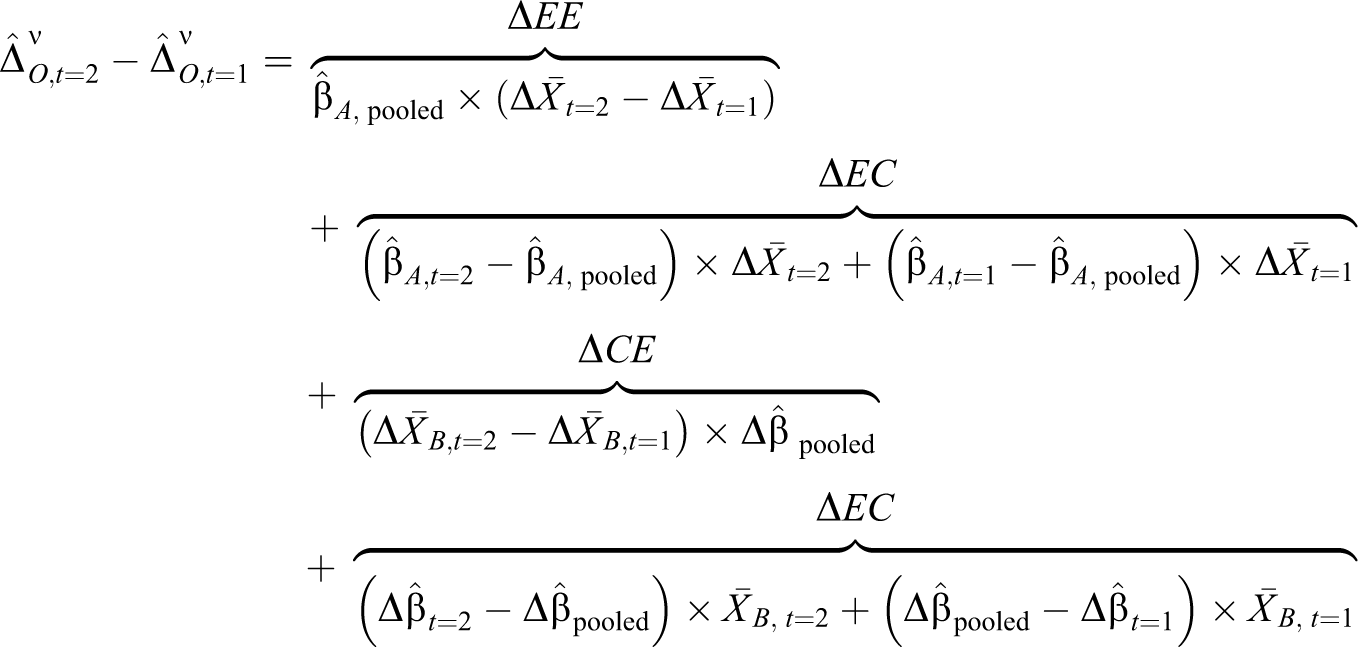
where A/B indicates German/Turkish group membership and t = 1 and t = 2 indicate the base and end year, respectively. The
The decomposition’s first two elements, ΔEE and ΔEC, provide estimates of the contribution of different dimensions of structural change to changes in group differences. ΔEE captures the effect of change in group differences of characteristics, that is, the effect of groups becoming more or less similar in their measured characteristics (as measured by
ΔEC captures the effect of change in the returns to characteristics, relative to the average across the period studied (as represented by
ΔCC captures the effects of the group-specific developments of returns and ΔCE that of the empirical deviation of Turks’ βs from the reference vector. Phenomena that are insufficiently captured by our models, like origin-based discrimination, systematically different returns to characteristics, measurement error, or other omitted variables, will show up in this part of the decomposition. Because of identification issues in detailed decompositions of coefficients, we cannot interpret these terms in detail and, thus, must treat them together as a residual coefficient component, ΔC =ΔCE + ΔCC (Yun 2005).
Calculating standard errors of complex decomposition equations analytically is not straightforward. Hence, we rely on a parametric bootstrap approach to estimate approximate confidence intervals of decomposition components. We calculate each decomposition and its underlying regressions over 50 bootstrap samples and then use the standard deviation of results as an estimate of a component’s standard error. For the analysis of incomes, we combine MI and bootstrap inference by repeating the bootstrap procedure in each imputed dataset (“MI Boot” in Schomaker and Heumann 2018).
Before we move on, a caveat regarding the identification of our decomposition strategy is in order. To the degree that our income regressions overestimate (underestimate) causal returns to educational degrees, our estimates of the contribution of educational expansion (ΔEE) and the growing importance of skill (ΔEC) will be biased upward (downward). However, studies on the returns to qualifications in Germany that apply a causal identification strategy produce estimates that are similar to, or even higher than, OLS estimates (Ichino and Winter-Ebmer 2004; Becker and Siebern-Thomas 2007), which reflects international findings (Card 1999). Nevertheless, it is important to clarify that our results are not based on an explicit causal identification strategy.
Addressing Endogenous Sample Selection
The information on which we rely is subject to potentially endogenous sample selection at two points. First, workers are (self-)selected into employment and, thus, into the sample for our income analyses. Second, Turkish workers might re-migrate to Turkey or choose to become German citizens, thus either falling out of our sample altogether or becoming part of the German group. If sample selection at these points is correlated with our dependent or independent variables, our analyses will yield biased results.
At both points of selection, the share of omitted cases is too high to be safely ignored. Unemployment in Germany has, at times, been in the double digits (see Figure 1). Likewise, re-migration of Turks in Germany has been substantial (see Section B.4 of the Online Appendix), and hundreds of thousands of Turkish immigrants naturalized over the last decades (Destatis 2018). While research for Germany on the selectivity of re-migration tends to find little selection on education, incomes, and integration measures (Constant and Massey 2002, 2003; Diehl and Liebau 2015; Dustmann and Görlach 2015; Kuhlenkasper and Steinhardt 2017), we know that migrants with higher educational levels are more likely to naturalize (Steinhardt 2007; Worbs 2008). We examine the selectivity of non-employment, outmigration, and naturalization in our data with respect to observed characteristics in detail in the Online Appendix, Section A.3.
To address potential selection issues, we employ a simulation strategy in the spirit of Manski (1989). This approach attempts to recreate the counterfactual distribution of outcomes that would have prevailed, had omitted values been observed, under a range of different assumptions. This strategy allows us to test our findings’ robustness even under conditions of extreme selectivity. Concretely, we impute unobserved incomes and employment states based on observed characteristics, using multiple imputation techniques. If potential respondents are missing entirely because of re-migration or naturalization, we extrapolate their entries from the distribution of education-birth-cohort-immigration-cohort cells in earlier survey years and impute missing covariates as implied by these three variables. In the main text, we report results for the assumption that non-employment, remigration, and naturalization are not selective with respect to incomes (and employment), conditional on observed covariates. That is, our results reflect the selectivity about which we know, but not potential selectivity on unobserved variables. The Online Appendix provides results for a range of alternative assumptions about endogenous selection with respect to income potential and employment likelihood, as well as a detailed description of our simulation approach. These alternative results consistently show that while different assumptions about the nature of selection do somewhat affect the respective sizes of coefficient estimates, they do not imply a different substantive conclusion.
Results
Inequality Trends between 1976 and 2015
How did Turks’ labor-market standing develop between 1976 and 2015? This section provides evidence on immigrants’ economic integration, using two indicators: employment probabilities and monthly net incomes. It is descriptive in nature and, hence, does not correct for sample selection. As we explain above, the following results are statistically controlled for demographic changes but otherwise unconditional. Figure 1, which compares the employment rates of German men and a group of same-aged Turkish male immigrants, shows that in contrast to the mild drop in Germans’ employment rate (from around 93 percent in 1976 to 87 percent in the early 2000s), Turks’ employment collapsed from around 96 percent in 1976 to less than 75 percent in 2004. Employment rates of both Germans and Turks picked up again after 2004, and the immigrant gap narrowed. Importantly, this result is virtually unaffected by considering (possibly selective) naturalization of Turkish immigrants. The dotted line gives result for an alternative definition of the Turkish group, which includes formerly Turkish men who acquired German citizenship. These results overlap almost entirely with those obtained using our simple citizenship-based group definition. The necessary information for this exercise is only available since 2005, however.
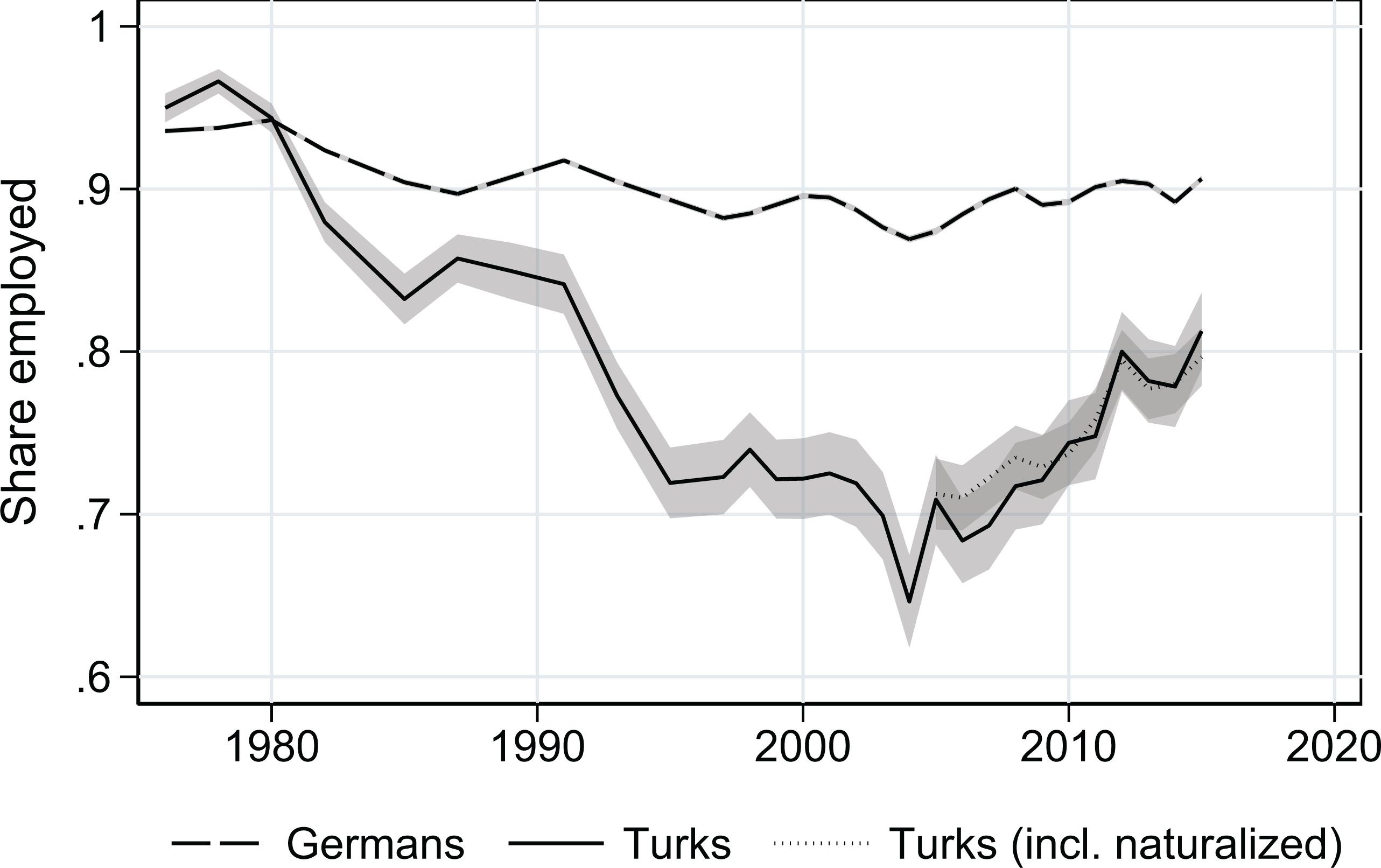
Employment trends among Turkish and German men.
Figure 2, which shows the difference in employment rates between immigrants and Germans for several arrival cohorts, documents that the overall divide evident from Figure 1 is the product of cohort and period trends. For ease of presentation, we omit the largely identical results using the alternative definition of the Turkish group. For most cohorts, we find employment gaps between Turkish immigrants and same-aged Germans that are initially high but reduce with time spent in Germany, which fits non-labor immigrants’ common adaptation profile. However, in the early 1990s, as well as in the early 2000s, we can see that relative employment falls across all migration cohorts, before picking up again after 2004. We also see that until the 2000s, later cohorts tended to start off relatively worse than earlier ones. These observations fit with theoretical perspectives on immigrant adaptation that emphasize structural change in the receiving context (e.g., Zhou 1997). Period trends are also evident in the profile of the actual guest worker cohort (1961–1973) who arrived with employment essentially guaranteed. Beginning in the late 1980s, their employment fell dramatically in comparison to Germans from the same generation, who were exposed to the same structural dynamics. This development hints at structural change having different implications for immigrants and native workers.
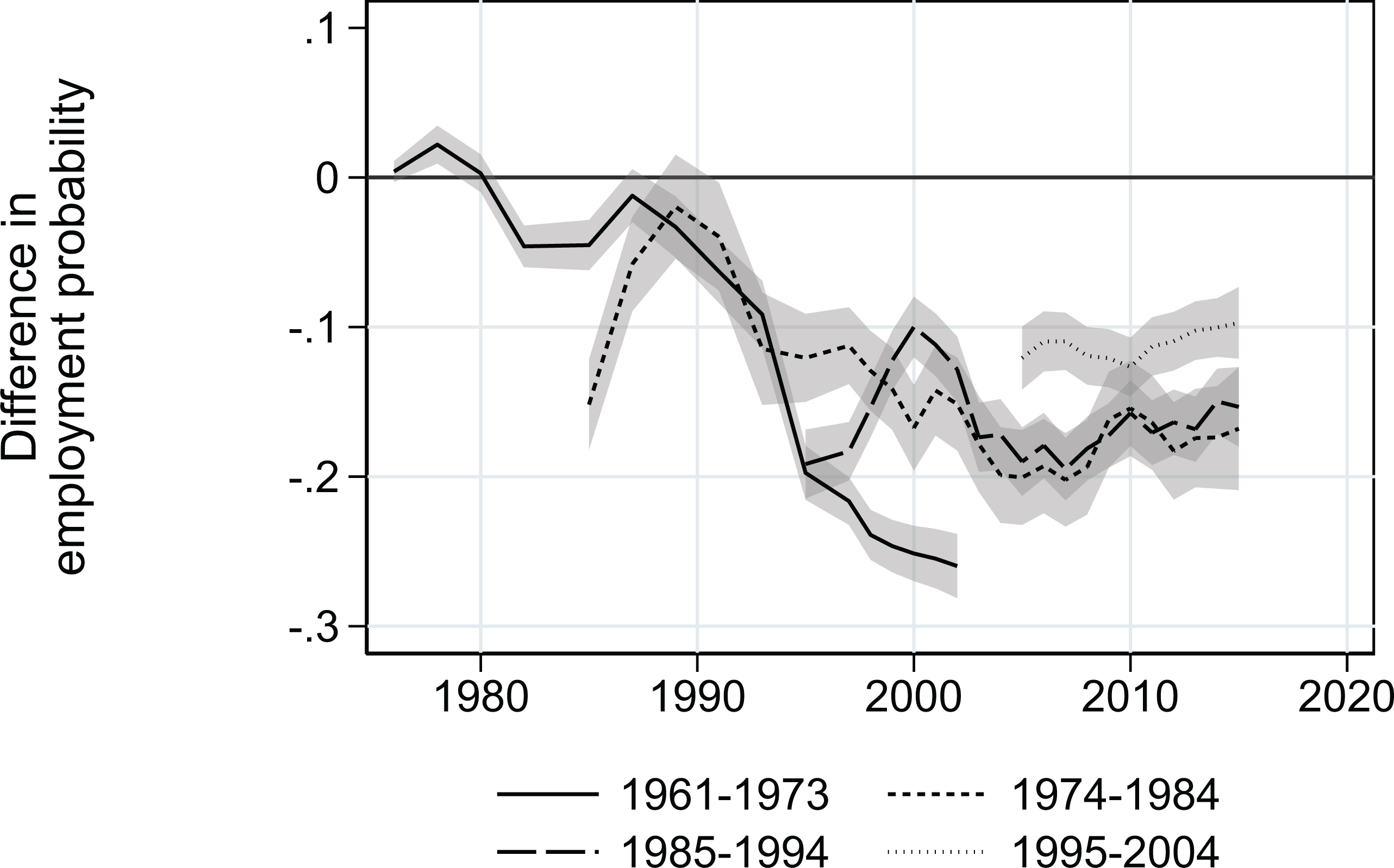
Employment difference between male Turkish immigrants and same-aged German men, by arrival cohort.
We now move to investigate Turks’ relative standing in employment and examine their incomes compared to that of Germans. Figure 3 shows a falling trend in immigrant-native ratios of monthly net incomes. Age and duration of stay are balanced across samples and groups. While the 25th percentile (P25) of the Turkish distribution corresponded to about 93 percent of a German worker’s income at P25 in the late 1970s, this figure had significantly eroded to below 75 percent in the 2010s. The P50 ratio fell from about 87 percent to 75 percent in 2015. Turkish incomes at P75 were only about 65 percent as high as German incomes at P75 in 2015. As in Figure 1, there is no evidence of a bias through selective naturalization. The lines representing the alternative group definition including naturalized Turkish-origin workers show patterns that are very similar to the simple citizenship definition. Additional analysis, which are available in the Online Appendix, break up the general trend by cohort. This exercise demonstrates that Turks’ deteriorating relative positions are not due to immigrant replenishment (i.e., an influx of less-adapted newcomers statistically diluting overall integration trends). On the contrary, gaps between same-aged male Turks and Germans grew even within arrival cohorts.
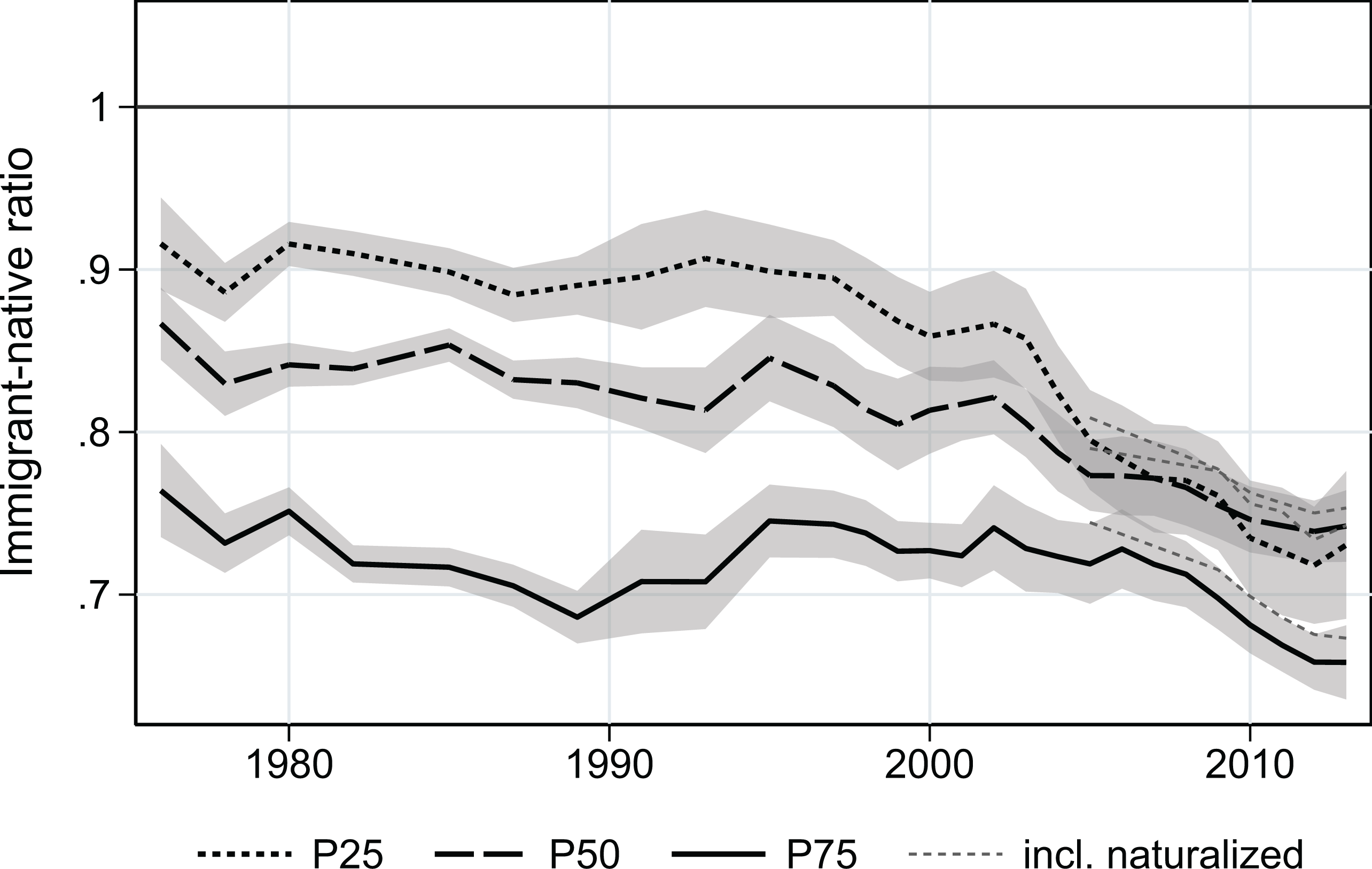
Development of male immigrant-native income ratios at the 25th, 50th and 75th percentiles.
The descriptive results presented here are in line with previous studies (e.g., Herwig and Konietzka 2012). First-generation Turks in Germany dramatically fell behind natives on host-country labor markets during the shift from manufacturing to services, although employment differentials have contracted between 2004 and 2015. While these figures are suggestive, we cannot draw conclusions from univariate trends about the drivers of increased group differentials. We, thus, now move to our central contribution, the results from our decomposition analysis, and examine to what degree the mechanisms we have proposed as measurable interpretations of the manufacturing exceptionalism thesis account for the observed trends.
Explaining Growing Ethnic Disparities
To explain the growing disadvantage faced by male Turkish workers and to test the theoretical mechanisms we have proposed, we now present results of formal decompositions of these trends. We ask which facets of macro-structural change contributed how much to trends in immigrant-native differences (net of demography but otherwise unconditional). Figure 4 shows the results of linear probability decompositions of employment probabilities for two periods: 1976–2004 and 2004–2015. 4 This periodization reflects the differing aggregate dynamics of rising (1976–2004) and contracting (2004–2015) group differences in employment. The plots show the contribution of relative changes in groups’ educational profile (ΔEE) and of changes in returns to education (ΔEC) to the trend in employment differences, net of age and duration of stay and corrected for selective (on observed variables) outmigration and naturalization. Change that is unaccounted for by our models is reflected in the coefficient component ΔC. Parameters of the underlying regression models can be found in the Online Appendix, as can results for alternative assumptions regarding the selectivity of outmigration and naturalization. These results show that our overall conclusions hold even under extreme assumptions about the nature of selection in our data.
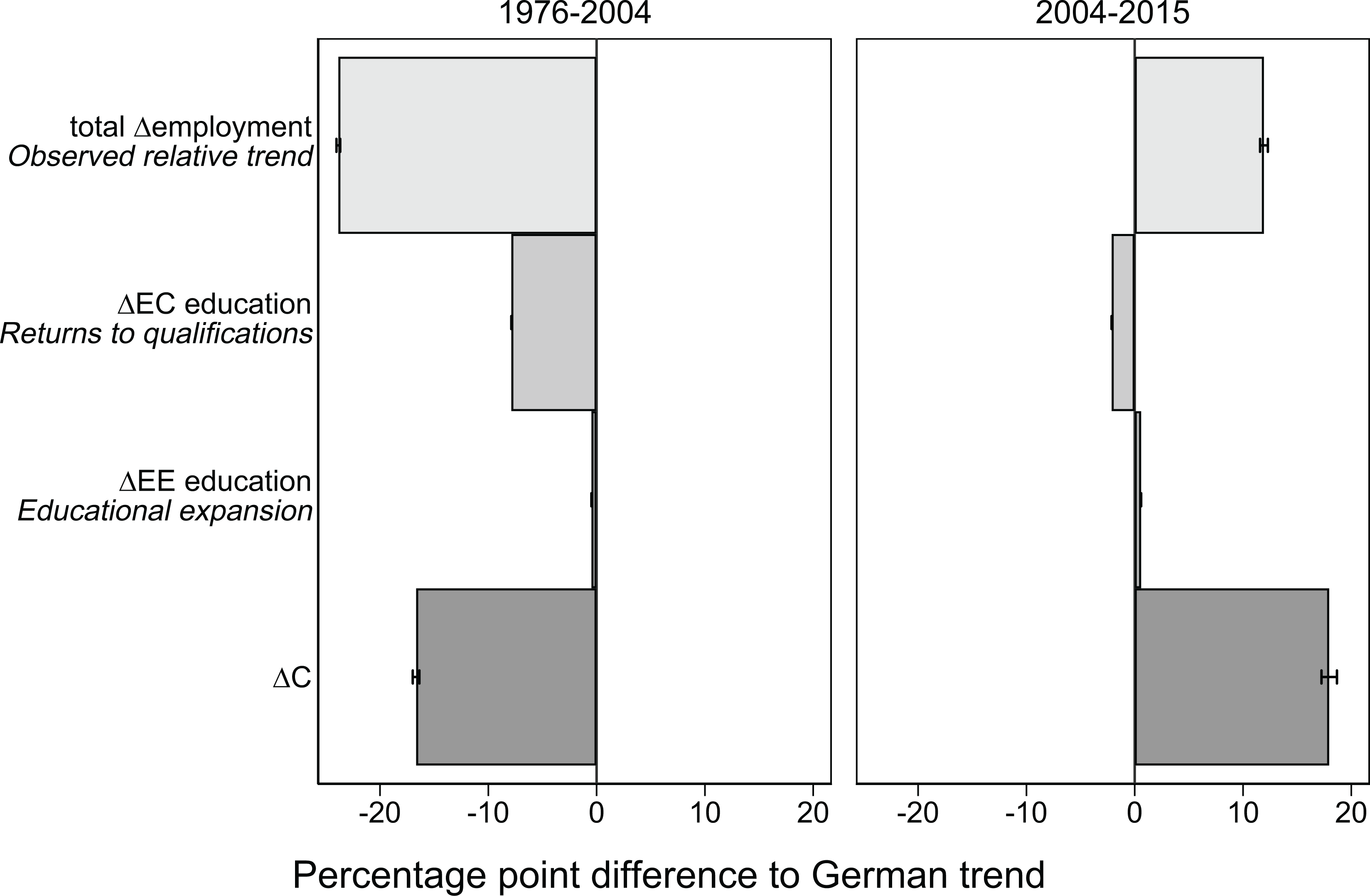
Contribution of education to change in immigrant-native employment differentials.
A first observation that emerges from Figure 4 is that changes in the groups’ relative education composition (ΔEE) played only a minor role in shaping relative employment trends. While between 1976 and 2004, Turkish employment dropped by more than 25 percentage points (p.p.) more than German employment, our results suggest that practically none of this increasing gap is due to a faster educational expansion among Germans compared to Turks. The data, therefore, do not support an important role of the educational expansion argument with respect to employment. To understand this finding, we must bear in mind that in Germany, unemployment risks are concentrated among the least educated without any vocational training (OECD 2020) and that the relative share of this group has decreased only mildly, among both immigrants and natives (OECD 2019, esp. Table A1.2; see also Section B.2 in the Online Appendix). Intuitively, in those parts of the qualification distribution that matter for employment probabilities, there was hardly any change between groups over time. On the other hand, more than 7 p.p., or more than a third of male Turks’ increasing disadvantage between 1976 and 2004, were linked to the fact that Turks were overrepresented in the lowest-skill groups that increasingly fared worse. We would expect this pattern, based on the literature on the growing relevance of skill (e.g., Dustmann, Ludsteck, and Schönberg 2009): As vocational qualifications became more important as insurance against unemployment during the transition from manufacturing to services, Turks fell behind because they held comparatively fewer vocational qualifications. The decomposition, thus, supports the manufacturing exceptionalism argument.
Between 2004 and 2015, a period marked by overall strong macroeconomic expansion in Germany, Figure 1 shows that group differences contracted markedly. Figure 4 repeats this insight but also shows that neither changes in the stock of Turkish human capital vis-à-vis Germans nor a better prospect of lower-skilled workers generally contributed to the observed trend (ΔEE). This result echoes the finding of Dustmann, Glitz, and Vogel (2010) that immigrant employment is more sensitive to the economic cycle, even net of education. It is at this point unclear whether our results indicate a reversal of longer-term trends or whether during an economic boom, the business cycle dynamics discussed by Dustmann et al. mask ongoing secular shifts against lower-skilled immigrants.
We now turn to ethnic stratification trends within the working population. Figure 3 shows an almost monotonic erosion of Turks’ standing at P25 and P50. How can this trend be explained? The manufacturing exceptionalism thesis argues that de-industrialization and changing skill demand have made economic adaption harder for less-skilled immigrants. To formally test this hypothesis, we link trends in income differences to changes in education and structural labor market position in a statistical decomposition.
In line with Figure 3, Figure 5 shows that between 1976 and 2015, group differences grew most markedly in the lower half of the income distributions (i.e., at p50 and p25). But are these patterns consistent with the three structural processes proposed above? In the following, we interpret the results obtained from setting the pooled sample as the benchmark and use a correction for sample selection that assumes selection to be uncorrelated with income, net of observables. Our conclusions, however, also hold if we base them on the specifications using start or end year as a benchmark and under alternative assumptions about selectivity, which we report in the Online Appendix. Looking at the education rows of Figure 5, we find that during our observation period, Germans outpacing Turks in the uptake of education (ΔEE) was a significant contributor to growing group differences, particularly at P50 and P75, even net of labor-market positions. While Figure 4 suggested that changes in Turks’ level of training relative to that of Germans had negligible consequences for entering the labor market, once we focus on differences within the labor market, Germans’ pattern of educational upgrading put Turks at a disadvantage. Turning to the effects of the growing importance of skill (ΔEC education), we find that this process disadvantaged Turkish workers below, but not above, the median, even when labor-market position was held constant. This observation is consistent with the uneven effects of upskilling and educational expansion: as educational expansion in Germany happened mainly at the top of the educational hierarchy, changing relative skill demand meant that disadvantages at the bottom of that hierarchy, rather than advantages at the top, increased. Turks in the lower half of the income distribution were far more likely than Germans to hold no or low qualifications; thus, they were disproportionately affected by this process.
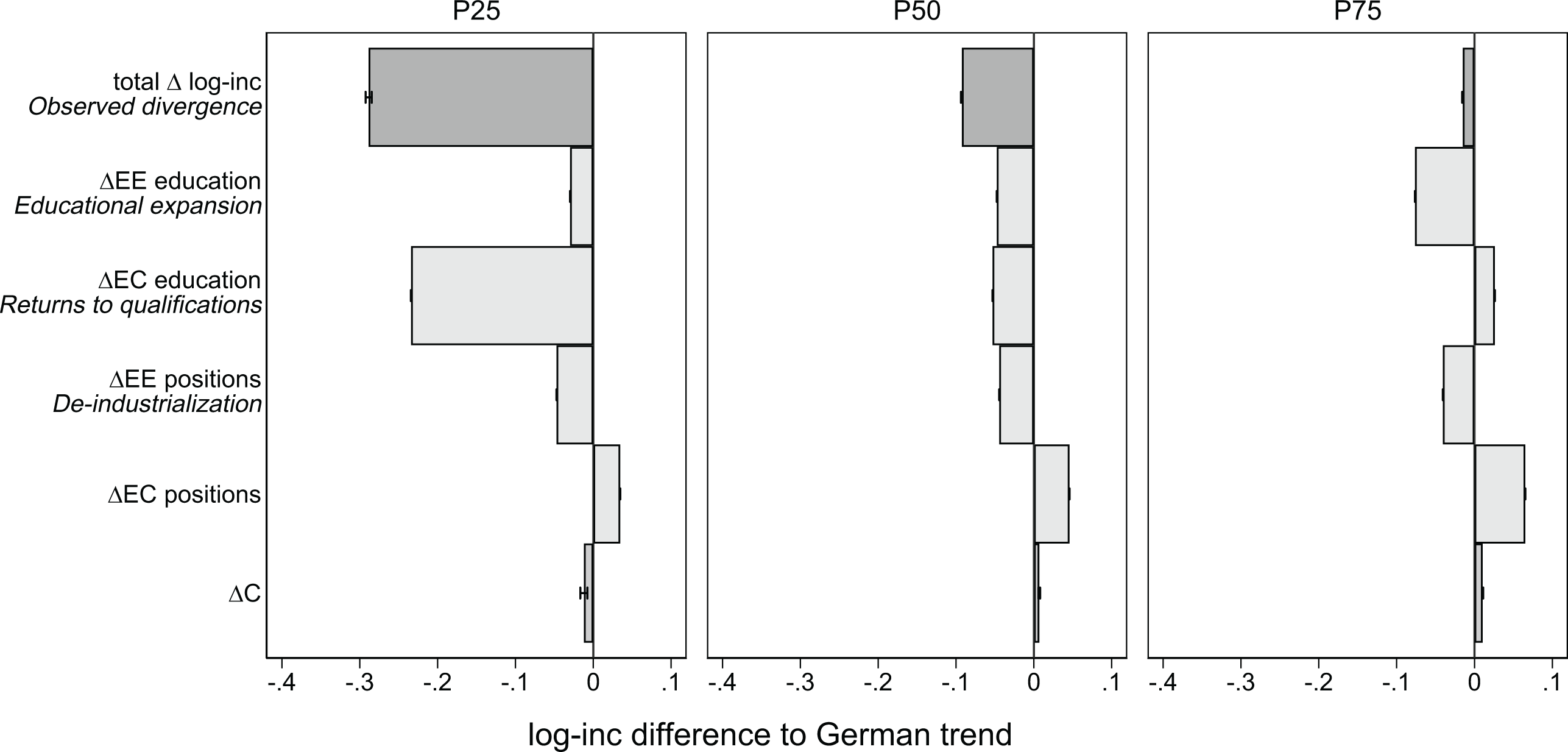
Contribution of education and labor market position to change in log-income group-differentials, 1976–2015.
So far, our findings are in line with the two expectations derived from the human-capital literature: first, that educational expansion among natives leaves lower-skilled immigrants worse off and, second, that the increasing importance of formal educational works against lower-skilled immigrants as a group. However, the core of pessimist appraisals of recent less-skilled immigrants’ upward mobility chances concerns modern labor markets’ changing sectoral composition (e.g., Gans 1992). Did de-industrialization contribute to growing income gaps between male Turkish immigrants and German natives? Our results support such a conclusion, especially for the lower half of Turkish incomes. The contribution of the ΔEE position component that represents the combined effects of occupational positions and industries is negative, indicating that Turkish workers shifted to positions which offered fewer positional premiums (net of one’s own human capital). We would expect such a pattern, based on our de-industrialization hypothesis. Figure 5 contains another, subtler insight: the ΔEC component of position indicators is consistently positive, showing that workers who stayed in labor-market positions with a large share of Turks witnessed increasing premiums to these positions. De-industrialization, therefore, did not typically mean that Turkish jobs fared worse but that Turks at and below the median typically shifted to worse jobs.
This process is illustrated by Figure 6, which plots the p.p. change in the employment share of occupation-industry cells, defined as the cross-classification of our industry and occupation indicators, against the rank of their average income premiums during that period. We can, thus, see to what degree employment shifted between relatively better and relatively worse labor-market positions. Employment in middling categories declined for both Germans and Turkish immigrants, but much stronger among Turkish workers. For both groups, the largest declines were among un- and semi-skilled manual workers in manufacturing. While among German workers, positions above these categories witnessed the largest employment gains, employment increases among Turks were concentrated in the lowest third of occupation-industry cells, particularly in unskilled service occupations. Figure 6, thus, illustrates a striking shift of immigrant employment from medium-pay (manual) occupations to low-pay occupations, but much less so for native employment. As the decline of middling positions had apparently different implications for immigrants and natives, this perspective offers yet more support for the importance of de-industrialization in the growth of group differences.
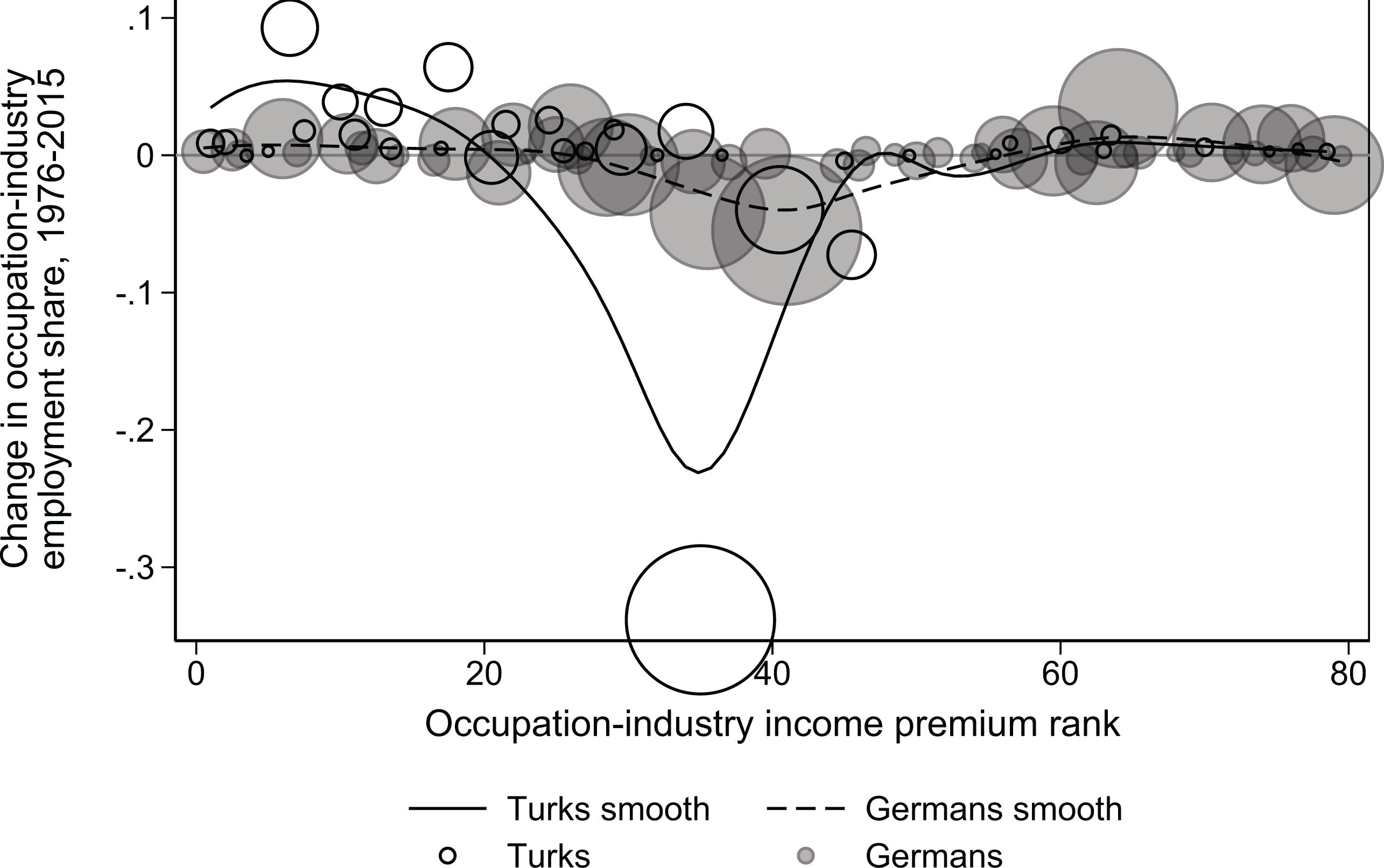
Employment-shifts among immigrant and native workers between 1976 and 2015.
Summary and Conclusion
Does the relatively equitable integration of lower-skilled immigrants depend on a manufacturing-centered economy? To address this question, we investigated the relative socio-economic position of first-generation Turkish men in Germany between the mid-1970s and mid-2010s, a period of profound sectoral change (Oesch 2013). Our review of explanations for rising inequality during de-industrialization identified three historical forces that should come with negative implications for lower-skilled immigrants: the educational expansion argument, the growing importance of qualifications argument, and the de-industrialization argument.
We find strong evidence that Turkish immigrant men fell behind Germans in their labor-market success between the 1970s and the 2010s. Our analysis of a country with comparatively low increases of overall inequality in this time period is, therefore, in line with similar studies in other contexts (e.g., Bevelander 2001; Gustafsson and Zheng 2006; Rosholm, Scott, and Husted 2006). An original insight provided by our analyses is that macro-social change had very different implications for immigrants of different skill groups. Especially the economically weakest immigrants found it increasingly hard to compete in a changing labor market.
The core of our analysis, and our main contribution, is a quantification of different mechanisms that contributed to these trends, using statistical decomposition techniques. This approach provides a novel, direct test of prominent arguments and, thus, adds important evidence to a literature dominated by descriptive approaches (c.f., Reitz 2001; Lubotsky 2011; Moreno-Galbis et al. 2019). The decompositions we undertook generally support the three hypotheses on the sources of growing immigrant-native differentials. The argument that group differences widened as a result of a growing importance of qualifications is clearly supported for employment prior to 2004 and for incomes at and below the median. Trends in the returns to qualifications put Turks at a disadvantage. The educational expansion argument applies across the income distribution, especially to the top, but shows hardly any contribution to employment differentials. We conclude that Turkish immigrants were disadvantaged not only because there was less demand for less-skilled labor but also because they faced a host society which rapidly increased its human-capital profile. Finally, our data provide evidence in favor of the de-industrialization argument, which forms the core of segmented assimilation scholars’ pessimist diagnosis (Gans 1992; Zhou 1997). Even net of the challenging trends at the level of individual human capital, we can discern an inequality-increasing shift of Turkish workers at or below the median to disadvantaged labor-market positions. It should be noted, however, that while male Turks did, indeed, shift to worse positions, the manufacturing positions in which they were concentrated experienced a positive development in terms of income premiums. Speculatively, such a pattern would be in line with accounts that diagnose a growing dualization of the German non-graduate labor market, with a continuously privileged, but shrinking, core and expanding fringes of more precarious work (Palier and Thelen 2010).
In sum, our results imply a sobering outlook for the economic adjustment of current cohorts of lower-skilled immigrants in affluent countries. Our analysis of the changing fortune of Germany’s largest guest-worker immigrant group suggests that economic polarization between immigrants and natives is likely to grow further if the trends we describe continue to affect advanced economies. Relatively egalitarian labor-market integration of large numbers of less-skilled immigrants, it appears, is structurally more difficult in a knowledge-based service economy than it was in the industrial economies of the mid-twentieth century. In other words, our decomposition approach provides clear support for the manufacturing exceptionalism thesis. That said, we should also point out that immigrant unemployment has declined significantly since about 2004, putting an overly strong version of de-industrialization determinism into question.
From a policy perspective, this observation suggests that a combination of overall employment growth and more interventionist integration policies of the kind Germany implemented in the 2000s may go some way toward countering ethnic inequality trends linked to structural change. Similarly, given our finding of the importance of male Turks’ relative lack of certified (vocational) education, policy-makers in post-industrial host societies should aim to increase the uptake of formal qualifications among less-educated newcomers.
An important implication of our results for the study of immigrant integration more generally is that researchers should pay attention to the consequences of structural change in receiving contexts. Dominant perspectives on immigrant integration mainly focus on change over biographical or generational time scales, where they expect increasing similarity between immigrant origin and native populations (Chiswick 1978; Kalter 2002; Alba and Nee 2003; c.f., Zhou 1997). This perspective treats historical change as a nuisance. Our findings, however, demonstrate that integration dynamics do not play out on a blank slate. Structural trends in technology and in the economy may drive a wedge between immigrant and native populations and, thus, counter or even override convergence dynamics at the biographical and generational level.
Supplemental Material
Supplemental Material, sj-pdf-1-mrx-10.1177_01979183211029903 - Immigrant Men’s Economic Adaptation in Changing Labor Markets: Why Gaps between Turkish and German Men Expanded, 1976–2015
Supplemental Material, sj-pdf-1-mrx-10.1177_01979183211029903 for Immigrant Men’s Economic Adaptation in Changing Labor Markets: Why Gaps between Turkish and German Men Expanded, 1976–2015 by Jonas Wiedner and Johannes Giesecke in International Migration Review
Footnotes
Acknowledgments
Earlier versions of this paper were presented at the 2014 Immigration Working Group Conference of the CUNY Graduate Center, the 2017 RC28 Spring Meeting, the 2018 IAB/ZEW interdisciplinary conference and in research seminars at the University of Cologne and at WZB Berlin Social Science Center. We wish to thank participants, the anonymous referees, and in particular Merlin Schaeffer for their helpful comments. This research was partly conducted while Wiedner was a PhD student at the University of Cologne. Violetta Haas provided excellent research assistance.
Declaration of Conflicting Interests
The author(s) declared no potential conflicts of interest with respect to the research, authorship, and/or publication of this article.
Funding
The author(s) received no financial support for the research, authorship, and/or publication of this article.

Supplemental Material
The supplemental material for this article is available online.
Notes
References
Supplementary Material
Please find the following supplemental material available below.
For Open Access articles published under a Creative Commons License, all supplemental material carries the same license as the article it is associated with.
For non-Open Access articles published, all supplemental material carries a non-exclusive license, and permission requests for re-use of supplemental material or any part of supplemental material shall be sent directly to the copyright owner as specified in the copyright notice associated with the article.
