




Abstract
Italy hosts significant numbers of forced migrants throughout its territory. The implementation of asylum policy thus occurs in diverse and sometimes fraught contexts, presenting different resources and obstacles. This paper examines how local context shapes the experiences and practices of street-level bureaucrats (SLBs) implementing policy in the Italian statutory asylum system. Semi-structured interviews with workers in two projects, one in a conservative rural area and one in a progressive urban area, show that the urban/rural divide alone is not an appropriate predictor of similarities and differences in policy implementation and outcomes, which are largely shaped by context-specific sociocultural and relational elements. Workers’ off-duty mediation in interpersonal contact between migrants and community members fosters positive encounters that could partially offset traditionally conservative political cultures and hostile attitudes; however, the same cultures and attitudes cause workers to feel isolated and alienated from their community. Furthermore, SLBs’ decision-making practices in both projects are always collegial and constrained by exhaustive rules, largely eliminating the need for individual discretion typical of SLBs and creating instead “group discretionary” bureaucrats. In light of these findings, I argue for increased attention to locality beyond the simple urban versus rural lens, and increased focus on asylum SLBs as a distinct category of “doubly embedded” SLBs participating in both policy implementation and local context.
Introduction
For the last decade, forced migrants have been arriving to Europe in unprecedented numbers, and the trend is constantly growing (Eurostat 2023). As a country of first arrival, Italy bears the brunt of this “migration crisis,” receiving approximately 850,000 forced migrants between 2013 and 2022 (Eurostat 2023). In Italian asylum policy, the statutory asylum system (SAI) coexists with many “emergency” centers (CAS) that were set up to respond to increasing numbers of forced migrants and are by now essentially a permanent feature of the system. The two branches of the system are both based on the dispersal of migrants throughout the territory, but have different governance structures, budgets, and regulations and offer different services to migrants. These differences, together with dispersal, imply that migrants may have very different experiences and opportunities depending on the type and location of the center they are assigned to (Novak 2021). Workers involved in the daily management of the system have a pivotal role in interacting with migrants, mediating their relationship with the host environment, and enforcing rules; thus, they are a relevant example of “street-level bureaucrats” or SLBs (Lipsky 2010), exercising a significant degree of discretion with important implications on the living conditions and outcomes of forced migrants. This paper focuses on the statutory asylum system or SAI, which is publicly managed by municipalities in partnership with civil society actors, such as charities and local NGOs. SAI adopts a team-based holistic approach to reception and integration, and an emphasis on migrants’ agency and autonomy. Using semi-structured interviews with workers in the SAI system, this paper examines and compares their experiences and perceptions in two SAI projects in northern Italy, one in Bologna, a historically progressive large city, and the other in a historically conservative rural area in the Veneto region. The paper asks whether and how location and local context influence SLBs’ experiences and perceptions of their job and their professional identity, and thus the way they implement policy in context.
Local Implementation of Asylum Policy
Asylum policy is typically based on the dispersal of people throughout the territory: policy implementation, access to services, interactions with institutions, and encounters with the community happen first and foremost on a local level, involving different local actors who provide different services. Thus, despite national and international norms pushing for convergence (Brumat, Geddes, and Pettrachin 2021), scholars have been advocating for a “local turn” (Zapata-Barrero, Caponio, and Scholten 2017) in the study of forced migration, arguing that the local element is key in creating “host society opportunity structures” (Phillimore 2020) which shape policy implementation and integration. Research has outlined how local actors develop their own discourses, agendas, practices, and policies in the governance of forced migration (Dekker et al. 2015). Local policies and practices can complement or contrast flawed or hostile national asylum policies by introducing innovative and inclusive measures (Kos, Maussen, and Doomernik 2016; Oliver et al. 2020), but they can also exclude migrants or create selective barriers to services (Ambrosini 2023; Semprebon, Marzorati, and Bonizzoni 2023). For example, some Italian municipalities have issued ordnances preventing migrants from obtaining the registered residency status and thus accessing certain services; others enforce fines on citizens who rent accommodation to asylum seekers (Ambrosini 2023).
Implementation of policy goes beyond formal policy instruments and actions performed by bureaucrats, to encompass indirect ways in which policy comes to fruition. For example, migrants’ social integration is produced through relationality, which encompasses a variety of possible interpersonal encounters, networks, and interactions and is a key component of locality (Glick Schiller and Çağlar 2009). Local context influences relationality by defining its boundaries, forms, and opportunities, thus determining at least partly the outcomes of policy for migrants, workers, and host communities (Valenta 2007; Hinger, Schäfer, and Pott 2016). Other context-specific elements such as rural or urban setting, local history and political traditions, economic circumstances, civic cultures, and social attitudes toward migrants can all shape how asylum policy is implemented locally. Existing scholarship has often adopted a rural versus urban analytical lens to assess variations in implementation, illustrating for example how cities tend to have a more diverse population and a healthier economy, and thus may respond more proactively and positively to forced migrants compared to marginalized rural localities, with limited diversity and economic opportunities and a perception of relative deprivation (Bock 2018; Crawley, Drinkwater, and Kausar 2019; Whyte, Larsen, and Fog Olwig 2019; Oliver et al. 2020). On the other hand, declining rural localities may be revitalized by an influx of foreigners requiring work and services and renewing social practices (Membretti and Lucchini 2021). Local context can also influence individual variables which affect social attitudes toward migration: younger, more educated and progressive individuals tend to have more positive attitudes toward migrants (Mancini, Bottura, and Caricati 2020) and are more likely to live in urban areas (Eurostat 2022). Some research also linked negative attitudes in rural areas to their increased social capital, which causes higher social control and stronger in-group cohesion; however, findings are mixed (Valenta 2007; Fratesi, Percoco, and Proietti 2019; Semprebon, Marzorati, and Bonizzoni 2023). Importantly, attitudes change through frequent contact with migrants (Herslund 2021).
The urban/rural divide is not the only relevant factor in shaping how asylum policy is implemented locally, although other contextual aspects not strictly linked to this cleavage have received less attention. For example, the political affiliation and leadership style of local policymakers influence the way they perceive reality and make decisions (Caponio, Donatiello, and Ponzo 2022); local context can encourage or discourage intergroup contact depending on the availability of shared public spaces (Irgil 2024); different contexts can produce different patterns of associationism and civil society mobilization, which may result in different ways of conceptualizing and implementing policy (Ataç, Schütze, and Reitter 2020; Semprebon, Marzorati, and Bonizzoni 2023). In sum, many elements of local context amalgamate in building “opportunity structures” (Phillimore 2020) for the reception of forced migrants and the implementation of asylum policy. Rural/urban environment is only one of those elements, and its explanatory power when it comes to policy variations may be limited (Semprebon, Marzorati, and Bonizzoni 2023).
From this complex picture, it is clear that how asylum policy is implemented in one place largely depends on the characteristics of that place. Research in this area has focused on a variety of urban and, more recently, smaller, rural, or remote localities (Ataç, Schütze, and Reitter 2020; Kreichauf and Glorius 2021; Membretti and Lucchini 2021; Novak 2021; Moralli, Pachocka, and Leung 2023; Semprebon, Marzorati, and Bonizzoni 2023; Irgil 2024) but often lacks an explicit comparative framework assessing how policy is implemented across different local contexts (but see Valenta 2007). Moreover, despite increased attention to the importance of local context in shaping forced migrants’ experience (Phillimore 2020; Wessendorf and Gembus 2024), research findings are mixed and there is still no clear consensus as to exactly which elements of that context provide the best environment for forced migrants, host communities, or asylum workers: our understanding of how local context and immigration influence each other is still poor (Lara-García 2022). This article situates itself in this locally focused, context-conscious line of inquiry and provides an in-depth comparative case study explicitly considering the unique characteristics of each locality's context and how these may interact with the asylum system “on paper” to produce different modes of implementation.
Furthermore, this article examines asylum policy implementation as performed and experienced by SAI workers. These SLBs are uniquely positioned to understand and reflect on the daily functioning of the system: they are asked to navigate a particularly complex and contentious policy realm on a daily basis, and they are immersed both in the process of policy implementation, as professional members of formal organizations implementing specific policy guidelines through appropriate actions, and in the concurrent local processes which shape implementation, as members of the community having to routinely interact with an array of other actors both officially and informally. They represent the point of contact between local context and policy, and the professional figures where these two realms meet, producing context-bound policy outputs. This “double embeddedness” produces a synthesis between the external context of implementation and the institutional and individual elements shaping asylum SLBs’ professional actions; policy actions and outcomes are produced by both these areas interacting.
There is a large body of literature focusing on different groups of stakeholders involved in various stages of asylum policy, including border authorities (Eule et al. 2018), caseworkers adjudicating asylum and citizenship applications (Fontana 2019; Shiff 2021; Haller and Yanasmayan 2024), policymakers (Caponio, Donatiello, and Ponzo 2022), the staff of EU-managed “hotspots” and other emergency centers (D’Angelo 2019; Novak 2021), or mainstream social workers (Andreetta 2019; Ratzmann 2021). Some studies adopt a psychological perspective addressing the well-being and burnout of asylum workers (Gemignani and Giliberto 2021). However, there is a dearth of comparative qualitative research studying the specific category of SLBs running asylum projects and their interaction with different local contexts in the ordinary performance of their duties, which represents the intended everyday functioning of the asylum system (partial exceptions are Giudici 2020; Artero and Hajer 2023). The role, routine, and potential challenges for these SLBs differ from those of other asylum workers and therefore merit distinct attention and analysis. This article adds to the literature by observing how asylum policy is implemented by SLBs in localities characterized by different geographic, political, and sociocultural circumstances, and how local context affects not only day-to-day implementation and policy outcomes, but also the ways in which workers conceptualize their job and professional identity.
The Asylum System in Italy
In Italy, increasing numbers of forced migrants, slow policy responses, and political instability have created a fragmented policy environment, marked by a state of “permanent emergency” (Carbone 2019) and by a hodgepodge of contradictory policies implemented by rapidly alternating governments. The statutory Italian asylum system or SAI is public, centrally regulated, and supervised by the Ministry of the Interior. Municipalities volunteer to host forced migrants according to capacity and devolve daily management to local NGOs, social cooperatives, and charities. SAI has been praised for its flexible, long-term approach to integration and its high level of coordination with other public services (D’Angelo 2019; Acocella and Turchi 2020). However, SAI coexists with “emergency centers” or CAS which have proliferated over the last decade. These centers are run directly by the Prefettura or local office of the Ministry of the Interior, operate under much looser regulations and with the explicit goal of minimizing costs, and thus offer worse living conditions and fewer services (Acocella and Turchi 2020). It is estimated that approximately 25 percent of forced migrants in Italy are part of the SAI system, while a growing majority are hosted in CAS centers (Openpolis 2023). Recent reforms implemented by right-wing governments (2018–2023) have restricted access to SAI and cut budgets for both SAI and CAS projects.
Both SAI and CAS models distribute forced migrants across the territory. Diffused reception means that forced migrants may find themselves in very different local contexts and circumstances: some projects are in major cities, whereas others are located in remote rural villages, where access to services such as healthcare, education, vocational training, public transport, and leisure facilities may be more difficult (Novak 2021); availability, location, and quality of accommodation may also vary. Being in the North versus the South of Italy may also affect available services, infrastructure, and opportunities: most migrants are hosted in the South, which has long been suffering from depopulation, higher levels of unemployment, and a worse quality of services and infrastructures (Acocella and Turchi 2020; Openpolis 2023).
Similarities between the systems end here. In every other respect, CAS and SAI differ considerably. The “emergency” nature of CAS means less careful planning and monitoring of their management, including when selecting suitable facilities or managing organizations (Ambrosini 2023). CAS are more likely to be large collective facilities instead of apartments (Openpolis 2023), and minimum standards for facilities set by the Ministry of the Interior are less strict and less comprehensive than for SAI. CAS budgets are significantly lower than SAI budgets and acceptable expenses do not include as many items and services; financial reporting requirements are also less strict than in SAI and therefore potentially less transparent. These differences have a significant impact on migrants’ experiences: being hosted in the SAI system means enjoying better living conditions, while CAS centers can be cramped, unsanitary, and occasionally unsafe (Openpolis 2023); it also means having access to more resources and services, such as Italian language courses or counselling services (compulsory in SAI projects, but optional in CAS).
Another key difference in the functioning of the SAI and CAS systems pertains to staff. The SAI manual regulates staff very thoroughly, prescribing the number, tasks, and desired expertise of the different figures required. Every SAI project has a coordinator who is nominally responsible for overseeing the project, liaising with municipal and state authorities, and coordinating the work of several “operators” who are assigned individual migrants’ files and/or cross-cutting areas of action, e.g., job training, language skills, or legal casework. The project also has a designated point of contact within the municipality, with regular meetings. Staff-related requirements are much less strict in CAS centers, where no specific qualifications are needed and the workers to residents ratio is also significantly higher (Ambrosini 2023). The SAI manual also emphasizes teamwork and collegial decision-making even if operators have different areas of action and expertise. This reflects the system's holistic approach to migrant integration, which is seen as composed of multiple different areas that should be addressed concertedly, in order to devise a completely personalized integration path. In a system like SAI, workers are involved firsthand in the daily lives of migrants by taking care of essentially every aspect of their life. Because of this they have authority and discretion in mediating migrants’ access to services and opportunities. For example, they broker relationships between migrants and possible employers for work placements, or they select which educational and training opportunities they think fit best the individual profile of each migrant; they conduct inspections in accommodation to ensure it is adequately clean and safe; they enforce curfews and other rules; they can administrate punishment for violations of such rules, by withdrawing of pocket money or even, in extreme cases, by excluding the migrant from the project, meaning that they will not be entitled to accommodation or any form of assistance. In doing so, workers embody the concept of SLBs who exercise their discretion in performing their tasks, with the potential to shape the experiences of forced migrants.
Theoretical Framework
The close attention paid in this study to how asylum policy interacts with local context derives from a theoretical understanding of policy as socially and contextually produced by actors and institutions interacting with each other and with other social and cultural elements, such as public opinion, belief systems, social attitudes, and collective past experiences (Ingram et al. 2007). A prolific theoretical strand, including for example multilevel governance theories (Bache, Bartle, and Flinders 2016) and “multiple streams” policy process theories (Howlett 2018), has brought attention to the plurality of actors and relations involved in every step of the policy process with diverse degrees of involvement, priorities, ideologies, or practices. The final outcome is policy implemented as a “messy” product, which often changes based on the unique configuration of actors, interrelations, and local context active in a certain site. The concept of “locality” (Glick Schiller and Çağlar 2009) applies the same attention to context, plurality of actors, and interrelations to the study of migration and migration policy, inviting research to focus on local areas as units of analysis. Migrants are situated in a specific local context and interact with it: research should reflect this reality by developing scalar approaches that address migration not only as a phenomenon involving entire nation states and populations, but also and especially cities and communities. Forced migration and inclusion are produced first and foremost at the local level, by a multiplicity of individual and organizational actors and practices.
Within this context-informed conceptualization of asylum and asylum policy, I focus particularly on relational elements and on their role as indirect instruments of policy implementation. If asylum is locally produced and localities are “continuously produced forms of socio-political relations and discourses” (Hinger, Schäfer, and Pott 2016, 446), then relationality can be a conduit through which policy goals come to fruition. For example, if one of the stated goals of asylum policy is migrants’ social integration, events producing social integration can be seen as realizing policy, albeit in ways that cannot necessarily be controlled. This approach acknowledges the importance of relationality as an analytical lens and indeed extends it, by interpreting relationality also as a possible way of indirectly implementing policy.
This research focuses on the minimal units of asylum policy implementation, i.e., workers in the asylum system. To do so, it draws on the seminal concept of SLBs (Lipsky 2010): individuals in various professional roles implementing policy firsthand, in contexts characterized by time and resource constraints and complex, sometimes confusing or contradicting goals and rules. SLBs develop coping strategies and original solutions to work in a challenging environment. A key part of their role is the personal discretion they exercise when implementing policy. Discretion and flexibility are needed to manage competing constraints and unique situations, create ad-hoc solutions, and reinterpret norms and roles (Belabas and Gerrits 2017). Bureaucrats exercise discretion in different directions and to different degrees, based on the specific organizational culture they operate in, their interaction with actors, and institutions outside their own, and individual characteristics such as value systems, professional experience, and moral judgments (Tummers and Bekkers 2014). The practices and results of bureaucrats’ work can thus vary within the same organization and sometimes with the same individual as well. Asylum SLBs in particular operate in a policy area where interactions with local context play a pivotal role: they have to contend with a particularly fraught and confusing policy environment, including fragmentary, contradictory, and fast-changing norms; because of the all-encompassing nature of the asylum system, they are called to interact with many other institutions and actors, which constraints and complicates their action; variation in their practices and their use of discretion can have concrete effects on the living conditions and outcomes of forced migrants.
The uniqueness of their position as SLBs is also enhanced by their “double embeddedness” in both the policy process and the local context. This adds to the complexity of their job and shapes their perceptions and practices. Arguably, “double embeddedness” is experienced and mobilized to different extents by all SLBs whose work is locally focused. However, it is particularly important in the work of asylum SLBs. These SLBs work with acutely vulnerable individuals who rely on public services, the local community, and SAI for virtually all their needs, who are visibly different from the local community, and whose presence in the locality can be contentious. Hence, “double embeddedness” is particularly important and useful for asylum SLBs: they can mobilize their double status as professionals and community members to coordinate multiple actors and resources more quickly and efficiently, perhaps using informal ties; to mediate potentially hostile community responses, which are more likely in a contentious policy area; to bridge distances and fill gaps between individuals, communities, and institutions that are wider than they would be for non-migrants.
Methodology
The research is a comparative case study (Yin 2009), seeking to identify two asylum projects located in areas with different spatial, socioeconomic, and political characteristics, in order to assess whether these differences cause differences in the functioning of the system as seen through the perspective of its workers. Comparative case studies are particularly appropriate in the study of complex phenomena characterized by multiple processes and systems of interrelations, such as the implementation of asylum policy in its local context.
Italy is at the geographical borders of Europe; this, combined with EU migration regulations, makes the country responsible for an exceptionally high number of forced migrants. The SAI system was developed in the early 2000s, inspired by grassroots reception experiences developed by some municipalities (Carbone 2019). Its multilevel governance structure and co-optation of civil society in the daily implementation of asylum policy represent a peculiar exception in EU asylum systems, which are mostly based on public–private partnerships or entirely managed by states. Italy is also characterized by a traditionally volatile and increasingly polarized political system, which often sees local governments in contrast with the central government (Dallara and Lacchei 2021); a stagnating national economy; and deep socioeconomic disparities between regions and between urban and rural areas (Ballatore and Mariani 2019). This high level of diversity and local complexity, combined with the high numbers of forced migrants dispersed across the territory, makes Italy a significant case study in how asylum policy is implemented in different contexts.
This study obtained ethical approval prior to the first contacts being made with SAI projects. I selected two SAI projects based on their location and local context, using the Ministry of the Interior's public database of SAI projects. CAS centers were deliberately excluded from the search, as it was determined that SAI, due to its wider resources and broader scope, allowed a more comprehensive and detailed study of asylum policy implementation. Furthermore, the holistic approach of SAI projects promotes both a higher level of integration within the territory for forced migrants and a higher level of involvement and active decision-making for the workers. Therefore, SAI offers a better opportunity to observe the plurality of actors and practices involved in asylum policy implementation, and how local context shapes workers’ experiences and migrants’ outcomes. However, both municipalities studied also host CAS projects and both projects did at some point manage CAS centers as well, because they offered a quicker way to set up reception in a context of rapidly growing demand. This was not known when first contacting the projects and the interviews remained predominantly focused on the SAI experience. However, it is relevant because workers’ past experiences with CAS allowed for deeper reflection and critical appraisal of the system. Both SAI projects host a mix of recognized refugees and asylum seekers still waiting for a decision (typically having appealed after their application was initially rejected). Project A is located in a small town in a mountainous area of the Vicenza province of Veneto region, currently among the richest in Italy but characterized by a history of widespread poverty and mass emigration until the 1980s. Veneto has been historically governed by center-right or far-right parties, such as the old Christian Democracy and the League, which was born precisely in this area. Project B is located in Bologna, a major city in a wealthy area of Italy which consistently ranks highest in the country for quality of life, and has traditionally been a stronghold of left-wing voters and civic engagement. The interviewer's past experience working in project B facilitated access.
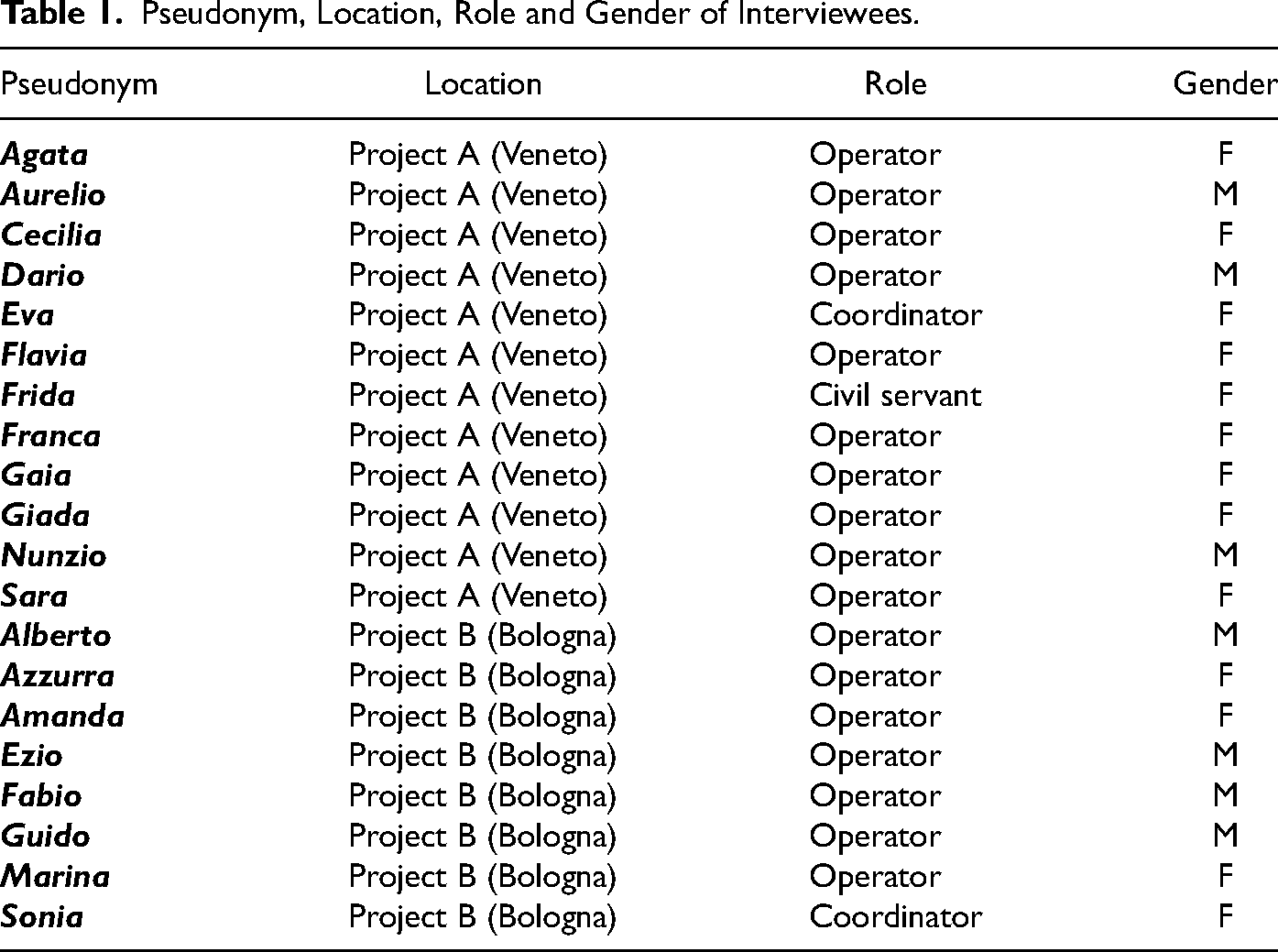
A majority of staff members accepted to be interviewed in each project. Between January and May 2023, individual semi-structured interviews were conducted with 20 workers in the two chosen locations (12 in project A and 8 in project B). Table 1 illustrates the location, gender, role, and assigned pseudonym of interviewees.
Pseudonym, Location, Role and Gender of Interviewees.
Interviews used a three-section guide consisting of open-ended questions. The first section asked about the workers’ personal and professional background, as well as the organizational background of the project; the second section explored the workers’ daily routine, tasks, decision-making processes, and interactions with other stakeholders, such as colleagues, public services, and migrants; the third section centered on the workers’ opinions and perceptions of their job, their professional identity, and their community, including the biggest obstacles they faced and the job's impact on their personal life. Interviews were conducted in Italian, recorded, and transcribed verbatim; selected quotes were translated to be included in the text. Interviewees were pseudonymized and identifying details were removed from the transcripts wherever possible.
Transcripts were coded and analyzed using thematic analysis (Braun and Clarke 2006) and discourse analysis (Fairclough 2013). These methods allow to identify recurring themes and patterns in texts inductively and bottom-up. Broad thematic categories emerged through simple analysis are then further analyzed to uncover deeper meanings. This process assumes that individuals are constantly engaged in a process of meaning-making performed through language and discourse, which therefore have a strict reciprocal relationship with reality, both constructing it and being influenced by it (Fairclough 2013). Analyzing language and discourse offers insight into interviewees’ experiences and opinions as mediated by their shared systems of meanings and by the interrelated systems of power in which they operate. Being mindful of these systems is particularly important when studying institutions such as asylum systems, which are based on relations of power and care between states, workers, and migrants.
Findings and Discussion
Although they expanded upon topics with different degrees of detail, interviewees in both projects displayed remarkably similar experiences and opinions. Several key areas shaping policy implementation emerged from interviews. These include available resources and services, interactions with institutions, interactions with the community, and social attitudes toward the interviewees’ profession and decision-making style. Crucially, according to interviewees, these areas do not have the same relevance in determining the practices and outcomes in policy implementation. The urban versus rural location of the project partly affects the availability of resources such as job opportunities, training, and leisure activities, but this is not perceived as especially relevant. Veneto interviewees remarked on the geographical isolation and scarce availability of public transport limiting job opportunities for migrants, but also on the relative liveliness of their small town, which has a library, a small cinema, and a sports center. Bologna workers praised the abundance of resources and leisure opportunities available in the city, including volunteering opportunities, free psychotherapy, and independent Italian classes; they also noted how the city's thriving economy and renowned university attract young, active, and diverse people and keep the city vibrant. However, Bologna workers also noted the increased precarization of work, which disproportionately affects forced migrants (Chacko and Price 2021). Most migrants hosted by project B only have zero-hour contracts in food delivery or monthly contracts in logistics. Lack of affordable housing and a general increase in the cost of living were reported as an issue by both projects.
Overall, interviewees perceived relational elements involving either themselves and local context or migrants and local context as particularly important. These relational elements are more important than material resources or obstacles deriving from the project's urban or rural location in shaping implementation and experiences. In particular, interactions with community members are perceived by workers as much more important than institutional frameworks or structural resources in fostering integration and building a welcoming, mutually beneficial environment. This applies to both migrants’ and workers’ interactions and relationship with the community; it confirms that workers construct relationality as actively constituting policy implementation; and it suggests the need for policy to explicitly target the informal social and relational aspect of migrants’ integration as a two- or even three-way process closely involving a specific local community of residents and practitioners, which plays an active role in shaping practices and outcomes.
Interactions with Institutions
Interactions with institutions were mixed in project A, but overwhelmingly positive in project B. Project A reported positive interactions with the city council, who is responsible for coordinating and monitoring SAI projects. A cooperative atmosphere was reported, with some exceptions related to individual members of the city council staff who “have very rigid views about how this should be done” (Aurelio), implying there have been clashes before. The same positive atmosphere was reported with reference to the Prefettura, who is responsible for processing asylum applications. Some workers said that being in a smaller project allows them to have a firmer grasp on the situation at all times and to communicate more quickly with institutional stakeholders (Semprebon, Marzorati, and Bonizzoni 2023). On the other hand, project A reported very negative experiences with other institutions, including some schools, the local police, and most notably the local healthcare office, who systematically refuses to issue healthcare cards to forced migrants, asking for unnecessary documents or using other bureaucratic loopholes. Workers in project A unanimously remarked on how stressful, frustrating, and traumatic this situation was for both them and the migrants involved. Many interviewees explicitly mentioned hostile attitudes toward immigrants and the personal political beliefs of managers in the institution as causes for this. At the time of the interviews, project A had sought legal counsel about the situation, a move which was perceived as inevitable but also likely to increase hostility.
Workers in project B believed that the success of the SAI project in Bologna was attributable to the “far-sighted,” “enlightened” political leadership who allowed the project to develop with a horizontal and participative framework. These features are already inscribed in SAI manuals, but the city council, regional authorities, and other local institutions (including the Prefettura) went above and beyond their mandate to promote inclusion, plurality, and diversity of actors and participative decision-making. Tasks are divided across organizations so that migrants are not managed by one actor only, and there is constant cooperation and knowledge exchange instead of competition for resources (Sara). Interviewees linked these participative practices to a long-standing political and civic tradition predominant in Bologna, where civil society organizations have long enjoyed an important social and political role and legitimacy as institutional partners. This long-standing partnership allows to use more “common sense” and flexibility while implementing policy, knowing that local authorities will not rigidly enforce bureaucratic rules (Ezio). Some workers believed “there is no better city in Italy to be doing this [receiving forced migrants]” (Marina). Some recent developments were unwelcome: for example, the city council had just decided to cut the budget for intercultural mediation and interpreting services, which workers believed was sorely needed in interactions between migrants and institutions, or sometimes between migrants and themselves. However, most workers constructed this issue as the city doing what they can in the face of increasingly strict national policies and decreasing funds.
In line with the decentralized, municipality-focused design of SAI, significant interactions happen not with national institutions but mostly with local and regional institutions, pointing to the crucial importance of the local dimension of policy (Brumat, Geddes, and Pettrachin 2021). However, both projects have engaged with recent national political developments in asylum policy. In 2018, a far-right government approved a legislative package retroactively restricting access to SAI to recognized refugees only. Existing projects were required to shift all asylum seekers still awaiting a decision (the large majority of migrants) to a CAS model. At the same time, the budget and available services for the CAS system were slashed, creating a “frankly insulting [situation, rations were] a fistful of rice a day, three biscuits […] completely embarrassing […] you were basically asked to manage a dormitory” (Dario). These measures were widely regarded as unfair, counterproductive, and undignified for both migrants and workers. Both projects refused to participate in the new asylum regime: project A decided to close the smaller CAS project it had been running in parallel with its SAI project, whereas project B allied with the local Prefettura and stalled by claiming there were no suitable CAS facilities in the area. Doing so allowed them to use a series of “exceptional stay extensions” to keep migrants in SAI until the law was changed. These creative interpretations of the law were used to fight hostile state authority from a distance, while not openly violating rules; in the case of project B, they were possible thanks to the already experimented successful partnership with other local institutions. Such cooperation in defiance of national policy did not occur in many other localities, where perhaps Prefetture did not display similar initiative (Ambrosini 2023). Where there is consensus between local actors, they can resist official policy, adopt creative strategies, and operate within gray areas, increasing territorial variations in policy outcomes and “twisting” top-down policy guidelines in unanticipated ways.
Interactions with the Community
Positive social contact with members of the host community is believed to be fundamental to foster integration and a sense of mutual belonging, as well as facilitating access to resources such as jobs and housing (Glorius et al. 2020; Herslund 2021; Fuchs and von Scheve 2023). Workers from project A reported mostly positive interactions with the community. Personal mediation in intergroup contact seems to have a key role in facilitating positive interactions between migrants and members of the host community. Informal, “off-duty” interactions with workers not acting in their professional capacity, but as ordinary members of the community, seem to be particularly constructive. Several workers mention that locals “came around when they saw I was interacting with [the migrants] and talking to them on the streets” (Franca) or expressed more openness after talking to them about their job. One interviewee reported running into a migrant from the SAI project in the café and exchanging some words with them. This elicited the curiosity of the café owner and of other local patrons and led to an informal conversation where the worker shared some thoughts about her job and the daily lives of migrants in the town. After this conversation, all people present made positive statements on the migrant they had encountered and on the SAI project. These encounters use relationality to create an accepting social landscape, fostering the potential for social integration. Informal interpersonal relations are also used by workers to mediate easier access to resources for migrants, such as housing or jobs. Veneto's conservative, anti-immigration political tradition is not irrelevant: interviewees agreed that the community still has prejudices and hostility toward the idea of non-white migrants, and several reported overhearing hostile comments or participating in heated conversations about immigration. However, this does not necessarily translate to hostile attitudes toward individual migrants in the community, especially when workers are able to act as informal “ambassadors” bridging interpersonal distances: Politically, in this whole area, I think it's clear that solidarity, integration and reception are not strong values here. But […] all this hostility toward foreigners is largely idealised, it is not concrete, and then when one finds oneself directly interacting with that person, gets to know their story and everything, then they get closer and something happens, this is fairly common. (Dario)
This finding echoes previous research concluding that local communities can create their own pragmatic modes of interaction with forced migrants despite polarized political discourses (Whyte, Larsen, and Fog Olwig 2019). However, the effect of mediated interpersonal encounters is context-dependent and may not be enough to broadly and permanently alter deep-seated political beliefs or the widespread “mistrust even towards people from the near valley” (Dario) typical of the area. The effect may be only temporary or on a purely individual basis (Matejskova and Leitner 2011; Irgil 2024); furthermore, migrants or community members may have a different perception of these encounters than SLBs. In fact, further findings about community perceptions of SLBs working in asylum partially contradict this positive conclusion (see below) and other research suggests that SLBs intervening can reinforce prejudices, power imbalances, and marginalizing narratives (Giudici and Boccagni 2022; Ambrosini 2023).
The importance of participation in the labor market as a dimension of perceived integration is also linked to local context: “Our territory is really Calvinist in this respect, work is a religion for most […] so if a migrant comes here and understands this, he's quite likely to stay [and integrate]” (Eva). Successful migrants are those who embrace the local work ethics and are recognized as committed workers by their local employers and colleagues. In this context, work has the potential to strengthen interpersonal relationships. Membretti and Lucchini (2021) point out that positive, constructive interactions with the community are not a given and need a favorable context, including shared spaces of existence and mutually beneficial opportunities for synergy and cooperation. In the context of Veneto and project A, work and work ethics may offer such an opportunity, allowing forced migrants to adopt the local ethos in ways that are visible and legitimized by members of the community. Of course, the importance of work as a way for migrants to conform to concepts of “deservingness” promoted by host societies and nation states is not a prerogative of Veneto, but rather a widespread feature of Western immigration policy and discourse and a key part of Western-centric definitions of integration (Marchetti 2020; Novak 2021). However, its importance here is enhanced by Veneto's sociocultural tradition. Local context can thus selectively emphasize or qualify specific components of a broader policy framework, such as migrants’ economic integration, in ways that are socially salient. Once again, this adds depth and complexity to the ways policy is translated into practices and outcomes on the ground, and poses challenges to top-down policymaking.
Microlevel intergroup encounters in shared spaces are known to influence “everyday strategies” of coexistence and integration employed by members of the local community in reaction to the presence of migrants (Irgil 2024). These encounters are not always positive, but when they are, they significantly help migrants’ wellbeing and to the community's shared sense of belonging (Glorius et al. 2020; Fuchs and von Scheve 2023). These findings add another dimension to intergroup contacts: encounters and strategies can be shaped by the presence of individuals who employ their double status as members of the local community and asylum workers as a tool to mediate positive intergroup contact. As such, informal mediated encounters represent an indirect policy instrument, which implements asylum policy “out of hours” and outside of offices by capitalizing on the key importance of unorganized microlevel encounters and de facto working toward social integration as one of the stated goals of asylum policy. They also speak to the key importance of SLBs’ “double embeddedness” in community and policy, which provides them with additional tools to gather community feedback and to informally promote social integration and acceptance.
Similar tools and modes of interaction are not equally available to workers in Bologna. Despite the positive institutional environment, interactions with the community are not perceived as positive. In fact, there is a perception that the progressive tradition of the city does not match social attitudes toward forced migrants. Project B workers report covert hostility and mistrust in interactions with locals, which do not correspond to the open, cosmopolitan, and progressive attitude that Bologna prides itself on. For example, workers assisting migrants in finding independent housing all reported episodes of discrimination, where landlords did not want to rent their house to migrants. In other occasions, shop owners addressed the Italian worker accompanying a migrant and not the migrant, even though they knew Italian and were the intended customer. Many interviewees reported surprise in encountering this dissonance (Azzurra, Guido). The element of personal mediation is also much less present in a large city: workers do not know the community members with which they interact in a professional capacity, nor do migrants. This removes the possibility of mediating microlevel encounters through pre-existing interpersonal relationships, and of collecting informal feedback from community members. Urban workers typically cannot use their social capital to “introduce” forced migrants to the social fabric and moderate positive interactions, or to promote a change in predominant narratives by raising awareness about their job. These findings appear in contrast with previous research (Fratesi, Percoco, and Proietti 2019) which found that increased social capital in rural areas could be used to close ranks against the reception of forced migrants. In this case, an abundance of social capital in a small rural town is mobilized to produce positive interactions. Conversely, a lack of strong community bonds in a large city negatively affects interactions with outsiders. In both cases, encounters with forced migrants conform to the broader script of locally produced social relationships, even when local political traditions may suggest otherwise. This finding once again points to the importance of relationality as a potential policy instrument, and suggests that migrants’ social integration should be conceptualized and promoted not as part of an asylum policy superimposed on a territory from the top down, but as an integral part of a locally constructed, bottom-up milieu of social relations; accordingly, policy should strive to strengthen social capital broadly defined, and not compartmentalized areas of social interaction between specific groups.
Social Attitudes toward Profession
As a result of the dispersal of migrants and the composite structure of asylum systems, frontline asylum workers frequently belong to different organizations, have different tasks, and operate disjointly from each other. It is thus harder to develop a recognizable professional group identity to extract meaning and legitimacy from (Gemignani and Giliberto 2021). Interviewees in both locations shared similar impressions of their professional role not being adequately recognized by society. All interviewees have third-level education and/or significant experience in relevant areas, such as anthropology, social work, or politics. They noted that the complexities of the job are not adequately reflected in compensation, career stability, and advancement prospects. Interviewees linked this to a general lack of recognition of the professionals involved in social work, which the asylum system is part of: “most people think you’re volunteering when you say you are working with migrants” (Alberto). This lack of recognition can have a negative impact on workers’ sense of professional identity, wellbeing, and performance. However, social awareness improves through interactions with institutions and communities, and workers are conscious that it is part of their job to educate the public on their profession (Agata, Alberto, Franca).
Many interviewees in project A reported a deterioration of personal relationships after taking the job: discussing work, they realized that their friends had incompatible values or political beliefs and distanced themselves from them, even though they had been friends “forever” (Giada). Others in project A reported that even though their family and friends have not been alienated, there is a feeling of prejudice, lack of understanding or interest when discussing their job. Some are hostile to the whole idea of working with forced migrants: When I say I work for a cooperative, people say ‘How nice, and who do you work with?’, and they expect to hear ‘people with disabilities’ or something. When I say what we do, they’re floored. ‘Are you crazy? With all the money being stolen [by asylum cooperatives]?’ Or ‘What's the point? These people are never going to integrate anyway, I don’t care about these people’. (Eva)
Others consider working with migrants for mediocre wages “useless” in a local culture that rewards saving and accumulating resources through work and is historically prejudiced against outsiders. For some workers, this causes a reluctance to disclose their profession to acquaintances.
Conversely, no interviewees in project B reported similar personal dynamics, instead expressing the belief that “we already surrounded ourselves with people who think like us before getting this job” (Azzurra). Most interviewees from project B originate from towns in Southern Italy and compare social attitudes toward migration in their areas of origin and in Bologna, saying for example that their families “do not understand why I do this” (Azzurra, Ezio) but this is not an issue in their social circles in the city. This suggests that one way in which an urban context may be more favorable to receiving forced migration is its pre-existing population of progressive, educated, proactive, and upwardly mobile young people, who are more supported by their community in their career choices because they consciously built it to match their personal beliefs and inclinations. However, as we have seen, the support workers receive from their personal circles is not matched by a supportive broader social milieu for forced migrants, perhaps suggesting that workers’ Italian identity is still a powerful force in mediating social attitudes. In smaller contexts characterized by little physical mobility, a conservative and xenophobic culture, and lifelong family and friendship ties, when these ties are strained by working with migrants, fewer alternative relationships can be cultivated with like-minded people. Rural workers may feel more “out of place” or isolated for being openly “pro-migrant,” and experience deeper negative personal consequences from their job (Valenta 2007). This hostility toward the professional aspect of workers’ identity may be linked to the fact that they are more successful as mediators of microlevel encounters when they are not perceived in their professional capacity. However, they may also be more incentivized to react to the reality of their environment by being more active in mediating encounters and promoting a positive narrative of migration in their interactions with hostile community members. These findings again highlight how relational dynamics involving migrants, workers, and community members are not only context-dependent, but also mutually constitutive. In this case, forced migrants do not need to participate in the interaction in order to influence it: workers’ professional identity and wellbeing are shaped by relationships formally uninvolved in their work, and in turn they shape their practices and choices.
Decision-Making Practices
Decision-making practices are remarkably similar across the two projects. The SAI decision-making style is based on collegiality and teamwork, as explicitly prescribed by SAI manuals. This creates a collective mode of working which contrasts with the individual, discretion-based practices of other asylum workers (Ratzmann 2021; Shiff 2021). The teamwork element was recognized by all interviewees as very positive. Interviewees in both projects run all decisions by each other and brainstorm strategies and ideas in weekly meetings. They believed these practices greatly help their efficiency, effectiveness, problem-solving skills, and morale: Being able to work in a team and getting each other involved is fundamental. We can speak openly to each other; we can get support. It is fundamental to me, because sometimes it's not easy to do all this. It helps carry the weight, so to speak, because everyone is carrying it and not just you. (Agata)
Furthermore, the SAI system is regulated by comprehensive manuals that leave very few scenarios uncovered. The clarity this provides is appreciated by many workers, despite others noting that regulations can sometimes be unnecessarily complex, and that they reflect a paternalistic and securitarian attitude to forced migrants (Alberto, Ezio).
While this system helps workers implement policy by providing clear flowcharts and instructions for most scenarios, it also leaves little to no space for SLBs’ individual discretion (Lipsky 2010). While SAI workers do operate in a complex, fraught, and sometimes contradictory environment, with time and resource constraints, they do not report exercising individual discretion. Roles and tasks within the team are clearly defined and respected. Rules are sometimes slightly bent in favor of the migrants, but this is always a group decision, and it only happens when it does not cause risks or larger expenses and it can easily go undetected. For example, projects can organize “integration activities” such as library visits or art workshops; however, these activities are only reserved for recognized refugees and not for asylum seekers. Despite this, workers in project B allow asylum seeker to attend these events without including them in the official attendance list they have to attach to their reports, because the events would have been organized anyway and more people attending would not have made a difference. Asylum seekers were also included in day trips when a bus had been booked and there were extra available seats. Other than this, no interviewee reported having ever felt the need to sidestep or violate rules. For most workers, exhaustive rules provide certainty and predictability to navigate a complex set of interrelated tasks, while group decision-making provides consensus, transparency, support, and mutual accountability. The individual action of SLBs is thus constrained in a way that is generally welcomed by bureaucrats themselves: they are non-discretionary at the individual level and exercise discretion only as a team.
The use of teamwork as a governance tool and the collective aspects of discretion are a relatively new focus of research on SLBs (Jacobsson and Hollertz 2021). Rutz and de Bont (2020) suggest that bureaucrats may welcome rules and use discretion to involve others in decisions. This study presents a slightly different case, where mutual involvement is already built into the rules and not produced as a form of discretion or a creative coping strategy. The emergence of “group discretion” in this case may be the result of the peculiar structure of the SAI system, which is publicly led but heavily relies on the co-optation of NGOs, charities, and other civil society actors. Extensive, detailed rules are put in place to manage the diversity of actors and situations involved in policy implementation. The lack of a perceived need to bend the rules, which results in less individual discretion, could also derive from value alignment between personal and organizational values. SLBs exercise discretion to the extent that they perceive existing norms and resources to be deficient or disagreeable (Tummers and Bekkers 2014). If workers perceive their personal values to be in line with the foundational values of the SAI system and the extensive rules to be an adequate expression of those values, there is less incentive to exercise discretion or reinterpret norms. It should be noted that these findings come exclusively from interviewees’ reports about decision-making practices and not from observation; since individuals’ ability to faithfully self-report actions is flawed, they should be appraised critically and potentially confirmed by further research.
Conclusions
As this paper has shown, a simple rural versus urban framework is not adequate to explore the local production of asylum. In fact, the rural versus urban location of asylum reception appears less relevant than the area's specific political, social, and community fabric and how it interacts with the practices of SLBs. It appears that interpersonal contact through the mediation of local citizens who successfully act as “off-duty ambassadors” can be a fundamental way in which asylum policy is implemented on a daily basis, constructing meaningful relational practices which can foster integration and improve local attitudes toward migrants (Irgil 2024) even if migrants themselves are not always directly involved. In both projects sampled, this factor (or its lack) was perceived as the most important relational component of integration, more important than economic opportunities or a welcoming or hostile institutional framework. A smaller, tighter-knit community seems to be better poised to achieve change in attitudes and perceptions through personal encounters and microlevel interactions, even though initial attitudes and political traditions may be conservative and less open to outsiders. Relationality is thus not only part of integration as a policy outcome, but also an instrument of policy implementation. While local political traditions still play a part in shaping how institutions and communities react to forced migration, their importance appears to be limited in the context of mediated everyday interactions. Urban localities with more favorable attitudes and a more diverse, progressive population may still present unique social and economic challenges to the social integration of migrants (Whyte, Larsen, and Fog Olwig 2019; Chacko and Price 2021). On the other hand, the same conservative political traditions and anti-immigrant attitudes seem to play a far greater role in isolating and alienating Veneto workers from their own communities. In fact, SLBs’ experience of hostility toward the professional aspect of their identity and the fact that they are more successful as mediators of microlevel encounters when they are not perceived in their professional capacity may be linked. In Bologna, a diverse and progressive community can develop around asylum SLBs that supports their professional identity, although community encounters with migrants are overall less fruitful. Here, the concept of SLBs’ “double embeddedness” allows research to recognize the interconnectedness of SLBs’ personal and professional subjectivities and statuses, to incorporate it in the analysis and to use it to inform more punctual conclusions about SLBs’ practices in context.
These findings point to the necessity of disaggregating the different components of local context and their reciprocal relations in order to assess how they shape asylum policy implementation, beyond the mere urban versus rural opposition. Positive institutional attitudes and broader social attitudes may not be enough to counterbalance the absence of meaningful, positive interactions with the community. On the other hand, hostile institutions may not reflect the positive nature of everyday community encounters. Secondly, the findings reinforce the need to investigate how context changes the identity, roles, and practices of asylum SLBs, and add more elements to the complex mosaic of social attitudes, political traditions, and everyday encounters which seems to influence the social production of asylum policy in context. This reaffirms the importance of analyzing the figure of asylum SLBs as “doubly embedded” in policy and context. These workers not only mediate daily encounters between migrants and the community in their capacity as “off-duty ambassadors,” but also conduct and reflect on their practices meaningfully. Their self-perception, relationship with the community and other institutions are integral parts of this reflexive and socially informed bureaucratic practice and concretely shape their action in policy implementation. SLBs’ statuses as professionals within a complex organization and at the same time as community members cannot be separated from each other, and the study of the social and relational production of asylum policy at the local level cannot prescind from this consideration.
This research also reveals that not all assumptions about how SLBs operate apply to the complex and contentious field of asylum policy, and the unique figure of the asylum SLB merits further exploration. While bureaucrats’ individual discretion is fundamental in determining migrants’ outcomes in other aspects of asylum policy implementation (Fontana 2019; Ratzmann 2021; Shiff 2021), these findings suggest that discretion is not applied in the same way in all areas. The SAI system is an example of asylum policy where rules are so detailed and exhaustive that workers never feel the need to fill the gaps with creative solutions or interpretations: they are non-discretionary SLBs at the individual level and they only exercise a modicum of discretion as a group, through strictly collegial decision-making practices. This lack of need for individual discretion provides a welcome sense of security and clarity. These findings expand on the body of research concerned with the collective dimension of discretion (Rutz and de Bont 2020; Jacobsson and Hollertz 2021) and invite to reconsider the role and characteristics of SLBs based on where and how exactly they are performing their duties.
This research does not address all elements that may shape asylum policy implementation in context. Economic context is fundamental in shaping reactions to and interactions with immigration (Bock 2018). Both projects studied are in relatively wealthy areas: projects in economically marginalized areas may tell a different story. Similarly, this research focuses on municipalities which voluntarily decided to host forced migrants: where reception is imposed by the central government, interactions and practices are likely to be different. Accordingly, these findings are not generalizable in a strict sense, but rather seek to further highlight the need for research firmly grounded in local context, in order to include different configurations of local elements. Finally, further research should certainly examine how the perspectives of asylum SLBs relate to those of forced migrants within a specific context.
In light of these findings, research and policy should move toward a more fine-grained conceptualization of how asylum policy is designed and implemented, where, and by whom (Wessendorf and Gembus 2024). Policymakers should also be aware of the many ways in which top-down policy goals and instruments can be changed, manipulated, and adapted to and by local contexts, and incorporate these possibilities in the policy process. For example, community-based approaches using pre-existing interpersonal networks to strengthen social capital and thus increase the opportunity for informal interactions between migrants and members of the host community could complement the provision of other services to promote micro-level social integration. In all cases, both research and policy should adopt a sharper focus and a flexible outlook when addressing the interactions between asylum systems and localities, avoiding a “one for all” approach in favor of a truly localized one.
Footnotes
Declaration of Conflicting Interests
The author declared no potential conflicts of interest with respect to the research, authorship, and/or publication of this article.
Funding
The author disclosed receipt of the following financial support for the research, authorship, and/or publication of this article: This work was supported by the Irish Research Council, Trinity Research in Social Sciences (TRiSS) (grant number GOIPG/2023/4564, Travel Bursary 2022/23).
