




Abstract
The 2016 US election of Donald Trump ushered in a wave of anti-immigrant rhetoric and federal policies that have been shown to harm immigrant families. This study examines how the election affected immigrant-serving community-based organizations (CBOs), which provide vital support to these communities and may mitigate harm. Focusing on migrant-legal CBOs — a key subset that offers pro-bono or low-cost legal services — and incorporating theories from organizations, social movements, and political opportunity, we assess whether these organizations were able to leverage the election as a focusing event to attract funding and whether they sustained this support over time. Using Internal Revenue Service records, we identify migrant-legal aid CBOs with a track record of delivering legal services to immigrant communities. Using synthetic control methods, we find that financial resources to migrant-legal CBOs increased from 4 to 11 percentage points during the 2016 election, and were 8 to 17 percentage points higher through 2019, the last year of available data. Our study shows that amid the shifting anti-immigrant policy climate of the Trump election, migrant-legal CBOs mobilized as a counterforce, using the socio-political landscape and public response as an opportunity to secure and sustain financial support, potentially acting as a safeguard against the escalating anti-immigrant climate.
Keywords
Introduction
Immigrant-serving community-based organizations (CBOs) are at the forefront of efforts to support immigrant and noncitizen families. They play a critical role in helping newcomers integrate by filling the gap left by the federal immigration system, which offers no national or subnational immigrant integration program and restricts most immigrants’ access to public benefits (de Graauw 2016; De Graauw and Bloemraad 2017; Sorrell-Medina 2024b; Carrillo 2024). Consequently, immigrant-serving CBOs respond to these policies of exclusion (Sorrell-Medina 2024a) as the main providers of basic economic (e.g., foodbanks), social (e.g., English language classes), legal (e.g., pro-bono legal services), and civic (e.g., naturalization classes) assistance to immigrant families in the United States.
Whether immigrant-serving CBOs can provide these services, however, depends heavily on their capacity to secure financial resources, a fundamental need for all CBOs. Building on established insights into organizational survival amidst unforeseen changes (Thompson 1967; Pfefer and Salancik 1978), CBOs must continuously seek funding (e.g., donations, grants), often contingent on evolving environmental demands (Vermeulen, Minkoff, and van der Meer 2016). Individuals and funders are more likely to support CBOs they view as legitimate — that is organizations whose actions align with widely diffused norms, values, and beliefs (DiMaggio and Powell 1983; Suchman 1995). Context-dependent, this sense of legitimacy often depends on the broader temporal, economic, social, and political opportunity structures in which CBOs are embedded (Bloemraad, Chaudhary, and Gleeson 2022).
For immigrant-serving CBOs, anti-immigrant rhetoric and restrictive immigration enforcement policies in the US political context are likely to impact their perceived sense of legitimacy and organizational survivability. Presidential elections, in particular, significantly influence the broader national discourse and narrative surrounding immigration and the perceived value of supporting immigrant causes and organizations. The Trump 2016 election is a key example. During his campaign, Trump used inflammatory language about immigrants (e.g., calling Mexicans ‘rapists’) to garner support and, once elected, enacted exclusionary policies (e.g., raids, travel bans) as promised (Bolter, Israel, and Pierce 2022). Research shows that such rhetoric and restrictive policies create fear and mistrust in immigrant communities, directly harming families, including US citizen children (Dreby 2012; Heinrich, Hernández, and Shero 2023; Perreira and Pedroza 2019). However, little research has explored how anti-immigrant climates, like that of the Trump era, affected the financial resource capacity of immigrant-serving CBOs. If immigrant-serving CBOs are directly harmed by anti-immigrant climates and policies, the negative impact on immigrant families and communities can be exacerbated. The protective influence of these organizations will weaken, and there will be fewer resources available to meet the increased needs of immigrant communities.
Whether and how anti-immigrant climates, like that of Trump's 2016 election, impact immigrant-serving CBOs’ financial resource capacity and thus survivability is unclear. Instead of losing support because of the election, immigrant-serving CBOs may have benefited from the counter-response to the Trump election, as reported in media and anecdotal evidence. These sources indicate that the election triggered a surge in donations and support (e.g., volunteering, membership dues) for progressive nonprofit causes, including immigrant rights, in reaction to the election outcome (Campisi and Ahmed 2018; Mesch et al. 2020). However, empirical evidence on this outpouring of support is mixed (Lamothe and Lavastida 2020; Mesch et al. 2020), and research has yet to examine its impacts on immigrant-serving CBOs specifically. Evidence specific to immigrant-serving CBOs suggests that some organizations were able to leverage public outcry over Trump's policies (e.g., family separation) to raise record-level donations and support (Campisi and Ahmed 2018). However, other evidence suggests that funder hesitancy to support controversial causes like immigration may have negatively impacted the financial resources of immigrant-serving CBOs (Tremblay-Boire, Prakash, and Calderon 2023). Furthermore, a reduction in federal grant funding may have exacerbated these challenges. The Trump administration's enforcement policies, which restricted various immigrant rights and services, often led to fewer federal grant dollars for CBOs providing these services (e.g., refugee resettlement), potentially further limiting their overall financial capacity (Darrow and Scholl 2020).
Extending theories from organizations, social movements, and political opportunity, this study seeks to understand how the 2016 presidential race impacted the financial resources of immigrant-serving CBOs both during and through the election. Theoretically, broader socio-political contexts, such as Trump's 2016 election, are believed to impact the organizational resource capacity of immigrant-serving CBOs (Bloemraad, Chaudhary, and Gleeson 2022), but empirical evidence on this assumption is limited. Treating support for immigrant-serving CBOs as a potential social movement, we assess whether these organizations were able to leverage the Trump election as a major focusing event (like an unexpected disaster) to create a political opportunity for garnering support and financial resources for their cause (Lamothe and Lavastida 2020). Additionally, we examine whether they were able to sustain such support over time. As suggested by issue-attention cycle theory, sustaining initial surges in public support can be difficult, especially when progress on the issue stalls or appears insurmountable (Downs 1972). Organizations can address this issue by mobilizing supporters, emphasizing the importance of their cause in response to a rising anti-immigrant climate, and showcasing their proven track record of serving immigrant communities. Initial evidence suggests immigrant-serving CBOs did just that: despite the added stress of the Trump administration's restrictive policies, front-line workers mobilized and intensified efforts to support immigrant families (Barajas-Gonzalez, Hoque, and Gutkin 2024). To gauge the extent of this phenomenon and whether it was short-lived, we assess two research questions: (1) How did the 2016 Trump election impact the financial resources of immigrant-serving CBOs? and (2) If immigrant-serving CBOs' financial resources increased as a result of the Trump election, were these increases sustained over time?
To answer these research questions, we focus on one specific type of CBO, termed “migrant-legal” CBOs. We do so for both theoretical and pragmatic reasons. Theoretically, much of Trump's anti-immigrant rhetoric and immigration enforcement policies focused on undocumented immigration, aiming to make every undocumented immigrant deportable (Reich and Scott 2023). This marked a shift from the previous administration, which emphasized high-priority cases (e.g., those with felonies) (Capps et al. 2018; Reich and Scott 2023), and increased the legal service needs of immigrant communities (Kerwin and Millet 2022). Migrant-legal CBOs, which offer pro-bono or low-cost legal services to immigrants, are often the primary providers of these services. Therefore, if the 2016 Trump election impacted the resource capacity of immigrant-serving CBOs, we would expect this effect to be particularly evident in migrant-legal CBOs. Pragmatically, we focus on migrant-legal CBOs because we have identified a credible way to identify them. In the absence of a national database for immigrant-serving CBOs, we created a novel dataset of 724 migrant-legal CBOs from 2006 to 2019 by combining Internal Revenue Service (IRS) Form 990 financial data with a Department of Justice (DOJ)-recognized list of organizations authorized to provide immigrant-related legal services. Our goal is to assess whether contributions to migrant-legal CBOs changed around the 2016 election relative to other causes. As this is a cause-specific question, we compare aggregate resources across different CBO cause categories (e.g., migrant-legal vs. other causes) using synthetic control methods to estimate relative changes in contributions over time. We compare migrant-legal CBOs as its own activity code amongst the 200 largest nonprofit categories based on the total number of reporting CBOs over the panel. Given the focus on aggregate contributions and the single event (the 2016 election), we conduct the analysis on a range of samples based on different CBO inclusion criteria and present the results side-by-side to ensure transparency with our analysis decisions and findings.
Our analysis reveals two main findings. First, monetary contributions to migrant-legal CBOs increased during the 2016 presidential campaign, with estimates ranging from 4 to 10 percentage points. Second, these increases in contributions were sustained through 2019. We interpret these results as evidence that migrant-legal CBOs were able to leverage the shifting socio-political and growing anti-immigrant landscape, along with a public response, as a political opportunity to garner and sustain financial support. This support potentially serves as a safeguard against the escalating anti-immigrant climate — an avenue for future research.
Theoretical Motivation
Organizational and Social Movement Theory Insights
Organizational and social movement literature offers insights into how immigrant-serving CBOs may adapt to political shifts while seeking necessary funding. Organizational scholars have examined how organizations, including CBOs, adapt amidst shifting environments that create constraints and contingencies beyond their control (Thompson 1967). This literature suggests that CBOs facing uncertain environments can thrive by demonstrating their capacity to meet emerging needs that align with public concerns (Pfefer and Salancik 1978; Vermeulen, Minkoff, and van der Meer 2016). Public support often flows to entities occupying legitimate practices (Suchman 1995) and viewed as leaders in their field (DiMaggio and Powell 1983). Social movement scholars add that mobilization opportunities — otherwise known as “political opportunity structures” — arise when groups rally around a common cause, often triggered by visible signals of impending change or after structural changes take root (Meyer and Minkoff 2004; Tarrow 2022). Together, these perspectives suggest that political shifts like that of the 2016 Trump election often prompt public support for CBOs engaged in legitimate, leadership practices.
Sustaining support, however, is not a given. CBOs must contend with the rise and fall of the public's attention to any given issue (Downs 1972). A central concern in research on political opportunities is the extent to which mobilization is short-lived or sustained over time. Immigration scholarship has weighed in on this issue by examining past mobilization efforts for immigrant rights. In 2005–2006, congressional action proposed restricting immigrant rights and culminated in nationwide, pro-immigrant street marches in 2006 (Zepeda-Millán 2017). The marches prompted scholars to assess whether the 2006 marches were ephemeral or not — whether that instance of large-scale opposition to anti-immigrant proposals was a moment or a movement (Voss and Bloemraad 2011). A decade later, the rise of the 2016 Trump candidacy posed a similar challenge.
A Shifting Anti-Immigrant Political Environment: The 2016 Presidential Election
To better understand immigrant-serving CBOs and their potential impacts and responses to anti-immigrant climates, we focus on Trump's 2016 election and presidency — a clear example of a sudden shift toward anti-immigrant discourse. National elections allow candidates to announce intended policies, often shaping the policy climate on key issues. When Trump launched his Republican candidacy in 2015, his speech included disparaging remarks against immigrants, making his potential presidency especially high-stakes for immigrant communities (Mutz 2018). Trump's rise was part of a broader movement supporting exclusionary policies with a persistent focus on immigration (Parker and Barreto 2014). During the 2016 election cycle, inflammatory rhetoric (Eshbaugh-Soha and Barnes 2021) shaped public opinion, increased anti-Latino prejudices (Newman et al. 2021), and activated support among voters aligned with Trump's immigration views (Sagir and Mockabee 2023), with anti-immigrant voters feeling particularly energized during the general election (Kustov 2023).
Once elected, Trump enacted many of the anti-immigrant, exclusionary policies he had proposed during his campaign. Examples include the 2017 “Muslim” travel bans (Amuedo-Dorantes, Bansak, and Pozo 2021), efforts in 2019 to end the Deferred Action for Childhood Arrivals (DACA) program, and “metering” practices that limited asylum-seeking starting in 2016 and intensified under his administration (Amuedo-Dorantes and Bucheli 2023). The 2019 Migrant Protection Protocols (MPP) forced asylum seekers to remain in Mexico during their immigration proceedings. Additionally, Trump's 2018 “public charge” rule aimed to restrict pathways to legalization for immigrants (Barofsky et al. 2020; Miller et al. 2022; Dias and Chance 2024). Thus, Trump's anti-immigrant rhetoric was not just a “discursive” shift in immigration narratives; it also resulted in formal structural political changes through multiple policy exclusions.
Extensive research indicates that Trump's 2016 anti-immigrant rhetoric and policies harmed immigrant communities. Trump's executive orders and increased emphasis on immigrant arrests coincided with diminished mental health outcomes among Hispanic individuals (Bruzelius and Baum 2019), and his election was related to adverse infant health for multiple groups (Langer, Patler, and Hamilton 2024; Gemmill et al. 2019, 2020). These trends persisted through 2017 and 2018 as distress and poor mental health became more common among Latinos (Morey et al. 2021; Johnson et al. 2024). These harms align with extensive research on the detrimental effects of anti-immigrant policies that predate the first Trump presidency (Amuedo-Dorantes and Antman 2016; Pedroza 2022a; Potochnick, Chen, and Perreira 2017).
Less is known about how these policies and the 2016 Trump election impacted immigrant-serving CBOs, which are on the front lines of serving immigrant communities. The few studies examining the experiences of social helpers during the Trump administration indicate that they encountered significant challenges, including strained staff capacities, particularly in educational settings (Ee and Gándara 2019; Barajas-Gonzalez et al. 2022). Refugee-focused CBOs lost government funding, which hindered their ability to continue supporting refugees and forced them to seek alternative sources of financing (Darrow and Scholl 2020). If such strains and resource losses are widespread, immigrant-serving CBOs may no longer be able to provide vital services, further intensifying the harms that anti-immigrant policies inflict on immigrant communities.
Immigrant Serving CBOs and Counter-Responses to Anti-Immigrant Climates
In response, immigrant-serving CBOs and advocates may take a proactive approach, leveraging Trump's rise as a national political figure and his anti-immigrant rhetoric as an opportunity to mobilize resources and public support to protect immigrant communities. During the first Trump administration, pro-immigrant actors faced renewed, urgent opportunities to mobilize counter-responses. As Trump rallied support for a presidential bid by framing immigrants as a threat to the nation, his rise also opened opportunities for immigrant rights supporters to defend immigrants. This response became especially pronounced following Trump's 2016 election. Newly enacted sanctuary laws became increasingly common after Trump's inauguration, with more sanctuary laws passed in 2017 than in the previous twelve years combined (Pham and Van 2019). Whether this same counter-response extended to immigrant-serving CBOs is unclear (Figure 1).
We know Trump motivated opposition forces that included women's (Fisher 2019; M. Berry and Chenoweth 2018) and immigrants’ rights organizations and advocates (Zepeda-Millán and Wallace 2018). Yet, evidence is mixed on whether this opposition led to increased and sustained financial resources for these causes and organizations. An analysis of online giving before and after the 2016 election shows no overall increase in donations to political causes, including immigrant rights; though, women were more likely to make targeted donations to specific organizations like Planned Parenthood (Mesch et al. 2020). In contrast, state-level analysis of support for CBOs in Oklahoma shows evidence of increased and sustained mobilization, including donations, following the 2016 election (Lamothe and Lavastida 2020). This suggests that some CBOs were successful in soliciting and maintaining financial support to advance their cause. Whether immigrant-serving CBOs were able to garner similar support is unclear. Despite public outcry against many of Trump's anti-immigrant policies (e.g., family separation), immigrant-serving CBOs faced challenges in overcoming hesitance to donate to organizations serving unauthorized immigrants (Tremblay-Boire, Prakash, and Calderon 2023) and narratives about deserving versus undeserving immigrant populations (Bloemraad, Chaudhary, and Gleeson 2022).
Our Contribution: Migrant-Legal Aid CBO Responses to Anti-Immigrant Climates
Our work responds to calls to examine the potential role of political opportunity structures in shaping the embeddedness of immigrant organizations (Bloemraad, Chaudhary, and Gleeson 2022). Specifically, we explore whether the rise of Trump's 2016 national candidacy — a potential political opportunity — spurred a corresponding organizational and public response by focusing on a critical subset of immigrant-serving CBOs: migrant legal CBOs. These CBOs provide essential legal services, which are especially important during periods of increased deportation risk, as seen in the 2016 election. We examine whether migrant-legal CBO support — in the form of contributions from individual donors, foundations, and public sector grantees — grew during the 2016 election, when a shift in the immigration discourse signaled an opportunity for action, and continued after the election outcome when the new administration expanded restrictive policies. If pro-immigrant actors were mobilized early on to support migrant-legal CBOs, we expect a signaling relationship in the form of more contributions to migrant-legal CBOs starting in the 2015–2016 election cycle when candidates announced presidential campaigns. Past work similarly focuses on policy changes before and after the 2016 election to study health outcomes and access to social services (Bruzelius and Baum 2019; Miller et al. 2022; Langer, Patler, and Hamilton 2024). Given that support for causes and movements often wanes over time, we also investigate whether any increase in contributions to migrant-legal CBOs was sustained throughout the first Trump presidency, particularly as policy changes were implemented.
Data and Methods
This study relies on a novel dataset we created by linking IRS 501(c)(3) organization financial data, notably contributions, with a list of 724 migrant-legal CBOs that are formally recognized by the DOJ. Here we describe these two data sources, clarify how we linked them, and provide details on the creation of our analysis file. We then discuss the methods used to perform the analysis.
Data from the National Center for Charitable Statistics
The primary source of data for this study is the National Center for Charitable Statistics (NCCS) (Urban Institute 2019). 1 This dataset includes contributions for over half a million CBOs that reported Form 990 to the IRS from 2006 to 2019. We exclude years before 2006 based on changes in IRS reporting policies, and 2019 is the latest year available. 2 We focus on contributions — which include individual contributions as well as government grants and other sources of donated income — because we believe they reflect the most reliable report of financial support over the entire time period. 3 Although NCCS data sometimes includes contribution components — like government grants — as a separate data field, it is only available before 2014 and appears inconsistent over time, so we do not use it for analysis.
The NCCS has several advantages. A key strength is the mandatory reporting requirement, which results in a large, nationwide administrative dataset. Second, because CBOs are assigned a unique Employer Identification Number (EIN) by the IRS, we can track CBOs over time. Third, we can use the 631 unique National Taxonomy of Exempt Entities (NTEE) classification codes, which CBOs self-report on Form 990 to identify their primary activity (e.g., P20: Human Service Organizations; D31: Protection of Endangered Species), to categorize CBOs by cause. Finally, we can distinguish service-providing nonprofits — more comparable to migrant-legal CBOs — from other types of nonprofits (e.g., churches, hospitals, government units, medical research, and college-affiliated organizations) using the IRS administrative “reason” field that indicates the basis for tax-exempt status.
Despite these strengths, there are limitations. As Form 990 is an “information return” rather than an audited tax return, it may contain undetected reporting errors, especially among outliers in reported contributions. This can also affect how CBOs are categorized by cause over time. As discussed below, we address these concerns by creating analytic samples under different CBO inclusion restrictions. For transparency, we do not rely on any one of these researcher decisions when presenting the results but perform our analysis on all sample definitions.
Data Identifying Migrant-Legal Organizations
Since few immigrant-serving CBOs select the NTEE code specifically for immigrant/ethnic services (P84) and instead opt for other codes (e.g., P20 for human services or I80 for legal services; Bloemraad, Gleeson, and de Graauw 2020), we use the Department of Justice's “Recognized Organizations and Accredited Representatives Roster” to identify 724 migrant-legal CBOs. This DOJ registry lists US organizations formally recognized to provide legal services to immigrants, making it a credible source used in previous research (e.g., Calderon, Chand, and Hawes 2021).
To ensure our comparison group includes only non-migrant-legal organizations, we identified and excluded migrant-legal CBOs not recognized by the DOJ. By cross-referencing legal-aid directories from the Immigration Advocacy Network (IAN) and the Catholic Legal Immigration Network (CLINIC) with the DOJ list, we found that 80 percent of DOJ-recognized CBOs appeared on these lists, while IAN and CLINIC added 155 and 42 additional CBOs, respectively. To be cautious, we exclude these additional IAN and CLINIC CBOs from analysis and focus solely on DOJ-recognized CBOs given their formal identification process.
Data Linkages and Migrant-Legal CBO Sample
Using these data sources, we manually linked them by identifying each organization from the DOJ, IAN, and CLINIC lists in GuideStar's online search tool. GuideStar provides each CBO's IRS-assigned EIN — which we added to each record — along with mission details for verification. This process enabled us to link all data sources through the EIN administrative identifier.
Merging these two data sources reveals the value of our approach. The 724 DOJ-identified migrant-legal CBOs had classified themselves under 125 unique NTEE activity codes. The three most commonly reported codes were P84: Ethnic & Immigrant Centers (27 percent); I80: Legal Services (14 percent); and P20: Human Service Organizations (14 percent). The remaining 45 percent of DOJ-identified CBOs were split across 122 separate activity codes — each representing 3 percent or less of these CBOs. This verifies the unique contribution of combining these lists to identify a specific type of immigrant-serving CBO that would not be possible using activity codes or categories in the NCCS alone (Pedroza 2022b) — an approach often used in the literature. 4
Analysis File Creation and Comparison CBO Sample
Our empirical goal is to determine whether contributions to migrant-legal CBOs changed around the 2016 election relative to other causes. Since this is a cause-specific rather than CBO-specific question, we aim to compare the aggregate resources available over time across different CBO cause categories (e.g., migrant-legal CBOs vs. other causes). To proceed, we create our analysis file by pooling all CBO contributions by cause and year, where we consider migrant-legal CBOs a new and separate category.
We identify relevant CBOs using IRS tax-exempt reasons and categorize CBOs to causes based on reported NTEE activity codes. First, we limit CBOs to those ever reporting two specific IRS “reasons”: (1) receive substantial support from government sources, or (2) more than 1/3 of support comes from contributions/fees. This is effective at removing less relevant CBOs from comparison, such as churches, hospitals, and medical research organizations. Overall, the two included reasons represent 83 percent of all reporting CBOs but represent 97 percent of migrant-legal CBOs. We believe this high rate of inclusion for migrant-legal CBOs is evidence of a relevant restriction. For consistency, we also exclude the 21 (of 724) migrant-legal CBOs that are not identified by these two focal reasons. After this, we group the remaining CBOs by NTEE activity code. Note, that approximately 11 percent of CBOs change their reported NTEE code over time. We proceed by using their most recently reported code so that each CBO is consistently grouped with the same activity code across the panel.
We focus our analysis on causes represented by the largest 200 of the 631 NTEE codes. When counting CBOs by code, the median code has 249 organizations, but some have as few as one over the entire panel. Comparing available financial resources for smaller codes is not our goal and also increases the chance of noise being introduced into the panel. To respond, we focus on the 200 NTEE codes with the largest number of reporting CBOs. Once we do this, the smallest code represents 530 CBOs and the median number of CBOs across codes is 1,162. We also decided on this cutoff because it is inclusive of migrant-legal CBOs (N = 703) as a group. Although this decision may seem subjective, it is still meaningful. Specifically, the study will reflect relative changes in financial support that is given to the 200 causes with the most CBOs across the country.
Finally, when aggregating contributions across CBOs for each code, we produce a range of outcome definitions to present the role of outliers and show robustness. We do this by adjusting which CBOs are included in the aggregation by code. We start by including all contributions for all CBOs. This is the simplest definition and will include contributions to CBOs who are inconsistently present across the panel. Next, we include just those CBOs with a balanced sample across the 14-year panel. We believe this is an important definition because it reflects a stable group of CBOs working on their cause for 14 consecutive years. Finally, we noticed that contributions to a code can be dominated by a handful of organizations with their contributions fluctuating by orders of magnitude more than the others. This made us want to specifically understand how the results would be influenced by these larger CBOs. To respond, we create a series of outcomes where we sequentially remove CBOs within each code based on having their largest contribution be above thresholds at the 98th, 96th, 94th, and 92nd centiles. 5 This will tell us whether relative contributions to the various causes are driven by the largest CBOs. Again, this decision may seem subjective, but each analysis is still meaningful. For example, after excluding CBOs with a contribution above the 92nd centile, we can still study the financial support available for the vast majority of CBOs in each code. This will speak to whether financial resources are spread amongst more CBOs or if changes are concentrated amongst just a few. For transparency, we perform the analysis on all of the above outcome definitions and report the results together so that any differences can be compared directly.
The above decisions result in a balanced sample of aggregate contributions to 200 NTEE codes from 2006 to 2019. Because we are interested in studying relative changes over time, we also normalize aggregate contributions within each NTEE code to contributions in 2010 when performing the analysis. This simplifies comparisons by abstracting away from levels while still allowing for relative comparisons to be made. We present summary statistics for all CBO inclusion criteria in the results section below to help us interpret findings from the analysis.
Synthetic Control Method
Our goal is to empirically measure whether contributions to migrant-legal CBOs changed surrounding the 2016 presidential election. Because this is a case study (i.e., there are no CBOs who were not exposed to the election), and we want to understand the experiences of causes, we decided to employ synthetic control methods (Abadie, Diamond, and Hainmueller 2010). The idea is that trends in contributions preceding the election should not be influenced by the anti-immigrant climate during the election because it had not yet happened. If we can find other activity groups that had similar trends before the election, but those other activities were not similarly influenced by the shifting political climate, then they can act as a valid comparison. To be clear, we are not trying to claim that other non-profit interests were not also influenced by the election. However, given the direct focus on immigrants during the election, we want to understand how migrant-legal CBOs generally fared relative to other causes.
Using the analysis sample of the 200 largest activity codes, we estimate synthetic controls for each code to study relative changes in contribution-growth trajectories over time. We focus on growth instead of levels because the size of the activity-code groups are meaningfully different and there is no natural definition of how much we should expect the public to contribute to different causes. For simplicity, we normalize annual contributions to 2010 within code before applying the method so that all findings should be interpreted as growth in contributions relative to that year. We then identify synthetic-control weights by including all years from 2006 through 2013 in the weighting process. 6
We assess the results in the following way. First, we exclude 2014 from the synthetic-control region to act as a placebo check against changes before candidates announced their intentions. Second, we show synthetic differences for all causes and estimate relative changes for migrant-legal CBOs by calculating their centile across the 200 codes. This is related to a Fisher-exact p-value on the synthetic differences, but we present them in centiles to show where contributions to migrant-legal CBOs rank relative to other causes. Finally, we perform the analysis separately for each of the CBO-inclusion criteria to improve our understanding of which CBOs are relevant for any observed differences.
We want to openly acknowledge the empirical limitations in this setting. First, we do not have a very long time period to perform the weighting. Second, we do not have reliable characteristics other than contribution amounts to create synthetic weights. Finally, we cannot cleanly separate causes that could have also been influenced by the election. It is because of this last reason that we do not believe it is appropriate to rely on traditional measures of inference and make strong causal claims from our approach. That said, we believe our strategy is able to provide evidence of relative changes over time, and our ability to use 2014 as a ‘placebo’ year will provide a test about whether our strategy is working as intended — since we should see no differences in that year.
Results
We present our findings in three parts. First, we provide statistics for the 200 largest activity codes to improve our understanding of which organizations are included in our different samples. Second, we present the synthetic control results for migrant-legal CBOs when using one of the CBO-inclusion criteria. Finally, we summarize the results for migrant-legal CBOs when using all of the CBO-inclusion criteria.
Summary Statistics
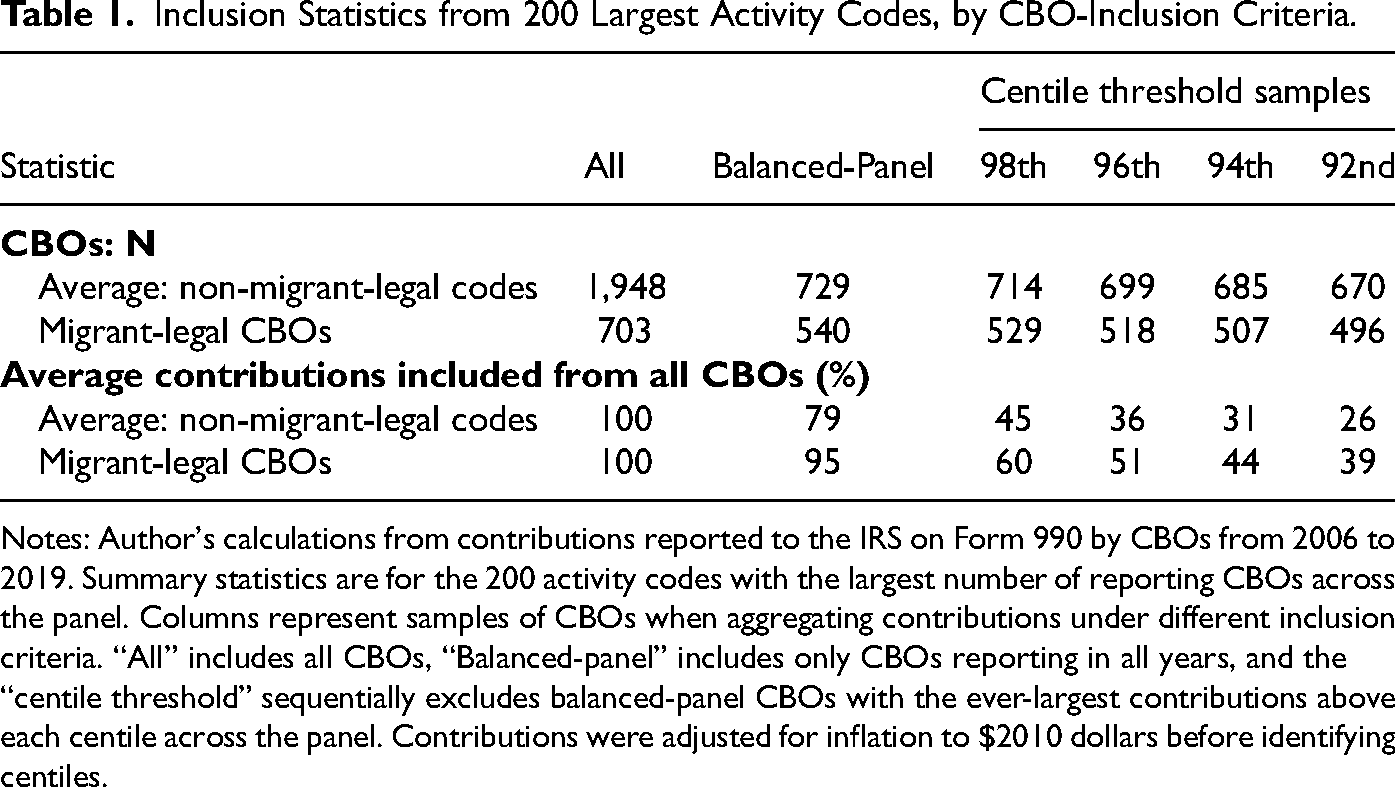
We start our summary statistics with a focus on how the analysis sample changes under the different CBO-inclusion criteria. Table 1 presents the number of CBOs and the share of total contributions that are included in the analysis across the criteria. To highlight how these changes differ for the migrant-legal CBOs, we present averages for the 199 non-migrant legal codes and place them next to the statistics for the migrant-legal CBO category.
Inclusion Statistics from 200 Largest Activity Codes, by CBO-Inclusion Criteria.
Notes: Author's calculations from contributions reported to the IRS on Form 990 by CBOs from 2006 to 2019. Summary statistics are for the 200 activity codes with the largest number of reporting CBOs across the panel. Columns represent samples of CBOs when aggregating contributions under different inclusion criteria. “All” includes all CBOs, “Balanced-panel” includes only CBOs reporting in all years, and the “centile threshold” sequentially excludes balanced-panel CBOs with the ever-largest contributions above each centile across the panel. Contributions were adjusted for inflation to $2010 dollars before identifying centiles.
Three features from Table 1 are notable. First, on average, the number of CBOs included for each code decreases by more than half when going from “all” CBOs who had ever reported Form 990 to those with a balanced panel (1,948 to 729, or 63 percent). This decrease is smaller for migrant-legal CBOs (703 to 540, or 23 percent). This tells us that it is common for CBOs to irregularly report to the IRS across the panel, although DOJ-identified migrant-legal CBOs reflect a relatively more stable reporting group. Second, even though the percentage of CBOs that are excluded when going to the balanced panel is high, the drop in contributions is much smaller. For the panel that only includes CBOs with a balanced panel, 79 percent of all recorded contributions are still included for non-migrant codes and 95 percent are included for migrant-legal CBOs. Finally, once we start to exclude CBOs with the largest contributions across the panel based on centiles, the share of remaining contributions drops meaningfully. For example, on average, after excluding CBOs with contributions above the 98th centile, only 45 percent of total contributions remain for non-migrant-legal CBOs and 60 percent remain for migrant-legal CBOs. These differences clarify how meaningful outliers are for the overall amount of contributions and how contributions to a small group of CBOs might influence overall trends. Our analysis will present side-by-side results for all of these samples.
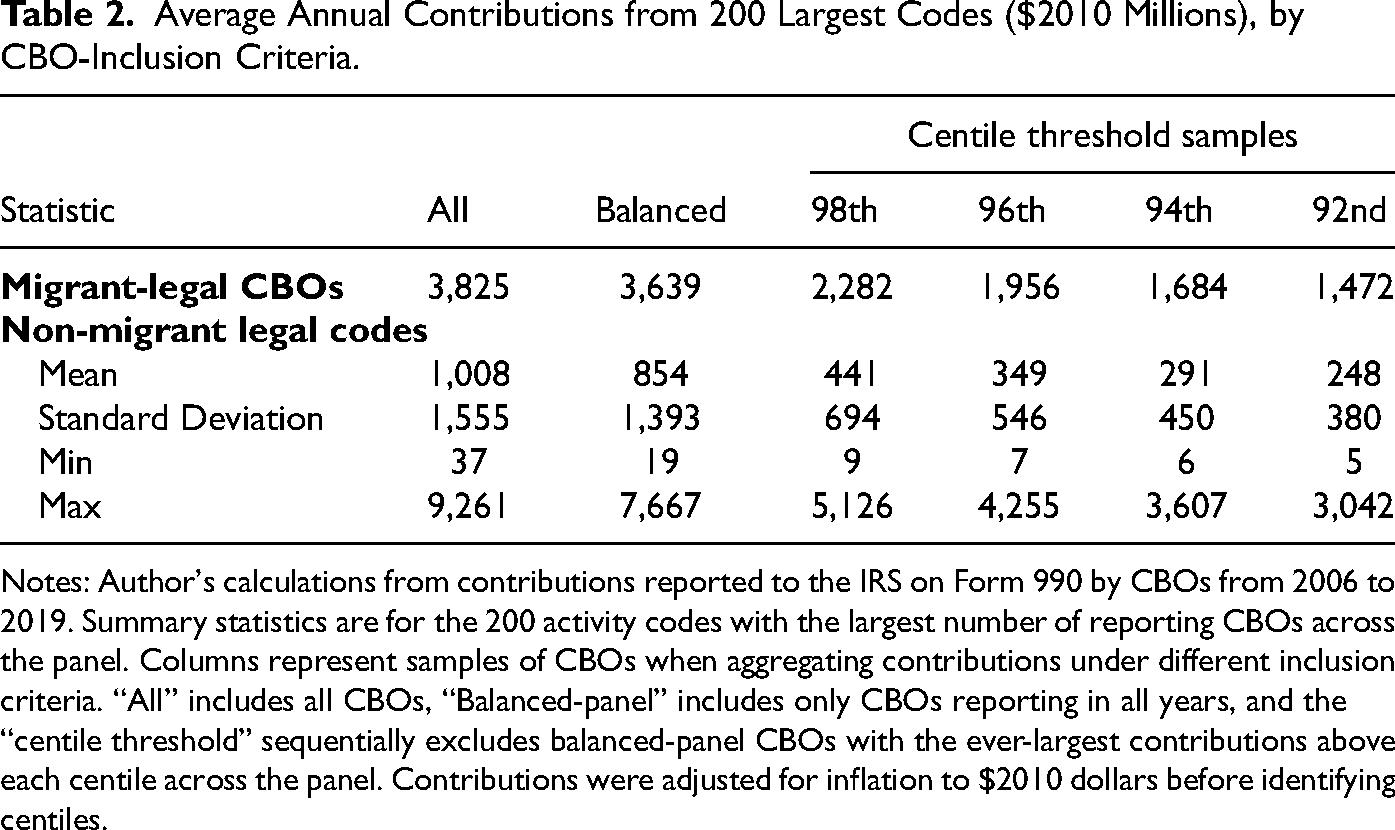
Next, we summarize the levels of contributions for the 200 largest codes. Table 2 presents the average annual contribution for these codes in millions of $2010 dollars. For migrant-legal CBOs, average annual contributions are $3.8 billion when including contributions to all CBOs, and stay high at $3.6 billion for the CBOs with a balanced panel before shrinking to $2.3 billion once we exclude CBOs receiving contributions in the top 2 deciles. Similar decreases exist when looking at the mean for non-migrant legal codes. When looking at the distribution for non-migrant CBOs, it is clear that migrant-legal CBOs represent one of the codes that receive the most contributions, but it is not the largest.
Average Annual Contributions from 200 Largest Codes ($2010 Millions), by CBO-Inclusion Criteria.
Notes: Author's calculations from contributions reported to the IRS on Form 990 by CBOs from 2006 to 2019. Summary statistics are for the 200 activity codes with the largest number of reporting CBOs across the panel. Columns represent samples of CBOs when aggregating contributions under different inclusion criteria. “All” includes all CBOs, “Balanced-panel” includes only CBOs reporting in all years, and the “centile threshold” sequentially excludes balanced-panel CBOs with the ever-largest contributions above each centile across the panel. Contributions were adjusted for inflation to $2010 dollars before identifying centiles.
Between 2006 and 2019, after adjusting for inflation to 2010 dollars, national contributions to migrant-legal CBOs steadily increased from $2.9 billion to $6.7 billion. But they increased for many other groups of CBOs as well. To better understand the relative growth in contributions, we present normalized contributions growth in Figure 1. We present this for two of the CBO inclusion samples: all CBOs are shown in Panel A, and balanced-panel CBOs after excluding those above the 98th centile are shown in Panel B. Starting with Panel A, the growth in contributions presents a lot of variance across codes, with some reporting contribution growth as high as 350 percent in 2019 relative to 2010. There is also evidence of large variation within codes, which can be seen from spikes and sharp adjustments. These could be real, but it may also represent volatility in which CBOs are reporting and what they are reporting over time. Now, looking at Panel B, after limiting to CBOs with a balanced panel and removing the top 2 centiles within each code, there are much smoother trends. There are still some outliers with the largest code having CBOs that reported around 180 percent of contributions in 2019 relative to 2010, but the trends are much more stable. As discussed above, a large percentage of overall contributions is removed when making this type of CBO-sample restriction, but they still represent 98 percent of all CBOs in each category and receive nearly half a billion dollars in contributions, on average.
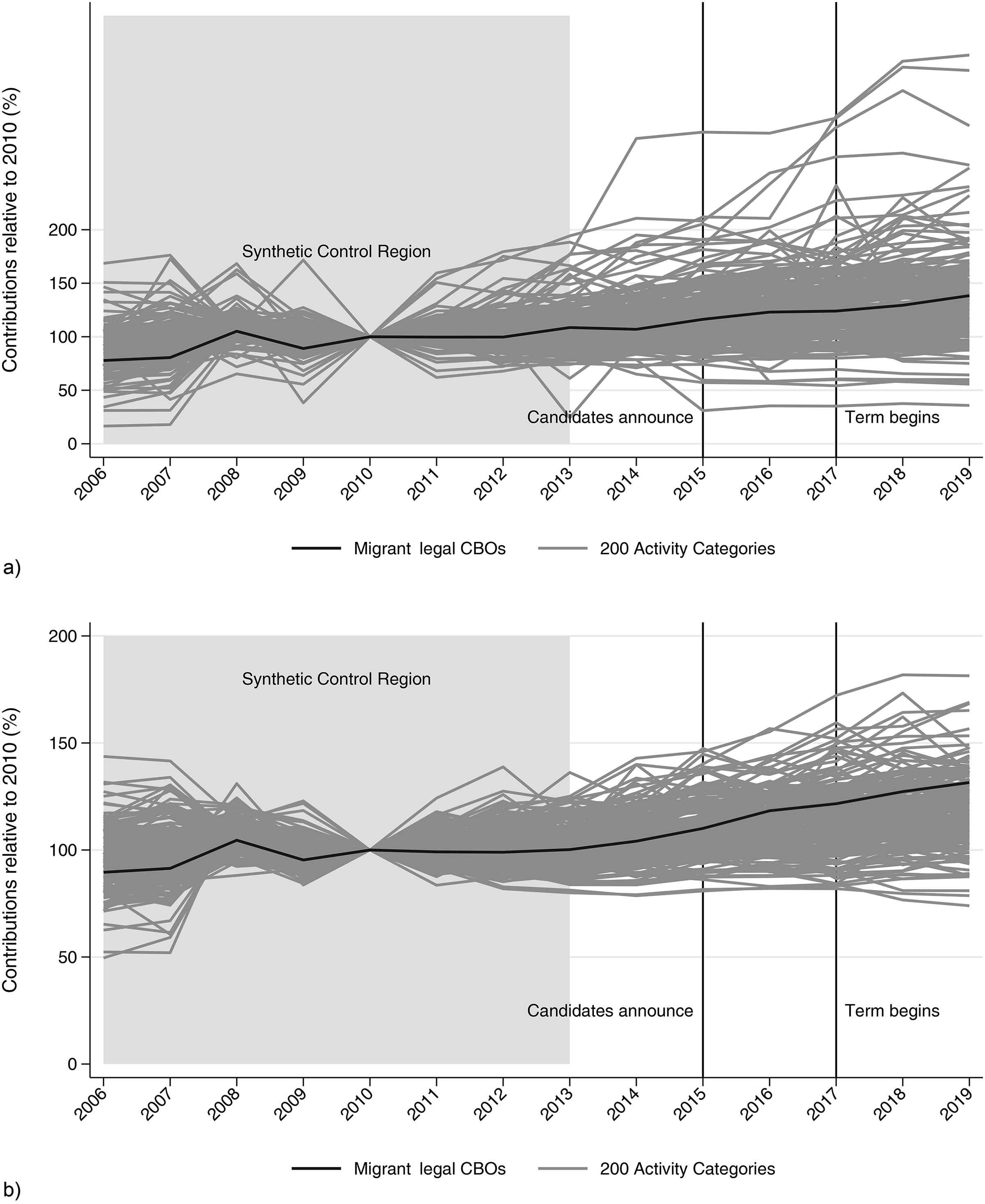
Contribution growth trajectories for CBOs grouped by activity code, relative to 2010. Panel A: All CBOs. Panel B: Excluding CBOs above the 98th centile in their code.
Synthetic Results for 98th Centile Exclusion
We now present results from the synthetic control analysis when excluding CBOs above the 98th centile. We do this as an example of how the estimates are created and to demonstrate the method. In the following section, we present and interpret results for migrant-legal CBOs after performing the analysis for all CBO-inclusion samples.
Recall, to assess whether the growth in contributions was differentially influenced around the 2016 presidential campaign, we created synthetic comparison groups using the other activity codes. Specifically, for each activity code, we created weighted combinations from the remaining 199 activity codes based on annual contributions from 2006 through 2013 — where we exclude 2014 from the weighting to act as a placebo check on the method. These weights are strictly non-negative and result in a weighted combination of other codes that minimize the difference in trends over the synthetic-control region. Note that when estimating the synthetic panel for migrant-legal CBOs, we found strictly positive weights across all other activity codes. This is useful because it implies that the synthetic version is not driven by a small number of comparison codes, but rather is a general reflection of many different codes.
The synthetic results for migrant-legal CBOs are presented in Figure 2. The synthetic match between the synthetic control and migrant-legal CBOs is very aligned in the synthetic-control region and stays relatively close through 2015. However, a gap of 10 percentage points emerged in the election year of 2016 and increased to 16 percentage points in 2019. Taking this evidence alone, it would appear that migrant-legal CBOs did receive an increase in contributions relative to a weighted group of codes with a similar historical trend. However, this does not provide any inference on whether these differences are meaningfully different relative to all of the other codes.
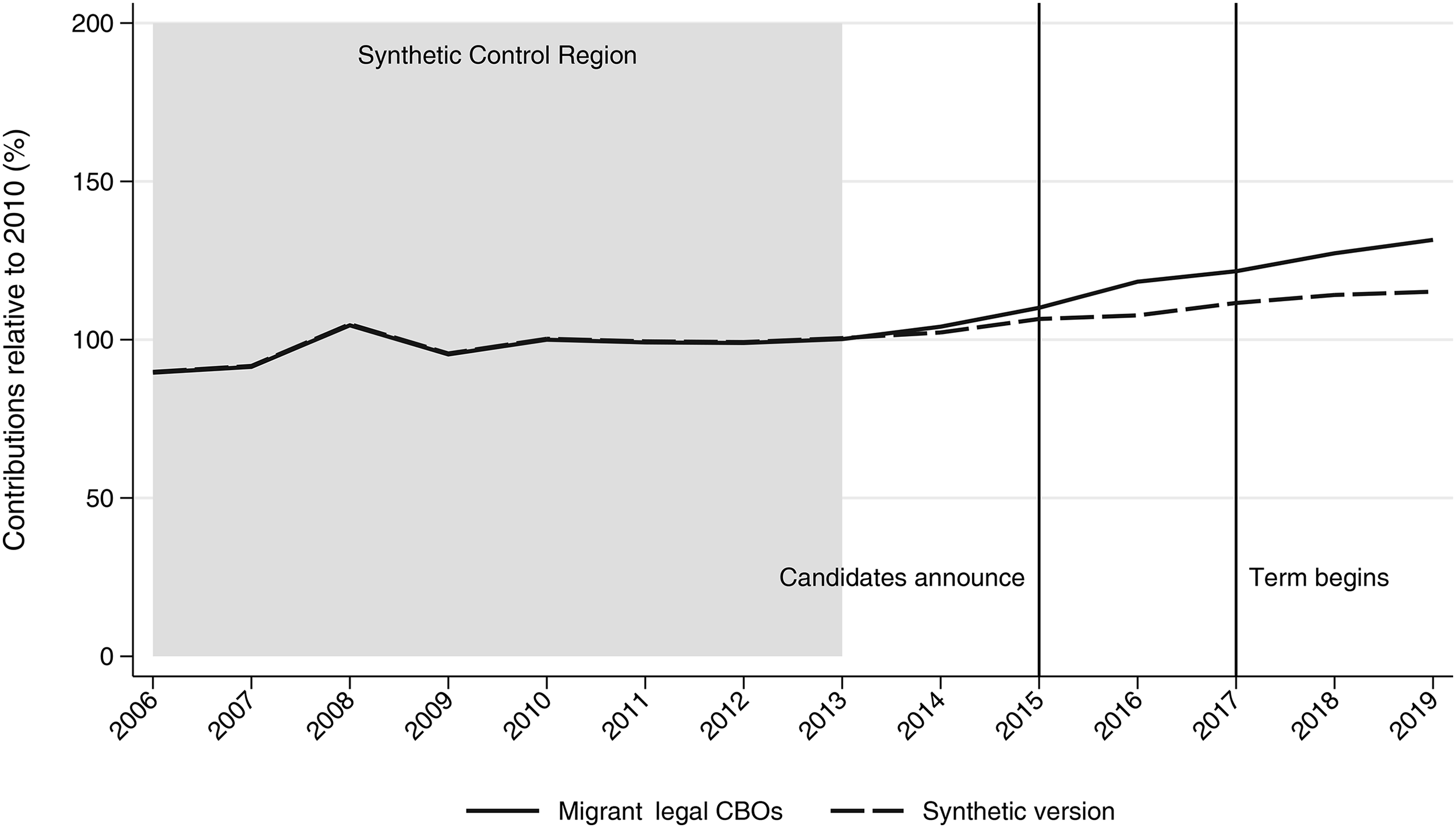
Actual and synthetic contribution growth for migrant-legal CBOs, 98th centile sample.
To assess the meaningfulness of the synthetic-control differences for migrant-legal CBOs, we repeated the process for each of the 199 other activity codes so that we could compare the reported and synthetic differences directly. This allows us to calculate the centile of the synthetic-control difference for migrant-legal CBOs relative to all the other codes in each year. 7 The results are presented in Figure 3. In the synthetic-control region, migrant-legal CBOs are well matched with a clear trend line at 0. The other codes are also relatively clustered around the 0 trend line with a few exceptions. Outside of the synthetic-control region, there is an increase in the variation in synthetic differences across codes starting in 2014 that expands through 2019. For migrant-legal CBOs in 2014, although increasing, the difference is not particularly large in magnitude or relative size (69th centile). However, the difference for migrant-legal CBOs starts to increase relatively over time and is at the 89th centile by 2016 and stays at the 88th centile in 2019.
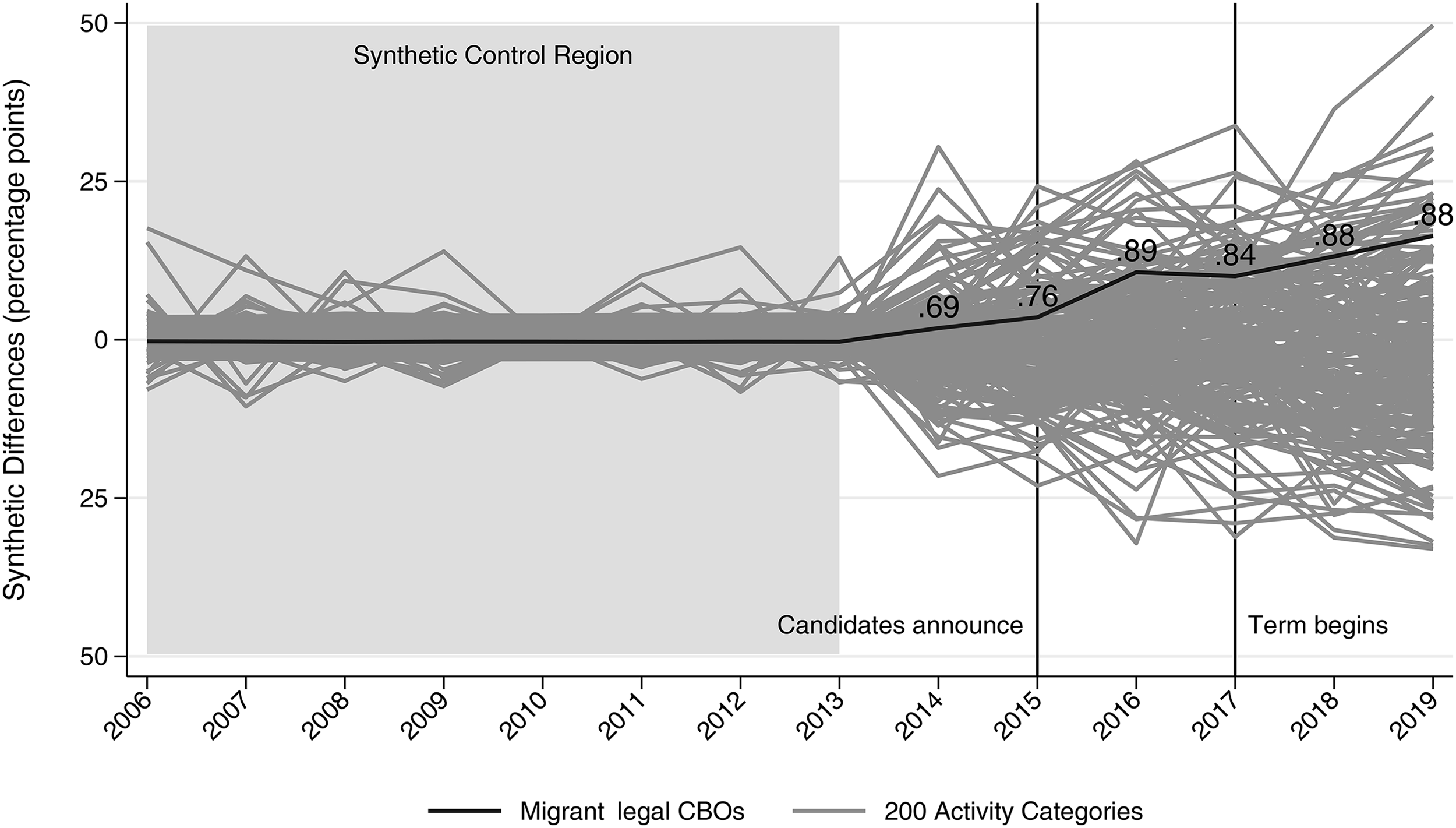
Synthetic differences for CBOs grouped by activity code, 98th centile sample.
For this particular sample, we take this as evidence that nationwide contributions did, in fact, increase in response to the political environment of the 2016 presidential election. Migrant-legal CBOs did not experience the largest relative growth over the time period, but the relative growth was 10 percentage points higher than those with comparable historic trends by 2016, and this larger level of contributions was sustained through 2019. Further, the differences remained near the top decile over this period when compared to the other 199 largest activity codes.
Results Across CBO-Inclusion Criteria
We now present the synthetic-control results for migrant-legal CBOs under all CBO-inclusion criteria. Before conducting any of the analyses, we were concerned about the stability of CBOs that reported Form 990 and whether there were small groups of large CBOs that would drive the results. By presenting the results for different CBO-inclusion criteria side-by-side, we can empirically check if these concerns were valid.
We present the synthetic difference for migrant-legal CBOs under different inclusion criteria in Figure 4. When including all CBOs, the synthetic difference is 4 percentage points in 2014 and 8 percentage points in 2019, with a noticeable dip toward 0 for the in-between years. Once we limit the sample to balanced-panel CBOs, the synthetic control differences shift upward across the entire panel, although they still maintain a relative dip in the 2017 and 2018 years. Finally, once we exclude those CBOs reporting in the top centiles of their code, there is a much clearer upward trend in relative contribution growth.
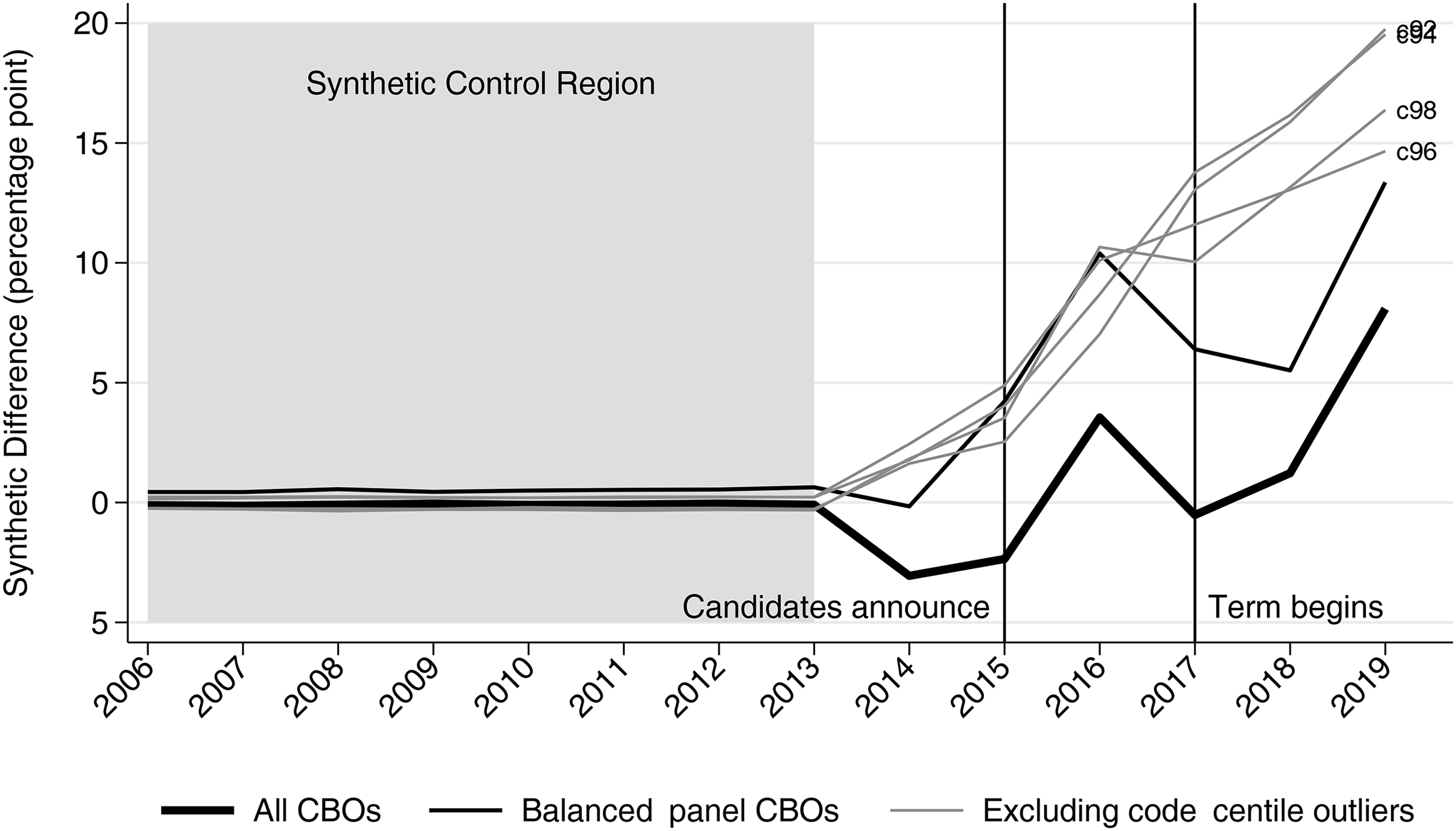
Synthetic differences for migrant-legal CBOs, by CBO-included samples.
To assess the meaningfulness of these differences relative to the growth in other codes, Figure 5 presents the centiles of synthetic-control differences across the inclusion criteria. In the synthetic-control region, there is large variation in the centiles across criteria, but this is not meaningful since the level differences are centered around zero by construction. However, outside of the synthetic-control region, the centiles generally increase from 2014 to 2019 across all inclusion criteria. This implies that migrant-legal CBOs were experiencing relative increases in their contributions over time. This growth was relatively smallest when including all CBOs, and peaks in 2019 at the 72nd centile. Similar to the synthetic differences, these centiles shift upward when focusing on balanced-panel CBOs. Finally, the trends become bunched and generally higher once we start excluding the largest CBOs, where the synthetic differences hover around the 90th centile from 2016 through 2019.
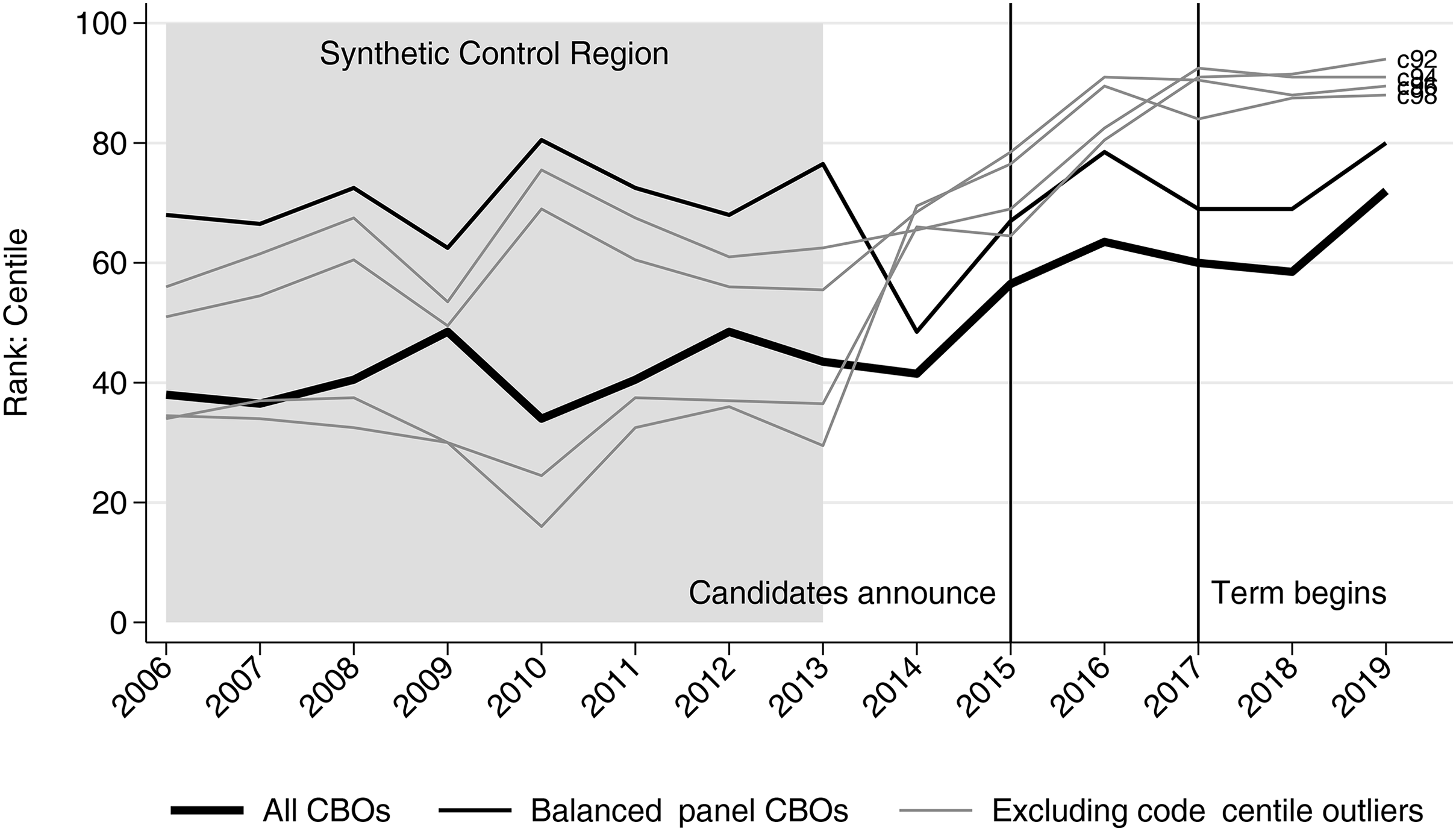
Centile of migrant-legal CBOs synthetic-control difference, by CBO-included samples.
Combined, we take this as evidence that migrant-legal CBOs did experience relative increases in contributions over time. This growth was not as large when including all CBOs, but was persistent when focusing on a balanced-panel of CBOs who reported in every year, as well as for contributions to CBOs after excluding those reporting the largest contributions. Even though excluding CBOs with the largest contributions leads to a meaningful drop in all contributions reported to a code, estimating their relative growth is meaningful because it still reflects resources that are available to the vast majority of reporting CBOs.
Discussion and Conclusion
We examine how contributions to migrant-legal CBOs fared during and after the 2016 presidential election. Using our synthetic-control analysis, we show that, compared to causes with similar historic trends, financial contributions to migrant-legal CBOs began rising (by 4 to 11 percentage points) as early as 2015, suggesting pro-immigrant actors responded to early signals (Meyer and Minkoff 2004) of Trump's intentions to reshape the immigration policy landscape. Based on the timing and duration of contributions, we show that these CBOs became leading recipients of CBO contributions by the time Trump first ascended to the presidency. In fact, contributions remained relatively high (between 8 to 17 percentage points higher) after the new administration took office suggesting sustainability. By 2019, migrant-legal CBOs were among the nation's top leaders in reported contributions; which marked a break from past trends. We interpret these results as evidence that pro-immigrant actors and migrant-legal CBOs leveraged the shifting climate as a political opportunity to garner and sustain financial support. Future work should determine whether these increased contributions acted as a safeguard against the escalating anti-immigrant climate.
Support Activation for Immigrant-Serving CBOs
Recent work shows that anti-immigrant supporters are activated by elite pressure and high-stakes election cycles (Flores 2018; Eshbaugh-Soha and Barnes 2021; Kustov 2023). Our study provides evidence of a mobilized counter-response by immigrant-serving CBOs and pro-immigrant actors. The increase in contributions to migrant-legal CBOs during and after the 2016 election suggests that, as organizational research indicates (DiMaggio and Powell 1983, Suchman 1995), these organizations are viewed as legitimate leaders capable of effectively combating the anti-immigrant climate and protecting immigrant communities. We suspect that migrant-legal CBOs, closely monitoring the changing policy climate, likely leveraged their networks and perceived legitimacy to secure additional support.
Although our study cannot disaggregate the sources of the increase in contributions to migrant-legal CBOs, evidence suggests that all sources — individual donors, foundations, and public sector grantees — likely played a role. First, research and news reports on 2016 donations suggest that individual donations to immigrant-serving CBOs increased. We know donations from individuals were mobilized during the 2015–2016 primaries (Kreiss 2019). Additionally, news coverage captured how rising donations correlated with newly announced immigration policy changes; which then funded new clients with legal and social service needs (Cerullo 2018). Second, in addition to mobilizing individual giving, foundations also likely played a role in making migrant-legal CBOs a leading destination of Trump-era contributions. Already actively involved in shaping immigration policy outcomes (Calderon 2020), foundations were in a position to respond to quickly changing conditions starting in the 2016 election cycle. Based on interview data, foundation giving may have lagged behind individual donors, but foundations did eventually mobilize to respond to newly emerging needs under the first Trump administration (J. M. Berry and Goss 2018). Third, the contributions we observe also likely came, at least in part, from government grants. Given that migrant-legal CBOs receiving foundation and government grants face restrictions on how they can use these funds (de Graauw 2016), it seems foundations and government entities were thus mobilized to serve a growing immigrant client base — and not as political advocates against a particular Trump immigration policy. Fourth, migrant-legal CBOs scanning the changing policy likely also leveraged their networks to secure added support. Rather than wait for financial support, the new conditions of the 2016 Trump era could have motivated at least some of these CBOs to mobilize in their role as social helpers for immigrants in need of assistance. As an example of ‘structured mobilization’ (Bloemraad 2006), they saw an opportunity to activate their mobilization capacity by securing new funding sources, including donations and grants.
Though we do not observe the exact source of each dollar donated, we assume the influx was intended to help these CBOs navigate a shifting and increasingly tenuous climate. Given the added strain that immigrant-serving institutions faced in the first Trump era (Ee and Gándara 2019; Barajas-Gonzalez et al. 2022), the rise in contributions may have helped CBOs address client needs in a new climate. Past work has documented the protective role of access to legal aid and experienced attorneys for hate crime reporting (McVeigh, Welch, and Bjarnason 2003), crime reporting and property values (Cunningham 2016), and deportation outcomes (Ryo and Peacock 2019; Chand et al. 2021). Our results add to the positive evidence by showing that migrant-legal CBOs and other pro-immigrant actors can mobilize to secure funding and potentially meet emerging needs.
Implications for CBOs
Finally, our results coupled with long-standing research on nonprofit giving suggest opportunities for CBOs receiving donations to assist immigrants. To begin, the volatility of funding for CBOs is well-known (Gronbjerg 1991), but our results suggest that immigrant-serving CBOs may be able to leverage a high-stakes climate, like the Trump 2016 election, to ease some of this volatility. Based on prior research using comparable IRS data, growth in donations to migrant-legal CBOs likely benefited from increased information and advertising; which promotes giving among individual donors and tends to complement government grants (Payne 1998; Okten and Weisbrod 2000). This is not to say that we should have more high-stakes conditions but instead speaks to the challenges CBOs face and their adaptive skill-set to meet that challenge. It appears that migrant-legal CBOs are recognized as high-profile and legitimate social helpers in the immigrant community.
Connecting donations to services for those in need, however, is not a given. Amidst the uncertainty of a shifting anti-immigrant climate, we know organizational constraints and administrative burdens (Yu 2023c; 2023a; Barajas-Gonzalez, Hoque, and Gutkin 2024) as well as ideas about which immigrants do or do not ‘deserve’ representation (Yu 2023b) can hamper nonprofit attorneys working with immigrants. Organization scholars long ago pointed to the tension between achieving tangible goals and maintaining survival (Thompson 1967) and how organizations vying for limited resources tend to become increasingly interdependent and interconnected (Pfefer and Salancik 1978). As awareness of immigration issues remains high, migrant-legal CBOs can apply recent lessons learned from other organizations responding to unforeseen spikes in donations. For instance, in the aftermath of Hurricane Katrina, CBOs collaborated to build legitimacy and trust in local communities and distributed in-demand goods and services (Simo and Bies 2007). Qualitative evidence on CBO responses to immigration raids comes to similar conclusions, especially in locations where CBOs draw from multiple sources of support (Chaudry et al. 2010). Through impact and collaborations, these organizations have been successful in maintaining public trust and hopefully continued public support.
Limitations and Avenues for Future Research
Key limitations apply to our study. First, records of contributions to CBOs rely on IRS records, which are available annually. Therefore, the evidence presented does not tie changes in when the general public gave to CBOs to specific changes in the nation's immigration policy climate. We do see migrant-legal CBOs eventually experience a relatively large growth in contributions compared to other activity codes, and the first Trump administration signaled important changes to immigration policy priorities each year in elected office. But we are unable to test whether or how much Trump's first presidential campaign (2015–16), inauguration (2017), or changes during our study period and under his administration between 2017 and 2019 (e.g., travel bans, public charge rule changes, efforts to end DACA, metering and MPP) directly led to such changes. In addition, CBO service providers do not operate independently of other CBOs. Some CBOs have extensive operations across multiple locations, and some pool information and resources across shared networks. Future work could investigate how individual CBOs with divergent characteristics respond to changing environments and the role that the location of their offices (and the networks in which CBOs participate) might play in determining levels of financial support. Although we do not directly account for these relationships and the potential for interdependence across networks and locations, we believe the results are able to capture important trends over time and the extent to which donations to migrant-legal CBOs resemble and differ from secular trends.
Our study highlights several future research avenues when it comes to charitable contributions to migrant-legal CBOs. Future research should examine whether donations to CBOs act as a countervailing force to anti-immigrant forces by linking those in need to legal representation. Currently, many people turn to ad hoc solutions (García Valdivia 2022) where such capacity is limited (de Graauw and Gleeson 2020). Whether — and under what kinds of conditions or contexts — CBOs and their uneven concentration (de Yasenov et al. 2020; Roubenoff, Slootjes, and Bloemraad 2023; Vries, Kim, and Han 2024) serve immigrants and reduce inequalities deserves careful attention. We do know it can be more difficult to undo the negative effects of exclusionary immigration policies (Vo 2024). As such, it may be unrealistic to expect donations alone to undo negative effects pre-dating our study period. Additionally, future research should examine whether the public support for migrant-legal CBOs persisted beyond Trump's administration and the onset of COVID. It remains to be seen whether donation growth continued into the Biden era, as needs among immigrants continued. Nor has research examined how COVID-related disruptions — which exacerbated inequalities in CBO capacity to meet immigrants’ rising need for assistance (Doering-White, Roth, and Woo 2022) — impacted public support and donations.
Conclusion
Our study shows that contributions to migrant-legal CBOs increased in response to the rising anti-immigrant rhetoric and enforcement policies of the 2016 US election. This is important because we know that legal aid and nonprofit capacity, which is often highly dependent on donations, grants, and renewed funding sources, supports immigrant rights (Gleeson 2009), including noncitizens undergoing deportation proceedings (Ryo and Peacock 2019; Chand et al. 2021). Our results suggest that immigrant-serving CBOs can effectively mobilize in response to anti-immigration rhetoric; and that the public demonstrates, through funding, trust in these organizations to effectively combat an anti-immigrant climate and promote immigrant well-being.
Footnotes
Acknowledgements
We acknowledge valuable feedback at the annual meetings of the Population Association of America, the Association for Public Policy Analysis and Management, the Cornell Population Center conference on The New Demography of Migration and Mobility, and the Allied Social Science Associations (hosted by the American Society of Hispanic Economists).
Declaration of Conflicting Interests
The authors declared no potential conflicts of interest with respect to the research, authorship, and/or publication of this article.
Funding
The authors disclosed receipt of the following financial support for the research, authorship, and/or publication of this article: This work was supported by the University of California Santa Cruz Hellman Fellowship, University of Wisconsin, Madison (Emerging Poverty Scholars Fellowship).
