




Abstract
It is often erroneously assumed that Russians and Ukrainians are the “same people.” This conviction of sameness partly drove the aggressive invasion of Ukraine in February 2022, with a determination to forcefully drag a sovereign nation onto an assumed similar destination with Russia and Belarus. Such an assault on a sovereign nation drew denunciations from organizations and people around the world. Nonetheless, by November 2022, the invasion had resulted in the tragic loss of numerous innocent Ukrainian lives and compelled an unprecedented number of people to seek sanctuary throughout Europe. The same event prompted a growing use of the language of imperialism to characterize Russia's supremacy, concurrently giving rise to the logic of Europeanness and whiteness. In this IMR Dispatch, I explore the impact of Europeanness, whiteness, and sameness on people of color fleeing the conflict in Ukraine. While it is crucial to examine the systematic racialization of these people, I argue that the racialized border enforcement witnessed during the conflict is better understood when viewed through the global color line embedded within migration and border management, particularly in Central and Eastern Europe where racialized logics are still underplayed.
Introduction
The February 2022 invasion of Ukraine by Russia did not only result in the displacement of people but also the deployment of logics of Europeanness, whiteness, and sameness. This was evident in the Eurocentric news commentaries filled with photographs of Ukrainians and non-Ukrainians desperately attempting to board trains toward any safe destinations. In various responses to the invasion that led to millions of people fleeing westward, articulation of Europeanness, whiteness, and sameness was deemed essential to different commentators. One such commentator, Daniel Hannan, the former Member of the European Parliament, observed in The Telegraph that Ukrainian people “seem so like us,” pointing to the Europeanness and whiteness of the people and the notion that war, to an extent, is remote to Europe. Hannan's assessment seems to reduce the impact of war to “impoverished and remote populations” in the Middle East and Africa (Hannan 2022). Similarly, Charlie D’Agata, the foreign correspondent for CBS News, reported the invasion as an attack on civilization. In D’Agata's representation, Ukraine “isn’t a place, with all due respect, like Iraq or Afghanistan that has seen conflict raging for decades.” 1 Such a commentary presents Ukraine as a distinct nation compared with Iraq and Afghanistan, which are assumed to have experienced prolonged conflicts. In D’Agata's view, Ukraine, as a European nation, is inherently more “civilized.”
Presenting Ukraine in this way equally had tremendous effect on the evacuation of people from the country and their relocation to other parts of Europe influenced by the assumed characteristics of Europeanness and whiteness, determined by “blue eyes and blonde hair,” as David Sakvarelidze, the Ukraine's deputy chief prosecutor, emotionally put it to the BBC. 2 At the heart of this, the separation of Europeanness from non-Europeanness seemed to be essentialized by all sort of racialized commentaries. The coverage by NBC news correspondent, Kelly Cobiella, further pinpointed the logics of Europeanness, whiteness, and sameness deployed during the invasion. As Cobiella bluntly puts it — “these [Ukrainians] are not refugees from Syria, these are refugees from Ukraine… They’re Christians, they’re white. They’re very similar.” 3 In Peter Dobbie's analysis, refugees from Ukraine are “prosperous, middle-class people. These are not obviously refugees trying to get away from areas in the Middle East… [or] North Africa.” The Al Jazeera presenter seemed to suggest that these individuals cannot be “refugees” in the traditional sense, but rather similar to “any European family that you would live next door to.” 4 These logics of Europeanness, whiteness, and sameness impelled the governments of the UK and the EU, encouraging their citizens to welcome refugees from Ukraine into their homes — a goodwill gesture that was hardly observed during the 2015 “migration crisis.” While the political landscape of individual EU states played a significant role in shaping responses to such crisis, it is difficult to overlook the rhetoric of non-Europeanness and non-whiteness attributed to people arriving from the Middle East at the time. In this context, Europe appears to represent both a sense of belonging and a set of limitations imposed on those considered “immigrants” or “refugees” who are assumed to have originated from outside Europe.
Taking the above commentaries as a backdrop, this IMR Dispatch examines the racialized mechanisms that placed people of color in vulnerable positions during Russia's invasion of Ukraine. By drawing on similar examples from across Europe, I argue that the racialized mechanisms experienced by people of color, particularly in Poland, are better understood as a global phenomenon rather than a manifest of a specific region in Europe.
Racialized Border: Refugees Separated by the Global Color Line in Poland
As an unprecedented number of people were displaced by the war in Ukraine, forcing almost 8 million Ukrainians and non-Ukrainians to seek refuge in neighboring countries, Poland was seen as a primary gateway to Western Europe while acting as a leading country with a refugee response plan 5 (Figure 1).
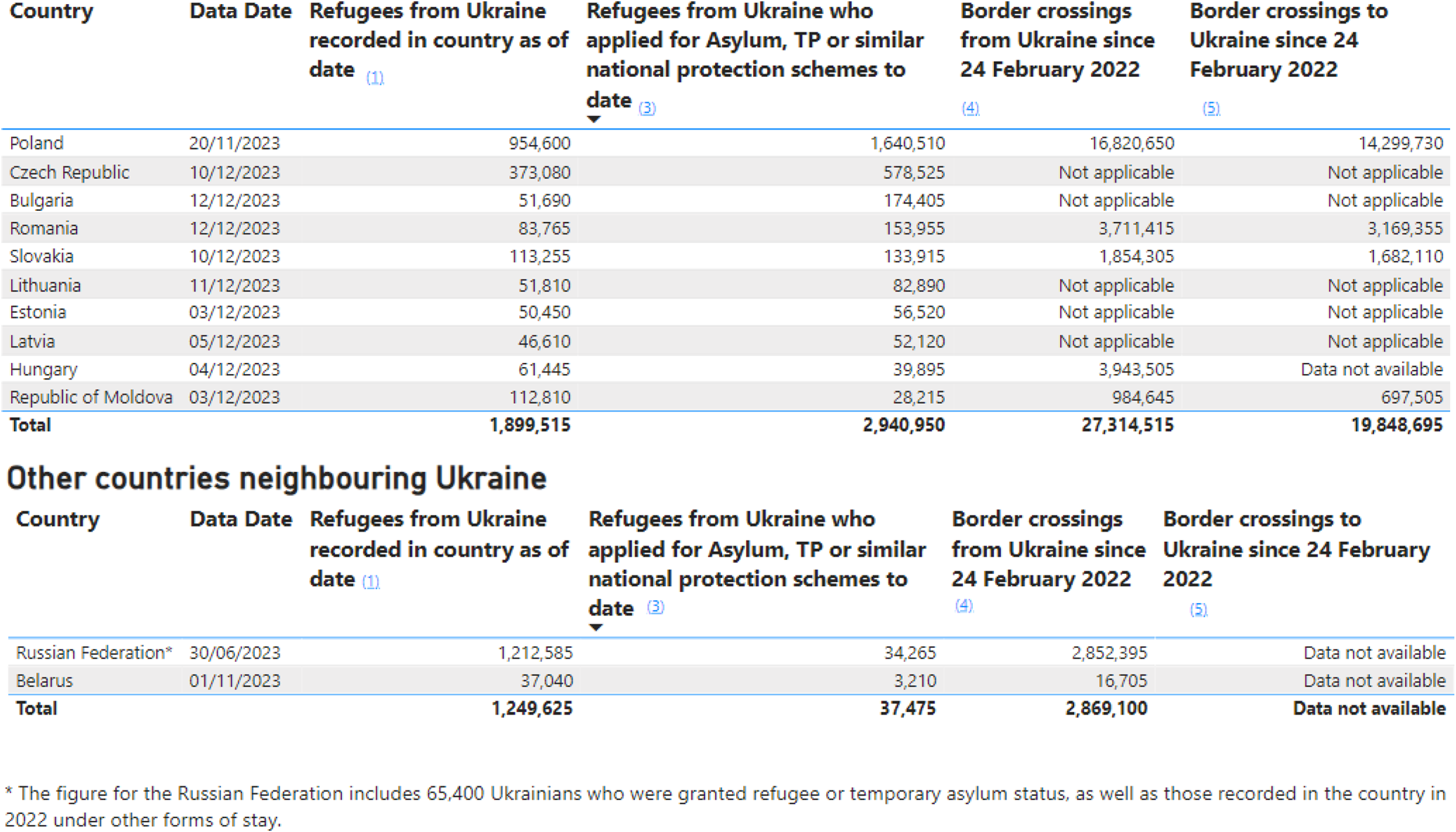
Countries Featured in the Regional Refugee Response Plan.
Among the people fleeing the war and seeking refuge were many non-Europeans and non-white populations who had lived and worked in various cities in Ukraine, including many international students from countries in the Caribbean, Middle East, Asia, and Africa. 6 These non-Europeans fleeing Ukraine for neighboring countries reportedly went through different ordeals informed by various racialized mechanisms (Townsend 2022; Tondo and Akinwotu 2022) — a stark contrast to the experience of white Ukrainians fleeing the same war. This is not to underestimate the horrific conditions experienced by many white Ukrainians. Nonetheless, the racialized mechanisms prompted global concerns that people of color were being denied access to board trains traveling to safe destinations near the Polish border with Ukraine (Akinwotu and Strzyżyńska 2022). It was an incident that caught the attention of international news, shared across social media platforms worldwide, and provoked international criticism from governments in Africa and human rights organizations (African Union 2022; UHCHR 2022).
In March 2022, as a response to the growing humanitarian crisis at the European Union's (EU) Eastern borders, the provisions of the 2001 Temporary Protection Directive were activated by the EU, providing unlimited admission to specific people seeking refuge in the EU (European Commission 2022a). The directive covers predominantly Ukrainian refugees, rightly providing them with fast-track access to essential services that include temporary freedom to travel across the EU, automatic work permit, education, and free healthcare for at least an initial period of three years (European Commission 2022b; Walker 2022a). Following the EU directive, the Polish government passed a humanitarian emergency law explicitly designed to improve the humanitarian response to the war in Ukraine, leading to the implementation of “perhaps the most liberal labour migration regime in the European Union towards Poland's eastern neighbours” (Pszczółkowska 2022, 222). The law relaxed the Polish labor and employment regulations for Ukrainians, providing them with access to education and healthcare, with financial support for locals willing to host Ukrainians. A similar gesture was rolled out by many states across the EU (Walker 2022b).
While the above responses seemed appropriate and highly needed to support many Ukrainians seeking sanctuary, they also led to a significant misunderstanding of the scale of the problem at hand. As ENAR (an anti-racist network that advocates for racial equality across Europe) has pointed out, the EU framework has racialized implications because of its failure to fully cover citizens of “Third Countries” (mainly countries outside the EU whose citizens do not enjoy the EU's freedom of movement) fleeing the war: “The decision to invoke the Temporary Protection Directive is historical and yet disappointing in that it still applies a racist double standard which prevents non-Ukrainians from having the same legal protection. Migrants from racialised backgrounds are often granted a 15-day visa which pales in comparison to the potential three years provided to Ukrainian migrants. Skin colour or passport types should not be a criteria which provides one group of people more protection over another. Europe must do better to be a safe haven for all. The Temporary Protection Directive shall not be an instrument that legitimises discrimination.”
7
With the above-racialized migration regime initiated by the EU, it was difficult to persuade Prawo i Sprawiedliwość (PiS), Poland's national conservative party and its right-wing government, the extent of their responsibilities for both Ukrainians and non-Ukrainians displaced by the war. For this reason, the solution put forward by PiS lends itself mainly to the needs of white Ukrainians rather than a global solution. Consequently, the practical issues of where to live, access to healthcare, and the continuation of their studies remained serious concerns for many students from sub-Saharan Africa sojourning in Poland. 9 While there was progress in securing temporary food supplies provided by NGOs, these individuals had to pay for mandatory residence permits, healthcare insurance, and education. As access to the Polish state-funded accommodation was restricted to only Ukrainians, many people of color who required fast-track well-being and financial support had to rely on a few Polish and non-Polish NGOs such as the Fundacja dla Migrantów; Foundation for Social Diversity; Nigerians in Diaspora Organization; Black Women for Black Lives; Alliance for Black Justice, and individuals of African descent and their allies across Europe. 10 Furthermore, the Union of Ukrainians, an organization that promotes cultural exchange in Warsaw, was among many NGOs in Poland that first protested against the appalling fate of non-Ukrainian people fleeing the war and the state violence at the Polish-Belarusian border. 11 The NGO questioned Poland's border policies while recognizing that “These are people who, like refugees and refugees from Ukraine, are entitled to protection” (Wyborcza 2022), leading to further criticism of the Polish refugee plan as racial segregation especially at the Polish borders with Ukraine (Wyborcza 2022; Ong and Adler 2022).
Border and the Color Line
Framing the above Poland’s refugee plan as a boundary means also paying critical attention to colorism — the discrimination against individuals with a dark skin color. This particular racialized logic seems to be at the center of the racialized experience of people of color displaced into Poland from Ukraine. Colorism emphasizes and privileges whites over blacks (Hunter 2017, 238), in doing so, it provides a broader, sometimes systemic, process of racialization. Indeed, darker skin color, as many scholars (Edwards 1973; Ransford 1970; Hunter 2002) have pointed out, is associated with more race-conscious views that were evident in higher levels of perceived discrimination where, in the present context, white Ukrainians were allowed rapid mobility, while dark-skinned individuals were made immobile through institutional checks and in some cases, detentions. In this circumstance, whiteness seems to represent “goodness and all that is benign and non-threatening” (Dyer 1988, 45), while the non-white other is deemed incompatible.
Having navigated sometimes the violence of European borders and different state authorities, Black and Brown people's lived experiences are somewhat clouded by a lack of access to critical healthcare during their extended periods of migration. This is only second to the constant reckoning with and taking into account physical assaults from anti-immigrant ethno-nationalists lurking on the streets. As pointed out by Jaskulowski and Pawlak (2020), this is an experience that many people of color are familiar with in Poland. Indeed, the mechanism that informed the differential treatment of Black and Brown people fleeing the war was guided by biological determinism with a specific reference to skin color. In this regard, bordering is not limited to the administrative divisions between nations but similarly translated into the boundaries of Europeanness and whiteness. What seems particularly important here is the work of race in putting whiteness as a supreme identity at the center of the migration crisis. As Borocz (2021) aptly suggests, such a system of racialization rests on the logic of race that arranges diverse populations into homogenous groups, creates borders between them, and fixes them into a system of subordination. The system relies mainly on the biological features of each group, most especially the color line that confers global privileges on whiteness, as well as religiosity that generally makes refugees vulnerable when identified as Muslims and/or appear to have darker skin color (Jaskulowski and Pawlak 2020, 460; De Coninck 2022; Kalmar 2022).
Whiteness, within the above hierarchical structure, has a social implication in its constitution with an implicit emphasis on a moral–geopolitical category (Borocz 2021). In recognizing the complex interactions between blackness and whiteness within such structure, Borocz (2021, 1124) underscores the analytic blackness as a precarious position “always already at the bottom of that hierarchy.” In doing so, he identifies the global operation of race with gradations of whiteness as evidence. While providing a significant challenge to the interaction between blackness and whiteness, Zarycki (2022, 327) calls critical attention to the conceptualization as a specific type of bordering that is “overtly essentialist-biological” but often conceals its racist implications in Central and Eastern Europe (CEE) (Balogun 2023; 2022; Rucker-Chang and Ohueri 2021) All this seems to suggest the perseverance of the old racism as part of the “European racism” that has been theorized almost exclusively in the West but still disguises as a symptom of underdevelopment across CEE (Tyler 2018, 1790).
The above processes of inclusion and exclusion are intricately linked to the role of race. Race functions as an imperceptible boundary that delineates who is considered a formal member and who is not, as well as what can or cannot be discussed in relation to it. In this sense, border and color line seem to be “inscribed not at the level of personal relation, of social and sexual intercourse or the excitement of avant aesthetic expression, but in the crevices of political divides and formal relations of power, of institutional access and full membership in the polity, of educational standards and citizenship requirements” (Goldberg 2006, 349). Key to realizing such a deeper understanding of border and color line is Anderson's (2022) conceptualization of “White Space” and the uneasiness of many Black people trying to navigate many spaces — perceived as “off limit” for people of color, who are typically not expected to be in or assumed to be absent from such spaces. Anderson's “White Space” is multifaceted: the lived experiences of many people of color displaced into Poland by the war typified how these people grapple with their hypervisibility and navigate predominantly white spaces, which sometimes are not without violence.
Border Management: The Redrawing of the Global Color Line
Surveillance and management of the movement of people, Benson et al. (2022) compellingly remind us, have long been part of nation formation. Still, such a formation often fails to consider or consciously ignores Europe's multiplicity and diversity (Boatca 2013). The reception of refugees from Ukraine by both the Polish state and the public has been an exceptional circumstance that has transformed Poland from a country with primarily economic migrants (Zubrzycki 1979; Korcelli 1992) to a country that hosts one of the largest refugee populations in the world (Pędziwiatr, Brzozowski and Nahorniuk 2022). Nonetheless, this welcoming Polish benevolence seems to be steered by the politics of whiteness and sameness that failed to take into account the racialized experiences of people of color in Poland (Balogun 2020; Ohia-Nowak 2020; Jaskulowski and Pawlak 2020; Balogun and Joseph-Salisbury 2021).The same Polish compassion failed to consider Poland’s construction of walls along the Poland–Belarus border. This systematic bordering prevented Syrians, Afghans, and Iraqis, perceived through cultural differences as unwelcoming to Europe, from entering Poland. Consequently, these non-white and non-Europeans found themselves reliant on the assistance of Polish NGOs, local activists, and compassionate Polish doctors who continued to provide humanitarian aid at the border (Pszczółkowska 2022; Tondo 2022). Despite this local support, the racialized border policy had led to several deaths at the border between Poland and Belarus. 12 In the face of this bordering, the Polish Border Guard introduced a range of techniques that included impoverishment of asylum seekers and “slow violence” (Mayblin 2020) in attempts to control movements into Poland. Perhaps all this seems relatable when viewed through Goldberg's (2009) framing of racial regionalizations — a regionally prompted racism guided by distinctive ways in which race acts materially and demographically in geographic contexts but often rationalized under the veneer of securitization and immigration.
The incidents that have unfolded with Russia's invasion of Ukraine and the Poland–Belarus border stand-off have confirmed that race and racism, as Christian (2019, 170) and Price (2010) have theorized them, are “a modern global project that takes shape differently in diverse structural and ideological forms across all geographies” with the supremacy of whiteness at their core. In this sense, race and racism did not start during Russia's invasion of Ukraine but were already embedded within border “control” and “management” of migration as the critical focus of bordering whiteness and Europeanness. This critical observation is better understood when viewed through the theoretical framework of race and racialization. Race, as a concept, has been relevant in theorizing political and migration problems in Western Europe and the Americas but often disregarded in CEE, where “ethnicity” is frequently deplored as a proxy for race (Hellgren and Bereményi 2022). Such negligence of race has allowed many European states to declare themselves as post-racial or “race-neutral” societies (Lentin 2011; De Genova 2018) while still benefitting from the global racial order with a preference for whiteness that is typically reduced to any simple substitute for Europeanness. With this, it is worth paying attention to how the color line interacts with migration and border management in CEE and the silent roles of race and racialization in such management.
A plethora of research has long demonstrated the ways in which border management is partly underpinned by logics of race and racialization (Achiume 2022; Krzyżanowski 2018; De Genova 2017; Puwar 2004). This scholarship has shown that, across many frontiers, racially minoritized people face barriers, challenges, and exclusions at borders. Significantly, they are often seen as outsiders or “bodies out of place” in specific territories, therefore subject to an obvious racial profiling disguised under the regime of border management with continuous recalibration of brutal tactics for border enforcement, while seeking the most effective strategies of bordering. Doing so, De Genova (2017) observes, requires a specific convulsive control of people with varied nationalities. Observing the racialized strategies of bordering within the convulsive control is not at all too difficult here. Although ostensibly intended to facilitate border crossing, De Genova (2017, 4) argues, these strategies are primarily embedded with and informed by various mechanisms of race and racialization. Here, one should not misread the overarching functions of bordering, as they are set to identify and differentiate between “the presumably proper subjects of a state's authority and those mobile human beings variously branded as “aliens,” “foreigners,” and indeed illegal “migrants” (De Genova 2017, 6). A large number of Black and Brown people who never identified as “aliens,” “foreigners,” or illegal “migrants” frequently find themselves slotted into these categories forced upon them through the administration of bordering of race, whiteness, and Europeanness. Hence, they are perceived as bodies that must be “over-controlled” and “over-managed” by border forces and other state authorities. This intricate interplay between race and borders, Weheliye (2014) notes, allows racism to function as a fundamental tool of statecraft in modern Europe. Whether enforced through physical barriers such as razor wire or established through rhetoric means, borders are “racial assemblages” through which humanity is classified and disciplined into “humans, not-quite-humans, and nonhumans” (Weheliye 2014, 8). Expansively, these important observations bring into focus an understanding of contemporary EU borders as a framing of colonial structure that is inherently racial (Achiume 2022). Such a structure, supported by what might seem to be race-neutral legal regulations of territorial and political borders, seems to be designed to facilitate white people's international mobility and migration (Achiume 2022, 448).
Since the invasion of Ukraine, there has also been much discussion about the distinction between “genuine refugees” and “economic migrants” in Poland, with serious implications in the media and the Polish state's policies about who is and who is not welcomed in the country. For the most part, the discussion has been predicated upon culture and religion that tend to exclude many people assumed to originate from the Middle East, Africa, or Asia (Jaskulowski and Pawlak 2020). However, much of the discussion and policies appear to ignore a significant historical account of thousands of war-displaced Poles that lived in refugee camps in the colonial East and Central Africa between 1942 and 1950, hosted and supported by Black African communities in Uganda, Kenya, Tanganyika, and Northern and Southern Rhodesia (Lwanga-Lunyiigo 1994; Nowak 2019; Lingelbach 2020). Paired with this history was another critical account of the large-scale emigration of over 2 million Polish people moving to the Americas in the 1800s as part of the “attempts to recognize Poland's position in the global capitalist economy and to test the possibility to compete for influence in overseas lands” (Snochowska-Gonzales 2020, 107; Zubrzycki 1953) (Figure 2).
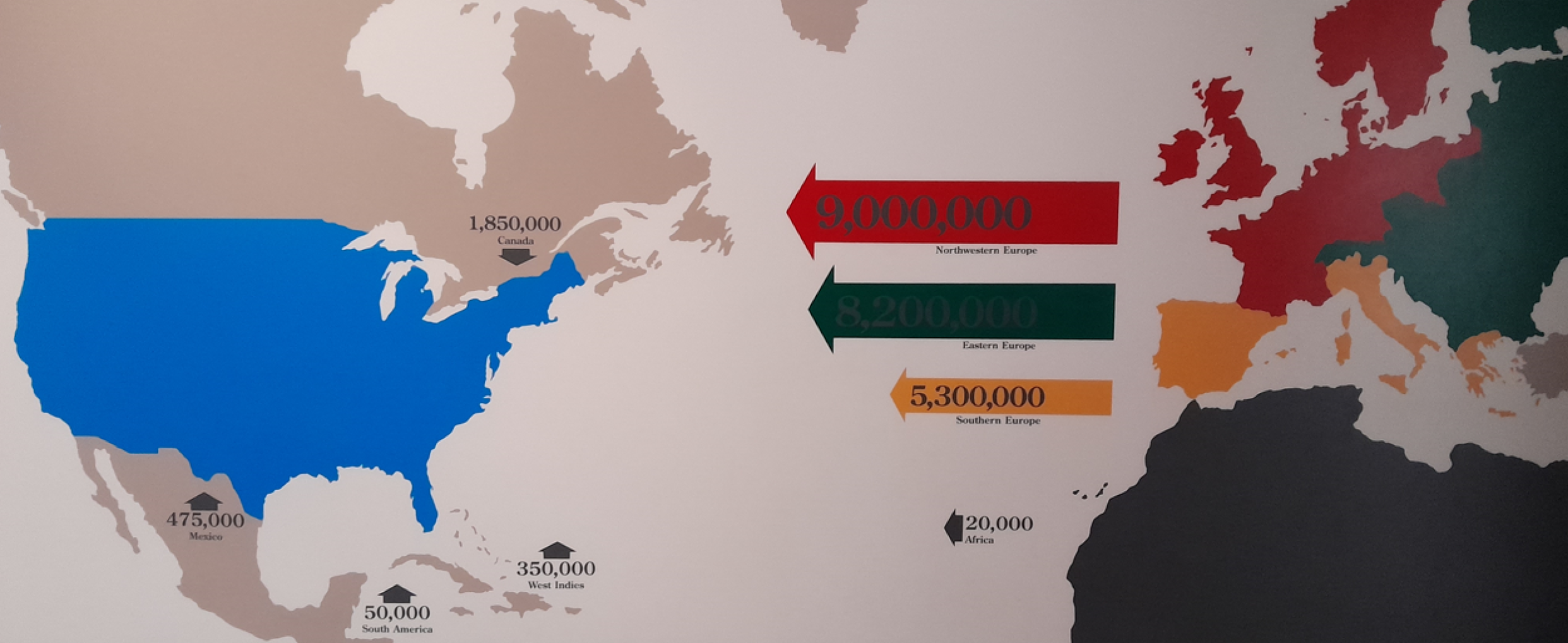
Paths of Migration 1880–1924.
These two abbreviated colonial histories neatly captured how we can begin “to think differently about the urgent questions of citizenship in the present…” in a more “broader frame within which all such questions about citizens and refugees and migrants play out” (Bhambra 2017, 401).
Discussion and Conclusion
Reducing the fore-discussed racialized hierarchies to Poland and Ukraine seems all too easy. To provide some broader contexts that might seem unfamiliar to the political situation in CEE, it is important to frame the above-racialized hierarchies beyond Poland and Ukraine. To this end, the pushbacks and denial of access to asylum at the Poland–Belarus border need to be understood beyond the activities of the Polish Border Guard. In a broader sense, Frontex (the EU's border agency that coordinates and manages European border policies) has already orchestrated a hostile border regime at various locations across the EU's frontiers, most notably in Bulgaria, Croatia, Cyprus, Greece, Hungary, and Malta (Human Right Watch 2021). Frontex's tactics for border enforcement were only weaponized by the Polish Border Guard, as evident in the securitization of largely non-European migrants at the Poland–Belarus border. Similar to the 2015 migration incidents, the pushbacks brought about wire fence-building at the EU's Eastern borders with Belarus and the opening of new camps in Poland to detain people classified as “undeserving migrants” (Amnesty International 2022). Therefore, what we have here is not exactly a case of one Eastern European nation's attempt at border regulations, but a more comprehensive European aggressive border regime unleashed at the EU's frontiers, whose victims are largely Black and Brown people from Asia, the Middle East, and Africa.
Framing the issues of race, racism, and migration in this way requires setting out their operations elsewhere in Europe, especially in the West. As the EU Agency for Fundamental Rights’ (FRA) report — “Being Black in the EU” — stresses, there is a widespread discriminatory practice across countries in Europe, leading to an understanding that “racial discrimination is a reality in all areas of life” of people of color in the EU. This includes harassment, violence, racial profiling, and the impact of skin color on access to adequate housing, all motivated by the logic of race (FRA 2019). The report is consistent with Benson and Lewis’ (2019, 2211–2212) ground-breaking project that brings further attention to issues concerning race and racialization of people of color in the EU. In it, they point out the everyday, structural, and institutional racism experienced by this group in the EU-27 as part of “the routine racial exclusion at the core of collective imaginings of who is British and who is European.” This suggests that many countries in Europe have “preferences for ‘white’ immigrants [that] construct ‘whites’ position at the top of two intersecting hierarchical systems: one a racial system, and the other a hierarchy of nations that some refer to as the world system” (Bashi 2004, 585; Krivonos 2023; Lewicki 2023).
The crucial point to underscore here is that the form of inequalities that manifested at the Poland–Ukraine border alongside the Poland–Belarus border stand-off has a long-standing existence that is not specific to particular countries or situations. As Bhambra (2022) writes, those situations seem global both in their current form and historical makeup. Therefore, in order “To capture the elasticity of race as a concept in shaping the national tradition of all European countries,” Turda (2022, 322) suggests, “one needs to travel widely, across historical periods and geographic locations….” Perhaps a good starting point would be in the UK, where Black, Brown, and other minority ethnic groups are still likely to experience racist incidents that include and not limited to stereotypes related to their appearances, and institutionalized racism (Murji 2006, 270–272). An explicit indication of this entrenched racism within institutions is the new racialized immigration regime brought about by the Brexit referendum in the UK (see Benson et al. 2022). Under this system, Ukrainian refugees would not have to settle in shanty-camp in Calais or cram on dinghies trying to cross from Calais to Dover or fighting deportation from the UK to Rwanda. Such an ordeal seems easily applicable to mainly refugees of color.
Similarly, in Italy, a country with a history of mass emigration and one of Europe's migrant flashpoints, Black people (born or raised in Italy) are often perceived through the racist, xenophobic political scaremongering tactics designed to warn white Italian voters about the “dangerous” immigrants and refugees crossing the Mediterranean Sea from Africa (Proglio et al. 2021). In Spain, perceived physical traits, especially skin color, continue to shape social inclusion, exclusions, and differential social treatment (Rodríguez-García 2022). Despite the upward mobility of children of North African immigrants in France, their Frenchness seems to be limited. As Beaman (2012) observes, these particular people are perceived through the lens of partial assimilation that racialized their claim to Frenchness. In Germany, many Black Germans live with experiences of racial discrimination (Aikins et al. 2021), as recently identified in a report by the United Nations, showing that people of African descent in Germany experience different forms of racism shaped by xenophobia and Afrophobia (United Nations 2017, 3). In the Netherlands, an individual bearing a Dutch name is more likely to get through selection procedures for employment or housing, compared to an individual whose name carries, for instance, an Arabic origin. This implies that people from “non-Dutch” backgrounds have fewer opportunities than those identified as “native”/white Dutch (Felten et al. 2021). A similar trend has emerged in Russia, where immigrants from sub-Saharan Africa experience, among other forms of exclusion, housing discrimination shaped by their skin color (Oni 2023).
The above accounts of being out of place (Puwar 2004) suggest that race and racism are not exceptional in Ukraine, Poland, or Russia. Framing the above-lived experiences of people of color in this way brings into view the web of stereotypes lurking behind their everyday representation (Van Den Berghe 1988; Shohat and Stam 1994), as a way of Europe's “embracing whatever group of immigrants [deem] to be deserving” (Younge 2022). This seems to be a framing that manifests itself beyond a particular region in Europe.
Footnotes
Declaration of Conflicting Interests
The author declared no potential conflicts of interest with respect to the research, authorship, and/or publication of this article.
Funding
The author disclosed receipt of the following financial support for the research, authorship, and/or publication of this article: This work was supported by the Leverhulme Trust, (grant number Grant number ECF-2020-080). A version of this article was presented during a public event on 'Racial Borders' at the Collège de France. The author would like to thank the staff and students for their comments, IMR’s editors, and the two anonymous reviewers for their feedback on the early versions of this article.
