




Abstract
Migrant entrepreneurship is viewed as a pathway to substantive social integration, one that makes host countries more prosperous in the process. Accordingly, scholars have studied the social context in which migrant entrepreneurs operate, and considered at length the range of policy options that governments can use to support their activities. Conversely, the issue of public attitudes to policies that support migrant entrepreneurship has been largely neglected. Leveraging the case of North Korean migrant entrepreneurs in South Korea, this article fills this gap in the literature by examining how the structure of government support within a broader “policy mix” for migrant entrepreneurship policies acts on public attitudes. Overall, it finds South Koreans are most supportive of migrant entrepreneurship policies endorsed and paid for by large companies through corporate taxation or loans to the individual, rather than the state, and which have a target goal of employment support for profitable migrant-run firms or joint ventures run by teams of natives and migrants. Notably, policies explicitly justified as tools to address discrimination actively discourage support. The specifics of the Korean case show that determinants of native hostility toward migrants apply to migrant entrepreneurship even when ethnic differences and many of the institutional barriers that apply in other cases do not exist, suggesting that ethnicity is not a major motivating factor; economic rationality and what is “good for South Korea” are.
Introduction
What are public attitudes toward migrant entrepreneurship policies? Given that entrepreneurship fosters socioeconomic integration among migrants and makes the host country more prosperous, this is an important question (Rath and Swagerman 2016; United Nations Conference on Trade and Development 2018). However, while scholars have studied the social context in which migrant entrepreneurs operate (Ram, Jones and Villares-Varela 2017; Sinkovics and Reuber 2021), with new work focusing on policies in place to support them (Solano 2021), the existing literature has largely neglected the issue of public attitudes toward policies that support migrant entrepreneurship. Using the case of North Korean migrant entrepreneurs in South Korea, this article fills that gap in the literature by examining how the structure of government support within a broader “policy mix” for migrant entrepreneurship policies affects general support and social integration.
North Korean migrants in South Korea provide a good case study for social integration. An ethnically identical, culturally and linguistically similar group, North Korean migrant entrepreneurs — indeed, all North Korean migrants 1 — have near-automatic citizenship rights in the Republic of Korea and, while by no means free of discrimination and integration challenges, do not face the same obstacles that migrant entrepreneurs elsewhere often do. As a result, they are, in a sense, among the least likely among all migrants in developed countries to face barriers to integration. Accordingly, the advantageous conditions obtained in their migration and resettlement facilitate the examination of whether public attitudes that might otherwise be attributed to race or ethnic-based prejudice, a common finding elsewhere, could instead represent simple immigrant discrimination.
Using a choice-based conjoint experiment supported by open-text answers, we examine the determinants of attitudes among South Korean residents regarding business support policies targeting North Korean migrant entrepreneurship. The conjoint permits us to test the simultaneous effects of various attributes in a multidimensional design (Hainmueller, Hopkins and Yamamoto 2014), and the open-text answers allow us to understand better what motivates support. The work is inspired by the policy mix literature, which focuses on policy instruments and goals, policy rationales, actors, and funding mechanisms (Flanagan, Uyarra and Laranja 2011; Borrás and Edquist 2013; Gok et al. 2013; Magro and Wilson 2019).
The specific content of the experimental design reflects theoretical expectations drawn from the literature regarding public attitudes toward immigration and migrant welfare support and the socioeconomic and political context specific to South Korea, with a focus on the policy goals, instruments, and eligibility requirements but considerate of the extent to which prejudice, economic self-interest, and broader sociotropic concerns drive preferences. Furthermore, we consider how endorsements by particular partisan or civic actors impact public support for specific migrant entrepreneurship support policies (Schläpfer and Schmitt 2007).
The article proceeds as follows. We begin with a short review of the literature on migrant entrepreneurship and attitudes toward migrants generally to generate a set of theoretical expectations informed by the literature and categorized according to the typology common to the policy mix literature. We then provide a primer on North Korean migrants and migrant entrepreneurs in South Korea, which justifies our case selection. Following this, we review the research design and other methodological considerations and present our findings. In the conclusion, we offer a summary, consider the limitations of our findings, and introduce avenues for future research.
Constructing Migrant Entrepreneurship Support
The existing literature on migrant entrepreneurship focuses on the experiences and issues faced by these entrepreneurs (Rath and Schutjens 2015; Ram, Jones and Villares-Varela 2017) and policies designed to support them (Solano 2021). The United Nations Conference on Trade and Development (2018) and the European Commission (2016) have both published guides on best practices for supporting migrant entrepreneurship. Reflecting the focus of this literature, these guides focus on policy priorities and measures of effectiveness, such as policy strategy coherence, regulatory optimization, human capital development (education and skills), technology exchange, access to finance, and awareness and networking. Building on this work, Solano (2021) utilizes the European Commission's framework to examine the scope of policy support in different countries, and the institutional framework that migrant entrepreneurs face, including restrictions on self-employment, sector-specific restrictions, and forms of policy support offered to address barriers to entry.
However, the focus on program evaluation and policy best practices reflected in the United Nations and European Commission reports tells us little about public opinion regarding different policy options. Given the importance of public support for redistribution and migrant integration, this constitutes a considerable knowledge gap. The lack of political power and social capital for minority groups, like North Korean migrants, means they cannot wield much influence over policy (Kloosterman, Van Der Leun and Rath 1999; Barrett, Jones and McEvoy 2001; Jones et al. 2014). Therefore, public opinion is potentially more important in determining the contours of policy design (Burstein 2003; Wlezien and Soroka 2016; Klüver and Pickup 2019).
Migrant entrepreneurship support policies are wide-ranging, but the literature on public attitudes toward immigrants and migrant welfare provisions indicates that some policies may be more popular than others. Casting these provisions as part of a broader policy mix (Flanagan, Uyarra and Laranja 2011; Cocos and Lepori 2020), we review the most relevant aspects, mechanisms driving attitudes, and expected outcomes.
We start with the policy goal, rationale, and public cost. The literature on public attitudes toward migrants indicates that natives may discriminate against the “other,” but the reasons for this are manifold (Hainmueller and Hopkins 2014). There is an extensive literature that considers the extent to which discrimination is motivated by sociotropic concerns (Solodoch 2021), material self-interest (Gerber et al. 2017), and exclusionary attitudes toward ethnically and culturally dissimilar migrants (Esses 2021). 2 However, the boundaries between these motivations are not always clear.
Concerns about employment (labor market competition) and costs to the taxpayer (welfare costs) are generally considered sociotropic or individual material self-interest-related and primary motivations of public attitudes. Hence, in many countries, natives generally support high-skill over low-skill immigration (Tzeng and Tsai 2020). Sociotropic concerns, which regard natives’ opinions about the economic or cultural impact of immigrants on the entire country (Kinder and Kiewiet 1981), may motivate natives in favor of migrant entrepreneurship that has a positive effect on employment or the business environment generally, while perceived economic self-interest may mean respondents favor programs that come at low to no cost to the taxpayer or offload costs onto other groups in society (Gerber et al. 2017). Relatedly, the literature on welfare chauvinism indicates that natives are highly motivated by a contributory principle.
Berens and Gelepithis (2019) and Eick and Larsen (2022) perceive migrants as newcomers who have not sufficiently contributed to the tax base to warrant certain kinds of support, like nonrepayable grants or cash transfers.
Given prior research on the potential salience of labor market competition for opposition to immigration generally (Hainmueller and Hopkins 2014; c.f. Hainmueller, Hiscox and Margalit 2015), we expect policies that create jobs to generate strong support. We also expect respondents to favor lower-cost programs and those which shift costs away from them and those around them.
Next, we examine the policy instrument and its target beneficiaries. Exclusionary attitudes, frequently tied to ethnic discrimination, often fuel concerns about labor markets and costs. Thus, providing economic support to migrants is often structured by exclusionary attitudes toward an ethnic “other” (Careja and Harris 2022). 3 Even when the other is a co-ethnic, an exclusionary attitude toward non-natives may prevail (Kim and Lee 2022; Ward and Denney 2022). These findings suggest that natives might be unwilling to grant significant financial support to foreign-born entrepreneurs. Thus, they may support more exclusionary institutions that limit foreign ownership or entrepreneurial autonomy.
Research suggests that besides the usual aspects of the policy mix, 4 such as instruments and goals, political elites’ cues may also affect attitudes, as they frequently guide public opinion formation (Nicholson 2012; Druckman, Erik and Rune 2013; Bullock 2020).
Endorsements from specific parties or political leaders can affect support for policies that target migrant groups, either through motivating support (Harteveld, Kokkonen and Dahlberg 2017) or opposition (Rossell Hayes and Dudek 2020).
Interest group and civil society endorsements may act as another form of elite or group cues. Research indicates that support for particular migrant-related policy proposals among specific interest groups, especially business associations, will likely impact attitudes toward immigration policies (Facchini, Mayda and Mishra 2011; Freeman and Tendler 2012). Likewise, civil society organizations are seen as facilitating significant changes in migration policy (Narkowicz 2018; Chung 2020), although the evidence for the effects is mixed; the limits to public awareness of civic groups make their expected endorsement impact on public opinion unclear (Dür 2019; Jungherr et al. 2021).
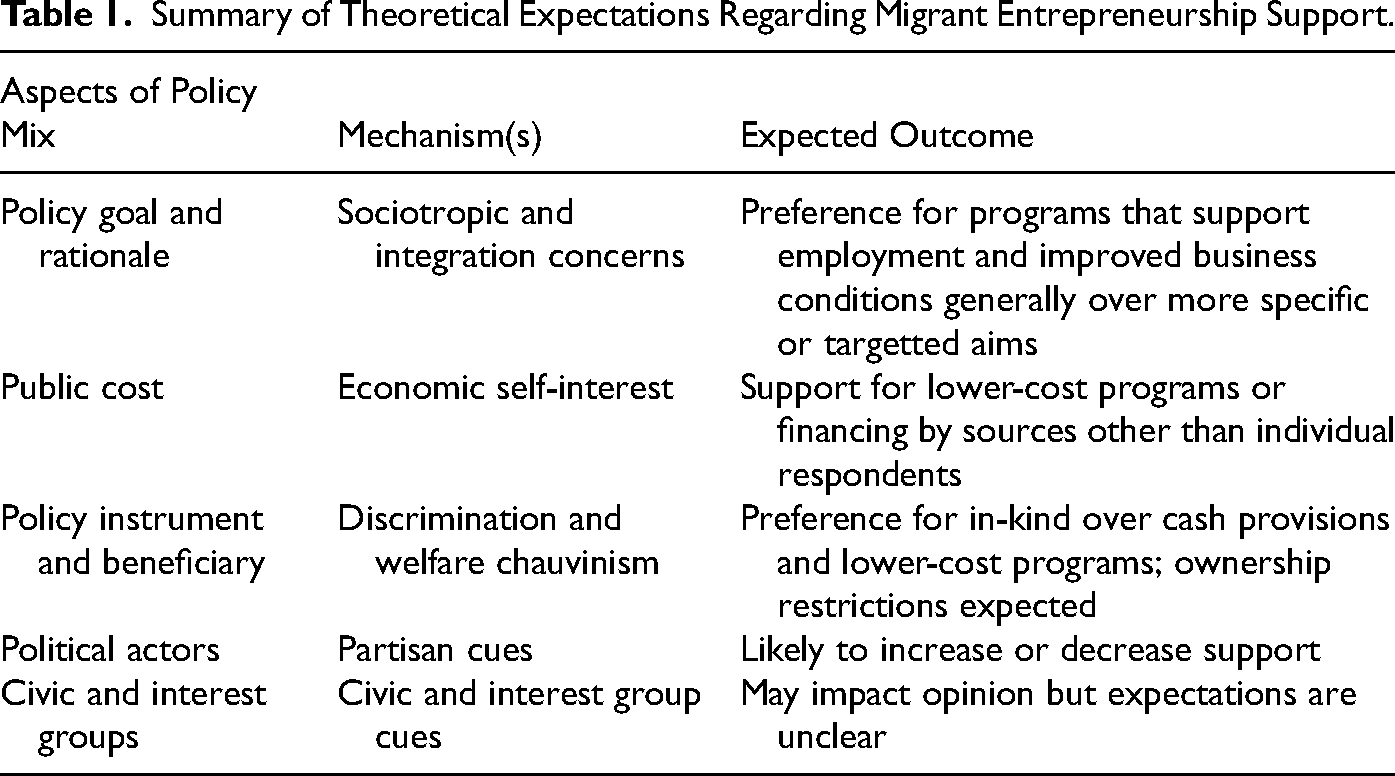
Table 1 summarizes the broader theoretical approach employed in this research, specifying the aspect of the policy mix we are concerned with, mechanisms that motivate attitudes, and expected outcomes for public opinion. In the next section, we discuss our case selection in more detail and then connect our theoretical approach to our experimental design to show how we empirically resolve our theoretical expectations.
Summary of Theoretical Expectations Regarding Migrant Entrepreneurship Support.
North Koreans in South Korea
This article examines North Korean migrant entrepreneurs in the Republic of Korea (or South Korea). Unlike other migrant groups, North Korean migrants who arrive in South Korea have near-automatic rights to citizenship (Denney and Green 2018; cf. Greitens 2021). This is due to the South Korean government's geopolitically inflected view of North Koreans in the North as co-nationals residing within its sovereign territory. Consequently, upon escape and subsequent resettlement, these migrants are provided with considerable support.
North Korean migrants do not face many of the same resettlement and integration barriers that other migrants do, including relatively low levels of discrimination (Ha, Cho, and Kang 2016; Denney and Green 2021). They do not encounter rigid language barriers (Ram, Jones and Villares-Varela 2017) nor institutional restrictions on residency and self-employment, which are common to many migrant entrepreneurs (Solano 2021).
From the standpoint of case selection logic, a common ethnocultural origin coupled with the absence of clear and visible boundaries presents a unique research design opportunity. The scenario allows us to investigate whether attitudes typically attributed to racial or ethnic-based discrimination might be manifestations of straightforward immigrant discrimination. Co-ethnics from North Korea are, arguably, some of the least likely among migrants to face barriers to integration. Alba (2005), for instance, notes four potential “bright boundaries” that may demarcate native-immigrant group membership: citizenship, religion, language, and race. None of these visible boundaries apply to North and South Koreans. Thus, factors that might otherwise confound claims of integration success (or failure) are controlled for naturally (Hur 2023).
Despite their shared ethnocultural origins, integrating North Korean migrants into South Korean society is not seamless. The attitudes of native South Koreans toward people of North Korean origins and the welfare policies to support them are not resolutely positive (Denney and Green 2021; Ward and Denney 2022). Moreover, the level of favorable opinion typically understood may be significantly overstated due to the social desirability bias in existing public opinion data (Denney, Ward and Green 2022). Existing research indicates a lack of social integration among North Korean migrants (Yoon 2021; Hough 2022b), reinforcing the importance of the current study from both comparative and South Korea-specific perspectives. Multiple studies show this group faces systemic and everyday discrimination (e.g., Kim and Jang 2007; Bidet 2009; Youm and Kim 2011). Surveys also find that cultural and language differences impede faster and more substantive social integration (Hana Foundation 2017: 16; Hana Foundation 2020: 40; Hana Foundation 2021: 41). Above all else, we still know very little about the experiences of North Korean migrants as entrepreneurs, which this study aims to address.
Regarding the number of migrant-run firms, estimates vary. Survey data collected in 2022 by the South Korean government indicates that about 17 percent of North Korean migrants working in South Korea are self-employed, either with or without employees (Hana Foundation 2022: 50). Considering that 63 percent of the migrant population is economically active and 59 percent are employed (Hana Foundation 2022: 46), approximately 3,000 migrants out of the total defector-migrant population of 33,916 run their own businesses as of March 2023. 5
A 2018 survey of 131 North Korean migrant entrepreneurs found that more than 80 percent work in the services industry (e.g., food services or retail), 16 percent in manufacturing or construction industries, and 7 percent in agriculture (Asia Foundation 2020). This same survey points to two significant obstacles faced by North Korean refugee businesspeople: (1) difficulties handling the regulatory and institutional environment in South Korea and (2) raising sufficient capital to finance investments and their businesses as ongoing concerns. Existing government support programs have focused on education and training, with some schemes also seeking to cultivate social enterprises. In contrast, some of the country's policy banks, foundations, and government corporations have also offered financial support through subsidized loans and loan guarantees (Kim et al. 2015: 5–8).
Data and Methodology
We use a choice-based conjoint to measure preferences for various policy proposals. A commonly used experimental approach in the political and social sciences (Hainmueller, Hopkins and Yamamoto 2014), the conjoint is a multidimensional design ideal for testing the simultaneous effect of different attributes on an outcome. In this case, policy support for North Korean migrant entrepreneurship.
As discussed, our research design is motivated by the literature on policy mixes. In designing the conjoint, we choose attributes reflective of our various quantities of interest regarding public attitudes toward migrant support policies. These attributes include the policy goal and rationale, funding instrument, and endorsement by political, business, and civil society actors. Our design choices reflect what we find to be theoretically and substantively meaningful. Table 2 shows our choice of attributes and their corresponding levels. Each attribute demonstrates an aspect of the policy mix identified above, and the levels reflect theoretically motivated and locally relevant values.
The Policy Mix: Defector Business Support Attributes and Values.
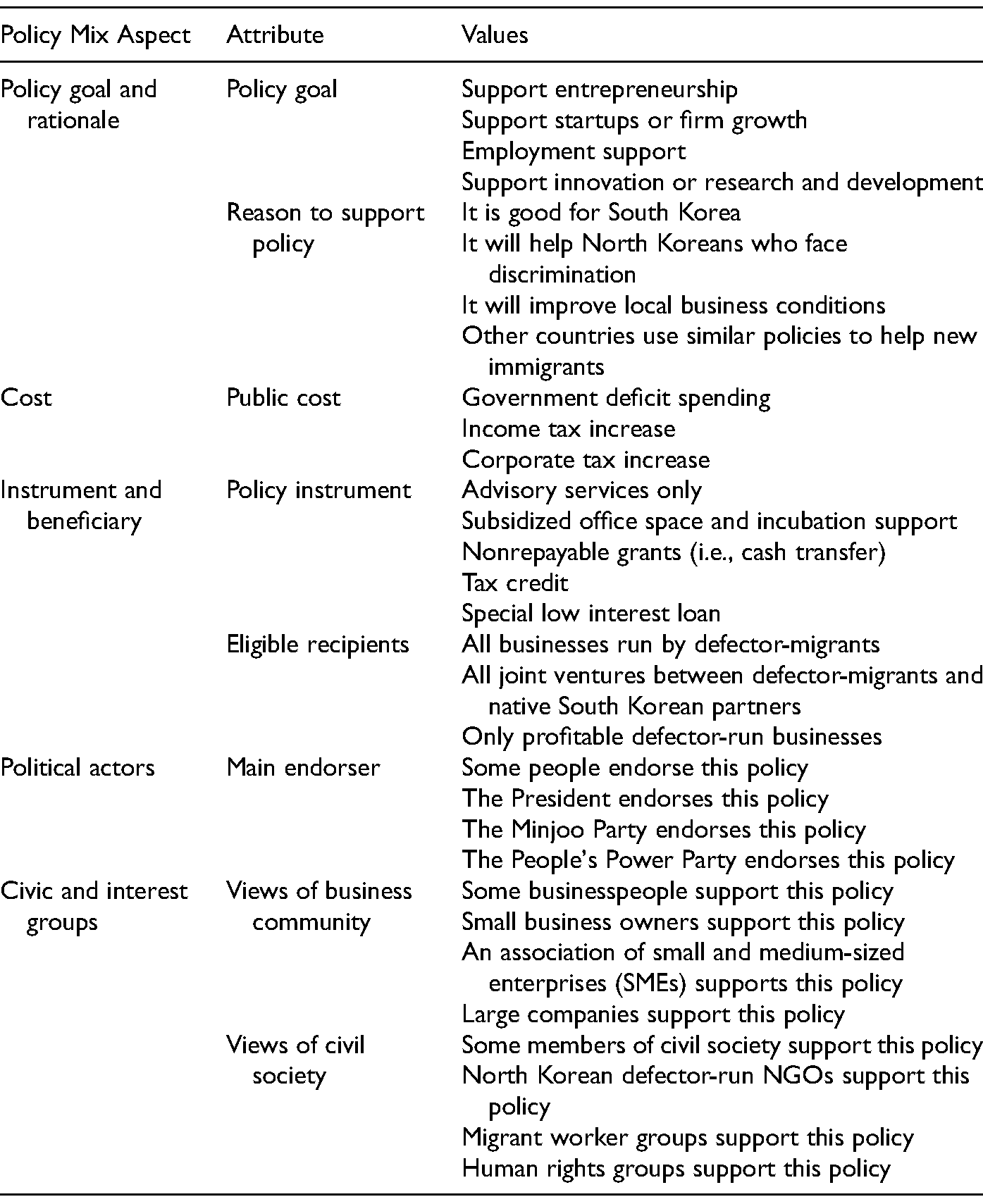
Attributes also contain a level we consider a “natural” reference category, as either a conceptually meaningful but nonspecific value (e.g., “support entrepreneurship” or “some businesspeople support this policy”) or as an intuitive default value, such as “all businesses” under the recipients attribute as a commonsense assumption for who will get support, or “deficit spending” as a common and easy way for governments to fund programs.
Among the attributes devised, the policy goal is most notable as the attribute that, in our view, is most closely related to the concept we are most interested in — social integration via migrant entrepreneurship. Within this attribute, the “employment support” 6 policy goal is that which measures most directly the social integration aspect of migrant entrepreneurship support (Brell, Dustmann and Preston 2020). We give particular focus to this attribute in the analysis below. The other policy goals aim to mirror common types of entrepreneurship support.
The given policy rationales aim to gauge the extent to which we can persuade respondents to aid in the integration process, either through a discrimination-based reason (“help North Koreans who face discrimination”) or an economic reason (“business conditions”). Appealing to “other countries” draws on the idea that South Koreans may wish to reflect policies common internationally, and the general category “it is good for South Korea” represents the default value, reflecting a general sense of being good for the country.
The public cost and instrument values draw from the migration integration literature (e.g., United Nations Conference on Trade and Development 2018; Solano 2021) and broader policy mix literature on interventions for business support reviewed above. Eligible recipients measure types of economic (“only profitable migrant-run businesses”) or social discrimination (“joint ventures with South Korean partners”) regarding natives’ ownership preferences for firms receiving policy support.
We designed the remaining attributes (endorser, business view, and civil society view) to symbolize different actors who might trigger political or group cues. For political endorsers, we use the ruling (“Minjoo Party”) and opposition (“People's Power”) parties at the time of the survey, the president, and the general nonpoliticized reference value. 7 Business group values represent common categories in industrial democracies. Civil society groups represent generic (“human rights groups” and “migrant worker groups”) and three specific to South Korea (“North Korean migrant-run,” “Joint Venture,” and “Profitable North Korean migrant-run”).
For the completion of the experiment, we recruited 2,009 South Koreans from a nationally representative online panel of participants who opted in between August 26 and September 27, 2021. We balanced the sample according to age, region, and gender quotas to align with that year's population statistics. Appendix A in the Supplemental information offers a more comprehensive sample overview.
After introducing the research, we instructed respondents to consider a hypothetical situation where the South Korean government would enhance its support for businesses owned by North Korean migrants. We then asked them to assess two competing policy proposals and choose the one they support the most. After making this forced choice, we asked respondents to rate their level of agreement with each policy on a scale of 1 to 7. Each respondent completed the exercise (a “task”) five times, resulting in a total sample size of 20,090 (2,009 * 5 * 2). After the fourth profile, we asked respondents to justify their chosen policy option. We fully randomized attribute levels for each task. To avoid order effects, so too are the order of the attributes. Figure 1 shows an English-language approximation of what each respondent saw when completing a task.
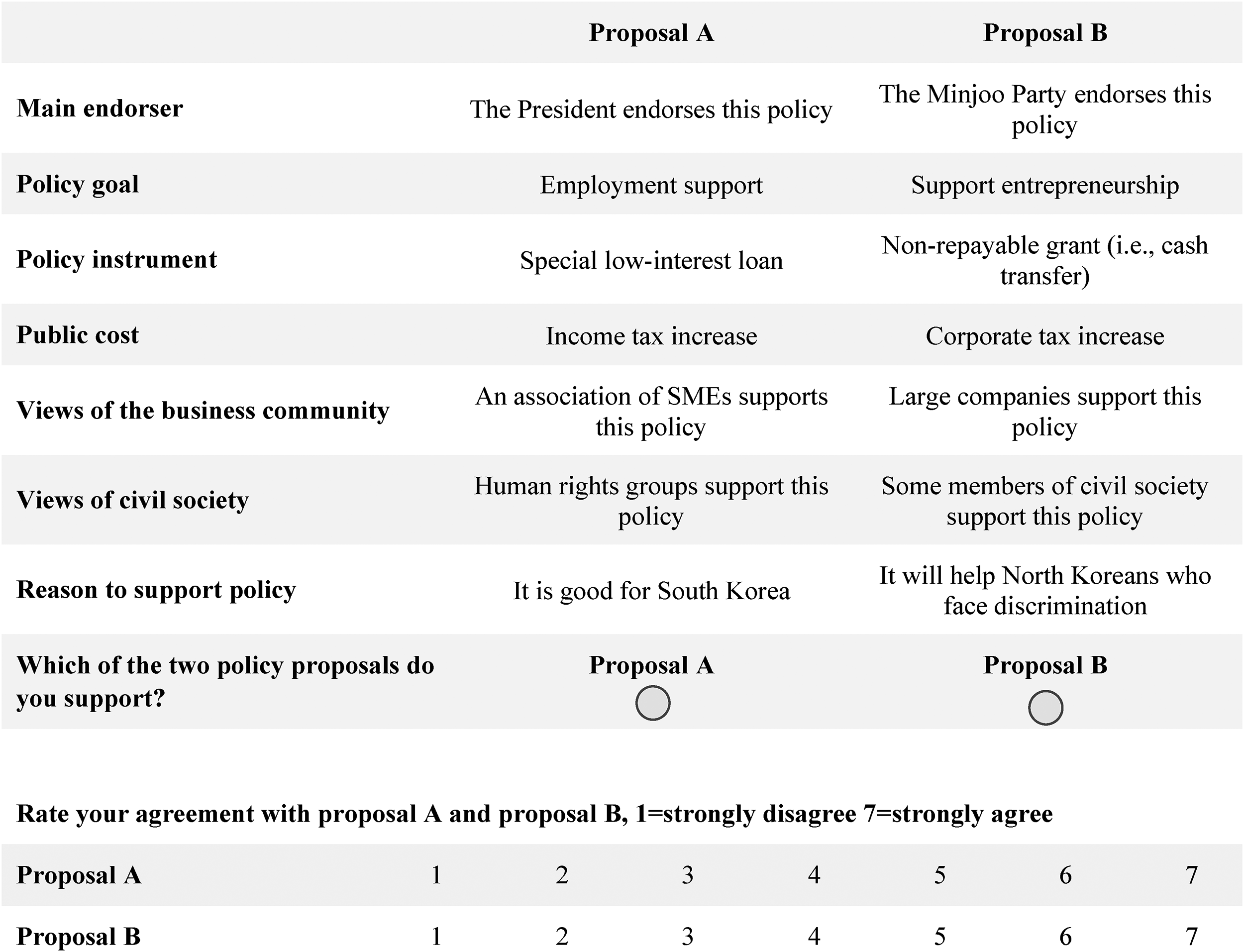
The experimental design.
We conduct the primary analysis of the experimental data by estimating attribute level effects using Average Marginal Component Effects (AMCEs) and Marginal Means (MMs). AMCEs display the causal impact each attribute level has on the likelihood of policy support, averaged over the effects of the attribute levels (see Hainmueller, Hopkins and Yamamoto 2014). Conversely, MMs demonstrate the mean outcome of each attribute level averaged across the rest. In a forced-choice design, the average is 0.50, with means above the average indicating attribute value favorability. The MM represents the percentage of profiles chosen given the attribute value. Leeper, Hobolt and Tilley (2020) show that MMs complement AMCEs and are advisable for interaction models and estimating conditional average treatment effects. We conduct textual analysis using a mixed-methods approach, which involves topic modeling and qualitative analysis, described in more detail below.
Findings
Figure 2 shows the main effects of the attribute levels using AMCEs and the descriptive MMs. 8 Overall, we see that migrant entrepreneurship policy with goals of employment support, paid for by corporate tax increases, issued in the form of a repayable loan, and endorsed by the business community are specific aspects of the policy mix that motivate public support. There is a preference that only migrant firms that have demonstrated economic viability (profitability) or those in a joint venture with a native should be eligible. Further, we see that rationales that benchmark other countries’ immigrant support policies discourage support, as do cash transfer instruments (nonrefundable grants), and political endorsements — especially by the Minjoo Party.
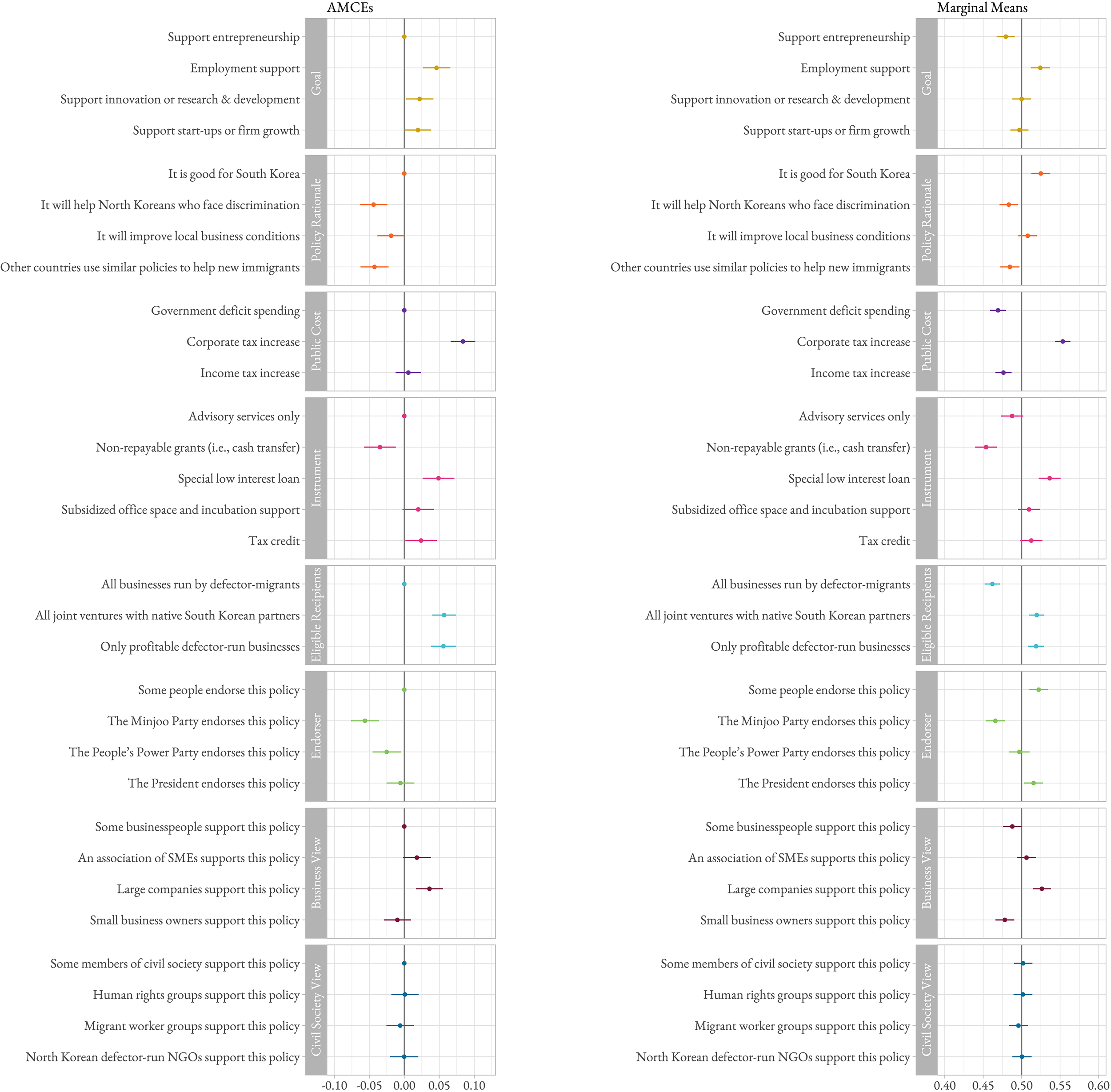
The effects of policy mix attributes on the probability of support for migrant business policy. Note: For Average Marginal Components Effects (AMCEs), the estimates show the effects of the randomly assigned information attribute values on the probability of use. The point values from the Marginal Means (MMs) show the mean outcome of any given attribute level, averaged across all others. The estimates and means are based on the benchmark ordinary least squares (OLS) model with clustered standard errors. The error bars represent 95% confidence intervals. “SMEs” in the attribute text stands for “small and medium-sized enterprises.”
The largest marginal component effect is for public cost. “Corporate tax increase” moves respondents to support the policy mix by shifting financial responsibility to corporations. Relative to the baseline category (“deficit spending”), if corporations pay for the policy, the probability of policy support increases by 8.4 percentage points, according to the AMCEs. On the other hand, according to the marginal means, respondents choose policy profiles containing this attribute level 55 percent of the time. We notice similar positive effects for eligibility. Relative to the level specifying eligibility for all migrant-run firms, if joint ventures or profitable migrant-run businesses are specified, the probability of policy support increases by six percentage points each. 9
Overall, a clear economic rationale drives preferences, but these preferences connect to broader sociotropic concerns and the support for social integration through employment. The preference for the policy goal of “employment support,” which is the most favored one, evidences this connection. 10 To further explore the interaction of purely economic and broader sociotropic concerns, we examine the interaction between the policy goal and two other important policy mix features — eligibility and instrument. The focus is whether the attribute levels for these two additional features affect peoples’ policy goal preferences.
First, we examine the interaction between goal and eligibility (Figure 3). We observe interaction effects. The type of firms eligible impacts which goal of the migrant support policy people support. Broadly consistent with the main findings, respondents favorably appraise policies matching employment support with firms perceived as economically viable or socially desirable (“joint venture” or “profitable”). We observe that respondents do not prefer policies available to all migrant businesses. Still, when the stated goal is supporting employment, they do not oppose it either. For all other goals, respondents do not support policies open to all migrant firms. In other words, policies with employment goals to support North Korean migrant integration will not be opposed and will often be supported.
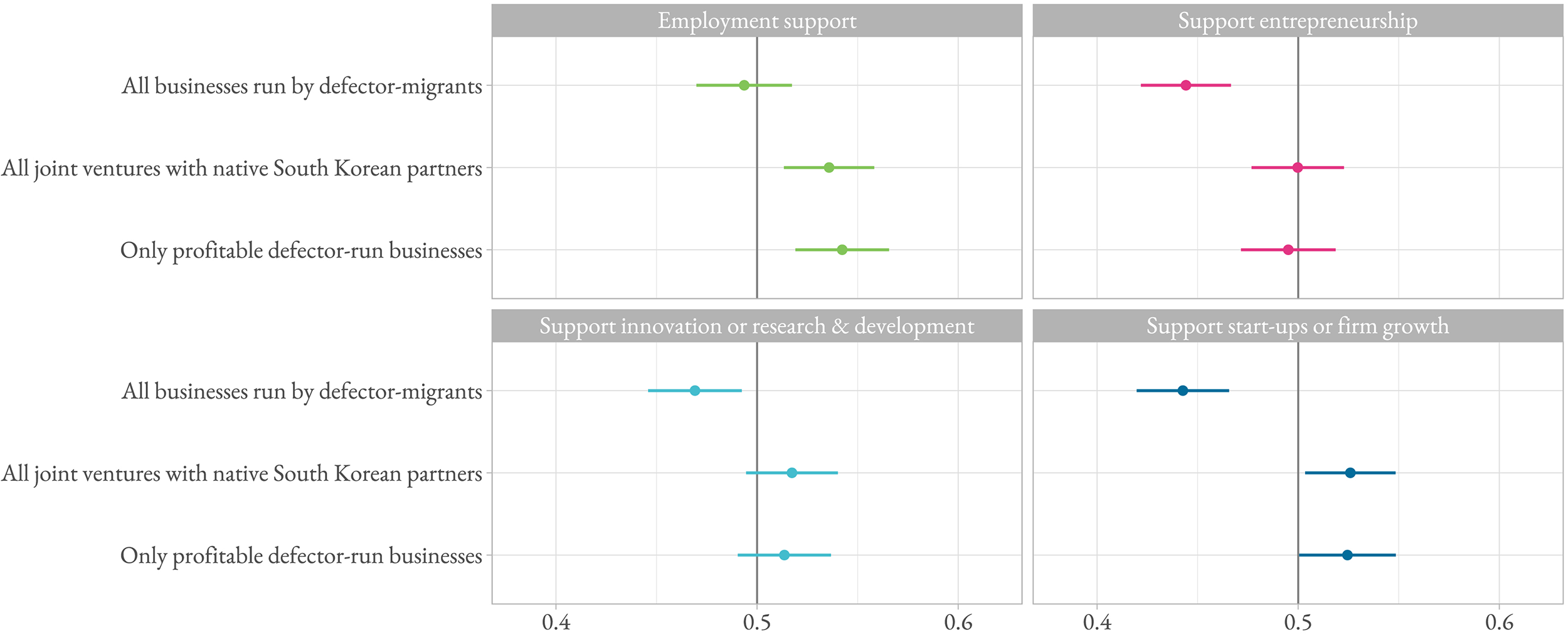
Marginal means of the interaction effects (eligible recipients * policy goal). Note: The point values from the Marginal Means (MMs) show the mean outcome of any given attribute level, averaged across all others. Estimates are based on the benchmark OLS model with clustered standard errors. The error bars represent 95% confidence intervals.
We examine policy goals and instruments for the second interaction (Figure 4). Here we see more evidence that when corporations are financially responsible for supporting the migrant entrepreneurship policies, respondents are encouraged to support any of the four policy goals more or less equally. While respondents do not favor the policy proposals in all other instances, it is worth noting that for “employment support,” there are no interaction effects, whether it involves deficit spending or increases to personal income tax. That is, respondents are neither motivated nor discouraged to support the policy. This finding further proves that respondents do not oppose migrant entrepreneurship policies supporting employment.
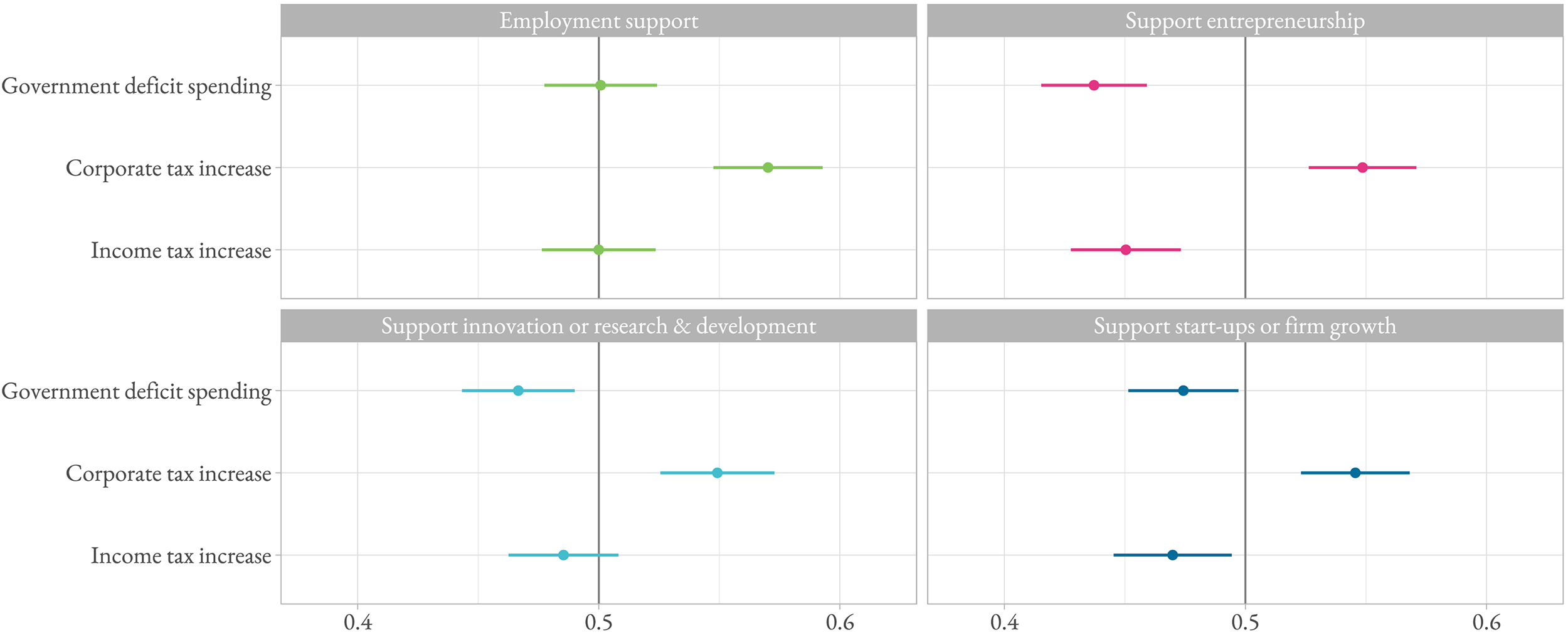
Marginal means of the interaction effects (policy instrument * policy goal). Note: The point values from the Marginal Means (MMs) show the mean outcome of any given attribute level, averaged across all others. The means are based on the benchmark OLS model with clustered standard errors. The error bars represent 95% confidence intervals.
Next, using the open-text answers collected after the fourth task, we examine what motivates migrant entrepreneurship policy support. This approach serves two partially overlapping purposes. First, we perform a robustness check on the conjoint analysis, confirming whether an alternative outcome measure corroborates the above interpretation. Second, in doing a robustness check, we seek to further unpack the rationales behind respondents’ policy preferences. We use a mixed-method approach, combining a topic modeling method with a general qualitative reading and, to validate the analysis, manual coding of the 2,009 open-text responses.
We apply Latent Dirichlet Allocation (LDA) for topic modeling, an unsupervised machine-learning approach to classify and understand text (Blei, Ng and Jordan 2003). This method allows us to identify the number of abstract “topics” within the responses and the words linked to these topics. Once we translate the answers from Korean to English and clean the data, we analyze the response for the optimal number of topics based on a statistical measure of semantic similarity and interpretability — the “coherence score.” Through this process, we identify two topics within the open-text responses.
Figure 5 reports the two topics and the words associated with them. The value on the x-axis indicates the probability of the word belonging to and thus defining the topic. The more familiar the word, the higher the probability score. Based on the words in each topic, we can then determine what the topic means or, more substantively, what meaning and rationale respondents were conveying in their answers. Topic 1, with words like “support,” “tax,” “policy,” “profitable,” and “employment support,” reflects an economically rational motivation for policy preferences consistent with the sociotropic and self-interested economic interpretations of the choice-based conjoint findings. Topic 2, however, reveals a different rationale. Words like “north korean,” “good,” and “support” are most common, with words like “rights” and “human rights” rounding out what appears to be a normative motivation for supporting entrepreneurship policies for North Korean migrants.
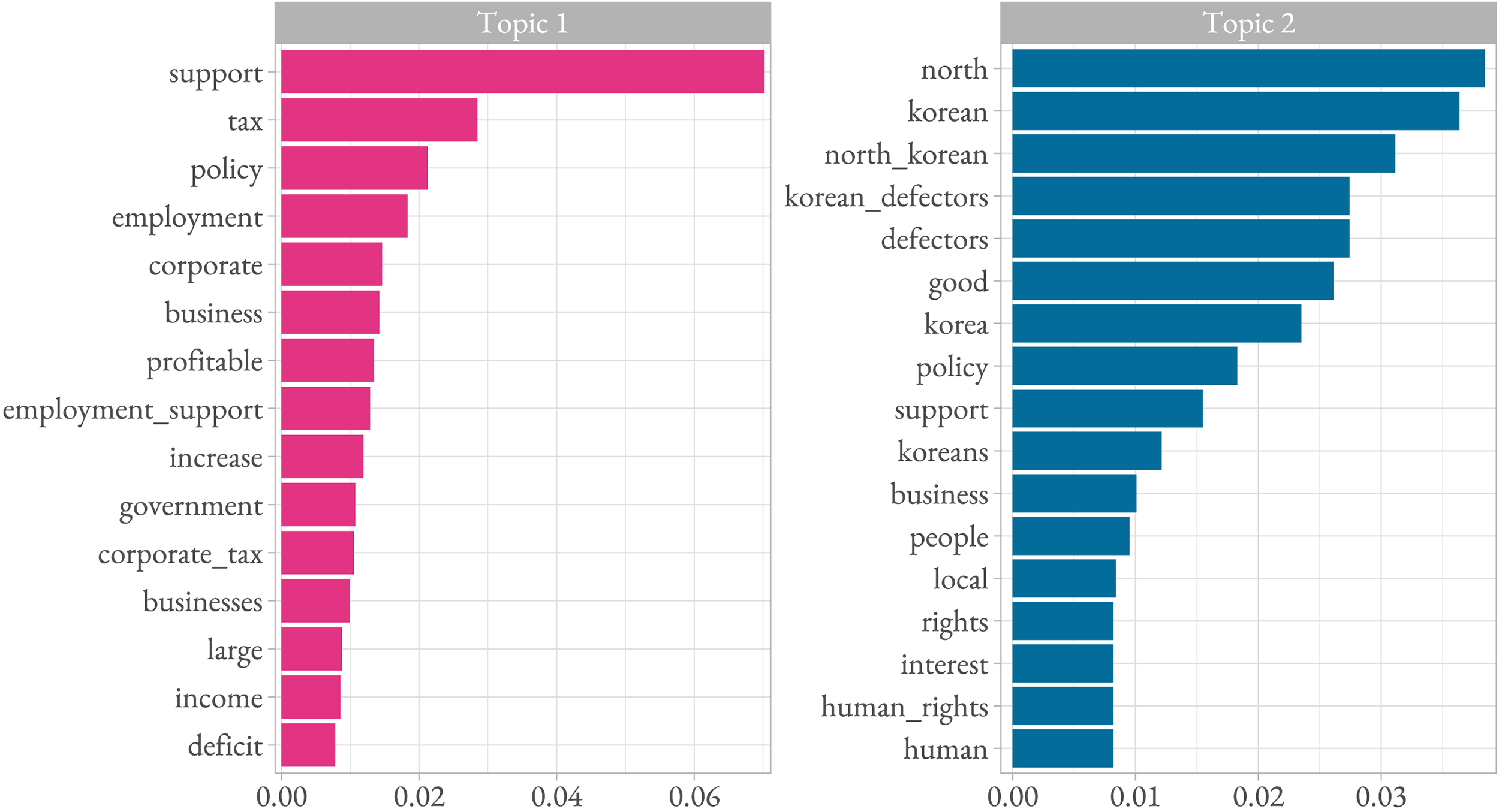
Topics from the implementation of Latent Dirichlet Allocation. Note: The values on the x-axis show the probability of the term given the topic.
While we did not necessarily expect the insight provided by Topic 2, the AMCEs and marginal means previously explored (see Figure 2) suggest that a normative rationale drives preferences. When it comes to policy rationale, “it is good for South Korea” stands out as the only attribute that positively influences a respondent's policy support. Our analysis highlights an overarching motivation concerning the actions that we should ideally initiate to assist in and promote the social integration of North Korean migrants. However, a closer examination of the data introduces more complexity to this interpretation.
Interestingly, the specification that the policy “will help North Koreans who face discrimination” slightly but negatively impacts the likelihood of policy support (see Figure 2). This observation contradicts the idea that South Koreans have a sense of moral obligation or normative commitment to help co-ethnic newcomers from North Korea. If co-ethnic effects are absent, then the motivation must be centered on some other concept of what is “good,” which raises an obvious question: good for whom?
We examine the respondent response-topic probabilities to understand the two topics’ significance better. In addition to extracting topics as a mix of words, the LDA model also estimates the probability that each respondent's answer belongs to either. Using only those answers for which there are >50 percent probability of belonging to the topic, we create two groups according to their open-text answers. Next, we conduct subgroup analysis on the conjoint data to determine whether policy preferences are conditional on whether the respondents belong to the first or second topic group. In other words, do those motivated by an economic rationale evaluate policy mixes differently from normatively motivated ones? Figure 6 reports the marginal means for the two groups. 11
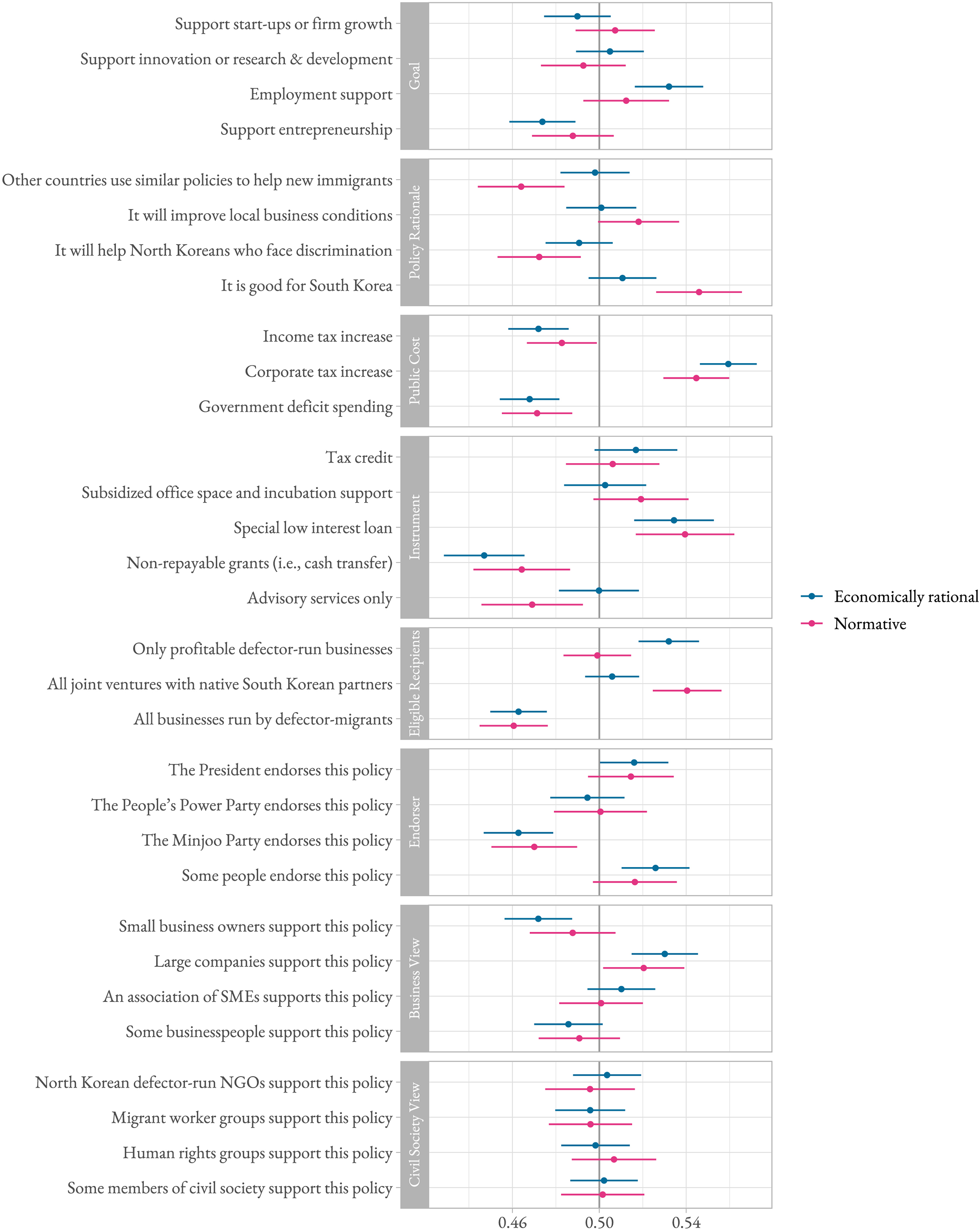
Marginal means for the topic subgroups. Note: The point values from the Marginal Means (MMs) show the mean outcome of any given attribute level, averaged across all others. The means are based on the benchmark OLS model with clustered standard errors. The error bars represent 95% confidence intervals.
Our findings show varied treatment effects across the attribute levels. As expected, respondents classified under Topic 1 favor policies targeting solely profitable migrant-run businesses, indicated by a marginal mean of 0.53. However, respondents under Topic 2 show ambivalence. Surprisingly, respondents classified as Topic 2 are more inclined to support policies rationalized as “good for South Korea,” reflected by a marginal mean of 0.55. However, if respondents belonging to Topic 2 are motivated in their policy preferences by some high-order principle to assist newcomers, as we posited above, then we expect to see an antidiscrimination logic moving opinions favorably. This is not the case. Helping “North Koreans who face discrimination” does not sway this group. They are discouraged from supporting a policy rationalized as similar to policies in other countries for helping new immigrants (MM of 0.47). Notably, this group shows the most enthusiasm in supporting migrant entrepreneurship when we restrict eligibility to joint ventures.
The findings suggest that respondents are mainly motivated by a South Korean-nation-centric logic that excludes overt consideration of North Koreans. One respondent from this group wrote, “If North Korean defectors are successfully settled, then it will be good for South Korea in the end.” Another respondent noted, “It is good for our country,” a common articulation of a similar sentiment. Moreover, drawing a sharp distinction between the two Koreas, one person remarked, “We do not need to support North Koreans, but [I chose the policy] because it is good for South Korea.”
The selected quotations show that South Korean respondents see the successful integration of North Korean migrants as good for South Korea. In this sense, it is similar to a sociotropic rationale insofar as respondents think migrant support policies that are good for the country are worthy of support. Notably, there is no mention of employment or a clear economic rationale. As such, it is a kind of support more abstract than that captured by the rationale observed in the Topic 1 group but arguably no less meaningful.
As noted in Figure 5 above, some terms seem more focused on North Koreans themselves (e.g., “human rights”). A search for responses containing “right” shows limited support for this interpretation, such as “human rights groups supported it” and “because human rights are important.” However, several respondents see human rights as a politicized concept and even note their opposition to human rights-motivated policies, noting that “human rights groups are problematic.” The endorsement of a human rights group motivated them to select the option not endorsed by such a group. Overall, the Topic 2 group is mainly concerned with helping North Korean migrants better serve the nation-state they belong to — the Republic of Korea.
Conclusion
The subject of support for migrant entrepreneurship has garnered attention in the realm of policy making, with an increasing academic interest following closely behind (Rath and Schutjens 2015; Ram, Jones and Villares-Varela 2017; Solano 2021). Despite a well-developed body of literature on public attitudes toward migrants (Hainmueller and Hopkins 2014; Gerber et al. 2017; Esses 2021; Solodoch 2021), there is little to no discussion of public attitudes toward migrant entrepreneurship support policies. This lack of discourse represents a notable gap in both policy and research, considering that many migrant entrepreneurs often find themselves socially and politically marginalized, hence less able to influence public policies that directly target them (Kloosterman, Van Der Leun and Rath 1999; Barrett, Jones and McEvoy 2001; Jones et al. 2014).
In this article, we demonstrate how empirically grounded and theoretically rigorous explanations of public attitudes toward migration can be applied to the issue of entrepreneurship support policy mixes. We use the case of North Korean migrants in South Korea because they are not generally considered an ethnic “other,” and face little to no institutional or linguistic barriers to integration.
Economic self-interest drives policy preferences among native respondents, according to our findings. They prefer policies funded through corporation tax and are sensitive to the fiscal burden of programs. Accordingly, respondents prefer loans to grants, profitable migrant businesses, and programs that support job creation. These attitudes align with sociotropic concerns highlighted in the existing literature (Berens and Gelepithis 2019; Tzeng and Tsai 2020; Eick and Larsen 2022), thus validating existing theories while demonstrating their applicability to migrant entrepreneurship. Such alignment represents a significant step forward in bridging the gap between the broader literature on public attitudes toward migrants and literature focused on barriers to migrant entrepreneurship (Rath and Schutjens 2015; Ram, Jones and Villares-Varela 2017) and policies to support these entrepreneurs (Solano 2021).
Interaction effects indicate that discrimination based on native/migrant ownership is less pronounced when support policies aim to support job creation, thus indicating that policy designs that focus on this particular concern may help overcome prejudicial attitudes. Conversely, when large corporations shoulder the costs of migrant support policies, respondents exhibit less concern about job creation, which is typically seen as a primary sociotropic issue. In other words, people are disinterested in policy aims when they do not have to pay.
Notably, endorsements by political parties or human rights organizations appear to have a negligible or negative impact on policy preference. This finding suggests that the role of partisan cues and support from some civic actors may not be as instrumental as previously assumed in building support for migrant support policies (Harteveld, Kokkonen and Dahlberg 2017; Chung 2020; Rossell Hayes and Dudek 2020).
Mixed-method analysis of the open-text data corroborates the main findings and furthers our understanding of natives’ motivations for supporting migrant integration through business support policies. Many respondents reference economic self-interest and concrete sociotropic concerns, while others invoke more abstract notions of the national or common good. However, these notions are not motivated by co-ethnic affinity or pan-Korean nationalism. If North Korean migrant entrepreneurs happen to benefit from a policy, it is seen as desirable because that outcome is in the broad national interest.
We note some limitations to the findings presented here. First, the immigrant group we focus on is small compared to the host society, and this smallness could affect the perception of the immigrant group and the extent of generosity natives are willing to extend (cf. Schneider 2008; Pottie-Sherman and Wilkes 2017). Second, the case is unusual because, to the best of our knowledge, most migration worldwide and most migrant entrepreneurship do not involve co-ethnic migrants. This circumstance prompts us to question whether designing policies addressing sociotropic and economic self-interest concerns will bolster public support for policies assisting migrant entrepreneurship, especially in cases where native-immigrant group boundaries are more defined. Given the paucity of literature on the subject, this article provides insights from which to consider other migrant entrepreneur groups.
Above all, people view entrepreneurship as a pathway to substantial social integration. This article's findings demonstrate the potential of a policy mix framework (Flanagan, Uyarra and Laranja 2011; Borrás and Edquist 2013; Gok et al. 2013; Magro and Wilson 2019) to connect the literature on migration (Tsuda 2009; Chung 2020; Denney and Green 2021) to research on entrepreneurship as a social integration mechanism (Rath and Swagerman 2016; United Nations Conference on Trade and Development 2018). Where much of the research across these domains takes a top-down perspective, we examine public attitudes and the determinants of support for migrant integration through the expansion of entrepreneurship support by operationalizing a policy mix framework using a conjoint design. As such, we forward a more complete view of migrant integration with academic and policy relevance.
Supplemental Material
sj-pdf-1-mrx-10.1177_01979183231203927 - Supplemental material for Public Support for Migrant Entrepreneurship: The Case of North Koreans in the Republic of Korea
Supplemental material, sj-pdf-1-mrx-10.1177_01979183231203927 for Public Support for Migrant Entrepreneurship: The Case of North Koreans in the Republic of Korea by Steven Denney, Peter Ward, and Christopher Green in International Migration Review
Footnotes

Declaration of Conflicting Interests
The authors declared no potential conflicts of interest with respect to the research, authorship, and/or publication of this article.
Funding
The authors disclosed receipt of the following financial support for the research, authorship, and/or publication of this article: This work was supported by the Academy of Korean Studies (grant number AKS-2021-R084).
Supplemental material
Supplemental material for this article is available online.
Notes
References
Supplementary Material
Please find the following supplemental material available below.
For Open Access articles published under a Creative Commons License, all supplemental material carries the same license as the article it is associated with.
For non-Open Access articles published, all supplemental material carries a non-exclusive license, and permission requests for re-use of supplemental material or any part of supplemental material shall be sent directly to the copyright owner as specified in the copyright notice associated with the article.
