



Abstract
Research on migration in arrival cities, particularly in the west, has traditionally focused on spatial formations such as ‘ethnic enclaves’ or ‘immigrant neighbourhoods’ in order to investigate questions around assimilation, integration and settlement issues relating to more permanent forms of migration. By shifting attention to the cities of migration in Asia that operate largely under a regime of temporary migration, we foreground the twin concepts of enclavisation and enclosure not as fixed entities but as ongoing spatial-temporal strategies of disciplinary power with uneven consequences for migrant life and labour in the city. Set within the context of Singapore, we draw on qualitative interviews with two groups of transient migrant workers – male construction workers and female domestic workers – to examine two sets of conjoined processes underpinning their spatial containment in the city-state: ground-driven enclavisation or the formation of ‘weekend enclaves’ /gathering grounds as co-national social spaces of support and comfort zones of co-ethnic belonging; and state-driven enclosure in dormitories or home-workspaces as a set of containment measures in response to gender-differentiated concerns about enclavisation. As spatial–temporal processes that shape the migrant’s place in, and mobility through, the city in highly gendered and disciplined ways, enclavisation and enclosure work in tandem to reinforce the non-integration of low-waged transient migrants in the city.
Longstanding research on cities of migration has often privileged more permanent migration forms and related issues of settlement, integration and assimilation in western arrival cities (Kalandides and Vaiou, 2012). Propagated by chain migration and generational continuity, these migration flows take spatial expression in the form of segregated ‘immigrant neighbourhoods’ or ‘ethnic enclaves’ which are often depicted as diasporic communities of ‘unassimilable foreigners’. Shifting attention to the cities of Asia in contemporary times, however, these migrant spatial concentrations operate differently under prevailing temporary migration regimes. The major presence of transient migrants on time-structured work contracts has paradoxically become a permanent feature of globalising cities in Asia, raising social anxieties and moral panics around migrant encroachment of urban spaces (Kim, 2017). As a compelling force in driving urban diversification in host societies, temporary migration is anything but temporary. At the same time, it should also be noted that issues regarding urban segregation and ethnic division are longstanding concerns in Asian cities, tracing back to the ‘divide-and-rule’ practices typical of Furnivallian plural societies under colonial rule (Kaur, 2004). In this light, we aim to further the understanding of how migrants who are admitted into the city to work but not to stay are managed through spatial strategies of containment and constraint in order to enforce transience and effect surveillance of migrant bodies in the city whilst paying concurrent attention to their situated agency.
Conceptually, we build upon the rich corpus of work on urban segregation and ethnic division in colonial and postcolonial times (Sharma, 2010; van Ham et al., 2021). More specifically, we draw on, and extend, the conceptual significance of the conjoined vocabulary of ‘enclosure’ and ‘enclave’ that has been foundational in understanding social and spatial division in the city of migration. Work on ‘enclosure’ traces its genealogical roots to spatial strategies of containment enacted by the powerful and privileged, as made manifest in gated communities, labour compounds, cordons sanitaires and other lines that divide (Bharathi et al., 2021; Kathiravelu, 2016). In parallel, the term ‘enclave’ classically refers to transplanted communities that operate as self-organising entities providing cradle-to-grave services to their ‘own kind’, predicated on alterity and closed to outsiders (Marcuse, 1997; Yeoh, 2020). While enclosure as a spatial formation suggests the imposition of disciplinary power from above, enclave is often used to reflect migrant clustering resulting from an interplay of structural economic, social and political constraints on the one hand, and the strategic choice of incumbents to cluster in order to build mutual support and solidarity, preserve the group’s cultural heritage or defend a base in the struggle for minority rights on the other (Chan, 2018; Liu and Geron, 2008). This historical literature on enclosure and enclave has thus been central to dominant narratives of ‘race and place’ and majority–minority relations, particularly in relation to colonial, postcolonial and post-imperial cities (Anderson, 1991; Bovo, 2020; Linder, 2019; Loo, 2012).
In this article, we expand on the conceptual utility of these terms by treating enclosure and enclave not as fixed and unchanging spatial entities; instead, we give attention to the dynamic and uneven processes of enclavisation and enclosure-in-the-making. We shift attention away from the focus on long-term migration (often across generations) and settlement in western cities in order to train the analytical spotlight on temporary low-waged migrant workers who are essential to the functioning of many Asian cities and elsewhere but treated as non-residents with few rights and a limited foothold in the city. In so doing, we also highlight the tensions between the bounded agency of these workers and the processes of enclavement and enclosure. We build on recent work on urban containment strategies by attending to enclosure and enclavisation processes as spatial technologies of disciplinary power (Collins, 2012; Seo and Skelton, 2017). At the same time, we also treat ‘enclosure’ and ‘enclave’ as temporally inflected processes, hence allowing us to move beyond a sense of spatial fixity and durability in how migrants are controlled and contained in the city, as well as their ensuing responses, to consider the partial effects of the acts of enclosing and enclaving and the variable consequences on migrant life and labour. As space–time concepts, ‘enclosure’ and ‘enclave’ serve to alert us not only to the immanence of spatial containment formations in the city but also to temporal variance that accompanies the work of human action in constantly testing, challenging, re-fixing and conforming to urban patterns of segregation and concentration.
This article focuses on the context of Singapore, where around a million low-waged transient migrant workers (of which about a third are construction workers and a quarter are domestic workers) live and work. It gives attention to low-wage labour migrants with few privileges and non-existent pathways to integration into the citizenry, and who may be stuck in transience indefinitely. Considered temporary-status migrants on time-limited contracts, transient labour is often subject to the politics of invisibilisation where they are relegated not only to the socio-political but also to the physical periphery of the city. We foreground two groups of gendered transient labour, female Indonesian migrant domestic workers (MDWs) and male Bangladeshi migrant construction workers (MCWs), in order to give weight to gendered ‘boundaries, selections and enclosures [that are] embedded within public spaces’ (Ye, 2019: 480). In particular, we compare differential access to space and mobility in examining the politics of enclosure that both groups encounter in their ‘private’ living spaces, and that of enclavisation in their ‘public’ social spaces. In doing so, the article responds to Goh et al.’s (2015: 289) call to ‘focus on marginal, exceptional, informal and grey spaces instead to break down the dominant narratives and understand the subaltern subjects and spaces of the Global South better’.
In the next section, we review how enclavisation and enclosure have been conceptually and strategically deployed in the literature to denote the segregation of migrants within cities under different contexts. We then explain the contextual background as well as methodologies underpinning the study, before presenting empirical evidence illustrating the processes of enclavisation and enclosure at work among the two larger groups of temporary labour migrants in Singapore, Indonesian MDWs and Bangladeshi MCWs. In the conclusion, we draw out wider insights gained in adopting enclavisation and enclosure as conceptual lenses to better understand the dynamics of exclusionary practices and (non-)integration in cities of temporary migration.
Spaces of enclavisation and enclosure
Scholars of migration and the city have observed that ‘migration involves both material and immaterial territorialisation of specific spaces in cities that are particularly apparent in built environment transformations like the emergence of ethnic enclaves’ (Collins, 2012: 319). In the context of North American, Australasian and European cities where migrants can and do avail themselves of differentiated pathways to family unification, permanent residency and eventual settlement, 1 host countries policies – at least in principle – usually aim to develop a sense of belonging and integration among immigrants. Models based on notions of assimilation, acculturation and settlement are often predicated on measuring the level of social, economic and political integration of immigrants vis-á-vis nationals (Papademetriou et al., 2009), whereby social integration is defined in terms of interactions with the ‘native’ population and the development of national identity among immigrants (Gilkinson and Sauvé, 2010).
In this literature, the concepts of ‘enclave’ and ‘enclosure’ as applied to migrants signify segregation (whether spatial, political, cultural, emotional or economic) from mainstream society. Ethnic immigrant enclaves often refer to migrant residential concentration or clustering of a visible level of ethnic exclusivity, and may be presented both positively as vibrant sites/attractions of valuable economic, social and cultural resources, or more pejoratively as ghettos associated with malaise, marginalisation and undesirable ‘signs of failure’ (Chan, 2015; Chimienti and van Liempt, 2015; Kroeker-Maus, 2014: 19; Shin, 2018). While traditional assimilationists forecast that immigrant enclaves will eventually diminish/disperse with the progressive acculturation and accommodation of migrants, neo-Weberian theorists consider the enclave as a spatial form of social closure based partly on exclusionary politics and partly on migrants’ strategic choice. As Dunn (1998: 508) summarises, the neo-Weberian approach considers the notion of ethnic immigrant concentrations to be a spatial outcome of both ‘the processes of exclusionary and usurpationary closure’ on the one hand, and ‘the strategic choice of incumbents in order to secure territory as a resource and as a way of preserving cultural distinctiveness [and providing social support]’ on the other.
A related vein of work focuses on the ‘multiple exercises of power’ inherent in the process of enclavisation (Kroeker-Maus, 2014: 802). Scholars writing on state-led territorial expansion have applied the term to describe practices of ‘spatial engineering’ and ‘strateg[ies] of territorial control’ (Dahlman and Williams, 2010; Falah, 2005: 1342, 1344). For Kaker (2014: 96), enclavisation processes result in spatialised biopolitics. On the one hand, spaces enclaved by the more affluent/powerful are based on fear of the ‘other’ and allow the privileged to ensure their own security and protection. On the other hand, similar processes of enclavisation by the urban poor tend to be viewed as a ‘threat to urban security’ and hence, discouraged. On the flip side, scholars have also considered enclavisation as an organic, bottom-up process reflecting migrants’ strategic choice, as illustrated in writings on the multifaceted experiences of living in ethnically concentrated neighbourhoods (Chimienti and van Liempt, 2015), and work drawing on the site of the enclave to challenge fixed notions of ‘race’ and ‘ethnicity’ (Anderson et al., 2019; Barabantseva, 2016; Shin, 2018). As Zack and Landau (2021: 1) write, the Janus-faced ‘enclave’ lies ‘at the social and legal margins but at the city’s geographic core, it enables fluidity in an otherwise hostile space; it is at once highly visible and invisibilising’.
In contradistinction to ‘enclavisation’, the term ‘enclosure’ is used to suggest a top-down imposition of disciplinary power (Turner, 2010). As a spatial technology of power, ‘enclosure’ usually refers to ‘violent predations of capitalist accumulation’ that involves ‘the transformation of commonable lands into exclusively owned plots and the concomitant extinction of long-standing common rights’ (Vasudevan et al., 2008: 1641). Within migration studies, enclosures may occur physically or metaphorically, for different purposes, at different scales and across the axes of class, gender and ethnicity and may manifest as residential enclaves, gated communities or confinement camps (Balaban, 2011; De Angelis, 2019). Enclosure denotes exclusionary measures that allow migrants to be ‘constantly governed from a distance through interventions in their everyday lives and affective relations’, and in this way ‘reproduce their condition of precarity and subjection together with exclusion and rejection’ (De Angelis, 2019: 633). As an everyday form of spatial power, ‘enclosure operates – contingently, provisionally and violently – across a range of scales, sites and networks’ (Vasudevan et al., 2008: 1642).
While work on immigrant enclaves and the ethnicised politics of enclosure in western contexts has raised ‘important questions about what constitutes urban space and its relation to processes of mobility’ (Collins, 2012: 317), migrant spaces of concentration (particularly of low-waged international migrants) in non-western cities have received less attention. In Asia, this lacuna is in part a consequence of the focus in western urban theories on ‘migration and settlement’ and residential concentration/segregation as the litmus test of social integration, obviating consideration of other spatial formations associated with non-residential migrants with a more ephemeral hold on the public spaces of the city. Where a migration regime of ‘enforced temporariness’ prevails (Baey and Yeoh, 2018: 257), as is the case in many Asian cities, large numbers of low-waged, contract-bound migrants are rendered transient subjects of the city with few rights or viable pathways to permanent residency and legal settlement, and where the emphasis is on ‘constraint, policing and exclusion rather than migration management’ (Hugo, 2008: 38).
In focusing on the spatial–temporal processes at play in (re)configuring the place of the transient migrant in the city, we draw on ‘enclave’ and ‘enclosure’ as space–time concepts to unpack the way that disciplinary power inherent in urban containment strategies interacts with transient migrant workers’ embodied practices of everyday life. In line with Bork-Hüffer and Peth’s (2020) discussion of temporary migrants’ differential embedding in transient spaces, we use the term ‘enclavisation’ to signal the active spatial–temporal process where transient and marginalised migrant populations stake temporary claims on the city’s public spaces to facilitate sociality and networking. Otherwise called ‘weekend enclaves’ or more pejoratively ‘migrant hot-spots’, these enclaved spaces are ephemeral in nature, formed and unformed through ‘a variety of practices, tensions, dynamics and politics’ (Muniandy, 2015: 566). Bereft of the residential embeddedness associated with the traditional enclave, these ‘spaces of appearance’ 2 come into being when groups of largely temporary migrant workers of particular ethnicities and nationalities congregate in public spaces, engaging in forms of ‘quiet encroachment of the ordinary’ (Bayat, 2013, cited in Muniandy, 2015: 566). We use the second term ‘enclosure’ as a companion concept to signal a linked but different spatial–temporal process imposed by the state and capitalists, one that involves the construction of borders – either symbolic or material – that mark separation and containment of the lower-waged immigrant ‘other’. As Tedong et al. (2014: 15) note, ‘enclosure mechanisms offer a “psychological buffer” between insiders and outsiders, and reinforce understandings of difference’.
Transient migrant workers in Singapore: A contextual background
Singapore has, over the years, relied on a carefully managed migration regime to accelerate its development goals of becoming a global city-state (see Yeoh and Lam, 2017). Within land-scarce Singapore, commentators frequently cite the country’s special degree of border control and exceptional ability to manage the imported workforce classified under various labour immigration categories differentiated by salaries, skill levels and an associated hierarchy of privileges. Contrasting with the privileges accorded to highly-skilled migrants in the nation-state, the presence of unskilled/low-waged ‘foreign workers’ on time-limited work permits in the construction, manual labour and domestic work industries is rigidly tied to specific sponsors for stipulated contracted periods and subject to easy repatriation during recession and pandemics (Ministry of Manpower, 2021). The state operates a set of levers to reflect labour market conditions, and/or modulate companies’ demand for such migrant workers by including a ‘dependency ceiling’ and ‘foreign worker levy’. The dependency ceiling is imposed to prevent the number of recruited foreign workers in a sector from exceeding a state-determined ratio in proportion to citizen-labour, while the foreign worker levy encourages the recruitment of locals by imposing a duty on employers in respective industries for each foreigner hired.
Constituting around 17.5% of Singapore’s total population of 5.704 million in 2019, migrant work-permit holders 3 are placed under constant surveillance, having to undergo regular medical examinations that include a general physical check-up, chest X-ray, pregnancy test (for female workers) and HIV testing (Ministry of Manpower, 2020b). The control of migrant bodies is further instituted in relation to family formation: work-permit holders are not permitted to marry Singaporeans or PRs (lest they become eligible for permanent residency) or to bring family members with them. As Mackie (2010) puts it, the ‘management of borders’ is rooted in the ‘management of bodies’. Control of the large low-skilled migrant workforce is hence facilitated by ‘enclosing’ these migrants in ‘separate, structurally determined sectors of society and the economy’ (Yeoh, 2006: 36), with few loopholes through which they can gain a more permanent presence in Singapore society. The tough multi-pronged measures imposed by Singapore authorities against illegal immigrants and overstayers are reflected in declining numbers arrested over the past decade (ICA, 2020; Yap, 2014).
Despite – or perhaps because of – the city-state’s structural dependence on the large low-waged foreign worker base that has to be sustained in order to provide labour power, these workers are governed on the basis of principles of non-integration and disposability rather than promoting acculturation and a sense of belonging. Prior to the COVID-19 pandemic, Singapore hosted over 300,000 all-male MCWs (primarily from Bangladesh, India, Myanmar and China) housed away from public and private housing estates in purpose-built dormitories (PBDs), factory-converted dormitories, construction temporary quarters, temporary occupation licence quarters and private residential premises such as shophouses (Ministry of Manpower, 2020a; MRSD MOM, 2019). Their employment comes under both Singapore’s main labour law, the Employment Act (EA), which provides for regulated work hours, rest days, overtime pay and annual and sick leave, and the Employment of Foreign Manpower Act (EFMA). In contrast, the 246,300-strong (in 2021), all-female labour force of MDWs (mainly from Indonesia, the Philippines and Myanmar) are contractually bound to live in the homes of their employers, and are excluded from the EA (hence, no regulated working hours and rest days, among other work conditions). Instead, they are only governed by the EFMA, which offers an arguably more limited set of welfare provisions and entitlements. In effect, conditions of service are left to market forces and private arrangements between the MDWs and their employers, and while the right to a weekly day off was legislated in 2013, there is room for negotiation where the day off can be traded in for monetary compensation (Koh et al., 2017).
While living conditions and their time-off and leave arrangements differ between MCWs and MDWs, their weekend presence – usually in large, nationality-bounded clusters – on their rest days has triggered anxieties over migrant encroachments of urban space. Unlike the sequestered spaces of the dormitory or the home, these visible ‘weekend enclaves’ emerge in prime locations around the city and include ‘Little India’ where South Asian male migrants collectively gather (Hamid, 2015; Loong, 2018; Ostertag, 2016) and City Plaza for Indonesian migrant women (Goy, 2014). For example, an estimated 100,000 Bangladeshi and Indian migrants used to visit Little India on Sunday evenings before the COVID-19 pandemic (COI, 2014), accessing the space either by public transport or by special bus services (Ostertag, 2016). While these migrant worker enclaves recall the racialised precincts that developed under the divide-and-rule policies of Singapore’s colonial past, they are mainly a product of contemporary cultural politics of race, class and nationality that draw sharp lines of divide between citizens who belong to the nation-state and transient migrants with no place (Yeoh and Kong, 2012).
With the continuous influx of migrant workers over the years (CNA, 2019), these temporary migrant enclaves and gathering grounds – some on sites with colonial roots – that attract low-waged, co-ethnic migrant workers have become a regular and recurrent but transitionary feature of the urban landscape. This ‘temporary–permanent’ conundrum has stoked the ‘fear of diversity’ and its association with urban violence (Turner, 2013), which had further escalated as a result of the ‘Little India Riot’ in December 2013 involving South Asian migrant workers on their day off in the enclave (Goh, 2019). We continue with a discussion of the methodological underpinnings of the research before turning to the twinned spatial strategies of enclavisation and enclosure.
Methods
This article draws on both primary and secondary research from non-governmental organisations (NGOs) and press reports. The studies informing this article include two separate qualitative studies on male Bangladeshi MCWs (n = 33) and female Indonesian MDWs (n = 38) in Singapore, as well as ongoing ethnographic observations conducted by the Singaporean researchers. The interviews exploring the different aspects of these gendered migrant workers’ lived experiences and encounters in both their work and social spaces in Singapore were conducted between October 2012 and July 2014.
The two nationalities of low-waged migrants who share similar precarious work situations were chosen as they are amongst the largest groups of migrant workers in their respective industries in Singapore (TWC2, 2021). Around 200 respondents per study were first recruited using both snowball methods and random intercept surveys 4 at various locations in Singapore, including near their workspaces as well as weekend gathering spaces to avoid clustering. To ensure a variety of responses, a sampling criterion covering different demographics (e.g. age and marital status) and work experiences (e.g. length of stay in Singapore, access to rest days and type of work visa) was devised, and a smaller sample was selected for follow-up interviews. Given the respondents’ fluid situation, additional MDWs were recruited through snowball sampling to supplement the interviews. The male interviewees’ ages ranged from 18 to 46 while the females were aged between 25 and 45. On average, both groups of migrants have spent around eight years working in Singapore, with the years spanning from one to 17 years.
The politics of enclosure in ‘private’ living spaces
In order to understand the dynamics of migrant-led diversification across urban spaces, we first examine the differential politics of enclosure as enacted in the ‘private’ living spaces of both migrant worker groups. As mentioned earlier, MCWs are often billeted as a group within dormitories or makeshift housing on construction sites, while MDWs are mandatorily engaged as live-in employees with food and lodging provided in their employers’ homes. Enclosure as a strategy of containment and control operates through acts of setting apart in legal and social–spatial terms, erecting (in)visible boundary lines to constrain mobility and facilitating surveillance to produce compliant subjects.
Dormitory space as enclosure
Exemplifying how ‘enclosure’ works, migrant worker dormitories are invariably set apart from citizen homes and located at peripheral sites, often in or next to industrial estates (Figure 1), or meld unobtrusively into the marginal landscape of construction sites and shipyards. Spatial distance provides a ‘natural’ barrier to minimise the psychological discomforts of proximity and the possibility of embodied interaction across the citizen–migrant divide. Conversely, the failure to segregate tends to kindle strong ‘not-in-my-backyard’ (NIMBY) sentiments. When the state planned to erect a foreign workers’ dormitory in Serangoon Gardens, a middle-class residential estate, 1600 residents signed a petition in protest, citing ‘fears that the workers would commit crimes in the area, seduce their maids and dampen property prices’ (Tan, 2008). Such fears and perceptions persist despite the government finally revealing that the number of foreigners arrested (mainly for cheating and theft) has been falling annually and that they accounted for only 20.6% of the total number arrested in 2020 (Singapore Police Force, 2020).
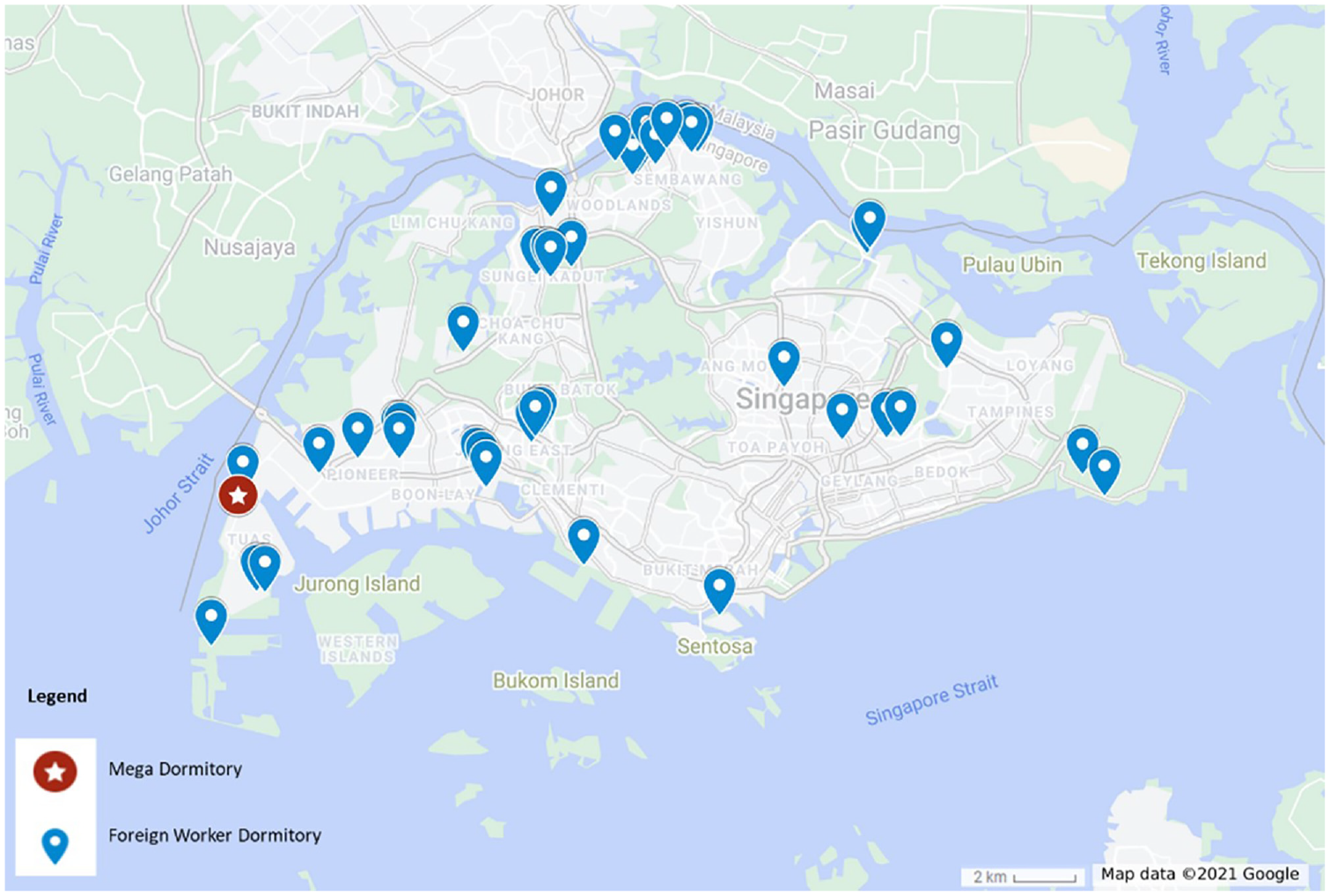
Locations of dormitories in Singapore.
Particularly in the aftermath of the ‘Little India Riot’, spatial distancing strategies were further enhanced by increasing ‘spaces of enclosure’ through building more ‘integrated dormitories’ (Tan and Toh, 2014), which in one illustrative case included a 16,800-bed complex with a minimart, beer garden and food court and recreational options such as a 250-seat cinema and a cricket field. By providing care and convenience in the form of services such as banking, remittance and help centres, these mega-dormitories also serve as a containment measure to reduce the need to access co-ethnic enclaves for services and businesses catering to migrants (Goh, 2019). By encouraging social ties between fellow occupants of different nationalities and filling discretionary time outside the long hours of work, enclosure facilitates care and control while effectively separating migrant routines from the everyday rhythms of citizens and the city. Buying into this arrangement, Sajib (27) felt that socialising within the dormitory was quite sufficient, and there was little need to venture outside: Dormitory very big … no [go] outside … Dormitory inside, cricket have, football have … All country [nationalities] men [live there]. Bangladesh, Indian, [Chinese,] Thailand, Myanmar … [I] can talk [with people of different nationalities]! [Also] cooking … games. [I’ve] many friends.
5
Disagreeing, Moinol (34) shared the general isolation he felt living in the dormitory on Jurong Island (a gated petrochemical complex) during the working week and even at weekends: … there’s a problem, except our holidays [and] Saturday, Sunday, we cannot come out. That’s a problem. [Have to stay on Jurong Island all week, can’t leave the dormitory]. [What do I do in the dormitory?] Nothing! … for entertainment, we have playground … we can play … and … the canteen have TV but no satellite channels, only Singapore local channels [laughs]. Actually … we don’t have a lot of time also because we’ve to work from 7.30 am to sometimes 7.30 pm, sometimes 8.30, sometimes 10.30 pm [daily]. We … almost always [have to also work on] Saturday and Sunday.
In these spaces of enclosure, surveillance of migrant bodies is further facilitated by the installation of CCTV cameras and the use of biometric security systems whereby restricted access to particular sections of the workers’ living quarters is controlled by finger scanning. Enclosure also facilitates the ‘packing in’ of bodies according to the economic logic of demand and cost-saving measures, as Syed (24) explained: We were six in the top [floor] in container and downstairs, it was five or less. It’s actually based on the demand, when more people in the company, then there is a crowd. [When] we moved to Tuas [dormitory], there is big room and 35 to 40 [people] in a single room … Yes, seven toilets and seven washrooms there. One person in every bed.
In addition to technological surveillance, the spaces of enclosure which are densely populated with immobile bodies also depend on mutual surveillance for effective control. Privacy is virtually non-existent, as every movement comes within the orbit of someone else’s notice. While most interviewees accepted the presence of CCTV cameras with a degree of nonchalance, they were more resentful of ‘human surveillants’, fellow occupants who make complaints to supervisors resulting in the eviction or repatriation of offending occupants. Fully conscious of the force of the human disciplinary gaze within enclosed quarters, Hussein (23) recounts: My boss won’t [arbitrarily] send home any people, but I think any people fighting, [if someone] just complain to manager, production manager … they can [take] action, then return [the workers] back. [Since] coming here, our company [repatriated] three Chinese men … because [someone reported them] fighting.
Home-space as enclosure
While there are often clear lines (and even a sizeable distance) demarcating work and home for MCWs, MDWs confront a very different experience of enclosure within the confines of their employers’ homes. Not only does ‘the confluence of home and workplace make it more difficult for household workers, compared to factory workers, to separate work spatially, it is also more difficult temporally to distinguish time on and off’ (Constable, 1997: 89). Given that their temporary living quarters within their employers’ homes are also their workplaces, MDWs learn quickly to avoid (or become invisible in) the ‘front stage’ where the activities of the employers and their guests dominate, and retreat quietly to the ‘back stage’ such as the kitchen to work and/or reclaim whatever privacy possible (Lan, 2006).
The large majority of the Singapore resident population lives in subsidised government flats built by the Housing Development Board (78.7%), and 16% live in condominiums/apartments (Department of Statistics, 2020). Flats typically come with living, dining and storage space, one to four bedrooms and a kitchen but usually without a separate space to accommodate the live-in MDW. Private apartments and landed homes may feature a ‘maid’s room’, although this can vary from a small windowless space to an en-suite room. Given that Singapore law does not mandate employers to provide MDWs with a separate room, it is unsurprising that they commonly encounter inadequate living conditions; 57% of those surveyed by migrant NGO HOME (n.d.) reported having no privacy.
6
The failure to provide dedicated living space for MDWs is not incidental, as Kobayashi (2015: 415) noted: To govern a hierarchy of space in the household, Singaporean employers deploy strategies available to them. A common practice is to have foreign domestic workers sleep in the kitchen. This way, it is clear that Singaporeans have their own room but a foreign domestic worker does not. Some private flats have a little area almost like a storage space, with no window, where the foreign domestic worker sleeps. And for those families with children, their foreign domestic worker often sleeps on a mattress next to the children’s beds.
Even when rooms are available, MDWs are not necessarily entitled to them, for the private enclosure would obstruct employers’ full view of the MDWs’ activities. MDW Una (32) associated the withholding of private space (in her case, within a house with ample rooms) with unremitting surveillance and the denial of human rights: The ma’am is not working. She always come around me, [watching over] whatever I doing. I didn’t have enough [time to] sleep, I [also] have to sleep next to the kitchen, on a very tiny bed. You know the … very thin folding bed. Always sleeping in there, next to the kitchen. Actually [the employer] got big house, they got … two empty rooms, but you know, you domestic worker, you can’t have that kind of … life right? In Singapore, we’ve no rights, at all!
Unlike MCWs, who are accorded a designated bed space in a dormitory, the sleeping arrangements of MDWs are often more flexibly arranged within the house, including the use of moveable bedding that can be kept out of the way during the day so as not to disrupt household activities. The lack of proper enclosed space, as argued by migrant NGO Transient Workers Count Too (TWC2), signifies and reinforces ‘the same sense of temporariness that the … lack of social rights of MDWs does, emphasising her transient identity’ (Tay, 2016: 12). Over time, the lack of access to personal space within the household becomes accepted by some MDWs as ‘knowing one’s place’. Ira (40) did not wish to negotiate for a room of her own and accepted the disparity in treatment given the social and class divide between herself and her employer: Yes, so we should not go over ourselves [and ask for a room] because we’re just domestic helper here. We should not expect the employers to treat us a certain way. I only think [of earning more] salary here. That’s my principle here.
Furthermore, unlike MCWs who can move fairly freely, albeit while monitored, around the indoor and outdoor spaces of dormitory complexes,
7
MDWs have less freedom to venture outside the house independently or even to enter certain home-spaces, unless performing their duties. Entering their employers’ bedrooms without a ‘valid’ reason (e.g. to clean) may be viewed with suspicion. Others may even be kept locked up within the housing enclosure, as Naning (31) reveals: … sometimes in Singapore, our employer doesn’t allow us to go out, so we’ll stay at home every time. It feels like being incarcerated, cannot go out. My second [employer], I was not allowed to go out at all. [They would lock the house when they went out to work] … And the employer’s sister would come every day. She owns the keys, not me. I stayed at home every time.
Similar to MCWs living in dormitories, it is also common to find employers installing surveillance cameras around the house to keep an eye on the MDW. HOME (n.d.) reported that around 20% of those surveyed in their study recounted having a surveillance camera installed in their rooms. A Filipino MDW in the same study reported that she was well aware of being watched at night while she was sleeping due to the camera’s blinking light (HOME, n.d.). This led her to suffer extreme distress and loss of appetite until her contract was terminated and she was eventually sent home.
Even for MDWs who can venture out of the apartment and have rest days, those living within gated condominiums soon realise that enclosure extends beyond the household door and that their mobility within the estate is circumscribed by both written and unwritten rules. Coming under the watchful gaze of neighbours and security guards, MDWs are often barred from using swimming pools and other facilities (MyPaper, 2016; TWC2, 2013). In some estates, MDWs are given an access card that only grants them entry into the estate but not to the facilities. Using the facilities for personal social gatherings on their rest days is frowned upon, as residents fear the potential problems that MDWs and their invited guests may have or bring. On one occasion, despite the absence of other potential users, a group of MDWs lounging on pool chairs in the evening were told to vacate the area as the chairs were not ‘meant for them’. The blurred boundaries between living and work spaces that MDWs encounter within the home enclosure also spill over to influence how they are viewed when they occupy the semi-private spaces of the estate and beyond. As migrant women brought into the home as a paid replacement for Singaporean women’s domestic and care labour, they are considered ‘out of place’ beyond the enclosure of the home (Yeoh and Huang, 1998). Rather than a refuge ‘where inhabitants can escape from the disciplinary practices that regulate our bodies in everyday life’ (Johnston and Valentine, 1995: 88), MDWs are subjected to an even more intensive form of surveillance that monitors their behaviour and is exercised through the constant gaze of the family and neighbours. As Una describes: The experience of [constant monitoring] … was hard for me. Very, very hard. This is the first time ever in [my] life, going abroad [to work]. It’s a [heavy] job. It’s not light. People go abroad to study, you can enjoy yourself … But [in my case], it’s like somebody is controlling you … every night I’m crying.
The spatial politics of enclosure hence work in different ways and across different scales. For MCWs, enclosure facilitates care and secures compliance by segregating and distancing migrant spaces, keeping migrant bodies out of sight and under surveillance, especially when they are not at labour. In MDWs’ case, as spatial proximity is unavoidable in enclosed home-spaces and gated estates, control is effected through spatial and temporal confinement to open ‘domestic’ spaces and the close scrutiny of individual behaviour to ensure self-compliance, with unwritten expectations of being ‘in place’ and ‘out of ‘place’.
The limits to enclavisation in social spaces
Confined largely to their workplaces during the working week (shipyards and construction sites for MCWs, Singaporean homes for MDWs), large numbers of migrant workers congregate temporarily in co-national enclaves over the weekend (Yeoh and Lam, 2017). Such ‘weekend enclaves’, sometimes occurring in ethnic heritage districts resulting from colonial urban planning, have become ephemeral spaces where migrant workers ‘meet up with their fellow workers and create a space where they could be at home outside their home country’ (Budianta, 2016: 279). Businesses catering to each nationality range from formal ‘money changers, pawn shops, phone stores, garment shops, hairdressers, food stores’ to itinerant hawkers (Ostertag, 2016: 120). Whether for socialising, contacting those back home or running various errands, rest days spent in the co-nationality enclaves mark a distinctly differentiated temporal–spatial rhythm for migrants, away from the structured timetables, constrained mobility and unremitting surveillance of the working week (Hamid, 2015).
While migrant workers appreciated the greater degree of freedom, albeit temporary, they have in their enclaves, as opposed to those of enclosure, most of our interviewees were also deeply conscious of the limits that continue to permeate their claims to public spaces. After describing the simple pleasures of co-national enclave spaces, Sumon (38) was quick to interject that he was careful in restricting his visits to the occasional foray rather than making this a habitual practice: In most Sundays, there are – at Farrer Park MRT [Little India] – people who are from same village as mine who come here [to] sit and chit chat. After work, I go sit with them, ask them how is their life [and so on] … every once a month, I go there to send money … [But] I don’t go there always … sometimes don’t go there …
Similarly, Hera (25) explained that while she frequented weekend enclaves and migrant gathering grounds, she was careful in regulating the time she spent in the enclaves, prioritising the training classes she attended on weekends and making sure curfews were strictly observed: To relax, I sometimes in Paya Lebar, sometimes in Kallang, sometimes somewhere else … near MRT [stations] so it’s easier and faster for me to go home. We’ll be talking outside, chit-chatting, then eating, then [we’ll] go home. [I’ve] to return home by 7 pm [employer-determined curfew]. I’ve ever returned home at 6.30 pm [implying that she never violates curfews]. If there’re studies, I’ll leave from school. [I’m] always late [for the social gathering].
Migrants’ self-regulation in weekend enclaves is also reinforced by a recurrent public discourse that associates the visible enclavisation of public spaces for and by ‘needed but unwanted’ migrant workers with social malaise. Viewing migrant gatherings as a form of ‘intrusion’ into ‘their own backyards’, some members of the public have called for the authorities to step up security measures or relocate migrants to out-of-sight places. Aware of the circulation of negative sentiments regarding the enclave, Mishkat (30) quickly justified his limited presence in Little India: ‘I usually come here once in a month to send money to my home. Otherwise I’d be in my room, watching drama, movies or listening to music in my mobile’. He also fended off potential criticism by differentiating his own behaviour from that of the perceived stereotypical migrant other, transposing negative traits to migrants of other nationalities in order to emphasise that he represented the well-disciplined migrant rather than the unruly object of discrimination: See all people are not same. Some people come here they gossip, walk around, but I don’t have that intention. I never faced such discrimination with the locals here … And you know we Bangladeshis are different than others. We try to maintain neat and clean, good dress and walk with good people. We act gently; we work decently … and are clean-shaven, dress up smartly. So that when I go out, [Singaporeans] don’t feel that I’m a worker here. Unlike the [names other nationalities], they’re not clean. … Actually I should not talk about this. It’s personal matter for them [laughs].
The social anxieties surrounding migrant concentrations were further heightened in the aftermath of the ‘Little India riot’, when the enclave became a space of state-imposed exception zoned to facilitate a ban on alcohol sales and increased police surveillance. Over time, some workers themselves started avoiding the enclave by channelling their activities elsewhere. Sumon, for example, developed other social pursuits outside of enclave spaces: I catch fish in the East Coast Park on holiday. I’ve friends from same village … I call them they come. We go catch fish in the morning for the whole day till the afternoon then cook the fish at whoever’s place has the facility for cooking … Other than that I don’t go out much.
Likewise, some MDWs preferred to spend their hard-earned rest days in productive spaces that enjoyed the approval of employers, agents, migrant NGOs, the religious authority and the state. Over the past decade, the range of ‘healthy’ (e.g. exercising) or ‘fulfilling’ (e.g. taking self-improvement or upgrading courses) activities offered by migrant NGOs, including the state-sponsored Centre for Domestic Employees (CDE), has expanded to encourage MDWs to make use of their rest days ‘wisely, safely and productively’ (in the words of one maid agency). As Rosita (32) shared, unlike other MDWs who ‘waste time’ immersing themselves in the enclave ‘shopping, walking around, enjoying themselves [but] not doing anything important’, she learnt English and used ‘the time to do something here, not just work only’.
Maesarah (40) agreed that enclave-based activities were not productive and preferred to use the rest day to improve herself: do something meaningful, like skills. I can [learn] the computer for internet, speak English with employer, cooking for my employer, how to take care of the old-aged, because it is your job. If you take the English course, very important to be able to communicate with everybody in Singapore. That is very good, also employer also happy.
In light of the bad press that migrant enclaves attracted, migrant workers – particularly MDWs who face a larger measure of moral policing compared to MCWs – were keen to present themselves as accountable subjects who were trustworthy and ever-conscious of their position in Singapore society. As Novi (34) explained, her employer was initially wary of the contaminating influence of her spending her day off with other MDWs in enclaves: ‘[At first] my boss was scared [that] I would be [negatively] influenced by others then cannot do the job properly … After two years, they [say] ok, “Every Sunday you can go” because they trust me already’. To counteract the moral unease associated with migrant enclaves, Novi made sure to explain to her employer her reasons for visiting these spaces (‘Even though they trust me, every time I go, I will ask permission, “I need to go, I need something, please, can I go?”’). By assuring her employer that she was aware of her ‘place’ in Singapore society and would not test its limits, her employer was prepared to allow her temporary respite from the strictures of enclosure so as to enjoy the relative freedoms of the enclave: Even though they’re very kind to me but, you know, I’ve to know my position. My position is always a domestic worker … we [must] always never take [for] granted … When people trust you [that does not mean] we can do what I like to do, I don’t want to do that. I always put myself [as] domestic worker, I put myself there. My job comes first.
While migrant enclaves offer a greater degree of freedom from control and close scrutiny compared to the constrictions of enclosure, they are clearly still within the reach of the pervasive net of social, moral and legal surveillance that continues to govern migrant lives beyond the purview of work. For migrant workers, enclavisation signals at least temporary claims on urban space which potentially provides co-national spaces offering social support and the possibility of building a base for non-compliance and assertion of difference. However, as the above accounts reveal, these emergent spaces of possibility in weekend enclaves are to a large extent stymied, not just by the regulatory powers of the state but also by the force of self-regulation as migrants strive to present their selves as productive workers who know their ‘place’ in the host society. In the context of a temporary migration regime with few safeguards against the loss of jobs and the threat of repatriation, migrant workers are keenly aware of their temporariness and the vigilance with which they must navigate the spatial politics of enclosure and enclavisation.
Conclusion
In this article, we have argued that enclosure and enclavisation are twinned spatial–temporal processes that work in tandem to reinforce the non-integration of low-waged transient migrants in Singapore. While enclosure enforced by those in power facilitates the effective surveillance of migrant bodies and restricts their mobility in the city, migrant-initiated ‘weekend’ enclavisation fosters a form of migrant sociality that inculcates self-regulation and a sense of transience. As part of the urban apparatus intended to effect social control and compliant management, both strategies operate in tandem to shape migrants’ place in, and mobility through, the city in highly gendered and disciplined ways. By treating enclosure and enclavisation as ongoing strategic processes that morph over space and time, we expand the conceptual bandwidth of the vocabulary usually associated with urban segregation and ethnic neighbourhoods in three ways.
First, while much work has been conducted on the formation of ‘ethnic’ residential neighbourhoods in western cities as a productive avenue to investigate questions of migrant integration and citizenship rights (Kalandides and Vaiou, 2012: 254), we use the conceptual apparatus of enclosure and enclavisation to study the converse process of how non-integration and limited rights to the city are effected in a different direction that is more appropriate for a context dominated by temporary migration. Focusing on strategies of non-integration and non-citizenship is not only appropriate in the context of migration-without-settlement, but is of increasing significance given that globally the number of labour migrants moving through temporary channels has been increasing twice as fast as that of those moving through permanent visas (OECD, 2019).
Second, as ‘temporalised space’, enclosure and enclave constitute ‘an observable property of timespace and in this respect they provide a tool for the observation of the unobservable’ (Lefebvre et al., 2004, cited in Mulí ček et al., 2015: 307–308). As conceptual tools, they alert us to the complex interaction between the strategies of control in managing migrant populations imposed by the powerful on the one hand, and migrants’ strategic choices under highly constrained conditions on the other. In tandem, the concepts help us articulate the wide variability and provisionality with which temporary migrants inhabit urban spaces. As disciplinary measures, enclosure and enclave have an in-built, ongoing tendency to immobilise human bodies, regulate the rhythms of labour and life, reduce encounters with difference and normalise visible landscapes of inequality and segregation. At the same time, they also offer (albeit limited) spaces of possibility where even ‘low-income migrants [can] circumvent official policy and begin to stake a claim to the city’s public space’ (Collins, 2012; Elsheshtawy, 2008: 985; Seo and Skelton, 2017).
Finally, twinning enclosure and enclavisation as a conceptual pair allows us to observe how they interact as concrete strategies in not integrating migrants into the city. On the one hand, the restrictions of enclosure for migrant life are partly dealt with by allowing access to weekend enclaves where heavy-handed surveillance and control are temporarily suspended. On the other hand, the excesses of the enclave – from non-conforming encroachment of public space to the dangers of rioting and other skirmishes – can be contained by the hardening of enclosure (as seen in the construction of self-contained mega-dormitories and the locking down of entire dormitories during the COVID-19 pandemic). The politics of enclosure are hence inextricably intertwined with the ongoing endeavour to manage the social outcomes of enclavisation.
Footnotes
Declaration of conflicting interests
The author(s) declared no potential conflicts of interest with respect to the research, authorship, and/or publication of this article.
Funding
The author(s) disclosed receipt of the following financial support for the research, authorship, and/or publication of this article: This work has been funded in part by Global Asia Institute – NUS Initiative to Improve Health in Asia (NIHA) Funding (GAI-NIHAG) [NIHA-2020-001] and by UK aid from the UK government through the Migrating out of Poverty Research Programme Consortium. However, the views expressed do not necessarily reflect the UK government’s official policies.
