




Abstract
The relationship between the European Union's (EU) free movement regime and welfare has received ample scholarly attention. However, this has almost exclusively been from the perspective of destination countries. We know surprisingly little about the “other side” of the migration phenomenon, i.e., the welfare-related implications of large-scale emigration, which predominantly takes place from peripheral EU member states toward the core. In this paper, we break new ground using an original survey fielded in 15 EU member states in 2021. We ask how worries about immigration and emigration shape people's attitudes about social spending in their country of origin and whether they are associated with preferences for EU involvement in social policy. We show that, on average, immigration is salient across the board, but more so in core states (West and North), while emigration is a more salient issue in peripheral states (East and West). In terms of policy preferences, regression analyses indicate that worries about emigration versus immigration are linked in an inverted manner to social policy. Indeed, a preoccupation with incoming migration increases opposition to higher government social spending, while it is irrelevant for support for a stronger EU role in social matters; by contrast, a preoccupation with emigration increases support for both higher government social spending and a stronger EU role in social matters.
Introduction
By eliminating barriers to free movement between its member states, European unification has created an internal migration regime that constitutes “an exception to the century-long, essentially worldwide trend toward increased control of international movement” (Luthra, Platt, and Salamońska 2016, 369). Indeed, European Union (EU) citizens have an unrestricted right to move and work in any other EU member state and, under certain limitations, they have access to the welfare system of the receiving state. While it is generally thought that the free movement of labor and equal access to national welfare states are incompatible, the EU has insisted on both (Ruhs 2015; Geddes and Hadj-Abdou 2016). At the core of this potential incompatibility lies the idea that free movement erodes the welfare state by impacting attitudes of national solidarity and cohesion, upon which it was historically built and still relies on today (Ferrera 2005).
The equilibrium between freedom of movement (FoM) and the welfare state in the EU is, therefore, “unstable” and prone to politicization (Geddes and Hadj-Abdou 2016). FoM became especially salient and controversial in the wake of successive enlargements toward the lower-wage countries of the EU's Southern and Eastern belt, which were accompanied by an increase in the numbers of intra-EU “mobile citizens” (as per EU parlance). To be sure, FoM is consistently ranked as one of the EU's most recognizable and valued policies among Europeans (Lutz 2021); nonetheless, sizeable portions of native populations have come to oppose it (Ferrera and Kyriazi forthcoming). The Brexit referendum is but the starkest example of the perils of the extreme politicization of FoM, which has contributed to the departure of a member state from the Union (Balch and Balabanova 2017). At the level of public attitudes, in particular, there is a clear negative link between welfare state support and intra-EU immigration (Cappelen and Peters 2018).
What is striking, however, is how much of the existing research on the effect of FoM on the welfare state has been conducted from the perspective of EU immigration states. Conversely, we know surprisingly little about the “other side” of the migration phenomenon, i.e., the welfare-related implications of emigration from Eastern and Southern EU member states toward the core (Kyriazi et al. 2023). Only recently have scholars begun to examine more in-depth emigration-related public attitudes (Kustov 2022), while the ways in which EU emigration may shape welfare spending preferences were singled out as an avenue for much-needed future research (Bruzelius 2021). This neglect is puzzling because, after all, the boundaries of welfare are affected not only by the entry of newcomers into the extant solidarity spaces but also by the exit of people from them. In fact, the historical process of welfare state creation has rested on the exclusion of those deemed not to belong just as much as on the enclosure of redistributive collectivities, leading to “structuring” the sphere of social protection (Ferrera 2005, Chapter 2). Indeed, emigration can give rise to concerns that are, though not identical, nonetheless of the same order as immigration, e.g., worries about the changing demographic composition of society or “brain drain” (instead of “social dumping”).
On social issues specifically, both immigration and emigration can feed into concerns about the fiscal and moral sustainability of the welfare state. While this tendency has been extensively discussed in relation to incoming migration, emigration could have similar or even direr consequences. This is because while emigration is a successful avenue for improving the lives of individual emigrants and also benefits the economies of receiving states overall, it is a regressive channel of social risk sharing for emigrants’ regions of origin (Schelkle 2017, Chapter 8). Indeed, there is also an awareness of the potential negative externalities of FoM at the EU level (Roos 2021). The European Commission's 2020 Annual Report on Labour Mobility warns of this phenomenon, writing: “[…] if high outflows of younger people from countries in Southern and Eastern Europe persist amid natural population ageing, those countries may face significant problems in financing welfare programmes and provid[ing] for the elderly through public pensions” (Fries-Tersch et al. 2020, 141).
At the same time, there are important differences between emigration and immigration. Most strikingly, while the issue of immigration has become widely politicized in Europe (with some cross-national variation), the issue of emigration is more difficult to draw sustained attention to, for example, because it does not represent a proximate “threat” to the ethnic boundaries of the “nation” or because governments may try to avoid talking about the issue since emigration can be seen as a symptom of a broader social and political malaise (Kyriazi et al. 2023).
Be that as it may, we simply lack a proper understanding of how emigration-related concerns compare to those surrounding immigration (since we have a much better grasp of the latter), as well as whether they translate into meaningful policy preferences in the sphere of welfare and, if so, how. We thus argue that examining both sides of the migration coin can immensely advance our understanding of the FoM-welfare nexus. To do so, we use an original survey conducted in the context of the “Policy Crisis and Crisis Politics: Sovereignty, Solidarity and Identity in the EU Post-2008” (SOLID) research project, which was carried out in 15 EU member states in 2021. Given the limited knowledge we have regarding attitudes related to emigration, we begin our analysis with a mapping exercise, looking at the prevalence of worries related to immigration versus emigration across the countries included in our survey and subsequently comparing the determinants of immigration and emigration concerns. We then turn to the main research question, i.e., to what extent do emigration/immigration-related concerns feed into preferences for welfare spending by the national government, as well as preferences for EU involvement in social protection.
To foreshadow our results, we find an inverted relationship: worries about immigration are linked to a decrease in support for more government social spending and are irrelevant for support for a stronger EU role in social matters. Conversely, a preoccupation with emigration is positively associated with support for a stronger EU role in social matters and with preferences regarding increased government social spending. Before elaborating on our results, we take a step back to discuss the intra-EU mobility regime and the theoretical grounding of our hypotheses.
FoM and Welfare in the EU
Contextualizing FoM: Trends and Effects
The right to leave one's country is internationally recognized by the Universal Declaration of Human Rights. 1 Policies that seek to discourage emigration and incentivize return are common, but the type of heavy-handed formal emigration restrictions such as those prevailing in Mexico until the 1970s (Fitzgerald 2006) is rare and, in contemporary democracies, is virtually nonexistent. This is in sharp contrast to the right to entry and immigration, which is subject to conditions and controls. In this context, EU legislation and case law from the Court of Justice of the EU have created a distinctive free movement regime in which EU citizens can reside and work in another member state, while also being able to access, under certain limitations, the welfare system of their host member state (Martinsen and Werner 2019). EU member states thus retain autonomy over the admission and treatment of so-called third-country nationals, but intra-EU FoM takes primacy over national law and policy, for it is constitutive of the internal market (Martinsen and Werner 2019, 640) and EU citizenship as such (e.g., Recchi 2015). By implication, member states cannot categorize intra-EU movers as international migrants or apply chauvinistic welfare policies to them (Cappelen and Peters 2018). 2
Consequently, intra-EU mobility is not labeled as “migration” and intra-EU “mobile citizens” (or “movers”) are distinguished from conventional migrants in both EU parlance and academic research (though the exact terms used may vary). We think referring to EU emigration/immigration is unavoidable if one is to measure and analyze the potentially different salience and geographic distribution of concerns related to the two sides of FoM. Granted, terms such as “movement” and “mobility” draw attention to several fundamental aspects of FoM, particularly the liberal circulation of people within a unified migration space. However, they obscure others, such as the fact that intra-EU mobility is heavily skewed geographically, specifically from poorer peripheral states to richer ones mainly for the purpose of seeking employment. 3 Similarly, it is also true that all EU member states “send” and “receive” EU migrants. Nonetheless, the differences in these rates are so broad that they justify a categorical distinction between countries of EU emigration and immigration.
Even though in its early days FoM was meant to apply only to workers, it was progressively extended to all EU citizens (Blauberger and Schmidt 2014). Still, a distinction is retained between economically active and inactive movers. The economically active and their families have unrestricted access to other EU member states; they enjoy the same welfare entitlements as natives and their contributory benefits are exportable (Schelkle 2017, 236). Conversely, noneconomically active citizens’ free access is restricted to 3 months, and they need to demonstrate their own resources and have health insurance for 5 years of residence, after which they, too, have the same welfare entitlements as natives (ibid.).
The main driver of intra-EU movement is socioeconomic heterogeneity across the EU. Sizeable intra-EU emigration from Eastern Europe was delayed by the transitional controls agreed upon ahead of the 2004 and 2007 enlargements, all of which had been lifted by 2014 (Ruhs 2015). This coincided with a wave of migrations primarily induced by the economic crisis, which had particularly harsh effects on the South (Lafleur and Stanek 2017). As a result, starting from the mid-2010s, there has been a surge in emigration from both the South and the East toward the North and West. The United Kingdom's departure from the EU slowed down the growth of intra-EU mobility, given that the United Kingdom was a major destination for intra-EU workers (Fries-Tersch et al. 2020), as did the COVID-19 pandemic (Commission 2023, 11), though presumably only temporarily.
Based on the latest available data (for the years 2020/2021), there were around 13.9 million long-term EU and EFTA movers for all ages and 10.2 million movers of working age (Commission 2023, 21). Relative to total employment, the size of the mobile labor force is small (<4%) (Commission 2023, 21), but it is nonetheless concentrated in specific geographic locales or skill groups (as subsequently outlined). In 2021, 81% of EU movers were active in the labor market, compared to 79% of nationals and 70% of third country nationals (Commission 2023, 12). The proportion of EU movers with a high level of education is 32% and has been increasing since 2016 (Commission 2023, 12). The largest sectors of employment of intra-EU migrants are manufacturing and craft and related trades, but there seems to be a general shift toward professional occupations (Commission 2023, 13–14).
The main direction of mobility is from the economically weaker member states in the East and the South toward richer member states in the North and the West. Indicatively, between 1990 and 2012, around 20 million people left their home country in Eastern Europe (Atoyan et al. 2016). Similarly, the Baltic States and Bulgaria lost 16%–26% of their population between 1991 and 2015, while the number of working age individuals that left Croatia and Romania is equivalent to 17% and 19% of their resident populations, respectively (see Kyriazi et al. 2023, 3 and references therein). Emigration rates from Southern Europe are also relatively large and soured following the years of the euro area crisis, when the annual number of outgoing migrants from Greece, Italy, Portugal, and Spain tripled (ibid.).
There is considerable variation, though. For instance, net emigration rates from Slovakia and Italy (Eastern and Southern member states, respectively) are relatively low, while at the same time, the Southern countries also attract substantial numbers of EU immigrants. The historic switch from countries of net emigration to countries of net immigration (the so-called migration turnaround) is a common characteristic of Southern European states (King and de Bono 2013). The country hosting by far the most intra-EU movers (one-third) is Germany, while Spain, Italy, Switzerland, and France are also major destination countries of EU internal migration (Commission 2023, 36). Romania, Poland, Italy, Portugal, and Bulgaria are the largest countries of origin of EU movers (Commission 2023, 35).
In terms of its intended effects, the FoM of workers is an integral part of the functioning of the Single Market. Theoretically, it creates a win-win situation: mobile workers improve their own living conditions, make a substantial contribution to the gross domestic product (GDP) of the receiving countries (see, e.g., Dustmann and Frattini 2014 for the United Kingdom), and their incomes can also benefit those who stay in the countries of origin, e.g., through remittances (Atoyan et al. 2016). However, FoM can also create negative externalities. In receiving states, immigration can dampen workers’ wages in sectors in which employers seek to attract migrants or put stress on the provision of public services in areas of high migrant concentrations—though on the whole receiving countries have much to win from (EU) immigration. As Schelkle (2017) observes, paradoxically, even though most of the benefits of migration are accrued in Western European destination countries, the fiercest political resistance to migration also arises within such countries. This, we would add, is especially prevalent at the intersection between immigration and welfare. In reality, when it is concentrated in specific areas or skill groups, emigration's negative effects on countries and regions of origin are more profound and potentially more adverse 4 and include human capital flight, skill shortages, and the erosion of the tax base (Alcidi and Gros 2019). They can also carry important political consequences, most notably decreased political engagement via the exit of dissatisfied citizens (Schelkle 2017; Kelemen 2020; but see Rone and Junes 2021). Large-scale emigration can make locales less livable, e.g., by weakening a sense of community and quality of life (Dancygier et al. 2022). Moreover, when emigration intentions have become the norm among the young, those who stay may feel like “losers” themselves, regardless of their circumstances (Krastev and Holmes 2019).
FoM and the Welfare State: Theory and Hypotheses
It is widely thought that the logic of openness implied by EU integration contrasts and even contradicts the logic of closure on which European welfare states have traditionally been built (Ferrera 2005). As Martinsen and Werner (2019) explain: “The rights of EU citizens to move, reside, take work and become members of national welfare communities clash with the traditional boundaries of the welfare state, which was developed to protect the interests and the welfare of a nation's own citizens” (639, emphasis in the original). In turn, individuals’ attitudes toward immigration affect the extent to which they support welfare redistribution, in what has been termed a process of the “immigrationization” of welfare politics (Burgoon and Rooduijn 2021; see also Kulin, Eger, and Hjerm 2016). Note, however, that studies on immigration and welfare do not systematically distinguish between intra-EU and extra-EU migrants (e.g., they ask respondents’ opinions in relation to people coming from “other countries”). Cappelen and Peters (2018), who do make this distinction, conclude that it is intra-EU immigration in particular that reduces public support for the welfare state and that this has less to do with ethnic and cultural diversity and more to do with control: “because EU states cannot discriminate against resident EU nationals from other countries in the field of social security, intra-EU immigration will negatively affect attitudes towards welfare spending” (1336).
While much has been said about the ways in which incoming migration impacts receiving welfare states, it is also clearly the case that outward migration influences welfare states in sending countries (Bruzelius 2021). Similarly, if immigration attitudes spill over into the politics of welfare from the perspective of the receiving context, then it is reasonable to assume that this also applies to emigration-related attitudes from the perspective of the sending context. Even though we can build on the existing literature to derive our hypotheses related to immigration, the main unknown remains whether emigration concerns feed into policy preferences in a similar way as immigration or whether they diverge. It may well be that the same patterns observed between attitudes toward incoming mobility and welfare also apply to outgoing mobility—after all, both exit and entry challenge the social closure that sustains welfare states. But concerns over emigration could shape the welfare-FoM nexus differently, as we explain in more detail in subsequent sections.
Preferences for Domestic Social Spending
Our main interest is whether emigration-related concerns translate into policy preferences and whether they do so in the same vein as immigration-related concerns. First, we focus on welfare spending by the domestic government. Do worries about emigration undermine welfare provisions, giving credence to the view that welfare states cannot be maintained at their current level, or do they, conversely, increase public support for social expenditure, not least as a means of keeping people in the country?
Our point of departure is the insight that migration-related concerns shape policy preferences by impacting people's considerations regarding the economic and moral (un)sustainability of the welfare state. We therefore expect that those who have high levels of concern about FoM are also less likely to support government social spending. On the side of immigration, citizens may assume that immigrants benefit disproportionately from welfare programs, straining fiscal resources (e.g., Hanson, Scheve, and Slaughter 2007; Cappelen and Peters 2018). On the side of emigration, people may come to believe that because of the departure of working-age people from the country, there will simply be insufficient contributors to finance the provision of solidaristic public goods. When people think that resources are diminishing, they will be unlikely to support increased government social spending funded with new taxes. Moreover, while it is uncommon to place blame on emigrants for social problems in the same way as it is routinely done in relation to immigrants, when many people emigrate, it is nonetheless possible that this may feed into a general sense of futility among those left behind, who may reason, for example, “Why invest in education, if highly educated people leave anyway?”.
By contrast, concerns about FoM could actually boost support for welfare spending to prop up the protection of those who are vulnerable to retrenchment (Burgoon, Koster, and Van Egmond 2012). In fact, it has been argued that anti-immigration sentiments can both undermine and increase support for redistribution, depending on a country's immigration and welfare conditions. In some contexts, anti-immigration sentiment is linked to increased support for redistribution because it directs attention to a person's own economic vulnerabilities (Burgoon and Rooduijn 2021). We see this as less convincing for the case of intra-EU immigration (as opposed to immigration in general), given empirical evidence demonstrating the opposite (Cappelen and Peters 2018), but quite plausible for emigration-related concerns. Emigration concerns could spur support for redistribution as compensation for vulnerabilities incurred by those who stay, stemming from other people's mobility. Furthermore, those worried about emigration may be more likely to support welfare spending, seeing it as a preventive measure to arrest the emigration of conationals abroad. Indeed, the conviction that it is socioeconomic factors that push people from their homelands to emigrate in search of better working and living conditions in other EU member states is rather common, especially in the EU periphery. This is in line with the findings emerging from our survey; in most of the 15 member states investigated, and especially in the South and East, respondents support the idea that people emigrate from their country because of the bad economic situation or lack of jobs in their home country. Exceptions are Austria, Finland, the Netherlands, and Sweden, whose respondents say that the major driver of emigration from their country is the search for new experiences (see Supplemental Table A2).
We summarize our hypotheses as follows:
- H1: Concerns about immigration will reduce support for increased government spending on social welfare.
- H2a: Concerns about emigration will reduce support for increased government spending on social welfare.
- H2b: Concerns about emigration will increase support for increased government spending on social welfare.
Preferences Regarding the EU's Role in Social Protection
We also examine whether concerns about immigration and emigration impact preferences for increasing the EU's role in social protection. The way “social Europe” relates to the national welfare states is complex: it may pose a challenge to their foundations, but it may also strengthen them (Ferrera 2017; see also Baute, Meuleman, and Abts 2019). Despite limited competence in the matter, the EU's involvement in social protection could be an avenue to correct some of the adverse consequences of market integration (Claassen et al. 2019), including the welfare-related externalities stemming from FoM. The catch, however, is that the more intrusive the EU's intervention in the nationally organized social sphere, the less likely it is to receive widespread support (Baute, Meuleman, and Abts 2019).
The link between FoM emigration/immigration concerns and preferences for increasing the EU's role in social protection derives from the insight that national and supranational politics produce public opinion toward the EU and its policies in combination; i.e., they are intertwined. Studies suggest that domestic conditions, such as the extent to which democratic institutions properly function in a country (Rohrschneider 2002) or its levels of economic prosperity (Rohrschneider and Loveless 2010), affect people's support for or opposition to (various aspects of) EU integration. Those dissatisfied with national-level performance are also more willing to transfer sovereignty to the EU level because they perceive lower opportunity costs to do so (Sánchez-Cuenca 2000). For the same reason, support is higher in countries with greater levels of political corruption and less developed welfare states (Sánchez-Cuenca 2000).
How can we apply this to the case of FoM? On the one hand, those with high levels of concern for immigration/emigration may view EU involvement in welfare as undesirable because they associate the EU with the problem of immigration/emigration in the first place (see Toshkov and Kortenska 2015 and the references therein). However, since our question relates to attitudes about EU involvement in social protection and not EU integration writ large, this could mean that people concerned with immigration/emigration could still prefer “more EU” in this specific policy field, believing that EU contributions can offset some of the negative externalities of integration effects (Baute, Meuleman, and Abts 2019). Nonetheless, the existing literature on immigration suggests that a negative association is more likely because higher levels of critical attitudes toward immigrants are associated with increased Euroskepticism (Stockemer et al. 2020). Particularly in wealthier member states, which tend to attract more migrants, it is likely that the issue of intra-EU immigration is widely debated and subject to some backlash (Vasilopoulou and Talving 2019), leading to opposition to transferring any more competences to the EU, especially in the field of welfare, which is considered a national competence.
Despite this, we cannot take for granted that immigration and emigration concerns operate in the same way. On this particular item, it seems more plausible that they diverge and that concerns with emigration may actually boost support for EU social involvement. This is because we can reasonably assume that the issue of emigration has not become as closely and negatively linked with European integration in public debates as immigration, even in countries in which emigration is a more numerically significant phenomenon than immigration. Moreover, the emigration of conationals abroad is likely to be taken as a sign of a general failure of the state and political class to create even the most basic conditions for natives to build their lives in their countries of origin (see, e.g., Rone 2020, 50 for Bulgaria). This could boost support for supranational involvement in social matters in largely the same way as concerns about political corruption tend to do (Sánchez-Cuenca 2000).
- H3: Concerns about immigration will lower support for the EU's involvement in social welfare.
- H4: Concerns about emigration will increase support for the EU's involvement in social welfare.
Conceptualization and Measurement of Emigration/Immigration Concerns in the EU
This paper's analyses are based on survey data collected within the SOLID project. The survey was conducted in the summer of 2021 in 15 member states by Gallup: Austria, France, Finland, Germany, Greece, Hungary, Poland, Ireland, Italy, Latvia, Netherlands, Portugal, Romania, Spain, and Sweden.
Dependent Variables
We measure support for domestic social spending using an index that averages answers to the following question: “To what extent would you like to see more or less government spending in each of the following areas? ‘Much more’ may require a tax increase.”: “Services for families and children,” “unemployment benefit and short-time work schemes (furlough leaves),” “social assistance to the poor,” and “training and job-search services for the unemployed.” Available answers are “spend much less,” “spend less,” “spend the same as now,” “spend more,” “spend much more,” and “don’t know.” Support for EU involvement in social protection is measured using a single question: “Indicate whether in the following areas you would want the European Union to take a more active role, [or] the same role as today.”: “Social welfare, poverty, and unemployment.” Available answers were “more active role,” “less active role,” “about the same role,” and “don’t know.”
Both variables have been harmonized into a binary variable taking a value of 0 if respondents want less or about the same government spending in social protection or if they preferred a diminished or the same role of the EU in social welfare. Conversely, a value of 1 is assigned if respondents would prefer more government spending or a greater social role of the EU. Figure 1 depicts the share of respondents supporting more government social spending (X-axis) by the share supporting a greater EU role in welfare (Y-axis) for each country. In all countries included in our survey, there is a majority that favors both options. However, there is a notable gap in preferences in Western and Northern countries, in which respondents support more domestic spending on social protection, while in Southern and Eastern Europe, the values between the two variables are very similar. This is hardly surprising as richer EU countries are also less likely to rely on the EU for economic development and share stronger social protections.
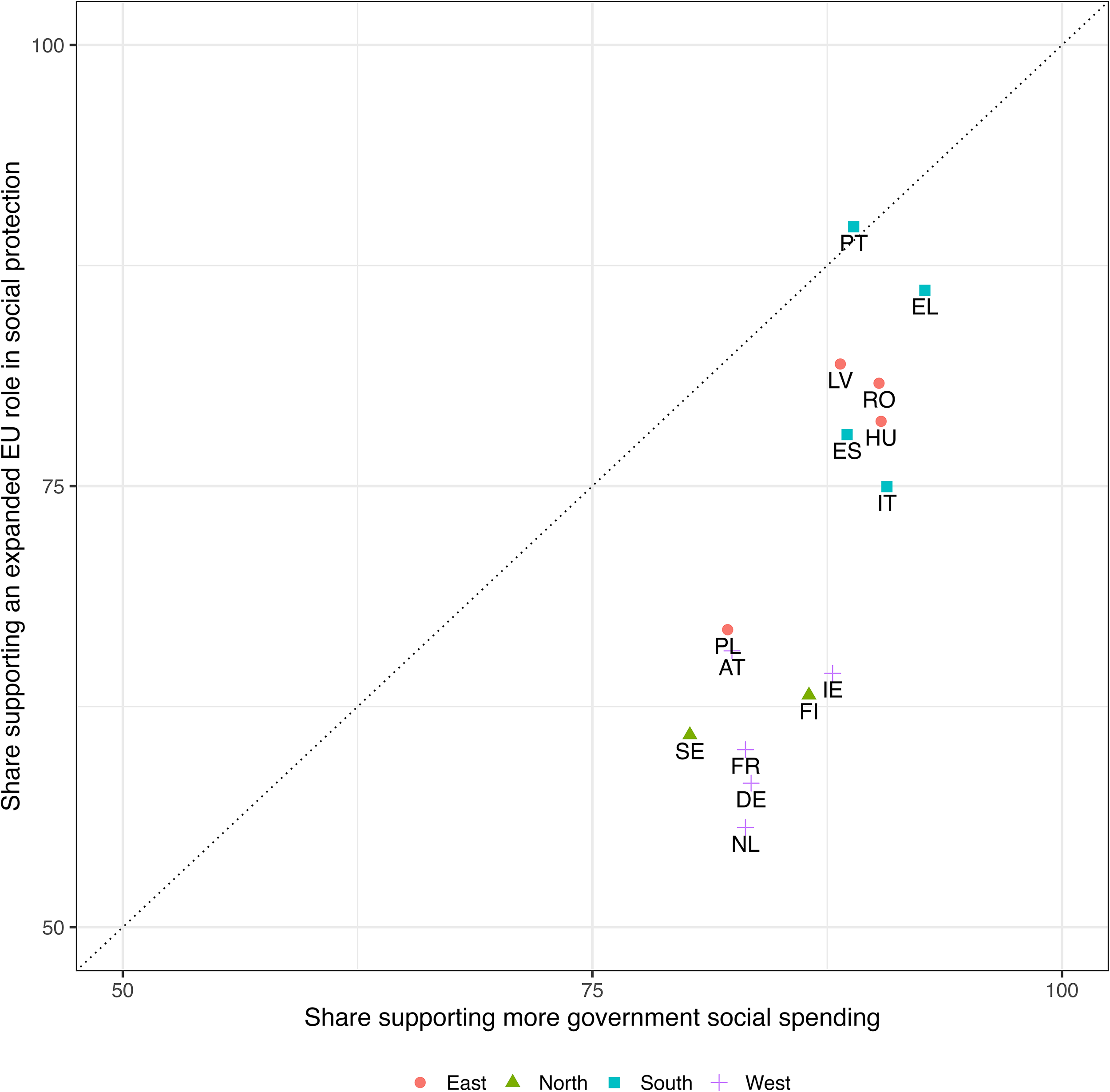
Support for More Government Social Spending and the Eu's Role in Social Protection.
Independent Variables
The main independent variables are survey respondents’ level of concern with emigration and immigration. These are measured through the following questions: “Now think about the freedom of movement in the EU. How much are you concerned about [NATIONALITY] citizens who emigrate to other EU countries/Citizens of other EU countries who immigrate to [COUNTRY]?” Answers are given on a 0–10 scale ranging from 0 “not concerned at all” and 10 “extremely concerned.” Note that these two questions do not allow us to explicitly differentiate between migration preferences and intensity, which could have different causes and consequences (Dennison and Geddes 2019; Hatton 2021). Our measures evaluate the importance respondents ascribe to EU immigration and emigration and are closer to a measure of individual salience rather than preference for migration policy. Still, in contrast to the typical measure of salience based on the “most important problem,” in which questions pit different issues against each other, our measures are absolute because they do not directly relate to other competing priorities.
Figure 2 plots the average level of concern with immigration (on the horizontal axis) and emigration (on the vertical axis) in the 15 countries investigated (symbols represent the four macroregions: East, North, South, and West). Regional differences seem to stand out: on average, respondents in Northern and Western European countries worry more about immigration than emigration; on the other hand, Eastern European countries are slightly more concerned about emigration than immigration (with the marginal exception of Poland). Finally, in Southern countries, respondents are equally concerned about immigration and emigration. As subsequently explored, a country's migration profile determines to a large extent its level of concerns with emigration/immigration.
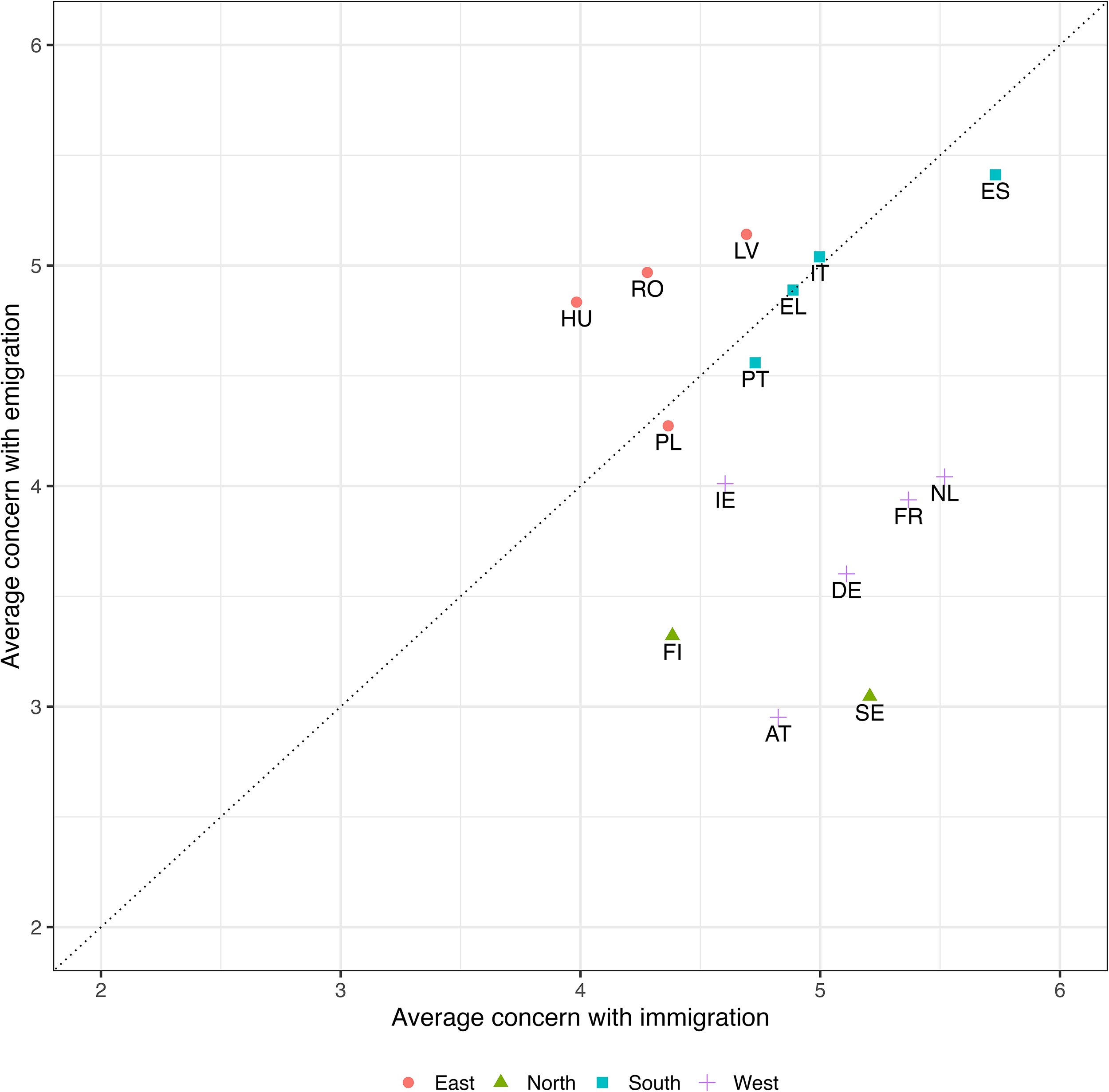
Average Concern With Emigration and Immigration of Respondents.
Correlates of Concerns
In the next step, we explore the social stratification of concerns related to immigration/emigration in our sample countries. Figure 3 reports coefficients from two multilevel regressions on the two concerns. We included the following controls: gender (female = 1 and male = 0), age (18–34, 35–54, and 55+), education (low, middle, and high); unemployed (0 = not unemployed and 1 = unemployed); rural (urban = 0 and rural = 1); economic insecurity (0 = not difficult to cope on household income and 1 = difficult to cope on household income); sociotropic evaluation of the past economy (0 = improved/the same and 1 = worsened); trust in the national government (0–1); left-right self-placement recoded into six categories (left = 0, 1; center-left = 2, 3; center = 4, 5, 6; center-right = 7, 8; right = 9, 10; and not located); exclusive national identity; and whether a respondent believes their country has benefited from EU membership.
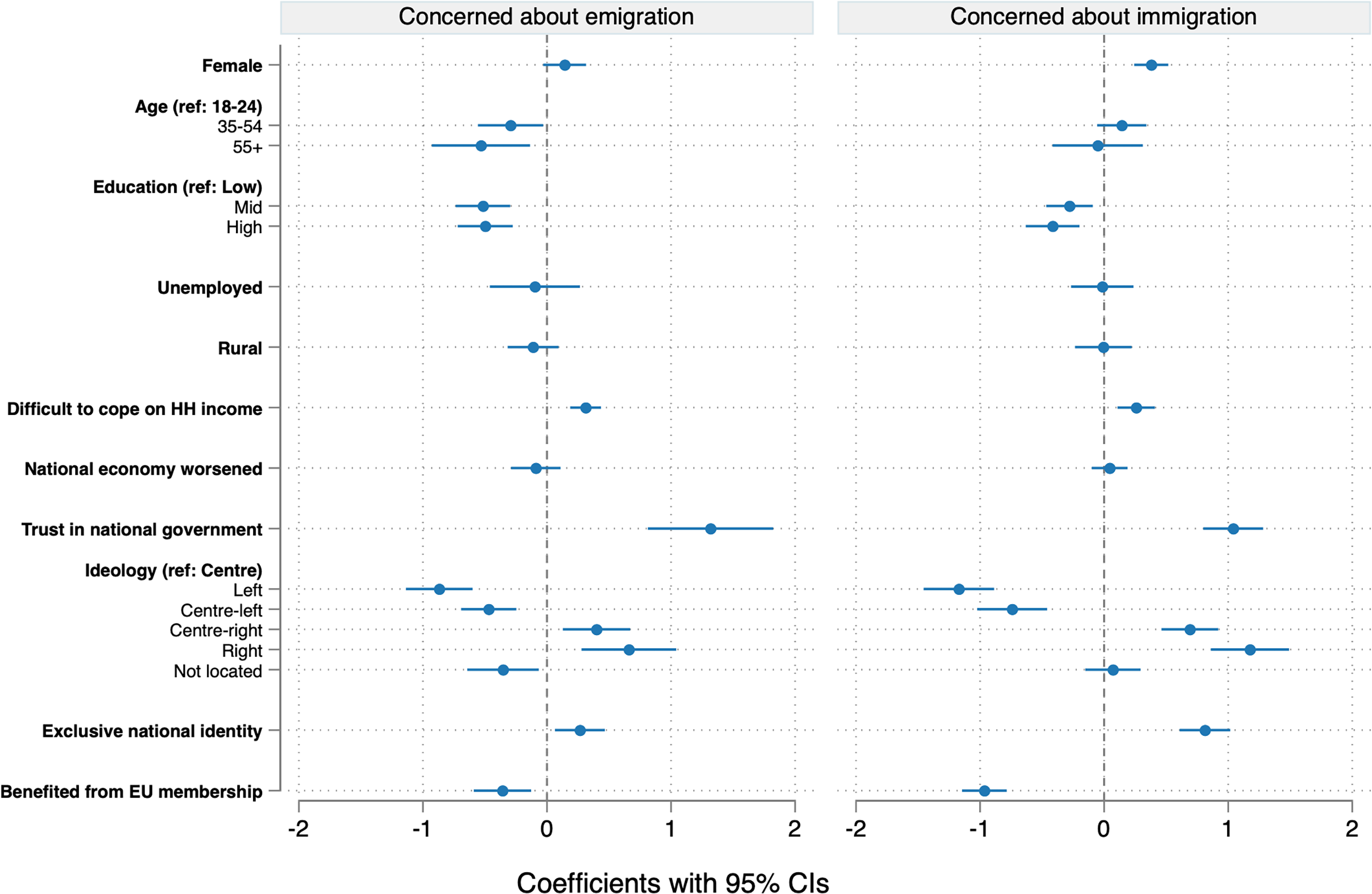
Determinants of Concerns With FoM Attitudes.
Some noteworthy differences emerge along age, with the old being less likely to be concerned about emigration than the young. Education significantly reduces the probability of being concerned with both emigration and immigration, a result that speaks to cognitive mobilization theory, according to which better-educated individuals are less scared by FoM (Inglehart 1970). By contrast, employment status and rural residence are irrelevant in explaining the two concerns. In both cases, subjective economic status returns positive coefficients: people concerned about their household income are also worried about emigration and immigration.
Attitudinal variables are more powerful than sociodemographics in explaining the probability of being concerned about FoM. First, trust in the national government shows a puzzling association: the more people trust their national government, the more they are concurrently worried about both immigration and emigration—a result that deserves further investigation and that could be related to the perception of the threat posed by FoM to the nation-state. Investigating political ideology, those respondents who place themselves on the left side of the political spectrum are less concerned about both emigration and immigration, while the opposite applies to those on the right, who are worried about both. Identity plays a significant role as well, with those self-identifying as “nationals only” showing a higher probability of being concerned with both immigration and emigration (as opposed to those who identify as both national and European). Indeed, cultural threat seems to drive FoM concerns for this category. Finally, believing that respondents’ own country benefited from EU membership significantly reduces concerns with FoM, and the association is particularly pronounced for immigration specifically. This demonstrates once again how migration and EU evaluation are entangled and tap into similar heuristics in the minds of citizens.
Next, we look at indicators capturing country-level economic and demographic characteristics, which can be expected to covary with concerns about immigration/emigration. On the one hand, countries in which wages are higher and welfare states more generous also tend to attract more immigration (though the causal relationship between the generosity of welfare programs and the residential choices of migrants is not straightforward, see Martinsen and Werner 2019). On the other hand, it is known that states that are unable to enhance the quality of life of their citizens, specifically through effective public spending and the provision of high-quality public goods, also experience the largest outflows of workers (Alcidi and Gros 2019).
Table 1 reports coefficients for multilevel regressions on concern with emigration and immigration including one country-level variable at a time. The level is reported for the share of emigrants, the foreign-born population, social spending, and the unemployment rate. The most noticeable feature is that the share of emigrants over the population does not return sizeable coefficients; this could depend on the fact that emigration is much harder to measure than immigration. Indeed, for a migrant, it is more important to interact with the institutions of the receiving country than with those of the country the migrant leaves. Instead, as the share of foreign-born in a country increases, so does a concurrent rise in concern with immigration, while worries about emigration decrease.
Regression Coefficients of Country Profile on FoM Attitudes.
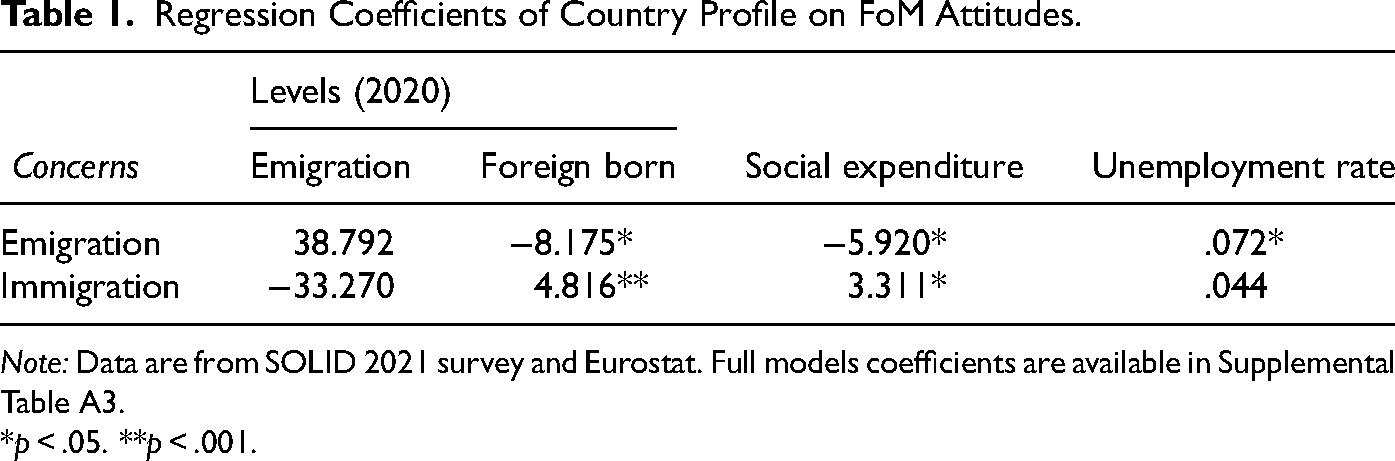
Note: Data are from SOLID 2021 survey and Eurostat. Full models coefficients are available in Supplemental Table A3.
*p < .05. **p < .001.
Spending on social protection over GDP shows greater correlations with concerns: the more a country spends on social benefits, the less people are concerned about emigration; by contrast, the opposite is true for concern over immigration. Finally, on average in countries with higher levels of unemployment rates, people are more worried about emigration. These results speak to the ambivalence of FoM, which constitutes an opportunity for people who cannot find a job in their own country, or who are dissatisfied with the way their country is managed, but could also be perceived as a threat as fellow EU citizens from other countries could increase competition for jobs in the national labor market and the departure of young emigrants endangers the future of their country.
To summarize these findings, individual-level antecedents of concerns are the same, and their differences seem to lie more in the socioeconomic profile of their country. We take this as evidence that the characteristics of people worried about FoM are similar and are variably expressed over emigration/immigration, depending on the context in question (in line with Kustov 2022).
Emigration, Immigration, and Social Policy Preferences in the EU
Having mapped the antecedents of concerns over emigration and immigration, we now move to our main research interest: the association of these concerns with welfare preferences. We perform separate multilevel logistic regressions on our two outcome variables: government spending in social protection and the EU's role in social welfare. To the controls listed for the model in Figure 3 we add the evaluation of national social policies using an index that averages respondents’ positions on a scale from 0 “completely dissatisfied” to 10 “completely satisfied” on five items: services for families and children; unemployment benefits and short-time work schemes (furlough leaves); social assistance for the poor; training and job-search services for the unemployed; and minimum wage for low-paid workers.
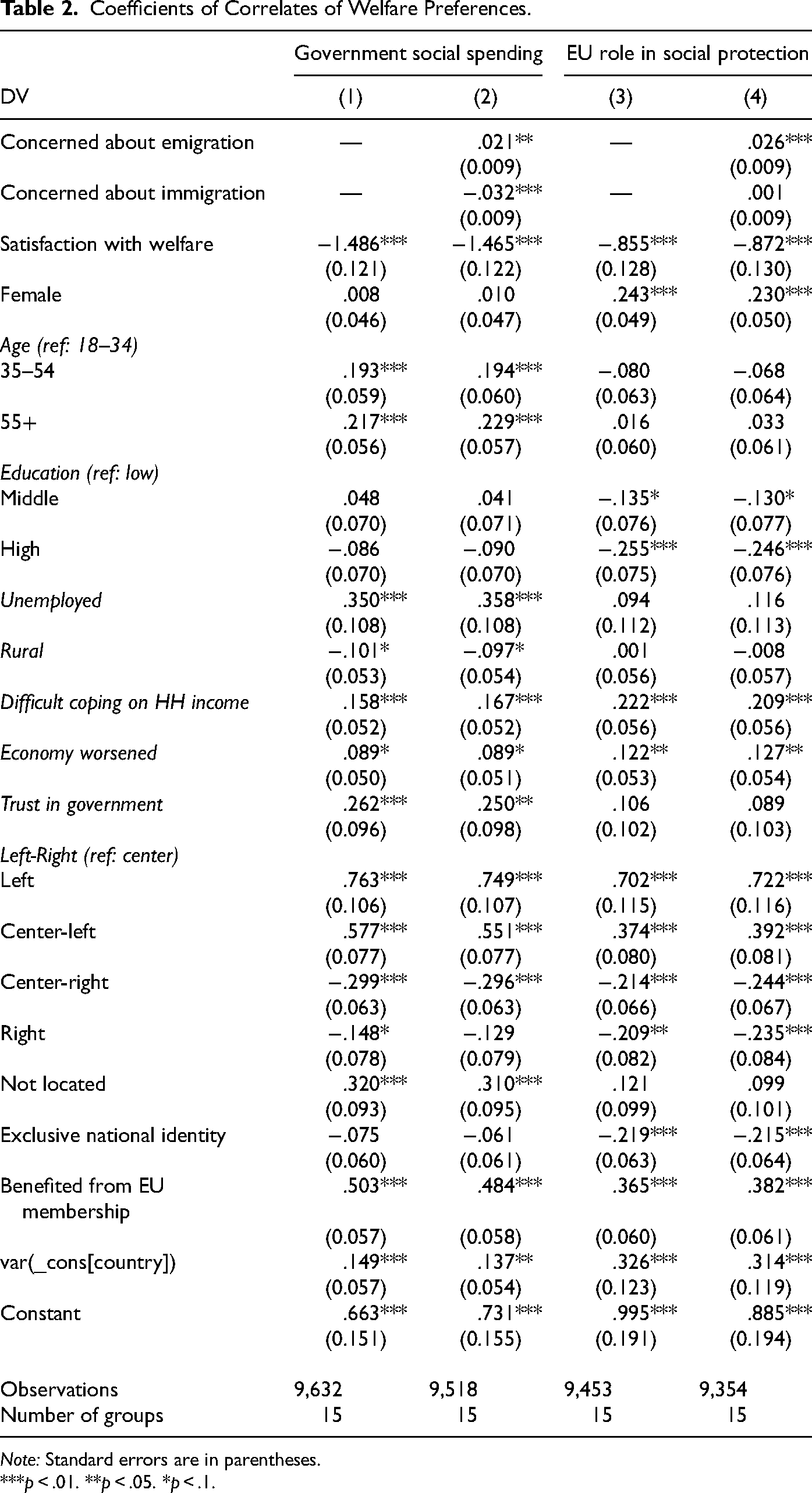
Table 2 reports full model coefficients from four different multilevel logistic regressions on government spending (Models 1 and 2) and the EU's role in social policy (Models 3 and 4), with random intercepts to control for country-level differences. Models 1 and 3 are the baseline and include only control variables, while Models 2 and 4 include both concerns for emigration and immigration. This model specification allows us to evaluate the net association of being concerned with emigration/immigration regardless of one's beliefs about the other concern. The key insight of our regression analyses is that worries about the two facets of FoM are linked to policy preferences in an inverted manner. As proposed in H1, being preoccupied with incoming migration is positively associated with opposition to government social spending (Model 2). Conversely, being preoccupied with emigration is positively associated with support for government spending on social policy (H2b) and with support for a stronger EU role in social matters (Model 4), thus corroborating H4. Finally, concern about immigration shows no statistically significant relationship with preferences regarding the EU's role.
Coefficients of Correlates of Welfare Preferences.
Note: Standard errors are in parentheses.
***p < .01. **p < .05. *p < .1.
Our study is in line with the immigrationization of welfare thesis (Burgoon and Rooduijn 2021) inasmuch as individual attitudes toward migration affect welfare preferences. However, worries about immigration versus emigration seem to have different consequences. On the one hand, people perceiving immigration as a salient issue do not favor further social spending. This suggests that the perception of intra-EU immigration as a problem has implications for citizens’ preferences on welfare redistribution; they may become concerned that migrants will unfairly benefit from social security benefits or overburden the social budget. On the other hand, people worried about the emigration of their conationals to other EU countries favor social compensation mechanisms, and they do so both in their country and at the supranational level.
Does the specific welfare program make a difference? There is some evidence suggesting that immigration attitudes relate to social policy differently depending on the type of program in question, such as universal versus means tested (Muñoz and Pardos-Prado 2019). More broadly, different groups of needy people are considered to be more or less “deserving,” for example, the elderly more than the unemployed, and both more than immigrants (van Oorschot 2006). We unpack the dependent variable on government spending into its four components and estimate different models for each. The results, which are available in Supplemental Table A4, reveal that concerns over emigration have a positive impact on increasing benefits and training for the unemployed, for the poor, and for families and children. On the contrary, the specific program seems to make some difference for concerns over immigration that reduce support for social investment policies: spending in training programs and in family and children services.
Given the nonlinear nature of the models reported, to comprehensively capture the strength and the significance level of the association between our dependent variables and concerns with emigration and immigration, we computed the predicted probabilities that respondents would express support for more government social spending and a greater EU social role at changing values of concern with emigration and immigration. Results are reported in the four plots in Figure 4. As we can see, concerns with FoM only have a small net association with social preferences; indeed, moving from the minimum to the maximum concern for emigration increases the predictive margin for the probability of favoring an increased EU social role by .048 and pro-government spending by .042. Conversely, moving from the minimum to the maximum concern for immigration reduces the predictive margin for the probability of a pro-EU social role by .001 and pro-government spending by .065. This latter result, while relatively small in magnitude, is slightly bigger than that found by Burgoon and Rooduijn (2021) in relation to the immigrationization of welfare policy preferences.
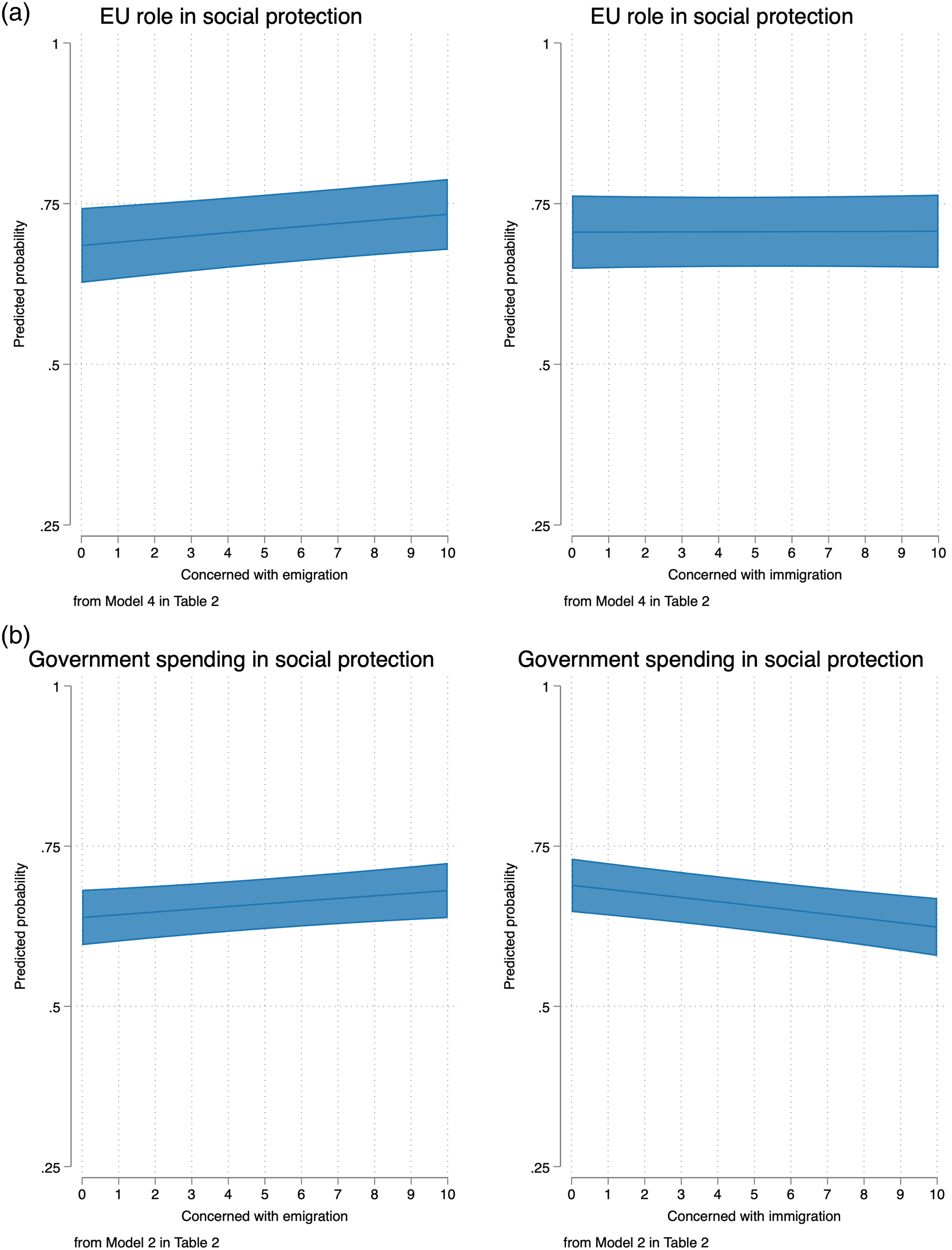
Change in the Predicted Probability of Public Attitudes Towards the Eu's Social Role (a) and (b) Government Social Spending at Varying Levels of Concerns With Emigration and Immigration.
Control Variables
The performance of the controls is in line with previous studies investigating support for redistribution, with some differences between the models. Similar coefficients are found for the pocketbook and sociotropic economic evaluations; people reporting a worsening of their finances or of the national economy are more in favor of social spending and expanding the EU's social role. Satisfaction with national welfare services represents a good benchmark to decipher respondents’ welfare preferences; the more a person is satisfied with the social benefits available in their country, the less they will favor increased spending or supranational involvement. Political ideology also associates linearly with both variables, with people on the left favoring more welfare (spending) and people on the right opposing it. Similarly, maintaining that one's own country has benefited from EU membership is a predictor of favoring both more government spending and more EU solidarity policies.
Apart from the rural–urban divide, which does not seem to relate to them, the remaining covariates show contrasting associations with the dependent variables. Women favor social Europe, but not more national spending on welfare compared to men; older respondents are relatively more in favor of national government spending compared to younger ones, while age does not discriminate on the EU's role in welfare. Educational levels do not predict preferences for government spending, while the highly educated are more skeptical about social Europe. This is an interesting result considering that education is generally a predictor of support for the EU project as a whole, but evidently not necessarily of solidarity policies. Indeed, higher educational attainment may lend more support for market-making rather than market-correcting policies. Moreover, the unemployed are more in favor of national spending rather than that of an EU role. Trust in the national government positively affects support for national solutions and does not relate to EU policy preferences. Finally, exclusive national identity does not predict preferences for government spending on social benefits but does reduce support for a greater EU social role coherently with previous findings (e.g., Verhaegen 2018).
Country-Level Variables
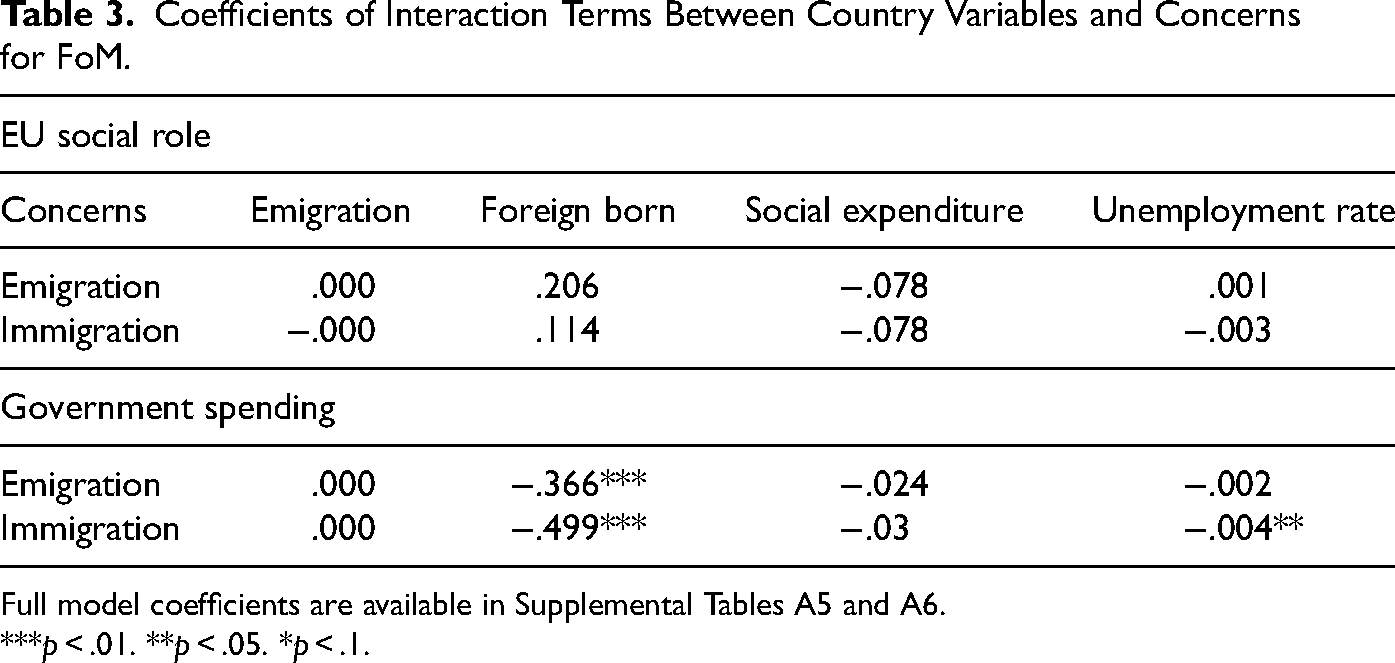
Finally, we explore the moderating role of country-level structural characteristics related to the socioeconomic profile of the member states included in our sample. We interacted with concerns about immigration and emigration the country-level variables presented in Table 1. Table 3 reports the coefficients of interaction terms between the concerns (in rows) and country-level variables (in columns). In terms of the EU's role in social protection, we found no significant interaction term. Instead, looking at the other dependent variable, we found that individual concerns about emigration and immigration decrease support for government social spending as the share of foreign-born in the respondent's country increases. Where the level of migrants is low, concern with emigration translates into support for increased government social spending, but as the share of foreign-born increases, concern for emigration loses relevance in explaining attitudes toward government spending.
Coefficients of Interaction Terms Between Country Variables and Concerns for FoM.
Full model coefficients are available in Supplemental Tables A5 and A6.
***p < .01. **p < .05. *p < .1.
Concerns for immigration are instead even more negatively associated with national social spending in countries with more foreigners. Another interaction is significant, specifically that between immigration and the unemployment rate; worry about immigration lowers its association with support for more national social spending as the unemployment rate increases. Once again, these results suggest the relevance of the socioeconomic profile of a country for understanding how concerns related to the two facets of FoM translate into greater or lower support for social policies.
Conclusion
Our analysis is the first to systematically map how worries about emigration and immigration shape social policy preferences in the EU. Drawing on an original survey fielded in 15 EU member states in 2021, we first examined the prevalence and geographic distribution of emigration-/immigration-related concerns in the EU. We discovered the existence of a divide in Europe regarding concerns about emigration versus immigration: on average, the former is more salient in the peripheral states and the latter in the core states. To be sure, people still worry more about immigration than emigration, and Southern Europe in particular stands out as the region in which both concerns are very high. In terms of the individual-level predictors of immigration/emigration concerns, we register striking similarities in both the direction and the magnitude of the relationship. We take this as evidence that, at least to some extent, concerns with emigration/immigration are different articulations of the same unease related to human mobility in its various forms (see Kustov 2022).
Our main research interest was whether emigration-related concerns translated into policy preferences and whether they did so in the same vein as immigration-related concerns. We thus focused on welfare spending by the national government, as well as preferences for EU involvement in social protection. The key insight of our analyses is that worries about emigration versus immigration are linked to policy preferences in an inverted manner; specifically, worrying about immigration lowers support for more government spending, but the opposite is true for concerns related to emigration. Moreover, concern with emigration is also conducive to preferences for a more robust involvement of the EU in social matters, indicating that national and EU-level welfare attitudes are additive rather than complementary. With regard to immigration and welfare, our research confirms existing knowledge by ascertaining a negative association between intra-EU immigration and welfare state support (Cappelen and Peters 2018). The fact that concerns over intra-EU immigration dampen support for the expansion of national government spending, while they are irrelevant for increased EU involvement in the social sphere, points to the limitations of extending social Europe as a way of compensating for the potential negative externalities of integration (cf. Baute et al. 2019).
Our study, however, does have some limitations to consider. First, we only had a sample of EU countries at our disposal. Each country follows a different electoral cycle, and thus the survey was conducted at different political stages and with different salient issues in their respective domestic political arenas. Second, with only one point in time at our disposal, we cannot evaluate the dynamic of concerns of both directions of FoM and their association with actual and perceived mobility trends. Third, future works should more explicitly disentangle the preferences and intensity/salience of citizens for the two facets of FoM to evaluate their relevance more precisely.
This said, our study suggests that FoM impinges on preferences for how the welfare state is organized and financed. We knew that worries about immigration structure social preferences, and we can now state that the same is true for worries about emigration, though in a different fashion; indeed, they have the potential to translate into support not only for stronger national welfare but also for a more social Europe. What is more, this result is particularly relevant in Southern and especially Eastern European member states, both of which have higher levels of intra-EU emigration rates and relatively weak welfare states.
Supplemental Material
sj-docx-1-mrx-10.1177_01979183231185096 - Supplemental material for Free Movement and Welfare in the European Union: The Social Consequences of the Right to Exit
Supplemental material, sj-docx-1-mrx-10.1177_01979183231185096 for Free Movement and Welfare in the European Union: The Social Consequences of the Right to Exit by Anna Kyriazi and Francesco Visconti in International Migration Review
Footnotes
Declaration of Conflicting Interests
The author(s) declared no potential conflicts of interest with respect to the research, authorship, and/or publication of this article.
Funding
The author(s) disclosed receipt of the following financial support for the research, authorship, and/or publication of this article: This work was supported by the H2020 European Research Council (grant number 810356 ERC-2018-SyG).

Supplemental Material
Supplemental material for this article is available online.
Notes
References
Supplementary Material
Please find the following supplemental material available below.
For Open Access articles published under a Creative Commons License, all supplemental material carries the same license as the article it is associated with.
For non-Open Access articles published, all supplemental material carries a non-exclusive license, and permission requests for re-use of supplemental material or any part of supplemental material shall be sent directly to the copyright owner as specified in the copyright notice associated with the article.
