




Abstract
In the aftermath of the rapidly increasing number of refugees arriving in Europe following the Russian invasion of Ukraine, nonprofit organizations, private companies, and also public institutions have promoted homestay initiatives: That is, local households hosting refugees. In order to reflect on the political issues that homestay accommodation for refugees raises, the article charts and synthesizes the available research on homestay produced in 75 works written in English, French, German, and Italian, and with a particular focus on the European context. Most of those texts were published in the second half of the 2010s and focused on the homestay initiatives that developed in the context of the so-called 2015 “refugee crisis.” We analyzed this material by focusing on three different levels: First, hospitality as an inter-individual relationship within the domestic sphere (micro level); second, refugee homestay as diverse accommodation arrangements, implemented by informal groups, nonprofit organizations, and public institutions (meso level); and, third, the (non-) contentious dimension of homestay accommodation (macrolevel). The review also identifies theoretical, methodological, and empirical perspectives for future studies on homestay. We call for more attention to be given to the intersectional inequalities and power relations between hosts and guests; to the life trajectories of refugees; and to the interplay between homestay initiatives and political contexts. We argue that homestay is an exemplary case to reflect on the ongoing evolution of refugee support towards solidarity practices that ambivalently interact with border regimes.
Keywords
In the aftermath of the Russian invasion of Ukraine in February 2022 and the subsequent flight of millions of Ukrainians from their home country, numerous initiatives have blossomed across Europe to promote private hospitality for refugees, to wit, homestay accommodation for refugees. 1 Homestay is private accommodation offered by locals to foreigners; it expresses the idea that a household is willing to share its living space with a person from another country (Hebbani, Khawaja and Famularo 2016). New online platforms to recruit hosts have been launched (Schiffmann, Burstein and Colon 2022). Transnational corporations, such as Airbnb (Haeck 2022) and CouchSurfing (2022), as well as social housing companies (BFM 2022), have encouraged their communities to host refugees in their homes. Moreover, existing organizations hosting refugees have suddenly received many more housing offers (Bassoli 2022a). States have also begun initiatives, suddenly promoting policies based upon homestay accommodation: Italy (Bassoli 2022b), France (Ministère de l’intérieur and DIHAL 2022), and Spain (Fundación La Caixa 2022), to name but some. All these public and private actions mirror the considerable popular interest: The growth of Internet searches between February and March 2022 on how to propose homestay accommodation nullified any previous record by 20 times (Bassoli 2022a).
All these examples show that, since the arrival of Ukrainian refugees, homestay practices have become increasingly popular in many European countries. However, this particular form of solidarity raises multiple ethical and political issues. What effect does domestic cohabitation between people occupying very unequal social positions have on the host-guest relationship and on the refugees’ trajectories? How do homestay organizations categorize and select refugees? Does homestay fit the asylum and reception policies of states or does it challenge it?
Homestay accommodation for refugees has been unprecedently popularized by the war in Ukraine. However, other refugee movements have generated homestay practices in recent decades. Homestay accommodation was organized for Spanish refugees in France in 1939 (Ponty 1996; Dreyfus-Armand 2016); for refugees from the former Yugoslavia in Germany, the Netherlands, and Italy in the 1990s (Rastello 1998; Komter and van Leer 2012); and for asylum seekers in Italy since 2008 (De Capite, Forti and Guaglianone 2014; Marchetti 2018; Vietti 2018) and in Australia since 2012 (Khawaja and Wotherspoon 2015; Hebbani, Khawaja and Famularo 2016). More importantly, homestay accommodation for refugees gained importance and visibility across Europe in the context of the so-called 2015 “refugee crisis” in Europe (Bazurli 2019) and the subsequent solidarity movement (Agustín and Jørgensen 2018; Della Porta 2018). This “boom” in the mid-2010s led dozens of researchers to explore the phenomenon. This article, which reviews studies conducted mostly between 2015 and 2020, will show what scientific knowledge is already available to shed light on homestay accommodation for refugees, and what remains to be questioned and analyzed. As the time limit of our literature review is December 2020, it will not cover how homestay has developed and evolved in Europe since the Ukrainian crisis (Bassoli 2022b).
By reviewing scholarly work published in English, French, Italian, and German, we wish to initiate a more international and interdisciplinary dialogue by proposing an exploration of the literature that spans different languages, countries, scales, methods, and scientific fields. We believe that this mapping is a much-needed task: so far, initiatives to gather researchers have been rare (BABELS 2019), as have been comparative works (Monforte, Maestri and d’Halluin 2021).
The article features six sections. The next section discusses the (re-) birth of homestay in Europe within the wider scenario of the refugee solidarity movement that developed from the mid-2010s. Then we propose a definition of homestay accommodation for refugees that underlines its specificities and a theoretical framework bridging hospitality and collective action studies. Thereafter, the methodological section presents the Preferred Reporting Items for Systematic Reviews and Meta-Analyses (PRISMA) method that we used to collect references. The fourth section gives a brief presentation of the corpus that we analyzed (chronology, academic disciplines, investigation fields, and methods). The main part of the article presents a compilation of the information present in the existing literature through a scalar analysis: first, private hospitality as a relationship, at the (inter) individual scale (microlevel); second, homestay accommodation for refugees as an object of collective and professional action on a group scale (meso level); and third, the contentious dimension of homestay accommodation, on a societal scale (macro level). Throughout the review, we highlight topics, aspects, and articulations that remain unexplored in the current literature. In particular, we underscore that scholars often analyze these initiatives as isolated case studies with a narrow focus on hospitality. We argue that future investigations could develop a more critical perspective on hospitality through closer attention to intersectional inequalities based on gender, race, class, age, and citizenship, and to the experiences and trajectories of refugees. We also suggest fueling the analysis of refugee homestay with studies on collective action and crossing different local or national contexts. In the conclusion, we argue that homestay accommodation remains a promising object for investigating more general issues, such as the inequalities between refugees and citizens, the residential trajectories of refugees, and the on-going evolution of refugee support.
Pro-Asylum Mobilization and Homestay Practices
From 2015 onward, a large solidarity movement developed to support the increasing numbers of refugees arriving in Europe from the Middle East and Africa (Agustín and Jørgensen 2018; Della Porta 2018). More precisely, European civil society contested the public policy adopted to tackle the so-called “refugee crisis” (Bazurli 2019; Puggioni 2021) along four dimensions. First, policies aimed at a stricter control of European external borders resulted in more people dying while attempting to enter Europe (Migreurop 2017) or being blocked—sometimes officially detained—in third countries or in European peripheral territories (Migreurop 2017; Tazzioli and Garelli 2020). Second, the European Dublin Regulation “illegalized” a large portion of refugees who arrived in Europe (Bhimji 2016; Maillary 2018; Bartel, Delcroix and Pape 2020), along with the high rejection rate of asylum applications (Eurostat 2022). As a result, many refugees have lived in Europe without legal or social rights, and thus have been excluded from public reception systems. Third, even for asylum-seekers or recognized refugees, many national reception systems have shown their limits (Hinger 2016; Slama 2018). Homelessness for refugees has grown dramatically in some countries (Trossat 2019; Gardesse, Courant, and Masson-Diez 2022), temporary housing arrangements are often highly constrained and segregated (Kobelinsky 2012; Foroutan et al. 2017; Carrère and Lévy-Vroelant 2019), and access to conventional housing has been hindered (Foroutan et al. 2017; El-Kayed and Hamann 2018; Clauzier 2019). Fourth, difficult access to language courses, education, and work has persisted in many contexts (Herman and Rea 2017; Brücker et al. 2019; DSED 2020).
This situation has sparked a wide range of solidarity mobilizations (Puggioni 2021), which have targeted one or several of the issues related to refugee reception and have taken many forms. In addition to legal support, social counseling, language courses, and clothes distribution (Karakayali and Kleist 2015, 28–29; 2016, 24–25), accommodation has been an important object of collective action in Europe. Simultaneously, municipalities, nonprofit organizations, and citizens have all developed alternative arrangements in an attempt to accommodate people whom the official systems have rejected or failed to help (Braud, Fischer, and Gatelier 2018; Gardesse, Courant, and Masson-Diez 2022). Among the different practices, local residents across Europe have offered refugees shelter by (temporarily) hosting them (BABELS 2019; Monforte, Maestri and d’Halluin 2021).
Homestay Accommodation for Refugees: A Theoretical Perspective
We propose homestay accommodation for refugees as an umbrella term that covers diverse practices that have the following elements in common: Local residents hosting refugees with whom they have no personal connection. In practice, homestay accommodation can take various forms. It can be a solution for a couple of nights or for weeks, months or years. Not only informal groups of volunteers and nonprofit organizations but also local or national governments initiate homestay practices. Hospitality may be blind to legal status or offered to a specific category of refugees (asylum seekers, unaccompanied minors, illegalized or recognized refugees).
Homestay accommodation for refugees is different from other forms of private hospitality. Private hospitality offered in diasporas by relatives, friends, and acquaintances has been observed in Europe for decades (Timera 2000; Baronnet, Faucheux-Leroy, and Vanoni 2012; Gerbier-Aublanc 2019) and provides an important safety-net for refugees denied the resources to access public shelters or standard housing (DSED 2020). Homestay expands the field of private hospitality, as it operates outside of migration networks through the involvement of (mostly) native-born citizens who have no initial personal connection with their guests. Moreover, we argue that homestay moves private hospitality to the public sphere. Whereas private hospitality is generally the product of personal relationships and networks (Gotman 2001), homestay accommodation for refugees proposes a form of hospitality implemented by groups that are part of humanitarian and solidarity movements, which seek visibility in the public space.
Moreover, homestay also differs from other support practices, such as sponsorship programs and community-based sponsorships (European Commission 2018) because the latter does not envisage the sharing of personal space and often blossom from previous connections between the guest and the host (Neuwirth and Clark 1981; Kumar Agrawal 2019; Kaida, Hou and Stick 2020; Ali, Zendo and Somers 2022). At the same time, sponsorship programs and many homestay programs have in common that they give volunteers the opportunity to support refugees’ social inclusion, especially access to housing. However, within sponsorship programs, financial support guarantees lodging (Kaida, Hou and Stick 2020; Ali, Zendo and Somers 2022), that is, refugees get money to establish their own home, whereas homestay programs propose shared accommodation and the establishment of a domestic relationship between citizens and refugees (Boccagni and Giudici 2022). Homestay accommodation for refugees involves greater proximity between guests and hosts, based upon mutual understanding, and the sharing of space, time, and daily routines.
Homestay accommodation for refugees has a double dimension. On the one hand, it is a relationship of hospitality between citizens and refugees. On the other, it is the product of collective action in the context of refugee support movements. Because of this duality, homestay accommodation for refugees is at the intersection of at least two forms of literature that are usually disconnected, hospitality studies and collective action studies. Whereas the former help to question the host-guest relationship, the latter is useful to understand how homestay is framed, promoted, and implemented in various contexts. We can see the bridging of hospitality and collective action studies as a theoretical strategy to analyze better the contentious dimension of homestay accommodation for refugees.
Hospitality is the object of a large and diverse literature (Stavo-Debauge, Deleixhe, and Carlier 2018). It is a broad notion, which at the same time refers to a concrete domestic practice—a host opens their home to a guest—and is used as a concept to envision the regulation of the openness of a community, notably the nation (Boudou 2017; Luccioni 2023). Applied to the question of migration, hospitality is a “metaphor” (Rosello 2001) or a rhetorical analogy between home and the nation (Bessone 2015; Boudou 2016). Hospitality, be it a domestic practice (private hospitality) or a set of policies (public hospitality), is an ambivalent process, producing both inclusion and exclusion (Derrida 1999; 2000; Gotman 2001; Pitt-Rivers 2012). Within the field of hospitality studies, Derrida's theory has been particularly influential (Bessone 2015; Boudou 2016; Stavo-Debauge 2018). Derrida (2000: 4) points out the contradiction between the will to offer absolute hospitality and the need to limit hospitality to maintain one's authority as masters in one's own home. In political terms, Derrida (1999) observes a contraposition between conditional and unconditional hospitality. On the one hand, the Law of hospitality is an ethical principle that considers that anyone should be unconditionally welcomed. On the other, the laws of hospitality, applied by the state, set norms, limits, and hierarchies to define who is entitled to be welcomed and who is not. “Hospitality is a self-contradictory concept and experience,” states Derrida (2000: 5).
Hospitality studies offer tools to analyze homestay accommodation for refugees. They help to shed light on the asymmetry and ambivalence of the host–guest relationship. They are a basis for discussing the potential conditions of homestay: Duration, legal status, host expectations, etc. They also offer a framework to envision the contentious dimension of this relationship: in a context of inhospitable states (Fassin, Morice and Quiminal 1997; Blanc and Brugère 2017), what is the political meaning of hospitality offered by citizens?
To explore homestay accommodation for refugees not only as an interindividual relationship, but also as the product of mobilizations rooted in local contexts, collective action studies are helpful. Two objects particularly catalyze the collective dimension of homestay: The conditions of the emergence and development of homestay initiatives and their contentious dimension. Throughout this paper, we will argue that it is heuristic to analyze homestay accommodation for refugees through the lens of theoretical developments about “entrepreneurs of mobilizations” (Zald and McCarthy 1979; Siméant 1998), “framing processes” in social movements (Benford and Snow 2000; Contamin 2010), and the current hybridization of contentious and noncontentious action in the field of refugee support (Della Porta and Steinhilper 2021).
We will show that, within the literature about homestay accommodation for refugees, many researchers fuel their empirical analyses of hosting practices with hospitality studies or conversely draw on their field data to engage with a larger debate about the ambivalences and contradictions of hospitality (see, for example: Deleixhe 2018; Gerbier-Aublanc 2019; Masson Diez 2020a; Merikoski 2021; Monforte, Maestri, and d’Halluin 2021). In contrast, only a few researchers frame their analyses with references about collective action (Masson Diez 2018; 2020; Merikoski 2021). Throughout the article, we will underline the benefits—but also the limits—of approaching homestay accommodation for refugees through the lens of hospitality, and the interest to question homestay with a perspective on collective action.
Methods
We first acknowledge our position in the field. Matteo Bassoli is a political scientist who founded an organization that implements homestay for refugees in Italy. Clément Luccioni is finishing his Ph.D. in urban planning on homestay accommodation in Germany and France. Inspired by our work as activists, we have been researching the topic for the past 5 years. The need for a multilingual literature review emerged in our discussions when we realized that there was no common understanding of homestay accommodation for refugees, as the topic was strongly divided into disciplines, languages, and countries.
We opted for a systematic literature review based upon the PRISMA approach (Page et al. 2021). We were able to accomplish the task in English, French, German, and Italian for academic literature published before December 2020. We searched the databases of Scopus, Web of Science (Core Collection, KCI, MEDLINE, RSCI, SciELO), ScienceDirect, EBSCO Host, Cairn International (for English), Cairn (for French), and Google Scholar (for Italian and German). Given the number of languages involved and the presence of different terms used for homestay, 2 we designed a research strategy testing a large set of keywords (see the Supplemental Online Appendix). The research identified 2,339 documents. We deleted duplicates, using Zotero reference management software, reducing the corpus to 1,557 items (919 in English, 327 in French, 202 in Spanish, 245 in German, and 75 in Italian). These records were screened in two phases: First based upon titles and upon abstracts, and second, based upon full text.
In the first phase, we excluded 1,508 records because they covered various topics such as touristic hospitality, other types of accommodation arrangements for refugees, foster care, or migration and integration policies. The 49 remaining records were eligible for the second phase. Exploiting an existing database managed by Refugees Welcome International and our prior knowledge, we added 43 additional documents (10 in English, 13 in French, 4 in German, and 14 in Italian). Then we read these 90 documents to assess whether they (a) discussed homestay accommodation for refugees as a main or secondary topic, and/or (b) described the practice of homestay accommodation for refugees. After this second screening, we excluded 15 papers because they dealt with the issue marginally. In total, 75 documents comprised the final corpus (see Figure 1).
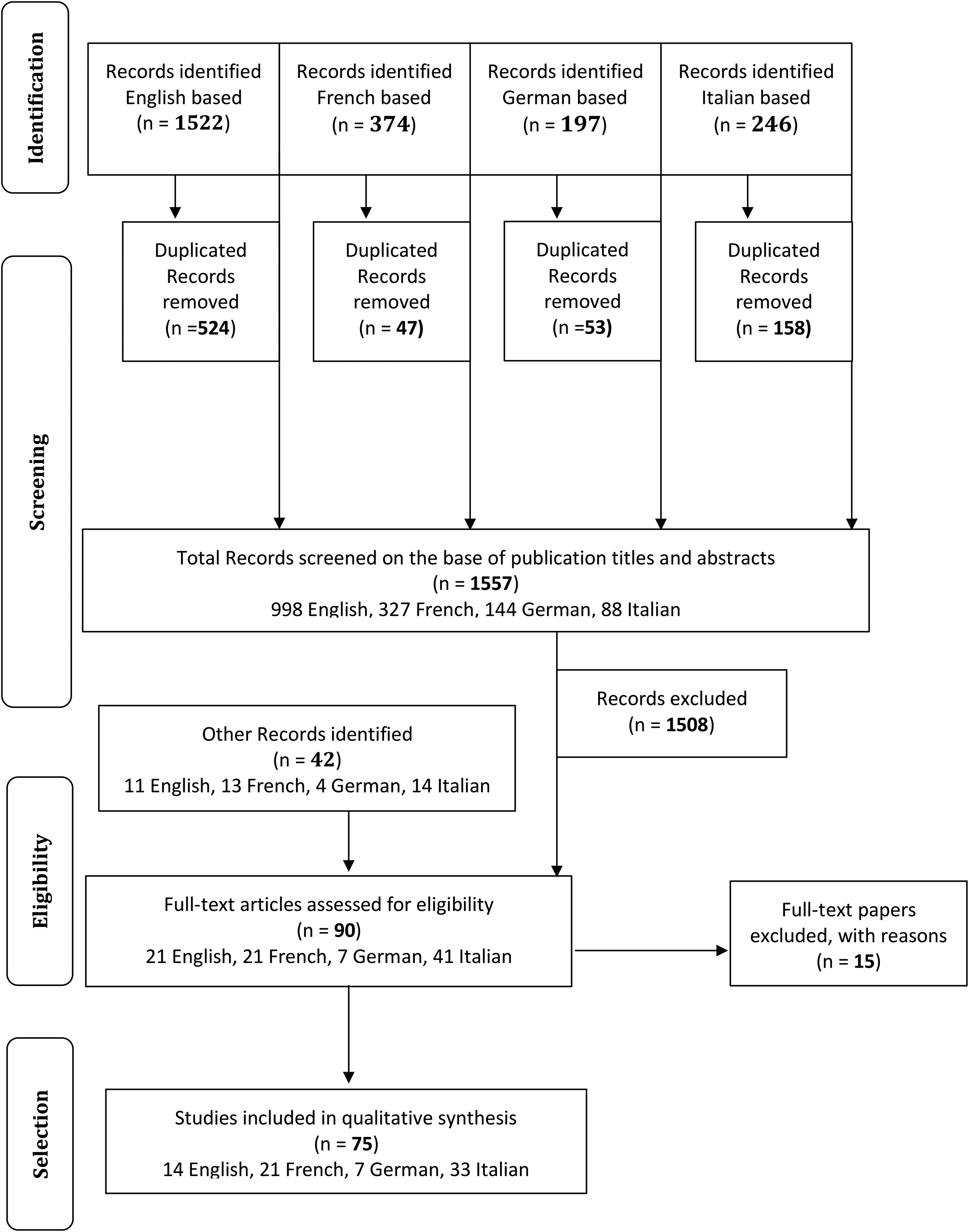
Preferred Reporting Items for Systematic Reviews and Meta-Analyses (PRISMA) flowchart for database searches. Source: Adapted from Page et al. (2021).
General Overview of the Corpus
The corpus included not only journal articles (31 percent) and book chapters (20 percent) but also the theses of master (27 percent) and bachelor (5 percent) degrees (see Supplemental Online Appendix). The oldest text (1998) deals with the arrival in Western Europe of refugees from former Yugoslavia in the 1990s, but the collected works were mostly published after 2016 (see Figure 2), after the so-called 2015 “refugee crisis” (Bazurli 2019). They are concentrated in the year 2019 and 2020, the last year covered by our mapping, well before the Ukrainian crisis.
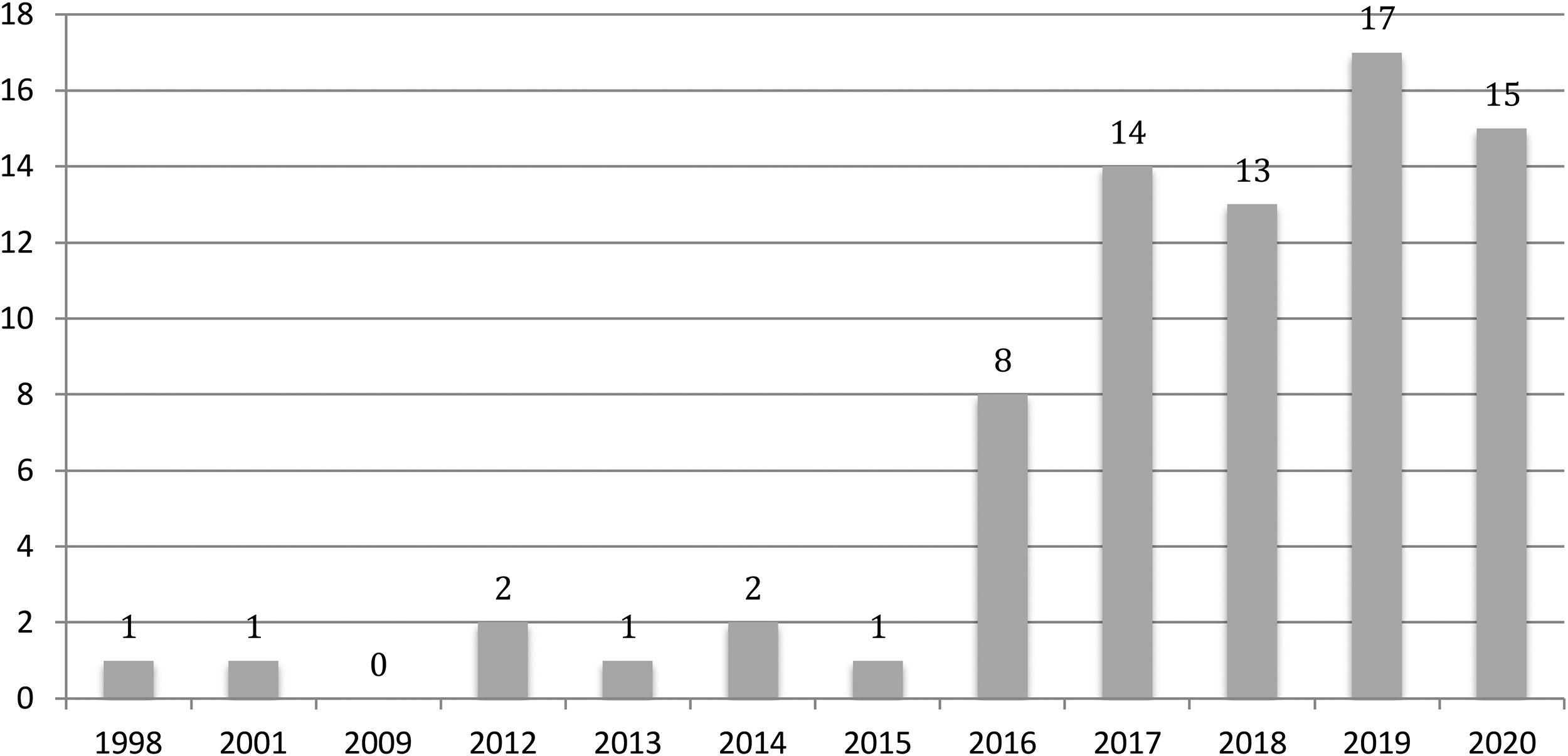
Publication dates of the relevant documents (1998–2020), absolute values.
The review covers mostly European countries. In the corpus, we found only two works on the Australian case (Khawaja and Wotherspoon 2015; Hebbani, Khawaja and Famularo 2016). By contrast, the corpus covers nine European countries: Austria, Belgium, Finland, France, Germany, Italy, the Netherlands, Switzerland, and the United Kingdom (Table 1). Homestay initiatives were particularly present in capital cities (Berlin, Brussels, Helsinki, Paris, and Vienna) but also in other areas, such as the region of Grenoble (Braud, Fischer and Gatelier 2018) and Alsace (Mathieu et al. 2016) in France, Ludwigsburg in Germany (Hayer 2017), a myriad of small cities in northern Italy (Bassoli 2016; Marchetti 2018; Nacci and Pannacciulli 2019), and border spaces, such as the Val Ròia (Roya Valley) in France near the border with Italy (Mollard 2017), or Ouistreham, a French harbor from which ferries cross the Channel to reach Great Britain (Gourdeau 2019). In Table 1, we briefly present the initiatives described in the corpus.
The Homestay Initiatives Analyzed in the Literature.
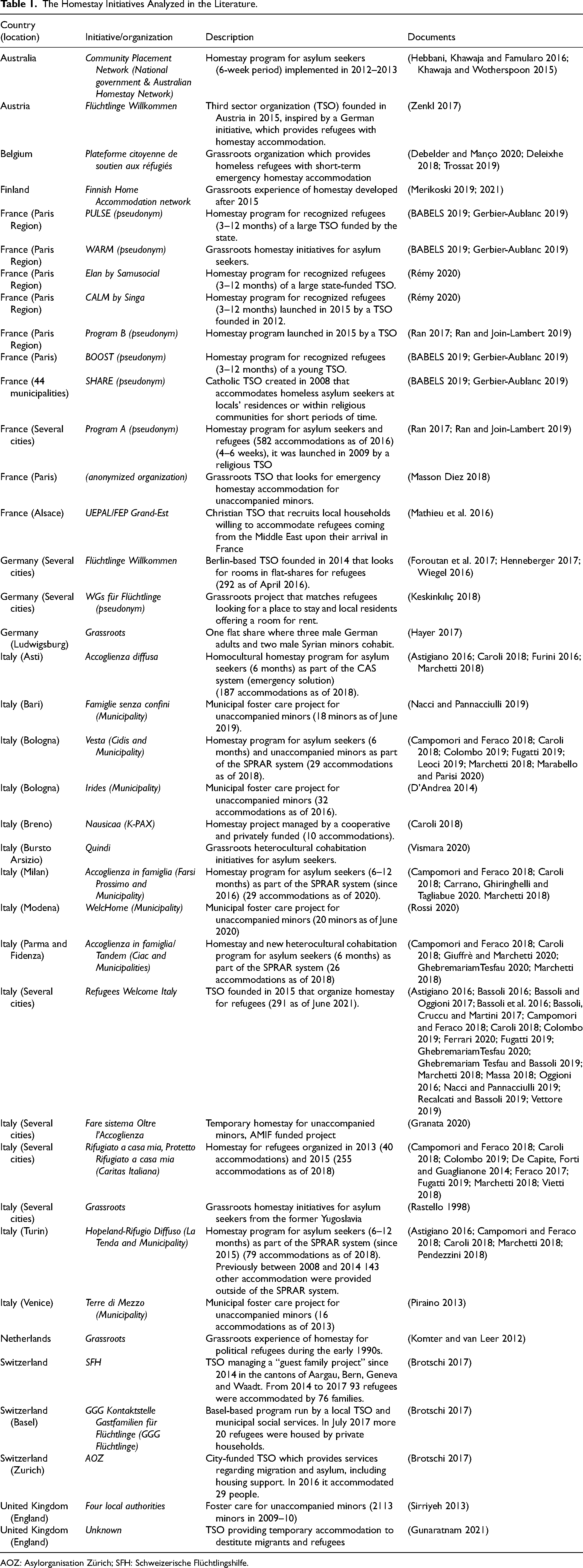
AOZ: Asylorganisation Zürich; SFH: Schweizerische Flüchtlingshilfe.
In terms of disciplinary approach, 47 percent of documents came from sociology or anthropology, 24 percent from social work studies, 4 percent from political science, and 3 percent from law. Nine percent were interdisciplinary, and the remaining 13 percent belonged to other disciplines (see Supplemental Online Appendix). From a methodological viewpoint, the corpus is more homogenous. Most authors deployed a qualitative method with a strong preference for semi-structured interviews. More rarely, they adopted peer research (Giuffrè and Marchetti 2020) or mix-methods (Ferrari 2020). Quantitative approaches were rare (5 percent) (Piraino 2013; Khawaja and Wotherspoon 2015; Astigiano 2016; Bassoli 2016; Ferrari 2020), as were purely theoretical works (Gotman 2017; Turco 2020b).
With regard to the focus of the works, only 15 percent dealt with homestay accommodation for refugees as a general phenomenon. Many publications addressed housing programs for refugees (48 percent) or asylum-seekers (40 percent). Fewer publications focused on homestay accommodation as an emergency housing solution for various legal categories of refugees (13 percent) or as a form of foster care for unaccompanied minors (12 percent) (see Supplemental Online Appendix). In the corpus, a minority of work explored two specific cases of institutionalized cohabitation: flat-shares created between refugees and local young people (Hayer 2017; Campomori and Feraco 2018; Fugatti 2019; Giuffré and Marchetti 2020; GhebremariamTesfau 2020) and hosts selected deliberately among former migrants (Furini 2016; Marchetti 2018). The full list of the publication is available in the Supplemental Online Appendix.
Homestay Accommodation for Refugees: A Multiscalar Approach
To synthesize the main issues emerging from the works analyzed, along with the gaps identified, we opted for a scalar approach, based upon the level of the analyses implemented. The three levels are not mutually exclusive, as some authors move across the different scales of analysis (see Supplemental Online Appendix). At the micro level, scholars discussed who the people involved in cohabitation were, what their motivations were, and what individual impacts the practice had. At mesolevel, the driving questions related to the organizational features of homestay and what made each case a set on its own. Finally, at macrolevel, the authors explored how homestay interacts with border regimes and reception policies to question the contentious dimension of private hospitality.
Microlevel: Interindividual Relationships of Hospitality
Forty-five percent of the corpus dealt with some aspects of the hospitality relationship within the domestic sphere. It provided knowledge about the host and guest profiles, their motivations, and some aspects and outcomes of the hospitality relationship. However, the amount of information about hosts was greater than that about guests, and the existing analyses did not investigate the trajectories of refugees in the long run (before and after hospitality). The literature also largely overlooked the reasons for power relations between hosts and guests.
The available information about co-habiting people's socio-demographic characteristics was rather limited and strongly biased toward hosts. According to different studies (Khawaja and Wotherspoon 2015; Gerbier-Aublanc 2018; 2019; Ollitrault 2018; BABELS 2019; Rémy 2019; Ferrari 2020; GhebremariamTesfau 2020; Gunaratnam 2021), hosts seemed to be rather wealthy and well-educated, native-born or at least national citizens, more often female than male, living in diverse types of households, and mostly in their forties or older. Race was much less documented and discussed, but rare comments suggest that the majority were white (Keskinkılıç 2018; Meyer 2018; Gerbier-Aublanc and Masson-Diez 2019; GhebremariamTesfau 2020), with the notable exception of an Italian initiative, which gathered hosts and guests who shared similar backgrounds (Furini 2016). With regard to the guest, we know very little. They were (temporarily) legalized as asylum-seekers (Merikoski 2021) or recognized refugees, or, more rarely, “destitute migrants and refugees” (Gunaratnam 2021). They were predominantly male and young adults from sub-Saharan African countries and the Middle East. There was no information about their socio-economic or educational background.
This lack of information about guests goes hand-in-hand with the little attention devoted to the motives behind the choices made by refugees. Only a few authors addressed the issue. Some refugees were homeless or needed a (better) place to stay (Gerbier-Aublanc and Diez 2019: 52), while others opted for homestay accommodation as part of a wider strategy to improve their living conditions and access new resources. Indeed, there were certain advantages to being in homestay accommodation, such as a more central location, greater material comfort, or an absence of schedule restrictions (BABELS 2019: 96–97). Rarely were guests forced into the homestay program, as occurred in the case of unaccompanied minors (D’Andrea 2014; Nacci and Pannacciulli 2019; Sirriyeh 2013; Rossi 2020) or for those pertaining to the Australian Community Placement Network (Khawaja and Wotherspoon 2015; Hebbani, Khawaja, and Famularo 2016).
By contrast, scholars extensively studied the process that made people become hosts. The main driver was a sense of duty (Merikoski 2021) triggered by the strong emotion felt in 2015, following media coverage of shocking images and the opening of the Central European corridor or, albeit to a lesser extent, Pope Francis’ public call for hospitality (De Capite, Forti and Guaglianone 2014; Feraco 2017; Marchetti 2018; Vietti 2018; GhebremariamTesfau 2020). Many hosts interpreted homestay as a contentious act toward public authorities (Depardieu 2017; Ollitrault 2018; Gerbier-Aublanc 2018; Merikoski 2021). In a more individual and moral perspective, the “refugee crisis” made some hosts be conscious of their privileges (wealth, safety) and decide to offer hospitality to share their resources (Ollitrault 2018; Merikoski 2021). Scholars identified two different paths toward hospitality. Hosting a refugee could be a second step after a previous engagement in grassroots movements (distribution of food, clothes, legal support, etc.). In this case, informality was a crucial dimension, and guests were often “illegalized” refugees (Trossat 2019; Race 2019; Gourdeau 2019). Others, morally troubled but less active in social movements, started to host through formal initiatives (Ollitrault 2018).
Homestay produced ambivalent outcomes for both hosts and guests. Komter and van Leer (2012: 15) registered very positive homestay experiences among guests (52.5 percent) and hosts (35 percent), as well as very negative ones (17.5 percent for guests and 10 percent for hosts). Similarly, Gerbier-Aublanc (2019) described homestay as both an “ordeal” and a “happy encounter” for hosts (see also BABELS 2019, Turco 2020a). On the one hand, homestay positively reshaped one's representation of foreigners, offered an experience of sharing and bonding, and created solidarity networks (Gerbier-Aublanc 2019; GhebremariamTesfau 2020). On the other, homestay can disturb the host family's intimacy, create tensions with relatives and friends, or lead to hyper-intense involvement and psychological fatigue (Komter and van Leer 2012, 19; Gerbier-Aublanc 2019, 66–7). Furthermore, hospitality can be a disappointing experience if the host's expectations are not met (Rastello 1998; Fugatti 2019; Gerbier-Aublanc 2019: 68–9; GhebremariamTesfau 2020, 66). Hosts’ (high) expectations have also an impact on guests’ experiences. They may be perceived as both demanding and intrusive by refugees (BABELS 2019; Gerbier-Aublanc and Masson-Diez 2019). For example, some hosts had a precise idea of how refugees should behave to attain their “integration” and expressed directions, suspicion, and eventually disapproval at their guests’ behavior (Ollitrault 2018: 48). The issue of hosts’ expectations epitomizes how ambivalent hospitality can be (see also Derrida 1999; 2000; Gotman 2001): hospitality is not only an act of generosity and solidarity, but also a potential experience of normativity and conflict.
Nevertheless, the authors highlighted the numerous positive outcomes—commonly considered in terms of “integration”—of being “immersed” into a local household: language and intercultural skill improvement, education and employment opportunities, social-network enhancement, and emotional support (Gerbier-Aublanc 2019; Gerbier-Aublanc and Masson-Diez 2019; Ran and Join-Lambert 2019). Scholars also stressed the positive changes experienced by guests in terms of health, living conditions, and the feeling of acceptance when moving from a reception center to a homestay (Ran and Join-Lambert 2019; Giuffrè and Marchetti 2020; Marabello and Parisi 2020). Regarding what happened after homestay, only a few works (Fugatti 2019: 22; Carrano, Ghiringhelli and Tagliabue 2020: 96) mentioned the housing solutions to which refugees had access.
Across the corpus dealing with interindividual relationships, the issue of power relationships surfaced. Any situation of hospitality creates an asymmetric relationship between the host, who is at home, and the guest, who is given a precarious right to stay (see also Derrida 1999, 2000; Gotman 2001). In a few cases, to reduce refugees’ dependence on their hosts, hospitality took the form of a rental relation; the rent may be financed thanks to social benefits (Brotschi 2017), sometimes completed by crowd-funding (Zenkl 2017). In other contexts, guests performed household chores (cleaning, cooking, etc.) and offered their hosts informal financial contributions, as counter-gifts to reciprocate (Komter and van Leer 2012: 18–19). However, in some situations, a persistent feeling of a “debt of gratitude” (Merikoski 2019: 123) made co-habitation difficult. Food exemplified the tension within the hospitality relation, as authors presented it as an area of both exchange and contention. On the one hand, food allowed acceptance of the other to emerge and be expressed (Sirriyeh 2013, 9–11; Ran 2017, 61; Fugatti 2019: 43). On the other, food drew borders and underlined power relationships (Feraco 2017: 97), stressing the authority of the “house rules” or even imposing the hosts’ wealth (Komter and van Leer 2012: 13).
In addition to the inherent asymmetry of hospitality, legal and social status, potentially reinforced by racialized representations, may lead to power relationships that assign refugees an inferior position and reduce their agency (Komter and van Leer 2012; Keskinkılıç 2018; Meyer 2018; Ollitrault 2018; Vietti 2018: 165; GhebremariamTesfau 2020).
Analyses of homestay accommodation for refugees at the microlevel of the interindividual relation of hospitality were rich but showed some limitations: under-explored refugees’ experiences, and limited problematization of the host–guest asymmetry. We argue for a more critical approach of hospitality, fueled by considerations for refugees’ experiences and trajectories, and for power relations between hosts and guests.
First, the analysis of homestay accommodation for refugees could be completed with a better understanding of the perspective(s) of the refugees. Studying refugees raises ethical and methodological issues (see also Krause 2017): The potential violence of interviewing people who have experienced trauma or repeated injunctions to tell their story; language and translation; the ambiguous relationship of the interviewees to scholars who are both volunteers and researchers, etc., in the field. Some authors mentioned these difficulties to justify focusing on hosts, rather than on guests (Masson Diez 2020b). In spite of this challenge, we believe that the study of homestay accommodation would benefit from better integration of the experiences and trajectories of refugees, especially concerning the issue of housing, which the literature on homestay has hardly thematized to date. What are the refugees’ living conditions before homestay? How do they hear about homestay initiatives? Do refugees elaborate strategies to maximize their chance of being recruited into a homestay program? What housing solutions do refugees access after homestay?
Second, by analyzing homestay within the framework of hospitality many publications tended to consider the actors of homestay above all as hosts and guests, with too little consideration for their larger social positions. As a consequence, the existing literature on homestay acknowledged power relations between hosts and guests but rarely identifies their logics (GhebremariamTesfau 2020). How do race, gender, class, age, religion, and legal statuses intersect and contribute to the power imbalance? Moreover, issues such as racialization, sexualization, privileges, or merit were mainly considered from the hosts’ point of view (see, for example: Ollitrault 2018; Gunaratnam 2021; Masson Diez 2020b), more rarely or less comprehensively from the guests’ perspective (Komter and van Leer 2012; Meyer 2018; Gerbier-Aublanc and Masson-Diez 2019). What are the hosted refugees’ perceptions of inequalities and power relations?
A more in-depth sociological portrait of the hosts and guests would open interesting perspectives. As mentioned above, some publications on homestay already provided interesting data on social positions produced through interviews or questionnaires (for example: Masson Diez 2020b). This could be completed with statistical analyses of the data gathered by organizations. While some ethical concerns are appropriate in gathering data on grassroots initiatives working with illegalized refugees, the same does not apply to institutional initiatives where data are available but not fully exploited (e.g., Piraino 2013; Khawaja and Wotherspoon 2015; Ferrari 2020). Our own work 3 shows that, in some cases, organizations can legally give access to anonymous data on hosts and guests. Crossing the data of qualitative and quantitative analyses draws contrasting portraits and experiences of hosts and guests and sheds light on homestay as a practice epitomizing, challenging, as well as reinforcing, power relations based upon intersectional inequalities. As homestay initiatives are very diverse, a dialogue between case studies would be fruitful to understand better the conditions for the production of power relations. Moreover, comparisons between the homestay arrangements and hospitality offered within migration networks would be heuristic for measuring to what extent homestay produces specific power relations.
Meso Level: Collective and Institutional Action
Whereas, before the mid-2010s in Europe, private hospitality was generally practiced in an individual and informal way (see also Baronnet, Faucheux-Leroy and Vanoni 2012), through the development of homestay initiatives, it has increasingly become an object of collective mobilizations and public policy (Luccioni 2022). Half the texts analyzed here dwelt on this dimension, drawing a very diverse landscape of homestay initiatives, with regard to the level of formalization, institutionalization, recruitment, matching, and regulation. Nonetheless, most of the accounts are descriptive and do not question the processes that explain how the homestay initiatives were elaborated. Moreover, scholars investigated the diversity among the initiatives to a lesser extent, as most works focused on unique case studies.
The literature on homestay presented different organizational configurations that can be classified into three categories: grassroots emergency homestay arrangements; homestay initiatives independently run by private organizations; and public homestay programs. The different level of institutionalization across these three categories directly impacts upon the enacted idea of hospitality and the precarious balance between absolute and conditional hospitality (see also Derrida 2000: 5). First, initiatives devoted to emergency were run by more or less formalized groups of volunteers working in the public space to provide shelters for homeless (mostly) illegalized refugees for short-time periods (Rastello 1998; Trossat 2019; Masson Diez 2018; Race 2019). Second, churches and nonprofit organizations created independent homestay programs specifically dedicated to asylum-seekers or recognized refugees (De Capite, Forti and Guaglianone 2014; Bassoli 2016; Bassoli et al. 2016; Oggioni 2016; Bassoli and Oggioni 2017; Ran 2017; Keskinkılıç 2018; Gerbier-Aublanc 2019; Ran and Join-Lambert 2019; Rémy 2019). 4 Third, local authorities directly implemented homestay programs or financed nonprofit organizations to implement them (Astigiano 2016; Campomori and Feraco 2018; Marchetti 2018; Nacci and Pannacciulli 2019; Carrano, Ghiringhelli and Tagliabue 2020).
The level of formality influenced organizational practices in all their aspects: Recruitment, matching, and regulation of co-habitation. While hosts were mostly recruited through online platforms (Bassoli, Cruccu and Martini 2017; Keskinkılıç 2018; BABELS 2019) or a public call (Carrano, Ghiringhelli and Tagliabue 2020), the recruitment process for guests changed according to the type of accommodation. Meeting points, such as Maximilian Park in Brussels, were crucial for the organization of emergency accommodation (Race 2019), while structured organizations relied on online platforms (Bassoli and Oggioni 2017; Keskinkılıç 2018) or intermediaries such as partner organizations or community members (Gerbier-Aublanc 2019: 41; Recalcati and Bassoli 2019). Given the existing constraints, the selection of guests happened according to different criteria. First, grassroots initiatives and institutionalized programs often targeted refugees according to their legal status. For example, the French state offered organizations subsidies but only for accommodating recognized refugees, forcing workers to develop strict control practices (BABELS 2019, 39). Further criteria were also applied, such as a good command of the host language, a minimum level of autonomy, good mental health, and willingness to join the program (De Capite, Forti and Guaglianone 2014; Astigiano 2016; Massa 2018; GhebremariamTesfau 2020). “Vulnerability” played different roles according to the program's specificities. While grassroots emergency practices prioritized the most vulnerable people, through an informal evaluation (Gerbier-Aublanc 2019: 43), vulnerable people were not considered suitable for homestay in many institutional programs (ibid.; D’Andrea 2014; Bassoli, Cruccu and Martini 2017). By contrast, less vulnerable migrants were privileged to enter institutional programs to ensure successful co-habitation and positive outcomes (Astigiano 2016: 149).
The level of institutionalization also affected host selection. In institutionalized practices, hosts needed to have an empty room, live close to public transportation (De Capite, Forti and Guaglianone 2014; Bassoli, Cruccu and Martini 2017; Rossi 2020), and have time availability (De Capite, Forti and Guaglianone 2014; Bassoli et al. 2016). The same did not hold for more informal emergency arrangements (BABELS 2019). People who (seemed to) offer hospitality in exchange for a service (babysitting, cleaning, cooking, or sexual relationships) were excluded (Keskinkılıç 2018). The vetting process was rigid and often included an interview to gauge excessive expectations, common interests, and compatible lifestyles (Astigiano 2016; Bassoli et al. 2016: 165; Keskinkılıç 2018; Recalcati and Bassoli 2019; Vettore 2019).
Finally, organizations, as hospitality intermediaries, tended to develop practices to regulate cohabitations. First, a formalization (with a contract) of cohabitation developed in programs that organized long-term stays and served a dual purpose: Providing a time-frame and providing house rules (Astigiano 2016: 94; Gerbier-Aublanc 2019: 35; GhebremariamTesfau 2020). Then, the organizational process often included a follow-up by a volunteer or social worker. In this regard, the practices greatly differed. Some programs provided a professional team composed of social workers and psychologists, while others relied strongly on the mentoring services of volunteers (Gerbier-Aublanc 2019; Réginal 2019). The literature on homestay also mentioned the difficulties and doubts that professional workers or volunteers experienced while running homestay initiatives, especially the tension between their moral and political ideals, and a pragmatic attitude to the efficient implementation of homestay accommodation (Keskinkılıç 2018; Pendezzini 2018; Gerbier-Aublanc 2019: 39).
Though the literature on homestay described organizational and institutional practices precisely, it did not provide analyses on how homestay initiatives emerged, developed, and evolved. The literature documented that homestay initiatives proposed very diverse models of hospitality, but what were the processes that led to this diversity? Here collective-action theories could be of great help, when focusing on the founders and leaders of mobilizations, their resources, networks, and strategies (see for example, Siméant 1998; Zald and McCarthy 1979). Envisioning the individuals who created homestay initiatives from scratch (Luccioni 2022), as the entrepreneurs of homestay, would pave the way for analyses of the diverse ways of successfully turning private hospitality into both a cause and a collective action. Furthermore, to understand how and why so many different homestay models developed, studies on homestay could benefit from a “frame analysis of collective action” (Benford and Snow 2000; Contamin 2010) that aims to comprehend how mobilizations problematize political situations and design solutions.
Concerning investigation methods, we believe that more comparative analyses would be fruitful to contextualize homestay accommodation for refugees better. The literature on homestay provided few elements to shed light on the diversity of initiatives. Indeed, most studies focused on one unique case. While some works mentioned diversity across initiatives (Depardieu 2017; BABELS 2019; Gerbier-Aublanc 2019) and others explored this diversity, using multiple cases (Campomori and Feraco 2018; Marchetti 2018; Ran and Join-Lambert 2019), we still lack truly comparative studies. Researching the role of the entrepreneurs of homestay and their framing activities in a comparative perspective across localities is a way to question the nexus between homestay initiatives and their local contexts, including migration regimes, reception systems, and housing policies (Luccioni 2022). In other words, it would shed light on the influence and constraints of the context on homestay initiatives, but also the entrepreneurs’ agency to make decisions and elaborate strategies to design, promote, and organize homestay. Envisioning homestay accommodation for refugees as the object of collective action would not only complete the knowledge on this phenomenon, it would also provide the basis for a better understanding of the (non-) contentious dimension of private hospitality, as we will see in the next section.
Macro Level: The Contentious Dimension of Homestay
At macrolevel, the studies discussed the contentious dimension of homestay (29 percent of the corpus), either by analyzing the relation between homestay initiatives and the state authorities, or by questioning the symbolic tension between private hospitality and discriminatory border regimes.
The relation between the state authorities and homestay initiatives could take various forms, as shown by the literature through examples in Belgium, France, and Italy. In Belgium, Debelder and Manço (2020) showed that municipalities and local organizations appeared, in the context of the coronavirus disease 2019 pandemic, to be increasingly important actors by quickly developing new reception practices that bypassed discriminatory national policies.
Similarly, in Italy, Nacci and Pannacciulli (2019) underscored the legal dualism between antimigrant national law and local pro-migrant inclusion regimes. Before the recent change in the national law triggered by the Ukrainian crisis (see for example Bassoli 2022b), the Italian government did not support homestay, leaving municipalities without guidelines for their homestay initiatives (Campomori and Feraco 2018; Marchetti 2018: 195; Recalcati and Bassoli 2019: 301; Tagliabue 2019: 15–16; Carrano, Ghiringhelli and Tagliabue 2020: 91). Moreover, Italian privately run initiatives were imbued with the need to provide support where the state had failed, denouncing that the national hospitality procedures were too hostile (De Capite, Forti, and Guaglianone 2014; Bassoli 2016; Bassoli et al. 2016; 2017; GhebremariamTesfau 2020).
Publications about the situation in France revealed an evolution of the French state's stance regarding homestay, comparing the 1990s and the 2010s, and the construction of noncontentious homestay practices. Gotman (2001) wrote that, at the end of the 1990s, numerous French households spontaneously hosted refugees from Kosovo. The central French administration, along with reluctant local social services and nonprofit organizations, took control of this mobilization, set conditions, and postponed the implementation to the extent that the war in Kosovo had ended before any co-habitation had been organized. In 2016, following the emergence of multiple nongovernmental homestay programs, the French housing ministry launched a call for projects to support homestay (BABELS 2019: 38–40). If state funds enabled organizations to develop more durable and professional programs, state guidelines also constrained them to implement stricter conditions and controls, such as the exclusive selection of recognized refugees (Braud, Fischer and Gatelier 2018; BABELS 2019: 38–40).
Other authors offered analyses of the contentious dimension(s) of homestay by focusing, in a more symbolic perspective, on the hosts’ narratives. Merikoski (2021) considered the hosting of asylum-seekers in Finland as an act of political resistance and proposed the concept of “contentious hospitality” to identify a process of contesting unjust migration policies both from and through the domestic sphere. Similarly, upon the basis of Walter's theory about “domopolitics” (2004)—a concept which “refers to how immigration is narrativised as a threat to the domestic order of the nation” (Gunaratnam 2021: 707)—Gunaratnam wrote that hosting had “the potential to invert the logic of domopolitics, where the aspiration to govern the state like a home is one that can encounter contingent socialities of care, generosity and hospitality”. Nevertheless, she pointed to “hosting dilemmas,” as “humanitarian reasoning and empathy can as much re-enact disciplinary power as counter it” (ibid. 720). What is missing in the literature is the perspective of the refugees in this configuration. The studies focused on the hosts’ viewpoint, making the refugees a political object, rather than political subjects. Does hospitality politicize guests, as it seems to politicize hosts?
At macrolevel, the literature on homestay taught us that the contentious dimension of private hospitality is not always obvious. Therefore, homestay represented an opportunity to dissect hospitality, echoing theoretical debates about the ambivalent articulation between private hospitality (i.e., individual and civil-society solidarity practices) and public hospitality (i.e., migration policies) (Derrida 2000; Gotman 2001; Agier 2018). However, further conclusions could be drawn to fuel debates not only about hospitality but also about the current evolution of refugee support.
Since 2015, the distinction between contentious and noncontentious collective action has been greatly blurred within the field of refugee support (Fleischmann and Steinhilper 2017; Karakayali 2018; Vandevoordt 2019; Della Porta and Steinhilper 2021). The literature on homestay accommodation for refugees provides accounts of this process (see, for example: Masson Diez 2020b; Gunaratnam 2021) but mostly through the lens of hosts’ narratives and not at the scale of organizations. Della Porta and Steinhilper (2021) suggest the study of “activities that often intersect between humanitarian practices and contentious politics” by “bridg[ing] diverse, yet largely disconnected literatures, including social movement, civil society and humanitarian studies” (Della Porta and Steinhilper 2021, 175). Following this theoretical proposal, future research could turn the ambivalences of homestay into an interesting example to reflect on the on-going re-shaping of refugee support.
Conclusion
This article offers the first systematic literature review on homestay accommodation for refugees, showing that the available knowledge on these experiences is substantial. We have clarified that homestay is a specific support practice that differs from sponsorship programs, human corridors, community-based sponsorship, and foster care for unaccompanied minors. We, thus, define homestay as local residents hosting, for various time periods, refugees with whom they have no personal connection, mostly through the intermediary of nonprofit organizations or local collectives.
This definition is based almost exclusively upon European experiences. Indeed, the article reviews a large number of academic productions, but they cover only ten countries, mostly located in Western Europe. Although this regional focus is interesting to analyze the consequences of the so-called 2015 “refugee crisis” regarding hospitality practices in Europe, we believe that further efforts are necessary to review on a more global scale the literature on private hospitality offered to refugees. We hypothesize that the tested languages—English, French, Italian, and German—and a choice of definition and labels based upon European representations have probably reduced the geographical scope. A more open methodological strategy, including more languages and more diverse representations, would probably open the scope to more case studies in Southern, Northern, and Eastern Europe, as well as in the Middle East, Africa, Asia, and Latin America.
This review presents three levels of analysis for homestay practices. At microlevel, the literature offers an (incomplete) analysis of host and guest profiles, motivations, and expectations. Many authors engage in an assessment of homestay and show how diverse and ambivalent the hospitality outcomes may be for both hosts and guests. Finally, we underlined that several authors, focusing on the inter-individual scale, pointed out the power relationships that affect how domestic space is shared. At mesolevel, scholars document the diversity of organizational configurations, ranging from the grassroots provision of emergency accommodation to institutional programs implementing homestay as a mid-term housing solution. The literature reviewed also provides good insights into the various recruitment, matching, and regulation practices of homestay initiatives and highlights the importance of formal and informal categorization and selection processes. Finally, at macrolevel, scholars are interested in the contentious dimensions of homestay accommodation. Empirically, homestay initiatives tended to disrupt local reception governance, but, in many contexts, legal and institutional constraints have shaped a noncontentious form of homestay. More symbolically, through the hosts’ perspective, homestay exemplifies the ambivalence of hospitality, as it is an opportunity to enact a more inclusive political paradigm while sometimes reproducing borders.
Although the literature on refugee homestay is already both diverse and rich, we call for further research to shed more critical light on homestay and make it a stronger case study to reflect on hospitality and migration. We identified a need for an in-depth analysis of social positions and power relations, more studies on the trajectories of refugees, and a better political contextualization of homestay practices through the introduction of collective action theories and comparative studies.
First, scholars working on homestay initiatives rarely problematize power relationships between hosts and guests, failing to go beyond the intrinsic asymmetry of hospitality. How do class, race, gender, age, language, religion, and legal status—and the ways in which they intersect—impact upon co-habitation and outcomes? More in-depth qualitative and quantitative analyses of host and guest profiles and comparisons between diverse hospitality arrangements would help document and assess better to what extent homestay produces power relations.
Second, we call for more research on the discourses, experiences, and life trajectories of refugees. The existing literature on homestay is highly unbalanced, with most studies focusing on hosts or activists. Longitudinal studies of refugees’ experiences would allow for a better understanding of the outcomes of homestay, especially on residential trajectories. The literature on the residential trajectories of refugees highlights both border regimes in housing access (El-Kayed and Hamann 2018) and the agency of refugees in homemaking (Brun 2015; Brun and Fabos 2015). We believe that homestay accommodation is an interesting case study to analyze further the intertwining of the constraints and decision-making power in the construction of the residential trajectories of refugees within host countries.
Third, our literature review revealed that homestay initiatives present very diverse political, organizational, and material features that have a strong impact upon the lives of refugees, but the processes that produce this diversity have not yet been addressed. Looking at homestay as the object of collective action, with tools elaborated to study social movements or humanitarianism would unveil the role of the entrepreneurs of homestay and how they imagine, promote and organize the homestay. Moreover, comparisons between different initiatives and “localities” (Çağlar and Glick Shiller 2009) could highlight the imbrication of homestay initiatives into political contexts. In other words, crossing different case studies could be a way of questioning how individual- and collective-decisions interact with state regulations or local networks in shaping and conditioning hospitality on the ground. More generally, the emergence and development of homestay practices represent an important example to illustrate and analyze the recent construction of a hybrid field of refugee support, “which is characterised by frequent intersection between humanitarian practices and contentious politics” (Della Porta and Steinhilper 2021: 176).
After several years of enthusiastic explorative research about an emerging social and political phenomenon, we believe it is time to build a more coherent transnational field of study around homestay accommodation for refugees and to develop a more complete and critical understanding of it collectively. This task is a necessity in the short term to understand the factors and consequences of the renewal of homestay in Europe in the aftermath of the Ukrainian crisis. It is also an opportunity to develop empirical analyses that will improve the understanding of larger issues within migration studies, such as the nexus between migration and hospitality and the on-going evolution of refugee support.
Supplemental Material
sj-bib-1-mrx-10.1177_01979183231172101 - Supplemental material for Homestay Accommodation for Refugees (in Europe). A Literature Review
Supplemental material, sj-bib-1-mrx-10.1177_01979183231172101 for Homestay Accommodation for Refugees (in Europe). A Literature Review by Matteo Bassoli and Clément Luccioni in International Migration Review
Supplemental Material
sj-docx-2-mrx-10.1177_01979183231172101 - Supplemental material for Homestay Accommodation for Refugees (in Europe). A Literature Review
Supplemental material, sj-docx-2-mrx-10.1177_01979183231172101 for Homestay Accommodation for Refugees (in Europe). A Literature Review by Matteo Bassoli and Clément Luccioni in International Migration Review
Footnotes
Acknowledgments
The authors wish to thank Refugees Welcome International for sharing its database and the Centro Studi Giorgio Lago of the University of Padua to host the corpus and update it.
Declaration of Conflicting Interests
The author(s) declared no potential conflicts of interest with respect to the research, authorship, and/or publication of this article.
Funding
The author(s) received no financial support for the research, authorship, and/or publication of this article.

Supplemental Material
Supplemental material for this article is available online.
Notes
References
Supplementary Material
Please find the following supplemental material available below.
For Open Access articles published under a Creative Commons License, all supplemental material carries the same license as the article it is associated with.
For non-Open Access articles published, all supplemental material carries a non-exclusive license, and permission requests for re-use of supplemental material or any part of supplemental material shall be sent directly to the copyright owner as specified in the copyright notice associated with the article.
