




Abstract
As is the case with the adoption of many other practices, social influence plays an important role in immigrants’ decision to apply for host-country citizenship. Existing work uses residential characteristics to proxy social network effects but does not directly analyze the hypothesized mechanisms – flow of information and signals about identity fit – nor does it specify the type of social network influence. We address this lacuna using data from in-depth interviews with immigrants about their decision whether or not to naturalize in the US. Our analysis of this data suggests that for migrants facing barriers naturalization diffuses through complex contagion. Rather than through the simple presence of naturalized co-ethnics, we show that social influence flows through strong ties to naturalized immigrants who share similar characteristics. When assessing information about the process and their chances of success, those who are on the fence look to others who have naturalized and who resemble them in attributes like education or migration trajectory. In addition, the promise of status equality that citizenship offers matters: comparing themselves to (social) peers that have citizenship can motivate respondents to naturalize as a way to claim equal status.
Explanations for how immigrants make the decision to naturalize emphasize the role of individual level attributes of migrants such as socioeconomic status, education, settlement history, or ongoing connections to the home country (Cheong 2021; Garcia 1981; Gilbertson and Singer 2003; Yang 1994) as well as the legal, political and social context in which these decisions are made (e.g. Aptekar 2015; Bloemraad 2006; Bueker 2021; Cort 2012; Logan, Oh and Darrah 2012). Bridging the individual-level and macro-level social context, another line of research has examined community-level social influences as one additional factor in these decisions (Abascal 2017; Bueker 2006; Leclerc, Vink and Schmeets 2022; Liang 1994; Logan, Oh and Darrah 2012; Mossaad et al. 2018). On the micro-level, the assumed model underlying this influence is diffusion through social networks – for example, information about the naturalization process that flows through co-ethnic networks, or the presence of naturalized co-ethnics facilitates immigrants to imagine a national community that includes people like “them” (e.g., Abascal 2017). Yet, in this research social networks are usually not measured directly but rather proxied through variables like the concentration of co-ethnics. Consequently, while this work clearly points to the importance of community-level influences for the decision to naturalize, the mechanisms creating these links are not directly examined.
In the following, we set out to fill this gap and examine the processes by which social network influences play out in the case of naturalization. To do so, we draw on research that points to important qualitative differences in how social network influences matter according to the type of practice/decision in question; specifically the contrast between simple contagion, where a single point of contact with an acquaintance may be enough to adopt a behavior, and complex contagion, where repeated interactions with multiple trusted associates with similar, context-relevant characteristics are necessary to take a certain decision or adopt a new behavior (Centola 2018; Centola and Macy 2007). A cursory interaction with a neighbor might be enough to get you to apply for a local job, while it would take a qualitatively different type of social influence to convince you to move to a different state or different country to find a job (see also DiMaggio and Garip 2012) – or, as we argue, to acquire a different country's citizenship. While existing work on the role of social networks for naturalization typically does not specify the underlying type of social contagion, the implicit model seems to be one of “simple contagion”, where the role of social networks for naturalization is likened to how they help immigrants find jobs or master other aspects of life in a new society (e.g., Abascal 2017, 298).
Building on analysis of 48 in-depth interviews with Latin American immigrants in California, who were eligible for naturalization and either decided for or against it, we show that rather than resembling the type of social capital that helps immigrants find jobs or the general “ambient” political culture that fosters political participation, naturalization is not driven by simple contagion but in fact shows many characteristics of complex contagion. For example, we demonstrate how influence often flows through multiple contacts rather than single encounters – what the literature on complex contagion calls “wide bridges”.
In addition, our data shows how the relevance of the connection matters for diffusion of naturalization – in particular, the similarity between ego and (naturalized) peers in several attributes besides just ethnic background, such as education, migration journey, legal status transitions, disability status, and general life situation. Previous work has generally examined the opposite case – situations where categorical differences (e.g. citizenship, gender, social class, ethnicity) overlap – and shown that such configurations can consolidate barriers to social interaction, solidify group-ness (Blau and Schwartz 1984), and reinforce perceptions of social difference (Kroneberg, Kruse and Wimmer 2021). We show that in instances where migrants share such characteristics but differ on one key categorical dimension, in our case citizenship, such ‘attribute alignment’ can powerfully condition social network influence. Especially for those who face significant hurdles to naturalization, knowing somebody who they perceive as ‘like them’ across a range of domains but who managed to successfully naturalize can be a powerful nudge to embark on the process. Where social contacts provided information about the naturalization process, the relevance of this information tends to be evaluated in conjunction with their interpersonal similarity: ‘if it worked for them, it will work for me’.
To the extent that social context can bolster claims of belonging to the national community, we argue that shared ethnicity is only one of the relevant dimensions; aspects like perceived similarity in capability, migration journey, or general life circumstance matter just as much. We argue that this logic is also linked to the status aspect of citizenship. To use the words of T.H. Marshal, citizenship is “a claim to be accepted as full members of the society” (Marshall 1950). Although frequently falling short in practice, the ideal of a political community of equals is still powerful – structuring how individuals make claims to social and political inclusion (e.g., Somers 2008). In the same way that legalization of undocumented migrants can raise a ‘legal consciousness’ which supports more assertive membership claims, political stances, and practices in everyday life (Abrego 2008; Gleeson 2010), citizenship provides an affirmation of moral and social standing that can foster and signal a stronger belonging to the host society and hence support stronger claims for recognition, participation, acceptance, etc. (Bloemraad 2018). We find that those deciding to apply for citizenship sometimes use a similar logic, albeit applying it in reverse. Those who are uncertain, because they perceive the process as risky or arduous, look to those they see as peers who took the step to naturalize to support their own claim to citizenship.
This article proceeds as follows: We begin with a review of the key literatures on the status of citizenship, decisions to naturalize and the specific research on social network influences on naturalization. Next, we introduce the concept of complex contagion and argue for its relevance in naturalization decisions. Drawing on data from our 48 interviews, we first show that the barriers to naturalization this group of migrants face render it a case of complex contagion and next introduce the main mechanism – comparisons respondents make to their naturalized peers – that we argue serves as the catalyst for decisions to naturalize. We conclude by putting the role of complex contagion in the context of other factors that shape naturalization decisions and assess for which populations complex contagion is likely to play a more important role and for which ones less so.
Citizenship Status and Naturalization
Citizenship as formal, documented, status is the key principle linking individuals to “their” states. In principle, it provides the right to unconditional presence in the territory and full membership in the political community. 1 As a formal-legal status, citizenship does not cleanly map onto social membership. Two immigrants from the same origin country, residing in the United States for the same number of years – perhaps in the same neighborhood – with comparable jobs and a similar command of English might find themselves on different sides of the citizenship boundary. In other words, two individuals who see themselves as social equals may have a different legal status and correspondingly different sets of rights and privileges. Yet, crossing this line is qualitatively different from the seamless (though not effortless!), self-reinforcing process of social assimilation which begins at entry into an initially unfamiliar environment (Alba and Nee 2003). Even once eligibility criteria are met, naturalization is a distinct step requiring a conscious decision – in contrast to the gradual processes that drive social assimilation.
Despite the promise of equality, naturalization does not erase all differences nor protect one from ethno-racial exclusion or guarantee recognition as equal by others (Bloemraad and Sheares 2017). In the United States, Latin Americans and their descendants, especially, are often treated as a “permanent immigrant group,” regardless of their citizenship status (Jiménez 2010, 259; Plascencia 2012). As shown by Fassin and Mazouz (2009) in their analysis of French naturalization processes and ceremonies, the very act of naturalization can introduce a double dividing line: among immigrants, with the distinction between those deemed worthy of naturalization as differentiated by the test, and among citizens, with the distinction between the native-born and the naturalized new citizens – those who chose to join a new society but whom will never “entirely resemble” the native-born (39).
The basic requirement for naturalization in the United States is a period of 5 years of legal permanent residence in the United States, though this is shorter (3 years) for those married to US citizens and for those who serve in the military. Candidates fill a lengthy application in which they need to detail their lives and pay $680 in fees, and those who hire an attorney face additional costs. A potentially bigger hurdle for many applicants is the ‘citizenship test’ in which an immigration official assesses whether or not the applicant has the requisite command of spoken and written English and a good enough knowledge of US civics and history. Two exemptions exist for the English language requirement which allows those eligible to take the civics test in their native language: (1) the “50/20” exemption, being age 50 or older and living as a permanent resident for 20 years; and (2) the “55/15” exemption, being age 55 or older and living as a permanent resident for 15 years (USCIS 2020). In the test, the applicant is asked 10 questions drawn from a pool of about 100 and in order to pass has to answer 6 out the 10 questions correctly. Given these hurdles and resources required for naturalization, it is not surprising that those with higher education and more secure financial status naturalize more quickly (Bueker 2006; Fix, Passel and Sucher 2003; Hainmueller et al. 2018; Jensen et al. 2019; Johnson et al. 1999; Liang 1994; Yang 1994).
Beyond these individual-level characteristics, the contexts of emigration and immigration matter. Citizenship is not merely a status; it denotes subjective and emotional aspects of belonging and symbolic concerns matter. Those with closer ties to the home-country could seek naturalization to facilitate travel and extended stays in the country of origin (Gilbertson and Singer 2003). Alternatively, they could be less likely to naturalize, especially in cases where the origin country does not condone dual citizenship (e.g., Joppke 1999). However, some recent work argues that these effects may only be found among immigrants from developed countries, where the cost of giving up one's own citizenship may weigh more heavily, and even then, this situation is concentrated among the recently arrived (Peters and Vink 2021). In regard to the context of immigration, the warmth of the welcome, level of support provided by government and society and general ease or difficulty of the process matters (Bloemraad 2006; Logan, Oh and Darrah 2012; Van Hook, Brown and Bean 2006).
Social Network Influences
While individual, institutional, symbolic, and contextual variables matter, decisions like the choice to naturalize (or not) have an important social component. Those who contemplate whether to make the transition from resident to citizen do so not only by weighing the costs and benefits and evaluating their individual capacity. Rather, these decisions are embedded in familial (Labussière and Vink 2020; Soehl, Waldinger and Luthra 2020) and extra-familial community contexts (Logan, Oh and Darrah 2012; Yang 1994).
In line with arguments that high levels of ethnic concentration are barriers to assimilation more broadly (Massey and Denton 1993), some findings indicate that residential segregation and higher concentrations of co-ethnics are associated with slower naturalization trajectories. These patterns may be driven by the dynamic among Mexican immigrants (Aguirre and Saenz 2002; Bueker 2006; Liang 1994) though other work finds the reverse relationship (e.g., Portes and Curtis 1987; Portes and Mozo 1985; Yang 1994). Refining these analyses, and resolving some of these contradictory findings, Abascal (2017) shows that the share of co-ethnics who are naturalized is a key variable in these associations. Similarly, Leclerc, Vink and Schmeets (2022), using more fine-grained geographical resolution and longitudinal data, show that while proximity to naturalized co-ethnics can foster naturalization, in other cases concentration of co-ethnics is associated with lower naturalization rates.
This work generally points to two key mechanisms through which migrant communities influence naturalization: First, just like immigrants find out critical settlement information through co-ethnic social networks, such as job opportunities (Rosales 2020; Waldinger and Lichter 2003) or educational resources for their children (Kasinitz et al. 2009), they may learn about the process of or resources for naturalization through their social networks. For example, co-ethnics may connect potential citizens to immigrant service organizations that provide support for naturalization, and those organizations may be more likely to exist in urban environments with higher concentrations of immigrants (De Graauw, Gleeson and Bloemraad 2013). Second, beyond concrete information on the how-to, living in proximity to naturalized co-ethnics could signal an inclusiveness of American identity by presenting “immigrants with an image of an American nation that includes people of their ethnic background” (Abascal 2017, 301) and thus foster naturalization.
While our findings are broadly consistent with these arguments, our detailed qualitative data allow us to refine and specify some of the mechanisms and highlight some theoretically important caveats. First, although the two are correlated, we argue that rather than a density of co-ethnics with citizenship per se, it is having close social ties to people who are similar to oneself that will give an impetus for naturalization. It is through such ties, more likely found in neighborhoods with high co-ethnic concentration, that information will flow and where the citizenship status of others might increase identification as American and thus foster naturalization.
Second, we argue that status difference matters, not primarily American identity; that citizenship at once promises a formal status equality among members and, at the same time, categorically excludes non-members is theoretically important. The discrepancy in cases where people considering naturalization see themselves as socially equal to somebody who already went through the naturalization process might encourage naturalization. Precisely because citizenship as a formal status does not necessarily map onto social membership, there is a potential incongruence between the shared social identity and formal legal identities.
More generally, we think it is helpful to think of naturalization, to the extent it socially driven, as a case of what Centola and Macy (2007) call complex contagion. Complex contagion describes instances where adoption (in our case application for citizenship) is a relatively hard sell; the greater the potential costs of adopting a behavior, the more social reinforcement is required (Centola 2018, 37). Multiple social influences, which create ‘wide’ bridges, are necessary for successful adoption as compared to simple contagion where a single (or few) distant social contacts, or ‘weak ties’, may be enough for an individual to adopt a new practice. Context-relevant homophily can facilitate social transmission of complex contagions – homophily between relative strangers creates empathy, making it “easier for people to understand how their peers’ decisions might be applicable to their own” (Centola 2018, 154). Complex contagion is used to explain network-based diffusion of information and behavior in the domains of health, technological innovation, social media, and politics in disciplines including computer science, epidemiology, physics, political science, and sociology (Guilbeault, Becker and Centola 2018).
Three characteristics of naturalization decisions suggest that social network influence would follow a logic of complex rather than simple contagion. First, as a formal status, citizenship is invisible in day-to-day interactions which makes spread through social networks difficult as people cannot easily read the share of ‘adopters’ in their social environment (DiMaggio and Garip 2012; Strang and Soule 1998, 269), thus social influence in this context will likely spread through close contacts rather than weak ties. Second, for many immigrants with limited formal education, the application process and subsequent tests are challenging enough to require a significant amount of help. It thus is a case of the type of social learning that requires “thick information” from peers and for some, sustained help. For others, due to the complexity of the application process, naturalization may appear risky and applicants feel the outcome is uncertain – a third characteristic of naturalization that suggests adoption through network effects will be more complex. Although the large majority of applications are successful – 91% as of June 2021 (USCIS 2021) – a non-trivial share of applicants are denied either because they fail the citizenship test or their file is flagged in the review process. The close background review that is part of the naturalization process may also appear risky for applicants who were previously unauthorized, had run-ins with law enforcement or who fear that for other reasons this review might jeopardize their permanent resident status (Asad 2020; Gilbertson and Singer 2003; Hyde, Mateo and Cusato-Rosa 2013) – something also articulated by several of our respondents.
Data and Methods
The data we use are part of a project examining the role of social context and family-level influences on Latin American migrants’ decisions to naturalize, a pan-nationality group with some of the lowest and slowest naturalization rates in the United States (Logan, Oh and Darrah 2012; Woodrow-Lafield et al. 2004). We draw on a set of interviews with 50 migrants from Latin America living in California, but for the present analysis, we do not consider data from two participants who were not imminently eligible for naturalization as they had not been in the United States for the required length, giving us a sample of 48 interviews. Our sampling strategy was designed to recruit US permanent residents who were eligible for citizenship and (recently) faced the decision to naturalize or to renew their permanent residency status. We recruited participants through several immigrant serving organizations, naturalization classes and at naturalization ceremonies. Although many of our respondents naturalized long after they were first eligible and thus had previously decided against naturalization, the sample underrepresents those who are not at all interested in naturalization and excludes those who never faced the decision. While our analysis can thus speak to the decision-making process of those that consider naturalization at some point in their life, it cannot offer a comprehensive and representative account of citizenship acquisition among immigrants.
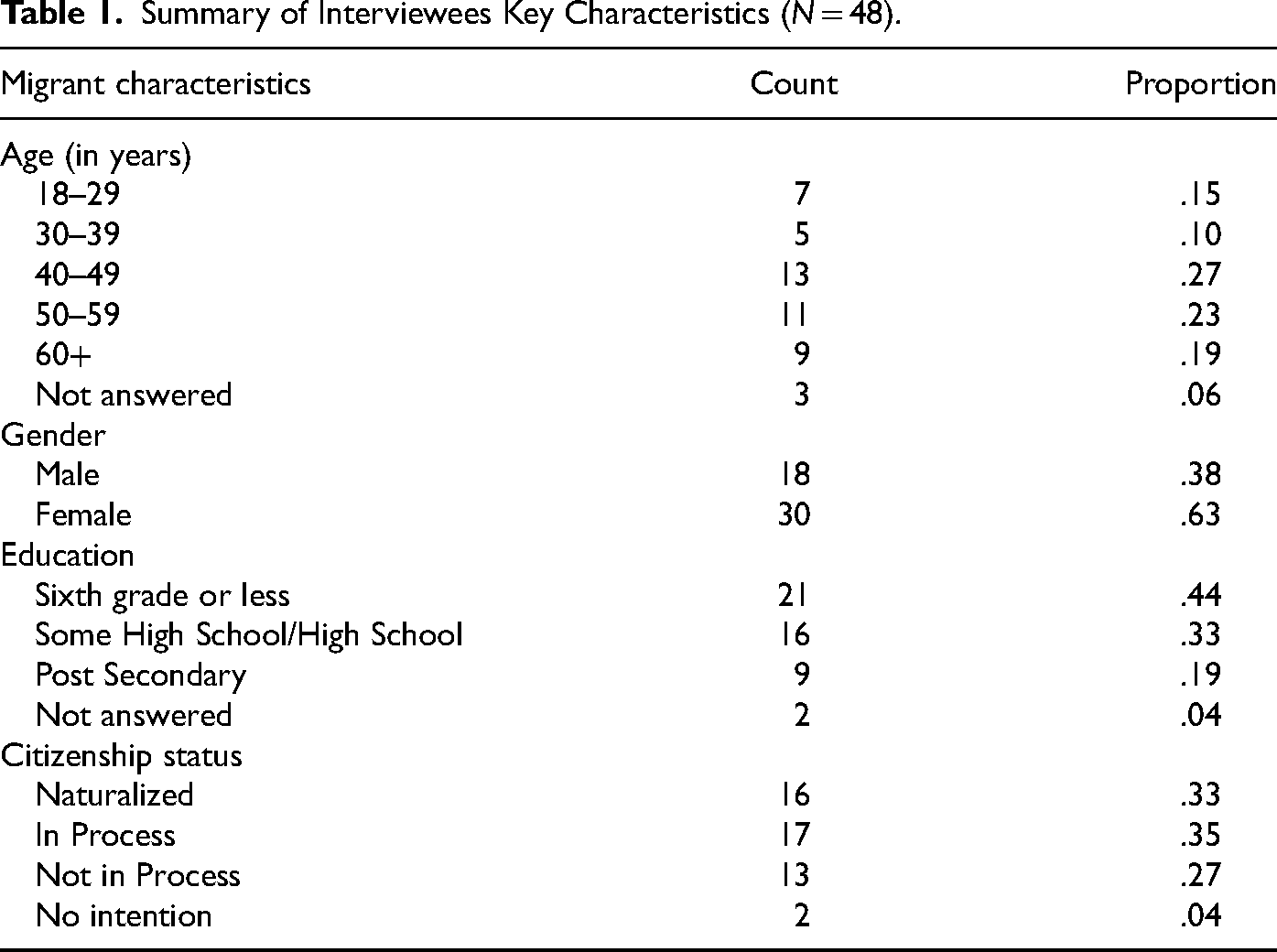
Most participants were born in Mexico [n = 32], the national origin group which exhibits the lowest naturalization rates of Latin American immigrants (Aguirre and Saenz 2002; Fix, Passel and Sucher 2003), followed by Guatemala [n = 7], El Salvador [n = 4], Honduras [n = 2], Peru [n = 2], and one participant was born in Mexico to Guatemalan parents. They entered the US between 1971 and 2012 and ranged from 18 to 77 years old. 21 participants had about six years or less of formal education, 16 had some high school or a high school education, and 9 had some post-secondary training ranging from community college to bachelor's degrees. All participants were legal residents of the US, though their migration trajectories and past legal statuses varied significantly. At the time of interviews, 16 had naturalized, 17 were in the process – which we define as actively attending classes, preparing for the test/interview, or had passed the test and were waiting for the ceremony. Two participants stated that they did not intend to naturalize, and 13 participants were residents who had not initiated the naturalization process. The stated intention of these 13 participants ranged from seeming conviction to naturalize to ambivalence; we do not take participants expressed intention of naturalization in the future as indication they will become citizens (Jerolmack and Khan 2014).
Interviews were conducted between the summer of 2016 and the fall of 2017. The interviews lasted an average of 35 min and asked about participants’ migration and residency trajectories, including employment and social connections in their home country and in the US, motivations for naturalization (or not), and, if applicable, questions about the naturalization process, including from whom or where they received support (or not) for their decision. Participants received a $50 stipend for their participation. A team of research assistants, all native Spanish speakers who were either immigrants from South or Central America themselves or the children of immigrants from that region, conducted the interviews. Most (41) interviews took place in Spanish with the remaining nine in English, though several participants spoke a dialect of Zapotec or Mam as their first language. Interviews in Spanish were translated and transcribed in English by three other research assistants. We used an abductive approach to data analysis (Timmermans and Tavory 2012); this approach allowed us to inductively distinguish the attribute alignment mechanism we outline from our data and refined its conceptualization through consulting broader literatures on social networks and behavior. We coded iteratively over several rounds following flexible coding practices (Deterding and Waters 2018) using MaxQDA software. Themes were refined through writing analytical memos that were shared among authors and focused on the barriers participants faced to citizenship, how they decided to naturalize (or not in several cases), and who was involved in their decision and their naturalization process and in what capacity. Eventually, we identified the underlying logic that pushed participants uncertain about their ability to naturalize as perceiving their similarity to other naturalized citizens and recognized this social network-based process as an empirical example of complex contagion.
We took several strategies to address some of the potential challenges that arise when studying the motives behind people's actions (Small and Cook 2021). The interview asked grounding questions based on their life experiences leading to their decision to naturalize (or not) before asking more subjective questions on motivations to naturalize. Following these questions, interviews included further probing to ask about multiple motives and influences at play in their decision-making processes. We did not presuppose that the mechanisms we highlight are the only driver of naturalization decisions but studied it as one aspect of the socially embedded nature of decisions to naturalize, a process that can unfold over the course of years or decades and is shaped by institutional and structural factors in both home and host country (Table 1).
Summary of Interviewees Key Characteristics (N = 48).
The Case for Complex Contagion: Barriers to Naturalization
Before detailing the role that social networks and the dynamics of self-comparison play in the decision to naturalize, we show that for those facing significant barriers naturalization matches at least three characteristics that research has shown render a practice subject to complex, rather than simple, contagion: observability, complexity, and the risk and uncertainty involved in the practice (DiMaggio and Garip 2012).
Observability
The less observable a practice, the less likely it is to spread through simple contagion (DiMaggio and Garip 2012, 104; Strang and Soule 1998, 269). As a formal legal status there are no visibly defining markers of citizenship. More so, legal status is often considered a contentious subject of discussion among migrants, and indeed, several of our participants in mixed-status families refrained from discussing their legal status with other members. Thus, rather than simple contact, multiple interactions are required to establish the trust needed to learn an individual's legal status.
Complexity
Decisions where success may require a considerable amount of skill or assistance are less likely to spread through simple social influence and instead require concerted and multiple points of persuasion and potential support. Our respondents echo previous findings that immigrants with limited financial resources, little formal education, or low literacy in their first language face steep hurdles to naturalization (Bueker 2006; Fix, Passel and Sucher 2003; Johnson et al. 1999; Liang 1994), making it a more complex process than for those who do not face these barriers.
Many of our respondents who viewed naturalization as challenging were over 60 years old and had little experience in institutional or self-directed learning, with any experience occurring over 45 years prior. This group felt uncertain about their ability to learn the necessary material, whether in civics classes or on their own. For example, Teresa, 2 67 at the time of the interview, finished the ninth grade in Guatemala. Though this was one of the highest levels of education reached by participants of this age, she explained, “it still is very difficult to memorize what I have to say in the exam. I already have been studying for a year and I feel that I still have a lot missing.”
Maria left school when she was 10 years old and, undocumented for much of her time in the US, worked inside her home or as a babysitter. She felt anxious in the civics classroom and that she could not keep up with the pace of learning in comparison to other immigrants in the class. The initial uncertainty for those struggling to learn was heightened in relation to other immigrants in civics classes who respondents perceived as better able to learn the material.
Those who are ineligible to take their civics test in Spanish faced the additional challenge of learning English. Like Maria, many respondents worked with primarily other Spanish speakers and did not need to learn English to live in the US. Though many attended English classes, many also balanced one or more jobs with care work, making it difficult to attend classes consistently and thus to learn English, in addition to the civics material.
Risk and Uncertainty
These barriers make naturalization appear to be a risky prospect for some when there are considerable fees 3 and the humiliation of failure at stake. Some others were concerned about the review of records required to become a citizen. The riskier a practice or decision, the more reinforcement will be necessary for people to take the step (DiMaggio and Garip 2012, 104).
Those who have little experience in institutional learning and formal evaluation on their ability to recall specific information saw the test as a risk. As put by Francisco: “that is why I am scared – that they ask me a question and that I have already forgot about it … I tell you that was one of my biggest obstacles.” Some connected this fear to the in-person context of the evaluation with a potentially antagonistic interviewer. As Elizabeth explained, “I know that's how they have to be, but there it's like confession.”
Given limited financial resources of many immigrant families, naturalization application fees and the time investment necessary to prepare comprise a non-trivial share of resources. For many participants, it was not the cost itself, but the fear of spending the money and not succeeding. Combined with a lack of experience in institutional learning and confidence that they can learn the material, participants like Luisa, who described extreme anxiety when required to take evaluations in her ESL school, and, afraid that this would happen during her interview, feared, “not passing it, and spending [her] money in vain.”
For others, it is not the citizenship test but the background review component of the application that is cause for anxiety. Although he eventually naturalized, Marco
[My] biggest fear … That they pull out something from my record, from my past, from my green card application, something I didn’t answer right or submitted and then they find out. Something that I had no idea about, and that could affect me, and then I get my green card taken away, and then I’m forced to go back to Mexico.
As a highly-educated resident who entered the US with documentation, Marco shows the magnitude of uncertainty in this decision. Though he demonstrates characteristics that make him a likely candidate for successful naturalization and had no criminal record, he still he feared losing his resident status or possible deportation if the naturalization process would turn up something in his file. This fear was only heightened for those who arrived or lived in the US undocumented or who had negative experiences with law enforcement.
Wide Bridges and Interpersonal Comparisons: Complex Contagion and the Decision to Naturalize
Our data suggests that given these significant barriers to naturalization, at least two conditions have to be met in order for social contacts to influence decisions to naturalize: we demonstrate the importance of reinforcement and relevance in the micro-level process of transmitting via complex contagion (Centola 2018). First, we show the reinforcement from multiple exposures necessary for respondents to take the step to naturalize – in the language of social network analysis, the wide bridges required for transmission of a behavior with a high adoption threshold (Centola and Macy 2007). In addition to the number of ties, the type of connection mattered. Since legal status is not easily visible in everyday interactions and may in fact be a sensitive topic, it takes a considerable amount of familiarity and trust, generally gained over multiple exposures, for this topic to occur in a relationship, making simple diffusion through weak ties unlikely. Respondents emphasized the similarity they saw between themselves and those who influenced their decision to naturalize which acted as relevant sources of social reinforcement (Centola 2018). These homophilic relationships, where potential citizens understand how naturalized citizens’ decisions might be relevant to their own, act as a specific, valuable form of social capital (Centola 2018, 174) to facilitate naturalization.
We find clear evidence of these processes working in the affirmative direction – where the successful naturalization of someone like them was a major impetus for respondents to take action and apply for citizenship. Overall in our sample 7 respondents, including 5 of the 16 naturalized citizens in our sample and 2 citizens attending naturalization classes, explicitly mentioned some version of these processes. In addition, we see 4 cases where respondents who themselves were encouraged by seeing others with similar socio-economic characteristics naturalize used arguments about similarity to convince others to naturalize. We also see indication that this mechanism can operate in the negative direction – where an unsuccessful naturalization attempt of somebody in the respondents’ social vicinity discourages them from naturalizing.
Reinforcement: Following the Example of Others
On the most general level, social influence to naturalize can mean following the examples of several others around them with attribute alignment, rather than one specific person. An example is José, a 65-year-old man from Guatemala with less than four years of formal schooling. He tried to naturalize in 2000 to petition for his Guatemalan-born children's residency, but did not meet the English language requirements. After this attempt, he found it difficult to learn English while working with primarily Hispanic colleagues and delayed naturalization, though he wanted to become a citizen since receiving his green card in the late 1980s. After renewing his residency card for the second time, he decided to give it a second try, influenced by those in his network who were able to naturalize:
José: I thought “I better … If other persons can become citizens, and pass the exam, why not me? Why wouldn’t I pass?” I thought that “I have to do it too. I’ve been here maybe more than … 30 years. I better become a citizen.”
Interviewer: And what other persons did you see that were passing?
José: Friends and co-workers told me that it had been easy for them, becoming citizens, and why I didn’t do it?
Vicente also saw several others in his social network, who were in comparable social positions to himself and lived in the US for a similar period, naturalize. Seeing several of his friends “becoming citizens and accomplishing their goals,” in addition to learning that he was eligible to interview in Spanish, gave him the confidence to successfully navigate the process. He said, “if they can do it, I certainly can.”
Though he entered the US as a child and recently graduated with a bachelor's degree, Marco viewed naturalization as a risk because he saw a friend have her naturalization delayed by six months after making a mistake on her application. He waited for nine years after becoming a resident to naturalize, which he partially attributes to being a university student on a limited income. However, he explains how seeing a friend from a similar area naturalize, in addition to the successful naturalization of his sisters, encouraged him to do so. Marco demonstrates both the power of similarity between ego and peer and the effect of reinforcement from multiple sources; he said, “I had a friend from school who became a citizen a year before that I did. Hmm … so he was also from … born in Mexico, around, kind of the same place that I was from too, as well. He was one year younger than me, so I guess we had pretty similar stories[…]My sister became a citizen one week before I did, and then my other sister became a citizen about six months ago, she tried it. So we were all kind of following my sister's first application. When she did it, then we kind of did it as well too.”
Claims About Equal Worth and Ability
A more specific variant of these comparisons involves participants invoking arguments about equal ability and worth. Francisco demonstrates the social mechanism at play in this process; with less than a first-grade education, at 63 years old he did not consider himself capable of learning the material to pass the civics test though he was a resident for 26 years. When asked about his ability to write in English, he answered, “I don’t even know Spanish, man. I never went to school.” However, when he learned that his cousin, whom Francisco considered a peer with similar level of education, migration history and experience in the US, was preparing to become a citizen, he changed his mind. He said, “He is just like me, he doesn’t know how to read … and I told him: “Chavo …” His name is Saul, and he told me: “I will become a citizen …” And I said to myself that if he was as dumb as I was and he could do it, and then it was certain that I could do it too (laughs).” (Francisco)
Gloria, a Mexican woman, became a permanent resident in 1997 and naturalized in 2015. She attributes her naturalization to witnessing a friend attending classes and asked herself, “Why would she be able to do it and not me?” Having been seriously injured in the Mexico City Earthquake in 1985, Gloria did not work in America so the cost was a barrier for her family. As a wheelchair user, she explicitly discussed how seeing other wheelchair users becoming citizens made her confident that she could also naturalize. She said,
I’m a citizen because I said “I’m able to. If she could, why not me?” “If she could, I'll have to be able to.” A lot of people in wheelchairs also go to classes and became citizens. So, that motivates one. Seeing another person in a wheelchair. One says “I’ll do it too.”
Vetting Information: If This Worked for You It Will Work for Me
In line with previous work, our data show that information about the naturalization process flows through social networks. What we also see, however, is that those who receive information assess how relevant it is to their situation or how applicable a particular strategy would be for them; in doing so they often make clear comparisons between themselves and those who provide information. One example is the suggestion to take a naturalization class that prepares applicants for the civics exam and provides help with the application process.
Members of José's church introduced him to Johnny, who taught civics classes and helped with naturalization paperwork for a small fee. Rosa, who found Johnny's classes from her brother's recommendation, explains why he is an effective naturalization teacher. She said, “When my brother and his wife were becoming citizens, he told me that he was taking classes every Saturday. They said that the teacher was really good, that he works with aged people, elders like us. So he had to know how, it is not the same than working with kids; you know they are like sponges that absorb quickly.”
While not yet a citizen, Rosa, retired, was also motivated by her sister in law's participation in Johnny's classes, whom she considered to be in a lesser social position. She said, “My sister-in-law has never worked, so she has always been in her house, and she did pass the exam going to the classes of professor Johnny. So, that encouraged me.”
Convincing Others
Four participants who have been encouraged to naturalize through this relational mechanism in turn use their experience to encourage others in their social network. Having seen that they were capable of naturalization despite the barriers and constraints discussed above by comparing themselves to others, these participants use similar reasoning about similarity to convince others to begin the naturalization process: if they could, why couldn’t others? I spoke with other friends that … it's a lady who's from El Salvador, and she hadn’t become a citizen either. And I told her “Well let's go, Mrs. Hernández, become a citizen. Go there with the teacher, he's very nice.” And yes, now she's going to classes. (Gloria)
Two participants discussed above who benefitted from Johnny's classes persuaded their friends to benefit from his specialized experience in helping older migrants to naturalize. Gloria encouraged her friend to take his classes and Rosa recommended Johnny to two friends who naturalized after taking his classes. In addition to being able to share their own knowledge about the process, given the barriers described earlier, Johnny's classes and his help with paperwork provides a valuable, context-specific resource for this group.
Cautionary Tales and Negative Feedback
Further strengthening our argument, we find evidence that this social mechanism may operate in the opposite direction. Two participants with social network contacts with comparable characteristics who have experienced negative outcomes in naturalization attempts or faced difficulties in the process were discouraged to naturalize by these experiences.
Both participants share some similarities, though the evidence is insufficient to make a claim for whether these attributes factor into the mechanism's direction. Both are men, slightly younger – in their forties – than the norm for those encouraged to naturalize by seeing the success of their peers, both are from Mexico and have less than a high school education. They also have business experience, though here their experiences diverge: Diego co-owns a business with his brother for 12 years which employed 14 people, while Juan owned a business for 13 years that he had to close but continued to work in the same field.
Perhaps more significant to their naturalization fears, both participants became residents at the same time as the key person who discouraged their naturalization; they saw that those with whom they went through the process of ‘fixing their papers’ were unsuccessful in their naturalization attempts, which discouraged Diego and Juan. Like others in the sample, Diego, a US resident for about 29 years, was well-settled in America and wanted to remain. All of his siblings lived in the US, and his wife, was “pushing [him] to become a citizen” in the first few months of Donald Trump's presidency. As he said, “now the ways the laws are, it's changing a lot. It's constant – I feel afraid. Truthfully, I would like to become a citizen, but I’m scared.” When asked why he hasn’t become a citizen after almost 30 years of residency, he said,
“Well, because I heard there in the company where I worked, I heard other people that my boss had also helped to get their residency … I don’t know, I heard they had some problems. Some … I don’t know. They have problems but … that's why I’m a bit afraid to go – to become a citizen, really.”
While he did not elaborate on what sort of problems his former coworkers faced when attempting to naturalize, their experiences left him scared. He feared that any errors or issues, which he seemed to attribute to his former employer, could lead to his deportation to Mexico and forced removal from his family, including two US-born children, and small business.
Juan, 43 years old with three US-born children, became a resident about 13 years prior to the interview with his brother, also through their former employer. His brother tried to naturalize twice and was unsuccessful. Seeing his sibling, in a comparable social position to him, attempt to learn the necessary material twice without success discouraged Juan from seeing himself as capable of naturalizing.
Discussion and Conclusion
Building on research highlighting the importance of an immigrant's social environment in decisions to naturalize, we contribute to an understanding of how social networks influence this process. As documented in previous research, we find that those with low levels of formal education, low incomes, who are older, who were undocumented in the US, or had previous run-ins with the law, face significant barriers to naturalization. Our data suggests that social network influence can be decisive for this group. Although our findings are broadly in line with research that has highlighted a positive association between residential concentration of co-ethnics and individual naturalization (Portes and Mozo 1985; Yang 1994), especially when those co-ethnic communities demonstrate high naturalization rates (Abascal 2017), our analysis reveals some important differences and points to limitations of this previous work.
While this work generally does not specify the mechanisms of social diffusion, the assumed process is one of “simple contagion”. In contrast, our analysis suggests that naturalization demonstrates several characteristics of complex contagion – a socially-mediated behavior with a high adoption threshold (Centola and Macy 2007). We show that reinforcement from “wide bridges” – from a number of contacts – and from similar peers was necessary for diffusion through social networks. In particular, we demonstrate that when non-citizens see themselves resembling those who naturalized along a range of dimensions, including education, age, language ability and work experience, this cross categorization encourages claims to citizenship and national membership. As our analysis also suggests, if the naturalization experiences of those social connections are negative, relating their experience to others may deter immigrants from attempting naturalization themselves, consistent with opposing results of negative correlations between residential segregation and naturalization (Liang 1994). These findings match research on the role of homophily and behavior adoptions in other domains including health behaviors, innovation adoption, social media activity and political participation (Centola 2011; Guilbeault, Becker and Centola 2018).
Our analysis adds an important micro-level insight on how social networks shape decision-making about naturalization. Rather than an ambient process of diffusion and peer-influence, we show that in the decision to naturalize social influence is often an act of careful reflection. Arguably, unlike other dimensions of settlement such as adopting host-country language or habits, naturalization requires a conscious, discrete decision to embark on the process (and ultimately fill out the forms). Given its high cost and complexity, it is a high-stakes decision for many. Thus, before taking the step to apply (or deciding against it) potential citizens carefully evaluate their ability to naturalize by explicitly comparing themselves on a number of dimensions to other migrants who have attempted to naturalize. We see a similar dynamic in the spread of information on naturalization resources through social networks. Rather than the mere presence of information, potential applicants evaluate the relevance of information provided through social contacts for themselves by comparing themselves to those providing the information.
We do not see any evidence for processes that would fit a ‘simple contagion’ model. This could be a limitation of the data; to the extent simple contagion works below the level of consciousness, our respondents may not have noticed it or recalled it in the interview process. Although our data do not allow us to make a definite claim, we think that simple contagion plays a limited role at best. Those for whom naturalization does not present a significant challenge, for example, immigrants with higher incomes or educational attainment, the social network influences we identify will be less important. For example, the highly educated will likely find relevant information through official channels without resorting to social networks for information and the test will not appear as a serious hurdle for them. In contrast, as our data shows, social influence generally resembles processes of complex-contagion for those who face significant challenges. Although this study focuses on Latin American migrants who are mostly from Mexico, an immigrant origin group with one of the lowest naturalization rates in America, in principle the mechanism we outline could apply to other national-origin groups – certainly to those where members face significant hurdles to naturalization.
Methodologically, our paper points to the limitations of research that uses measures like neighborhood-level concentration of co-ethnics as a proxy for the effects of social networks. Such data do not allow researchers to distinguish between processes of simple diffusion and complex contagion which, as we argued, has important consequences for how processes of social network diffusion play out. There is also nothing inherently geographic about the location of social influence – the key contacts that influence people's naturalization decisions may be in places of employment, or long-distance relationships mediated through online platforms.
Finally, our findings also speak to approaches that take citizenship as “a relational process of claims-making and recognition” (Bloemraad 2018, 18) – emphasizing how the socio-political dimension of citizenship overlaps with its formal-legal aspect. Like the majority of Latin American immigrants, our respondents are embedded in mixed-status social networks and evaluate their membership claims to the US through comparisons with others in their network. In addition to the purely practical aspects we emphasize above, these comparisons shape ideas of who can become a citizen. When a potential citizen is similar to a peer whom they learn is a naturalized citizen – categorically different in terms of legal status to them – this may shift their conception of what becoming a US citizen entails. Thus, individuals can come to see themselves as being closer, as a matter of degree, to the citizenry, rather than categorically excluded. This process can spark further (re-)evaluation of claims for recognition which can diffuse through social networks.
Footnotes
Acknowledgements
For feedback on an earlier version of this manuscript we thank Hanno Kruse and Maarten Vink. William Rosales, Daisey Del Real, and Karina Chavarria provided valuable assistance in collecting the data.
Declaration of Conflicting Interests
The author(s) declared no potential conflicts of interest with respect to the research, authorship, and/or publication of this article.
Funding
The author(s) disclosed receipt of the following financial support for the research, authorship, and/or publication of this article: This work was supported by the Social Sciences and Humanities Research Council of Canada (grant number 430-2015-00931); Fonds de Recherche de Québec Societé et Culture (FRQSC) (grant number 2017-NP-200503); the Canada Research Chairs Program.
