




Abstract
Existing studies analyzing the relation between immigrants’ residential environment and their propensity to naturalize produce contradictory findings. These results are difficult to interpret, as studies typically do not measure residential characteristics at a sufficiently fine-grained scale to test hypotheses about social networks and naturalization, do not model the data's multi-level structure appropriately, and do not account for selection into the residential environment. To address these shortcomings, this article draws on longitudinal micro-data from administrative registers at the neighborhood level in the Netherlands (approximately 1300 residents per neighborhood). We employ a stratified Cox proportional hazard model with shared frailty and inverse probability of treatment weighting to reduce bias due to self-selection into neighborhoods and draw on proxies of social networks in such areas. Our analyses provide support for the ‘migrant enclosure hypothesis,’ as we find that greater migrant concentration in the neighborhood is associated with lower naturalization rates and largely driven by the density of migrant social networks in those residential areas. In the Dutch context, this negative effect of migrant enclosure is especially prevalent among the large, long-settled migrant communities from Morocco and Turkey. We also find support for the ‘naturalization diffusion hypothesis’ and observe that the negative naturalization effect of residing in neighborhoods with higher levels of migrant concentration is offset by the presence of immigrants who have completed the naturalization procedure. Together, these findings reveal a nuanced picture that contrasts with de-contextualized cost-benefit theories of immigrant naturalization and highlights the relevance of the local context of immigrant settlement.
Introduction
Citizenship acquisition represents an important event in an immigrant's life: becoming a citizen of a country is both a symbol of inclusion into a common system of governance and a vehicle that can stimulate societal integration (Bloemraad 2017). Formal benefits of naturalization can take various forms, such as voting rights, unlimited access to restricted public administrative jobs, and a right of abode in a given country (Vink 2017). Moreover, naturalization may act as a signalling mechanism toward employers and help reduce statistical discrimination in the job market (Bratsberg, Ragan and Nasir 2002; Peters, Vink and Schmeets 2017). Finally, becoming a citizen of a country may alleviate psychological stressors associated with living with a precarious legal status, such as fear of forced out-migration and anxiety about the future (Menjívar 2006).
Despite the significant advantages granted by citizenship acquisition, naturalization rates remain low in much of Europe and vary greatly across countries and immigrant groups (Eurostat 2018). Given this heterogeneity, a number of studies have analyzed the different determinants of citizenship and shed light on why some immigrants naturalize while others do not. Previous studies have notably paid attention to individual determinants like age at arrival, socio-economic status, length of stay in the host country (Evans 1988; Yang 1994), as well as to origin countries’ characteristics (Yang 1994; Jasso and Rosenzweig 1986; Vink, Prokic-Breuer and Dronkers 2017).
Within research on immigrant naturalization, few scholars have devoted attention to the broader environment in which immigrants reside, particularly in relation to neighborhood's migrant concentration. 1 Moreover, studies that do pay attention to the relation between migrant concentration and naturalization have come to contradictory conclusions, with some observing that immigrants are less likely to naturalize if they reside in migrant-concentrated areas (Yang 1994; Abascal 2015; Mossaad et al. 2018) and others finding that living among a large immigrant community increases immigrants’ propensity to naturalize (Bueker 2006) or that the relationship between migrant concentration and naturalization propensity varies by immigrant group (Liang 1994; Logan, Oh and Darrah 2012).
This article contributes to this discussion of the relevance of neighborhood's characteristics for immigrants’ naturalization by examining the relationship between migrant concentration at the neighborhood level and immigrants’ citizenship acquisition in the Netherlands, a country where one in five residents either is an immigrant or has at least one parent born abroad (Salentin and Schmeets 2017, 4). We draw on administrative data based on Dutch registers and distinguish among four cohorts of immigrants who either could naturalize under relatively facilitated conditions (cohorts 1996 and 1997) or were required to pass a language and civic knowledge test (cohorts 2001 and 2002). All four cohorts are examined over a 14-year period (1996-2009/1997-2010/2001-2014/2002-2015). The relationship between migrant residential concentration and naturalization is assessed with a stratified Cox proportional hazard model with shared frailty. We control for self-selection into neighborhoods, due to observed characteristics with an inverse probability of treatment weighting method (IPTW).
As this article shows, immigrants’ decision to naturalize in the Netherlands is partly determined by the residential context in which they are embedded. Since naturalization is an important part of the immigrant settlement process (Bloemraad 2017), the immediate living environment affects not only immigrants’ decision to become citizens but also the settlement process as a whole. We, therefore, contribute to the literature on the determinants of citizenship acquisition but also engage more broadly with the question of how neighborhood concentration and immigrant integration are related, a discussion that so far remains unsettled (Musterd 2003; Bolt, Özüekren and Phillips 2010).
To develop these ideas, this article starts with a review of the literature on migrant concentration and naturalization propensity and subsequently moves to the theoretical framework and hypotheses. Information on the data, on the operationalization of variables, and on the method is provided in the data and method section. Findings are presented in the analysis section and discussed in the conclusion.
Migrant Concentration and Citizenship Acquisition
Much of the literature on citizenship acquisition considers the decision to naturalize to be the outcome of a cost-benefit calculation (Yang 1994). Individuals, it is assumed, examine whether the benefits of host-country citizenship supersede the cost of naturalization and take a rational decision on whether they should engage in the procedure. Following this line of reasoning, previous studies have paid attention to individual characteristics that could induce immigrants to acquire citizenship, such as age at migration, education, and socio-economic status (Evans 1988; Yang 1994). Origin-country characteristics are also identified as important predictors of citizenship acquisition (Jasso and Rosenzweig 1986; Vink et al. 2021). The presence or absence of dual citizenship laws in the origin country, for instance, particularly affects the cost of naturalization (Vink et al. 2021). Moreover, immigrants coming from politically insecure and economically unstable countries are traditionally less likely to return to their origin country and more likely to naturalize (Jasso and Rosenzweig 1986; Yang 1994; Chiswick and Miller 2009; Peters, Vink and Schmeets 2016).
While the decision to initiate a naturalization procedure is ultimately left to the individual, immigrants who embark on the road toward citizenship do not act in isolation. Their decision to engage in the procedure is conditioned by the lives and events placed along their paths (Peters, Vink and Schmeets 2016). In that regard, the literature on citizenship acquisition highlights the importance of immigrants’ marital status and family composition in the decision to apply for citizenship (Yang 1994; Street 2014; Helgertz and Bevelander 2017). Similarly, previous studies show that the institutional and political context in which immigrants live can shape their decisions concerning naturalization (Bloemraad 2018). Institutional forces, such as the destination country's citizenship policies, have the potential to restrict or expand immigrants’ access to citizenship and, thus, have an important impact on their decision to naturalize (Peters, Vink and Schmeets 2016). Living in an anti-immigrant or pro-immigrant political environment can, moreover, alter the way immigrants use naturalization as a mean of political empowerment and mobilization (Logan, Oh and Darrah 2012; Carrillo 2015).
The broader social environment in which immigrants are embedded can also shape the way they understand the naturalization process (Abascal 2015; Yang 1994). It is often argued in the literature on naturalization and immigrants’ residential context that the degree of migrant concentration in a neighborhood influences immigrants’ decision to naturalize through various social mechanisms (Abascal 2015; Liang 1994; Logan, Oh and Darrah 2012; Yang 1994). However, studies focusing on this issue reach contradictory conclusions (Table 1). In a pioneering study, Yang (1994) observed that living in a large community of co-nationals increased the odds of naturalization. Although he hypothesized that this relationship might be due to immigrants’ improved access to naturalization-related information, his study did not test for any variables specifically related to information sharing. In line with Yang's information-sharing argument, Logan, Oh and Darrah (2012) observe that immigrants living in an area with a high share of naturalized migrants from the same national background are more likely to naturalize. Abascal (2015) corroborates this finding and specifies two pathways through which this relation may operate. Immigrants living among naturalized co-nationals, she argues, have a higher chance of being informed about the benefits and hurdles of the naturalization procedure, since this type of information is more likely to be shared by individuals who have been through the process themselves. Moreover, having regular contacts with immigrants who have already become citizens, she suggests, may act as a signal of an inclusive society and strengthen immigrants’ identification with the host country. In a recent study, Mossaad et al. (2018) find that refugees who were initially placed in a location with a high presence of co-nationals were more likely to naturalize. However, their analysis does not shed light on potential factors that could be driving this relationship.
Overview Findings US-Based Studies on the Effect of Migrant Concentration on Naturalisation Propensity.
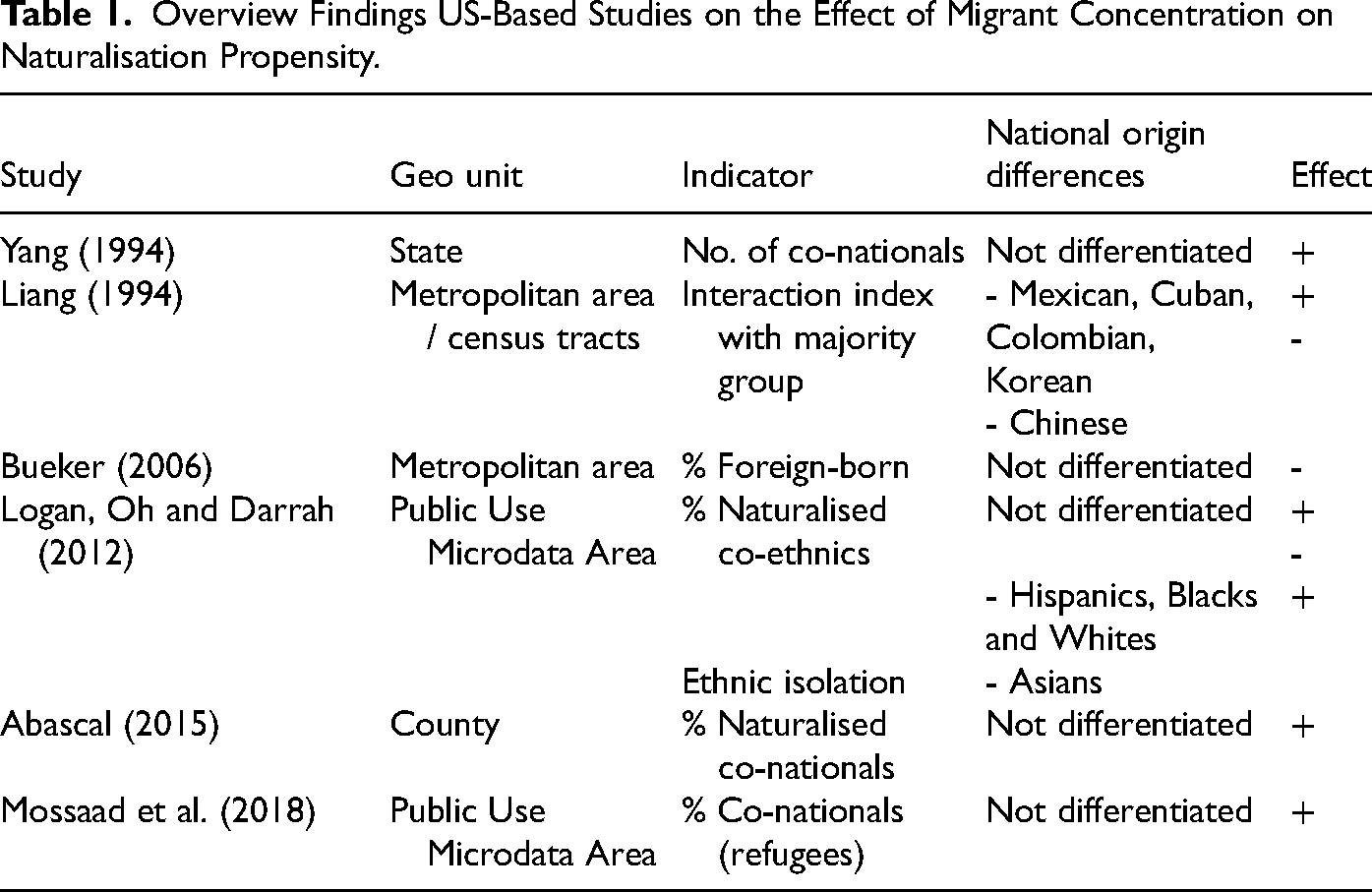
Overview Findings US-Based Studies on the Effect of Migrant Concentration on Naturalisation Propensity.
Contrary to these arguments and findings, Liang (1994) suggested that a higher likelihood of social contacts with the majority group in the residential area and workplace increased the probability of naturalization, hence implying the existence of a negative relationship between migrant concentration and naturalization propensity. According to Liang, lower naturalization rates reflected the fact that immigrants who lacked regular contacts with natives would develop a stronger in-group identity and be less likely to integrate socially and culturally in US society. These findings were consistent across all immigrant groups, with the exception of Chinese immigrants. Similarly, Bueker (2006) observes that living in an area with a high percentage of foreign-born persons was negatively associated with naturalization in the United States. She argues that native-born individuals acted as role models for non-naturalized migrants. Consequently, living in a predominantly native neighborhood encouraged non-naturalized migrants to acquire citizenship in an attempt to become more similar to the native population and as a way to be better integrated into the native community. In line with these arguments, Logan, Oh and Darrah (2012) find that living among immigrants with similar migration background had a slight negative effect on immigrants’ naturalization propensity. However, they also indicate that ‘additional research and theoretical work will be needed to understand the nature of these effects’ (2012, 550).
Notwithstanding these contributions to an important research agenda, we observe that existing studies in this field suffer from three major methodological limitations. First, most studies summarized in Table 1 draw on cross-sectional data and are not able to determine whether immigrants acquired citizenship prior to or after having moved into their area of residency. A notable exception in that regard is Mossaad et al. (2018), who measure neighborhoods’ concentration at arrival and citizenship acquisition at a later point in time. Yet the cross-sectional nature of their data does not allow them to account for the fact that individuals may have moved to different areas between these two periods. Under these conditions, it is, therefore, not possible to identify the independent effect of neighborhoods’ citizenship acquisition.
Second, with the exception of Mossaad et al. (2018, 9176), who only look at refugees for whom ‘decisions about initial placement are made by the US government and refugee resettlement agencies,’ none of these studies consider immigrant selection into concentrated neighborhoods, beyond controlling for observable characteristics that may correlate with the location of residence. Yet not controlling for immigrants’ self-selection into concentrated neighborhoods is problematic, as immigrants who reside in neighborhoods with higher migrant concentrations may have particular characteristics that could potentially affect their propensity to acquire citizenship. We argue that, at least potentially, not controlling for the selective nature of living in segregated neighborhoods could lead to an under or over-estimation of the effect of residential characteristics on immigrants’ naturalization propensity. In our estimation strategy, we, therefore, explicitly consider immigrants’ potential self-selection by controlling for self-selection into migrant-concentrated neighborhoods based on observed characteristics.
Third, and as it is apparent from Table 1, there is strong variation even among existing US-based studies (we are not aware of comparable studies outside the United States) in terms of the level of aggregation at which different studies measure migrant concentration. Geographical units in existing studies range from metropolitan areas to Public Use Microdata Areas (PUMAs) 2 or county level and, in the case of Yang (1994), are as large as the state level. Although previous studies have shown that US residents may be aware of their county's socio-economic characteristics (Newman et al., 2015), we argue that these large-scale areas, which include one urban core of at least 50,000 people, or counties, which average over 100,000 people (and go up to 10 million in Los Angeles county), are unsuitable to analyze the hypothesised social interaction processes, such as information sharing and inter-group contact, that take place on a smaller scale in immigrants’ near social environment. Hence, we argue that it is important to investigate these processes in small-scale residential contexts, such as neighborhoods, which provide a more intuitive environment to analyze the relation between residential characteristics and naturalization propensity.
As the preceding section showed, previous studies have largely relied on social contacts and identity building, on the one hand, and information-sharing arguments, on the other, to explain why and how residential migrant concentration could affect immigrants’ naturalization propensity. In what follows, we develop two testable hypotheses based on these alternative mechanisms driving this relation.
a. The migrant enclosure hypothesis
The ‘migrant enclosure’
3
hypothesis was first applied in the context of citizenship acquisition by Liang (1994). According to Liang (1994), living in a migrant-concentrated neighborhood increased the chance of inter-group contacts and the frequency of contacts with the in-group (native citizens), which can have important implications for immigrant intentions to naturalize. As stated by Liang (1994: 410), “the more within group interactions immigrants have, the more likely their ethnic identity will be reinforced and the less likely they will be to become US citizens.”
Although the migrant enclosure argument seems to be based on the idea that ethnic and national identity are situated at the two ends of the same continuum, it also relies on the more concrete assumption that between-group interactions facilitate mutual understanding and reduce inter-group prejudices (Pettigrew and Tropp 2006). The migrant enclosure hypothesis resonates with previous studies that have suggested that mobility into the out group only occurs when the boundaries between one's in-group and the target out-group are permeable (Tajfel 1975; Hochman 2011). In this context, it can be argued that individuals who have regular contacts with members of the out-group may be more likely to become acquainted with their culture, language, and social norms, which can lead to the development of more favorable attitudes toward the out-group and foster a desire to become a member of the out-group (Tajfel 1975; Hochman 2011).
While, in this article, we cannot measure ethnic identification directly, our data do allow us to proxy part of the underlying hypothesized social network mechanism. According to the migrant enclosure hypothesis, the negative relation between neighborhoods’ migrant concentration and immigrants’ propensity to naturalize is mainly driven by the fact that immigrants living in such areas are more likely to have regular contacts with other immigrants living in their local community. Yet not every migrant-concentrated neighbourhood offers the same opportunities for social contacts, and the relation between migrant concentration and naturalization may be prominent in neighborhoods that have dense social networks. In this article, we use two proxies of availability of social networks at the neighborhood level that have been used in recent comparable work to measure peer effects (Bratsberg et al. 2020). First, we argue that immigrants are more likely to have regular contacts with neighborhood co-residents who share the same linguistic and cultural background. We operationalize the density of same origin-background network by looking at the proportion of persons living in the neighborhood with a migrant background from the same origin country (co-nationals). Second, we suggest that immigrants are more likely to have contacts with peers of comparable age. We measure the density of same-age network with the proportion of persons living in the neighborhood with a migrant background and who are in the same age category (more details in the empirical section on these operationalizations). Using these social network proxies, we formulate the following ‘migrant enclosure’ hypothesis:
b. The naturalization diffusion hypothesis
Logically, immigrants living in a migrant-concentrated neighborhood are more likely to encounter others who have completed the naturalization procedure than immigrants living in neighborhoods with a high proportion of native citizens. Such a situation may positively affect immigrants’ propensity to become citizens in two different ways. First, because naturalized migrants are more likely to be knowledgeable about the naturalization procedure, it can be argued that immigrants living in a community with many naturalized migrants are more likely to receive information about the various aspects of the procedure, either from individuals who have gone through the procedure themselves or from other members of their local community. Hence, we assume that going through the naturalization procedure (or considering to apply) is a relevant social experience that migrants are likely to comment on, or to seek information about, among relevant peers. This information may relate to the financial costs, eligibility requirements, duration, or different stages of the process of becoming citizens of the destination country. Similarly, immigrants may be more likely to receive assistance throughout the process if they live among people who are familiar with the ins and outs of the procedure. Overall, we argue that living in such an environment may encourage immigrants who aspire to become citizens to start and successfully complete the procedure (Abascal 2015).
Second, the relation between the immigrant community's size and immigrants’ likelihood to naturalize may operate through a mechanism of identification. Immigrants living in close proximity to other naturalized migrants may be more likely to view the host society as being inclusive, making them more likely to identify with its members and, therefore, to naturalize (Abascal 2015: 300-301). While in this article, we cannot empirically distinguish between information-sharing and identification, both hypothesized mechanisms point to the expectation that immigrants are more likely to acquire destination-country citizenship if they reside in a neighborhood with a higher proportion of naturalized migrants. We label both arguments as the ‘naturalization diffusion’ hypothesis:
Context
a. Citizenship policy in the Netherlands
Becoming a Dutch citizen can have an important impact on many aspects of immigrants’ life. First, in the Netherlands, naturalization comes with a number of formal rights, such as voting rights or access to public sector jobs that are restricted to nationals and can help improve immigrants’ integration process (Van Oers, de Hart and Groenendijk 2013). Second, studies focusing on the Netherlands show that becoming a Dutch citizen can strengthen immigrants’ position in the job and housing market by reducing the risk of statistical discrimination (Peters 2020; Peters, Vink and Schmeets 2017).
Conditions to acquire Dutch citizenship have changed in the last decades. Dutch citizenship policy took a liberal turn when the new Dutch Nationality Act came into force on 1 January 1985 (Van Oers, de Hart and Groenendijk 2013). The 1985 Act aimed to improve settled immigrants’ legal position and integration by facilitating their access to Dutch citizenship (Van Oers, de Hart and Groenendijk 2013). Requirements for eligibility included being at least eighteen years old, holding a permanent residence permit in the Netherlands, residing in the Netherlands for at least five consecutive years prior to the application, and willingness to renounce foreign citizenship (Van Oers, de Hart and Groenendijk 2013). Additionally, immigrants were required to show basic knowledge of the Dutch language and to prove their integration into Dutch society (Van Oers, de Hart and Groenendijk 2013). These latter two conditions were tested during non-standardized interviews with municipal officials (Van Oers, de Hart and Groenendijk 2013). Renunciation requirements would subsequently be abolished in 1991, leading to an increase in the number of naturalizations (Van Oers, de Hart and Groenendijk 2013).
Dutch integration policy shifted toward a more assimilationist approach with the restoration of the renunciation requirements in 1997 and the establishment of stricter language and integration requirements, as implemented in the revised Dutch nationality act of 2003 (Van Oers, de Hart and Groenendijk 2013). Immigrants were, then, required to pass a formal naturalization test in which they are tested on their knowledge of Dutch society and their command of the Dutch language (Van Oers, de Hart and Groenendijk 2013). The introduction of these stricter requirements resulted in a rise in the cost of the naturalization procedure and a substantial drop in the number of naturalizations after 2002 (Van Oers, de Hart and Groenendijk 2013). Since then, the integration and language requirements have remained mandatory to acquire Dutch citizenship.
b. Neighborhood concentration in the Netherlands
The number of persons with a migrant background has steadily increased in the Netherlands over the last 20 years (data Statistics Netherlands, own calculations). In 2019, foreign-born residents accounted for 12.5 percent of the Dutch population (Statistics Netherlands). Their descendants (persons born in the Netherlands with two parents born abroad) represented 4.9 percent of the Dutch population (Statistics Netherlands).
4
While a large majority of Dutch neighborhoods have, on average, a migrant concentration below 10 percent, other neighborhoods experience high or very high migrant concentrations (above 30 percent and above 50 percent) (Supplemental Appendix Table A.1). Migrant-concentrated neighborhoods tend to be situated in highly populated and urban areas (Table A.2). The city of Amsterdam alone, for instance, has 111 neighborhoods with an average migrant concentration above 50 percent for the period 1996–2016 (Table A.3). Taken together, these numbers suggest that immigrants living in the Netherlands tend to locate in neighborhoods with a migrant concentration. A glimpse at our data confirms this impression, as 44.8 percent of immigrants from our four cohorts (1996/1997 and 2001/2002) were located in neighborhoods with a proportion of persons of migrant background higher than 30 percent (Table A.4).
Data and Method
a. Data
In this article, we use register data to analyze citizenship acquisition among foreign-born residents in the Netherlands. Available data include individual information on immigrants’ arrival date, legal status, demographic characteristics, socio-economic status and, crucially for our analysis, the residential context in which immigrants lived. Because this article focuses on foreign-born residents, we exclude the second and 1.5 generations, since persons born in the Netherlands, or migrating to the Netherlands at a young age, can make use of facilitated procedures to acquire citizenship (Immigration and Naturalisation Service 2022a). We also exclude all immigrants born in Surinam or the Dutch Antilles, since these individuals may benefit from facilitated procedures (Van Oers, de Hart and Groenendijk 2013). Additionally, we exclude immigrants who naturalized within the first three years of residency, as they are likely to have been married or in a partnership with a Dutch citizen before they came to the Netherlands and, therefore, may have a specific profile in relation to naturalization (Immigration and Naturalisation Service 2022c). Moreover, we remove immigrants who were naturalized before they were eighteen years old, as these immigrants likely have not acquired citizenship on their own initiative (Immigration and Naturalisation Service 2022b). Finally, we exclude, for computational reasons, immigrants living in neighborhoods with fewer than 100 residents. 5
To make sure that we observe, for all individuals, the moment when the event (in this case, naturalization) occurs, we follow immigrants from the period they became eligible for naturalization until they completed the naturalization process, dropped out of the examination, or the observation period ended. The eligibility period varies across immigrant groups. Immigrants opting for the ordinary naturalization procedure must reside in the Netherlands for five years before they can start the procedure (Immigration and Naturalisation Service 2022a). For these individuals, the at-risk period 6 is set to five years after registration. Immigrants who are married or in a registered partnership with a Dutch citizen can submit their application after three years of partnership (Immigration and Naturalisation Service 2022c). Therefore, the at-risk period is set to three years after registration for immigrants who declared to be in a partnership with a Dutch citzen upon arrival in the Netherlands.
This article investigates four different cohorts of immigrants. The first two are composed of immigrants who registered in the Netherlands in 1996-1997. The last two cohorts include immigrants who registered in 2001-2002. We focus on these four different cohorts to include immigrants who were eligible both before and after the revision of the Dutch nationality act of 2003. Each cohort has a similar tracking period of fourteen years and is tracked per year. Altogether, the population examined in this article includes 118,591 individuals and 891,281 observations. 7 A comparison of the naturalization rates across the four different cohorts is drawn, using Kaplan Meier analysis (Figure 1).
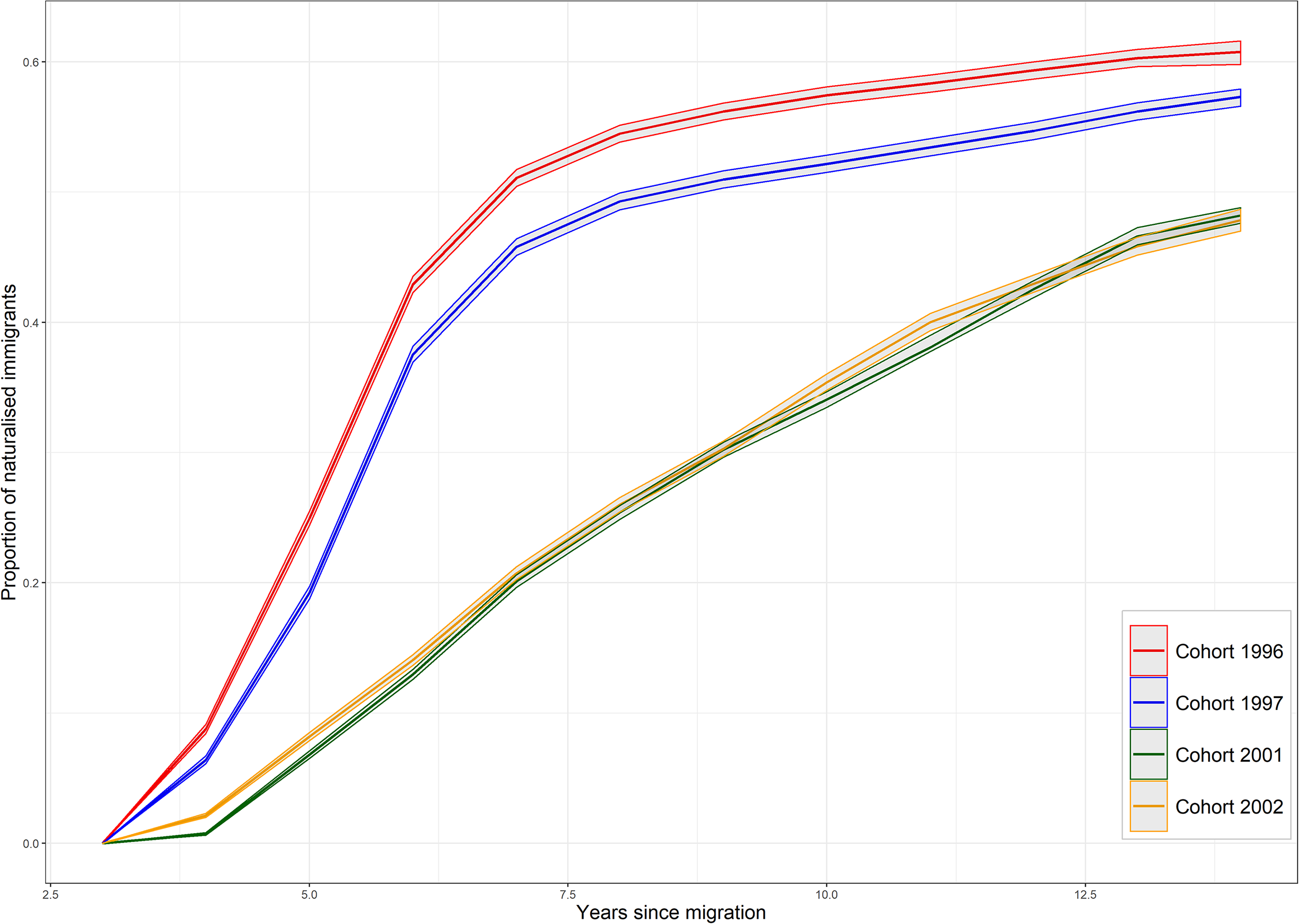
Cumulative naturalization rates by cohorts. Kaplan-Meier estimates (with 95% Cis) based on migration cohorts 1996, 1997, 2001 and 2002 with observation period until 2016.
The dependent variable examined here is Dutch citizenship, which is a dichotomous variable that measures whether an immigrant acquired Dutch citizenship in a particular observation year. Independent variables are measured at the individual, the contextual, or the neighborhood level. 8 Individual-level variables cover a large range of information like gender, age at migration, migration type, partner's citizenship status, and employment status. Migration type distinguishes five types of legal bases for the granting of immigration permits or, for EU immigrants who do not require a permit, a derived migration motive 9 labor migration, asylum, family migration, student migration, and other type. Partner's citizenship status includes three categories referring to immigrants with no partner, immigrants in a partnership with a Dutch citizen, and immigrants in a partnership with a foreign partner. Employment status distinguishes between employed and unemployed migrants.
Contextual-level variables refer to the origin country's characteristics. We control for the origin country's development level, measured with the Human Development Index, and level of political stability, using the Kauffman index. Additionally, we control for dual citizenship acceptance in the origin country (Vink, de Groot and Luk 2015), in conjunction with the applicable rules in the Netherlands. 10
Several neighborhood-level variables are included in our analysis. The main variable of interest, migrant concentration, is analyzed at the neighborhood (buurt) level. After ZIP code street level units, neighborhoods are the second-smallest spatial units in the Dutch population register data. They correspond to mid-size residential areas and are composed, on average, of approximately 1,300 inhabitants (Statistic Netherlands, our analysis). Neighborhoods constitute well-defined territories that are drawn along clear and homogeneous socio-economic and geographical lines. This level of measurement has the advantage of capturing characteristics linked with immigrants’ close living environment, including daily interactions with neighbors (i.e., at the street level), as well as social processes taking place in a slightly wider, but still immediate, living environment, such as those around local shops, schools, restaurants, and parks in the neighborhood.
We determine migrant concentration by looking at the proportion of persons of migrant background, including both foreign-born immigrants and children born with two foreign parents, in a specific neighborhood to capture social network dynamics that likely cover not just foreign-born residents but also persons of migrant descent. 11 As our data do not allow us to directly measure immigrants’ personal relationships, we proxy the availability of social networks in a certain neighborhood with two measures that aim to determine the migrant community's degree of homogeneity: the proportion of co-nationals living in a neighborhood and the proportion of persons with a migrant background within the same age category. Both measures have been used in the past to proxy availability of social networks (Bratsberg et al. 2020). Regarding the proportion of co-nationals, we determine the origin-country background of first-generation (i.e., foreign-born) immigrants by their birth country and the background of their descendants by looking at their parents’ birth country. If the parents were born in two different countries, we use the mother's birth country. Co-nationals, thus, refer to individuals who were born, or whose parents were born, in the same country. While not a perfect measure of migrant background, origin country is typically used as the best available proxy based on survey or administrative data capturing ‘shared experiences with those who came from the same country, who have settled in the same community, and who have their race and ethnic background’ (Logan, Oh and Darrah 2012: 536).
We construct our measure of proportion of persons with a migrant background within the same age category, using four different age categories: 18 to 30 years old, 30 to 45 years old, 45 to 60 years old, and 60 years or older. These three indicators of migrant concentration - the share of persons with a migrant background, the share of co-nationals, and the share of migrants within the same age category - were originally measured as ratio variables but were, then, divided into quartiles and transformed into categorical variables with four categories to identify possible non-linear relationship patterns (c.f., Mossaad et al. 2018, 5). We test the empirical validity of these proxies by linking our register-based neighborhood network proxies with individual-level survey data from the first wave of the “New immigrant survey – The Netherlands” (Lubbers et al. 2018). This survey covers immigrants from four selected origin countries and includes questions on immigrants’ social integration and, more specifically, on immigrants’ frequency of contacts with people from the same origin country. For immigrants from Turkey, one of the largest groups in the Netherlands (Salentin and Schmeets 2017), we cross-tabulate our two register-based proxies of social networks and the survey-based measure of contacts. These results show that Turkish immigrants living in a neighborhood with a high proportion of co-nationals or with a high proportion of same-age persons with a migrant background are more likely to have more regular contact with other persons of Turkish origin (Table A.10).
In addition, we test the naturalization diffusion hypothesis with a variable referring to the proportion of foreign-born residents who have acquired Dutch citizenship.
12
This variable only covers foreign-born residents who acquired Dutch citizenship and, therefore, does not include foreign-born residents’ descendants who were born in the Netherlands and could become Dutch citizens through a different procedure, as this group is not relevant for our measurement of accessibility to information related to the naturalization procedure. This variable is a ratio variable categorized across quartiles. In addition, we account for the socio-economic characteristics of immigrants’ environment by controlling for the urbanization rate and the percentage of employment in the municipality in which immigrants lived. The degree of urbanization is a categorical variable ranging from very low urbanization (less than 500 inhabitants per square kilometer) to very high urbanization (more than 2,500 inhabitants per square kilometer). The percentage of employment was originally expressed as a ratio variable but was transformed into a categorical variable cut across quartiles.
b. Method
We examine the relationship between neighborhoods’ migrant concentration and migrants’ naturalization propensity, using survival analysis (Box-Steffensmeier and Jones 1997). In our analysis, the event under investigation is citizenship acquisition, a clearly defined and only rarely revers event (Vink and Luk 2016). We employ a Cox proportional hazard model, a type of survival model which does not assume a parametric form for the distribution of time and which allows for the inclusion of time-varying covariates (Box-Steffensmeier and Jones 1997). For an individual (i), with a vector of covariates X, the Cox proportional hazard model expresses a hazard rate that takes the form of:
We subsequently deal with two important issues: the nested data structure and selection into neighborhoods. First, to accommodate the nested data structure, where individual immigrants are nested within neighborhoods, we apply a multilevel survival analysis with shared frailty (Austin 2017). As with conventional regression models, survival analysis assumes that individuals are independent from one another (Box-Steffensmeier and Jones 1997). If individuals are clustered within larger units, these individuals’ failure time may be correlated. Shared frailty models constitute a specific case of mix-effects models that are designed to control for this within-cluster homogeneity by adding a random factor, or shared-frailty term, that will account for unmeasured group homogeneity (Austin 2017).
Second, with the exception of asylum-seekers, immigrants’ choice of place of residence likely does not follow a random process. Previous studies of the Netherlands have shown that immigrants tend to move to segregated neighborhoods upon arrival, due to the presence of migrant networks established prior to migration or to restrictions in the housing market (Zorlu and Mulder 2008). This decision can also be driven by fear of prejudice and discrimination (Ibid.). In other words, immigrants moving to segregated neighborhoods may have certain characteristics that could be related to their determination to integrate into the host society and, hence, to their propensity to naturalize. To ensure that an observed association between neighborhood characteristics and the propensity of immigrants to naturalize does not reflect an omitted variable that relates both to residence and naturalization, it is, therefore, necessary to control for selection into neighborhoods.
Beyond Mossaad et al. (2018), who only look at refugees precisely because their place of residence is randomized, we are not aware of any study on residential characteristics and naturalization propensity that includes such a control. In this article, we control for self-selection into neighborhood due to observed characteristics, using an inverse probability of treatment weighing method (IPTW) (Austin and Stuart 2015). IPTW estimation is based on individuals’ propensity scores to receive the treatment (understood here as the neighborhood's migrant concentration upon arrival). We estimate the propensity scores with a multinomial regression in which exposure to the treatment variable is regressed on a range of observed covariates. In this article, we follow the suggestion of Caliendo and Kopeinig (2008, 6) and only include in our propensity score model variables that influence simultaneously the treatment variable (a neighborhood's migrant concentration) and the outcome variable (naturalization). The propensity score regression, therefore, controls for socio-demographic characteristics (age at arrival, gender, number of children within the household), for economic factors (employment status, standardized household income), for origin countries’ characteristics (EU citizenship, development level), and for various indicators of integration (partner's citizenship status, home ownership). It is important to note that propensity scores are only measured on the basis of observed characteristics. Bias may, therefore, remain if unobserved characteristics causing self-selection into neighborhoods are also linked to naturalization propensity. 13
The first part of our analysis aims at testing the migrant enclosure hypothesis. To do so, we start by estimating the relevance of living in a neighborhood with a higher proportion of persons of migrant background for immigrants’ naturalization propensity. We observe that this relation is negative and significant, all other covariates held constant (Figure 2, M1). 14 For both the second quartile with medium-low levels of immigrant concentration (neighborhoods with 12.6 to 24.4 percent of persons of migrant background) and the third quartile with medium-high levels of immigrant concentration (24.4 to 41.4 percent), we found that immigrants were about 10 percent less likely to naturalize (HR = 0.90), compared to immigrants living in neighborhoods with the lowest proportion of persons of migrant background. Immigrants living in the most migrant-concentrated neighborhoods (> 41.4 percent) were 13 percent less likely to naturalize (HR = 0.87), all else constant. The random effect's variance indicates that on average, there is limited variance in naturalization propensity at the neighborhood level, but with a substantial standard deviation (variance of the random effect = 0.07; standard deviation of the random effect = 0.27, Table A.11, M1).
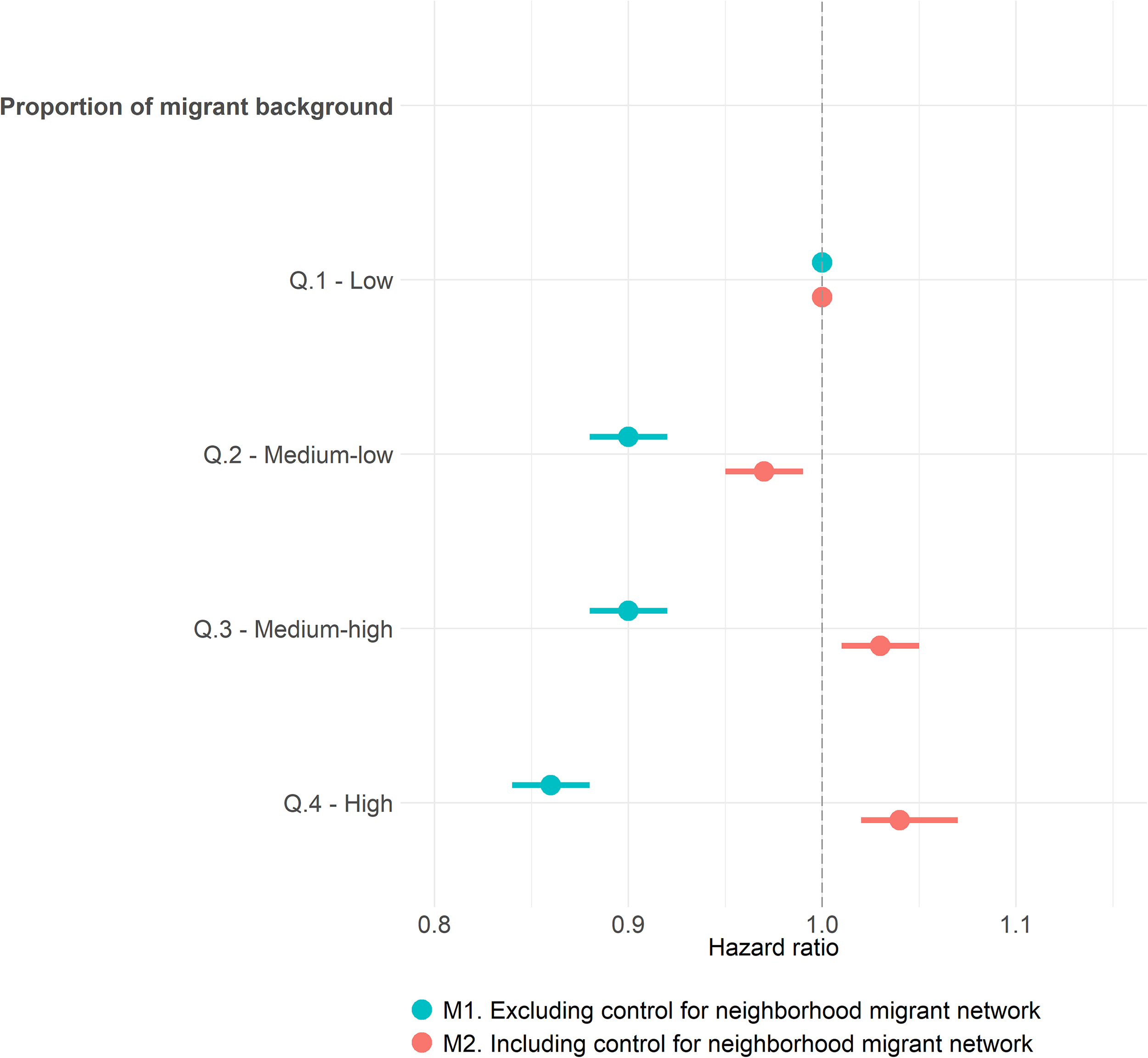
Effect of neighbourhood concentration of persons with a migrant background (in quartiles from lowest to highest concentration) on the risk of naturalisation among immigrants in the Netherlands. Dots denote hazard ratios and horizontal lines correspond to 95% CIs, from Cox regression with shared frailty and IPTW. Model 1 excludes control for share of co-nationals and share of same-aged persons of migrant background; otherwise both models include full controls and are stratified by migrant cohort. Full model output in Table A.11.
While the results of model 1 suggest that living in a migrant-concentrated neighborhood was associated with a lower propensity to naturalize among immigrants, the negative effect of living in a migrant-concentrated neighborhood virtually disappeared when we add, in model 2, two proxies of availability of social networks: the proportion of co-nationals and the proportion of persons with a migrant background within the same age category (Figure 2, M2). With these two network controls included in the model, immigrants were marginally less likely to naturalize when they resided in low-medium migrant-concentrated neighborhoods (HR: 0.97) and marginally more likely to do so in medium-high (HR = 1.03; Figure 2, M2) or highly concentrated neighborhoods (HR = 1.04; Figure 2, M2).
Further inspection of the results from model 3 (visualized in Figure 3) show that network availability was negatively associated with naturalization. Immigrants living in a neighborhood with a very high proportion of co-nationals (fourth quartile) were 40 percent less likely to naturalize (HR = 0.60), while immigrants living in a neighborhood with a very high proportion of persons with a migrant background within the same age category were 16 percent less likely to become Dutch citizens (HR = 0.84; Figure 3, M2). Overall, the results of our model with social network proxies (model 2) suggest that the negative effect of migrant concentration was mainly driven by the density of the migrant-based social network. This finding corroborates the migrant enclosure hypothesis (H1).
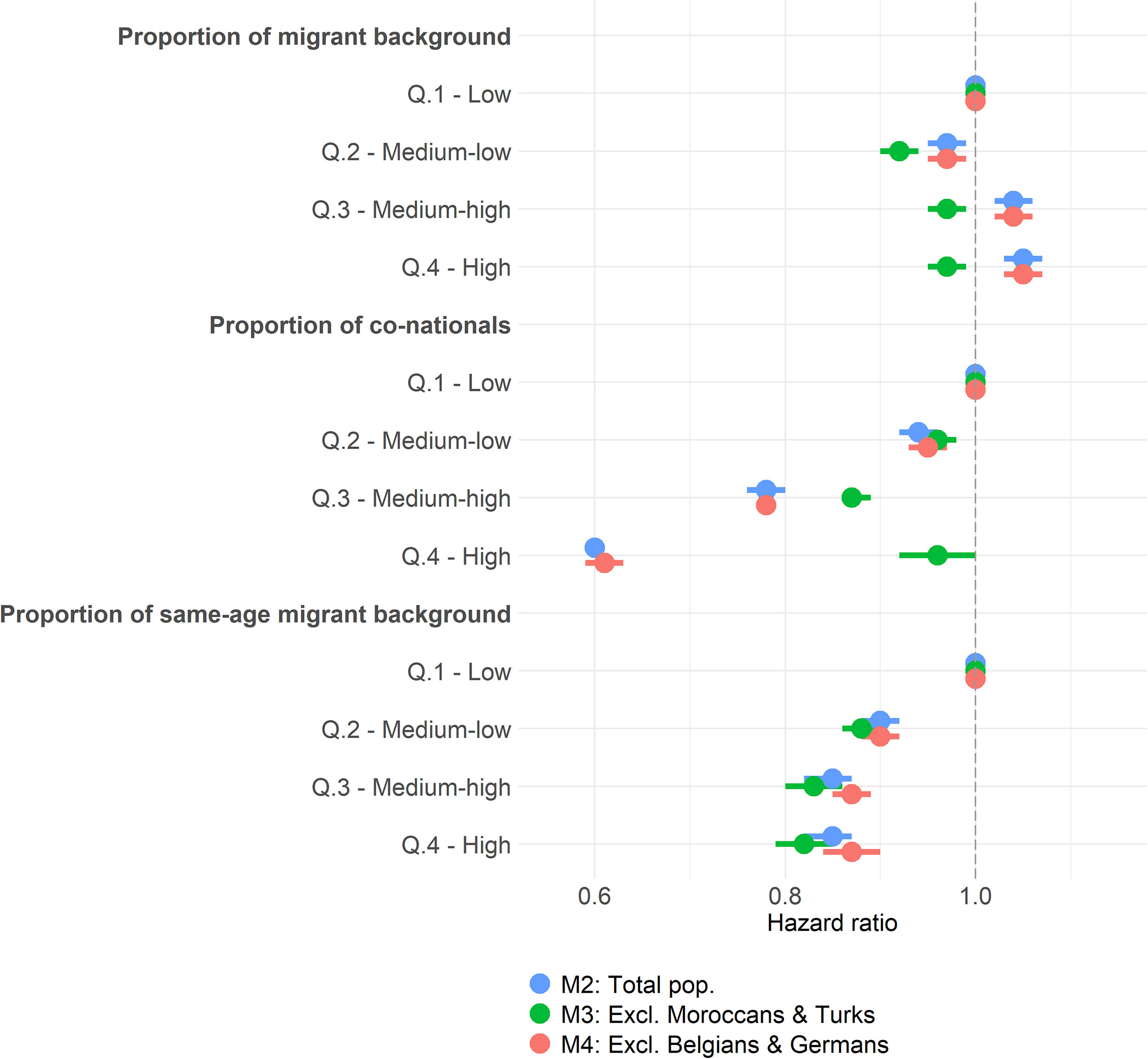
Heterogeneous effects of neighbourhood characteristics on the risk of naturalisation among immigrants in the Netherlands, full sample and subsamples (migrants from Turkey and Morocco, resp. Belgium and Germany excluded). Dots denote hazard ratios from Cox regression and horizontal lines correspond to 95% CIs. All models include full controls and are stratified by migrants cohorts. Full model output in Table A.11 and Table A.12.
The next step in our analysis is to assess whether the negative association between network availability and naturalization propensity was driven by the largest immigrant groups, especially Moroccans (8.6 percent) and Turks (9.1 percent), who jointly constitute 18 percent of our research population and up to 68 percent (Moroccans, 32.2 percent; Turks, 35.8 percent) of the population residing in Dutch neighborhoods with a high degree of co-nationals (fourth quartile). These two long-established communities in the Netherlands maintain a strong sense of national community identification (SCP/WODC/CBS 2005, p. 108; c.f., Gijsberts and Dagevos 2007) and are known to have strong same-national origin social networks, especially among foreign-born immigrants living in immigrant-concentrated areas (van Tubergen 2015). To identify to what extent the results of our main model are driven by these two large immigrant groups, we ran an additional model in which we excluded immigrants born in Morocco or Turkey from the analysis. Doing so reduced the effect of living in a neighborhood with a high and very high proportion of co-nationals (Figure 3, M3). Although denser co-national social networks in the neighborhood remained negatively and significantly associated with naturalization propensity, a substantial part of the downward effect was clearly driven by an overrepresentation of Moroccan or Turkish migrants in those neighborhoods. Living in a neighborhood with a high proportion of persons with a migrant background within the same age category remained negatively associated with naturalization at comparable levels, even after excluding these two groups (Figure 3, M3). We also looked at German and Belgian immigrants residing in neighborhoods, particularly at the respective Eastern and Southern borders of the Netherlands, that were predominantly composed of members of the Belgian or German communities. The percentage of naturalization was very low among these two immigrant groups, who were mainly composed of cross-border workers. Excluding these groups from the sample did not substantially change the coefficients’ value (Figure 3, M4).
There may also be heterogeneity across different types of immigrants and, more specifically, between immigrants who came to the Netherlands with different migration permit types or derived motives. To account for this heterogeneity, we ran separate analyses for sub-groups of the three main registered migration types. The results of these analyses reveal that living in a neighborhood with a high concentration of co-nationals was negatively associated with immigrants’ naturalization propensity for family and labor immigrants (Figure 4, M5, M7). For asylum migrants, we observe a negative effect of living in a neighborhood with a high share of co-nationals, but not with medium-high or medium low levels (second and third quartile, Figure 4, M6). This negative coefficient may be due to overall high rates of naturalization among asylum migrants, who typically are more prone to receive legal advice as part of the asylum determination procedure and, thus, may be less subject to local network effects, especially at intermediate levels of network density. An explanation for this finding, however, may reside in the fact that refugees are, on average, more mobile than other groups (Table A.9) and may, therefore, not be impacted by their local community to the same extent as other immigrant groups (c.f., De Hoon, Vink and Schmeets 2021).
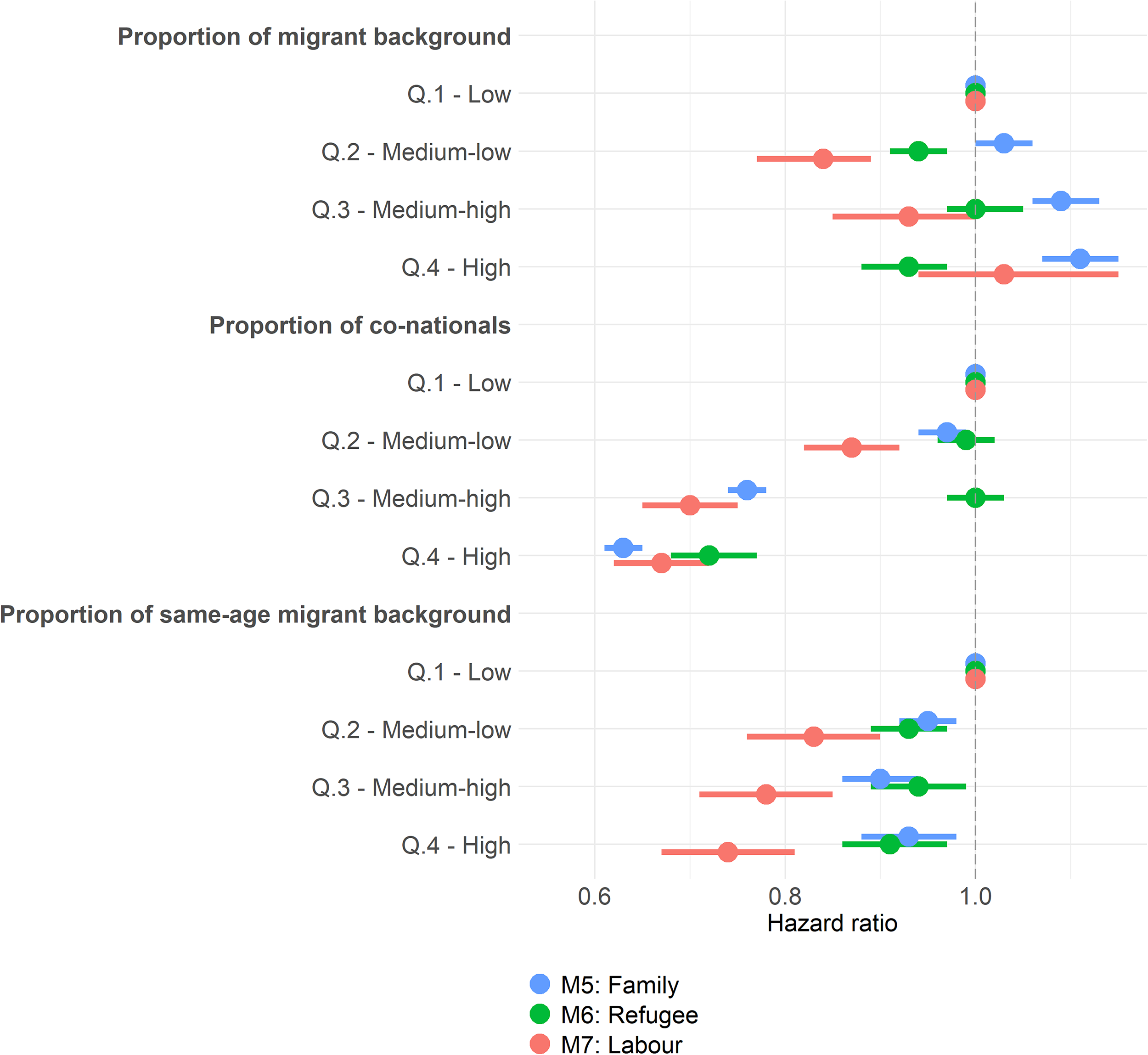
Heterogeneous effects of neighbourhood characteristics on the risk of naturalisation among immigrants in the Netherlands, subsamples by registered migration motive (family migrants/asylum applicants/labour migrants). Dots denote hazard ratios from Cox regression and horizontal lines correspond to 95% CIs. All models include full controls and are stratified by migrants cohorts. Full model output in Table A.13.
To check whether residential mobility among asylum migrants explains why network density is relevant only at higher, but not at intermediate, levels, we conducted an additional analysis based only on asylum migrants who stayed in the same location during the whole observation period. We find a significant, but weak, negative effect of neighborhood co-national density among these immobile asylum migrants (HR: 0.95–0.97; Table A.13, M9), suggesting that immigrants’ greater residential mobility is only a limited part of the reduced relevance of intermediate levels of social density network for naturalization propensity. Living in a neighborhood with a higher share of migrants in the same age category was negatively associated with naturalization propensity, regardless of migration type (Figure 4), although the magnitude of this association was stronger for labor migrants (Figure 4, M7). Overall, this sub-group analysis shows that our findings are largely consistent across groups of immigrants by migration type.
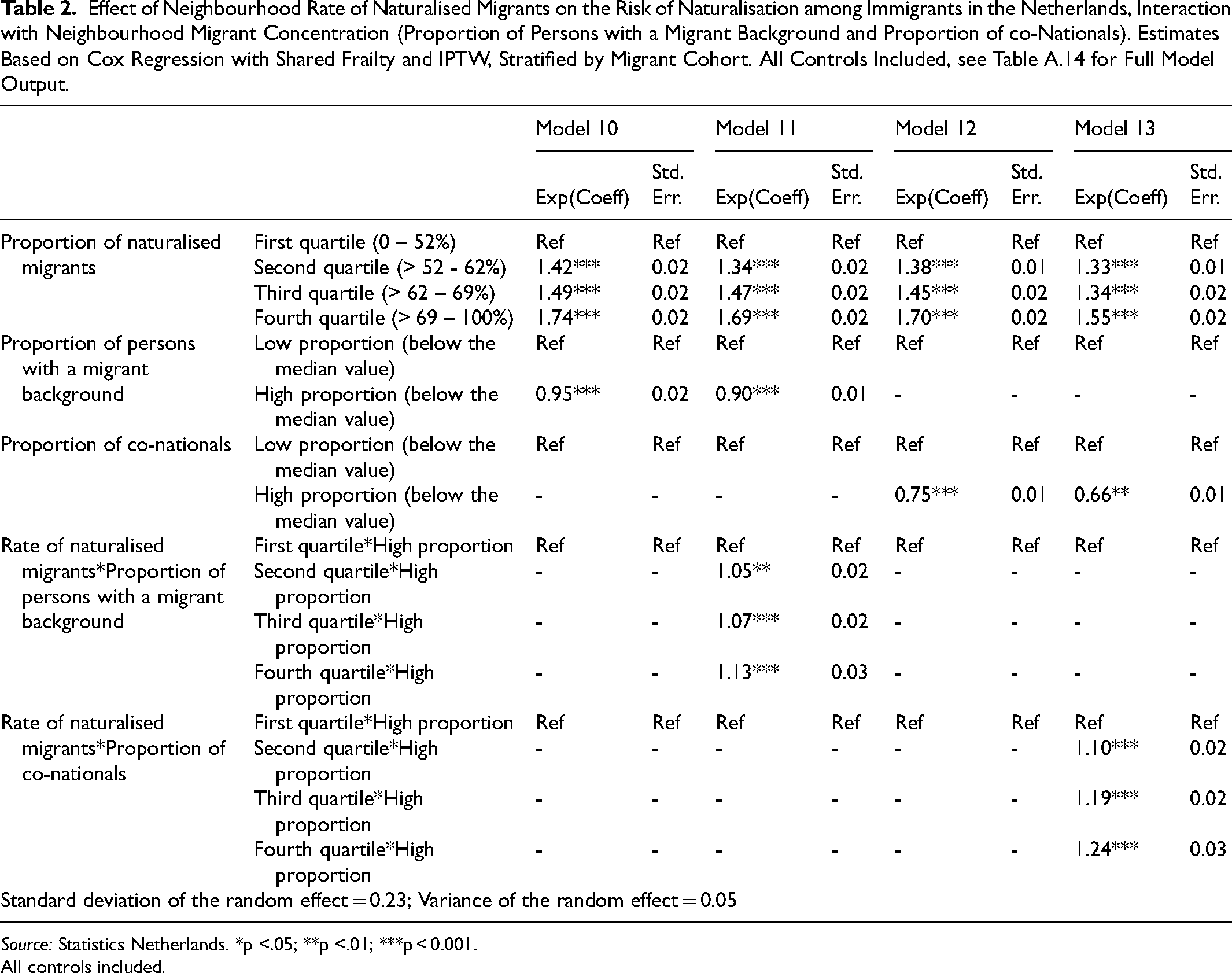
Next, we looked at the relevance of higher proportions of naturalized immigrants in the neighborhood. First, we observed that immigrants were more likely to acquire destination-country citizenship if they lived in a neighborhood with a higher proportion of naturalized migrants. As shown in Table 2 (Model 10), immigrants living in a neighborhood with a high proportion of naturalized migrants (fourth quartile) were 74 percent more likely to naturalize than immigrants living in neighborhoods where less than half of immigrants had acquired Dutch citizenship (0 – 52 percent of naturalized migrants).
Effect of Neighbourhood Rate of Naturalised Migrants on the Risk of Naturalisation among Immigrants in the Netherlands, Interaction with Neighbourhood Migrant Concentration (Proportion of Persons with a Migrant Background and Proportion of co-Nationals). Estimates Based on Cox Regression with Shared Frailty and IPTW, Stratified by Migrant Cohort. All Controls Included, see Table A.14 for Full Model Output.
Source: Statistics Netherlands. *p <.05; **p <.01; ***p < 0.001.
All controls included.
Subsequently, we interacted this measure of the proportion of naturalized migrants with our measure of migrant concentration to test whether the positive association between the proportion of naturalized migrants and naturalization was conditioned by migrant concentration (Table 2, M11 and M13). Here, we measure migrant concentration, alternatively, with the proportion of persons with an immigrant background and the proportion of co-nationals. For simplicity's sake, we recode both measures into dichotomous variables and set the cut-off points to the median values. This analysis shows that when the share of naturalized immigrants was low, immigrants living in a neighbourhood with a high proportion of persons with an immigrant background and a high proportion of co-nationals were, respectively, 10 percent (model 11) and 34 percent (model 13) less likely to naturalize, compared to when they resided in less migrant-concentrated areas. However, looking at the interaction coefficient, we can see that this negative effect of immigrant concentration decreased in neighborhoods with a higher share of naturalized immigrants. Thus, immigrants living in a neighborhood with a high concentration of persons with an immigrant background and a high share of naturalized migrants (fourth quartile) were 13 percent (model 11) more likely to naturalize in comparison to immigrants living in a neighborhood with a high concentration of persons with an immigrant background and a low share of naturalized migrants (first quartile). Similarly, immigrants living in a neighborhood with a high proportion of co-nationals and a high proportion of naturalized migrants (fourth quartile) were 24 percent (model 13) more likely to naturalize, compared to immigrants living in a neighborhood with a high proportion of co-nationals and a low proportion of naturalised immigrants (first quartile).
Overall, these findings suggest that living in areas with higher proportions of naturalized immigrants can offset the overall negative effect of migrant concentration. This compensation effect of high proportions of naturalized immigrants is stronger for immigrants residing among high proportions of co-nationals (Table 2, Model 13). These findings support H2 and suggest that immigrants’ propensity to acquire destination-country citizenship was positively affected by the presence of other immigrants who successfully completed the naturalization procedure. As stated in the theoretical section, this finding may be driven by the fact that naturalized migrants can share information about the naturalization procedure but also by the fact that those living among naturalized individuals may be more likely to perceive the host society as being inclusive (Abascal 2015). Future studies will need to disentangle these two mechanisms.
The topic of citizenship acquisition has received much academic attention over the past decades, contributing to a better understanding of the individual determinants of citizenship acquisition (Abascal 2015; Logan, Oh and Darrah 2012; Peters, Vink and Schmeets 2016; Yang 1994). Yet we have limited and contradicting empirical knowledge of how neighborhood factors could affect immigrants’ decision to naturalize. This article addresses this gap by examining the relationship between migrant concentration and immigrants’ citizenship acquisition in the Netherlands. In contrast with previous studies that used large-scale levels of aggregation (Abascal 2015; Liang 1994; Logan, Oh and Darrah 2012; Mossaad et al. 2018; Yang 1994), we were able to investigate this relationship in small-scale residential contexts, which provide a more intuitive environment suited to analyze social interaction processes taking place in immigrants’ immediate environment. We tested two hypotheses, previously used in the context of cross-sectional studies only (Yang 1994; Liang 1994; Abascal 2015), and drew on longitudinal administrative data that allowed us to follow four immigrant cohorts over fourteen years after entering the Netherlands. We applied a stratified Cox proportional hazard model with shared frailty to account for our data's multilevel structure and employ propensity score matching to control for potential self-selection into neighborhoods, due to observed characteristics.
Our analysis of the frailty models highlights the importance of controlling for within-neighborhood homogeneity. Moreover, our Cox proportional hazard regressions show that living in a migrant-concentrated neighborhood was negatively associated with naturalization propensity. Using two proxies of social networks availability, we observe that this negative association was driven by a higher density of migrant-based networks in these neighborhoods. These results confirm the expectations derived from migrant enclosure theory (Liang 1994), using fine-grained neighborhood measures and after controlling for compositional biases and selection mechanisms.
At the same time, we demonstrated that living in a neighborhood with a high proportion of naturalized migrants increased immigrants’ propensity to naturalize, a finding which provides evidence that the assumption of the local diffusion of naturalization, previously tested using large-scale geographical units of measurements, is also relevant at the local level (Abascal 2015). This relation may operate through an information-sharing mechanism according to which naturalized migrants are better able to provide information about the naturalization procedure to aspiring citizens. It may also be driven by the fact that immigrants who have regular contacts with naturalized migrants are more likely to view the host society as being inclusive, which could stimulate their identification process and desire to naturalize.
Altogether, these findings reveal a complex picture that contrasts with often de-contextualized cost-benefit theories applied in much of the literature on citizenship acquisition (Yang 1994; Chiswick and Miller 2009; Peters, Vink and Schmeets 2016). This article emphasizes the need to move beyond individual predictive factors and suggests that we should turn attention to the broader residential context in which immigrants are embedded. More specifically, just as it is well established that people are influenced by those they meet on a daily basis or live close to (Elder 1994), our analyses show that immigrants’ living environment has a significant impact on their likelihood to become a citizen in the destination country. We find that greater migrant concentration in the neighborhood is associated with lower naturalization rates in the Netherlands, especially among two large immigrant groups from the Middle East and North Africa, providing support for the migrant enclosure hypothesis. This negative effect can, however, be offset by a positive spillover of higher rates of naturalized migrants in the neighborhood.
This article not only contributes to the literature on the determinants of citizenship acquisition but also speaks to a broader debate on the potential effect of neighborhoods’ migrant concentration for immigrant integration (Musterd 2003; Bolt, Özüekren and Phillips 2010). We encourage future studies at the cross-section of these fields to add to our work by addressing some of its limitations. First, while we are the first to address potential endogeneity between residential environment and naturalization outcomes explicitly, our empirical strategy only allowed us to control for self-selection due to observed characteristics (Mossaad et al. 2018). Second, while we were able to link our administrative data to survey data and partially validate our two proxies of social networks availability at the neighborhood level, in our main analyses, we did not directly measure immigrants’ social contacts. In a similar way, we were not able to directly measure the relationship between inter-group contacts and in-group identity. Future research could test these mechanisms, using indicators of personal relationships, including, for instance, the frequency of contacts with other immigrants or with natives, as well as survey data related to identity. Nevertheless, we think that the whole-population and detailed household information from administrative registers used here have a strong appeal in terms of generalizability, large samples, and longitudinal nature.
Third, in this era of big-data analysis, we look forward to seeing studies using more dynamic contextual units, such as GPS-activity data, that can record people's activities and routes more systematically. Such data would provide a finer-grained measure of immigrants’ social networks and test the theoretical mechanisms developed in this article in a more dynamic manner. Finally, neighborhoods with large immigrant communities may be more likely to have active immigrant civil organizations or more welcoming local politicians and bureaucrats that could help immigrant groups during the naturalization process. As our data do not allow us to tease out these mechanisms, further studies are needed to better understand this relationship.
This article fills an important gap in the study of citizenship acquisition and neighborhood context. By applying a design that uses low-scale, fine-grained geographical units and controls for self-selection into concentrated neighborhoods, we are able to overcome a number of limitations identified in previous studies (Liang 1994; Yang 1994; Logan, Oh and Darrah 2012; Mossaad et al. 2018) and to test several alternative hypotheses in a robust manner. These findings speak both to the study of immigrant naturalization propensity and to the migration literature at large by contributing to a better understanding of the role played by residential context within immigrants’ post-migration settlement process.
Supplemental Material
sj-docx-1-mrx-10.1177_01979183221115165 - Supplemental material for Does Residential Context Matter? Neighborhood Migrant Concentration and Citizenship Acquisition in the Netherlands
Supplemental material, sj-docx-1-mrx-10.1177_01979183221115165 for Does Residential Context Matter? Neighborhood Migrant Concentration and Citizenship Acquisition in the Netherlands by Christophe Leclerc, Maarten Vink and Hans Schmeets in International Migration Review
Footnotes
Replication material
Register data for the analyses in this article were made available by Statistics Netherlands. The data use agreement does not allow us to disclose individual-level data. Information about access to the microdata of Statistics Netherlands is available here:  . Replication code will be made available upon publication through the corresponding author's dataverse.
Declaration of Conflicting Interests
The author(s) declared no potential conflicts of interest with respect to the research, authorship, and/or publication of this article.
Funding
The author(s) disclosed receipt of the following financial support for the research, authorship, and/or publication of this article: This work was supported by the H2020 European Research Council, (grant number 682626).
Notes
References
Supplementary Material
Please find the following supplemental material available below.
For Open Access articles published under a Creative Commons License, all supplemental material carries the same license as the article it is associated with.
For non-Open Access articles published, all supplemental material carries a non-exclusive license, and permission requests for re-use of supplemental material or any part of supplemental material shall be sent directly to the copyright owner as specified in the copyright notice associated with the article.
