




Abstract
Immigrants bring contemporary demographic changes to the destination country through their contributions to diversity, and future population. In this study, we examine the partnership and fertility trajectories for individuals with Turkish, Russian, Kazak, Polish, and Southern European backgrounds born between 1970 and 1999. We adopt a life course perspective using event history techniques on retrospective partnership and birth histories of the German Socio-Economic Panel (GSOEP) Survey. By treating first entrance into cohabitation, marriage, and parenthood as competing events, we illuminate not only the differences in family ideologies between natives and immigrants but also highlight the heterogeneity among immigrant origin groups and generations in family formation pathways. Convergence with natives occurs at different paces for immigrant groups. Controlling cohort effects and socioeconomic conditions, individuals with Turkish background stand out with an earlier and higher level of entrance into marriage and parenthood, with only modest changes across birth cohorts and migrant generations. The risk of nonmarital or pre-marital childbearing is lower for non-European immigrants than for German natives. Marriage remains an important institution to individuals of some immigrant backgrounds, despite global trends in the rise of cohabitation and nonmarital childbearing in recent years. This work serves to highlight the diversification of family types in a leading migration country.
Keywords
Introduction
In the context of declining fertility and increasing family complexity in the Western world (Lesthaeghe and Permanyer 2014; Kreyenfeld and Konietzka 2017), understanding the family processes of immigrants is vital for predicting population changes. Demographers are particularly interested in the unique family characteristics that set immigrant groups apart from natives, such as the timing and level of conjugal union formation and childbearing. Moreover, migration researchers and policymakers often use family behavior as both a predictor and an outcome of interest in measuring the level of integration of immigrants with the native population (Milewski 2009; Baykara-Krumme and Milewski 2017; Kuhnt and Krapf 2020; Wolf and Kreyenfeld 2020). To this end, observing the differences among the family processes of different migrant generations, or first (adult migrants), 1.5 (child migrants), and second-generation (those born in the destination country with one or both parents born abroad) individuals, is pivotal.
The pathway to family formation for immigrants and natives can differ due to cultural ideologies (Kagitcibasi 2017), economic circumstances, and structural opportunities (Kulu and González-Ferrer 2014). Previous research has shown that non-European immigrants and their descendants in European countries tend to follow conservative family trajectories, such as marrying before childbearing (Rahnu et al. 2015; Kalmijn and Kraaykamp 2018). A rich volume of knowledge has accumulated on the choice between cohabitation versus marriage for natives (i.e., individuals with two native-born parents) and nonnatives in Europe (e.g., Kleinepier, de Valk, and van Gaalen 2015; Rahnu et al. 2015; Hannemann et al. 2020), but fewer studies have brought entrance into parenthood outside of union context into the picture (Sakkeus et al. 2019). The mechanisms that contribute to these differences may vary for those of first, 1.5, or second-generation individuals.
First-generation individuals are typically defined as those who migrated as an adult, or at least as an adolescent, whereas those who migrated as children are referred to as 1.5 generation, though the cut-off age varies from study to study. The family formation process of first-generation immigrants can differ substantially from both nonmigrants in the destination and origin due to the population itself being self-selected, such as married women joining their husbands at the destination through family reunification schemes (Andersson 2004). Furthermore, economic and housing uncertainties upon arrival may disrupt one's family formation plans. Child migrants, or 1.5 generation migrants, many of whom arrived with their parents, do not face the same constraints. Their partnership and fertility behaviors are often influenced by the adaptation process toward the mainstream. They tend to be partially socialized at the origin and partially socialized at the destination, or “straddle both worlds” ranging from feeling a member of fully both to neither of those worlds (Rumbaut and Ima 1988). Second-generation, or those born in the destination to migrant parents, are in theory entirely socialized by the institutions of the newly adopted country. However, research has shown that tight-knit migrant communities in the destination often serve to preserve cultural values more in line with one's heritage (Crul and Vermeulen 2003).
Of the various studies on immigrant family processes, union formation is often treated as a preceding step to childbearing (Baizán, Aassve, and Billari 2004). Techniques such as sequence analyses are instrumental in identifying unique family trajectories of individuals from a life course perspective (e.g., Castro Torres 2020; Raab and Struffolino 2020; Delaporte and Kulu 2021). However, with the growing prevalence of single parenthood and cohabitation accompanied by the decline of marriage in the recent decades under the Second Demographic Transition (SDT) framework (Lesthaeghe 2010; Perelli-Harris et al. 2010), we propose a view of the entrance into parenthood without a partner, into cohabitation, and into marriage from singlehood as competing rather than sequential events. This perspective clearly distinguishes “conservative” (marriage first) and “liberal” (cohabitation or parenthood first) pathways.
Germany has been one of the largest migrant destinations in Europe in the past few decades. The immigrants who arrived in Germany contributed to its diversifying landscape. Germany distinguishes itself from other European countries as a migration destination in its unique composition of individuals of migrant family backgrounds. The diverse demographic landscape of Germany is home to large volumes of those from culturally distant countries such as Turkey, more culturally similar Europeans, and ethnic Germans who migrated to Germany post World War II and the Cold War from countries such as Poland and the former Soviet Union. The “Recruitment Agreement of Labor” in 1961 brought large numbers of male laborers from Turkey who were later joined by their spouses through family reunification schemes (Mueller 2006). The lack of planning for their long-term stay from the German authorities and the gendered nature of their arrivals plausibly influenced Turkish individuals’ unique family processes and preserved gender norms. Similarly, many migrants from Southern Europe who have steadily migrated to Germany since the 1950s to fulfill labor demands brought along their families and opted to stay, although the gender dimension of the migration being male- or female-led is more balanced compared to those from Turkey (Wolf and Kreyenfeld 2020). Ethnic Germans, despite ancestral links to Germany, often arrived without language proficiency (Dietz 1999) and considerably different cultural practices (Dietz 1999) but were given favorable conditions for integration into German society (Kreyenfeld and Konietzka 2017).
In this study, we aim to uncover the family pathways of immigrants and their descendants in Germany by migration background, cohort, and generation, to disentangle factors that influence family processes. We further examine nonunion fertility in addition to cohabitation and marriage, as a measurement of the liberalization of childbearing under the framework of the SDT. To this end, we use the German Socio-economic Panel data to examine the partnership and fertility transitions of individuals born between 1970 and 1999 of Southern European, Polish, Turkish, Russian, and Kazakhstani backgrounds in Germany, compared to West Germans without migration background. The first novelty is that we investigate transitions into parenthood, cohabitation, or marriage for migrant groups and natives in a competing risk framework. To the best of our knowledge, no study in Germany has investigated partnership and childbearing changes simultaneously. The second novelty is that we distinguish between immigrants who arrived as adults (first generation), as children (1.5), and descendants of immigrants (second). While there is increasing literature on the descendant of migrants, very few (if any) have investigated family patterns among the 1.5 generation. Comparing individuals who moved as adults, as children and the descendant of immigrants is critical to improve our understanding of the factors shaping the family behavior of migrant populations.
Background
Heterogeneity Among Immigrant Groups in Germany
Historically, distinct waves of international migrations brought diverse groups of immigrants to Germany. One's structure and expression of the family are often influenced by the migration context under which individuals arrive in addition to the selection process by socio-demographic characteristics.
Since the 1950s, West Germany has been one of the most significant migration destinations in Europe, receiving millions of refugees and expellees from Central and Eastern Europe, known as Aussiedler, or Ethnic Germans (Bade et al. 1997; Milewski 2009). After World War II, waves of individuals of German ancestry moved from the former Reich and countries such as Russia, Poland, Hungary, and the former Yugoslavia into modern-day Germany. These immigrants often had German ancestry, entitling them to a legal claim to German citizenship, and a pathway to labor market integration in Germany.
The second wave of postwar migration to Germany began in the early 1960s as a result of Germany's rebuilding effort and economic boom (Wirtschaftswunder) which led to large-scale foreign labor recruitment. West Germany proceeded to sign bilateral agreements with countries such as Portugal, Greece, Italy, Spain, and Turkey, as a remedy to labor shortages in lower-prestige occupations. Immigrants who arrived in this context were known as guest workers. Other channels of immigration, such as family reunification and asylum, dominated migration in the 1970s and 1980 s, as foreign recruitment halted. Since 1994, citizens of countries within the European Economic Area were allowed to work and live in Germany, further diversifying its demographic landscape.
Guest workers, their family members, and asylum seekers are offered less favorable conditions for integration compared to Ethnic Germans s due to the original intention of the recruitment effort to lead to only temporary stay. Many of these individuals, most notably, Turkish, settled permanently in Germany. The descendants of immigrants from Turkey have since been the main subject of migration studies on the adaptation and integration process of immigrant families in Germany (Krapf and Wolf 2015; Wolf 2016; Baykara-Krumme and Milewski 2017; Kulu et al. 2019; Guveli and Spierings 2022).
Under family reunification schemes, many Turkish women immigrated to Germany through their marriage with Turkish guest workers who arrived earlier (Wolf 2016; Baykara-Krumme and Milewski 2017). This fact, in combination with the high tendency of Turkish guest workers to migrate from rural Anatolia in Turkey (Mueller 2006), where fertility can be twice as high as in urban areas (Yüceşahin and Özgür 2008), serve as the underlying factors behind the fertility and union formation differential between German natives and those with a Turkish background.
Similarly, most guest workers from Southern Europe originated from poorer regions such as Northern Portugal, Western Spain, Southern Italy, and Northern Greece (Van Mol and De Valk 2016). However, unlike the Turks and despite regional variation in fertility and marriage rates, Spain and Italy have long experienced marriage and fertility postponement. Moreover, under the SDT framework, Southern Europe paradoxically was a forerunner in its decline to the lowest-low in fertility but a laggard in adopting cohabitation over marriage compared to other regions in Europe (Dominguez-Folgueras and Castro-Martin 2013). In 1960, the mean age at first marriage was 24.8 in Italy, 26.1 in Spain, and 23.7 in West Germany, and the mean age at first birth was generally comparable among the three countries (Perez and Livi-Bacci 1992).
Ethnic Germans from the former Soviet Union, such as from Russia or Kazakhstan, have a distinct identity that sets them apart from both ethnic Germans in Germany and those in the former Soviet Union. They are mostly the descendants of Germans who settled in the Russian empire in the Volga region in the eighteenth and nineteenth centuries. Although historically known for high levels of fertility, studies have found that those who migrated to Germany rapidly adapted to the local fertility rate (Dinkel and Lebok 1997).
Migration from Eastern European states, such as Poland, is particularly complex and multi-faceted. Immigrants from Poland range from ethnic Germans who moved to Germany following the fall of the Berlin war, to Poles who arrived more recently following the accession of Poland into the European Union in 2004. The different ethnic backgrounds and legal pathways of immigrants from the same sending country are likely to influence cultural norms which underpins family behavior (Wolf and Kreyenfeld 2020). Eastern European states historically, and currently, still lag behind many Western and Northern European states in the spread of cohabitation. The East-West and the North-South divide in the speed of liberalization of union formation are attributable to socioeconomic and religion conditions which overtime has formed a degree of historical legacy (Puur et al. 2012). Although institutional conditions change for immigrants as a result of migration, established historical norms from one's sending country are likely to continue to exert their influence. Furthermore, evidence from the Netherlands suggests that a selection effect of nonreturn migrants plays a role, with Polish migrants who are more likely to follow more traditional family pathways more likely to return to Poland and those who show a more similar likelihood to cohabitate as the natives more likely to stay (Kleinepier, de Valk, and van Gaalen 2015).
Due to sample size restrictions, migration literature using panel studies on first and second-generation individuals in Germany often focuses on people of Turkish origin and Ethnic Germans (e.g., Milewski 2009; Wolf 2016; Wolf and Kreyenfeld 2020). Ethnic Germans who left countries in the Former Soviet Union such as Russia and Kazakhstan are not only culturally similar to German-born Germans but were also given a legal framework which facilitates faster and smoother integration into the German society. Turkish immigrants not only show fewer signs of assimilation to natives when compared to other immigrant groups in Germany (Mueller 2006), but they also exhibit high levels of socio-cultural differences than natives in other countries, such as France (Ersanilli and Koopmans 2010). Most foreigners in Germany reside in the old states of (West) Germany, with Berlin and Bremen seeing the highest share of foreigners in the total population (BPB 2018).
Migrant Generations
Some studies examine the adaptation or assimilation of migrants or aggregate groups focusing on a single generation. In this view, the timeline of a person begins upon arrival, and the extent to which individuals change with elapsed time in the destination country is in question. This approach is common in labor economics where income or earnings might be of interest (e.g., Borjas, Bronars, and Trejo 1992). From a longer-term perspective, changes across generations from those who first migrated to their descendants can often pinpoint ideological shifts. It is difficult to pin down cultural effects, due to the complexity of separating institutional factors from individuals’ true preferences (Fernández and Fogli 2009). Those who migrated as adults, as children, or those who are the descendants of migrants despite being parts of the same story, require separate theoretical frameworks (Portes and Rivas 2011).
Individuals who migrated as adults, commonly known as the first generation, are those who initiated the move for reasons including but not limited to pursuing better economic opportunity, family reunification, or avoiding crises in the origin (Constant and Massey 2003; Van Mol and De Valk 2016). Depending on the cultural distance between destination and origin, first generation often exhibits the most distinct characteristics from the natives due to reasons such as socialization and selection (Kulu 2005). The former implies that immigrants who have spent the entirety of their impressionable years in a different cultural setting are likely to hold values, such as gender norms, and characteristics that resemble those from their origin. The latter stipulates that immigrants may not fully resemble the stayers in their home country because they tend to be a select group of people, such as lower-skilled laborers in some cases, or women who migrated to join their husbands. Not only are the latter's characteristics latently selected through their husband's characteristics due to the probability of homogamy (Kalmijn 1998), but their partnership status also precedes migration status, leading to an over-representation of first-generation wives and mothers. Similarly, the challenges of settling in a new destination, such as housing and income instability, bring the possibility of disruption to one's fertility or partnership plans.
Those who migrated as children, or the 1.5 generation, tend to have accompanied parents who migrated. These individuals undergo an acculturation process and face challenges that are entirely unique to that of their parents. Their attachment to the values of their family's heritage, their peers in the new country, and self-identity vary significantly depending on their age of arrival (Rumbaut 2012). Although those who arrived as very young children are theoretically indistinguishable from the second-generation, individuals who arrived as school-age children are often partially socialized in the origin and partially in the destination, rendering their process of socialization and adaptation particularly informative.
The children of immigrants, or the second-generation, unlike their 1.5-generation counterparts, are entirely socialized in the destination country's institutional setting. The study of second-generation individuals is illuminating in testing the portability of culture (Fernández and Fogli 2009). While the North American literature on migration has placed great emphasis on second-generation-specific social barriers such as the propensity to downward assimilate into the native underclass due to some groups’ tendency to concentrate in urban ghettos (Portes, Fernández-Kelly, and Haller 2009), the European view often focuses on the speculation that tight social cohesion among migrant groups appears to preserve cultural values of their origin country (Crul and Vermeulen 2003). In other words, an individual fully socialized in the destination country (or rather, the country of birth, for second-generation) could be either heavily influenced by the majority population or minority subculture if one exists (Kulu et al. 2019). The latter is referred to as the subculture hypothesis, which stipulates that the existence of cohesive immigrant communities can serve to preserve cultural values for immigrant descendants.
Previous studies in Germany have found little generational differences among immigrants in fertility patterns (Baykara-Krumme and Milewski 2017). In terms of union formation, women show more generational persistence in marital strategies such as marrying transnationally to someone from one's sending country than men (Kalter and Schroedter 2010). To our knowledge, no prior work has directly scrutinized the generational differences among immigrants regarding family formation considering both fertility and conjugal union type in Germany.
Marriage, Cohabitation, and Nonmarital Childbearing
The SDT theory argues that the declining trend of marriage, the increase of union instability, and the postponement of fertility reflect the liberalization of family ideologies and post-materialism (Van De Kaa 1987; Lesthaeghe 2010). This framework has played out to a varying degree across societies, with countries in Asia particularly slow to embrace out-of-wedlock childbearing, and Latin America saw an increase in cohabitation without the postponement of fertility, due to their unique geographically specific heritages (Lesthaeghe 2020; Sobotka 2021). Although the degree to which societies show signs of SDT hinges on their historical kinship systems and family ethics, such as whether individual discretion should play a role in family decisions, economic conditions also shape the pace of ideological changes. This led to wealthier countries in Europe and North America leading, while less affluent countries lagged in this process. In countries such as Russia and Poland, substantial changes have occurred in recent decades, with both seeing signs of SDT such as the rapid spread of cohabitation, though retaining their country-specific characteristics (Andersson, Thomson, and Duntava 2017; Matysiak 2009; Zakharov 2008).
Of the various outcomes associated with the studies of immigrants and their descendants, migration and family researchers often target processes associated with family formation and reproduction. The lower propensity and later entrance into marriage have been observed in Germany over the past few decades (Sassler and Lichter 2020). Compared to other European countries, Germany is characterized by a middle-level of prevalence in cohabitation, with lower levels than Nordic countries such as Sweden and Norway, but higher levels than Mediterranean countries (Noack, Bernhardt, and Wiik 2013). Previous studies have found that in West Germany, cohabitation continues to be seen as a prelude to marriage (Klärner and Knabe 2017).
Due to the rise of cohabitation, children are increasingly likely to be born to cohabitating rather than to married parents in the Western world (Lesthaeghe 2020; Sassler and Lichter 2020). Historically, childbearing outside of marriage had been uncommon and generally linked to disadvantaged groups in Europe (Perelli-Harris et al. 2010). In the late twentieth century, the proportion of first births outside of marriage increased substantially, from 10% in the 1970s to over 50% in the early 2000s in France, for example (ibid). Although SDT posits that nonmarital childbearing is a manifestation of rising individualism and progressiveness in developed societies, recent studies have pointed to an educational gradient in the differences in the propensity of out-of-wedlock childbearing (Perelli-Harris et al. 2010; Stone, Berrington, and Falkingham 2011) and its relationship with negative social outcomes such as poverty (Hübgen 2020). The opposing view argues that cohabitation is no longer “a poor man's marriage” and is likely to spread across all social strata (Lesthaeghe 2020).
Literature on the propensity of nonmarital childbearing for immigrants and their descendants is by comparison much thinner, with a few exceptions such as Sakkeus et al. (2019). Overall, German natives are both more likely to be in cohabitation (Kuhnt and Krapf 2020) and significantly more likely to have a first child prior to marriage compared to Turkish immigrants (Windzio and Aybek 2015). Studies based on other countries, such as the Netherlands (Kalmijn and Kraaykamp 2018), Norway (Wiik, Dommermuth, and Holland 2020), and Sweden (Bernhardt et al. 2007) revealed that children of immigrants are more likely to come from families with more conservative values toward marriage, where direct marriage is seen more favorably than cohabitation. In the case of the United Kingdom, immigrants from Bangladesh, India, and Pakistan are highly unlikely to give birth to children outside of marriage compared to the natives, although those from the Caribbean countries frequently do so, lending support to the socialization hypothesis which stipulates that first generation immigrants’ fertility often reflect family norms of their sending country (Sobotka 2008; Hannemann and Kulu 2015).
Previous research does not often distinguish between nonmarital and nonunion childbearing, with the latter being a specific sub-group of the former. The latter is a true form of single-parenting and signifies a departure even further from the traditional family compared to childbearing under cohabitation. The state of nonunion childbearing is virtually unknown, but essential in uncovering the extent of the liberalization of the family.
Hypotheses
Bearing the above, we expect Turkish individuals to show family patterns different from those of natives, due to evidence of their high tendency to directly enter marriage in other institutional settings such as France (Hannemann et al. 2020), possibly due to heavy socialization within migrant communities (Naderi 2008). We expect that Turkish individuals are most likely to follow conservative order of family formation sequence, for example, marriage preceding cohabitation and childbirth; or that cohabitation, and especially direct entrance into parenthood should be rare, particularly for those who migrated to Germany as adults (H1).
Following findings from prior studies on European migrants, we predict that Southern European and Polish immigrants will likely resemble German natives’ partnership and fertility pattern, due to the closer cultural distance (Adserà and Ferrer 2015) between the two origins compared to other groups. Those from the former Soviet Union countries, such as Russia and Kazakhstan, are likely to fall between those with Turkish and Polish backgrounds (H2) due to their known high fertility rate (Cygan-Rehm 2014), yet many were provided with easier integration pathways as a result of having German ancestry (Konietzka and Kreyenfeld 2001).
Individuals who migrated as children, who were exposed to the destination environment where both nonmarital cohabitation and childbearing are common, we expect to observe diminished importance of following a conservative family pathway for the 1.5 generation, and to a comparatively more pronounced extent, the second-generation (H3).
Lastly, we expect that we will observe a convergence among immigrant groups and natives by birth cohort (H4), considering that the liberalization of the family has been observed as a global trend (Lesthaeghe 2010). Recent work on fertility by migrant cohort has shown that changes in selectivity from the sending countries will be reflected through migrant family behavior (Erman 2022). Younger individuals, or specifically those born in the 1980s or 1990s, are far less likely to be marriage migrants in Germany.
Data
German Socio-Economic Panel
This study uses the German Socio-Economic Panel (GSOEP), an ongoing longitudinal survey that began in 1984. GSOEP boasts large, representative data of 15,000 households in Germany with periodic over-sampling of immigrant families. Periodic refreshment samples are collected to deal with panel attrition. Details of the survey methodology such as sampling, weighting, and data structure are publicly available (Goebel et al. 2019). Its panel design is ideal for life-course research. GSOEP contains various survey instruments, one of which is a biographic interview. These interviews capture the retrospective history of individuals from birth, which holds an advantage over register data for migration research because they capture life events that took place prior to migration.
To fully take advantage of the panel structure of the data, we use event history techniques to first estimate the probability of (“survival” to) experiencing marriage, cohabitation, and first birth for all men and women 16 years or older for those born between the years 1970 and 1999. These three events are highly related and can occur in any order, repeatedly. We explore the timing and level of these three events by birth cohort (born in the 1970 s, 1980 s, or 1990 s) and migrant background. Next, we shift our focus to the competing types of the first entrance into family life. In this part, we focus on the order by which the three events occur, rather than solely on whether individuals cohabit, marry, and/or have children. Specifically, we extend the analysis by examining the competing risks of these three events: first entrance into a cohabiting union, first marriage, or parenthood outside of cohabitation and marriage.
Prospective and retrospective monthly partnership data are available in GSOEP's BIOCOUPLM file. However, monthly data is often not collected for individuals of migrant background to minimize response fatigue, therefore cannot serve the purpose of this study. We use SOEP's BIOCOUPLY yearly data, which contains complete retrospective history. To apply a continuous-time model, we impute monthly data with annual data. Below, we describe the outcome variables (partnership and fertility) and independent variables of interest.
Partnership and Fertility
To extract cohabitation and marital history, we used the BIOCOUPLY file of SOEP which contains various types of partnership events such as noncohabiting unions, cohabiting unions, marriage, etc. The age by which the partnership event commenced and ended is documented. Noncohabiting marriage is rare; hence we grouped noncohabiting and cohabiting marriages under the same category for marriage and use the cohabiting nonmarital union as the entrance to cohabitation. Duration is converted to months by multiplying the age at which an individual experienced the event by 12.
We constructed retrospective fertility history of individuals using the BIOBIRTH file in SOEP by converting the difference between the respondent's birth year and the birth year of one's first child, if they have any, into months. It is important to note that the yearly data provided in SOEP's BIOCOUPLY does not allow us to distinguish the order of the occurrence of conception or intention to cohabit or marry if these events occur in the same year. Preliminary analyses reveal that a larger proportion of the Turkish population in the sample experienced their first cohabitation and first marriage in the same year. We interpret this as cohabitation under a marital context. Therefore, we consider those who cohabited in the same year as marriage as having experienced marriage as a first event. To check the robustness of this assumption, we performed data quality checks with prior studies using different data sources, which supported our decision to consider same-year cohabitation and marriage as marriage (see supplementary material).
In our sample, 1,362 individuals experienced marriage and first birth in the same year (defined as marriage first); 727 cohabitation and first birth in the same year (defined as cohabitation first), and 1,825 cohabitation and marriage in the same year (defined as cohabitation first). We prioritize same-year events in the order of marriage, cohabitation (or coresidence), then birth, by assigning 5 months to the year of marriage, 6 months to the year of cohabitation, and 7 months to the year of the birth of a first child 1 . Sensitivity analyses have been conducted by assigning 7,5,6 months respectively to marriage, cohabitation, and birth of a child (results available upon request). This does not change the overall picture. Individuals are censored at the last observation or at age 40. Marriage prior to the age of 16 is rendered impossible within the GSOEP universe. All those who experienced first birth or cohabitation prior to the age of 16 (56 cases) are deleted.
Origin and Background
Individuals are classified as German natives if they were born in West Germany and have no detectable migration background (not migrants themselves nor descendants of migrants). We focus our attention on migrants from Spain, Italy, Greece, Portugal, Poland, Russia, Kazakhstan, and Turkey. Together they comprise roughly 27% of all migrants in GSOEP, due to large refugee boost sampling in recent years targeting individuals from Syria, Iraq, and Afghanistan. Since we are interested in a longer generational trajectory, we do not examine the recent refugee migrants at this time.
Individuals from Russia and Kazakhstan are likely to be Ethnic Germans, who migrated to West Germany in large numbers in the late 1980s. Those in the 1970 s or 1980 s birth cohort would have been child migrants during this wave. Russia and Kazakhstan are coded as one group, as origin countries within the former Soviet Union. Preliminary analyses (not shown, but available upon request) informed us that most of individuals in the sample from Russia and Kazakhstan entered Germany as Ethnic Germans. Additionally, these two groups share high levels of similarity in the entrance into first birth, cohabitation, and marriage. Those with Spanish, Italian, Greek, and Portuguese backgrounds are coded as one group as Southern Europeans.
Among the immigrants, those who migrated at age 16 or older are defined as first generation (1G), and those who migrated younger than 16 are considered 1.5 generation (1.5G). We identify second-generation (2G) individuals using several variables from the biography questionnaire, including the birthplace of one's mother and father, respondent's current and former citizenship, and respondent's mother's and father's citizenship, for those who self-identify as German-born native or German-born descendant of migrants. Using this method, we are able to identify 190, 289, 52, and 24 2G individuals with Southern European, Turkish, Polish, and Russian or Kazak backgrounds respectively. A detailed classification scheme for origin and background is shown in Appendix 1a.
In our sample, fewer 1G individuals were born in the 1990 s, ranging from 1% of those from Russia and Kazakhstan (29% born in the 1980 s, and 70% born in the 1970 s) to 7% of those from Poland (40% born in 1980 s and 54% in the 1970 s). On the other hand, 1.5G and 2G individuals are more evenly distributed among birth cohorts. Although in the regression models, we control for birth cohorts in examining migrant generations, we need to consider the possibility of multicollinearity between birth cohorts and migrant generations, particularly for those with a Turkish background.
Following previous studies, we restrict our analyses to West Germans for natives, due to their long-standing differences with their East Germans in family norms (Hank and Kreyenfeld 2003; Milewski 2010). The variable for identifying East and West Germans is available for 99.6% of cases. The location of the remaining individuals is identified by an additional variable which pinpoints their residence in 1989, or before the unification of Germany. We do not make East and West distinctions for individuals of migrant background as they historically reside in the West.
Covariates
Preliminary analyses show that when comparing immigrant groups with native Germans of the same sex, the differences among the groups are similar for both men and women. In the descriptive part of the analyses, we do not separate observations by sex nor migrant generation for the sake of visual clarity of general patterns. In all regression models, the effects of sex and birth cohort are controlled to show the origin and migrant generation differences.
Employment and education are both time-variant variables in our analyses. Employment is inferred from the biographical history of activities, which includes categories such as schooling, full-time, and part-time work, of individuals. Observations at 15, the youngest age recorded in the file, is recoded to 16 to enhance comparability with our analyses. If multiple activities occurred in the same time frame, for example, schooling, part-time work, and full-time work at age 17, we consider the individual to be working full-time. Employment statuses are grouped into: Still in school (apprenticeship included), Full-time employment (military included), Part-time employment, Not working (housewife/husband included), and Other (maternity leave, etc.) (see Schmelzer, Hamjediers, and Group 2018).
We construct educational level of individuals using a variable defined by the International Standard Classification of Education of 2011 whenever possible. For those with missing ISCED11 information (around 15% of cases), we imputed education by the number of years of schooling, and the age of individuals with missing education. We further simplified educational groups into low, medium, and high according to the specifications outlined by Eurostat (Eurostat 2020). Detailed grouping for education is shown in Appendix 1b.
We fit stepwise piecewise constant hazard exponential models on the competing risk of cohabitation, marriage, and having a first child, on all origin groups separated by first, 1.5, and second-generation, controlling for demographic and social characteristics associated with family processes. Table 1 describes the sample by sex, cohort, origin, education, and employment status. The rates of those who enter first cohabitation, first marriage, and first parenthood show that women and older cohorts have higher rates of experiencing family events. Education and employment are both time-varying. Individuals are least likely to experience partnership or fertility events when they are in school.
Sample Description of Cohabitation, Marriage, and Having a First Child in a Competing Framework.
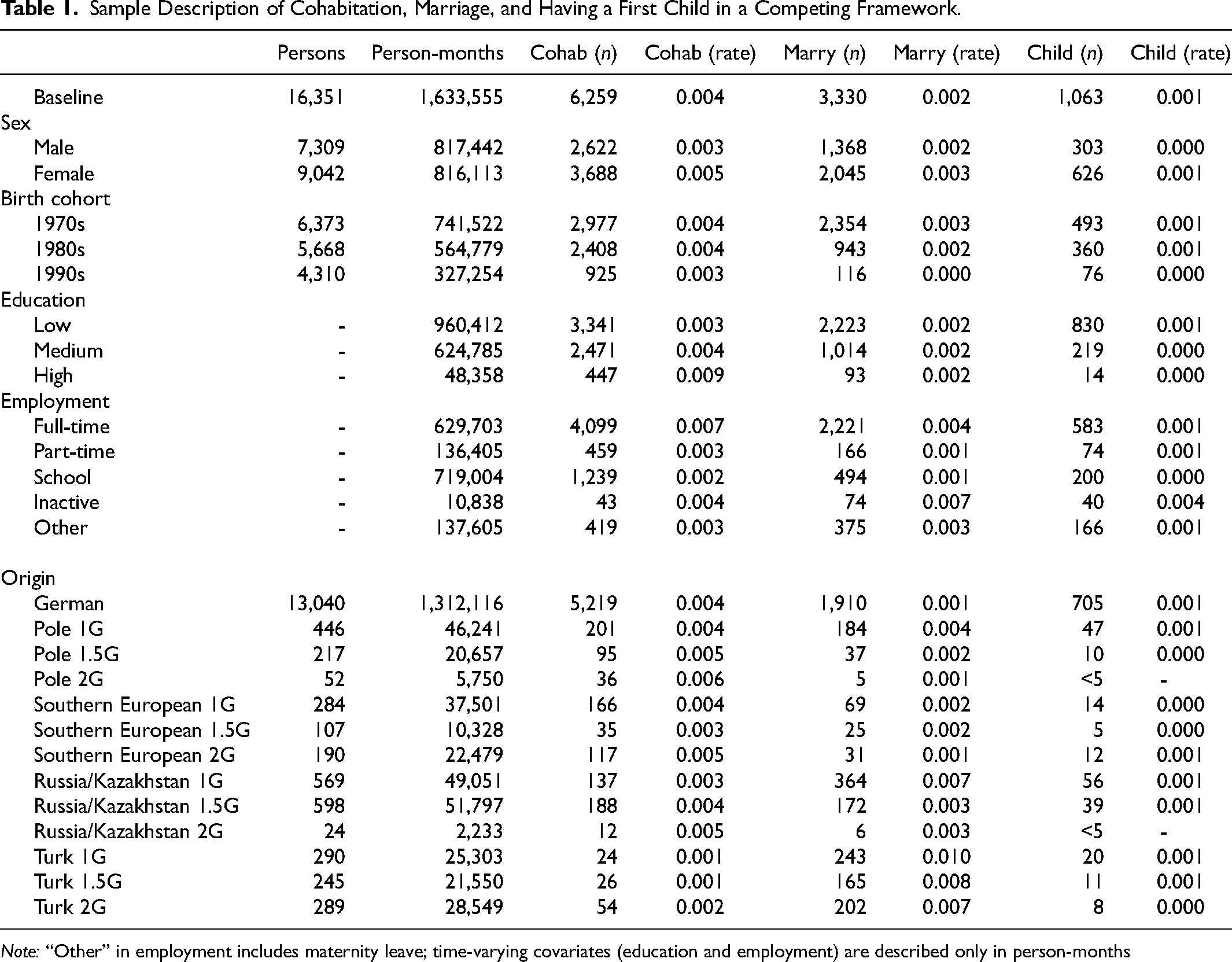
Note: “Other” in employment includes maternity leave; time-varying covariates (education and employment) are described only in person-months
Methods
We focus both on the timing and level of first birth and union formation. Given the panel design of the German Socioeconomic Panel of which individuals can enter and exit at different points in their lives, we use an event history design to fully take advantage of all available information on individuals’ propensity of experiencing the event of interest. We first use the Kaplan–Meier method to investigate the entrance into cohabitation, marriage, and parenthood. We then analyze the competing risks of entering a marital or nonmarital union or having a child out of the union by using the cumulative incidence function (CIF) (Austin, Lee, and Fine 2016). Entering a nonmarital cohabitation or having a first child outside of marriage does not preclude the propensity of entering marriage subsequently (with the same or a different partner), but we are interested in the first type of family process of the individuals, rendering these partnership and fertility events competing rather than sequential. The three competing events that can occur from singlehood are: direct entrance into marriage, direct entrance into cohabitation (without a child nor under the context of marriage), or direct entrance into parenthood (outside of the context of cohabitation or marriage).
Finally, we use competing risks event-history modeling to adjust transition rates for control variables (Putter et al. 2007). The transition-specific hazard function, 

The effect of age and other variables can vary by the transition in the model defined in equation 2. However, we cannot measure the relative importance of each transition by migrant status from separate models. We propose the following model to measure the relative importance of each transition by migrant status:
All analyses are conducted in R using the survival (Therneau et al. 2021), eha (Broström and Jin 2021), and cmprsk (Gray 2020) packages. The phreg function in eha is used to perform piecewise constant exponential regression.
Findings
Out of the 16,351 persons born between 1970 and 1999 observed from the age of 16 until their last survey year or 40 years of age, totaling 1,633,555 person months, 6,858 individuals experienced a first cohabitation, 7,603 experienced a first marriage (before cohabitation), and 7,935 individuals had a first child within the observation window. The above figures are noncompeting, or individuals can experience these events sequentially or simultaneously. If an individual experiences cohabitation at 17, marriage at 18, and childbirth at 19, all three instances would be accounted for in this figure. Figure 1 shows the Kaplan–Meier estimations of all three events by migrant background and birth cohort. This allows us to show the overall rate and timing of family formation for all groups. Sex and migrant generation are collapsed in this figure, to highlight migrant group differences.
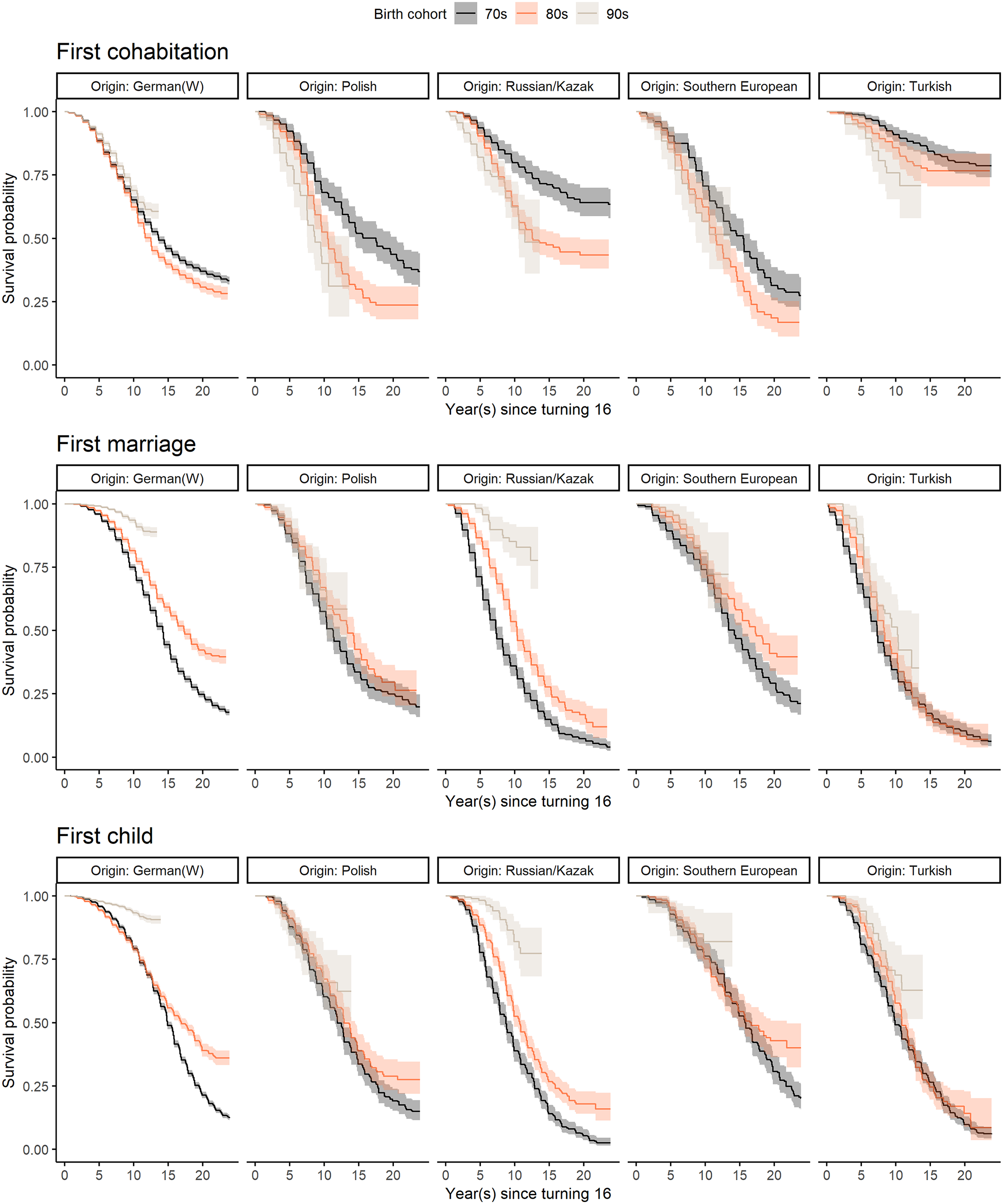
KM survival curves to having a first child, entering a first cohabitation, and entering a first marriage in noncompeting framework (first, 1.5, and second generations combined).
We observe a clear postponement of entrance into marriage and parenthood for natives and those with Russian and Kazakhstani backgrounds. Those born in the 1990 s are less likely than their counterparts born in the 1970 s and 1980 s to have children or get married at younger ages. Cohabitation, on the other hand, shows a different picture. Younger cohorts with immigrant family backgrounds exhibit a higher level of and earlier entrance into cohabitation. The cohort differences are particularly pronounced for those of Polish, Russian, and Kazakhstani descent. Taken together, young adults are not necessarily delaying their timing in forming a union, but marriage has been replaced by cohabitation in younger individuals. In addition, individuals are also not having children as early as those of previous birth cohorts. In other words, we witness an informalization of conjugal unions in addition to delayed entrance to parenthood, consistent with predictions outlined by the SDT. Turkish Germans are marked by their high levels of marriage and lower levels of cohabitation, with a modest level of cohort changes. Southern Europeans, and to a lesser degree, Polish immigrants and descendants, display patterns more akin to native Germans.
Next, we extend our analysis to create a competing framework of the first instance of cohabitation, marriage, and parenthood. Figure 2 depicts the conceptualization of three possible states following singlehood at 16 years old. In our sample, 6,259 entered cohabitation, 3,330 married, and 1,063 had a first child before entering cohabitation or marriage. Individuals who experienced multiple events in the same year are assigned priority of marriage, then cohabitation, then birth as their sequence (see Partnership and Fertility section).
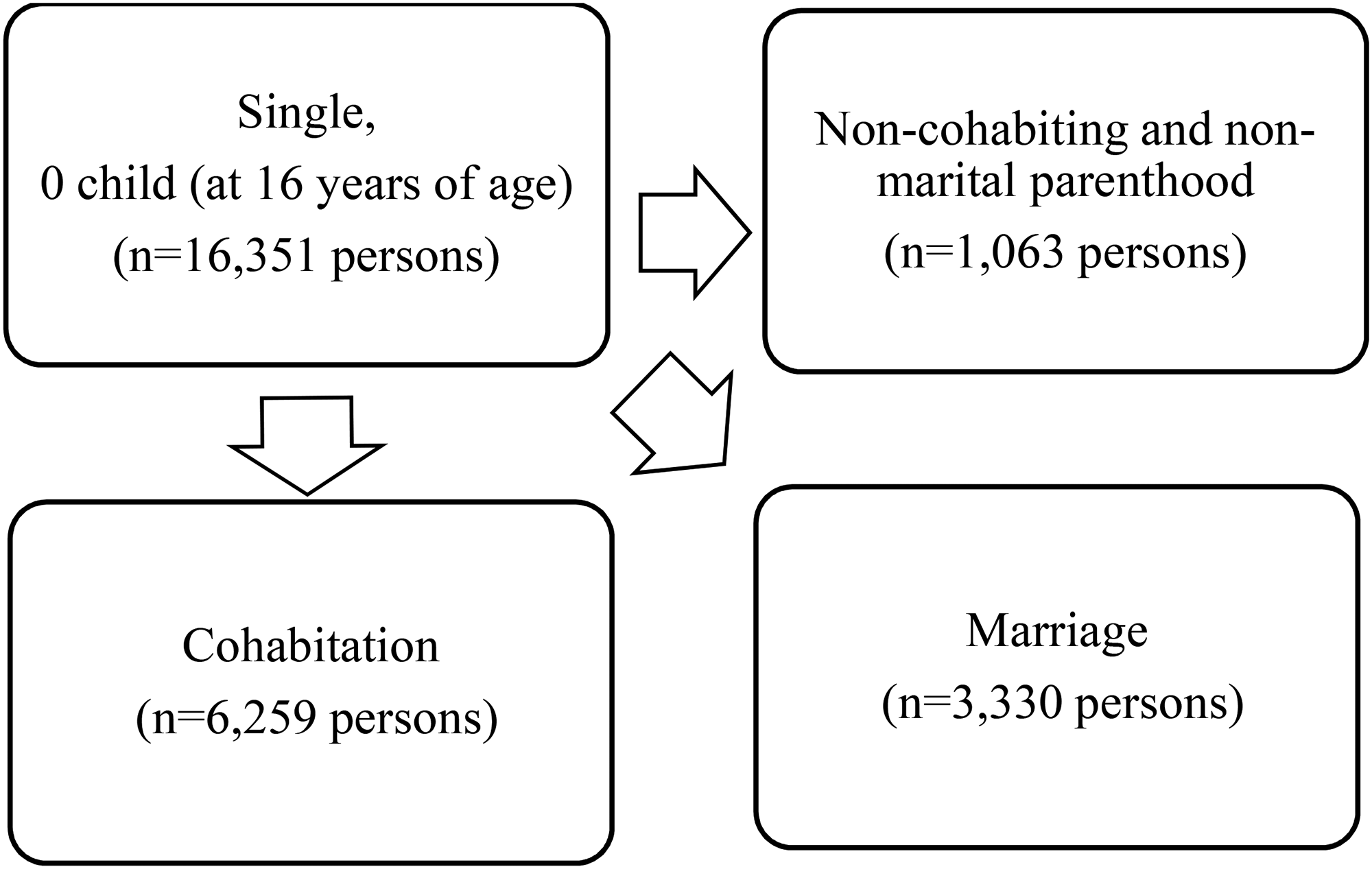
Transition to three competing events in the sample population. Note: Those who experienced multiple events in the same year are assigned priority by the following order: marriage, cohabitation, and parenthood.
To pinpoint the first emancipation of family formation, we show the CIF of cohabitation, marriage, and having a first child as competing events in Figure 3. In this view, we argue that a person can enter family life in two major ways: through union formation or parenthood. Union formation is further broken down into cohabitation or marriage. Although it is possible that one might be in a living-apart-together (LAT) arrangement, the level of commitment in such a relationship is difficult to measure. Therefore, if one is in a LAT arrangement and sharing a child with a noncohabiting partner, they are considered to have entered nonunion parenthood.
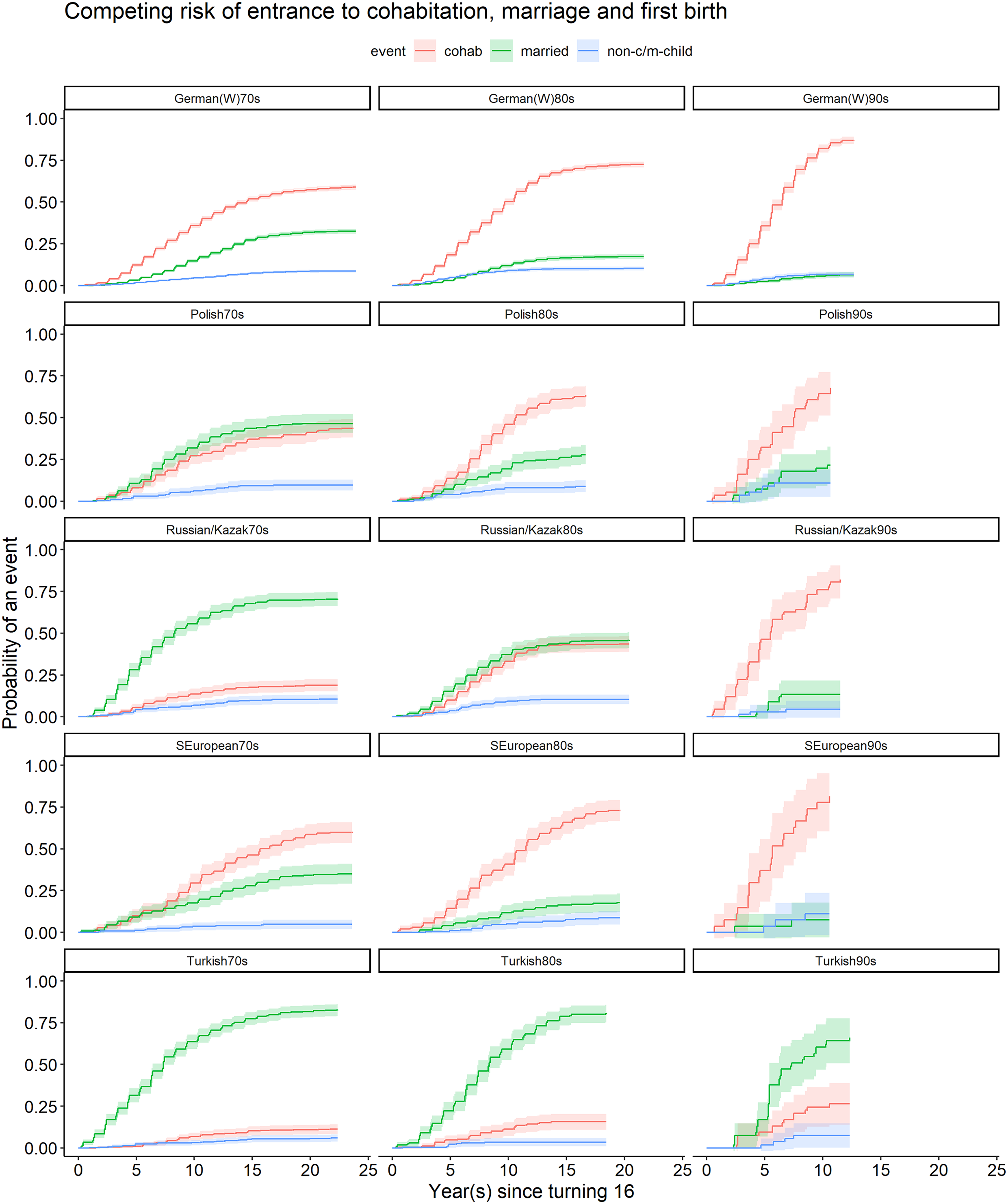
Cumulative incidence function of entrance into parenthood, cohabitation, and marriage as competing events by origin and birth cohort.
The CIF is calculated by modeling the transition-specific hazard of the three events. For German natives, cohabitation has been clearly the preferred type of first union across all cohorts, with younger cohorts increasingly likely to cohabit rather than marry.
Polish migrants and their descendants born in the 1970 s are equally likely to cohabit or marry, but those born in the 1980 s and 1990 s show a clear preference for cohabitation. The pattern of change from the 1970 s to 1980 s cohort for the Polish is comparable to the changes of those from Russia and Kazakhstan born in the 1980 s to 1990 s. Cohabitation overtakes marriage for those with Polish background born in the 1980 s, and individuals with a Russian and Kazakhstani background born in the 1990 s. Southern Europeans follow a similar pattern of cohort change as German natives, for whom marriage as a first entry into the family was significant for those born in the 1970 s but never preferred over cohabitation. Its importance has fallen across cohorts. Distinct from the rest of the groups, Turkish individuals prefer marriage over cohabitation across all cohorts with very limited change, especially for those born in the 1970 s and 1980 s. For the youngest individuals of Turkish origin, we see an increase in the likelihood of cohabitation and a decrease in the propensity of marriage compared to their predecessors. Compared to the natives, parenthood outside of the union is uncommon for all migrant groups across all three birth cohorts.
We split the age of individuals into a 4-year episode from 16 to 19, then in 5 years subsequently until censor time at 40. Our baseline model, or model 1, controls for sex and birth cohort. Model 2 also includes education. Lastly, model 3 additionally controls for employment status. Hazard ratios are shown in relation to German natives' cohabitation hazard. The coefficients with confidence intervals for all variables in the three models are shown in Table 2.
Piecewise Constant Hazard Exponential Models on Event by Type of Event Origin, With German Natives in Cohabitation as Baseline Hazard.
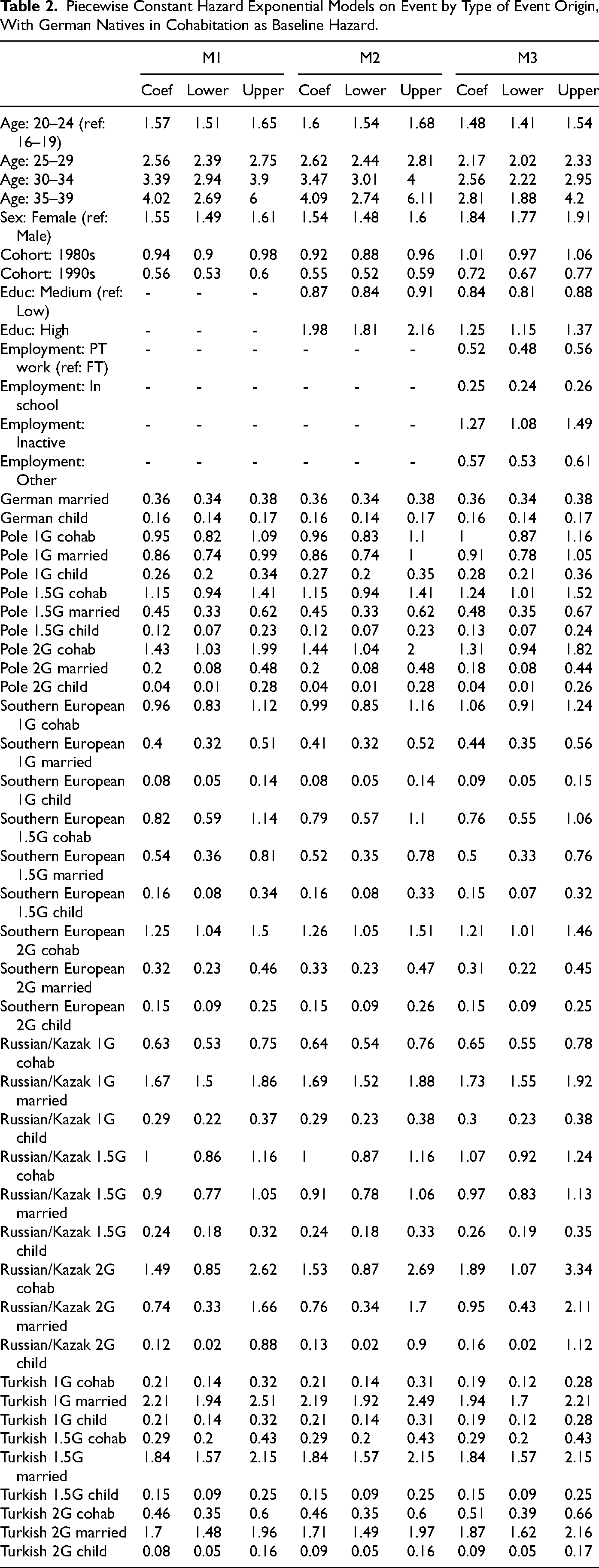
Figure 4 presents the adjusted model coefficients (model 3) in points, and the confidence intervals in the accompanying lines. A hazard ratio of above one signifies a higher transition rate, while a hazard ratio of under one expresses a lower transition rate of experiencing an event compared to the reference category. Once again, the hazard of native Germans entering cohabitation serves as the point of comparison, shown as a dot on the reference line. We do not show 2G with Polish and Russian or Kazak backgrounds due to their small sample sizes. Although their figures will not be discussed in this section, model coefficients, and upper, and lower confidence intervals for these groups are still shown in Table 2.
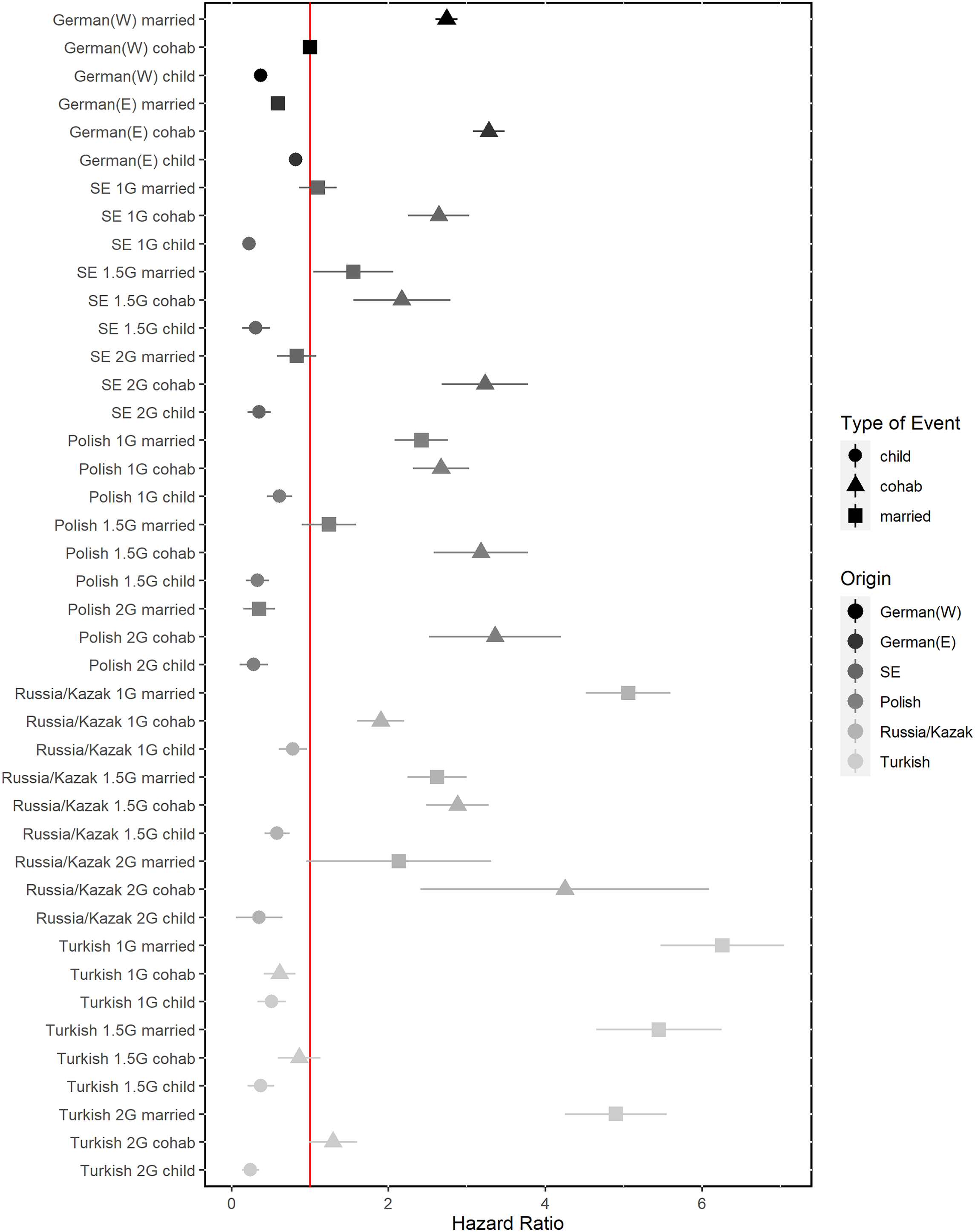
Piecewise constant hazard model (adjusted for sex, cohort, education, employment status, with German native in cohabitation as baseline hazard). Note: Polish and Russia/Kazak 2G are excluded due to small sample size.
Our modeling strategy enables us to compare transition rate of multiple outcomes among multiple groups, here by origin and migrant generation, of individuals. For example, we see that the marriage risk for Polish 1G is similar to the cohabitation risk of native Germans. With education and employment status controlled, we capture both origin and generational differences in Figure 4.
First, Southern Europeans (“SE”) and Polish show similar transition rates in first cohabitation, marriage, and parenthood compared to the natives, regardless of migrant generations. Southern European 2G are slightly less likely to marry and more likely to cohabit compared to their previous generations and to the natives. Polish 1.5G, or those who migrated as children, are both slightly more likely to cohabit and slightly more likely to marry compared to the German natives, which shows an overall higher rate of union formation regardless of formality. Second, individuals from Russia and Kazakhstan exhibit remarkable differences in their age of migration. Those who migrated as adults (1G) tend to elect marriage over cohabitation. Their 1.5G counterparts, however, are similarly likely to cohabit as married. In other words, they have a significantly higher rate of transition to marriage than German natives, which is lower than their 1G counterparts; and a similar transition to cohabitation than German natives, which is higher than their 1G counterparts. Third, and most remarkably, Turkish individuals show sharp distinction from German natives across all migrant generations and birth cohorts. They are substantially more likely to marry and far less likely to cohabit than Germans. Although changes across birth cohorts and migrant generations can be observed, those with Turkish backgrounds have distinguished high levels of marriage and low levels of cohabitation compared to Germans and other migrant and their descendant groups. This finding is consistent with prior studies which point to persistence of family traditionalism of those with Turkish background in Germany, possibly due to cohesive ethnic communities which reinforce within-group norms.
Overall, marriage rates are higher among immigrants than their descendants (even after controlling for birth cohort), although the confidence intervals are larger due to the smaller sample size of 2G groups that are shown. All groups, including German natives, have a very low risk of entering family via nonunion childbearing compared to cohabitation, showing that the extent of liberalization of the family under the SDT framework stops at the informalization of union, and cannot be extended to childbearing outside of the cohabiting partnership.
Discussion
Family ideologies, such as whether and when to have a child and under which circumstances, differ cross-culturally and change over time. The pathway through which one enters family life (if at all) or transitions into adulthood signals one's values and norms. In this study, we compared the partnership and fertility transitions for individuals with a migrant family background with those without one in Germany. We investigated the likelihood of entering cohabitation, marriage, or parenthood in a competing-risks framework. To adequately address the changing composition of immigrants and distinguish between changes that occurred with elapsed time in destination and pure ideological shifts that took place with changing times, we drew attention to those born in different decades and migrant generations in our analyses.
We hypothesized the following: those with Turkish backgrounds will likely exhibit the most conservative family pathway (H1). In contrast, individuals with Southern European and Polish backgrounds will show similarities with native Germans (H2). Some level of assimilation will be observed for all groups across migrant generations (H3). Lastly, we expected a convergence by birth cohort, as younger individuals will show more similarities than their older counterparts (H4).
We found that consistent with previous studies (Milewski 2010; Krapf and Wolf 2015) and in line with our expectation, those with a Turkish background exhibit the most distinct family patterns from native Germans and their European counterparts, marked by high levels and early entry into marriage. Despite the substantial expansion of cohabitation in recent years across Europe, Turkish Germans continue to prefer more conservative family trajectories, with direct entrance into marriage as the preferred first type of union formation. The preference is extended from the first into the 1.5 and second generations with only a modest decline. Thus, our H1 is supported by our findings but H3 is only partially supported here, as Turkish Germans show high levels of persistence in conservative family trajectories across generations.
Individuals from Poland and Southern Europe share the most similarities with Germans, which corroborates with our H2 and previous findings that migrants of European origin show more similarities in family behavior with European nonmigrants, than migrants from non-European origins (Pailhé 2017). In line with our expectation, Southern Europeans’ propensities to cohabit, marry, and have a first child differ little from Germans. In fact, Southern European countries such as Spain has seen dramatic rise in mean age at first marriage, at 35.3 for men and 33.2 for women in 2017 (Idescat 2020) compared to 34.2 for men and 31.7 for women in Germany of the same year (Destatis 2021). Those who migrated might have even assimilated to a more “family-oriented” German level compared to their nonmigrant counterparts in the sending country. The reason for that might also be that many of them are married with native Germans (Milewski and Kulu 2014) and family decisions were made jointly with their native partners.
Our findings on migrant generations lend limited support to our H3 for several reasons. First, we showed that independent from migration circumstances, such as being required to marry to facilitate the international move, those with a Turkish background who arrived as children or were born in Germany still adhere to a more conservative family pathway. This corroborates with previous studies that highlight the association between religion and sexual liberalism among those with Turkish or Moroccan background in Europe (Kalmijn and Kraaykamp 2018), although the relationship weakens from first to second-generation (Beek and Fleischmann 2020). Second, we tested both socialization and adaptation hypotheses by examining the 1.5 generation who had the unique experience of both socializing in the sending country and adapting to the destination. Other than for Southern Europeans, who differ little from the natives, all groups show that the 1.5 generation are more likely to cohabit than the first generation, but less likely to cohabit than second-generation individuals, effectively “straddling both worlds” (Rumbaut and Ima 1988). It is important to keep in mind that strong familism in the Turkish community is not only manifested in early and high levels of marriage, but prior research has found that Turkish young adults in Europe are more likely to delay their entrance into adulthood, or prolong their stay in their parental home until they are ready for marriage (Huschek, de Valk, and Liefbroer 2010). The nuanced approach to what it means to adhere to higher familism requires much more extensive exploration into family living arrangement and informal exchanges, which are beyond the scope of this study.
We see a growing level of preference for cohabitation across both migrant generation and birth cohorts. Groups are changing at a different pace, with those from Russia and Kazakhstan born in the 1980 s resembling Polish-born in the 1970 s. Due to the small sample sizes of individuals from several groups, we cannot make definitively claim to have found support for H4. In particular, we hold reservations with our generational findings for individuals with Polish and Russian or Kazakhstani backgrounds. Nevertheless, we argue that the debate of migrant integration into the host country can benefit from a view of “at what stage” one is starting to resemble destination groups rather than “whether” they do at all. Under SDT framework, global trends in the liberalization of family formation are expected to sweep across all walks of life (Lesthaeghe 2020), plausibly leading to younger individuals from different backgrounds to behave more similarly than their predecessors. Moreover, preference for cohabitation, marriage, and having a child are subject to structural and institutional influences. For example, the lack of access to affordable housing may either promote cohabitation by joining households to share resources or discourage cohabitation by delaying one's departure from parental home. In theory, structural environment should influence individuals’ family pathways similarly, but gaps in information or access to resources may differentially impact noncitizens in practice.
In future research, we suggest a detailed view of various groups of second-generation individuals to highlight generational pathways in family formation where sample size allows. Additionally, individuals with foreign-born parents can also be further broken down into second and 2.5 generation, or those with both or only one foreign-born parent, to enhance our understanding of intergenerational transfer of values. It would also be essential to consider the difference in timing and type of entrance into family among second-generation individuals who form endogamous and exogamous unions. In addition, different types of settings such as rural or urban, multi-ethnic, or less diverse neighborhoods, might influence the degree to which individuals are acculturated to the dominant view of the destination. Lastly, GSOEP collected a refugee boost sample as a response to the sharp increase of refugee migrants in 2015. Retrospective biographies have not been widely collected among them and prospective observation window has been too short. In the future, understanding refugee partnerships and fertility trajectories will become vital in shedding light on the diversification of European family demography.
We highlight competing pathways in family formation for immigrants and natives in Germany by first, 1.5, and second-migrant generations. From childless singlehood, individuals can experience the birth of a child, cohabitation, or marriage in any order. With the rising importance of cohabitation in family processes, we focus on the most recent cohorts or those born between the years 1970 to 1999. Our work additionally distinguishes between nonmarital cohabitation and entrance into parenthood outside of the context of a cohabiting or married partner. Our study shows changes in family patterns across birth cohorts and migrant generations among different origin groups of immigrants in Germany. This work reveals the gradual convergence in some aspects of family life and continual diversity in others.
Supplemental Material
sj-docx-1-mrx-10.1177_01979183231161600 - Supplemental material for Competing Family Pathways for Immigrants and Their Descendants in Germany
Supplemental material, sj-docx-1-mrx-10.1177_01979183231161600 for Competing Family Pathways for Immigrants and Their Descendants in Germany by Chia Liu and Hill Kulu in International Migration Review
Footnotes
Declaration of Conflicting Interests
The author(s) declared no potential conflicts of interest with respect to the research, authorship, and/or publication of this article.
Funding
The author(s) disclosed receipt of the following financial support for the research, authorship, and/or publication of this article. This work was supported by the H2020 European Research Council (grant number 834103).

Supplemental Material
Supplemental material for this article is available online.
Notes
Appendix
References
Supplementary Material
Please find the following supplemental material available below.
For Open Access articles published under a Creative Commons License, all supplemental material carries the same license as the article it is associated with.
For non-Open Access articles published, all supplemental material carries a non-exclusive license, and permission requests for re-use of supplemental material or any part of supplemental material shall be sent directly to the copyright owner as specified in the copyright notice associated with the article.
