




Abstract
Many immigrants struggle to integrate into host societies, despite the frequent long-term benefits of integration for immigrants and host societies. This article aims to increase understandings of immigrants’ experiences and obstacles in the daily socio-cultural integration process by examining the understudied impact of daily integration behaviors on momentary happiness. The daily experiences of 213 immigrants from the United States in Germany were captured, using a day reconstruction method. Our panel fixed-effects estimates show that immigrants who were not fluent in the host country's majority language generally felt happier when communicating in their mother tongue, as opposed to the majority language. Moreover, interacting with majority group members negatively affected the momentary happiness of less culturally integrated immigrants. By contrast, socio-cultural integration related positively to immigrants’ enduring happiness. Our results suggest that socio-cultural integration is an investment involving short-term costs to happiness, with important daily obstacles being the cost to momentary happiness of speaking the majority language and, to a lesser extent, interacting with majority group members. We argue that integration behaviors’ short-term costs also occur in many other migration contexts. The revealed short-term costs can increase understandings of immigrants’ integration struggles and related outcomes, including segregation and loneliness, and decreasing the costs may improve socio-cultural integration trajectories.
Introduction
Many immigrants struggle to integrate into the cultural and social life of the host country's mainstream society (Rumbaut 1997). Natives’ concerns about the level of immigrant integration have contributed to anti-immigrant sentiments and fueled tensions between natives and immigrants in immigrant-receiving countries (Lesińska 2014). To better understand the integration process, an abundance of literature has emerged on the role of stable factors (i.e., factors that vary little over time) as causes and consequences of immigrants’ socio-cultural integration, using cross-sectional comparisons or longitudinal comparisons with lengthy (e.g., yearly) time intervals. This literature stream demonstrates that socio-cultural integration, and biculturalism, in particular, is generally positively associated with immigrants’ enduring subjective well-being and mental health (Nguyen and Benet-Martínez 2013; Paloma et al. 2020; Angelini, Casi, and Corazzini 2015; Yoon et al. 2013). Socio-cultural integration is also positively associated with other well-being domains such as labor market performance and educational achievement (Phinney et al. 2001; Bisin et al. 2011; Chiswick and Miller 2015; Lochmann, Rapoport, and Speciale 2019), even if positive outcomes are not observed in each domain of socio-cultural integration and in each context (Potarca and Bernardi 2021; Zlotnick, Dryjanska, and Suckerman 2020; Casey and Dustmann 2010). 1 The enduring well-being benefits of greater socio-cultural integration and the low social cohesion between natives and immigrants make immigrants’ limited socio-cultural integration among the leading policy issues in immigrant-receiving countries (Bauloz, Vathi, and Acosta 2019). The integration literature has also offered valuable insights into the stable determinants of socio-cultural integration, including the interplay between social conditions and immigrants’ personal conditions, such as persistent (dis)incentives (e.g., expected duration of stay), learning efficiency (e.g., education level), and exposure (e.g., actual duration of stay) in the realm of language acquisition (Chiswick and Miller 2015; Spörlein and Kristen 2019). 2
An important void in the integration literature is that while much is known about the roles of stable factors as causes and consequences of socio-cultural integration, the transient causes and consequences of the daily integration process have received limited empirical attention (Doucerain, Dere, and Ryder 2013). A probable reason is that quantitative data about the daily integration process is not readily available and difficult to collect. Consequently, while it is frequently acknowledged that the daily socio-cultural integration process is hindered by pecuniary and non-pecuniary costs (Esser 2006), a comprehensive picture is missing about what—and to what extent—particular momentary costs are experienced in the daily socio-cultural integration process. A better understanding of momentary integration costs can facilitate the development of effective policies to reduce those costs and, thereby, improve the experienced instant utility of integration behaviors (Kahneman, Wakker, and Sarin 1997). Moreover, the short-term consequences of behaviors play an important role in behavioral decision-making in daily life, with people avoiding momentary costs such as integration behaviors that trigger negative moods and emotions (Gendolla 2000). We argue, therefore, that better knowledge of such transient experiences and everyday obstacles can help in understanding immigrants’ integration behaviors and in further explaining why immigrants’ socio-cultural integration is frequently slow or not progressing, despite the generally positive long-term consequences. The behavioral consequences of momentary integration costs also imply that evidence-based policies aimed at reducing momentary integration costs can improve the long-term socio-cultural integration trajectories of immigrants.
This article aims to help fill this void in the immigration integration literature by examining how integration behaviors in the daily integration process affect immigrants’ momentary happiness. To our knowledge, ours is the first study to quantitatively examine momentary happiness effects of daily integration behaviors and to directly compare these momentary (i.e., short-term) effects to the enduring (i.e., long-term) consequences of socio-cultural integration. We propose that two types of daily integration behaviors—interactions with majority group members and speaking the majority language—have negative short-term consequences for immigrants’ happiness in early stages of socio-cultural integration. We further propose that these negative short-term effects can discourage immigrants from engaging in such integration behaviors and contradict socio-cultural integration's positive long-term effect on happiness. To empirically explore these propositions, we collected data about the daily integration behaviors and happiness experiences of first-generation immigrants from the United States in Germany, using the day reconstruction method (DRM).
We consider a happiness perspective particularly informative for understanding the integration process for three reasons. First, given that virtually all people yearn for a happy life, feeling happy is a primary driver of human behavior—and, by extension, integration behavior—when basic survival needs are met (Benjamin et al. 2012). Behavior is driven not only by striving for high enduring happiness but also by striving for high momentary happiness (i.e., a good mood) (Gendolla 2000). Second, happiness measures are increasingly used to comprehensively evaluate well-being or utility because they capture, in an integrated manner, people's subjective well-being, thereby serving as a summarizing measure of the balance between the positive and negative feelings experienced (Hendriks and Bartram 2019; Frey and Stutzer 2002; Hendriks 2015). Third, a burgeoning happiness literature shows that feeling happy is foundational to a myriad of positive outcomes, such as productivity, health, and openness toward other values and cultures (De Neve et al. 2013), as well as immigrants’ length of stay (Shamsuddin and Katsaiti 2020; Schiele 2021). By implication, the momentary happiness costs of integration behaviors may not only discourage integration behaviors but also negatively affect other behaviors and outcomes of immigrants.
The article proceeds as follows. First, drawing on insights from different literature streams on immigrant experiences of integration behaviors, we develop several hypotheses about the short- and long-term relationship between socio-cultural integration behaviors and happiness. Next, we contextualize the case of US immigrants in Germany and show why it is a particularly insightful context for testing these hypotheses. We, then, move on to discuss the usefulness of the day reconstruction method. Next, we present the data and empirical methodology, after which the hypotheses are tested. In the final section, we draw our conclusions and discuss the implications.
Happiness in the Daily Socio-Cultural Integration Process
Speaking the host county's majority language is often a prerequisite for interacting with the host country's natives. In turn, interacting with the host country's natives—and thus indirectly also speaking the majority language—sit at the core of many other forms of socio-cultural integration and structural integration (Vacca et al. 2018; Esser 2006). Speaking the majority language and interacting with natives are frequent, observable, and conscious behaviors and therefore comprise some of the most concrete socio-cultural integration behaviors in daily life. Hereby, interacting with natives captures more the interactive/social component of socio-cultural integration while speaking the majority language captures more the cultural component, and these daily behaviors are both influenced by one's situation-specific identity (the identificational component of socio-cultural integration). For these reasons, we focus on these two foundational elements of socio-cultural integration when outlining the impact of the daily socio-cultural integration process on immigrants’ everyday happiness.
We first consider the impact of interacting in the host country's majority language. The second language acquisition (SLA) literature documents that second language use may elicit positive emotions among non-fluent immigrants, such as enjoyment in practicing the language and pride about one's proficiency or efforts (Dewaele et al. 2019). More frequently, however, it is suggested in the SLA literature that second language use provokes negative emotions, such as nervousness about making mistakes, fear of negative perceptions or rejection, feelings of shame and embarrassment about one's language proficiency, and frustration when making mistakes (Horwitz, Horwitz, and Cope 1986; Dewaele et al. 2019). There are various additional indirect mechanisms through which second language use can affect momentary happiness. First, speaking a non-fluent language is a fatiguing endeavor because it requires high levels of mental processing, while mental fatigue negatively affects mood and emotion regulation (Grillon et al. 2015). Second, non-fluent speakers comprehend less and express their emotions, humor, and beliefs less easily, which can cause adverse effects such as being perceived as less competent and credible, not being understood, or not being able to be oneself (Morita 2004). Third, speaking a language non-fluently or with an accent can result in prejudice, discrimination, and being treated as an outsider by strangers or acquaintances (Lippi-Green 2012). Taken together, second language use is, in many situations, perceived as a stressor that induces immediate acculturative stress and strain (Berry 2006) and that can eventually result in language anxiety, reduced self-esteem, and mental health problems (Horwitz, Horwitz, and Cope 1986; Fox, Thayer, and Wadhwa 2017).
We argue, however, that the extent to which these mechanisms occur is contingent on immigrants’ level of language proficiency. We expect fluent speakers to experience more positive emotions when speaking a second language because their fluency can facilitate the development of positive relationships with others, because they are likely to be more often commended on their fluency, and because they may consider speaking their second language more enjoyable (Dewaele et al. 2019). Stress theory (Lazarus and Folkman 1984) and strain theory (Agnew 1992) posit that stress and strain occur when an individual fails or anticipates failing to achieve positively valued goals such as good language command. Following this rationale, more fluent speakers of the host country's majority language will also experience the negative mechanisms discussed above to a lesser extent when speaking the majority language (i.e., they will have less language anxiety, develop less fatigue, express themselves better, and ultimately be perceived or treated in less negative ways by majority members). In this vein, Demes and Geeraert (2015) show that immigrants’ psychological distress tends to decline with the length of stay and often follows a reverse J-pattern or, in case, of an initial “honeymoon” period, an inverse U-curve. While there is no direct evidence regarding what the discussed positive and negative mechanisms add up to in terms of momentary happiness, the above discussion suggests that second language use's negative short-term effects outweigh the positive effects for non-fluent speakers in particular. Therefore, we formulated the following hypothesis:
H1: Immigrants, especially those who are less fluent in the majority language, will feel happier when interacting in their mother tongue than in the host country's majority language.
Next, we consider the impact of interacting with the host country's natives. Interethnic interactions can elicit positive effects on momentary happiness, for example, in situations where interethnic interactions improve mutual understanding, break down barriers, or result in a pleasant cultural learning experience (Pettigrew and Tropp 2006). More frequently, however, language, cultural, and attitudinal barriers complicate exchanges between migrants and natives, causing them to be more reserved and less open to one another (Wessendorf and Phillimore 2019). In particular, ethnic differences in practices, values, culture, religion, and so forth, can reduce mutual understanding between ethnic groups and therefore make interethnic contact less comfortable and increase the chance of conflicts (Pettigrew and Tropp 2006). People in general also feel closer to, as well as prefer to interact with, others who are perceived as similar to themselves, which more often tend to be co-ethnics (McPherson, Smith-Lovin, and Cook 2001). This homophily principle can explain why interethnic contact more often involve negative outcomes, such as peer rejection and discrimination (Hewstone, Rubin, and Willis 2002). However, language and cultural boundaries should diminish with better cultural integration, making interactions with majority group members more pleasant for more culturally integrated immigrants. Again, there is no direct evidence regarding what these positive and negative effects of interethnic interactions add up to in terms of momentary happiness, but the above discussion suggests that the negative short-term effects of interethnic contact outweigh the positive effects for less culturally integrated immigrants in particular. 3 Therefore, we hypothesize:
H2: Immigrants, particularly those who are less culturally integrated, will feel happier when interacting with people from their heritage society than with people from the host society.
Socio-Cultural Integration and Enduring Happiness
Research on the broaden-and-build theory of positive emotions (Fredrickson 2003) has shown that while anticipating or experiencing positive emotions can increase openness to activities that are outside one's comfort zone, negative emotions have the reverse effect (MacIntyre and Gregersen 2012). The experience of negative emotions during day-to-day integration behaviors outside one's comfort zone can be disruptive to immigrants’ motivation and confidence for engaging in such integration behaviors and result in withdrawal from integration behaviors as a coping strategy (Lou and Noels 2019; Rubin, Watt, and Ramelli 2012). Structural withdrawal behavior slows down or blocks the integration process, and in turn, reduces immigrants’ enduring happiness and well-being because socio-cultural integration is generally positively related to enduring happiness and well-being (Nguyen and Benet-Martínez 2013; Paloma et al. 2020; Angelini, Casi, and Corazzini 2015; Yoon et al. 2013).
A key driver of the positive long-term relationship between socio-cultural integration and enduring happiness is identificational integration given that a sense of belonging to the host country is found to be particularly strongly related to enduring happiness (Angelini, Casi, and Corazzini 2015; Helliwell and Putnam 2004). Another notable driver is that by interacting with majority members and speaking the majority language, immigrants create social networks that can bring them structural benefits that are conducive to happiness, such as employment and consumption opportunities and better educational achievement (Phinney et al. 2001; Bisin et al. 2011; Chiswick and Miller 2015). While the positive association between socio-cultural integration and enduring happiness is well-established, there is no direct evidence of whether this enduring relationship differs from the momentary relationship. Yet, the above discussion suggests that integration behaviors can negatively affect happiness in the short term, but positively affect happiness in the long term. Therefore, we hypothesize:
H3: Socio-cultural integration will be more positively related to enduring happiness than momentary happiness.
The Case of US Immigrants in Germany
American immigrants in Germany are a particularly interesting case study for testing our hypotheses. First, to test the hypotheses, language effects must be disentangled from nationality effects. Given that many Germans can speak some English, US immigrants will communicate with Germans partly in English and partly in German, allowing us to disentangle language effects from nationality effects.
Second, this immigrant group - largely neglected in migration studies – is important in and of itself, given that there are approximately 120,000 US citizens in Germany, representing 1 percent of immigrants in Germany (Destatis 2022). 4 Unlike citizens of the Schengen area, US citizens must acquire a German residence permit to reside in Germany (BAMF 2022). Main eligibility criteria include having an employment offer, being a skilled job seeker, or moving for family reunion or study purposes. 5 Therefore, this immigrant group consists primarily of people who moved to Germany because of a job offer, temporal relocation by the employer, being a co-moving family member, or for study purposes.
Third, for reasons outlined below, we expect weaker negative momentary effects for US immigrants in Germany compared with many other immigrant populations, meaning that our case study offers a conservative empirical test of our more generally applicable hypotheses. Concerning the role of nationality, interethnic contact's negative effects may be softened in our case study by the possibility for US immigrants to frequently communicate in English with Germans, thereby avoiding the possible momentary happiness costs of interacting in the majority language for those who are not fluent in the majority language. In addition, US immigrants can be expected to be regarded relatively favorably by Germans than many other immigrant groups whose culture or religion is less appreciated by some natives (Fietkau and Hansen 2018). For instance, as Erel (2009, 27–28) notes, “although legally anyone without German citizenship is an Ausländer, socially the term coincides with racialization so that white West-Europeans [and Americans] are only occasionally labelled as Ausländer.” One counteracting contextual factor is the fact that Germany has a pluralistic climate where discontent with expressions of immigrants’ heritage culture can make interethnic interactions less pleasant (Yağmur and Van de Vijver 2012). Turning to language, US immigrants may experience a higher cost of speaking and learning a different language because the lack of experience with other languages may cause the relatively often monolingual US immigrants to struggle more in learning a new language (Hirosh and Degani 2018; Preply 2022). A counter-effect is that US immigrants may struggle less with the German language because of the relatively small linguistic distance between German and English, particularly compared with languages with different alphabets (Isphording and Otten 2014). By and large, we expect the above-discussed contextual factors that dampen negative effects of integration behaviors on momentary happiness to outweigh contextual factors that exacerbate negative effects, particularly in terms of interethnic contact, resulting in a conservative empirical test of our more generally applicable hypotheses.
The Day Reconstruction Method
The day reconstruction method (DRM) (Kahneman et al. 2004) is one of two popular quantitative approaches used to assess daily life experiences, the other one being the experience sample method (ESM) (Hektner, Schmidt, and Csikszentmihalyi 2007). The DRM assesses daily life experiences by having individuals complete daily happiness diaries in which they systematically reconstruct their day and report how they felt during each activity or situation (Kahneman et al. 2004). The ESM, by contrast, asks individuals to report how they feel on multiple occasions throughout the day (Hektner, Schmidt, and Csikszentmihalyi 2007). While the DRM's reliance on retrospective reports introduces some degree of recall bias in individual reports, the high convergence at an aggregated level between ESM and DRM estimates suggests limited recall bias is present in aggregated DRM estimates (Lucas et al. 2021). The DRM has several advantages over the ESM, including that it is less burdensome for respondents, has more complete coverage of the day, and provides information about the duration of activities (Kahneman et al. 2004). Therefore, the DRM has become a popular method to assess daily life experiences and has been implemented in large-scale surveys like the German Socio-Economic Panel Study, the American Time Use Survey, and the Panel Study for Income Dynamics. 6 Here, we opted for using the DRM because of the above-mentioned advantages and the use of aggregated DRM estimates in our analysis.
Method
Procedure and Sample
We empirically test our hypotheses in the context of US immigrants in Germany. A self-selected sample of US immigrants in Germany was recruited between April 2017 and December 2019 through various channels, including newsletters and websites of expat organizations (e.g., Internations, Expatica, Liveabroad), the American German Business Club (AGBC), and Facebook groups by and for US immigrants in Germany. To incentivize participation, respondents could opt for a €10 gift card as a reward for participation in this study. The convenience sampling procedure resulted in 213 US immigrants who participated in both the one-time survey and the daily happiness diaries. 7 The one-time survey asked about various stable characteristics, including immigrants’ life satisfaction, socio-cultural integration, and socio-demographic characteristics. After this one-time survey, respondents were invited to complete a daily happiness diary at night for a one-week period through a weblink or smartphone application. The DRM study's goal was to capture immigrants’ daily integration behaviors and happiness experiences. With the DRM, participants first divided up their day into a series of episodes (i.e., activities), after which and for each activity between 8 am and 10 pm, they were asked (i) how they were feeling during that activity, (ii) what they were mainly doing, (iii) where they were, (iv) who was with them, and if applicable (v) the nationalities of interaction partners and (vi) the language spoken during that activity. Sleeping episodes were excluded. Collectively, the 213 respondents reported their state of happiness during 6,194 daily activities across 884 days, with an average of nearly 60 hours per respondent and an average activity duration of 124 min. The adult sample contained relatively more females, younger people, and people with a shorter length of stay than the total US immigrant population in Germany (see Table A1 in the Online Appendix).
Estimation Strategy
We use within-subject fixed-effects regressions to test how two core elements of the socio-cultural integration process—the nationality of interaction partners and the language spoken—related to the momentary happiness of US immigrants in Germany.

To examine the relationship between socio-cultural integration and enduring happiness (H3), we use OLS regression models in which the full model has the following specification:

Results
Table 1 reports the estimated effects of the interaction partner's nationality and the spoken language on momentary happiness in daily life. Immigrants’ momentary happiness generally did not depend on the interaction partners’ nationality (Column 1). However, immigrants reported, on average, 0.23 points higher happiness on the 11-point scale when speaking English than when speaking German, ceteris paribus (Column 2). The immigrants also felt happier when speaking English than when speaking a mix of German and English. These language effects hold when additionally controlling for the interaction partner's nationality (Column 3). An auxiliary analysis shows that the main results are not driven by reverse causality, that is, the used language and the interaction partner's nationality did not depend on how happy immigrants felt in the preceding activity (see Table A6). In addition, we find that the positive effect of speaking English on momentary happiness was short-lived, given that we observe no evidence for a lagged effect of speaking English on momentary happiness (see Table A7).
The Impact of Language use and Nationality on Momentary Happiness (FE Models).
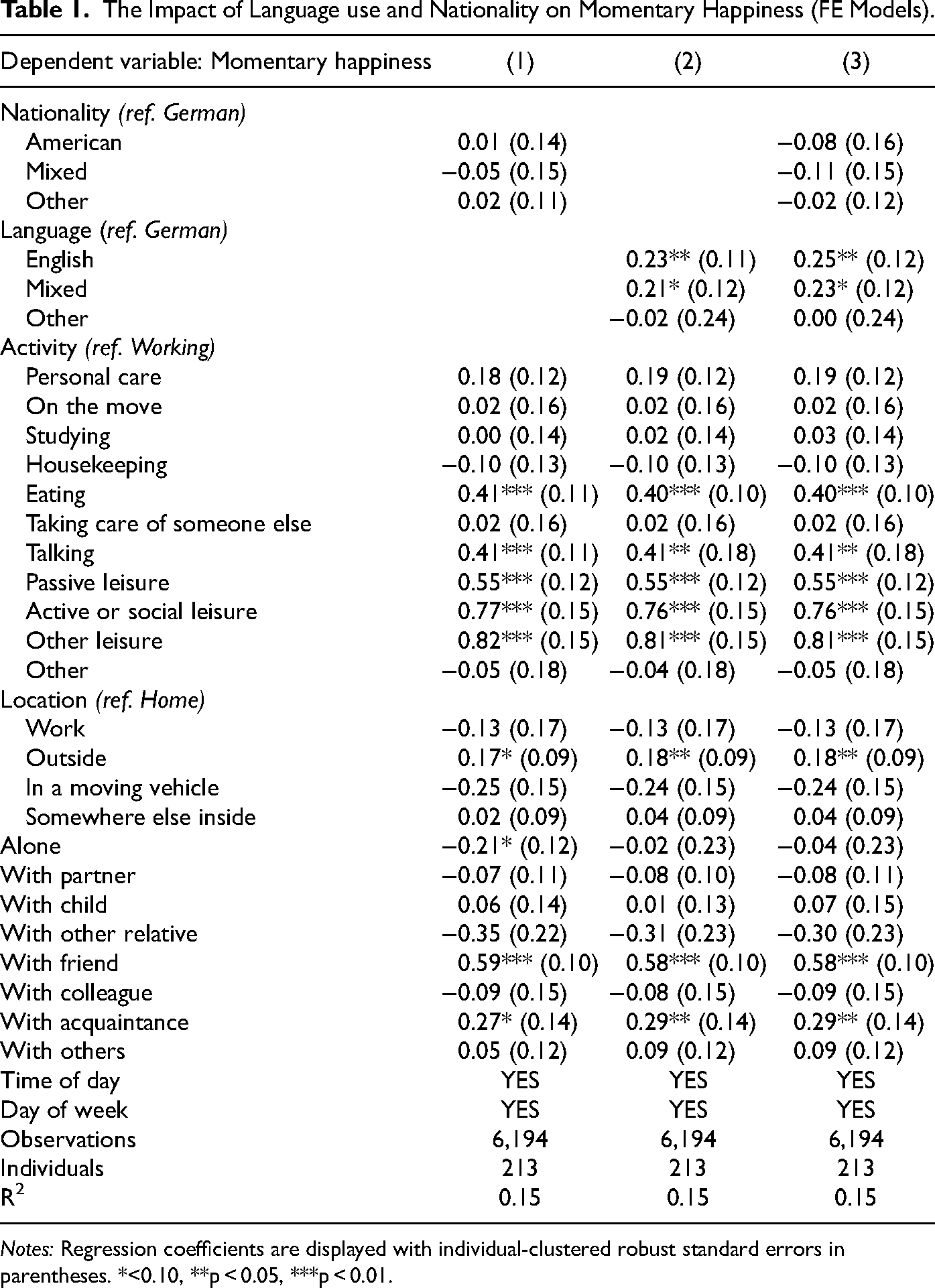
Notes: Regression coefficients are displayed with individual-clustered robust standard errors in parentheses. *<0.10, **p < 0.05, ***p < 0.01.
The left panel of Figure 1 shows that the momentary happiness benefit of speaking English, as opposed to German, declined with better language proficiency at the 99 percent confidence level and became statistically insignificant for those scoring the maximum on the German language proficiency scale - that is, fluent speakers. Turning to the interaction partner's nationality, the right panel of Figure 1 shows that less culturally integrated immigrants were happier when interacting with Americans, as opposed to Germans, but that this momentary happiness difference gradually diminished (at the 95 percent confidence level) and disappeared when a modest level of cultural integration was reached. These patterns occurred, regardless of whether nationality (left panel) or language use (right panel) was controlled for. Correspondingly, the momentary happiness benefit of speaking English and the happiness cost of speaking German, compared with a mix of German and English, declined with better language proficiency (see Figure A1 in the Online Appendix). Similarly, the happiness benefit of interacting with Americans, as opposed to a mix of Germans and Americans, declined for better culturally integrated immigrants (all significant at the 95% confidence level). In sum, H1 and H2 are supported by the data, although we did not find a positive main effect of interacting with people from the heritage society as opposed to people from the host society.
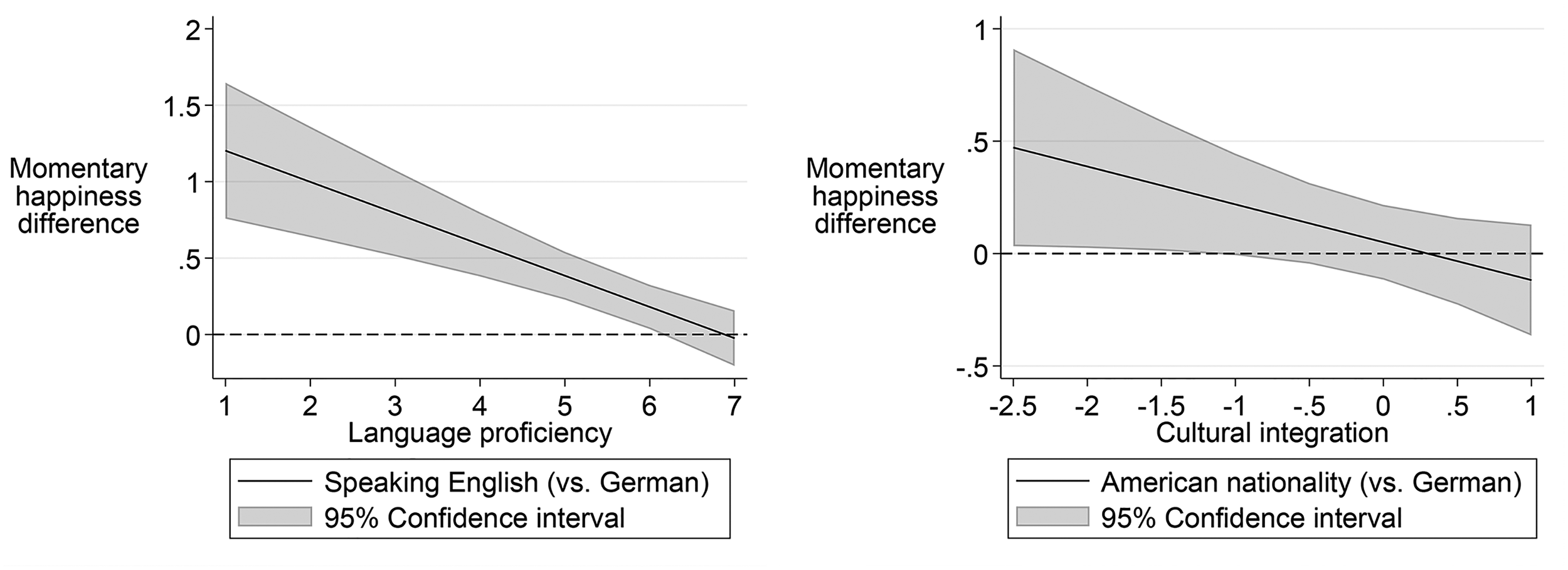
The conditional impact of language use and nationality. Notes: Control variables are as in Columns 1–2 of Table 1.
An auxiliary analysis aimed at developing a deeper understanding of our main effects shows that language use's effect on momentary happiness was contingent on the interaction partner (see Figure A2). Immigrants felt happier speaking English than German when interacting with friends and acquaintances, but not when interacting with family members or colleagues. In addition, immigrants felt happier speaking English than German when interacting with Germans. The effect of the interaction partner's nationality on momentary happiness was not contingent on the type of interaction partner (friends, acquaintances, family members, or colleagues).
Standard utility theory predicts that higher momentary happiness costs of interacting with Germans and in German will be associated with less interactions with Germans and in German (Kahneman, Wakker, and Sarin 1997). If so, the peak in momentary happiness costs at the early stage of integration will disincentivize immigrants from interacting with mainstream society and possibly lock them in a situation of no integration progress and, eventually, segregation. We find partial support for this rationale. As shown in Figure A3, immigrants interacted less with Germans, but did not speak less German, when experiencing higher momentary costs of doing so.
Next, we examine, from a long-term perspective, whether better integrated immigrants had higher enduring happiness. By comparing the results on the short-term relationship and long-term relationship, we can infer whether the revealed short-term relationship between happiness and socio-cultural integration differs from the long-term relationship (H3). Table 2 shows that better-integrated immigrants were happier and more satisfied with life. This finding holds for a model controlling for personal characteristics that are exogenous to socio-cultural integration (Columns 1 and 4), a model additionally controlling for personal characteristics that are potentially endogenous with socio-cultural integration (Columns 2 and 5), and a model additionally controlling for a person's time composition - that is, how, where, and with whom time was spent during the survey period (Columns 3 and 6). Columns 3 and 6 show that better integrated immigrants had higher SWB, regardless of how they spent their time, meaning that time-composition effects were not primary drivers of better-integrated immigrants’ greater SWB. An auxiliary analysis, however, revealed a few differences in time composition: better integrated immigrants spent less time on passive leisure, at home, and alone and more time with their colleagues and at work (see Figure A4). One noteworthy observation regarding the control variables is that our finding that time since migration did not relate positively to SWB is consistent with the null relationship documented in the extant literature (e.g., Hendriks and Burger 2020).
The Relationship Between Socio-Cultural Integration and Enduring SWB.
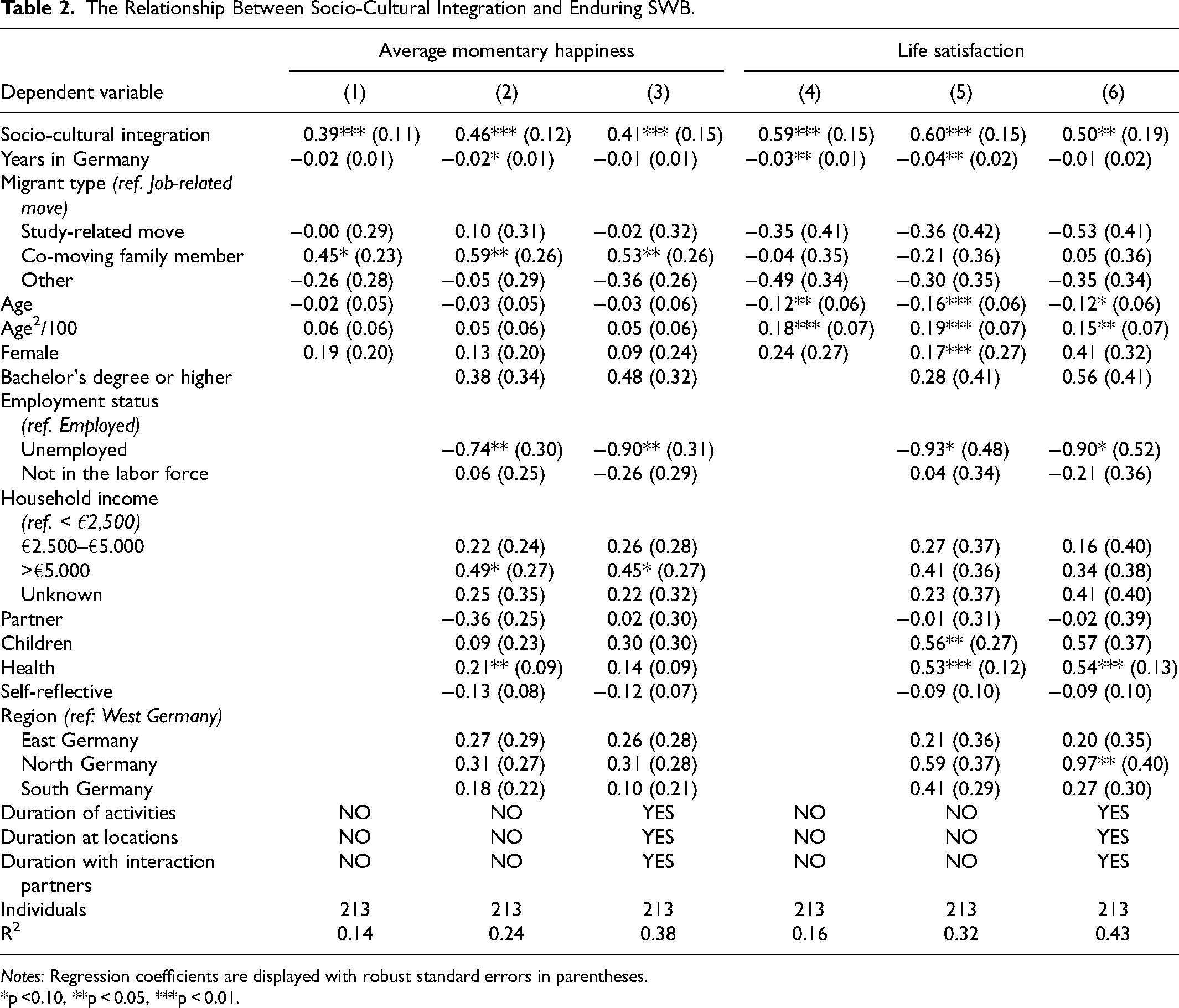
Notes: Regression coefficients are displayed with robust standard errors in parentheses. *p <0.10, **p < 0.05, ***p < 0.01.
Two additional tests were conducted to obtain a deeper understanding of the relationship between socio-cultural integration and enduring SWB. First, we re-estimated the models of Table 2 by entering the socio-cultural integration index as a quadratic term (the index and index squared). In all models, the squared term was not statistically significant, suggesting that the positive relationship between socio-cultural integration and averaged momentary happiness was linear. Second, re-estimating the models using the individual index components shows that cultural affinity, feeling at home, and interacting with Germans were the primary drivers of greater SWB among better-integrated immigrants, while German language use and proficiency and having a larger proportion of German friends were not associated with greater SWB (see Table A8).
When comparing the long-term relationships (Table 2) with the short-term relationships (Table/Figure 1), we observe that German language use negatively affected immigrants’ momentary happiness but was unrelated to their enduring happiness. Similarly, interacting with Germans had no positive effect on momentary happiness but was positively related to enduring happiness. More broadly, in support of H3, integration behaviors (i.e., interacting with Germans and speaking German) can decrease momentary happiness, but more socio-cultural integration was associated with greater enduring happiness. However, we caution that the results of Table 2 should be interpreted as conditional associations, rather than reflecting causal relationships, because of endogeneity issues (e.g., reverse causality and common method bias).
Compared with the extant literature using similar life satisfaction measures, the null relationship between language proficiency and life satisfaction is consistent with findings documented for other immigrant populations (e.g., Wiernik et al. 2017; Zlotnick, Dryjanska, and Suckerman 2020), while a somewhat more positive relationship has been found for the general immigrant population in Germany (Kóczán 2016; Angelini, Casi, and Corazzini 2015). The relationship between life satisfaction and other cultural and identificational integration variables (feeling at home, cultural affinity, and language use) is of a similar sign and magnitude as has been documented in the extant literature (Nguyen and Benet-Martínez 2013). Overall, the long-term relationship between socio-cultural integration and life satisfaction among US immigrants in Germany is not systematically different from this relationship in most other migration contexts. The similar relationship suggests that the momentary happiness costs of migration in our study population are not driven by exceptionally low benefits from integrating and may thus apply in other migration contexts as well.
A final set of robustness checks aims to address the limitations of our sampling procedure. First, we created sampling weights to make the sample representative for the US immigrant population in Germany in terms of age, gender, and length of stay. As shown in Table A9, the weighted and unweighted results are generally consistent, with the most notable difference being a slightly weaker momentary language effect in the weighted sample. This weaker effect can be attributed to a longer length of stay in the weighted sample. Specifically, higher language proficiency and cultural integration were associated with a longer length of stay, and as shown in Figure 1, with weaker momentary language effects. We caution that we cannot rule out sample selection bias based on unobservables. Second, we tested the role of sample attrition. As shown in Table A10, the analysis sample reports slightly higher life satisfaction and cultural integration, and these two variables had a stronger positive correlation, compared with the attrition sample. However, these differences were not statistically significant, which suggests a limited impact on sample attrition.
Conclusions and Discussion
This article has offered a novel perspective on the integration process by zooming in on the impact of the daily socio-cultural integration process on momentary happiness. Using US immigrants in Germany as a case study, we provide panel evidence, based on unique diary data, that immigrants who were not fluent in the host country's dominant language generally felt happier when communicating in their mother tongue, as opposed to the host country's majority language, and that interacting with the host country's natives affected momentary happiness negatively for less culturally integrated immigrants. We find that the momentary happiness costs gradually diminish and ultimately disappear with better language proficiency (for language use) and cultural integration (for interactions with majority group members). By contrast, socio-cultural integration related positively to some aspects of immigrants’ enduring happiness. Our results suggest that socio-cultural integration is an investment involving short-term costs to happiness, with important daily obstacles being the cost to momentary happiness of speaking the majority language and, to a lesser extent, interacting with majority group members. Following the logic of standard utility theory (Kahneman, Wakker, and Sarin 1997), these momentary costs are probable disincentives for socio-cultural integration and could be one of the causes of unsuccessful socio-cultural integration. This rationale is partially supported by our finding that immigrants interacted less with Germans, but not in the German language, when experiencing higher momentary costs of doing so.
A critical question is to what extent the findings of our empirical case study generalize to other migrant contexts. While we cannot conclusively answer this question without comparable diary data, there are several reasons to believe that daily socio-cultural integration behaviors documented here also have short-term happiness costs in other migrant contexts. First, the proposed underlying mechanisms apply across migration contexts, such as the language, cultural, and attitudinal barriers that complicate interethnic communication (Hewstone, Rubin, and Willis 2002) and the stressful feelings and difficulties to express oneself when not being fluent in the used language (Dewaele et al. 2019). Second, our results show that the long-term relationship between SWB and socio-cultural integration among US immigrants in Germany is not systematically different from that found in other migrant contexts (e.g., Wiernik et al. 2017; Nguyen and Benet-Martínez 2013), suggesting that our study population does not experience exceptionally low benefits from integrating. Third, we have discussed several reasons as to why relatively mild negative momentary effects can be expected for US immigrants in Germany, compared with other migration contexts, such as the small linguistic distance between German and English (Isphording and Otten 2014) and the relatively favorable perceptions among Germans of US immigrants (Fietkau and Hansen 2018). For these reasons, we believe that the findings and processes outlined above likely apply generally to different immigrant groups across destinations, with possibly more negative effects of interacting with native populations in most other migrant contexts. To verify this supposition, empirical work on the momentary consequences of integration behaviors in other migrant contexts should be undertaken.
This article makes three significant contributions to existing scholarship on migration. First, it advances understanding of the causes and consequences of socio-cultural integration. By zooming in on the largely neglected, but nevertheless important, daily socio-cultural integration process, we have shown that immigrants experience momentary happiness costs in the daily socio-cultural integration process. We also provide unique direct evidence that the revealed negative short-term effects of integration behaviors do not always align with the long-term effects. Accordingly, the revealed momentary impacts of integration behaviors provide a more comprehensive picture of the consequences of socio-cultural integration by complementing insights from the traditional long-term perspective (Nguyen and Benet-Martínez 2013; Paloma et al. 2020; Angelini, Casi, and Corazzini 2015; Yoon et al. 2013). Revealing the short-term costs of integration behaviors is particularly important considering that short-term well-being costs are probable disincentives for socio-cultural integration. The revealed short-term costs suggest the importance of taking into account these momentary costs when modeling the determinants of socio-cultural integration and its elements (e.g., majority language acquisition). Moreover, when modeling integration costs and (dis)incentives, our findings suggest the relevance of considering the moderating role of the stage of integration, i.e., the gradually diminishing momentary happiness costs of integration behaviors with better language proficiency (for language use) and cultural integration (for interactions with majority group members).
Second, our findings have relevance for other streams of migration research. Notably, while the ethnic segregation literature has demonstrated the role of structural forces like economic opportunities and racism as determinants of ethnic segregation (e.g., Borjas 1998), the demonstrated momentary happiness benefits of speaking in one's heritage language and interacting with co-ethnics may offer an additional explanation for immigrants’ geographical segregation and for the non-negative impact of ethnic segregation on immigrants’ SWB (Herbst and Lucio 2016; Knies, Nandi, and Platt 2016). Similarly, integration behaviors’ momentary happiness costs can help explain the composition of social networks in the social networks literature (Lubbers, Verdery, and Molina 2020). For instance, the momentary costs could provide an additional explanation next to well-established structural explanations like racism and cultural barriers for immigrants’ greater inclination to refrain from interactions in the absence of co-ethnics and the resulting disproportionate social isolation and loneliness among immigrants (Tegegne and Glanville 2019). Note, however, that personal immigrant experiences offer partial, rather than full, explanations for phenomena such as segregation and immigrant loneliness, given that these phenomena also depend on external (structural) circumstances such as prejudice and discrimination in host societies (e.g., Borjas 1998; Tegegne and Glanville 2019).
Third, this article provides some first insights into a sizable immigrant group that has been largely neglected in the literature: US immigrants in Germany. The revealed happiness determinants for this specific immigrant group, and their happiness and socio-cultural integration levels, can improve the understanding of their situation and path towards greater happiness.
This article's findings also have practical implications. A motivating insight for immigrants is that after overcoming the hardship of the early stages of integration, the daily integration process will become less costly, and their efforts will eventually improve their well-being. However, to get through the initial hardship, policy-makers, employers, and other stakeholders must facilitate psychologically safe environments for interethnic contact and second language use. For instance, language schools can be such an environment where immigrants can practice the host country's majority language without experiencing negative momentary effects. Immigrants’ family members with good proficiency in the majority language, such as spouses from the destination country, should also be aware that they offer a safe environment for immigrants to practice the language. By contrast, the divisive rhetoric that is increasingly seen in hosting countries is counterproductive for integration because the ensuing lower trust and lack of social support will increase immigrants’ momentary costs of daily interethnic interactions. More research is needed on how specific integration-related situations and environments influence immigrants’ momentary happiness to provide concrete policy recommendations to optimize the daily integration process. Another important question for future research is why some immigrants overcome the short-term happiness costs and achieve integration while others do not. We hope that this article's insights help open a line of research on the daily integration process that can provide important new insights for promoting successful integration trajectories among immigrants.
Supplemental Material
sj-dta-1-mrx-10.1177_01979183221149022 - Supplemental material for Happiness in the Daily Socio-Cultural Integration Process: A day Reconstruction Study among American Immigrants in Germany
Supplemental material, sj-dta-1-mrx-10.1177_01979183221149022 for Happiness in the Daily Socio-Cultural Integration Process: A day Reconstruction Study among American Immigrants in Germany by Martijn Hendriks and Randall Birnberg in International Migration Review
Supplemental Material
sj-dta-2-mrx-10.1177_01979183221149022 - Supplemental material for Happiness in the Daily Socio-Cultural Integration Process: A day Reconstruction Study among American Immigrants in Germany
Supplemental material, sj-dta-2-mrx-10.1177_01979183221149022 for Happiness in the Daily Socio-Cultural Integration Process: A day Reconstruction Study among American Immigrants in Germany by Martijn Hendriks and Randall Birnberg in International Migration Review
Supplemental Material
sj-docx-3-mrx-10.1177_01979183221149022 - Supplemental material for Happiness in the Daily Socio-Cultural Integration Process: A day Reconstruction Study among American Immigrants in Germany
Supplemental material, sj-docx-3-mrx-10.1177_01979183221149022 for Happiness in the Daily Socio-Cultural Integration Process: A day Reconstruction Study among American Immigrants in Germany by Martijn Hendriks and Randall Birnberg in International Migration Review
Footnotes
Declaration of Conflicting Interests
The author(s) declared no potential conflicts of interest with respect to the research, authorship, and/or publication of this article.
Funding
The author(s) received no financial support for the research, authorship, and/or publication of this article.

Supplemental Material
Supplemental material for this article is available online.
Notes
References
Supplementary Material
Please find the following supplemental material available below.
For Open Access articles published under a Creative Commons License, all supplemental material carries the same license as the article it is associated with.
For non-Open Access articles published, all supplemental material carries a non-exclusive license, and permission requests for re-use of supplemental material or any part of supplemental material shall be sent directly to the copyright owner as specified in the copyright notice associated with the article.
