




Abstract
Organizations working with refugees are increasingly using information communication technologies (ICTs) in their work. While there is a rich literature in the field of media and communications studies exploring how refugees use ICTs to meet their social and economic needs, this article focuses on whether and how refugees’ ICT use maps onto the policy concept of refugee self-reliance, focusing on the economic, educational, administrative, health, and security/protection domains of self-reliance in informal urban settings. Building on the literature on refugees’ ICT use, we use semi-structured interviews with urban refugees in Malaysia to understand how they use technology in their daily lives and whether these refugees’ digital practices support self-reliance. We also interviewed practitioners from the Malaysian United Nations High Commissioner for Refugees office and non-governmental organization (NGO) sectors to better understand such institutions’ strategies for using ICTs to deliver economic, educational, administrative, health, and protection programs in local refugee communities. Our findings are twofold: refugees’ use of ICTs represented idiosyncratic ways of achieving self-reliance, but when institutions tried to implement ICT solutions to support refugee self-reliance at a population level, refugees either did not use these ICT solutions or were critical of the institutional solutions. The findings presented here have import for not only research on refugee self-reliance and ICTs but also the wider migration field, as organizations, such as the International Organization for Migration and national immigration authorities, integrate ICTs into processes that affect migrants’ and displaced peoples’ economic, social, and political inclusion in cities of arrival.
Keywords
Introduction
Information communication technologies (ICTs) are an increasingly ubiquitous part of daily life for urban refugees (e.g., GSMA 2017; Patil 2019; Eppler et al. 2020; Dressa 2021). Urban refugees and displaced people use ICTs to meet individual administrative, social, or emotional needs, or what technology and media scholars call “affordances” (e.g., Faraj and Azad 2012). 1 In this article, we extend the concept of affordances, or individual-level uses of ICTs, to the refugee policy level, using an empirical framework based on the concept of refugee self-reliance in urban settings. Self-reliance is particularly salient for urban refugees since they live outside the formal administration of camp settings and end up having to meet their own needs through formal and informal economic and social activities (UNHCR 2009). Extending the concept of affordances to understand the concept of refugee self-reliance allows us to ask the question: Do ICT affordances support urban refugees’ self-reliance in Kuala Lumpur and Penang, Malaysia, a middle-income refugee host country? We used structured interviews, conducted in 2019, to ask whether refugees living in Kuala Lumpur and Penang who arrived from Myanmar, Somalia, and Pakistan used ICTs to support self-reliance across five domains drawn from the United Nations High Commissioner for Refugees’ (UNHCR) definition of refugee self-reliance: economic inclusion (e.g., access to jobs and financial services), accessing education, finding healthcare, managing administrative processes, and providing for their own safety in host countries (UNHCR 2005).
Refugees in both high- and low-income host countries around the world could use ICTs to do these things, and indeed, there is evidence that ICTs improve refugees’ access to administrative services in high-income resettlement countries like the United States and New Zealand (e.g., Kabbar and Crump 2007; Evans, Perry, and Factor 2019). However, in the middle- and low-income countries, access to public services can be constrained or non-existent, often due to hostile policy environments and/or a lack of political will. 2 In such contexts, digital technologies have the potential to create opportunities for urban refugees to establish self-reliance at the community level and to coordinate more effectively with the UNHCR and local non-governmental organizations (NGOs). Malaysia provides a context to better understand what the future of refugees’ self-reliance and digital practices could look like in a world where refugees spend increasingly long time periods in host countries awaiting resettlement, while at the same time global refugee response policy is moving away from refugee encampment and toward local integration (Grant 2016; Brankamp 2022). Malaysia has no encampment policy, no refugee or asylum legislation, and a large refugee population (UNHCR Malaysia 2022a). Many refugees in Malaysia reside in urban enclaves and must meet their social, economic, and administrative needs either on their own or through community-based organizations (ibid.). While the UNHCR's local office provides refugees in Malaysia with as much support as possible, effectively, most refugees in the country must be self-reliant to survive (UNHCR Malaysia 2022b).
We found that ICTs made it easier for urban refugees in Malaysia to engage in community- and individual-level aspects of self-reliance, such as participating in community-organized safety programs and maintaining family/social connections. However, our findings indicate that ICTs had little effect on improving refugees’ self-reliance in domains that were closely tied to host-country laws, such as economic inclusion, or access to public education and health systems. Our results provide insights into how refugees’ ICT affordances help them achieve different aspects of self-reliance and add to the growing body of research on ICT use among urban refugees and migrants by analyzing how refugees’ ICT affordances align with formal and informal processes of refugee self-reliance (e.g., Danielson 2013; Martin-Shields et al. 2022). This research also sheds light on how ICTs fit into the lives of other displaced populations, such as people displaced by climate change or internally displaced people whose social safety net is being replaced with self-reliance policies. Thus, our research speaks to practical challenges and opportunities facing refugee and immigration authorities that are attempting to use ICTs to engage with and support displaced populations (e.g., Kluzer and Rissola 2009; Green 2020; IOM 2020).
This article proceeds in this way. We start by introducing Malaysia as a case and explain why it is relevant for understanding our research question. From there, we explain what self-reliance is, highlight debates around self-reliance as a global humanitarian policy, and create a conceptual framework for examining how ICTs fit into self-reliance activities. We, then, review the literature on ICTs in refugees’ lives and how ICTs and digitalization have influenced refugee and humanitarian operations. From here, we move to methods and, then, our presentation of results, where we draw on our interview data to analyze how refugees in Malaysia used ICTs to engage in the five domains of self-reliance mentioned in the opening paragraph. We close this article with reflections on how our findings speak to the wider field of migration and their importance for understanding self-reliance in urban migration and displacement.
Kuala Lumpur and Penang: Refugee Contexts of Limbo and Survival
We selected Malaysia for two main reasons. First, Malaysia has a large refugee population who live in cities and meet their daily survival needs on their own, with limited help from the UNHCR and local NGOs (Crisp 2012), making refugees in Malaysia self-reliant by default. The second reason to focus on Malaysia is that it has a fully developed internet and telecommunication sector; 95 percent of the population has access to high-speed mobile internet, and 96 percent of residents own a mobile phone (ITU 2022). Thus, refugees in Malaysia are likely to engage in the daily activities on which our research focuses, in terms of both self-reliance and ICT use.
Malaysia is not a party to the 1951 Refugee Convention or its 1967 Protocol and is, therefore, under no legal obligation to fulfill the protection requirements of these treaties (UNHCR 2013, 212). Thus, refugees and asylum-seekers in Malaysia are considered to be irregularly residing in the country, with special protection entitlements only partially addressed through tacit permission provided to the UNHCR to operate in the country (Anis 2020). Refugees in Malaysia are not permitted to work, are unable to access healthcare on the same basis as nationals, and cannot access public education (Crisp 2012). The de facto refugee protection space in Malaysia continues to sway between quasi-permission to stay and explicit pronouncements of illegality, leading to convoluted messaging and an unpredictable protection environment for refugees (ibid.). However, informal support systems, propped up by capacity building and community development initiatives undertaken by the UNHCR and other development organizations in Malaysia, have created tenable options for refugees who, by living on the margins, have somewhat progressed in establishing patterns of self-reliance (ibid., 213).
According to the UNHCR, as of July 2022, Malaysia was host to 184,980 refugees and asylum-seekers registered with the organization (UNHCR 2022a). A total of 29,601 lived in Kuala Lumpur and 19,737 in Penang, an island state in northern Malaysia (ibid.). Selangor, the state surrounding the federal territory of Kuala Lumpur, was home to 70,101 refugees in 2022 (ibid.). UNHCR refugee data are not reflective of refugees who did not register with the UNHCR, a number which stood at approximately 80,000 in 2020, according to refugee community groups (Fishbein and Hkawng 2020). Kuala Lumpur is often where newly arrived refugees first settle, and refugee-led community organizations have been established within different Kuala Lumpur enclaves where refugees live (Munir-Asen 2018, 2). Delineated along ethnic or national lines, these organizations represent Rohingya, Chin, Myanmar Muslims, Pakistanis, Somalis, Syrians, Sri Lankans, Palestinians, and other refugee groups in Malaysia (see Table 1 for the current breakdown of refugees by nationality in Malaysia). Although Penang does not have the pull of UNHCR offices or more established civil-society organizations, Rohingya refugees and asylum-seekers have been drawn to the island state's labor opportunities (Nungsari, Flanders, and Chuah 2020).
Current Population Statistics of Refugees in Malaysia by Nationality. While There are Refugees From 50 Countries Residing in Malaysia, this Table Only Specifies Refugee Communities With More Than 500 Members in Malaysia.
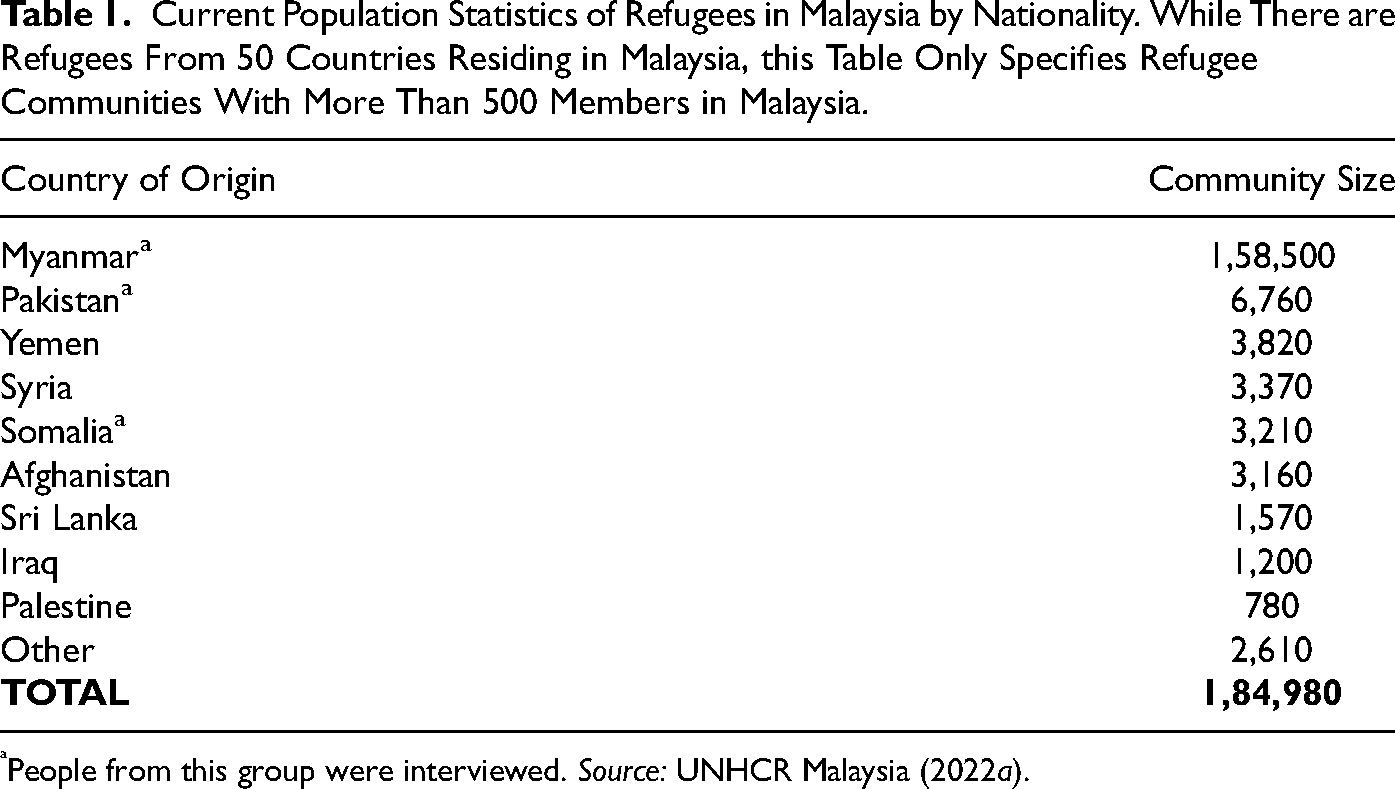
People from this group were interviewed. Source: UNHCR Malaysia (2022a).
Urban ethnic community organizations play a central role in the initial stages of refugees’ arrival in Malaysia, assisting with housing, access to community schools (refugee children cannot access Malaysia's formal education system), employment opportunities, and referrals to the UNHCR (Munir-Asen 2018, 18–20). As part of the UNHCR's community-based protection policy, these types of organizations have benefited from capacity-building exercises to ensure sustainability, transparency, and efficiency (ibid.). In the Klang Valley, which includes Kuala Lumpur and central Selangor, there are 159 community focal points that facilitate contact between the UNHCR and refugee communities themselves (UNHCR 2017a). The location of UNHCR offices in Kuala Lumpur also makes the city a natural point of arrival for refugees, who must complete their registration in-person (UNHCR 2022b).
Self-Reliance: A Framework for Understanding ICTs in Refugees’ Daily Lives
Having explained the context of our research, we now move to our conceptual framework, going into more detail about the concept of refugee self-reliance. While the UNHCR has generally framed self-reliance broadly (UNHCR 2005, 1; UNHCR 2017b, 3), in practice, refugee self-reliance has often had an implicit or explicit economic or financial focus (Omata 2017, 3–6). The UNHCR's (2005) Handbook for Self-Reliance defines self-reliance as the social and economic ability of an individual, a household or a community to meet essential needs (including protection, food, water, shelter, personal safety, health and education) in a sustainable manner and with dignity. Self-reliance, as a programme approach, refers to developing and strengthening livelihoods of persons of concern, and reducing their vulnerability and long-term reliance on humanitarian/external assistance. (ibid., 1)
Since 2005, the concept of self-reliance has become increasingly embedded within the wider humanitarian/development nexus, as well as within policy frameworks like the New York Declaration and Global Compact on Refugees (UNHCR 2017b). While global development and humanitarian policy frameworks have become more complex and interlinked, with the peacebuilding and development sectors playing complementary roles in supporting refugees’ self-reliance, the UNHCR's root concept of self-reliance has not radically changed since 2005. At its core, it remains focused on creating space for refugees to have the agency and right to create livelihoods in host communities and to be prepared to take advantage of durable solutions, including resettlement, voluntary return, or local integration (ibid.). In urban settings, where legal grey areas around refugee protection and residence often abound, the UNHCR policy on refugee protection focuses on self-reliance through access to schooling, post-secondary vocational training, health services, and a policy of working with governments to create legal pathways to work status and access to public services (UNHCR 2009). More recent urban refugee self-reliance activities, though, remain focused on economic livelihoods and food access (UNHCR 2012).
A consistent criticism of the concept of self-reliance is that in practice, it represents a push to roll back humanitarian support and replace it with programs meant to force refugees into the local economy and into income-generating activities (Easton-Calabria and Omata 2018; Bhagat 2020; Skran and Easton-Calabria 2020). As Easton-Calabria and Omata (2018) argue, problems with self-reliance emerge when it takes on a purely economic manifestation, reflecting donors’ interests in financial exits from long-term refugee situations, rather than refugees’ interests in leading sustainable, dignified lives. Bhagat (2020) argues that, in the case of Nairobi, Kenya, refugee populations became part of a market-based system of self-reliance in which the state withdrew or withheld support, and refugees were forced into informal systems of work and housing. Such informality was backstopped by piecemeal efforts to provide loans to refugees and support refugee entrepreneurship. In Bhagat's analysis of refugees in Nairobi, the policy space simultaneously excluded refugees legally while tacitly allowing them to remain in the city if they could survive without government support. By removing the social safety net and humanitarian aid and by withholding legal residence status, refugee self-reliance in Nairobi was reduced to a process of survival in the informal urban economy.
However, urban settings can also provide the social and economic networks that urban refugees need to survive and potentially thrive. Campbell (2006), for example, argues that long-term refugees in Nairobi, especially those who own established businesses, would be best served by having their resident status formally recognized, thus opening pathways for them to exercise choice in medical, educational, and administrative issues. More recent research from Nairobi shows how local NGOs that provide holistic support services create space for refugees to meet their initial financial and health needs more efficiently, leaving them better prepared to live independently after two years (Slaughter 2020).
Refugee self-reliance activities can alternatively be organized within refugee communities and cover psycho-social, material, and protection needs (Grabska 2006). Pascucci (2017, 340–41) points out, though, that community-based solutions supporting refugee self-reliance, especially when organized along ethnic lines, can be exclusionary, citing the example of a Syrian family who was alone in Cairo and had no community networks to fall back on and only limited access to formal settlement services. Community organizations also need physical space to meet their communities’ needs; Field, Tiwari, and Mookherjee (2020) explain the spatial practice of self-reliance, showing how refugee groups in Delhi made use of urban space to meet their cultural and social needs. As in the examples from Nairobi, Cairo, and Delhi, refugees in Malaysia are forced to be self-reliant since the host government offers no material support to refugees and since the local UNHCR office has limited programmatic and financial resources for supporting refugees’ self-reliance activities. Following the approaches taken by Leung (2011) and, more recently, Lintner (2020), we understand ICTs as a sociological infrastructure that can facilitate access to different domains of self-reliance. ICTs provide a potential mechanism for leveraging individual- and community-level refugee self-reliance and for connecting those activities with the resources UNHCR and NGOs can provide.
ICTs and Refugees: Linking Technology and Self-Reliance
This section links the concept of self-reliance to our empirical question of whether ICTs support refugee self-reliance in Kuala Lumpur and Penang. In the introduction, we used the word “affordances” — the things that ICTs allow individual refugees to do. Affordances could include staying in contact with family and creating a digital reality that makes day-to-day life tolerable (Twigt 2018), saving/archiving photos and documentation (Georgiou and Leurs 2022), or making appointments with UNHCR or NGOs, among other things. While self-reliance can have a number of definitions and while there are normative debates about the self-reliance agenda's motivations (e.g., Easton-Calabria and Omata 2018; Bhagat 2020; Skran and Easton-Calabria 2020), the definition of self-reliance used in this article aligns with the domains found in the UNHCR's (2005) handbook and grounds our study's ICT aspect firmly in a migration/refugee policy space. We focus our questions on refugee self-reliance in the domains of economic inclusion (e.g., access to jobs and financial services), managing administrative processes, accessing education, finding healthcare, and providing for their own safety in host countries. We use this section to show how existing research on refugee ICT affordances can be mapped onto the policy-level concept of refugee self-reliance, thus setting up our methods and results sections.
In the early 2000s, Kabbar and Crump (2007) used a sample of newly arrived refugees in Wellington, New Zealand, to examine how using ICTs supported resettled refugees’ access to daily administrative and educational activities. They found that community-based ICT programs supported by the city government made it easier for refugees to access information and knowledge tools at their own pace and supported secondary outcomes like language acquisition necessary for achieving self-reliance. Evans, Perry, and Factor (2019) more recently completed one of the first randomized control trials on the impact of mobile-phone access on refugees’ e-government uptake. Drawing on a sample based in the United States, they found that a treatment group of refugees who had mobile internet access became self-sufficient more quickly than a control group who did not. Stepping away from a high-income country context, however, raises two questions: Do refugees have access to ICTs in middle-income host countries, where many refugees apply for third-country resettlement, and if so, what affordances do they gain from ICTs?
Access is a pre-requisite for ICT use, and refugees in host-country contexts often have access to ICTs (Maitland and Xu 2015; UNHCR 2016; Hounsell and Owuor 2018). In Kenya, for example, demand for and access to ICTs and the internet among refugees are high in both the Kakuma refugee camps and Nairobi (Hounsell and Owuor 2018). In most cases, the key piece of technology in refugees’ daily lives is mobile phones; in Kakuma, smartphones using 3G mobile internet were the primary way that refugees accessed the internet (ibid.). Kakuma is not unique in this regard; Maitland and Xu (2015) found similarly high levels of ICT use among young Syrians in the Za’atari refugee camp in Jordan. These results are supported by the UNHCR's (2016) global survey on technology use in camp settings, which showed that refugees across contexts relied heavily on mobile phone-based internet access. While these studies confirm that refugees in middle-income host countries have ICT access, they do not go into refugees’ ICT affordances.
In response to data showing how many refugees have access to mobile internet and smartphones, there has been a push in the refugee policy community to build an app and internet-based tools that refugees can use to meet their daily needs. 3 Essentially, organizations like the UNHCR are trying to bridge the gap between individual ICT affordances and policy-level goals of using ICTs to support refugee self-reliance. However, in interviews with refugees in Nairobi, Eppler et al. (2020) found that institutional apps and websites explicitly designed to support refugees’ access to healthcare were often unknown to urban refugees. It is not impossible to bridge this information gap, which could be solved with more effective digital communication strategies by refugee-supporting institutions (Danielson 2013; Buffoni and Hopkins 2020). In practice though, instead of using institutional ICT tools, many refugees described sophisticated, idiosyncratic ways of using ICTs for community-level political, economic, and social organizing via tools like WhatsApp and Viber (Eppler et al. 2020).
In Latin America, ICTs are also an important tool for refugees. Research by Martin-Shields et al. (2021) used a survey of displaced Venezuelans and long-term residents in Bogota, Colombia, to empirically study whether there were differences in e-government use between long-term residents and newly arrived displaced people. While Venezuelans in Bogota quickly gained access to ICTs, their lack of official identification documentation prevented them from accessing e-government services. This demand for technology access and use among the urban displaced in Bogota is mirrored in Brazil, where displaced Venezuelans rely on strong digital networks of support from within their immediate communities and from local organizations for protection and social services but are often shut out of official government services (Alencar 2019).
Even if refugees gain access to formal ICT tools like e-government platforms and tools, using government ICT services often comes with unique risks (Ajana 2013; Harney 2013; Witteborn 2015; Gillespie, Osseiran, and Cheesman 2018). Biometric profiling of asylum-seekers by European states creates the pervasive risk of surveillance by host-country security services, including potentially hostile actors (Ajana 2013; Harney 2013). Gillespie, Osseiran, and Cheesman (2018) show that during their journeys, refugees rely on digital connections with smugglers and traffickers and that relying on these networks opens up refugees to exploitation with no legal recourse in host countries. After navigating often-perilous journeys, arrival in a host country comes with its own challenges. Witteborn's (2015) long-term observation of refugees in Germany, for example, showed how they balanced tolerance of digital surveillance by state authorities with using ICTs to build community networks and maintain cross-border political and social identities.
Building on Witteborn's (2015) work, we also see ICTs supporting the social side of self-reliance among urban refugees and playing a central role in developing community-level social networks, socializing, and accessing news and entertainment. Madianou and Miller (2013) describe how “polymedia” environments in which networks are shaped across different ICT platforms shape refugee connectivity and socializing. Twigt (2018) examined how access to digital connections and spaces was central to the abilities of Syrian refugees in Jordan to maintain hope and optimism in an environment marked by prolonged displacement and waiting. Twigt's results echo Leurs’s (2014) findings that access to ICTs and the internet helped young Somalis stuck in Addis Ababa, Ethiopia, deal with the stress and precariousness of being stranded by creating avenues for maintaining family connections via Skype and social media.
While connectivity and community empowerment are ostensibly good, there is also a more critical line of research on refugees, ICTs, and self-reliance, especially in low- and middle-income contexts. Madianou (2019), for instance, introduces the concept of technocolonialism in which humanitarian actors use technology to reshape the dependencies that exist between institutions and refugees. These dependencies (or exclusions) can also manifest in ways that block self-sufficiency; a particular example is a role of financial technology (fintech) in providing refugees with or excluding them from banking services. As Bhagat and Roderick (2020) explain, fintech solutions are often the only source of capital for refugees in Kenya, creating a system where private capital from the Global North intervenes in livelihood support for refugees, favoring those deemed most entrepreneurial and able to repay loans. To explicitly bring together the concepts of self-reliance and refugees’ ICT affordances, the next section explains our methodology for answering our question: Do ICTs support urban refugee self-reliance in Kuala Lumpur and Penang?
Methodology
Data collection for this study involved semi-structured interviews and two focus groups, administered with 49 refugees and 10 practitioners in November 2019. Based on Yin's (2009, 46–59) definition of an embedded case design, we conducted semi-structured interviews with refugees from different communities, as well as with respondents from community organizations, NGOs, and the UNHCR. Our sample included 47 refugees from the Pakistani, Chin, Somali, Myanmar Muslim, and Rohingya communities in Greater Kuala Lumpur. Two additional focus groups were held with five Rohingya men and five Rohingya women in Penang; the reason for the different methods is explained later in this section. We interviewed a near-equal number of men (23) and women (24), whose ages ranged from 18 to 60 years old; the majority of the sample was aged 20–35. 4 Education levels varied; most respondents had limited formal education, although a few in the Pakistani and Chin communities had training beyond university. The refugee communities that respondents came from were selected with help from the local UNHCR office. The first condition for participation was that community focal points felt safe having community members participate in the study. The second condition was that the communities with which we worked had robust community organizations engaged in self-reliance activities.
Introductory interview questions centered on individuals’ access to technology and were followed by more substantive questions on how technology assisted with finding work; banking; accessing health and education services; building and retaining social/familial relationships; interacting with public bodies; maintaining safety (e.g., UNHCR and Malaysian immigration services); and getting news. Additional questions examined refugees’ knowledge of and perceptions about the utility of technology, particularly social media and other platforms such as cab-hailing apps and e-wallets. Interviews took 30–50 minutes, depending on respondents’ experience with and use of ICTs, and we worked with interpreters when necessary. 5 Interviews were conducted in community centers or people's homes, both to get a sense of the context in which respondents lived and to make it easier for respondents to participate (Figure 1).
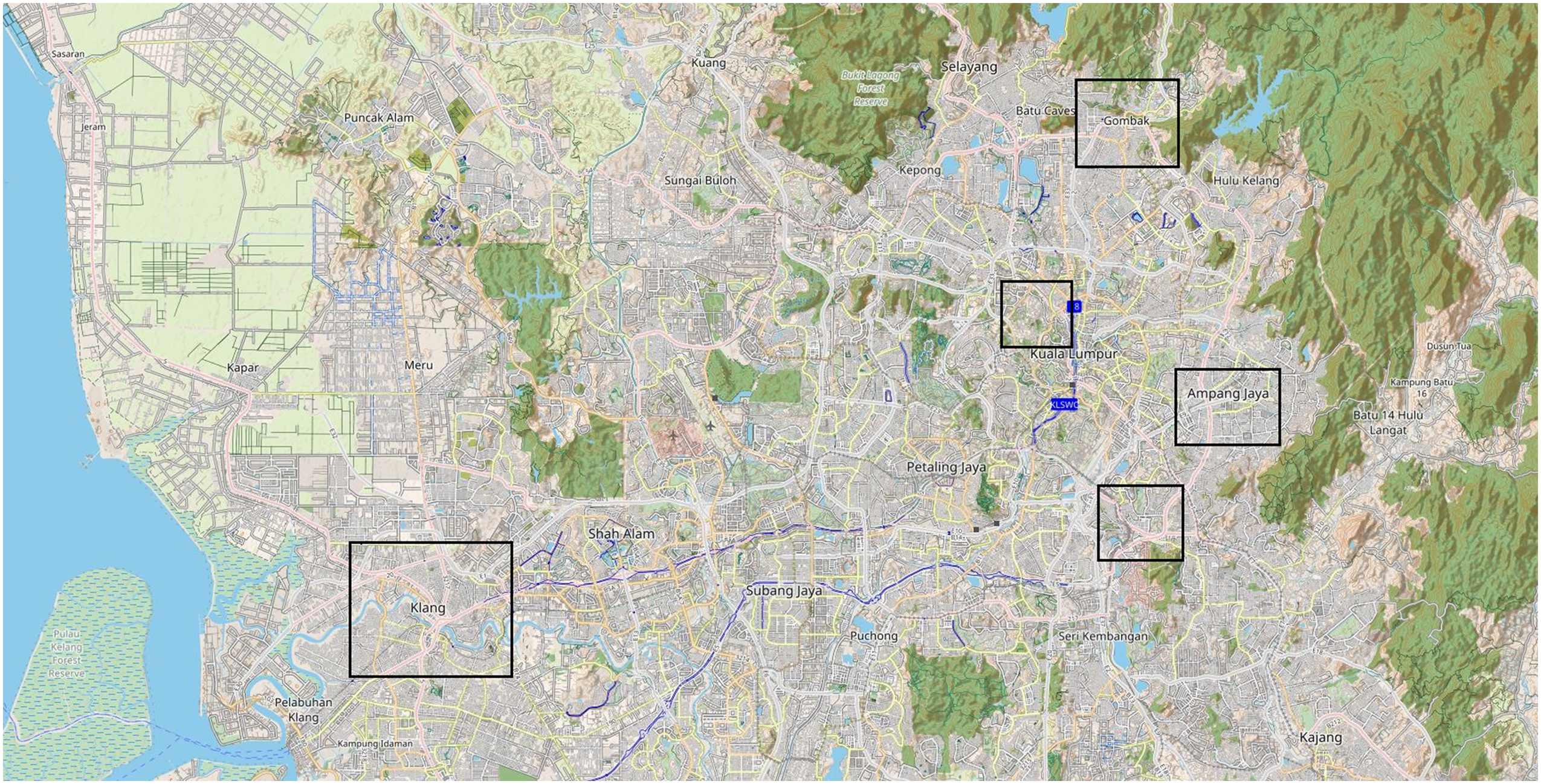
Map of the general areas in Kuala Lumpur where interviews took place. Data on specific interview sites are not provided, due to privacy and safety concerns (Source: ©OpenStreetMap contributors with modifications by authors (OSM 2022a)).
Semi-structured interviews with ten NGO workers, two community leaders, and seven UNHCR staff members followed the logic of the interview instrument used with refugees. 6 Fifteen of the 19 interviewees from this sample were women. The Malaysia UNHCR office was contacted through already-established relationships with the organization, and NGO workers were contacted based on previous research relationships established in Malaysia. We interviewed staff from UNHCR departments that had the most engagement with local refugee communities. Interviews with institutional actors were meant to gather data on how organizations implemented ICT solutions in their daily work and to understand the assumptions they made regarding refugee use of ICTs and social media in daily life. It is important to note that forming and maintaining an NGO in Malaysia is difficult, due to legal constraints preventing registration (Amnesty International 2019, 9–10). For this reason, we cover institutional digital strategies in less detail than refugee community digital strategies (Figure 2).
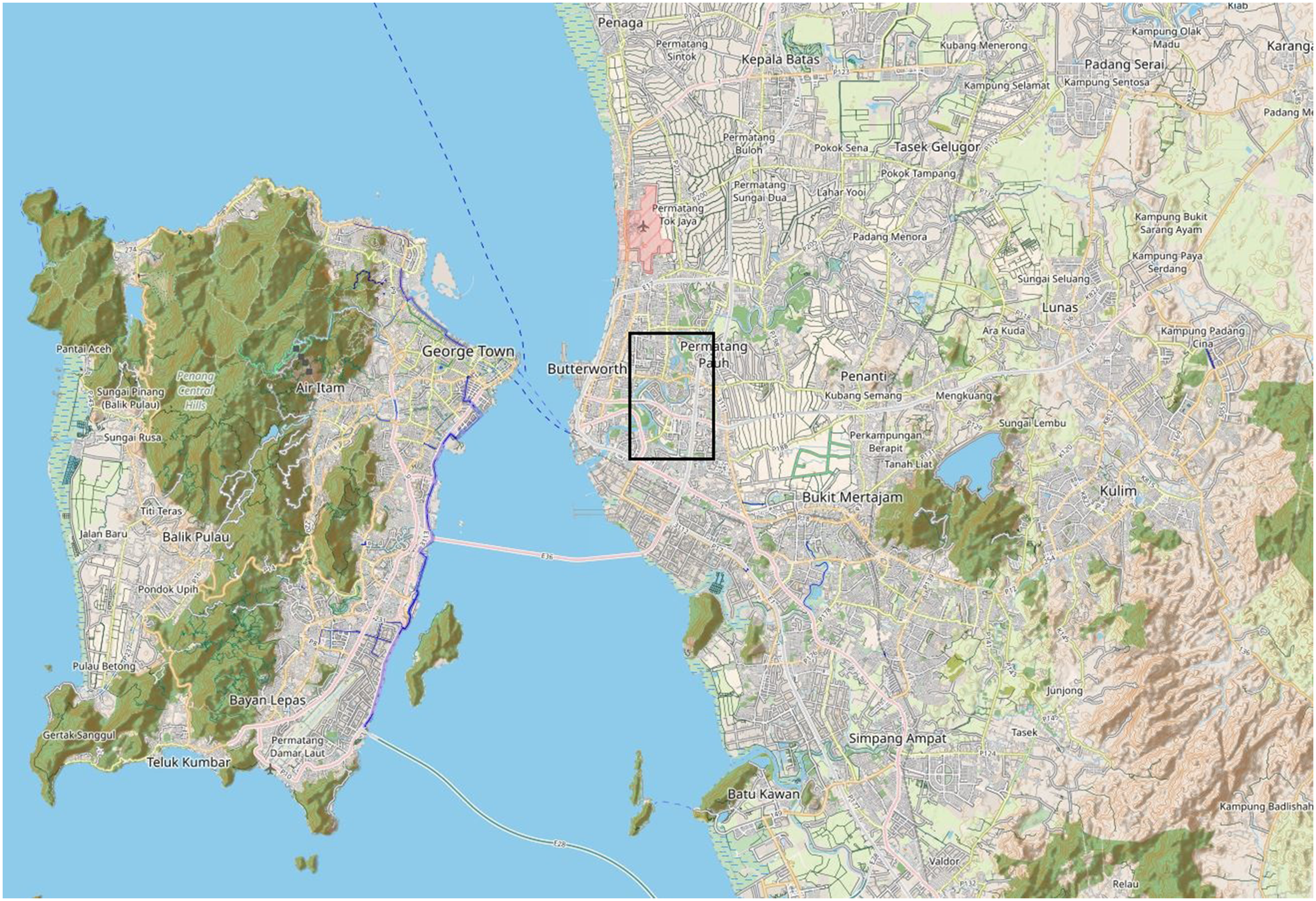
Maps of the general area in Penang where interviews took place. Data on specific interview sites are not provided, due to privacy and safety concerns (Source: ©OpenStreetMap contributors with modifications by authors (OSM 2022b)).
Ethical considerations were central to our research planning. Due to the lack of direct UNHCR support in Penang, refugees there faced a more acute set of risks than their peers in Kuala Lumpur. 7 For this reason, we conducted focus groups, rather than individual interviews, with Rohingya refugees in Penang. While there is no perfect strategy when doing refugee research, we aimed to draw on the recommendations of Jacobsen and Landau (2003) when thinking through our methods and ethical considerations. By using semi-structured interviews in Kuala Lumpur and focus groups in Penang, our approach allowed us to let participants go deeper into topics that interested them and to highlight their experiences with, and beliefs about, using ICTs.
Results
Using our concept of self-reliance as an analytic framework, interviews covered five domains of self-reliance: economic, educational, administrative, health, and safety/security. This mix of domains allowed us both to cover mainstream areas of self-reliance, such as economic activities and access to public services, and to gather data on the health benefits of informal social structures such as maintaining family/social networks and community-organized safety programs (e.g., Grabska 2006; Easton-Calabria et al. 2017; Pascucci 2017; Cabalquinto 2019).
Self-Reliance and Economic Outcomes
For the majority of respondents, work and work-seeking were core parts of self-reliance. Since refugees lack work rights in Malaysia, they commonly worked in the informal economy. Thus, respondents sought work through face-to-face interactions, as well as on social media platforms, such as WhatsApp and Facebook. Refugees would hear about a job and let others know that an employer was hiring and whether the employer was reliable. The breadth of these social and digital networks was especially pronounced in Penang's Rohingya community. Male refugees interviewed in Penang described traveling regularly to work sites across the country for construction and farming jobs which lasted a few months at a time and having to frequently keep in touch with their networks to identify the next work opportunity (Rohingya male focus group discussion, 13 November 2019). Information about jobs came via individual phone calls and short message service (SMS) text messages or through established WhatsApp groups, indicating significant reliance on these modes of communication.
The Chin community organization in Kuala Lumpur ran job boards on the organization's Facebook group, curated by the organization's leadership. Employers reached out to the community organization's leaders, who verified job details and the employer's reliability, prior to posting the ad (Interview, Chin community leader, November 8, 2019). These online job boards were the only example of a community organization formally filtering job opportunities to make sure refugees were treated fairly at work, which was surprising, given the legal and workplace safety risks that refugees face in Malaysia. Indeed, multiple respondents shared experiences of employers refusing to pay them for work they had completed (Interview Chin Male 4, November 8, 2019; Rohingya male focus group discussion, November 13, 2019; Myanmar Muslim Male, November 16, 2019).
While Rohingya men in Penang and the Chin community in Kuala Lumpur used networking tools to improve job search outcomes, respondents also shared about innovative ways they showcased professional talents using ICTs. In one case, Instagram was used to create a digital presence and to market photography services to the local refugee communities (Myanmar Muslim Male 2, November 16, 2019), and a baker in the Somali community in Kuala Lumpur used WhatsApp to let consumers know when and where to purchase his bread (Somali Male 2, November 7, 2019). Interviews showed examples of ICTs increasing opportunities for those with a trade to build a business and for communities to share information about employers so that those seeking day labor could maximize job searches while minimizing the risk of exploitation. Since the communities with which we worked were generally spread across Kuala Lumpur's sprawling peripheral neighborhoods, ICTs and the internet played key roles in helping them find jobs throughout the city. As Martin-Shields (2022) notes, due to Kuala Lumpur's sprawling nature and lack of transit access in refugee neighborhoods, many refugees faced a transit deficit and often struggled to access the city's inner neighborhoods.
While job seeking using ICTs manifested in a variety of ways, financial inclusion was almost non-existent. Management of wages was predominantly limited to physical cash payments kept with the individual. Access to financial services was rare, as UNHCR cards were often rejected by Malaysian banks and financial institutions as a form of identification. Familiarity with e-wallets and ICT-based financial tools among refugees with whom we spoke was limited, although some respondents expressed a desire to learn more about them. UNHCR staff noted that the challenge of refugee financial inclusion in Malaysia was magnified by many refugees lacking familiarity with electronic cash, e-wallet services, and bank accounts: “People would not understand where the money is and how to use [an ATM card]” (Interview 4, UNHCR, November 4, 2019). Furthermore, according to UNHCR staff, services like ride-sharing apps and public transportation that required travelers to pay with money stored in e-wallets were deemed inaccessible to refugees, even though urban transportation services were critical to refugees’ daily lives. Although a UNHCR staff member stated that UNHCR had limited involvement in local refugee communities’ day-to-day economic organization and activities, the UNHCR was working with the Malaysian government on financial inclusion through formal banking and digital tools like e-wallets to improve economic self-reliance.
Education and Self-Reliance
ICT use in community schools run by refugees predominantly focused on using video content, websites, or games in the classroom, when internet access was available, and varied widely. Some respondents noted that community schools ran computer courses and that the UNHCR had supported bringing in outside teachers to do short courses on software programming and coding. While spending time in the communities, we observed that many community centers had computers and that these computers were often brought into refugee community schools when there were specific lessons that required access to a computer.
Respondents from the Pakistani community reported using YouTube in the classroom and using English-language websites to teach students English. In one case, the coordinator for community schools in the Pakistani refugee community described using Google Drive to manage records across different schools. This same community also used e-books and downloaded worksheets for their students (Pakistan Male interview 2, November 6, 2019). Overall, though, it seemed that ICTs in the classroom were not a central concern for respondents. Indeed, as one respondent put it, “you can have good education without computers; you just need good teachers” (Pakistan Male 1 interview, November 6, 2019). It is important to note, too, that Pakistani interviewees included a computer scientist and a trained medical doctor, both of whom led the process of digitizing the management of school activities. For communities that lacked skilled individuals, schools were often “only simple, so we don’t have technology” (Chin Female 2 interview, November 8, 2019).
Digital solutions for learning and teaching existed outside classroom structures. For example, one Somali respondent who was a professional baker had an idea for setting up a YouTube channel to help advertise the community bakery and show others how to set up a bakery in their host country or city (Somali Male interview 3, November 7, 2019). While the example of teaching people to set up a bakery on YouTube was the only specific example of using a digital channel to teach others a trade, many respondents noted that YouTube was a useful resource for learning how to do things. The way that refugees described YouTube as an information source could be considered ICTs supporting greater educational self-reliance, but it would be a stretch to consider YouTube an education tool in a systematic sense. Indeed, the biggest theme that emerged as we spoke with refugees about education and visited their community schools had nothing to do with technology: respondents were most concerned that community schools could not provide credentials that would be recognized by host governments and that refugees were banned from Malaysian government schools, colleges, and universities. Without permission to access formal educational institutions and gain locally recognized credentials, ICT solutions’ wider potential was limited in terms of supporting the educational domain of refugee self-reliance.
Administration and Self-Reliance
All organizational and NGO staff we interviewed used ICTs, to varying degrees, to communicate with refugee communities. The UNHCR set up WhatsApp groups with community leaders, and an NGO working with survivors of sexual and gender-based violence (SGBV) frequently contacted clients through WhatsApp. However, in communicating with the larger refugee community on administrative issues such as confirming appointments with the main office, the UNHCR primarily used phone calls. In many cases, these phone calls came during the workday, when, respondents explained, either their phones were confiscated by employers or they were not allowed to answer them. As a result, appointments went unconfirmed, and, if someone made the journey to the UNHCR, they were often told to reschedule. These journeys were time consuming, and respondents mentioned that an app to confirm appointments outside work hours would be a significant help. As one respondent noted, “They take our email and phone number, but they only ever call. They should use this [email] contact data” (Pakistan Male 2 interview, November 6, 2019).
The UNHCR also operated a website 8 which provided general information on resettlement, voluntary repatriation, education, health services, and how to update a phone number. An email address was also available for refugees to submit queries to the UNHCR, although this email account was managed manually and emails were forwarded to the relevant unit. UNHCR staff acknowledged that not all refugees were familiar with email services and, thus, relied on local organizations or friends to assist them with emailing the UNHCR (Interview 5, UNHCR, November 5, 2019). The lack of response from the UNHCR, including things like missed emails and calls, was cited by refugee interviewees as a frustration, a limit on being administratively self-reliant. One refugee said she felt stuck in “limbo,” since she was unable to find out where her resettlement case was in the review process (Pakistani Female 1, November 7, 2020). Respondents stated that they would feel reassured and empowered by having access to information regarding the progress of their cases, such as an app or web platform that gave them access to their biodata and a summary of their resettlement status.
Refugee communities in Kuala Lumpur relied on their community organizations’ strong digital networks to deal with the administrative domain of self-reliance. These organizations had well-established WhatsApp groups managed by community leaders based in different neighborhoods. Information (e.g., where health services were located or when community schools would open) was communicated by refugee community focal points through community Facebook pages. In the Chin community, Facebook Messenger was the main form of communication between the community organization and community members (Interview, Chin community leader, November 8, 2020). In other communities, WhatsApp was the predominant form of communication. On both platforms, voice memos were often sent to ensure that people who could not read could listen to the information. Using these channels, community organizations played a key role in re-broadcasting and sharing updates from the UNHCR office.
Health and Self-Reliance
Refugees reported using the internet, especially YouTube and Facebook, for health information. Most often, however, health information was solicited from other community members. One respondent, for example, explained that he and his wife were unaware that they would be given access to birth and post-natal medical treatment in Malaysia and, thus, decided to smuggle themselves back into Thailand to give birth (Myanmar Muslim Male 1, interview November 16, 2019). The interviewee explained that there were complications during the birth and that while being smuggled back into Malaysia, the baby died. Had reliable information explaining that he and his wife could access emergency services in Kuala Lumpur been available, they would not have made the journey to Thailand. While an institution like the UNHCR may see a website as a means to disseminate information efficiently to a large audience, the volume of information can lead to confusion and potentially tragic outcomes. Essentially, the volume of information on a website is not necessarily synonymous with creating the conditions for self-reliance.
Where technology did show signs of improving refugee health self-reliance was in the psycho-social and affective spaces. ICTs can provide connections to families and friends in origin countries, Malaysia, and elsewhere. Similar to findings by Leurs (2014), Twigt (2018), Cabalquinto (2019), and Marlowe and Bruns (2021), we found that familial connections relieved stress for refugees, with Facebook cited as a source of connection both to the wider community and to news on the origin country and loved ones there. 9 Others cited watching movies or listening to music on YouTube as a source of relaxation (Rohingya Female 3, November 10, 2019). Another respondent said that she used the internet to research ideas for wellbeing and happiness in the home (Pakistani Female 1, November 6, 2019). Many shared that WhatsApp or Facebook was used to keep up with social events organized in the community. Many responses aligned with Twigt's (2018) findings on refugees’ lives in Jordan and how digital connectivity provided social connections that were fundamental to building a life and having hope for the future. Overall, we found that in Kuala Lumpur and Penang, the domain of health ICTs delivered important individual-level affordances, but at the population level, the lack of clarity around legal access to public health services negated the advantages ICTs brought to diffusing health information.
Safety: Security, Protection, and Self-Reliance
We break this section down by starting from the individual level of security and protection and, then, moving to the community and state levels. At the individual level, only a minority of respondents discussed having knowledge of cybersecurity, privacy, and online safety (not wanting to post photos on Facebook or share photos on WhatsApp, not using Facebook Messenger “as it doesn’t feel safe” (Rohingya Female 2, November 10, 2019)), and most felt that social media platforms were secure. The lack of interest in, or knowledge of, online safety and privacy is particularly concerning, as younger refugees used social media platforms, such as WeChat and TikTok, but may not have been aware of the risks posed by being active on them (Organization 4, November 15, 2019). Staff from community organizations felt that refugees’ understanding of cybersecurity was limited. For example, in the context of SGBV cases, many survivors who had left their partners were reportedly unaware of the “track my phone” app or being outed on social media platforms by members of their own community (Organization 4, November 15, 2019). Contrary to our expectations going into interviews, we were surprised at how little individual respondents seemed to care about digital security and privacy.
At the community level, community organizations used ICTs to foster refugee protection in a variety of ways. One was using WhatsApp groups to alert members of immigration raids or a police presence in an area, advocating for community members’ expedited registration at the UNHCR, and emailing the UNHCR lists of community members who had been detained. SGBV response was one area where communities and NGOs consistently used digital technologies to support refugee self-reliance. An NGO working with survivors of SGBV operated a hotline through which people could report cases (Interview, Organization 4, November 15, 2019). This same organization disseminated MP3s in the Rohingya language to provide awareness on SGBV in Rohingya communities and received a generally positive response: people liked being able to listen to its content in their own time, and some shared the file with friends and family (ibid.). In this way, ICTs were used to both educate individuals and help communities recognize issues of SGBV, while also increasing access to support services.
What we heard in interviews, which aligns with Grabska's (2006) and Pascucci's (2017) findings, is that refugee- and community-led organizations can be central to fostering self-reliance through protection activities. However, there are limits; some community organizations, like the Chin organization, were very effective at using ICTs to document abuses by police and human traffickers so that refugees could include them in interviews with the UNHCR (Interview, Chin community leader, November 8, 2019). Their ability to extend this capacity to support neighboring communities was limited, however. In practice, refugee community-organized safety and protection activities could not be extended to protecting refugees’ rights or affording legal protections, since there is no national legislation that provides any legal rights or protection to refugees in Malaysia.
At the state level, the UNCHR's Malaysia office has attempted to leverage digital technologies to prevent harassment of refugees by police (UNHCR 2022c). Because no legislation in Malaysia defines refugees’ immigration status, police often arrest refugees under the pretense that their UNHCR documents are fake and, then, require someone from the UNHCR to come to immigration detention and confirm that the arrested refugee is, indeed, registered with the UNHCR (Aspire Penang 2022; Pakistan Male 1 interview, November 6, 2019). The local UNHCR office developed an app, in collaboration with the Malaysian government, which police could use to scan QR codes on UNHCR registration cards to verify their authenticity. Few respondents knew about this app, and among those who did, enthusiasm was lacking: police often arrested people anyway, since the UNHCR card itself was not a legal form of identification under Malaysian law (Pakistan Male 1 interview, November 6, 2019; Interview, Chin community leader, November 8, 2020). The UNHCR cards’ lack of legal standing was the root problem; for refugees in Malaysia, UNHCR registration had no legal standing, so demonstrating a UNHCR card's “realness” had no binding effect on whether police could arrest a refugee for being in Malaysia illegally.
Informed consent, and whether refugees truly understood the implications of having their data stored digitally by the UNHCR, presents another problem for refugee self-reliance (Organization 2, November 14, 2019). Indeed, many refugees in Malaysia cannot read and write, and the concept of informed consent may not exist in their language; regardless, they are required to consent to sharing their data if they want to apply for asylum (Interview 4, UNHCR, November 4, 2019). While a lack of informed consent and digital data privacy is important, refugees in Malaysia did not view them as critical problems. When refugees in Malaysia were harassed and surveilled by the police, it generally took place in-person. The immigration police knew where to find these communities, so tracking refugees online was not necessary.
Discussion: Digitalization and Fragmentation of Self-Reliance
After going through the results and data, we return to our question: Do ICTs support refugee self-reliance in Kuala Lumpur and Penang? At the personal level, yes; at the institutional level, no. As we showed, ICTs made possible a wide range of individual-level self-reliance activities for urban refugees in Malaysia. Twigt (2018) would refer to these individual-level ICT uses as affective types of refugee self-reliance, including building social networks, maintaining contact with relatives at home, and finding informal work. Respondents shared that these personal-level factors made them feel more connected, hopeful, and proactive.
Most respondents had one or two key communication apps — generally, WhatsApp plus Viber or Imo — that they used for individual-level self-reliance activities. The uses of WhatsApp, Facebook, and YouTube manifested in idiosyncratic, personal ways — the Somali baker who wanted to make YouTube videos about baking bread (Somali Male Interview 2) or the photographer from the Myanmar Muslim community who advertised his services on Instagram (Myanmar Muslim Male 2, November 16, 2019). At this individual level, most refugees found creative, sometimes-intimate, ways to derive some level of self-reliance using ICTs. These examples of self-reliance may not show up in a UNHCR handbook, but they provide windows into understanding how urban refugees in Malaysia used ICTs to create spaces for themselves that they controlled.
When the discussion was expanded to using apps and the internet for institutional domains of self-reliance like finding jobs and accessing health and education systems, however, respondents generally said these activities were handled face-to-face, instead of via ICTs. For example, Rohingya men in Penang (Rohingya Male Focus Group, November 12, 2019) who reported having extensive personal networks to share information about new job opportunities generally did so face-to-face and only occasionally used WhatsApp. Examples of community organizations or individuals doing things like creating online job forums to share job opportunities were the exception, not the rule. When we talked about identity and case administration, a majority of respondents said that an app that gave them the ability to control their data and case records and to know where they were in different administrative processes, would be useful. Much of this information, however, was on paper or locally stored hard drives at the UNHCR office, along with a centralized database mainly housing refugees’ biodata.
The inherent problem with using ICTs to support refugee self-reliance in a context like Malaysia is that most systemic barriers to refugee self-reliance we observed were not amenable to ICT solutions. ICTs themselves do not grant refugees the right to set up a bank account or access education and health services if national law bans them from accessing these services in any form. Bhagat (2020) describes how the implementation of self-reliance policies in Nairobi, Kenya, removed the humanitarian safety net but did not grant legal status, forcing refugees into the informal economy to survive. In Malaysia, the experience was similar: refugees were largely forced to meet their economic, educational, health, and social needs through informal community-level solutions. ICTs might have made it easier to organize community-level self-reliance, but they did not fundamentally change the power dynamics that forced refugees in Kuala Lumpur and Penang into permanent legal, economic, and social precarity.
Conclusions
ICTs are central to the daily lives of refugees living in Kuala Lumpur and Penang and support refugee self-reliance at the individual and community levels. To increase the potential positive impact ICTs can have on refugee self-reliance in Malaysia and elsewhere, host-country governments must create legal avenues for refugees to access financial services, work permits, public schools, and public health systems. Without an inclusive legal framework, ICTs risk being a partial work-around to meet refugees’ economic, social, and administrative needs. Our findings are not limited to refugee contexts, either — displaced people not under UNHCR protection, and migrants moving between cities and countries without identity documentation, face many of the same barriers to achieving self-reliance across the range of economic, social, and administrative domains as do refugees (e.g., Lintner 2020; Martin-Shields et al. 2022).
Considering the social and political barriers refugees and displaced people often face (e.g., Tomlinson and Egan 2002; Zeus 2011), the role of ICTs in self-reliance will be salient to a wide spectrum of urban migrants. As more people are displaced to cities, due to conflict, environmental change, and economic crises, Mike Davis’s (2006) vision of large numbers of marginalized urban migrants slipping through a stretched social safety poses a real risk. For urban refugees and other displaced people, self-reliance will be an inherent part of life, and access to ICTs will play a role in achieving self-reliance. However, international organizations and host governments must, first, focus on reducing the legal and social barriers that prevent refugees and migrants from accessing the full spectrum of economic, educational, social, and administrative services available in the cities where they settle.
Footnotes
Declaration of Conflicting Interests
The authors declared no potential conflicts of interest with respect to the research, authorship, and/or publication of this article.
Funding
The authors disclosed receipt of the following financial support for the research, authorship, and/or publication of this article: This work was supported by the Bundesministerium für Wirtschaftliche Zusammenarbeit und Entwicklung (grant no. 9002001).
