




Abstract
Almost 60,000 people claimed asylum at Canada's border with the United States between 2017 and 2020, marking Canada's first sustained cross-border asylum migration since the 1990s. Virtually, all entered irregularly via a rural road on the New York/Québec border. The “Roxham Road route” was partly owing to the 2004 Canada/US Safe Third Country Agreement (STCA), which allows both states to refuse asylum-seekers on the grounds that the other offers commensurate protection standards yet only applies to official ports of entry. Roughly, 40 percent of the 60,000 who claimed asylum were US residents with precarious immigration status. This article examines the route's emergence and contributes a novel case on decision-making and destination choices for asylum migration. Data are derived from interviews with over 300 asylum-seekers, two dozen experts, and monthly asylum statistics. The central finding is that Trump-administration immigration policies were the major driver for asylum migration yet do not entirely explain the new route, since a relatively small number of US residents departed for Canada. Interviews revealed that while Trump-era policies fostered a climate of fear, individual experiences with immigration enforcement, loss of temporary protected status, or deferred asylum cases were catalysts for migration. Welcoming Canadian rhetoric and liberal asylum policies were only considered in light of risk in the United States, challenging research findings that asylum-seekers are primarily motivated by destination-state policies. The article also offers qualitative methods for connecting asylum data with migrant decision-making and problematizes the STCA's ethics and effectiveness for managing asylum.
Introduction
Almost 60,000 people claimed asylum at Canada's border with the United States from April 2017 to May 2020. 1 The flow from and through the United States contributed to a doubling of overall asylum claims in Canada, from just under 24,000 in 2016 to 50,400 in 2017 and 55,000 in 2018. 2 This increase strained reception capacities in Canadian cities, led to multiyear asylum backlogs, required billions in emergency expenditure (Parliamentary Budget Office 2018; Auditor General of Canada 2019), and fomented broad debate in Canada around asylum policy divergence with the United States (Paquet and Schertzer 2020).
Virtually, all arrivals associated with this flow (98 percent) crossed irregularly at Roxham Road, a non-descript rural road connecting upstate New York and the Canadian province of Québec. 3 The route was made possible by what is often referred to by journalists and politicians as a “loophole” in the 2004 Canada/US Safe Third Country Agreement (STCA), whose asylum coordination provisions only pertain to official ports of entry (Mercier and Rehaag 2021). 4 As describe below, the STCA is an example of safe-country designations, which the UNHCR defines as countries to which asylum-seekers “have, or could have, sought asylum and where their safety would not be jeopardized, whether in that country or through return from [that country] to the country of origin” (UNHCR 1991). Safe-country designations are based on the legal concept of effective protection, which allows states to deny access to asylum procedures so long as the country to which asylum-seekers are returned provides commensurate protection standards (Moreno-Lax 2015). Safe-country designation proliferated throughout the 1990s and early 2000s as tools for states to manage asylum flows and prevent what politicians often referred to as “asylum shopping” to states with more liberal asylum systems (Costello 2005). After a significant spike in July and August 2017, entries at Roxham Road stabilized to roughly 1,350 per month (described in Figure 2, below) and were halted in March 2020 by Canada's decision to close the border to asylum-seekers in response to the COVID-19 pandemic (Mercier and Rehaag 2021).
Roxham Road presented a challenge to Canadian Prime Minister Justin Trudeau's centrist government. Right-wing parties in Canada called for extending the STCA to the entire border and incarcerating asylum-seekers (Smith and Hofmann 2019). Civil-society groups and left-wing parties demanded that the STCA be suspended, arguing that the United States was unsafe for refugees (Paquet and Schertzer 2020). Human-rights criticisms were troubling for a government which came to power in 2015 vowing to increase refugee resettlement, reengage multilateral institutions, and export Canada's refugee policies (Smith 2020). Donald Trump's election a year later cast those policy promises into stark relief. As detailed below, the Trump administration rapidly curtailed immigration, refugee resettlement, and asylum access in the United States, ramped up inland enforcement, and terminated temporary protections for hundreds of thousands of residents. These policy changes drastically expanded immigration policy and protection differentials with Canada.
Although Trump-administration policy changes coincided with increased STCA border refusals and Roxham Road asylum claims, relationships between Trump-era policies and the significant increase in border refusals remain underexplored. This article presents findings from an 18-month research project which included in-depth interviews with over 300 asylum-seekers who used Roxham Road. Fieldwork revealed two distinct populations: 42 percent of participants resided in the United States for an average of 3.5 years and a median duration of 13 months (though many resided for far longer—the maximum was just over 24 years), and 58 percent transited through the United States with the intention of claiming asylum in Canada. 5 This article focuses on the former groups to investigate relationships between US policy changes and asylum-seekers’ mobility choices.
The research discussed here is the first to investigate drivers of irregular migration to Canada by interviewing a large number of asylum-seekers in effort to understand their decision-making and contributes to research on changes to irregular routes or emergence of novel routes in other regions in Africa, Asia, or Latin America or intercontinental mobility to Europe, Oceania, or the United States (e.g., Collyer 2010; BenEzer and Zetter 2015; Van Hear, Bakewell and Long 2018). It offers an in-depth case study to a growing literature on migrant agency and destination choices (e.g., Crawley and Hagen-Zanker 2018; McAuliffe 2017) and on how state policy differentials influence routes and aspirations for regularizing migration status (Kuschminder 2018; Freier and Holloway 2019; Aslany et al. 2021). More specifically, this article argues that changing conditions in the United States created the perception of threats to safety and status, which drove secondary asylum migration to Canada for 42 percent of research participants, and opened the door to larger-scale transnational flows. It, thus, complements research on onward migration to and within Europe (e.g., Kuschminder and Waidler. 2020; Wissink, Düvell and Mazzucato 2020). However, while asylum-seekers participants’ selecting Canada as a mobility option depended on new information about Roxham Road as a means for accessing protection outside the STCA's restrictions, perceptions about Canadian asylum procedures, access to services, or labor and education opportunities were only considered in light of the increased threat in the United States (c.f., McCauliffe and Jayasuriya 2016; Hager 2021).
Although the original data presented in this article support the claim that US policy changes drove migration at Roxham Road, simple push/pull dynamics, I argue, are insufficient to explain participants’ mobility choices. Instead, interviews revealed a complex set of conditions, which help explain why a relatively small number of US residents with precarious status used the route. First, Trump-administration policies, practices, and discourses fostered anxiety among asylum-seekers, precipitating their search for options. Widely available information about Roxham Road led them to consider Canada a viable option. Trump-administration policy changes and information about Roxham Road created an enabling environment for individual-level catalysts, including delayed asylum procedures, changes in immigration status, and encounters with immigration enforcement, which spurred mobility decisions. 6 This chain of decision-making was common among asylum-seekers, regardless of gender, age, origin country, family situation, employment, or immigration status. Although Canada's asylum policies informed decisions, they were not a sufficient driver, in the absence of Trump-administration policy changes.
I begin my argument by illustrating how this article fills an important gap in research into irregular migration to Canada and contributes to broader scholarship on migrant agency and decision-making. I, then, unpack the methodology and data collection, before providing evidence that US policy changes precipitated asylum-seekers’ decisions through representative narratives from interview data. I conclude by considering some implications for understanding the relative influence of migration drivers and decision-making on irregular flows and the policy and ethical considerations of safe-country designations for migration management.
Irregular Migration to Canada and Mobility Drivers
There is little empirical evidence about irregular migration to Canada. Part of this absence is owing to Canada's geographical position, distance from origin countries, and strict visa regimes, all of which insulate it from large-scale irregular flows (Satzewich 2016). As in Europe and the United States, the majority of individuals with irregular status in Canada overstay visas, abandon asylum procedures, or lose status as a result of changes in immigration policy, rather than enter at international borders (Magalhaes, Carrasco and Gastaldo 2010). Canada has historically served as a transit country for smuggling and trafficking to the United States, rather than a destination (Crépeau and Nakache 2006; Mountz 2009; Perrin 2011).
This lacuna is exacerbated by poor data. Canadian governments have unsuccessfully sought to approximate the irregular population since the early 1970s (Robinson 1984), with the latest estimates ranging from 200,000 to 500,000 (Simich, Wu and Nerad 2007; Goldring and Landolt 2011). Canada's Immigration and Refugee Protection Act does not define “irregular migration” (Atak 2018), and the Canadian Border Services Agency (CBSA) did not disaggregate data on irregular entries until April 2017, when Roxham Road became a prominent issue. 7
Using the concept of “precarious status,” Goldring, Berinstein, and Bernhard (2009) offer the most comprehensive overview of irregularity in Canada through comparison to the United States, arguing that the lack of statistics and small unauthorized population in Canada mean that irregular migration is not considered an important research area. The majority of research on irregular migration to Canada takes critical approaches to understanding governmental reactions to specific events, rather than situating Canada in global scholarship on mixed migration (Mountz 2004; Robinson 2018). The best-developed research agenda on irregularity in Canada examines how bureaucratic and legal categories produce irregularity in Canada by, inter alia, creating incentives to live clandestinely (Ellis 2015; Atak, Hudson, and Nakache 2018). Studies generating original data rely on small-n, in-depth ethnographic research with precarious populations (Goldring and Landolt 2011; Tungohan 2018).
The Roxham Road case presents an opportunity to address these knowledge gaps around how policy differentials between the United States and Canada influence asylum migration with Canada's only contiguous neighbor and contextualizes bilateral US–Canada asylum flows in wider research on migrant aspirations (Aslany et al. 2021) and agency in route and destination selection (Triandafyllidou 2017). As described below, interviews with asylum-seekers sought to understand drivers for their aspirations to leave the United States, catalysts for mobility, selection of Canada among potential destinations, and the relative importance of US and Canadian asylum and immigration policies on migration decisions.
This article employs qualitative case-study methods to explore the relative influence of policy changes in the country of residence (the United States) and destination (Canada) on asylum-seekers’ decision-making. Qualitative case-study methods are particularly useful for understanding novel events where quantitative evidence is not available (Dul 2016) but where observations suggest linkages between policy changes and the emergence of new irregular routes—in this case, the Roxham Road route's rapid emergence after the 2016 US Presidential election (Beach and Pedersen 2018). Importantly, my findings that Trump-administration policy changes were responsible for the emergence of the Roxham Road route implies the counterfactual that the observed asylum flows would not have occurred in the absence of those new, critical conditions (Goertz 2006; Goertz and Levy 2007). However, policy changes in the United States are insufficient to explain why some US residents used Roxham Road, given the large population with precarious status who would potentially be affected by those changes, including an estimated population of 11 million unauthorized immigrants, 320,000 with Temporary Protected Status (TPS), and 650,000 with Deferred Action for Childhood Arrivals (DACA) (Passel and Cohn 2019). 8 The relatively small proportion of the population with precarious status who did use Roxham Road implies that individual experiences of policy changes played a key role in asylum-seekers’ decision-making, which the project sought to understand through in-depth interviews. Although findings can only claim to be representative of research participants, interviews revealed strikingly similar decision-making and, thus, offer a qualified explanation for the Roxham Road route's emergence.
Context: The US/Canada Safe Third Country Agreement
Similar to the European Union's (EU) Dublin Regulations, the US/Canada Safe Third Country Agreement (STCA) stipulates that people must claim asylum in the first country of arrival and allows both countries to turn back asylum-seekers at the border (Macklin 2013). It also includes exceptions for unaccompanied minors, those with immediate family in Canada, or anyone facing the death penalty (UNHCR 2006). Unlike the EU's Dublin Regulations, the STCA only applies to official ports of entry at land borders (Ibid).
Canada's institutions around the border and refugee policy were influenced by asylum-seekers entering from the United States in the late 1990s (Mountz 2009). Presaging Roxham Road, in the mid to late 1990s a “border rush” of Central and South Americans transiting through the United States to Canada led to asylum backlogs, anti-refugee sentiment, and criticism of Canadian government policy (Garcia 2006). From 1995 to 2001, between 8,000 and 13,000 (roughly a third of all asylum-seekers) arrived via the United States to access Canada's more liberal asylum system (Crépeau and Nakache 2006). Only 200 per year entered the United States from Canada (Cowger 2017). After September 11, 2001, the Canadian government included the STCA in a bilateral Smart Border Declaration, which came into force at the end of 2004 (Macklin 2013). Although framed in terms of responsibility-sharing, the STCA's fundamental purpose was to prevent asylum-seekers from entering Canada (Garcia 2006).
There has been limited empirical analysis of the STCA's impacts on asylum flows (c.f., Abdel 2013: 71–72). As described in Figure 1, asylum claims dropped dramatically after 2004. It remains an open question whether potential asylum-seekers were deterred by the STCA or whether the agreement fostered clandestine entry. Canadian asylum rates varied over the next 12 years as a result of factors including wars in the Middle East; EU enlargement into Central and Eastern Europe in 2004 and 2007; and visa restrictions for countries with high numbers of asylum-seekers such as Mexico and the Czech Republic in 2009 (Yeates 2018: 12) (Figure 1).
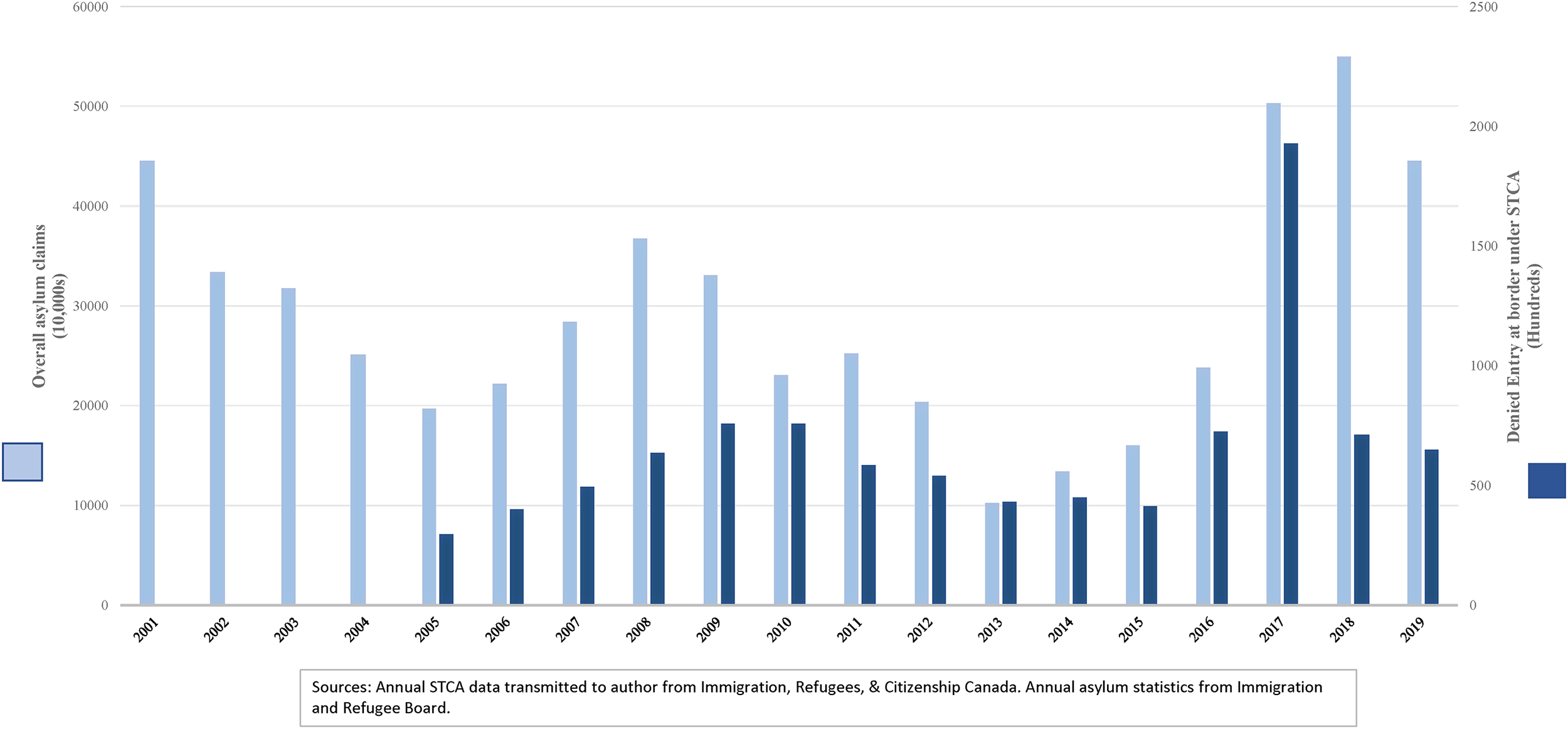
Total asylum claims and STCA ineligible claims, 2001–2019.
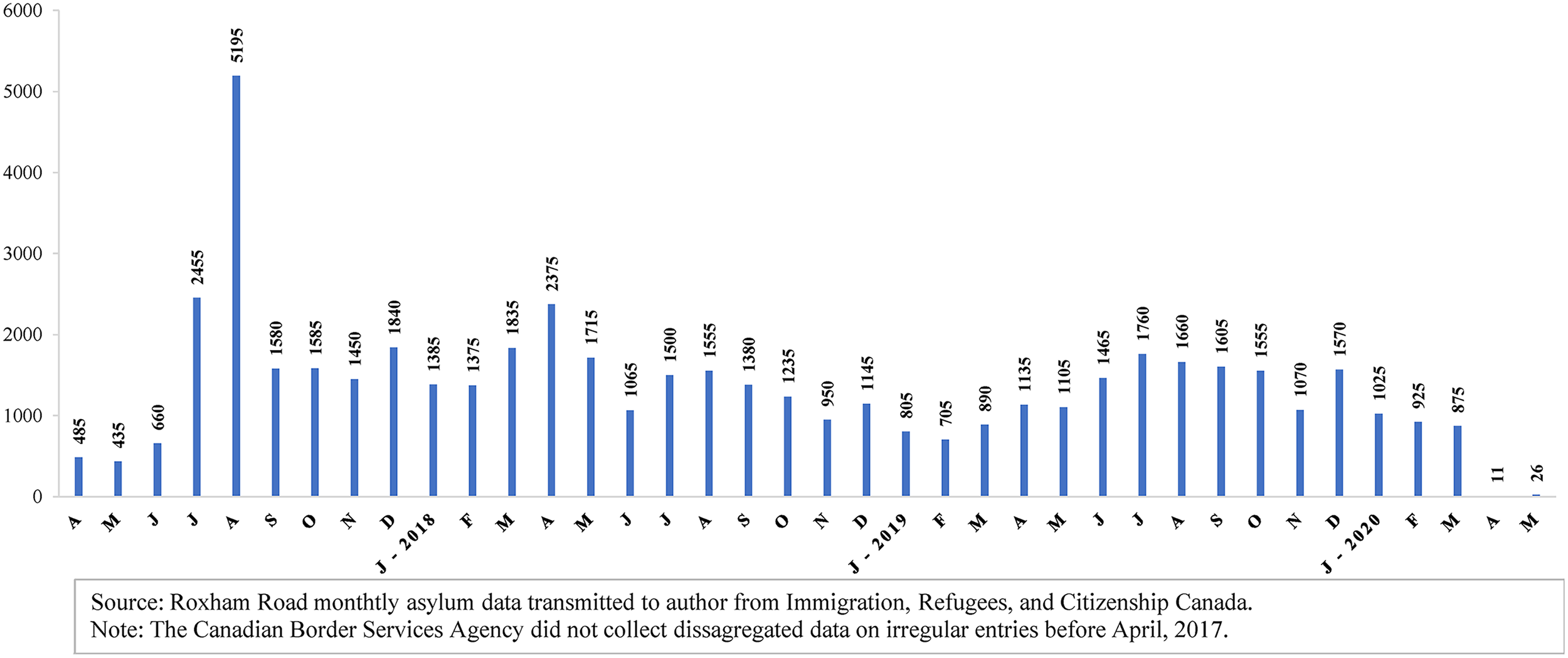
Monthly asylum claims at Roxham Road, April 2017–March 2020.
More recent STCA data show correlations between Trump-administration policies and asylum claim rates at the Canadian border. As described in Figure 1, Canada deemed 5,808 people inadmissible at the border from 2005 to 2015. 9 The number turned back increased from 417 in 2015 to 729 in 2016, before jumping to almost 2,000 in 2017. These changes illustrate that a growing number of people sought to leave the United States in the immediate aftermath of Trump's election. However, while Trump-administration policies and increased border asylum rates coincided, increased border rejections after 2016 alone do not provide evidence that Trump-administration policy changes drove increased asylum claims at the Canadian border (Figure 2).
The situation around asylum at Canada's land border began to change in the winter of 2017, when a small number of people crossed irregularly from Minnesota and North Dakota into the province of Manitoba (Simon and Sidner 2017). The Manitoba border region is sparsely populated, open country and was hazardous to traverse; Canadian media drew attention to cases of those who lost fingers and toes to frostbite (Wright 2019). In contrast, the border region between New York State and Québec has a number of large towns and populated agricultural areas, historically linked communities, and small-scale, preexisting smuggling networks (Wilson Centre 2014). Although it remains unclear how information about the crossing originally proliferated, by April 2017, a sustained number of asylum-seekers were using Roxham Road (Ormiston 2019). The route garnered broad media attention in the United States and Canada, including information about the ease of travel to the border (Bernstein 2017). Most asylum-seekers took public transit to Plattsburg, NY, and used taxis on the final 25-mile leg to the border (Ibid). Our research team's site visits from 2017 to 2019 showed increasingly permanent border infrastructure, where federal police conducted security and health screenings before individuals were transported to cities for asylum procedures (Smith and Hofmann 2019).
Methods and Data
The data analyzed here are derived from over two-dozen elite interviews 10 and over 300 semistructured interviews with asylum-seekers. The research team conducted interviews at shelters and community organizations in Toronto, Hamilton, Ottawa, and Montréal from January to October 2019. Recruitment attempted to yield a representative sample of asylum-seekers who used Roxham Road by nationality from April 2017 to the period of data collection, with a projected total of 320 interviews (dictated by project funding), calculated using statistics provided by Immigration, Refugees, and Citizenship Canada. 11
In some cases, the project under or oversampled nationalities. For example, we undersampled Nigerians to allocate resources for nationalities where the projected sample size was less than one, with significant variation in experiences (e.g., between Colombians who resided in or transited the United States) or where nationality obscured life experiences (e.g., Yemenis who spent their lives in Saudi Arabia). In some cases, it was not possible to recruit through our networks (e.g., Venezuelans), and in other cases, the project was unable to meet the sample size since many had been deported after rejected asylum claims (e.g., Haitians).
Of the final cohort of 290 participants, 120 (42 percent) resided in the United States. Interviews with civil servants suggested that our sample was roughly representative of those who used Roxham Road (government estimates suggest 60–70 percent transited the United States). We defined US “residence” for asylum-seekers as two months or more and if participants reported no intention of transiting to Canada at the outset of a journey. The average duration of residence in the US was 3.5 years, and the maximum over 24 years. The median duration of residence was thirteen months—far higher than the two-month minimum. Participants included 41 nationalities. US immigration status varied, with the majority residing unauthorized in the United States after overstaying visas.
The project recruited asylum-seekers by posting notices at shelters and community organizations with instructions to contact staff or volunteers, who, then, verified recruitment criteria and helped explain the project. Interviews were conducted in participants’ language of choice in private settings and usually lasted one hour. Interviews began with a discussion of the project's goals, potential risks and discomforts, assurances that we would not share data with authorities and that the interview would not affect asylum cases, and rights to speak off-record or withdraw consent. Six people declined to be interviewed. We offered a $25 CAD honorarium.
The interviews’ overarching goal was to understand participants’ life situations in the United States, when and why they began to consider departing, and sources and relative influence of information about routes, migration experiences, and catalysts for mobility. Particular attention was paid to information sources, since misinformation and rumor are common among precarious populations (Bakewell and Jolivet 2015; Sanchez 2017). We used open-ended questions and took pains not to ask leading questions around hypothesized relationships with policy changes. We also asked participants to describe how they decided between staying in situ, returning to origin countries, or moving to a third country and where Canada ranked in their choices. The study, thus, developed a picture of aspirations and decisions by privileging participants’ narratives (Strange, Squire and Lundberg 2017; Triandafyllidou 2017), which I situate against policy changes (see Eastmond 2007).
The most significant limitation of data collection was that participants had already left the United States. The study, therefore, cannot account for conditions under which potential asylum-seekers decided to remain or depart for another country or for those who were potentially incarcerated or deported but would otherwise have made different decisions. Nor are findings representative of all former US residents, since participants were not randomly sampled. Regardless, interviews revealed strikingly coherent experiences and decision-making, despite differences along with other variables.
Findings: Policy Changes and Catalysts for Mobility
Interviews revealed a common narrative arc. All participants had precarious immigration status and reported growing anxiety over Trump-administration policies, often framed as a significant departure from previous administrations. Precarity and anxiety were coupled with awareness that Roxham Road offered a viable route outside the STCA's restrictions. However, interviews revealed that macro-level policy changes alone were insufficient to compel participants to leave the United States (see Van Hear, Bakewell, and Long 2018; de Haas et al. 2019). If strict immigration policies were sufficient to spur asylum migration from the United States to Canada, one would have expected some degree of demand to depart the United States for Canada over the preceding eight years in light of historically high deportation rates under the Obama Administration (Chishti, Pierce and Bolter 2017). Rather, interview data showed that mobility decisions required individual-level catalysts as well. Experiences with incarceration or deportation among participants’ social networks often spurred them to move preemptively.
In the following sections, I situate participants’ narratives against observable policy changes in the early months of the Trump administration and asylum trends at Roxham Road. Space constraints dictate a narrow selection from hundreds of pages of transcripts—a necessarily interpretive exercise based on 10 months of in-depth interviews. Selected narratives offer representative examples of how Trump-era policy changes influenced mobility decisions for a broad range of participants. Narratives are supported by visualizations of overall research data.
US Policy Change and the Search for Options
Immigration was a central plank of the Trump presidential campaign in the United States (Davis and Shear 2019). Once in office, Trump enacted a series of sweeping Executive Orders (EOs) and presidential proclamations. Seven of 17 EOs in the first two months of Trump's administration focused on immigration, with several drafted before inauguration with an eye to immediately fulfilling his strict immigration and border security platform (Ibid.). In contrast to immigration EOs of previous presidents, Trump's were “substantive policy-making documents” focused on curtailing immigration and refugee resettlement, militarizing the southern US border, increasing inland enforcement, incarcerating asylum-seekers, and defunding sanctuary cities (Waslin 2020, 55). As the remainder of this section illustrates, participants cited four major policies and attendant practices and discourses as spurring their decisions to look for options to leave the United States.
On 27 January 2017, one week after his inauguration, President Trump signed a “travel ban” barring travel and resettlement from seven Muslim-majority countries: Iran, Iraq, Libya, Somalia, Sudan, Syria, and Yemen. Although the order largely affected people abroad, several participants relayed how mobility decisions were spurred by the fact they could not leave to renew visas and would become unauthorized. A 24-year-old woman with Sudanese citizenship who grew up in Abu Dhabi and had lived in the United States since the age of 18, for example, told us: Life was good in the US until the Trump administration made it feel so hard… The last time I went back to Abu Dhabi was in 2016… The idea of going back and trying to renew my visa, the risk of getting denied in the airport, the risk of not being able to enter America was so scary. The immigration system was way more fluid with Obama; I was able to get my social security, my work permit… And then it was like there was more, longer processes… They were openly discriminating against Sudanese. Everyone talked about the difference in the way they treated people.
Rather than risk being trapped outside the United States, she made the decision to claim asylum in Canada.
A 25-year-old man with Yemeni citizenship exemplifies how decision-making played out. While he had TPS, which offered a reprieve from deportation, the travel ban made him look for other options: It's not an easy thing to feel like there's no place you can belong to. In Saudi Arabia it was the same as the US; I can never belong. I was in the US, and the Republican Party started to say Muslims are not allowed, and one by one, my friends began to go to Canada and said it was safe there, so my brother and I decided to come.
12
The second major US policy change came one day after the travel ban, when the DHS announced a “last in, first out” system, suspending pending asylum cases indefinitely. The new system's stated goals were to reallocate resources to the southern border, avoid contributing to a national backlog of over 320,000 cases, and “deter those who might try to use the existing [asylum case] backlog as a means to obtain employment authorization.”
13
It also spurred people to look for options. A 53-year-old woman from Ethiopia, who claimed asylum in the United States in 2015, told us: It was officially communicated that the immigration offices were trying to deal with the new cases… I was becoming frustrated and started suffering from insomnia. I didn’t have any options and was desperate. I felt hopeless because my family [in Ethiopia] was suffering because of me. So, I decided to come here, and if I am successful, I can rescue them.
14
Thirty-five percent of participants reported that new barriers to asylum influenced their search for new options and were a departure from Obama-era asylum policies. A 36-year-old man who completed post-doctoral work at an Ivy League university could not return home, due to threats to his family: It's obvious that the US is safer than Burundi. But… I was following the news, I knew what the Trump policy decisions were about, the direction it was going… Even apart from Trump's unpredictability, the asylum process can last up to ten years. I can’t afford a house or to pay out of pocket for health care. I learned about Canadian policy and about Roxham Road, about Francophone communities here, about healthcare and work, and it became a choice of trying to claim asylum over the course of many years, [or] start over in Canada.
16
We paid the lawyers and filed the paperwork. Until the day we left for Canada, we had no interview, no nothing… Then we went to the back of the line. I have two small children, they couldn’t get into daycare or school, I couldn’t get medical care… It's not a possible way to live just waiting and paying a lawyer.
17
Eight participants avoided filing asylum claims in the United States altogether because of the cost and duration of asylum procedures. For example, a 30-year-old woman from Rwanda, who resided unauthorized in the United States for six months while waiting to file an asylum claim, told us: If a head of state can one day simply ban all Muslims or close a border with Mexico, then one day he can wake up and say he doesn’t want any refugees anymore—that was too much of a risk… I needed to stay in a place where there would be a guarantee that this will go forward even if I am rejected. I don’t want to waste my life waiting.
18
The third major policy driver for participants to seek asylum in Canada began in late April 2017 through pronouncements about terminating TPS for roughly 2,500 Nicaraguans and 58,600 Haitians. 19 In late May 2017, DHS announced an extension until January 2018 but stipulated that the purpose of the extension was to allow Haitians to get their affairs in order before deportation (Blitzer 2018a). This policy change was crucial, since Haitians accounted for 5,785 out of 15,915 (36.3%) asylum claims at Roxham Road from April to December 2017—the first major wave of entries. 20 Roughly, one-third of this cohort had resided in the United States. Interviews and journalistic sources suggest that Haitian asylum-seekers were spurred by TPS announcements (Stevenson 2017). This finding, however, requires qualification, since TPS was not formally terminated until November 2017. 21 Reactions from Haitian communities comport with research that news coverage around immigration policy changes increases stress and anxiety around detention, deportation, and family separation for precarious populations (Roche et al. 2018; Ee and Gándara 2019). The precarity of TPS meant that Haitians were susceptible to targeted online rumors and drawn to Canada by the large Haitian community in Montréal (Frelick 2019). 22 Interviews with CBSA officials, civil servants, and most importantly directors at shelters and Haitian community organizations in Montréal corroborated that TPS termination triggered the search for options outside the United States.
We interviewed 11 Haitian participants, although only one had TPS. The remainder avoided lodging asylum claims or remained in the United States after rejected cases. A 24-year-old woman, who spent several years in Venezuela and six months in the United States, told us, “Trump [was] looking at Haitians, talking about us in the news… Then, we saw on the news that even those Haitians [with TPS] would be deported. So, my husband said it's time to go now.” 23 A 35-year-old Haitian man who lived in Florida told us: “My aunt heard about [Canada] from people at the church, and she urged me to come… The Haitians in the US know that status can be taken away. They can be made illegal there. That is why they are all coming here.” 24
The fourth and most significant policy change was around immigration enforcement, which 58% of participants cited as leading to their decision to look for options to depart the United States. Interviews conveyed a palpable sense of anxiety among unauthorized communities (see Lind 2017). Participants also noted a growing climate of discrimination, which many linked to Trump-administration discourse (see Czaika and de Haas 2015) (Figure 3).
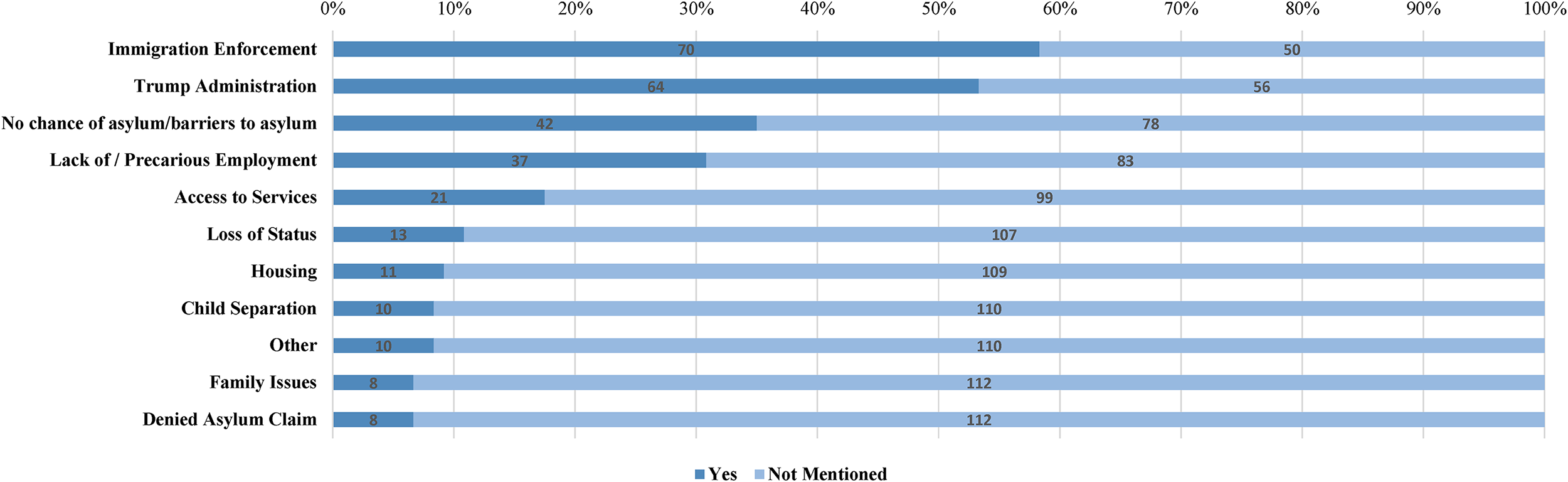
Reported US-side migration drivers.
In his first week as president, Trump signed a sweeping EO entitled “Enhancing Public Safety in the Interior of the United States” meant to increase the number of Immigration and Customs Enforcement (ICE) agents, defund and target sanctuary jurisdictions, and increase workplace raids to apprehend “all removable aliens” (Pierce 2019). Although arrests varied across jurisdictions, the overall number of immigration-related arrests in the United States escalated, given policies to detain and deport unauthorized immigrants, regardless of criminal record or compelling reasons to remain (Capps et al. 2018). In June 2017, the head of ICE testified before Congress, stating, “If you’re in this country illegally and you committed a crime by being in this country, you should be uncomfortable, you should look over your shoulder. You need to be worried” (quoted in Blitzer 2018b). The quote, and aggressive exchanges with House Democrats, circulated in US media (Ibid). Interviews illustrated that participants and their communities paid close attention to media around Trump-administration policies. Taken together, harsh immigration enforcement, weakened sanctuary jurisdictions, and targeted discourse fostered a sense of fear among participants.
Participants often considered enforcement discourse as a precursor to immigration enforcement in their areas of residence. They explicitly contrasted these changes with previous administrations and often sought preemptive mobility options. As a 46-year-old man from Kenya, who had lived with his family in the United States for 18 years, recounted: George Bush was good for immigrants. Obama was okay with families, but he was sending immigrants back home left and right; it was really bad. But with Trump, it's terrible. It went from deportation [of those] with criminal records to police with rifles catching people at their front doors. My main thought was…, “What would come next?”
25
Participants took pains to illustrate how enforcement measures made already-precarious status untenable. 18% reported limited access to services including access to healthcare and education, and 31% reported a lack of employment opportunities for asylum-seekers as influencing their decisions to seek options outside the United States. A 43-year-old woman from Nigeria, who lived in the United States with three children, was exemplary of the confluence of these concerns: Undocumented get rough jobs under the table… We thought we were going to be able to rectify our status, but then two years went by, and things started to get worse… You could get caught any time, so you can’t even think of those other things like making money or kids going to school.
28
People weighed increased enforcement against new information about Roxham Road and Canada. One 38-year-old Salvadoran participant had lived in the United States for 13 years. The fact that she had one son with DACA and a US-citizen daughter exacerbated fears of family separation: The election felt like a trauma because his campaign was hatred for us. At work and on WhatsApp, we started warning each other to be careful when coming or going. They were rounding up people in the area, and it felt very dangerous. We were sharing information about Canada. When we decided to leave, the workplace raids were escalating.
31
A 38-year-old woman from Nigeria who had lived undocumented for two years shared: I hadn’t any experiences [with ICE], but people all around me were being arrested… People in church were gossiping about it, but then it started to become a reality. We heard they would take the children from school. I was keeping them home all day. My husband told me that we should come, that there's no ICE [in Canada].
32
Broader interactions with authorities also fostered fear of deportation. As a 33-year-old woman from Nigeria who lived unauthorized for three years shared: Someone broke into our apartment, so I had to call the police. [The officer] didn’t seem to care about the break-in. I lived in an apartment complex with a lot of [Latinx] people. The only ID I had was my passport. He said, “Is this the only ID you have?” …The way he flipped through the pages started freaking me out. After that, whenever a police car pulled into my complex, I’d think, “Oh my goodness, this is it for me.” …You wouldn’t understand because you never lived live in that situation. Every sound was, “Are they coming for me?” I couldn’t get used to it.
33
Anxiety was often tied to experiences of racism, which long-term residents felt was emboldened by Trump's election. As a 29-year-old man from Chad who had lived in the United States since 2008, for example, reported: The Obama administration deported more people than Trump. [But] they never detained kids; they didn’t turn down families like they do now… Americans became more racist when Trump came to power. The same day he got elected, I was in Mississippi, and we went through a gas station, and I start hearing the ‘N’ word. Then, there's some guy yelling at me that my life is over and I have to go back to Africa… You are scared you might get attacked at any time for the color of your skin. Even for Americans born and raised there, it is a very dark time.
34
A 25-year-old Eritrean man who had arrived in the United States on a student visa at eighteen offered a similar perspective. He had a job offer with a technology start-up but became undocumented in 2016 because he could not leave the country to process his visa: A lot of things changed when Trump got into power… People who were hiding these racist emotions can do this openly now. I heard comments sometimes, but it's more how people look at me when they heard my accent. Frankly, it was sad [because] it's drilled into you since you were a kid: “The US is the best, the only option.” When you tell people back home, they never believe what it's actually like there.
35
A 48-year-old man from Peru who had lived in the United States since 2014 told us: “In California, it felt safer because it is a sanctuary state, except for a couple of dangerous cities. But the racism goes up, up, up, because the things Trump is talking about… Like people will stare at you more. Watch you. You can feel it.” 36
Awareness of Roxham Road and Destination Choice
71% of participants reported that new information about Roxham Road was crucial for selecting Canada as a destination. The route was receiving daily coverage in Canadian media by Winter 2017, including detailed stories about border procedures (Bernstein 2017). The New York Times first printed detailed reporting on Roxham Road in March 2017, as crossings began to increase (Rojas 2017); CNN first aired footage in May 2017, with detailed reporting on routes, and compared Trump-administration policies with ease of access to asylum procedures in Canada (Marquet and Roche 2017; Valdes and Shoichet 2017). Reputable news sources about the route were shared widely on social media among participants.
37
A 30-year-old man from Yemen who had lived in the United States for eight years told us: After I was finished school, I was going to apply for asylum. I thought this would be easy because of the war [in Yemen]. But [a social worker] updated me and told me that now because I was from a Muslim country, I would be suspected. She showed me that Canada accepted almost all Yemenis, showed me the statistics… Every one of my friends knew about Roxham Road; everyone had links in their WhatsApp.
38
The news was showing some Africans were losing fingers in the cold. We started following it on YouTube, and then we saw Roxham Road, and we followed it very closely. Everyone who was an [unauthorized] immigrant was frustrated, and we heard all the time about the acceptance of… Canada. We were relieved that people had somewhere to go.
39
Several echoed a chain of events from anxiety to searching for options to considering Roxham Road. As a 30-year-old man from Nigeria who had lived unauthorized in the United States for two years reported: Before Trump, it was not a problem as long as you are obeying the laws. But we saw the videos and thought, “Can this actually be true?” Then, we searched more, and it's all online. Statistics and information about exactly how to do it. And I thought maybe it's really this easy to finally be legal.
40
Threat Experiences as Catalysts for Mobility
For most participants, increasing precarity and new information about Roxham Road were necessary, though not sufficient, to make the decision to depart the United States for Canada. The majority of participants (58%) reported personal catalysts around immigration enforcement. For example, a 49-year-old Nigerian woman who had lived undocumented in the United States for 18 months with two adult children and one minor recounted an ICE raid on her apartment complex in which all adults were arrested. After a church group raised bail, they stayed in their apartment for four days until her children used news footage to convince her to travel to Roxham Road. A 28-year-old participant from Egypt was raised in the United States since the age of six and had DACA status. He was arrested for a misdemeanor in late 2017, and his DACA status was revoked. In late 2018, he was moved from detention to house arrest after 18 months because the Egyptian embassy could not verify his citizenship. He removed an ankle monitor and boarded a bus from Florida to Plattsburgh the same day.
Other participants were facing deportation. A 48-year-old man from Peru described how his son had attempted to regularize his status through marriage, which US immigration authorities deemed fraudulent. We were thinking maybe he will go back to Peru, or even somewhere else in the US. But [my brother] warned that when you get to the airport or southern border or [an inland] checkpoint, maybe you will be caught… I decided to come with him because I’m undocumented. My wife is a citizen, so she stayed with our daughters. She drove us from LA all the way to Plattsburgh because we were scared about being in bus stations.
42
The decision was quick because I was reporting to immigration; they’d taken all my documents… I have grandkids and my children and my whole family in the US. It was [Canada], or I go back to Rwanda after more than twenty years. At least here they can visit me. 43
The majority of participants who reported enforcement as a catalyst were spurred by experiences in their social circles. For example, a 31-year-old man from Cameroon, who had completed his graduate studies in the United States but lost his immigration status, recounted how “the decision was creeping up” on him: I heard about Roxham Road in 2017. It was all over my Google News feed… I was interested, but I decided to wait until 2018 to see if the Democrats would win the House. Then [ICE] picked up my friend, and about fifty of us ended up contributing money to get him out; he said… I need to leave [because] ICE agents asked about me and other undocumented friends living in the same apartment.
44
Several participants reported that until 2016, they felt prosperous and protected by sanctuary policies in the United States. A Kenyan woman described how her family had lived unauthorized for five years, obtained work permits, and opened a business, but “[ICE] started asking people for papers, going through peoples’ businesses, asking about their employees, and stuff like that. It never blew up in the media because it wasn’t 700 people in cages; it was two people here, two people there, but it kept happening.” She described her catalyst as a friend being deported: I wanted to leave before anything could happen. It's a step of faith… You see people drown in the Mediterranean or crossing the Rio Grande. I always thought, “Why are people putting themselves in such a danger?” But when you are trying to find something better for your kids, you take the risk, no matter what.
45
A 38-year-old Eritrean man recounted how “a friend of mine was deported from Texas to Egypt. He died… when he got back. They say it was suicide, but I think someone else could have done it. If I go back to Eritrea, I’ll be killed. So, I started to look about how to come to Canada.”
46
A 34-year-old man from Ethiopia who had lived in the United States for four years told us: I lived in a large community of Africans in Chicago… It felt safe enough because [of sanctuary] policies. I knew a guy who was undocumented but had a work permit [and] paid taxes. ICE came with a random check. They deported him without even bringing him home. All of a sudden, he was gone. That was a warning call for me and the moment I decided.
47
Catalysts also included lack of access to healthcare, being asked for identification at hospitals or schools, and threats from employers. One case, in particular, included each element. A 30-year-old man from Turkey had lived in the United States since 2012. He originally worked at a Turkish consulate but was fired because of social media posts condemning crackdowns after the 2016 attempted coup. He tried to regularize his status but eventually became undocumented and worked under the table in restaurants, while friends in Turkey were incarcerated. “Now I have to choose to be illegal… or go back to Turkey. But… I know for sure I will be in prison. Even an uncle threatened to kill me.” He faced continued online threats and deleted his social media accounts. He was also HIV positive and required hospital visits every three months. He stopped attending appointments after staff asked about his immigration status, became homeless, and lived in his car. I was going to the gym to shower and then back to my car. Nothing more. My friend gave me an Uber sticker so it would not look strange… What am I supposed to do? I can’t work, and I can’t get my medication. In the last three months before Canada, I felt like life is so… I am so depressed. I was giving up. One day, the police were knocking on my window while I was asleep, and I [told them] I’m just taking a break. Then they parked behind me for two hours. I felt like this was the moment I get sent back.
48
Canadian Policy and Destination Choice
One of this project's more politically sensitive findings is the role of Canadian policy in participants’ decisions to claim asylum at Roxham Road, particularly in light of global trends to curtail asylum and social support to deter arrivals (Zaun 2017). As described in Figure 4, 48% and 44% of participants, respectively, said that perceptions of Canada's asylum system and society affected their destination choice. Most were aware they would be eligible for employment, social assistance, and healthcare in Canada and that their children would be enrolled in school during asylum procedures. Crucially, however, Canadian policies did not weigh equally in participants’ decision-making and were only taken into consideration in response to increasing precarity in the United States. However, Canada ranked first in potential destinations ahead of origin countries or other third countries, in light of ease of access to Canadian asylum procedures via Roxham Road (Figure 4).
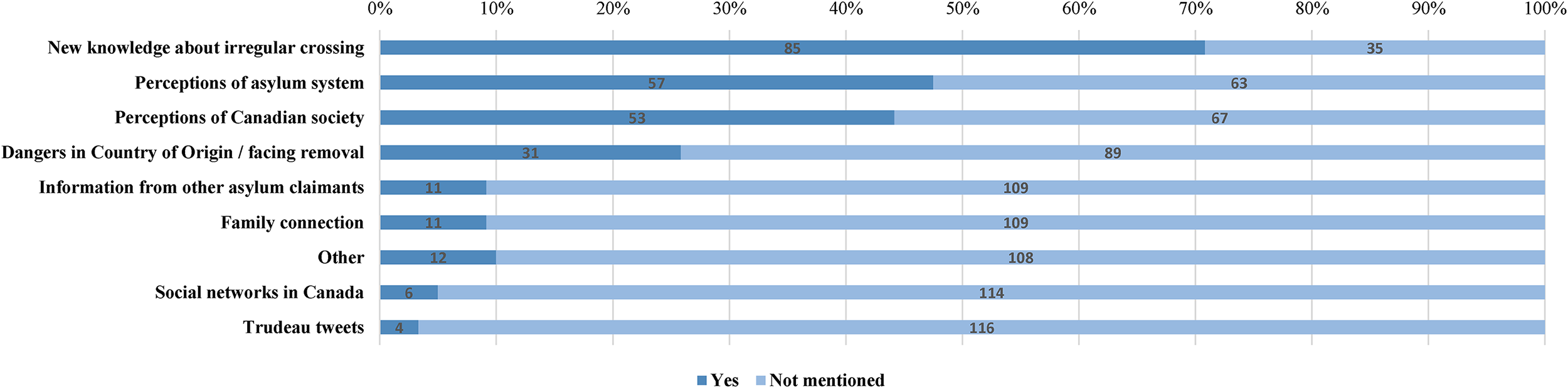
Reported destination choice drivers.
Although the Canadian government maintained that the United States was safe for refugees and that the STCA was still fit for purpose through both media narratives and Federal Court challenges from 2018 to 2021 (Mercier and Rehaag 2021), early political pronouncements about changes to US immigration and asylum policies responded directly to Trump-administration policy changes and contrasted them with Canada's reception standards. Most significantly, on 28 January 2017, one day after the Muslim travel ban in the United States, Canadian Prime Minister Trudeau published a tweet reading: “To those fleeing persecution, terror & war, Canadians will welcome you, regardless of your faith. Diversity is our strength #WelcomeToCanada.” 49 Conservative politicians and media claimed the tweet was responsible for Roxham Road. 50
On the contrary, findings from this project suggest that elite signaling from Canada had little impact on participants’ decisions. Only 3% of participants reported knowledge of Trudeau's tweet, which opposition politicians and political pundits in Canada contended compelled asylum migration at Roxham Road. Asylum claims at Roxham Road remained constant at roughly five hundred per month until May 2017, four months after the tweet, and volume peaked during attempts to deter migrants in the United States. 51 The best-known recent comparison of signaling and public messaging as potentially compelling asylum migration is former German Chancellor Angela Merkel's 2015 decision to suspend returns under EU Dublin Regulations during the European migration crisis (Spijkerboer 2016). As with Trudeau's tweet, right-wing criticism suggested that Germany's “open-door” policy caused asylum migration to Europe (Trilling 2021). However, time-series evidence around the policy change and migration trends shows that while more migrants already en route chose Germany over states with less favorable policies and more exclusionary rhetoric, suspending Dublin Regulations did not affect flows to Europe (Ibid.; Pries 2019). Interview data from this project revealed that Canadian policies were, likewise, not a driver for participants’ decisions to leave the United States yet influenced destination choices for those already seeking immediate physical security, access to legal protection, and expectations for employment opportunities (Crawley and Hagen-Zanker 2018; Kuschminder 2018).
Conclusions
This article's central argument is that Trump-administration policy changes were the key driver of asylum migration to Canada from late 2016 to mid-2019, particularly for participants residing in the United States with precarious status. Although deportations were far higher under the Obama administration, interview data show that employment authorizations, sanctuary policies, and programs, including TPS and DACA, under Obama meant that participants felt relatively safe and had options for regularization. Conversely, Trump-administration policies stripped those safeguards, created well-founded anxiety, and foreclosed participants’ options to remain.
The Roxham Road case offers some applicable findings for understanding migration decision-making and new irregular routes for cross-border asylum flows. First and most broadly, it shows that rapid policy changes which undermine the viability of living with precarious immigration status can drive secondary asylum migration, particularly when viable options are available for accessing protection in a neighboring state. Prominent comparative cases include how flagging humanitarian aid in host countries triggered large-scale migration from the Middle East to Europe in 2015 and 2016 or recurrent “surges” at the US/Mexico border driven partly by weak protection in third countries (Düvell 2018; Kuschminder and Waidler 2020). Second, while declining asylum claim rates from the United States to Canada from 2004 to 2016 may suggest the STCA was an effective deterrence mechanism, cross-border asylum rates were also likely impacted by variables including domestic US policy, externalized controls in Latin America, and global changes to visa policies and mixed migration routes. It may also have led to more people entering Canada clandestinely and living undocumented. Although it is likely not possible to accurately determine the STCA's impacts on cross-border asylum from 2004 to 2016, this article provides some baseline findings for future research on bilateral asylum flows. In addition to offering data for increased STCA border refusals and subsequent shifts toward irregular routes after 2016, interviews show that most asylum-seekers had resided in the United States for an extended period. This article, thus, shows that social ties and established lives which otherwise might compel people to remain in the United States do not preclude future policy changes from triggering renewed asylum migration to Canada, particularly given broad media attention and knowledge among migrant communities about Roxham Road (Sands and Jackson 2021).
Methodologically, this article highlights how in-depth, qualitative research can draw out relationships between migration drivers and cross-border asylum statistics. The relatively small number of US residents who sought asylum in Canada might be read by quantitative researchers to suggest that Trump-era policies had minimal effects on overall asylum in Canada. Research participants, however, had remarkably common narratives around their search for options and decision catalysts, despite broad variation in demographic variables and immigration status. This finding complicates macro-level analysis of irregular flows and suggests the efficacy of centering migrants’ aspirations, experiences, and decision-making (BenEzer and Zetter 2015; Tuzi 2019).
From a policy perspective, this article calls into question the effectiveness and ethics of safe third-country designations, which have proliferated among Global North states as a tool for managing asylum, particularly throughout Europe (Macklin 2013; Hunt 2014). The STCA failed to deter asylum-seekers and pushed them to irregular routes, comporting with research that the absence of regular channels can lead to “deflections into irregularity” (Czaika and Hobolth 2016) and “categorical substation” to asylum (de Haas et al. 2019). In late 2020, a Canadian Federal Court overturned the STCA on the grounds that it subjected asylum-seekers to inhumane and arbitrary detention in the United States (Macdonald and Ayres 2020). The ruling was overturned on appeal and will be heard by the Supreme Court of Canada in 2022. 52 Policy changes under the 2016–2020 Trump Administration raise significant questions about the durability of the United States providing commensurate international protection standards as Canada and, thus, the rationale underlying the STCA, particularly given executive authority over US immigration and asylum policy (Waslin 2020). Maintaining the STCA complicates Canada's role as a norm and policy entrepreneur around refugee protection and responsibility-sharing for displacement (Smith 2020; Milner 2021).
Supplemental Material
sj-xlsx-1-mrx-10.1177_01979183221112418 - Supplemental material for Policy Change, Threat Perception, and Mobility Catalysts: The Trump Administration as Driver of Asylum Migration to Canada
Supplemental material, sj-xlsx-1-mrx-10.1177_01979183221112418 for Policy Change, Threat Perception, and Mobility Catalysts: The Trump Administration as Driver of Asylum Migration to Canada by Craig Damian Smith in International Migration Review
Footnotes
Declaration of Conflicting Interests
The author(s) declared no potential conflicts of interest with respect to the research, authorship, and/or publication of this article.
Funding
The author(s) disclosed receipt of the following financial support for the research, authorship, and/or publication of this article: This work was supported by the Social Sciences and Humanities Research Council of Canada (grant number Insight Development Grant).

Notes
References
Supplementary Material
Please find the following supplemental material available below.
For Open Access articles published under a Creative Commons License, all supplemental material carries the same license as the article it is associated with.
For non-Open Access articles published, all supplemental material carries a non-exclusive license, and permission requests for re-use of supplemental material or any part of supplemental material shall be sent directly to the copyright owner as specified in the copyright notice associated with the article.
