




Abstract
Can specific policies support the economic integration of immigrants? Despite the crucial importance of this question, existing evidence is inconclusive. Using data from the European Social Survey, we estimate the effects of integration and anti-discrimination policies, alongside social expenditure and labor market regulation, on the labor market performance of 6,176 non-European immigrants across 23 European countries. We make three contributions: 1) we investigate the distinct role of discrete policy areas for labor market integration outcomes, 2) we allow for heterogeneous effects of policies on immigrants with different characteristics, and 3) we examine immigrants’ occupational attainment while accounting for their selection into employment. We find that immigrants’ employment chances are negatively associated with national levels of expenditure on welfare benefits but positively associated with policies facilitating immigrant access to social security. We also find that labor market rigidity is negatively associated with immigrants’ occupational attainment, but we find little evidence that policies aimed at supporting the transferability of immigrants’ qualifications promote their occupational success. Our results strongly suggest that anti-discrimination policies are important for immigrant economic integration. Yet while these policies are associated with greater occupational success for all female immigrants, they seem to be only positively associated with the occupational attainment of higher-skilled and non-Muslim immigrant men. As this article suggests, anti-discrimination policies can foster immigrants’ labor market success, yet these policies currently fail to reach those who face the strongest anti-immigrant sentiments — that is, unskilled male immigrants and Muslim immigrant men.
Keywords
Introduction
Immigrants’ effective integration represents one of the key challenges facing European governments (Alba and Foner 2015). The growth of immigration into the European Union (EU) since the beginning of the twenty-first century has been described as an “historic transformation” (Parsons and Smeeding 2006), and Alba and Foner (2015) have persuasively argued that Europe’s future will depend on how well it integrates immigrants (see also OECD 2018). Immigration can increase human capital, slow population aging, and foster economic growth, thus contributing to the sustainability of European welfare states (Peri 2011). Yet it can also fuel labor market competition and anti-immigrant sentiments (Davis and Deole 2019). Such anti-immigrant attitudes are likely to reinforce discrimination against ethnic minorities, resulting in poorer labor market outcomes for immigrants, either through reduced employment or relegation to segregated low-paid sectors (Catanzarite 2000; Tesfai 2020). Barriers to immigrant integration imply not only a waste of human capital (Engzell and Ichou 2019) but also lower fiscal contributions (Dustmann and Frattini 2014), which can further undermine popular support for immigration (Hainmueller and Hopkins 2014). The scope of this integration challenge highlights the need for knowledge-based immigrant integration policies.
In this article, we set out to identify those policies that are effective in enhancing immigrant economic integration in Europe and argue that there are compelling theoretical reasons to expect policies to affect immigrant economic integration. By immigration policies, we refer to those policies that are specifically directed at enabling or restricting immigrant access to employment, education and training, and social security. We argue that anti-discrimination policies, policies providing access to training opportunities, and those facilitating the recognition of qualifications should foster immigrants’ occupational attainment, but we expect the effects to differ depending on immigrants’ own characteristics. We also expect European countries’ national institutions to affect immigrants’ labor market outcomes. By national institutions, we specifically refer to 1) the regulatory framework and organizational structures that embed wage and employment determination processes (labor market institutions) and 2) the entitlement rules and redistributive principles that define welfare provision (welfare provision institutions). We argue that more highly regulated labor markets are disadvantageous for immigrants’ occupational attainment, while higher minimum wages and lower social security provision can promote immigrant employment.
Testing these propositions requires comparative research encompassing variation in regulatory frameworks (policies and institutions) over time and across European countries. Yet there exist few comparative studies on immigrants’ labor market incorporation that involve a substantial number of European countries (e.g., van Tubergen, Maas, and Flap 2004; Kogan 2006; van Tubergen 2006; Heath and Cheung 2007; Corrigan 2015). Careful comparisons of a small number of countries, each representing a typical welfare/immigration “regime,” can shed light on the implications of certain combinations of institutions (e.g., Devitt 2011; Ballarino and Panichella 2015; Larsen and Di Stasio 2019), but, besides well-known problems of external validity, such regime comparisons cannot test for the contribution of specific policy areas. Among studies involving multiple countries, institutional variation (e.g., in wage setting and welfare benefits) has been much less comprehensively studied than individual-level compositional factors (e.g., differences in individual characteristics of immigrants moving to different destinations), local context (e.g., composition of areas where immigrants settle), or origin-level factors (e.g., social and economic differences in sending countries) (van Tubergen, Maas, and Flap 2004; Spörlein and van Tubergen 2014).
The evidence we do have offers mixed results on the impact of institutional factors on immigrant integration and suggests negligible or ambiguous effects of immigration policies (e.g., Kogan 2006; Heath and Cheung 2007; Fleischmann and Dronkers 2010; Cebolla-Boado and Finotelli 2015; Corrigan 2015). The lack of consistent evidence in existing studies could be attributable to different selections of countries, the use of different aggregate migration indices that cover different aspects of migration incorporation, or the failure to distinguish the specific targets for whom particular integration policies are relevant (Bilgili, Huddleston, and Joki 2015).
In this article, we identify the role of discrete policy domains and institutions in promoting the occupational attainment of third-country immigrants who migrated to Europe as adults. 1 We examine outcomes over the 10-year period from 2002–2012. We claim three main contributions. First, while extant research typically focuses on either immigrant access to employment (e.g., van Tubergen, Maas, and Flap 2004; Kogan 2006; Heath and Cheung 2007) or occupational attainment (e.g., Connor and Koenig 2013; Corrigan 2015) or studies access and attainment as separate processes (e.g., Gorodzeisky and Semyonov 2017), we study occupational attainment and access to employment jointly (see Pichler 2011 for a similar approach). Studying employment and occupational attainment jointly is important because some policies and institutions might have effects on employment, but not on occupational attainment (and vice versa). For example, reviews suggest that anti-discrimination legislation does not improve immigrant access to employment (Zschirnt and Ruedin 2016). However, we would argue that such legislation is more likely to affect occupational attainment and progression (Valfort 2018). Conclusions based on employment access cannot, therefore, be extrapolated to occupational performance. Certain policies may help immigrants get “any job” whereas others may ease access to “better jobs.” Entering any kind of paid employment is an important first step for economic success, but immigrants’ life chances, and their fiscal contributions, benefit from accessing jobs with higher wages and better working conditions. 2 Hence, we argue, measuring immigrant economic integration in terms of occupational attainment represents a more demanding test of societal cohesion. However, estimates for policy effects on occupational attainment that are calculated without taking account of selection into employment will likely be biased: where access to employment is harder, those individuals with jobs will be more positively selected and, hence, more likely to be more successful. Selection and occupational attainment should, therefore, be estimated together.
Second, rather than mechanically using ready-made batteries of aggregate indices of integration policies, we investigate the discrete effects of particular, theoretically selected integration policies and institutions. Specifically, we analyze five different integration policies: anti-discrimination legislation, credentials conversion, labor market rights, job support, and access to social security. We also investigate the role of two additional institutional characteristics likely to affect immigrant labor market outcomes: welfare expenditure and hiring and minimum wage regulations. We contend that studying the specific impacts of these policies on immigrant economic integration gives greater insight into which policies actually “matter,” compared to employing multi-factor indices or fuzzy “integration regime” types (e.g., Fleischmann and Dronkers 2010; Koopmans 2010).
Third, previous studies have typically assumed that policy and institutional effects on immigrant labor market performance are homogenous across the immigrant population, once controlling for individual characteristics (e.g., Fleischmann and Dronkers 2010; Pichler 2011; Cebolla-Boado and Finotelli 2015). We contend that, theoretically, such homogenous impacts on attainment are implausible. Drawing on arguments from segmented assimilation theory (Portes and Rumbaut 1996) and the literature on prejudice and discrimination in Europe (e.g., Strabac and Listhaug 2008; Hellwig and Sinno 2017; Lancee 2019), we posit that specific policies may affect skilled and unskilled immigrants, female and male immigrants, and Muslim and non-Muslim immigrants differently. 3 As we show, our approach yields analytical pay-offs, revealing heterogeneous policy effects.
To implement these contributions, we exploit variation in policies and institutions across 23 European countries and six time points, pooling six rounds of the European Social Survey (ESS) for the period, 2002–2012, before the onset of the “migrant crisis.” Given its high-quality procedures and nationally representative sampling, the ESS is regularly used for international migration research (e.g., Engzell and Ichou 2019). We focus on 6,176 third-country nationals residing in European countries. Research consistently identifies different outcomes for third-country nationals (e.g., Gorodzeisky and Semyonov 2017), who are the main target of integration policies in European countries. By our sample selection, we ensure some comparability in the immigrant populations studied across the 23 countries, though we also control for origin context. The ESS provides us with identical individual-level measures across countries and over time. We match aggregate measures at the country-year level of a range of social indicators relating to immigrant integration policies, employment regulation, and welfare expenditure to individual-level ESS records. One caveat raised by analysis of immigrant outcomes using the ESS is the potential bias from excluding those who cannot be interviewed in the destination-country language; we implement a series of robustness checks to engage with this issue. We analyze occupational attainment, using the International Socio-Economic Index (ISEI) (Ganzeboom, De Graaf, and Treiman 1992), and estimate full maximum likelihood Heckman selection models to account for immigrant selection into paid employment.
In the rest of this article, we first review the existing cross-national comparative literature on immigrant economic integration. We then set out our theoretical arguments relating to the impact of specific policies on occupational attainment. Next, we describe the data and measures, before we present and discuss our results. Finally, we offer some conclusions.
Immigrant Economic Integration in Europe
Despite the dominance of the US literature on immigrant integration (Levy, Pisarevskaya, and Scholten 2020), there is now a wealth of studies that highlight the particularity and diversity of the European context (e.g., Alba and Foner 2015; Lancee 2019). Although there are numerous single-country or comparative case studies on immigrant incorporation in EU countries (e.g., Kesler 2006; Ballarino and Panichella 2015; Gorodzeisky and Semyonov 2017), few include a large enough number of European societies to draw inferences at the macro level (e.g., van Tubergen, Maas, and Flap 2004; Adsera and Chiswick 2006; van Tubergen 2006; Heath and Cheung 2007; Spörlein and van Tubergen 2014), and even fewer explicitly address institutional and policy drivers of immigrant economic integration (e.g., Kogan 2006, 2016; Fleischmann and Dronkers 2010; Pichler 2011; Aleksynska and Tritah 2013; Cebolla-Boado and Finotelli 2015; Corrigan 2015). These latter studies are most relevant to our research question, even though the majority focus on employment access, rather than occupational outcomes (c.f., Pichler 2011; Corrigan 2015) and some are concerned with impacts on both immigrants and the second generation (e.g., Cebolla-Boado and Finotelli 2015).
We argue that immigrant occupational attainment provides more insight into the effectiveness of integration policies, which, moreover, can best be understood by focusing on the immigrant generation alone. Second-generation outcomes remain of core interest to many societies, but institutional factors shaping their occupational trajectories are distinct. For example, children of immigrants are not selected as their parents are, and their outcomes have been shown to be fundamentally connected to differences in education systems in the destination country (Crul and Vermeulen 2003; Heath, Rothon, and Kilpi 2008; Cebolla-Boado and Finotelli 2015). We, therefore, focus on the factors shaping occupational outcomes of the immigrant generation. Judging from existing research, which we go on to discuss, likely candidates for drivers of immigrant economic success are individual characteristics, origin-country factors, community features, and destination-country characteristics.
In relation to individual predictors of integration, there is a high degree of consensus about which are associated with better or worse economic outcomes. A significant body of scholarship, for example, shows that human capital variables such as skills or qualifications, language proficiency, immigration status, length of stay, and work experience influence immigrant labor market attainment in destination societies (Heath and Cheung 2007; Cebolla-Boado and Finotelli 2015; Gorodzeisky and Semyonov 2017). Yet attainment differences by origin country often persist, even after controlling for observed micro-level factors (e.g., Heath and Cheung 2007; Gorodzeisky and Semyonov 2017). These origin differences net of observable individual-level characteristics have been referred to as ethnic penalties or ethnic residuals (Heath and Yu 2005). Ethnic residuals are likely the outcome of both differential employer discrimination (Portes and Rumbaut 1996; Pager, Western, and Bonikowski 2009; Lancee 2019) and immigrants’ unobserved characteristics (Koopmans 2015; Polavieja 2015).
Cross-national research has clearly demonstrated origin countries’ role in contributing to ethnic penalties (van Tubergen, Maas, and Flap 2004; Adsera and Chiswick 2006), and non-European immigrants typically demonstrate poorer labor market outcomes in Western European destinations (e.g., Fleischmann and Dronkers 2010; Pichler 2011; Ballarino and Panichella 2015; Gorodzeisky and Semyonov 2017). Studies differentiating among non-European sending countries have demonstrated that those from richer and more stable societies do better in the labor market (e.g., Fleischmann and Dronkers 2010). This finding is consistent with compelling evidence that immigrants who come from contexts that are economically, as well as culturally and phenotypically, more distant from Europe face the highest levels of prejudice and discrimination (Lancee 2019). In a European context, Muslim immigrants tend to be perceived by native populations as the most culturally distant immigrant group (van Tubergen 2006; Strabac and Listhaug 2008; Alba and Foner 2015; Hellwig and Sinno 2017).
The degree to which immigration regimes are selective will be reflected in observed characteristics, such as educational qualifications that proxy for skill levels (Kogan 2006; Luthra and Platt 2021). However, unobserved characteristics may also be associated with immigrant economic or educational selectivity over and above absolute attainment (e.g., Lewin-Epstein et al. 2003; Feliciano and Lanuza 2017; Engzell and Ichou 2019). Selection is intended to proxy for unobserved characteristics such as drive or motivation, yet Polavieja, Fernández-Reino, and Ramos (2018) found a mixed picture for immigrants’ motivation selection, reinforcing the argument that people “select” into contexts in which they will do best (Aksoy and Poutvaara 2019). Such self-sorting highlights the need to take account of destination countries’ institutional and economic context when attempting to identify the role of policies for immigrant labor market outcomes.
The existing literature on the role of contextual and institutional factors in immigrant economic integration provides relevant insights for our analysis. van Tubergen, Maas, and Flap (2004) cross-classified, multi-level model exploring outcomes of different origin groups across 18 Western societies demonstrated that economic conditions (e.g., local unemployment) at reception were significantly correlated with immigrant employment. Spörlein and van Tubergen (2014) came to similar conclusions in a study expanded to include 33 non-Western countries, and Fleischmann and Dronkers (2010), in their cross-classified model of 13 destination countries, also found a clear impact of destination-country unemployment rates on immigrant unemployment. Heath (2007), however, found only a weak association between the unemployment of the majority population and minority groups’ employment disadvantage in his synthesis of 13 country studies. On balance, from these studies, we expect that local unemployment levels will shape immigrant access to employment.
Studying 16 European countries, Kogan (2006) argued that the labor market structure is also relevant for immigrant employment outcomes. Specifically, she suggested that countries with larger demand for low-skilled labor should benefit immigrants because in these jobs, which are often shunned by natives, productivity signals are less important than in high-skilled ones. She found a positive relationship between low-skilled share and employment probabilities for both immigrant men and women, though Fleischmann and Dronkers (2010) failed to replicate this finding.
Kogan (2006) also argued that more flexible labor markets enable better access for immigrants, since flexibility in hiring and firing reduces the costs of potential mismatches for — and, therefore, statistical discrimination by — employers (Arrow 1973). She demonstrated that higher levels of such recruitment and retention flexibility were associated with better employment chances for immigrants. Although this argument is embraced by other authors (e.g., Devitt 2011), the empirical finding has not been universally supported: Heath (2007), for example, found only weak evidence that strict employment protection leads to greater ethnic penalties in unemployment, and Fleischmann and Dronkers (2010) found no effect of employment protection on immigrants’ unemployment risks.
Consistent with Corrigan (2015), who, in his study of 14 countries, found clear associations between labor market rigidity and occupational status, we argue that employment regulation should be more relevant for immigrant occupational success than for labor market access. More rigid labor markets may consign immigrants to less-regulated, and less-rewarded, labor market segments but should not, on their own, reduce access to work. While this relationship was not observed by Pichler’s (2011) study of 28 destination countries, he operationalized a binary measure of occupational success, which might be insufficiently sensitive to the impacts of labor market rigidity on mid-range occupations. In addition, his sample of immigrants included those of European origin, who are subject to a different employment context and different employer expectations.
Immigrant employment may depend less on labor market rigidity and more on the alternatives available. The “welfare magnet” hypothesis states that generous welfare states decrease immigrant participation in paid work by offering an “outside offer” on a par with wages in the low-skilled segment of the labor market to which they have access (Koopmans 2010). Polavieja, Fernández-Reino, and Ramos (2018) argue that generous welfare states may also attract immigrants who are less motivated to find work. While there is some evidence for the welfare magnet argument (Koopmans 2010; Razin and Wahba 2015), results may be misleading in that higher spending on social security in general does not necessarily mean that immigrants can access more generous welfare benefits. Instead, many states limit the amount, type, or timing of access to benefits for third-country nationals (Vintila and Lafleur 2020), rendering levels of benefits irrelevant for these immigrants’ participation. Additionally, other studies find no “magnet” effect of more generous welfare states (e.g., Ponce 2019).
European states also differ in their integration policies (Huddleston et al. 2015). It is here, however, that research has been least conclusive. Koopmans (2010) argues that multiculturalist policies are an obstacle to socioeconomic success because they hinder acquisition of the destination-country language and foster the creation of ethnic niches. He finds some support for these claims in his eight-country study of employment outcomes, though the effects are inferred from the characterization of different regimes rather than by direct testing of specific policies. Others argue that policies that actively support immigrants’ labor market participation alongside anti-discrimination policies should have positive impacts on immigrant outcomes (Bilgili, Huddleston, and Joki 2015; OECD 2018). Despite the intuitive expectation that integration policies should matter, those studies that have directly tested domains of integration policies find few significant effects (e.g., Fleischmann and Dronkers 2010; Pichler 2011; Cebolla-Boado and Finotelli 2015).
One possible explanation for this puzzling lack of evidence on the impact of integration policies is methodological. Recently, the use of hierarchical lineal modeling has become popular in comparative research across the social sciences, including research on international migration (e.g., Kogan 2006; Fleischmann and Dronkers 2010; Corrigan 2015). Bryan and Jenkins (2016) show, however, that hierarchical models are likely to yield biased estimates for second-level co-variates when the number of second-level units is smaller than 25 and that binary outcome measures (such as employed or not) are more sensitive to the number of units. In such cases, conventional regression with clustered standard errors can provide more robust estimates (see also Lewis and Linzer, 2005). In addition, most of the literature reviewed above focuses on employment, which, as argued previously, offers a rather limited measure of economic integration, particularly with the increasing emphasis in Europe on high-skilled migration (Triandafyllidou and Isaakyan 2014). Focusing only on access inevitably disregards the problem of (skilled) immigrants concentrating in low-skilled, poorly paid, and precarious jobs in the labor market’s “secondary segment” (Edwards, Reich, and Gordon 1975). Finally, many studies incorporate European immigrants as part of their immigrant sample, despite the fact that they are not the direct targets of most immigrant integration policies (e.g., Pichler 2011; Gorodzeisky and Semyonov 2017). The implication is that the estimation approach and sample selection must be appropriate for the question and data under consideration.
Theoretical Argument and Empirical Expectations
Our approach to immigrant occupational attainment considers employers’ recruitment and promotion practices in different institutional contexts. Employers make hiring decisions under uncertainty and information deficits (Arrow 1973). Contractual hazard arises because employers cannot observe the potential productivity of their candidates and, hence, must infer it from signals. If employers resort to ethnic stereotyping to infer productivity clues from their candidates’ origin, they will be committing (statistical) discrimination (Arrow 1973). This practice raises the question of how far regulation can reduce such discrimination. We set out three possible channels by which policies can reduce the negative consequences of discrimination for immigrants.
First, to the extent that discriminatory processes are triggered by a lack of unambiguous productivity signals, not by employers’ explicit animosity toward certain immigrant groups, integration policies that improve information on immigrants’ potential productivity can help moderate discrimination (Kogan 2016; Tibajev and Hellgren 2019). Integration policies that improve productivity signals include certification policies, that is, policies that help with transferring and certifying immigrant credentials, and job support policies, that is, policies that allow immigrants to access public employment services and specific training. Beyond signaling, these latter policies can also directly increase immigrants’ human capital (c.f., Kogan 2016).
Second, integration policies can directly influence the costs for employers of discrimination by making all forms of discrimination illegal and by setting up monitoring and enforcement schemas to punish such practices (Amiraux and Guiraudon 2010). We can distinguish two types of polices that increase the costs of discrimination: 1) anti-discrimination policies per se and 2) equal rights policies. While the former aim to stem discriminatory actions by targeting employers and providing routes for redress, the latter seek to improve immigrants’ rights by guaranteeing equal working conditions and equal representation in works councils (Afonso, Negash, and Wolff 2020). Anti-discrimination policies can also have an indirect effect on immigrant labor market opportunities by shifting existing norms about acceptable behaviors (Kalev, Dobbin, and Kelly 2006; Valfort 2018). This secondary effect on organizational cultures might be particularly important, given that enforcement of anti-discrimination legislation is typically weak and discrimination practices are hard to prove (Amiraux and Guiraudon 2010).
Third, general labor market regulations can affect employers’ hiring decisions by reducing or increasing the costs of job mismatches and/or by allowing for or precluding long probationary periods and their associated costs (Giesecke and Gross 2003). For example, if temporary contracts can be used for long time periods and for all kinds of tasks (and if such contracts entail very low or no termination costs), then the match-or-miss pressure for employers is lessened (Kogan 2006) and, hence, statistical discrimination should decrease. Rather than labor market access (e.g., Kogan 2006; Fleischmann and Dronkers 2010), this argument better applies, we would suggest, to hiring immigrants for higher-skilled compared to lower-skilled jobs, where the costs of mismatch are greater.
We, therefore, test the role of these policy and institutional dimensions on immigrant occupational outcomes, adjusting for non-random selection into employment (Heckman 1979). However, we also expect that these institutional factors differ in their impact according to immigrants’ own characteristics. Portes and Rumbaut (1996) distinguished between “labor” (i.e., unskilled) and “human capital” (i.e., skilled) immigrants and argued that their divergent integration patterns describe a process of segmented assimilation. Although this distinction is well established in the incorporation literature (e.g., Biegert 2017), extant research on institutional and policy effects on immigrant labor market outcomes tends to assume that such effects are uniform across skill groups (e.g., Kogan 2006; Fleischmann and Dronkers 2010; Pichler 2011; Gorodzeisky and Semyonov 2017). By contrast, we contend that immigrant integration policies should be more relevant in assuring higher-skilled immigrants’ occupational attainment because these immigrants have the highest attainment potential, one that integration policies can help fulfill. By contrast, unskilled immigrants have limited opportunities for occupational upgrading regardless and also tend to work in more segregated settings, which are likely to be less permeable to policy effects (Frattini and Campa 2020). We, therefore, test for heterogeneous effects according to immigrants’ skill levels.
Statistical discrimination is usually seen as the main driver of employers’ biases (Arrow 1973). Yet, if employers’ hiring decisions are predominantly driven by what Becker (1971 [1957]) famously called “taste for discrimination” (i.e., a dislike for particular groups that does not respond to information deficits), increasing the quality of productivity signals will not help much. Similarly, increasing the costs of discrimination or reducing the costs of job mismatches may not outweigh decisions based on deeply ingrained or strongly felt prejudices. In a European context, the group most likely affected by this type of discrimination is Muslims (Strabac and Listhaug 2008; Hellwig and Sinno 2017; Gorodzeisky and Semyonov 2019). Hence, we also test whether anti-discrimination policies have differential effects for Muslim and non-Muslim immigrants.
Furthermore, in the employment equation of our selection model, we incorporate two additional institutional features that we expect to be associated with access to employment (and only with occupational attainment via their influence on access to employment). These two additional institutional measures draw on our earlier arguments concerning the “welfare magnet” effect of generous welfare states. Since generous welfare provisions must be accessible to immigrants if welfare benefits are to provide the incentives anticipated in the welfare magnet literature (Razin and Wahba 2015), we test for both welfare expenditure and immigrants’ access to social security benefits, and their interaction, on immigrants’ employment propensity.
Data and Methods
We pool data from the first six rounds of the European Social Survey (ESS) to form a data set comprising 6,176 first-generation immigrants between 16 and 64 years old and living in 23 European countries. 4 The ESS is a biennial, face-to-face social survey implemented across a large number of European countries, using rigorous methodological approaches and with academically driven content. 5 Not all countries have participated in every round; nevertheless, the ESS enables researchers to track attitudes, behaviors, and conditions among European populations over time and comparatively. The ESS was not designed as a study of immigrants, but its high-quality, rigorous implementation, with high response rates, consistent measurement across countries, and measures encompassing birth country, citizenship, religion and time of arrival, has rendered it attractive for cross-national analyses of immigrants’ experiences, such as ours. One key limitation, however, is that the ESS only conducts interviews in the destination-country language, unless a minority language is spoken by 5 percent or more of the population. While previous research has found little evidence of systematic bias resulting from this restriction (van Tubergen 2006; Connor and Koenig 2013), the ESS may tend to under-sample more recent immigrants, and sampled recent immigrants are likely to be biased toward those with greater fluency in the destination-country language (Tegegne and Glanville 2019). We, therefore, implement additional analyses to assess any potential implications of this bias for our findings.
Since we are interested in those individuals who are likely to be affected by specific immigrant-related policies, we exclude the second generation and the 1.5 generation who arrived at the destination country at age 13 or earlier. We also include only third-country nationals, since it is those subject to EU border control to whom immigration policies typically apply. Our data include 132 different non-EU foreign origins, including rich, low-income, and middle-income countries. We estimate separate models for men (N = 2,885) and women (N = 3,291).
Variables
Dependent Variable
Our dependent variable is the International Socio-Economic Index (ISEI) (Ganzeboom, De Graaf, and Treiman 1992), a continuous measure of occupational status that runs from around 19 to around 90, with higher scores representing occupations that yield higher labor market returns.
Institutional Macro-Level Measures
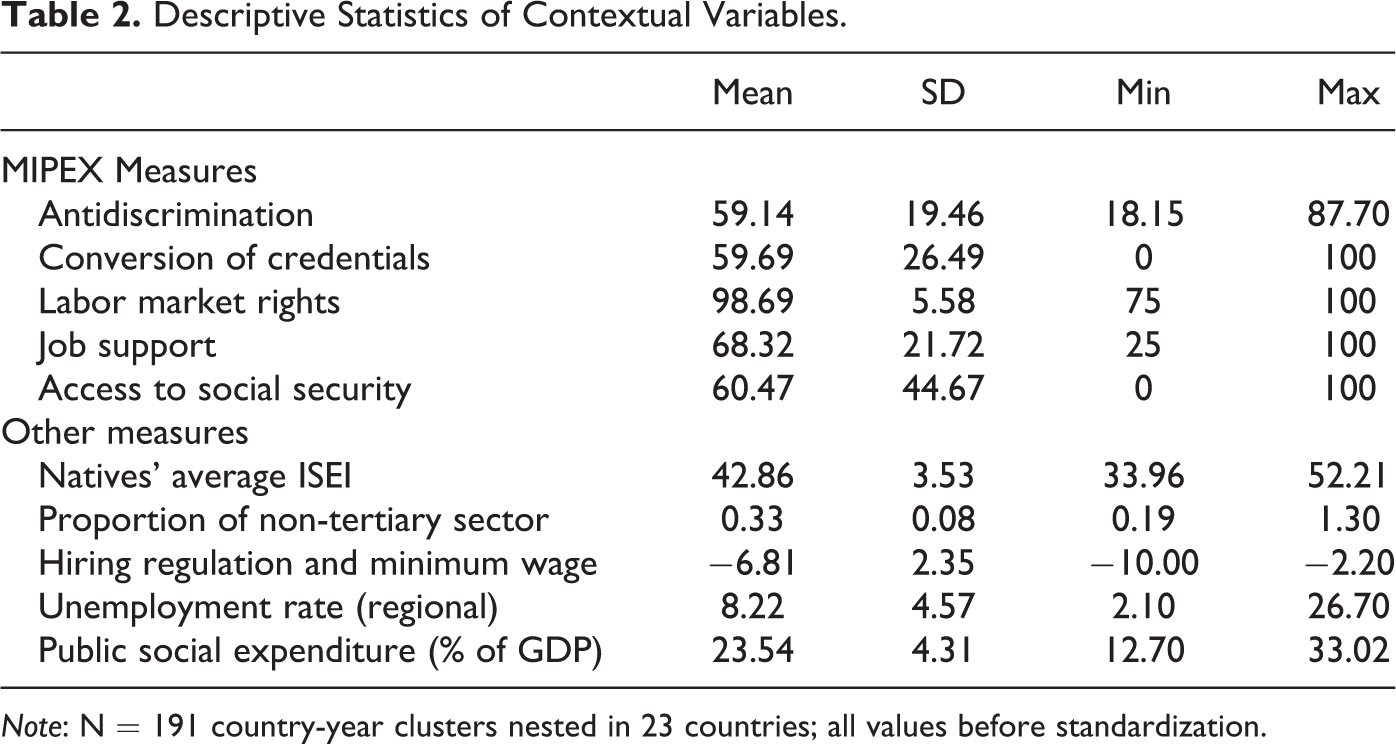
We created four different variables based on the Migrant Integration Policy Index (MIPEX) (Barcelona Centre for International Affairs and Migration Policy Group, 2010). MIPEX draws on expert reports and measures the extent to which third-country nationals enjoy the same conditions as nationals across different domains. Our four measures operationalize the institutional factors we aim to test and relate to the period under study.
Job support is measured as the average of two items: “access to public employment services” and “equality of access to education and vocational training” to capture the degree to which policies provide immigrants with support to find the best matching jobs in the labor market.
Labor market rights comprise an average of “membership of and participation in trade union associations and work-related negotiation bodies” and “guaranteed equal working conditions.” This variable is intended to capture the extent to which immigrants enjoy equal working conditions and are equally empowered to have their interests represented at the workplace level.
Conversion of credentials is formed of the average of items measuring the “recognition of academic and professional qualifications acquired outside the EU” and “state facilitation of recognition of skills and qualifications obtained outside the EU.”
Anti-discrimination covers 34 single items grouped in the following four categories: definitions and concepts, fields of application, enforcement mechanisms, and equality policies. It is a largely legal concept that captures, for example, the grounds on which anti-discrimination legislation operates and the degree to which minorities are informed and supported to take their case to the justice system.
For evaluating the role of labor market rigidity, we include a measure of labor market regulation based on the hiring regulation and minimum wage measure provided by the Economic Freedom of the World report published by the Fraser Institute (Gwartney, Lawson, and Hall 2013). This index, derived from employer surveys, measures (i) whether fixed-term contracts are prohibited for permanent tasks; (ii) the maximum cumulative duration of fixed-term contracts; and (iii) “the ratio of the minimum wage for a trainee or first-time employee to the average value added per worker.” We reverse-code the measure so that larger values represent greater rigidity.
In line with the theoretical arguments outlined above, we include the size of the manual sector in each country as a proportion of the overall workforce as a measure of the secondary segment. We also account for different national occupational structures by controlling for natives’ average ISEI, as measured in the ESS, at the country-year level. 6 Controlling for natives’ average ISEI in this way renders our measure of occupational attainment relative to the national context and enables us to capture the extent to which immigrants are prospering net of selecting into different contexts.
We include two further institutional/policy measures in the employment selection equation, allowing us, as discussed, to test the potential disincentive effects associated with welfare state generosity: 1) public social expenditure, as percentage of GDP (from the OECD) and 2) immigrants’ access to social security (from MIPEX, single indicator). In line with empirical findings on the relevance of destination-country unemployment rates on immigrants’ employment chances (e.g., van Tubergen, Maas, and Flap 2004; Fleischmann and Dronkers 2010; Spörlein and van Tubergen 2014), we control for the (within country-year) regional unemployment rate in the selection equation.
Individual-Level Covariates
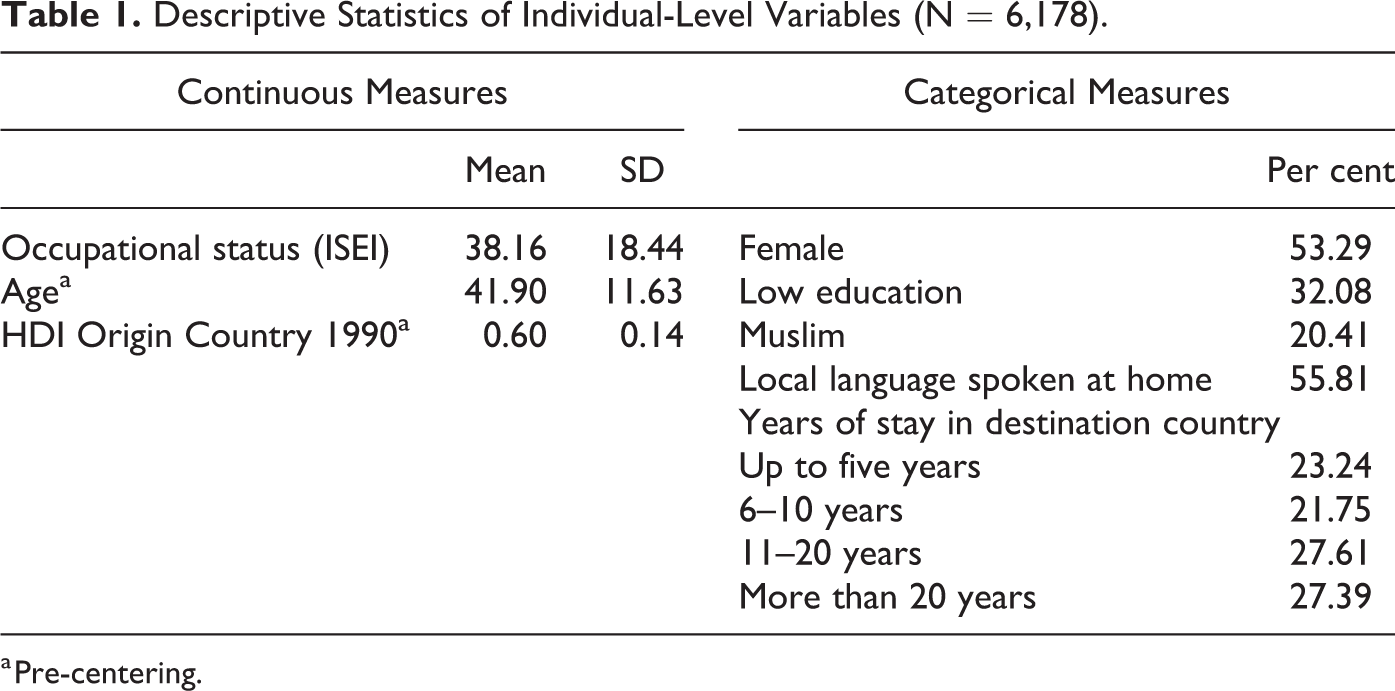
Our key covariate for capturing immigrants’ individual-level skill heterogeneity is level of education, measured using a dichotomous variable indicating lower than upper secondary education compared to higher education levels (i.e., ISCED 0–2 vs ISCED 3–6). While this covariate captures qualifications attained rather than directly measuring skills, we follow common practice in using it as an identifiable proxy for skill level (e.g., Poot and Stillman 2016). To test for specific discrimination and negative stereotyping directed at Muslims, we include a dummy constructed from the question on religion, identifying whether the respondent was Muslim.
Control Variables
We include age and years of residence in the destination country as covariates. The latter is measured in four categories: up to five years; six–10 years; 11–20 years; and 20+ years. To account for relevant differences associated with origin country and the finding that those from poorer and less stable countries fare worse in the labor market (Spölein and van Tubergen 2014; Gorodzeisky and Semyonov 2017), we control for the Human Development Index (HDI) 1990 of immigrants’ birth country, since 1990 approximates the median point in the emigration period. We additionally include a measure of whether the local language is spoken at home. While not fully capturing fluency in the destination-country language, this measure provides some information on capacity in that language (c.f., Maxwell 2010). Since local language spoken at home was correlated with employment, but not ISEI, for both men and women, we restrict it to the employment equation. Finally, we include dummies for ESS survey round in the employment equation.
Model Specification
We estimate a Heckman selection model (Heckman 1979), using full maximum likelihood, with occupational attainment (ISEI) as our dependent variable. ISEI is observed if the respondent is employed and not otherwise. Accounting for selectivity into employment is important because where there is a higher bar to accessing employment, those in work are likely to be more positively selected, which could bias our estimates of policy effects. By taking account of selection, our estimates of occupational attainment are, thus, those which would apply, absent differential selection into a job (see Pichler 2011 for a similar approach, though using a two-step method). We estimate separate models for men and women, given that occupational outcomes and structures are likely to differ across the sexes (Charles 2005). In particular, women are more likely not to be in employment (around half our sample of women); therefore, the selection issues for those women with an observed occupation are more acute.
Our model is estimated as follows:

where

that is, when person j is employed. X and Z are vectors of individual-level variables, and Y and W are vectors of institutional variables. V is the year-specific regional unemployment rate. The correlation between u
1 and u
2 is given by
Both the selection (employed/not) and occupational attainment (ISEI) equations include age, education (high/low), and whether or not Muslim. The ISEI equation includes our key institutional measures of interest and the measure of immigrants’ average ISEI, as well as the measure of origin-country HDI. We identify the employment equation with our measures of regional unemployment rate, social expenditure, and access to social security. 7 We further include an interaction between social spending and immigrant access to social security and adjust for our control variables.
We estimate a series of models to test the role of each institutional factor of interest in turn — namely, job support, labor market rights, job conversion of qualifications, and anti-discrimination policies — and combine them in a single model. We test for the role of labor market regulation and size of the manual sector across all these models and retain the same specification for the selection equation for each. Having evaluated the association between each policy indicator both separately and together, we explore heterogeneity in effects for any measure with a significant association with ISEI. In practice, this analysis of potentially heterogeneous effects only applied to anti-discrimination policies. We interact this measure with educational level and Muslim affiliation in line with our theoretical arguments.
Model Rationale
Despite the popularity of multilevel models in previous research, as noted above, there is increasing attention to some of the problems in using such models to estimate institutional contextual effects. The assumption that the countries considered are a random sample from an overall population is hard to sustain. In addition, as noted, estimates may be biased when using small numbers of observations (Bryan and Jenkins 2016). Multilevel models for data, such as ours, with a relatively small number of countries measured at repeated points over time are often vulnerable to model misspecification (Schmidt-Catran and Fairbrother 2016), and particularly influential cases may drive the results (Van de Meer, Grotenhuis, and Pelzer 2010). We, therefore, employ a simpler specification and estimate models on a pooled sample of (different) individuals across six waves of data, with the institutional factors for the relevant year that the respondent was surveyed as covariates. Although our controls do not exhaust all potential sources of heterogeneity across country contexts, we adjust for key factors that could potentially confound the estimates of the institutional and policy measures of interest. Of course, there are limits to this approach in terms of degrees of freedom, but we strove for a wide set of country indicators, including a range of both institutional and structural features. To avoid underestimating our standard errors for the coefficients, we cluster our standard errors at the country-year level (Moulton 1986). There were 191 country-year clusters nested in 23 countries. Clustering at the country-year level means that we assume that observations are more similar within countries in a given year, avoiding the problems highlighted by Schmidt-Catran and Fairbrother (2016). The application of such clustered standard errors is regarded as a “conservative strategy,” as within-country-year correlation is controlled but not explicitly modeled (Bryan and Jenkins 2016).
For clarity and parsimony, we report only our main parameters of interest below, along with the key statistics on the selection models — namely,
Descriptive Statistics of Individual-Level Variables (N = 6,178).
a Pre-centering.
Descriptive Statistics of Contextual Variables.
Note: N = 191 country-year clusters nested in 23 countries; all values before standardization.
Results
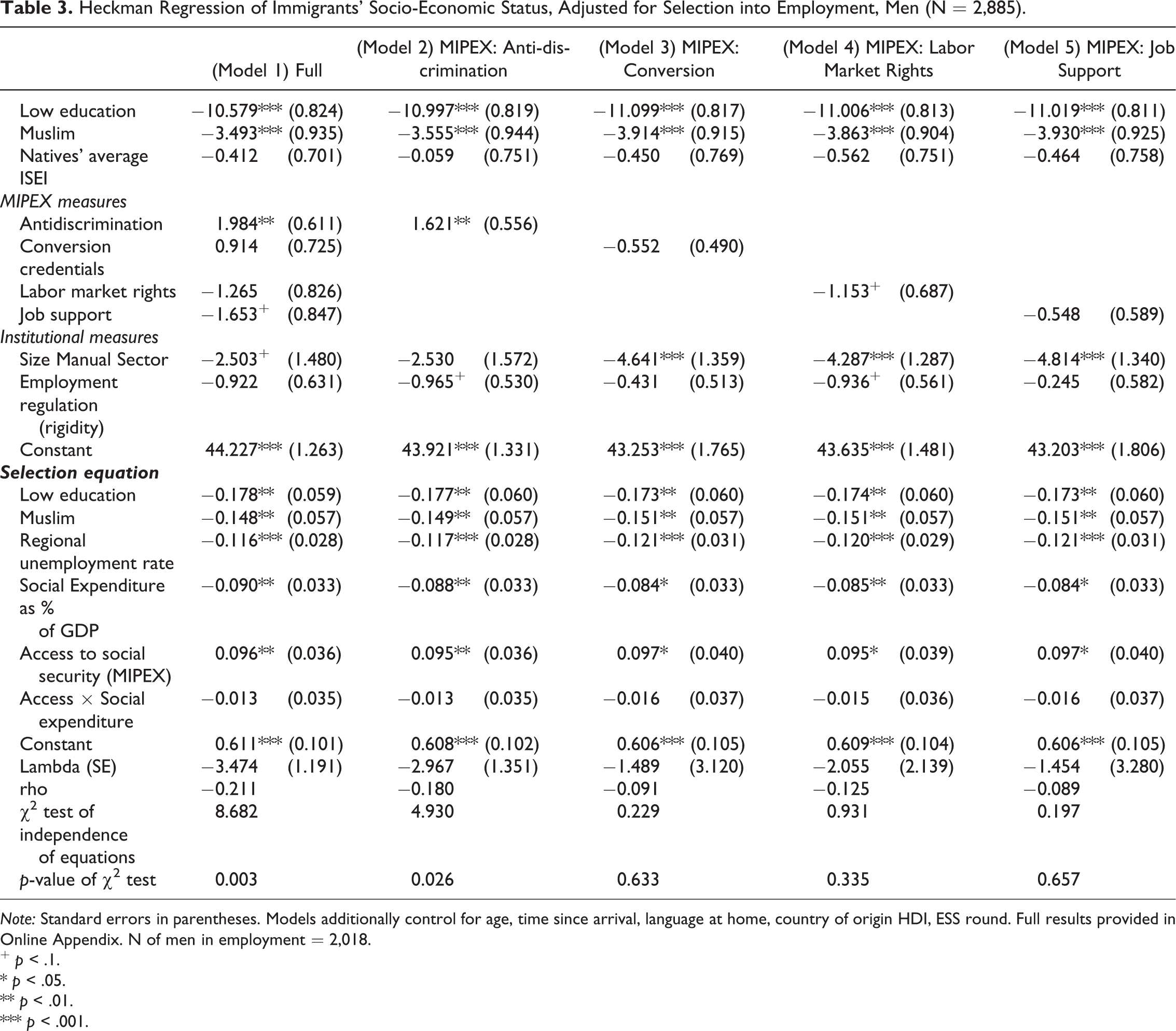
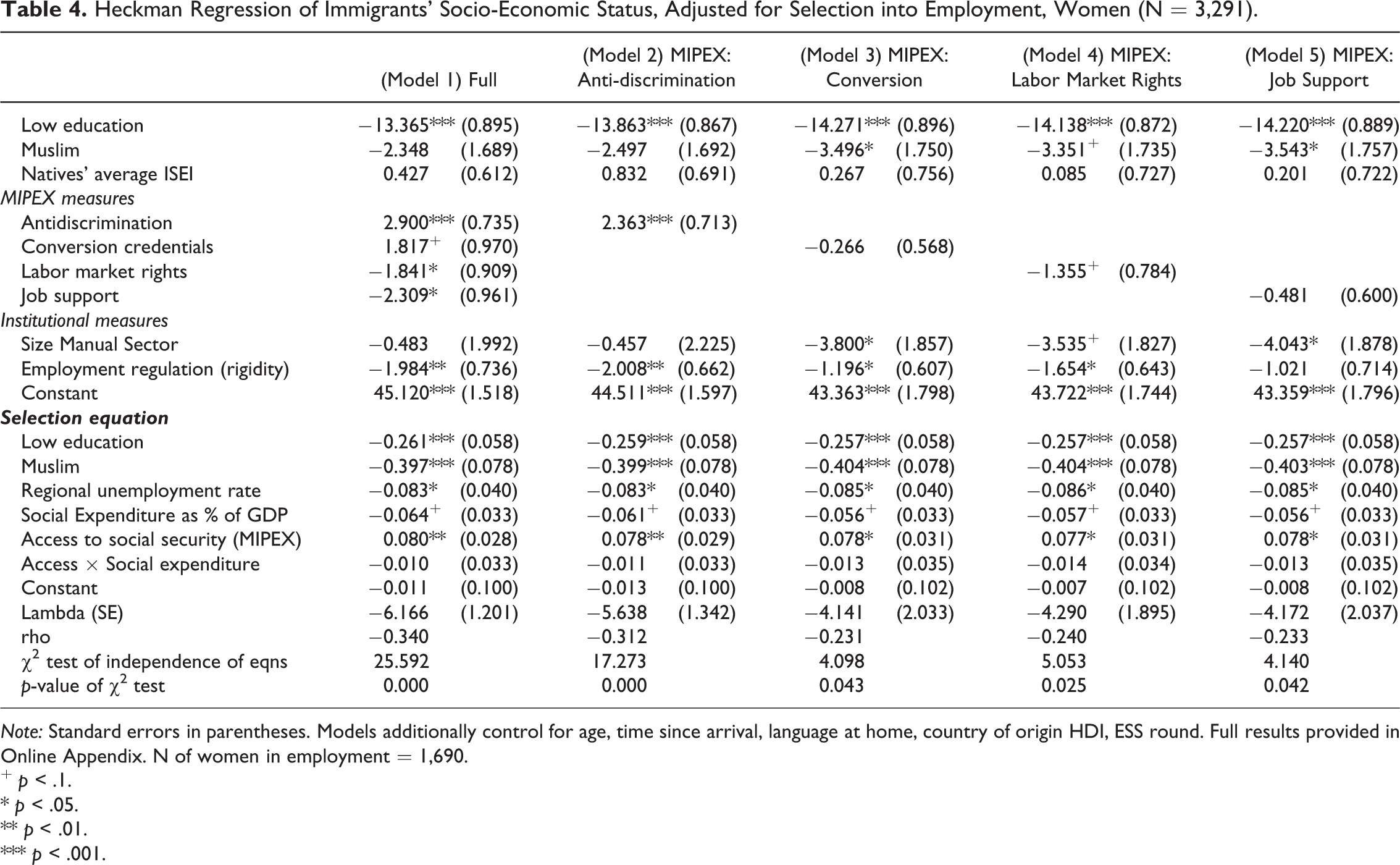
Tables 3 and 4 show the associations, for men and women respectively, of our macro-level variables on ISEI, after accounting for selection into employment. We see from the
Heckman Regression of Immigrants’ Socio-Economic Status, Adjusted for Selection into Employment, Men (N = 2,885).
Note: Standard errors in parentheses. Models additionally control for age, time since arrival, language at home, country of origin HDI, ESS round. Full results provided in Online Appendix. N of men in employment = 2,018.
+ p < .1.
* p < .05.
** p < .01.
*** p < .001.
Heckman Regression of Immigrants’ Socio-Economic Status, Adjusted for Selection into Employment, Women (N = 3,291).
Note: Standard errors in parentheses. Models additionally control for age, time since arrival, language at home, country of origin HDI, ESS round. Full results provided in Online Appendix. N of women in employment = 1,690.
+ p < .1.
* p < .05.
** p < .01.
*** p < .001.
Our main findings, relative to our main theoretical expectations, are rather mixed. Policies supporting conversion of credentials, contrary to our expectations, are not consistently associated with ISEI scores, while labor market rights show a negative, rather than positive, association. It is possible that labor market rights are associated with aspects of labor market rigidity not captured by our measure of labor market regulation, which shows the expected negative effects, though it is only statistically significant at the 5 percent level for women. Job support is associated with ISEI in the full model, but not found in the separate models. Again, the association is negative, possibly indicating a remedial role of job support for those with fewer labor market options and, hence, negative productivity signaling (c.f., Kogan 2016). The one area of policy where we find clear and consistent associations with occupational attainment, for both men and women, in both the separate and full models, is anti-discrimination policies.
Among other factors of interest, the manual sector’s size is, as expected, negatively associated with occupational attainment for both men and women, and at the individual level, Muslims have strikingly lower occupational attainment, controlling for other individual-level factors and adjusting for selection into work. This effect is reduced for women when controlling for differences in anti-discrimination polices, suggesting that where such policies are absent, Muslim women fare considerably worse.
Given the consistent results for anti-discrimination policies, we further explored potential heterogeneous effects by interacting anti-discrimination policies with immigrants’ skill level and whether or not Muslim. As Tables 5 and 6 make clear, the main effect of anti-discrimination policies shows a clear association with higher occupational attainment. However, among men, this positive effect is canceled out for both Muslims and those with lower educational levels. For women, the main negative effect of being Muslim on ISEI attainment is not consistent, and unlike their male counterparts, female Muslim immigrants appear to benefit, along with other female immigrants, from anti-discrimination policies. Immigrant women with low educational levels also cannot be differentiated from immigrant women with higher educational levels in reaping the benefits of anti-discrimination legislation (the interaction effect is small and statistically insignificant). The differences in findings for immigrant women compared to immigrant men may relate to the fact that immigrant women’s occupational settings differ from those of men. Thus, immigrant women with lower educational levels may be less segregated from other women and, hence, benefit more from anti-discriminatory policies, which can affect organizational cultures.
Heckman Regression of Immigrants’ Socio-Economic Status Adjusting for Selection into Employment: Heterogeneous Effects of Antidiscrimination Policies, Men (N = 2,885).
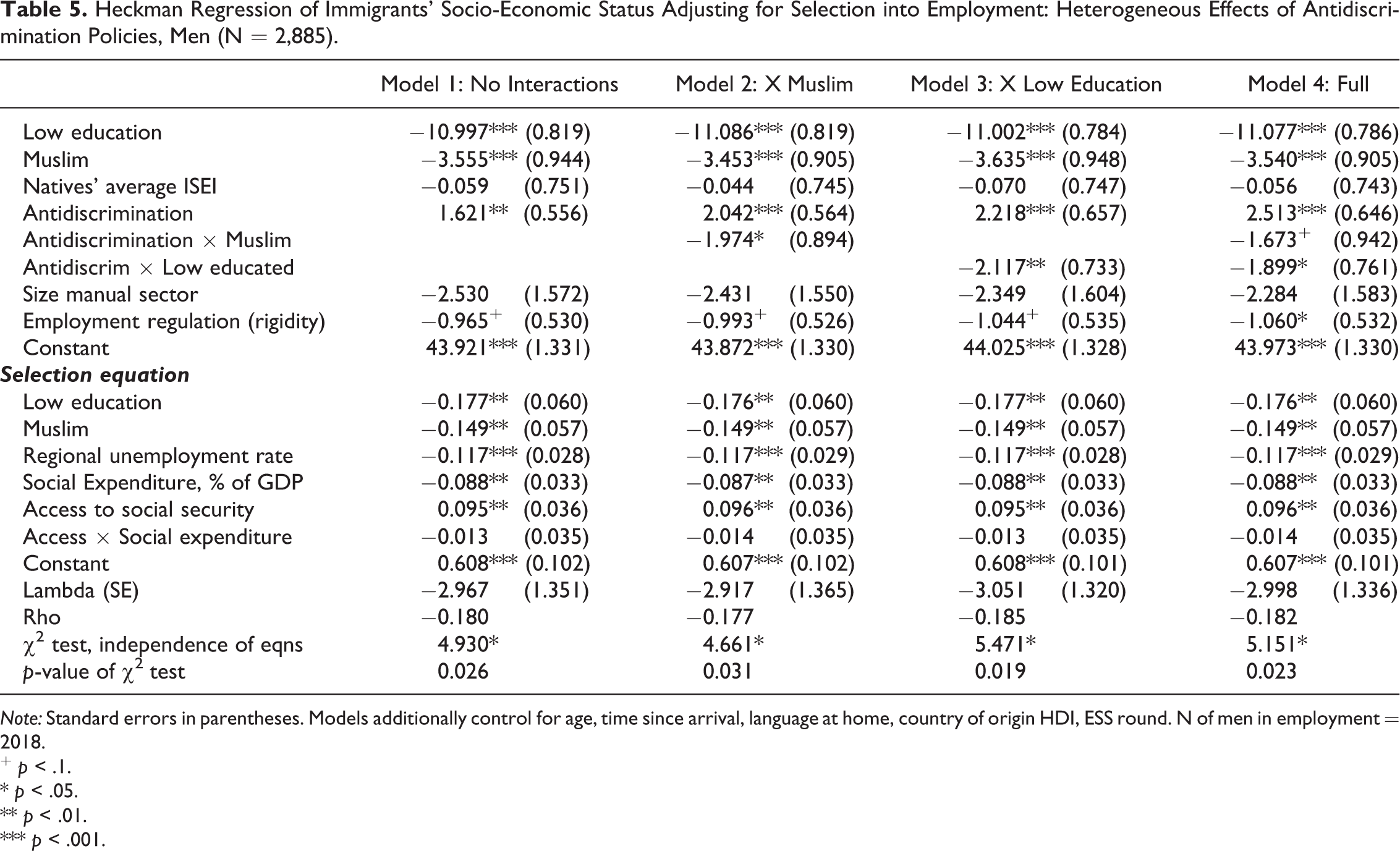
Note: Standard errors in parentheses. Models additionally control for age, time since arrival, language at home, country of origin HDI, ESS round. N of men in employment = 2018.
+ p < .1.
* p < .05.
** p < .01.
*** p < .001.
Heckman Regression of Immigrants’ Socio-Economic Status Controlling for Selection into Employment: Heterogeneous Effects of Antidiscrimination Policies, Women (N = 3,291).
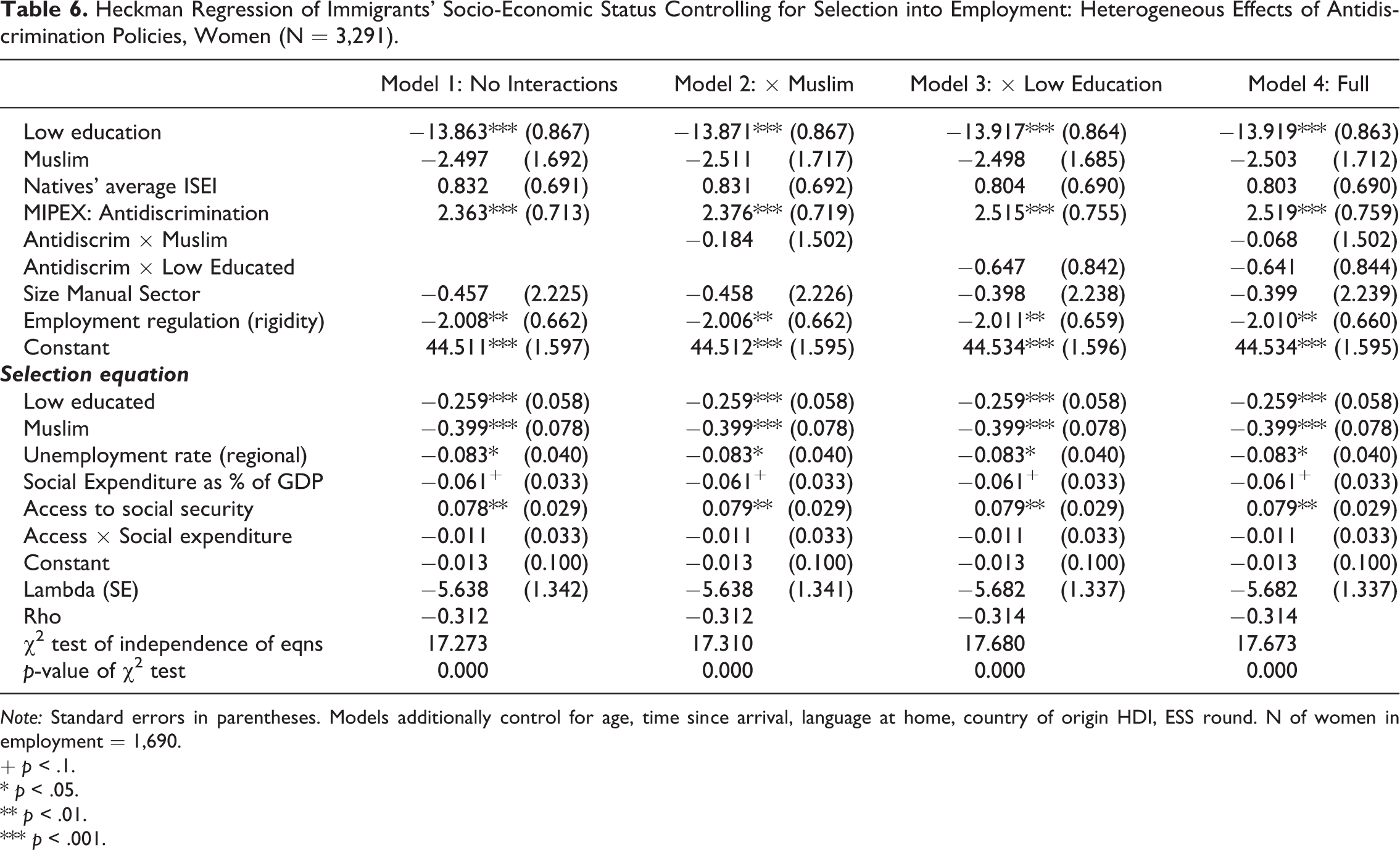
Note: Standard errors in parentheses. Models additionally control for age, time since arrival, language at home, country of origin HDI, ESS round. N of women in employment = 1,690.
+ p < .1.
* p < .05.
** p < .01.
*** p < .001.
Robustness
We carried out a number of robustness checks to assess the sensitivity of our analysis to different assumptions and specifications. To test for influential outliers, we re-estimated our main models, excluding each country in turn. Our results were robust to these exclusions. As already mentioned, a noted concern with using the ESS to analyze immigrant outcomes is the fact that it does not translate the instruments into minority languages unless those minority languages are spoken by 5 percent or more of the population. This restriction has the potential to bias the results if those without sufficient destination-country language fluency to participate in the survey are systematically associated with both the outcome of interest and key independent variables. It is, of course, likely that destination-country language fluency will be associated with occupational outcomes, even after selection for employment. However, it is not clear whether it is likely to confound the relationship between policy measures and occupational outcomes (net of other observables and institutional controls). To address this issue, we implemented a number of checks. First, we collated information on the numbers of those in each country-round who were excluded from the issued sample due to language. We estimated the ratio of these cases to all first-generation immigrants (from all countries) in each country-round (see Table A1 in the Online Appendix). From these ratios, we created normalized weights (centered at 1, with a range from 0.9 to 1.27) to adjust for the probability of inclusion. We then re-estimated our full models, adjusting for these weights. Since we do not know the sex of those excluded, we estimated the weight for all immigrants and used the same weights for the analysis of both men and women. Results are provided in Tables A2 and A3 in the Online Appendix and show that despite some small changes in the coefficients, our main results hold, indicating that the exclusions are not biasing the relationship between our policy measures and occupational outcomes adjusted for employment. Second, given that local language fluency increases with time in the destination country (Carliner, 2000; Akresh 2006; Aleksynska and Algan 2010), we reanalyzed our models, restricting our sample to those with longer durations of stay (>5 years), among whom there should be fewer differences in destination-country language fluency by country-cohort. Third, we re-estimated our main models, restricting the sample to those who spoke the destination-country language at home, for whom, again, differences in language exclusions by country-cohort should not apply. Our findings (provided in Tables A4–A7 in the Online Appendix) were robust to these restrictions, again indicating that selection bias was not driving our results.
Conclusions
Immigration to Europe from diverse societies has been posited as an important integration challenge (Alba and Foner 2015). European societies devote substantial resources to developing and monitoring immigrant integration policies, though typically without clear evidence of their impacts (Joppke 2007). To gauge the effectiveness of such policies, comparative evidence is needed. Yet there is relatively little cross-country research on the effects of policies and institutions on immigrant economic integration in Europe, and the evidence produced to date has been inconclusive (e.g., Fleischmann and Dronkers 2010; Pichler 2011; Gorodzeisky and Semyonov 2017). In this article, we exploited individual variation in immigrant labor market performance across 23 European countries over a 10-year period preceding the current “migrant crisis.” By using disaggregated policy indices, allowing for heterogeneous policy effects, and focusing on occupational attainment, while accounting for selection into employment, we provide fresh insights into the conditions that can foster relatively better economic outcomes for both lower and higher-skilled immigrants. This insight is important as policy-makers and researchers attempt to identify which policies actually increase immigrant economic incorporation.
Alongside limited support for a number of policy effects, we found a negative association between labor market rigidity and immigrant occupational scores, as well as a strong positive association between anti-discrimination policies and immigrant occupational attainment. The effect of anti-discrimination policies was, however, heterogeneous: it benefited all women equally but, among men, was limited to those who were higher skilled and not Muslim.
Our article contributes to the literature on international migration, both conceptually and empirically. We developed specific theoretical arguments as to how policies can influence the way in which employers treat third-country nationals by linking macro-level policies and institutions to employers’ micro-level behavior. Moreover, we reported relevant new evidence on the potential for policies to promote immigrant integration. In particular, we distinguished among three types of policies potentially affecting immigrant performance in European labor markets: 1) those that help immigrants better signal their (actual or potential) skills (i.e., accreditation and job-support policies); 2) those that target discrimination practices directly (anti-discrimination and equal right policies); and 3) those that reduce (increase) employer incentives to draw on statistical discrimination by facilitating (hindering) the use of flexible forms of employment (labor market policies).
As we argued, anti-discrimination policies could not only affect the direct costs to employers of discriminating against immigrant employees but also have an indirect impact on organizational cultures to facilitate immigrant access to better jobs and career prospects. We suggested that such positive effects of anti-discrimination policies were more likely to benefit more skilled immigrants seeking access to less segregated occupational sectors and with greater potential for advancement. Our results support these skill-heterogeneous impacts of anti-discrimination policies for men and indirectly suggest that policies have the potential to create cultural shifts in employers’ and managers’ willingness to discriminate.
Our finding that male Muslim immigrants do not benefit from anti-discrimination policies could suggest that discrimination against this group is based on distastes that are sufficiently strong to outweigh other considerations. In other words, European employers appear willing to incur opportunity costs in acting on their prejudices against this group of immigrants. Anti-Muslim discrimination may be more widely accepted socially than other forms of racial or ethnic prejudice (Creighton and Jamal 2015). An alternative explanation would be that Muslim men’s employment is highly segregated in ethnic enclaves that restrict occupational opportunities regardless of the policy context (e.g., Koopmans 2015). The potential for anti-discrimination cultures to take root and inform treatment may also be stronger for less, rather than more, marginalized groups. Segregation and discrimination processes are mutually reinforcing, so both explanations are plausible. In any event, this finding is relevant to European policy-makers, particularly given concerns about widespread Islamophobia (Strabac and Listhaug 2008) and employment discrimination against Muslim men in Europe (Di Stasio et al. 2019).
The effect of anti-discrimination policies on women differed. Muslim women did not face a statistically significant additional occupational disadvantage, compared to other women, once anti-discrimination policies were controlled for, indicating that they benefited equally with other immigrant women from anti-discrimination policies. The evidence reported in this article, therefore, suggests that anti-discrimination polices fail to reach immigrant Muslim men, while highlighting their potential to reach immigrant Muslim women, a group that has been regarded as particularly vulnerable to labor market exclusion (Khoudja and Platt 2018).
We also examined the potential disincentive effects of generous welfare provision on employment by looking at two further institutional characteristics of destination countries: welfare expenditure as a proportion of GDP and policies that facilitate immigrant access to social security benefits. Interestingly, we found no evidence for the interaction between generosity and access, which would constitute a meaningful “magnet.” This finding offers an important caution to popular associations of immigration with welfare usage. The results relating to the impacts of the manual sector’s size on occupational outcomes and the effect of regional unemployment rates on immigrant employment chances both are consistent with our expectation and earlier research (e.g., van Tubergen, Maas, and Flap 2004; Kogan 2006) and confirm that macro-level variation in economic structures and conditions co-determine immigrants’ labor market opportunities in Europe.
As with other attempts to identify policy effects from exploiting cross-national policy and institutional variation, this article cannot claim to establish causality, which is the main limitation of our approach. Yet, while extant research has typically used highly aggregated measures of integration polices, multiple-measure indices, or stylized regime “types,” making the direct implications hard to spell out (e.g., Cebolla-Boado and Finotelli 2015; Corrigan 2015), we have identified specific policy and institutional dimensions by grounding them in explicit theoretical expectations regarding employer behavior. This theoretical link between fine-grained, macro-level policies and institutions, on the one hand, and micro-level behaviors, on the other, makes causal interpretations of our estimates somewhat more plausible. Such plausibility is further reinforced by the robustness of our estimates to alternative specifications and various tests for potential selection bias due to the ESS language restriction – an issue that has received limited attention in extant research.
In terms of the policy implications of our findings, we conclude that the best policy mix for increasing first-generation immigrants’ labor market performance in Europe is one that combines labor market flexibility, to ensure access to occupational opportunities, with anti-discrimination policies, to foster cultures of inclusion and enable immigrants to fulfill their potential and contribute in line with their skills. Our findings also suggest that equal access to social security benefits may help, rather than hinder, immigrant economic integration. Finally, additional measures to improve the occupational attainment of unskilled male immigrants and male Muslim immigrants seem sorely needed for these two sizable groups of immigrants in Europe (Frattini and Campa 2020).
Our findings also have implications for the wider study of international migration. They highlight the need to consider heterogeneity among immigrants when evaluating immigration policies. They also illustrate the analytical purchase that can be gained from more precisely specifying the potential link between institutions and policies and those specifically targeted by those outcomes. Finally, while much research addressing immigrant economic integration focuses on employment or occupation separately (e.g., OECD 2018), we make the case that occupational outcomes accounting for selection into employment and relative to the occupational distribution in destination countries may represent a better measure of successful immigrant incorporation in the longer term, with implications also for succeeding generations.
Supplemental Material
Supplemental Material, sj-pdf-1-mrx-10.1177_01979183211032677 - Which Integration Policies Work? The Heterogeneous Impact of National Institutions on Immigrants’ Labor Market Attainment in Europe
Supplemental Material, sj-pdf-1-mrx-10.1177_01979183211032677 for Which Integration Policies Work? The Heterogeneous Impact of National Institutions on Immigrants’ Labor Market Attainment in Europe by Lucinda Platt, Javier Polavieja and Jonas Radl in International Migration Review
Footnotes
Author's Note
Jonas Radl is also affiliated with WZB Berlin Social Science Center, Germany
Acknowledgments
We are grateful for the helpful and insightful comments of the anonymous referees and from the editors of the International Migration Review. We thank Louis Klobes and Laura García Llamas for research assistance.
Declaration of Conflicting Interests
The author(s) declared no potential conflicts of interest with respect to the research, authorship, and/or publication of this article.
Funding
The author(s) disclosed receipt of the following financial support for the research, authorship, and/or publication of this article: This study received financial support from the project New Approaches to Immigration Research, NewAIR, funded by the Spanish State Research Agency (CSO2016-78452).

Supplemental Material
Supplemental material for this article is available online.
Notes
References
Supplementary Material
Please find the following supplemental material available below.
For Open Access articles published under a Creative Commons License, all supplemental material carries the same license as the article it is associated with.
For non-Open Access articles published, all supplemental material carries a non-exclusive license, and permission requests for re-use of supplemental material or any part of supplemental material shall be sent directly to the copyright owner as specified in the copyright notice associated with the article.
