




Abstract
What drives people to migrate? Amid a stark increase in international migration at the global scale, we lack individual-level evidence that causally adjudicates between migration’s many drivers. We implement a survey experiment in Northern Lebanon—a hotbed of international migration—to a random sample of 1,000 Syrian refugees and 1,000 Lebanese residents. Respondents were shown the profile of a hypothetical Syrian refugee and asked whether they recommended that the refugee migrate to the European Union. The vignette randomly primed five prominent causes of migration, including push factors (political instability and poverty) and pull factors (open borders, employment opportunities, and cultural openness). We find that pull factors outweighed push factors, suggesting that migrants carefully weigh their chances in Europe. Still, all five primes yielded positive effect sizes, which underlines that prominent theories of migration are complements, not substitutes. Taken together, the evidence suggests that empirical models of migration can be improved if they take into consideration both pull and push factors, rather than prioritizing one over the other.
What drives individuals to migrate? Migration’s causes are a core research topic in the social sciences (Cornelius and Rosenblum 2005; Peters 2017). Many studies use the nation-state as the unit of analysis and correlate explanatory variables such as poverty or political instability with the share of emigrants (Mosley and Singer 2015; FitzGerald and Arar 2018; Blair, Grossman, and Weinstein 2019). Migration, however, is a decision taken by individuals or families, as potential migrants carefully weigh whether to stomach the risks of migration. Yet few studies have marshaled reliable individual-level evidence that can causally adjudicate among migration’s many drivers (e.g., Fafchamps and Shilpi 2013; Holland et al., 2020).
This article provides fine-grained evidence from a survey experiment in Northern Lebanon—a hotbed of international migration (MPC 2013, 1; EU 2015). Drawing a random sample of 1,000 Syrian refugees and 1,000 Lebanese citizens, we asked respondents to evaluate a vignette of a Syrian refugee in order to probe five prominent causes of migration. Specifically, the vignette varied whether push factors (political instability and poverty) or pull factors (open borders, employment opportunities, and cultural openness) were primed. Our outcome of interest is whether respondents recommended that the hypothetical refugee migrate.
Our results show that pull factors, particularly cultural openness and employment opportunities, positively affected respondents’ propensity to recommend migration. Both primes led to a treatment effect of roughly 0.2 standard deviations, a substantively meaningful size given rather mild experimental primes. Push factors, too, yielded positive effects, though they were comparatively smaller and less precisely measured. Thus, our findings imply that prominent theories of migration are complements, not substitutes. Empirical models of migration are, we suggest, arguably more complete if they take into consideration both pull and push factors, rather than prioritizing one over the other.
The remainder of this article is organized as follows. The Theoretical Motivation section discusses our pre-registered 1 theoretical hypotheses regarding the effect of pull and push factors on migration intentions and introduces expectations about subgroup heterogeneity. The Design section introduces our empirical design, including the population, sample, survey experimental treatments, outcome measures, and empirical model. In the Results section, we discuss the key experimental results, while the Heterogeneity section explores treatment effect heterogeneity.
Theoretical Motivation
What variables can explain why some individuals migrate, while others do not? This article revisits five salient (pre-registered) drivers of migration, broadly classified into “push factors” and “pull factors” (Hare 1999). There are undoubtedly additional factors that shape whether an individual decides to migrate. This article, however, focuses on five particularly prominent causes that are not only commonly debated in the scholarly literature but also carry importance in Northern Lebanon (Hourani and Sensenig-Dabbous 2007, 16).
Before delving into the theoretical drivers, two words of caution are in order. First, the decision to migrate is not always a voluntary one (Neumayer 2005, 391–92). Refugees, in particular, have no other choice but to migrate (Edwards 2016). Our setting and sample – Syrian refugees and Lebanese residents in Northern Lebanon – can, thus, only meaningfully illuminate the decision-making process of potential migrants who have a choice whether to migrate. 2 Our empirical focus is, therefore, on potential migrants. Second, our theoretical focus is on individual-level perceptions of salient push and pull factors. There are undoubtedly other household- or community-level variables that affect individuals’ propensity to migrate (Massey and Espinosa 1997; Hunter, Luna, and Norton 2015). Our focus, however, is on individual decision-making, which we explain on the basis of five macro-level factors discussed below.
Push Factors
Political insecurity
The first primary push factor which has led Syrian refugees to migrate to Europe is political instability (Widgren 1990; Campos and Lien 1995; Naudé 2010; Koubi et al. 2018). In March 2011, during the Arab Spring’s height, a revolutionary movement aimed to topple Syria’s president, Bashar al-Assad. The regime reacted with brute force, which paved the way for the ensuing Syrian Civil War (Gabriel and Pinto 2013, 209). The following years saw brutal fighting, which has created a highly volatile political situation and has been the primary cause for Syrian emigration (World Bank 2020, 10). Even so, there is variation in the degree to which Syrians were directly affected by the civil war. Some areas, such as the cities of Homs, Aleppo, and ar-Raqqah, have witnessed continued fighting since 2011, while other areas (e.g., the Tartus Governorate, which borders Lebanon as well as the Mediterranean Sea) have been comparatively peaceful (World Bank 2017a).
While there can be no doubt that Syria’s political struggle is the major cause of emigration, its precise effect on Syrians’ decision-making calculus remains unclear. We also do not know how political instability compares to other salient drivers of migration. What is more, we similarly lack information on whether Syrians are less likely to migrate when political stability improves—a question of great significance to policy-makers and academics alike. Thus, our first testable hypothesis is that political instability increases migration (H1).
Economic poverty
A second and related pivotal push factor which has driven Syrian refugees to migrate to Europe is economic poverty (Massey, Gross, and Shibuya 1994; Stark, Micevska, and Mycielski 2009; Thorleifsson 2016). The war between the Syrian regime and the “Free Syrian Army” has shattered the Syrian economy (Devadas, Elbadawi, and Loayza 2019, 2). At the time of conducting the research, Syria remains effectively cut off from international markets (Suliman and Khwanda 2020, 15), international investments have come to a standstill, and the destruction of many cities has minimized economic activity (UNESCWA 2017; World Bank 2017a). There is, however, pronounced variation in the degree to which economic activity has been reduced. Areas around the capital, Damascus, have survived the war with comparatively less pronounced economic repercussions, while economic activity in the city of Homs has virtually come to a halt (World Bank 2017a). Poverty is, thus, a major explanatory variable with significant variation and a second important driver of migration in our study context.
That said, scholars disagree on poverty’s importance in driving individuals to migrate. On one hand, a variety of studies have found that economic hardship does not predict refugee migration (Schmeidl 1997; Davenport, Moore, and Poe 2003). Others, by contrast, have found a positive link between poverty and migration (Morrison 1993). What role economic poverty plays in the Syrian context, and how it compares to other drivers, is a question of significant importance (Weiner and Munz 1997). Our second (pre-registered) hypothesis is, therefore, that economic poverty increases migration (H2).
Pull Factors
Border openness
A first important pull factor that undergirds Syrians’ decision to migrate is the openness of borders in European countries. A variety of scholarly accounts would lead one to believe that open borders are a pivotal pull factor that explains why potential migrants decide to embark on their risky journeys (Haus 1995; Rudolph 2003; Léonard 2010; Peters 2015). A historic case in point is Germany’s recent decision to take a remarkably open stance toward refugees. In 2015, Chancellor Angela Merkel insisted that Germany’s borders should not be closed amid an increasing influx of refugees. By the end of 2015, Germany was witnessing an average of 10,000 refugees arrive every day (BAMF 2015). 3 Other examples purporting to show a link between border openness and migration come from the United States, Australia, and Spain. Ackleson (2005), for instance, studies the United States and shows that the framing of migrants as a “threat” by state and society led to a sharpening of border security in the 1990s with the intention to curb migration.
There is little doubt that countries in Europe and elsewhere increasingly engage in border fortification (Hassner and Wittenberg 2015; Carter and Poast 2017). Skepticism remains, however, as to whether such fortification has any impact on potential migrants’ decision on whether to migrate (Press 2017, 15; Schewel 2019, 338). Tighter borders may simply shift migration to other ports of entry (Getmansky, Grossman, and Wright 2018). Moreover, there is evidence that border fortification increases migration, while inhibiting migrants from returning to their home countries (Massey, Pren, and Durand 2016). Whether perceptions about border openness affect potential migrants’ decision to migrate is, thus, an unsettled empirical matter, as is how such perceptions compare to the two aforementioned push factors. To address these lingering questions, our third hypothesis is that open borders increase migration (H3).
Employment opportunities
A second prominent pull factor concerns possible employment opportunities of migrants in Europe. Thriving labor markets should increase potential migrants’ propensity to migrate (Stark and Bloom 1985; Beegle, De Weerdt, and Dercon 2011). Many Syrian refugees, however, feel forced to migrate (World Bank 2017a, 2017b, vii); economic considerations may, thus, be less prominent. In fact, few Syrian refugees, as our own qualitative interviews regarding the drivers of emigration in Northern Lebanon 4 demonstrated, migrate primarily for economic reasons. Even so, it would not be surprising if refugees preferred countries where they stood a greater chance to obtain secure employment. Equally important, since refugee access to the labor market varies starkly across Europe, it is an especially prominent explanatory variable (Martín et al. 2016).
The scholarly debate has pointed to employment opportunities as a primary driver of migration (Kogan 2003; Fitzgerald 2009; Corluy, Marx, and Verbist 2011), including in the Mediterranean region (Tsourapas 2018). In a similar vein, development aid is often specifically motivated on the grounds that it can curb migration by increasing employment in sending nations (Bermeo and Leblang 2015; Lof, Mekasha, and Tarp 2015; Gamso and Yuldashev 2018). Whether employment opportunities in receiving nations affect potential migrants’ decision-making calculus, however, remains an open question. Thus, our fourth hypothesis is that employment opportunities increase migration (H4).
Cultural openness
A final pull factor concerns the degree to which receiving countries are culturally open to migrants. Countries with greater cultural openness should be more likely migration destinations (Vertovec 1996; Masso 2009). The case of Syrian migration to the European Union (EU) is emblematic in this regard. In 2015, Germany witnessed the influx of over one-million refugees, while Hungary saw as many as 350,000 refugees pass through, but not stay in, its territory (Kallius, Monterescu, and Rajaram 2016). The relatively large refugee influx into Germany is commonly attributed to a welcoming attitude among German leadership, as well as to civil society at large (Adida, Lo, and Platas 2019), while the opposite was the case in Hungary. Even so, most European countries have witnessed the rise of right-wing parties, which push for more restrictive immigration policies (Kriesi et al. 2006; Rydgren 2008). While much is known about the drivers of host-country citizens’ preferences toward migration (Goldstein and Peters 2014; Hainmueller and Hopkins 2014), evidence on potential migrants’ perceptions about host-country openness is currently lacking. In response, our final hypothesis is that cultural openness increases migration (H5).
Heterogeneity
Besides the five pre-registered hypotheses described above, the context in Lebanon also allows one to form hypotheses for which subgroups the potential drivers should be particularly salient. We make six conjectures in this regard that map onto the five experimental primes. 5
First, political instability in the home country may be more likely to drive migration among very vulnerable groups, as compared to individuals with a moderate economic safety net. Without resources, it is virtually impossible for a potential migrant to protect their family against violence in a war-torn state (Brückner et al. 2016, 4; World Bank 2020, 13). Poorer individuals also tend to be less politically connected, exposing them to a greater degree to insecurity (Press 2017, 9). By contrast, wealthier, more connected individuals have more options to buy security (Haddad 2011, 53), leading one to expect that political instability is a more likely driver of migration among relatively poor individuals.
Second, poverty in the home country may, conversely, be a more pronounced driver among relatively wealthy individuals. Individuals with a greater economic safety net may seek to invest their capital in an environment that is economically fertile and may, therefore, be pushed out of their home countries when the economy is in ruins. By contrast, individuals without economic resources may not react strongly to increased poverty, since it marks a constant feature of their lives. Evidence for this conjecture comes from studies of emigration from sub-Saharan Africa, which consistently find that the middle class is most likely to emigrate (Hagopian et al. 2004, 7; Adepoju 2008, 29).
Third, open borders should be a particularly important driver among migrants who are not in a physical and mental position to cross a border using illegal means or who prefer not to take such risks. Crossing borders illegally – notably in Hungary or via the Mediterranean Sea – is a highly risky, stressful, and dreadful experience (Press 2017, 1; UNOCHA 2017, 10). One would, therefore, expect women, particularly when they have children, to be more likely to migrate when borders are relatively open. By the same token, individuals with low risk preferences may also react more strongly to open borders (Calavita 2006, 111; Schewel 2019, 342).
Fourth, employment opportunities should be particularly important to potential migrants with a greater degree of human capital. There is evidence that migrants’ labor market integration is mediated by individual skill level. As Zwysen (2019, 86) notes, “[w]e find that the differences between migrant groups [regarding labor market integration] are particularly large among migrants with low language skills, qualifications that are not recognized in the country and without host country nationality.” Without proper education, potential migrants may not stand a good chance of employment in any case. Educated migrants, by contrast, have a reasonable chance to gain employment, but only if such employment is legally possible in the destination country.
Fifth, cultural openness should hold particular importance, in our empirical setting, for potential migrants of Muslim faith, as opposed to Christian faith. Europeans are predominantly of Christian faith (Große Hüttmann, Wehling 2013; Renger 2020). Muslims may, therefore, fear discrimination on the basis of religion. Evidence for such discriminatory attitudes toward Muslim refugees is provided i.a. in Bansak et al. (2016) and Laitin et al. (2015).
Design
Population
This article aims to assess the drivers of migration among potential migrants. To this end, we study two distinct populations. The first is Syrian refugees in Northern Lebanon. Since the beginning of the Syrian civil war, over a million Syrian refugees have settled in Northern Lebanon (EU 2015; World Bank 2020, 30), and many have since migrated to the EU to apply for political asylum (Adepoju 2008, 23). Others, however, decided to stay. Syrian refugees in Northern Lebanon are, thus, an excellent population to study the drivers of potential migrants’ decision-making. A second population of interest are local Lebanese residents. Given that Lebanese nationals are among the most active migrants in the world (MPC 2013, 2; UN 2019), they constitute a natural comparison group, allowing us to assess the external validity of our findings. 6
We must caution, however, that our evidence can only illuminate migration decisions within the two populations under study. We cannot assess whether the findings translate to other populations. The evidence presented in Holland, Peters, and Sanchez (2020), discussed below, though, points to a broadly similar picture. We should also note that our population is rather “elastic,” by which we mean that our analysis focuses on populations of potential migrants that are more likely to react to the experimental primes we lay out below. We confirm this migration elasticity in Figure A3, which shows that we see no effects among relatively older respondents for which migration is less likely to be an option.
Sample
To try to obtain a representative sample of Northern Lebanon’s Syrian refugee and Lebanese resident population, we employed a multi-stage random sampling method (for details, including the discussion of a small, inconsequential coding error, see Appendix Section 1.3). Our primary sampling units (PSUs) are 1 km x 1 km grids, which we superimposed onto our sampling area. We then drew a random sample of PSUs, weighted by the size of the Syrian refugee and Lebanese population, respectively. Within selected PSUs, we recruited a number of respondents proportional to the number of inhabitants. Households were chosen by means of a random walk. Individuals within households were also chosen at random. The pre-registered survey was implemented by the survey firm REACH from October to December 2017 and administered face-to-face in Arabic by professional enumerators. The final samples are shown in Figures 1a and 1b. The descriptive statistics are discussed in Appendix Section 1.1.
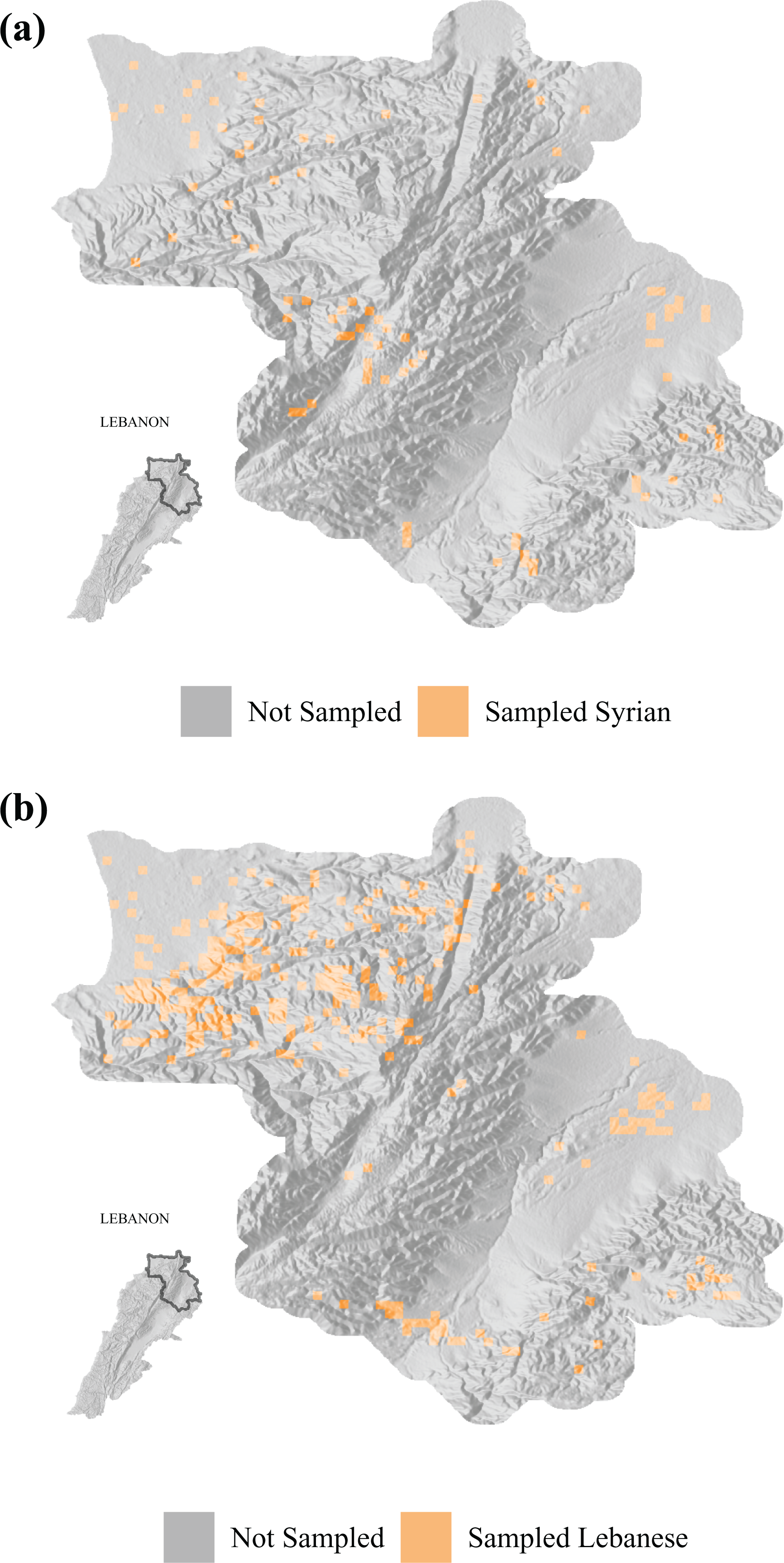
Maps of final samples in Northern Lebanon (a) Syrian sample; b) Lebanese sample).
Construct Validity
Before introducing our vignette design, three potential objections toward survey experiments deserve critical reflection. First, one may object that survey primes cannot meaningfully shed light on the true causal drivers of migration. There can be no doubt that actual changes in, say, the economic climate or strictness of border controls are what drive the decision to migrate. At least three reasons, however, make survey experimental primes a useful method to explore the effects of push and pull factors on this decision. First, respondents learn about real-world changes to structural factors through the media, by word-of-mouth, or other informal channels. Few migrants witness firsthand whether border controls are tightened or whether the labor market is open. Potential migrants, in other words, base their decision-making process on perceptions. The vignette was specifically modeled to capture this process. Second, research designs that explore the effects of true changes in push/pull factors (e.g., a change in economic conditions) run the risk of falling victim to unobserved confounding. Survey experiments, by using random assignment, circumvent this problem and allow one to delineate clear causal relations. Third, even if one were able to dissect the effect of one push or pull factor on migration, it is exceedingly hard to do so for several factors in unison. The vignette’s virtue is that it can adjudicate between several factors—mentally activated using primes—at once. Activating several factors at once is important inasmuch as potential migrants consider a variety of push and pull factors at the same time.
Second, one may be concerned that the vignette, as we detail below, introduces a hypothetical refugee, Mohamad, as well as a hypothetical friend, and then asks whether respondents would recommend that Mohamad migrate. The decision to use a hypothetical scenario was based on ethical grounds. Given the highly volatile situation in Northern Lebanon, we did not deem it ethical to expose respondents to the fate of a real migrant. In a similar vein, we decided against providing true information, rather than hypothetical information from a friend. Providing true information could conceivably have led individuals to migrate (or not). Such tampering with individuals’ lives in a volatile setting struck us as unethical. For this reason, we used a hypothetical scenario and asked about a hypothetical recommendation. Another advantage of this design is that it leads individuals to objectively contemplate the potential migrant’s fate, reducing personal biases to the extent possible. Reassuringly, as we detail below, the primes did not have an effect on respondents’ own migration calculus.
Third, one may be concerned that a vignette priming five factors will be too long and may lead to survey satisficing (i.e., fatigue). To tackle this concern, we pre-tested the vignette extensively and verified that respondents clearly understood all statements and were able to recall important pieces of information. We also inquired whether any statement struck respondents as factually wrong, which was not the case. We, therefore, decided to include five primes in order to jointly test five salient and distinct drivers of migration. Providing information on several relevant drivers also arguably comes closest to the decision-making process Syrian refugees face. In qualitative interviews, we learned that the five primes represent key considerations on individuals’ minds. The fact that we observe pronounced treatment effects (more below) shows that the primes worked.
Treatment
After eliciting a number of individual-level covariates, respondents were asked to evaluate the profile of a hypothetical Syrian refugee named Mohamad. The vignette read as follows: Now, we would like to introduce you to a hypothetical Syrian refugee named Mohamad. Mohamad is 24 years old. He has been contemplating whether to migrate toward the European Union to apply for asylum. Friends told Mohamad that refugees are [
Regarding pull factors, we randomized three primes. First, we varied whether certain European countries had recently put in place more or less strict border controls. At the time of the survey, some European nations, notably Nordic countries, continued to accept large numbers of asylum-seekers. By contrast, countries such as Hungary had publicly stated they would not accept any refugees. Second, we varied whether refugees stood a good or poor chance of gaining full-time employment in the EU. This prime, too, mapped neatly onto refugees’ actual experience in Europe. In Nordic countries, the labor market was relatively strong, while in countries such as Italy or Greece, refugees had little chance to secure stable employment. Finally, we varied whether refugees were welcomed or ostracized in Europe—a prime that juxtaposed positive feelings in some host populations (e.g., Germany; Hager and Veit, 2020) to negative feelings in other nations (e.g., Hungary).
Overall, there were 32 unique vignettes (2^5 – two for each treatment). The vignettes were programmed into the survey software (handheld devices) ex ante, and respondents were randomly assigned to a given vignette. Taken together, our design falls into a broader set of studies using survey experiments to decipher potential migrants’ decision-making. Holland et al. (2020), for instance, use a conjoint experiment to adjudicate what factors make a destination country attractive to migrants. Related, Ferwerda and Gest (2020) use similar experimental primes to parse out the determinants of emigration. More broadly, scholars such as Bansak et al. (2016), and Hemker and Rink (2017) use similar survey experimental techniques to understand attitudes toward migration across Europe.
Outcomes
After the enumerator read the vignette out loud, respondents were asked the following question: “Given this information, what would you advise Mohamad to do?” The answer choices, scored on a 5-point scale, were: definitely not migrate, probably not migrate, unsure, probably migrate, and definitely migrate (average of 3.4). Moreover, respondents were asked: “How about yourself, on a scale from 1 to 10, how likely are you to migrate elsewhere in the coming years?” (average of 5.3). The latter question serves as a placebo outcome, which allows us to assess whether the treatment also affected respondents’ own migration likelihood.
Model
To assess whether the hypothesized macro-level variables—made salient using primes in the vignette—affected individuals’ likelihood to recommend migration, we estimated the following linear model:

where Yi represents our outcome of interest—namely, the answer to the two questions for individual i. The explanatory variables take on the value 1 if respondent i was positively primed (i.e. in line with the respective hypothesis) and 0 otherwise. We estimate the model using ordinary least squares. In line with our pre-analysis plan, our main model includes all covariates presented in Table A1. Additionally, we control for 12 pre-treatment PSU-level variables. Regarding geography, we control for the distance to the nearest road in meters (Road), the distance to the nearest waterway in meters (Waterway), the elevation in meters (Elevation), and a dummy for land use (Landuse). Regarding demographics, we control for population density (Density), distance to the nearest refugee settlement in meters (Settlement), the number of refugees in the nearest settlement (Refugees), and distance to the nearest collective refugee shelter in meters (Shelter). Regarding infrastructure, we control for the distance to the nearest public school in meters (School), distance to the nearest primary and secondary care hospitals in meters (Primary Care and Secondary Care, respectively), and distance to the nearest social development center in meters (Development). All PSU-level variables are reported in Table A3.
Results
Migration Recommendation
In Figure 2, we plot the coefficients and confidence intervals for the five treatment dummies. The left panel demonstrates that respondents were most likely to recommend migration on the basis of positively primed pull factors. When primed with “cultural openness” and “good employment chances,” respondents were 0.19 and 0.17 standard deviations, respectively, more likely to recommend migration. The push factors (i.e., priming respondents with economic poverty and political instability) also show positive effect sizes of 0.08 and 0.04, respectively. However, both coefficients are substantively small and not consistently statistically significant. Finally, the prime concerning “border openness,” too, yields a small, though insignificant, increase by 0.06. Taken together, we, thus, find support for all hypotheses, though the most robust evidence is produced for H4 and H5 concerning the importance of cultural openness and employment opportunities, respectively.
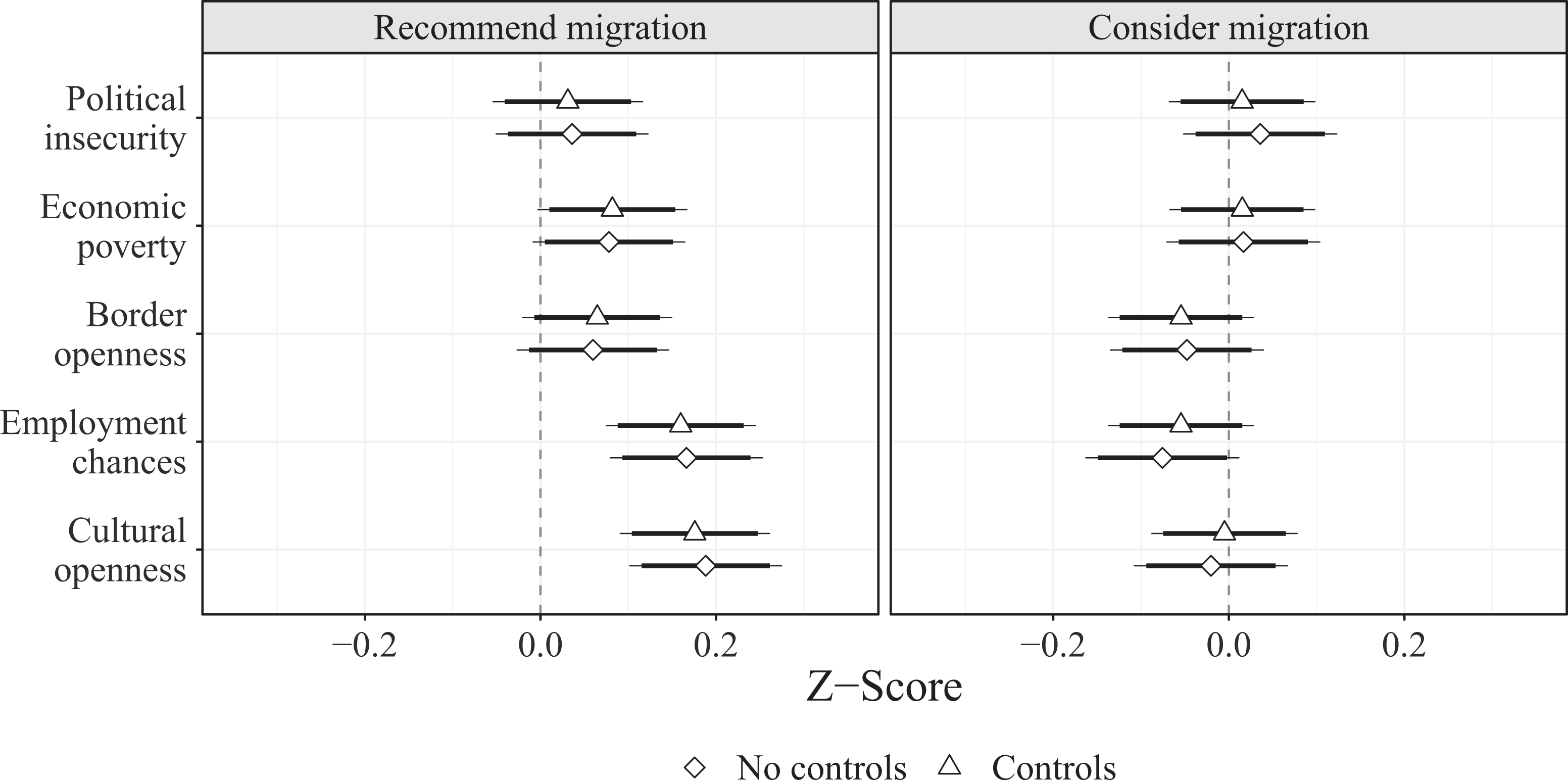
The Figure plots point estimates (square / triangle) and 90 / 95 percent confidence intervals (thin and thick lines, respectively) of regressions of the two main outcomes on the indicated primes. The outcomes are standardized. Triangles denote regressions including all pre- registered individual-level and PSU-level controls (1,962 dof). Squares denote regressions without covariate adjustment (1,994 dof).
What do we learn from these results? Four points merit discussion. First, to our knowledge, this study offers clean causal evidence, using a random sample of potential migrants, that adjudicates between different drivers of migration. Our evidence points to pull factors as the most salient drivers of migration. This finding has important policy implications. Above all, elected officials in receiving countries frequently argue that migration is a product of push factors, not pull factors (Abdou 2020). Our evidence questions this premise. Second and notwithstanding, all five primes produced positive effects. Push and pull factors, thus, jointly shape attitudes toward migration in Northern Lebanon. Put differently, the causal drivers are not theoretical substitutes, but complements. Third, the observed effect sizes are substantively large. Given the rather mild primes and given that respondents had to weigh five different primes, an increase by 0.2 standard deviations is substantively relevant. To see the substantive relevance more readily, Figure A2 dichotomizes the outcome variable to translate effect sizes into percentage points. The treatment effects are all substantial, including for cultural openness (+8 percentage points), employment chances (+8 percentage points), open borders (+3 percentage points), economic poverty (+6 percentage points), and political instability (+2 percentage points). The effect sizes also compare favorably to recent studies adopting similar experimental designs. Holland et al. (2020), for instance, use a conjoint experiment administered to a sample of Turkish, Syrian, Iraqi, and Jordanian respondents and estimate that a prime of having “many employment opportunities” increases the probability that respondents choose a hypothetical destination country by 11 percentage points. Our own estimate is 8.3 percentage points. 8 Last, the effect sizes are virtually unchanged when dropping the covariates. The coefficients’ stability, therefore, builds trust that the observed differences are, indeed, the product of the experimental primes. 9
Migration Likelihood
Did the primes also affect the degree to which respondents considered migration themselves? The right panel in Figure 2 does not imply as much. We do not find any substantively or statistically significant effect of the primes on respondents’ own migration likelihood. Not a single coefficient is greater than 0.07 standard deviations, and not one estimate is statistically significant. The experiment, thus, affected respondents’ likelihood to recommend migration to the hypothetical refugee, but the primes did not affect respondents’ own migration calculus. What is more, the direction of the estimated coefficients is, if anything, at odds with the theoretical expectations. Additionally, they do not fall into the broad pull/push pattern observed for the first outcome (left panel). We are, therefore, inclined to interpret the second outcome as a null finding.
This null finding is of interest for at least two reasons. First, it underlines the limits of survey experimentation. The primes did affect a seemingly low-stake outcome, namely, respondents’ propensity to recommend migration. The high-stake outcome whether to migrate oneself remains unchanged. Second, the null finding is reassuring in that it circumvents tough ethical questions that would have arisen had the primes changed respondents’ migration likelihood. The journey to Europe is dangerous, having brought death to tens of thousands of refugees. It is, thus, a significant ethical question whether researchers should tamper with respondents’ decision to migrate.
Heterogeneity
Did the primes yield greater effects among theoretically plausible subgroups? Above, we formed six expectations concerning which subgroups were most likely to react to the five primes. To explore these expectations, Tables A4 and A5 present six regressions where we interact a given prime with the covariate for which we expect a stronger effect across the consideration (A4) and the recommendation outcome (A5), respectively. Three results stand out, which we highlight in Figures 3a and 3b. First, we confirm that respondents were significantly more likely to consider migration when exposed to the employment opportunities prime if their education level was high. The treatment effect is negative at low education levels, while for highly skilled respondents, it was positive. Second, men were significantly more likely to react to the open border prime relative to women. If primed with “open borders,” men were 0.15 standard deviations more likely to recommend migration, while women did not react to the prime. One interpretation of this finding is that men prioritize considerations pertaining to the logistics of migrating. Additional research, however, is necessary to pinpoint the causal mechanism with greater clarity. Finally, the remaining interaction effects are not significant. Overall, effect heterogeneity is, thus, rather limited in our sample. One should bear in mind, however, that interaction effects require a large degree of statistical power, which the present study does not afford. What is more, given the plentitude of interaction effects, there is a looming risk of uncovering false positives.
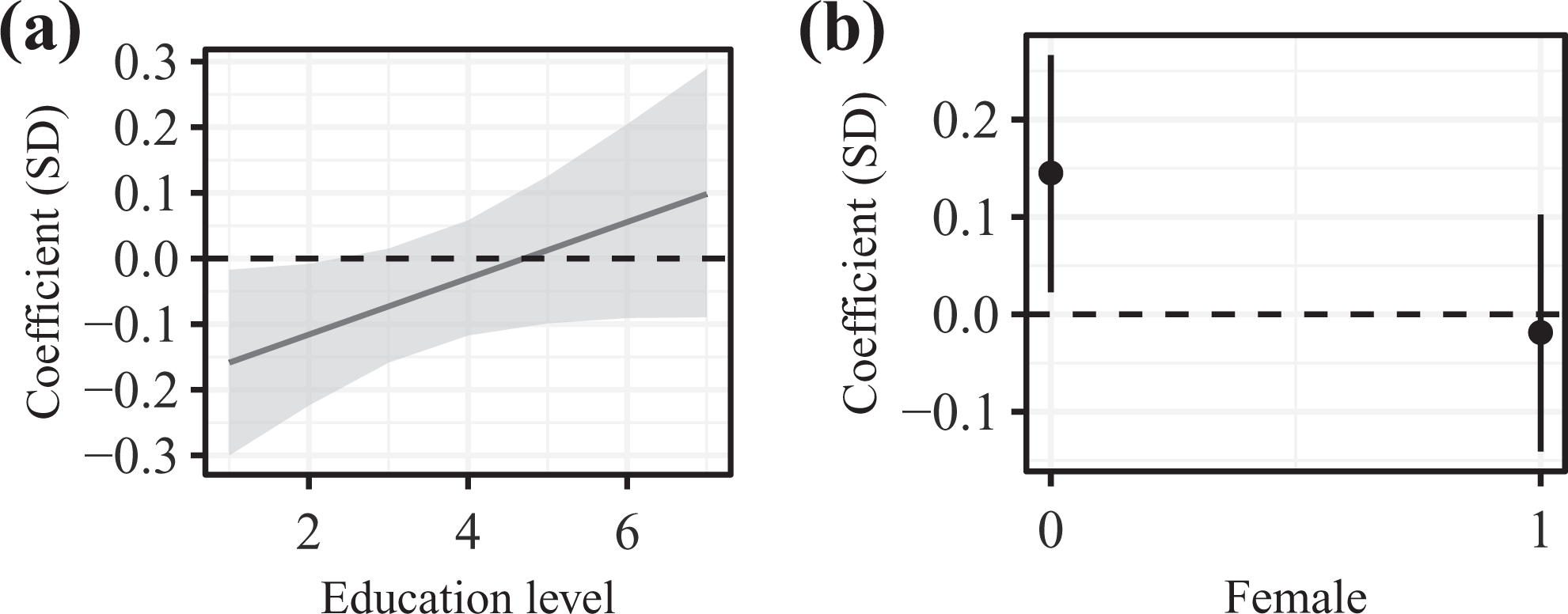
The Figure plots the interaction effect on the recommendation outcome between the employment opportunity prime and respondents' education level (a) as well as the open border prime and respondents' gender. The model follows the one presented in Figure 2, including covariates.
Conclusion
What drives people to migrate? This article used a vignette experiment, administered to 1,000 Syrian refugees and 1,000 Lebanese residents, to probe five salient causes of migration. Asking respondents to evaluate the profile of a hypothetical Syrian refugee, we point to pull factors (notably, employment opportunities and cultural openness) as significant predictors of recommending migration. Push factors, by contrast, had a less pronounced effect. Still, all five primes yielded positive effect sizes, which underlines that prominent theories of migration are complements, not substitutes. We also pointed to some effect heterogeneity, whereby certain subgroups reacted to the primes more strongly in a theoretically plausible way. Men, for instance, were significantly more likely to react to open borders than women.
How could future research expand on our work? First, we studied one population of particular interest—Syrians and Lebanese in Northern Lebanon. Whether the results generalize to other settings—internally displaced persons (e.g., Kenya), different transit states (e.g., Morocco), or sending nations (e.g., Eritrea)—is a question of high policy importance and may also help solidify our empirical findings. Second, to avoid affecting real migration, the present study asked subjects to evaluate hypothetical profiles. The drawback is clear: we are left wondering whether the decision to migrate may be quite different from the recommendation. One way forward is to enroll refugees in panels, although this strategy is very costly.
More broadly, this article has shown that different push and pull factors work in unison, presenting scholars of migration and international political economy with an opportunity to theorize more precisely on how the different drivers interact. Some variables may work as necessary conditions (e.g., border openness), while others may represent sufficient conditions (e.g., political instability). In the case of Syria, push factors may have been perceived as sufficient conditions (i.e., factors that necessarily lead to migration), which may explain the rather mild treatment effects. That said, our study only focused on perceptions, which raises the question whether primes in a survey experiment map onto real-word structural changes.
Supplemental Material
Supplemental Material, sj-docx-1-mrx-10.1177_0197918320988662 - What Drives Migration to Europe? Survey Experimental Evidence from Lebanon
Supplemental Material, sj-docx-1-mrx-10.1177_0197918320988662 for What Drives Migration to Europe? Survey Experimental Evidence from Lebanon by Anselm Hager in International Migration Review
Footnotes
Declaration of Conflicting Interests
The author(s) declared no potential conflicts of interest with respect to the research, authorship, and/or publication of this article.
Funding
The author(s) received no financial support for the research, authorship, and/or publication of this article.

Supplemental Material
Supplemental material for this article is available online.
Notes
References
Supplementary Material
Please find the following supplemental material available below.
For Open Access articles published under a Creative Commons License, all supplemental material carries the same license as the article it is associated with.
For non-Open Access articles published, all supplemental material carries a non-exclusive license, and permission requests for re-use of supplemental material or any part of supplemental material shall be sent directly to the copyright owner as specified in the copyright notice associated with the article.
