




Abstract
Ceramic rattles and rattle vessel adornos have received little attention in current Caribbean archaeology literature and may be overlooked or misidentified in Caribbean ceramic collections due to their minimal audibility or “failure” during the construction process. Here, we evaluate existing reports of rattle ceramics and adornos in the Caribbean and report on the discovery of rattle adornos within collections at the Florida Museum of Natural History and the Yale Peabody Museum. A detailed analysis of adorno rattles, including microscopic analysis, measurement of sound intensity, and a replication experiment was conducted. This study answers questions regarding their technological construction, potential function, geospatial and temporal spread, and cultural implications to Indigenous groups in the Caribbean. Despite difficulty in their construction, adorno rattles and ceramic rattles appeared in the Greater and Lesser Antilles throughout the Ceramic Age and likely functioned in ceremonial spaces.
Introduction
Ceramic rattles and vessel rattle adornos have been identified in low quantities across long periods within the Caribbean region (Beeker et al., 2002; Moravetz, 1999; Rainey, 1940; Rouse and Cruxent, 1963; Sajo, 2014; Van Heekeren, 1963; Waldron, 2016; Wild, 2001). Adornos are modeled out of clay, often as human-like or animalistic forms, and affixed to vessel rims and handle terminals. The majority are associated with bowl forms. They do not appear to have served a utilitarian function. As rattles, they have hollow cavities containing one or more pellets, and generate a gentle tinkling noise when shaken. Their relatively quiet sound suggests they likely were not used in large communal settings, but intimate ones. Their persistence over time, but rarity in archaeological assemblages may indicate that they were made for specific ceremonial use with circumscribed production and exchange.
Were ceramic rattles or rattle adornos more common in certain periods or places? Was production standardized, and what are the implications of technological constraints in their manufacture? And finally, what function did these ceramic rattles and rattle adornos serve, and did they achieve greater status than other decorated ceramics, akin to social valuables (Mol, 2011)? To better define the role of ceramic rattles in the pre-Columbian Caribbean, we evaluate the current literature of ceramic rattles in the region, discuss the background and origins of rattles in early Caribbean history, and compare archaeological specimens from legacy collections across the Caribbean. We consider the technical aspects of ceramic rattle production, including a replication experiment, sound intensity testing, and microscopic evaluation. Understanding the manufacture of such ceramic rattles shines light on those who were using these rattles, for what purposes, and possible spread of these objects.
Our investigation finds that the presence of these rattle adornos, while rare in the Caribbean, were not spatially constrained, appearing on the mainland and the islands of the Caribbean beginning in Trinidad and reaching as far as Cuba in the northwest. The appearance of rattle adornos over 2000 years ago across multiple culture series suggests ceramic continuity or intermittent revivals. Manufacture of these rattle adornos was technologically difficult, and their production was unstandardized across the region. Further, finding previously unidentified rattles in legacy Caribbean collections at multiple institutions, we suggest that closer examination of existing collections are likely to reveal additional examples, which would provide a more complete picture of their production span and geographic range.
Background
Cultural history and rattle use in the Caribbean
Caribbean archaeologists have traditionally relied on the usage of ceramic series (Saladoid, Meillacoid, Chicoid, and so on) to describe settlement history and cultures of the Caribbean, defined by Irving Rouse in the mid-twentieth century (Rouse, 1992). Though this Classificatory-Historical approach is rather limiting, it has largely remained (Berman, 2015; Keegan, 2001; Rodríguez Ramos et al., 2023). Here, we rely on ceramic series to describe these rattle adornos because they provide, though perhaps overly broad, a structure within which to classify their chronology, spread, generalized culture, and geographic origins. People and communities creating these specific ceramic series were diverse and came from various backgrounds and ethnicities.
Saladoid peoples arrived from along the Orinoco River Basin from the Upper Amazon and into the Caribbean as early as 600–400 BC (Haviser, 1997; Table 1). Evidence suggests they arrived as mostly egalitarian societies, but perhaps with some level of hereditary hierarchy (Heckenberger, 2013). The introduction and manufacture of Saladoid pottery marks the beginning of the Ceramic Age in the Caribbean, though Archaic Age groups produced pottery in small quantities (Rodríguez Ramos, 2008; Rodríguez Ramos et al., 2008). In the Caribbean, Saladoid series pottery has been recovered only within the Lesser Antilles and modern-day Puerto Rico, with limited extension into eastern Hispaniola (now Dominican Republic) as well (Rouse, 1992).
Selected ceramic series and origins from Keegan and Hofman (2017) and Rouse (1992).
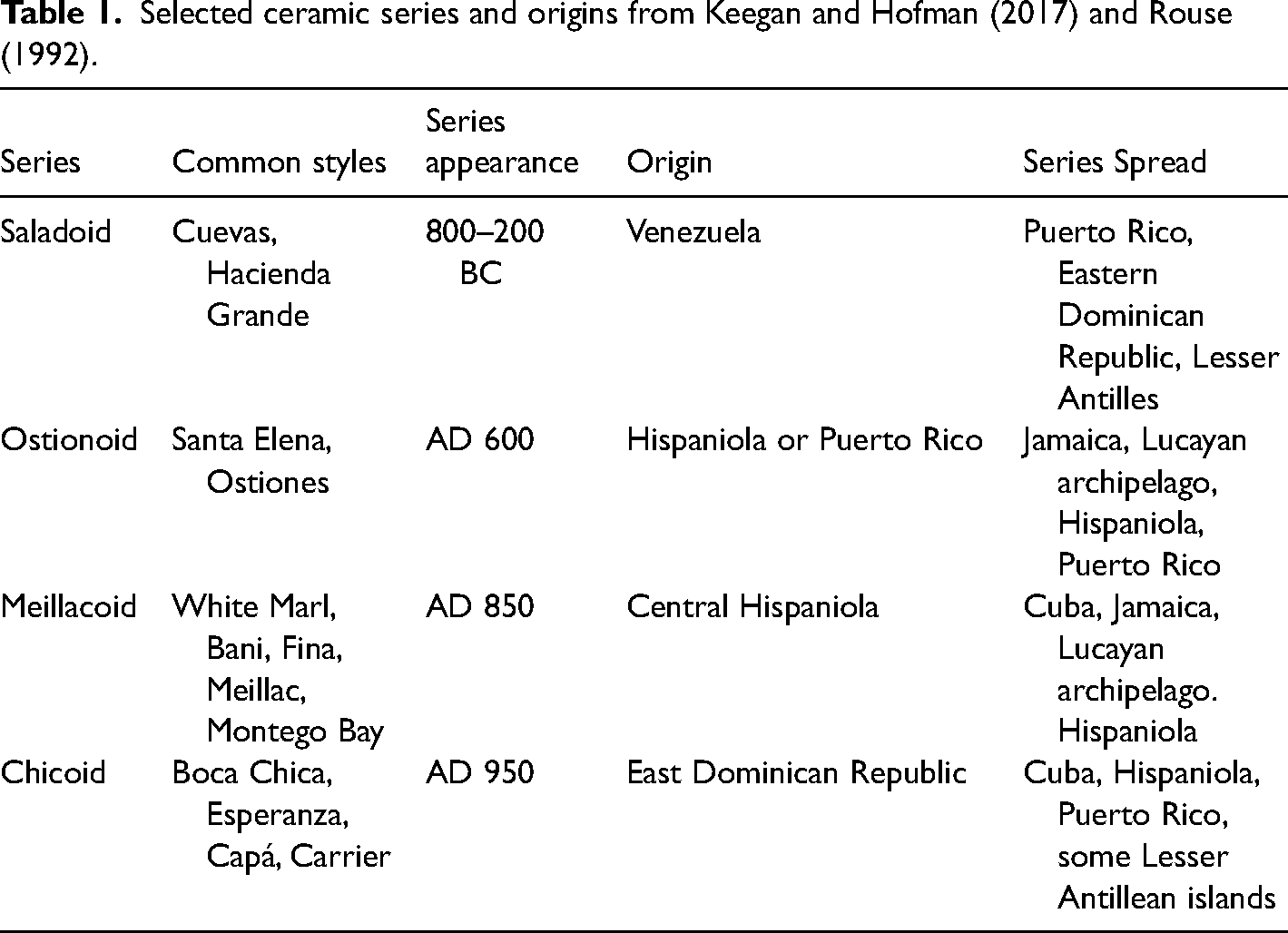
Though there is no “end” date for Saladoid series pottery, it was largely replaced after the emergence of Ostionoid series pottery around AD 600 (Table 1; Curet, 2005). The Ostionoid and Meillacoid series followed the Saladoid series (Table 1) and spread throughout the Greater Antilles and into the Lucayan Islands. The Chicoid series, whose resulting cultural group is referred to as the “Classical Taínos” (Keegan, 2013), began in eastern Hispaniola (now Dominican Republic) around AD 950 (Keegan and Hofman, 2017). Some mixing of these series, or elements from these series, can also be seen. It should be noted that the term “Taíno” does not capture the full complexity and diversity of peoples living in the Caribbean at this point in time, often called a mosaic of expressions (Wilson, 1993; Curet, 1996). Subsequently, where possible, we will use the term “Indigenous” instead.
However, new evidence and reinterpretation of existing data suggest groups producing various ceramic series may have lived contemporaneously with one another. For example, a recent study by Rodríguez Ramos and colleagues (2023) suggests these ceramic temporal boundaries are more fluid than traditionally thought. Bayesian modeling of radiocarbon dates in Puerto Rico indicates that the Cuevas and La Hueca styles of pottery, belonging to the Saladoid and Huecoid series, extended at least into the twelfth and sixteenth century, respectively (Rodríguez Ramos et al., 2023). Likewise, the earliest Chicoid series pottery, of Esperanza style, dated back to 880 AD, overlapping with styles in Saladoid and Ostionoid series pottery. Hanna (2019) makes a similar case for cultures on Grenada, a Lesser Antillean island with one of the clearest chronologies and stratigraphies in the Caribbean, putting the Saladoid-Barrancoid occupation from about AD 200 to 750 based on radiocarbon dates.
Adornos in the Caribbean appear along the top or side of the vessel, often as lugs. Modeled from clay, adornos may be hollow or completely solid throughout; however, most adornos recovered are not rattles. When ceramic rattles are present, they are mostly placed within adorno heads or legs, though in Saladoid pottery the rattles can also be within a hollow rim of the vessel (Waldron, 2016).
Saladoid adornos are common on pottery vessels, featuring human-like or animalistic faces. Several stylistic studies have been completed on ceramic adornos (e.g., Keegan and Byrne, 2001; Moravetz, 1999; Paulsen, 2019; Waldron, 2011; Wauben, 2018). Iconography of mainland animals from South America persisted in Saladoid ceramics and adornos, including jaguars and caimans (Hofman et al., 2010; Roe, 1989). Adornos are also found on Ostionoid, Meillacoid, and Chicoid pottery, though appear more frequently in the latter two. Meillacoid adornos will typically feature animals, often with applied arms acting as lug handles (Rouse, 1992). In Chicoid pottery, adornos may be animalistic, human-like, or more broadly anthropomorphic. It is unclear if these human-like adornos represent specific individuals or gods (Waldron, 2019).
The significance of a rattle adorno as a sound-making device may be understood within broader research on sound, music, and myth in the Caribbean. Stevens-Arroyo (1988) provides an in-depth analysis of Indigenous Caribbean myths, often featuring rattles, from historical and ethnographic accounts, using a structuralist framework set forth by Lévi-Strauss. Stevens-Arroyo and Lévi-Strauss describe the duality of the gourd as both a vessel for food and as a rattle. It thematically becomes a “tomb for plant life,” and a “womb for cultural and symbolic meaning” (Lévi-Strauss, 1973: 469–473; Stevens-Arroyo 1988: 95). These myths also make connections between rattles to tobacco and cohoba rituals, where one ingests narcotics to interact with the supernatural (Keegan and Hofman, 2017).
Auditory experiences played a meaningful role in the belief system and lives of Indigenous peoples (Berman and Gnivecki, 2019; Saunders, 2003). Rattles were a primary tool for shamans (Waldron, 2019), allowing them to interact with spirits, use the forces of nature, or cure the sick (Rouse, 1992). Rattles were also commonly used in arietos, a ceremony or dance (Lovén, 1935; Rouse, 1992). In this process, rattles ultimately became a magic or sacred container (Waldron, 2019). Wooden or calabash rattles, shell tinklers, flutes, and drums were all forms of sounding-making objects or instruments likewise used in these ceremonies or by shamans (Rouse, 1992; Waldron, 2019). Shell tinklers, usually made with Oliva shell, are shell beads that rattle when strung together along wrists or ankles (Blick et al., 2010).
Use and appreciation of rattles by Indigenous groups continued after Spanish colonialism. Keehnen and Mol's (2020) creation of a network documenting exchange items between Indigenous and European groups found that hawk's bells were one of the most exchanged items alongside beads and gold. Vega (1980) describes a series of artifacts recovered on Hispaniola, including metal alloy rattles of European origin. Though Vega calls these objects rattles, a more appropriate term would be bells, specifically hawk's bells (Keehnen, 2011). Their noise was louder than Indigenous-made rattles, and made of brass, an alloy of copper and zinc. Indigenous groups may have seen the European alloys as similar to guanín, a gold alloy that was highly valued from the South American mainland (Vega, 1980; see also Martinón-Torres et al., 2012). It is unlikely that the Europeans knew beforehand the value these bells would hold for Indigenous groups, who saw these objects akin to their own rattles used in arietos (Vega, 1980).
Reported ceramic vessels with rattles and rattle adornos in current literature
Rattle adornos and ceramics with rattles have been reported in previous studies at several locations in the Caribbean including Hispaniola, Puerto Rico, Guadeloupe, Trinidad, St Vincent, St Johns, Montserrat, and Curaçao (Table 2; Figure 1). It is worth noting that rattle adornos and rattling ceramic vessels are not limited to the Caribbean, but also found throughout the world. In the Americas, communities creating these materials have been found in Costa Rica (Lange and Accola, 1979), Belize (Lucero et al., 2017), Mexico (King and Santiago, 2011), Honduras (Healy, 1978), Venezuela (Cruxent and Rouse, 1958; Wagner and Tarble de Ruíz, 1975; Waldron, 2016), Suriname (Versteeg, 2003: 122), and as part of Mississippian cultural expressions in the Southeastern United States (Burnette et al., 2022; Howell, 2011).
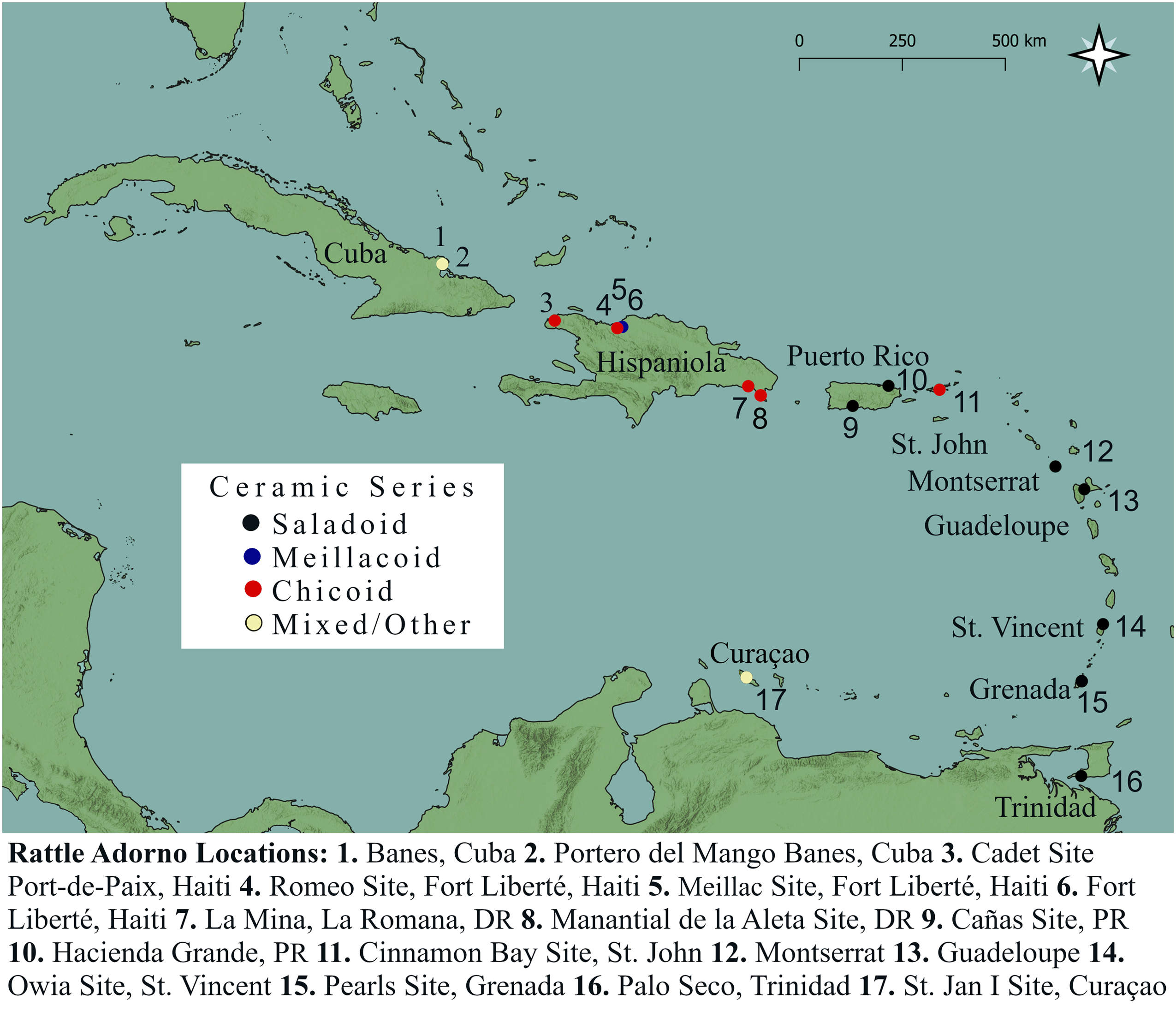
Map of known rattle ceramics and rattle adornos in the Caribbean, sorted by series. Map created with QGIS with ESRI topographic basemap. See Table 2 for references.
Known ceramic rattles recovered in the Caribbean.
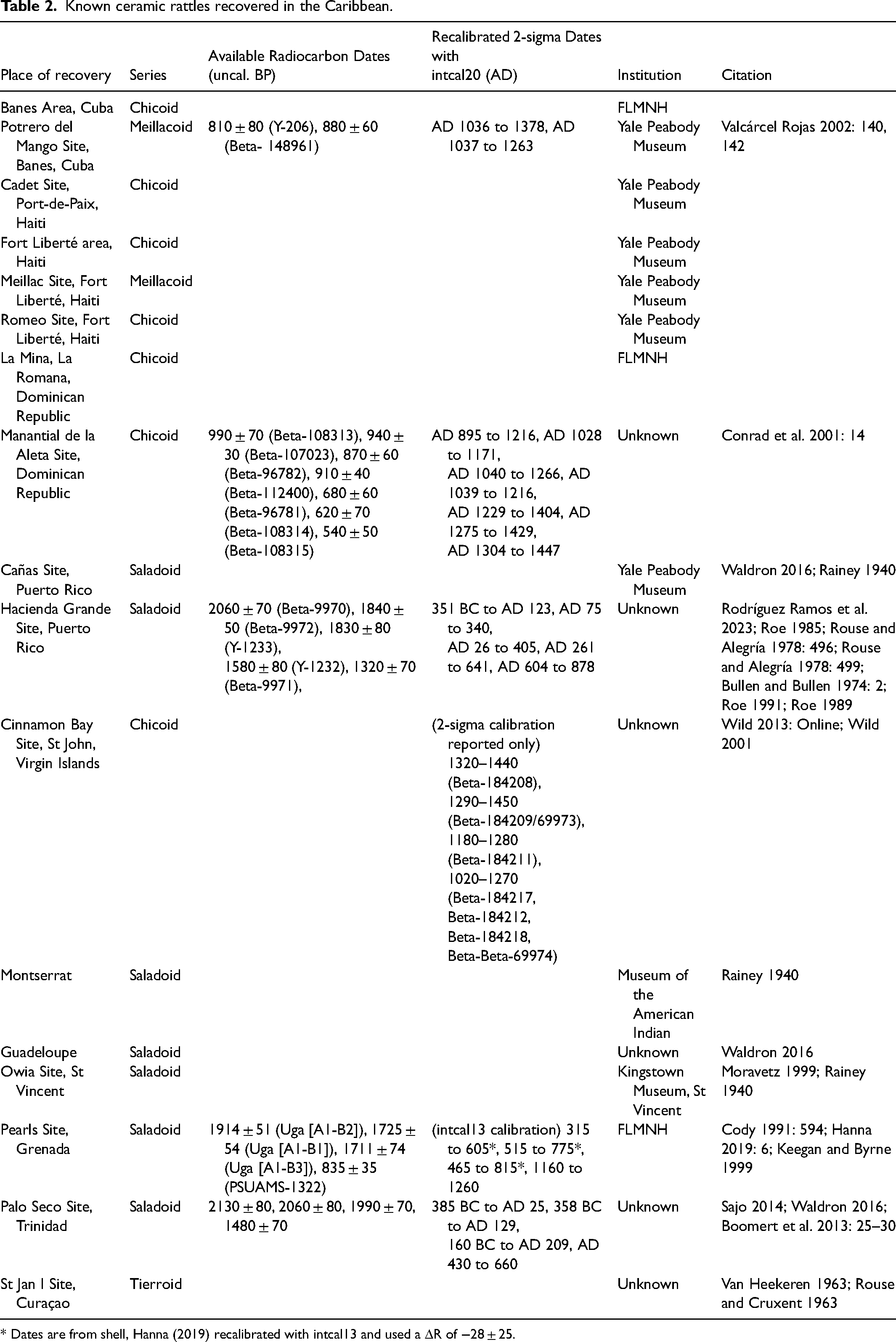
* Dates are from shell, Hanna (2019) recalibrated with intcal13 and used a ΔR of −28 ± 25.
One study by Beeker et al. (2002) focused on sites in the East National Park Region of the Dominican Republic. A broken vessel with an adorno rattle was recovered along with other objects from a nearby flooded cave, called Manantial de la Aleta. The nearby site of La Aleta was one of the largest sites in Hispaniola, with four ceremonial courts, though it was never permanently occupied (Conrad et al., 2001). This part of Hispaniola also made up the chiefdom, or cacicazgo, of Higüey (Beeker et al., 2002). Other recovered objects from Manantial de la Aleta include duhos, a type of wooden ceremonial seat, gourds, a vomiting spatula, and part of a canoe paddle (Beeker et al., 2002). These objects are considered as offerings to spirits, potentially at the watery gateway to the underworld, known as Coabay (Conrad et al., 2001). Other scholars also interpret specialized objects recovered from caves as an extension of ritual (Kaye, 1999). The rattle adorno they recovered was part of a shallow platter with a slit at the end of its handle; the adorno figure was dressed in a special-purpose costume. The authors suggest the rattle adorno is comparable to vomit spatulas, used in preparation for the ingestion of drugs (Roberts, 2014).
Rainey (1940) discusses excavations in Cañas, Puerto Rico, which is a municipality of Ponce. Rainey describes two rattle adornos, along with a rattle vessel leg discovered in Puerto Rico. No series is assigned to these ceramics beyond the adornos discovered in the “crab level,” which is associated with Saladoid groups (Keegan et al., 2018). Rainey also compares these rattle adornos to those found on Montserrat and St Vincent, determining they were of the same kind as the “crab level” adornos at Cañas.
Other reports of rattle adornos include Moravetz's (1999) investigation of 248 adornos on St Vincent, identifying one rattle adorno at the Owia site, Wild's (2001) report of one ceramic rattle at the Cinnamon Bay site on St Johns in the Virgin Islands, and Van Heekeren's (1963) report of a rattle vessel on Curaçao. The St Vincent rattle adorno depicted a parrot and featured a bulging belly containing a single pebble. Wild (2001) argues that Cinnamon Bay was a ceremonial site, eventually developing into a cacique's, or chief's, temple. Rattle ceramics also appeared at Palo Seco in Trinidad and Hacienda Grande in Puerto Rico in funerary contexts (Roe, 1989; Roe, 1991; Waldron, 2016). Boomert et al. (2013) describe the adorno rattles discovered at Palo Seco as biomorphic, containing either clay pellets or stone pebbles. It is worth noting that there is a rattle vessel of Ostionoid (subseries Elenan) series identified and photographed in the collections of the Smithsonian's Museum of the American Indian. It was reportedly recovered during a 1934 archaeological expedition on St Croix, but lacks any other provenience information.
According to current literature, rattle ceramics and adorno rattles appear in the far south of the Caribbean in Trinidad, and as far north as Hispaniola. There are more reports of rattle adornos on islands of the Lesser Antilles than islands of the Greater Antilles, and most of these are Saladoid series. At least nine have been reported in existing literature, if only in passing in archaeological reports of sites. This number is likely significantly underreported, but many reports did not reveal counts of rattle ceramics or adorno rattles.
Production of ceramic rattle adornos
One of the most curious things about the rattles is not only their “impractical” adaptation to ceramic vessels (Waldron, 2016), but also the difficulty in their construction. It is hard to imagine such a vessel being able to rattle, particularly if one is unable to shake it when used as a container without losing the contents. It is unlikely that these vessels held anything in the long-term, much like what Waldron (2019) and Beeker et al. (2002) note about vessels used for presentation and ceremonies in Saladoid and Chicoid series pottery. Specialized ceramics mentioned by these authors bore little evidence of use.
Caribbean ceramics were hand built with coils; adornos were likely modeled and added to the rims as appliqué. Bulging or raised facial features like the mouth, nose, ears, or eyes were added as appliqué (Moravetz, 1999). Most, but not all, adornos also have incised decoration.
In order to make the rattle sound, the adornos heads or torsos must be hollow with pellets inside. The clay pellets and the clay of the unclosed adorno head must both be leather-hard when the pellets are added. If the pellets and surface of the ceramic adorno are too wet, they will stick and bind together. At the same time, the adorno must also be plastic enough to seal shut once the pellets are inside. In addition to pellets, other materials inside the rattle may include stones or seeds, the latter of which would not survive the firing process given its organic nature.
Another consideration for potters is the mechanical stress of an enclosed adorno. When building vessels, potters are able to bind coils from both sides, strengthening the bonds. On an adorno, the suture point can only be smoothed gently from the outside, creating a weaker joint more prone to cracking. According to Rice (2015), repeatedly smoothed parts of the vessel are also wetter and will shrink more than the drier parts of the body. As the vessel dries, mechanically bound water evaporates, decreasing plasticity and shrinking the clay body (Rice, 2015), which could also result in cracking.
Adornos without holes or slits to the interior cavity make it difficult for bound water to escape from the clay minerals during the firing process and will often lead to explosions from the expansion of trapped water vapor. Most pottery in the Caribbean was open fired; one characteristic of these open fires is how quickly they heat (Orton et al., 1993). Open fires will typically reach temperatures anywhere from around 600 to 900 °C (Gosselain, 1992). If heated too quickly, vessels can explode or crack from gas trapped inside (Sinopoli, 1991). To fire these adornos without causing explosions would require skill in controlling the firing temperature, as well as the ability to heat up these adornos slowly over a period of time. Simply waiting for the pottery to fully dry before firing may not prevent thermal shock or failure (Rice, 2015). Chemically bound water in clay bodies will not evaporate at room temperature, but vaporizes at temperatures around 200 to 300 °C (Rice, 2015).
Early potters making adorno rattles likely knew that entirely enclosed adornos would be harder to fire than those with holes, but did so anyway. Perfecting sound, shape, and aesthetic in the construction process was complex. Rattle adornos were made with varying levels of success, many of them were minimally audible, due to differences in manufacturing characteristics. Thicker walls will dampen the sound, pellet size will affect the volume, and the size and geometry of the internal cavity will also affect the rattle. Pellets made with stones or denser clays would also make the rattle louder. Imaging techniques like micro-CT could be used to confirm the presence of these pellets along with other important characteristics contributing to audibility.
Methods
Macroscopic analysis
Ceramic adornos at FLMNH
The Florida Museum of Natural History (FLMNH) houses a wide collection of Caribbean ceramics including sites from islands in the Lesser Antilles, Greater Antilles, and Lucayan Islands. During the course of a recent research project using these legacy materials, an animalistic rattle adorno from La Mina, La Romana, Dominican Republic was discovered (Figure 2; FLM01). Based on Chicoid occupation of east Hispaniola, it was likely made sometime between AD 950 into the 1500s (Rouse, 1992). The adorno head sits near the rim of the sherd, facing outwards. The adorno head and ears were applied, along with incised facial features. Beneath the head are two applied handles, making up part of the animal representation. The adorno is animalistic in style, and is perhaps a bat based on its large ears, circular motif on its head, and v-shaped handle representative of wings (Waldron, 2011). It falls under the Chicoid series based on its ceramic paste, incising, and highly stylistic modeling (Keegan and Hofman, 2017; Rouse, 1992). The completely enclosed head is hollow with a mobile pellet inside. The rattle was tested as part of a study on the elemental composition of ceramics recovered from the Lucayan Archipelago, today making up The Bahamas and Turks and Caicos islands, and Greater Antilles (Kracht et al., 2022). The sherd belongs to a source group associated with Hispaniola, likely produced near where it was recovered. Additional investigations into collections housed at FLMNH uncovered more adornos recovered from Cuba and Grenada.
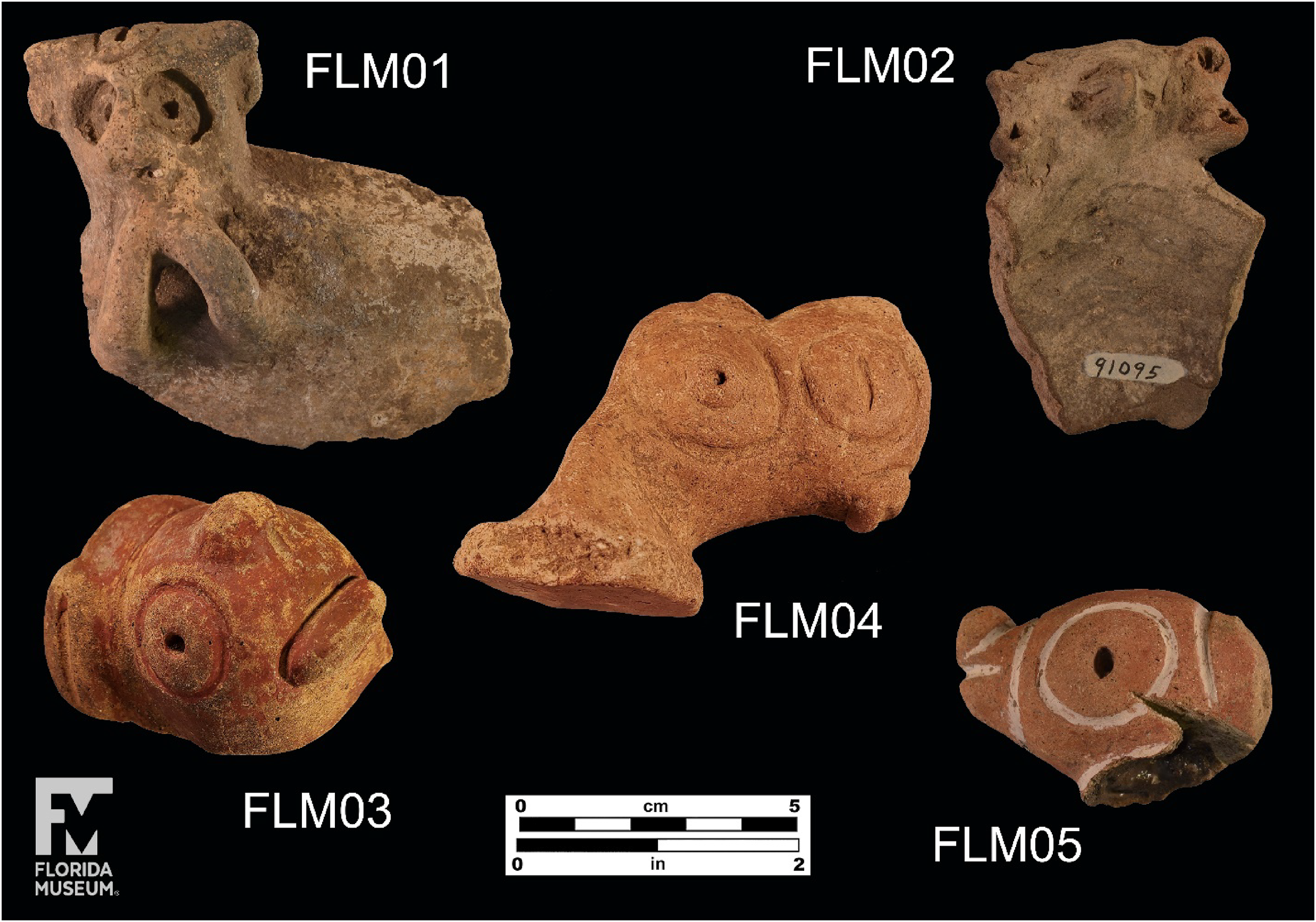
Compilation of ceramics from FLMNH: FLM01, Chicoid rattle adorno from La Mina, La Romana, Dominican Republic; FLM02, Chicoid rattle adorno from Banes, Cuba (Donated by Rene Herrera Fritot); FLM03, FLM04, and FLM05, Saladoid rattle adornos from Grenada (Donated by Leon Wilder).
Four additional rattle adornos have been identified within the Caribbean archaeology collection at the FLMNH (Table 3). The next adorno (FLM02) was a donation by Dr Rene Herrera Fritot, director of the Cuban Museo Ethnologico in 1950 and was recovered in Banes, Cuba. FLM02 is also assigned to the Chicoid series. Based on Rouse's ceramic chronology (1992), Chicoid pottery in Eastern Cuba appeared shortly before 1250 AD, though the only dated Chicoid site in Cuba dates to AD 1310 (Ulloa Hung and Rojas, 2013). The head, ears, and facial features of the adorno were applied with less precise incising compared to the Chicoid example from Hispaniola. The disks located on the side of the head, perhaps ear spools, suggest it is a human adorno (Mol, 2011). FLM02 faces inwards. The reverse side of FLM02 shows where the potter initially sealed the clay adorno shut, but the seal opened during the drying or firing process. A single ceramic pellet is fused to the inner surface of the adorno.
Identified rattle adornos at FLMNH (FLM) and Yale Peabody Museum (YPM).
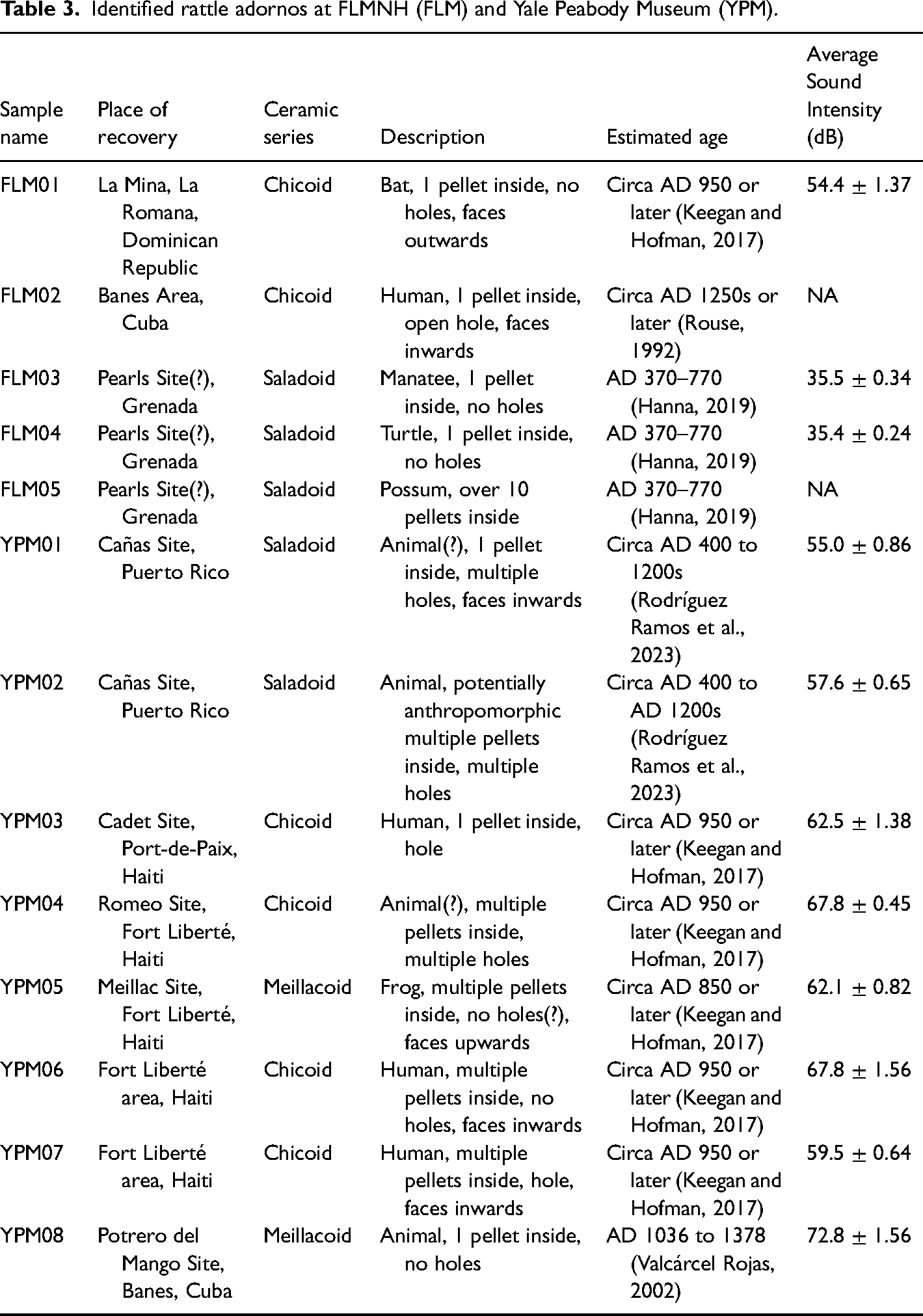
The remaining three rattle adornos found in FLMNH collections are Saladoid series and recovered from Grenada. These rattles are a part of over 300 Saladoid adornos donated by Leon Wilder in 1985; though there is no confirmed provenience they likely come from the Pearls or Grand Anse sites (Keegan and Byrne, 2001). Saladoid adornos from Grenada have strong Barrancoid influence, another early ceramic series in the Caribbean (Hanna, 2019; Moravetz, 1999). The adornos are animalistic. The first of these Grenada adorno rattles (FLM03) is red painted with a rounded head. Facial features are both incised and applied. FLM03 may be a turtle based on its circular eyes, applied mouth and “crown” protuberance on the top of the head (Moravetz, 1999; Waldron, 2016: 200–201), though the variety of features may also encourage viewing from multiple viewpoints to see various creatures (Keegan and Byrne, 2001). The rattle is completely enclosed.
The next adorno rattle (FLM04) may be manatee based on descriptions by Moravetz (1999: 160) and Waldron (2016: 82) which include a lack of ears, a stubby snout, small eyes, round nostrils, and whiskers near the mouth. The two edges along the base parallel to the direction of the face are roughened, indicating it must have been attached to a larger vessel. Interestingly, the bottom edge beneath the face and flat base of the adorno show no wear and may not have been attached to anything like the sides of the base. When pictured frontward facing, vertically oriented incised lines are visible near the mouth. FLM04 is enclosed with no holes. Based on the sound, it seems to have a single pellet inside. These first two Saladoid rattle adornos produce fainter rattle sounds compared to the other Chicoid rattle adornos, perhaps by choice of the potter making these adornos or some technological miscalculation.
The last Grenada rattle adorno (FLM05) matches descriptions of an opossum from Waldron (2016: 69) including a bulbous nose, incised mouth below the nose, and pointed head with incised facial features. FLM05 was previously sawn open by colleagues at FLMNH to see what was inside. Unfortunately, no image has been found of the rattle adorno beforehand. The (n > 10) imperfectly rounded ceramic pellets found inside average 3.98 mm in diameter. These were visually smaller, about half the size, compared to the single visible pellet in FLM02 from Banes, Cuba.
These five rattle adornos represent a small proportion (1.5%) of the total number of vessel adornos in the collection, which totals over 325 examples (Grenada n = 300; Hispaniola n = 23; Cuba n = 9). All the rattle adornos from Grenada were Saladoid while those from Hispaniola and Cuba were Chicoid.
Ceramic adornos at the Yale Peabody museum
A collections visit to the Yale Peabody Museum also yielded eight Caribbean rattle adornos (Figure 3). The majority of these have provenience to specific sites. These rattle adornos were recovered from Haiti, Puerto Rico, and Cuba, spanning ceramic series and locations across the Caribbean. Only six had been identified as rattles in the current catalog system, along with many shell rattles not studied here. Two identified rattle adornos not listed as such in the catalog system are from Cañas, in central southern Puerto Rico, one of which was newly identified here (YPM01), and another mentioned in Waldron (2016, YPM02).
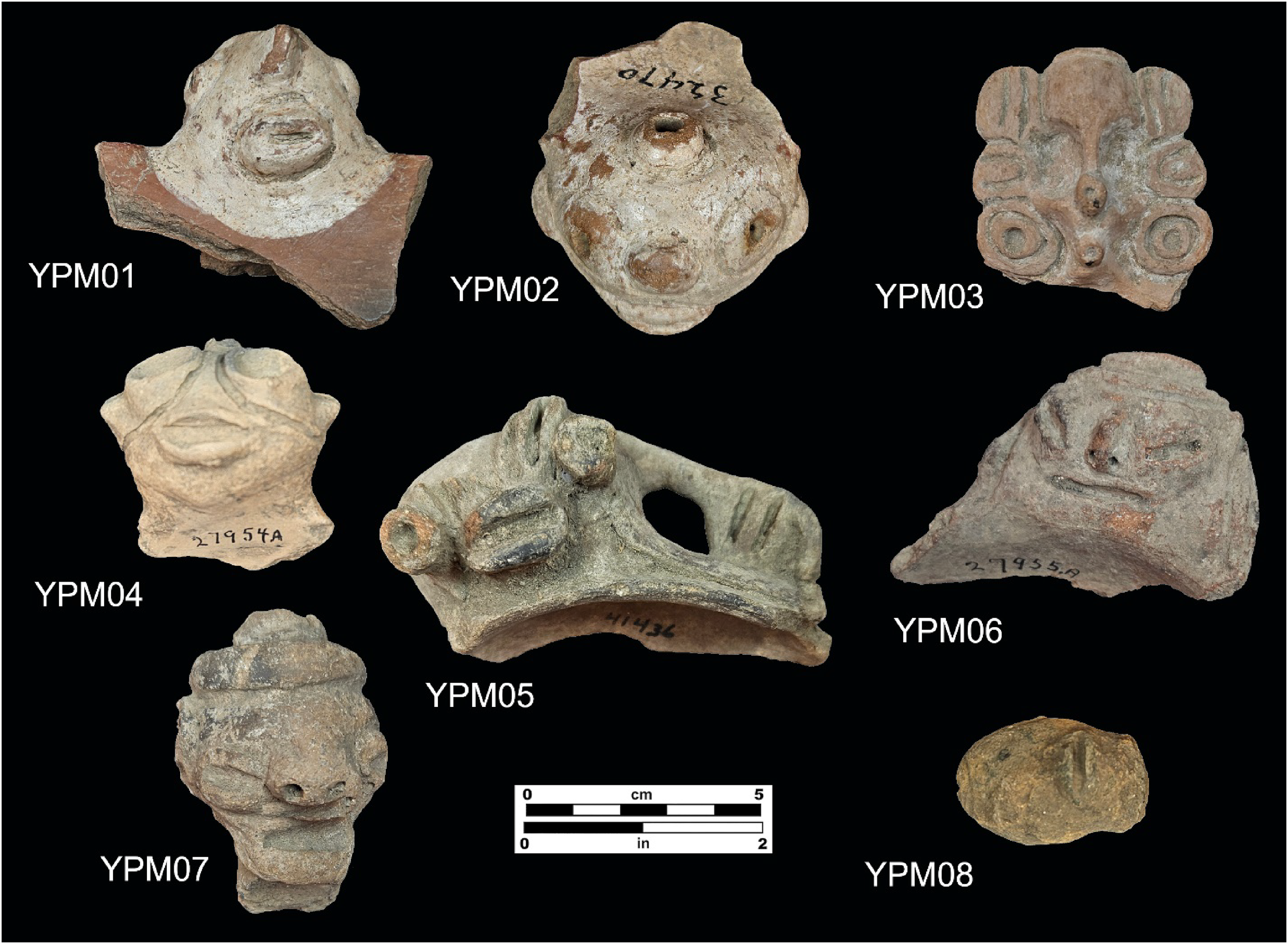
Compilation of ceramics from Yale Peabody Museum: YPM01and YPM02, Saladoid rattle adornos from Cañas Puerto Rico; YPM03, Chicoid rattle adorno from Cadet, Haiti; YPM04, Chicoid rattle adorno from Romeo site, Haiti; YPM05, Meillacoid rattle adorno from Meillac, Haiti; YPM06 and YPM07, Chicoid rattle adornos from the Fort-Liberté area of Haiti; YPM08, rattle adorno from Portero del Mango, Cuba.
The two adorno rattles from Cañas are both from Excavation #2, from fieldwork conducted by Froelich Rainey (1940). Both adornos are white painted with red paste, and both have simple rounded eyes and ovular applied mouths with incising. The painting and stylization indicate they are part of Saladoid series pottery. Handle attachments are visible on the backs of both adornos, with some faint red paint. YPM01 has a rim still partially attached, which is incurvate with red painting. The adorno is facing inwards along what would have been the vessel. This adorno has a triangular beak-like nose or head piece that extends backwards. This rattle was very quiet. It also has three holes present in the head itself, one in each eye and one hole in the back. The other adorno, YPM02, has a rounded nose, and additional rounded appliqué piece between its two eyes. This adorno has four air holes present. It may appear as two different faces depending on the orientation, as described by Keegan and Byrne (2011). Both are animalistic, though perhaps anthropomorphic to some extent given the presence of ears on both adornos. A recent sourcing study of ceramics from across sites in Puerto Rico included these two rattle adornos within the sampled assemblage. Preliminary results suggest that both rattle adornos were non-local, sourcing to a production group associated with the southeastern end of Puerto Rico (Kracht et al., 2024).
The rattle adornos from Haiti come from the sites Cadet, Romeo, and Meillac. Two additional adornos have no associated site, but were surface collections in the Fort-Liberté area of Haiti. The rattle adorno from Cadet (YPM03) represents a human in an elaborate circular incised headdress. The stylization and depiction of a human indicates that this adorno belongs to the Chicoid series. YPM03 is relatively flat, attached to the vessel from the bottom, with an air hole in the back. Wide, deep eyes were probably pressed into the clay with fingers. The mouth and nose are applied, modeled, and incised. There is a single pellet, the same size as the hole in the back of the head. Tape has been applied to cover the hole for curation, as the pellet can easily slip out. The pellet measures 4.83 mm in diameter. The sound of this adorno is very quiet.
The rattle adorno from Romeo site (YPM04) is animalistic with protruding facial features. The features, including eyes, ears, a mouth, and a double-pointed forehead are wide and large, applied with deep incising. YPM04 has multiple air holes. The adorno also attaches to the vessel rim from the bottom, though the back of the adorno is rough and eroded, so it is possible something else was once attached there as well. It sounds like there are multiple pellets in the adorno. The style likely belongs to the Chicoid series.
The adorno from Meillac (YPM05), the site from which Meillacoid pottery derives its name (Keegan and Hofman, 2017; Rouse, 1941), contains multiple pellets. The adorno is attached to an incurvate rim along the outside, facing upwards, unlike many of the other adornos. An incised and modeled hand acts as a handle on the side of the vessel. This hand comes from the head of the adorno, another hand is also present on the adorno head, but the rest of the arm has been detached. The facial features also protrude from the head. A strange narrow strip of appliqué sits underneath the handle with no clear purpose or decoration. The shape of the head and bulging eyes and mouth may indicate its representation as a frog (Moravetz, 1999). There are no visible holes in YPM05. This adorno belongs to the Meillacoid series, as the arm extending from the base of the adorno is a Meillacoid feature (Rouse, 1992). Additionally, the majority of pottery at this site belongs to the Meillacoid series (Rouse, 1941).
The two adornos from the Fort-Liberté area of Haiti both appear to be human representations (YPM06 and YPM07). Both faces have two tiered-circular head pieces with large noses with punctated nostrils, coffee-bean eyes, and large slit mouths. These details indicate they are likely part of the Chicoid series. The facial shapes themselves are different, one wide and flat (YPM06) while the other is long and narrows towards the neck (YPM07). Both have appliqué or incising along the side of the heads representing ears. YPM07 has a small hole near the bottom, but the area is heavily eroded so this may have formed over time, rather than in the initial manufacture. The backs of both adornos have handle attachments, and both likely faced inwards. The back of YPM06 is heavily eroded and cracked. The back is flattened from the original formation of the handle or adorno head, which may have contributed to mechanical weakness of the form over time though no air holes intentional or otherwise were seen. Both adornos sound like they have multiple pellets, and YPM06 is particularly loud.
The last adorno is from the Portero del Mango site (YPM08), which is also located in Banes, Cuba. The Meillacoid site was home to a large village that acted as a regional center (Valcárcel Rojas, 2002). Banes, Cuba was known for its large number of adornos (Keegan and Hofman, 2017; Rouse, 1941) and highly conservative cultural expressions (Valcárcel Rojas, 2002). This site was occupied from the eleventh through sixteenth century, with evidence of European occupation (Mol, 2011; Valcárcel Rojas, 2002). This was the smallest but loudest rattle adorno. YPM08 was roughly half the size of the other adornos, with a highly eroded surface. It was attached to a larger vessel at its neck and would have stood up vertically. Fine, thin incising is present along with ovular appliqué. There are no visible holes in the adorno, and what sounds like one large pellet inside. YPM08 is poorly formed, and seems like an imitation of the other adorno rattles. It is likely animalistic. According to museum collection notes, YPM08 was purchased from a surface collection downslope from the excavation unit on the site.
Microscopic examination
Evaluation of FLM02, from Banes, Cuba, under a Dino-Lite microscope (Figure 2; Figure 4) confirmed that the roughened edges were previously sealed together, but split during the drying or firing process. In contrast, evaluations of other hollow adornos, not included in this study, but present in FLMNH collections, have smoothed surfaces and edges where such openings were clearly intentional and neatly made. On this particular rattle adorno, a small fracture line is visible along this split, indicating the mechanical weak spots of the form. Also in Figure 4, part C of the image shows a profile of the tear, and the flattened back of the adorno head near the tear. This flattening was probably created as the potter sealed the adorno closed and applied too much pressure. This flattening caused mechanical stress upon the form, likely exacerbated during the drying and firing process. One of the rattle adornos from the Fort-Liberté area of Haiti, YPM06, had similar flattening on the back of the head. The area also showed cracking and wear.
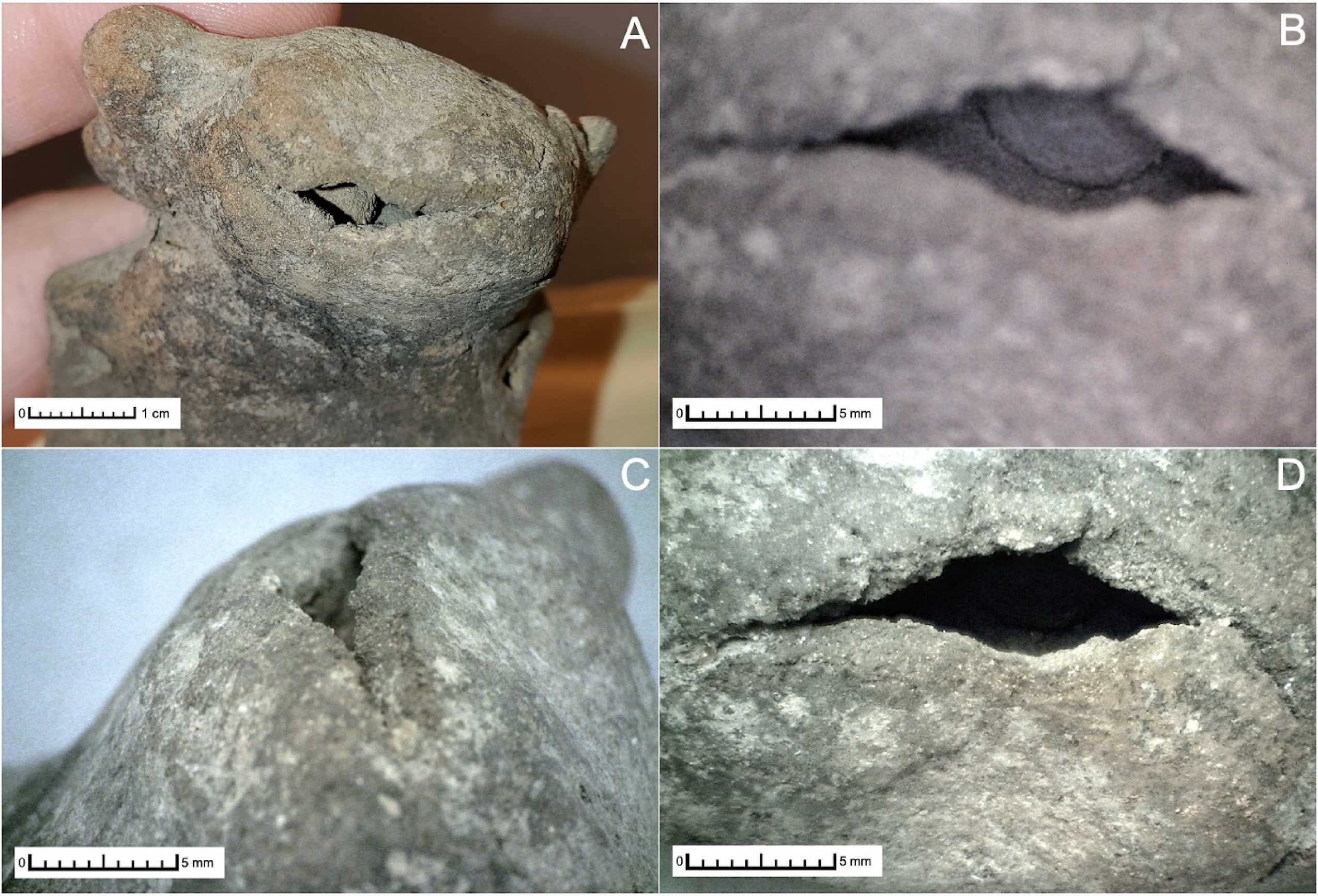
Detailed images of the FLM02 from Banes, Cuba showing the failed seal of the back of the adorno head, with ceramic pellet visible. Images 4B-D at 18X magnification.
A single clay pellet is visible inside the hollow head of FLM02. The pellet is stuck to the inner surface so it does not rattle. It is approximately 7.5 mm in diameter. The pellet stuck to the inner surface of the adorno because one or both surfaces were too wet at the time of manufacture, causing it to adhere instead. This rattle gives clear evidence of potential pitfalls of rattle manufacture. Any mistiming of drying or stress upon the ceramic form can cause problems that affect the sound or usability of the rattle.
Replication
To test if these adornos could be replicated under controlled conditions, we constructed four rattle adornos with commercial clay (Terra Cotta Low Fire Cone 06 from Rocky Mountain Clay). Though commercial clays are not ideal for replication studies they are relatively commonplace. Caribbean sourced clays were not available, and given the diversity of clays and processing methods in the Caribbean, we determined the type of clay used here was not of great importance. Additionally, commercial clays can in some ways be more challenging, often lacking the temper, which controls for shrinkage, drying time, and cracking that natural clays already have (Leach, 1976: 43–44; Rice, 1987: 75).
We made four replicate rattle adornos (Figure 5) to be roughly the same size as the adorno rattles housed at FLMNH. These were styled to look like an owl, bat, alligator, and human. The owl and bat were completely enclosed, while the alligator had four small holes along the head and the human had three vented slits on the top. We added a few ceramic pellets to each adorno, averaging about 5 mm in size each, with the expectation of some shrinkage to occur. The reported average shrinkage for this specific commercial clay was 11%. Rye (1981) notes shrinkage up to 15% can occur in clays after firing, but this is highly dependent on use of temper, inclusions, clay composition, and more. The rattle adornos were left to dry for a few weeks.
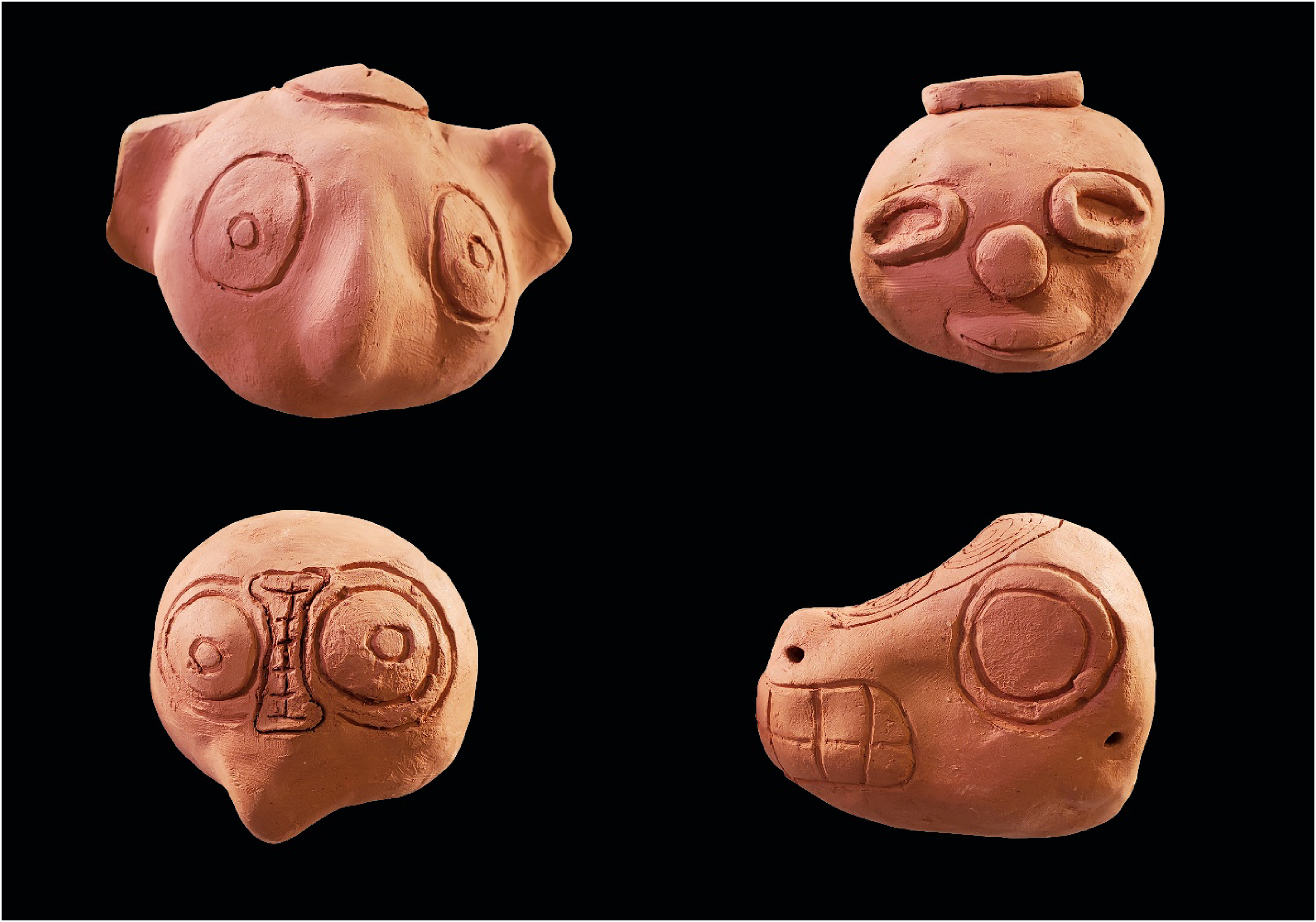
Four rattle adornos (averaging around 5 cm in size) constructed with commercial terra cotta clay by Kracht. From the top left (clockwise) is the bat adorno, human adorno, alligator adorno, and owl adorno.
The adornos were fired in the Ceramic Technology Laboratory at the FLMNH in a Thomas Scientific benchtop muffle furnace. We slowly ramped up the oven to 275 °C over the course of an hour, held it at 275 °C for approximately 45 minutes, slowly ramped up to 600 °C over the course of an hour, and finally held it there for 30 minutes before letting the furnace cool slowly while closed. No cracking or exploding occurred in any of the rattles, and they were fully fired based on the color and texture of the clay. Overall, they held up well in these idealized firing conditions.
Sound testing
These adornos rattles are variable in their sound and loudness; many were easy to overlook based on their minimal audibility. What conditions were these adorno rattles made for, and just how loud were they? To test this, the sound intensity of the eleven functioning rattle adornos were measured from the FLMNH and Yale Peabody Museum. The sound intensity of the replica adornos was also recorded.
To record sound intensity, measured in decibels (dB), two phone apps were used, called Sound Meter (version 1.7.14) and NIOSH Sound Level Meter (version 1.2.6.42). The first app is designed for Android phones, developed by Smart Tools co. and free for use and download. A recent study (Murphy and King, 2016: 21) found the app to be fairly accurate for Android phones, with a deviation of about +/-2.0 dB(A) from true noise. The latter app was created by EA Labs in conjunction with the Center for Disease Control for iOS devices. The latter app also measures within +/-2.0 dB(A) when compared to a reference type 1 sound meter (Kardous and Celestina, 2017). Unfortunately, it was not possible to measure all the adornos on a single app or phone, due to time and accessibility restraints. To account for any variability, three measurements were taken for each rattle adorno over a period of 15 seconds. Rattles were held approximately 3 inches away from the microphone, and the average sound intensity and variability of each adorno was calculated.
The average sound intensity measurement of the eleven rattle adornos (Table 3) is 57.3 dB (+/-0.90 dB). The adorno with the highest sound intensity, YPM08, from Portero del Mango, Cuba, averaged 72.8 dB (+/-1.56 dB). The adorno with the lowest sound intensity, FLM04, from Grenada, averaged 35.4 dB (+/- 0.24 dB). When separated out by ceramic series, the Meillacoid series adornos (n = 2) produce the most intense sound, averaging 67.5 dB (+/-1.19 dB). This is followed by the Chicoid series adornos (n = 5), averaging 62.4 dB (+/-1.09 dB), and the Saladoid series adornos (n = 4), averaging 45.9 dB (+/-0.53 dB). The average decibel reading of the four replica adornos together was recorded to be 50.3 +/- 0.68 decibels.
For reference of how quiet these adornos were, whispering measures at about 30 decibels, normal conversation at about 60 dB, and objects like washing machines at about 70 dB, according to the CDC (https://www.cdc.gov/nceh/hearing_loss/what_noises_cause_hearing_loss.html). Decibels are also measured on a logarithmic scale. For reference, speaking at 60 dB is more than ten times more intense than at 50 dB. The variability in sound intensity for these adornos is relatively large. These adornos are mostly audible at normal conversation levels, but perhaps not made for large or loud settings. These adornos may have been used in more intimate or quiet spaces. Interestingly, it appears that the Saladoid adornos produced less intense sound than the other rattle adornos across both collections, though the sample size may be too small to draw any conclusions.
Discussion
Adorno rattle summary
Our investigation of FLMNH and Yale Peabody Museum collections revealed 13 rattle adornos. Of those investigated, the majority are from the Greater Antilles (n = 10) rather than the Lesser Antilles (n = 3), despite literature reports indicating a greater presence of adornos in the Lesser Antilles. While all the adornos in the Caribbean collections at FLMNH were investigated, only those previously recorded in Waldron (2016) or already identified in the Yale Peabody Museum catalog were evaluated, with the exception of one found by the collections manager while pulling the materials (YPM01). Additional investigations at Yale Peabody Museum would undoubtedly yield additional rattle adornos. Significant skill and technique was required to make these rattle adornos, particularly those that were completely enclosed. Proper temperature control is evident given the maturity of all of the rattle adornos, based on their consistent coloring throughout the body, as well as their texture and hardness. There otherwise appears to be no standardization in production of these rattle adornos (Table 3) in terms of audibility, number of pellets, presence of air holes, or stylistic choices.
None of the rattle adornos within the collections at FLMNH have visible holes or slits, with the exception of the FLM02, which appears to be a failure of the clay form, while the majority (five out of eight) of those at Yale Peabody Museum had holes in them. One, a Haiti rattle recovered from the Fort-Liberté area, YPM07, appears to be an unintentional hole perhaps caused during the firing process or from heavy erosion over time. The rest have clear punctations or holes, mostly located on appliqué. The rattle adornos with holes include YPM01, YPM02, YPM03, and YPM04 from Puerto Rico, the Cañas site, and Haiti, the Romeo and Cadet sites, respectively. Overall, of the collections from both FLMNH and the Yale Peabody Museum, only four of the 13 rattle adornos likely have intentional holes for evaporation.
Some of these rattle adornos do not rattle consistently, and the pellets may be sticking to uneven or narrow inner surfaces, including those from Grenada, Puerto Rico, and Haiti. It is possible that other enclosed hollow adornos were manufactured as rattles, but simply do not work, like FLM02, making them more difficult to identify. It is also possible that, given the fragmentary nature of these ceramics, the pellets inside rattle adornos were lost over time, rendering the rattles useless. Problems with the mechanical form of the rattle adorno were clearly not isolated to specific potters or islands. Most of the rattle adornos at FLMNH sound as if they have a single pellet, while most those at Yale Peabody Museum sound like they have multiple pellets. Some of these were visible through the holes of the adornos, all were clay. The loudest rattle adorno from Portero del Mango, Cuba sounded like a single, large pellet inside. Future investigations of these rattle adornos could include imaging, such as micro-CT, to confirm the presence of these pellets. Micro-CT can also measure the thickness of adorno walls and density of the clay body itself, which may contribute to audibility of the rattle.
The majority of rattle adornos evaluated at FLMNH and Yale Peabody Museum were no longer attached to parts of vessels. Wauben (2018: 21) was particularly interested in the intentional disembodiment of adornos from their vessels, and the social roles typical adornos may have played attached to vessels or removed from them. Keegan and Byrne (2001: 23) also mention potential secondary usage of adornos after their separation from vessels, including the wearing of adornos as pendants. Interestingly, many of the adornos recovered from Grenada housed in FLMNH do not appear to have attached to vessels at all. The disembodiment of rattle adornos from vessels would allow them to be shaken and used freely, more akin to a typical hand-held rattle.
Positionality of the adorno rattles could be determined where the adornos were still attached to vessels or where handles could be seen on the back of adorno heads. Six adorno rattles could be determined to be facing inwards, outwards, or upwards when attached to vessels. The majority of rattle adornos faced inwards, towards the user or holder of the vessel, including FLM02, from Banes, Cuba, YPM01, from Cañas in Puerto Rico, and YPM06 and YPM07, from the Fort-Liberté region of Haiti. Adorno rattles facing upwards includes YPM05, from Meillac, Haiti, while adorno rattles facing outwards includes FLM01 from La Mina, Dominican Republic. Conversely, Moravetz's (1999) and Wauben's (2018) investigation of adornos both found outward facing adornos to be more common, though those from Moravetz were closer to equal orientations of inward and outward. Both authors noted that orientation of adornos was related to shape of the adorno itself. Wauben (p.71) interprets the outward looking adorno as able to “see” its surroundings, or perhaps for people to see it. Waldron (2016; 2019) noticed differences in orientation when it comes to ceramic series and representation of animals. He argues orientation and position of adornos on vessels are intentional, and, in the case of Barrancoid ceramics, “activate” the vessel for use (2016: 32).
Many of these reported rattle ceramics have little provenance information associated with them, though the ones that do reveal sites with long histories of use or occupation. Manantial de la Aleta, in particular, has an extensive and interesting history given its interpretation as a gateway to the underworld (Conrad et al., 2001), and the region's association with a cacique (Beeker et al., 2002). Beeker and colleagues (2002) also compare the recovered rattle adorno at this site to vomit spatulas. They were typically made with bone, shell, stone, and wood (Kaye, 2018). Vomit spatulas sometimes contain rattles as well (Stevens-Arroyo, 1988) and were used to prepare for ceremonies as a way of “detoxifying” a body (Beeker et al., 2002).
Though the spread of vessel rattles and adorno rattles does not appear to be spatially constrained in the Greater or Lesser Antilles, it is worth noting that no adorno rattles have been recovered in the Lucayan Archipelago. Though it is possible, given Lucayan pottery's friable nature, adorno rattles preserved poorly in archaeological contexts. Interestingly, hawk's bells have never been recovered here either (Berman and Gnivecki, 2019). Perhaps they were not a major component of the Lucayan worldview, unlike duhos, or wooden ceremonial seats, which would be appropriated and replicated throughout the region into the seventeenth century (e.g., Ostapkowicz, 2015). Oliva shell tinklers have been recovered in the Lucayan archipelago, however (Blick et al., 2010).
Broader considerations
Petitjean Roget (1997:101) considers Indigenous art in the Caribbean as “a faithful translation of primeval mythology, that of the creation of the world, of animals, of the arrival of heroes who introduce cultural gifts.” Early Caribbean potters did not create highly decorated, technologically complex pottery for aesthetics alone. Such ceramics conveyed identity, culture, social cues, and more. This is particularly true of adornos, where animals and other creatures represented are largely present in Indigenous mythology (Moravetz, 1999; see Stevens-Arroyo, 1998). Wauben (2018) goes one step further and argues adornos are tied to cosmological concepts, playing active roles within the cosmos. People regularly decorated pottery and other functional items, giving them symbolic meaning greater than their function alone. Some examples include how the gourd is repurposed into a rattle or vessel, and the duho as a physical seat, but also as a seat of power (Ostapkowicz, 2015).
Classic Taíno art is frequently imbued with cemísm to become a cemí artifact (Oliver, 2009). A cemí is “an immaterial, numinous, and vital force” and not a physical object but rather a “condition of being” (Oliver, 2009: 59) or “symbolic reality” (Roget, 1997: 106). Though associated with the rise in adornos on Meillacoid and Chicoid pottery, it traces its roots back to Saladoid and Archaic age groups with the use of three pointed icons, snuff tubes, vomit spatulas, and more (Oliver, 2009; Rouse, 1992). At Manantial de la Aleta, Beeker et al. (2002) interpret the vomit spatula as a step in the process of communing with cemís. In the context of this underwater cave site, perhaps the rattle adorno recovered there, with its similarity to vomit spatulas, can be seen as both an offering and way of communicating with cemís at the gateway to their underworld.
There are also suggestions that early modeled Saladoid adornos fit within this pre-cemí system (Allaire, 1997; Moravetz, 1999). Boomert et al. (2013: 137) describe how effigy ceramic vessels were likely used in shamanistic ceremonies, potentially as “temporary repositories of the shaman's guardian spirits,” and that rattling vessels were used during curing ceremonies. Waldron (2016) also considers these rattling vessels as intended for ritual. Samson and Waller (2010) describe these shamanistic practices as sequestered, perhaps in line with the limited audibility of these adorno rattles.
Mol (2011; Spielmann, 2002) describes the use of social valuables in building connections and authority in the Indigenous world, not only are material objects exchanged during these interactions, but narratives as well. Mol (2011) includes objects like duhos, shamanic paraphernalia, ceremonial paraphernalia, lithics, and shell ornaments as social valuables given their stylistic standardization over the region. The ceramic rattle adornos’ and rattling ceramic vessels’ associations with cemísm and function as a rattle, often featured in Caribbean Indigenous mythology and rituals, allow them to achieve the status of a social valuable. However, it is worth noting that these rattles do not appear to be standardized across the region, but rather had great variability. Site-level similarities may indicate individual or community-mediated potting practices and iconography. There is a similar case for heirloom objects with specific circulation practices (Fitzpatrick et al., 2015) and imported ceramics into the Bahama archipelago with potentially special disposal practices (Keegan et al., 2022).
The rattle adornos evaluated (n = 13) were predominantly Saladoid (n = 5) and Chicoid (n = 6) series, despite large assemblages of Ostionoid and Meillacoid pottery present in both museum collections. Connections in cultural expression have long been noted between these two ceramic series (Moravetz, 1999; Waldron, 2016). One interpretation is that later Ceramic age caciques, who sought to legitimize their power or rule, returned to these traditional forms of expression as a result of growing political and social stratification (Keegan and Hofman, 2017; Waldron, 2019). Roe and Montáñez (2011) call this “archaism” in their evaluation of Chicoid ceramics replicating Saladoid aesthetics at La Arena, Puerto Rico. Similar trends are noted from Wild's (2001: 308; See also Curet and Oliver, 1998) study at the ceremonial site of Cinnamon Bay, where the cacique gains elite status by claiming “direct access to the ancestors,” and Hanna's (2018) explanation of the representation of Saladoid ceramics across the region into only a few forms as a rigidity trap within a Resiliency based framework (Hegmon et al., 2008). The context of the Meillacoid rattle adorno from Portero del Mango, Cuba, may also fall into this framework given the region's integrated but tightly controlled forms of expression among communities (Valcárcel Rojas, 2002).
Though ceramic chronology defined by Rouse (1992) would suggest Saladoid and Chicoid series pottery were temporally separate phenomena, more recent evidence (Rodríguez Ramos et al., 2023) suggests it was possible for communities producing these ceramic series to be contemporaneous. Whether or not the sites where Saladoid adorno rattles and Chicoid adorno rattles were recovered from were contemporaneous or not, why have so few Ostionoid or Meillacoid adorno rattles been found? It is difficult to say based on limited evidence if these groups choose to make ceramic rattles in limited quantities or under specialized conditions.
One interpretation by Roe (1989) is that rattle vessels and adornos fit within the egalitarian nature of the Saladoid, where material culture is personalized, small, and promotes high craftsmanship. Post-Saladoid, Roe (1989) argues that specialized material culture became larger, less detailed, and more focused on public visibility, likely falling outside of a rattle vessel's utility. Another possible, and likely, reason is that many adorno rattles and ceramic rattles have not yet been identified in existing collections.
Conclusions
Investigations into extensive collections at FLMNH and the Yale Peabody Museum revealed at least thirteen ceramic rattle adornos, each created uniquely with varying levels of success in terms of mechanical form, audibility, and style. We reviewed reports of ceramic rattles in the Caribbean, discussed the cultural background of ceramics and rattles in the Caribbean, as well as possible technological production.
The presence of Saladoid, Meillacoid, and Chicoid ceramic rattles suggests ceramic cultural continuity. These objects appear tied to large or important sites, with frequently shifting political landscapes leading up to Contact period. These rattle vessels and adornos do not appear to be specific to any interaction spheres or islands, appearing throughout the region, with the exception of the Lucayan Archipelago, at large sites and sometimes in funerary or ritualistic contexts. The vessels holding adorno rattles and ceramic rattles were not used in everyday life, but were likely reserved for ceremonial or ritualistic purposes. One suggestion is that they were used during “curing ceremonies” (Boomert et al., 2013). These ceramic rattles may have achieved the same status of a social valuable as duhos, shell faces, and snuff bowls (Mol, 2011; Spielmann, 2002).
And finally, if rattle adornos are so significant in early and late Caribbean cultural history, why have so few been identified? Many Caribbean collections may not have been thoroughly evaluated for rattles. It is also possible some rattle adornos do not work, much like FLM02. The use of computerized tomography (CT) scans provides a nondestructive method for identifying non-functional rattles in ceramics. Additional efforts should be made to identify and investigate rattling ceramic vessels at museums or universities with Caribbean ceramics collections, especially as they may be easy to misidentify.
Footnotes
Acknowledgments
Many thanks to Bill Keegan, Michelle LeFebvre, and Amanda Hall at the FLMNH, Roger Colten at YPM, and Rose Esqueda for her help with Spanish translations. Additionally, the authors appreciate the feedback of anonymous reviewers.
Data Availability Statement
All data are reported in this study.
Declaration of conflicting interests
The authors declared no potential conflicts of interest with respect to the research, authorship, and/or publication of this article.
Funding
The authors disclosed receipt of the following financial support for the research, authorship, and/or publication of this article: This work was supported by the Research Accelerator grant from the Department of Anthropology at UC-Santa Barbara, Birgit Faber Morse and Benjamin Irving Rouse Grant-in-Aid Program at Yale Peabody Museum, NSF GRFP (grant number 2139319).
