




Abstract
Electoral spots are an especially significant element of political parties’ campaign strategies, and they are keys for building their identities. This article analyzes the spots from the election campaign for Spain's general elections of April 28, 2019, and it observes how the differentiation strategies of the parties can be understood through their different attitudes to the historic process. Using references to memory studies, it proposes a semiotic square that summarizes the different positions of each party with respect to this variable. In so doing, the article intends to shed light on the profound logic of positioning used in these elections. Moreover, as the different attitudes to the historic process seem to be related to contrasting ways to consider the national identity, we believe that the proposed model could be extended to other similar cases.
The Spanish general elections of April 28, 2019, were held in an unprecedented climate of fragmentation of the electorate. In the preceding years, the Spanish political situation had undergone profound changes, and the electorate was much divided.
Since the democratic transition, and more specifically since the first government of the Partido Socialista Obrero Español (PSOE), which lasted from 1982 to 1986, the Spanish political system has been characterized by an alternation in the national government between two parties: PSOE and the Partido Popular (PP). Until the 2015 general elections, one of these two forces had always achieved a sufficient parliamentary majority to form a government without the need for alliances. During this period, in contrast to other smaller and regional formations, these two political forces were considered “governing parties.”
PSOE, founded clandestinely in 1879, is the oldest party in Spanish politics today. In the Extraordinary Congress of 1979, 3 years after the death of dictator Francisco Franco, PSOE abandoned Marxism as its official ideology and quickly became a social democratic party. In 1982, it won its first general election and was the most voted party eight times to date. In 2016, PSOE had its worst result in the history of democracy. However, after an internal restructuring and a major crisis in PP, PSOE approached the 2019 elections with expectations of victory.
The other “governing” party, PP, was founded in 1989 as a successor to Alianza Popular, a formation created in 1976 as a federation of small organizations led by well-known Francoist leaders. This restructuring completed a move toward liberal positions that had been forged in the 1980s, incorporating several of the branches of the first party that formed a government during the Transition: the Unión de Centro Democrática. Throughout its history, PP has won the general elections five times and stood in the 2019 elections as the force with the most seats in parliament. However, the party was undergoing a process of renewal due to several corruption scandals that led to the dissolution of its government in 2017.
In the second decade of the 21st century, a series of events weakened the leadership of PP and PSOE. These included corruption cases involving some of their representatives, the consequences of the 2008 financial crisis, and the 15M movement, which in 2011 questioned with broad popular support the foundations of the Spanish political system. In addition to all this, the attempted secession of Catalonia carried out in 2017 by proindependence parties highlighted some significant issues around the territorial and state order, reactivating the debate around the Spanish national identity. These factors opened a space for new formations whose aim was to hold a leading role in national politics.
In the 2015 elections, Podemos became the third national force, just behind PSOE, which they always criticized for not being sufficiently left-wing. This new party presented itself as the heir to the 15M spirit of people's renewal and openly bet on the end of bipartisanship. Indeed, the most remembered slogan of the first period of Podemos is the Marxian quote about “storming heaven” used in reference to its entry into parliament. For the 2016 elections, Podemos joined with Izquierda Unida, Spain's historic federation of left-wing parties, in a coalition called, at first, Unidos Podemos and, subsequently, Unidas Podemos. This alliance was born with the ambition to lead the Spanish left; however, following a series of controversies and internal divisions, the hopes of Unidas Podemos to overcome PSOE in the April 2019 elections were weakened.
Another new party that achieved a leading role in Spanish politics was Ciudadanos, which was born with a pronounced regional character in Catalonia to face the so-called independence challenge. Ciudadanos presents itself as a liberal formation, which aims to place itself in the center of the ideological spectrum, between PSOE and PP. In 2015, it became the fourth national force, and, in the following years, it continued to improve its electoral results. In 2019, given the expected victory of PSOE, Ciudadanos ran in the general elections with the ambition of leading the opposition.
Finally, mention must be made of Vox, founded in 2013 through the agreement of former PP militants, but which also includes several members linked to fascist-inspired movements, such as Democracia Nacional or Falange Española de la JONS. Since its beginnings, Vox took a very firm stance against illegal immigration, and, in its founding manifesto, it advocated the defense of the unity of the Spanish nation and the abolition of regional autonomies. When its leaders have been directly asked whether Vox is a far-right formation, they have never given a direct answer, preferring to reply that they are a party of “extreme necessity.” In 2018, Vox achieved surprisingly positive results in the administrative elections in Andalusia, and in 2019, it was clearly on the rise, partly due to the territorial crisis generated by the conflict in Catalonia.
This divided scenario resulted in the composition of the Chamber of Deputies that stemmed from the elections analyzed here. PSOE, with 7,513,142 votes, achieved 123 seats of the 350 overall seats; PP obtained 4,373,653 votes and 66 representatives; Ciudadanos reached 4,155,665 votes and 57 seats; Unidas Podemos attained 3,513,084 votes and 40 deputies; finally, Vox achieved 2,688,092 votes and 24 seats. These results forced the reconvening of elections in November of the same year, and, in January 2020, PSOE and Unidas Podemos formed the first national coalition government in modern Spanish democratic history.
All this indicates how in Spain, at the beginning of 2019, there was a more complex and competitive party system than the one that had characterized the rest of the recent democratic era. Therefore, it is of particular interest to study how each formation communicated its proposal and the differentiation strategies they deployed. Moreover, in the months prior to the election, the public debate had been saturated by the Catalan issue; this, like all crises (Lotman, 2009), favored the emergence of self-descriptive narratives and the discussion of the fundamental values that govern a given sociocultural community.
We decided to analyze the election campaign by focusing on the videos shared on the YouTube channels and Twitter accounts of the five main parties (PSOE, Vox, Unidas Podemos, PP, and Vox). The videos designed for television broadcast have also been shared on these channels, meaning we have been able to compile all of the campaign spots of these parties.
Audiovisual electoral advertising, whether broadcast on television or spread online, is a fundamental element of electoral campaigns (Holtz-Bacha & Just, 2017). It is obvious that the objective is to rally voters and to convince them of the benevolence of a certain political proposal; accordingly, there have been many studies that have investigated and questioned their effectiveness (Spenkuch & Toniatti, 2018).
However, beyond the persuasive power of these electoral spots, there is a symbolic dimension that can be very complex. The agonistic nature of an electoral campaign obliges parties to establish a differentiation that allows potential voters to see themselves in the proposals of each. As a result, in their most elaborate forms, the electoral spots often focus as much on rhetoric about the identity of each party—a subject that has been thoroughly studied in the field of political branding (Cosgrove, 2012)—as they do on a vision of the community ties of a certain territory. Through spots, a party's manner of presenting profound values is revealed, making them an extremely interesting focus of study, not only just for understanding electoral strategies but also for exploring the more generic sociocultural dimensions built into political discourse.
Our first look led us to focus on how the attitude toward the historic process or, in other words, on how the different parties interpret the course of history. This has to do with how they value the three moments into which every temporal process is, generally, broken down: the past, the present, and the future. Indeed, electoral advertising can be seen as a sort of proposal, and, as such, it should tend to focus on the future since this is based on present arguments and questioning. Contrary to expectations, we found that many of the most elaborate videos referred instead to the past, while the discursive approaches to it varied depending on each party.
In reality, this contradiction is only perceived. In fact, Jan Assmann observed that “memory culture is [about] plans and hopes—that is, to the formation of an identity, including the social construction of meaning and time” (Assmann, 2011, p. 17). It could be said that a political project that dwells on the past is different from one that focuses on the present or one that directly projects the future; similarly, it is obviously not indifferent to refer to certain past events and not to others. If, in line with the traditional reflection of Halbwachs (1992), the past is nothing more than a social construct that depends on the need for meaning and present frames of reference, it is reasonable to consider the possibility that the varying uses of the past by the various political parties reflect the national and territorial divisions that have damaged modern-day Spain.
Not in vain, the problem with the territorial unit and its definition of nationhood is in the roots of its historic formation in the XIV century, which is a recurring issue in the history of Spain in a multitude of ways (Hobsbawm, 1990, pp. 24–25). Spain's transformation from a union of Christian kingdoms into a nation whose own constitution recognizes “the autonomy of the nationalities and regions that form it” (article 2) has always carried constant historical territorial tension in various state and national projects with it (Tusell, 2007). In any case, the rise of nationalist movements in some of the historical regions of Spain over the past century, underpinned by the consolidation of their entrenched vernacular languages and their own histories, has provoked a progressive national identity crisis, broken up into many alternative identities in our historical present (Álvarez Junco, 2019, pp. 201–282).
Attitudes to the Historic Process
Based on all of this, it seemed to us that the different attitudes to the historic process could represent a point around which it is possible to analyze each party's strategy for the electoral spots. Our fundamental hypothesis is that the differences between the parties can be organized based on a semiotic square articulated on the continue/discontinue category (Figure 1), which we propose as the foundation of various accounts of the historic process.
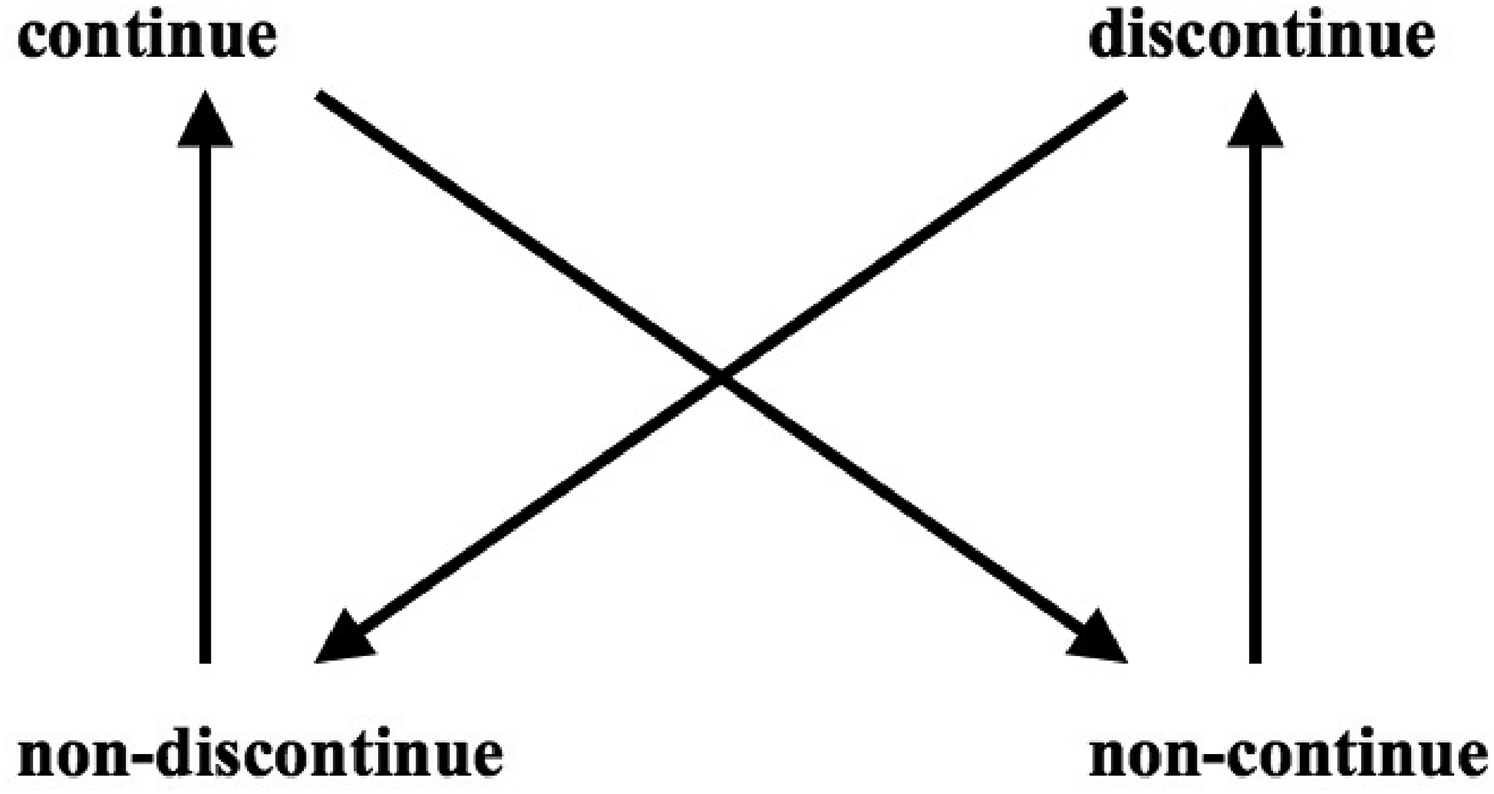
Semiotic square of the continue/discontinue category.
In generative semiotics, the semiotic square represents the most fundamental level of significance, and it is defined by Greimas and Courtés (1982, p. 305) as “the visual representation of the logical articulation of any semantic category.” 1 It is therefore employed to describe the elementary structures of meaning of a given semantic universe; the latter may coincide not only with a text in the traditional sense (e.g., a poem, a film, or a newspaper article) but also with everyday practices, media flows, or strategic interactions (Marrone, 2010). As a result, on many occasions, the semiotic square has been used to describe the deep logic of a group of texts or signifying practices. Well known is the case of Jean-Marie Floch's square of consumer axiologies (1990), elaborated from a corpus of car advertisements and then applied in many different marketing analyses. In the study of electoral campaigns, very relevant is a study by Bertrand et al. (2007), where a semiotic square is employed to account for the political behavior of the candidates in the 2007 French presidential elections; moreover, it is worth mentioning that Guarino (2001) applied another Floch semiotic square, originally designed to describe advertising ideologies, to the spots of the Italian campaigns of 1999 and 2000.
As previously outlined, we propose the category continue/discontinue as the foundation of the various accounts of the historic process. As the sociologist Zerubavel (2003, p. 34) observed: Regardless of the specific form of historical narrative we use to help us impose some retrospective structure on the past, there are two basic modes of envisioning the actual progression of time within it. While one of them features essentially contiguous stretches of history smoothly flowing into one another like the successive musical notes that form legato phrases, the other tends to highlight unmistakably discontinuous breaks separating one seemingly discrete historical episode from the next, like the successive notes that form staccato phrases.
In other words, the process of history can be seen as a continuous accumulation of events that advance a progressive change, or on the contrary, it can be seen as a process of discontinuities, where highly significant moments bring about radical or even revolutionary changes, compared with periods of stability 2 .
The projection of this base category in the semiotic square reveals the other two positions, which complete the possible basic attitudes to the historic process. On one side, the rejection of continuity (noncontinuity) comes with the rejection of the progressive character of history, therefore formulating itself as a reinstallation of a past moment. On the other side, the rejection of discontinuity (nondiscontinuity) comes with the rejection of radical or revolutionary changes that would break a certain timeless continuance.
Based on this framework, which aims to describe the underlying logic in a series of observable differences in the discourse, we will use certain conceptual instruments that have been developed in the field of memory studies and other conceptual instruments forming a part of semiotics. This is in order to highlight the implications that the varying attitudes to the historic process have meant for the political discourse of the last Spanish elections. Following the logic of the square, we will analyze the political discourse of each party's campaign in isolation to try to later offer a summary view in the conclusions.
Before we begin, we would like to make clear that our perspective is not based on exhaustive statistics, but rather on semiotic significativity, meaning that we are not concerned with an evaluation of all the spots produced during the campaign. For the analysis, we have selected the longest and most articulate videos from each of the parties’ campaigns, plus some other clips that we consider especially significant regarding the attitude toward the historical process.
We will address the corpus by analyzing the campaign of each party separately. The order of presentation will follow the internal logic of the proposed semiotic square. The first position corresponds to the term continue, which we will see occupied by PSOE. Its negation leads us to the contradictory noncontinue, where we will find Vox. By implication, we then move on to the term discontinue, where we will locate Unidas Podemos. Finally, the negation of the last term gives us its contradictory, the nondiscontinue, where we will encounter PP. Regarding Ciudadanos, we will see that it occupies the neutral position, defined by the union of the subcontraries: noncontinue and nondiscontinue.
PSOE: “Make it Happen. The Spain You Want”
The main slogan from the campaign of PSOE was: “Make it happen. The Spain you want,” putting the emphasis on the achievements of various socialist governments that have been in charge in the period between the start of the Spanish transition to democracy to current times.
Two of the most significant videos 3 featured a recently retired woman. As in other videos from this campaign, both spots were to be viewed one after the other as they featured two testimonials from the same person. In the first video, the main woman appears alongside a friend at the entrance to the Pequeño Cine Estudio in Madrid, a movie theater that was emblematic of a Spain that opened up to new tastes and ideas after a long period of censorship. After making a comment about a film they were going to see, the woman sums up the social advances achieved since the transition by PSOE against the opposition, which maintained an ideological link to the Francoist regime.
PSOE promotes its own memories, so that its achievements are not forgotten and so that the continuation in the progress of social rights is highlighted. In fact, the party presents itself as the guarantor of the continuation of the transition, something understood as a period of continual advances. This progressive image of the last 40 years of history is bolstered in the second video, where the legacy of this memory is represented through three generations of women.
We can observe a clear theme of memory in these spots, of a memory that is embodied in the form of a witness and that, thanks to the emotion behind the message, manages to take on a degree of authenticity (Assmann, 1999, p. 253). More specifically, this is what Assmann (2011, p. 36) calls “communicative memory”, meaning a memory that “the individual shares with his contemporaries” and that “accrues within the group.” This memory is perpetuated across three or four generations, which is precisely the timeframe that the experiences of the second video covers, experiences that the main woman communicates alongside her daughter and granddaughter. This process of remembrance covers a timeline of events that began roughly 40 years ago, which is a significant date, not only because this coincides with the step towards democracy but because it corresponds to a need on the part of PSOE to underline certain memories from the past. As has been observed by Assmann (2011, p. 36), “after forty years those who have witnessed an important event as an adult will leave their future-oriented professional career, and will enter the age group in which memory grows as does the desire to fix it and pass it on.”
It is these memories, overlapping with those of the party, that form a community, a group with an identity that is constructed based on a common and alive memory (Halbwachs, 1980; Halbwachs, 1992, p. 59). The viewer is invited to include himself in this group through the look of the witness, who questions the viewer directly. Here, we better understand the slogan “The Spain you want”: It is a type of Spain shaped by this memory—which corresponds to PSOE's proposal—and it is a type of Spain that stands in opposition to another Spain that resists this image of gradual and progressive change in history.
Based on all of these elements, the PSOE campaign can be placed in the “continue” position on the semiotic square that we proposed beforehand. Also implied by the titles of the spots that have been analyzed—“On April 28th the reformist women vote with memory” and “The reformist women want to keep prospering with equality” —is the idea that this position can be later lexicalized as “progress.” In this way, it also reflects the positive outlook this party has on the continuity of the historic process. Through the establishment of a link between memory and progress, the historic process is represented as a linear and gradual advancement, a position that is consistent with the traditions and ideology of this party.
Vox: “Make Spain Great Again”
The rejection of “continue” in the proposed semiotic square gives us its opposite, which is “noncontinue.” With this, there is a rejection of the vision of the historic process as a continuous and progressive thing. This is the perspective of Vox, a party formed in 2013 that had parliamentary representation for the first time in these national elections.
While PSOE constructs its identity on a foundation of a living memory that returns to the transition to democracy, Vox's historic references hark back to a remote past connected to milestones from national history. In fact, one of the main slogans of the party's campaign, which was clearly inspired by that of Donald Trump, was “Make Spain great again,” which reveals a distinguishing feature of certain types of populism, which is the proposal of something new that is really a repetition (Sedda, 2018).
This slogan was complemented by a phrase that was repeated throughout the party's campaign: “Resist and reconquer.” Following in the footsteps of story of the Reconquista, Vox started its campaign with an event on April 12, 2019, next to the statue of Pelagius of Asturias in the Santa Cueva de Covadonga sanctuary. This figure, who unites history and legend, represents a symbol of the resistance of the Arab conquest and the start of a fight against the invaders. History tells us that Pelagius started the Reconquista in the VIII AD century at the Battle of Covadonga, where some accounts claim the foundations of the Spanish Empire were laid. It is this place of memory (Nora, 1989) that Vox, symbolically aligning itself with the strength of this past, chose as the starting point for its own particular Reconquista.
Along with this emphasis on the origins of the Spanish Empire, it is not for nothing that the most significant precampaign spot from Vox 4 —published on Twitter on March 13, 2019—focused on its end. By placing so much emphasis on the beginning and end, the two structurally most important moments in a narration (Lotman, 1990, pp. 151–152), Vox is revealing its time reference: that the idealized era of Spanish Empire that must be returned to by reversing the present historical situation.
This spot begins with the refusal of the Madrid City Council to install a statue in honor of the men known as “the last of the Philippines”. This monument recalled the heroic resistance of the 30 or so isolated soldiers who, unaware of the 1898 surrender of their mother country, continued maintaining a Spanish presence in the colony until several months later.
By using clips from the movie Last Stand in the Philippines (1945), directed by Antonio Román, Vox establishes an analogy between present events and the loss of the last colonies. Once again, as was also the case with the PSOE, cinema appears as a vessel for memory. However, whereas PSOE discussed the fight against censorship and the role of certain cinematography in the modernization of Spain, in the case of Vox there is a celebration of nationalist Francoist propaganda. Along with details of the Madrid City Council's veto of the proposed statue, the spot also presents some declarations from Pablo Iglesias, the leader of the Podemos party, where he states that he does not feel comfortable saying “Spain” or using the national flag. Then, in the following scene, there are images from the Román movie in which the soldiers raise a tattered flag. With this, Vox symbolically recovers elements from this remote past and the values they represent.
The video goes on to show some recent images from protests in Madrid where the national flag was being waved. On top of these moving images, there is audio of the military battle cries from Last Stand in the Philippines, which achieves the effect of identifying the old heroes with Vox activists, who therefore take on the symbolic role of the resistance. This revenant effect links to the appearance of Vox Secretary General, Javier Ortega-Smith, who leads a toast by reciting some patriotic verses taken from Eduardo Marquina's theatrical piece The Sun Has Set in Flanders (1910). In this way, the video brings to the present the historical period that Vox wants to recover, something clearly identified in resistance and reconquest.
As such, Vox's memory strategy involves the logic of oblivion; in particular, it is guided by the figure that Augé (2004, p. 56) terms “return,” which refers to attempts “to find a lost past again by forgetting the present—as well as the immediate past with which it tends to be confused—in order to re-establish a continuity with an older past.” So, Vox is canceling the very living memory reactivated by PSOE in order to go back to a golden political age, separate from current conflicts and salvaged in a ritual form.
Contrary to the PSOE position, where the key is the idea of not forgetting a past that is still present, Vox has selected the elements from a distant past that should be reinstalled in memory. Using the terms of Assmann (2011, pp. 50–53), we can say that Vox contrasts “hot” memories from the communicative memory with “cold” memories, through which a cultural memory is formed. This, which is positioned through fixed points of the past and which takes shape in symbolic figures, finds its own specific place in formalization and ceremonialness, characteristics that clearly appear in Ortega-Smith's toast as he lifts his glass and says the following verses: “For Spain! And whoever wishes / to defend her, may honorably die; / and whoever, as a traitor abandons her, / cannot find anyone to pardon them, / not a holy shelter, / nor a cross on his remains, / nor the hand of a good son to close his eyes.”
A toast, as is well known, is a secularized form of sacrifice (Schivelbusch, 1993, pp. 169–170), and, as recalled by Assmann (1999, p. 38), this ritual serves to update the foundational past, allowing for the entry into a sacral dimension of memory. One thing in particular that is established from this reference to the past is the identity of the group that is remembering. In this spot, this ritual-esque ceremony, which features hints of solemnity, represents the unity of a whole community, that of Vox. These are the people who take on the role as defenders of an atavistic country against its political adversaries, those who it accuses of treason, and those who reject the right to memory.
Going back to our semiotic square, with Vox we are seeing a “noncontinue” that rejects the gradual advancement of the historic process in the frame of the recent past. Its proposal acquires the form of a historic regression, not so much in the sense of a crabwalk through history but in that of “restoration,” with a mythical element of a golden Spanish age. With this, Vox aims to project onto the present its idealistic images, those of a historic era seen as a block, and those of the robust unity of the Spanish nation.
Unidas Podemos: “History Is Written by You”
Based on the logic of the semiotic square, “noncontinue” comes with the implication of “discontinue,” which is the position where we find Unidas Podemos, and this party presents itself as a force for breaking down what has gone before. This position is clearly expressed in its first campaign spot, 5 which took the title “Black and White” and which was made up of written text. In the first part, white text on a black background represents a historic situation that reflects a mismatch of wealth and power: “The owner of a television channel has more power than any member of parliament. The banks owe us 60,000 million euros. They don’t want to give it back. The big businesses don’t pay taxes and take our wealth to offshore tax heavens. The electricity companies’ profits are growing. Thousands of families suffer as they can’t pay the bills. They are the ones who are in charge even without standing for election. But there is someone who has more power than all of them.”
The second part of the video inverts the coloring to place black text on a white background, indicating a change from the initial situation. On the screen, the viewer reads: “YOU. You can change everything. On April 28th, history is written by you. Vote for Unidas Podemos.”
This video not only launches its electoral campaign but it also serves as an introduction to the party's most representative spot of the campaign, 6 which takes the title of the electoral slogan of “History is written by you.” In this spot, the party's position on the historic process is summarized, and we see clear signs of rupture with respect to the present period.
Like in the previous spot, this one is divided into two clearly different sections of similar duration: the first part is focused on the development of the last economic crisis, and the second part is focused on the possible path that could be taken with Unidas Podemos.
At the beginning of the spot, the viewer is presented with the story of the historic situation in which the elites propose saving capitalism ahead of the disastrous consequences of the crisis. The style it uses is borrowed from recent documentaries or investigative television reports and follows an argumentative logic that reminds one of the certain conspiracy theories, normally based on the strategy of contradicting more than proving facts (Knight, 2000). Through the visual editing and the voiceover from party leader Pablo Iglesias, the intent is to reveal the inner workings of the world's economic elite, accusing them of benefitting at the expense of the people. 7
Right in the middle of the spot, a black fade switches the focus to the consequences of the crisis, which are represented by countless protests led by people from young environmentalists, feminists, workers, and people from other social movements. To counter the historic impasse in which the capitalism is situated, Unidas Podemos now offers a shake-up that can allow for a different future. Benefiting from the inevitable uncertainty of a crisis (Koselleck, 1988, p. 158), this call to cast a vote presents a historical choice: on one side, there is the option to continue with the late-capitalist logic; on the other side, there is the opening of new potential development paths (Lotman, 1990, p. 7–8).
As such, the discontinue position of Unidas Podemos can be lexicalized as “revolution,” understood as a historical category that serves to “define social and industrial occurrences in terms of a self-accelerating process” (Koselleck, 2004, p. 55). Furthermore, the presentation of future possibilities is connected to the party's vision for the state: Spain is never named and only appears as negative, as a myriad of social identities and territories that will form a framework that is yet to be defined.
All of this is reflected in the personal interpellation of its slogan “History is written by you,” which both titles and closes out the spot. This appeal to a generic voter promotes a double input: on one hand, that of authority in the interpretation of history and, on the other hand, that of selecting the actors who will carry it out. In this way, April 28 seems almost like an explosive moment of a radical rupture, from which new actors will substitute the economic elites in power and the past will be revealed to have been a sustained exploitation of the people by a small group of the powerful.
PP: “Sure Value”
The logic of our semiotic square takes us to the last position possible that of the rejection of discontinue, which brings us to nondiscontinue, and this is where we find PP—a conservative party that was founded in 1989 and that has alternated with PSOE as the parties in national government since then.
Its preference for nondiscontinue in relation to the historic process is seen in its most elaborate spot, 8 which, as was the case with Unidas Podemos, has the slogan of its campaign as the title of the spot: “Valor Seguro”—something close to “Sure value” in English, although each of the Spanish words has multiple meanings. The video even begins with dictionary definitions from the Real Academia de la Lengua Española of these two words: “Valor: def. 1. The degree of usefulness or aptitude for satisfying needs. 2. Courage. 3. Principle. Seguro: def 1. Free and devoid of risk. 2. Certain, indubitable. 3. Unfailing, offering confidence. 4. Not feeling doubt.”
This very pronounced reference to the certain character of sure values immediately reveals PP's resistance to radical change. In this way, it is significant that the video opens with definitions from the dictionary, the reference for the current meaning of terms regardless of their historical evolution (Eco, 1986, p. 47–53). With respect to the rest of the video, there is an insistence on featuring certain fundamentally traditional cultural elements, and this culminates with the final image of the national flag. On top of it, the term “future” and the title “sure value” appear, indicating that the conservation of customs will save Spain from the risks of history. It is a figurativization of a resistance to change, reinforced by the routine character of this series of habits that appear as daily behaviors that fall within social norms.
The sure value advocated by PP is manifested in comforting predictability, and it implicitly carries a promise of no risk. Such certainty is shaped in the invariability of customs and traditions that, in the words of Hobsbawm (1983: 9), possess the value of “automatic procedure” or “reflex reactions,” meaning that they have a certain collectively unconscious character.
This attitude is confirmed in a series of three other spots, set the day after the elections, that represent hypothetical conversations between family members or friends. In each of them, somebody feels regret at not having voted for PP as they learn that PSOE is negotiating with regional proindependence groups. In this way, the resistance to historic rupture is shown in the desire for nondiscontinue in a territorial sense, an idea also asserted in a different way in the video titled “Spain in not Game of Thrones”. 9 Designed for sharing on social media, this spot references the famous television series to accuse the other parties of wanting to divide Spain into various enclaves that pursue their particular interests. “There are some who think that Spain is made up of seven kingdoms,” the narrator says, but PP resists this idea of fighting and fragmentation, presenting itself as a party that instead builds bridges and trains that unite the country.
The nondiscontinue represented by PP can, therefore, be lexicalized as “maintenance.” Consistent with the ideology of the party, the attitude toward the historic process that is observed in these videos is conservative and, with the aim of defending the customs that preserve the essence of Spain, manifests itself as a resistance to rupturing changes.
Ciudadanos: “Let's Go!”
The final case is that of Ciudadanos, the party whose name translates as Citizens in English and whose strategy represents an exception. This electoral campaign saw all the most relevant national parties insisting on the theme of the past, and it is striking that only one of them expresses indifference in its relationship to the historic process. This is a “marginal” position that is coherent with the general strategy of this party, that since its founding has always built its discourse through double negation (neither … nor), a rhetorical tool for the party's aim of placing itself in a neutral position in front of the traditional political divisions (Serra & González, 2018).
This strategy is reaffirmed with its attitude toward the historic process, which in our semiotic square coincides with the combination of nondiscontinue and noncontinue. In fact, the only time period that the viewer experiences in its spots is the present, characterized by a clear punctuality, while history and memory are not relevant. It is a logic of oblivion that, in Marc Augé's terms, corresponds to the figure of suspense, the main aim of which is to recover the present by provisionally splitting it off from the past and the future (Augé, 2004, p. 57).
The video “Citizen Rhythm” 10 is a musical piece with various sounds from people performing activities coming together simultaneously: a family plays in a children's play park, a girl jogs, a boy skates a skateboard, a boy rides a bicycle, a worker hits nails, a worker fills a cement mixer, and an electrocardiograph beats to mark the rhythm of the general public's lives. It ends with an image of the party's number 2 Inés Arrimadas and the leader Albert Rivera scanning the horizon, and this is followed by various takes on the campaign slogan: “Let's go! Together; Let's go! To win; Let's go! Spain; Let's go! Citizens.” In keeping with its previous campaigns, not only does Ciudadanos not focus on history or memory but the video has a clear aestheticization of the present, which is separate and isolated from the past and the future.
This emphasis on the current moment is reiterated with a short series of other spots, titled “Something is happening,” 11 in which a group of undecided voters react to a series of news stories to suddenly realize that they want to vote for Ciudadanos. In one of them, two friends are having a drink together. “Ah, María,” one says to the other, “I don’t know what's happening to me, eh? But no. No. I’m no longer undecided. Ah, just like I tell you, eh? I want to go to vote now. But now. I can now see myself voting for Ciudadanos.” “The same is happening to me,” the friend replies. This is the representation of an epiphany that leads to an exciting conversation, where the insistence on the punctual aspect of the moment cancels out any other time reference.
This strategy of neutralizing the historic process and of emphasizing the punctual aspect of the present can also be seen in another spot in which two young people appeal directly to the viewer, urging them to go to vote straight away. In particular, it is noticeable how the value of punctual aspect of the act of voting is underlined by the slogan of “Vamos!” (“Let's go!”) in the imperative tense, a verbal form that maintains a vital link with the act of enunciation (Benveniste, 2014, p. 142).
While Ciudadanos previously demonstrated a cold attitude to history, in this campaign, it reaches a complete indifference with respect to the historic process. In this sense, the neutral position, of neither continue nor discontinue, where Ciudadanos is placed, could be defined as “presentism” (Hartog, 2015), understood as an emphasis on the current moment without any link with past events or with the future.
This attitude confirms the party's vision of the nation, which it does not refer to in terms of identity. The reason is that the collective identity needs to be placed within a historic narration (Anderson, 1983, pp. 191–192), and, from the moment in which Ciudadanos insists on the prompt and current experiences of individuals, it is logical that Spain is represented as a neutral space where citizens go about their lives without being defined by a collective identity (Serra & González, 2018).
Conclusions
Over the course of our analysis, we have verified the validity of the continue/discontinue categorization in order to organize each Spanish political party's interpretation of the historic process through their electoral spots. The basis for this resides in the hypothesis that the varying attitudes to the historic process are a key element in the main parties’ strategies for differentiation and positioning (Figures 2 and 3). From the expansion of this categorization in a semiotic square, we have shown that the discursive strategies from each party are distributed based on the positions that were logically anticipated in our model.
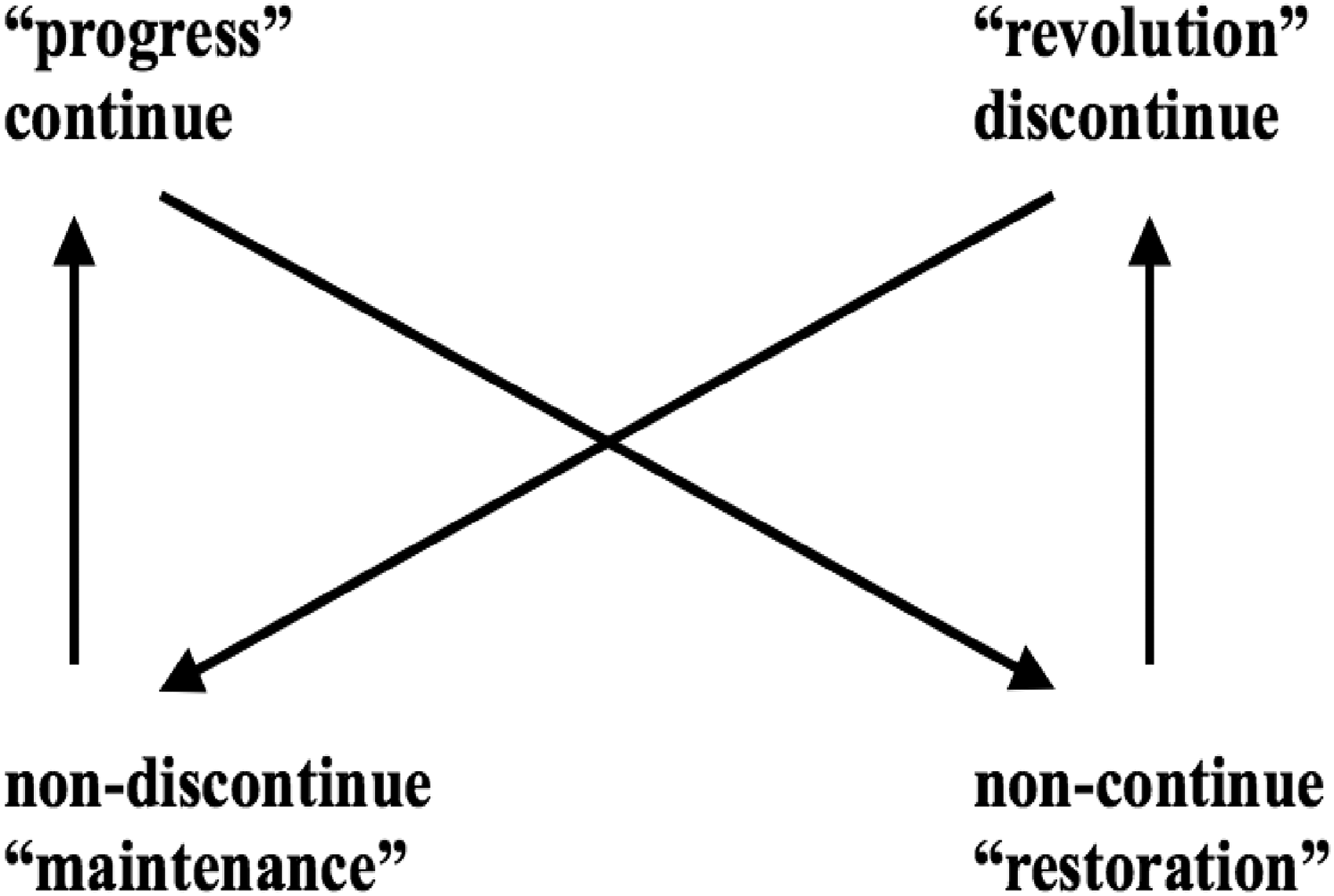
Semiotic square of possible attitudes toward the historical process.
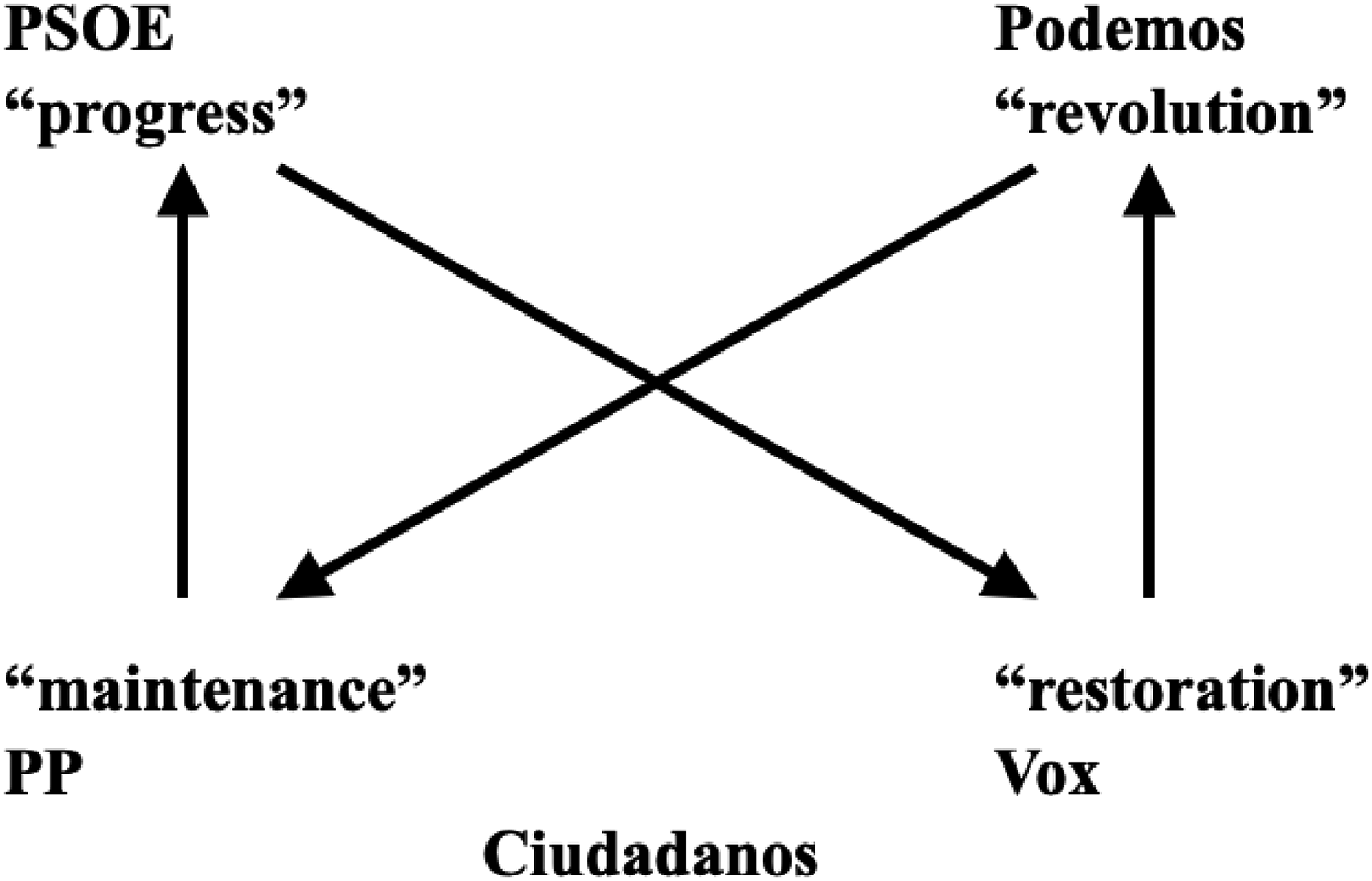
Semiotic square with each party's position.
Beyond this confirmation, our analysis allows for further theoretical considerations to be drawn, as the positioning of each party is essentially revealed through the two deixes, which indicate relationships of complementarity. It can be observed that on the left side of the square, called the positive deixis, the two historically competing major forces of Spanish politics, PSOE and PP, are found, and then on the opposite side, the negative deixis, the two extremes of the Spanish political spectrum, Unidas Podemos and Vox, is found.
At first, these pairings may seem surprising: one might wonder how there could be complementarity between the two parties that have traditionally represented alternative options in Spanish democracy, or one might wonder what there could be in common between a left-wing party with Latin American communist regimes sympathies and a party that does not hide its Falangist roots. The reason for this apparent paradox is not to do with the ideological differences of the parties, but it is to do with their moderate or extreme political attitudes, positions which have different views of the historic process. In this respect, the analysis of Bobbio (1996, p. 22) is enlightening: If we look at the question in terms of the philosophy of history […] we find that moderatism is gradualist, and believes that action should be guided, metaphorically speaking, by growth of an organism from its embryo according to a pre-established order; whereas extremism has a catastrophic vision, whatever its objectives. Extremism interprets history as progressing by sudden leaps forward and clean breaks, which leave room for human intelligence and forcefulness (in this sense it is less determinist than moderatism).
As such, both the traditional parties that have been in government share a coherent and moderate attitude toward the historic process, while the extreme view is held by the younger political forces. Bobbio (1996, pp. 21–22) also makes clear why this classification is independent of ideology: the distinction between left and right is different from the distinction between extremists and moderates, this means that the opposing ideologies can have points of contact and agreement at their extremes, even though they are still quite distinct in terms of the political programmes and final objectives which define their position vis-à-vis the left/right distinction.
From this point, we can now try to clear up the internal logic of these surprising relationships. First, we see that the position of continue, lexicalized as progress and occupied by PSOE, presupposes the maintenance that characterizes the position of PP. In the logic of the historic process, the fact that something is maintained implies that changes are not disruptive. This double tie explains the logical interdependence between the two governing Spanish parties, and it also explains their alternation in power over the past decades, with the parties having two distinct visions but compatible ones in terms of the historic process.
Meanwhile, the relationship of implication and presupposition between Unidas Podemos and Vox is more problematic but equally inevitable. Naturally, the position of restoration, defined by a return to a past time, does not intuitively entail the position of revolution, which we have seen figurativized in an advance made up of bursts forward. However, if we follow Yuri Lotman, then the logic of the rupturist visions carries with it the return to a potential time path that has never before been trodden, to the recovery of elements of the past that had been forgotten on the development path historically followed (Lozano, 2013). For Lotman (2009, p. 8), this is summed up with the image of a minefield: A minefield with unexpected explosive points and a river in spring with its powerful but directed stream—these are the two images visualized by the historian studying dynamic (explosive) and gradual processes. The mutual dependency of these two structural tendencies does not change and on the contrary sharply emphasizes their mutual stipulation. Neither can exist without the other. However, from the viewpoint of each, the other represents an obstacle which must be overcome or an enemy which should be destroyed.
The potentialities of the past as reserves of imaginaries, the recovery of the abandoned as a possibility for rupture in the future: this is the logic that unites the positions of noncontinue and discontinue when discussing the historic process. This is how the references to figures of the past in the rupturist discourse of Unidas Podemos make sense.
Furthermore, this movement from a return to the past to an idea through bursts forward, from a restoration to a revolution, replicates the history of the semantic change of the term revolution, a term that started out as meaning a return to an initial point (Koselleck, 2004, pp. 43–57).
As we conclude, we cannot overlook the underlying divisions within the ideological spectrum that our model reveals. The positions on the semiotic square of PSOE and Unidas Podemos on one side and of PP and Vox on the other are opposed, although the first two share a left-wing ideology and the latter two share a right-wing one. This suggests that within each ideology, there is space for visions of the historic process that can be very distinct. When these become central, as we have seen in our case, it is not surprising to see that agreements between parties that are ideologically similar can be difficult. In this, there is one explanation for the failure in the postelection negotiations between PSOE and Unidas Podemos to try to agree on a pact to govern—something that led to the calling of fresh elections for November of 2019—just as there have also been continued tensions characterizing agreements between parties on the right.
Meanwhile, the indifferent position with respect to the historic process of Ciudadanos places this party between PP and Vox within our model. Based on this perspective, it is not surprising that with these parties, Ciudadanos was able to achieve some type of agreement in the postelection period.
Finally, we have to point out that none of the studied parties seems to place itself in the complex position of the square, which remains empty. The combination of a continuous attitude toward the historical process (progress) and a discontinuous one (revolution) can be defined as turbulence; this would mean understanding the historical process as characterized by a sequence of leaps into the future, which, however, keep certain graduality in the background. It is interesting to note that this idea seems compatible with the attitude shown by Más País, a formation born in September 2019 from a schism within Podemos.
In our article, we intended to go against the grain with respect to the ideological differences between parties. Instead, we took their perspectives toward the historic process as the distinguishing criterion. Over the course of the analysis of the Spanish electoral spots, this aspect was confirmed to have played a role in the parties’ positioning strategies. In addition, this approach helped us to elucidate certain political behavior that appears unexplainable if analyzed from a purely ideological perspective.
More generally, the identity of a nation is tightly linked to the strategies of memory and forgetting, with which the value and meaning of historical development are constructed. This, in times of crisis, is not surprising that different possibilities of understanding and interpreting the historical process appear in political discourses. This has been the case of the elections analyzed, which took place at a time of political instability largely due to the Catalan territorial problem.
According to the heuristic nature of any semiotic square, our model is meant to describe the analyzed corpus and should not be automatically extended to other contexts. However, it could be interesting to apply it to the debates on the European Union (EU) and its identity. Just as we have seen for Spain, in the public discourse, there is no hegemonic representation of what the EU is or should be (Migliore & Mangiapane, 2021), and this plurality of images could be investigated by looking at the different attitudes toward the historical process. A project that aims to unite people with different histories and cultures inevitably needs some agreement on how to view the past and how to envision the future; however, the existence of different and potentially conflicting memories has favored a recent upsurge of nationalist movements and the birth of new irredentisms in Europe. Therefore, future investigations could test the productivity of our model by paying attention to the attitudes toward the historical process present in different Europeanist and anti-Europeanist discourses. In particular, such research could help to have a better understanding of how these relate to nationalist or proindependence positions (Sedda, 2021).
Finally, we believe that an international comparative study could shed light on two other issues that go beyond the scope of our analysis. First, it could reveal which attitudes toward the historical process are predominant in certain historical and political contexts and which, on the contrary, are less widespread or even absent. Secondly, it could clarify the level of coincidence or discordance between parties of the same ideological spectrum with respect to the attitude toward the historical process. This last aspect, once again, could be significant at the level of the European Parliament, where representatives of national parties converge in different groups based on political affinities.
Footnotes
Declaration of Conflicting Interests
The author(s) declared no potential conflicts of interest with respect to the research, authorship, and/or publication of this article.
Funding
The author(s) disclosed receipt of the following financial support for the research, authorship, and/or publication of this article: This work was supported by the Ministerio de Ciencia, Innovación y Universidades del Gobierno de España (grant number PGC2018-098984-B-I00).
