




Abstract
Mass communications frame fatness and COVID-19 as a dual threat. This discourse furthers well-established tendencies to degrade bodies labelled overweight or obese, positioning them as deficient and requiring correction. Empirically, this article draws from an online US right-wing news media platform, Campus Reform, including readers’ comments (n = 135) on an article denouncing professors working in fat studies during the COVID-19 lockdown. This status degradation ceremony—backed by ‘big money’ that funds campus culture wars—not only targeted fat people but also academic disciplines, expertise, universities and social justice agenda. Analytically, this study draws from ethnomethodology and literature on media and bodyweight, meddling or health fascism, weaponized stigma and the politics of cruelty. Going beyond the flesh and a particular case study, it also challenges the ways in which cruelty enacted towards those deemed fat (especially women) can spiral into corrosive nationalist discourse in pandemic times.
The most obvious problem with jokes about the ‘quarantine 15’ or ‘the COVID 19’ is that gaining weight is framed as an inherently bad thing—an idea that’s steeped in fatphobia. (De Elizabeth 2020, cited by Thoune, 2020)
Mass communications frame fatness and COVID-19 as a dual threat. This discourse furthers well-established tendencies to degrade bodies labelled overweight or obese, positioning them as deficient and requiring correction. Following the declaration of the coronavirus pandemic, fear-based public health messaging and mass media quickly posited a putative relationship between overweight/obesity and COVID-19 (increased risk of infection, of being hospitalized in intensive care and death) (e.g. Brooks, 2020; Donnelly & Newey, 2020). As Pausé et al. (2021) explain, such claims further ‘problematized fatness’ in line with the tenets of the contested weight-centred health paradigm. In short, in the absence of certain science and much prejudice, journalists, obesity researchers, public health officials and other claims-makers reproduced the ‘fat as fatal’ and ‘frightful’ frames (Kwan & Graves, 2013). Such actors and framing devices are known to amplify pre-existing stigmatizing body norms and practices, comprising ‘fat panic’ or sensibilities (Monaghan et al., 2019), which are gendered and especially corrosive for women and girls (e.g. Fikkan & Rothblum, 2012).
Add to this mix pervasive concern about unwanted weight gain during government-imposed quarantines, or mass lockdowns, in the time of COVID-19. Fat activists have responded to such concern and derisive humor by reframing the problem as one relating to socio-cultural fears about fatness, or fatphobia (Pausé et al., 2021; Thoune, 2020). According to such reasoning, if such fears are constructed then they can also be deconstructed and reconstructed in positive ways via education, self-acceptance work and declaring fat pride rather than shame. What has been called the Fatosphere – specifically, online groups and communications advanced by fat activists and the ‘body positivity’ movement—is one domain wherein such pedagogy occurs (Hynnä & Kyrölä, 2019; Lupton, 2017). Here actors repudiate discrediting meanings, such as the ‘fat as fatal’ public health frame, by emphasizing civil rights, respect, admiration and alternative weight-inclusive health paradigms (Bombak et al., 2019; Kwan & Graves, 2013). Burgeoning literature on media and bodyweight explore such matters (e.g. Lupton, 2017). However, little is known about the intersection of the declared COVID-19 and obesity crises as enacted online, and how this might be weaponized.
Empirically, this article aims to advance knowledge on such matters primarily though a case study of communications that were published by an online right-wing US news media platform, Campus Reform (CR), in April 2020. Backed by ‘big money’, CR is directed at conservative students and is known to manufacture ideologically motivated attacks against faculty (Hamera, 2019; Kamola, 2019). The present study focuses on a particular CR story (Dallmeyer, 2020) and readers’ comments (n = 135) denouncing a blog post from a professor working in fat studies during the early COVID-19 lockdown (Thoune, 2020). The denunciation might be conceived ethnomethodologically as an attempted ‘status degradation ceremony’, defined as ‘communicative work between persons, whereby the public identity of an actor is transformed into something looked on as lower in the local scheme of social types’ (Garfinkel, 1956: 420). However, rather than a purely localized matter, the vitriol expressed on CR radiated towards other professors, various academic disciplines, universities and social justice agenda amidst perceived threats to the body politic. Analytically, this article not only draws from ethnomethodology but also sociological scholarship on meddling and health fascism (Edgley & Brissett, 1999), the weaponizing of stigma (Scambler, 2018), and the politics of cruelty, defined as infliction of pain, including emotional pain, with the purpose of achieving ‘some end, tangible or intangible’ (Shklar, 1989: 29, cited by Kivisto, 2019: 191). When looking beyond the flesh and a particular media case study, this article challenges the ways in which cruelty enacted towards those deemed fat (especially women) can spiral into corrosive nationalist discourse in pandemic times.
Research Context, Data Generation and Analysis
After reports of an initial outbreak of pneumonia of unknown cause in Wuhan, China, in December 2019, the World Health Organization declared COVID-19 a global pandemic in March 2020. Research for this article commenced one month later, a period when responses to this novel coronavirus had profoundly affected everyday life. Many governments claimed that healthcare systems could collapse if otherwise uninfected people’s movements were not radically curtailed. Mass lockdowns or ‘shelter-in-place orders’ became the primary non-pharmaceutical public health intervention. As noted above, concern also quickly emerged about weight-gain, a topic that subsequently attracted the attention of psychologists interested in ‘health behaviours and wellbeing during COVID-19’ (Ruiz et al., 2021).
It was in this context that my curiosity as a critical weight scholar and medical sociologist was piqued. How was fatness and COVID-19 being discussed online during the early stages of the lockdown? Was such discussion implicated in intense forms of stigmatization, a feature not only of the enduring ‘war on obesity’ (O’Hara & Taylor, 2018) but also of what Strong (1990) calls ‘epidemic psychology’ that comprises fear-based psycho-social response to a large scale, novel infectious disease? If fatness was being further denigrated, which actors were engaged in this and what did this mean in a broader political economy? Might sociology offer a lens on such matters, just as health offers a lens on society (Scambler, 2018)?
Such questions prompted me to undertake an exploratory online search on April 15, 2020. I typed ‘fat shaming AND COVID-19’ into Google’s search engine. The top ten results included an attention-grabbing CR article, ‘“Two Fat Professors” are afraid of COVID-19 causing “fat phobia”’ (Dallmeyer, 2020), published on April 5. Rather than expressing empathy, the article, as with other CR communications, sought to fuel suspicion and even outrage (see Hamera, 2019). Indeed, the article, in keeping with the general tenor of that platform, gave expression to the ‘US campus culture wars’ wherein those with right-wing political agenda attack public intellectuals and institutions with progressive or left-leaning sensibilities. Followed by 135 reader comments, Dallmeyer (2020) centred Thoune’s (2020) blog post on diet culture during the COVID-19 lockdown (discussed further below). No further comments were posted during the next two months when I undertook a thematic analysis of these materials. Interestingly, when I revisited Dallmeyer’s (2020) article twelve months later, there were 127 reader comments (suggesting moderators had removed some). Some paratext had also been deleted, including editorial statements claiming ‘the radical left’ were intent on intimidating conservative students and CR depended on reader donations. My analysis focuses on the originally published text.
Given the foci of the CR article and readers’ comments, I also visited Thoune’s (2020) blog post and co-hosted website: Two Fat Professors (https://www.twofatprofessors.com/). The blog post was published on April 1, 2020. When I finalized my study twelve months later, Thoune’s contribution had reportedly been viewed over 3,000 times (the second most viewed post on twofatprofessors.com), though there were no reader comments. The parent website offered various resources, enacting what has been termed ‘fat pedagogy’ (Cameron & Russell, 2016) that challenges oppression directed at people who identify as fat and/or are labelled as such. The website informed visitors that its hosts were dedicated to ‘fighting fatphobia with education, community-building, and A LOT of sass.’ The menu linked to an ‘about us’ section (containing the hosts’ scholarly profiles), another on ‘publications’ (academic writings, news reports), ‘resources’ (their favorite readings, videos, links to other websites etc.), and blog posts dated from March 1, 2019. Rather than geared towards direct income generation and monetization via advertising or donation requests the website was focused on the unremunerated work of public intellectuals.
After reading materials on twofatprofessors.com several times, I sent Thoune an introductory email on May 5, 2020. I explained my interest in and support for her work and I subsequently obtained permission to refer to her blog post in my own academic writing. These exchanges furnished me with additional insights on the hostile conditions under which fat studies professors do the work of public intellectuals. For example, Thoune informed me that they sometimes take their website offline ‘for a few days when the hate emails become too frequent and too suggestively violent’ (personal communication, 2020). I also corresponded with Thoune’s co-host, Cooper Stoll, who, interestingly, has published on the problem of fatphobia within health research (see Cooper Stoll & Egner, 2021). In view of CR’s modus operandi and after reading literature from academics who have first-hand experience and knowledge of their inflammatory journalistic practices (Hamera, 2019; Kamola, 2019), I did not contact anybody on that platform. I would defend this decision with reference to not only the aforementioned literature and personal communications with fat studies scholars but also what I observed in respect to Dallmeyer’s (2020) article and her readers’ comments (see the analysis below). These communications are treated in this study in the same way as any other views would be if they were published in traditional print media (for related discussion on the ‘situational ethics’ of digital research, see the British Sociological Association, 2017). When reporting such data I quote materials verbatim without correcting the originators’ grammar, spelling and other errors. In addition, I mainly present depersonalized data, especially from readers’ comments, rather than give undue space to ad hominem attacks.
Data were analyzed using an abductive approach. For Scambler (2001), abduction entails identifying underlying generative mechanisms that may, at least in part, explain observed events in the empirical world as analysts seek to construct ‘second-order’ accounts of what people say and do (p. 35). As also explained by Timmermans and Tavory (2012), abduction requires an awareness of existing theoretical frameworks or models when interpreting data. To be sure, I remained open to being surprised by what I observed, seeking to discern emergent patterns and themes as I read and re-read data. However, I did not wear theoretical blinkers, as might be the case with a purely inductive approach. Accordingly, I drew from and sought to further critical scholarship on the already existing problems encountered by those writing about and seeking to rethink what biomedicine calls obesity (e.g. in terms of pathologizing assumptions, moralizing actions and stigma) (Lupton, 2018). Such literature is also part of the social world and is invaluable when making sense of and ultimately challenging ways of knowing fatness in contexts of culture, power and difference. The outcomes of this research and analysis inform the remainder of this article.
‘Diet Culture at the End of the World’: Insights From the Fatosphere
Thoune (2020) offered an early intervention during the COVID-19 lockdown, derived from her own experiences as a self-identified fat woman in America. She spoke to concerns about unwanted weight-gain and derisive humor, often expressed online, that mock fat people who already risk shame and blame for their putative deviance. In her blog post, ‘Diet Culture at the End of the World’, Thoune stated the title ‘is a bit of an overstatement, but in many ways everything in my life has changed as a result of this global pandemic.’ She acknowledged that her ‘privilege’ enabled her to manage various changes, some of which were ‘pleasurable’ (e.g. wearing comfortable pajamas and watching Netflix). However, the pandemic also surfaced ‘deep-rooted American cultural values’, including those relating to ‘diet culture’ that can be especially pernicious for women. Immediately after joking about her compatriots’ fear of running out of toilet paper (an item that quickly disappeared from supermarkets during this period), Thoune stressed the serious side to her message: ‘Before I go any further, I want to emphasize how important it is in this moment to lead with kindness and compassion—not just for others, but for ourselves as well.’ She continued: Based on what I’m witnessing in the news and on social media, many of us are legitimately and justifiably freaked out. And, I don’t mind confessing that over the course of my life, in my most desperate, anxious, and freaked out moments, my default mode has been to find ways to hate or to be cruel to myself. The scenario generally goes like this: Life is fucked up? This means I’m worthless. The math has always been easy. Although, the older I get the longer it takes to get to this point. And, I’m guessing the math must be easy for others too—the number of posts that have popped up on my social media sites addressing fears about weight gain has been astounding. In the midst of a global pandemic, for many their greatest fear is gaining weight. Or, having too much food around. Or, not being able to exercise enough. Or, not having easy access to ‘healthy’ food. Or, doing too much stress baking. Or, of being worthless. And on, and on, and on. In addition to comments from people I know online, I’ve also noticed a sizable (no pun intended) uptick in the number of ‘funny’ memes about weight gain during the Covid-19 crisis. These memes seemingly poke fun at diet culture and shame viewers for: not going to the gym, eating ‘too much,’ for getting fat, and for not starving ourselves at the end of the world.
Furthermore, Thoune’s blog post urged readers to reflect upon how their own ‘health talk’ during the crisis could make others feel ‘terrible’ about their perceived or assumed failures, possibly contributing to disordered eating and social isolation rather than connection and hope. Obvious linkages could be established here with fat studies scholarship on the problem of fatphobia before and during COVID-19 (Cameron & Russell, 2016; Pausé et al., 2021). A sociological reading of Thoune’s (2020) position would also suggest that she was asking her compatriots to avoid ‘meddling’ or ‘thrusting of oneself, often boldly, into the affairs of others’ (Edgley & Brissett, 1999: 4). Meddling, which incorporates ‘health fascism’ and ‘the cult of the perfect body’ (see also Edgley & Brissett, 1990), has historical roots in Puritanism and efforts to purify the moral fiber, spirit or soul of America. Meddling gained momentum in the last decades of the twentieth century with the rise of health and fitness movements, including injunctions and interventions that could be experienced as ‘unwelcome, if not downright improper, and certainly unnecessary, annoying or offensive’ (Edgley & Brissett, 1999: 5). Indeed, health fascism and meddling invite, demand even, extreme opprobrium from the broader community towards those believed, or assumed, to have reneged on their duties as responsible bio-citizens. Fat people are obvious targets here. In response, Thoune (2020) finished her blog post on a compassionate and optimistic note: When we creep out of our shells to look at the Internet with one eye open, it would be wonderful to see signs of help, encouragement, nurturing, kindness, and generosity. As much as trauma and anxiety are contagious, I also believe that hope can be equally contagious. Let’s be hopeful. Let’s be kind. Let’s be the very best versions of ourselves that we can be as we face down what feels like the end of the world.
An Unconvincing Status Degradation Ceremony: Observing and Analyzing CR
Thoune’s calls carried no weight on CR. Rather, efforts were made to discredit the messenger via misrepresentation, silences and cruel denouncement. In grounding my analysis of what might also be termed a ‘status degradation ceremony’ (Garfinkel, 1956), the success of which is never guaranteed, this section is divided into three parts. First, I will critically outline Dallmeyer’s (2020) piece, moving, second, to the publishing context and finally to an analysis of core themes derived from readers’ comments. As will be shown, this ceremony was irreducible to any particular individual or even fatness. Rather, there emerged a spiraling of vitriol that spoke more to the denouncers’ organizational context and a broader political economy comprising vested interests, shared anxieties, tensions and (potential) conflict. Furthermore, contradictions emerged that rendered this assault unconvincing for those not sharing CR’s conservative standards of preference.
The CR Article
Published under CR’s logo, resembling a circular target from a shooting gallery, Dallmeyer’s (2020) headline proclaimed ‘Two Fat Professors’ were ‘afraid of COVID-19 causing “fatphobia”.’ Whilst the headline might be considered successful, if judged as ‘click bait’ intended to grab potential readers’ attention and attract traffic to CR, it was misleading. Thoune’s (2020) blog post was single authored and she was not claiming COVID-19 (a biomedical disease) caused fatphobia (an already existing, socially constructed problem). Rather, the post foregrounded embodied social relations, practices and (dis)connection, not crude biological pathways construed within a reductionist, temporally and thus causally flawed model of emotional life. Two bullet points then followed the headline:
A blog post on a website owned by a pair of professors who proudly call themselves ‘fat,’ laments that too many people are advising others on how to stay healthy during social distancing. The post argues that speaking about health is ‘traumatizing’ for some who are impacted negatively by ‘diet culture.’ (Dallmeyer, 2020)
These bullet points, whilst introducing skepticism and implied derision by inserting scare quotes around certain words (similarly, see Hamera, 2019), incorporate certain truths. As already noted, fat activists substitute pride for shame and Thoune (2020) was concerned about trauma in the context of diet culture and COVID-19. The remainder of Dallmeyer’s (2020) article also had superficial plausibility insofar as it referred to the two fat professors’ publications and presented direct quotations. However, Dallmeyer did not acknowledge Thoune’s central message about the need for compassion and kindness. Indeed, there was complete silence on this. Instead, various framing devices established a preferred reading.
The CR article featured a photograph, directly taken from twofatprofessors.com, immediately after the bullet points. It showed the smiling scholars in graduation gowns with the word ‘professors’ in bright pink plus two pastel-colored iced doughnuts replacing the letters ‘o.’ Readers were invited to interpret the image as such: witness two professors who cannot be taken seriously, especially in the midst of declared public health crises. And, similar to other CR articles, the story was interspersed with numerous ‘related’ hyperlinked reports that were again littered with scare quotes: ‘[
Furthermore, Dallmeyer’s (2020) piece, which read like a prosecution in the court of public opinion, included testimony from two putatively credible witnesses: a CR correspondent who was a sophomore at Thoune’s university, and a ‘Fitness coach and former college cross country athlete.’ The sophomore’s testimony included his repeated complaint that Thoune ‘is portraying something that isn’t an issue’ and ‘is expressing an issue that isn’t relevant’ (cited by Dallmeyer, 2020). Critically, such words were suggestive of his social distance from Thoune’s situation, lack of empathy and unfamiliarity with critical literature on weight-related issues (e.g. Lupton, 2018; O’Hara & Taylor, 2018). Implicitly referring to Thoune’s (2020) use of the word ‘fat’, the sophomore also went from the singular to the plural when complaining: ‘I also think it’s unprofessional where [the author] uses derogatory terms’ (cited by Dallmeyer, 2020). Yet, rather than using terms such as ‘overweight’ and ‘obesity’, which imply pathology and disease (risk), fat is the preferred word among fat activists, fat studies scholars and others (e.g. ‘plus-size’ fashion bloggers; see Limatius, 2019) who reclaim this as a political act. Any apparent concern here about Thoune’s ‘derogatory’ and ‘unprofessional’ language was thus based on strategic ignorance and was also betrayed by the fact that the sophomore was participating in a potentially harmful status degradation ceremony.
The fitness coach, another man, predictably issued lifestyle advice. In so doing, he could be compared to those ‘field experts’ discussed by Setälä and Väliverronen (2014) who are mediators of science and biological citizenship. The coach’s ‘expert’ advice, as reported by Dallmeyer (2020), conflated health with weight (loss) and presumed fat people were inactive and ignorant. He warned: ‘Obesity leads to a majority of our health problems here in the States. We shouldn’t be praising or shaming obesity but we must educate.’ The hardly flattering corollary of such pedagogy, of course, is that if fat professors are intervening in public health debates then they should learn some basics about healthy lifestyles and put this acquired knowledge into practice. Yet, Thoune’s (2020) blog post did not ignore health nor was it ‘against health’ broadly defined (including mental and physical health). Thoune repeatedly mentioned ‘health’, though she differed from the fitness coach and other advocates of the weight-centred health paradigm because she avoided conflating it with weight-loss. Rather, Thoune raised concerns about unsolicited and unhelpful advice, especially ‘health talk’ on avoiding weight gain amidst widespread fear, anxiety and stigma. She supported a weight-inclusive and relational view of health, which entails being surrounded by ‘people with love, empathy, and understanding so we are all able to get through these next couple of months without losing our minds’ (Clarishka, undated; cited by Thoune, 2020). The erasure of such concerns on CR contradicted its assurances of accuracy and objectivity through ‘rigorous journalism’, as outlined below.
The Publishing Context: CR as a Political Economic Project
CR identifies as ‘a project of the Leadership Institute’ (LI). Founded in 1979 and backed by wealthy US donors, the LI website states that it ‘trains conservatives.’ Its expressed goal is to teach ‘conservatives of all ages how to succeed in politics, government, and the media’, focusing on ‘campaigns, fundraising, grassroots organizing, youth politics, and communications.’ The LI website’s ‘about’ section, which I accessed when researching the background to CR, boasted that the organization offered almost 50 ‘types of training schools, workshops, and seminars’, alongside other services and that, over the past 40 years, it had ‘trained more than 200,000 conservative activists, leaders, and students. The Institute’s unique college campus network has grown to more than 1,700 conservative campus groups and newspapers’ (LI, 2020). Kamola (2019: 10) offers further context: The [LI] is part of the State Policy Network, a group of think tanks and political groups funded by the Koch donor network. The LI’s primary source of funding comes from the Donors Capital Fund, Donors Trust, and the Charles Koch Foundation. Donor Trust and its affiliated Donors Capital Fund have been called the ‘the Dark-Money ATM of the Conservative Movement,’ taking hundreds of millions of dollars from donors and channeling these anonymized funds into groups advocating free-market and ultralibertarian political objectives. In 2016 the [LI] spent $15.8 million on its political campus activities, much of it coming from dark-money sources.
Like other well-funded conservative and libertarian media in the USA, CR has manufactured stories with an eye on Fox News as a ‘final destination’ (Kamola, 2019: 14). The platform has been a ‘go to’ source for other conservative US populist media, such as Breitbart News, as explained by Hamera (2019) with reference to anti-feminist and anti-fat coverage. It is in such a context that CR proudly claimed to be ‘America’s leading site for college news.’ Offering a narrative of grievance and putative abuses against conservative students, the website mission statement, accessed in 2020, proclaimed: As a conservative watchdog to the nation’s higher education system, [CR] exposes liberal bias and abuse on the nation’s college campuses. Our team of professional journalists works alongside student activists and student journalists to report on the conduct and misconduct of campus administrators, faculty, and students. [CR] holds itself to rigorous journalism standards and strives to present each story with accuracy, objectivity, and public accountability.
In sum, the above has provided context to CR’s communicative practices, and why the Two Fat Professors were denounced therein. The remainder of my analysis critically explores how readers of Dallmeyer’s (2020) article were active participants in this theatre of cruelty. As will be observed, members’ shared communicative practices not only instructed others that fatness is shameful and deviant, but also other intersecting identities and practices such as: being a woman who looks and feels a certain way, being a feminist and having credentials in ‘useless’ or ‘risible’ academic disciplines (notably sociology and women’s studies). Here, fatness became a peg to hang myriad grievances, ranging from suspicion that US universities host ‘unreasonable’ ideas to the charge that these allegedly inferior – rather than world-leading – institutions are responsible for the nation’s declining hegemony.
Readers’ Comments: A Critical Thematic Analysis
Consider three comments, posted under Dallmeyer (2020). These words advanced a symbolic assault that was irreducible to any specific individual and fatness. Indeed, one may discern here a spiraling strategy, comprising foreboding meanings that gave cruel expression to shared anxieties about the US body politic. Stated differently, fat bodies were denigrated and then discarded by readers when constructing a particular vision of how the world should be. Infused with racist, sexist, ableist and nationalist ideology, the comments below also incorporate neoliberal tenets that extol personal responsibility for status, fitness and health: We live in a liberal dominated fictional world where no one is responsible for their status. Fat people, Africans, etc. are all relieved of their responsibility for their poor performance, (gsh) Very fit guy here. Proud of it. And I LOATHE fat people. I wish they’d all just die. They use more resources, hospital stays are more expensive and they’re just ugly and useless. (j James) Here we have a Dean of – wait for it – Diversity & Inclusion in the Med School ….and she’s a virtual Laff Riot! https://campusreform.org/?i.. I’m guessing if we combine ’em…and let the cute D&I Dean do an interchange with the Fat ‘Profs’ (and I use that word loosely)…we could generate an entire 15 minute skit for Ye Olde Monty Python: Fat Shaming the Wuhan Virus is Racist & Dangerous Fat Phobia at the End of Time! (bdavi52)
Readers’ Comments Under Dallmeyer (2020).
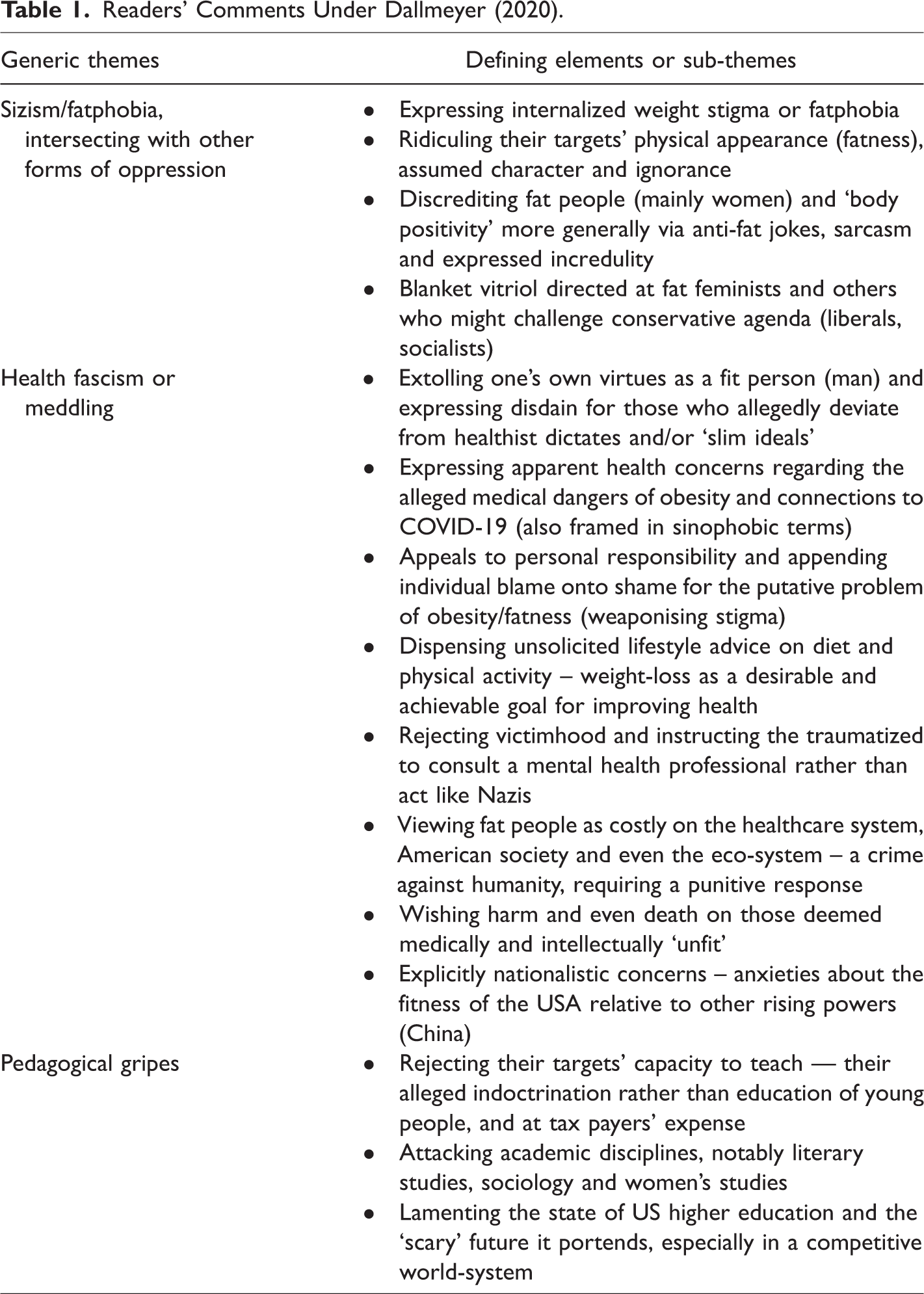
First, comments varied in length, ranging from one derogatory word, intended to dehumanize fat people, ‘Oink!’ (FreeManinAmerica), to a protracted response (227 words) that conceded ‘Eating healthy can be somewhat challenging’ but then dispensed highly moralizing advice on diet and physical activity plus a religious injunction: ‘don’t forget’ that ‘[g]luttony is a sin’ (Higgs Boson). Other comments typically consisted of one or two sentences, usually comprising insults or grievances. Second, none of the comments directly engaged with Thoune (2020) and her core message. Rather, they were one stage removed, drawing from and filtered by Dallmeyer’s (2020) story. Accordingly, comments such as the following emerged, which appear to be personalized but lack credence insofar as the author failed to establish certain publicly verifiable facts, notably Thoune’s status as an English Professor: ‘Sociology is garbage. They are fat because they are physically lazy and have no will power. They are sociologists because they are intellectually lazy and could (sic) hack it in a real science’ (sunny). Third, commentators often mixed elements for rhetorical effect. For example, fatphobia was combined with health fascism, though the latter was not dependent on the former as seen in a comment that incredulously positioned those calling for compassion and kindness as such: ‘Anyone who’s traumatized by speech needs to take it up with a mental health practitioner and not act like a Nazi’ (SGT). Fourth, a small minority of comments escaped my schema if they contained materials that diverged from or contradicted the in-group’s primary concern to pillory fat women academics and what they might symbolize. For example, after somebody expressed internalized weight-stigma, another replied: ‘If your (sic) not setting fires or killing kids you’re OK with me’ (Michael Sullivan). Another worried more about the US opioid crisis than obesity: ‘Chemically enhanced lifestyles carry the real risk. Like overdosing or fatal dependency’ (catapult). Although limited, ‘deviant cases’ should be noted in any credible thematic analysis.
Table 1 refers to sizism/fatphobia, intersecting with other forms of oppression. Elements or subthemes range from internalized fatphobia to blanket vitriol towards feminists and others considered ‘left of center’ on the political spectrum. Personal weight concerns are worth underscoring because they indicate that Thoune’s (2020) troubles, if directly engaged and recognized as public issues, could potentially resonate with CR readers. Indeed, consider the possibility that few readers embody normative ideals of health: most of the US population is, after all, medically classed as overweight or obese. Consequently, securing ‘distance’ between the denouncer and the denounced, a necessary condition for a successful degradation ceremony (Garfinkel, 1956), might be viewed as an unsustainable fiction. In such a context, some commentators offered concessions albeit whilst reproducing the idea that fatness, framed as obesity, is undesirable. For instance: ‘It’s ok to be imperfect because that is all of us [and] obesity is a very hard way to live’ (YrMum).
For Hamera (2019), anti-fat vitriol could prompt right-wing media supporters to reconsider their allegiances: the intense degradation of fatness therein could spoil their own identities and/or others whom they know and love. However, there is no evidence from my analysis that such concerns were to the fore. What did emerge, in line with other research on media audiences, was internalized weight stigma or ‘anti-fat bias’ (Holland et al., 2015: 439). Another commentator wrote: ‘I have “fat phobia” whenever I look in the mirror and see a roll of it [fat] developing’ (RealityCheck04). However, whilst some commentators admonished themselves for their own fatness and unhealthy lifestyles, they also turned their self-disdain towards fat studies professors and activists whose standards of preference elevate pride over shame. This observation does not undermine Hamera’s (2019) point that attacking fatness, notably women’s fatness, serves right-wing groups’ affective investments. However, greater emphasis should perhaps be given to displayed attitudes to fatness rather than fatness per se – the ‘sin’ is to unapologetically accept adiposity rather than ‘do contrition’ by waging a quasi-religious ‘war on obesity’ (Monaghan, 2008). Accordingly, other commentators scoffed: LOL, you cannot make this stuff up. I almost feel bad for all the young people that fell for the whole body positivity movement and ar enow fat and in bad health. Oh well, good luck fatty. (Esaelp_Aggin)
Moving to health fascism and meddling, Table 1 lists various subthemes. Some of those have already been illustrated above with reference to data; for instance, the commentator who extolled their own healthist virtues in contradistinction to fat people who were wished dead (j James). And whilst some dispensed unsolicited lifestyle advice in a somewhat patronizing manner, others used COVID-19 as ammunition. In so doing, they also evidenced anxieties about the health and future of America: ‘A very bad thing (one of dozens) about this virus is that one wishes it would wipe out these idiots, so that America itself can have a fighting chance to stop committing suicide’ (Don Reed). Others also cited coronavirus whilst expressing sinophobia, implying that even if one is not prejudiced against fat people there is an ‘objective risk’ emanating from China that needs to be reckoned: ‘Fatophobe or not. If you’re obese you’re at greater risk of a terminal Wuhan virus outcome’ (koz). After scoffing that ‘proud fatties’ inevitably suffer serious health problems, another mentioned hospitals under strain: ‘it’s gonna be tougher for them to find an ICU [Intensive Care Unit] bed these days’ (Lamontyoubigdummy). Another ignored fatness but conflated health with healthism, ingratitude and assumed political allegiances: ‘When a virus targets you, blame those trying to help, they must be liberals’ (jgilman1). Consider some additional fascistic comments, infused with a ‘couldn’t-care-less’ attitude, contempt and feigned superiority: Wu-Flu doesn’t care about your boo-hoo, Professor screws-loose. (Faiillia) Sociology professors and Gender Studies professors really do not understand science and nature. COVID-19 will solve the problem. Do they think that COVID-19 cares about their feelings? Anyway, their unhealthy bodies will find out that obesity is not a social construct. (failureofreality) A PHD in gender studies? That is about as helpful as curb feelers on a baseball. (attackslack) Give someone a PhD in the Social ‘Sciences’… .double down if that degree is in Gender Women Black Latinx Studies …. and you have pure, undiluted hilarity. (bdavi52)
Complaints about academic credibility, respectability and danger were recurrent in the readers’ comments section. Consider a contradictory comment from somebody self-presenting as a ‘steadfast’ parent who objected to ‘PC indoctrination.’ On the one hand, they boasted that two of their children successfully graduated with two more about to enter higher education. On the other hand, they complained that many professors (who, incidentally, set and grade exams) were more interested in indoctrination rather than education. What is also striking here is that despite enlightening their ‘kids’ to such ‘crap’, they did not publicly object to their offspring entering higher education and successfully completing their studies: Every parent with kids in college has a duty to ensure their kids are not sucked in by the crap that many professors spew. Talk to your kids. Don’t let them be indoctrinated. I have 4—two of whom have graduated and two of whom are about to start. I have been steadfast in my efforts to open their eyes and reject the PC indoctrination and it is working. Don’t let your kids fall for this stuff. (KSA63) With professors like this, it is easy to see why China will surpass/has surpassed America militarily and economically. (Jewish Voice) No, China has not surpassed the US in either regard. That is just fake news from the MSM [Mainstream Media]. (Reddog replying to Jewish Voice) Better educate yourself on China’s hegemony in Africa and South America. Not cool, and alarming. Quietly they gain control while we dither over finding toilet paper. (Winter Tomato replying to Reddog)
Discussion: From ‘Health Crises’ to the Politics of Cruelty
CR, an online right-wing student news platform that routinely attacks faculty (Hamera, 2019; Kamola, 2019), provides a case study of how fat studies professors risk vitriol amidst heightened concerns about public health. The study shows how the dual COVID-19/obesity crisis frame was cruelly marshalled for politicized ends within a publishing context that is backed by ‘big money’ and antagonistic to social justice agenda. Consonant with Pausé et al.'s (2021) observations, the above is suggestive of the ways in which the COVID-19 pandemic response has provided fertile conditions for the ongoing degradation of fatness. The substantive focus was a media article, written by Dallmeyer (2020), and 135 readers’ comments that spiraled from the denigration of fat professors to US imperial decline. Thus, although this article is grounded in a single case study, consisting of micro-social processes, communications were related to organizational premises and macro-social or political economic concerns. Analytically, my use of Garfinkel (1956) on degradation ceremonies is compatible with other literature that compares the COVID-19 outbreak to an ethnomethodological ‘breaching experiment’ that has thrown a spanner into the workings of a ‘fractured society’ (Scambler, 2020). Indeed, early societal responses to and outcomes from COVID-19 — including but also going beyond providing a ‘bonanza’ for the billionaire-class (Collins et al., 2020) – have thrown into relief pre-existing tensions, fissures and extant health inequalities (Arber & Meadows, 2020). Amidst the changes Lupton (2020) alludes to in pandemic times, there is continuity. The latter includes the intense stigmatization of and moralization surrounding fatness as obesity, a symbol and crude proxy for bigger problems.
Such degradation evidently found quick expression following the COVID-19 outbreak, with digital media serving as an efficient channel for hate and abuse. Arguably, the acceleration of ‘digital sociality’ during the COVID-19 emergency (Keleman Saxena and Johnson, 2020), a vector for ‘epidemic’ or ‘pandemic psychology’ (Monaghan, 2020; Strong, 1990) amidst other declared crises (e.g. economic, interracial, geopolitical), could provide the conditions of possibility for intensified politicized cruelty. Although unconvincing for those who do not share right-wing groups’ standards of preference, such invective ‘makes sense’ within the cruel logics of a crudely dichotomizing gendered, heterosexist imaginary that fabricates enemies to be neutralized. Within this foreboding digitally-mediated landscape an ideally hard, strong and thrusting US superpower must avoid being ‘weighed down’ and rendered impotent by fat feminist professors, or, rather, what they represent when calling on the world to be a kinder or ‘softer’ place. Elsewhere, Hamera (2019), writing before the COVID-19 outbreak, conceptualizes such vitriol as an ‘accumulation strategy’ (Harvey, 1998) or mechanism that has political and cultural, not just fiscal, significance. This view emerges from her analysis of populist media that ‘agglomerate, then attack a wide range of other targets – most frequently feminist women and social justice activists – on the putatively obviously rational basis of “health” rather than consistent, aggressive misogyny’ (Hamera, 2019: 154). Yet, as indicated above, this strategy is not only tied to misogyny or sexism, wrapped in ‘health talk’, but also self-disgust (felt stigma), racism, ableism and other cruelties that proliferate in crisis times (Sponholz & Christofoletti, 2019).
Going beyond any specific individual, the discrediting of fatness on CR served as a ‘peg’ to hang multiple grievances against a backdrop of declining US hegemony and already existing antagonisms. Here, putative health concerns, refracted through a reductionist biomedical lens and obesity discourse, enabled participants to express, in barely disguised form, cultural anxieties about national fitness and preparedness. This, I would add, is in a capitalist world system wherein US dominance has long been in decline and, according to Wallerstein’s (2011) macro-sociological analysis, could end in the not-so-distant future. Yet, by using anti-fat invective as an accumulation strategy, numerous contradictions emerged on CR, exposing the Achilles heel of this political economic project and populist arena for the aggrieved.
Contradictions on CR not only included misleading and selective reporting that belied the platform’s declared mission to accurately and objectively report on US higher education and (mis)conduct. More disturbingly, perhaps, CR did exactly what it condemns its targets for putatively doing, namely, silencing the concerns of those who typically have less power and influence within university hierarchies. Other problems, noted above, included: the use of symbolically violent imagery, CR’s professed dependency on donations from its intended student audience despite backing from wealthy sponsors, ill-informed comments from readers and other contributors, and possible alienation of overweight/obese/fat readers who might feel especially vulnerable in the time of COVID-19. On the latter point, denouncers and denounced may have been more similar than different not only given the scale of the putative obesity crisis but also early reports in North America of widespread fear and anxiety about coronavirus (see Monaghan, 2020). The possibility (statistical probability) of an elective affinity emerging from shared embodied concerns was not directly investigated during this study. It is nonetheless worth acknowledging in an inequitable world where there is also likely to be a massive and widening gap in wealth and status between CR’s biggest financial sponsors and the platform’s intended student audience.
The degrading of bodies (women’s fat bodies, bodies of knowledge, educational bodies) on CR is thus bigger than, whilst nonetheless grounded in, the flesh and its digital (de)construction. The above hopefully prompts questions that are also bigger than the competencies or otherwise of individual online media commentators, university faculty and (student) journalists. Amidst massive disruptions wrought in the wake of the COVID-19 pandemic, a big question concerns ‘what sort of society are we heading towards?’ This question is pertinent amidst claims from the United Nations chief that the COVID-19 pandemic has led to a ‘tsunami of hate and xenophobia, scapegoating and scaremongering’ (cited by Davidson, 2020), and already existing studies of how social media can be unsafe for academics researching oppressed and minority groups (Barlow & Awan, 2016). Arguably, attempts to discredit university faculty and what they symbolize (what they can be treated as crude proxies for in traumatic times), might be taken as a canary in the coalmine – a warning of worsening socio-cultural conditions and technologically mediated responses wherein embittered tribes ignore or attack other people’s suffering and enact cruelties that are irreducible to a novel coronavirus. In furthering critique and supporting research on such matters, I will finish by briefly (re)connecting with scholarship on media and bodyweight, stigma, health fascism and the politics of cruelty. Whilst these reflections are theoretically informed it should also be stated that there are substantive issues, the surface of which has barely been scratched here, which also demand further empirical investigation. For example, to draw from Kivisto (2019) on political theology and cruelty, to what extent does White Christian nationalism influence CR and its supporters? And, if deemed pertinent for in-depth analysis, how might a comparative historical sociology of religion and violence further critical understandings of such processes (Collins, 1974)?
As noted, there is mounting international literature on media and bodyweight (e.g. Holland et al., 2015; Hynnä & Kyrölä, 2019; Lupton, 2017). Monaghan et al. (2019) review core themes from literature on media and ‘fat panic’ (LeBesco, 2010), or what Raisborough (2016) terms a ‘fat sensibility’ that is reproduced through public pedagogy that ‘teaches’ audiences about the perils of ‘excess’ flesh. When undertaking research during and in the aftermath of COVID-19, many social scientific propositions about traditional and social media made prior to the pandemic provide a useful handle in this ‘changed’ context. For instance, reference was made above to research on media audiences who internalize and enact weight stigma or bias (Holland et al., 2015), an observation that extends to CR. Other noteworthy themes in the existing literature range from how news media amplify anxieties, moral panic even, amidst pre-existing and widely circulating societal tensions (Campos et al., 2006), to the ways in which other media, including state sponsored public health campaigns, enact ‘pedagogies of disgust’ (Lupton, 2018). Indeed, CR could be viewed as one further medium for ethically suspect public pedagogy that compounds fatness as morally, viscerally and thus emotionally intolerable. Here CR is the antithesis, and even nemesis, of those ‘body positivity blogs’ explored by Hynnä and Kyrölä (2019: 1) that seek to ‘open up spaces of comfort which can be radical for bodies accustomed to discomfort’ (similarly, see Limatius, 2019). Yet, what is missing from existing media studies, besides a focus on COVID-19 and its intersections with obesity discourse (understandable at the present juncture), are the ways in which public health crises can be layered and how corrosive psycho-social responses may be mutually reinforcing. When undertaking further research on media and fatness, the overlapping COVID-19 and obesity crises might offer a useful lens on public pedagogies, conceptualized as status degradation ceremonies enacted in broader political economic context. Interesting lines of investigation may also be pursued here in view of Flew’s (2020) advice to media studies scholars not to underestimate the nation-state and ‘the challenge of populism.’
As part of that endeavor, lessons might also be gleaned from Edgley and Brissett (1999) on meddling. Unfortunately, meddling has proliferated in twenty-first century, digitally mediated, society and it could accelerate in pandemic times following government invitations to everybody to become public health advisors and informants (for example, on ‘snitching’ in the Canadian context, see Urquhart, 2020). Somewhat disturbingly, meddling is framed as not only being of personal but also broader societal benefit in a manner that echoes the Nazi regime’s prioritization of the commonweal. As Edgley and Brissett (1999) remind us, meddling should not simply be equated with the honest and benevolent actions of altruistic people who are concerned for their fellow citizens. Going forward, and in taking lessons from the present study, it would be useful to return to Edgley and Brissett’s work and mine it for further insights. No doubt, many parallels could be drawn with earlier crusades waged in the name of ‘health’ and which have ‘legitimated’ all manner of unwelcome and harmful intrusions (e.g. intensive surveillance, curtailment of everyday freedoms, ridiculing and censoring dissenting views, destroying livelihoods and lives, disciplining and punishing the recalcitrant). As per CR, responses to ‘health matters’ in the time of COVID-19 are not necessarily grounded in concerns for the well-being of people traumatized in/by society.
The above fits well, perhaps somewhat disturbingly too well, with recent sociological literature on the politics of cruelty. Amidst the resurgence of fascism, right-wing populism and attacks on liberal democracy in the USA, Kivisto (2019) reflects critically on the Trump presidency. Reference is made to authoritarianism, nationalism, ‘deliberate state-sponsored cruelty’ (e.g. the removal of over 2,000 children from their parents at the US-Mexico border) (p. 192) but also voter appeal. Although only a minority of the US population voted for Trump in 2017, his success has to be placed in the context of globalization and attendant White, nationalist anxiety. This is a world wherein relatively privileged citizens fear losing status to minorities whom they believe have been making gains in recent years. It is understandable why, in this politically divided and affective context, the vitriol expressed on CR was not confined to ‘fat women’ and ‘the obese’ but also extended to racialized others and those advocating for social justice more generally. By reflecting on how such cruelty emerges from the body politic and embodied crises, researchers will be better able to interrogate how stigma is not simply a micro-social process. Rather, it is weaponized, notably via the heaping of blame onto shame, in order to serve powerful and well-funded interests within capitalist society (Scambler, 2018; for discussion that connects ‘the stigma system’ to scapegoating, as a divide-and-rule strategy that serves elites, see Friedman et al., 2021).
Finally, it should be stressed that this analysis is not premised on the naive assumption that universities are beyond reproach and there is no axe to grind with respect to higher education, within and beyond the USA. Much about contemporary universities is unpalatable. Whilst Gill (2009) poignantly broke the silence on ‘the hidden injuries of neoliberal academia’ over a decade ago, others have since discussed, for example, the stigmatization of marginalized bodies within contexts of teaching, learning, research and career progression (Reidinger, 2020). Moreover, in view of the economic fallout from the COVID-19 pandemic and the possibility of a future ‘shock doctrine’ response from right-wing governments (Klein, 2020), already existing ‘rationalizing’ practices enacted in neoliberal universities could be intensified. Pre-existing market-oriented tendencies towards individualizing, depoliticizing, highly competitive and calculative action could prevail and in ways that threaten academic disciplines and freedoms that challenge extant power structures. Amidst trends such as escalating student debt, precarious academic contracts, institutionalized distrust of faculty, overzealous managerialism, and the opening of university campuses to myriad private profit-making interests, it is possible that the agenda favored by CR’s billionaire sponsors could proceed unabated. The likely clarion call from ‘big money’ goes like this: ‘publicly funded universities, especially at a time of economic crisis, cannot continue to support dangerous or unreasonable ideas given that public health, and, indeed, the health of the body politic, is under threat. Health must be protected as a matter of national and global bio-security.’ However, if anything has been learnt from this analysis and from public intellectuals such as Thoune (2020), who are willing to express their own vulnerabilities, it is this: we urgently need alternative approaches to pedagogy, politics and public health that are for, rather than against, people. In so doing, we need to pay heed to canaries in the coalmine and amplify, rather than ignore, their calls for compassion and kindness in pandemic times.
Footnotes
Acknowledgments
I owe a big thankyou to Darci Thoune and Laurie Cooper Stoll for their receptiveness to my work and for making this article possible. Feedback from the journal editor and anonymous reviewers has also proved invaluable.
Declaration of Conflicting Interests
The author(s) declared no potential conflicts of interest with respect to the research, authorship, and/or publication of this article.
Funding
The author(s) received no financial support for the research, authorship, and/or publication of this article.