




Abstract
Echoing the discussions about the role of the state in accelerating the transition to low-emission sources of energy, this article revisits the ideas developed in Brazil, from the 1930s to the 1950s, to accelerate the transition not away from but at that time further toward domestically produced oil, with the creation of the state-owned company Petrobras. It shows that two distinct issues were at stake: the public or private control over the company for matters of economic efficiency, and the use of domestic or foreign capital for questions of long-term energy sovereignty and economic independence. This article finally draws parallels for the twenty-first-century energy transition, especially in developing countries. Given today’s geopolitical uncertainty and the need to accelerate the transition to energy sources that are still in development, such as renewables and green hydrogen, the creation of sector-specific public companies could be a valuable strategy alongside traditional regulatory tools.
1. Introduction 1
In a context of tensions on global energy markets, with erratic prices and occasional supply difficulties, and in view of the profound challenges of the low-carbon transition following the enactment of the Paris Agreement, which called for structural changes in the extraction, distribution and use of energy sources, discussions have been growing in the Global South about the role of the state in the energy sector, especially to expedite the transition away from fossil fuels (e.g., Aunphattanasilp 2018; Malliet and Saumtally 2023; Steffen and Patt 2022). A crucial challenge lies on financing and managing large-scale capital investments needed for the build-up of sufficient capacity, while combining multiple objectives ranging from energy access to energy security and decarbonization.
The role of the state in energy industries and in accelerating changes in the energy mix is an old issue, both in the Global North and in the Global South, since at least the early stages of industrialization in the nineteenth century (Millward 2005; Xiaoying and Abbott 2020). Economists and historians have examined various sectoral policies, the nationalization programs launched in the Middle East and other countries in the mid-twentieth century, and the privatization policies that followed the Washington Consensus in the late twentieth century (e.g., Beltran et al. 2009; Bolton 2022; Garavini 2019; Pollitt 2012; Venegas 2024). However, this literature mostly looked into the past through the lens of institutional, political, social, economic, or energy history. The use of a history of economic thought framework is lacking. 2
This article focuses on Brazilian economic ideas for the organization of the country’s oil industry, from the 1930s to the 1950s. The case of Brazil is particularly original and insightful compared to others because the economic discussions about the creation of a public oil champion, Petrobras, from the 1930s to the mid-1950s, took place at a time when Brazil had not discovered domestic petroleum resources yet. Brazil first created two governmental bodies, the National Department of Mineral Production (DNPM) in 1934, followed by the National Petroleum Council (CNP) in 1938, which directly financed and carried out exploratory drillings that led to the country’s first oil discovery in 1939 3 ; and later, the state-owned company Petrobras in 1953. 4 Still in 1955, only 3% of oil consumption was covered by local resources (Acker 2020; de Castro Santos 1985, 147f; Dias and Quaglino 1993). What was at stake in Brazil was to solve a pressing energy security and economic development problem with the creation of a company in charge of an almost non-existing supply sector.
This article examines the evolution of underlying ideas and theories from economists and economic advisors shaping Brazilian oil affairs from the 1930s to the 1950s. As far as we know, this has not yet been done, even in histories devoted to Brazilian oil policy and Petrobras (e.g., Dias and Quaglino 1993; Figueirôa et al. 2019; Peyerl 2019). We seek to understand what the initial situation of the Brazilian energy sector was, what the perceived problem on this initial situation was, what the alternative energy policy solutions available were, why state intervention through the creation of governmental bodies and later a new company was considered the best approach, and finally to what extent lessons can be drawn from that experience for today’s energy transition to new fuels such as green hydrogen, particularly for developing countries.
The most famous Brazilian economists of the mid-twentieth century, such as Roberto Simonsen, Roberto Campos, Eugênio Gudin, and Celso Furtado, only marginally—if at all—discussed energy provisioning. This prompted us to turn to other authors, less known today but important at the time, particularly on the subject of energy. Our investigation brings to light the unpublished archival materials of Jesus Soares Pereira (“JSPA” hereafter), 5 who occupied various positions in the mining and energy administration in the 1930s and 1940s, and then became an economic advisor of Getúlio Vargas, together with Rómulo Almeida, Ignacio Rangel, Ewaldo Correia Lima, Cleanto de Paiva Leite, and a few others. We also used published materials by Rómulo Almeida, and by José Pires do Rio, who wrote on Brazilian energy issues as early as 1916.
The article is organized as follows. Section 2 provides the historical background to the creation of Petrobras in 1953 and to the development of a national oil policy in Brazil. Section 3 analyzes the theoretical justifications given at the time in terms of economic efficiency and investment capacity for a public rather than private control of the company, under the influence of state-led developmentalism and old inspirations coming back to the 1910s work of José Pires do Rio. Section 4 examines how, in a context of geopolitical reconfiguration after the Second World War, nationalism also came to frame the investment strategy in the oil sector, for matters of energy sovereignty and economic independence (but not strict autarky). Section 5 draws on the lessons from our inquiry regarding the acceleration of the low-carbon transition in the twenty-first century. The last section presents our key conclusions.
2. The Historical Context for the Creation of Petrobras
Petrobras was created on Saturday, October 3, 1953 during the second term in office of President Getúlio Vargas (1951–1954) and came to represent an important legacy of his government. The company was constituted as a state monopoly of prospection, extraction, distribution and refinement of oil—Brazil became one of the first countries in the world to enter oil supply activities not by expropriation of the local activities of foreign companies but by the creation of a new state-owned company with a full government monopoly on extraction and sales (Acker 2020). 6 It was the culmination of a process started in 1934 with the creation of the DNPM, followed by the creation of the CNP in 1938, as a strong response to Brazil’s increasing need of domestic oil supplies since the 1930s and to the debates on oil management ongoing since then. Oil policy acquired a great political importance during Vargas’s first terms in office (1930–1945), as Brazil recovered from the economic depression and spurred its industrial production. The weakness of its oil sector was increasingly seen as a main obstacle to an accelerated pace of development, as well as to national security (Dias and Quaglino 1993).
The Brazilian oil industry was virtually non-existent before the 1930s, and oil consumption, which was a third that of Argentina, was satisfied by imports (Philip 2006; Rubio et al. 2010). As illustrated in Figure 1, still in 1939 the production of oil and derivatives was insignificant compared to consumption, and this situation prevailed until the mid-1950s, after Petrobras was created. Not only was there no domestic oil production, but also foreign companies failed to take root in Brazil, both for oil exploration and refining activities. Although “foreign oil companies entered [the country] in 1921-1922,”“by 1924, after finding no oil, they were discouraged” (Wilkins 1974, 419, 443). In the late 1920s, in addition to discussions in the Congress about limiting oil explorations and ownership of refineries to Brazilian citizens, the worldwide oil overproduction made the foreign companies lose interest in establishing themselves in Brazil. Domestically, Brazil rather relied on traditional energy carriers, including fuel wood, even if early public policies, right from the 1920s, encouraged the development of ethanol and hydro-electricity (de Castro Santos 1985; Eaglin 2022; Rubio and Tafunell 2014). While oil consumption surpassed coal consumption by 1940, organic energies still made up more than 70% of Brazil’s energy consumption in 1939 (Rubio and Folchi 2012). Hence, the transition to oil away from organic sources was a major element in Brazil’s industrialization process.
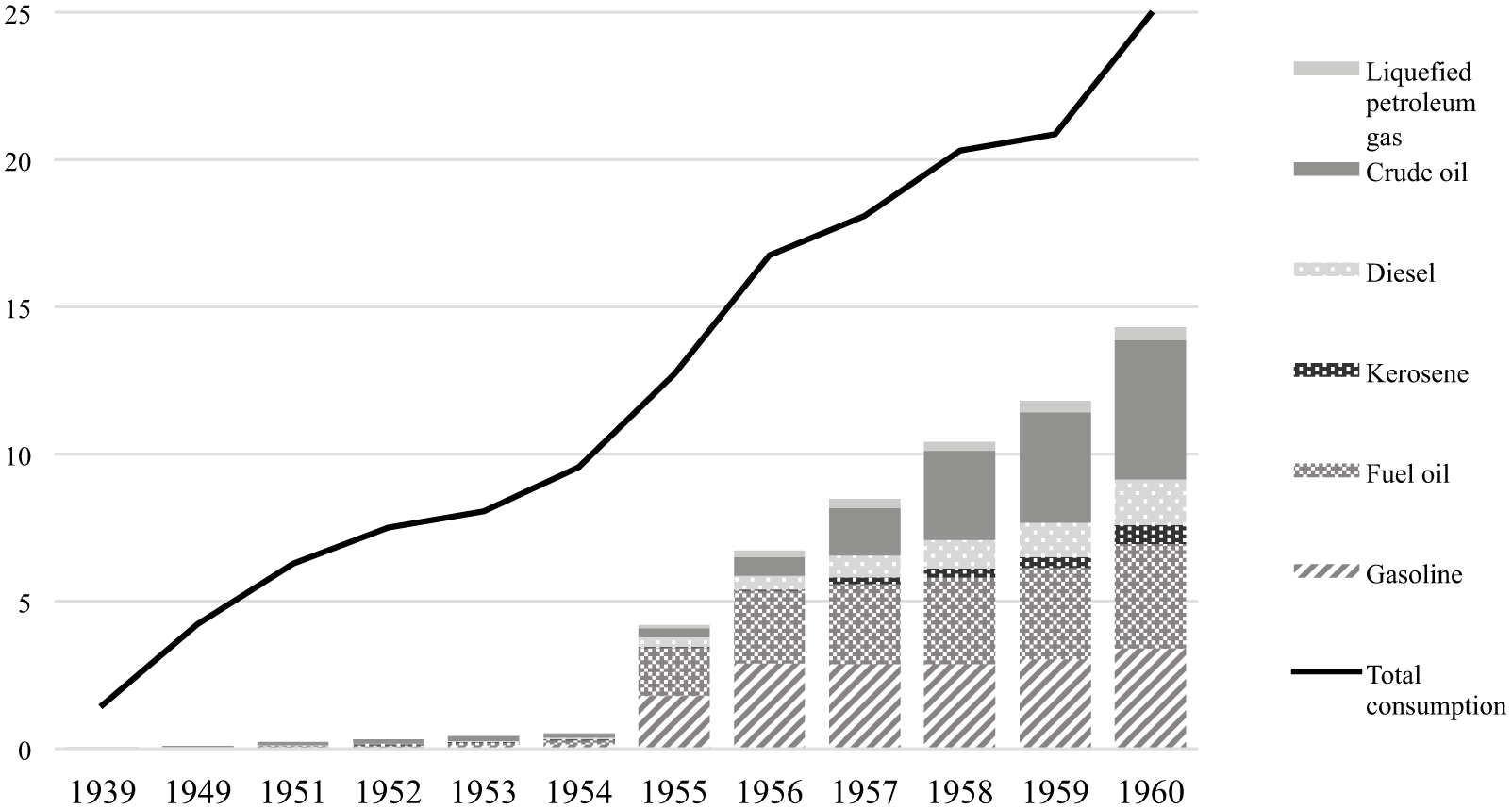
Production of oil and derivatives in Brazil, 1939 to 1960 and total consumption (in million m3).
The industrial impetus that followed the Great Depression and the Second World War significantly increased oil consumption, that went from 1.49 million m3 in 1939 to 24.96 million m3 in 1960 (Figure 1). As shown in Figure 2, there were increasing imports of oil and derivatives between 1929 and 1939. While these were impacted by the supply difficulties due to the Second World War, they exploded afterwards, following the higher demand for oil due to the rapid industrialization and urbanization after 1945. In 1954, imports of oil and derivatives were 8.4 times that of 1945. The “Questão do Petróleo” (the “Oil Issue”), with excessive dependence on foreign supply especially for the most valuable oil derivatives, became central for the government, for both economic and military reasons (Medeiros Lima 1975; Philip 2006). As we shall see in the next sections, after the creation of Petrobras in 1953 to 1954, the structure of imports radically changed, with significantly more crude oil to be refined locally and less imports of higher value-added derivatives.
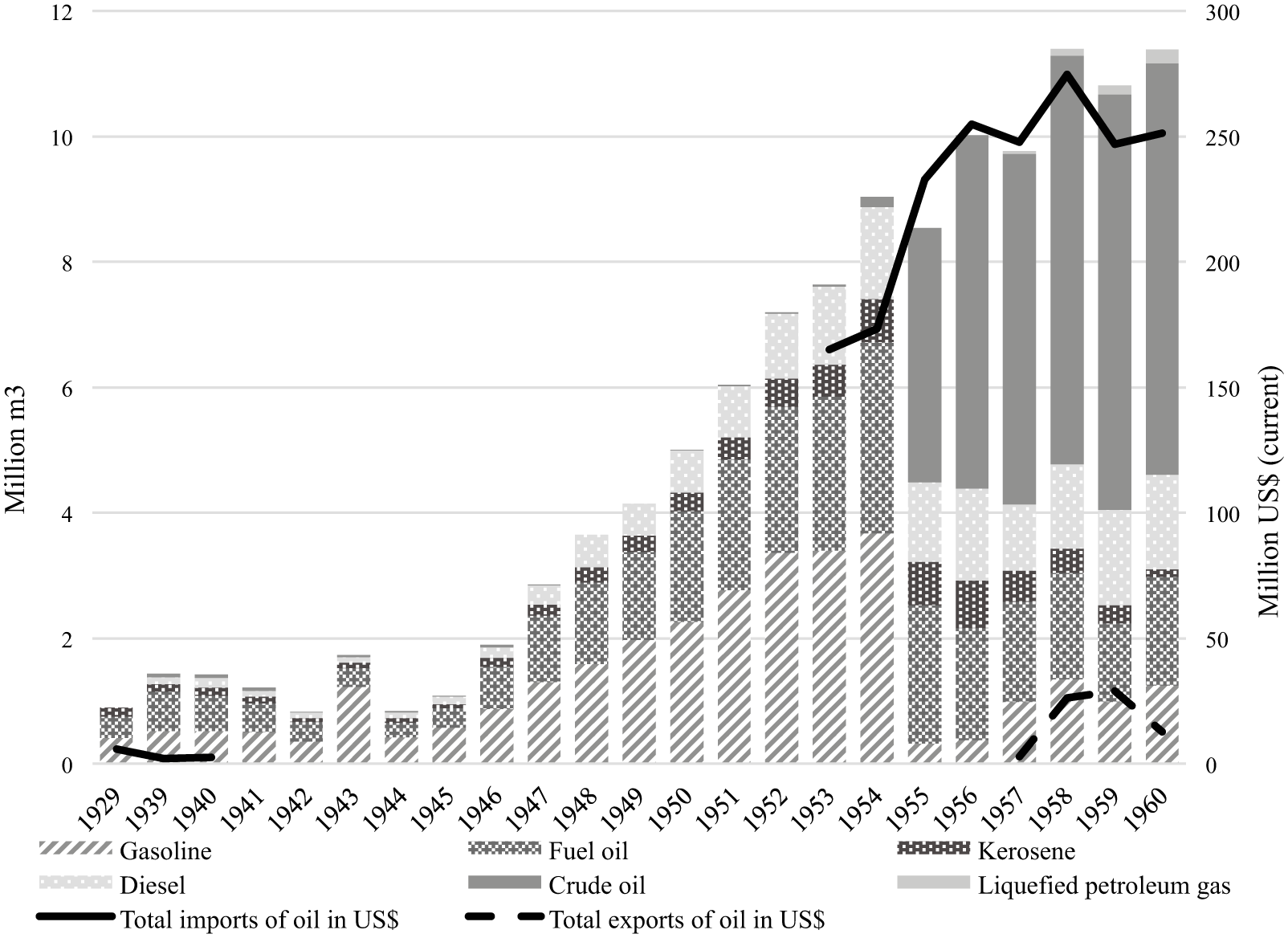
Imports of oil and derivatives in million m3 (left axis) and total imports and exports of oil in million US$ (right axis).a
After showing growing surplus between 1940 and 1946, trade balance became erratic after 1947, with several years posting deficits, especially when considering the Cost, Insurance, and Freight (CIF) value of imports (Figure 3). 7 The industrialization efforts of Brazil implied both increasing imports and changing their composition to match the needs of new industries. Hence, the increasing weight of oil imports on the trade balance became a pressing issue, especially in the second half of the 1940s and throughout the 1950s (see also Dias and Quaglino 1993). Although the data is incomplete, we can calculate, based on IBGE (1990), that the value in US$ of the imports of oil and derivatives went from 0.99% of total imports in 1940 to 14.78% in 1953 and up to 24.37% in 1956. 8 In 1956, the Economic Commission for Latin America also worried that Brazil’s fuel imports were draining the country’s foreign currencies and affecting its capacity to import (CEPAL 1956).
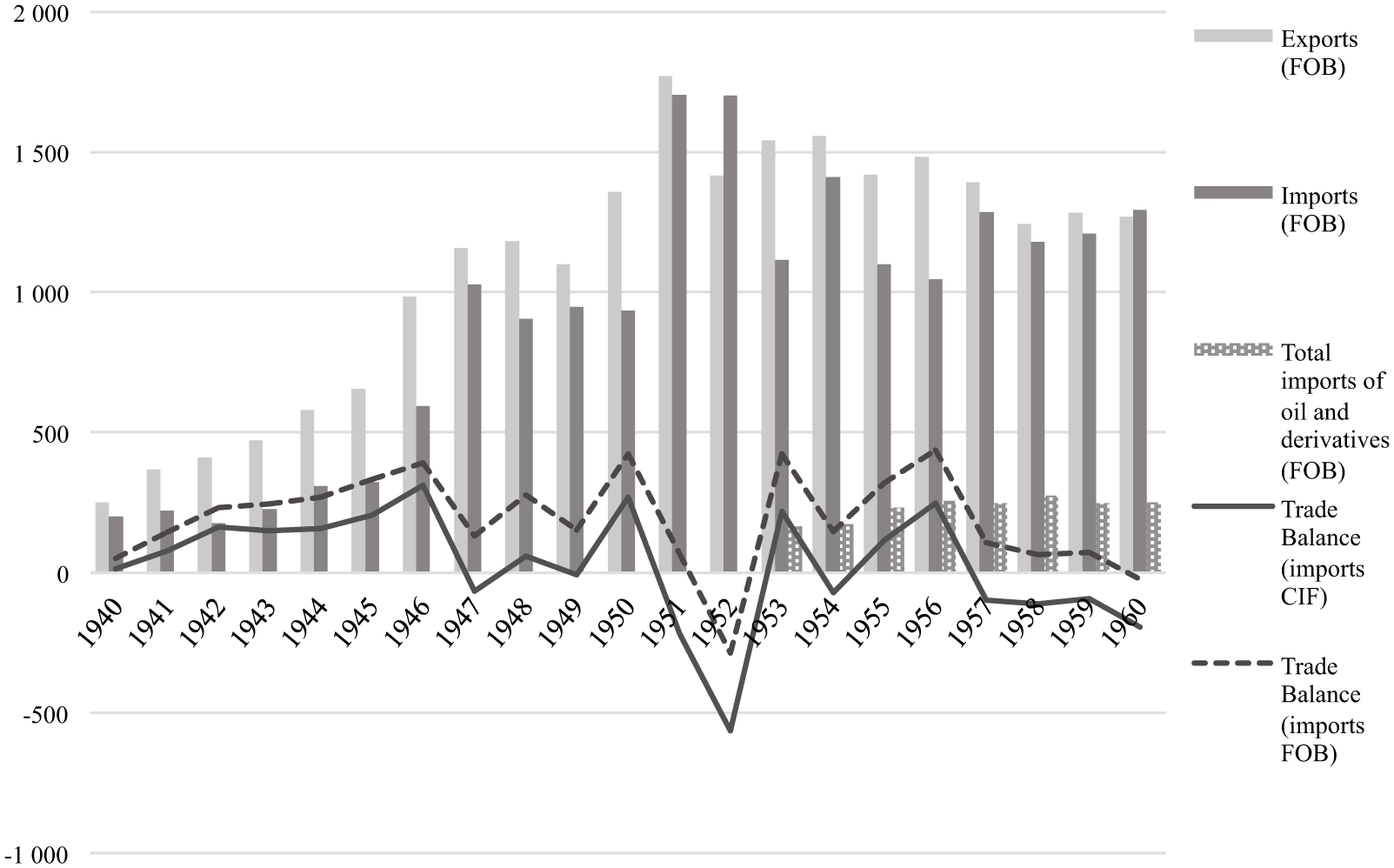
Evolution of Brazil’s trade balance, 1940 to 1960 (in million US$).a
As in many other Latin American countries, establishing a national oil policy became a major component of the new development strategy that took shape from the 1930s onwards. The old liberal paradigm based on primary exports was gradually replaced by a new one, in which state intervention, domestic markets and industrialization would play a central role. Although there was no proof that Brazil had the potential for substantial oil supplies, there was a widespread belief that Brazil—given its generous natural resources in general, its continental size and oil discoveries in neighboring countries—had to also have oil (Acker 2020). This view was shared, for example, by Geminiano Lira Castro, the Minister of Agriculture between 1926 and 1930, and Brazilian writer José Bento Renato Monteiro Lobato in the 1930s. 9
A first step toward state’s management of the country’s oil sector ahead of any major oil discovery was the change in the country’s mining law in 1934. The new 1934 constitution introduced a distinction between soil and subsoil property (art. 118), and conditioned “the industrial use of mines and mining deposits, as well as water and hydraulic energy, even if privately owned” to “federal authorization or concession.” 10 It also set the “progressive nationalization of mines, mineral deposits and waterfalls or other sources of energy, as well as industries considered basic or essential to the economic or military defense of the nation.” 11 Within this context, the DNPM was created and began to directly conduct exploratory activities. The 1937 Constitution kept these points. 12 Vargas gave a particular importance to the mining law, with an early wish to nationalize oil resources. On January 21, 1939, following efforts in the city of Lobato since August 1937, the DNPM accomplished Brazil’s first domestic discovery of oil. 13
In parallel with its strong political support for the development of new fuels such as bioethanol, which would play an important role in Brazil’s subsequent energy history, particularly in the 1970s (de Castro Santos 1985; Eaglin 2022), 14 the Vargas government created the CNP in 1938 with the hope to increase oil production under state control. CNP had extensive powers over the oil industry but did not have the monopoly over the exploration of oil fields—private actors could continue their investigations when authorizations were valid (Dias and Quaglino 1993; Philip 2006). By the mid-1940s, CNP had not managed to increase significantly oil production, notably not in line with the rapidly rising oil consumption met through imports (see Figures 1 and 2).
During the government of Eurico Gaspar Dutra (1946–1950), there was an attempt to liberalize the oil sector (among others). In this vein was proposed the “Estatuto do Petróleo” (Petroleum Statute), which allowed any (domestic or foreign) company formed in Brazil to have access to oil concessions (Medeiros Lima 1975, 75). This enabled more exploration campaigns but did not radically change the oil situation in Brazil, especially with an industrial sector that had started booming (8.8% per year during almost three decades) and requiring more and more energy inputs (Aldrighi and Colistete 2015).
When Vargas came back to power in 1951, he did not have the majority in Congress even though he had won the presidential elections. He charged Rômulo de Almeida with the task of setting up a group of economic experts, which included Jesus Soares Pereira, to advise him on a range of issues, including the organization of the oil industry.
Almeida had begun his advisory activities in 1946 with the Commission of Economic and Social Investigation of the National Constituent Assembly. He had also participated in different boards relating to the economic alliance between Brazil and the United States of America in the late 1940s (for details on the institutions created at the time for fostering public expertise, see Bielschowsky and Mussi 2023; Gumeiro 2013). In 1950, he had become an economist within the National Confederation of Industry (CNI), and had taken an affiliation with Vargas’s Partido Trabalhista Brasileiro (PTB, Brazilian Labor Party). This is how he came to directly serve as Vargas’s advisor in 1951.
On his side, Soares Pereira had begun his career at the Ministry of Agriculture, working for the National Department of Mineral Production and the State Secretariat for Agriculture. In 1937, he had been transferred to the Federal Council for Foreign Trade (CFCE) and then appointed to CNP. In 1945, he had graduated in social sciences from the National Faculty of Philosophy of the University of Brazil and, in the same year, had entered the National Pine Institute, an institution in charge of forest management, of which he would become president in 1949. After Almeida solicited him, he became Vargas’s main energy advisor.
The first project for Petrobras was that of a public agency owned 51% by the state, working as a holding company, and being, if not a de jure monopoly, at least a de facto monopoly (Soares Pereira, in Medeiros Lima 1975, 21). The idea was to find a narrow way through in Congress, where a clear majority was lacking, and also to promote a model flexible enough to have the state and private actors cooperating. Archival documents from 1952, a few months before the creation of Petrobras, demonstrate that the advisors, especially Soares Pereira, were in favor of such an option, to build also on the experience of private companies: I believe that the oil problem […] should not be framed within a radical policy. For this reason, I gave my support to the Government’s project. With it, we could move towards the solution that would seem convenient in the future […].
15
It is necessary to act in the industrial field according to the experience accumulated in this field of activity by private companies. The mixed economy company reconciles the superior management of the state, in undertakings of national interest, with the flexibility of action indispensable for the execution of these undertakings.
16
The project raised important opposition, both from the nationalist left wing of the Partido Trabalhista Brasileiro (Vargas’s own party) and from the União Democrática Nacional (National Democratic Union, UDN), which was traditionally more liberal and defending private initiative. An agreement was finally reached over a full de jure state monopoly, the left wing in defense of state control over the oil industry, the right wing to simply mark its opposition to Vargas’s initial plan (Philip 2006). The company was therefore created in 1953 by the Federal Law nº 2004 with more power, but also with less capital flexibility, than originally imagined by its designers.
The law established a monopoly for the Federal State of Brazil on “the prospection and extraction of oil deposits and other fluid hydrocarbons and rare gases,” in the “refining of national or foreign oil” and in the maritime and pipeline transportation of crude oil, petroleum derivatives, and rare gases (both from national and foreign origin). 17 The monopoly would be carried out “through the National Petroleum Council, as a guidance and inspection body” and “through the joint-stock company Petróleo Brasileiro S.A. and its subsidiaries, established in accordance with this law, as executive bodies.” 18 The law also set as Petrobras’s object “the research, extraction, refining, trade and transportation of oil from wells or shale—its derivatives as well as any related or similar activities.” 19
To measure the importance of the creation of Petrobras and of the national oil policy to the perception of foreign dependence in Vargas’s priorities, it can be remembered that when he committed suicide, in August 1954, Vargas explicitly mentioned Petrobras and foreign economic interests in his testament letter, considering it as a key achievement to be preserved in the future, whatever the political oppositions: After decades of domination and plundering of international economic and financial groups, I became head of a revolution and won. […] I wanted to create national freedom in leveraging our wealth through Petrobras and, as soon as it started operating, the wave of agitation grew.
20
It finally took decades before Brazil discovered and started exploiting massive (offshore) oil reserves, at the turn of the twenty-first century. Yet the roots of Brazilian oil policy, and more broadly of a peculiar centralized, public and national way of promoting yet to be fully discovered energy carriers, must be tracked back to that decisive period of the 1930s to 1950s.
In summary, the situation of Brazil between 1930 and 1950 was characterized by a nascent and underdeveloped oil sector heavily reliant on imports, which increasingly strained the country’s balance of payments and posed a constraint on economic development. Policymakers at the time perceived a major economic and national security vulnerability due to this dependence on foreign companies. This led to the conclusion that the state was the only domestic actor capable of shouldering the investment and technical risks necessary to accelerate the transition to domestic oil products (from oil derivatives in the short run to crude oil after future discoveries). The following sections explore in depth the theoretical arguments behind this view.
3. Theoretical Justifications for the Public Control of Oil Activities in 1950s Brazil
3.1. The Rise of Developmentalism in Latin America
Developmentalism provided the main theoretical support for Brazilian officials to assert public control over the country’s oil sector through the creation of Petrobras in 1953. Although archival and published materials show they had initially considered a mixed capital model for Petrobras, Vargas’s economic advisors, and Soares Pereira in particular, became later on very attached to public control over the oil sector. Even with the contribution of private capital, it must be remembered that the initial plan was to have a public company anyway, owned by the state (51%). The reason is firstly to be found in the intellectual and political atmosphere of the time, at a period when state-led developmentalism was a doctrine receiving strong echo in Latin America.
State-led developmentalism and planning was propelled by the impacts of the Great Depression on world trade, which had fallen by 60% between 1929 and 1932. With the undermining of multilateral trade due to the generalization of protectionism, “the Great Slump destroyed economic liberalism for half a century” (Hobsbawm 1994, 94–95). In the West, with massive unemployment, Keynesianism gained influence and modern welfare systems started appearing in industrialized countries, normalizing state intervention in the economy (Hobsbawm 1994; Myrdal 1951). Economic planning became the norm in the 1940s, both in the East and the West; it was not a temporary response to times of war or depressions anymore, as it had been the case in the 1930s with the New Deal in the United States of America (Christian et al. 2018).
In Latin America, the Great Depression also brought a change of paradigm, as the collapse in international trade had the indirect effect of spontaneously favoring the growth of national industries, which marked the start of import substitution industrialization. Like in the West, market self-regulation was dropped in favor of state intervention to mitigate the effects of the crisis and to create employment. Monetary policy tools also started being used as a support to export activities and, eventually, to spur industrialization (Bulmer-Thomas 2003). With the Second World War, what had started as so-called spontaneous industrialization became part of a conscious development program.
This process marked the start of developmentalism, which can be defined as an economic policy project for which planning and industrialization led by the state are the means to change the economic and social structure of a country and bring about development (Bielschowsky and Mussi 2023). Throughout the 1930s and 1940s more scholars started supporting, theorizing and legitimizing state intervention in the economy and, in particular, its active role in pushing forth industrialization. In Argentina, Raúl Prebisch started defending state intervention in 1934, but clearly supported state planning for industrialization from 1940 (Calcagno 2023). In the case of Brazil, Roberto Simonsen was one of the first intellectuals to theorize developmentalism in the 1940s (Bielschowsky and Mussi 2023). The creation of the United Nations Economic Commission for Latin America (CEPAL) in 1948 and the theoretical identity it acquired when Prebisch became its Executive Secretary in 1950 greatly contributed to legitimizing developmentalism in Latin America. There was a sort of developmentalist consensus because state intervention and planning to reach industrialization became widespread in the region in the 1950s and 1960s.
Developmentalism in Brazil was greatly strengthened by Vargas between 1930 and 1945, particularly during the authoritative period of the Estado Novo (1937–1945). It came to dominate the political scene and guide economic policies until the 1980s. But developmentalism was not monolithic, and there were significant divergences between currents. This was particularly the case in Brazil. Bielschowsky (1985) and Bielschowsky and Mussi (2023) distinguish three currents: (i) the developmentalists who were associated with private sector institutions, (ii) non-nationalist developmentalists in the public sector, and (iii) nationalist developmentalists in the public sector. All three were in favor of economic planning and state intervention to achieve modern industrial capitalism.
The private sector developmentalists were characterized by both supporting planned industrialization and defending the interests of private industrial capital. This group mostly comprised industrialist entrepreneurs. The main figure among them was Roberto Simonsen. He notably considered that industrialization needed to be carried out by state planning and protectionist policies, as this process of structural change could be the opportunity to develop and overcome poverty (Bielschowsky and Mussi 2023).
The main difference between public sector developmentalists was that the non-nationalists were favorable to attracting foreign capital in all economic sectors to deepen industrialization, while the nationalists were against it. Among the nationalist, the more extreme saw foreign capital as an entry point for foreign interests in the country, while more moderate nationalists were mostly against the use of foreign capital in vital sectors like “energy, transports, mining and heavy manufacturing” (Bielschowsky and Mussi 2023, 172–73). The main figures of the non-nationalist developmentalists were Horacio Láfer, Valentin Bouças, Ary Torres, Glycon de Paiva, and later, Roberto Campos. Among the nationalist developmentalists, some figures were part of the economic advisory group of Vargas’s 1951 to 1954 administration, including Almeida, Soares Pereira, and Rangel.
3.2. The Justification Under Developmentalism for the Creation of Petrobras
Soares Pereira’s writings from the early 1950s to the 1960s show that, in his view, the Brazilian private sector was ultimately unable to develop the country’s potential for oil supplies. Given the strength of international private companies, a laissez-faire approach would inevitably expose the country to foreign dependence, resulting in the great strategic importance that was given to having a state company with monopoly on the oil sector, despite his earlier preference for a mixed-capital enterprise. The state monopoly was formally justified as providing a better use of domestic capital, and a better coordination of the oil industry for a holistic, long-term planning of the economy with the objective of economic development. 21
Soares Pereira considered that private capital could play a role, but that the state had to be the central actor taking initiatives, because of the importance of oil and energy resources for economic development. In an archival document from 1959, he clearly ruled out the possibility of letting Brazilian private capital taking the lead in the oil sector: […] a state monopoly is […] undoubtedly the process best suited to our conditions as a country at an early stage of economic development and to the peculiarities of the oil industry itself […]. Besides, in addition to being a pressing issue of undoubted public interest, the oil problem in our country is of such magnitude that its solution is not really within the reach of national private initiative.
22
(italics added)
In a sense, Soares Pereira argued that the oil sector benefited in its early stages from a natural monopoly. Because of the incipient development of the country, there was a lack of infrastructure and capital, so it would not be realistic to expect the private sector to be able to develop the oil industry under competition: the costs and investment risks would be too heavy to handle. Finally, there was no guarantee that the private sector would have the public interest in mind. A state monopoly, well equipped, could have the benefit of using existing capital more efficiently and could avoid wasting resources: […] the problem of oil in Brazil had to be tackled by the state on a scale compatible with the means at its disposal. The essential thing, the starting point, was to equip public authorities with instruments and processes capable of applying resources with the minimum of waste. (Soares Pereira, in Medeiros Lima 1975, 65)
Soares Pereira was against a public-private configuration of the market, with several companies operating, some owned by the public, others run by private capital, because this would mean “reserving for the private sector the projects that are guaranteed to be profitable, while leaving the other [public] partner in charge of those that are unprofitable.” 23 In modern terms, the privatization of gains and socialization of losses were absolutely to be avoided.
One reason why Vargas’s economic advisors pushed for a public control over the oil sector was also to finally provide a strong response to the alleged delay in oil production in Brazil, even if major reserves had not been discovered yet. In Soares Pereira’s view, the energy question had become urgent; Brazil could not wait more in view of the pace of development in Europe and in the United States of America. The “circumstances” required state monopoly: [The] weakness [of small domestic private companies] would not only jeopardize the national oil policy in terms of its guidelines; it would also threaten it with a fatal delay in its implementation, since this requires […] huge resources to be applied in good time. The state monopoly was therefore necessary in view of the circumstances […].
24
Soares Pereira was likely influenced by some of the theses developed at CEPAL, showing another point of convergence with Latin American developmentalism. In the 1960s, he worried about the lack of currency due to the decrease of foreign exchange revenues, with a reasoning very similar to Prebisch’s explanation of the deteriorating terms of trade for primary commodities that he wrote in the famous Havana Manifesto (Prebisch 1950, 10–13). Archives contain a document from circa 1963 in which Soares Pereira expressed his concerns about such deterioration: [The] revenue [from foreign exchange] was reduced by more than a third between 1954 and 1962, a period in which the physical volume of national exports practically tripled.
25
[Imports from] industrialized nations or [from] areas under their control incorporate into their commercial value the additional costs resulting from wages paid to increasingly qualified and demanding workforce, as well as from technological improvements increasingly required by modern industry, all resulting in rising unit prices.
26
3.3. A Pre-developmentalist Influence from José Pires do Rio
Soares Pereira’s late testimonies suggest that his thinking can be traced to earlier roots in the history of Brazilian energy economic thought. In 1975, he explicitly paid tribute to José Pires do Rio (1880–1950), a Brazilian engineer, economist and politician of the early twentieth century, because “the careful reading of [Pires do Rio’s work] led [him] to give the Brazilian energy problem the necessary prominence” (Soares Pereira, in Medeiros Lima 1975, 37).
In 1916, Pires do Rio authored O Combustível na Economia Universal (The [Role of] Fuel[s] in the Global Economy), a pioneering work that argued for the pivotal role of energy resources—particularly coal—in driving global economic development, explaining Latin America’s lagging industrial progress. Pires do Rio’s central thesis was that access to affordable and secure energy resources was, already at that time, the primary determinant of a nation’s industrial capacity and economic prosperity. This perspective directly challenged controversial theories that blamed underdevelopment on factors such as climate, race, or culture (see Luz 1980; Pelaez and Suzigan 1981). Pires do Rio advanced a materialist framework for understanding economic growth, while also laying the foundations for an active role of the state in addressing a country’s energy limitations to overcome these structural disadvantages.
Pires do Rio did not outline a formal policy framework but he considered the state as responsible for aligning national priorities with Brazil’s unique geographical and economic conditions and for fostering economic development: The modern state, once esteemed for the honesty of its administration, completes its work of assistance to the economic development [desenvolvimento econômico] of the country by focusing on technical education, upon which depends the study of the physical conditions of the national territory for its economic revelation; finally, the state attends to the construction of public works of general interest and, ultimately, to the support of certain industries capable of taking root in the country, given the natural conditions in which they may thrive. (Pires do Rio 1916, 264)
The combination of a strong interest in energy resources—Pires do Rio was mostly concerned with coal as he did not consider that oil would emerge as a major source, but we can expand his reasoning to oil—and of a special attention given to the role of the state in economic development is something we can find also in Soares Pereira, three to four decades later. This shows that the inspiration for the 1950s Brazilian national oil policy had roots also preceding the 1940s developmentalist wave and Vargas’s centralized state intervention.
In summary, in the mid-twentieth century, Vargas’s economic advisors thought about alternative energy policy solutions under the influence of developmentalism, which promoted significant state involvement in the productive activities of developing countries. Older roots of Soares Pereira’s ideas can also be found in Brazilian history of economic thought, that is, in Pires do Rio’s 1916 work, which already considered energy resources and state policies as key for industrial development. This confirms that sources of inspiration to think about the role of the state in the energy industry, still today, are not limited to experiences in the Global North, nor to the period following the Second World War. The Brazilian example, before and after the war, provides rich insights, including, as we shall now see, on the matter of energy security and sovereignty.
4. Economic Nationalism and Energy Sovereignty
The second source of theoretical support for state intervention in the Brazilian energy sector was the rise of economic, especially resource, nationalism in Latin America since the 1910s. We can consider Jesus Soares Pereira and other Vargas’s economic advisors to be part of the “nationalist developmentalist of the public sector” group, following Bielschowsky’s above-mentioned categorization, in the sense that their tendency to promote state-led developmentalism was completed by a nationalist bent. It is important to note that the term “nationalism” in Latin America has taken a different meaning than its sense in other parts of the world, lacking for instance the linguistic and ethnic distinctions commonly associated with national identities in Europe or Asia, and more associated with emancipation from colonial patterns of economic dependence with former ruling powers in Europe (Goebel 2007; Miller 2006).
There have been various sorts of nationalism in Latin America, depending on the time or country, the cultural, economic or political concerns, and also the social class or ethnic group (Siekmeier 2015). In the nineteenth century, most of the newly-independent countries did not yet have a complete national narrative or a full sense of nationhood among the population—Brazil faced separatist revolts in the 1830s to 1840s and a contradiction marked by the late abolition of slavery in 1888, until when a large part of its population was excluded from full citizenship and the most basic human rights. In this sense, “the state preceded the nation by as much as a century” (Siekmeier 2015, 68–69). In the early twentieth century, the emerging industrial classes had different interests from the landowners and exporters of primary goods, as the former were oriented toward internal economic activity. The difficulties associated with the First World War and, to a greater extent, the Great Depression and the Second World War, strengthened the industrialists and propelled both developmentalist and nationalist ideas in the continent. Nationalism became an idea that guided the objective of economic sovereignty against foreign influence. This at the same time contributed to an increased sense of national unity. Economic nationalism gave new momentum to a feeling of national belonging.
Under this notion of nationalism, Latin American states began to push for a development model based on industrial production and internal markets, often accompanied by income redistribution, and in which the state now played a large planning role. This new phase of industrialization was justified by a double dimension of economic and social integration, which were lacking until then, notably with the surge of “urban populism” (Siekmeier 2015, 69), attracting support from both workers and national entrepreneurs. A Listian influence, from nineteenth-century German thinker Friedrich List’s protectionist ideas intertwining industrialism and nationalism, was probably present, notably in Brazil (Bruzzi Curi 2018).
In the case of energy, Brazil followed a branch of this Latin American trend called resource nationalism, which started with Mexico’s nationalization of oil in 1938 and aimed at taking control over all domestic natural and energy resources. One of the goals of Vargas’ government and advisory team at the turn of the 1950s was not only to take control over domestic (yet to be discovered) resources, but also to ideally promote self-sufficiency in oil as an end in itself. This became the ultimate raison d’être of the national oil policy, with Petrobras at its core, to get rid of the dependence on foreign oil, which was identified at the time, in Soares Pereiras’s words, as “the oil problem” of Brazil.
27
Still in the late 1950s, Soares Pereira continued to repeat that self-sufficiency in oil should be a national priority, even if equipment and materials were lacking and had still to be imported to develop the domestic industry: […] the lack of domestic production to replace imported equipment and materials for the oil industry should not be a reason to slow down the main effort to achieve self-sufficiency in this energy source [oil] in the shortest possible time.
28
The pursuit of self-sufficiency in a strategic sector such as oil or energy, especially for a developing country, can be understood here as a way to decrease the external vulnerability of the country (balance of payments, risks of shortage, etc.) without cutting itself from international trade in other sectors. It would allow for a sturdier development process and to reallocate the available foreign currency. Indeed, already in 1951, Soares Pereira was concerned by the availability of foreign currency for other imports than mere barrels of oil. The situation of “dependence” to foreign countries could not be accepted if Brazil aspired to being an economically sovereign country: To date, during almost half a century of increasing consumption of petroleum derivatives, the country has been reduced to the position of a mere importer of liquid mineral fuels […]. The war has shown, even to the most blind, what this situation of dependence means for the country.
29
The issue of (the lack of) foreign currency deserves to be examined in detail because, in the 1950s, it related to the debate on whether or not Brazil should palliate its lack of capital for developing its oil sector by turning to foreign capital. While Eugênio Gudin and other liberal economists were in favor of attracting foreign capital to foster Brazilian development—Gudin did not analyze the case of oil in detail but he wrote on industrial development in general—, Vargas’s economic advisors, especially Soares Pereira, strongly argued against the use of foreign capital in strategic sectors such as oil, on the basis of both economic and political arguments (on Gudin, see Bielschowsky 2001). 30
It might appear paradoxical to refuse the support of additional capital, though foreign, to achieve a quick transition to a new fuel: to accelerate the development of a new industry, all sources of funding might be welcome. Soares Pereira’s argument, however, was that, even with the objective of accelerating the development of oil production and consumption, short-run opportunities and long-run robustness should not be confounded. He explained that resorting to foreign investments in oil could solve the lack of foreign currency in the short-run, but would imply currency outflow in the long run—foreign investors would repatriate the profits from the oil sector back home—an issue with a direct parallel to the strategic interests of developing countries today in the context of the energy transition. He stated that refusing foreign capital would mean a decrease in the entry of dollars in the short-term, but in the long-term Brazil would not lose foreign currency due to profit repatriation. In this latter case, the transition to oil would therefore not be conducted at the expense of long-term general economic development.
Soares-Pereira defended such a position when he designed, with his colleagues, the project of creation of Petrobras, arguing that it was preferable to have the “capitalization of the profits of this industry in the country and in national hands,” and that “it would be unforgivable for future generations” if the country was “paying interest and dividends to foreign capital that came here to exploit the petroleum industry.”
31
Interestingly, archival materials show that he still had the same opinion a few years after the company started operating, which shows not only the continuity of his thought, but also the fact that the debates over economic nationalism continued to drive Brazilian energy policy, even years after Vargas’s death: […] it will be essential to set up and maintain the industry in Brazilian hands, since its control by the big international consortia would necessarily imply foreign currency payments, especially after self-sufficiency is achieved. This is [one of the] inconveniences of the “internationalist” pseudo-solution.
32
To these economic arguments relating to the availability of foreign currency, Soares Pereira, together with Rómulo Almeida, also pointed out the political consequences of asking for foreign support to develop the Brazilian oil sector. Both warned against the possibility that foreign capital would come together with foreign political interests, jeopardizing the sovereignty of Brazil. In a retrospective testimony from the early 1980s, Almeida stated that one of the political vulnerabilities of Vargas’s government was that “large forces committed to the interests of foreign capital” 33 tried to get traction in Brazil, a fear that Vagas himself had when he committed suicide, warning in his testament letter against “the underground campaign of international groups.” 34 More precisely, Soares Pereira feared foreign multinationals that would be interested in Brazilian oil.
In this regard, his archives contain a telegram dated April 16, 1951 from Shell-Mex Brazil, Limited, a subsidiary of the Royal Dutch Shell Group, sent from New York, as indicated in the header. The telegram is addressed to someone referred to as “Reed” and reads: Group of [Standard Oil of New] Jersey representatives including Johnny Johnson had meeting last week with group Brazilians representing themselves as the free enterprisers unquote. They unanimously declared whilst they all felt a change in law very necessary for Brazil’s well-being in fact due to nationalistic furor which has been whipped up over petroleum matters over so many years the law can’t repeat can’t be changed even though Vargas himself would like do so.
35
Additional context for this telegram is lacking, and we cannot be sure of who wrote it and if the information was trustworthy. However, we know Soares Pereira had it, which illustrates his perception of the tensions taking place behind the scenes between foreign oil companies’ desire for a more favorable legal and economic environment and Brazil’s nationalist push to assert control over its oil resources.
The archives also contain an anonymous document that investigates potential connections between the established and fast growing Brazilian entrepreneurial group Moreira Salles and the Rockefeller Group, historical owners of the Standard Oil Company in the United States since the nineteenth century. 36 The document is speculative and fails to provide concrete connections but the fact that Soares Pereira had it in his possession shows that he monitored foreign influences in Brazil, regardless of whether he asked for this information or simply received it. Both this document and the telegram show that Soares Pereira was scared of foreign intervention and kept an eye on information related to it.
On another footing, to support his view of the dangers of foreign investment in the Brazilian oil industry, Soares Pereira also looked at other Latin American countries. He especially called the case of Argentina as an example not to imitate: The Argentine example must be seen […] as another source of teaching, a warning about what awaits us if we don’t know, or do not want, to properly conduct our oil policy.
37
In 1958, the newly elected Argentine President Arturo Frondizi announced a plan to achieve self-sufficiency in oil, in the context of what he called the “batalla del petróleo” (battle for oil). He nationalized hydrocarbon reserves, gave the state enterprise Yacimientos Petrolíferos Fiscales (YPF) authority over the oil policy and put in place a system of contracts through which YPF would employ private companies to prospect for and extract oil (Gerchunoff 1994; Rapoport 2006). This system favored foreign companies: even if they were forced to sell their production to YPF, foreign companies obtained favorable prices and got paid in dollars, which obliged Argentina to use a large part of its currency reserves to pay the companies. The system did increase oil production in Argentina, which, according to some estimates, almost achieved self-sufficiency by 1962, but it has also been considered a gateway to foreign interests, with a partial loss in sovereignty over energy resources and currency reserves (Gómez-Lende 2022; Rapoport 2006). This, Soares Pereira was perfectly aware of, and kept considering that resorting to foreign capital to quickly increase oil production was a “short-sighted” (“espírito imediatista”) option jeopardizing the country’s long-term economic and political sovereignty.
38
Definitely, Brazil had to count on its own financial resources to achieve a sound transition to oil: How, then, can we allow foreign interests to interfere […] in a field of economic activity of transcendental importance for the future of the nation? Why, precisely now, when there are auspicious prospects for the exploitation of the country’s oil deposits, should we grant favors, or even mere authorization, for the investment of foreign capital in a highly profitable industry? Does Brazil not have the resources to carry out such an enterprise?
39
Does it mean that the Brazilian example suggests that quick transitions toward yet to be discovered energy carriers in a context of geopolitical tensions and uncertainties require autarky and a fully fragmented world? That would be misreading the proposals made at the time. Although Soares Pereira was strongly against foreign capital in the oil sector and wanted Brazil to achieve self-sufficiency in oil through its own means, he was not an autarkist, including in the energy sector—by autarky, we mean the will to be self-sufficient in (almost) all sectors in order to have a closed economy. Import substitution did not mean cutting Brazil from international trade but rather changing position in trade, as Prebisch’s structuralist theory of development had shown (Calcagno 2021). As discussed above, Soares Pereira considered that materials and equipment still needed to be imported to develop a domestic oil industry in the long run. Also, his warning about external control over essential sectors did not mean that he was closed to cooperating with foreign countries.
Under the first Vargas’s administration, Brazil had established an alliance with the United States of America—Brazil even sent troops to support allied forces during the Second World War. In the early 1940s, Vargas launched a program to create an important steel plant in Volta Redonda (in the state of Rio de Janeiro), with the financial support of US Eximbank. It seems such an agreement could have been reached, on the same model, for the oil industry, but US envoys came to be only interested in obtaining extensive concessions, which Vargas did not accept (Philip 2006).
Soares Pereira did participate to the elaboration of the joint venture for the steel plant in Volta Redonda, “which [he] consider[ed] to be of the utmost importance for Brazilian development” (Soares Pereira, in Medeiros Lima 1975, 48). At the turn of the 1960s, he also believed that international cooperation was needed to have the Brazilian industry benefit from the best expertise at the international level. For instance, he saw favorably the contribution of Walter Link, a US citizen who had worked with Petrobras as an advisor and expert, and he denounced that “Mr. Walker Link had been the object of attacks, in the press, as an element suspected of infidelity to the national oil program.” 40 He added that “it [would] be difficult for Petrobras to do without qualified foreign labor,” especially in the short run. 41
Economic nationalism in the context of the acceleration of the transition to oil in Brazil in the 1950s therefore was not an inward-looking, isolationist attitude, but rather a thoughtful policy combining sound short-run cooperation agreement with external partners and long-run objectives of self-sufficiency in essential sectors such as energy and robust development.
In sum, state intervention was considered the best approach in mid-twentieth century Brazil due to the strategic importance of achieving energy sovereignty and reducing dependence on foreign oil, which was seen as a significant threat to national security and economic stability. This approach was driven by a desire to control and utilize domestic resources effectively to foster national development, while also guarding against foreign influence and economic instability that could result from an excessive reliance on foreign imports. Today, in a context of geopolitical uncertainty and preferences given to securing energy provision, the Brazilian discussions of the 1940s and 1950s appear particularly topical, including when it comes to avoiding confusing sovereignty with autarky.
5. Lessons for the Twenty-first Century Energy Transition
The situation of Brazil between 1930 and 1950 was characterized by an underdeveloped oil sector and growing dependence on imports of oil derived fuels, which eventually began to increasingly constrain the country’s balance of payments and raise concerns about long-term economic sovereignty. Policymakers at the time perceived a major economic and strategic vulnerability stemming from foreign control of oil supplies and the domestic private sector’s limited capacity to mobilize the capital and technical resources required to develop a national industry. This led to the conclusion that the state was the only domestic actor capable of establishing an integrated oil supply chain.
The parallel with today’s global energy transition lies in the renewed relevance of the state as a coordinating agent, or even a leading actor for building productive capacity in the energy sector in a short period of time. The case of Brazil’s historical oil development highlights how the state can play a catalytic role in sectors where private investment is either insufficient or misaligned with long-term strategic objectives. Contemporary technologies such as green hydrogen, long-duration energy storage, and industrial decarbonization exhibit characteristics similar to early oil development in Brazil: large upfront investments, significant uncertainty regarding future demand and prices, and a context of geopolitical reconfigurations raising concerns in terms of long-term energy security. In the case of hydrogen, some studies show that private actors’ expectations regarding the development of a hydrogen industry are more “wait-and-see” than those of public actors (Chantre et al. 2022). The persistent high cost of new technologies, the attractiveness of fossil fuels and the uncertainty surrounding regulation are also factors that make investors hesitant (Ikonnikova and Steinbuks 2025).
In particular, scaling-up the hydrogen industry is currently an objective in many countries around the world, as testified by a variety of roadmaps and public supports in the Global North (Bade and Tomomewo 2024; Moura and Soares 2023; Steinbach and Bunk 2024), China (Wang and Zan 2024), and developing countries such as Chile, Colombia, Brazil, and Vietnam (Da Silva et al. 2025; Gómez et al. 2025; Hoang et al. 2023). However, public policies are usually limited in these contexts to traditional tools (taxation, subsidies, command-and-control). 42 Surveys reviewing policy interventions in the (green) hydrogen sector do not include new public companies among the options (e.g., Farrell 2023).
While the historical case of Petrobras emerged from a different technological and geopolitical context, some similarities with today’s situation can nonetheless be identified, especially in the context of developing economies. Rubio and Folchi (2012) state that adopting new energy sources could be easier in countries that have yet to fully develop their energy sector and have not adopted a determinate energy source like oil. In this case, they do not have the cost of replacing existing technology, which can be a real problem in a situation where capital is lacking. In the case of hydrogen, as in the case of oil seventy-five years ago, it has been shown that important resource potentials exist in many developing countries, especially those well-endowed with renewable resources (Ikonnikova et al. 2023; Tonelli et al. 2023). However, there is a risk that these countries will remain “bystanders” in future global hydrogen markets due to limited infrastructure or inaccurate positioning in the value chain (Eicke and De Blasio 2022). Gómez et al. (2025) note that Latin American countries should stimulate domestic supply and demand not only for green hydrogen but also for its derivatives, which is clearly reminiscent of the strategy elaborated by Vargas’s advisors for oil at the turn of the 1950s. Caiafa et al. (2025) examine the Brazilian state of Ceará and emphasize the importance of implementing accurate policies to ensure that the benefits of hydrogen-based decarbonization are not exported to developed countries at the expense of long-term opportunities for developing countries. Again, this echoes Soares Pereira’s warning about the distribution of costs and benefits of foreign investments in the energy sector and makes the 1950s episode worth reconsidering in the twenty-first century.
Apart from hydrogen, regarding energy storage, the case of lithium is another illustration of the challenges which developing countries may face in the context of the global energy transition. 43 In Latin America, Argentina, Bolivia, and Chile account for 56% of world’s identified lithium resources (CEPAL 2023). Brazil, Mexico, and Peru also have non-negligible reserves. Here again, the question is what sort of market structures and regulations need to be implemented to see these countries contributing to the global transition while protecting and beneficiating from their resources. As is frequently the case with mining, two main issues are at stake: which proportion of the natural rent will be captured by local authorities and to what extent the resource will be transformed in the country, generating domestic production linkages, or will be exported as a raw material. With that aim, Bolivia, Chile, and Mexico are following more traditional nationalization strategies: they declared lithium to be a strategic resource, with exclusive state use in Bolivia, a special State Lithium Company in Mexico, and a future National Lithium Company in Chile, called to play a central role in the exploration, exploitation, and transformation of lithium (CEPAL 2023). The case of lithium is somehow different from that of hydrogen insofar as the lithium market already exists at a large scale. However, it shows the importance of strong state (energy) resource regulation in Latin America, almost a century after the emergence of state-led developmentalism.
In a context of geopolitical uncertainty, aspiration for energy security, and appearance of new energy carriers, twenty-first-century energy policies have much to gain by looking at past experiences. The history of the creation of Petrobras and of the ideas and expertise that supported it demonstrates that the state can play a foundational role in shaping long-term sectoral transformation. Obviously, this does not prevent private actors to participate to the effort—private capital played a role in Vargas’ advisors’ initial plan for Petrobras. Revisiting that episode under present conditions does not mean that it should be directly replicated but invites a reassessment of the tools available to public actors.
6. Conclusion
This paper focused on key economic ideas, developed from the early 1930s to the turn of the 1960s, about how to accelerate the transition toward emerging energy carriers, at the time oil—especially domestic oil. On this point, there are important lessons to be learned from history, now that the main challenge is also to accelerate an energy transition, this time away from fossil fuels and toward new, low-carbon energy sources.
The role of the state in the energy sector is at the heart of current policy debates worldwide. France and Mexico, for instance, have nationalized or renationalized some of their champions in the electricity sector in 2023, because of critical financial situations and needs of new investments, including for the low-carbon transition. On the other hand, Brazil and in different ways Saudi Arabia have launched privatization programs of their national energy companies. In between, interventionist policies have been implemented to reorient energy production and consumption, for example, to break Europe’s dependence on Russian gas, or to green electricity production in India and China.
Moreover, almost a decade after the signature of the Paris agreement, greenhouse gas emissions due to the combustion of fossil fuels are still increasing and voluntary agreements in many private sectors, from energy to airline consortiums, for now fail to change the game. New energy carriers such as green hydrogen struggle to privately emerge at the necessary scale, especially when not supported by significant public subsidies. All this raises the question of the ability of private actors to fully and rapidly engage with the energy transition, especially when the new (local) resources are still to be fully discovered and operated.
The Brazilian economic ideas for the oil industry, from the 1930s to the 1950s, suggest that specialized state-led companies can be an option when it comes to such new energy sources and when the objective is to have a new sector scaling-up rapidly. Figures from the mid-1950s clearly demonstrate the substantial effect of the creation of Petrobras on the Brazilian oil market. This is a particularly relevant lesson for developing countries requiring large scale investments in low or zero-emission technologies, running the risk of unsustainable foreign dependence under the umbrella of climate finance. At the time, experts concluded that companies under domestic private control were failing to develop the country’s oil potential at the necessary pace. While the use of domestic private capital was deemed not feasible at the scale required, the state, in turn, was correctly seen as capable of mobilizing sufficient capital and undertaking risks to prevent foreign dependence. The creation of a new state-owned company was a concrete opportunity to promote domestic energy carriers and accelerate a sturdier economic development. This directly echoes today’s need to accelerate and coordinate investments in green fuels for the transition away from fossil fuels. As seen in the last section, state-owned companies specializing in green hydrogen, for example, could be worth considering, particularly in developing countries whose future position on its global value chain is still uncertain.
What makes also the parallel particularly insightful is that today’s objective of having a self-sufficient energy supply can carry the risk of a retreat from international cooperation. The Brazilian economists of the 1950s mentioned above did not consider that economic sovereignty implied autarky; it rather meant a sound control of international flows to avoid foreign interference in strategic sectors such as energy production and distribution. Today, while resource nationalism is a topic coming back in the spotlight (Xu et al. 2024), energy self-sufficiency should therefore not lead to abandoning multilateral cooperation. Governments all over the world have an interest in securing their own energy supply. Because of climate change, they also have a common interest in quickly transitioning away from fossil fuels. While the scale of the challenge is unprecedented, history is not devoid of experiences that deserve to be recalled in order to be up to the task.
Footnotes
Acknowledgements
Previous versions of this paper were presented at the 2024 Gide Conference in Bordeaux (France), the 2024 ELAEE Conference in Rio de Janeiro (Brazil), and the 2025 IAEE Conference in Paris (France). The authors would like to thank Luc Elie, Louis-Gaëtan Giraudet and all the participants of the ETRANHET working group, especially Bruna Capinã Botelho Costa and Marco P. Vianna Franco, for insightful discussions. Thanks also to the FGV/CPDOC for allowing access to the archives of Jesus Soares Pereira in Rio de Janeiro, and to Marina Mafra Garcia and Hugo Borges da Silva for their help in collecting materials. Finally, we would like to thank the reviewers and the editor of this journal, who helped us greatly to improve our work. Views and opinions expressed are those of the authors only and do not necessarily reflect those of the European Union or the European Research Council. Neither the European Union nor the granting authority can be held responsible for them.
Funding
The authors disclosed receipt of the following financial support for the research, authorship, and/or publication of this article: This research was supported by the European Union (ERC ETRANHET 101040475).
Declaration of Conflicting Interests
The authors declared no potential conflicts of interest with respect to the research, authorship, and/or publication of this article.
1
CRediT: A. Calcagno (
2
The literature in history of economic thought dealing with energy issues in various national contexts is only emerging (see e.g., Calcagno 2025; Declercq et al. 2025;  ).
).
3
4
Petrobras had also a mandate for natural gas but we focus in this article on the case of oil.
5
Jesus Soares Pereira’s archives are stored at CPDOC in Rio de Janeiro. We are grateful to the staff of CPDOC for welcoming us in the archives and to EnClim colleagues for assistance in processing the documents. We identified around 180 documents (drafts, pieces of correspondence, memos, etc.) relevant for our investigation, some of them not clearly dated, covering a period starting in the 1940s and ending in the mid-1970s. Half of these documents directly concerned the oil sector. Documents from the 1940s by Soares Pereira himself are quite scarce. Most of them date from the mid-1950s onwards, yet always with a clear defense of Petrobras, suggesting some continuity between the late 1940s and the early 1960s in Soares Pereira’s positions.
6
7
The data of the Instituto Brasileiro de Geografia e Estatística (IBGE) is consistent with the MOxLAD database, and they show the same trade balance result when considering Free on Board (FOB) exports and CIF imports. Since the IBGE has detailed data on FOB import values of oil and derivatives, we chose to use the FOB value of total imports for comparability purposes.
8
9
Monteiro Lobato particularly played a role in spreading the assumption that Brazil could be rich in oil resources. See for example, his letter to Getúlio Vargas, dated from December 1930 (Monteiro Lobato 2012 [1930]), and his book O Escândalo do Petróleo ().
13
14
The Instituto do Açúcar e do Álcool (Institute for Sugar and Alcohol) was created in 1933 to coordinate national action and experimentation in the ethanol sector.
15
Letter from Soares Pereira to Getúlio Vargas, circa 1952, JSPA, ae cp 1951-1952.00.00/3. We have translated all quotes originally in Portuguese into English.
16
“Solução Estatal Flexível a Propósito da Petrobrás,” circa 1952, JSPA, ae cp 1951-1952.00.00/1.
21
It is interesting to note that, although planning was central in Brazil at the time, the economic advisors had instructions not to pronounce the word “plan,” nor “5-year plan.” Soares Pereira reveals that they “were compelled to use euphemisms such as multi-year program” and that “the programs were either four or six years long.” These instructions were to ensure that Brazil would not be attacked of being a socialist country (Soares Pereira, in , 48).
22
“Considerações em Torno da Politica do Petroleo,” 1959, JSPA, pi td Pereira, J.S. 1959.00.00/1.
23
“Considerações em Torno da Politica do Petroleo,” 1959, JSPA, pi td Pereira, J.S. 1959.00.00/1.
24
“Considerações em Torno da Politica do Petroleo,” 1959, JSPA, pi td Pereira, J.S. 1959.00.00/1.
25
“Objetivos e Resultados da Política Nacional do Petróleo,” circa 1963, JSPA, pi td Pereira, J.S. 1963.09.03(5).
26
“Objetivos e Resultados da Política Nacional do Petróleo,” circa 1963, JSPA, pi td Pereira, J.S. 1963.09.03(5).
27
“Solução Estatal Flexível a Propósito da Petrobrás,” circa 1952, JSPA, ae cp 1951-1952.00.00/1.
28
“Considerações em Torno da Política do Petróleo,” JSPA, pi td Pereira, J.S. 1959.00.00/1(2).
29
“A Industrialização do Petróleo,” JSPA, pi td Pereira, J.S. 1951.00.00/02(2-3).
30
Not only Gudin thought that foreign capital was beneficial for industrial development but he was also explicitly against nationalism: “Today’s Latin American nationalism is a sad inferiority complex that is hindering the collaboration of foreign capital, which has contributed so much to the progress of countries that are already more than emancipated, such as the United States, Canada, Australia, etc.” (, 66).
31
“A Industrialização do Petróleo,” JSPA, pi td Pereira, J.S. 1951.00.00/02(2-3).
32
“Considerações em Torno da Política do Petróleo,” JSPA, pi td Pereira, J.S. 1959.00.00/1(2).
35
Telegram, April 16, 1951, from Shell-Mex Brazil, Limited, JSPA, ae cp 1951.04.17.
36
“Moreira Salles Group’s connections,” JSPA, mvop cnp 1956.10.00.
37
Draft of the Preface to Carlos Medeiros Lima’s book “Petróleo: Desenvolvimento ou Vassalagem?” JSPA, pi td Pereira, J.S. 1960.04.00.
38
Draft of the Preface to Carlos Medeiros Lima’s book “Petróleo: Desenvolvimento ou Vassalagem?” JSPA, pi td Pereira, J.S. 1960.04.00.
39
“A Industrialização do Petróleo,” JSPA, pi td Pereira, J.S. 1951.00.00/02(3).
40
“Notulas Confidenciais Acerca da Atual Crise Política do Petróleo, Elaboradas a Pedido do Dr. Augusto Marzagão, Para Ciência do Dr. Jânio Quadros, Presidente-Eleito da República, por J. Soares Pereira,” JSPA, pi td Pereira, J.S. 1961.00.00/2.
41
“Notulas Confidenciais Acerca da Atual Crise Política do Petróleo, Elaboradas a Pedido do Dr. Augusto Marzagão, Para Ciência do Dr. Jânio Quadros, Presidente-Eleito da República, por J. Soares Pereira,” JSPA, pi td Pereira, J.S. 1961.00.00/2.
42
Interestingly, in the same way Brazil reformed the mining law in 1934 before discovering major oil deposits, on August 2, 2024, the country enacted a law which created a regulatory framework for the hydrogen industry before the first green hydrogen project had been built in the country.
43
In the case of Brazil, bioethanol is another energy source which occupies a special place, because of the long history of public programs supporting its development, from the 1930s to the 1970s and again in the 2000s.