




Abstract
This paper proposes a game-theoretic model to analyze the strategic behavior of inc-dec gaming in market-based congestion management (redispatch). We extend existing models by considering incomplete information about competitors’ costs and a finite set of providers. We find that inc-dec gaming is also a rational behavior in markets with high competition and with uncertainty about network constraints. Such behavior already occurs in our setup of two regions. Comparing market-based redispatch with three theoretical benchmarks highlights a lower efficiency level of market-based redispatch and inflated redispatch payments. Finally, we study seven variations of our basic model to assess whether different market fundamentals or market design changes mitigate inc-dec gaming. None of these variations eliminates inc-dec gaming entirely.
1. Introduction
Through much of the twentieth century, the power industry was vertically integrated, mostly fossil-fuel based, and organized regionally. Market liberalization and the energy transition lead to an increased distance between generators and consumers (Hesamzadeh et al. 2021). Renewable energy plants are most productive at sites with high resource availability. The expansion of wind turbines is usually concentrated in windy areas, for example along coastlines. Both wind and solar power stations are preferably built where land prices are low. Further strain on transmission infrastructure results from a closer integration of neighboring electricity markets.
In Europe, among others, electricity markets are organized in large pricing (or “bidding”) zones. Within a bidding zone, the electricity price is uniform for each time step. This implies that prices do not reflect intrazonal transmission constraints, that is, they are operated as if the entire internal network were a copper plate. While this simplification has helped the integration of the European markets into the world’s largest electricity market, it imposes new challenges in terms of increasing congestion in the network.
Various power systems worldwide addressed congestion through the introduction of locational marginal pricing, also known as nodal pricing (see e.g., Joskow 2008). This market design considers transmission constraints in the spot market clearing. While nodal pricing is applied among others in all liberalized U.S. power markets, a transition to nodal pricing in continental Europe is unlikely for political reasons (Eicke and Schittekatte 2022). Instead, a bidding zone review is conducted to better align the delineation of bidding zones. While this process might result in smaller pricing zones in Europe with presumably less congestion, the management of transmission constraints within zones remains necessary as long as the zonal market design persists.
In zonal markets, system operators such as transmission system operators and distribution system operators relieve the overload of network elements within zones through out-of-the market measures. The most important instrument is the “redispatch” of power stations: some market participants who contribute to congestion are ordered to alter their generation or consumption such that the power flow on congested lines is reduced. 1 In many European countries, the use of redispatch has increased over the years, leading to higher costs (ACER and CEER 2021). How to procure redispatch resources is subject to an intense debate. While participating in redispatch has often been mandatory, the European Commission proposed to turn this into voluntary redispatch markets (EU 2019). Here, system operators procure redispatch resources from market participants through auctions.
This paper proposes a game-theoretic model to study strategic behavior in market-based redispatch. It has been long understood that firms factor in profit opportunities from redispatch markets and change their spot market bids accordingly (Hirth and Schlecht 2019). Such behavior is known as “inc-dec gaming.” Inc-dec gaming increases the probability of congestion, and has caused severe problems in the past. Most prominent is the case of California, where strategic behavior contributed to a series of rolling blackouts in 2000/01 (Alaywan et al. 2004; Brunekreeft et al. 2005). This eventually led to the introduction of nodal pricing in California in 2009 (Cramton 2019). Other cases where inc-dec gaming occurred are the Scottish-English border, where congestion strongly increased after the rapid expansion of wind energy in Scotland (Konstantinidis and Strbac 2015), and the Italian market (Graf et al. 2021).
So far, only few authors have studied market-based redispatch by analytically solving for the Nash equilibrium of the game played by market participants. The main reference is Holmberg and Lazarczyk (2015). They assume a continuum of infinitesimally small generators, which have full information about all costs. The authors find that the dispatch under nodal pricing equals the final dispatch of a zonal spot market with uniform pricing followed by market-based pay-as-bid redispatch, 2 which are both an efficient allocation. Also the local market-based redispatch prices are the same as in markets nodal pricing. A key difference in the outcomes of the two market designs is that generators’ total profits are higher in zonal markets with redispatch. This is for two reasons: first, generators trade at the higher of the uniform zonal price or their local redispatch price. Second, generators at export-constrained nodes can make a profit without producing electricity: they sell electricity at the zonal price and buy it back at the lower local redispatch price. Hence, one main result of Holmberg and Lazarczyk (2015) is that inc-dec gaming also occurs in a perfectly competitive market. This finding is supported by Hirth and Schlecht (2019), who point out a number of consequences of inc-dec gaming.
Another stream of literature studies inc-dec gaming by using bi-level equilibrium modeling (Sarfati and Holmberg 2020; Sarfati et al. 2019). These papers have in common that they assume oligopolistic competition and full information about costs. Their models also provide evidence for inc-dec gaming in redispatch markets. Grimm et al. (2022) combine analytical and numerical modeling and find in a full-information model that market-based redispatch with a system operator that minimizes redispatch costs may result in inefficient (i.e., not welfare-maximizing) outcomes for more than two nodes or regions.
Our paper extends the analysis by Holmberg and Lazarczyk (2015) by relaxing two of their strong assumptions, namely full information about all costs and an infinite set of providers; instead, we assume incomplete information about competitors’ costs and a finite set of providers. The assumption of incomplete information of market participants about their competitors’ costs is motivated by the increasing market shares of renewable energy sources and flexible assets such as storage and flexible consumers. The costs of both types of technologies are difficult to predict for other market participants because the availability of renewable energy resources varies over time and the costs of flexible market participants are mainly determined by opportunity costs. Second, we consider cases with a finite set of generators in a situation of strategic interaction, reflecting these aspects of the oligopoly situation in some electricity markets.
We derive four main results from our model. First, market-based redispatch leads to inefficient outcomes and high payments due to inc-dec gaming. Second, inc-dec gaming occurs even when the number of generators goes to infinity or when the uncertainty about competitors’ costs vanishes. Third, the analysis of the effect of three different market fundamentals (competition and market size, different congestion levels, and the probability of congestion) shows that inc-dec gaming occurs in these setups. Fourth, this also applies to four market design changes proposed in the literature and by practitioners to mitigate inc-dec gaming: the restriction to a single bid for spot and redispatch markets, price caps, uniform pricing in the redispatch market, and a hybrid model, combining cost-based and market-based redispatch.
In the next section, we provide background information on redispatch markets and on inc-dec gaming. Section 3 introduces our basic model as well as its results, and highlights the inefficiency and high payments resulting from market-based redispatch. We analyze how gaming opportunities are affected by fundamental characteristics of power markets in Section 4 and market design changes in Section 5. Section 6 summarizes and concludes.
2. Background: Markets for Redispatch
Redispatch can be organized in multiple ways. In cost-based redispatch, generators are obliged to participate, hence it is also termed mandatory redispatch. The system operator appoints assets that must provide redispatch services and compensates them for the incurred costs. The main problem of this approach is that the incurred costs vary between assets. Because the system operator has incomplete information on these costs, they need to be estimated. Such estimations are already difficult for conventional power plants, where costs depend, among others, on the asset’s efficiency and fuel costs. For flexible demand and storage facilities, including electric vehicles or heat pumps, such an estimation is nearly impossible (for the system operator but also for competitors). 3 As a result, these assets are usually not considered in cost-based redispatch. The limited number of assets participating in the redispatch mechanism lowers its economic efficiency and potentially even renders the redispatch impossible if not enough steerable units are available in a deficit region. For comparison, we use cost-based redispatch with a completely informed system operator as a theoretical benchmark in Section 3.2, which we refer to as idealized cost-based redispatch due to the assumption of complete information.
An alternative approach is voluntary market-based redispatch, which is at the core of this paper. In this auction-based mechanism, market participants can submit bids to indicate at which price they are willing to adjust their output or consumption. This facilitates the participation of flexible demand and storage facilities. Proponents of market-based redispatch argue that this mechanism would be more efficient due to the participation of flexible assets. The European Commission is among these proponents. In 2016, it stipulated market-based redispatch as the default mechanism in the Electricity Market Regulation recast, which became effective in 2019 (EU 2019). 4 Currently, many member states apply market-based redispatch (e.g., Finland, Italy, Sweden, and the Netherlands), others make use of the exemptions mentioned in Footnote 4 and apply cost-based redispatch (e.g., Germany), and a third group applies a combination of market-based and cost-based redispatch (e.g., Denmark, France, and Ireland).
Market-based redispatch can be interpreted as a two-stage market where the first stage is a zonal short-term market (spot market) and the second stage are local redispatch markets. These two market stages open opportunities for inc-dec gaming. When congestion occurs due to the spot market allocation, generators in the importing region prefer selling on their regional redispatch market, where prices are higher than on the zonal spot market, which does not reflect local scarcity in supply. Thus, generators bid sufficiently high in the spot market to avoid being dispatched. Conversely, generators in the export-constraint region can profit by being downward redispatched. They bid low in the spot market, thereby ensuring being dispatched. On the redispatch market, generators with high generation costs buy the electricity back at a lower price.
Such inc-dec gaming in market-based redispatch is problematic for multiple reasons. First, it inflates the volume of redispatch: congestion increases because generators in the deficit area increase their bids in the spot market to benefit from higher redispatch prices. Second, generators that participate in gaming will be able to extract rents, that is, gaming generates windfall profits. Third, gaming is problematic for financial markets, since the spot market, which serves as underlying for futures and forward contracts, becomes less meaningful. This reduces the possibility to hedge prices. Finally, gaming provides perverse investment incentives: it incentivizes the construction of additional generators in surplus regions. In the extreme, it leads to investments of generation assets in the oversupplied region with the sole purpose to engage in gaming but never to actually generate electricity.
3. Strategic Behavior in Market-based Redispatch
In this section, we introduce our game-theoretic model to study the behavior of profit-maximizing generators in the presence of redispatch markets.
3.1. Basic Model
The model is chosen such that it captures the relevant characteristics of the strategic situation of generators under market-based redispatch and at the same time is as simple as possible to enable analytical tractability and the traceability of results. We focus on the behavior of generators and assume price inelastic consumers. This reveals the fundamental incentives under market-based redispatch, which are also transferable to flexible consumers.
The setup of the basic model is depicted in Figure 1. There are
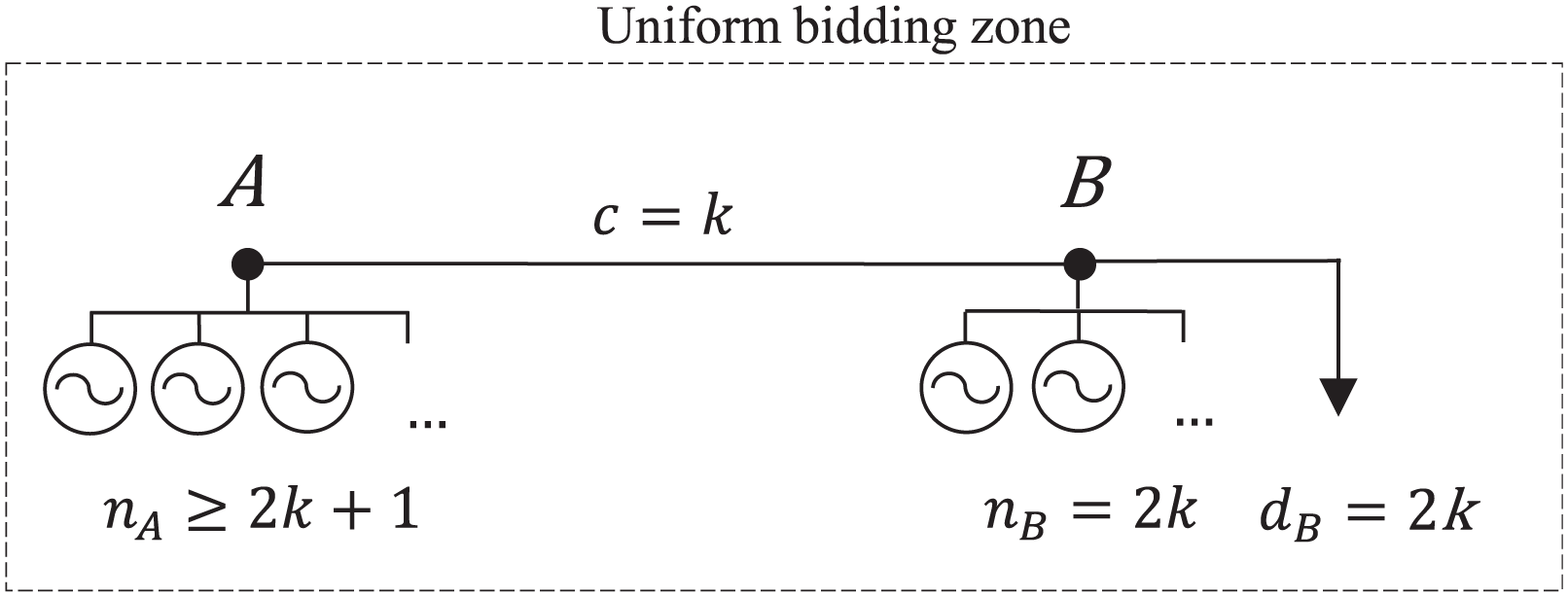
Setup of the model in the basic case.
Regions
The game has two stages: In the first stage, generators submit a bid in the spot market, and, depending on the spot market outcome, redispatch markets are conducted in which generators can submit a second bid.
We assume that generators are profit-maximizing and sequentially rational. Each provider knows its generation costs and their relative position in the distribution of generators’ costs. Generation costs are private information, that is, providers do not know their competitors’ costs.
This is modeled as follows. Generation costs are i.i.d. random variables
Consequently, the generators with the lowest costs can be in any of the two regions. The basic model captures both the case that generators’ costs are such that transmission capacity is congested and the case that no congestion occurs. Regions are asymmetric in the sense that congestion of a transmission line is possible only in one direction. Thus, an efficient dispatch only sometimes involves congestion (depending on the realized costs), but if a congestion occurs, its direction is always the same. 7
Maximum bids in the spot market and the market for upward redispatch are limited to
Market-based redispatch is conducted if the spot market allocation is not feasible due to the grid constraint. In our basic model, in which transmission capacity is limited to
The redispatch markets are organized as auctions with pay-as-bid pricing. 8 At the redispatch stage, demand for upward and downward redispatch is known. In the auction for downward redispatch, the highest bids win and the winners pay their bid (i.e., the provider buys the electricity back); in the auction for upward redispatch, the lowest bids win and the winners are paid their bid (i.e., the provider sells the electricity). Thus, a provider that is downward redispatched has a profit (payoff) equal to the spot market price minus the provider’s redispatch bid; a provider that is upward redispatched has a profit equal to the provider’s redispatch bid minus generation costs.
In this game there exists a Perfect Bayesian Equilibrium in which only generators in
The equilibrium bidding functions


The equilibrium bidding functions

for all

Boundary bids are
In the equilibrium, all spot market bids of generators in
The equilibrium bidding functions
As
The intuition behind the equilibrium is as follows. First consider the second stage, the redispatch markets. On the redispatch market in region
A provider who wins at the worst spot market price conditional on winning, that is, a price equal to the provider’s bid, knows the price-setting provider has the same type,
In both regions, the expected profit of generators is positive and decreases with their costs. Moreover, the expected profit of a provider in
In this setting, the generators’ uncertainty about the competitors’ costs requires them to trade off the different potential outcomes that may result from their bid, making their decisions risky. As a result of the uncertainty, the final dispatch may not be efficient, that is, it is not the cost-optimal subset of generators that operate. Inefficiency occurs whenever more than
Furthermore, note that in the equilibrium outcome, the maximum volume of
In addition to the equilibrium in Proposition 1, others may exist. However, all equilibria with a positive redispatch probability for the generators have in common that the generators in
3.2. Benchmarking Market-based Redispatch
To highlight why market-based redispatch with strategic behavior results in higher generation costs and electricity payments for consumers, we compare the approach with three theoretical benchmarks: an unconstrained grid, idealized cost-based redispatch with a completely informed system operator, and the Vickrey-Clarke-Groves (VCG) mechanism, which incents truthful bidding and results in a cost-efficient dispatch. Note that these benchmarks are no practical alternatives to market-based redispatch. Instead, the comparison with these theoretical benchmarks helps to understand where inefficiency and high payments arise in market-based redispatch and what causes them. The comparisons in this section also hold for uniform pricing in the redispatch markets and a single bid for spot and redispatch markets because these are outcome-equivalent to the basic model.
As a first benchmark, we compare market-based redispatch with the case of unconstrained grids (deviating from the basic model). Redispatch becomes dispensable when the network is expanded to the extent that congestion no longer occurs. Then, generators have an incentive to bid their marginal costs in the spot market,
The second theoretical benchmark is what we call idealized cost-based redispatch. This benchmark represents a fictitious situation in which the system operator can limit the redispatch payments to the generation costs, that is, it can enforce price discrimination. This is only possible when the system operator has full information about the costs of all generators (deviating from the basic model). In this case, generators always have the incentive to bid their costs in the spot market,
The third benchmark is the Vickrey-Clarke-Groves (VCG) mechanism. This one-step mechanism determines an efficient (i.e., generation-cost-minimizing) dispatch given the transmission capacity and provides a robust incentive (a weakly dominant strategy) to bid the costs,
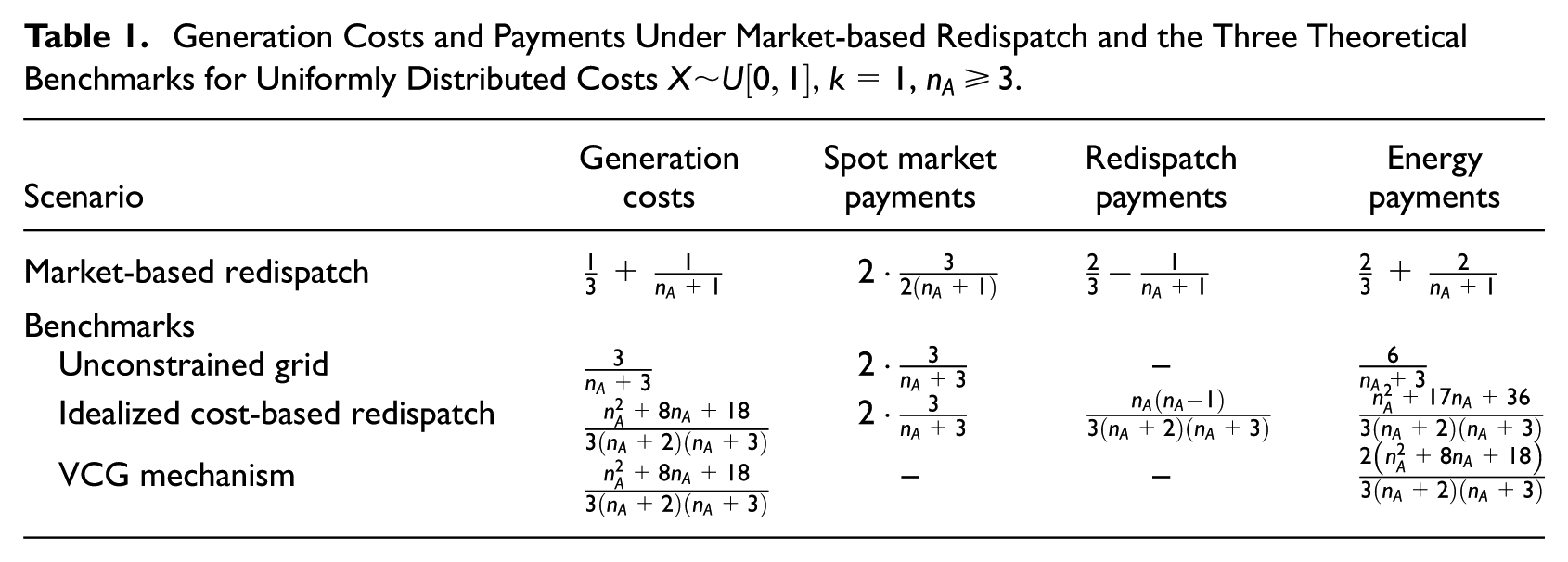
Table 1 provides an overview of expected generation costs and electricity payments in the spot and the redispatch markets; see Appendix A.2 for the associated calculations. The electricity payments are the spot market payments (two times the spot market price) plus the redispatch payments. To simplify the comparison, we assume a uniform distribution (
Generation Costs and Payments Under Market-based Redispatch and the Three Theoretical Benchmarks for Uniformly Distributed Costs
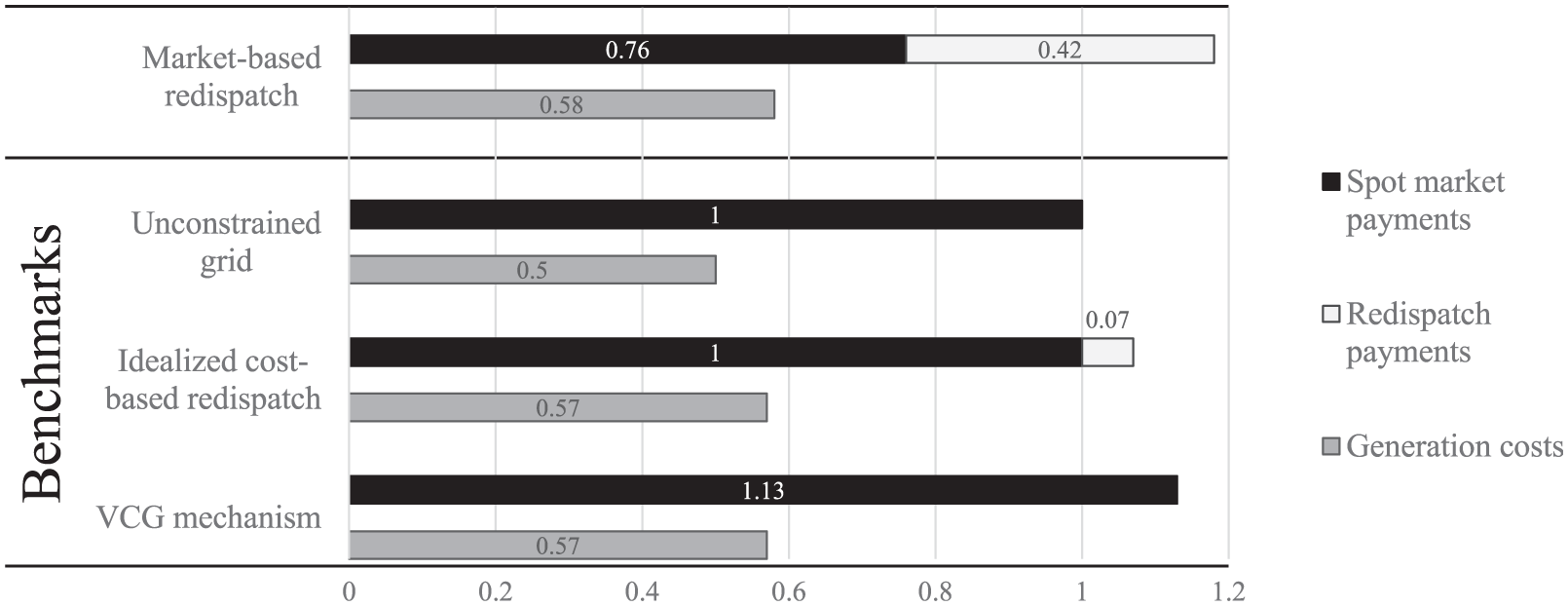
Generation costs and payments under market-based redispatch and the three theoretical benchmarks for uniformly distributed costs
Generation costs are highest with market-based redispatch due to the inefficient final dispatch in the case when the two cheapest generators are located in
The spot market price with market-based redispatch differs from the benchmark scenarios because it is determined by the competitive bids in region
Total energy payments with market-based redispatch are higher than in the benchmark scenarios due to the additional redispatch payments. The difference in energy payments between market-based redispatch and the VCG mechanism is the additional payment caused by the strategic behavior under market-based redispatch. As
4. Impact of Market Fundamentals
This section focuses on market fundamentals that might influence the likelihood of inc-dec gaming. To this end, we model and analyze the impact of competition and market size, the probability and the level of congestion, as well as the impact of uncertainty about congestion. Formal derivations of the results are given in Appendix A.3.
4.1. Competition and Market Size
To assess the impact of competition and market size, we vary the number of generators
In the basic model, we have excluded the case
Next, consider the case of
To compare our model with a model of perfect competition and atomistic generators (Holmberg and Lazarczyk 2015), we increase the number of generators in our game and make them smaller at the same time. To do this, we let
With




In the limit, generators in
When
In the limit, our model is one of full information with an infinite number of generators, and the equilibrium outcome is the same as in the equilibrium identified by Holmberg and Lazarczyk (2015). Thus, in the limit, inc-dec gaming persists, but the inefficiency vanishes, as in a setting with perfect competition.
4.2. Varying Cost-related Congestion
We vary cost-related congestion by varying both the probability of cost-related congestion (i.e., the probability of generation costs for which the transmission capacity prevents that the generators with the lowest costs satisfy the demand) and the cost-related congestion level (i.e., the maximum amount to be redispatched
In the basic model, the maximum amount to be redispatched is
We extend our analysis by also studying scenarios where this is not the case, that is, where congestion occurs with probability zero, or where the congestion level is higher than in the basic model. For this purpose, we vary the demand. Since we want to identify and illustrate the basic effects of varying congestion, for simplicity we set
If
If




where
Note that bidding in the redispatch market in region
Comparing the cases
4.3. Uncertainty About Congestion
As a further variation of the model, we study the case of uncertainty about congestion in the network. One motivation for this sensitivity analysis is the claim that inc-dec gaming would only occur when congestion is well predictable.
Methodologically, we implement the uncertainty about congestion as stochastic demand, that is, generators do not know the level of demand when submitting their bids in the spot market. This is equivalent to uncertainty about congestion because the level of demand determines whether and how much the network is congested. It is not necessary for generators to know the actual demand after the spot market has cleared because then only redispatch quantities matter. The results of the models are given in Appendix A.3.3.
For simplicity, we again set
In the spot market, if demand is stochastic with
Similarly, if demand is stochastic with
The analysis reveals that uncertainty about congestion does not necessarily reduce the occurrence of strategic behavior. A reduction in the probability of a binding transmission constraint is ineffective if it is not strong enough (a reduction by 50% in our model is ineffective) and may have unintended consequences (it may prevent the existence of pure-strategy equilibria).
5. Impact of Market Design
In this section, we analyze regulatory changes to the market design that have been brought forward as a means to mitigate inc-dec gaming: a single bid for spot and redispatch markets, price caps, and uniform pricing in the redispatch market (ENTSO-E 2021). 19 We expand our model accordingly and provide formal derivations of the results in Appendix A.3. In addition, we qualitatively discuss a hybrid model combining market-based and cost-based redispatch.
5.1. Single Bid for Spot and Redispatch Market
This change relates to the argument that the possibility to adjust the bid in the spot market for the redispatch market is problematic. The rationale is that if generators could not adjust their bid, they would be unable to engage in gaming. To assess this claim, we extend the basic model accordingly: We allow only one bid per provider that is used both in the spot market and, if relevant, the respective redispatch market.
With only one bid and
However, such invariance of bidding functions when only one bid is feasible does not hold in general. As shown in Section 3.1,
Therefore, for these cases, the expected spot market price and the expected redispatch payments with only one bid are different from those in the corresponding case of the basic model. However, the final allocation is identical to that of the basic model, and in both
Accordingly, the one-shot game with a single bid for both markets has no advantage over the approach with two bids.
5.2. Price Caps
Price caps in spot and redispatch markets are proposed to restrict profits from gaming and thus make it less attractive (Klempp et al. 2020). In the basic model, we assume price caps that do not undercut the variable costs of the most expensive generator, that is, the cap is set at
Furthermore, a price cap in the spot market changes the outcome only if it is below the expected median costs,
Price caps are hence not an adequate mitigation option for inc-dec gaming because gaming relies on bids in the range of the variable generation costs to take advantage of arbitrage opportunities.
5.3. Uniform Pricing in the Redispatch Market
The basic model assumes pay-as-bid pricing in the redispatch markets, as it is usually applied in practice. However, changing the price rule in the redispatch markets to uniform pricing yields the same results. Under uniform pricing, the highest rejected bid determines the price in the auction for downward redispatch and the lowest rejected bid determines the price in the auction for upward redispatch. In this setting, it is weakly dominant for generators to bid their costs at their redispatch market,
5.4. Hybrid Model
Another suggestion to avoid inc-dec gaming is a hybrid redispatch model: a combination of cost-based redispatch for generation units and market-based redispatch for all other flexibility units. This approach would integrate all redispatch potentials in one joint merit-order. Market-based bids are used only if they are cheaper than their regulated cost-based counterparts (Cramton 2019). To our knowledge, a hybrid approach as discussed in this subsection has not been implemented in practice as of 2023. In the following, we illustrate a case where the hybrid approach reduces the incentives for inc-dec gaming and its effects.
For the analysis of a hybrid model, we consider the basic model in Section 3.1 and assume that the costs of all
In conclusion, the example shows that the hybrid model reduces the incentives for inc-dec gaming compared to market-based redispatch.
6. Conclusion
We propose a game-theoretic model to study strategic behavior in redispatch markets. Our model comprises a setting with two interconnected regions within one pricing zone. We extend existing models by considering incomplete information about competitors’ costs and a finite set of generators. We identify an equilibrium in which the final dispatch is inefficient due to the strategic behavior of inc-dec gaming. According to our analysis, market-based redispatch leads to inefficient outcomes and high redispatch payments. The sources and extent of inefficiency and high payments are identified by comparing market-based redispatch with different theoretical benchmarks. Moreover, we study multiple variations of our basic model to assess whether inc-dec gaming incentives occur only in markets with specific characteristics. Our assessment reveals that inc-dec gaming is also a rational behavior in markets with high competition and with uncertainty about congestion. Finally, we examine whether market design changes can mitigate inc-dec gaming. The analyzed market design changes comprise single bids for spot and redispatch markets, price caps, uniform pricing in the redispatch markets, and a hybrid model. None of these market design changes prevents inc-dec gaming entirely.
Our analysis is well suited to identifying and attributing the problems of market-based redispatch. However, the model has some limitations, and the analysis can be extended in future research in several ways. First, the chosen setting may seem restrictive with respect to the number of generators in
Footnotes
A. Appendix
Funding
The authors disclosed receipt of the following financial support for the research, authorship, and/or publication of this article: This research received funding by the German Federal Ministry for Economic Affairs and Climate Action in the project “
Declaration of Conflicting Interests
The authors declared no potential conflicts of interest with respect to the research, authorship, and/or publication of this article.
1
2
The outcome is the same whether there is one bid per market stage or a single bid for both stages.
3
To determine an adequate compensation for these assets, system operators would need to estimate each consumer’s opportunity costs, that is, their willingness to pay for electricity.
4
The regulation states that redispatch must be organized via a competitive mechanism, unless one of the following exemptions apply: no market-based alternative is available, all available market-based resources are exhausted, the number of available units is too low to ensure effective competition, or the current grid situation leads to congestion in such a frequent and predictable way that market-based redispatch would result in strategic bidding.
5
We vary demand (relative to
7
This assumption can be justified by real-world network characteristics in which congestion usually occurs in the same direction (until the network may finally be enforced) or by predictability of the direction of a congestion for specific market time units.
8
In Section 5.3, we will show that uniform pricing leads to the same outcome.
9
As is common in auction theory analysis, we concentrate on symmetric equilibria in pure and increasing strategies (e.g.,  ). That is, all generators in
10
11
The order statistic
12
This is an equilibrium: No single losing or winning bidder can cause congestion by unilaterally deviating, all winning bidders prefer winning to losing and cannot lower the price, and all losing bidders prefer losing to winning and cannot win at a lower price. Note that also in the opposed case of cost realizations where for atomistic generators. Assume for simplicity that all generators’ realized costs differ, and assume for equilibrium existence that ties are broken in favor of efficiency. There is an equilibrium in which all generators bid the same in the spot market as in the redispatch market. In
13
An example of an asymmetric equilibrium where generators in
14
The VCG mechanism is the unique mechanism with these properties. Only fixed transfers added to the payments resulting from a VCG mechanism, would also not affect the incentives (Green and Laffont 1979; ).
15
In contrast to traditional locational marginal pricing, the VCG mechanism may set different local prices even if the transmission capacity is just sufficient. Therefore, generators cannot profit from inducing a congestion by misstating costs in the VCG mechanism.
16
With this approach, we follow Aumann (1964) and and consider the limit of a sequence of non-cooperative games with finite players while maintaining the structure of the game.
17
For
18
The revenue equivalence theorem applies to comparing cases
20
In contrast to
21
Their equilibrium is outcome equivalent to our equilibrium as