




Abstract
Widespread implementation of energy efficiency is a key greenhouse gas emissions mitigation measure, but rebound can “take back” energy savings. However, the absence of solid analytical foundations hinders empirical determination of rebound magnitudes. In Part I, we developed foundations of a rigorous, analytical, consumer-sided rebound framework that is approachable for both energy analysts and economists. In this paper (Part II), we develop energy, expenditure, and consumption planes, a novel, mutually consistent, and numerically precise way to visualize and illustrate rebound. Further, we operationalize the macro factor (
Keywords
1. Introduction
In Part I of this two-part paper, we argued that improved clarity is needed about energy rebound. We said that [a] description of rebound [is needed] that is (i) consistent across energy, expenditure, and consumption aspects, (ii) technically rigorous and (iii) approachable from both sides (economics and energy analysis). … In other words, the finance and human behavior aspects of rebound need to be presented in ways energy analysts can understand. And the energy aspects of rebound need to be presented in ways economists can understand.
To help improve clarity in the rebound field, we developed in Heun et al. (2025) foundations for a rigorous analytical framework, one that is tractable for both energy analysts and economists. Three aspects of rebound are analyzed in the framework: energy, expenditure, and consumption. The framework contains both direct and indirect rebound and four rebound effects (emplacement, substitution, income, and macro) between five stages (°, *, ∧, −, and ~). Rebound terms and symbol decorations are shown in Figure 1. (See Table 1 in Part I for details. See Appendix A for nomenclature.)
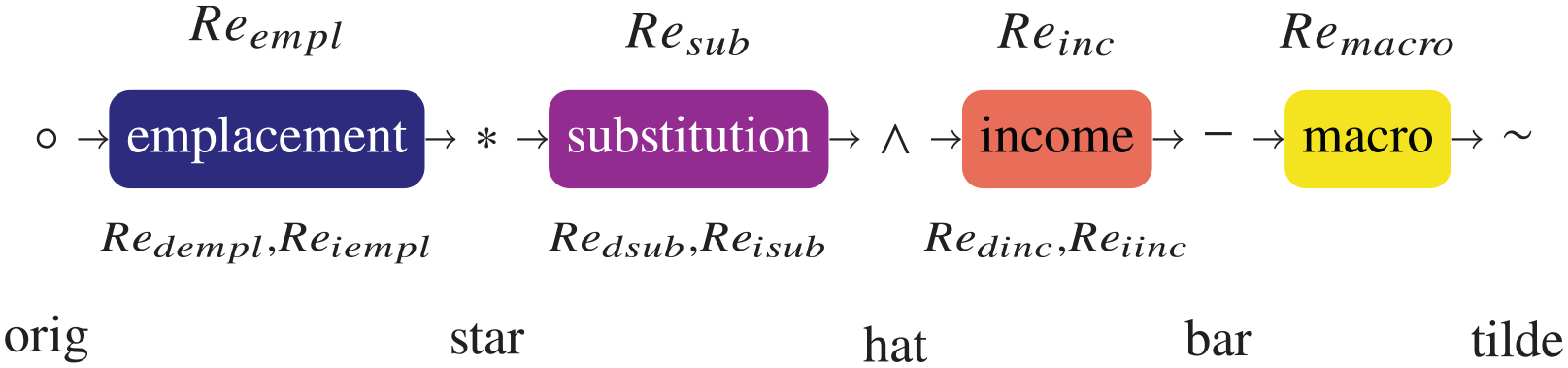
Flowchart of rebound effects and decorations.
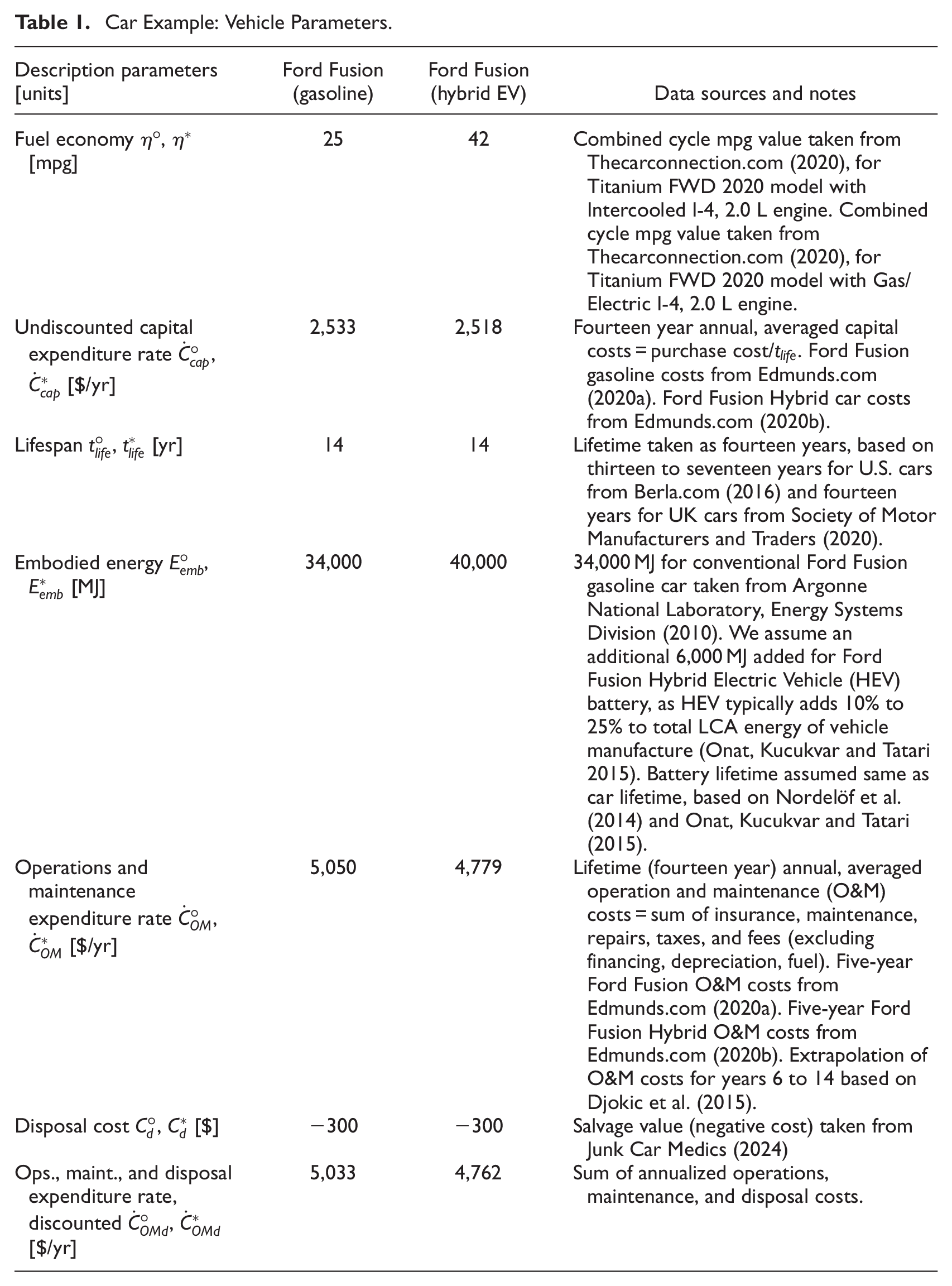
Car Example: Vehicle Parameters.
In this paper (Part II), we make further progress toward the goal of clarity with five contributions. First, we develop a new way to communicate components and mechanisms of rebound via mutually consistent and numerically precise visualizations of rebound effects in energy, expenditure, and consumption planes. Second, we calculate the macro rebound effect via a macro factor (
The remainder of this paper is structured as follows. Section 2 describes data for the examples, our method of visualizing rebound, and open source software tools for calculating and visualizing rebound. Section 3 provides results for two examples: energy efficiency upgrades to a car and an electric lamp. Section 4 operationalizes the macro factor (
2. Data and Methods
This section contains data for the examples (Section 2.1), an explication of our new method for visualizing rebound effects and magnitudes (Section 2.2), and a description of new open source software tools for rebound calculations and visualization (Section 2.3).
2.1. Data
To demonstrate application of the rebound analysis framework developed in Part I, we analyze two examples: energy efficiency upgrades to a car and an electric lamp. The examples are presented with much detail to support our goal of helping to advance clarity for the process of calculating the magnitude of rebound effects. Here, we collect parameter values for the equations to calculate nine rebound components:
2.1.1. Data for Car Example
For the first example, we consider the purchase of a more fuel efficient car, namely a gasoline-electric Ford Fusion Hybrid car, to replace a conventional gasoline Ford Fusion car. The cars are matched as closely as possible, except for the inclusion of an electric battery in the hybrid car. The car case study features a larger initial capital investment (
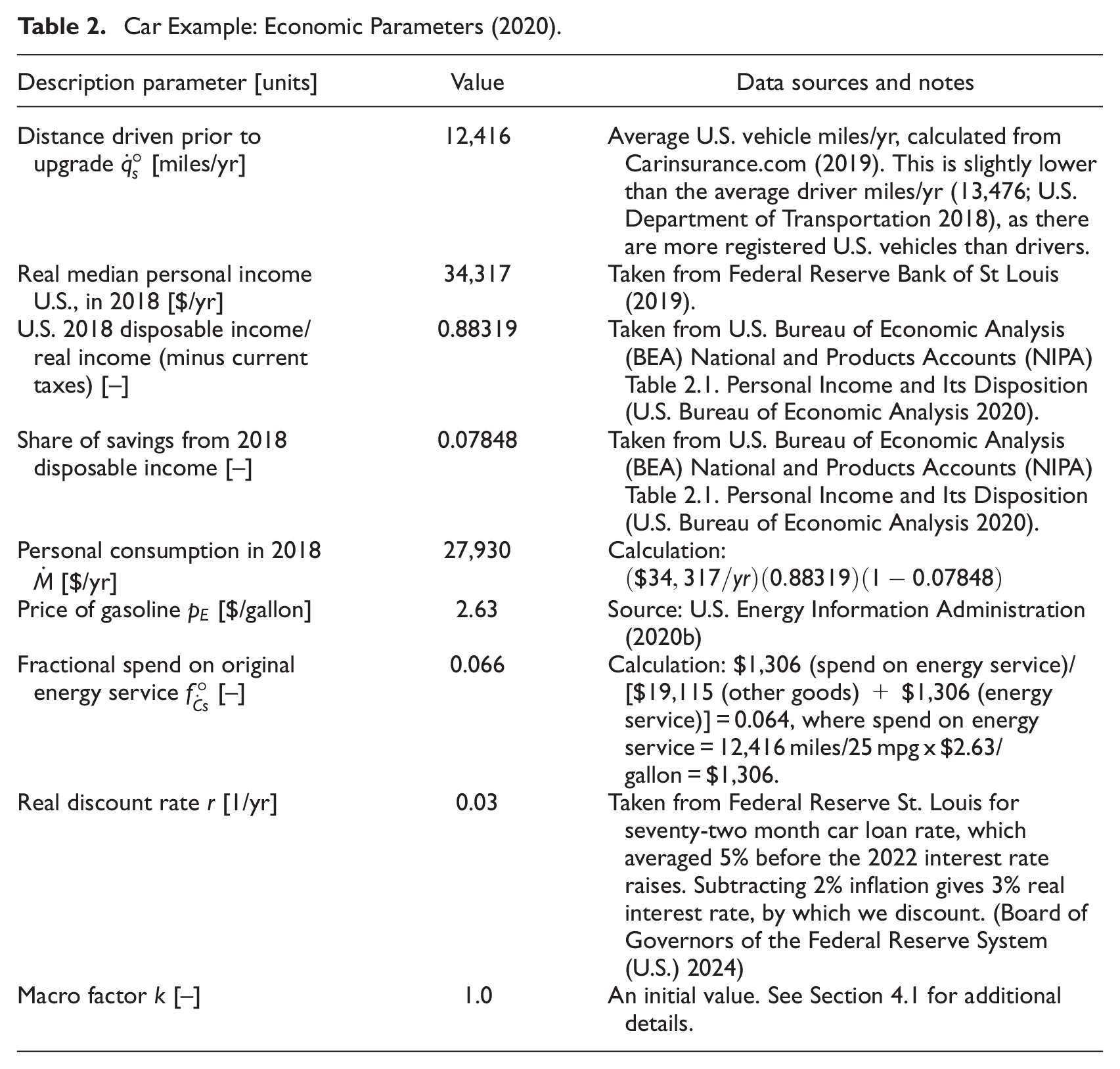
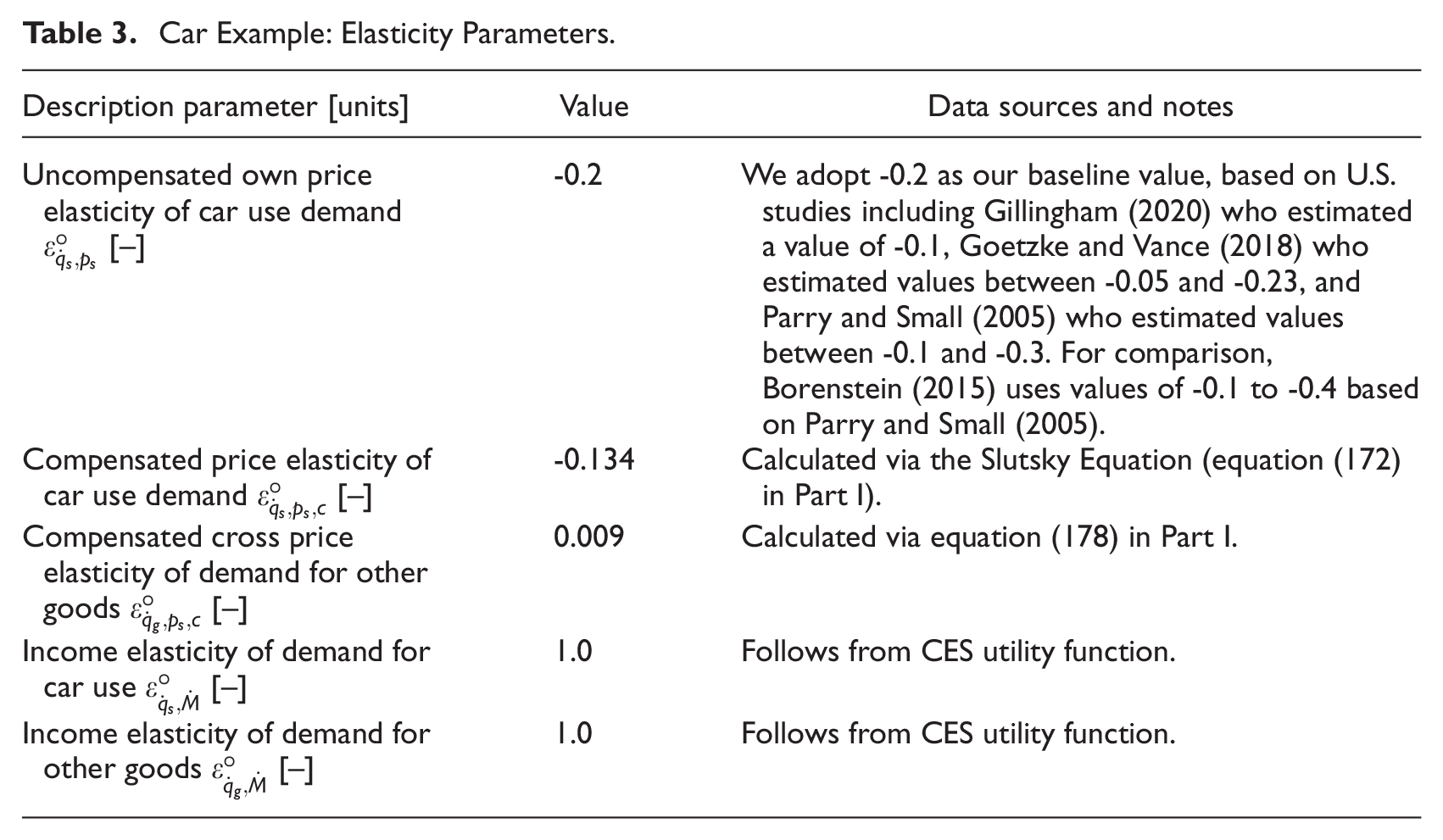
We require three sets of data. First, basic car parameters are summarized in Table 1. Second, we require several general economic parameters, mainly relating to the U.S. economy and personal finances of a representative U.S.-based user shown in Table 2. Third, we require elasticity parameters, as given in Table 3.
Car Example: Economic Parameters (2020).
Car Example: Elasticity Parameters.
2.1.2. Data for Lamp Example
For the second example, we consider purchasing a Light Emitting Diode (LED) electric lamp to replace a baseline incandescent electric lamp. Both lamps are matched as closely as possible in terms of energy service delivery (measured in lumen output per lamp), the key difference being the energy required to provide that service. The LED lamp has a low initial capital investment rate when spread out over the lifetime of the lamp (less than the incumbent incandescent lamp) and a long-term benefit of decreased direct energy expenditures at approximately the same energy service delivery rate (lm hr/yr).
Again, three sets of data are required. First, basic lamp parameters are summarized in Table 4. Second, several general economic parameters, mainly relating to the U.S. economy and personal finances of a representative U.S.-based user are given in Table 5. Third, we require the elasticity parameters, as shown in Table 6.
Lamp Example: Electric Lamp Parameters.
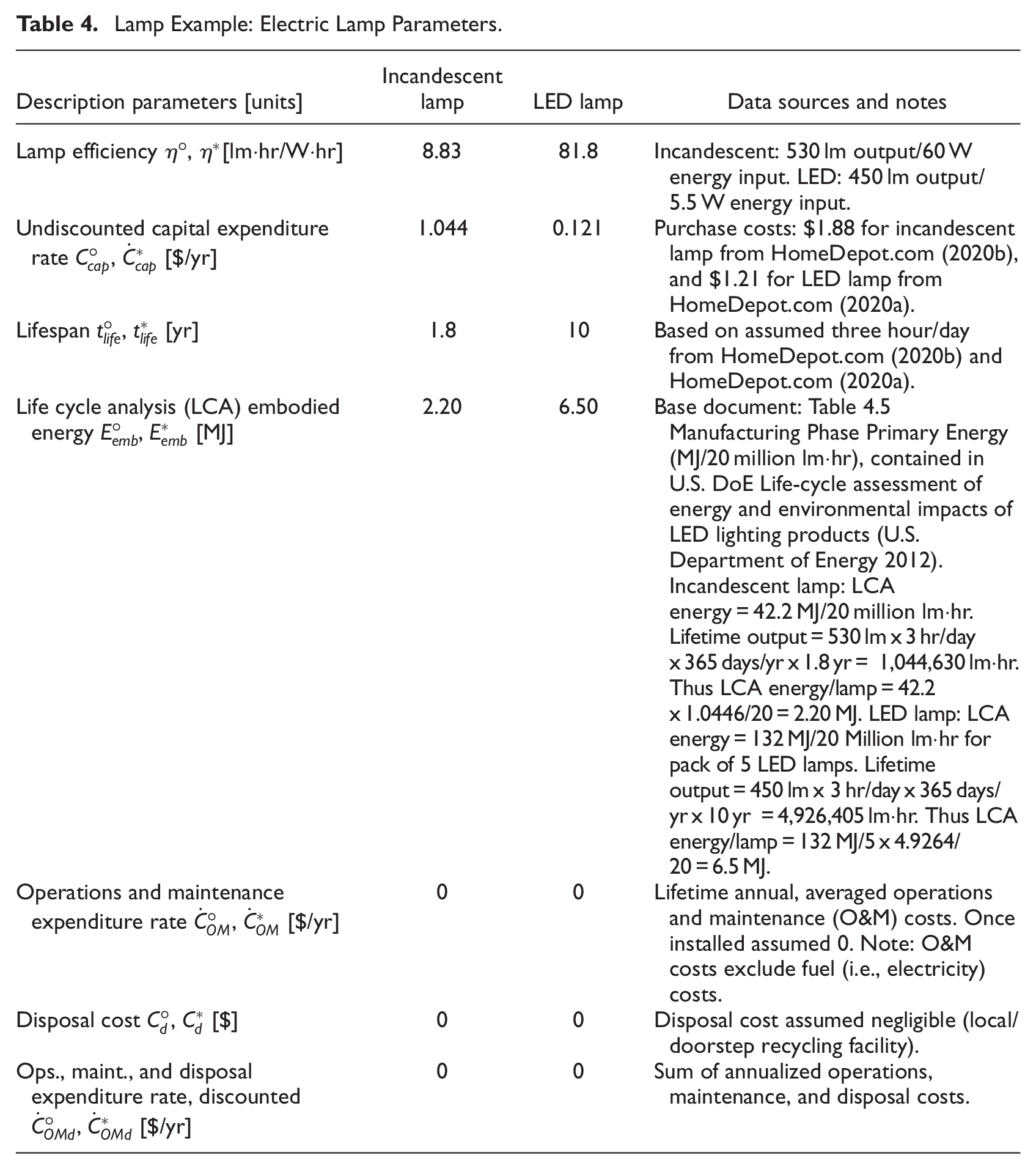
Lamp Example: Economic Parameters (2020).
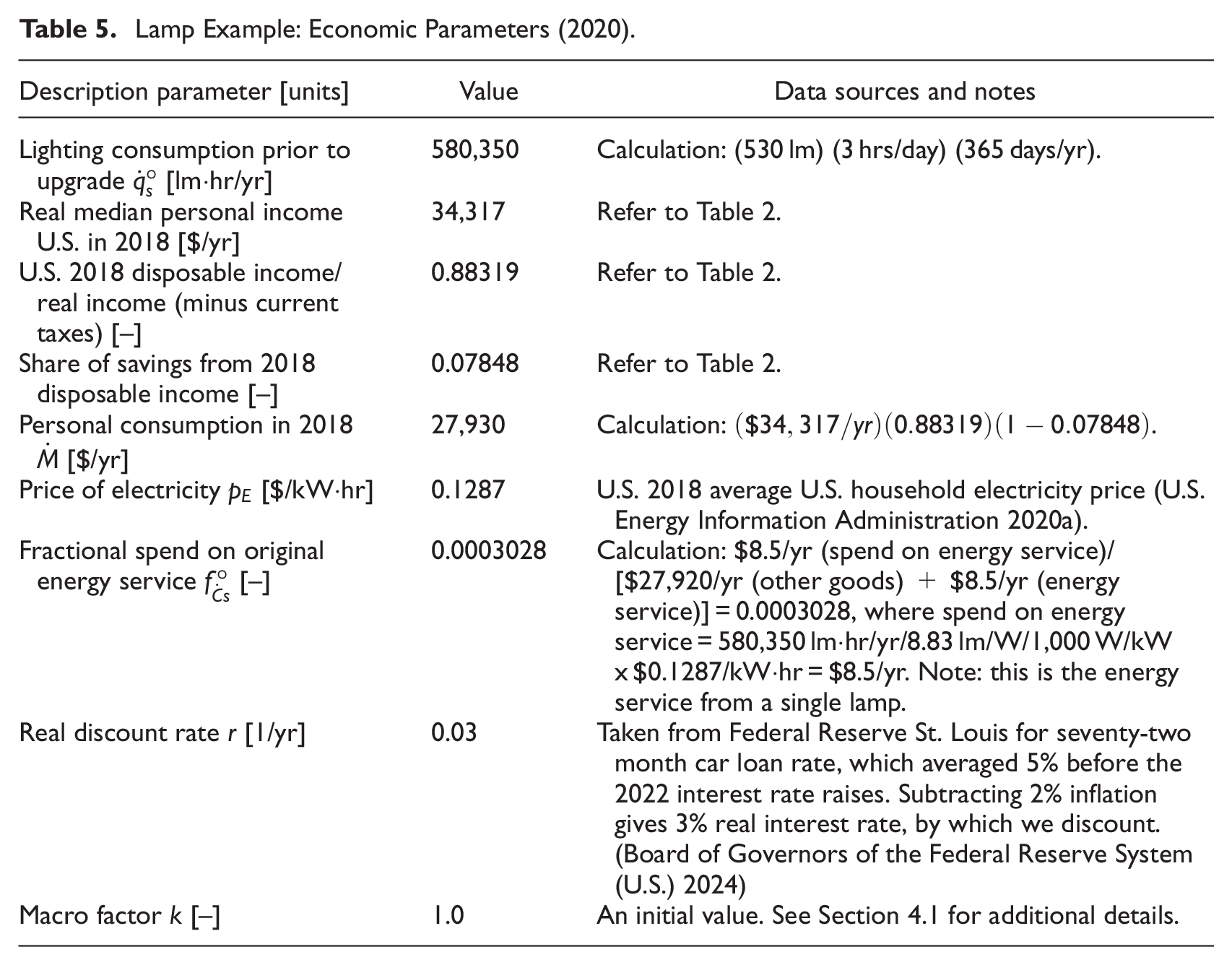
Lamp Example: Elasticity Parameters.
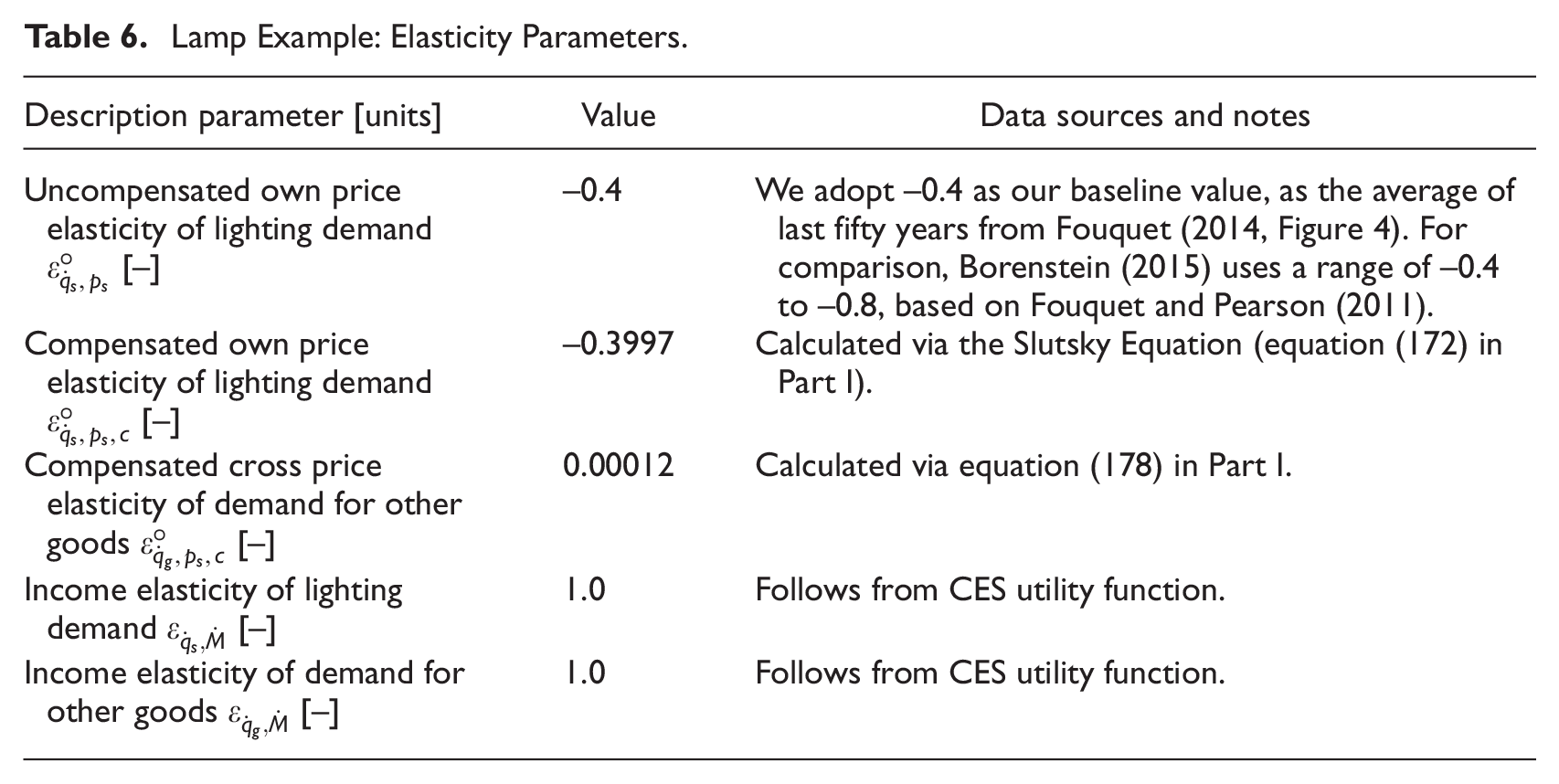
2.2. Visualization
A rigorous rebound analysis should track energy, expenditure, and consumption aspects of rebound at the device (direct rebound) and elsewhere in the economy (indirect rebound) across adjustments for all rebound effects (emplacement, substitution, income, and macro). Doing so involves many terms and much complexity.
To date, visualizing the energy, expenditure, and consumption aspects of rebound phenomena has not been done in a numerically precise manner with a set of mutually consistent graphs. We introduce rebound planes to help advance clarity of (direct and indirect) rebound and adjustments (via emplacement, substitution, income, and macro effects) across all aspects (energy, expenditure, and consumption). Each aspect is represented by a path in its own plane, showing adjustments in response to the EEU.
Axes of the rebound planes represent direct and indirect effects, with direct effects shown on the
2.3. Software Tools
We developed an open source R package called
To find the path to an example spreadsheet bundled with the package, users of
In addition, an Excel workbook that performs identical rebound calculations using the framework of this paper is available from University of Leeds at https://doi.org/10.5518/1634. (See Brockway, Heun and Semieniuk [2025]).
3. Results
In this section we present rebound calculation results for two examples: energy efficiency upgrades of a car (Section 3.1) and an electric lamp (Section 3.2). Univariate sensitivity studies for both examples (car and lamp) can be found in Appendix C.
3.1. Example 1: Purchase of a New Car
3.1.1. Numerical Results: Car Example
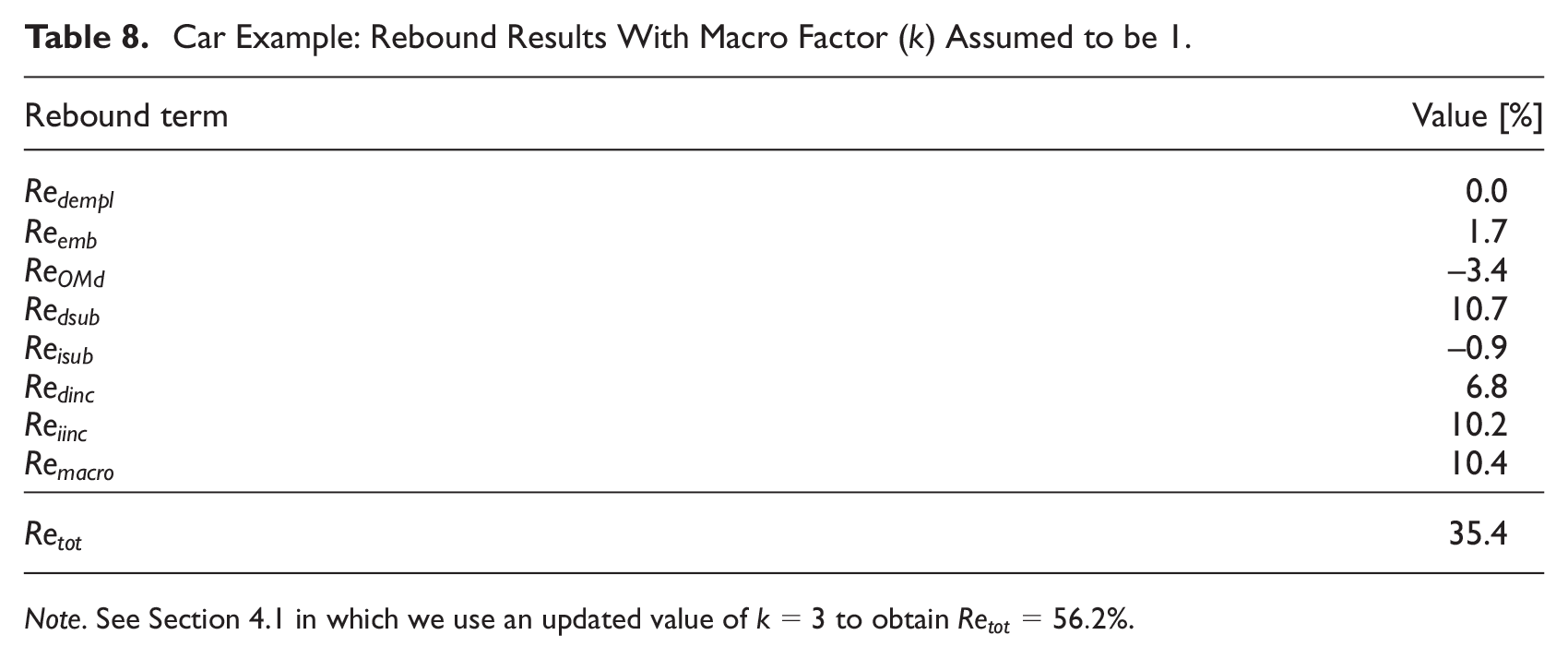
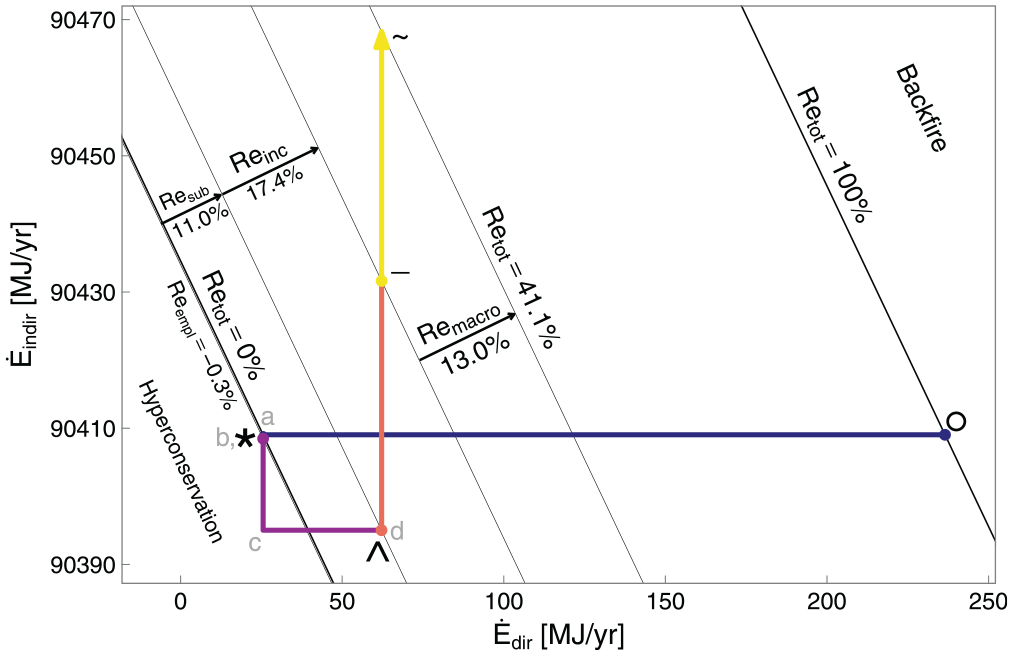
Armed with the data in Tables 1 to 3, and the equations in Section 2 of Part I, we calculate important values at each rebound stage, as shown in Table 7. Note that Table 7 applies to the car user. Across the macro effect (segment –  ~ in Figure 2), changes occur only in the macroeconomy. For the car user, no changes are recorded across the macro effect. Thus, the ~ (tilde) column is absent from Table 7. Rebound components for the car upgrade are shown in Table 8.
Results for Car Example With Macro Factor (
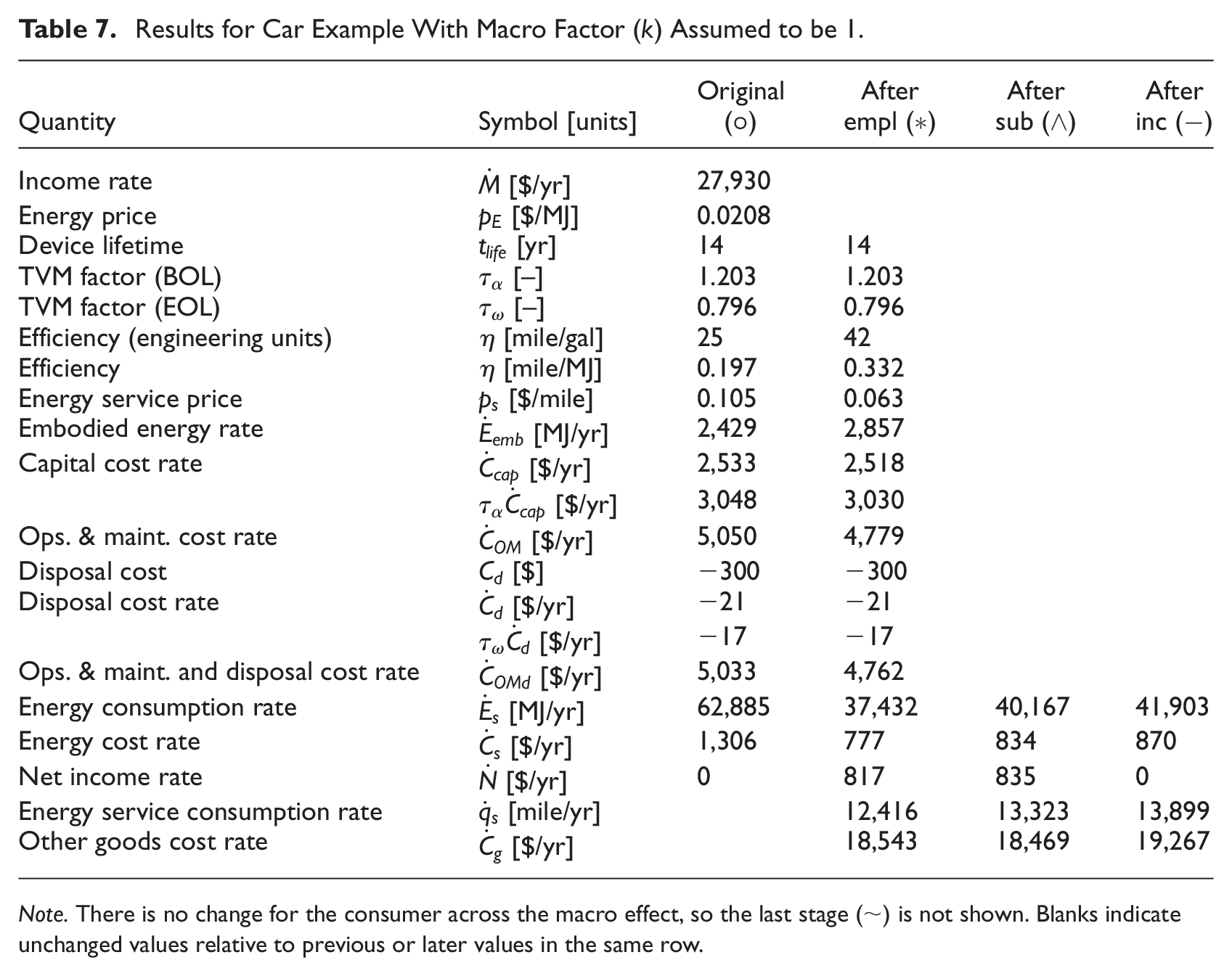
Note. There is no change for the consumer across the macro effect, so the last stage (~) is not shown. Blanks indicate unchanged values relative to previous or later values in the same row.
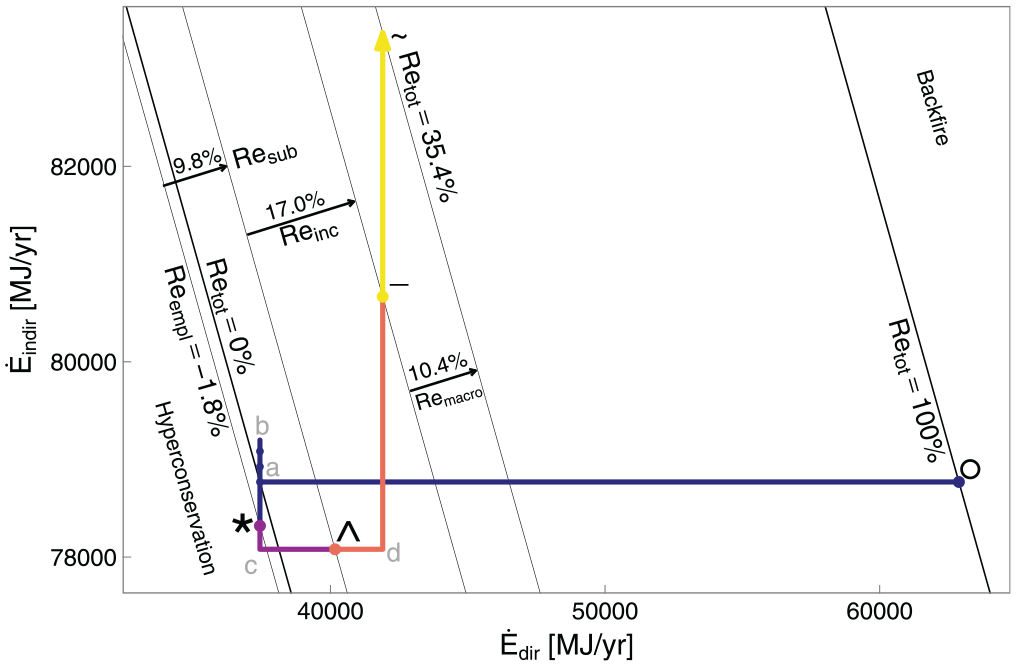
The energy plane for the car example. The macro factor,
Car Example: Rebound Results With Macro Factor (
Note. See Section 4.1 in which we use an updated value of
The emplacement effect has three components: the direct emplacement effect, the embodied energy effect, and the combined operations, maintenance, and disposal effects. Rebound from the direct emplacement effect (
The substitution effect has two components: direct and indirect substitution effect rebound. Rebound from direct substitution (
The income effect also has two components: direct and indirect income effect rebound. The direct income effect (
Finally, in Part I we noted that the link between macroeconomic and microeconomic rebound is largely unexplored, so we assume a value of
3.1.2. Rebound Visualizations: Car Example
Figure 2 shows the energy plane for the car example, assuming ~ appears only in the energy plane, because the framework tracks energy consumption but not expenditures or consumption for the macro effect.
Segments in Rebound Planes.
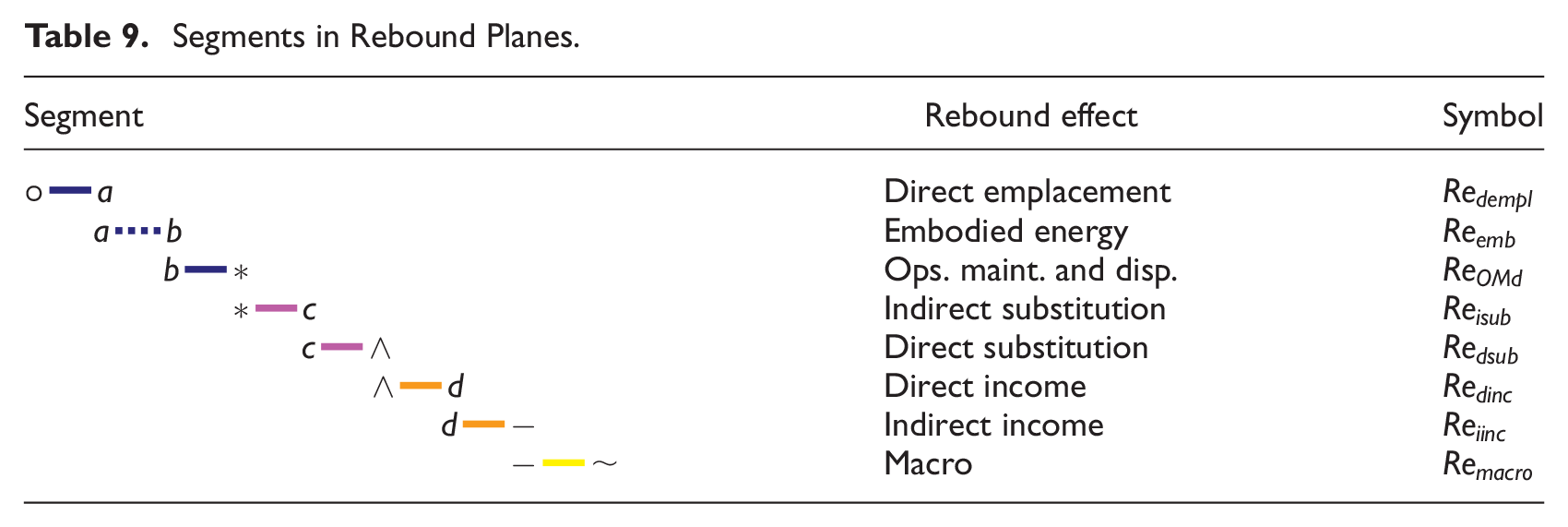
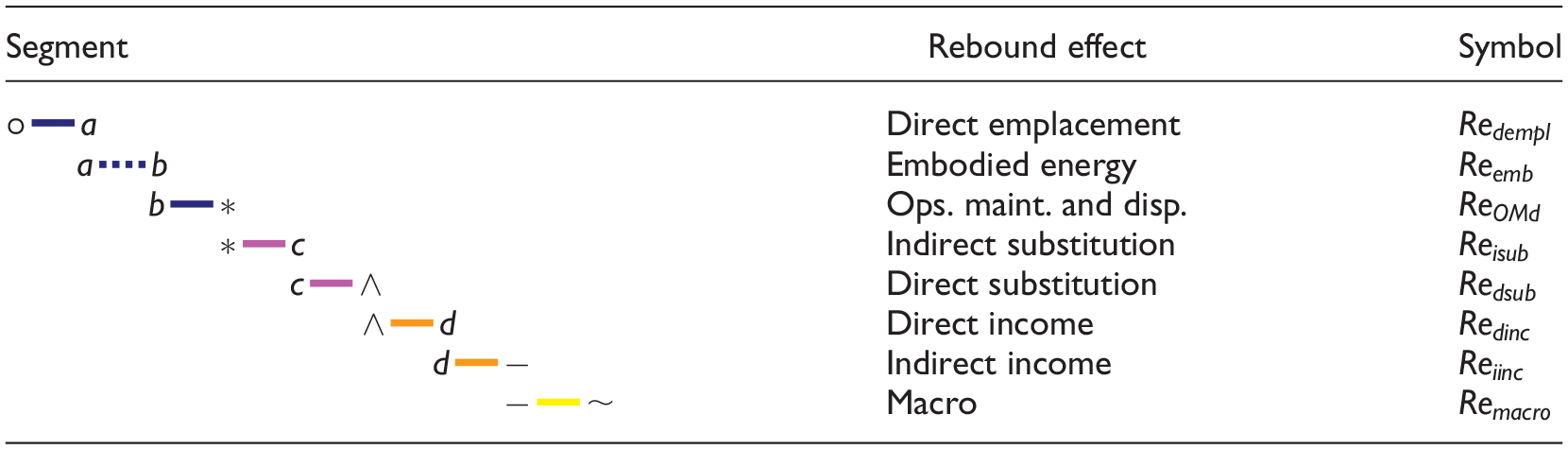
In the energy plane, lines with negative slope through points °,
Segment *  c moves in the negative ^ moves in the positive
  d and d –) show more energy consumption, because net savings are spent on goods and services that rely on at least some energy consumption.
2
Segment – ~ always moves in the positive
d and d –) show more energy consumption, because net savings are spent on goods and services that rely on at least some energy consumption.
2
Segment – ~ always moves in the positive
Note that rebound values from Table 8 are indicated on Figure 2 as sums of direct and indirect components for each effect: emplacement, substitution, income, and macro. Total rebound is also shown.
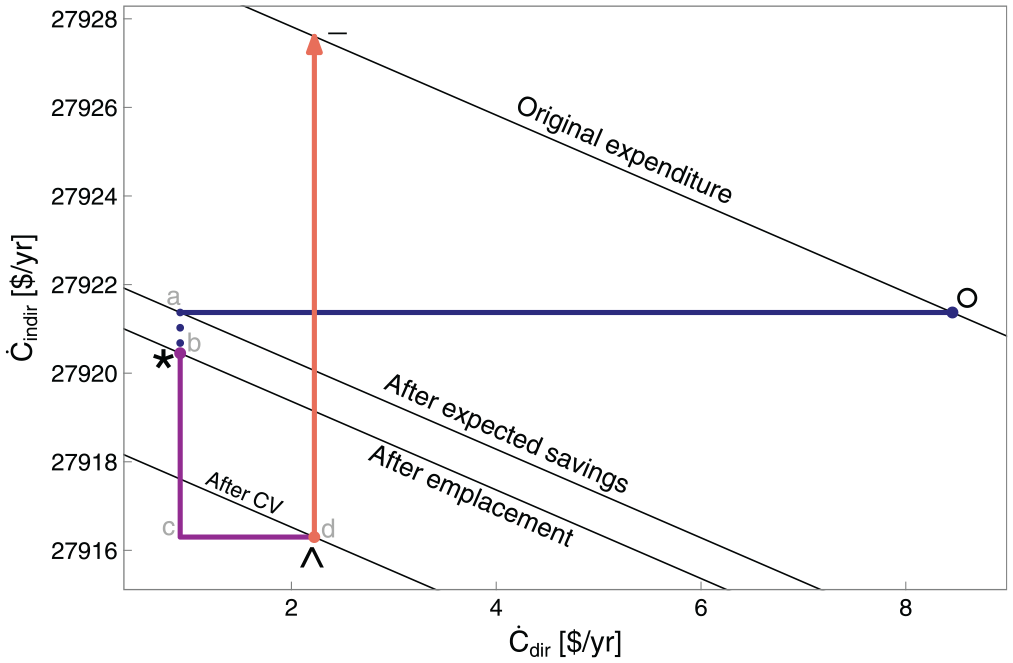
Figure 3 shows the expenditure plane for the car example. The expenditure plane shows the direct expenditure rate on the energy service ( b and b
  * could both move in the positive c and c ^ will together, by definition, lead to lower expenditure due to the energy service price decline and the budget-reducing compensating variation (CV). The income effect (segments ^ d and d –) must bring expenditure back to the original expenditure line (equal to the budget constraint set by income in dollar or nominal terms) by assumptions about non-satiation and utility maximization in the device user’s decision function.
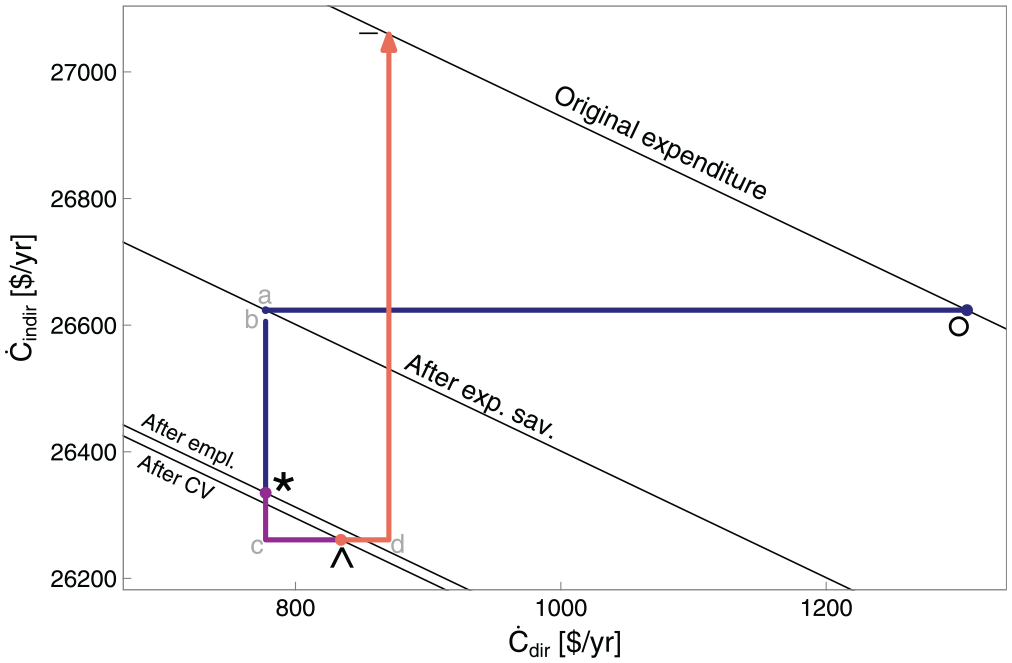
The expenditure plane for the car example. CV is compensating variation, the increase in consumption of the energy service and decrease in consumption of other goods and services to maintain constant utility.
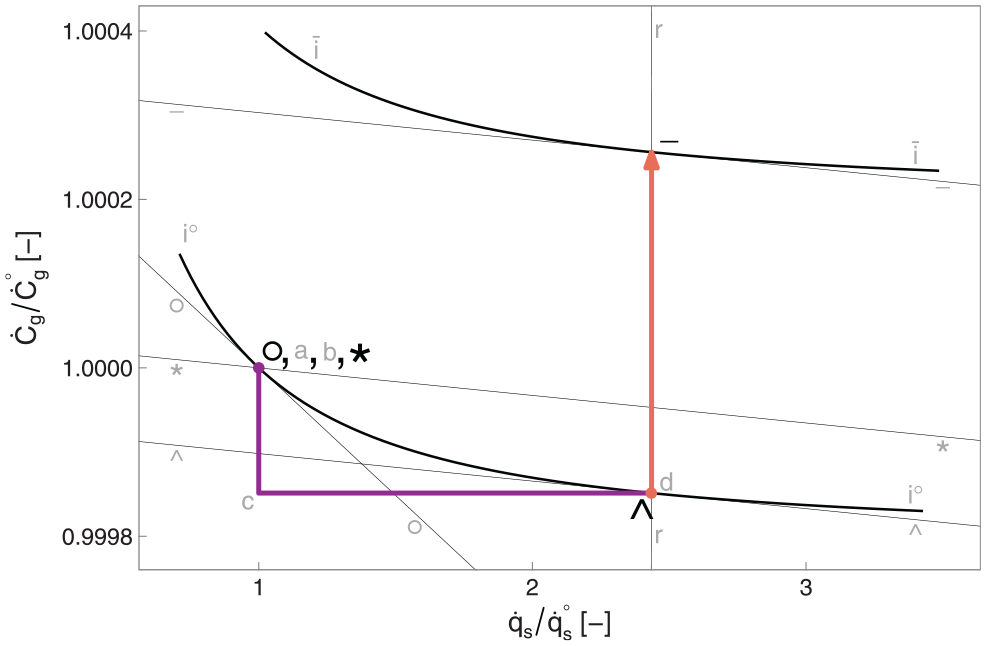
Figure 4 shows the consumption plane for the car example. The consumption plane shows the indexed rate of energy service consumption (
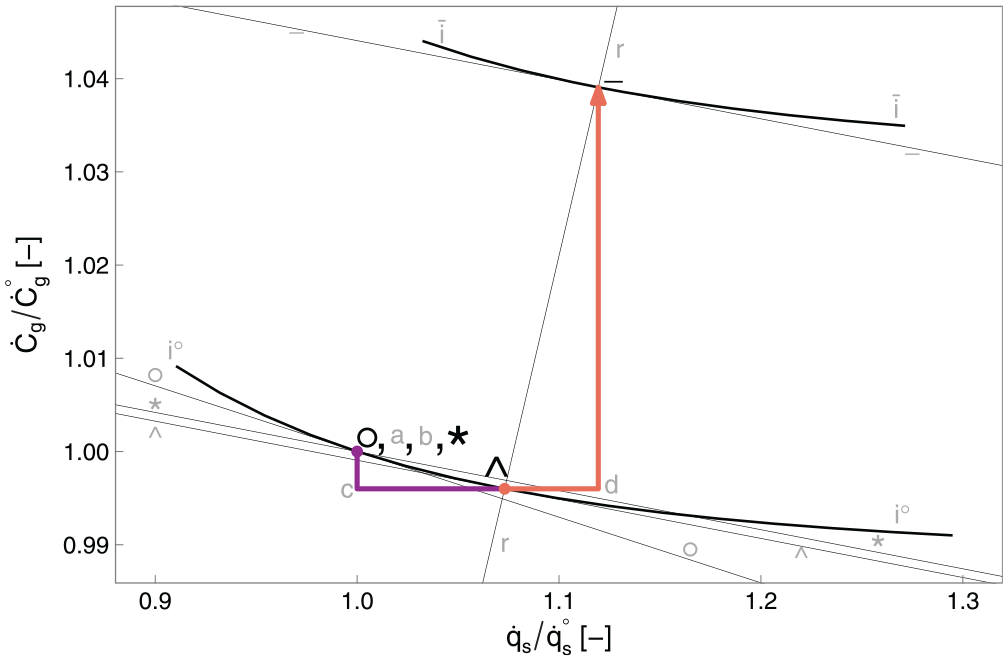
The consumption plane for the car example.
Indifference curves for the CES utility model are denoted by
The substitution effect leads to the cheaper, optimal CES-utility-preserving consumption bundle at the ∧ point. The substitution effect is shown by segments * c (the indirect component, which represents the decrease in other goods consumption) and c ^ (the direct component, which represents the increase in energy service consumption). Although the substitution effect is calculated in the consumption plane, its impact can be seen in the energy and expenditure planes.
In the consumption plane, the income expansion path under the CES utility model is a ray (r__r) from the origin through the ∧ point in the consumption plane. The pre- and post-income-effect points (∧ and −, respectively) lie along the r__r ray, due to homotheticity. The increased consumption rate of the energy service is represented by segment ^ d, and the increased consumption rate of other goods and services is represented by segments d –.
Under non-homothetic utility models, the income expansion path will be closer to vertical in the consumption plane, as the device owner spends more net income (
3.2. Example 2: Purchase of a New Electric Lamp
3.2.1. Numerical Results: Lamp Example
With the data in Tables 4 to 6 and the equations in Section 2 of Part I in hand, we calculate important values at each rebound stage, as shown in Table 10. Rebound components for the lamp upgrade are shown in Table 11.
Results for Lamp Example With Macro Factor (
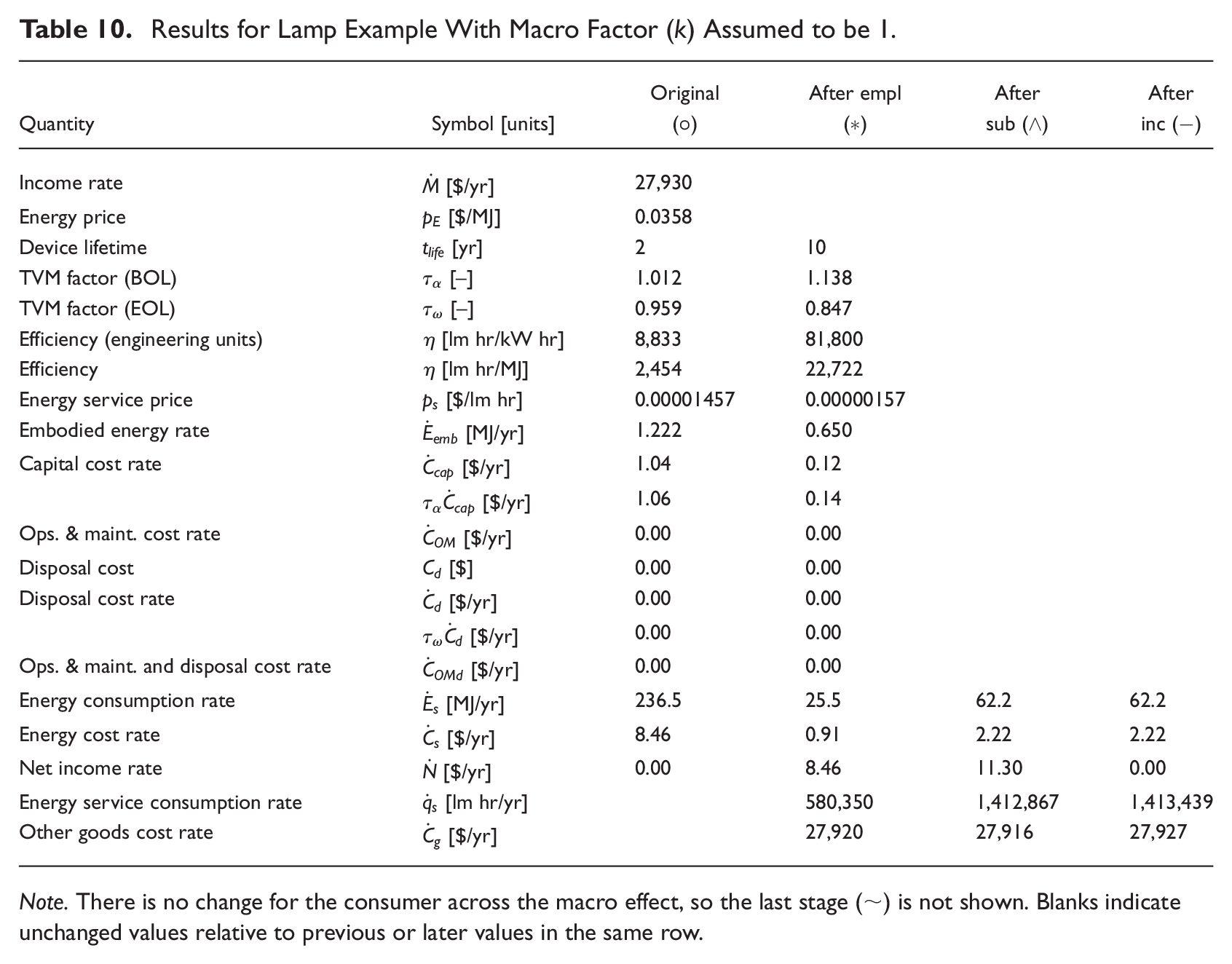
Note. There is no change for the consumer across the macro effect, so the last stage (~) is not shown. Blanks indicate unchanged values relative to previous or later values in the same row.
Lamp Example: Rebound Results With Macro Factor (
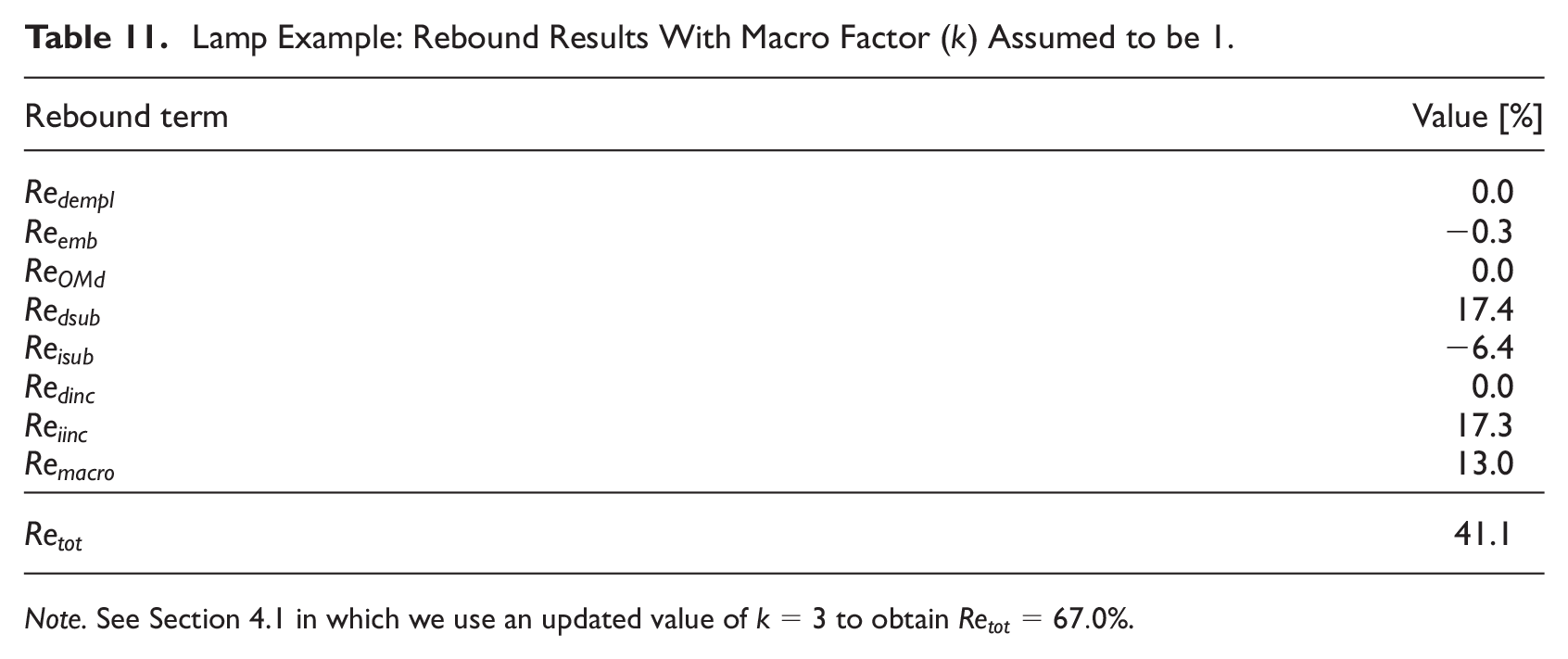
Note. See Section 4.1 in which we use an updated value of
The emplacement effect rebound components start with the direct emplacement effect (
Direct substitution effect rebound ( ^ in Figure 7. To maintain constant utility, consumption of other goods is reduced (
Income effect rebound arises from spending net energy cost savings associated with converting from the incandescent lamp to the LED lamp (
Finally, macro effect rebound (
3.2.2. Rebound Visualizations: Lamp Example
Figures 5 to 7 show energy, expenditure, and consumption planes for the lamp example.
The energy plane for the lamp example. The macro factor,
Expenditure plane for the lamp example. CV is compensating variation, the increase in consumption of the energy service and decrease in consumption of other goods and services to maintain constant utility.
Consumption plane for the lamp example.
4. Discussion
4.1. A First Attempt at Calculating Macro Rebound
Few previous studies explored the link between microeconomic and macroeconomic rebound. Inspired by Borenstein (2015) and others, the framework developed in Section 2 of Part I links macroeconomic rebound to microeconomic rebound via the macro factor (
For the results presented in Section 3 above, we assumed a placeholder value of
Sectoral multipliers capture the impact of sectoral revenue increases into aggregate demand or GDP growth. While the idea of scale economies from larger markets for particular products have a long history in economic thought dating back at least to Smith (1776), data from input-output tables and recent advances in network theory allowed formalization of the spill-overs from sectoral to aggregate growth. First results from the literature show that three quarters of U.S. aggregate output growth originates from sectoral shocks, which are amplified through the production and investment network where one sector’s output is used as intermediate inputs and capital goods in others (Foerster et al. 2022). Durable goods are estimated by Foerster et al. to have the largest sectoral multiplier, and their effect on agggregate output is more than three times their sectoral growth. Since we are also considering durable goods, we adopt the value of
After setting ~) should be three times longer than they appear. In Tables 8 and 11, the values of macro rebound (
4.2. Comparison Between the Car and Lamp Case Studies
Tables 8 and 11 and selection of
First, the magnitude of every rebound effect is different between the two examples, the exception being direct emplacement rebound (
Second, one cannot know a priori which rebound effects will be large and which will be small for a given EEU. Furthermore, some rebound effects are dependent upon economic parameters, such as energy intensity (
Third, the two examples illustrate the fact that embodied energy rebound (
Fourth, macro effect rebound is different between the two examples, owing to differences in net income (
4.3. Comparison to Previous Rebound Estimates
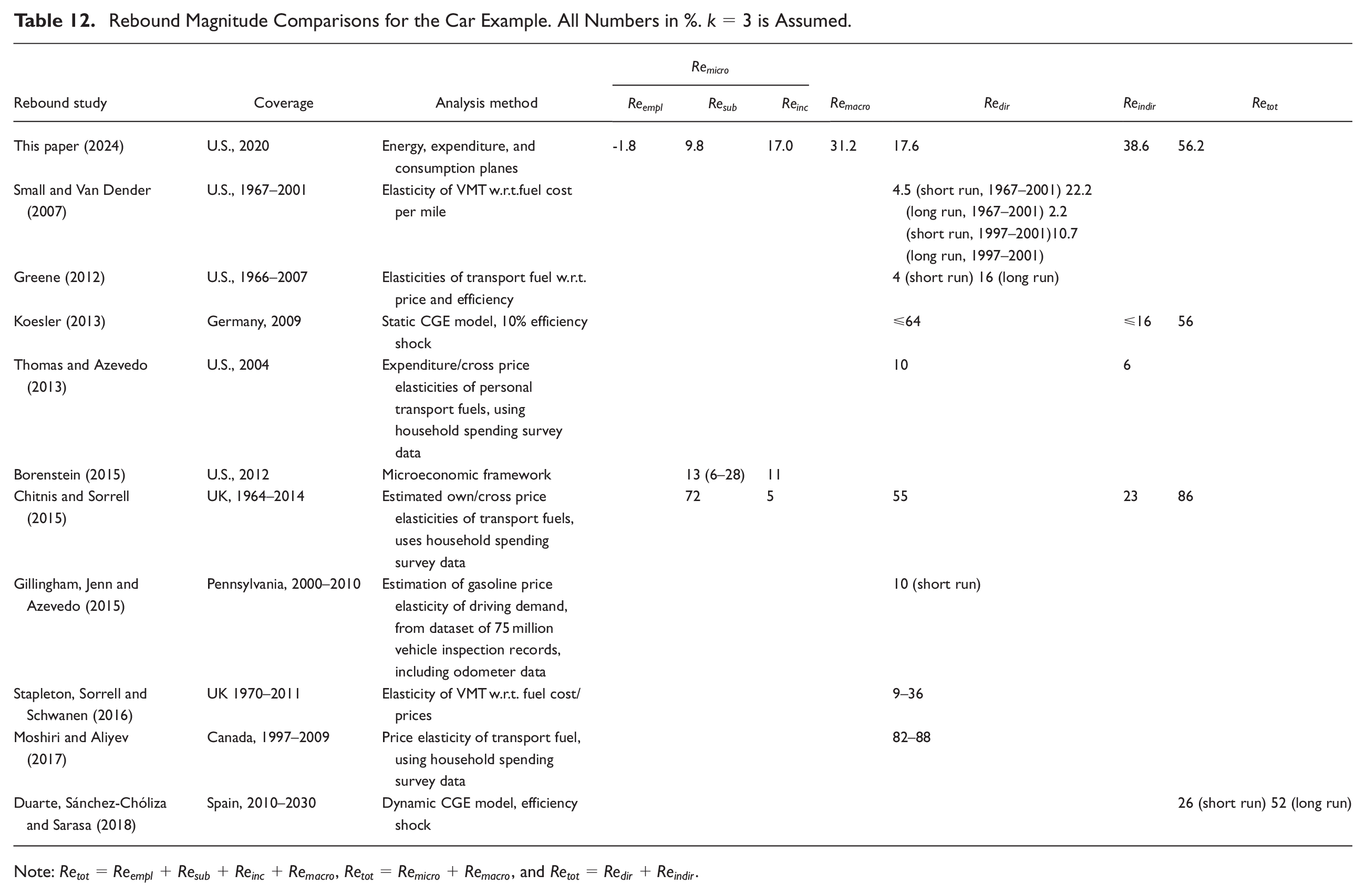
Tables 12 and 13 compare car and lamp results (with
Rebound Magnitude Comparisons for the Car Example. All Numbers in %.
Note:
Rebound Magnitude Comparisons for the Lamp Example. All Numbers in %.
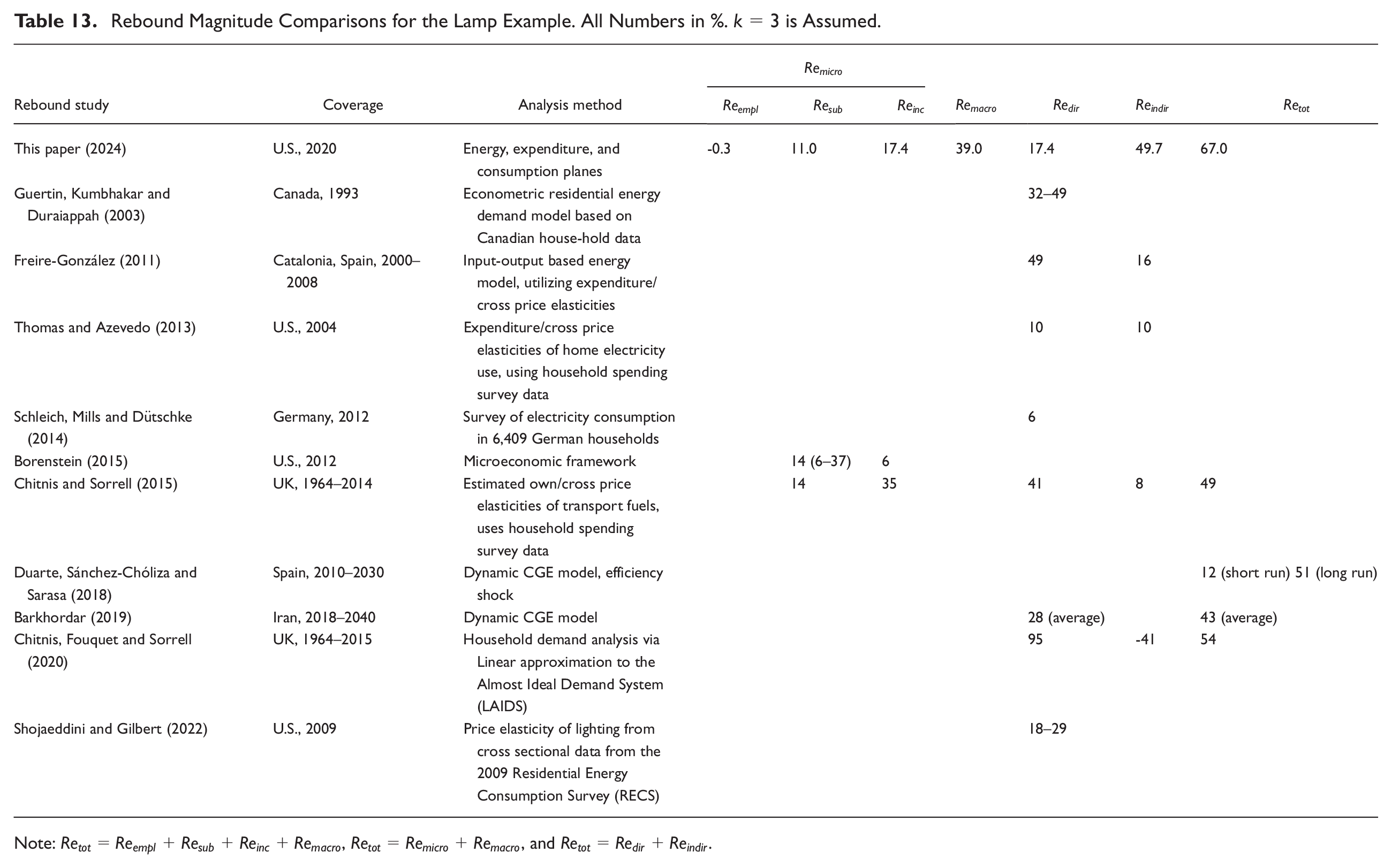
Note:
First, we see that none of the comparison studies report all rebound effects considered in this paper. Also, no previous studies report either emplacement rebound (
We also observe that studies which provide total rebound are based on a top-down calculation of overall, economy-wide rebound, rather than the bottom-up “sum-of-components” approach that we employ. That finding is instructive. It supports the view that a rigorous analysis framework that sets out individual rebound components has been missing, which informed the objective for Part I of this paper. Further, the finding means that comparisons between top-down estimations or calculations of total, economy-wide rebound may also be of limited value, because the rebound effects included or excluded may not be clear, giving an appearance of a “black box” calculation approach. 4
Second, helpful insights can be gained from comparison of rebound magnitudes and calculation methods. Greatest alignment between our values and earlier values appears within the direct (microeconomic) rebound (
For indirect rebound (
For total rebound (
4.4. Sensitivity of Rebound to
The effect of the uncompensated own price elasticity of energy service consumption (
Because the microeconomic portion of this framework is focused on adjustments caused by a single EEU (in this example, replacing a single incandescent lamp with a single LED),
Fouquet and Pearson (2011, Table 3) estimate
To our knowledge, the only study that focuses on single-device rebound and differentiates between “burn time” rebound and “luminosity” rebound is Schleich, Mills and Dütschke (2014). Their methodology to determine burn time rebound relies on surveys and self-reported estimates rather than in-home measurements of the additional burn time per day for an LED lamp compared to an incandescent lamp. Because of this shortcoming, we prefer the value of
Regardless, Schleich, Mills and Dütschke (2014) and Fouquet and Pearson (2011) can be used to assess the sensitivity of total rebound to the value of
Figure 8 shows the univariate sensitivity to
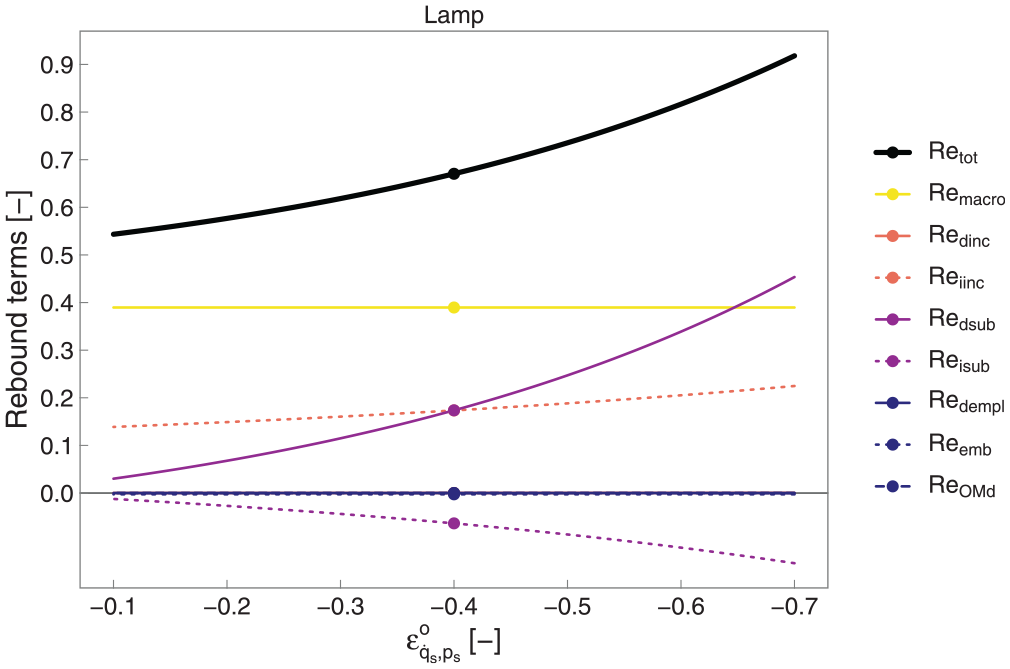
Sensitivity of rebound components to uncompensated own price elasticity of energy service demand (
4.5. Comparison of CES With Satiated and Constant Price Elasticity (CPE) Utility Models
In Section 2.5.3 of Part I, we showed income-effect rebound expressions under the limiting condition of already-satiated consumption of the energy service such that the income expansion path is a vertical line in the consumption plane of Figures 4 and 7. Here, we discuss the numerical impact of the different utility models.
Table 14 compares income-effect rebound under the CES utility model, the bounding condition of satiated consumption of the energy service, and the constant price elasticity (CPE) utility model. 7
Comparison of Substitution Effects (
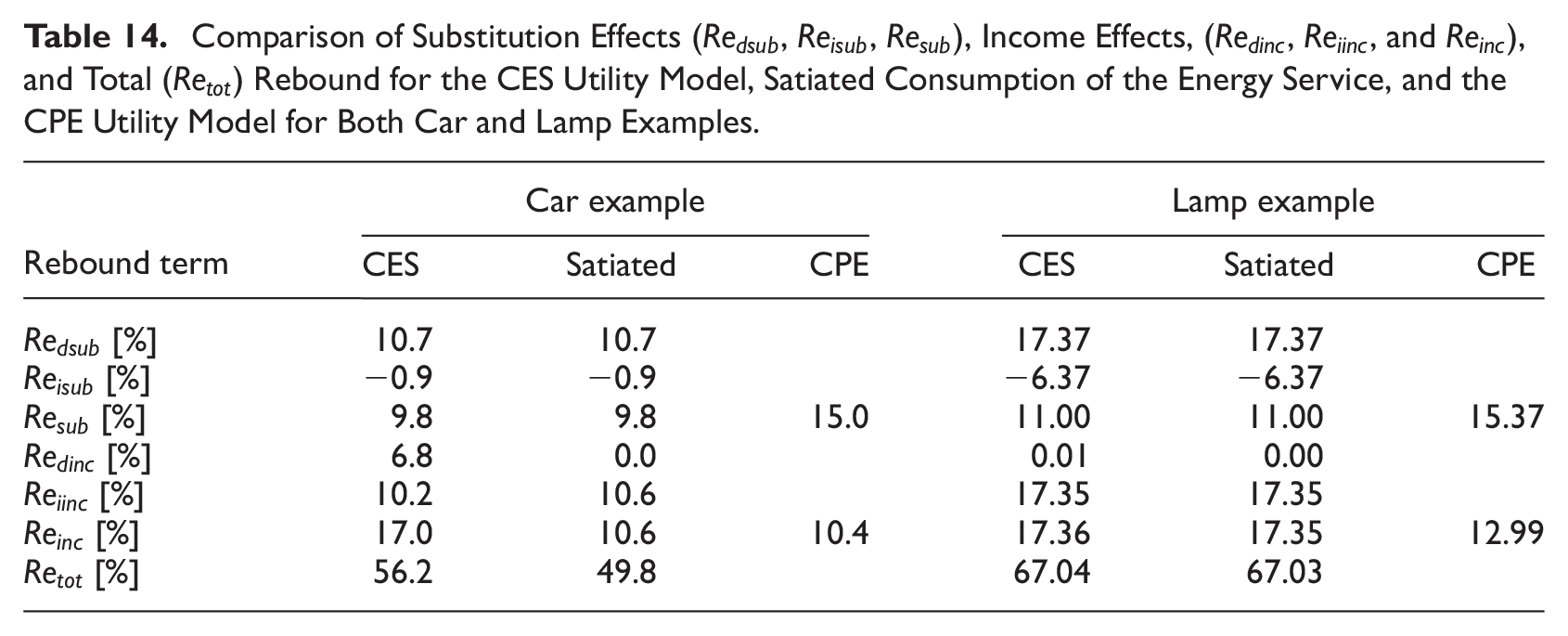
In the car example, income effect rebound (
The reason for the nearly unchanged value for total rebound (
Calculation of substitution rebound under the constant price elasticity (CPE) utility model, which approximates the substitution and income effects using only the uncompensated own price elasticity of energy service consumption (
4.6. Energy Price Rebound
Section 3.2, equation (36), and Appendix F of Part I provide an extension to the framework involving energy price rebound (
To quantify energy price rebound, data are needed for personal consumption (
We also need data for the price elasticity of energy supply (
Parameterizing on the fraction of all devices in the economy that are upgraded (
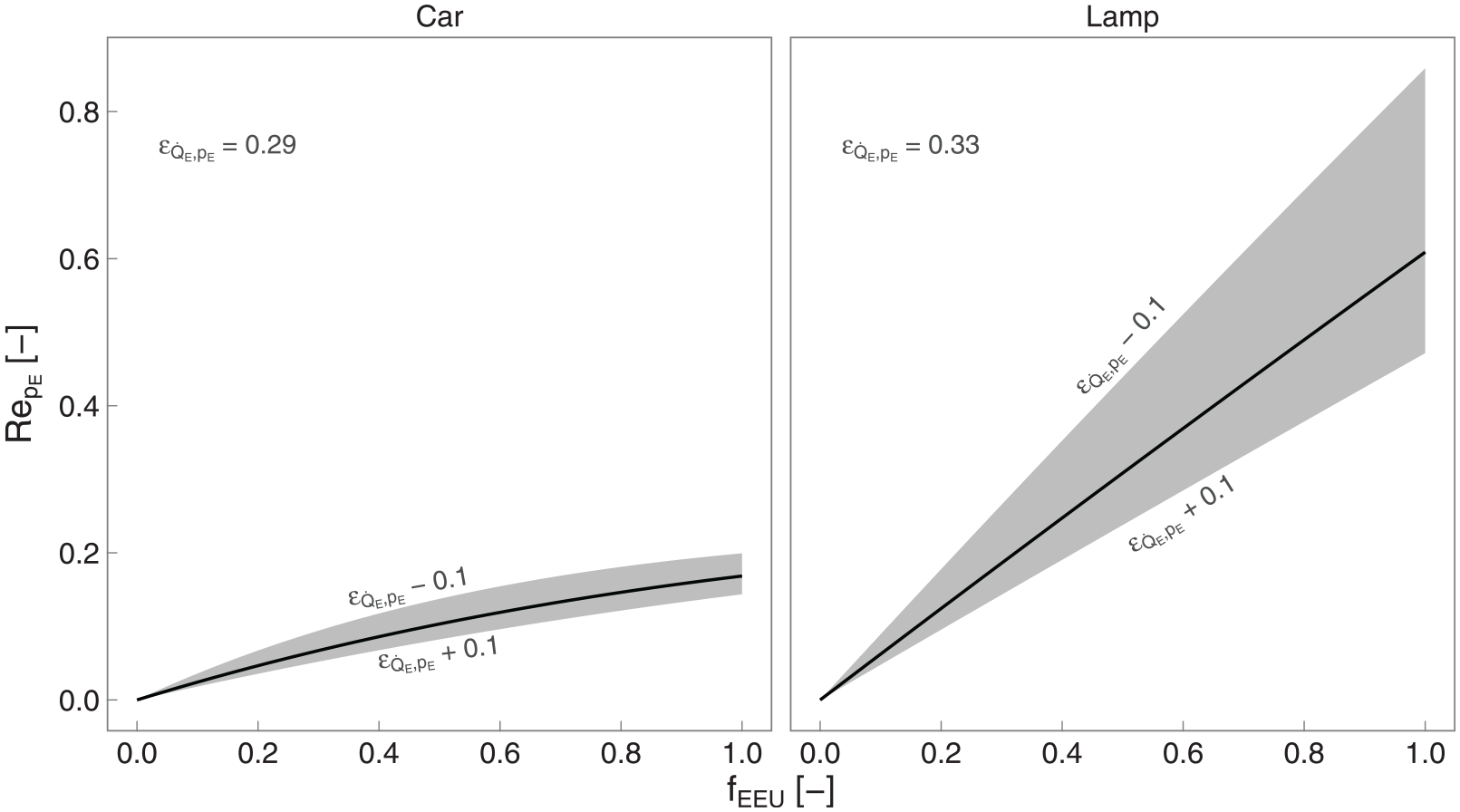
Energy price rebound (
In these examples, the car upgrade yields little additional freed cash beyond the (slightly) cheaper fuel for the car, so there is limited spending on other goods and services and little additional indirect energy demand. In contrast, the upgrade of the electric lamp is much more likely to provide energy price rebound, because electricity for the upgraded lamp is a small fraction of total electricity consumption by the consumer. All electricity purchased by the consumer becomes cheaper when the price of electricity falls due to widespread lamp upgrades throughout the economy, leading to freed cash spent on other goods and services which, themselves, demand energy at the energy intensity of the economy.
At 100% penetration of LED lamps (
5. Conclusions
In this paper (Part II of two), we help to advance clarity in the field of energy rebound by (i) developing mutually consistent and numerically precise visualizations of rebound effects in energy, expenditure, and consumption planes, (ii) operationalizing the macro factor, (iii) documenting in detail new calculations of rebound for car and lighting upgrades, (iv) showing the extensibility of our framework by applying it to estimate energy price rebound, and (v) providing information about new open source software tools for calculating and visualizing rebound for any energy efficiency upgrade. We encourage energy analysts and economists to use visualizations like the energy, expenditure, and consumption planes to document and visualize rebound calculations going forward. Our hope is that additional clarity will (i) narrow the gap between economists and energy analysts, (ii) lead to deeper interdisciplinary understanding of rebound phenomena, and (iii) enable energy and climate policy that takes fuller account of rebound.
From the application of the framework in Part II, we draw two important conclusions. First, the car and lamp examples (Section 3) show that the framework enables quantification of rebound magnitudes at microeconomic and macroeconomic levels, including energy, expenditure, and consumption aspects of direct and indirect rebound for emplacement, substitution, income, and macro effects. Second, the examples show that magnitudes of all rebound effects vary with the type of EEU performed. Thus, values for rebound effects for one EEU should never be assumed to apply to a different EEU, and it is important to calculate the magnitude of all rebound effects for each EEU in each economy.
Further work could be pursued in several areas. (i) Additional empirical studies could be performed to calculate the magnitude of different rebound effects for a variety of real-life EEUs. (ii) Deeper study of macro rebound is needed, including improved determination of the value of the macro factor (
Footnotes
Appendices
Acknowledgements
The authors benefited from discussions with Daniele Girardi (University of Massachusetts Amherst) and Christopher Blackburn (Bureau of Economic Analysis). The authors are grateful for comments from internal reviewers Becky Haney and Jeremy Van Antwerp (Calvin University); Nathan Chan (University of Massachusetts Amherst); and Zeke Marshall (University of Leeds). The authors appreciate the many constructive comments on a working paper version of this article from Jeroen C.J.M. van den Bergh (Vrije Universiteit Amsterdam), Harry Saunders (Carnegie Institution for Science), and David Stern (Australian National University). Finally, the authors thank the students of MKH’s Fall 2019 Thermal Systems Design course (ENGR333) at Calvin University who studied energy rebound for many energy conversion devices using an early version of this framework.
The findings, interpretations, and conclusions expressed in this paper are entirely those of the authors. They do not necessarily represent the views of the International Bank for Reconstruction and Development/World Bank and its affiliated organizations, or those of the Executive Directors of the World Bank or the governments they represent.
Author Contributions
Declaration of Conflicting Interests
The author(s) declared no potential conflicts of interest with respect to the research, authorship, and/or publication of this article.
Funding
The author(s) disclosed receipt of the following financial support for the research, authorship, and/or publication of this article: Paul Brockway’s time was funded by the UK Research and Innovation (UKRI) Council, supported under EPSRC Fellowship award EP/R024251/1.
Data Repository
1
A related, notional-only (not quantified), one-dimensional visualization of direct and indirect energy rebound (but not on expenditure or consumption planes) can be found in Figure 1 of  .
.
2
We exclude the case of an inferior good, whose consumption decreases as real income increases, but we note here the possibility of such behavior. This behavior would however require a different utility model besides the CES utility model, which we use throughout this analysis.
3
Maintenance cost rates for both incandescent and LED lamps are likely to be equal and negligible; lamps are usually installed and forgotten. Real-world disposal cost differences between the incandescent and LED technologies are also likely to be negligible. However, if “disposal” includes recycling processes, cost rates may be different between the two technologies due to the wide variety of materials in LED lamps compared to incandescent lamps.
4
That said, without the top-down approaches, we would have few values to compare with our total rebound (
5
Also worthy of note is that direct (microeconomic) rebound of personal transport may be the most-studied subfield in the rebound literature and likely the only topic with enough studies to enable meta-reviews such as Sorrell, Dimitropoulos and Sommerville (2009), Dimitropoulos, Oueslati and Sintek (2018), and .
7
The constant price elasticity (CPE) utility model in Table 14 follows who holds income constant, not utility, when calculating the substitution effect. Furthermore, Borenstein’s income effect assumes all post-emplacement freed cash (
8
For the car example, the gasoline price in Germany is taken as 1.42 €/liter for the average “super gasoline” (95 octane) price in 2018 (finanzen.net 2021). For the lamp example, the electricity price in Germany is taken as 0.3 €/kWċhr for the 2018 price of a household using 3.5 MWh/yr, an average value for German households (). Converting currency (at 1 € = $1.21) and physical units gives 6.5 $/US gallon and 0.363 $/kWċhr.