




Abstract
Ten head and neck cancer survivors diagnosed with head and neck lymphedema (HNL) were imaged using near-infrared fluorescence lymphatic imaging (NIRFLI) prior to and immediately after an initial advance pneumatic compression device treatment and again after 2 weeks of daily at-home use. Images assessed the impact of pneumatic compression therapy on lymphatic drainage. Facial composite measurement scores assessed reduction/increase in external swelling, and survey results were obtained. After a single pneumatic compression treatment, NIRFLI showed enhanced lymphatic uptake and drainage in all subjects. After 2 weeks of daily treatment, areas of dermal backflow disappeared or were reduced in 6 of 8 subjects presenting with backflow. In general, reductions in facial composite measurement scores tracked with reductions in backflow and subject-reported improvements; however, studies are needed to determine whether longer treatment durations can be impactful and whether advanced pneumatic compression can be used to ameliorate backflow characteristic of HNL.
Keywords
Head and neck lymphedema (HNL) with its associated functional losses1-4 affects as many as 75% of head and neck cancer (HNC) survivors 3 months or more after HNC treatment. 5 Using near-infrared fluorescence lymphatic imaging (NIRFLI), we previously observed persistent lymphatic “dermal backflow” (retrograde lymphatic drainage to initial lymphatics) over the cancer treatment course in patients with HNC, 6 similar to patients with breast cancer–related lymphedema (BCRL).7,8 Lymphedema treatment consists of skin care and complete decongestive therapy (CDT), 9 but unfortunately, HNL is often undiagnosed, and when it is, treatment is often inaccessible. Herein, NIRFLI and anatomic facial and neck measurements 10 were made on 10 HNC survivors to assess the impact of single treatments and 2 weeks of daily treatments using advanced pneumatic compression devices. 11
Study approval was obtained from the Institutional Review Board of the University of Texas Health Science Center at Houston under IND 102,765 for NIRFLI. Subjects ≥18 years of age, diagnosed with HNL, and ≥4 weeks postradiation were recruited and provided written informed consent. After measurements to obtain composite facial and neck scores, 9 intradermal indocyanine green injections (25 µg/0.1 cc saline) were administered fore and aft each ear and bilaterally along the jawline as previously reported. 6 NIRFLI was conducted before and after an initial 32-minute pneumatic compression treatment. Subjects were then provided a pneumatic compression device for home use and asked to complete and document treatments. Cases 1 to 5 completed 1 treatment daily while cases 6 to 10 completed 2 treatments, typically 1 each morning and evening. After 2 weeks, NIRFLI was again conducted before and after treatment. In all cases, composite scores were acquired before and, in cases 5 to 10, after treatment at each imaging session. Subjects completed surveys assessing fit and comfort of the device and treatment. Areas of dermal backflow, observed by NIRFLI, were computed and profilometry measurements acquired as described in the online supplemental material (available in the online version of the article).
Subject demographics, cancer-related history, and study compliance are available in Supplemental Table S1 (in the online version of the article). Table 1 presents percent changes in the area of backflow and composite scores after treatment at each visit and the pretreatment (baseline) measurements from both imaging sessions. No apparent differences were observed between daily and bidaily treatment groups. No adverse events were observed.
Percent Change a in the Area of Dermal Backflow and the Facial and Neck Composite Scores as Measured by Tape Measure.
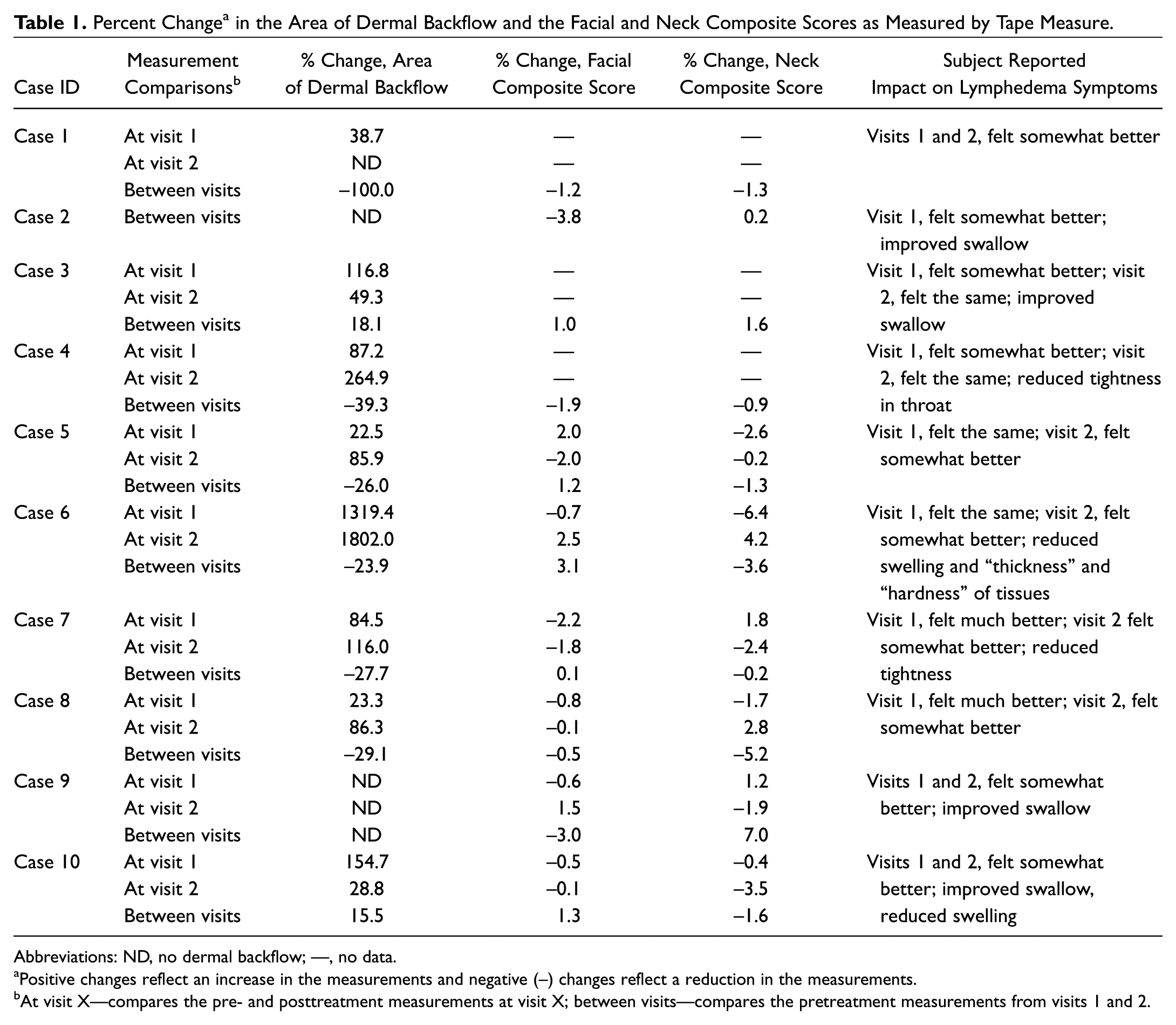
Abbreviations: ND, no dermal backflow; —, no data.
Positive changes reflect an increase in the measurements and negative (–) changes reflect a reduction in the measurements.
At visit X—compares the pre- and posttreatment measurements at visit X; between visits—compares the pretreatment measurements from visits 1 and 2.
Impact of Single Treatment
In all subjects, we observed enhanced lymphatic uptake after single treatments as indicated by more functional lymphatic vessels, drainage to lymph nodes, and/or acute increases in backflow ( Figure 1A-D ), indicating treatment promotes movement of lymph toward functional lymphatics as observed in patients with BCRL 12 and venous stasis ulcers. 13
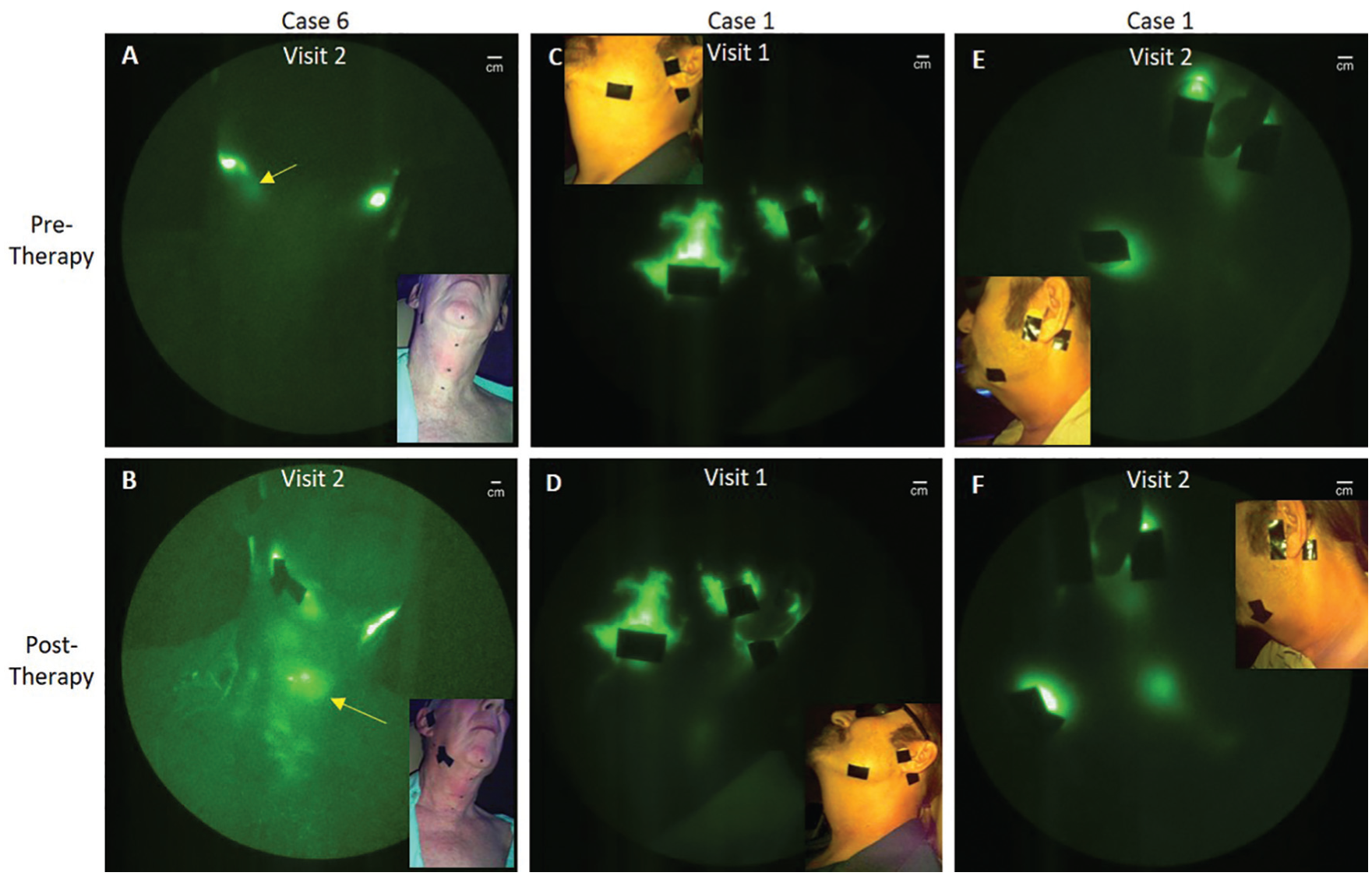
Near-infrared fluorescence lymphatic imaging illustrating (A, B) increased dermal backflow (case 6, visit 2) and (C-F) drainage to lymph nodes (case 1, visits 1-2) after single treatment sessions and (C, E) backflow (case 1) ameliorated by 2 weeks of treatment.
Impact of 2 Weeks of Treatment
Because differences in pretreatment images allow assessment of longitudinal treatments without the acute treatment impact, we compared pretreatment areas of backflow across visits. Taking a 20% difference as the threshold of reportable change, we found longitudinal treatment reduced backflow in 6 subjects and 4 had no change in backflow, with 2 of those subjects never initially presenting with backflow. Backflow did not increase across 2 weeks of treatment in any study subject.
Of the 6 of 8 subjects who presented with backflow and experienced backflow reduction after 2 weeks of treatment, 1 (case 1) had complete resolution of dermal backflow (Figure 1C,E) with facial and neck composite score reductions. Interestingly, active lymphatic propulsion was observed before and after treatment at visit 2 but not visit 1, possibly indicating improved lymphatic function. In case 5, backflow reduced by 26% and active propulsion in a new vessel was observed draining from right to left with another observed pumping cranially toward functional lymphatics ( Figure 2 and Supplemental Video S1, available in the online version of the article). This subject’s first treatment resulted in an increase in facial composite score, while the last treatment resulted in a decrease. Why some composite scores increase immediately after treatment remains unknown, although in this case, it may be attributed to stimulation of the vessel actively pumping fluid upward toward other functional lymphatics.
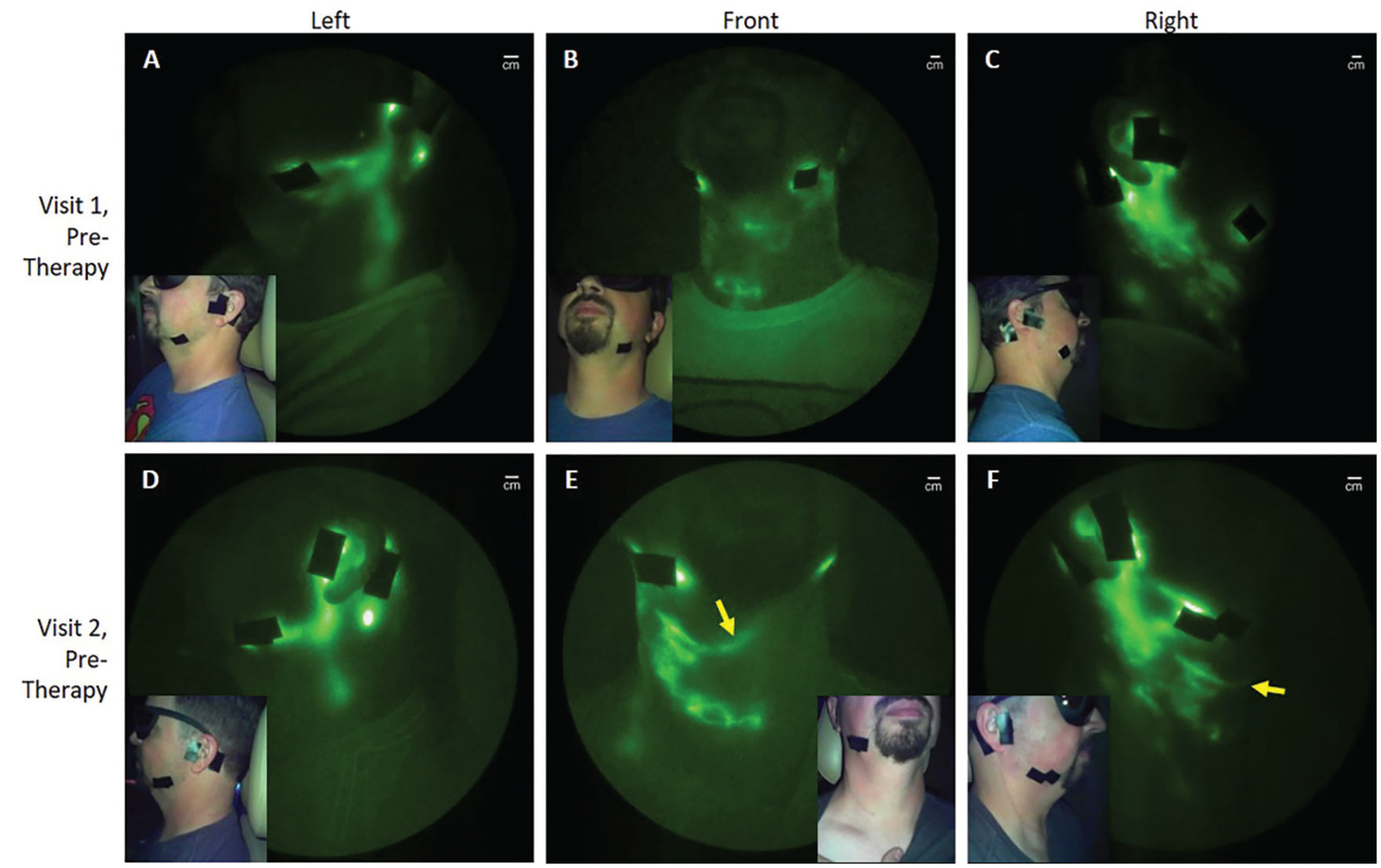
Near-infrared fluorescence lymphatic imaging illustrating case 5’s pretreatment lymphatics at visits 1 (A-C) and 2 (D-F). Better-formed lymphatics are observed (D) along the jawline and (E, F) pumping lymph (arrows) right to left toward healthier vessels.
Case 3 and 10 had no reportable changes in backflow, but both reported improved swallow and/or speech. While these self-reported improvements may be influenced by treatment bias, case 10 reported that, after 3 days of treatment, he regained the ability to swallow liquids without forced nasal drainage, an improvement he directly attributed to the treatment and, which we hypothesize, indicates a reduction in internal swelling not readily assessed by measurements or NIRFLI. The lack of response in case 3 may be a function of the 1.6-year delay between radiation and lymphedema treatment as lymphedema patients with early intervention typically have better outcomes. 14 We hypothesize that continued treatment may result in measurable improvements in both cases.
Two subjects, who did not present with backflow before or after treatment, nonetheless experienced a reduction in the pretreatment composite scores and reported improved swallow function.
Subjective patient reports included being more relaxed, neck softer, voice better, and less swollen, with less fluid in the face and less tightness in throat ( Table 1 ). It may be noteworthy that case 10 reported that the left side of his face felt more swollen after treatment but that he experienced similar feelings after manual lymphatic drainage; however, his facial composite score decreased after treatment.
In conclusion, 2 weeks of advanced pneumatic compression treatment improved self-reported outcomes, stimulated lymphatic function, reduced the area of backflow in 6 of 8 subjects with backflow, and, in 1 case, ameliorated backflow. This latter result may be striking as previous HNL studies demonstrated persistent backflow during months of observation. 6 Future studies evaluating lymphatic response to longer durations of treatment and its durability could definitively determine whether advanced pneumatic compression treatment can ameliorate all backflow and potentially mitigate or prevent HNL.
Author Contributions
Disclosures
Supplemental Material
OTO823180_Supplemental_Material_CLN – Supplemental material for Head and Neck Lymphedema: Treatment Response to Single and Multiple Sessions of Advanced Pneumatic Compression Therapy
Supplemental material, OTO823180_Supplemental_Material_CLN for Head and Neck Lymphedema: Treatment Response to Single and Multiple Sessions of Advanced Pneumatic Compression Therapy by Carolina Gutierrez, Ron J. Karni, Syed Naqvi, Melissa B. Aldrich, Banghe Zhu, J. Rodney Morrow, Eva M. Sevick-Muraca and John C. Rasmussen in Otolaryngology–Head and Neck Surgery
Footnotes
Sponsorships or competing interests that may be relevant to content are disclosed at the end of this article.
Supplemental Material
Additional supporting information is available in the online version of the article.
References
Supplementary Material
Please find the following supplemental material available below.
For Open Access articles published under a Creative Commons License, all supplemental material carries the same license as the article it is associated with.
For non-Open Access articles published, all supplemental material carries a non-exclusive license, and permission requests for re-use of supplemental material or any part of supplemental material shall be sent directly to the copyright owner as specified in the copyright notice associated with the article.
