




Abstract
Although many studies have been conducted on the role of renewable energy in the environment, literature has ignored the potential role of socioeconomic indicators in renewable energy and pollution nexus. Also, critical questions arose with the critical factors, such as income inequality and economic complexity, have not been answered properly. This study explores the nexus between income inequality, economic complexity, renewable energy consumption, GDP per capita, and pollution and thus aims to reach efficient policy strategies by revealing empirical evidence. The study follows an environmental impact model structure and conducts the panel-corrected standard errors and fixed effect regression. BRICS countries (Brazil, Russia, India, China, and South Africa) are selected to conduct our research. Annual data covering the period 1990–2017 for the sample countries are employed. Consumption-based carbon dioxide emissions as an indicator of environmental pollution are used since income inequality makes more sense in terms of the consumption side of an economy and is more related to consumers rather than the production sector. The obtained results reveal that income inequality has a positive and significant impact on consumption-based carbon dioxide emissions. However, GDP per capita, renewable energy, and economic complexity reduce pollution. It is also observed that the interaction term of inequality and renewable energy decreases emissions. Findings confirm that socioeconomic indicators, such as economic complexity and income inequality with the interaction of renewable energy, are crucial factors in reducing emissions and designing a greener future.
Keywords
A Short Informative Containing the Major Keywords
• Explores the nexus between income inequality, economic complexity, renewable energy, and pollution. • The panel corrected standard errors (PCSEs) and fixed effect estimators are employed. • Renewable energy and economic complexity reduce pollution. • Income inequality significantly increases consumption-based CO2 emissions.
Introduction
The growing environmental crisis has now become a major issue in the global debate. Environmental issues are increasingly putting significant pressure on individuals, governments, and policymakers. Clean energy sources, including renewable energy, have become a strategic choice due to higher greenhouse gas emissions (GHG) caused by fossil-based energy sources (Uzar, 2020b). Renewable energy promotion is among the key goals of climate policy. As renewable energy is one of the most feasible options to reduce carbon dioxide (CO2) emissions, it has become a significant part of energy policy to achieve sustainable development (Danish and Ulucak, 2020). Thus, promoting investment in renewable energy projects contributes to the effort of climate change mitigation (Sarkodie et al., 2020), and clean energy adaptation is getting great importance in the discussion of climate change mitigation (Bourcet, 2020). Even though renewable energy mainly contributes to climate change mitigation, its implications have certain limitations (Seetharaman Moorthy et al., 2019; Solangi et al., 2021).
Policymakers focus on the role of income inequalities while shaping policies for renewable energy transition and should be dynamic in policymaking, especially given the channels through which income inequalities operate (Awaworyi et al., 2021). Consequently, policies that ignore the effects of renewable energy consumption are likely to fall short of targets for reducing income inequality (Topcu & Tugcu, 2020). However, it should also be noted that policies aimed at decreasing income inequalities should not be extended due to the irregular response of the sample countries regarding initial levels of renewable energy consumption. Basically, the preventive role of inequalities diminishes through the growing importance of renewable energy consumption. In essence, the preventive role of inequalities diminishes with the increasing importance of renewable energy consumption. Therefore, it would be helpful for policymakers to understand, before implementing relevant policies, why inequality is a necessary but insufficient policy concern for countries in the top distribution of renewable energy consumption (Asongu & Odhiambo, 2021). Since income inequality affects the consumption habits of inhabitants and producers’ production, it may take some time before having an impact on the energy structure and polluting emissions. Therefore, the income inequality-pollution relationship can change eventually (Liu et al., 2019). The only solution to this trade-off is when the higher incomes of the poorer population groups do not turn into higher emissions, for example, by ensuring that their higher energy requirements are mainly encountered by renewable energy technologies (Grunewald et al., 2017). Consequently, income inequality presents massive hurdles to implementing effective clean energy strategies to accomplish a more sustainable environment.
On the other hand, economic complexity has attracted great attention to analyzing the role of production patterns in designing new strategies to achieve goals for sustainability (Balsalobre-Lorente et al., 2022; Doğan et al., 2022) since it refers to the diversity, sophistication, and interconnectedness of a country’s productive capabilities (Minondo and Requena Silvente 2013). It measures the range of goods and services a country is capable of producing and the complexity of the production processes involved and can be a tool for analyzing a country’s competitiveness and potential for economic growth (Khezri et al., 2022). The concept emphasizes the importance of having a diverse and complex economy for long-term sustainable growth, as well as the role of technology, education, and innovation in shaping economic complexity (Balland et al., 2022). Since economic complexity is defined as the number and diversity of productive capabilities within an economy, it has been shown to be positively correlated with sustainable development. Because complex economies are more resilient to economic shocks and are better equipped to adapt to changing circumstances, they will be stronger in the long term with their elasticity of elasticity against business cycles. Additionally, greater economic complexity is often associated with higher levels of technological innovation, which can lead to more efficient use of resources and reduced negative impacts on the environment. However, it is essential to note that simply having a more complex economy is not enough to ensure sustainable development. Other factors, such as income inequality, use of renewables, and consumption patterns, also play critical roles.
Despite the crucial role of income inequality and economic complexity, the available literature has rarely investigated their role in controlling pollution and considered production-based carbon dioxide (CO2) emissions. Also, the potential role of those variables has been ignored so far from the point of consumption-based carbon dioxide emissions (CBCO2), which are adjusted for international trade. Because there are concerns that developed countries might reduce pollution by shifting carbon emissions via international trade to the origin countries that produce products (Safi et al., 2021). More importantly, consumption-based carbon dioxide emissions make more sense in terms of the consumption side of an economy and are more related to consumers rather than the production sector. Income inequality is also an essential driver of energy poverty, a multi-dimensional sustainability issue that triggers improper material use with more pollution for heating and other basic needs (Ulucak et al., 2021). Previously, attention has been paid to the direct emission of CO2 emitted by each country. However, somewhat little emphasis has been placed on CO2 emitted from each country’s consumption. CBCO2 emissions vary from traditional, production (inventory)-based CO2 emissions and help consider the potential for international carbon leakage (Franzen & Mader, 2018). The distinctions in the consumption level across different income groups and income inequality generate differences in the effects of income inequality on the consumption-based GHG emissions level (Baležentis et al., 2020).
Recently, CBCO2 has been used as a measure of environmental degradation rather than conventional CO2 emissions (Baležentis et al., 2020; Hasanov et al., 2018; He et al., 2021; Khan et al., 2020; Liddle, 2018), as it is often found in the literature. Recent literature also has raised the importance of income inequality in pollution reduction concerning climate change. However, earlier work has ignored empirical investigation regarding the potential impact of renewable energy on CBCO2 emissions taking income inequality into account. Furthermore, previous work on the inequality-pollution relationship either provided theoretical analysis or empirical analysis, considering only territorial or production-based carbon dioxide emissions (Liobikienė, 2020). Hence following Liobikienė (2020), the current study focuses on the impact of income inequality on CBCO2 emissions for BRICS countries (Brazil, Russia, India, China, and South Africa) by employing economic complexity, renewable energy, and per capita GDP.
The study offers several contributions to the extended body of knowledge. This paper presents the first empirical inquiry that focuses on the effect of renewable energy on CBCO2 emissions, considering the role of income inequality. The study extends the work of Baležentis et al. (2020) through the inclusion of renewable energy and economic complexity as significant determinants of CBCO2 emissions. Second, this study introduces the interaction effect of income inequality and renewable energy on CBCO2 emissions. The findings would provide a better direction for decision-makers in designing energy and environmental policies. Last, this study applies the panel-corrected standard errors and panel-fixed effects (FE) regression methods, which can provide reliable output to better understand the investigated case in a panel sample of BRICS countries.
Literature Review
Renewable Energy-Pollution Nexus
A growing number of studies have discussed the renewable energy-pollution nexus. The extensive literature on the RE-CO2 nexus comprises studies covering periods as far back as 1960. Most authors argue that renewable energy decreases environmental pollution (see Bélaïd & Youssef, 2017; Danish et al., 2020; Danish and Ulucak, 2020; Rasoulinezhad & Saboori, 2018). For various regions and panels of countries, authors have identified renewable energy helps improve environmental quality. For instance, Vural (2020) for Sub-Saharan African countries; Shahnazi and Dehghan Shabani (2021) for European Union countries; Wang et al. (2020) in the Next-11 countries; Saidi and Omri (2020) in major renewables-consuming countries. On the other hand, some studies have found a positive relationship between renewable energy and CO2 emissions. For example, authors, including Bulut (2017), reveal that renewables worsen the environment in Turkey; Mert (2014), for the case of 16 European Union countries. Some other studies have obtained an insignificant role of renewable energy in environmental degradation (Al-Mulali et al., 2016; Pata, 2018; Pata and Caglar, 2021). Although some empirical findings have revealed insignificant or boosting impact of renewable energy, it is expected to decrease CO2 emissions and hypothesized such that empirically:
Renewable energy decreases CBCO2 emissions.
Inequality-Pollution Nexus
Higher-income inequality causes pollution since marginalized citizens in an unequal society accept a higher level of pollution. This hypothesis brings to the public by Boyce (1994), who imitates the idea that unequal wealth distribution causes environmental deterioration. Several empirical studies have tested this hypothesis and developed the opposite opinion (Boyce, 1994). Scruggs (1998) found income equality contributes to pollution. In another study, Torras and Boyce (1998) linked the environmental impact of inequality with various kinds of pollutants, a country’s income, education, and institutional quality. Many studies have focused on income inequality and the CO2 emissions relationship and produced mixed results. Some studies have reported income inequality contributes to pollution, for instance, Baloch et al. (2020) for Sub-Saharan African countries; Uzar and Eyuboglu (2019) for Turkey; Chen et al. (2020) for G-20 countries; Zhang and Zhao (2014) for regions of China; Liu et al. (2019) for provinces in China; Wu and Xie (2020) in OECD countries and high-income non-OECD countries; and Mahalik et al. (2018) in Brazil, India, and China. Some studies have highlighted the negative impact of income inequality on pollution, including Liu et al. (2019) for the United States. Further, Wolde-Rufael and Idowu (2017) found an insignificant relationship between income inequality and carbon emission in China and India. Similar results were found by Knight et al. (2017) for high-income countries. Further, Kusumawardani and Dewi (2020) concluded the negative effect of income inequality on carbon emissions. However, an increase in income with rising income inequality increases carbon emissions in Indonesia. Hailemariam et al. (2020) argued that the increase in top-income inequality contributes to carbon emissions, but the rise in the Gini index reduces carbon emissions. Similar results were found by Jorgenson et al. (2017) for the US state-level analysis. In concluding remarks, it is hypothesized that:
Income inequality increases CBCO2 emissions.
Economic Complexity-Pollution Nexus
Economic complexity represents the knowledge and skills required to produce exported goods and measures economic development (Chu, 2020). Several studies have considered the effect of economic complexity on environmental pollution. In this regard, Pata (2021) indicated that an increase in economic complexity reduces environmental degradation in the USA; similar results were found by Can and Gozgor (2017) for France. Further, Doğan et al. (2020) estimated the positive role of economic complexity in reducing pollution in OECD countries. In contrast, Shahzad et al. (2021) concluded the detrimental impact of economic complexity on environmental degradation in the United States. However, Yilanci (2020) illustrated that economic complexity increasingly impacts environmental degradation in China. Recently, Tauseef Hassan et al. (2022) concluded a positive relationship between economic complexity and ecological degradation in the United States. Hence it is hypothesized that:
Economic complexity increases/decreases CBCO2 emissions. Based on the above-mentioned literature, the investigation of socioeconomic determinants of environmental pollution has gotten immense attention in recent years. As can be seen, literature has discussed the energy-emissions nexus and inequality-emissions nexus. However, the impact of economic complexity and income inequality on CBCO2 emissions has not been explored yet by considering the role of renewable energy. This study, therefore, investigates the role of renewable energy, income inequality, economic complexity, and per capita GDP on CBCO2 emissions.
Material and Methods
Data
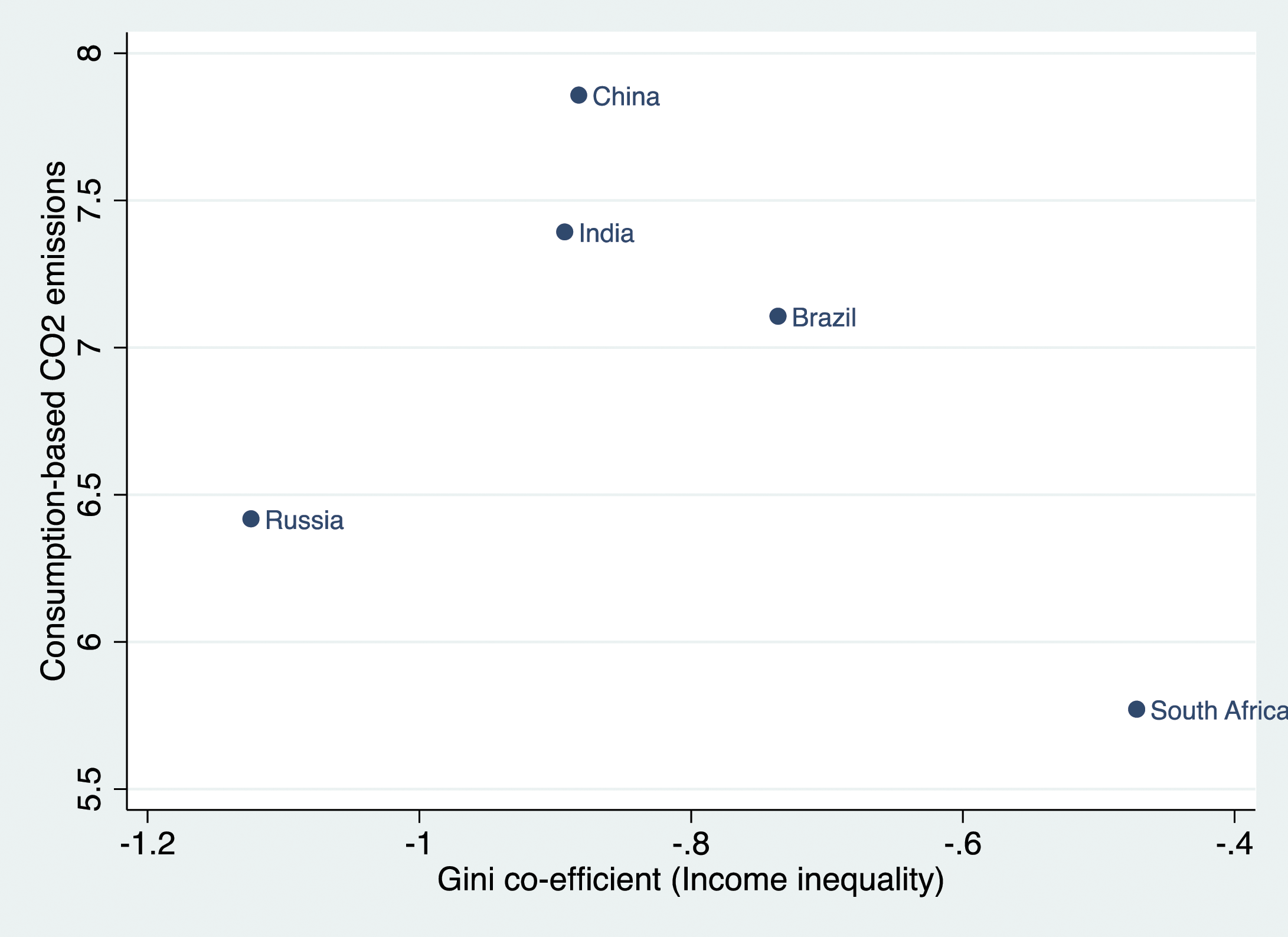
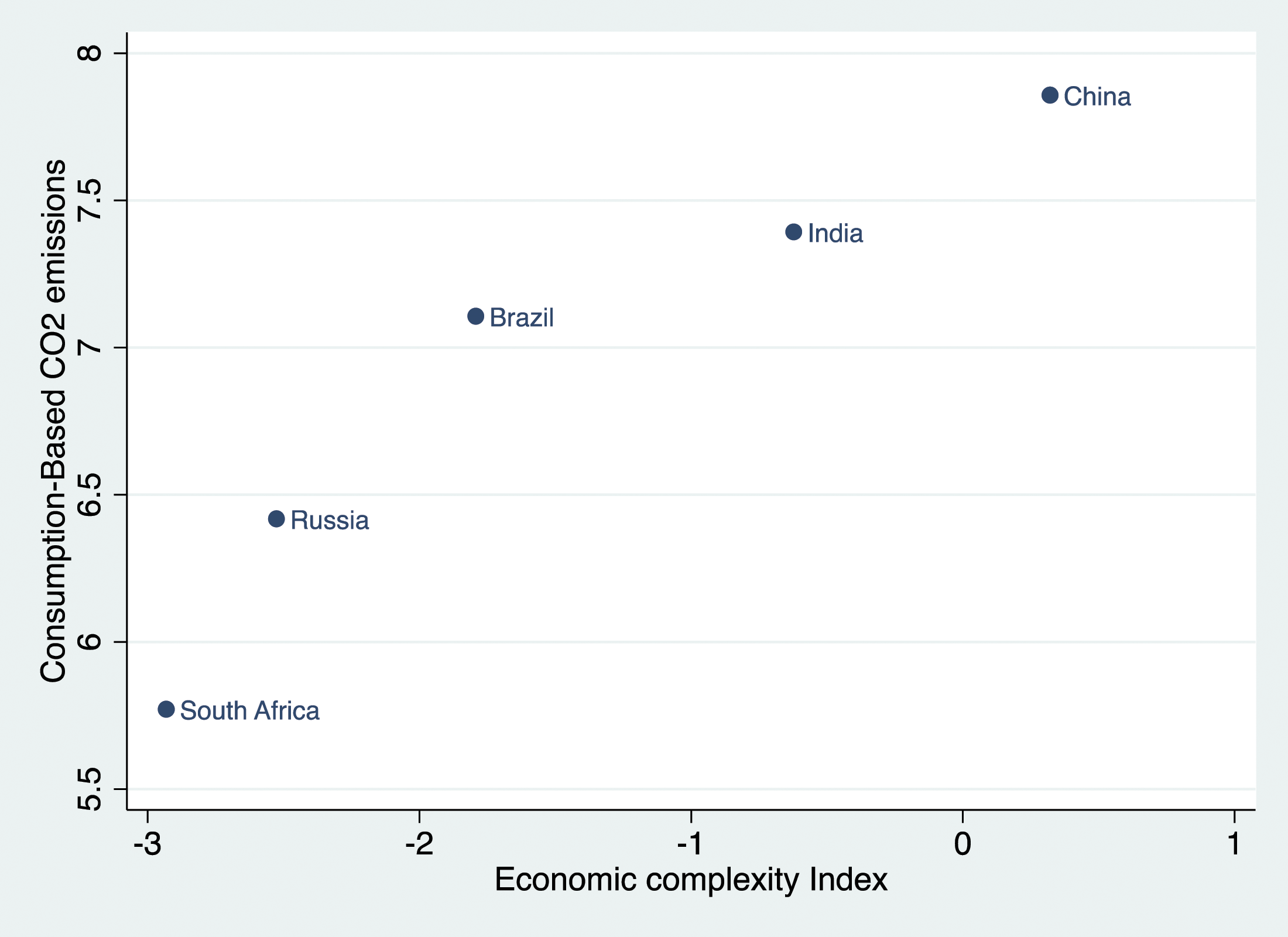
In the empirical estimation, a panel data sample consisting of BRICS countries is employed in the study with annual data covering the period 1990–2017. Both selections of countries and time depend on the data availability. The dependent variable is consumption-based CO2 emissions as an indicator of environmental quality. Independent variables are income inequality, economic complexity, per capita GDP, and renewable energy consumption. Inequality indicates the economic, well-being, or income differences among individuals in a group, groups in a population, or countries. The data on renewable energy (nuclear, hydropower, solar, and others) were retrieved from the International Energy Agency (IEA). Data on per capita GDP (constant 2010 U.S. dollar) and the Gini coefficient as a proxy of income inequality were retrieved from the World Bank Development Indicator (WDI). Economic complexity is an indicator of the level of knowledge and skills required to produce goods and services (Romero & Gramkow, 2021), and it was collected from the database of Atlas of Economic Complexity (https://atlas.cid.harvard.edu/). The trend in the data series across BRICS countries is shown in Figure 1. Further, the relationship between the Gini coefficient and CBCO2 and the economic complexity index and CBCO2 are visually drawn in Figure 2 and Figure 3, respectively. The trend of data series in BRICS countries. Relationship between income inequality, and consumption-based carbon emission across BRICS countries in 2018. Relationship between economic complexity, and consumption-based carbon emission across BRICS countries in 2018.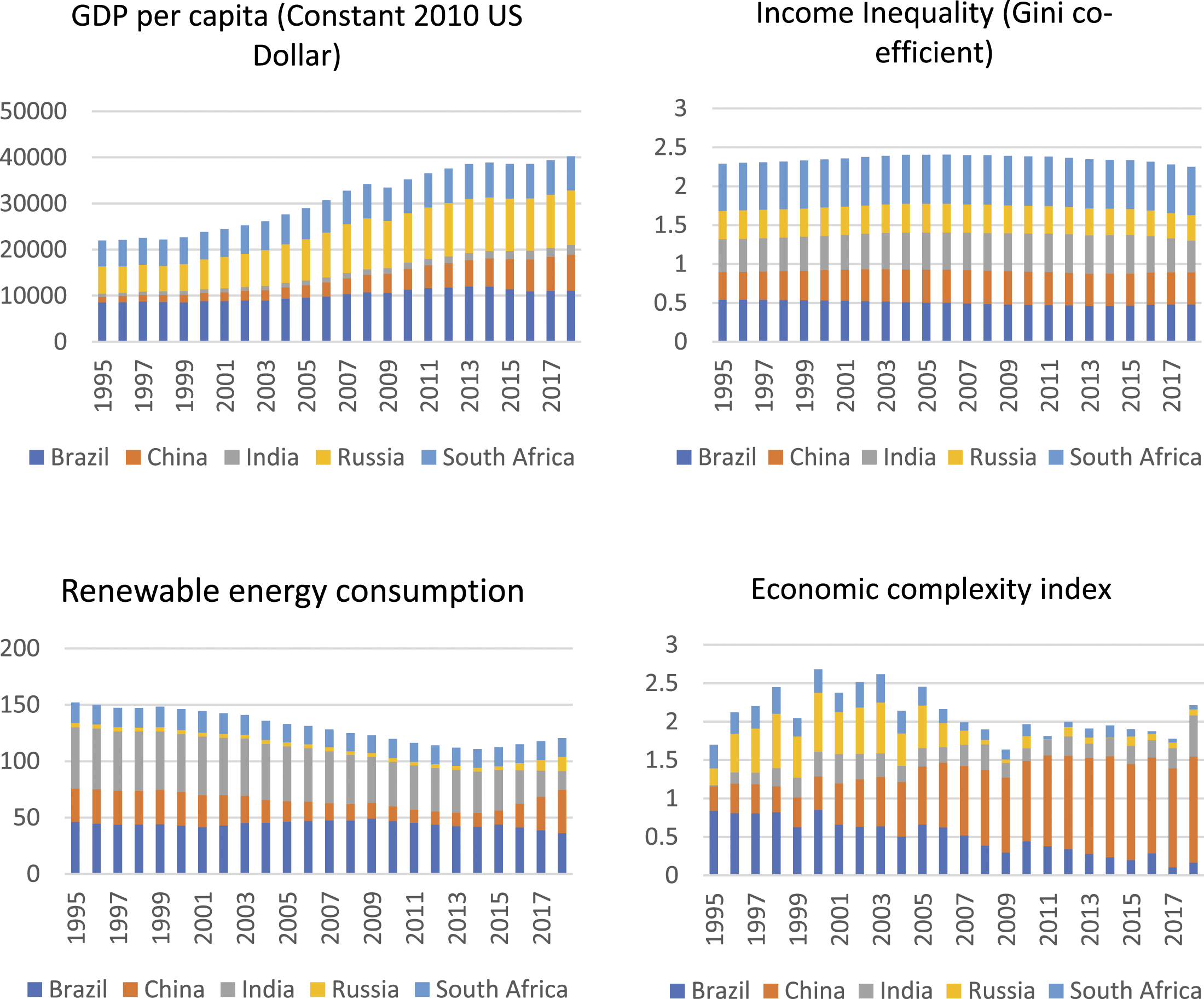
Theoretical Framework
Two theoretical approaches can explain the effect of income inequalities on CBCO2 emissions. The first approach is known as the “Veblen effect” which can be determined by changes in working time.
Concerning the Veblen effect, in countries with high-income inequality, individuals work harder to copy people’s lifestyles of those with higher status (Chancel et al., 2018). Meanwhile, increasing working hours also helps to stimulate economic growth and consumption, which affects pollution levels (Jorgenson et al., 2017). In a consumer society, people work harder to buy more and maintain their image. Veblen (1934) assumed that people from different walks of life compare their lifestyles to other people of the upper class and imitate the way they are used. In particular, it is observed in unequal societies. Further, rich people or higher-income group tends to consume a large number of goods and services (Grunewald et al., 2017; Hill et al., 2019) and consequently cause environmental degradation (Wolde-Rufael & Idowu, 2017).
The second approach combines the “Veblen effect” and the theory of marginal propensity to emit (MPE) and refers to the economic pattern of a household’s level of consumption (Liobikienė, 2020). According to Jorgenson et al. (2017), patterns and levels of consumption are among the factors determining the MPE. The influence of income inequality on pollution (positive or negative) relates to the MPE for the poor and the rich. If the MPE for the poor exceeds the rich’s, assuming the riches are a smaller share of society, growing income inequality contributes to reducing the pollution level (Q. Liu et al., 2019). At the same time, if the MPE of rich people is greater than poor individuals, the widening of the income gap contributes to the pollution level. Therefore, the redistribution of income from rich communities to poor communities may help reduce CBCO2 emissions. As a result, two goals—reducing inequalities and reducing climate change—can be achieved simultaneously (Grunewald et al., 2012).
Following the prevailing literature applications for the role of socioeconomic variables on environmental degradation, the present investigation constructed the model in equation (1)

Econometric Strategy
This paper relies on panel data regression tools, starting with the panel corrected standard errors (PCSE) models and panel fixed effects (Panel FE) regression estimators. The ordinary least square (OLS) estimations are not appropriate in the case of heteroscedasticity because disturbances have different variances, which disrupts the supposition of spherical disturbances in conventional models. The FE method tolerates alleviating heterogeneity across countries and handles the multicollinearity issue between independent variables (Wooldridge, 2002). Moreover, the PCSE model, developed by Beck & Katz (1995), comprehensively allocates heteroskedasticity and serial correlation across panels and within panels, respectively, by identifying a heteroskedasticity error structure and integrating a one-lag autoregressive, AR (1), error structure within panels. The PCSE generates efficient and unbiased results while controlling the heteroscedasticity and autocorrelation issues. For model estimation, this paper takes the natural logarithm of data series to eliminate data fluctuations and multicollinearity. Another advantage is better-estimated coefficient interpretation in terms of changes in those variables.
Results and Discussions
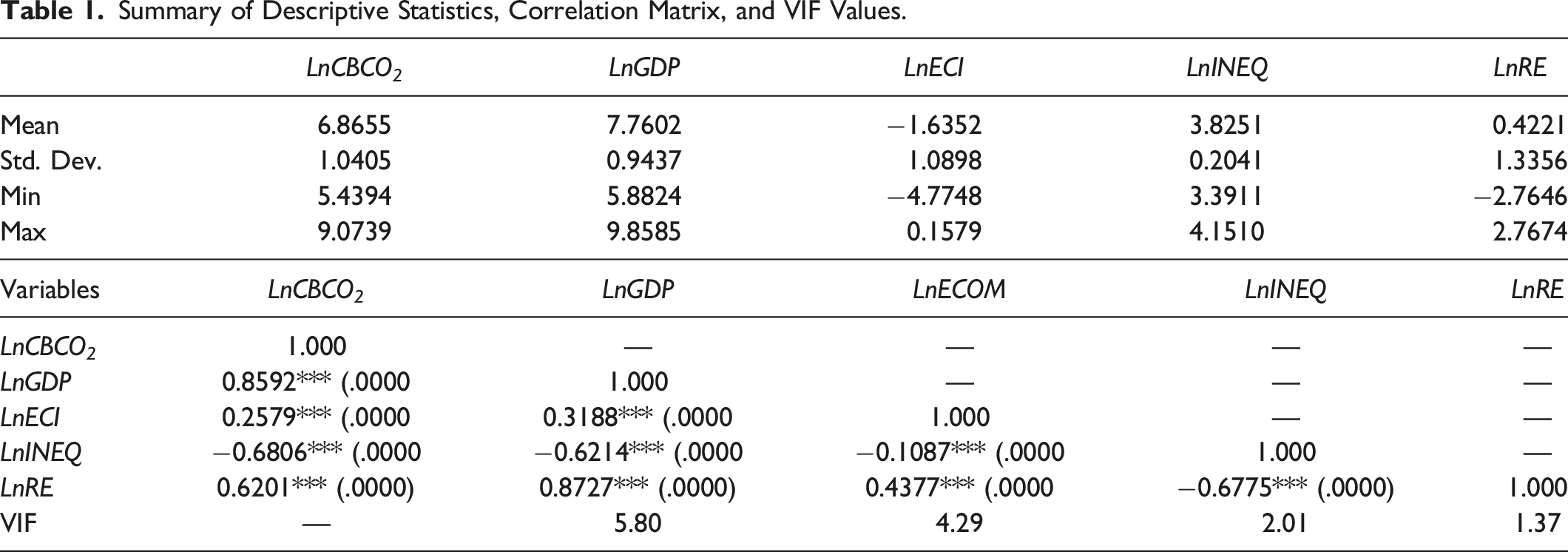
Summary of Descriptive Statistics, Correlation Matrix, and VIF Values.
Regression Estimates.
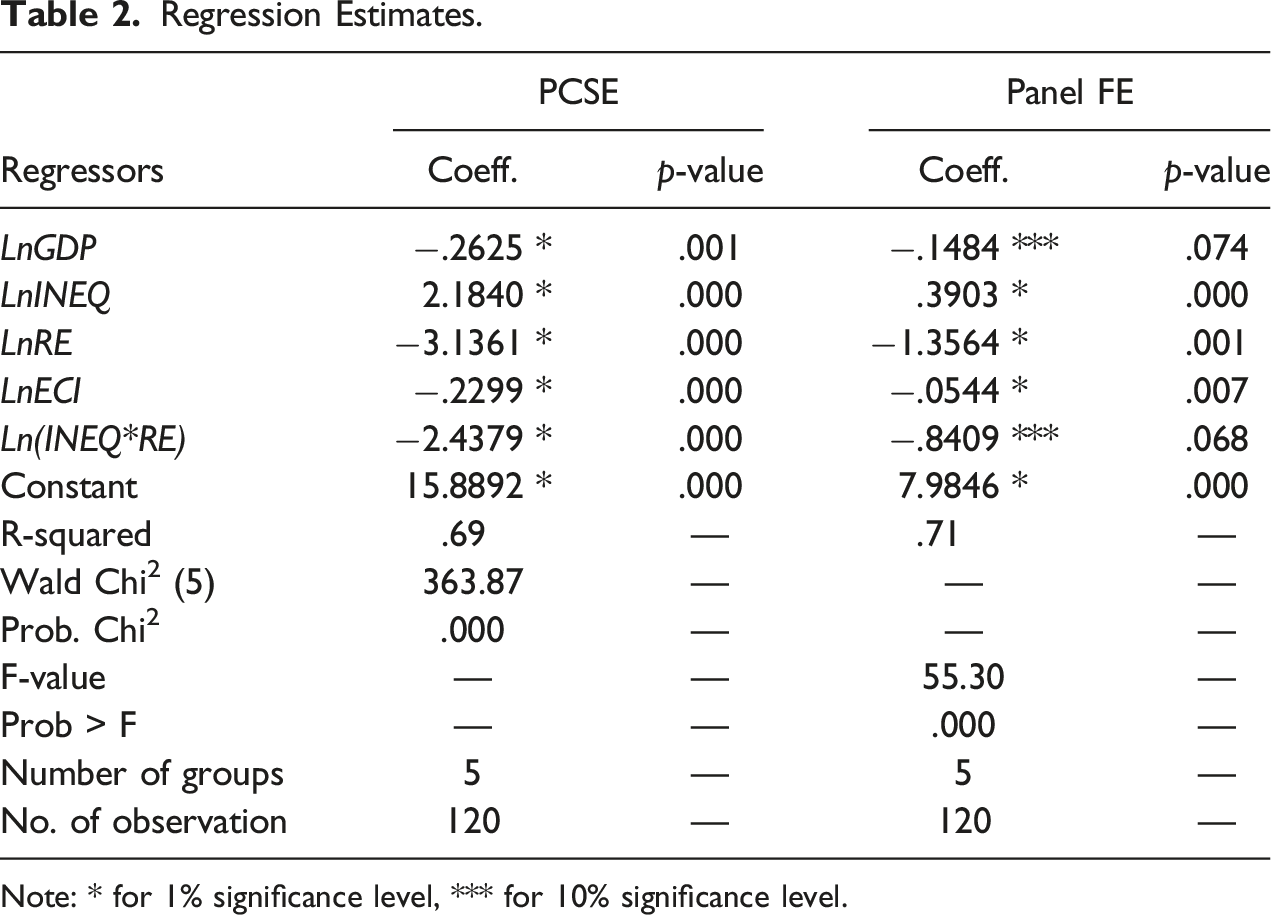
Note: * for 1% significance level, *** for 10% significance level.
From the empirical estimation, it is evident that ‘per capita GDP’ contribute to decreasing CBCO2 emissions. It is an interesting finding because GDP rise requires more production and consumption that surge material usage and pollution. However, this result can also be explained by the theoretical underpinnings of the environmental Kuznets curve (see Grossman & Krueger, 1995). According to the composition and technique effects, the expanding share of the service sector in economies would be helpful to decrease environmental degradation since it is not a dirty sector as much as the industrial sector is. Another idea is that productivity rises through learning by doing over time and technological development enables economies to produce goods and services by employing less material as well as emitting less CO2 emission. So, similar findings are widely available in the literature, and they are explained and justified by structural and technological change in economies. One critical note here is that the environmental Kuznets curve hypothesis is commonly investigated by following a quadratic model structure that includes the square term of GDP but the quadratic model structure is criticized because of possible collinearity, multicollinearity, and weak identification problems in econometric estimations (Wagner, 2015; Bernard et al., 2015; Narayan and Narayan 2010). Besides, this result can be related to rising awareness and demand for a clean environment in line with the income rise as discussed by Beckerman (1992), Roca (2003), and Dinda (2004).
Renewable energy is negatively linked with CBCO2 emissions. Renewable energy consumption reduces CBCO2 in the long run, and these results are supported by Ding et al. (2021) and Khan et al. (2020). The positive role of renewable energy is attributed with that renewable energy technology exploits pure and cleaner energy sources that are sustainable and accomplish the current and future needs; thus, it is the source of lower CBCO2 emissions. Renewables have prodigious market potential and are more profitable as well. The development of renewable energies provides energy security, supports economic growth, and reduces poverty. Given the constructive role of renewables in reducing pollution, the continued increase in carbon emissions in the BRICS can be reduced by shifting from non-renewable energy to renewable energy sources. The production of renewable energy leads to lower costs and can also cause fewer external costs, which means less pollution (Alam & Murad, 2020). The BRICS countries contribute to environmental quality through the adaptation of the clean energy process (Balsalobre-Lorente et al., 2019).
According to the estimation results, economic complexity also reduces CBCO2 emissions in line with the expectation that economic complexity would increase the efficiency of energy use and reduce the emission since such a system with efficient productivity based on skill and knowledge can be helpful to decrease pollution (Gozgor & Demir, 2017). Countries with higher economic complexity can produce more productive products. Also, sample countries in this study have a high level of knowledge and skills required to produce exported goods that is helpful in the mitigation of CBCO2 emissions. BRICS countries are discussed they updated their economic structure by replacing technological infrastructure considerably and they are expected to benefit from greener production and a clean environment (Sun et al., 2022, Peng et al., 2022). The empirical findings are quite exciting since most BRICS countries use high-tech machinery and equipment that are more environmentally friendly compared to many other countries with middle-income levels. Besides, efficient operation of the economic complexity helps the country to get the status of the circular economy when the stakeholders apprehend the possible financial advantages, social inequities, waste reduction, decreased environmental load, and material reuse. All people in societies including businesses, farmers, the environment, and others, benefit from a circular economy. Similar findings confirming the positive role of economic complexity can be found in the literature for Asian countries (Liu et al. 2022), G7 countries (Ghosh et al., 2022), regional comprehensive economic partnership (RCEP) countries (Bashir et al., 2022), and 20 emerging economies (Ahmad et al., 2021).
It is worth mentioning that earlier studies have focused on total CO2 emissions but this study relates to CBCO2 emissions. According to the results of the study, income inequality has a positive impact on CBCO2 emissions, which means more inequality leads to more environmental pollution. Income inequality and air pollution are closely related issues that often have a mutual reinforcement effect. It is discussed in the literature that communities with lower income levels are more likely to be exposed to higher levels of air pollution compared to wealthier communities. This is due to a variety of factors, such as the disproportionate placement of polluting industries and infrastructure in low-income areas, the lack of political power to advocate for better environmental protections, and the inability to afford to live in areas with lower pollution levels (Baloch et al., 2020). Our results confirm that BRICS countries can also deal with environmental pollution by decreasing income inequality as well as being able to get socioeconomic development and welfare increases. On the other hand, although it is beyond this present research, environmental degradation can exacerbate income inequality by limiting opportunities for economic growth and mobility, as well as increasing costs for things like health care and housing. This can create a cycle where low-income communities are trapped in a cycle of poverty and environmental degradation while wealthier communities enjoy the better ecological quality and improved health outcomes. Addressing both income inequality and environmental pollution requires a multi-faceted approach that considers the interconnections between these issues. This can include policies and programs that promote environmental justice and equitable distribution of environmental benefits and burdens, as well as investments in clean energy and sustainable infrastructure that can create good jobs and improve public health for all communities.
It is important to note that this study used an interaction term to observe the effect of income inequality and renewable energy on CBCO2 emissions. The interaction effect of renewable energy and income inequality has a moderating impact on carbon emissions. It means the power of renewable energy changes the adverse effect of income inequality on CO2 emissions. The transition to renewable energy has the potential to both address income inequality and promote economic growth. Renewable energy technologies, such as wind and solar, are becoming increasingly cost-competitive with traditional fossil fuels, and the growth of the renewable energy industry has created many new jobs in manufacturing, installation, and maintenance. To ensure that the transition to renewable energy is equitable and inclusive, it is essential to adopt policies and programs that promote environmental justice and equitable access to the benefits of renewable energy, such as job training and career opportunities, investment in low-income communities, and community-led renewable energy development initiatives. By doing so, the transition to renewable energy can help to address income inequality and create a more sustainable and equitable energy future for all. Reducing income inequality can raise ecological awareness by decreasing personal concerns about the economy. Ecological issues increase the demand for environmental quality. As income distribution is more equitable, individual reductions and raising collective awareness can be the key reason for encouraging renewable energy consumption. Considering the individual demand for environmental quality, the government can promote investment in renewable energy through tax concessions and credit facilities. Furthermore, the unfair distribution of income causes a decline in the allocation of the budget for the distribution of renewable energy production (Uzar, 2020a). On the other hand, higher inequality may hinder the deployment of renewable energy through social norms, including individualism, consumerism, and short-termism (Awaworyi et al., 2021). Lack of social cohesion and collection action itself creates inequalities. In such societies, there is a lack of environmental sensitivity and rent-seeking behavior, and people use a large number of non-renewable environmental resources to meet their needs (Boyce, 1994; Laurent, 2015). Also, in such communities, people preferred short-term benefits (Berthe & Elie, 2015) instead of the long-term effects of current consumer activities (Uzar, 2020a). Overall, our finding suggests that income inequality matters in fighting environmental problems in BRICS countries, and renewable energy is one of the key tools to change the adverse effect of inequality on the environment.
Conclusion
Although earlier studies have examined the connection between income inequality and the environment considering production-based CO2 emissions as the traditional measure for environmental pollution, the potential role of renewable energy consumption in CBCO2 emissions in the significance of income inequality has been neglected. So, it has not been studied yet whether income inequality interacting with renewable energy plays a moderating role in CBCO2 emissions. This study aimed to investigate the potential role of economic complexity, income inequality, and renewable energy in CBCO2 emissions for the panel of BRICS countries. To this end, PCSE and panel fixed effect estimators were performed. The key findings are (i) income inequality has a positive and statistically significant impact on CBCO2 emissions, which means more inequality, more emissions. (ii) Per capita GDP, renewable energy consumption, and economic complexity reduce pollution. (iii) The interaction effect of inequality and renewable energy reduces environmental pollution.
Important policy implications can be directed according to the finding of the study. Reducing income inequality could uplift society in a way that can encourage the research and development budget dedicated to renewable energy. This leads to a decrease in the cost of renewable energy production and increases its use. The reduced income inequality, together with increased use of renewable energy, will, in turn, strengthen carbon emissions reduction. Moreover, a provision for the fair distribution of wealth ensures the fair distribution of political power in society. This will reduce the influence of politically powerful elites on the environmental policy who shaped the environmental policy to serve their interests. For instance, many traditional energy companies create a powerful lobby to relax the environmental policies which reduce investment in renewable energy. This should be controlled through effective governance and a better institutional framework to improve the quality of the environment. Equal distribution of income and power in society can eliminate the influence of powerful elites in policymaking, and thus strategies can be molded for the best interest of median voters. In this way, society, which becomes part of global discussions for example environmental degradation, can encourage renewable energy deployment. Further, officials from BRICS nations should consider the structure and complexity of the product particularly deciding energy and environmental policies. Such innovative approaches may help in attaining the national policy obligations of a country regarding a greener and cleaner environment and climate change goals. They should promote the diversity, sophistication, and interconnectedness of their productive capabilities to increase the complexity level, which is useful to improve environmental quality.
Footnotes
Author Contribution
I confirm that this work is original and has not been published elsewhere, nor is it currently under consideration for publication elsewhere. All authors listed have contributed sufficiently to the paper. No conflict of interest, financial or other, exists.
Declaration of Conflicting Interests
The author(s) declared no potential conflicts of interest with respect to the research, authorship, and/or publication of this article.
Funding
The author(s) received no financial support for the research, authorship, and/or publication of this article.
