



Abstract
The menstrual cycle and its relationship to athletic performance has become a topic of high interest in sporting and academic circles. Novel sport-focused menstrual knowledges, practices, and technologies abound, offering coaches and athletes new narratives and at times untested strategies that promise to address athletes’ menstrual cycles and push them to higher levels of performance. In this paper, we explore sportswomen's experiences of this changing menstrual landscape by examining the pressures that they face to navigate and manage their menstrual cycles “correctly.” Drawing from Persdotter's theorization of the construction and negative effects of menstrual norms (i.e., menstrunormativity), we use qualitative methods (participant ethnography, athlete focus groups, coach interviews, and a qualitative form of strength tracking) to characterize the menstrual norms at two Olympic Weightlifting gyms in Aotearoa New Zealand. In examining the effects of these “athletic menstrunormativities” on athletes’ training practices, we identify how some athletes are positioned as “menstrual monsters” by the very norms that were intended to empower them. Ultimately, this paper raises critical questions about the application of novel menstrual knowledges, technologies, and practices to contemporary women's sport.
Introduction
In recent years, the menstrual cycle (MC) and its relationship to athletic performance have come under renewed and expanded interest. Driven by the growth of women's sport, athlete activism (Jakubowska, 2024) calls for increased academic research on female athletes (Bruinvels et al., 2017; Cowley et al., 2021), social media trends (Janse De Jonge & Thompson, 2023; Sutherland, 2024), and increased news coverage of menstruation in relation to sport (e.g., Chica-Latorre & Pengelly, 2023; Foster, 2024; Saner, 2019), the landscape of MC-related knowledges, practices, and technologies have grown quickly in just the last decade. In the wake of these significant shifts within and beyond sport, it stands to question: what pressures do sportswomen face to experience and address menstruation and the MC “correctly”?
Building on recent feminist literature that critically examines contemporary MC-related practices and technologies in sport and physical activity (Howe, 2024; Schofield et al., 2022), this paper explores how athletes feel they “should” experience and address their MCs. We do so in the context of Olympic Weightlifting, a barbell-based strength sport wherein athletes compete to lift the most combined weight in the two ground-to-overhead Olympic lifts, the “snatch” and the “clean & jerk.” Holistically exploring the creation and implementation of menstrual norms at two Olympic Weightlifting gyms in Aotearoa New Zealand, we draw on Persdotter's (2020) theorization of “menstrunormativity” to illustrate the prominent beliefs and practices related to the MC within these training spaces. Further drawing on Persdotter's concepts, we discuss how these norms created “menstrual monsters”: that is, athletes who did not or could not accommodate sport-specific understandings that indicated how to navigate the MC “like an Olympic Weightlifter.” Exploring these monsterings and their effects on women weightlifters, we critically examine athletes’ agency to resist and navigate the athletic menstrunormativities they encountered.
Characterizing the MC in Contemporary Sport: From “Eternal Wound” to “Performance Enhancement”
The MC is generally understood to be composed of four phases of roughly equal length: menstruation (the menstrual/bleed phase), the follicular phase, the ovulation phase, and the luteal (premenstrual) phase (Meignié et al., 2021). Although each phase is generally characterized by rising/falling hormone levels (e.g., estrogen, progesterone) and symptoms (e.g., bleeding, mood changes, energy levels), the MC varies dramatically on an inter- and intra-individual basis (Sims & Heather, 2018). Yet despite the heterogeneity of MC experiences, menstruation and the MC have long been negatively associated with women's physical capacities and their participation in sport (Kissling, 1999; Vertinsky, 1987).
As depicted by Vertinsky (1987), in Western cultures menstruation has historically been framed as an “eternal wound”: a recurring and inescapable source of weakness that indicated women's unsuitability for vigorous physical activity and competitive sport. As illustrated by contemporary women's sport researchers, these negative beliefs—which stigmatize menstruation and link it to physical weakness—persist in many sporting environments (Gibbons et al., 2024, 2025; Goorevich & Zipp, 2024; Höök et al., 2021; Maclean, 2025; O’Loughlin et al., 2023; Srinivasa Gopalan et al., 2024). However, menstruation and menstrual health have also recently been characterized as the “next frontier of performance” in women's sport (Schofield et al., 2022). Recognizing that menstruation and menstrual disorders (i.e., absent menstruation/amenorrhea, heavy bleeding/menorrhagia, painful periods/dysmenorrhea, endometriosis) often serve as barriers to sport participation and to high performance, some sport organizations, researchers, coaches, and athletes have advocated for increased awareness, improved menstrual health education, destigmatization of menstruation, and efforts to link affected athletes with qualified medical providers such as reproductive health specialists and sports dieticians (Fletcher et al., 2024; Heather et al., 2021; Jakubowska, 2024; McGawley et al., 2023).
Academics’ expanded interest in researching the MC and physical activity has additionally served to introduce nuance—and at times, contradiction—to understandings of the relationship between athletic performance and the MC. In particular, contemporary exercise science researchers are exploring the effects of the hormonal fluctuations of the MC beyond the menstrual/bleed phase on many dimensions of athletic performance, including recovery, injury, metabolism, strength, endurance, muscle gain, flexibility, and movement learning (McNulty et al., 2020; Meignié et al., 2021). Such scholarship raises questions regarding whether menstruating athletes’ training programs should be structured around the phases of the MC to maximize their performance. This body of research is evolving and contested, stemming in part from advancements in and debates over effective methods to study the MC (Burden et al., 2024; Noordhof et al., 2022). Some researchers find that strength performance may be improved or hindered during some phases of the MC (Thompson et al., 2020; Vargas-Molina et al., 2022). However, others have found no differences in either strength performance or muscle growth between MC phases (Blagrove et al., 2020; Colenso-Semple et al., 2023; Colenso-Semple et al., 2024). Further complicating this discussion are recent findings indicating that even if physiological measurements remain steady, individuals may still perceive their strength training capacity to decline during menstruation (Ryman Augustsson & Findhé-Malenica, 2025). If athletes report performance decreases during some MC phases but research suggests that women's bodies are still capable of high performance throughout the MC, it is unclear whether athletes should push through their negative menstrual sensations and perceptions or alter their training to accommodate them.
Accompanying this rising interest in the MC and its multifaceted effects on athletic performance are a range of new menstrual practices and technologies. Positioning the MC as a potential source of performance enhancement, coaches who take up the idea that the hormonal fluctuations of the MC meaningfully alter athletic performance are experimenting with the use of “menstrual phase-based training.” In these training programs, coaches attempt to optimize athletes’ performance by changing training intensity, volume, and exercises based on each athlete's MC phase (Carmichael et al., 2025a; O’Halloran, 2025; Rowan, 2020). For example, during the high-estrogen follicular phase an athlete's program might emphasize heavy resistance training, while the high-progesterone luteal phase might consist of lighter and easier movements intended to prioritize recovery.
These coaches and others are integrating MC tracking into their coaching practices, aiding their efforts to align training programs with athletes’ MC phases and to identify and navigate MC disorders (Carmichael et al., 2025a, 2025b; Schofield et al., 2022). Facilitating these practices are menstrual tracking apps, including several sport/physical activity-focused apps that have been launched in recent years (e.g., FitrWoman, Wild.AI). Promising empowerment through the ability to track menstrual phases and symptoms (e.g., “heavy legs,” motivation) in relation to athletic performance (Friedlander et al., 2024), some of these apps also offer coaches the ability to view their athletes’ menstrual data. While proponents believe these practices and technologies will improve athletes’ health and performance, critical sport scholars have noted that menstrual tracking not only reifies unequal coach/athlete power relationships (Schofield et al., 2022) but has the potential to facilitate unethical, exclusionary, and exploitative uses of athletes’ MC data (Darvin et al., 2024; Howe, 2024).
From an “eternal wound” to a promising yet often untested source of performance enhancement in women's sport, understandings of and approaches to the MC and menstruation in relation to athletic performance have changed significantly. While sport scholars have recently published important work exploring normative perceptions of menstruation within specific sporting contexts, such as menstrual meanings in Scottish karate (Maclean, 2025), the normalization of amenorrhea in endurance sport cultures (Langbein et al., 2021; Thorpe, 2016; Thorpe & Clark, 2020), and the prominence of Western knowledges of menstruation in competitive sport (Gibbons et al., 2024, 2025; Thorpe et al., 2020; Watene, 2024), it remains uncertain how athletes are meant to experience and respond to their MCs to optimize their performance and wellbeing. When in the MC are they supposed to perform at their best and at their worst, what menstrual symptoms should they experience and how should they cope with them, who should they talk to about their MC and menstrual health, and do they need to menstruate to maximize their athletic performance?
In this paper, we contribute to the growing body of critical sport and menstruation literature by exploring women Olympic Weightlifters’ engagement with the contemporary menstrual landscape and examining the normative menstrual practices (e.g., alterations to training programs, use of hormonal birth control to manipulate menstruation) and knowledges structuring their understandings about how strength athletes “should” experience and respond to their MCs. Drawing from contemporary feminist critiques of these new practices (e.g., Schofield et al.’s (2022) analysis of coaches’ “proactive” monitoring of athletes’ MCs), we examine how weightlifters’ ability to effectively address their MCs was improved and impeded by the menstrual norms prevalent in their training environments. To do so, we draw on Persdotter's (2020) concept of “menstrunormativity,” which she uses to discuss how menstrual norms are constructed, navigated, and ultimately come to affect women's lives and bodily practices.
Menstrunormativity & Menstrual Monsters
The social experience of menstruation is oftentimes one of unresolvable contradictions and impossible standards. For example, in Western cultures, menstruation has long been framed as dirty and shameful, yet simultaneously as a natural and defining facet of womanhood (Fahs, 2020; Jackson & Falmagne, 2013; Johnston-Robledo & Chrisler, 2020; Wood, 2020). These orientations imply contradictory approaches to the MC: individuals should menstruate invisibly and silently, yet simultaneously express pride in and appreciation for their ability to menstruate. Seeking to produce a coherent understanding of women's negotiations of these and other menstrual expectations, Persdotter (2020) develops the concept of “menstrunormativity” to refer to “the multitude of entwined social/medical/statistical norms, discourses and imperatives that construct certain ways of understanding and experiencing menstruation as ideal/correct/healthy/normal and morally superior, and others as wrong/unhealthy/abnormal, or monstrous” (Persdotter, 2020, p. 362, original emphasis). Using this framework to delineate the multiple sets of menstrual norms that circulate and come to affect menstruators’ experiences, she illustrates that menstrual norms are not only contradictory but stringent: they indicate how long menstruation should last, precisely how much an individual should bleed, and how much pain they should experience. Due to the specificity of menstrunormativities, she argues that unlike other “normativities”—e.g., heteronormativity, cisnormativity—the ideal menstruator who perfectly complies with all menstrual norms (i.e., the “menstrunormate”) does not and cannot exist. All individuals who can menstruate are “menstrual monsters,” permanently “wrong/unhealthy/abnormal” (Persdotter, 2020, p. 362) regardless of their attempts to menstruate “correctly” according to social and cultural norms.
Persdotter (2020) further argues that menstrunormativities do not arise from a single external or patriarchal source: rather, “we are all, always, culpable in creating normativities (and monsters)” (p. 358). For example, she notes that despite the empowering aims of the feminist menstrual countermovement, their efforts to destigmatize menstruation by making it a topic of open conversation and pushing back against the medical suppression of menstruation makes menstrual monsters out of individuals who do not wish to discuss menstruation publicly or who want/need to use menstrual suppressants. Moreover, Persdotter (2020) emphasizes that not all sources of menstrunormativity are human: menstrual technologies (e.g., tampons, pads, pharmaceuticals, etc.) “function and malfunction, fit and chafe,” creating “(illusions of) normates and (actual) monsters” (p. 366). Recognizing the damaging stigma attached to these many constructions of “correct” and “incorrect” menstruation, Persdotter (2020) advocates for a “transformative future of menstrunormativity” that centers the diversity of menstrual experience, thereby lessening the “pressure on what it is to be a menstruator” (p. 367).
Amidst the contemporary fervor over the MC, the concepts of menstrunormativity, menstrual monstering, and the menstrunormate offer the potential for meaningful and critical insights into women athletes’ experiences of the translation of new menstrual knowledges, practices, and technologies into sport. Moreover, by directing attention toward the ways that menstruators are “monstered” by these norms, these concepts offer a framework to theorize how this menstrual landscape has the potential to constrain, rather than strengthen, women athletes’ health and performance.
In this study, we apply Persdotter's (2020) concepts within the context of Olympic Weightlifting. Although the sport has a highly masculine history, it has recently become dominated by high-performing women athletes in countries such as Aotearoa New Zealand and the United States (Huebner et al., 2021; Ogilvy, 2022). With women weightlifters now more internationally competitive than men in select countries, these athletes and their coaches face pressures to find new ways to improve their performances (Nelson et al., 2025), such as by engaging with new scientific narratives about the MC as a source of performance enhancement. However, there remains very limited sociocultural literature on women strength athletes’ bodily experiences (Nelson, 2025); to date, the only social exploration of their menstrual experiences is SantaBarbara et al.’s (2024) quantitative study of women who recreationally and competitively strength train. This study therefore meaningfully adds not only to strength sport scholarship, but offers meaningful insights into the contemporary, growing landscape of women's sport and the new menstrual knowledges and practices that are being constructed and implemented.
Methods
To analyze the menstrunormativities within Olympic Weightlifting, we utilized a series of ethnographic methods designed to closely chart their construction and effects on women athletes. Situated at Olympic Weightlifting gyms in Aotearoa New Zealand, we used participant observation, qualitative strength tracking, athlete focus groups, and coach interviews. Recognizing the ethnic and socioeconomic diversity of the country (Stats NZ, Tatauranga Aotearoa, 2024), we aimed to conduct the study at gyms that were located in areas that differed significantly in those regards. To achieve a more thorough understanding of the menstrunormativities being constructed within the relatively niche sport, we also sought to recruit gyms that had more than 15 women athletes that competed at the regional, national, or international level. Ultimately, two gyms—“Atlas Barbell Club” and “Solo Weightlifting Club”—were recruited for the study. While we discuss several characteristics of these gyms and participants in following paragraphs, pseudonyms are used for all gyms and research participants to protect their privacy. A total of 17 women weightlifters (some of whom participated in multiple methods) and two coaches (“Dave” and “Kevin”) agreed to participate in the study; further participant details can be found in Table 1. Interviews were recorded and transcribed, and field notes were typed during and immediately after observations. Ethical approval for all methods was granted by the University of Waikato.
Participant Details and Data Collection Methods.
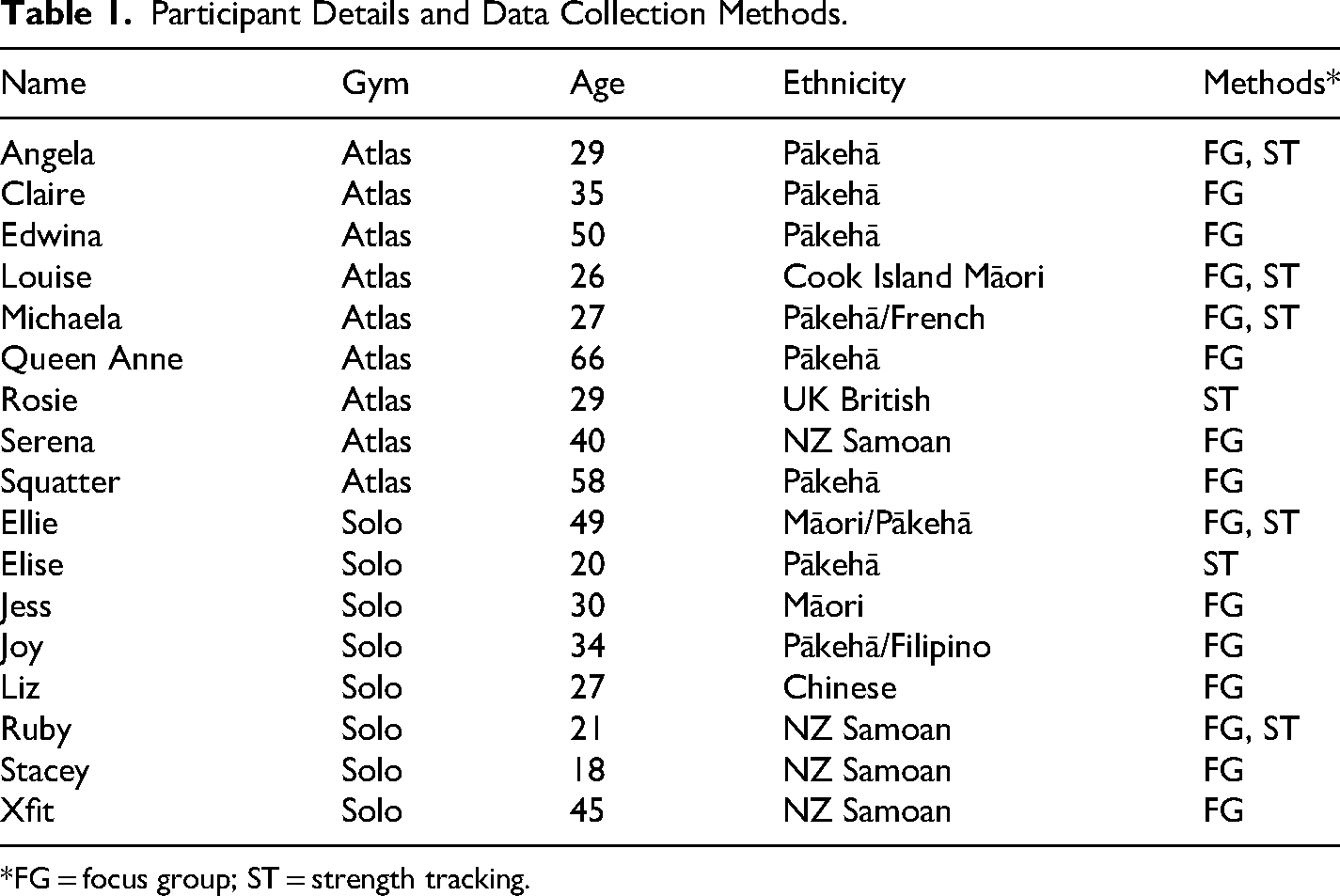
*FG = focus group; ST = strength tracking.
The first method, participant ethnography, was conducted at both gyms over a 12-month period. During observation sessions, the lead author—a white, cisgender American woman who has been involved with the sport as an athlete, coach, and researcher for over a decade—took part in team training sessions up to twice per month at each gym. The field notes resulting from participant observation at the gyms broadly documented the sex- and gender-based knowledges, training practices, equipment, and coaching strategies used, including those related to the MC.
To add further depth to our understanding of the construction of the menstrunormativities that we began to identify at Atlas and Solo during participant observation, a qualitative form of strength tracking was designed and implemented by the researchers to evoke athletes’ embodied knowledge of the MC. Over a 12-month period that started three months after participant observation began, seven cisgender women weightlifters (four from Atlas, three from Solo) tracked a series of factors in relation to their performance using either a Google Form or a physical journal. These athletes are aged between 20 and 49 years old, compete at the national or international level, and recounted experiencing a range of MC symptoms and menstrual disorders (e.g., amenorrhea, dysmenorrhea, suspected endometriosis). Athletes were asked to denote the heaviest lifts they completed, the difficulty of the training session (1–10 scale), and how strong they felt that day (1–10 scale); all other tracked factors were chosen by the athlete. The first author provided the weightlifters with a list of options to consider—e.g., MC phase, life stress, motivation to train—but athletes were encouraged to suggest and track any influences that they felt were relevant to their performance. Although not required, all athletes opted to track their MC phase. Every four months, these athletes participated in a one-on-one, semi-structured interview—completing four total interviews during the study— about their experiences over the previous four months of training. Drawing from their strength tracking, athletes discussed their evolving personal understandings of the MC and its influence on their athletic performance. They also noted their use of menstrual technologies that were not visible during participant observation (e.g., pharmaceuticals, menstrual tracking apps), adding significantly to our understanding of acceptable MC-related management methods within the gyms.
Two focus groups were conducted to explore athletes’ collective understandings of the MC and athletic performance. One focus group was held at each gym and was open to any woman weightlifter who was a part of the gym's membership; Solo weightlifters could not attend Atlas's focus group, and vice versa. A total of 15 cisgender women participated in the focus groups (eight at Atlas, seven at Solo). Participants ranged in age from 18 to 66 years old and competed at the regional, national, or international level in their age category. Participants at the Atlas focus group were Pākehā (5), Cook Island Māori (1), NZ Samoan (1), and Pākehā/French (1), while the Solo focus group was composed of NZ Samoan (3), Māori (1), Māori/Pākehā (1), Pākehā/Filipino (1), and Chinese (1) athletes. The athletes in these focus groups reported variable menstrual symptoms, MC experiences, and life stages (menstruating, perimenopausal, menopausal).
Finally, interviews were conducted with both coaches of Atlas and Solo to delineate their influence on the menstrunormativities constructed at each gym. During these interviews, coaches recounted how they learned about the MC and its relationship to Olympic Weightlifting performance. They also discussed the coaching strategies they used to navigate the MC, from alterations to training programs to suggestions made to athletes about hormonal menstrual suppressants and dietary strategies.
Research Context
“Atlas” is in a metropolitan area with a relatively affluent population and higher numbers of Asian and European immigrants. The head coach of the gym, “Dave,” estimates that roughly 80% of the gym's 55 members are women. Of these women athletes, the vast majority are working adults who compete in the “senior” (20 and older) and “master's” (35 and older) age categories and identify as Pākehā [NZ European] or as more recent European immigrants, with just a few identifying as Māori [the Indigenous people of Aotearoa New Zealand], Pacific, or Asian. As identified during participant observation, menstruation and the MC are casually discussed at the gym. With weightlifters chatting while warming up or resting between sets, the MC and its effects on Olympic Weightlifting performance are common topics of conversation. Often listening in on these discussions, head coach Dave—a cisgender man born and raised in Aotearoa New Zealand—also frequently and openly discusses athletes’ MCs with them.
In contrast to Atlas, “Solo” is in a metropolitan area with a higher proportion of Māori and Pacific community members and lower average income levels. Head coach “Kevin”—also a cisgender man—estimates that the gym has around 60 members, roughly half of whom are women. While Solo has a few master's women athletes and around ten senior athletes, the majority are “youth” (<17 years old) or “junior” (17- to 20-year-old) weightlifters. The women weightlifters at this gym predominantly identify as Pacific (e.g., NZ Samoan); those remaining define their ethnicity as Māori, Pākehā, or Asian. Like Atlas, MC conversations are common at Solo. However, these discussions are infrequently led by athletes; given the rapid pace of training sessions, weightlifters rarely have time for casual conversations about the MC. Instead, Kevin often begins MC conversations during training sessions based on his concern that menstrual health challenges can prevent athletes from achieving higher levels of performance. He also co-founded and attends a semi-regular “Women's Forum” for the women weightlifters of the gym to share their menstrual experiences and challenges.
Data Analysis
To analyze the menstrunormativities in the two gyms, we used Persdotter's (2020) theorization as an analytical guide. Coding transcripts and field notes in NVivo, we first identified all instances when athletes and coaches recognized or acted on the MC. Drawing on Persdotter's (2020) assertion that “[menstrunormativity] is co-produced by everyone and everything” (p. 366, original emphasis), we aimed to document how athletes’ menstrual experiences were shaped not only by their coaches, but by social media fitness influencers, prescription painkillers, ibuprofen, Voltaren, other athletes, iron tablets, international and national competition calendars, and menstrual tracking apps. Next, we identified the menstrual norms at the gyms by grouping these instances and human and non-human influences into the directives that the women athletes attempted to accommodate. We were particularly interested in what we term the “athletic menstrunormativities” of the two gyms, which specifically indicated how women Olympic Weightlifters “should” experience and address their MCs to achieve the highest levels of physical performance. Finally, we further drew on Persdotter's (2020) perspective that the purpose of the concept of menstrunormativity is not to define the “right” way to menstruate, but to “highlight [the] social constructions and social and emotional consequences” (p. 360) of menstrual norms. In line with this guidance, we explored women athletes’ responses to these norms as well as the challenges that these menstrunormativities produced.
We endeavored to improve our analytic “reliability” through member-checking (Krefting, 1999). The lead researcher hosted a research update for participants every six months (after the beginning of data collection), discussing analytical findings and encouraging participants to offer critical feedback. However, we also note limits to the “closeness” that we were able to achieve. Although the lead researcher was a cisgender woman Olympic Weightlifter, being a white, American postgraduate student and Olympic Weightlifting coach positioned her as both an “outsider” to the gyms and an “expert” on the MC. To minimize the possibility that the lead researcher would overlook meaningful ethnic knowledges and practices related to the MC and menstruation, Māori and Pacific cultural advisors were regularly consulted throughout the project. In this paper, we recognize where appropriate how cultural and national knowledges and practices inflected athletes’ MC-related experiences and beliefs.
Tracing the “Olympic Weightlifter MC”
In the following sections, we characterize the athletic menstrunormativities at Atlas and Solo. We begin by discussing the multitude of menstrual beliefs, knowledges, and practices held by the women weightlifters in the study, as well as their divergence between the two gyms. Yet regardless of this menstrual diversity, we note that athletes and coaches asserted consistent beliefs about what an Olympic Weightlifter's MC “should be.” To characterize this athletic menstrunormativity, which positioned the MC as a “minor inconvenience” rather than an “eternal wound” (Vertinsky, 1987) or a “performance enhancement,” we discuss the human (e.g., coaches, athletes) and non-human influences (e.g., competition calendars, painkillers) that contributed to its construction. We then outline its directives for menstruating athletes: make minimal changes to your training program, reject menstrual phase-based training narratives, take pain medications as needed, and avoid hormonal interventions. This section ends with a discussion of the athletes that were empowered and those that were positioned as nonconforming “menstrual monsters” by this sport-specific athletic menstrunormativity, as well as the limits on weightlifters’ agency to dictate their MC-based practices and training strategies.
Menstrual Diversity at Atlas and Solo
With the study situated at gyms with dramatically varying socioeconomic and ethnic compositions, it was readily apparent that athletes’ menstrual practices and knowledges were influenced by many aspects of their identity. During the Atlas focus group, Pākehā weightlifters Edwina, Queen Anne, and Squatter noted that they shared a “just get on with it” attitude to menstruation that was impressed upon them by their parents and teachers; Ellie (Solo), a Māori/Pākehā athlete, noted tikanga [cultural knowledges and customs] around menstrual practices that influenced her training strategies (Murphy, 2011; Watene, 2024). She emphasized the importance of listening to her body and respecting its knowledge: “I still will train with my period, but follow all other Te Ao Māori tikanga… I will get more sleep or skip a training… if I feel unbalanced [I will] let the body do what it needs to do, to bring equilibrium or mātauranga [wisdom]” (strength tracking interview). Other Solo athletes acknowledged complex engagements with the menstrual norms they were raised with. During the Solo focus group, NZ Samoan weightlifter Xfit stated that her approach to dealing with adversity (such as training through MC symptoms) was shaped by a need to dispense with Pacific gender roles that positioned women as being less physically capable than men (Nemani & Thorpe, 2023). She noted that in the culture she was raised in, “…you’re not allowed to climb the coconut tree, because that's a man's job.” However, being a single mother led her to push back: “I do climb the coconut tree… women can do anything.” Continuing this line of discussion, Xfit's daughter Stacey credited her mother's attitude for her own ability to be “mentally strong” under MC-related pressure: “most of my comps were on my period, and they were really bad…I just focused on what numbers I wanted to get up there on the stage, and I just went and did it” (Solo focus group).
A generational divide in menstrual norms also became apparent during focus groups, particularly regarding whether it was “appropriate” to talk about menstruation openly and with men. All three Atlas focus group participants who were over 45 years old expressed discomfort with coach/athlete MC conversations, with Edwina, a 50-year-old weightlifter, stating that “I would never tell my coach when I’ve got my period.” However, younger (20- to 30-year-old) weightlifters expressed appreciation for the open coach/athlete MC discussions at their gym. Highlighting the generational changes to this prevalent menstrual norm, Stacey—the youngest weightlifter in the study at 18 years old—characterized her casual MC discussions with Kevin by stating, “even if he doesn’t want to know, I’ll just tell him” (Solo focus group).
The weightlifters at Atlas and Solo also embraced the idea that all athletes experienced the MC differently. As related by Louise, the frequent MC discussions at the gym were not just focused on menstruation, but on the entire MC: “sometimes, me and the girls will just have chats about our cycle, and how it affects us” (strength tracking interview). Weightlifters’ beliefs about the variability of the MC and athletic performance flourished. During focus groups, athletes emphatically noted that “everyone's period is different” (Jess; Solo) and that determining how an athlete should train in relation to their MC is “so person dependent” (Angela; Atlas). As further noted by Louise, “I’ve had friends say ‘when I’m menstruating I’m way stronger. Like I feel way stronger.’ But I do not. Not at all… And neither one of us is wrong, because you can’t take away someone's personal experience” (strength tracking interview). Yet despite these weightlifters’ open recognition of the diversity of menstrual experiences, definitions of what constituted the “correct” way to navigate the MC as an Olympic Weightlifter remained.
Sport-Specific Knowledge: The MC as “Minor Inconvenience”
The coaches and athletes at both gyms consistently asserted that neither the MC, nor the menstrual phase in particular, impeded athletes’ strength performances. During interviews, the head coaches of both gyms (Dave and Kevin) recounted their exposure to recent academic literature on the MC and the impact of different phases on athletic performance. Kevin (Solo) noted that “going back 20 years… you thought ‘oh, woman's got her period, they’re weak and they’re meek and they’re irritable.’ [But now] science is saying physiologically, they’re really strong. So how do we shift that narrative [of weakness]?” Multiple weightlifters further emphasized that they could achieve high performances during any phase of their MC. Elise (Solo), an athlete who competed internationally, recalled a training block where “I was PB’ing every Friday, like close to every Friday, you know? And it didn’t matter where I was in my cycle” (strength tracking interview). Drawing on academic research and personal experience, the athletes and coaches at the two gyms rejected and reversed longstanding menstrual norms that positioned athletes as “eternally wounded” or physically incapable—“weak” and “meek”—during the MC and menstrual phase.
However, at times, the coaches and athletes also operated on the understanding that the MC did negatively impact weightlifters’ performances. According to Ellie, “I’ve heard the girls walk in and go, ‘Oh, I'm getting my period.’ And Kevin, he’ll know that he can’t push them as hard as what he maybe would mid-cycle” (strength tracking interview). As in Ellie's narrative, athletes’ perceptions that menstruation reduced their athletic capabilities took precedence in determining their training; Kevin did not push back against their “misconceptions” of the menstrual phase.
Yet coaches also led the way in establishing normative, negative understandings of the MC and athletic performance. At Atlas, athletes consistently noted that Dave associated their MCs with sub-standard strength levels. Louise recalled one such interaction with Dave, who approached her during a training session to ask about her MC phase: He's like, “where are you at on your cycle?” And I, at first, I was like, “wait, what do you mean?” He's like, “your menstrual cycle. Where are you at with it? Are you due for it?” And I was like, “oh, yeah I am, actually, now that you mention it.” And he's like, “Well, that's obviously gonna be like a huge thing.” (Strength tracking interview)
Further complicating these divergent menstrual narratives and their translation into training practices and strategies was the competition calendar, which often took precedence over athletes’ MC phases and experiences. As noted by Ruby, a weightlifter attempting to qualify for the Paris Olympics, out of the 11 competitions she had taken part in over the previous year, “most of them have been on my period, I think there's been one, maybe one, without it” (Solo focus group). Athletes and coaches alike therefore emphasized that Olympic Weightlifters’ MCs could not be allowed to hinder their performances: “you can have a competition at wherever in your cycle, and you just have to be turned on and pull out the best numbers” (Joy; Solo focus group). According to Joy, who had competed internationally, athletes who accommodated the MC by taking days off or significantly altering the intensity of their training program during “good” and “bad” phases of their MC risked “creating a specific type of psychology around training” that left athletes without the “resilience” to handle competing during a bad phase of their MC.
This series of contradictory menstrual knowledges and pressures produced the following athletic menstrunormativity: that regardless of its monthly recurrence, the MC and menstruation were a “minor inconvenience.” Olympic Weightlifters should be negatively affected by their MCs, but their symptoms should be minimal. Moreover, the MC was best dealt with in equally minor ways: to ensure high athletic performance, coaches and athletes should predominantly accommodate MC side-effects and symptoms with casual, low-impact interventions. And as we further discuss, this athletic menstrunormativity not only dictated “normal” menstrual practices but also positioned a group of weightlifters that failed to fit within its boundaries as menstrual monsters who menstruated “incorrectly.”
Normative Menstrual Practices: Addressing the “Minor Inconvenience” MC
This athletic menstrunormativity of “minor inconvenience” was primarily used to dictate the MC-related training strategies used at the two gyms. When the MC was evidenced during training—by athletes telling their coaches that they were menstruating, or coaches noting that an athlete was “feeling particularly exhausted or beat down and can’t pinpoint why” (Dave; Atlas field notes)—athletes were instructed to decrease the weights that they were scheduled to lift that day by just 10 to 15%. This small alteration to training intensity was the only variable changed; athletes would not avoid particular lifts or incorporate extra exercises. Moreover, athletes and coaches consistently stressed that any MC-related changes to an athlete's program should be unstructured. According to Angela, coaches should “adapt on the fly” (strength tracking interview) rather than creating training programs around the phases, hormonal fluctuations, and anticipated effects of a weightlifter's MC.
This approach to managing the MC positioned athletes and coaches in opposition to the concept of menstrual phase-based training, wherein athletes’ programs would be designed around the anticipated hormonal fluctuations of their MCs. On the perception that menstrual phase-based training would entail phases of dramatically altered strength training (e.g., ≥30% decrease in intensity) athletes worried that such programs would be “half-baked” (Angela, strength tracking interview) and leave them undertrained. They therefore rejected any training strategies that appeared related to menstrual phase-based training, particularly those that they encountered on social media. As stated by Claire, a weightlifter who also works in the fitness industry, “it's like clickbait. [Influencers] are like, ‘oh, I want to be the one that gives my opinion on how everyone should train around their cycle’” (Atlas focus group).
Athletes further extended this critique to their perceptions of academic literature about the MC. Noting their exposure to MC-related academic information through social media, weightlifters recounted the belief that research was “being extrapolated from endurance athletes and tried to apply to strength-based athletes” (Louise; Atlas focus group). Athletes believed that this led science communicators to recommend that strength athletes should reduce their training during entire phases of the MC, thereby leaving women weightlifters undertrained. This effort to reject phase-based training even led experienced weightlifter Joy to note her distrust of research that positioned certain MC phases as performance-enhancing: “[I’ve heard] there are very, very specific elements of your period for performance, where you can have more strength gain, but then there's so many other variables…” (Solo focus group). Louise's and Joy's consistently negative perceptions of menstrual phase-based research led them to assert that Olympic Weightlifters should never meaningfully structure their training around the MC. MC phases were not sources of performance enhancement, nor were they inevitable impairments to an athlete's ability to perform and progress.
Beyond training strategies, the “minor inconvenience” menstrunormativity dictated which medications were considered acceptable for athletes to use to manage their menstrual symptoms. Multiple athletes took iron tablets to reduce the effects of blood loss, and many used various pain medications—ibuprofen, Voltaren, prescription painkillers—to combat painful cramps. Yet while some weightlifters took such pharmaceuticals and seemed to experience meaningful relief from negative menstrual symptoms, these medications also served to “produce (illusions of) menstrunormates” (Persdotter, 2020, p. 367). In particular, weightlifters with more severe menstrual cramps used pain medications to gain the artificial appearance of being an “athlete menstrunormate” who was able to accommodate the menstrual norms of their context.
Ultimately, solutions such as pain medication were vital to maintain the normative understanding that the MC was negative, but simple for athletes to overcome. Take for example elite athlete Ruby's discussion of her significant efforts to avoid interruptions to training and competition, regardless of her highly impactful MC: “the first few periods of this year actually, they were really crampy, like really sore to the point where I would not want to go to training. And I’ll just, you know, dial it back a bit… I’ll be in bed crying with these cramps” (Solo, strength tracking interview). Rather than take the day off from training, “I just kind of push through it…. I just take my ibuprofen. Let's get it done with, one hour.” In Ruby's narrative, the only acceptable ways to work through debilitating MC symptoms as an internationally competitive athlete were to “dial it back a bit” and to take an over-the-counter anti-inflammatory. Obscuring her far-from-minor menstrual symptoms with pain medication, Ruby emphasized that she only needed minor interventions to train through her menstrual phase.
There were also several menstrual interventions and technologies that were not prominent or even accepted in the two gyms. Most notably, hormonal interventions—e.g., oral contraceptives, hormone replacement therapy—were labeled as “too extreme” to be used except in dire circumstances, unlike more “minor” interventions such as iron tablets and Voltaren. Neither coaches nor athletes discussed the possibility of using hormonal contraceptives to align athletes’ MC phases with competition dates. There was a widespread avoidance of hormonal MC management, with only one athlete stating her use of an intra uterine device (a form of long-term contraception placed in the uterus) to manage her MC symptoms. Angela, an athlete who worked in women's health, noted frustration with what she perceived as a prevalent trend among athletes: “they’re trying to stay off hormones, because they think it's bad for their strength, but actually, they’re hemorrhaging every month, and it's causing them anemia, that's not good for your strength either” (Atlas focus group). Yet hormonal interventions were labeled as an “extreme” solution to the MC, which “should” require only minor and casual management strategies.
Athlete Agency: Empowered and Monstered
This outline of the athletic menstrual norms prominent at Atlas and Solo illustrates marked divergence from both longstanding (“menstruation as eternal wound”) and novel (“MC as performance enhancement”) beliefs regarding the “correct” way to manage the MC in sport. In some ways, it has demonstrated an empowerment of menstruating athletes: the weightlifters and coaches in this study strongly asserted that menstruating weightlifters were not “weak” or “meek” and drew on training strategies that matched that belief. Through these normative beliefs about the MC, athletes at Atlas and Solo viewed the MC as just one factor—like sleep, nutrition, injury, and stress—that affected athletic performance. Reflecting on her previous 12 months of strength tracking as a part of this study, Elise stated that “It doesn’t make sense to me why I would just all of a sudden change the way that I’m training for that one aspect [the MC], when there's 50 other small things that are going to make up the big picture” (strength tracking interview). Athletes were also careful to assert that while they appreciated the increased academic and public attention on the MC and its impact on athletic performance, their MCs made up only a small component of their experiences in sport.
Yet normatively characterizing athletes’ MCs as a “minor inconvenience” also served to problematically limit the actions that Olympic Weightlifters could take to address them. Facing an intensive schedule of high-level competitions, internationally-competitive athletes—e.g., Ruby, Joy—experienced additional pressure to act in accordance with the athletic menstrunormativity of “minor inconvenience,” making only the most minimal changes to their training and bodily practices regardless of severe or concerning menstrual experiences. Athletes who felt that the hormonal fluctuations of their MC meaningfully impacted them were also challenged to access training strategies that worked for their bodies. At Atlas, two athletes recounted feeling that structured menstrual phase-based training—featuring weeks of lower and higher intensity that aligned with the hormonal fluctuations of their MCs—would improve their athletic performance. Serena (Atlas) stated that the impacts of her MC had intensified as she aged: “I would love to be able to train more to my cycle. I’m very hormonal and very affected by my cycle… I think I would actually benefit and get more out of it if I did train to my body” (Atlas focus group). Rosie recounted experiencing challenges with energy levels, motivation, and pain during her MC, but felt unable to justify asking Dave for a menstrual phase-based training program: “it's not fair on him to have to follow my cycle. I mean, maybe when I, if I hit a certain performance, right, and I maybe started paying him more money…” (Atlas; strength tracking interview). For both athletes, menstrual phase-based training did not feel like an option in their particular sporting environments. Because their experiences of disruptive MCs ran counter to the normative menstrual practices at Atlas and Solo, it was unreasonable to ask their coaches to accommodate their needs.
Evident in these weightlifters’ experiences were their limited options to express significant agency over their training strategies related to the MC. The weightlifters in this study were always welcome to advocate for and make minor alterations to their training practices that fit within the gyms’ wider menstrunormative practices (e.g., a 10–15% reduction in workout intensity). However, more significant changes were not easily achievable. To gain access to an MC-based training program, Rosie ultimately decided to leave her coach of multiple years (Dave) to begin training remotely with another coach (a woman) who seemed likely to be “more understanding.” This new coach worked closely with Rosie, developing a program over several months by having her record her MC symptoms and what day of the MC she was on. After being allowed to train according to her MC, Rosie reflected on its positive impact on her weightlifting: I think it's actually helped me, because I now have a better understanding of what I’m capable of when… I think the worry is, with cycle training, that people think they can’t then lift heavy when they need to lift heavy because, “oh, I’m always tapering off.” But that's actually not what's happening. It's just very responsive to my body, because, like, every month doesn’t feel the same, and some days feel worse than others. So it's just like I have more of an understanding about when I’m ready and how much recovery I need. (Strength tracking interview)
Rosie's experience with MC-based training raises two concerns about Olympic Weightlifters’ agency in relation to the MC and athletic performance. First is their need to take significant measures (i.e., changing coaches in a niche sport with few in-country alternatives) to gain greater agency over their MC-related training practices, particularly if they felt that they experienced impactful MC symptoms. The second concern relates to athletes’ knowledge of their MCs and its relative importance in determining their training.
As demonstrated throughout this analysis, athletes’ embodied knowledge of their MCs was not rejected at Atlas and Solo. Angela (Atlas) noted that her coach's aim was to make weightlifters “independent”: “[Dave] prefers athletes to sort of monitor themselves, work independently to adjust their programming accordingly” (strength tracking interview). Contrary to Foucauldian critiques of dominant coach/athlete power relations that render athletes docile to coach power-knowledge (Barker-Ruchti & Tinning, 2010; Denison, 2007; Gearity & Mills, 2012), our findings indicate a high degree of athlete agency in determining their own MC-related practices during training. Yet it was also apparent that athletes’ knowledge of their MCs was at times more aligned with the gyms’ menstrunormativities than with their own bodies. For example, early in the study, strength-tracking athletes often expressed the belief that their MCs did not perceptibly or consistently affect their performance. However, after tracking their MCs in relation to their athletic performance for several months as part of the study, their beliefs shifted. Angela found that her luteal phase was consistently marked by decreased strength levels, Michaela (Atlas) noted that her MC was more regular than she had believed it was, and Ellie concluded that her athletic performance was best served by not training on the first day of her period.
Together, Rosie's experiences and those of the strength-tracking athletes suggest a pattern at the two gyms: with athletes reading their MC experiences through the athletic menstrunormativity of “MC as minor inconvenience,” coaches and the competition calendar became the predominant arbiters of what was “normal” for an Olympic Weightlifter's MC. After switching to a new coach, Rosie reflected negatively on the menstrual environment at Atlas, particularly how it had been shaped by Dave's beliefs about the MC: I think that because [Dave] was open to talk about it, and because as women, we are not used to people wanting to talk about it, especially men, and especially in a training space, that we were like, “Oh, this is so great and so progressive”… But actually, he never put his hand up and was like, “I don’t actually know.” (Strength tracking interview)
Conclusion
In writing about menstrual norms and their detrimental effects on menstruators, Persdotter (2020) calls for a “transformative future of menstrunormativity” (p. 367) that recognizes and celebrates the diversity of menstrual experiences. Applying her concepts to sport and the experiences of menstruating athletes, our analysis aligns with Persdotter's arguments by illustrating that even sport environments that present athletes with “empowering” understandings of the MC may still negatively restrict these athletes’ MC-related training practices and management strategies. Our analysis also demonstrates the importance of closely exploring the sources of these menstrual norms. In alignment with Schofield et al.’s (2022) research on coaches’ efforts to address menstrual disorders, our analysis shows that Olympic Weightlifting coaches played an outsized role in establishing normative understandings of the MC at the gyms they led. While athletes’ MC experiences were incorporated into the athletic menstrunormativity that we documented, their personal and embodied knowledge of their MCs was either used to inform their training practices in limited ways or remained relatively underdeveloped over time as coaches leaned into their own beliefs about the MC and prioritized the competition calendar above athletes’ MC-related symptoms.
Based on the findings of this study, we argue that as the body of academic and sporting knowledge of the MC continues to expand and evolve, it will be vital to explore how to enable athletes to develop and apply their own embodied knowledge of their MCs to their training practices and MC-management strategies, both in training and in competition. To date, menstrual tracking practices in sport have been used to allow coaches and athletic trainers to develop their knowledge of the MC and to monitor athletes’ bodies (Carmichael et al., 2025a, 2025b). Some researchers have been highly critical of the surveillance of menstruating athletic bodies, and expressed concerns about the new ethical considerations that such technologies raise for the policing and regulating of gendered bodies (Bowell et al., 2024; Darvin et al., 2024; Friedlander et al., 2024; Howe, 2024). Based on our research, we argue that menstrual tracking in sport should not be used for coach/trainer monitoring of athletes’ bodies, but to develop athletes’ knowledge of their own MCs.
In this study, we have outlined two methods that can help deepen athletes’ understandings of their menstruating bodies: the qualitative strength tracking method used in our data collection, and the menstrual phase-based training program that Rosie's coach implemented. In both cases, athletes tracked their MC alongside their training—logging what day of their MC they were on, or what phase they anticipated they were in—and began to develop theories and practices related to the MC that reflected their own bodily experiences. While such tracking methods cannot indicate subtle menstrual dysfunctions that may influence athletes’ performances—e.g., anovulatory MCs (Janse De Jonge et al., 2019)—they enable athletes to position themselves as experts on their own MCs and engage in more meaningful dialogue with their coaches about effective and individualized MC-related training practices.
Finally, building on the important work of critical sport and menstruation scholars (Darvin et al., 2024; Howe, 2024; Schofield et al., 2022), this analysis indicates the need for continued examination of the evolving menstrual landscape in sport. Without careful attention, the same gendered coach/athlete power relations and body-sacrificing pressures that have long structured competitive sport will continue to be constructed while using new menstrual knowledges, technologies, and practices that are being developed and incorporated into sport with the intent of empowering menstruating athletes. This exploration of athletic menstrunormativities therefore demonstrates that as coaches, educators, and sport organizations continue to work towards integrating the MC into sport environments, it will continue to be important to consider the unintended effects of such knowledge, technologies, and practices.
Footnotes
Funding
The authors received no financial support for the research, authorship, and/or publication of this article.
Declaration of Conflicting Interests
The authors declared no potential conflicts of interest with respect to the research, authorship, and/or publication of this article.
