



Abstract
As traditional sport participation stagnates or declines, flexible informal sporting forms are increasingly a focus for those with a vested interest in maximising participation in sport and physical activity. This study critiques existing definitions of informal sport as overly binary, largely unhelpful, and conceptually diffuse. We propose a more nuanced understanding of informal sport that explores participant proximity to the negotiation of practices that come to shape the sporting experience and therefore levels of (in)formality. Drawing on qualitative data from three Australian case studies, we examine how participants negotiate key features of their sporting experience, such as affiliation, environment, scheduling, competition, rules, social relations, and dress. Findings reveal that informal sport is characterised by participants’ proximity to the negotiation of these features, challenging the binary formal-informal distinction. Understanding sport as a spectrum of negotiated practices and decision-making, provides a useful framework for understanding (in)formality. A sport sector that pays attention to the types of negotiations people want to have some control over, whilst negotiating other elements on their behalf, will be well positioned to respond effectively to the changing nature of sport.
Introduction
We are entering an era of sport participation where scoreboards and league tables are being replaced by café chats, group messages, finish line selfies, online kudos, and likes or shares (Barratt, 2017; O’Connor & Brown, 2007; O’Connor & Penney, 2020). Despite sustained levels of physical activity amongst younger and older Australians (Australian Institute of Health and Welfare, 2023), participation in club-based competitive sports, both in Australia and globally, appears to be stagnating or even decreasing in favour of a variety of alternative sporting forms (Boston Consulting Group, 2017; Eime et al., 2015; Hajkowicz et al., 2013; Harris et al., 2017; Klostermann & Nagel, 2012). In Australia, for example, people are becoming less “focused on competitive outcomes or traditional sporting options” (Cameron et al., 2022, p.22). Three decades ago, Bach (1993) discussed informal versions of sport as a considerable segment of sport participation, a trend that is now acknowledged in more contemporary sport participation data (Eime et al., 2023b; Harris et al., 2017). This paper critically examines informal sport and proposes a more nuanced understanding by exploring participants’ proximity to the negotiation of practices that shape their sporting experience. In doing so, it challenges the traditional binary distinction between formal and informal sport.
Given sport clubs are not the preferred choice for participation in sport or physical activity in Australia for adults aged 18 years and over (Australian Sports Commission, 2022), sporting administrators, those with a vested interest in increasing physical activity, and policy makers, must consider supporting alternatives to the European sports eco-system designed around clubs, coaches, leagues and associations. To this point, informal sport has lacked appropriate recognition in sport policy and planning arenas (Jeanes et al., 2019). We suggest that this is in part because the concept of informal sport remains contested and definitionally confused. Previous attempts to describe informal sport have tended to focus on how it differs from or exists in opposition to traditional club-based formal sport participation (Jeanes et al., 2019; Wheaton & O’Loughlin, 2017) or; how it is not organised by a club or association (Commonwealth of Australia, 2006; Jeanes et al., 2022; Neal et al., 2023). Following four years of research examining informal sport participation within Australia 1 , we now find these descriptions to be inadequate, not least because informal sport is more than what it is not (i.e., a lack of membership fees) but also because, as we will argue, it cannot be readily disentangled from defining characteristics associated with ‘sport’ itself.
Within Australia, similar to many Western nations, sport is managed largely via a top-down complex hierarchy overseen by the Federal Government, with a mix of National Sports Organisations, State Sporting Organisations (Gowthorp et al., 2017) and community clubs. National Sports Organisations hold much of the decision-making power centrally whilst managing the strategic development of sports at the national level within a federated sport system (Robertson et al., 2020). In these contexts, participation is considered in the context of conformity to a set of structured rules and guidelines that are regulated through seasonal competition. These internationally recognised constitutions and structured frameworks for sport create a sense that sport is clearly distinguishable from other pastimes, making what constitutes sport appear somewhat self-evident. There is sport (comprising of the dominant club based, heavily regulated format), and then there are other things peripheral to this core notion of sport. This is illustrated in the extensive number of qualifying prefixes used to explain other formats such as light, extreme, alternative, individual, lifestyle and of course informal sport, all of which serve to position sport as mainstream, central and unchallenged.
Yet things are rarely purely formal or informal in practice (Boudreau & Davis, 2016). Some time ago Tomlinson et al. (2005) argued for a move away from simplistic and often constraining dichotomies that position things as either traditional or new, alternative or mainstream, and even formal or informal, suggesting that these dichotomies rarely hold true in the everyday practices of participants. Others have similarly called to move beyond dualist notions of formal/informal when considering different formats of sport participation (Gilchrist & Wheaton, 2017; Miyashita et al., 2024). Instead of trying to look for what distinguishes informal sport from sport, the focus needs to be on the relationality among the mix of actors and their negotiated practices in the context of sport participation (Boudreau & Davis, 2016; Gilchrist & Wheaton, 2017; Tomlinson et al., 2005). To avoid replicating the problem, we utilise the term ‘(in)formal sport’ as a way to encompass forms of sport, and specify ‘more informal sport’ and ‘less formal sport’ where a distinction is required.
To progress understandings of what informal sport is, this paper explores the fluidity of sport by examining how participants negotiate key aspects of their sporting experience. Rather than viewing sport as a binary between formal and informal, we argue that degrees of formality are determined by participants’ proximity to decision-making processes and their ability to influence practices such as rules, level of competition, and social relations. Through this lens, we develop a nuanced understanding of (in)formal sport, challenge traditional definitions and highlight the dynamic, negotiated nature of sport participation. Understanding this nuance can open opportunities for sport administrators, policy makers and managers to interrogate the ‘right mix’ of (in)formality that can enhance sport provision and capitalise on the health, social and financial opportunities that (in)formal sport presents.
The paper starts by unpacking the relevance of informal sport and outlines why it is worth our attention. We then look to formal definitions of sport and consider its defining features to help us form a basis for understanding (in)formal sport. From here we draw on observational and interview data from our informal sport research to consider the particular practices that occur with more or less formality in relation to these defining features of sport. By focusing on the lived experience of (in)formal sport participants and their negotiation of their agency in relation to defining practices of sport, we build our understanding of what (in)formal sport is.
The Importance of Informal Sport
Early research describing informal sport can be found in the work of Bach (1993) who noted discussions in 1980s’ Germany about “a considerable segment of sports activities” that were “neither officially organized activities (as in sports clubs), nor” were “they conducted in official sports facilities” (p. 282). Bach (1993), pointed to population participation statistics in the 1990s that suggested more than 50% of all sports activities were organised without institutional assistance or commercial support (Bach, 1993). A Commonwealth of Australia (2006) senate inquiry into women in sport and recreation identified non-organised participation rates (i.e., sport and physical activities which were not organised by a club or association, including non-sporting bodies) to be higher for women and within 5% of organised participation rates for men (ABS Participation in Sport and Physical Activity survey). More recently, Australian national survey findings indicate 13% of Australians aged 15 and older engage with a sporting club, whereas 62% participate in more casual forms of physical activity including one-off events (i.e., half marathons), and more regular programs like parkrun (Australian Sports Commission, 2024). Jeanes et al. (2024) identified that the number of informal sport participants using public ovals in suburban Australia was at least comparable to that of formal sport participants. Outside of Australia, a report examining sport participation in Europe concluded that “sport and exercise predominantly take place in non-organised settings outdoors” (Rask et al., 2024 p.23).
Observations within participation data are underpinned by the rationale that people are increasingly squeezing sport into busy and time-fragmented lifestyles. In 2018, the Sport 2030 report (Commonwealth of Australia, 2018) made the following observation: 2018 is not 1992. The way we live, work and engage in sport has changed. Australia has changed around sport…. Where once people planned their weeks around sporting and physical activity, today many Australians now look for sporting and physical activities that work around their week. (p. 7)
Academic research has called for greater attention to be paid to informal sports participation that involves unaffiliated individuals and groups self-organising their participation outside of traditional structures (Gilchrist & Wheaton, 2017; Jeanes et al., 2019; Klostermann & Nagel, 2012; Neal et al., 2023; Tomlinson et al., 2005). Researchers have been pointing to a range of sporting forms (and formats) that continue to challenge traditional club-based delivery, due in part to post-modern societal demands for increased freedom, social connection, autonomy, expression and fluidity (Atkinson, 2013; Harris et al., 2017; Hitchings & Latham, 2017; O’Connor & Brown, 2007; Wheaton, 2004). This manifests in some contexts as a form of resistance to the constrained nature of traditional sporting forms, including inflexible scheduling, increasing fees, exclusionary practices and narrow rule-laden competitive foci (Gilchrist and Wheaton, 2017; Hitchings and Latham, 2017; O’Connor and Brown, 2007; Spaaij, Magee & Jeanes, 2014; Wheaton, 2004, 2010). Indeed, a notable portion of informal sport participants likely arrive there due to exclusion from so-called mainstream club-based participation (Jeanes et al., 2018; Spaaij et al., 2019, 2021). Many participants looking to experience the more enjoyable elements of sport tied to wellness, social belonging, expression, mastery and spending time outdoors also seek informal opportunities (Bailey et al., 2013; Hitchings & Latham, 2017). As a result, participants through their actions are reproducing a range of sporting forms that more closely align with their goals, resources, interests and values.
Eime et al. (2016) have called for government bodies to recognise that for many people, the current and dominant organised competitive format of sports offerings very quickly loses its appeal. According to Eime et al. (2023a) nearly half of sport club participants aged 4–29 years drop out of Australian club-based sport participation within 2 years of starting. Most people stop playing competitive sport altogether after adolescence (Eime et al., 2022; Eime et al., 2023b). In Europe, only 12% of Europeans engage with sport through a sporting club, raising questions about the focus on European sport's pyramid structure model and its claims for impacting physical activity (Rask et al., 2024). Sporting ecosystems that continue to replicate traditional (European inspired) club-based competitive structures, tend to struggle to cater to the needs of the broader population (Eime et al., 2022; Harris et al., 2017; Rask et al., 2024; Spaaij et al., 2018).
Having made the case for greater attention to be placed on informal sport, we now turn to understanding what informal sport is. To do that, we first consider the defining features of sport and utilise these to form a framework for exploring what (in)formal sport is from case study data on informal sport participants.
What Is Sport and its Defining Practices?
To gain a deeper understanding of informal sport, or any other form of sport, we must first consider the concept of sport itself. In particular those qualities that define sport and its practices. Chu (1982) suggests the “definition of such a commonly used term [sport]…is fraught with difficulty” (p12). Kurtzman and Zauhar (2003) note that “sport can be defined in many ways and from different viewpoints or distinctive perspectives” (p. 35). Parry (2019) suggests “no-one can research ‘sport’ simpliciter” (p. 5). Mandell (1984) reminds us that the word sport ‘covers vastly too much’ having been appropriated by the world's languages and “applied to activities that are various indeed” (p. 17). By these accounts, what the word sport encompasses is hard to pin down and destined to reflect historical, cultural and social distinctions.
Distinguishing sport from all other activities in more strongly bounded terms has occurred through identifying persistent traits of skilled physicality, codified rules and competition. Chu (1982) draws on Edwards (1973) work to describe a transition from play to serious sport that is characterised by a progressively increasing reliance on formal rules, roles and responsibilities, behavioural requirements, relevance of the outcome beyond the participants, greater focus on goals related to values that emanate from outside of the context and greater notions of seriousness. For engagement in an activity to be considered sport, Edwards (1973) includes a requirement for participants to be part of formally organised associations with a goal of defeating opposing groups. Singer (1976) defined sport as having “administrative organisation and a historical background of rules which define the objective and limit the pattern of human behaviour” (p. 40). It involves competition and or challenge with a definite outcome (Singer, 1976). Sport is an ‘institutionalised’ game and consequently has attained the status of a social institution (Chu, 1982). Messner (2002) describes this version of sport as being located within “institutional structures – [with] historically formed entrenched systems of rules, conventions, allocations of resources and opportunities, and hierarchical authority and status systems” (p. 65). Summarised, there is a distinguishing emphasis on external levels of governance in more formal ideas of sport.
Coakley (1982) notes sport to be an institutionalised competitive activity requiring the use of relatively complex skills and physical exertion where participation was motivated by both intrinsic and extrinsic factors, and where institutionalisation implies some kind of formalised structure across contexts. For Parry (2019), sport comprises “institutionalised rule-governed contests of human physical skill”, while Borge (2021) presents sport as “an extra-ordinary, unnecessary, rule-based, competitive, skill-based physical activity or practice where there is cooperation to fulfil the prelusory goal of having a competition” (p. 309). Suits (1988, p. 5) argues that games (and consequently sports) are a product of their rules, and these rules are integral to games, as “it is the rules of any particular game that generate the skills appropriate to that game” (p. 5). In summary, strongly bounded definitions, typically position sport as rule-based physical pursuits that centre on determining a winner or ranking through contest.
According to Borge (2021), winning in competition is a key component in defining what constitutes a sport, forming an important part of any known sport's external purpose or function. Indeed, because of a lack of contest, Mandell (1984) rules out bicycle touring and body surfing as sport. Borge (2021) and Parry (2019) also suggest that activities such as recreational parkour, surfing and skateboarding typically do not constitute sport. Parry (2019) takes this another step further and suggests “an informal game of football in the park, with four coats as ‘posts’, 4 players against 5, and some ad hoc rules to suit circumstances” is an example of “football, but not an example of football played as sport” (p. 8, our emphasis).
Adopting these more formal classifications serves to constrain sport to be a certain kind of participation that, in the interest of preserving purity in competition, must operate in particular ways (i.e., officials studiously enforcing the internationally accepted rules of play). Yet Coakley & Pike (2014) note that single institutionalised definitions of sport can fail to recognise contexts that do not have the resources or the motivation to develop formal competitive physical activities. Indeed adhering to strongly classified definitions of sport focused on the integrity of rankings, whilst insulating it from other physical activities, privileges practices such as having fixed seasons and teams (graded and defined by age and gender), umpires to enforce rules, and fee structures to pay for umpires, highly specialised lighting, player/coach payments, and layers of regulation.
Yet despite the appearance of a rigid adherence to institutionally imposed regulation, even in competitive sport, several unregulated practices and negotiations of sport are clearly evident (Miyashita et al., 2024). Particularly at the local community level, compromises such as self-umpired games, smaller than regulation playing fields, varied rule interpretations, and significantly modified junior competition formats blur boundaries around rigid definitions of sport. McFee (2004) notes that “definiteness embodied in the search for definitions” (p. 23) requires only one counter-case to show that definition to be wrong. If the Olympics represents the pinnacle of competitive sport, then sports like skateboarding pose a clear challenge to tightly constrained definitions of sport that rely on contest and clarity of rankings. Wheaton and Thorpe (2021) noted that even within Olympic skateboarding, the judging criteria remains subjective whilst participants continued to value “progression and camaraderie over rules, regulations, and ‘win at all costs’ values” (p. 94).
Like the skateboarders in the Olympics, we argue that sport is much more than a contest and that notions of competition are increasingly transforming. However, to avoid an unnecessary argument about what can or cannot be counted as sport, and therefore informal sport, we focus on features of participation considered by some to distinguish it as sport. As noted earlier, when sport is considered through its distinctiveness found in ‘formal’ definitions, it calls for a set of practices that establish a clear winner or ranking, via a set of rules, through the process of a contest. These qualities impose practices on which we can begin to explore (in)formality. Consequently, sport that prioritises ‘purity in competition’, also prioritises institutionally established game formats and rules, rule enforcement, affiliation with obligation (i.e., ‘joining’ a team/club and its conditions), standardised uniforms and equipment, fixing same-gender teams in graded leagues and among other things, fixturing seasons to accurately and fairly determine the winner. Given competition is considered a defining component of sport, exploring those features makes for fertile ground to explore (in)formal sport (see Table 1), noting that this list is neither universal nor exhaustive.
Defining Practices Within Sport and Relationship with Participants.
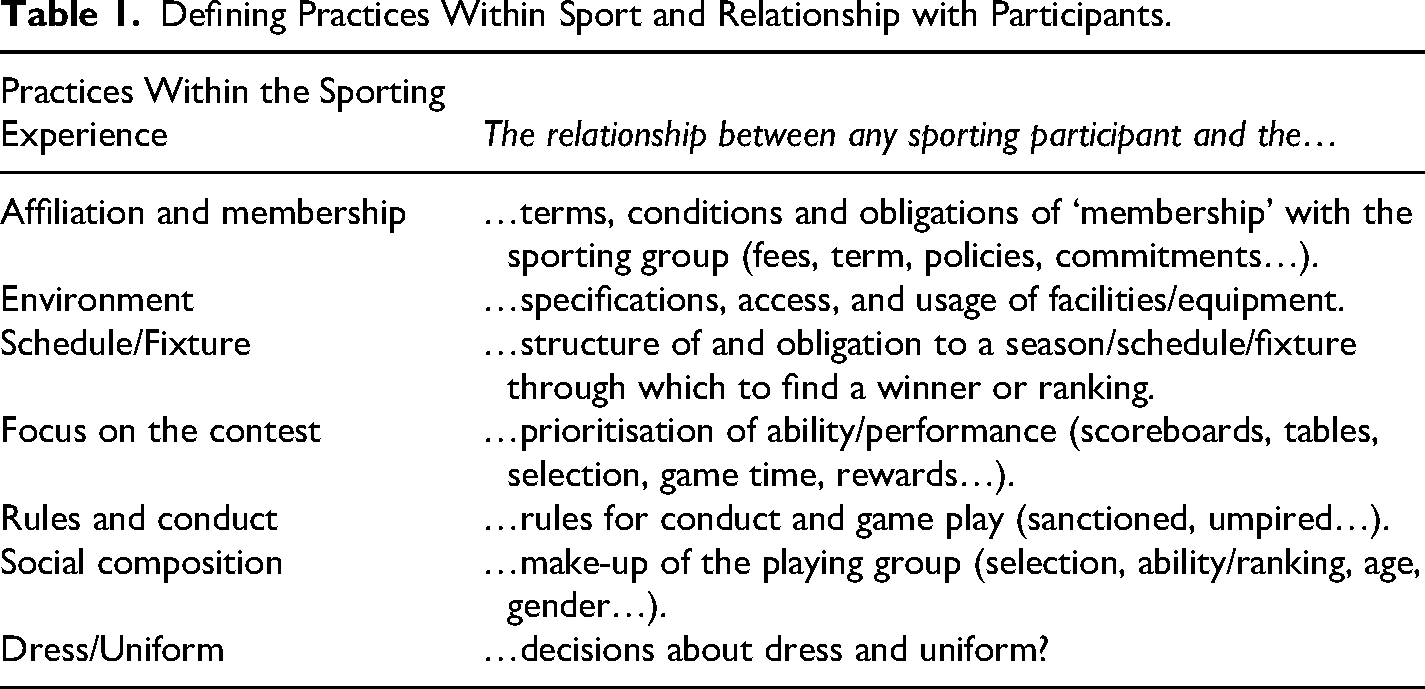
From here, we conceptually explore the utility of these defining features of sporting experiences to understand informal sport. We draw on data from representative (in)formal sporting groups as case-studies to understand how they regulate key features of their sporting participation (see Table 1). By examining participant proximity to the negotiation of these practices that relate to the sporting experience, we aim to identify key characteristics of (in)formal sport that help us understand what it is.
Method
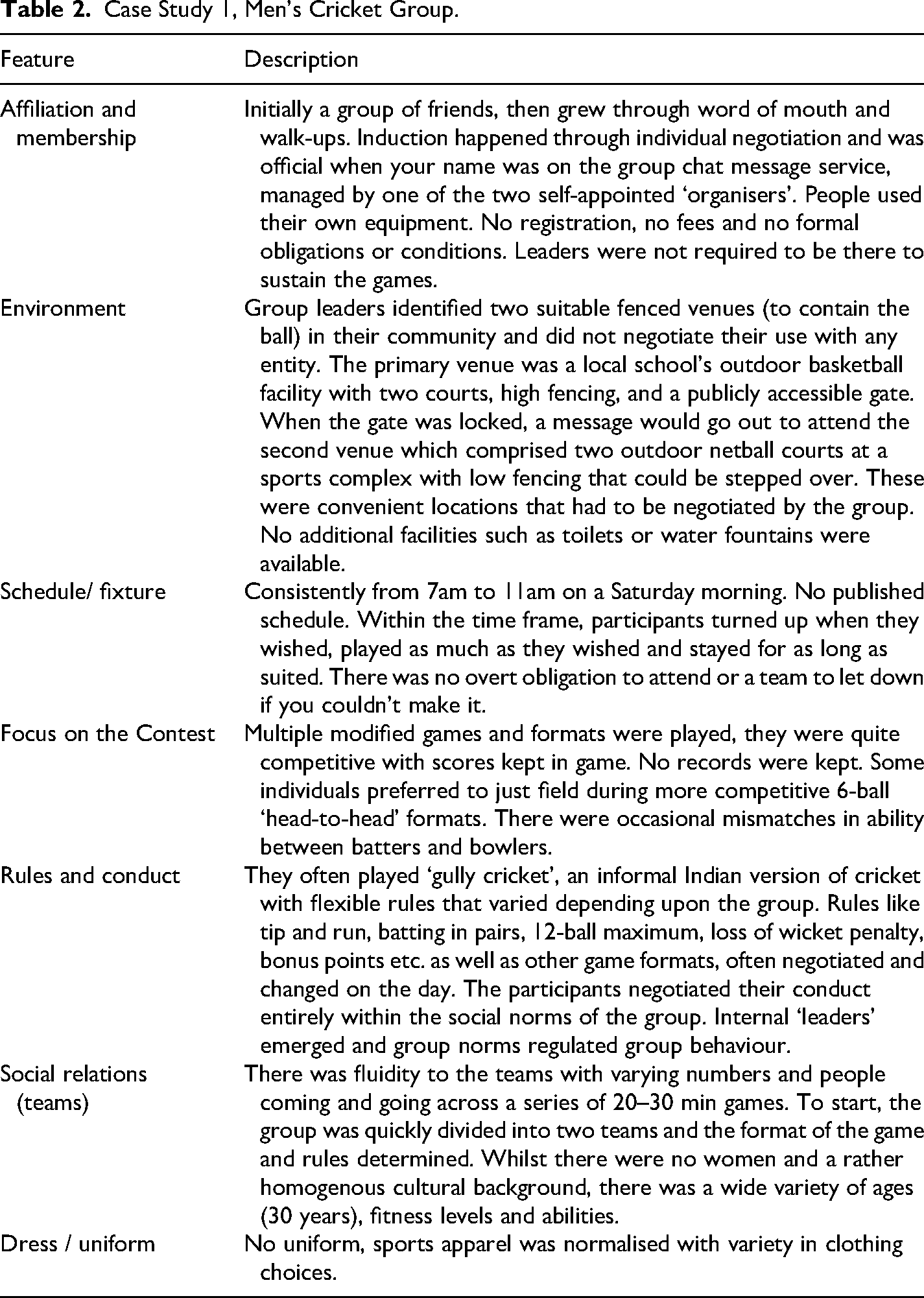
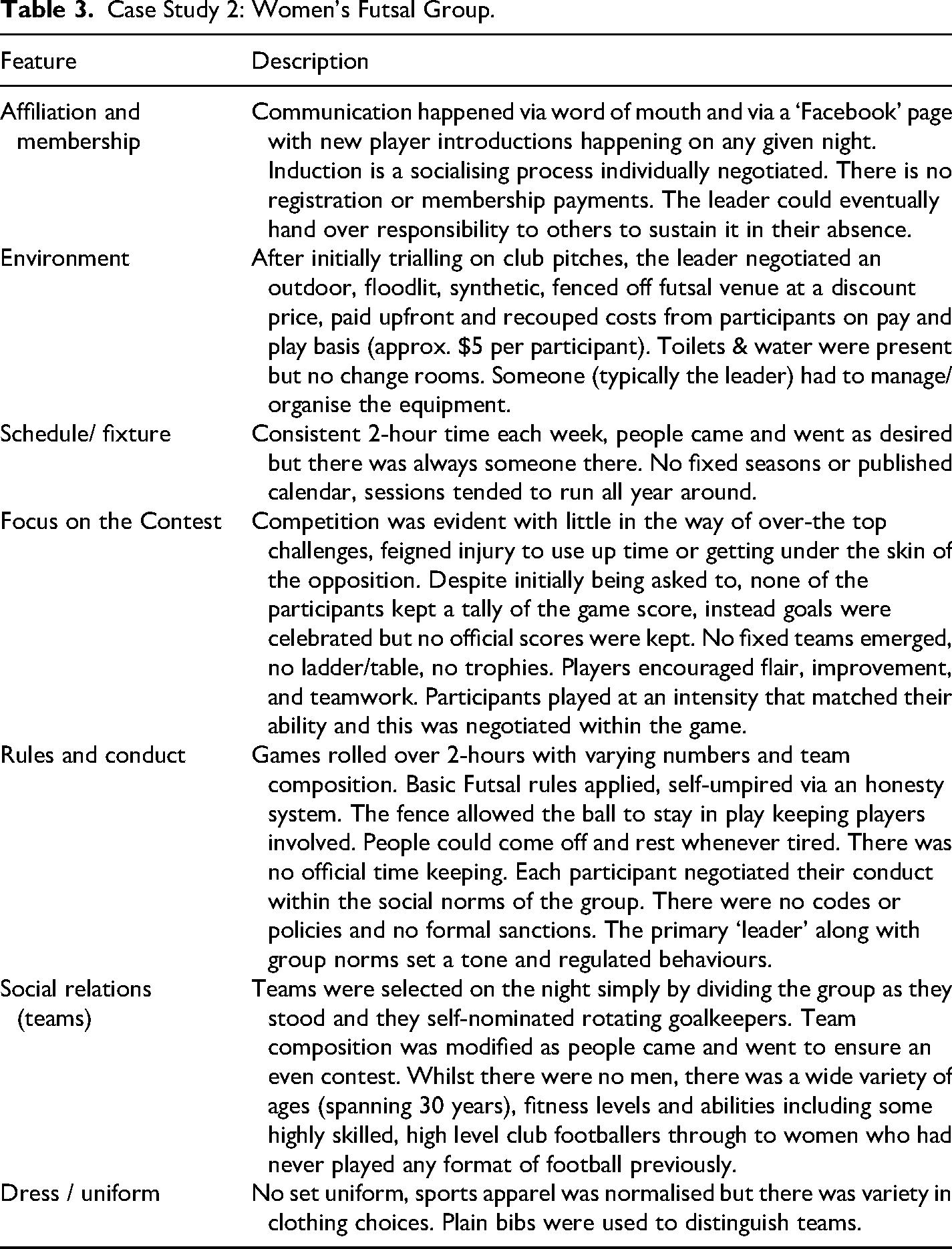
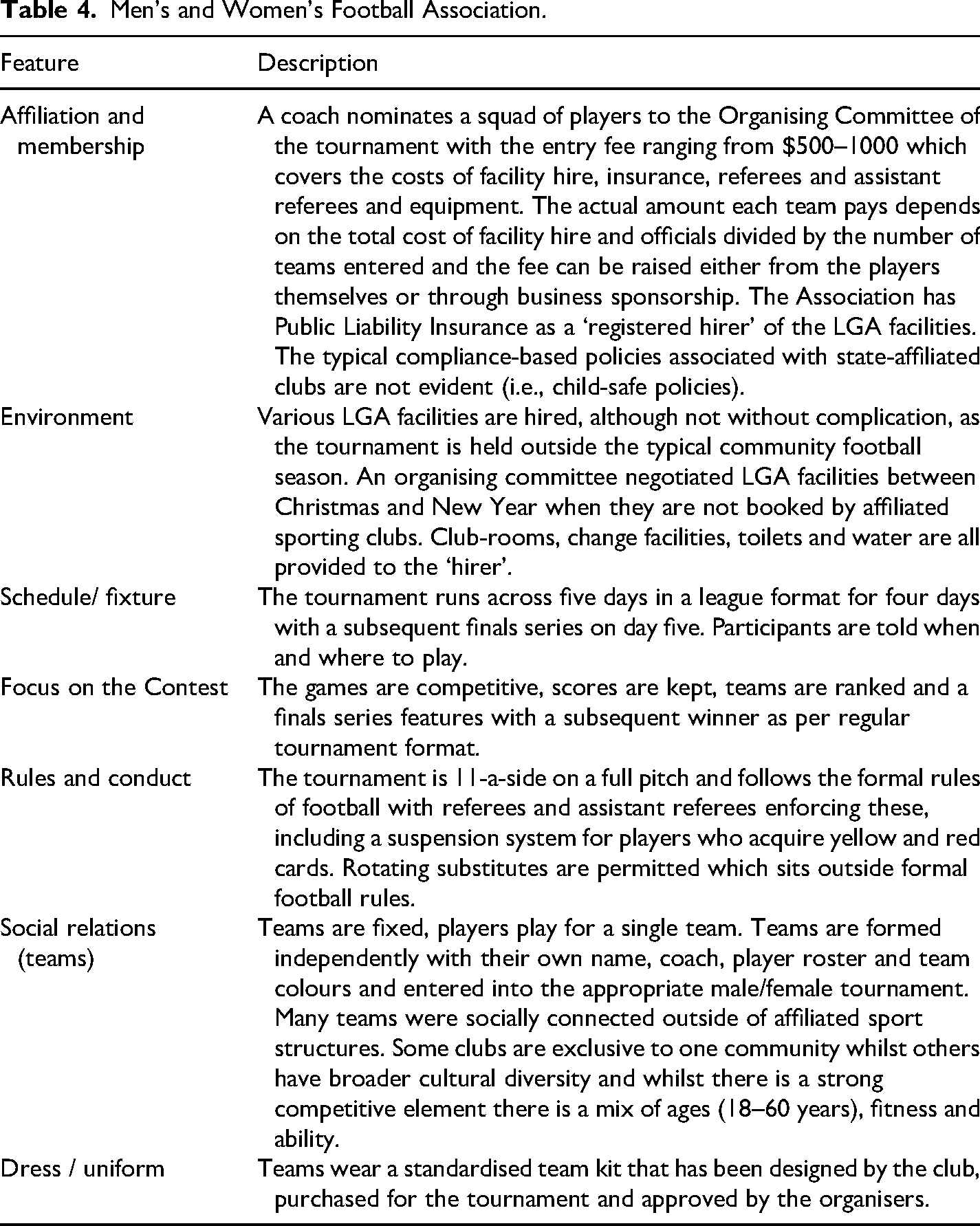
Three qualitative case studies were drawn from a large data set exploring informal sport within metropolitan Melbourne Victoria and Perth Western Australia. The case studies were compiled with university ethics permission (ref. no. 18504), from a data set that consisted of observational, interview and focus group data collected over several months following the groups in action. A summary of these cases is presented in Tables 2–4. These case studies offer exemplars of a much wider spectrum of informal sport participation that we observed across an 18-month data collection period (Jeanes et al., 2024). As exemplars, these represent ‘maximum variation cases’ (Flyvbjerg, 2006), whereby they provide information about the significance of various circumstances in relation to the extent of regulatory practices tied to defining features associated with (in)formal sport. These cases were selected as they represented a spectrum of different levels of informality from relatively high levels of informality (case study 1 & case study 2) and lower levels of informality (case study 3). The intent of their use centres on evaluating the extent to which defining features of sport were negotiable by participants within the sporting experience. That is, to gain an understanding of the actors and their practices that co-construct the governing processes of sport participation (Miyashita et al., 2024). The goal was not to describe the nature of informal sport participation, but rather consider the likely negotiations taking place to mobilise resources and establish its governance (Miyashita et al., 2024).
Case Study 1, Men's Cricket Group.
Case Study 2: Women's Futsal Group.
Men's and Women's Football Association.
To avoid the creation of a formal/informal binary, we considered a continuum of practice which, when taken as a complex whole, indicates an overall degree of (in)formality. This process was not intended to be quantifiably objective. Rather it was intended to illustrate participant proximity to the negotiations of the governing process of sport participation. That is, we learn more about (in)formal sport and its structures when we considered the level at which individuals could negotiate key decisions associated with key features of their participation. If we simply ask, “Is there a uniform?”, the answer may well be yes across a spectrum of informal and formal sporting contexts. If, however, we ask questions such as “does the participant have to wear a uniform (without sanction)?”, “can they adjust the way they wear a uniform?”, or “can they readily influence, change or challenge any uniform requirements?”, then we will likely be interrogating a more nuanced understanding of (in)formality.
Using the case study data, two authors independently considered defining features of sport and inferred participant proximity to decision making about this practice. Authors considered each case against a continuum whereby participant proximity to decision making about their practice (autonomy) signalled a level of informality. It is proposed that the degree of participant proximity to the negotiation of key features of their participation, reflect the complex relations between formality and informality with variation across settings (see Table 5).
Defining Practices of (In)Formal Sport.
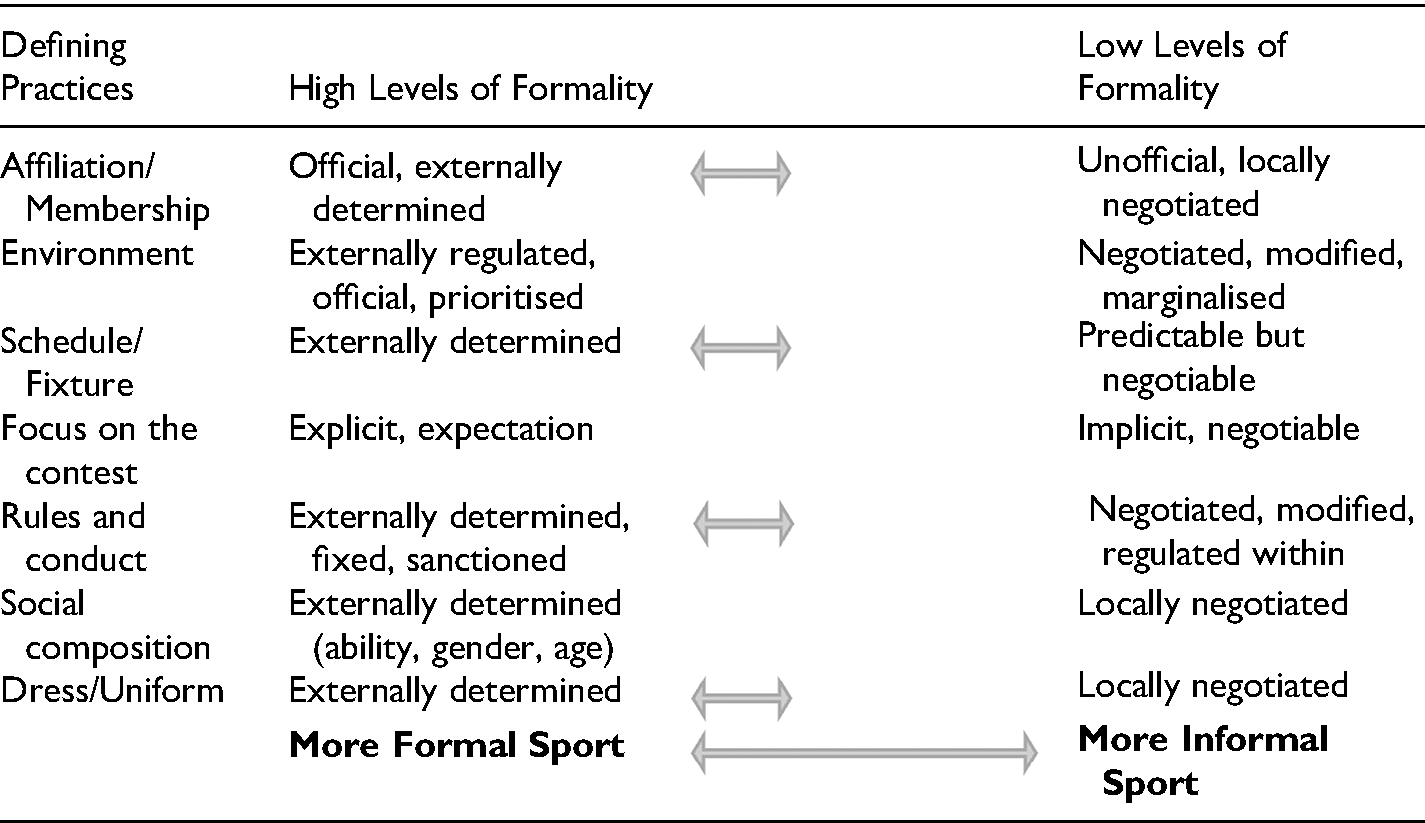
From this analysis we consider what (in)formal sport is, establish a framework to understand (in)formal participation and ultimately provide a working definition that can support policy makers and sport managers to consider engaging with this form of participation in meaningful ways. We acknowledge this as an initial conceptual and exploratory step and appreciate more work is needed to explore the veracity of this work across a wider number of cases. Worth considering in future research is how this framework might apply to more ambiguous forms of sport (i.e., skateboarding, yo-yo, climbing). Here, our intent was to focus on recognisable sporting activities (cricket, futsal, football) in order to explore the notion of (in)formality whilst avoiding potentially distracting arguments about whether these activities should even be considered as sport.
Case Studies
Case Study 1: Men's Cricket Group
The first case study group is a men's cricket group comprising participants who were all originally from Southeast Asia (see Table 2). The group was established by two friends who had moved from India to Melbourne (Australia) years previously and had remained in close contact. Both had played local club cricket but found the commitment too taxing, especially with young families. They decided to arrange a casual cricket game with a few friends early one Saturday morning at the local school's basketball court. One of them created a group via WhatsApp and acted as a communication point. They had enough equipment to start the group with eight participants initially. This grew to an average of 25 participants through word of mouth and passers-by getting added to the group message. Collectively the group had enough equipment and could be sustained without the two original leaders being present.
Case Study 2: Informal Women's Futsal Group
The second case study group is a women's futsal group (around 18 to 45 years of age), comprising participants who were from a mix of cultural backgrounds (see Table 3). The group began when the leader, herself a club-based football (soccer) player and coach, wanted to keep her football activity going outside of the regular football season. As a coach, the leader had access to the necessary equipment such as footballs and bibs. She contacted a local pizzeria and negotiated pizzas to be delivered to be eaten at the end of the session to add a more social element to the session. The leader used various social media outlets including Instagram and Facebook to inform local women of the futsal group and advertised it as a ‘come and try, stay as little or as long as you want, there's pizza’ session. Sessions consisted of ongoing futsal games with players rotating in and out of games. Initially, 19 participants attended with word of mouth leading to a regular 40–50 participants.
Case Study 3: Men's and Women's Football Association (MWFA)
Two volunteers, who arrived in Australia from Afghanistan over 20 years ago, founded the association in 2019 having both been involved in organised football in the Melbourne area since their arrival (see Table 4). They later realised that the regulatory structures and costs of football provided significant barriers for participants from the Afghan and other multicultural communities, especially as migration rates of multicultural communities increased in their local areas. They initially ran informal football groups for multicultural communities and this eventually led to informal football programs for multicultural communities, funded from various not-for-profit organisations and LGAs. In order to host an annual 5-day tournament, they formed their own Football association for Afghan and other multicultural communities. Many of the ‘clubs’ that enter the tournament are formed by people coming together outside of club structures to play informally, others are formed from teams and players involved in formal pathway football looking to extend their football participation in the ‘off season’ outside of their affiliated leagues. All ‘clubs’ playing in the tournament are not connected to, or recognised as an officially sanctioned football entity. The association and the annual tournament are not registered with the relevant State Sport Association, but are recognised by relevant local government authorities as an independent registered association. Over 20 ‘clubs’ enter the tournament each year which has men's and women's strands.
Figure 1 provides a visual representation of the case study findings. Generally speaking, the more formal sport gets, the stronger its adherence to institutionally/externally determined or governed practices where decisions get made more distally from those participating. In case study 3, there was a level of official affiliation whereby typically unaffiliated ‘clubs’ signed up to participate in a tournament and committed financially to it. In return the association took on key decisions to do with the sporting experience (see Table 4). Players deferred decisions about schedule, fixture, venue, rules, officiating, insurance, ranking systems, and cost to an organising body, suggesting greater degrees of formality than was evident in the other two cases. In return, through paying their fees and signing up for the tournament, players were submitting to an externally determined focus on trophies/rankings, fixed team structure, coach decision making about playing position and time, as well as requirements for particular equipment or uniform. Decisions about when the tournament was to be played were shaped by decision makers that sat even more distally to the association.
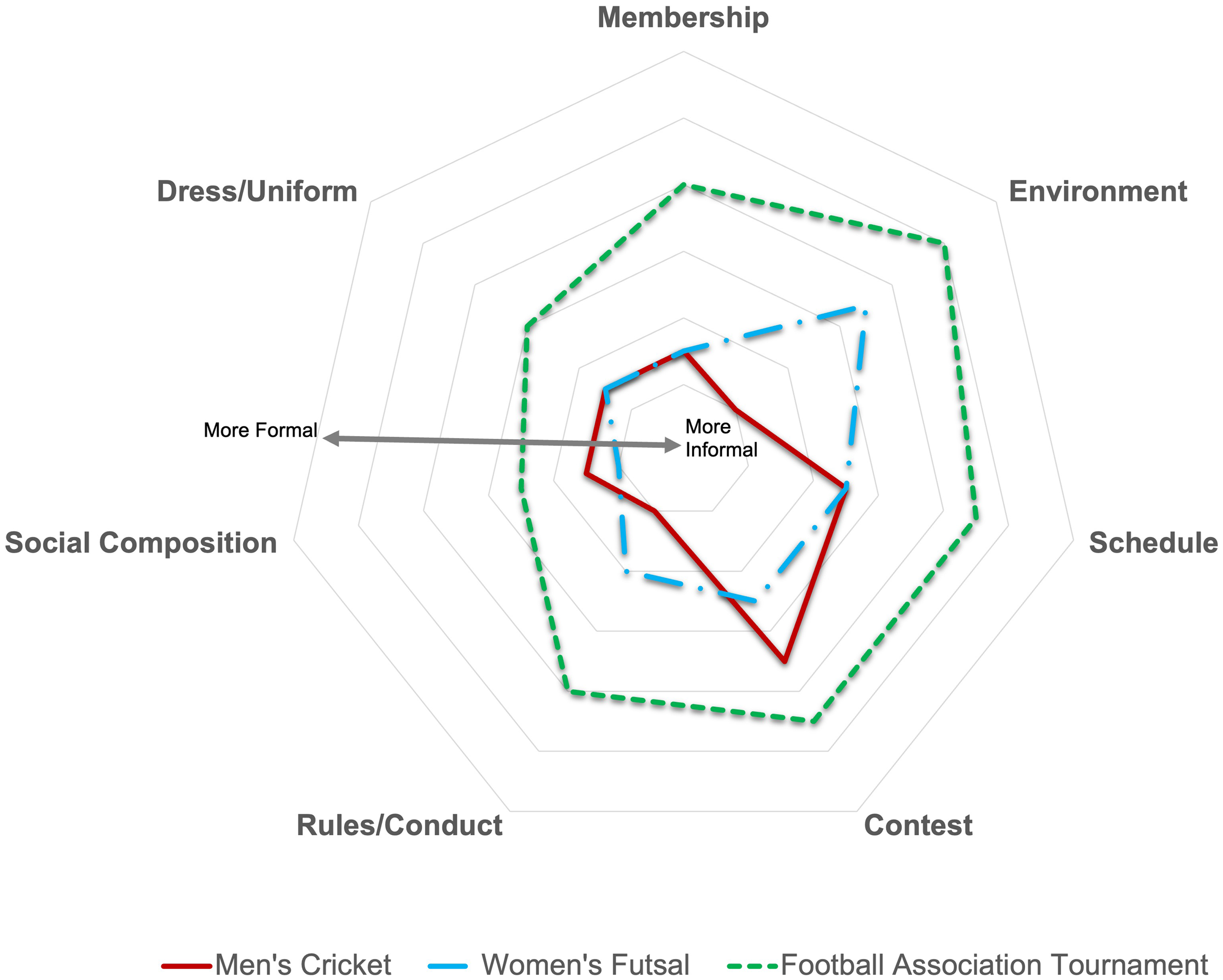
A visual representation of (in)formality.
While the tournament itself was largely externally regulated and represented more formal sport, the extent to which players initially formed and affiliated as “clubs” prior to and after the tournament was more loosely determined and individually negotiated. For example, many participants did not join a club and get assigned/selected into a team with a coach, rather they formed these teams out of shared friendship, cultural or community bonds across a diversity of age groupings. Following the tournament many went back to more informal forms of participation. This participation model is similar to how groups of runners or swimmers informally meet as a group for most of the year and then periodically enter more formal annual events, competitions or challenges (i.e., half marathon event).
In case study 1, the men's cricket game, there was no signature required on any official documentation, there were no policies to adhere to, and no codes. Multiple game formats were played primarily in an enclosed netball court, and the games continued regardless of what sporting season the rest of the country was experiencing (see Table 2). Rules were highly modified and games self-umpired, teams and format negotiated on the day and scores were fleetingly recalled but not documented. There was no formal commitment to attending with no fee structure. The participants themselves were making all of the key decisions through various power relations from within the group. Yet despite this apparent informality, membership was to some extent still being regulated. There were unofficial gatekeepers controlling membership via a WhatsApp message service that notified location and start times. The start time was relatively fixed although people came and went. Game formats varied but were well known within the group and operated with stable albeit modified rules. Despite scores not being recorded, competition remained an important focus to the extent some participants chose to withdraw from one of the more overtly competitive game formats (without any repercussion).
In case study 2 the environment was quite regulated, more so than the men's cricket group with its fixed facilities (futsal pitches, fixed goals, etc.) that required a financial negotiation (see Table 3). Despite not having a formal committee of management and an overarching set of policies, the women's futsal group had clear leadership that set a tone for conduct and negotiated the setting and conditions of the sporting practice. The games themselves were competitive but only in the moment. The goal was not to determine an overall winner, there were no fixed teams, seasons, trophies or league tables, but rather it was focused on maintaining a sense of challenge from moment to moment. This meant scores were not recorded, umpires were not needed and some rules were ignored. Players could shape their level of competitive engagement within this mix and in doing so, could be challenged nearer to their ability level. Some players chose to rest and return whilst the game went on. Contrary to popular terminology, the activity did not appear to be individualised, light, alternative, extreme or even self-organised.
Figure 1 suggests there is no single binary understanding of (in)formality, but rather negotiations around practices that contribute to a relational understanding of informality and formality. Taken as a whole, an overall pattern emerges. While the MWFA (case study 3) appears more formal than the other groups, elements of informality are also present (particularly associated with team formation). The association negotiated the format, the trophies, officials, scoreboards and the like and this set a competitive tone that was quite different to case study 2. Yet the length of commitment was minimal, making access to participation easier to negotiate. Across all cases, formality and informality coexisted to some extent when the holistic practices of participants were considered.
Discussion
Given the complexity and contestations involved in attempting to define sport, there can be no clear-cut definition of what (in)formal sport is. Rather than ascribing formality to the presence of a membership or informality to an apparent ‘lack of organisation’ we considered the extent to which participants could negotiate particular practices within sport, tied to defining features of sport that emerge from quite ‘formal’ or bounded definitions. This approach aligns with Tomlinson et al.'s (2005) direction to emphasise the relationships and practices among participants within sporting contexts. In doing so we developed an understanding of (in)formal sport that is attuned to the ‘relations among actors and their practices that co-construct the governing processes of sport participation’ (Miyashita et al., 2024, p. 5). This approach allowed us to understand (in)formal sport not by the nature of the (self)governance, but rather through the negotiations that occurred to mobilise resources and regulate participation (Miyashita et al., 2024). Understandings of sport as a spectrum of negotiated practices and decision making (both logical and embodied), provided a useful framework for understanding (in)formality (see Figure 1).
Our findings challenge the idea that a binary formal:informal distinction can be made on any one of these elements, particularly in isolation of others. Instead, our observations suggest degrees of informality and formality co-exist in complex and relational ways. This aligns with the idea that informality is a process of (non)negotiation and fits with a wider idea of “sport hybridity” whereby the “regulations and resources for sport are negotiated” (Anonymised, p.X). As the case studies demonstrate, more informal contexts emerge where the participants playing the sport are in closer proximity to the negotiation of key elements of their participation. This includes negotiating the role competition, comparison and ranking plays.
Through understanding informality as the relationality among the mix of actors and their negotiated practices (Miyashita et al., 2024; Boudreau & Davis, 2016; Gilchrist & Wheaton, 2017; Tomlinson et al., 2005), we more confidently define informal sport as sport. If people wish to stick to the more strongly bounded definitions to distinguish it from other forms of skilled physical activity, we might go further and define informal sport as sport, whereby goals relating to comparison and competition are more readily negotiated by the participants, alongside other forms of achievement or expression. That is, the more informal the sport, the more readily participant collaborators tend to be negotiating many (but not all) of the conditions of their engagement. Answering the question, ‘Who is making the decisions?’ offers a relatively simple way to understand degrees of informality in sport.
It is worth noting that as the emphasis on finding a clear winner or loser fades, the requirements to include many of the regulatory structures and practices that govern formal sport and consequently limit its access, tend to also fade, making informal sport more local, negotiated and arguably more inclusive. Because of this, informal sport should be a serious consideration for planners, administrators, and sporting codes. The most formal case-study presented here, only needed to sustain these formal competitive features over a small period of time before dissolving back into more locally negotiated structures.
The case studies illustrate the fluid way features of sporting practice presented across settings. Like our case studies, within the cycling bunches described by O’Connor and Brown (2007), some regulation and organisation has to exist or the activity would not consistently occur. O’Connor and Brown (2007) noted how informal cycling bunches were not free from formality nor completely individualised, rather the participants themselves were negotiating leadership roles associated with “determining routes, maintaining web pages, greeting new members and conducting pre-ride announcements” (p. 94). In all our case-studies, the more informal sporting participants still tended to hand over some control of their experience to designated ‘leaders’, ‘social media managers’ and ‘equipment maintainers’, who typically took on decision-making roles from within the group.
Within more informal sport settings, decisions were not being governed or imposed externally by committees or hierarchical institutional structures with little room to negotiate, instead they were being negotiated much more proximally to the participants themselves, collectively or by endorsed leaders from within the group. Typically, more informal sporting groups discarded constraining features such as the need for fixed teams, age groups, a fixture, or keeping records of scores or rankings in favour of being able to take a break, to focus more on the social context, to play for longer this time, to change teams midway through a game and even up the contest, or to increase or decrease the intensity at which they enter the contest.
More research is needed to understand the negotiations that occur within and around (in)formal sport. Of particular interest is how this more transient, and adaptable form of sport participation is susceptible to forming, dissolving, and reforming as different negotiators exert their agency. In addition, we have already seen the emergence of (in)formal sport brokers in this space who act as intermediaries sitting somewhere between the formality of a club and individual autonomy (see for example Footy Addicts Ltd.; Timpik). The sports broker who negotiates the right mix of sport participation decisions on behalf of the individual, whilst allowing the individual to retain control over other key decisions has the potential to reshape sporting provision into the future. Given the difficulty in challenging exclusionary practices within sports clubs, this is also an interesting avenue to explore for inclusion and diversity.
Conclusion
In developing the framework summarised in Table 5, it becomes apparent that there is no clean cut-off point at which formal sport stops and informal sport starts. By considering (in)formality through the negotiation of elements of sporting practice, the proximity of actors to (or agency of actors in) the negotiation can begin to illustrate (in)formality. This approach eliminates the need to rely on often misunderstood definitions of informal sport that classify it as being about membership, unorganised, self-organised, unregulated, social, individualised or non-competitive. Recognising informal sport as sport first and foremost should help to provide some much-needed attention within sport policy and planning arenas (Jeanes et al., 2019). Drawing on data and observations from our ongoing engagement with informal sport groups, we would argue that concrete and absolute definitions of informal sport that attempt to summarise it in terms of binary criteria are largely unhelpful. At the extremes, people may engage in something resembling a pure form of formal or informal sport, but in many cases, it will be an entanglement of both. Consequently, informal sport is perhaps best explained by understanding the participants and their practices that co-construct the governing processes of sport participation (Miyashita et al., 2024). Through considering the proximity of participants to the negotiations that govern their sporting practice (whereby proximity is a proxy for agency), we suggest that it is possible to more clearly understand (in)formality in sport. From here, we can begin to consider a wider range of sporting practices and negotiations that are key to sustaining or even increasing participation. Future research is needed to explore how negotiation might help to explain informality across a range of more ambiguous sport-like activities, potentially using a different set of defining practices/features relevant to those experiences.
Those who are invested in growing sport participation might look to explore the parts of the sporting experience that the contemporary sport participant wants to retain some control over, and the ones they would prefer others negotiate on their behalf. Getting the right mix of (in)formality in contemporary ‘sport’, could offer those seeking to support and promote sport participation with a much clearer line of sight into understanding the forms of sport participation that people are looking for, and how such opportunities might be facilitated and resourced. If sport is to attract and retain a large and vibrant sport participation base, it needs to tune into the types of negotiations people are looking to make about their participation and in those areas, offer up some autonomy (i.e., flexible commitment). On the flip side, they could benefit considerably by understanding the types of negotiations people would prefer others engage in on their behalf (i.e., facility access) and provide this as a service in return for obligation (i.e., to a sport, to an active lifestyle, etc.).
If sport continues to position itself as only existing to deliver “purity in competition” whilst sidelining or ignoring more negotiated formats, it will continue to lose relevance within a society where people are looking to exert their agency outside of this narrow notion of “sport”. A sport and health sector that embraces a widened conception of informal sport as sport, will have greater scope to transform traditional sporting structures, broaden facility provision and support group-appointed leaders in informal sport to grow sport. A sport sector that pays attention to the types of negotiations people want to have some control over, whilst addressing decisions participants would rather not have to make, will be well positioned to respond effectively to the changing nature of sport.
Footnotes
Acknowledgements
The authors would like to acknowledge the support of the four local authority areas involved in the research City of Casey, City of Hume, City of Canning and City of Stirling.
Conflict of Interest Statement
The authors declared no potential conflicts of interest with respect to the research, authorship, and/or publication of this article.
Funding
The authors disclosed receipt of the following financial support for the research, authorship, and/or publication of this article: This work was supported by the Australian Research Council [LP180100038]; Department of Local Government, Sport and Cultural Industries, Western Australia; Cricket Victoria; Centre for Multicultural Youth; Victorian Health Promotion Foundation.
Australian Research Council, (grant number LP180100038).
Ethical Approval Statement
The study received approval through the first author's university ethics committee, project number 18504.
