




Abstract
Women's flat track roller derby is a grassroots full-contact sport underpinned by an explicit gender policy stating that any self-identifying woman can play, including those who are transgender and gender diverse (TGD). Adopting a queer-feminist lens, this research examined attitudes toward and experiences of gender inclusivity in the sport from the perspective of cis and TGD athletes in the United Kingdom. Reflexive thematic analysis, drawing on survey (n = 153) and interview (n = 20) data, examined how roller derby offers a space accepting of different identities; its underpinning principles surrounding body positivity and how it is perceived a social movement, involving a community of individuals sharing values of equality, diversity and inclusion. This research shows that an inclusive rhetoric surrounding gender not only engages TGD individuals in sport but offers a space for marginalised and alternative identities to participate together.
Introduction
Roller derby is an anomaly in women's sport. Unlike sport traditionally associated with women, for example, netball, roller derby is not associated with compliant femininity but by the desire to partake in a sport that embraces a range of identities (Finley, 2010; Pavlidis, 2021). Breeze (2010) posits that roller derby presents a unique context for analysing the gendered terrain of sport while also problematising hegemonic sport institutions and ideology.
Women's roller derby first emerged in the early 1900s as a marathon race (Storms, 2008). Versions of the sport have been introduced over time and with each revival, women's roller derby has evolved. Prior to the contemporary revival of roller derby in 2001, roller derby was considered sport as entertainment. It became synonymous with fake fighting, loud music, spandex costumes and entertaining penalties (Barbee & Cohen, 2010). Contemporary roller derby, however, has moved away from this and developed into a grassroots full-contact sport made for women, by women (Beaver, 2012). It provides an empowering and inclusive space for all women to explore identity through sport (Beaver, 2012; Pavlidis, 2012) by offering opportunities for those of all shapes, ages and identities to engage (Pavlidis, 2021). Pavlidis (2023) positions roller derby as a transformational space for women, offering freedom of movement and freedom of expression. Roller derby transgresses traditional sporting cultures, offering women an accepting environment where the enactment of hegemonic masculinity (e.g., athleticism, aggression, combative competition, strength, etc.), traditionally reserved for men's sport, is celebrated alongside emphasised femininity (Breeze, 2010).
Becker's (2018) work on women's roller derby highlights how skaters resist compliant femininity by tactically, consciously and purposefully displaying performances of alternative femininities which push boundaries around typically feminine traits, such as being promiscuous, being aggressive, exhibiting ‘butchness’, or by taking on recognisably masculine characteristics, such as physical strength, aggression, or violence (Schippers, 2007). Through roller derby, women can actively disrupt, resist and challenge heteronormativity in sport, making it a space where queering gender is encouraged and supported (Breeze, 2010; Pavlidis, 2021). In this way, roller derby provides a space where all types of women can participate in the sport, creating opportunities for the inclusion of marginalised identities, such transgender and gender diverse individuals (TGD) (Strübel & Petrie, 2016), who are often excluded from sporting spaces.
Roller derby is often presented as an inclusive sporting space, although historically, the inclusion of diverse (female) gender identities, including trans and non-binary people, was contested terrain (Pavlidis, 2021). Many sports have set parameters for the inclusion of TGD individuals, such as requiring a case-by-case review before permitting participation which was the approach adopted in the early development of roller derby as a grassroots sport for women. However, supported by the democratic, ‘by the skater for the skater’ governance, a more liberal approach to gender inclusion has developed over time (Pavlidis, 2021). Currently, the Women's Flat Track Derby Association (WFTDA), which sets the international standards for rankings, rules and competition for the sport, advocates an explicit policy on gender inclusivity, stating: “The Women's Flat Track Derby Association (WFTDA) is committed to inclusive and anti-discrimination practices in relation to all transgender women, intersex women, and gender expansive participants, and aims to ensure that all skaters’, volunteers’, and employees’ rights are respected and protected… An individual who identifies as a trans woman, intersex woman, and/or gender expansive may skate with a WFTDA charter team if women's flat track roller derby is the version and composition of roller derby with which they most closely identify. The WFTDA will actively work to promote a climate that is welcoming and inclusive of transgender, intersex, and gender expansive participants. Any conduct which fosters a hostile environment for any participant on the basis of gender identity will not be tolerated.” (WFTDA, 2022, online)
WFTDA place themselves at the forefront of the gender-inclusive movement, breaking away from the traditional binary spaces often enacted through sport. Instead, they have carved out a space which allows for the development of alternative sporting identities (Pavlidis, 2021) and the inclusion of all women and TGD individuals, thus allowing those who are often excluded from sport the opportunity to participate (Becker, 2018).
While the WFTDA's gender-inclusion policy welcomes TGD skaters into leagues, the existence of the policy itself does not mean that spaces are inclusive to all (Pavlidis, 2021). For example, Gillaim's (2018) autoethnographic study indicates that there are no set procedures to ensure that the policy is upheld by individual athletes or leagues, or what the repercussions are if it is not. As a trans female skater in the process of transitioning, Gilliam reported transphobic behaviour within roller derby, particularly at more advanced competitive levels (Gilliam, 2018) transphobic remarks outside of the sport were reducing, as her body took on a more feminine aesthetic. This indicates a juxtaposition between heteronormative beliefs held by some cis skaters and the gender-inclusive policy set by the sports’ governing body. This divide can be linked to the underlying culture of women's roller derby, as it remains strongly tied to its feminist roots as a sport ‘for women, by women.’ Indeed, Pavildis & Fullagar (2013) note that despite roller derby being based on feminist ideals and principles of democracy and empowerment, it does not mean that it is a space free from plays for power where inclusion and exclusion intersect.
While WFTDA policy has tried to bridge this intersection through gender-inclusive policy, for some within this space, particularly those who may identify as trans-exclusionary radical feminists, opening up membership to include TGD individuals is perceived as a threat to the feminist identity of the sport and a women-only space (Raymond, 2006; Jefferys, 2014; Clarke-Billings, 2015). In essence, then, gender performances may be constrained by the social pressures to fit within its culture and predisposed boundaries of ‘women’. TGD individuals may, therefore, be perceived as unintelligible, despite the inclusive gender performances which allow alternative, queer presentation (Krausch, 2009; Gieseler, 2012). The unintelligibility and subsequent alienation and discrimination of TGD skaters is perpetuated by a fear of unfair play that fundamentally persists due to strength differences in transgender skaters (Ahmed, 2015; Gilliam, 2018). This focus on bodies and biology is not new but is seen across sporting contexts in discussions concerning transgender individual's right to compete in sports which align with their gender identity (Jones et al., 2017). However, roller derby's gender policy is one in a small number of sports which explicitly aim to include TGD individuals.
The movement toward gender inclusion in roller derby stems, in part, from the organically developing nature of the sport, which is described as “dynamic, political and power-infused” (Pavlidis, 2021, 241). Its feminist origins have resulted in a sport where women defy traditional sporting narratives (Breeze, 2010), where all bodies are celebrated, and where “women queer institutional conventions and expectations of women athletes’ sexualities and relationships with an inclusive spirit typically shunned in traditional sports” (Gieseler, 2014, 760). Gieseler (2014) goes on to note that roller derby encourages women to embrace themselves as representatives of a diverse female population, challenging heteronormative ideals surrounding feminine athleticism and sexuality. An openness to feminine diversity (Knott-Fayle et al., 2022) in roller derby welcomes individuals who, in traditional sporting environments, feel that they ‘don’t fit’. This includes trans women (Lucas-Carr & Krane, 2012). Thus, despite previous literature's focus on exclusion, some research does report the positive experiences of trans people in roller derby. Oakleaf & Richmond (2017), who examined the experiences of trans people in recreational sport, indicated one participant specifically opted for roller derby because of its gender inclusive policies. This participant notes how teammates made her feel included and supported and that she had found a space in which she could maintain a high level of physical activity in a league explicitly inclusive of transgender identities, something which was not represented in other community sports. Linghede et al., (2022) report similarly positive experiences for one of their transgender participants, who cites the WFTDA gender policy as a motivator to try out roller derby. They note that while roller derby is not free from transphobia, it is ‘light years’ ahead of more established, mainstream sports.
This research aimed to broaden the literature examining gender inclusivity in women's sport, through the lens of women's roller derby in the United Kingdom (UK). Whilst there is literature examining the experiences of cis women in roller derby, there are few studies focusing on gender inclusivity in the sport. Of the available literature, none has examined the views and experiences of both TGD and cis individuals. Thus, this research intended to examine the attitudes toward and experiences of inclusivity in women's roller derby from the perspective of both cis and TGD athletes.
Theoretical Framework
Queer-feminist theory frames this research. Roller derby presents an opportunity for women to explore alternative identities, in a space where they can use their bodies in risky ways, breaking with traditionally acceptable forms of feminine behaviour. Butler's (1990) concept of performativity - the notion that gender does not exist without gender display - is central to understanding how skaters construct, accomplish, and display alternative identities; and how they use this to challenge and resist entrenched heteronormative gender boundaries by taking on recognizable characteristics of hegemonic masculinity, such as physical strength, aggression or violence (Schippers, 2007, Breeze, 2010). The performance and accomplishment of an alternative femininity (Knott-Fayle et al., 2022) is conscious and purposeful and is not a failure to ‘do gender’ correctly. Based on this, femininity (and its meaning) can be manipulated or queered, moving markers and expanding the category. In doing so, those who have been excluded to the margins of femininity, for example, queer, butch and trans women, are creating alternatives to the hegemonic version of femininity and roller derby embraces this (Breeze, 2010). Therefore, roller derby offers an opportunity to examine a sport in which (TGD and cis) women push the boundaries of femininity in a context where gender inclusion is explicitly valued. In examining the experiences and perceptions of inclusion for TGD and cis members of the women's roller derby community through this theoretical lens, we aim to understand how values surrounding gender inclusion are interpreted.
Methodology
A mixed-methods design was adopted. Data were collected using an online survey and semi-structured telephone interviews. A sequential explanatory mixed-methods approach was used (Ivankova et al., 2006), whereby survey data were collected and analysed; and taken forward to inform the development of questions for the qualitative interview phase, which aimed to collect rich data to explain and expand upon the findings from the survey.
Drawing on queer theory and poststructuralist feminism as the lens through which the data was read, this research was underpinned by social constructivism which considers concepts and experiences of gender as socially constructed and enacted through social interaction. The quantitative data was therefore used descriptively to contextualise the research, while primacy was given to the qualitative data collected (through both the survey and interviews). Using a mixed-methods approach in this way offered opportunity to engage with, and gain insight from, a wider range of participants. Online surveys can offer an additional layer of anonymity for individuals and can encourage participation in research for harder-to-reach populations (Terry & Braun, 2017). This was important in this research to engage members of the TGD community who may not be out but who wanted to contribute their experiences to developing new insight about gender inclusivity in sport.
Data was analysed using reflexive thematic analysis (RTA). RTA is an approach which is theoretically flexible and highlights the researchers’ active role in the production of knowledge (Braun & Clarke, 2019). Given this, it is necessary to highlight the researchers’ positionality in this research. All authors identify as cis women with strong feminist leanings, who have been involved in research relating to the experiences of TGD individuals in sport for a number of years. The lead author is a member of the LGBTQ + community, and the second author has been involved in women's flat track roller derby for the last decade. All authors hold the position that a person's gender identity should not prevent them from being included in sport.
Participants
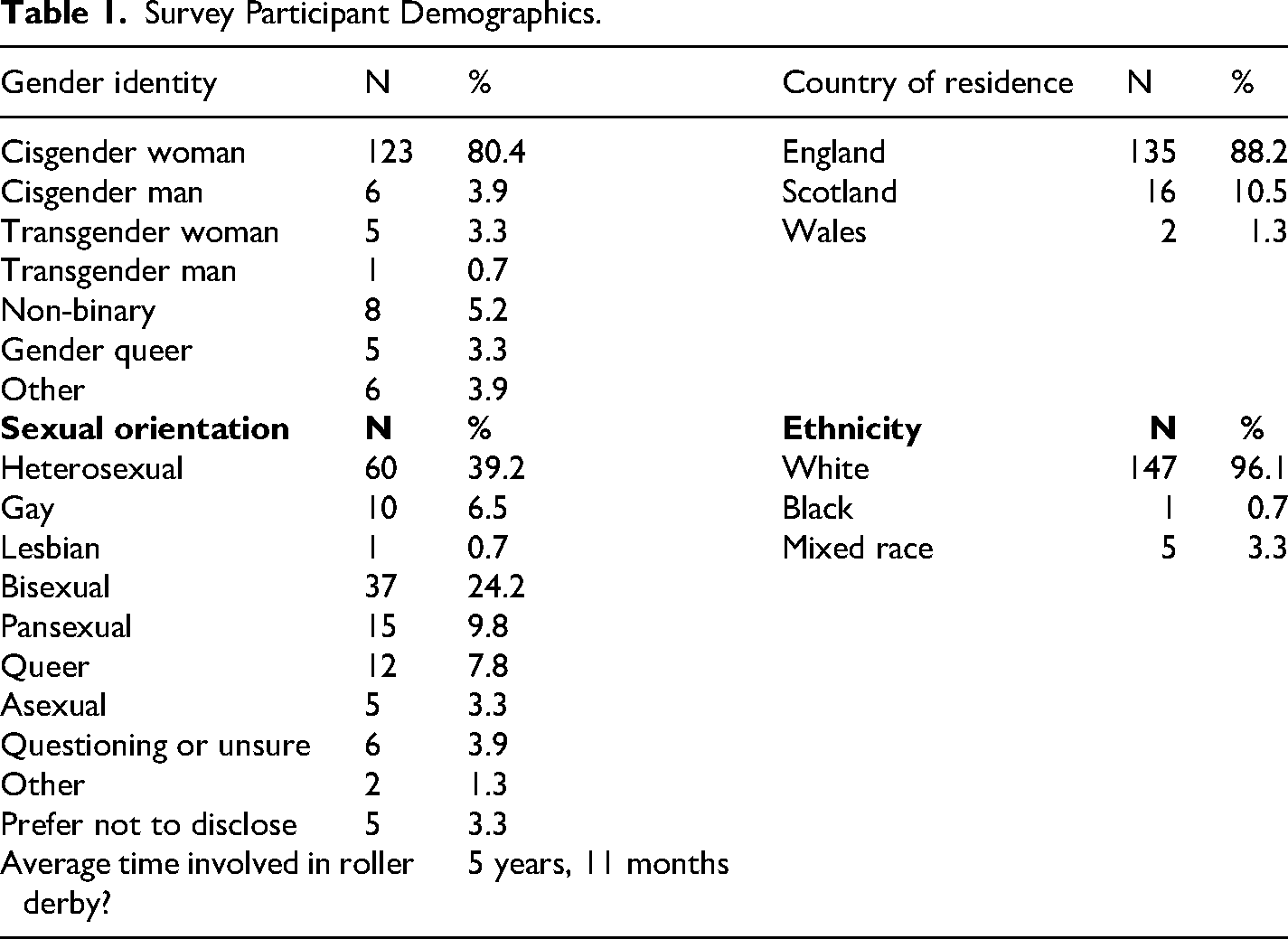
For the online survey, participants were recruited via social media (Twitter and Facebook) and through direct contact with UK roller derby leagues. Recruitment was led by the second author due to her connection with the roller derby community. Members of roller derby leagues were asked to share a recruitment post with others in the roller derby community, therefore facilitating a snowball sampling approach. Participant inclusion criteria were that participants were over the age of 18 and were a member of a women's flat track roller derby league, either as a skater, referee or NSO. A total of 210 participants completed the online survey; 153 responses were from participants residing in the UK and 57 responses were from participants living elsewhere in the world. Given the focus of this study on UK roller derby, the 57 responses from participants outside of the UK were removed for analysis. Table 1 presents demographic information for the participants included in the final sample.
Survey Participant Demographics.
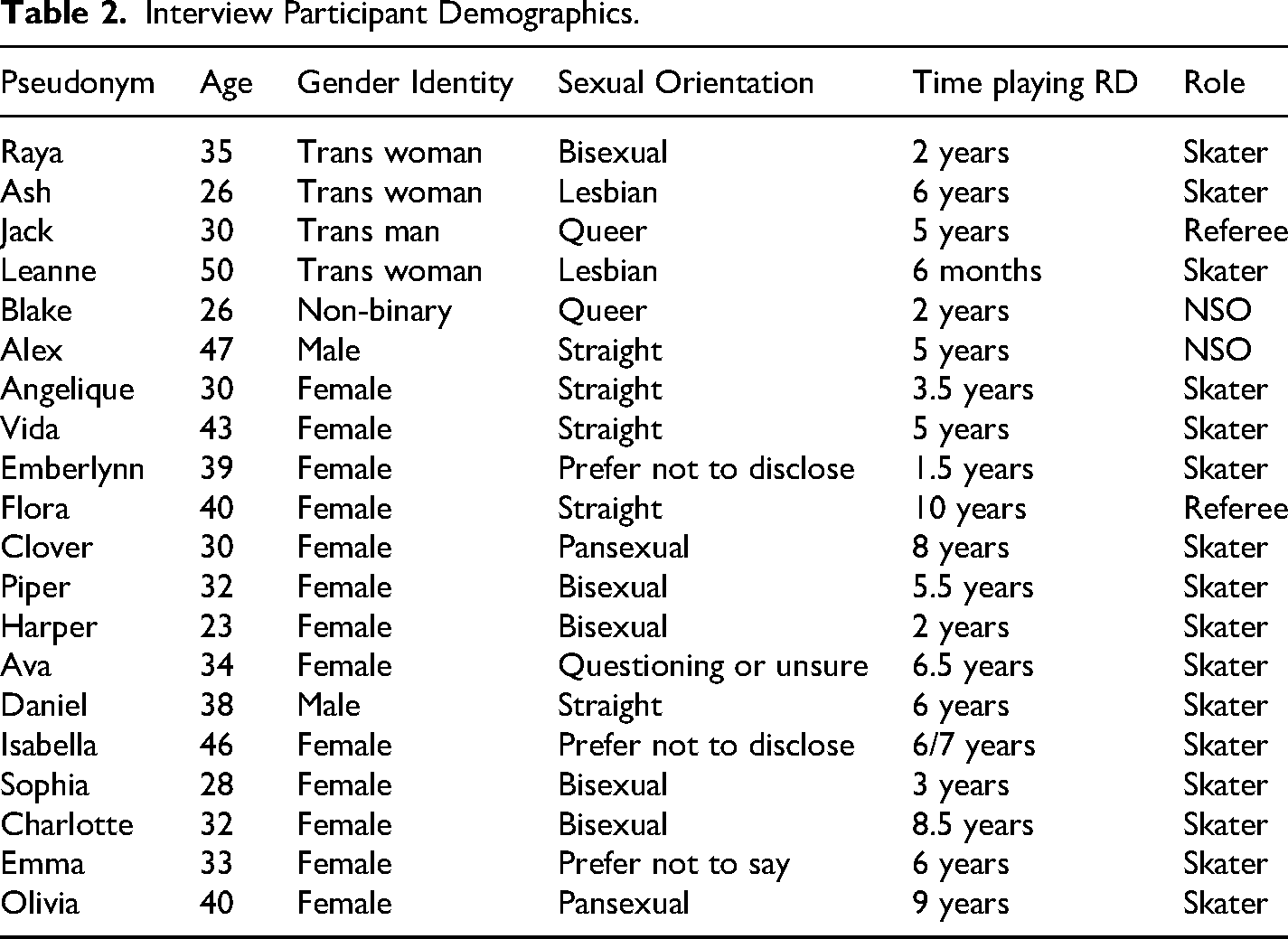
At the end of the online survey, participants were asked to provide their contact details if they were interested in taking part in an interview. A total of 62 participants provided their contact details with 20 individuals agreeing to participate in an interview. Of these participants, 4 identified as transgender, 1 as non-binary, 13 as cisgender women and 2 as cisgender men. All interview participants were White. Further demographic information can be found in Table 2.
Interview Participant Demographics.
Data Collection
Online Survey
The online survey collected data about how gender, and gender-related issues are represented in the sport and to examine participant's motivation to engage with roller derby. It consisted of 30 closed and open questions, asking about: 1) participant demographics (including gender identity), 2) impact of gender identity on work and daily life, 3) roller derby participation, 4) attitudes towards gender inclusivity in roller derby and 5) personal satisfaction with gender inclusion policy.
Telephone Interviews
Qualitative telephone interviews examined in greater depth why individuals might choose to participate in roller derby, alongside their attitudes and experiences of gender inclusivity within the sport. In interview guide including prompts relating to prior sport experiences, motivation for engaging with roller derby, attitudes toward gender policies within their league, and experiences of gender diversity and gender inclusion within the sport was used, although this was used flexibly in response to the participants’ developing account. This provided space for participants to examine their personal constructions and experiences of gender inclusion in roller derby openly and without limitation. Interviews were audio-recorded and transcribed verbatim. Interviews lasted between 40 and 90 min (average length = 65 min). Institutional ethical approval was received and all participants provided written consent to participate.
Data Analysis
Quantitative Survey Data
Descriptive statistical analysis was completed for demographic data and responses to closed-response items using Statistical Package for the Social Sciences (SPSS). These are presented to support the thematic analysis.
Qualitative Survey and Interview Data
Open-ended survey responses were added to the interview data set and analysed using RTA. Braun & Clarke's (2006) six-phase model was followed, with data analysed inductively whilst drawing on the queer-feminist theory to interpret and make sense of the data. Coding drew both on the personal views and experiences of participants (e.g., ‘body positivity’ and ‘trans women are women’), and was used to make visible issues that participants did (and did not) explicitly articulate relating to theoretical constructs from queer scholarship (e.g., ‘gender stereotypes’ and ‘transgressing heteronormativity’). Initial themes identified from the coding phase were reviewed in relation to the wider understanding of the data, the theme's relevance to the research questions and in relation to queer-feminist theoretical considerations. During analysis, authors discussed the coding and thematic development to ensure the constructed narrative from the data presented a clear understanding of gender inclusion in women's roller derby in line with the research aims.
Three themes are discussed: 1) A space accepting of different identities, 2) Body positivity, 3) Roller derby as a social movement.
Findings and Discussion
A Space Accepting of Different Identities
Participants highlighted a variety of reasons why they chose to get involved in roller derby. Survey respondents indicated that many initially engaged in roller derby for enjoyment (n = 42), social interaction (n = 40), or to improve their fitness (n = 36). For instance, Piper was drawn to roller derby after moving to a new city with her partner, seeking a space to make new friends. In this way, fitness, social interaction and a sense of belonging were motivators for engaging in roller derby (Kim et al., 2019). Similarly, a few survey respondents (n = 4) indicated that roller derby offered an opportunity to be more than just a parent, with one stating it was “a way to get out of the house and be me, rather than just mum/wife.”. Some participants (Emberlynn, Sophia, Isabella, Flora, Blake, Ava) described being motivated to find a fitness activity which was unusual, non-mainstream and a replacement for “boring and tedious” trips to the gym (Isabella). Both survey respondents and interviewees reflected on roller derby as a subversive space in which to explore their often shifting, emerging or alternative identities. In this sense, roller derby offered these individuals opportunity to align themselves with a movement which rejected traditional feminine social expectations (Breeze, 2010; Pavlidis & O’Brien, 2017).
That roller derby could offer a means to develop a parallel, alternative identity to mother and partner was also discussed by Angelique, who described joining her local roller derby league after having her first child: “It was just after I had had my little girl and the whole world was completely different to the world before. I just needed to be doing something that meant I wasn’t at home being a mum full-time, because it was really hard. I had postnatal depression so I needed something that made me feel like I had a different identity than just that… I saw one of the This Girl Can adverts and it was roller derby and I thought ‘oh that looks fun, I’ll have a look’.”
Angelique reflects on the difficulty parents, and mothers in particular, face in transitioning to parenthood. New mothers renegotiate their identities through this often challenging, lonely and all-consuming activity (Miller, 2007), and in doing so, sometimes feel part of their former identity is lost (Laney et al., 2015). For Anglique, roller derby offered an opportunity to redefine her identity beyond that of a full-time mother, thus incorporating motherhood and herself into a new imagining of her own identity (Laney et al., 2015). This is, in part, facilitated in roller derby culture by the creation of “derby names” and on-track personas which foster the development of new identities (Becker, 2018). This empowers women to embrace and highlight parts of themselves often obscured by their primary identity as, for example, a parent.
Several participants were drawn to roller derby because its history and culture aligned with their feminist identity. Roller derby is considered a feminist sport - a space which seeks to empower women, whilst allowing the disruption and resistance of conventional forms of femininity (Finley, 2010; Pavlidis & Fullagar, 2013). This perspective was reflected by one survey participant who described how its feminist roots attracted her : “As a feminist, I was interested by the sport as it was formed by women, rather than being an established sport dominated by men. I was also interested as it enables the expressions of behaviour that don’t conform to socially sanctioned femininities.”
Emberlynn, an interviewee, echoed a similar message, describing roller derby as “a sport that is ours.” Roller derby is one of a handful of sports established primarily for the participation of women, setting it apart from sports established (and often dominated) by men. Furthermore, the full-contact nature of roller derby was a drawing point for participants who sought the opportunity to partake in behaviours consider to be tough and stereotypically masculine; providing them a sense of empowerment (Breeze, 2010). In facilitating the expression of behaviours which do not conform to traditional femininity (McRobbie, 2009; Pavalidis & Fullgar, 2013), roller derby is a site for women to challenge gender boundaries, attracting those with feminist ideologies and letting them “hit things” (Emberlynn).
The representation of LGBTQ + membership within roller derby was a key drawing point for gender and sexually diverse individuals who were seeking a space which embraced their identities. This was significant given 60.8% of survey respondents identified as non-heterosexual and 15.7% as non-cis. Several respondents indicated they wanted to join the derby community due to its LGBTQ+ inclusive stance, with one respondent seeking out a space where they could “become more comfortable with my bi identity.” Historically, roller derby has presented a queer public image that visibly recognises and celebrates different sexualities, leading to a common assumption that lesbians comprised a majority of participants (Becker, 2018). This assumption was mentioned by Blake, a non-binary interviewee, when discussing the acceptance of diversity within the sport: “I think it has really progressed like, I think, it was seen as just a lesbian sport, but I think it has changed beyond that.”
The problematising of heteronormative sporting ideals within the sport (Breeze, 2010) gives space for women to explore their identities in new ways, outside of the often binary ways in which sex, gender and sport are enacted. The acceptance of diverse identities beyond ‘(cis) woman’ or ‘lesbian’ was especially significant for TGD participants who felt they would not be accepted within other sport settings. For example, one transgender survey respondent stated that they joined roller derby because “it was a sport with a trans-inclusive gender policy and I was a trans woman becoming aware the rest of the sporting world was hostile to me.” The inclusion of TGD identities within the sports’ gender policy provided a clear message of acceptance and was a significant factor for joining a league, as Raya, a transgender women, reflected: “I did research. My friend suggested we go and do all kinds of things without really thinking about it and like, I always have to do a little bit of research to make sure that I might not have issues, but I did a little bit of research beforehand and I read all about the inclusivity of the sport and it did put my mind at ease and I felt more confident going.”
For the TDG interviewees, roller derby was the only sport they participated in because it embraced their gender identities within both policy and practice. Concerns around sporting fairness have led to the introduction of policies which restrict the categories in which transgender individuals can participate across many sporting bodies in the UK (Gleaves & Lehrbach, 2016). For instance, Blake (non-binary) discussed how they enjoyed cycling but couldn’t compete in a cycling team because of binary gender classifications in the sport which would force them to align with a gender they do not identify with. In some cases, the inclusion of transgender adults in community sports requires them to meet specific criteria, most often taking cross-sex hormones (see Engl& Netball, 2017; Basketball England, 2017; BCGBA, 2021). The omission of these kinds of restrictions within roller derby is significant for TDG individuals participating in the sport. Ash, a transwoman, discussed how gender policies in sports, like cycling and fencing, which follow Olympic gender policy alongside trans-discriminatory sporting cultures, prevented her from competing in these sports, whilst the more inclusive WFTRDA gender policy attracted her to roller derby. Similarly, Jack, a transgender man who refereed for his league, indicated that it meant finding a space to play sport where his gender identity did not act as a barrier to participation, but rather was embraced. They note, “I’d seen a sport that didn’t misgender me, that wouldn’t require me - and I asked, I said ‘I’m trans can I still compete, can I still play derby?’ and they said ‘yes, absolutely.’”
In this way, the absence of restrictions to TGD participants provided a space where their gender identities were accepted. Other studies examining recreational sport participation among TGD participants reported roller derby to be favoured because of its inclusive policies (e.g., Linghede et al., 2022). This research extends this to show that the inclusive rhetoric in roller derby not only attracts TGD individuals, but rather that the sport offers a space for a range of transitioning, marginalised and alternative identities to come together and feel accepted. This was true of different bodies, which is explored in the next theme.
Body Positivity
Body positivity and the inclusion of all body types were a common discussion point for cis and TGD participants. Survey responses indicated that positive body representation was integral within the sport, whereby there was little emphasis on what your body looks like, but rather on what your body can do. This phenomenon was described as ‘freeing’ when compared to the scrutiny women's bodies are often under within sporting contexts, where the focus is often on stereotypical femininity and heteronormative sexualisation of female athletic bodies (Sherry et al., 2016). In this sense, body positivity was an important part of the culture of roller derby and was significant in participants’ continued participation. Almost all of the interview participants reflected on how, unlike in other sports, there is no ideal body type for a successful roller derby player. This was highlighted by Clover, a cis woman, who recalled an interaction during her first training session: “Someone said, ‘oh, you’re a bit bigger’ and I was thinking ‘oh, here we go’ and they went ‘that's really cool’ and I was like… ‘oh, that's not the right response. You’re supposed to say I can’t do this’, but then I looked around the hall and there was people, all kinds of different people there.”
In fact, participants unanimously viewed diverse bodies as integral to the efficiency of a team. The diversity of body types in roller derby is often celebrated, offering opportunities to enhance team performance rather than diminish it. In this way, all body types within the derby setting hold equal value. This culture of body positivity had a significant impact upon skaters’ views of their bodies. For example, Sophia, a cis woman, reflected: “I just loved it [roller derby] because for once like I loved my body for what it could do. It didn’t matter what it looked like, I just felt really strong and powerful in myself.”
Eklund & Masburg (2014) also indicate the positive impact of roller derby on participants’ body image, which could be explained through the ways the sport confronts heteronormative femininity, which positions women as fragile and passive (Breeze, 2010). Through roller derby, women are able to embody aspects of their identities which ordinarily may be shunned or hidden, allowing them to define and redefine identity through both performance and image. Participants referred to how participation in roller derby made them feel more confident in their body. For example, Jack stated “I’ve never found another sport where I’ve felt comfortable being fat.” The body positive culture of roller derby was, therefore, significant in maintaining participants involvement in roller derby.
The acceptance of all body types played into participants’ views around fairness in sport. Specifically, they felt that the nature of the sport itself counteracted issues relating to unfair advantage because the sport offers a space for all bodies, including those which traverse the gender binary. For example, Sophia, a cis woman, discussed roller-skates as being ‘the great equaliser’ and perceived them as a means of mitigating the need for gender segregation and weight categories in comparison to other contact sports. Several interviewees went further with this argument, considering the diversity of bodies and the advantages and disadvantages associated with these. Ava notes: “The idea that you can talk about a sport which is known for being advantageous for lots of different body types and shapes and strengths, taking something where one of the selling points of roller derby is, are you tall, short, fat, thin, strong, weedy, top heavy, bottom heavy, there’ll be something useful that you can do. The idea that you can take that ethos and then say, ‘oh, but it would be advantageous with more male hormones’. For starters, people's hormone levels are all completely different anyway.”
Ava's statement reflects the underlying attitude of cisgender interview participants towards the question of transgender advantage in roller derby. To skaters, the nature of the sport is ‘equalising’ as any advantage from height or body type came with an equal disadvantage. This perception was reflected upon by Raya, who discussed how the inclusion of diverse body types mitigated arguments about advantage: “I’ve never felt that my [trans]gender has given me any advantages with roller derby… it's clear that I’m not the tallest, I’m not the strongest, I’m not the fastest so there can’t really be any arguments against me.”
Raya compares herself and her body to that of her teammates. In participating in a sport where all bodies are celebrated, and all bodies offer advantage, participants felt that an inherent level-playing field was established, diminishing arguments about unfair advantage relating to the gender binary. The nature of the roller derby space as one which actively challenges and disrupts heteronormativity provides greater engagement opportunities for TGD skaters who are often rendered abject and unintelligible by gender boundaries within sport and wider society (Butler, 1993). Abjection represents social dynamics whereby identities which do not fit the normative ideal of gender binarism become dehumanised and excluded (Butler, 1990, 1993); the symbolic ‘pushing away’ of anyone who does not fit within the confines of an acceptable self. However, the celebration of all bodies and all identities in roller derby challenges this directly, empowering participants to embrace and celebrate their own bodies.
That being said, changing facilities were a site which had the potential to counter this for TDG participants. Whilst some roller derby leagues have their own venues, many leagues use local leisure centres, which primarily include binary changing spaces. These changing spaces were either assigned for the use of the league (e.g., one women's communal changing room for all) or changing rooms were used which were open to the public. Whilst these spaces were available for the use of all skaters, interviewees described how formal changing areas were often ignored in favour of the main training hall, or other public spaces (e.g., cafeteria). Whilst changing spaces ‘did not even register’ (Flora) for cisgender participants, for Blake, a non-binary participant, they were a site of discomfort: “Everyone was told to go and kit up in the women's changing room which kind of to me was a bit like ‘why? Because there are other [spaces] available’.”
Since changing spaces were sometimes used to discuss game play and coaching plans, Blake felt they had no other option but to use a space they were not comfortable inhabiting. Using alternative spaces to change came with challenges, as they describe: “I think there is a disabled toilet but it's a bit awkward to go and find it and then find where everyone else is…I think for me that bit is hard to say to other people like ‘oh I’m just going to go and get changed somewhere else if you don’t mind’.”
When changing spaces were not delineated by gender (i.e., ‘the roller derby changing room’), Blake described feeling much more at ease because everyone was in there, so “it was just like normal”. This was echoed by Raya: “When we go to away games and are changing quite often, we’ll all change in one room and I’ve always been quite comfortable in that environment, but perhaps not everyone would be…it's being aware and not just treating everyone the same but with an awareness of what people might struggle with.”
Here Raya considers that whilst she does feel comfortable changing with her team, others may struggle in those spaces, calling for more awareness of that within the sport. This also highlights that although roller derby positions itself as a gender inclusive sport and participants are accepting and celebratory of this, that there are gaps in understanding and existing societal barriers which persist as exclusionary hurdles for TGD individuals both within and outside of the sport. This is raised in other research examining the experiences of TDG people, where changing spaces were often described as ‘unsafe’, hindered their participation in sport and generated fear of social rejection and harassment (see Devís-Devís et al., 2018; Erikainen et al., 2022). Gender segregated changing rooms can cause feelings of invalidation toward the identities of TGD individuals, making them difficult spaces to navigate. Thus, gender-neutral changing spaces and toilets are perceived favoured by TGD individuals (Jones et al., 2017, Erikainen et al., 2022).
Roller Derby as a Social Movement
Participants in this study felt that roller derby offered a community underpinned by a shared values system. They described the core values they viewed as being central to the derby community and how these facilitated a higher sense of comradery amongst members. These values were primarily concerned with the promotion of equality, diversity and inclusion within wider society. For instance, Piper, a cis woman, described how joining the derby community was to join a social movement, stating: “It's very strong early on that all bodies are equal, that we’re sort of supporting the LGBT + movement, the trans movement… you’re not just part of a sport, you’re being part of this social movement and I feel like you’re committing just as much to that movement as you are to the sport itself.”
In this way, roller derby is a site for social and political activism, where members of the community are expected to commit themselves to the sport and to take action against injustice. Several participants discussed attending protests for transgender rights with their team, along with their leagues’ presence at pride parades, which for some was how they learned of roller derby in the first instance. Generally, participants spoke to their roller derby leagues’ support for these movements, promoting awareness about the inclusivity of the sport and its community. The political stance of roller derby leagues was a common point of discussion for participants, who described their leagues as holding socialist, or left-wing values, and for many, this was a big part of the community and could not, or in their view should not, be separated. Ava, a cis woman, notes: “My view personally is you can’t separate those things [politics and derby], you know, people who experience prejudice in whatever way day to day don’t get to just switch that off. As a community for those people and for anybody, we have to be mindful that we don’t get to switch that off. We don’t get to decide that the political side of things doesn’t matter.”
Participants considered these values in relation to roller derby gender policy. They explained that being inclusive of TGD individuals was part of their community and that their stance was one of zero tolerance for anyone who disagreed with TGD inclusion in the sport. For example, in relation to her league's stance on gender inclusion, Angelique stated “This is what we stand for. You have to sign up to this, or perhaps this isn’t the place for you”.
When examining the survey data, a vast majority (79.5%) of respondents were aware of the gender policy and were comfortable playing with (93.8%) or against (89.6%) a TGD skater. Interviewees provided insight in relation to this: “As far as I’m concerned and as far as our league is concerned, anybody who identifies as a woman and anybody who feels that their gender identity matches best with women's roller derby is welcomed as a part of it and I will absolutely defend that” (Ava, cis woman)
Ava presents a clear message of support for skaters, regardless of their identity. The use of language, like ‘defend’, alludes to ongoing debates surrounding inclusion particularly of trans women in women's sport (Gleaves & Lehrbach, 2016). Roller derby has been targeted as a ‘female-only sport now open to males’ (Fair Play for Women, 2019), causing uproar from the roller derby community who took to social media in solidarity with TGD skaters. All of our interviewees condoned this article, stating that arguments about unfair advantage were ‘ridiculous’. Vida (cis woman), for example, says “nobody decides to be a woman because of the advantage it's going to give them in roller derby, that's a stupid concept.”; while Angelique states that arguments about fairness were: “Just a reason to exclude people… It's almost framed as ‘oh they’re competing in the women's category because they could win that and they couldn’t win if they were in the male category’…that assumption that that's what's going on, I think it's ridiculous.”
Indeed, 90% of survey respondents disagreed with the statement, ‘I think women's roller derby should only be played by people who are born female’ and 74.5% did not believe that being transgender offered unfair advantage in the sport. This demonstrates overwhelming support for the WFTDA gender policy. Emberlynn, who is a cis woman, however, acknowledged the complexity of the situation from a feminist standpoint: “This is a sport that originated by women, for women… I can understand how that feels incredibly precious from a feminist viewpoint and that we own it, it is ours, but if we tell other people they’re taking something away from us by allowing them in, we are no different from the men who say we have no place in their sport. We are guilty of the same thing. Just because we originated it, doesn’t make it ours to control.”
Here, Emberlynn recognises why some skaters may not want the sport to change, but essentially argues that dictating who can and cannot participate is continuing the same exclusionary acts of control that feminists have sought to overcome. Other participants echoed similar notions, suggesting that derby “isn’t a cis women's sport, it's everybody's” (Ava). Taken together, participants in this study felt roller derby was more than sport but a community built on shared values around social justice, inclusion and equality. These shared values act to create strong bonds between members and work to create a welcoming space for TGD individuals. As noted by Raya, the roller derby community have “the desire and the drive to understand and to be inclusive, that attitudinal thing, that's at the heart of it.”
The inclusive vision held by many of our participants translated into practical measures taken by leagues. Some cis participants noted that their leagues sought to educate their members on gender diversity. For one, this included inviting speakers from local universities and providing diversity training to help make skaters ‘better informed’ (Harper). In these cases, training impacted the language used by members in the leagues, with participants encouraged to use they/them pronouns for skaters they did not know. These small steps were seen by TGD members as bolstering feelings of acceptance within roller derby. Blake explains: “Even small things, like a lot of places have like rainbow versions of their logo and things like that and it's just kind of nice that they have really accepted all of those things and I think it has really progressed.”
Part of feeling accepted was to feel that they were, or would be, supported in any circumstance. Whilst Raya had never experienced exclusion in roller derby, she suggested: “If push came to shove and someone overtly said, ‘what the fuck are you doing playing women's roller derby?’ that my bench coach and my league and the officials would back me to the hills.”
Aligning with this viewpoint, cisgender participants gave examples of instances where they had had to support a TGD team-mate. For example, Harper described a situation where a rival team sought to exclude a transgender skater, stating: “The other team had an issue saying ‘well technically she's a male, she’ll have an advantage over us because she's a little bit stronger’ and we were all going ‘well, you can’t really dispute that, that's not fair’ and it was an ongoing argument… they eventually just let her play.”
Here, Harper and the rest of her team embodied the core values of inclusion by opposing the exclusion of their teammate on the grounds of gender identity. However, this illustrates that these values may not be shared universally within the roller derby community. Rather, normative ideologies do remain in the sport, and such instances speak to the broader power relations which exist in an organically developing, do-it-yourself governance. In this sense, roller derby is a shifting entity, where sport is entangled with political activism, something Pavlidis (2023) refers to as troubled derby subjectivity.
Whilst TDG participants’ experiences of roller derby were predominantly positive and inclusive, several shared instances of feeling consciously and unconsciously excluded or discriminated against. This predominated around competition, where rival team members misgendered participants or sought unjust penalisation. For example, Ash described how she was ‘singled out’ on penalties compared to her teammates during a tournament, stating: “I pick up very few penalties which is one of the reasons I get selected so often as a jammer, but in this tournament, one of the games I fouled out… they seemed to pick me up on absolutely everything… I didn’t raise it with anyone, but it was pointed out by one of my teammates.”
In picking up so many penalties, she described feeling singled out in comparison to her teammates. Indeed, cisgender participants discussed instances where they had witnessed TGD skaters accumulating more penalties than others during bouts. Angelique stated, “I wonder if it's like an implicit bias type thing that they’re not aware of”. TGD participants reflected on situations such as these, feeling they had been unfairly treated within tournament settings due to unconscious biases regarding a perceived advantage (Jones et al., 2017; Gilliam, 2018). This can be linked to debates around physiological attributes of transwomen within competitive sport environments, wherein the discourse presents transgender athletes as possessing a significant advantage which results in a complete loss of fair play and creating unsafe environments for cis female athletes. In this way, TGD skaters can face discriminatory practices during both competition and training, despite the inclusive values which are considered so central in the community (Gilliam, 2018). This highlights the broader and persistent heteronormative values which underly competitive sport, and the challenge sports like roller derby have in confronting them to create more inclusive sporting environments.
Conclusion
This study has highlighted how women's flat track roller derby offers opportunities for both women and TGD people to engage in sport, whilst developing, exploring and embracing alternative identities. Within roller derby, women and TGD people are empowered to disrupt and resist heteronormative ideals on gender through the expression of behaviours which challenge gender borders traditionally present within sport.
Within sporting contexts, the abjection of TGD identities takes the form of strict gender policies which often exclude TGD individuals from participating in categories aligned with identified gender. This research indicates how the inclusion of TGD identities within the sports gender policy provided a clear message of acceptance to TGD people, a significant factor that influenced their participation. Through actively disrupting heteronormative ideals, including through their gender policy, roller derby breaks down the hegemonic limits placed on identity, creating a space where there is no ‘incorrect’ way to identify, or perform gender. In this way, TGD skaters can meaningfully engage with the sport, without their identity or gender performance acting as a barrier. Future research should seek to extend this by examining how gender policies are constructed and interpreted, and the influence they have on engagement and participation, particularly in sports looking to expand their diversity.
Our research showed that body positivity was an embedded part of the sport's culture and played a role in developing an inclusive sporting space for all participants. Diverse bodies were unanimously viewed as integral to the efficiency of a team. In this way, the nature of the sport was perceived by many as a means to mitigate the need for gender segregation and weight categories in comparison to other contact sports. To this end, participating in a sport where all bodies are celebrated, and all bodies offer advantage, participants felt that an inherent level-playing field for all was established, diminishing arguments about unfair advantage as a result of sitting outside of the gender binary.
This research highlighted roller derby as a site for social activism, where members of the community shared core values in relation to the promotion of equality, diversity and inclusion within wider society. As a sport underpinned by explicit inclusion policies, it attracted individuals who shared in these values, creating a community driven to promote social change for the diverse members of that community. Other studies have examined sport participation among TGD individuals, but this research extends on this to show that inclusive rhetoric surrounding gender in roller derby not only attracts TGD individuals but offers a space for a range of marginalised and alternative identities to come together and feel accepted within a sporting space. More research is needed to examine the ways in which sports can and are used as sites for social activism.
Footnotes
Competing Interests Statement
The author(s) have no competing interests.
Data availability statement
Due to the nature of this research, participants of this study did not agree for their data to be shared publicly, so supporting data is not available.
Funding
This research received seedcorn funding from Loughborough University.
Loughborough University, (grant number n/a).
