



Abstract
This paper draws from a research project that was initiated in 2017 and continued in to 2020. It followed on from previous University-LGBT + community projects (e.g., football versus homophobia 2012–2018) and involved working with a local transgender social group, specifically, their engagement with once-a-month recreational swim sessions. The research findings that are discussed come from sixty-three research participant's ‘drawings’, three focus groups including a professionally drawn illustration of two of these focus groups, and nine semi-structured interviews. The analysis of the qualitative data demonstrates the significance of play and pleasure, feeling free, and transgender and non-binary imaginations to physical activity participation, and wellbeing. These three themes are presented through the lens of queer/queering and transfeminism. As such, the paper has two aims: to document the experiences of physical activity by an often-excluded group; and to evaluate the concept of queering to an understanding of indoor recreational swimming and wellbeing.
Introduction
Swimming is a popular physical activity in the UK. Sport England regularly publish survey findings and for the years 2015 to 2019 swimming featured annually in the top six physical activities, behind participation in walking, fitness, running, and cycling (Sport England, 2020). Swimming usually takes place in indoor pools in the UK, but there is evidence of increased participation in outdoor and open water swimming (Sport England, 2018). Swim England promote the many health and wellbeing benefits of swimming, citing their commissioned report published in 2017 (see: https://www.swimming.org/swimengland/health-and-wellbeing-benefits-of-swimming/). In the report, Moffatt (2017) posits that swimming and aquatic activity can contribute to community capacity and wellbeing because of the potential value participation can add to human capital, social capital, civic engagement and shared values. And yet, neither Sport England nor Swim England have figures for Lesbian, Gay, Bisexual and Transgender (LGBT) participation in swimming and aquatic activity. Sport England does have levels of physical activity figures for gender (women/men), socio-economic groups, age, disability and ethnicity.
LGBT communities are known to experience health inequalities related to mental health and wellbeing (Public Health England, 2017). For example, LGBT youth are shown to have higher risk of suicidality and self-harm compared with non-LGBT youth as a consequence of: ‘(i) homophobia, biphobia or transphobia; (ii) sexual and gender norms; (iii) managing sexual and gender identities across multiple life domains; (iv) being unable to talk; (v) other life crises’ (McDermott et al., 2018, p. e244). Transgender individuals tend to experience these inequalities more than LGB individuals (Connolly et al., 2016; Government Equalities Office, 2018). Amongst others, Zeeman et al. (2017) confirm this point: … whilst research with LGBT people has uncovered joint concerns over experiences of marginalisation, exclusion and stigmatization … a number of studies indicate that trans people experience significantly higher rates of bullying and marginalisation, they feel socially isolated more often, or have a decreased sense of connectedness to their communities. (p. 385)
Health geographers Foley and Kistemann (2015), focusing on blue space, demonstrate how water impacts, positively, the health of individuals. In particular, research of outdoor waterscapes reveals the restorative, salutogenic and therapeutic value of swimming and immersion in water (Foley, 2015, 2017). There is limited research of indoor blue space, which tends to document the development of spas and links to predominantly physical health (Foley, 2010). Broadly, within the health geography literature there is acknowledgement of the emotional, physical, and imaginative properties of being in blue space/water (Foley, 2015) and an appreciation of geographies of difference and diversity; for example Foley and Kistemann (2015) recognise: ‘One characteristic of blue space is its capacity to embrace bodies of difference in ways that are gently enabling’ (160). However, from this perspective, there is no previous study of the health and wellbeing benefits of water-based physical activity to transgender and non-binary individuals and their communities.
In this paper, I seek to bridge the gap between the popularity of recreational swimming in the UK, the inequalities of health and wellbeing faced by transgender and non-binary people, and the value of indoor water-based physical activity participation by members of a social group advertised as: ‘for trans people’. Discussion turns to the concepts of queer and queering to enable an argument for the re-thinking of indoor public pools in the UK in order to include the transgender and non-binary community. Accompanying this conceptual focus is a transfeminist theoretical framing, which works to challenge transpathologization and transphobia. According to Ahmed (2016), transphobia has deep and insidious consequences as it ‘works as a rebuttal system, one that, in demanding trans people provide evidence of their existence, is experienced as a hammering, a constant chipping away at trans existence’ (p. 22).
The discussions in this paper offer useful interjections at a time when transpathologization and transphobia are increasingly evident within societies that are deemed liberal democracies. The current moves to deny inclusion in sport in USA is one example: ‘Republican lawmakers in more than 25 US states have advanced legislation banning transgender children from certain sports teams and limiting their access to gender-affirming healthcare’ (Levin, 2021, ¶1).
Queer/ing physical activity
The term ‘queer/ing’ seeks to recognize both queer (adjective) and queering (verb) physical activity. In discussing queer/ing physical activity it is important to introduce and acknowledge the application of queer within the fields of sport studies and physical education.
Existing contributions to the study of sport span two decades and debate, for example, the value of queer/queering to: demonstrating gender resistance in women's sport (Broad, 2001); understanding sexualities in sport (Caudwell, 2006); evaluating theories of sexualities in sport studies (Sykes, 2006); critiquing the whiteness of sport studies (McDonald, 2006); exploring the queering of sport through lesbian softball and transgender participation (Travers, 2006); questioning what is queer about sport sociology (King, 2008); interrogating white queer privilege within homonationalism during Gay Games and Out Games (Davidson, 2013); and examining normalization and inclusion of queer identities (Mann & Krane, 2018), to name a few.
Within Physical Education (PE), critical thinkers have highlighted that PE is not queer and that this has had a negative impact on teachers and students (Clarke, 2003; Sykes, 1998). And yet, PE has the potential to be queer/queered (lisahunter, 2019). In particular, introducing a queer PE pedagogy is cited as a fruitful avenue to subvert normative notions of gender and sexuality (Larsson et al., 2011; Larsson et al., 2014). Continuing with a critical approach to pedagogy, Devís-Devís et al. (2018) report on their work to include the experiences of trans students in the PE curricula, and Sykes (2009, 2011) advocates for queer bodies, including fat and LGBT bodies, as productive embodiments in reforming PE tradition and culture.
As is evident queer has nuanced alliterations. It announces the group Lesbian, Gay, Bisexual, Transgender, Queer and Intersex (LGBTQI) as well as similar groupings (e.g., LGBT, LGBT + ) based on sexuality and gender. In this way, it works as a noun. It is used to name theory: queer theory, which seeks to critically interrogate, via deconstruction, previous knowledge claims and theories of gender and sexualities. In brief, queer theory deconstructs the dominant normative by highlighting and celebrating LGBTQI experiences. There are rigorous evaluative reviews of how this is achieved in sport (Sykes, 2006) and PE (lisahunter, 2018). Both Sykes (2006) and lisahunter (2018) identify the value of a move beyond the noun queer to the adjective queer and verb queering.
Away from sport and PE, Espineira and Bourcier (2016) argue that ‘queer’ reflects a white Anglo imperialistic language that promotes ‘an abstract concept of political subjectivity’ (p. 88). They highlight its shortfalls: “Queer” lately has been the target of harsh criticisms for its multiple perceived failures: internal racism, false promises of intersectionality, class privilege, the still burning issue of feminism. (Espineira & Bourcier, 2016, p. 90)
The authors go on to pose an interesting question, and advocate for the development of a queer approach: Is this queer corpse worth reanimating, or should we let it die? In Animacies, the linguist Mel Y. Chen (2012) suggests that if such a thing as queer liveliness still exists, it is to be found in queer's verbal and abjectival forms rather than its deadly nominal one. (Espineira & Bourcier, 2016, p. 90)
It is worth noting that these arguments are made within the context of transfeminism and a chapter entitled: Transfeminism. Something Else, Somewhere Else. After opening the potential value of queering, the authors opt for the term ‘trans’ and all that it holds: ‘Trans is not about resignification; rather, it is about rematerialization’ (p. 90). They conclude that ‘transfeminism is that “something else,” and it is happening somewhere else than white Anglo feminism and queer theory in the United States’ (p. 90).
The idea of something else and somewhere else receives some reiteration in sport studies with Linghede and Larsson (2017) ‘Figuring more livable elsewheres: Queering acts, moments and space in sport’. Through a bricolage of Swedish elite athletes’ experiences the authors present narratives of the queering athlete. There are three figures of queering athlete – the sports dyke, the sports fag and a sexuality that is not one. The lesbian, gay and bisexual perspectives that are told through these queering athletes are based on ‘queer(ing) acts, moments, and spaces’ (p. 292). The three figures are used to story and re-story gender and sexuality within the often-conservative realms of sport. To tell of the normative, dominant and oppressive and to weave in as a form of re-telling the complicated, contradictory, and affirmative; ‘that not only reproduces what has already been but also opens up the possibilities of alternative and more livable futures.’ (p. 292). It is the construction of the three figures that provides a ‘criticalcreative way that opens up for queering’ (p. 303). This queering seeks to enable ‘livable elsewheres’ (p. 303).
Although from different fields, the work of Espineira and Bourcier (2016) and Linghede and Larsson (2017) offer ways to explore the value of queering to the potential of something else, somewhere else and livable elsewheres. For Linghede and Larsson (2017), queering is given meaning through the lives of elite female and male athletes and their sexualities. This focus on sexuality is not uncommon within queer studies. In this case, it provides further challenge to how sporting cultures and practices construct heteronomativity through gender norms that are apparent in the myriad of sporting acts, moments and spaces. However, for Espineira and Bourcier (2016), queering must be contextualised within trans and transfeminism. In doing so, there is a move away from a focus on sexuality per se and a move to involving transgender and non-binary embodiments. And yet, the authors leave unclear, and incomplete, the relationships between trans, transfeminism and queering. Suffice to conclude that the potential links between trans, transfeminism and queering remain largely underexplored within sport studies and PE.
If queering is about disturbing, dislocating and deconstructing the infinite normatives by self-identified non-normative individuals, their embodiments and behaviours in time and space, then the physical activity of recreational swimming by transgender and non-binary people is an appropriate site to study its operations. The critical analyses of sport and PE from a queer perspective do call for alternatives, resignification and rematerialisation of form and formations of bodies and human movement, however there is limited research (e.g., Travers, 2006) that considers the queering of physical activity by transgender and non-binary participants. Moreover, research that demonstrates the consequences of queering recreational swimming, and how this queering enables wellbeing.
Methodology
Introduction to the Project
This research project developed from a previous University-LGBT community initiative that involved football, the work of Football 4 Peace (F4P) at the University of Brighton, and the engagement by university sport studies and physical education students in F4P versus (v) Homophobia (2012–2018). F4P v Homophobia gained momentum as a social justice sport event; it achieved awareness raising of homophobia, biphobia and transphobia within student and local/national LGBT + communities (see Caudwell & Spacey, 2018).
In 2017, community groups came together for Bournemouth University's (in partnership with the University of Brighton) Football v Homophobia event. This involved the inclusion of local transgender and non-binary groups. From this meeting, the swimming project started and developed by way of securing funding from external (i.e., British Academy and Leisure Studies Association) and internal sources (Bournemouth University). This funding financed: private-hire swimming pool sessions (x 11); employment of a professional illustrator (non-binary artist) to draw the content of two focus groups; the hire of regional art gallery space (The Lighthouse, Poole, UK) as well as Bournemouth University campus gallery space; and the purchase of exhibition materials for art work that was displayed from January-March 2020, aligned with LGBT History Month (February).
The research period began in February 2017 and ended February 2020; it involved being at some of the Friday night once fortnightly group gatherings (n = 9) and attending swim sessions as observer or participant observer (n = 11). The observations of swimming sessions and attendance at group sessions adopted a short-term ethnographic (Pink & Morgan, 2013) element of ‘hanging out’, building trust, sharing information about the project, and gaining group approval for ideas such as the art exhibitions.
This paper is based on the findings from semi-structured interviews (n = 9), focus groups (n = 3)(including images cropped from the professionally drawn illustration of two focus groups), and participant's ‘drawings’ (n = 63). After nearly all of the private-hire pool sessions, participants were asked if they would ‘draw’ how they felt before, during and after being at, and in, the swimming pool. Not all participants wanted to do this, but a good number of participants did complete ‘drawings’. The results of the request varied from artistic drawings, simple drawings, a number of words on the page and written passages. These research methods (interviews, focus groups and drawings) are returned to in more detail after the discussion of ontology.
Ontology: Trans Being/Being Trans
What if you are required to provide evidence of your own existence? … An existence can be nullified by the requirement that an existence be evidenced. (Ahmed, 2016, p. 29)
Societal institutions aligned with the political, religious, scientific and medical as well as seismic processes such as colonization have governed the social construction of the terms lesbian, gay, bisexual and transgender in order to bring in to existence, mark out, and present as stable the nomenclature of gender and sexuality. The resultant systems of LGBT classification have been exposed as simplifying the immeasurable nature of human sexualities and genders (Sedgwick, 2008).
Previously, when writing about research with, by and for LGBT individuals, I have critically discussed the historical socio-cultural naming and labeling of sexualities (Caudwell, 2015a, 2015b), and the complexities of lived experience within the term LGBT in relation to transgender (Caudwell, 2014); referring to self-identification (Caudwell, 2020). Notwithstanding identity politics and the value of the terms lesbian, gay, bisexual and transgender to equality, inclusion and social justice, there is a need for a deeper discussion regarding transgender and non-binary existence from an ontological and epistemological point of view.
Ahmed (2016) highlights—in the quotation at the start of this section—that transgender existence can be denied. This means that for some transgender people: ‘Survival becomes a project when your existence is the object of a rebuttal. You have to survive a system that is constantly chipping at your being’ (p. 31). Underpinning this rebuttal system are elements of feminism, namely Gender Critical Feminists and Trans Exclusive Radical Feminists (TERFs). These strands of feminism contest the existence of transgender, in particular trans women. The denials of trans women's existence are based on philosophical and ideological arguments surrounding the unitary category ‘woman’ and who can/can not be included (Bettcher, 2017).
Transfeminism seeks to merge feminism, gender studies and transgender studies. Writing from a transfeminist perspective, Enke (2012) explains that ‘… the compound “transfeminist” arises out of a desire to see both “trans” and “feminist” do more flexible work’ (p. 3). This desire is based on the argument that transgender and transgender studies have been viewed as ‘shadowy interloper[s]’ (p. 2) and that some aspects of gender studies consider transgender as ‘a small number of “marked” people whose gender navigations are magically believed to be separate from the cultural practices that constitute gender for everyone else’ (p. 2). Instead Enke (2012) shows how transfeminism has potential to fuel flexible gender epistemologies (p. 8). One example offered is ‘the breakneck pace with which we adapt and adopt new vocabularies and linguistic practices’ (p. 9) vis-à-vis transgender.
A key point at this juncture is that if components of feminism and gender studies have operated to deny and exclude transgender existence then it is no wonder that the ontological and epistemological starting point for many societal institutions—e.g., sport and recreation provision and public health—is to omit and/or refuse transgender existence. Obviously, this is damaging and dangerous as Enke (2012) argues: If we can become speaking subjects only by occupying legible nodes within institutional structures—that is, by having a name, performing a recognized demographic category, and so forth—we also reckon with the fact that we exceed every possible legible node … sometimes so much so that the institution literally has no place for, or violently mis-places, such subjectivities (p. 11).
With the aim of bringing together the above discussion that implicates the work of Ahmed (2016); Bettcher (2017) and Enke (2012), I finish this methodological sub section with the advocacy for a transfeminist ontology as fundamental to the fields of sport, PE and physical activity. That is a belief in, and commitment to, the legitimacy of transgender existence, trans being and being trans. Such ontology accepts self-definition, self-identification and the possibility that trans is not always fixed and stable; it has potential to be unclassifiable. This transfeminist ontology has capacity to connect with the role of sport, PE and physical activity in aiding wellbeing. The violations of being mis-placed, having no place, excluded and nullified are known to link with health inequalities faced by transgender and non-binary individuals and communities. Consequently, a transfeminist ontology in sport, physical activity and health studies is overdue.
Method
The research adopted the traditional qualitative research methods of semi-structured interviews (n = 9) and focus groups (n = 3). The sample was a volunteer sample from members of the social group who participated in the swimming sessions. Three people took part in both an individual interview and a focus group because they volunteered to do so. The focus groups involved nine people in each focus group. The nine interviews lasted between 25 min and 40 min. The three focus groups lasted: 35 min, 50 min and 60 min. The interviews and focus groups were recorded and the recordings were transcribed verbatim. The analysis of the transcripts conformed to processes of thematic analysis (Braun & Clarke, 2006) and coding sought to address the research question: how does access to swimming facilities impact individual and group wellbeing? In this way, coding aimed ‘to identify patterns across the dataset in relation to the research question’ (Braun & Clarke, 2014, ¶4). The derived themes of play and pleasure, and feeling free were subsequently applied through further analysis to the ‘drawings’ made by the participants (n = 63). During this phase of analysis a third theme emerged from the ‘drawings’, namely transgender and non-binary imaginations. This theme, which originated immediately after the swim sessions, indicated how participation in the swim sessions gave rise to creative thoughts and expressions that centred the self.
The research project gained ethical approval through the usual procedure at Bournemouth University. Participant information sheets and participant agreement forms were used for the interviews, focus groups, observations and drawings to ensure informed voluntary consent. Pseudonyms are used in this paper to ensure anonymity.
Reflexivity
During writing about ‘an affinity of hammers’ and the rebuttal system of transphobia, Ahmed (2016) acknowledges: ‘[m]y cis privilege was … not having had to notice that harassment or not having had to hear the sound of that blast’ (p. 27). By this, she means the constant hammering and chipping away of (transgender) existence. I acknowledge the same privilege and positionality. In previous critical analysis of the project, which focuses on spatiality, embodiment and safety, I write: As a cisgender, white, academic (i.e. middle-class), I have socio-cultural power and privilege in a number of arenas, including the physical activity of swimming. For example, I am given easy access to the public spaces of swimming pools. In terms of my embodied self, I do not normally face everyday, frequent and deliberate scrutiny, surveillance and suspicion. (Caudwell, 2020, p. 4)
Ahmed (2017) also highlights that trans allies can contest and oppose the normative and coercive sex-gender system and accompanying transphobia. My aim in this paper is to represent the research participant's experiences in order to demonstrate the value of physical activity that is not usually facilitated.
Findings: Indoor Swimming, Transgender And Non-Binary Wellbeing
I nearly did it as a sport when I was younger and then I came out and didn’t swim ever again. I tried it one time before the swimming group and was like – “never doing that again”, so it's really nice way for me to swim. … I think December was my first time doing it with the group and I had swum in November with a friend and it was really bad. I was wearing a waterproof tank top and it is literally designed for a pool, for anyone. A lifeguard in front of several people, it was a busy day; there was big blokes next to me and families next to me; very curious kids that were very curious of my body anyway. I was wearing an extra thing and covered in tattoos, I just look queer. They were all looking anyway and this lifeguard she came over and tapped me to speak to me, and said “why are you wearing that into the pool?” I was like: “it's waterproof.” She was like, “why are you wearing it, what's your reason?” So, I actually outed myself in front of thirty people. I was like, “I am transgender, this is the only way I can swim”. I don’t know why she felt the need to single me out. (Seth, one-to-one interview)
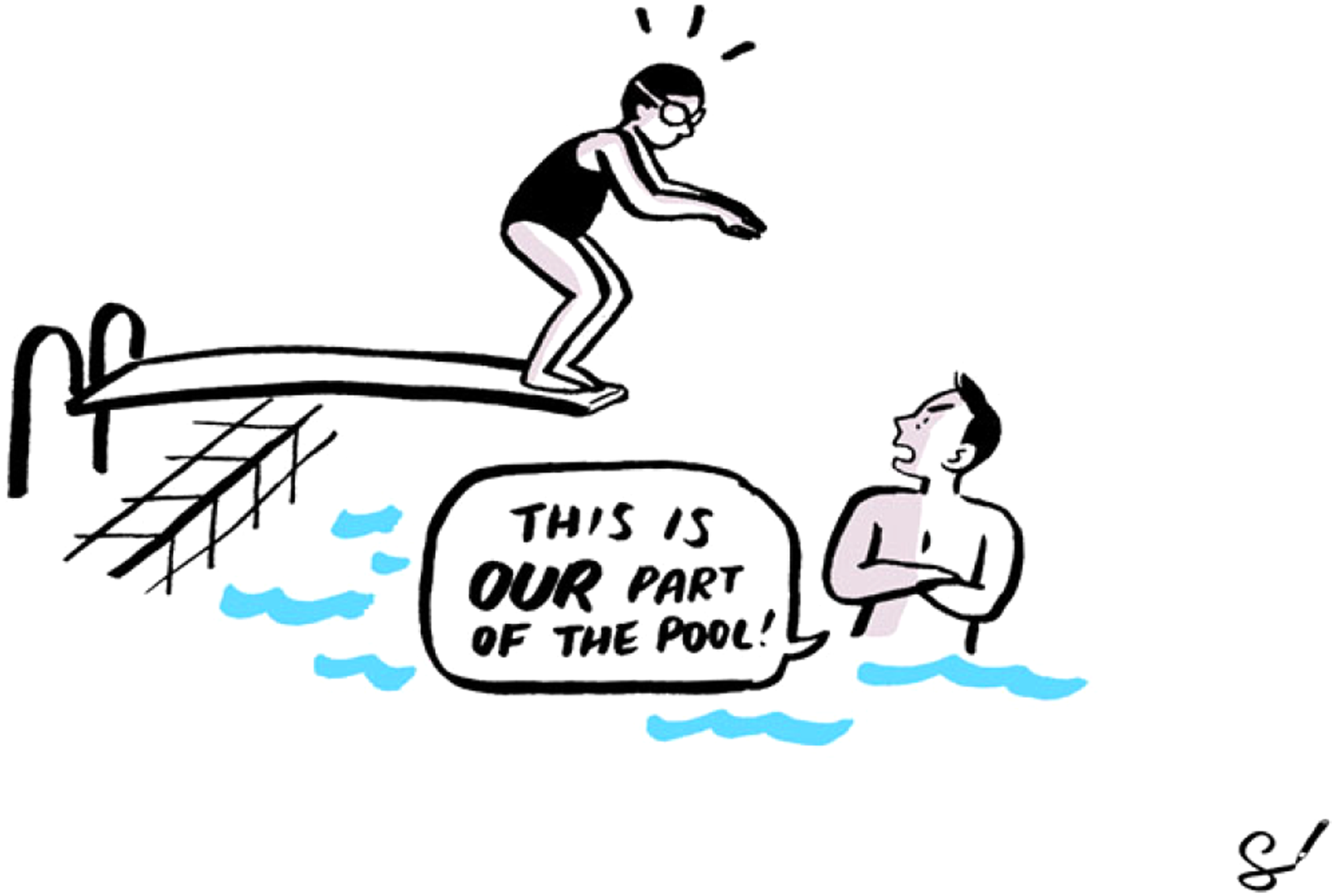
(Crop from professionally drawn illustration of Focus Group 2)
As the above research findings indicate as well as confirm previous research findings (Elling-Machartzki, 2017; Jones et al., 2017; López-Cañada et al., 2021), swimming and indoor public pools are often unwelcoming to transgender and non-binary people and communities. This gives rise to non-participation, which can further marginalization, exclusion and isolation of transgender and non-binary individuals. These processes can impact wellbeing. Wellbeing, related to leisure and sport participation, is a complex concept (Mansfield et al., 2020) and can be viewed as contradictory (Breslin & Leavey, 2019). However, in recreation contexts, friendship and belonging, social networks, group sociability and community identification are considered key to positive wellbeing (Chalip et al., 1996; Moffatt, 2017). Additionally, ‘[t]he intrinsic wellbeing value of leisure only materialises when experiential aspects are explored that account for the pleasures … ‘ (Mansfield et al., p. 3). Pleasure implicates happiness, play and freedom (Pringle et al., 2015) as well as love of (Caudwell, 2015b), and the research findings show that love of, play and pleasure gave rise to positive feelings, including positive feelings of the self: I loved it, haven’t swam since I was 14 (am 20 now) (post-swim session ‘drawing’) It was amazing to swim and be around others like me. Made me happy (post swim session ‘drawing’) I used to love swimming when I was young, I used to go loads and I think because I haven’t been swimming for so long and like my body has changed, I struggle to swim now and I’m not a very strong swimmer anymore so I’m learning again how to swim, and I love it … definitely having a safe space for swimming has been the start of something amazing for me, like, it's got me back in love with fitness and myself. (Jed, one-to-one interview) Best ever.
Play and Pleasure
Indoor swimming, for most adults, usually involves swimming lengths of the pool, unless they accompany children, which can involve playful aquatic activities. The private-hire sessions took place once a month on a Saturday evening from 6pm to 7pm. The participants were able to wear T-shirts and shorts as well as binding or go topless. The nature of private-hire meant the inclusion of small and large floats and inflatable objects. A small number of the research participants re-produced this swimming scene when they were asked to draw how they felt before, during and/or after the sessions. Playful improvisation is evident in terms of using a lane rope or walkway between small and large pool (below drawing) as a ‘net’ to play a form of ‘volleyball’ (no scores were kept).
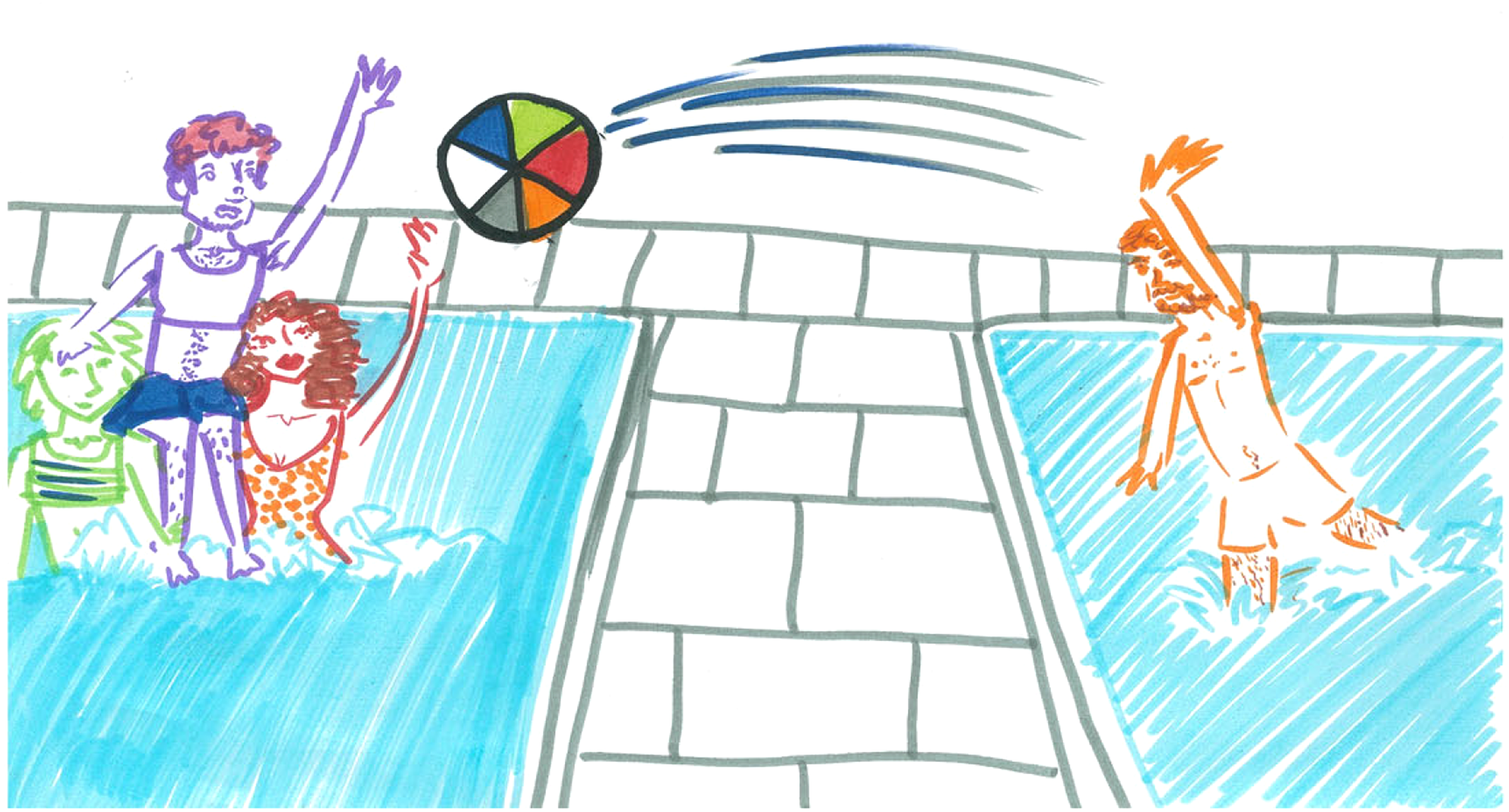
Of interest, the perception of the pool's safety authority remained in tact, as most of the participants were aware of surveillance by the lifeguard. The group participated in physical activity that was confined to immersion and the watery spaces of the pool, as evident in another depiction:
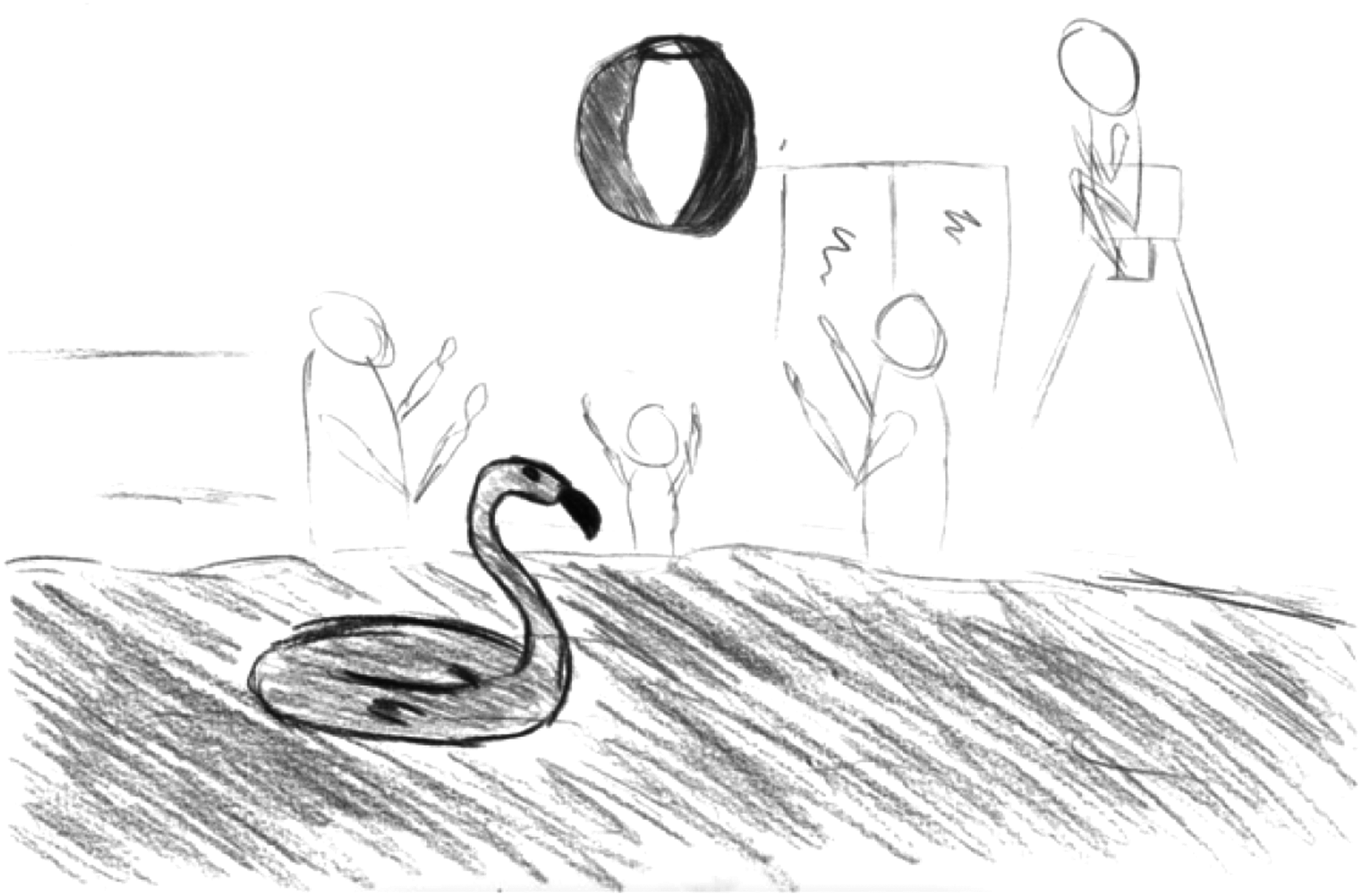
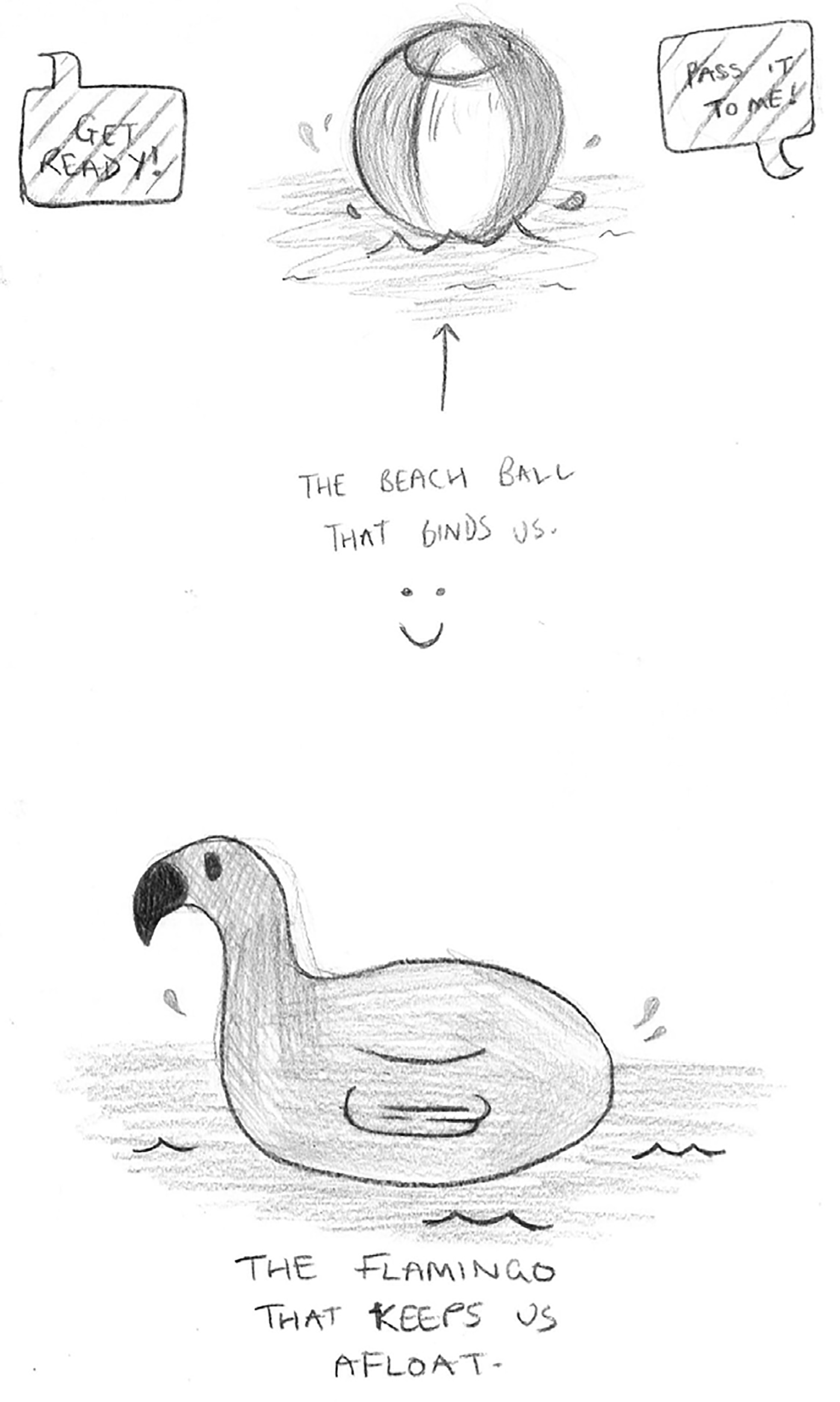
Members of the group, who were all over the age of 18 years old, regarded the inclusion of inflatable objects as positive to physical activity participation. The objects were viewed as bringing the group together (e.g., “the beach ball that binds us” and “the flamingo that keeps us afloat”), as is highlighted in this post-swim session drawing:
During the one-to-one interviews research participants talked about having fun because of the opportunity to be together to play: … one of the reasons I go is because it gives me a chance to interact with other people … And, it's fun! Right! You can’t do inflatable dolphins at XXXX leisure centre and impromptu volleyball and games. (Abi, one-to-one interview) … it is fun just to get in the pool. You’ve got the inflatables, we can mess around … you know you can be a big kid without having any worries. … We’ve had sessions where we’ve had games of volleyball. You just forget about everything else that's going on for a bit. (Mason, one-to-one interview) I forget. I don’t have to worry about anything. I can just enjoy myself, which is something I never really get to do while exercising. I can just have fun with my friends and have good exercise. (Ed, one-to-one interview)
During the focus group research the research participants talked about mainstream recreational swimming, the stereotypical perception was that: “… if you go to a swimming pool, people are doing lengths … there will be lanes and people will be taking it seriously” (Focus Group 3). The focus group discussion highlighted that the research participants were cognizant of normative recreational swimming; they found such an environment unattractive. This was based on an apprehension of, or actually being singled out (as evidenced above in Seth's account) as well as a lack of interest in swimming lengths of a pool. For some of the group not being a good swimmer, or not being able to swim deterred them from swimming at a public pool during public sessions, but it did not stop them from coming to the group swim session: N: I can’t swim and I know that. J: Did you stay within your depth? N: Yeah. Or, I’d hang on to stuff. Grab on to anything inflatable. Or, on the sides. Yeah, but it's good fun. (Natt, one-to-one interview)
For many of the group, the structured nature of normative recreational swimming was viewed as detrimental to being together, exercising, and having fun. The private-hire swim sessions were seen as a form of physical activity that was of physical, including sensual, and mental benefit. … we were just passing, hitting the balls at each other and that was great fun, everyone was getting exercise. And you don’t realise you’re getting exercise. I think that's a big thing. (Joel, one-to-one interview) … you don’t have to keep swimming lengths and stuff. The option is there, but you don’t have to do it. Even just being in the pool playing is good for you because the water resistance and stuff. (Fyn, one-to-one interview) I might not have the swimming body I want, but it doesn’t matter. I still have fun; it is like therapy to me. (Rhys, one-to-one interview) Even though I’m just splashing around, it is good fun. I really like it. It reminds me of being a kid. We used to go when I was a kid and we used to splash about. The smell of chlorine, it's quite nostalgic, I like the smell of chlorine. I think that's why I like it, it's really really good fun. You feel like you’re on holiday. I look forward to it now. (Natt, one-to-one interview)
The inflatable objects were often already in the pool because the session often followed on from a children's pool party. On one occasion, a lifeguard on duty removed the inflatable objects from the pool. The group challenged this action and the response they received was based on health and safety. The issue was taken up with the receptionist of the facility who involved the duty manager. Both the receptionist and duty manager knew the group and were familiar with the private-hire sessions; they were supportive and the inflatables were reinstated. After this session one of the group drew this picture representing a fictitious lifeguard:
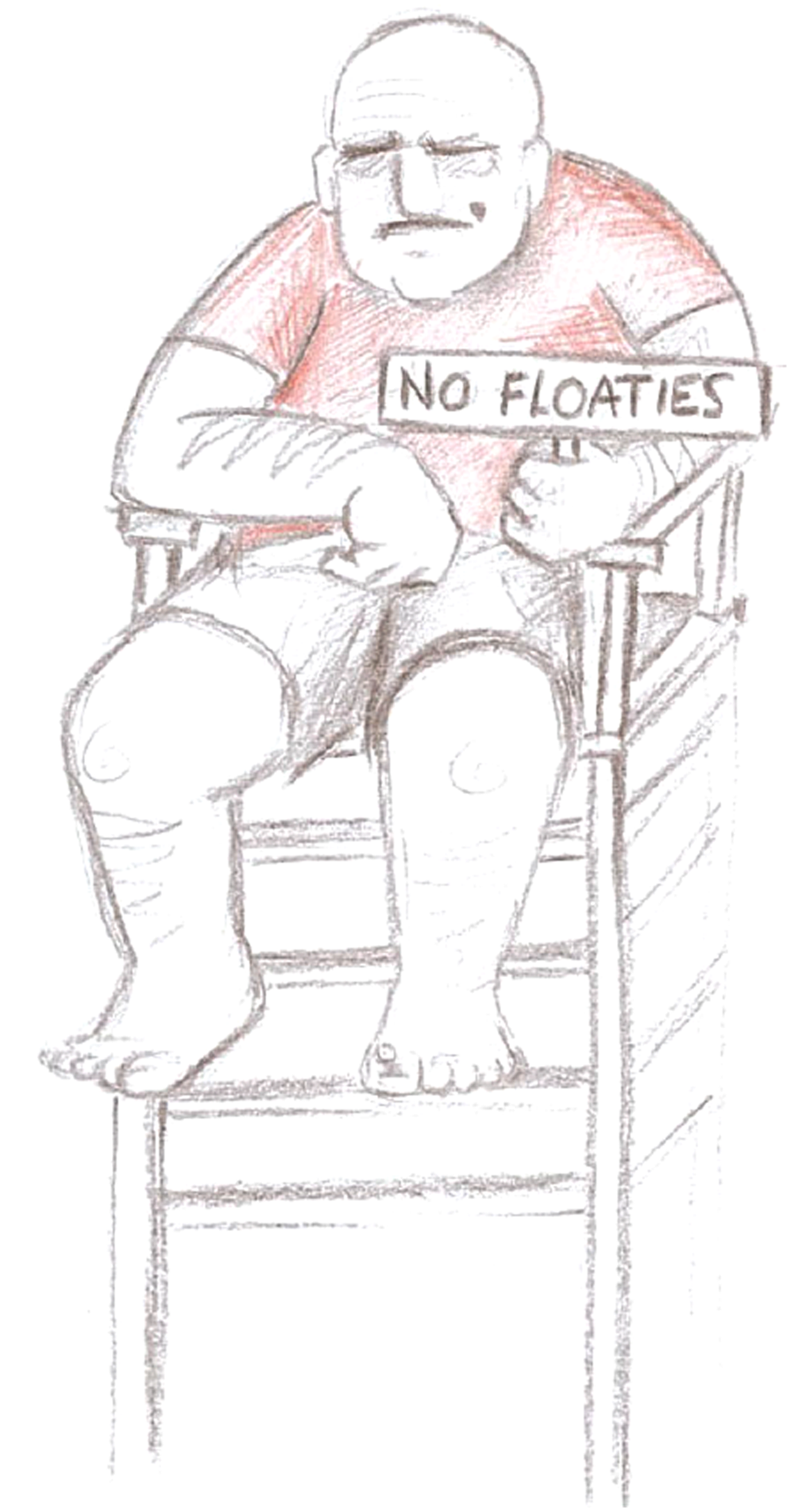
In many ways, the inflatables enabled play and play was considered important to individual pleasure, group sociability and enjoyment. Ed (one-to-one interview) compared the swimming sessions with the once-a-fortnight group sessions: … it's really nice to go, because it's just nice to be with the community in such a safe way. And then, with swimming it's exercise, but you also have fun and it's how you get to mingle with people in the water, because even though we’re at group [once-a-fortnight Friday night session] there's a table in the way, but in the water you just find yourself talking to everyone. Especially like waiting in the changing rooms, you end up talking to the people you don’t usually talk to. So I find the whole experience really enjoyable and I look forward to it.
Taking away the inflatables suggests the belief that adults, transgender and non-binary adults, are not entitled to play in an indoor swimming pool. Some of the group found the move hostile and believed the hostility was based on a form of transphobia. On one level, the lifeguard can be viewed as stealing the pleasures of ‘others’ and this can be viewed as mirroring authorities and figures of authority governing the physical activity experiences of marginalized non-normative participants. Being denied pleasure compounds the processes of being denied subjectivity. In the end, the lifeguard was denied authority to make such a decision.
The whole scenario can be interpreted through a notion of queering. The normative landscape of indoor public swimming pools for adults reflects serial swimming; competent and skilled swimmers swim repetitive lengths in confined lanes, lifeguards regulate the space and the swimmers; they survey what they are permitted to wear. The transgender and non-binary swim sessions present a very different landscape. Participants often wore T-shirts and shorts; some wore binding while a few went topless regardless of being pre-op. The main activity was play, improvising and adapting games, and socializing.
Some participants did want to see if they could swim a number of lengths. For instance, one person wrote after a session: “I very rarely go swimming, 10 lengths achieved”. Swimming lengths sometimes involved support from another member of the group and two or three people swimming alongside each other. The inflatables would often litter the pool and some of the younger lifeguards would provide a sound system for music. In these moments, non-normative participants and their non-normative physical activities (e.g., ‘volleyball’) queer the swimming pool. The landscape of physical activity is made differently, and made different. In her summons for the support of LGBTQ students in PE, Block (2014) calls
… for the creation of an environment where students experience movement for the purpose of realizing and developing self rather than continuing to equate being physically educated with skill development through sports. (p. 16)
Transforming the nature of PE (sport and physical activity) through processes akin to queering is not a new idea (cf., Sykes, 2011), but there is little evidence of when, why and how it happens. For the participants in this research project, collective play and pleasure were paramount to their attendance and participation in the swim sessions. A similar component, which can be viewed as transgender and non-binary contingent, was feeling free: “We are there to have fun and you don’t need to swim, it's a place where you can actually be free and your body as well. I feel like lots of the time we are all stuck in our vessels and it's nice to just get out of that” (Focus Group 3 participant).
Feeling Free
Research demonstrates that transgender and non-binary bodies are under frequent scrutiny in the public domain (Halberstam, 2005; Patel, 2017). This surveillance is not benign, but functions to regulate, sometimes violently, transgender and non-binary bodies. The public spaces of physical activity are not exempt from this dominant and domineering gaze, which positions transgender and non-binary participants as problematic when it is the infrastructures of physical activity (e.g., toilets and changing rooms, single-sex teams, leagues, competitions) that create inequalities and exclusions (Caudwell, 2014; Caudwell, 2020; Hargie et al., 2017). The research participants’ expression of ‘feeling free’ must be understood within this often-obdurate context. One of the research participants wrote (post-swim session) the following:
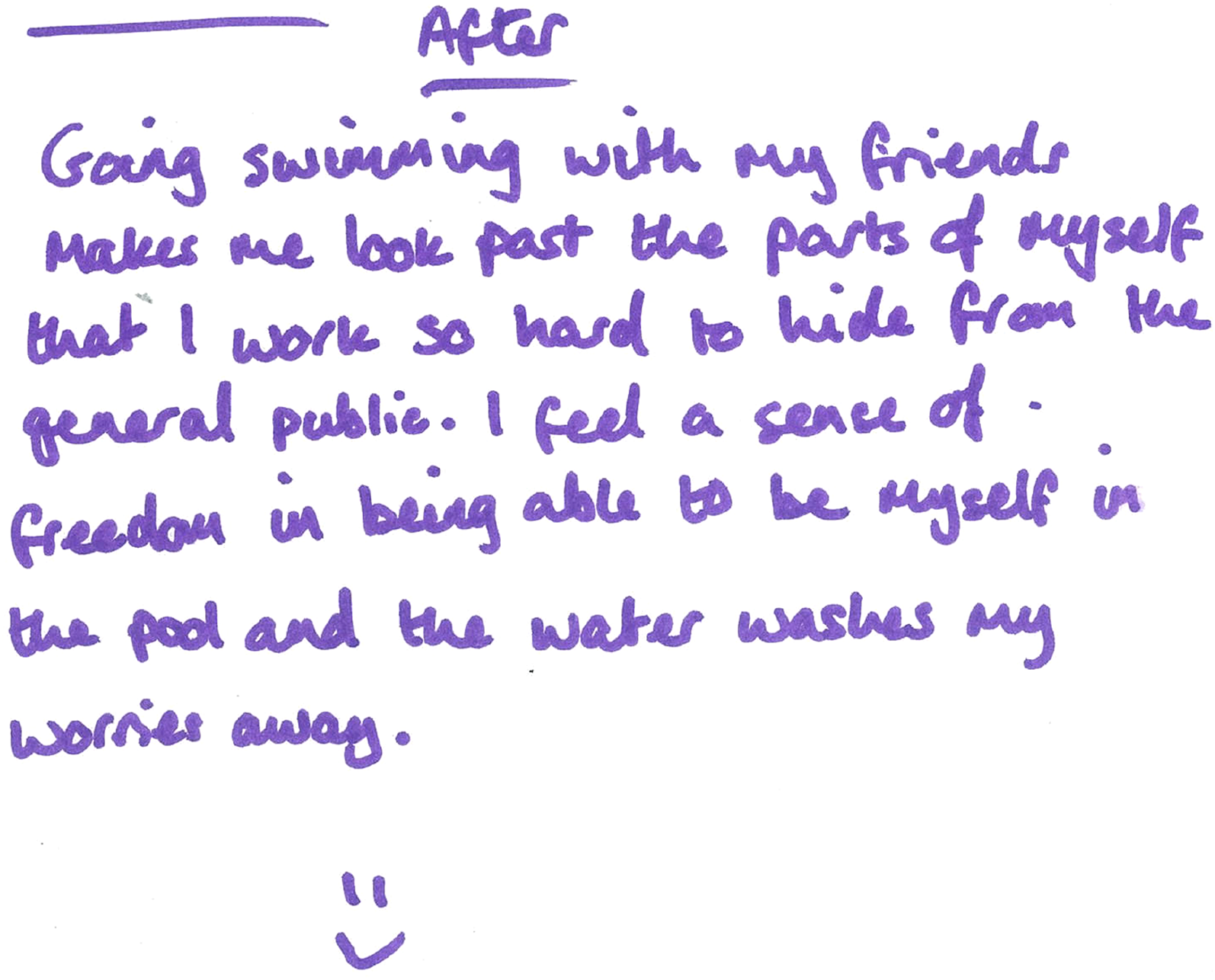
Two more examples of post-swim session feelings include large colorful, words on the page: “Happy Safe Fun Free” and “Fun Freedom Friendships”. One participant took some time to express their feelings through an artistic drawing of ‘before’ (tight coil/shell) and ‘after’ (exploded-through-a-brick wall trans flag and the word: freedom):
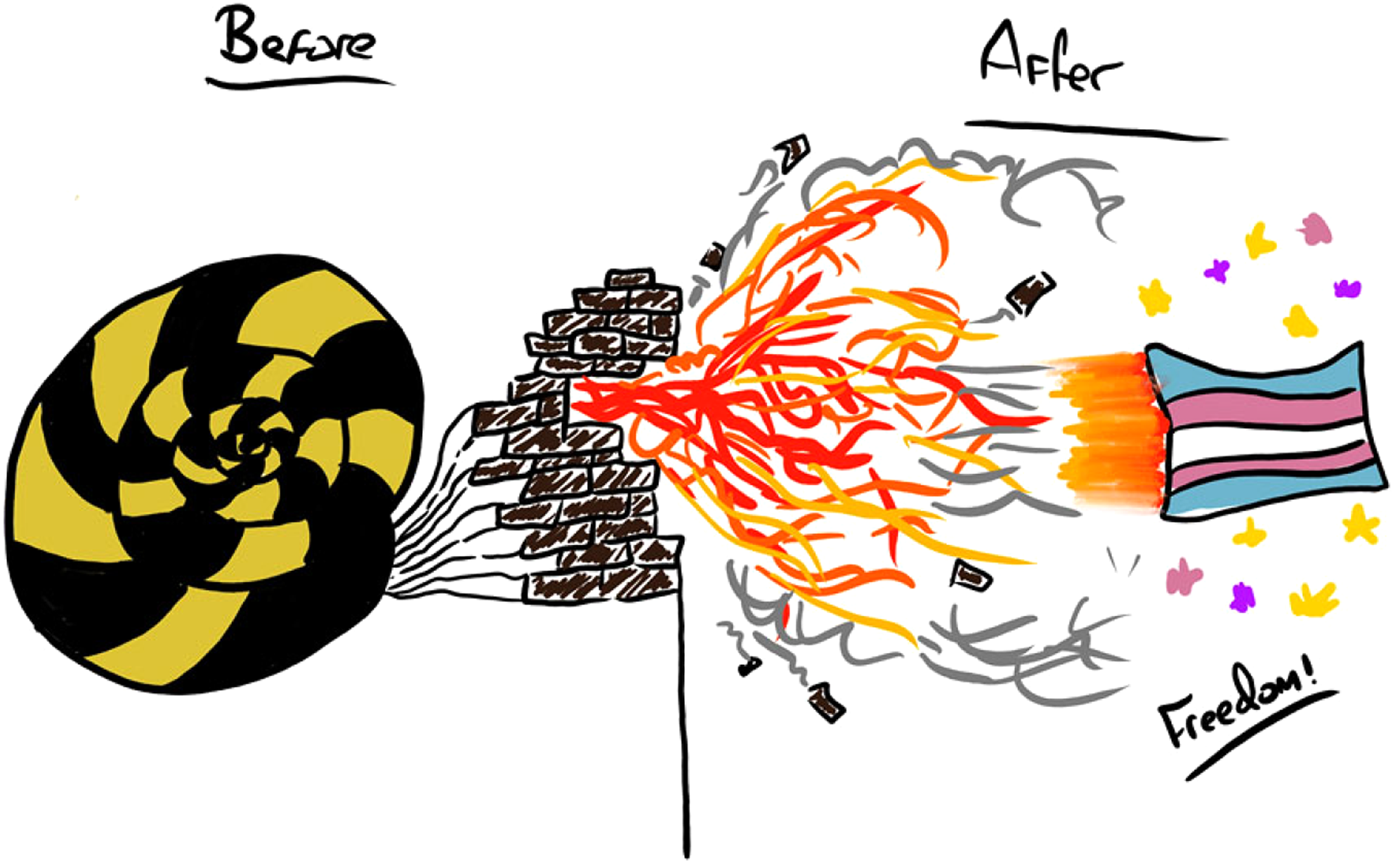
The emphasis on freedom was repeated in the one-to-one interviews and focus groups. Jed's sense of freedom is palpable: “… being able to go in the water and jump in … it's just freedom” (one-to-one interview). For Seth there were a number of related sentiments: “Amazing freedom, but mostly safe. Just not being different, not being the different person in the pool. Like, everybody is different and diverse in the pool” (one-to-one interview). The point about ‘amazing freedom’ was made when Seth was asked about the differences between going to a public swimming pool during public sessions and going to the transgender and non-binary swim sessions.
Alongside feelings of freedom, some research participants expressed feelings related to liberation.
It's one of those things you just got to put your foot in. It's kind of liberating and freeing to be able to do it [swim sessions], because I love doing it. It's nice to be able to have that again (Participant Focus Group 2)
That's why it's so liberating, because we are often told “no”, or questioned.
(Participant Focus Group 2)
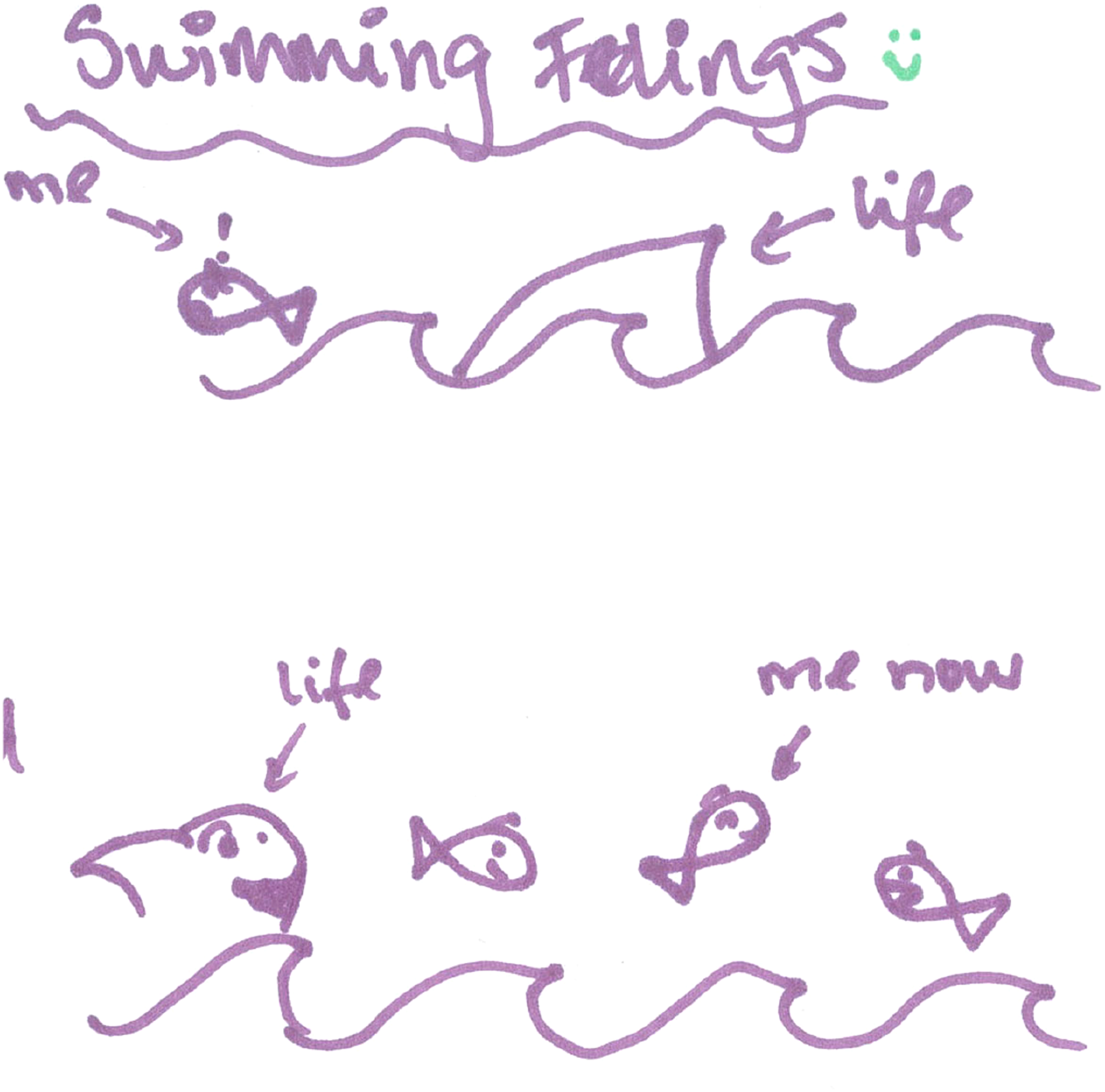
Although it is not always easy to interpret drawings and artwork, the picture below appears to suggest feelings of liberation from a life of feeling pursued.
During the focus group research, the conversations indicated that feeling free and liberated were the result of feeling safe and being together, and the embodied satisfaction of not being judged as well as learning about other people's transgender and non-binary bodies. One participant explained their experience: Being in the pool, you get to talk to people you don’t really talk to at group [once-a-fortnight Friday evening session], and you have really good conversations. I find that it's a really good time to talk about transition stuff, because I feel like it's the fact our bodies are on display, but in a normalized way. I feel like my body is quite alien compared to other ones, but being in a pool of trans people it seems such a diverse type of body types. It's so lovely to not feel weird about my body and yeah; it's just great. You can talk about surgeries or hormones and you can see who has had surgery and stuff as well; it's nice to talk to people about that if they are comfortable and ask how their experiences have been (Participant, Focus Group 3).
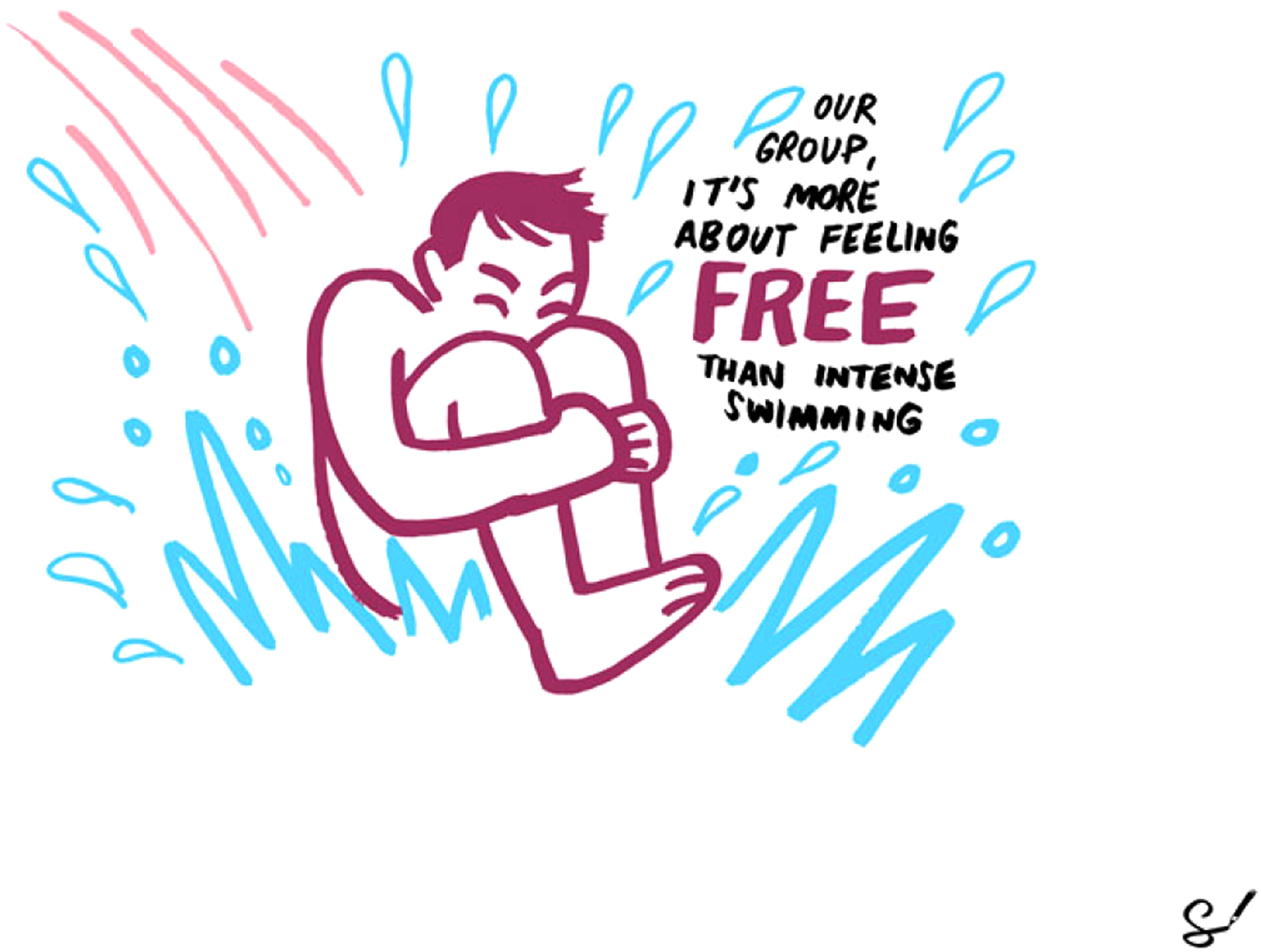
The emphasis on feeling free was captured by the professional artist who attended focus group 2 and 3. The artist identified as non-binary and although a member of the focus group did not make the comment depicted below – it is not verbatim, the artist has captured a group sentiment.
(Crop from professionally drawn illustration of Focus Group 2)
This image of a person jumping into the pool can be described as ‘bombing’. Public indoor pools (in the UK) usually have a pictorial poster of rules on display in changing rooms and pool areas. Normally, a red line encircles a simple black ink picture, and a diagonal line is drawn across, indicating “no”. A familiar indoor swimming pool rule in the UK is: “No Bombing”. The artist has presented a celebratory image (of No Bombing) that contests this indoor swimming pool rule, and it challenges the nature of swimming, stereotyped as ‘intense’. In this way, the image offers a queering of formal swimming discourse.
Methodologically, the turn to ‘drawings’ in this research project not only reiterated and/or reinforced findings from the one-to-one interviews and focus groups; the method of drawing opened up more creative elements, including imagining and transgender and non-binary imaginations. Imagination is not usually associated with formal physical activity participation, but creativity and being able to imagine do connect with wellbeing. The connections can be aligned with opportunity for self-expression, and developing materials for education and empathy more broadly (Bloem et al., 2018).
Transgender and Non-binary Imaginations
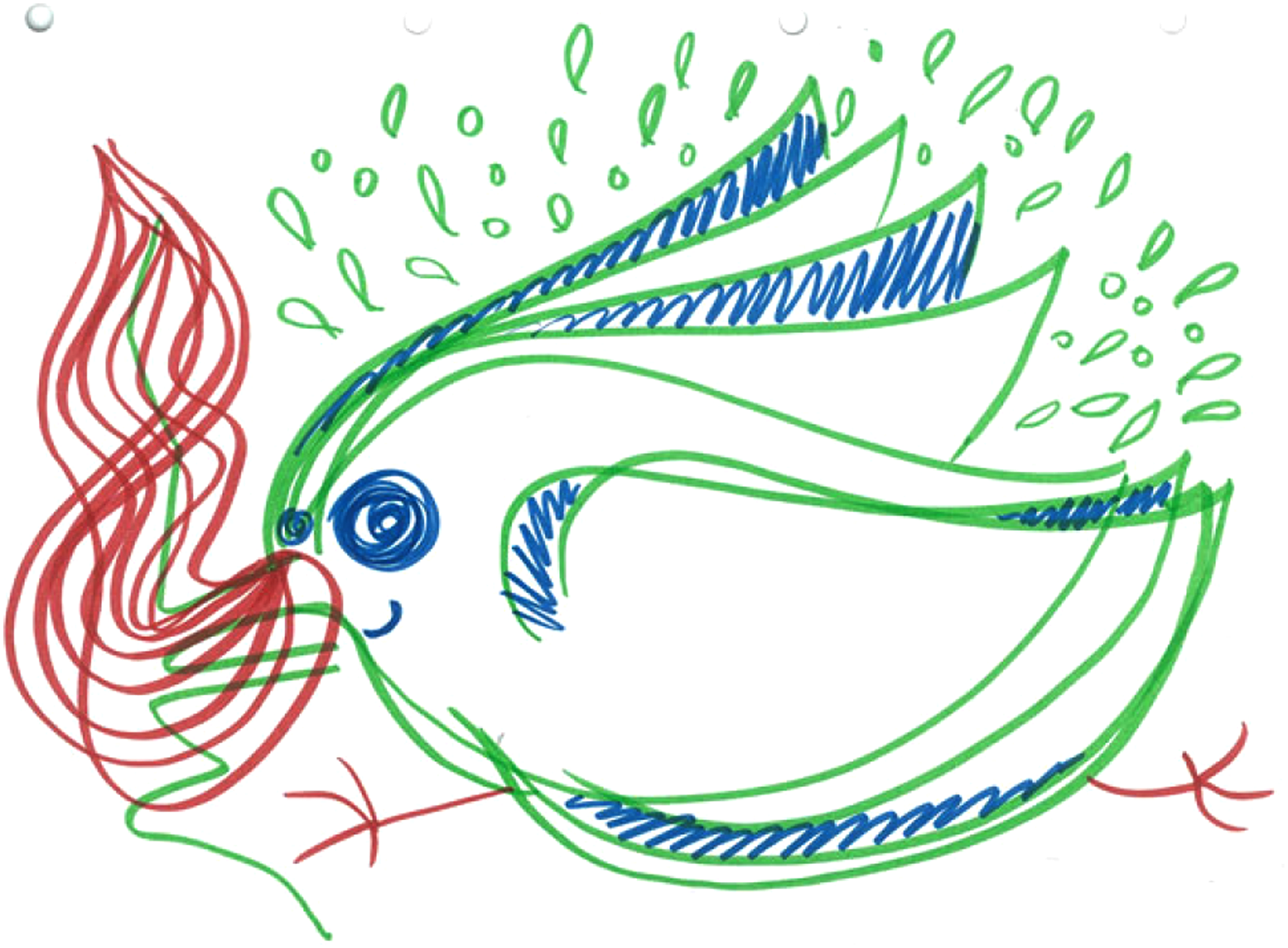
Pleasure and freedom are no uncommon feelings for people who spend time immersed in water (Foley, 2015, 2017; Throsby, 2013). These feelings link with positive wellbeing through an intrinsic value of happiness. Alongside comments of feeling happy some of the research participants drew fish, dolphins and mermaids. This indicates the imaginative properties of indoor water immersion. For example, one participant wrote: “Today, Now, I AM AND I AM A BEAUTIFUL DOLPHIN” (post-swim ‘drawing’). Some of the participants were able to capture, in artwork, how being in the swimming pool amplified their sense of self. One example depicts a small grey face (before), then a fish (during) and finally a larger smiling fish with colorful fins and rainbow colored bubbles (after). Another appears as a feminine bust (head and neck only) for before and a full-embodied mermaid with flowing hair and v-shaped flat chest for after.
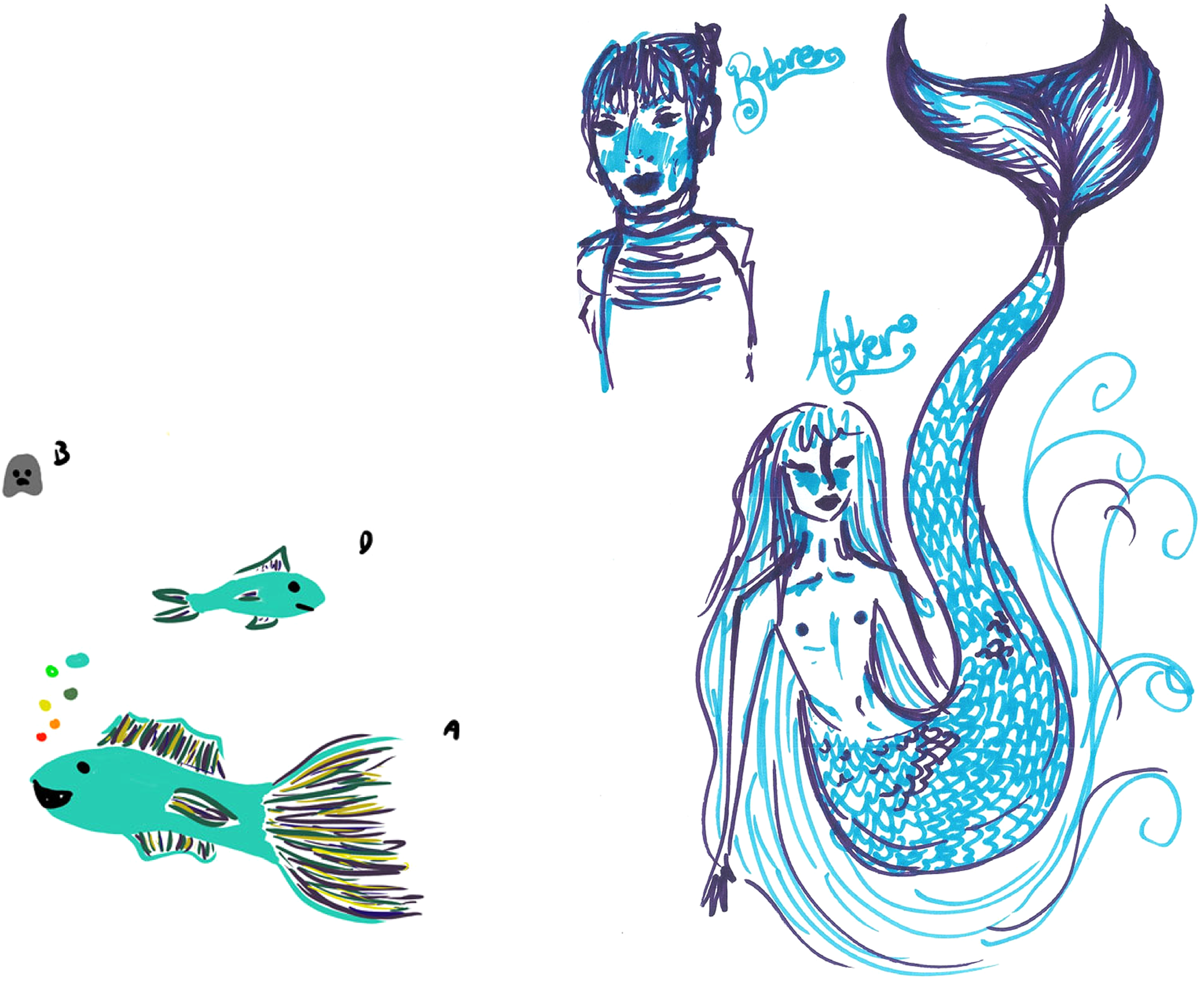
The method of ‘drawing’ feelings for before, during and after the swim sessions appears to have enabled creative responses that tell of the self in very different ways to the confines of words and speech. This is important for participants that might feel they constantly have to verbally justify their non-normative embodied self. This verbal justification extends to processes of ‘reassignment’, specifically encounters with the medical profession and processes of surgery. The turn to non-normative-human forms (e.g., fish, dolphins, mermaids) of feelings offers a different way to express the self: it indicates creativity, imagination and imaginings. Although some of the artwork was hard to decipher, the display of lightness and happiness are evident in the illustrations, as is shown here:
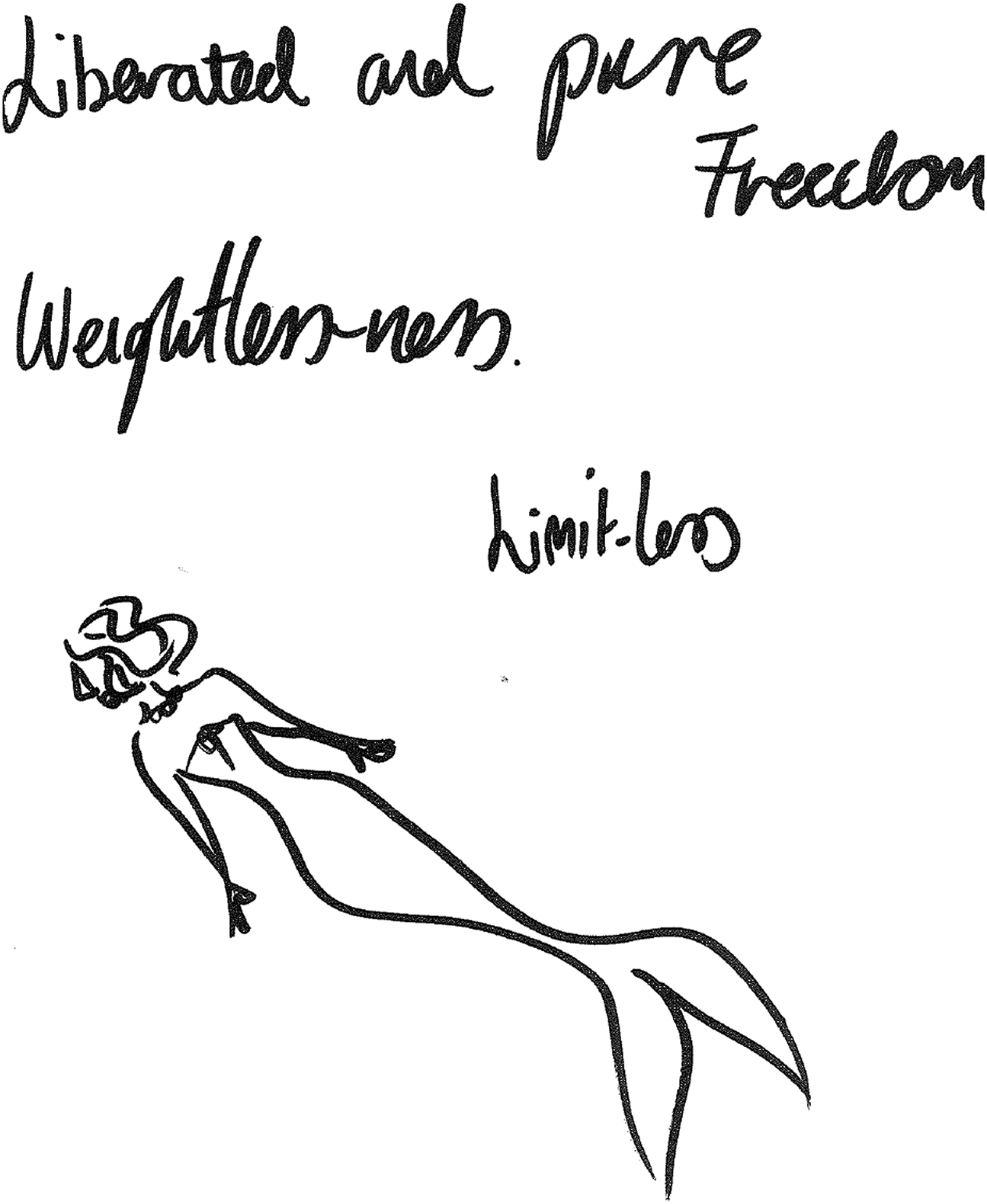
At times, participants used both words and images to convey their feelings when in the water and afterwards. In the ‘drawing’ below there is some ambiguity, however, the term “limit-less” and the drawing of a mermaid might indicate an imagined future that is not constrained by boundaries of normative embodied gender:
For some of the participants the swim sessions triggered tangible imaginings, including this comment written alongside other comments and small drawings:
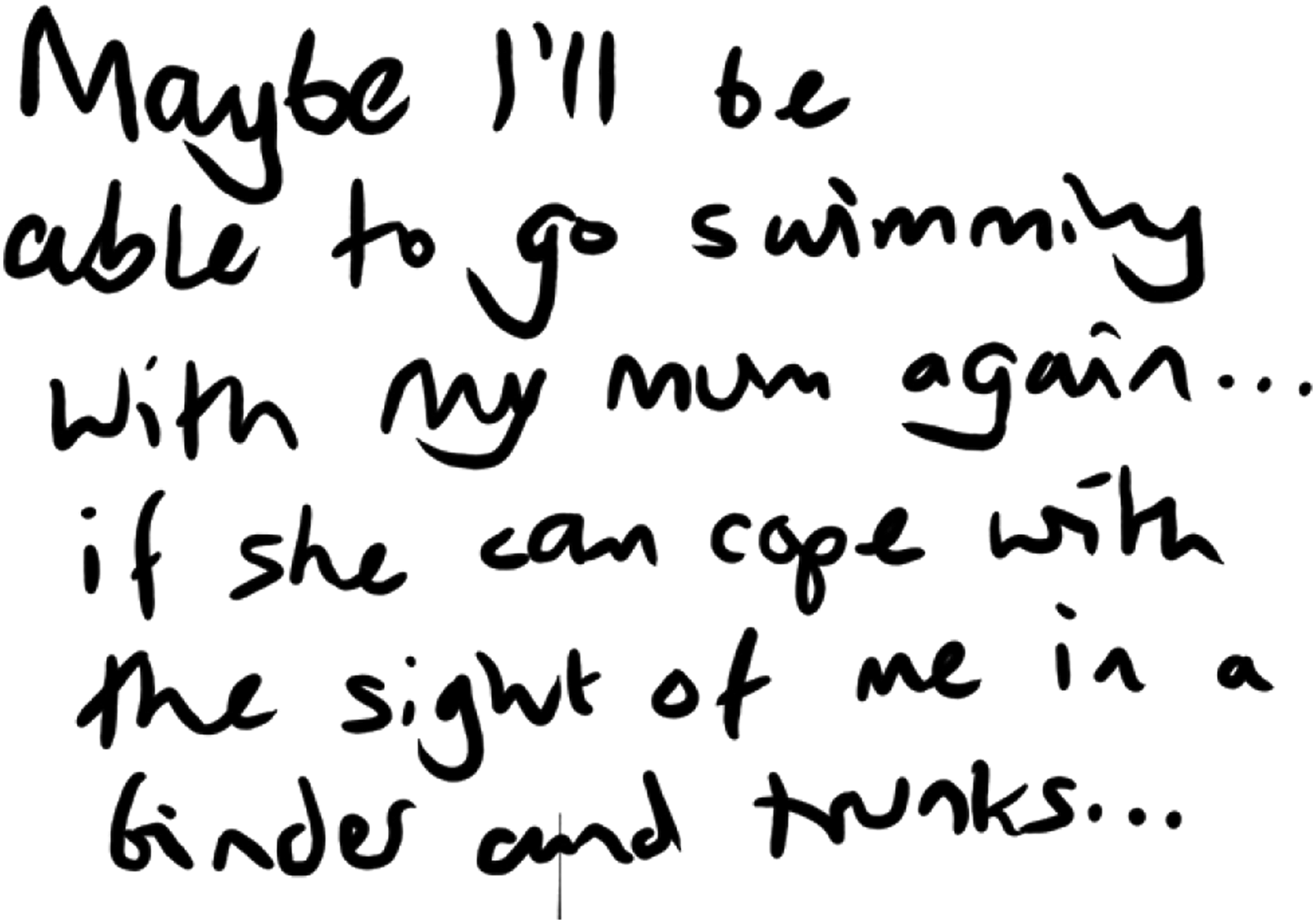
This final theme of transgender and non-binary imaginations emerged from the research as a consequence of requesting participants draw their feelings immediately after the swim sessions. After leaving the changing rooms the group would meet and sit together in the foyer area of the leisure centre. They would have conversations with each other and write or draw how the swim session made them feel. Accessing feelings, emotion and affect in academic research is often difficult, especially for physical activities that involve water (Merchant, 2011) and with groups that experience individual and collective exclusion and marginalization. This emergent theme might not have been possible with more traditional qualitative research methods. In this sense, it is methodology that has been queered and this queering has engendered scope to explore links between transgender and non-binary creativity and wellbeing. Moreover, the artwork was displayed in two public art galleries and it served as a form of public education (Bloem et al., 2018) during LGBT History month.
Conclusions
This paper presents qualitative findings from an on-going research project with a local social group that participated in once monthly recreational swimming sessions. The analysis of the findings is framed by a transfeminist ontology that starts by acknowledging that transgender and non-binary gendered subjectivity exists and is often not fixed. It is this theoretical contribution to our knowledge of bodies and embodiments—underpinned by qualitative research findings—that is of value in challenging existing practices and cultures, and transforming transgender and non-binary experiences. The project demonstrates that there is something else, somewhere else and livable elsewhere (Espineira & Bourcier, 2016; Linghede & Larsson, 2017)
The binaried cultures and practices of sport and PE are known to struggle with, and are hostile towards, transgender and non-binary bodies and this impacts transgender and non-binary participation. In turn, non-participation can mean a missing out on the wellbeing benefits of physical activity. The findings from this research demonstrate that participation in swimming and aquatic activities have positive impacts on wellbeing for the research participants. In this case, enhanced wellbeing is based on processes of queering normative recreational swimming spaces and practices. Recreational swimming is queered through participation in play and through feelings of freedom. The transgender and non-binary research participants do not normally feel the latter in the contexts of physical activity.
The incident that involved a denial of the inflatables brought to the fore the value of freedom to play for this group. It echoed the commonly experienced feeling (by trans people) of being told ‘no’. However, through a micro-network of stakeholder trans allies (facility receptionist and duty manager) the group continued their usual type of participation, which involved inflatable objects in the pool, play and having fun. This demonstrates that the physical activity workforce has real potential to enable inclusion and promote activity levels. This is a key finding for physical activity service providers as it identifies inconsistencies in staff social attitude and active behaviours towards supporting transgender and non-binary individuals and groups.
Through the method of ‘drawing’ feelings immediately following the swim sessions, it is evident that transgender and non-binary wellbeing is not only based on having fun and feeling happy and liberated; it is connected to creativity and imagination. As such there is scope for the imaginative properties of water immersion to be viewed as queering wellbeing for this group of participants. For a number of the participants, immersion in water triggered creative, positive, bodily, imaginings of the embodied self.
Through a queer and tranfeminist theoretical lens this paper contributes an analysis of the significance (to transgender and non-binary wellbeing) of queering normative in-door swimming pool space, queering normative swimming activity and queering wellbeing. However, the research was limited to a group of predominantly white individuals and this is a significant concern in terms of whiteness. As Semerjian (2019) makes the point, we need to seek out and document the stories of trans people of color. The lack of engagement with transgender and non-binary people from ethnic backgrounds that are not white ethnicity compounds the normative perceptions of whiteness and swimming as a physical activity. These perceptions are often racist in terms of swimming, ethnicity and ability. Transfeminism does call for an inclusion of racism within its remit to address sexism and transphobia, but this research project cannot contribute to this call at this stage; this is a limitation of the research and its contribution to the conceptual development of queering in/through sport and physical activity.
Footnotes
Declaration of Conflicting Interests
The author(s) declared no potential conflicts of interest with respect to the research, authorship, and/or publication of this article.
Funding
The author(s) disclosed receipt of the following financial support for the research, authorship, and/or publication of this article: This work was supported by the British Academy (grant number SRG18R1\180449), and Leisure Studies Association Research Support Fund.
