




Abstract
There is a growing body of research signaling the health and wellbeing benefits of being in blue space. Here, we advance this intellectual agenda by critically examining perceptions and experiences of coastal blue space among residents of a disadvantaged, predominantly African American community who report limited engagement with their local coastal blue space, despite beachgoing being considered mainstream by a previous generation. Drawing on focus group data and sensitized to a range of theoretical perspectives aligned with race, space, and social class, we advance theoretical and empirical knowledge pertaining to blue space engagement. In doing so, we demonstrate the need for more critically informed, theoretically appropriate research in this area, which connects individual stories of the sea to the wider historical, social, and political settings in which relationships with blue space are framed and (re)produced.
Introduction
In recent years, a growing body of research has alluded to the relationship between engagement with outdoor blue space and a range of health and wellbeing outcomes (Bell et al., 2015; Gascon et al., 2017; White et al., 2013). Building on these observations, physical culture, and leisure research has played an important role in expanding our understandings of how and why encounters with blue space can contribute to experiences of wellbeing, generating an almost “palpable intensity of feeling” (Ryan, 2012, p. 3), or, to borrow Anderson’s (2015) expression, “make life worth living” (p. 55). Focusing primarily on oceanic environments—the core concern of this article—contributions from these fields, along with the social scientific study of health more broadly, have shown how being in blue space can promote wellbeing by facilitating sensual pleasures (Phoenix & Orr, 2015; Throsby, 2013); provide respite from suffering (Caddick et al., 2015); facilitate positive but undemanding human and nonhuman connections (Bell et al., 2015); and a “sharpened awareness,” or “peak flow”—particularly via the mastery of water-based activities (Humberstone, 2015, p. 568). In light of this “hydrophilic turn”, which largely celebrates what being in and around blue space can do for, and to, our health and wellbeing, there are growing calls for a focus on the wider social and political settings within which relationships with blue space are framed and produced (Bell et al., 2019; Foley et al., 2019). A small number of important contributions examining the more problematic and complex dimensions of blue spaces have shown they can be experienced through pollution (Evers, 2019), with fear and dislike (Pitt, 2019) and as sites of marginalization (e.g., Kahrl, 2016, 2018; Stanonis, 2014).
Contributions by Stanonis (2014), and Kahrl (2016, 2018), among others, offer important context in this regard. They capture the complexities of Black community formation as African Americans have negotiated complex and changing structures of racial discrimination, showing how ostensibly non-racialized beach leisure was historically far from. Moreover, Burdsey’s (2016) in-depth sociological study of race, ethnicity, and seaside resorts in England advocates that work in this domain critiques the implicit assumptions that these spaces are racially neutral, where race is absent and social structures and relations are not racialised, and, consequently, identifies where, when, and how racial and xenophobic prejudice and discrimination occur at the seaside. (p. 22)
Indeed, Burdsey achieves this by highlighting how seaside resorts can contribute to racialized categorization, exclusion, and subjugation, yet they can also act as a site of resistance, intercultural exchange, and camaraderie.
Similar sentiments concerning both marginalization and the sea as a space of resistance have been made in a compelling body of literature examining surfing, race, and identity (see Comley, 2018; Thompson, 2011, 2014; Wheaton, 2013, 2017). For example, Nemani’s (2015) account of being a “brown” bodyboarder drew attention to the marginalized position of “brown” bodyboarders within the hierarchical field of surfing and the assumptions imposed on the (female) Brown body in relation to swimming and paddling ability. Importantly, however, Nemani also showed how the predominantly white space of surfing continues to be negotiated, in part, through the use of “brown capital” in which displays of respect, courtesy, and fairness offer a counter-discourse to dominant white projections (Nemani & Thorpe, 2016, p. 226). Similarly, Wheaton (2017) illustrated how despite racial difference being reproduced through Californian surfing and beach culture, the African American surfers involved in her research were able to transcend such difficulties to feel, in some spaces and contexts, at home and a sense of relative freedom due to their commitment to surfing. Expanding this further, more recently, Wheaton and colleagues (2020) have shown how indigenous knowledges of wellbeing and outdoor leisure within Aotearoa New Zealand are affecting on dominant (white, colonial) discourses, policies, and practices.
This research tells us much about race and ethnicity by the beach, particularly for those involved in lifestyle sports that draw them into the water. But what of those who do not share—through desire, opportunity, ability, or circumstance—that same commitment to water-based lifestyle activities such as surfing? What of those who enter discussions around engagement with beach culture first and foremost because of their absence from it? Research examining levels of engagement within a U.S. context has shown that Black and Hispanic Americans visit blue space far less than White or Asian Americans (Leeworthy, 2001). Moreover, Wolch and Zhang (2004) argue that even when African Americans have perceived fewer constraints to marine access than other ethnoracial groups, visitation has still lagged behind. Against this backdrop, and in response to calls to “recognise the landscapes of race and deep histories of racism that have shaped the socio-ecological formations of coastal regions” (Dean Hardy et al., 2017, p. 62), in this article, we critically examine the perceptions and experiences of coastal blue space among people living within Liberty City—a predominantly African American community in Greater Miami, Florida—who had reported limited engagement with their local beaches. This was despite just a generation before, beachgoing being considered mainstream and desirable (Bush, 2016; see also Wheaton, 2013). We bring to the fore their stories of the sea, which continue to be shaped by “regional histories of racism and perceptions of places as coded by race/ethnicity in ways that discourage beach use” (Wolch & Zhang, 2004, p. 438). In doing so, we provide a unique contribution to the blue space literature, specifically within the growing body of work that offers a cautionary response to the somewhat over-celebratory notion of “hydrophilia.”
According to Finney (2014), the process of collective memory and historical racialization of space are crucial to understanding current attachment and engagement to different environments. As such, we begin by offering a brief historical summary of the racialization of coastal blue space in Greater Miami. This is followed by an outline of the theoretical frameworks that informed our approach to collecting and analyzing the accounts of present-day Liberty City residents.
As a note on terminology, given the range of ethnicities and nationalities included in the study, we employed the term Black, rather than African American. While cognizant of rich and varied experiences within and across these groups, it was intended as an inclusive term to engage with groups who experience racialization and encounter unfair discrimination in response to color. “Black” was also the term most used by the study participants to describe themselves and others.
A Historical Overview: Racialized Coastal Blue Space in the Greater Miami Area
At the beginning of the 20th century, beaches were popular leisure spaces with African American visitors (Burdsey, 2016). Yet the increasing appeal of beaches to wealthy Whites and the subsequent growth of exclusive resorts shifted the role of the Black visitor from tourist to service provider (e.g., as waiters, nannies, entertainers). This was certainly true of the beaches of Greater Miami, which emerged as one of America’s primary tourist destinations in the late 1800s, through to the 1960s and beyond. At this time, Whites managed the area through an apartheid-like system (segregation practices colloquially known as “Jim Crow”) dependent on violence in the form of vigilantism, excessive policing, lynch laws, and racial segregationist (exclusion and isolation) practices (Connolly, 2014). While Black workers had labored to create Greater Miami’s legendary beaches, local African American residents were no longer allowed to use or visit such coastal areas except in a service function (Bush, 2009). Accordingly, during the 1920s, Black residents bathed illegally in closed or hidden coastal areas, risking harassment and arrest.
In 1945, following the end of World War II, seven Black protestors held a “wade-in” at Miami’s all-White Haulover Beach, fighting for the provision of their own bathing beaches, given their legal right to facilities and services through the “Separate but Equal” legislation (Connolly, 2014). The protest worked. As White and Black leaders negotiated a solution to prevent more civil unrest and to keep the White beaches “pure,” the site of Virginia Key was officially chosen as the area’s first “Blacks-only” beach in South Florida (Hussey, 2015). Garth Reeves, former publisher of the Miami Times, told interviewer Chanelle Rose that this decision was far from a move toward equality. Rather, “it was a place where black people could go to keep them from going to the white beaches. That was what Virginia Beach was. . . that was the only place they could go” (Bush, 2016, p. 99) (Figure 1).
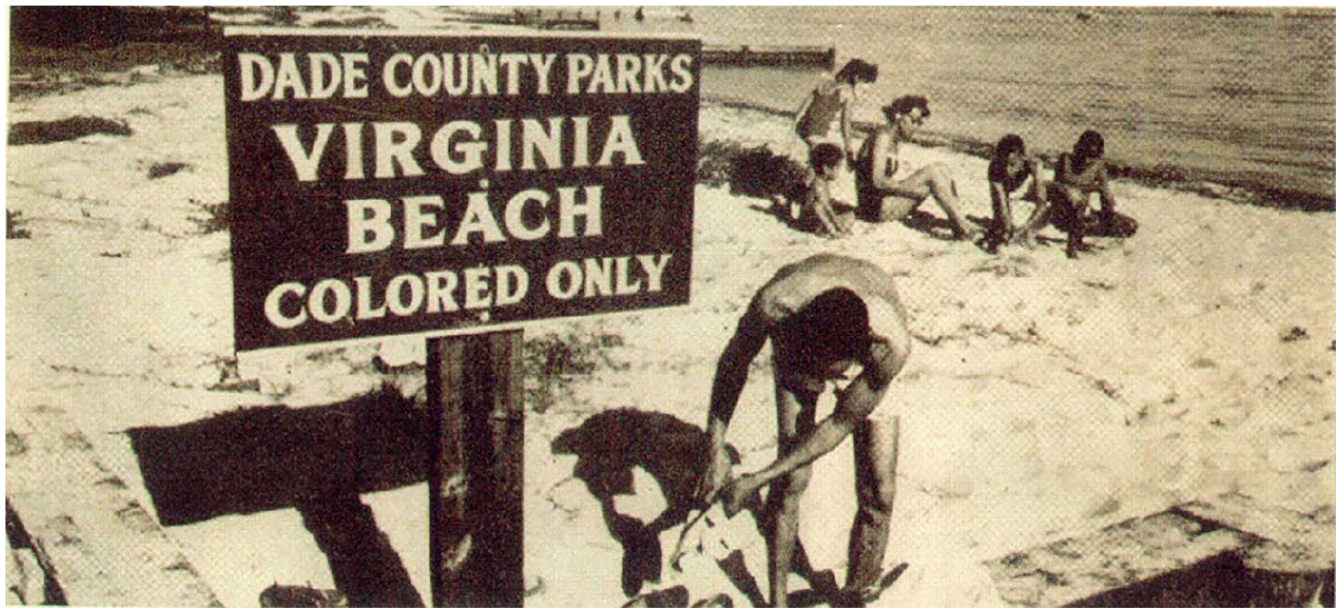
Beach-going at Virginia Key Beach (formerly Virginia Beach).
While Virginia Key was eventually designated a “coloured only” beach, it had few amenities compared with its White counterpart, Crandon Park on Key Biscayne (Connolly, 2014). The beach itself was narrow and steep, with the channel just off the shoreline, known as “Bear Cut,” being prone to “treacherous” waters and unpredictable undertows. Given such dangerous currents, many beach swimmers drowned in the years after its inception (Bush, 2006). Historian Dr. Dorothy Jenkins Fields noted, “. . . the currents were so swift that it was frightening. . . We always thought, why would [whites] give us the water that had the bad spot, knowing that we were going to bring children” (Bush, 2009, pp. 209–210). Still, Virginia Key beach remained a popular, even sacred place among Miami’s Black community, being used for numerous social gatherings including family picnics and Baptisms.
Postwar, Miami flourished, along with its real estate, land development, and tourism. Yet the purposeful design of Miami’s recreational coastal areas as “America’s playground” for White tourists resulted in the relocation of Black residents to Miami’s interior, precluding them from living, playing, or relaxing “anywhere near” Greater Miami’s coastline (Connolly, 2014, p. 5, 49; see Figure 1). In 1986, Warren et al. observed “Blacks continue to confront the worst living conditions in the Miami area. Blacks possess the lowest median family income, the largest percentage of families in poverty, the worst housing conditions, and the highest unemployment rate by far” (p. 629)—a situation that has failed to improve by any significance.
Following legal desegregation of Miami’s beaches in the early 1960s, upkeep of the beaches closer to historically Black residential neighborhoods, such as Virginia Key, declined. State funds to maintain Virginia Key Beach were transferred to Crandon Park (Bush, 2016; Connolly, 2014). With a lack of investment, Virginia Key Beach fell into a further state of disrepair, ultimately succumbing to closure in the 1980s. It would not reopen again for more than 20 years. By this time, despite a rich history of beachgoing at Virginia Key Beach, leisure-oriented engagement with coastal blue space among local Black communities had ebbed.
Framing the Findings
In seeking to understand the relationship between race and engagement with coastal blue space in Miami, the research was approached and our data analyzed with a sensitivity to a range of theoretical perspectives. These included critical race theory (CRT; Arai & Kivel, 2009; Burdsey, 2016; Hylton, 2010, 2012), Bourdieu’s theory of habitus as applied to racialized contexts (Bourdieu & Wacquant, 1992), and the cultural geography and leisure literatures concerned with the racialization of space (e.g., Burdsey, 2016; Neely & Samura, 2011; Puwar, 2004).
With regard to CRT, we remained mindful of the five precepts of this framework outlined by Hylton (2012). Specifically, through our collection and interpretation of data, we sought to (a) centralize “race” and racism while also recognizing its intersection with other forms of subordination and oppression, in this instance social class; (b) challenge traditional dominant ideologies around objectivity, race-neutrality, and equal opportunity to promote alternative insights into the perceptions and experiences of being in and around coastal blue space; (c) commit to social justice that incorporates elements of liberation and transformation in response to postcolonial politics of blue space, place, and identity; (d) center the stories of marginalized Black communities in a bid to offer alternative versions of “truth,” in this instance countering the largely uncritical, Eurocentric assumptions concerning a seemingly unproblematic relationship with blue space, including access, emotional attachment, and differential impacts on health and wellbeing; and (e) draw from different disciplines and knowledge sources with a view to interrogating the historical and contemporary impacts of segregation on coastal blue space leisure policies and practices.
Building on a growing body of research applying the work of Bourdieu to explain experiences of race and ethnicity within nature-based recreation (e.g., see Erickson et al., 2009; Lee et al., 2014; Lee & Scott, 2016; Wheaton, 2013, 2017), our understanding of how race intersects with social class was supported by some of the insights provided by Bourdieu’s theory of practice. Briefly, this theory of practice offers a dialectic (and temporal) relational approach in which three elements (habitus, capital, field) work together to unconsciously generate the social practices of agents. Elaborating on the nature of this interconnecting relationship, Maton (2012, pp. 50–51) explains how one’s practice results from relations between one’s dispositions (
For Wallace (2017), habitus, field, and capital offer tools for identifying the complexities of, and contributions to, social (dis)advantage, including their racialized dimensions (Bourdieu & Wacquant, 1992). Indeed, articulating the connection between field and space, Swartz (1997) asserts how a field is a space of struggle, domination, resistance, differentiation, and inequality. This connection has been explicated more recently by Neely and Samura (2011), who argue that “a spatial perspective can provide a particularly useful lens and language for locating and understanding persistent racial processes” (p. 1934). Drawing on existing theoretical discussions by key spatial theorists from within human geography (e.g., Harvey, 1996; Lefebvre, 1991; Massey, 2005), these authors distill four key characteristics of space. First, they note how space is contested in that social actors engage in political struggles over how space is used and defined. Second, because such contestations cause the meanings and use of space to change over time, they assert that space is fluid and historical. Third, for Neely and Samura, the fluidity of space is played out through its interactional and relational characteristics, to the extent that space is composed of interlocking, stretched-out social relations. Finally, these authors emphasize how space is characterized by structures of difference and inequality. It is through these structures that political struggles are played out and the meanings and uses of space are shaped, most notably by defining who does and does not have the power to control and define space. The work of Puwar (2004) is also illustrative of how, “as matter out of place” a series of processes signal when racialized minorities are present, becoming “space invaders” of spaces to which they are not typically nor traditionally deemed to belong (p. 10). These processes include racial marking or stereotyping, whereby “others” are known and made visible in a limited sense as “Black” bodies, while at the same time considered invisible outside restricted racialized confines. They also include processes of supersurveillance whereby Black bodies are positioned in such a manner that minor mistakes are more likely to be observed, denigrated, and amplified.
Method
This is the first publication from a larger research project (Hollenbeck, 2016), which explored how and why a resident Black population within the community of Liberty City, Miami, exhibited limited engagement with their local coastal blue spaces. This was despite beachgoing being considered mainstream and desirable within the community just a generation before (Bush, 2016). This larger project also examined exceptional stories (Phoenix & Orr, 2017) told by a small number of residents who reported regularly engaging with blue space. In line with the framing of this larger project with a CRT approach, these exceptional stories incorporated elements of liberation and transformation in response to postcolonial politics of blue space, place, and identity. Like the surfers featured in Wheaton’s (2013, 2017) work, their experiences and strategies offered a counter-discourse to the current norms relating to beachgoing within this community (albeit, often due to, or resulting in them leaving Liberty City entirely). That notes, in this article, our concern is with the majority; those whose experiences of coastal blue space shape and continue to be shaped by the dominant narrative of non-engagement that circulate within the neighborhood. Foregrounding these narratives provides an important point of reference in relation to the need to remain cautious with the notion of hydrophilia, and via empirical studies, lay bare the blue space inequalities and environmental injustices that continue to shape contemporary coastal practices.
Approach and Setting
We adopted a collective case study approach (i.e., multiple cases illustrating one concern) (Creswell, 2013) to examine recreational beachgoing among residents in a predominantly Black community in Miami, in relation to racial, cultural, and social phenomena within historical and contemporary contexts. The setting was the community of Liberty City in the greater metropolitan area of Miami, Florida, United States. Liberty City was selected for the study due to its stable and specific geographical boundaries (Figure 2). It is situated 4 to 10 miles from the coast, with Interstate 95 (I-95) running north to south along the eastern border. I-95 effectively separates the neighborhood from wealthier, White communities along the coast (Bush, 2009). Liberty City has a large concentration of Black residents of varying ethnicities and nationalities (e.g., African American, Caribbean American, Haitian American, Hispanic American), as well as high rates of poverty, health disparities, crime, violence, hypersegregation, and unemployment and low rates of education (U.S. Census Bureau, 2012) (Table 1).
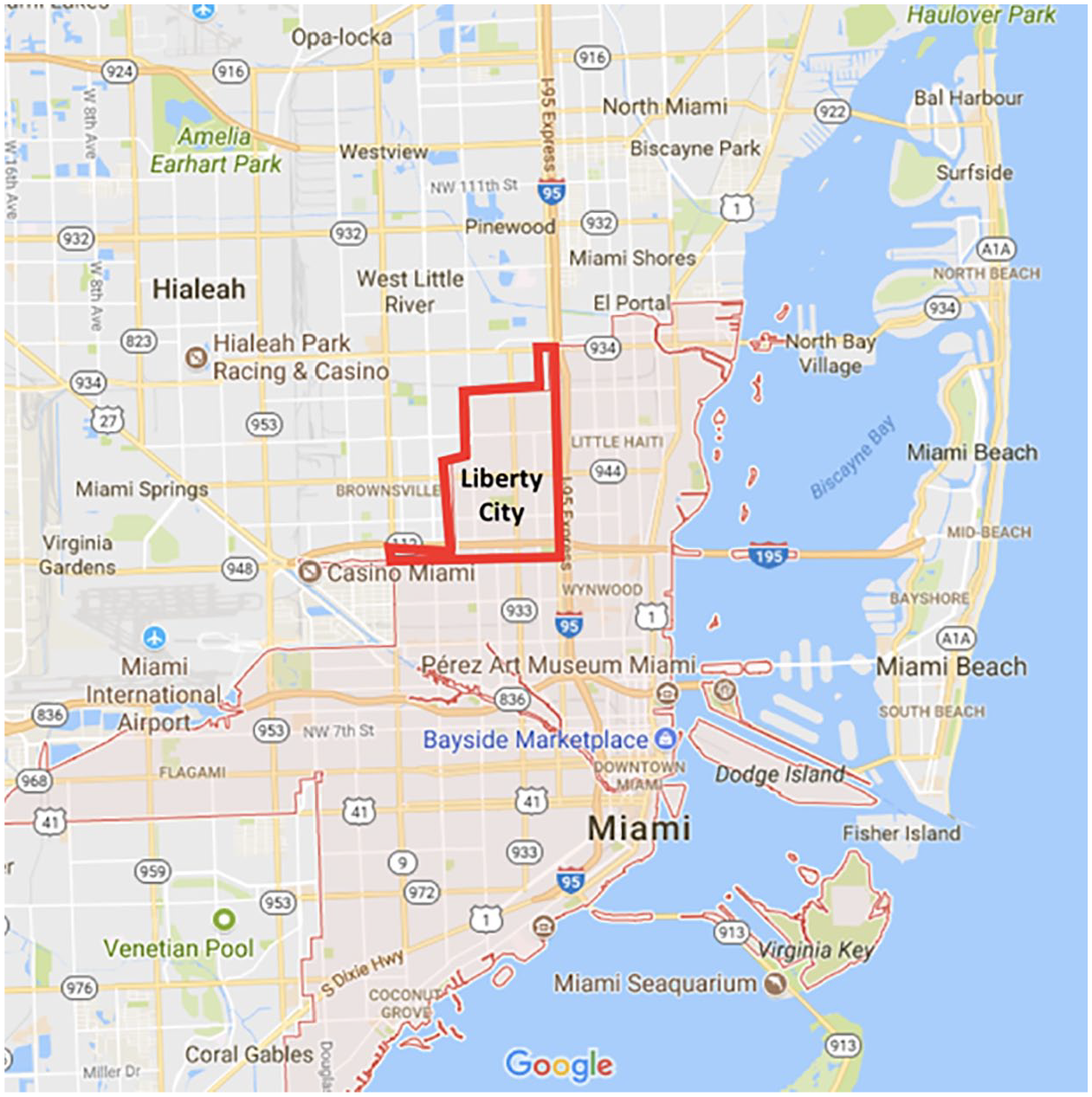
Map showing Interstate 95 (I-95) running along the eastern (coastal) side of Liberty City (map amended; Liberty City denoted by a red boundary line).
Selected Demographic Data of Liberty City Compared With Miami-Dade County.
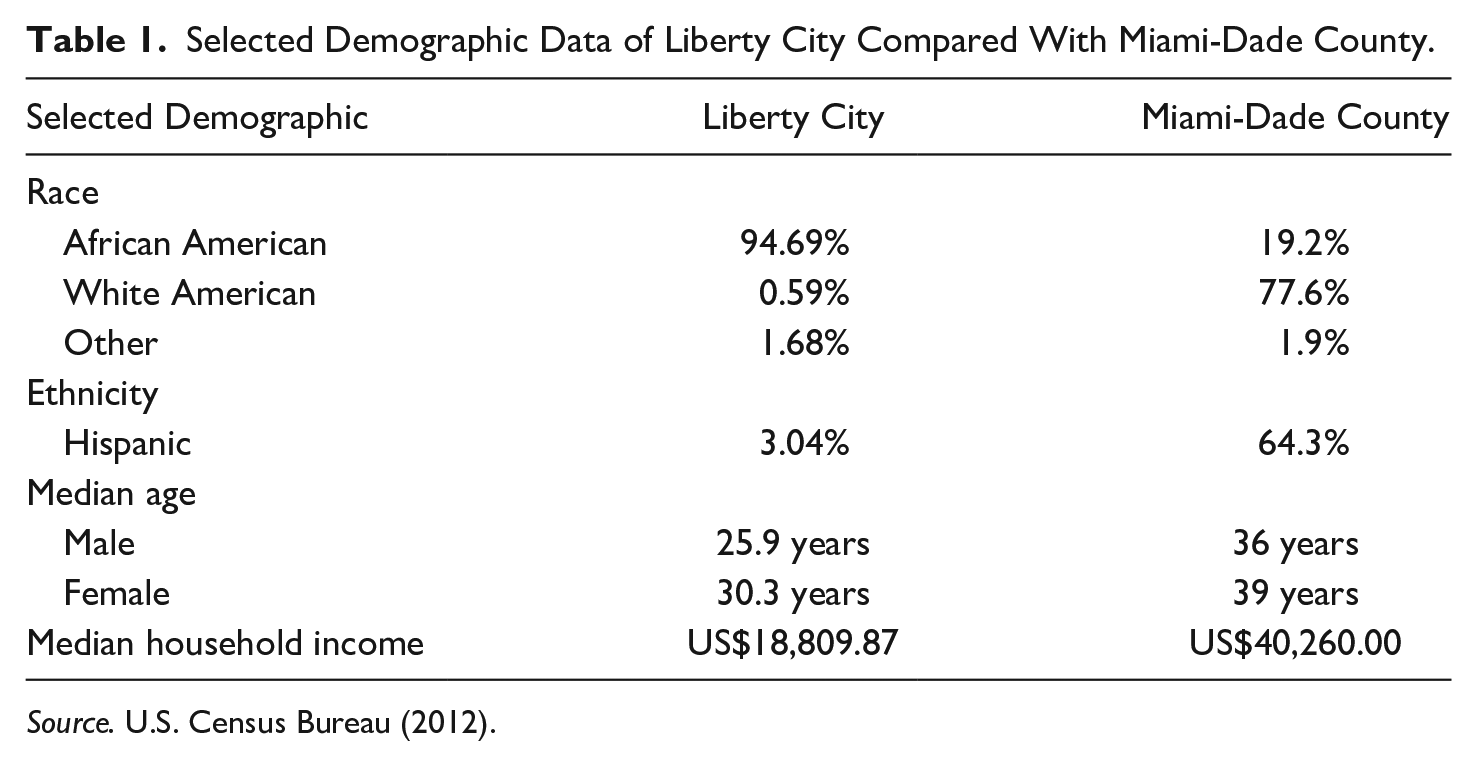
Source. U.S. Census Bureau (2012).
Negotiating Access
Prior research has shown that meaningful access to disadvantaged, marginalized, and minority populations should not be taken for granted (Culley et al., 2007; Flanagan & Hancock, 2010). The research team therefore embarked on a long recruitment phase (1 year, instead of a few months). After several months of “door knocking” to numerous individuals and groups living and/or working in Liberty City, access to the community was ultimately gained serendipitously through a University of Miami faculty member who was also a prominent community member within Liberty City. Through their contacts, a key informant emerged with interest in facilitating meaningful access and recruitment in the community. Access was also supported by the Miami Workers Center, an advocacy and activist group for disadvantaged and minority workers. With this support, J.H. committed to sustained participation in numerous community events (e.g., health fairs, picnics, lecture series, activist meetings, church services) between November 2011 and August 2014, which helped to legitimize the study and build trust.
As a White American citizen, not residing in Liberty City (J.H.), working as part of a White British research team (including C.P. and S.L.B.), the team was—and continue to be—acutely aware that the research was conducted from various levels of privilege, an “outsider” status, and geographical distance. Acknowledging this, and in an effort to mitigate the uneven power dynamics that are undoubtedly present in these situations, we engaged in multiple visits to the community, established open dialogue with key informants, were transparent with the community about the study and its goals, and engaged participants collaboratively and reciprocally. Lessons learned from previous studies (e.g. Culley et al., 2007) were particularly instructive in this regard. Finally, J.H.’s partner—and University of Miami approved volunteer research assistant accompanied J.H. to all community events and focus group meetings. As a Hispanic minority himself, we noted how his presence helped to foster points of connection between J.H. and the research participants.
Data Collection and Analysis
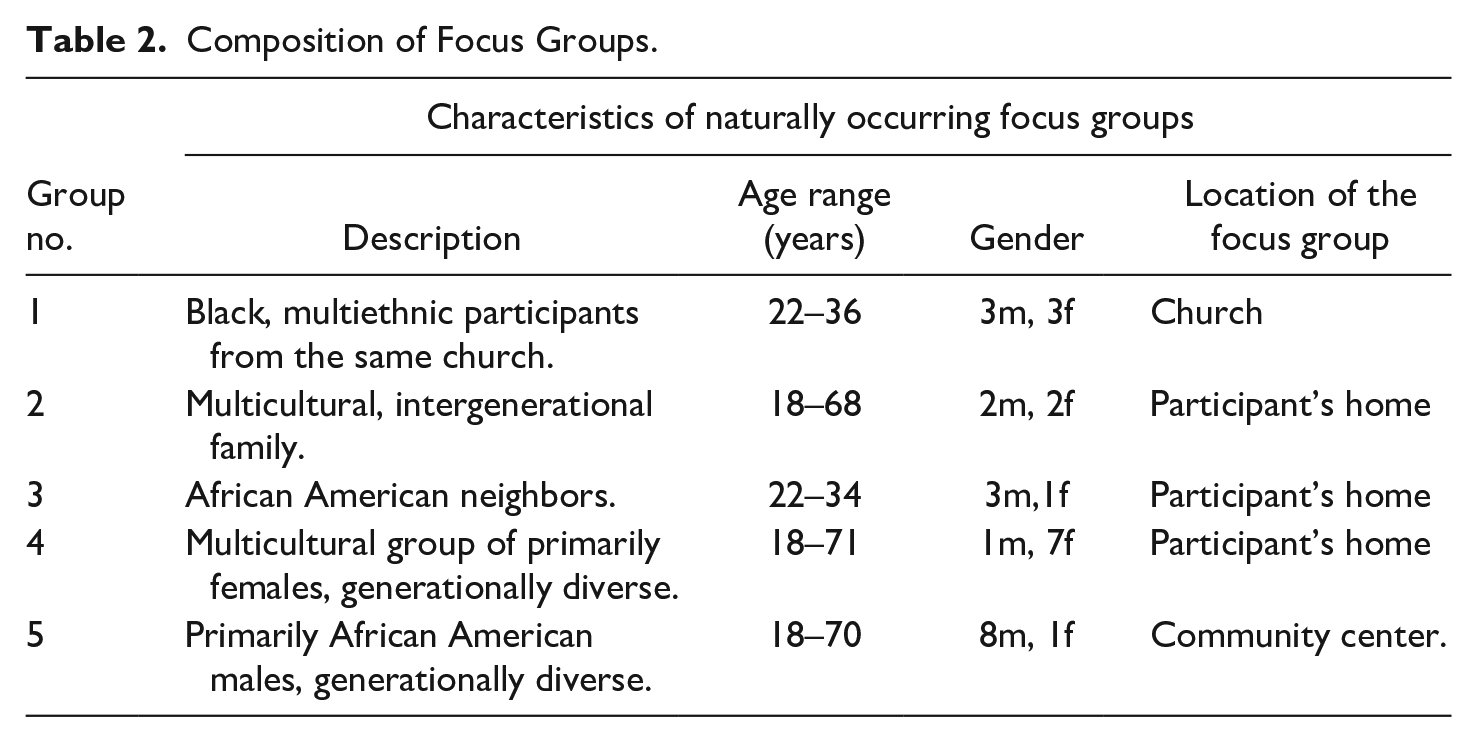
Prior to any data being collected in Liberty City, ethical approval for the study was secured from the University of Miami Research Ethics Committee (Approval Reference: IRB# 20120345). The focus group sample comprised 31 African American participants, across five “naturally occurring” (Barbour, 2015) groups (see Table 2).
Composition of Focus Groups.
Guiding questions included those around the meaning of the ocean, current level and nature of engagement, early coastal memories, from where and how participants gathered information about coastal blue space, the influence of significant others on participant engagement with the sea, and so forth. Each discussion was moderated by J.H. with technical support provided by her partner. Video recordings of the focus groups were produced to aid with the transcription process (e.g., identifying order of speakers).
Recorded data were transcribed verbatim and uploaded to qualitative data management software (HyperResearch®) for organization and storage. Data were analyzed using Riessman’s (2007) approach to narrative thematic analysis. This involves interpreting the data “in light of thematics” established, that are recognized as being partially influenced by a priori themes/theories, the project’s research aims and questions, as well as participant observations and demographics, historical, cultural, and geographical contexts (p. 54). The data were not fractured, but analyzed in such a manner that an overarching story could be told. A selection of transcripts was analyzed separately by C.P. to help enhance analytical rigor via the use of critical friends (Smith & McGannon, 2018).
Present-Day Stories of the Sea in Liberty City
Our analysis showed the ways in which the broader, historically situated narrative of Greater Miami’s racialized blue space continues to shape and frame contemporary stories of the sea that circulate within the community of Liberty City. Despite using a plethora of positive terms when asked what the beach meant to them (e.g., “freedom,” “tranquility,” “stress reliever,” “joyful,” “soothing,” and “spiritual”), many of our participants noted how visiting the sandy beaches and tropical waters just a few miles from their homes simply did not occur to them. Like so many others involved in our study, Lillian (age 36 years) and Penny (age 23 years) explained the following:
You don’t hear anything about the beach. So, you know, I didn’t think about it. I mean, I didn’t think I was losing anything because how can you miss something you never really had?
‘Cause like if you’re not exposed to something you’ve never seen before, you’re limited in what you can have, ‘cause you don’t know that it exists.
Speaking of local parents, Millie, a 51-year-old wife and mother commented, I don’t think they prevent the kids [from going to the beach] but they probably don’t ever talk about it, so the kids don’t really hear about it in their homes.
Previous research asserts that minority groups often make active and agentic choices to avoid nature-based recreation due to constraining factors, such as parking costs, beach access fees, time restrictions, distance, and so forth (e.g., see Erickson et al., 2009; Wolch & Zhang, 2004). Our findings build on this by signaling how perceptions of being in coastal blue space as an experience that is somehow unavailable had, for some, developed unconsciously through habitus. For many of our participants, beachgoing was no longer even talked about, thought about, known about, nor missed. Given that historically, beachgoing had been a normative social practice for local Black communities within Greater Miami, these findings reinforced the fluid and historical nature of the social geographies of race (Neely & Samura, 2011). Such a loss of collective consciousness, or what Bush (2009) terms loss of racial memory, concerning previous (beachgoing) dispositions among our participants was not just an outcome of a contained historic event (i.e., segregation), but symptomatic of its legacy, including the persistent racialization of coastal blue space.
Key themes identified in our data clustered around the dominant (interrelated) mechanisms by which this persistent racialization of coastal blue space occurred. Specifically, for many of our participants, coastal blue space continued to be racialized as a result of disproportionate exposure to both physical and social risks in such environments. These are reflected in the transmission of “strong lessons” (Thompson-Miller et al., 2015) across generational groups about swimming (or sinking), sea life, and survival, and in the social interrelations and boundary-making processes that have served to embed and reinforce experiences of difference, exclusion, and racial inequality at the coast.
Being in the Water: Lessons on Swimming, Sea Life, and Survival
Our analysis highlighted how information and advice—or lessons—about coastal blue space flowed through familial and social networks within Liberty City. According to Thompson-Miller et al. (2015), the manner and method of socializing children via this form of “intergenerational transmission” is a direct result of the lived experiences of Black Americans who suffered for generations under brutally oppressive segregation. Specific values, skills, wisdom, and mental strength were passed down intergenerationally, using “strong lessons” about the importance of conforming to policies and customs necessary to “cope and survive, as well as thrive and resist” (p. 140). We identified how “strong lessons” concerning being in the sea seemingly developed and maintained a fear of being in the water, or what Pitt (2019) terms “hydrophobia,” among the majority of our study participants. Fear of drowning, either from personal experience of that of family or friends, played an important role here. For example, limited swimming proficiency had resulted in a near-drowning experience for 62-year-old Charles Jones Sr in the 1960s. As a consequence, he explained how he never swam in the ocean again and foreboded his own children from learning how to swim or visiting beaches in the area. Such transmission of fear across different generations was commonly observed within our data, and negatively affected how parents and their children went on to perceive and engage with the sea. For example, Penny (23 years) and Lillian (36 years) explained,
Parents don’t take their kids to the beach because of a lack of training how to swim . . . They don’t know how to swim.
They knew we didn’t know how to swim. “Ain’t no need for you to go out there and you come drownin’ and I got somebody callin’ me.” You know so, that could be one of the biggest hindrances . . . Now they won’t let you go to the pool. They halfway ain’t gonna let you go to that big body [of water] at the beach.
Similarly, Donald (25 years) recounted a story of his stepbrother who embodied a deep fear of the ocean due to the knowledge accrued through strong lessons about drowning that had been transmitted by his own father: My little brother has a different father than me. His father won’t go to the beach because of drowning incidences that him and his family had at the beach. And now my little brother is scared to go to the beach. So, he would be frantic if we tried to pull him near the water. It’s like fighting a tiger.
With the Centre for Disease Control (2012) reporting that 116% more Black children (ages 5–14 years) drown than White children, transmitting a fear of drowning across generations was not without substance (see also Steel et al., 2005; Wiltse, 2007). In her discussion of “how swimming became White”, Wheaton (2013, p. 148) noted the economic and culturally based factors that have contributed to contemporary African American children being less likely to swim confidently. These factors included the fears of non-swimming parents being passed down through generations, such that their own children were kept away from the water.
According to Ito (2014), limited opportunities for learning how to swim within inner city communities, which typically have higher numbers of Black residents, has led to a “vicious cycle” between generations. “[I]f there is no access to facilities there is no access to knowledge, which leads to social customs of no water activities and fear resulting in embedded values—no pools are built and no lessons provided, once again assuring that ‘Blacks don’t swim’” (p. 252)—a racial stereotype challenged by Wiltse (2014). Indeed, on a broader level—and from a CRT perspective—our participants’ fear of being in water exemplified how the distribution of resources continued to disproportionately marginalize their position within society and their sense of belonging within coastal blue space. Staying out of the water was an intergenerationally transmitted “strong lesson” within this community that was deemed necessary for survival. The embodiment of fear foregrounded the ways in which coastal blue space was racialized within Greater Miami through the (re)production of difference and inequalities pertaining to the accrual of physical capital (swimming ability) and also cultural capital in the form of marine-based education.
Indeed, in addition to swimming, our analysis revealed how limited knowledge of sea life and tidal patterns—a consequence of constrained opportunities for (marine-based) education—further contributed to feelings of fear and unease regarding the unpredictability of the water and what lives in it. This was exemplified by Quentin (32 years) in his description of the sea: Dirty, dangerous, unpredictable. It’s just, those three things to me, really, because anything can happen out there you know. Shark can take a chunk out of you, you can get stung by a jellyfish, a tidal wave could just suck you under. The sea is just unpredictable. It’s like something you really gotta take serious. Not “Hey let’s go the beach and just jump in the water alright?” You know, something might happen.
The manner by which stories of dangerous sea life contributed to negative perceptions of being in the water—now positioned as something alien and to be avoided—was also emphasized in the following exchange between Leon (66 years) and Donald (25 years):
You hear that one story, about the one person who is attacked by a shark, it’s now become something that’s foreign to you, that’s outside your experience, and is something that you don’t want to experience. And one of the things that we do is whatever we believe is negative, we want to stay away from it. So, once we’ve painted that picture, and gotten framed with the idea that there’s danger there, we don’t want to go there.
And that’s it.
In the absence of equal opportunities to accrue, employ, and activate balanced and accurate information about the coastal environment and its relative risks (e.g., the nature of tides and currents, behavior of various sea life including incidences of shark attacks in local waters), experiencing a fatal episode while being in water was often perceived by participants as probable rather than possible. It was perceived as a predictable occurrence in an otherwise unknown and unpredictable field.
The salience of such concerns for participants contributed to the sustainment of place boundaries, namely, between “the streets” or “neighbourhood” (i.e., Liberty City) and local coastal blue space, with many participants alluding to feeling at home in the former and “out of place” in the latter (Cresswell, 1996). This can be considered through Bourdieu’s notion of habitus, whereby individuals come to instinctively know what is appropriate, possible, and expected (or not) in certain familiar situations and environments. Bourdieu (1990) termed this a “second nature. . . feel for the game” (p. 63). For example,
The water, you know, realistically is not our natural environment. We thrive here on the grounds, in the streets. You know so now it more comfortability. But at the same time there’s more risk where we come from in the neighbourhoods than the ocean, but the ocean is a great mystery.
You don’t know what to expect. On your street you know what to expect, or you know how to avoid this, but how you going to avoid the shark coming at you?
Despite both Liberty City and the beach being perceived and experienced as risky spaces, the known nature of how to manage (i.e., be prepared for and/or avoid) risk “in the streets” provided some of our participants with cultural capital. This, in turn, facilitated some sense of comfort and belonging. The same, however, did not apply to the beach, despite its relative safety when compared with the criminogenic environment of “home,” a line of argument put forth by 76-year-old Otis to Nate (18 years) and Donald (25 years):
Nate, I can guarantee you within a 10-block radius of your house, you’ve had more people to die than have drowned at the beaches. Within a 10-block radius of where Nate lives, he’s had more people that die from accidents, shootings, and that whole thing, just fights, than people drowning.
Saying that right, that’s the odds I have to beat already. And then going to the beach, that’s more odds.
Yeah, but the reality of it is, it’s more dangerous in that 10-block square that you live in than it is at the beach.
But if you make it out of the 10-block radius, and get in your car and then go to the beach and die, how would you feel? I did all of this for nothing.
But you gotta look at both sides of it man (to Nate).
I understand. Look we have no choice but to walk that 10-block radius. We gotta go somewhere.
Drawing this together, those living in particularly disruptive environments (field) have learned to negotiate their communities to stay safe and survive (habitus), while anything outside the “safe/dangerous” embodied mental map of their neighborhood (cultural capital) can seem “foreign and vast,” preventing practice (Rymond-Richmond, 2007, p. 197). As this exchange shows, while habitus afforded many of our participants the embodied knowledge required to negotiate Liberty City’s challenging physical, social, and cultural terrain—albeit, within the context of unchosen choices (Bourdieu & Wacquant, 1992)—this was not felt to be the case within their local blue spaces. Rather, participants questioned the applicability of their habitus to a new field (i.e., the ocean).
Mi-ami and Their-ami: Belonging, Boundary-Making, and the Invasion of Space
Our analysis further exemplified how racial boundaries do not just linger in social memories of segregation but continue to play out in areas of coastal blue space. Participants who had made the 4- to 10-mile trip to the coast from Liberty City—albeit infrequently—described feeling “out of place” when they got there, with the beach often described as a “different world” for “others”. “Others” was typically translating as affluent, White tourists. Connolly’s (2014) observations of leisure for Black residents in Greater Miami are particularly pertinent here, emphasizing how there was not one Miami, but two: Miami and Their-ami. “Their-ami,” as one young woman pined in the pages of the Crisis in 1942, “is the ‘ami’ that the vacationist dreams about-miles and miles of beautiful Atlantic Beach . . . towering coconut and royal palms, majestic hotels and apartments.” “Their-ami,” she continued, “is the ‘ami’ I can only imagine and dream of.” From the standpoint of Miami’s black civic leadership, the life-and-death difference between Miami and “Their-ami” was fundamentally about an unresponsive and uncaring state. . . What was the value of Negro life in an international city? (pp. 118–119)
Through his discussion of racialized themes in contemporary seaside pleasure and leisure, Burdsey (2016) critically examines a variety of seaside entertainments and amusements, past and present, across the United Kingdom. From rides and amusements based on stories of colonial adventure, to the somewhat inaccurate representation of “whitened” pirate communities, Burdsey argues that the unconscious consumption of seaside leisure “actually stabilised these racial discourses, reinforcing the broader racialization of seaside and coastal spaces” (p. 132). Our findings also exemplified how entertainment and amusement in the form of Greater Miami’s annual Urban Beach Week—7 days of Carnival spanning America’s Memorial Weekend—served as a mechanism by which the racialization of coastal blue space was reinforced. Specifically, during this period, police patrols were drastically increased, resulting in intensified racial profiling (stop and search). The use of stereos and cooler bags—practices that typically align with how Black communities prefer to use beach space (discussed later in this section)—was banned from the beach during these festivities (Shammas, 2019). In response to the imposition of such regulations, the National Association for the Advancement of Colored People claimed that there was “a strong feeling in Miami-Dade’s African-American community that Black visitors to Miami Beach are held to a tougher standard and treated more harshly than others” (Iannelli, 2018). Similar sentiments were shared by many of the younger males involved in the study, as illustrated in the following exchange between Glen (22 years), Donald (25 years), and Nate (18 years), where they described typical responses to their presence on “the wrong side of the bridge” during Urban Beach Week:
With experiences from Memorial Beach weekend [also known as Urban Beach Week festival], you have a lot of police officers and a lot of harassment, discrimination and racial profiling going on. You know so these things like already we have it in the back of our minds, like we really want to keep ourselves under the radar, and not at those scenes, to not be a target in the eyes of the police.
Their first instinct is “what are you doing out here? What are you guys up to? You guys look . . .” Most of the time we don’t feel welcome going out there, because we already know we’re the ones being looked at. We look like we are from Miami. We’re from the inner city of Miami and as the inner city comes out there to the water, “oh these mother fuckers ain’t tourists. Hold up bro. What are you doing bro?”
They fix it up for tourists.
Yeah like they want the tourists they don’t want the inner-city out there basically.
It’s a money thing . . . They try to keep us away from there, like it’s nowhere for us to be. They want it there for tourists and stuff like that. They don’t want people who live around here to go there, that’s crazy.
Tourists provide the economics, so people from the inner city are not welcome because they’re not bringing enough money. Simply put.
These comments show how various social actors (e.g., event organizers, law enforcement officers, members of the local Black community, White tourists) might engage in political struggles over how to define and use coastal blue space (Neely & Samura, 2011). They connect with the intersectionality of race- and class-based identities, by reinforcing boundaries between the disadvantaged inner city (home to a high proportion of ethnic minorities) and the affluent (largely White) beachside Miami. Separated physically and symbolically by three bridges (Route A1a, 934, or Interstate I-95; see Figure 1), these areas continue as a lasting legacy of the slum clearance programs (1920s–1960s) and later the construction of federal highways (1960s), both of which resulted in the relocation of Black communities to the outskirts of town and away from the coast. Within the downtown area itself, boundaries were created and maintained, in part, through participants’ space-based interactions (e.g., in beachside shops/at stalls), which often left them feeling dismissed and deterred, encounters they attributed to a combination of being both Black and economically disadvantaged.
From the perspective of our participants, during Urban Beach Week, Miami’s beaches (and South Beach area in particular) had the potential to become increasingly contested. That is, they became “geographic locations where conflicts in the form of opposition, confrontation, subversion, and / or resistance engage actors whose social positions are defined by differential control of resources and access to power” (Low & Lawrence-Zúñiga, 2003, p. 18). Yet they also draw attention to what Neely and Samura (2011) describe as the “fluid and historical” nature of this contestation (p. 1939). Coastal blue space in Miami was not experienced by our participants as “fixed,” but rather varied as racial processes played out at different intensities and different times. Urban Beach Week, a time when vast numbers of wealthy (largely White) tourists were expected to mobilize into this space, represented a time where these processes intensified.
This is not to suggest, however, that profiling and harassment only occurred in the time and space of large-scale beach-based leisure events. Rather, our analysis identified ways in which coastal blue space and race were “interactional and relational,” being continually made and remade through interactions between groups and individuals on macroscale and microscale (Neely & Samura, 2011, p. 1944). For example, many of the younger males recounted experiences of being “eyeballed” suspiciously by local authorities and merchants, or being ignored when they entered stores at the beach. These small acts of microaggression are examples of how “other-ing” processes are used to establish and maintain particular racial and spatial positioning. These processes also took the form of more overt and confrontational interactions. To examplify this, we borrow from one of our small number of participants who engaged regularly with the beach, and do not form the focus of our analysis for this particular paper (refer to Methods section). Speaking of an encounter with the police while taking his family to the beach one afternoon, Doug (age 32 years), recalled the following: They came to the car and pulled guns out on us. We had our hands out the window and I’m like, “What the hell?” Once they looked in the car, they still had their guns out. These are babies and myself, and they said, “Oh, this car . . . It was a car just like this was in an armed robbery.” I said, “That’s funny, that’s what you all tell everybody. If this is your way of deterring Blacks from the beach, just let me know, I won’t come.” After I told them that they put the guns back. I said, “Look how long it took you guys. You see what’s in the car? You see there’s 2 adults, 3 kids? Who in the hell is to rob anybody with these circumstances?” That’s why I don’t go to Hollywood Beach.
As further emphasized using the exchanges above, our findings offer support for what Lobo (2014, p. 102) refers to as the “racialising force of Whiteness” and Carter’s (2008) description of spaces that have been coded “white.” In other words, while in theory, young Black males from Miami’s inner city neighborhoods like Liberty City can enter the South Beach area during Urban Beach Week, just as Doug and his family can go out for the afternoon to Hollywood beach, it is White (wealthy) bodies that are designated as being “the natural” occupants of these spaces. In contrast to these so-called “natural occupants,” our participants were seemingly viewed with suspicion, experiencing rising tension, and at times, interrogation by authorities such as store merchants and law enforcement agents. Using Puwar (2004) notion of space invaders to elaborate further, while some (i.e., White) bodies are deemed as having the right to belong, others (i.e., Black bodies) “are marked out as trespassers, who are, in accordance with how both spaces and bodies are imagined (politically, historically and conceptually), circumscribed as being ‘out of place’” (p. 8). Accordingly, when our participants entered the South Beach area for Urban Beach Week—or, as one participant put it, “when the inner city comes out to the water”—many encountered racial marking and supersurveillance (Puwar, 2004). These processes had taught them the value of keeping, “under the radar” (their words) in such (coded White) spaces and where necessary, modifying their movements to ensure they were “not at those scenes” (their words) of police interrogation. Yet as ‘space invaders,’ Black bodies were highly visible and intensely surveyed. While unsurprising, under such conditions, participants’ desire for, and steers toward, maintaining invisibility could be counterproductive to broader efforts to increase the visibility of—and nurture a sense of belonging among—Black bodies within coastal blue space.
Reflective Comments
In this article, we critically examine perceptions and experiences of coastal blue space among people living within Liberty City who had reported limited engagement with their local beaches. Taking inspiration from CRT, Bourdieu’s theory of practice, and sensitizing concepts relating to the racialization of space, we further advance an emerging body of literature that challenges traditional ideologies around equal opportunities that have seemingly plagued the hydrophilic turn to date. Thus, our findings are an important point of reference for those seeking environmental and social justice by highlighting the exclusionary politics that continue to govern coastal blue space, excluding and at times endangering Black communities. Focusing exclusively on community members who reported limited or no engagement with coastal blue space is a lesser trodden path within this research area, yet provides a crucial reminder that despite the formidable and much needed accomplishments of “black,” “brown,” and other ethnic minorities contesting the continued white coding of blue space via their commitment to waves and water (e.g., as surfers, bodyboarders, wild swimmers, and so forth), there remain many who cannot nor do not share—through desire, opportunity, ability, or circumstance—that same narrative. Such empirically driven insight is essential at a time when being in blue space is rapidly becoming positioned as a public health resource that provides opportunities for health restoration for all those who enter or expose themselves to it.
Our findings make a theoretical contribution by challenging “traditional dominant ideologies around objectivity, meritocracy, colour-blindness, race-neutrality and equal opportunity” (Hylton, 2005, p. 85), instead showing how current structural forces and cultural dispositions are shaped by the legacy of segregation, which continue to affect current perceptions and experiences of coastal blue space. For our participants, these included deep seated fears of drowning, limited opportunities to accrue swimming skills, knowledge of sea life, and changing coastal environments. Accordingly, while habitus afforded many of our participants the embodied knowledge required to negotiate Liberty City’s challenging physical, social, and cultural terrain, this was not felt to be the case within their local blue spaces and participants questioned the applicability of their habitus to a new field (i.e., the ocean). Moreover, Miami’s coastal blue space continued to be racialized through episodes of contestation, which were relational and interactional and changed its meaning and use over time (Neely & Samura, 2011). Participant experiences of normative exclusion and racial profiling when leaving the inner city and entering coastal blue space contributed to them feeling highly surveilled and racially marked (Puwar, 2004), “out of place” in “Their-ami.” After all, as Finney (2014) powerfully asserts, “one does not need to see a ‘whites only’ sign to feel that he or she is not welcome” (p. 62).
The theoretical framework used to analyze the data was innovative in terms of scope and originality. We layered multiple sensitizing concepts aligned with race, social class, and space to interpret our participant’s stories of the sea. Such an approach equipped us with the analytical techniques and ideas needed to engage with intersecting forces that spanned individual subjectivities, social identities, and historical, social, and political settings. We hope this approach guides further work in this area and helps to centralize race, racism, and their intersection with other forms of subordination and oppression as enthusiasm for research and policy on the benefits of the blue space agenda gathers pace.
Footnotes
Acknowledgements
The authors would like to thank Lora Fleming, Katrina Wyatt, Ray Trujillo, and Angela Clark for their ongoing support with this research. Our sincere appreciation goes to the Liberty City community—including gate keepers/key informants and participants—who were generous in sharing their time and their stories. Finally, we are grateful to the anonymous reviewers and editors of this Special Issue for their constructive comments on an earlier version of this article.
Declaration of Conflicting Interests
The author(s) declared no potential conflicts of interest with respect to the research, authorship, and/or publication of this article.
Funding
The author(s) disclosed receipt of the following financial support for the research, authorship, and/or publication of this article: This research was supported by the European Centre for Environment and Human Health (part of the University of Exeter Medical School), which at the time of data collection, was part financed by the European Regional Development Fund Program 2007 to 2013 and European Social Fund Convergence Program for Cornwall and the Isles of Scilly. Support for this project was also provided by the National Science Foundation (NSF) and the National Institute of Environmental Health Sciences (NIEHS) Oceans and Human Health Center at the University of Miami Rosenstiel School (NSF 0CE0432368/0911373) and (NIEHS P50 ES12736).
