




Abstract
Humans and nonhuman primates (NHPs) share numerous anatomical and physiological characteristics, thereby explaining the importance of NHPs as essential animal models for translational medicine and nonclinical toxicity testing. Researchers, toxicologic pathologists, toxicologists, and regulatory reviewers must be familiar with normal and abnormal NHP biological traits when designing, performing, and interpreting data sets from NHP studies. The current compilation presents a list of essential books, journal articles, and websites that provide context to safety assessment and research scientists working with NHP models. The resources used most frequently by the authors have been briefly annotated to permit readers to rapidly ascertain their applicability to particular research endeavors. The references are aimed primarily for toxicologic pathologists working with cynomolgus and rhesus macaques and common marmosets in efficacy and safety assessment studies.
Keywords
Nonhuman primates (NHPs) are essential model species for basic biological research, translational medicine, and nonclinical safety assessment.1-6 Their importance as models is dictated by the highly conserved anatomic7,8 (especially brain9-12) and functional (behavioral, biochemical, physiological, and social)2,13,14 attributes that NHPs share with humans.
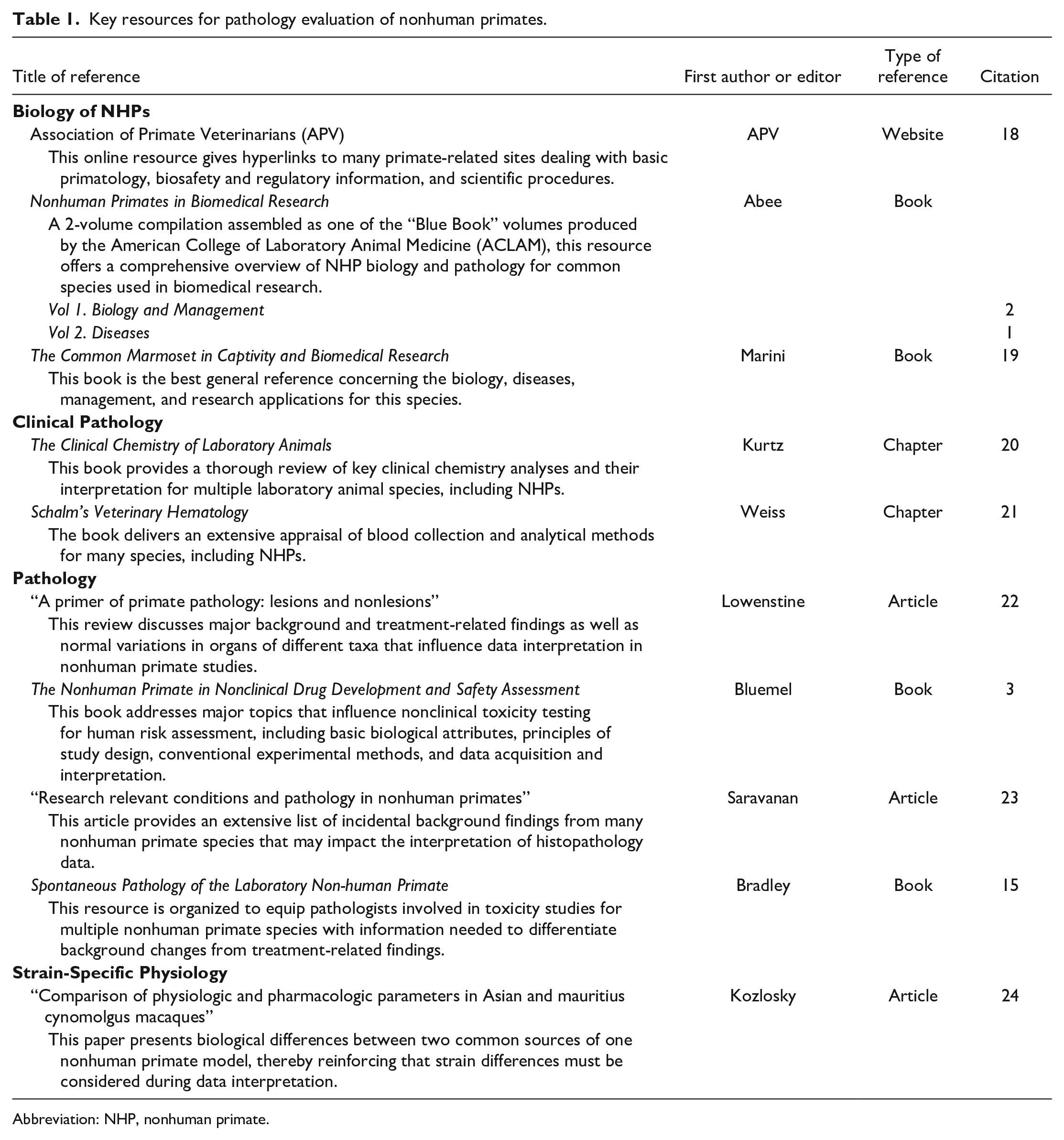
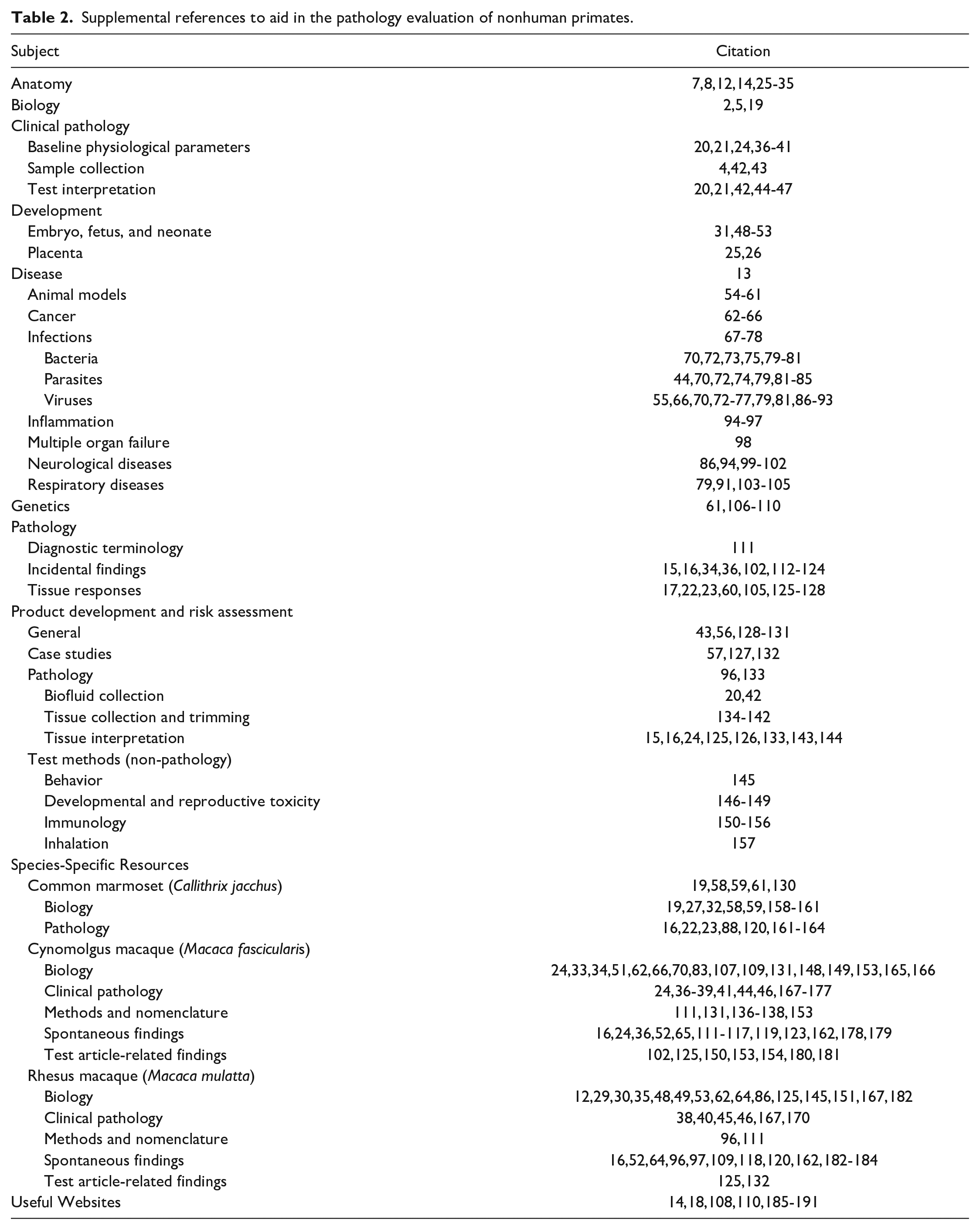
With respect to pathology evaluation, expertise in primate pathology may be developed in several settings. Formal training in diagnostic and/or experimental pathology typically is obtained in various academic institutions, primate-oriented research foundations (e.g., the 7 National Primate Research Centers in the United States [https://nprc.org/]), and zoological parks. On-the-job experience in toxicologic pathology of primates may be gained in some academic institutions as well as certain contract research foundations or biopharmaceutical companies. In many cases, toxicologic pathologists must engage in considerable self-study to build the needed knowledge base to discriminate NHP species-specific anatomic features and spontaneous background findings15-17 from potential changes related to test article exposure. The current mini-review is designed to provide a pathology-focused compilation of Internet and print resources to support a self-guided curriculum in comparative, experimental, and toxicologic pathology of common NHP models used in safety assessment. Both New World monkeys (e.g., common marmoset [Callithrix jacchus]) and Old World monkeys (e.g., cynomolgus [Macaca fascicularis] and rhesus [Macaca mulatta] macaques) are covered. The cited resources are arranged in two tables for convenience. The first provides a short list of printed materials and websites that are used most often by the authors in performing their duties as comparative and toxicologic pathologists working with NHP models; the important contents within the reference is given under the entry. The authors recommend that the annotated print items in Table 1 should be available in each pathologist’s office or departmental library due to their importance as tools in diagnosing and interpreting morphologic findings in common NHP species. The second table lists topics related to NHP pathology that may occasionally require the attention of a toxicologic pathologist but which fall outside the core expertise expected of such individuals in performing their daily tasks. These latter topics are accompanied by a list of one or more non-annotated citations that offer options for further exploration.
Key resources for pathology evaluation of nonhuman primates.
Abbreviation: NHP, nonhuman primate.
Supplemental references to aid in the pathology evaluation of nonhuman primates.
A solid understanding of the core knowledge needed for proficient NHP pathology evaluation may be attained by dedicated study of the several annotated resources in Table 1. Sufficient time will have to be spent perusing these baseline resources so that the budding NHP pathologist becomes familiar with both individual facts and the location of essential topics of relevance to evaluating primate specimens. Pathologists who regularly participate in NHP pathology will also need to engage in lifelong continuing education due to the continued growth of information, skills, tools, and techniques within this field. Effort to identify other NHP pathologists to serve as mentors and eventually collaborators (e.g., the many members of the Nonhuman Primate Pathology Special Interest Group [NHP-SIG] of the Society of Toxicologic Pathologists [STP]) will facilitate the acquisition of real skill in working with NHP models.
Footnotes
Declaration of Conflicting Interests
The author(s) declared no potential conflicts of interest with respect to the research, authorship, and/or publication of this article.
Funding
The author(s) received no financial support for the research, authorship, and/or publication of this article.
