




Abstract
Pathologists are trained medical professionals with special expertise in diagnostics, research, and pathophysiology. In these roles, pathologists are well qualified and positioned to engage in conversations about animal use replacement, reduction, and refinement (3Rs), thereby championing the guiding principles of the 3Rs. In particular, toxicology or nonclinical safety assessment is an important area where the discipline of toxicologic pathology can have a critical role in adopting 3Rs principles. As such, a working group of the Society of Toxicologic Pathology Scientific and Regulatory Policy Committee was formed to investigate and summarize some of the areas where veterinary pathologists working in the field of toxicology can increase involvement and impact on 3Rs. This “Points to Consider” publication provides an overview of areas within toxicology where the veterinary pathologist’s perspective may maximize animal value, including refinement of study design, optimizing sample collection, the development of 3Rs focused regulatory policy, and humane end point determination. * This Points to Consider article is a product of a Society of Toxicologic Pathology (STP) Working Group commissioned by the Scientific and Regulatory Policy Committee (SRPC) of the STP. It has been reviewed and approved by the SRPC and Executive Committee of the STP, but it does not represent a formal Best Practice recommendation of the Society; rather, it is intended to provide key “points to consider” in designing nonclinical studies or interpreting data from toxicity and safety studies intended to support regulatory submissions. The points expressed in this document are those of the authors and do not reflect views or policies of the employing institutions. Readers of toxicologic pathology are encouraged to send their thoughts on these articles or ideas for new topics to the editor.
Introduction
Toxicologic pathologists participate in the study design, data generation, and interpretation of anatomic and clinical pathology data in the fields of pharmaceutical, biological, industrial chemical, agrochemical, environmental, medical device development, and academic toxicology. In these roles, clinical and anatomic pathologists are well qualified and positioned to initiate focused conversations about animal use replacement, reduction, and refinement (3Rs) and can play a key role in championing the guiding principles of the 3Rs.
The concepts of the 3Rs were put forth 60 years ago as a framework to guide research animal use ethics and legislation. 1 Since that time, approaches and technologies to reduce, replace, and refine have continued to evolve and improve with active participation and interest by industry and regulatory agencies 2 involved in conducting and reviewing studies involving animal research. When animal use in research is necessary, the 3Rs facilitate improvement in both animal welfare and scientific quality. Investigative pathologists and those working in industry to assess safety of novel pharmaceuticals, agrochemicals, and medical devices are optimally positioned and knowledgeable to be part of the team that champions 3Rs concepts. Pathologists may impact human and animal health through discovery, translational, or clinical research. A large proportion of the pathologists working in the field of toxicology are also veterinarians. The veterinary pathologist pledges to use “scientific knowledge and skills for the benefit of society through the protection of animal health and welfare, the prevention and relief of animal suffering, the conservation of animal resources, the promotion of public health, and the advancement of medical knowledge.” 3 With extensive training in medicine and systems biology, the veterinary toxicologic pathologist is a critical member of the research team and brings clinically relevant questions into the research arena to drive 3Rs-focused conversations. Scientists involved in safety assessments of pharmaceuticals and chemicals are uniquely challenged in this regard, given the overarching goal (and regulatory requirements 4 –6 ) of nonclinical safety testing involves identification of target organ toxicity and its relationship with dose. Some areas of particular relevance within the 3Rs arena, specific to the toxicologic pathologist, include an initial assessment of whether a particular study adds value to human safety assessment, refinement of study design, optimization of sample collection, the development of 3Rs-focused regulatory policy, and humane end point determination.
Toxicologic Pathologist’s Role in Study Design
Independent of job responsibility, the toxicologic pathologist is an important member of the toxicology study team. 7,8 The pathologist’s perspective is informed by scientific and regulatory knowledge, allowing for judicious 3Rs recommendations that can support both animal welfare and scientific integrity. Pathologists can directly contribute to the determination of the need for a given study as well as the key scientific objectives the study is addressing. Once the need for and objectives of the study are established, the pathologist plays an important role in the study design, including determining the appropriate numbers of study animals/groups, appropriate control groups, key end points required to accomplish the study objectives, and necessity of recovery groups.
Conducting a study with an inadequate group size can negate the value of the study and result in the need to repeat animal work; however, judicious refinement in study design and data analysis techniques can result in reduction of animal numbers without impact to data integrity. 9 When study design is predetermined by regulatory guidance, refinements in analytical sensitivity, and therefore, power, may allow for decreased group sizes, particularly in the context of rodent studies. 10 Such refinements must be carefully considered during the study design phase to ensure that the data generated will provide adequate quality and scientific value, thus guarding against a counterproductive scenario of requiring additional animal studies to resolve ambiguity. In addition to decreasing the numbers of animals per group, a judicious reduction in study groups should be considered, where appropriate. A common scenario where fewer than the typical “control plus 3 dose groups” paradigm is often warranted is when drug exposures are limited due to immunogenicity (eg, monoclonal antibody therapeutics). In line with International Council for Harmonisation of Technical Requirements for Pharmaceuticals for Human Use (ICH) 11 and Society of Toxicologic Pathology (STP) best practices, 12 an argument against automatic inclusion of recovery groups should be informed by well-characterized responses to injury and the pathologist’s experience and perspective on the likelihood of recovery based on the extent and character of the findings and the regenerative capacity of the organ system(s) affected.
Another animal group reduction may be achieved through analytical refinements allowing for microsampling and serial blood collection for toxicokinetics (TK). Microsampling, small sample volumes (
In medical device testing, risk assessments can be used to decrease or eliminate the number of animal tests performed. When designing a regulatory package, “the number of animals and the amount of data that can support the safety and performance of a medical device, FDA recommends balancing the ethical principles of reduction/replacement/refinement as well as regulatory least burdensome principles, with the goal of using the minimum number of animals necessary to generate valid scientific data to demonstrate reasonable safety and performance”. 16 Pathologists have the scientific background, training, and experience in integrating diverse data points to qualify them for developing a scientifically justified rationale for not performing certain tests or assays. Careful development of risk assessments may result in determination that in vivo work is not necessary. When use of live animals is necessary, the pathologist can play a role in determining whether the proposed studies will provide relevant data by ensuring the intended clinical use (of a device) is considered. For example, in developing a safety package for a new medical device, a systemic dosing model would not be relevant for a device designed for topical use. In such a case, analytical tests of the device and extracts to determine the maximum amount of chemicals that could leach out of the device could be used to evaluate the potential human dose.
Strategic selection of the most appropriate end points may allow for integration of multiple regulatory requirements within a single study. Thoughtful integrative study design can reduce animal use and may positively impact study timelines thereby reducing the overall developmental cost. For example, a micronucleus test may be completed as a standalone assay or integrated into a repeat-dose toxicity test through inclusion of appropriate positive controls and selection of acceptable dose levels [per ICH S2(R1) 17 ]. Similarly, immunotoxicology end points such as the T-cell–dependent antibody response may be performed as an integrated end point in repeat-dose studies already required by regulatory guidance. 18 The European Medicines Agency (EMA) published a reflection paper 19 providing an overview of the current regulatory testing requirements for medicinal products for human use and opportunities for implementation of the 3Rs. 20 This work supports inclusion of safety pharmacology [eg, to support biotechnology-derived pharmaceuticals per ICH S6 (R1)] or genotoxicity end points to repeat-dose studies. Live virus vaccines and gene therapy medicinal products often require biodistribution end points, and depending on the program, it may be possible to include these evaluations within a toxicology study rather than conducting separate stand-alone studies. An integrated testing paradigm is also well suited for toxicity testing of agrochemicals regulated through the Federal Fungicide, Insecticide, and Rodenticide Act (FIFRA). 21 Studies can be designed using 3Rs techniques within an FIFRA regulatory framework from dose-range finding assays through carcinogenicity testing, 22 saving animals, time, and cost. As with all 3Rs techniques, end point integration should be applied judiciously. Application of additional in-life end points may result in additional physiological stress. Poorly designed integrative studies may not produce sufficient data to make any conclusions, resulting in animal wastage. The pathologist has the opportunity to see the impact of successful and failed integration designs at the level of the tissue and whole organism. These real-life experiences inform the degree of physiological stress that can result in increased variability among test subjects. With the goal of decreasing variability and increasing the predictive value of the study, a pathologist is often able to provide valuable insight into integrative study design.
A critical, but often overlooked, component of study design is determination of the appropriate end point. Regulations frequently define study length; however, the pathologist can provide valuable insight when an animal should be euthanized early. Preemptive determination of criteria for euthanasia, dosing holidays, clinical treatment, or termination of an entire adversely affected dose group are study refinements that should be considered by the study director with laboratory animal veterinary and pathology input, prior to study initiation. In this advisory role, the pathologist may provide guidance in support of data integrity and animal welfare. Euthanasia ensures timely collection of valuable clinical pathology and histopathology end points that would be lost or altered if animals are found dead. When end points have been reached or when emergency termination of an animal is warranted, and euthanasia is required, pathologists should try to ensure that necropsy teams are available as soon as possible. Whenever permissible by regulatory requirements, animals meeting euthanasia criteria, and those anticipated to become moribund before the next observation, should be euthanized. 23 The clinical pathologist can have a unique role in an early termination decision-making process by integrating in-life and clinical pathology data from nonrodent species under veterinary care to make recommendations in the best interest of the animal. Further, the pathologist may be in a position to evaluate and make recommendations surrounding the quality of the euthanasia procedure. Euthanasia is a critical study event that impacts the animal, the operator, and any observers. 24 As supervisors, pathologists should be aware of the potential for “compassion fatigue,” a situation that can occur in staff either directly or indirectly involved in animal euthanasia. 25 The pathologist should ensure that the procedure is performed with minimal stress and by competent personnel, using accepted techniques and in-house standard operating procedures (SOPs). 23,24 Encouraging the routine use of a sedative for all large animal necropsies prior to intravenous pentobarbital is an example of how the pathologist can introduce refinements into SOPs and improve animal welfare.
Toxicologic Pathologist’s Role in Sample Collection
Clinical and anatomic pathologists advise on methods for sample collection and preservation. Two areas of significant impact to overall animal use are sample collection volume and tissue banking techniques.
Blood collection volume often drives sampling approach and the addition of satellite groups in rodent studies. Reducing volume requirements through assay refinement as previously described may eliminate the need for terminal sampling and/or allow for blood collection from the primary study animals, thereby eliminating or reducing the need for satellite cohorts. 26 Reducing blood volume requirements in large animal species decreases the overall impact of blood collection on animal physiology and potentially facilitates blood collection from smaller vessels using smaller gauge needles. Using peripheral blood collection sites reduces the potential for injury or restraint-associated stress (eg, use of lateral saphenous vein instead of femoral vein in macaques, use of cephalic vein instead of jugular vein in dogs or rats). Pathologists may also have the ability to impact 3Rs considerations when reviewing blood collection SOPs for a facility by providing recommendations concerning bleeding techniques for a given species and harm–benefit trade-offs, based on their experience and judgment. For example, considering the hydration status, tissue injury, and animal temperament when attempting multiple repeat blood collections may reduce risk of physical injury to animals and holders.
Sample volume and total amount of blood collected should be carefully monitored to avoid impacting other study parameters. The impact of increased handling stress with multiple in-life collections may be minimized by better habituation of animals to restraint and handling procedures, by introducing positive reinforcement techniques such as food rewards, by keeping sample collection and animal handling practices uniform across all groups, including concurrent control(s), and by performing hematology assessment prior to multiple TK collections.
Cumulative blood volumes requested by different laboratories are often higher than the “minimum requirement” to accommodate repeat analysis in case of instrument error or results obtained outside a given reference range. The additional sample volume required for repeat analysis should be reviewed by the pathologist to allow further reduction in volume, particularly for interim collections where samples from individual animals may be recollected, if needed. Based on a recent survey performed by a working group of the Regulatory Affairs Committee of the American Society for Veterinary Clinical Pathology, there was a large, unexplained variation in the blood volume requirements for different institutions involved in drug development and toxicity testing. Given this variability, potential exists to refine techniques and reduce volumes collected. 15
The biggest opportunity for sample reduction in clinical pathology end points exists in coagulation testing, especially for large animal species, in which blood volume requirements are often driven by the availability of specific commercial tube sizes due to strict blood-to-anticoagulant ratio requirements. The use of pediatric and small mammal veterinary blood collection tubes for routine testing may allow for volume reduction. Coagulation testing is challenging in mice, often requiring a separate cohort of animals because of their small body size and strict requirements for blood-to-anticoagulant ratio. Considering these limitations, coagulation testing is generally not performed for mouse studies if information can be obtained from rat and non-rodent studies. 15 A few exceptions may be drugs where coagulation is a direct/known target and use of a separate subset of mice for coagulation testing can be justified. Since a relatively small blood volume is required for routine coagulation panels for toxicity studies (ie, prothrombin time, activated partial thromboplastin time, fibrinogen concentration), this usually results in leftover plasma which is discarded. Additional biomarkers or novel assays that can utilize citrated plasma (sodium citrate as anticoagulation) could be incorporated to utilize leftover coagulation samples, if this assay is deemed critical.
To ensure the most efficient use of animals, pathologists may advise research and development teams to proactively collect and preserve extra blood and tissue samples from control animals at necropsy for specialized testing (eg, immunohistochemistry, electron microscopy, genomics/proteomics, or other specific techniques), potentially preventing the need for blood or tissue collection from study spares or training colony animals. In-life blood collection volumes are limited by published recommendations 27,28 and specific Institutional Animal Care and Use Committee guidance at various institutions; however, there may be opportunities to collect additional blood under sedation or anesthesia prior to necropsy. In some cases, residual blood or fluid samples can be stored and utilized for later biomarker testing or instrument validation. The decision to plan preemptive collections involves a cost–benefit analysis, considering the additional expense and unknowns of stored samples on assay development against the potential long-term cost, and animal welfare gain of alleviating the need for future studies. This is especially critical for assays that cannot be conducted on formalin-fixed tissues and require fresh or frozen tissues or fluid or special preservatives. The addition of transmission electron microscopy end points to a toxicology study is another example where careful consideration of up-front investment in collection and preservation of select tissues can pay dividends in terms of specimen quality and avoid the need to repeat a study.
Many organizations may be hesitant to bank valuable samples from control animals in good laboratory practice (GLP) studies for future exploratory purposes. Although GLP regulations provide a reporting framework, 29 they do not preclude additional tissue or fluid collection or analysis. One area of potential advocacy for the pathologist could exist in clarification of tissue banking in support of the 3Rs. The framework for such interagency 3Rs efforts has been defined in a shared memorandum of understanding in support of care for the use and welfare of laboratory animals (Food and Drug Administration (FDA), National Institute of Health, and US Department of Agriculture).
Toxicologic Pathologist’s Role in Study Conduct Communication
The veterinary pathologist is well qualified and often in a position to provide impactful feedback to study staff related to animal care and treatment practices through communication of necropsy observations, histological diagnoses, and site-visit findings. For example, communication of glossitis associated with lingual vein collection in rats may result in collection from the lateral saphenous vein. Table 1 illustrates similar examples compiled by the authors that demonstrate communication of in-life or histological observations that resulted in improvements to animal welfare and subsequent improved data quality.
Examples of Communication Facilitated by Study Pathologists That Impacted Animal Welfare.
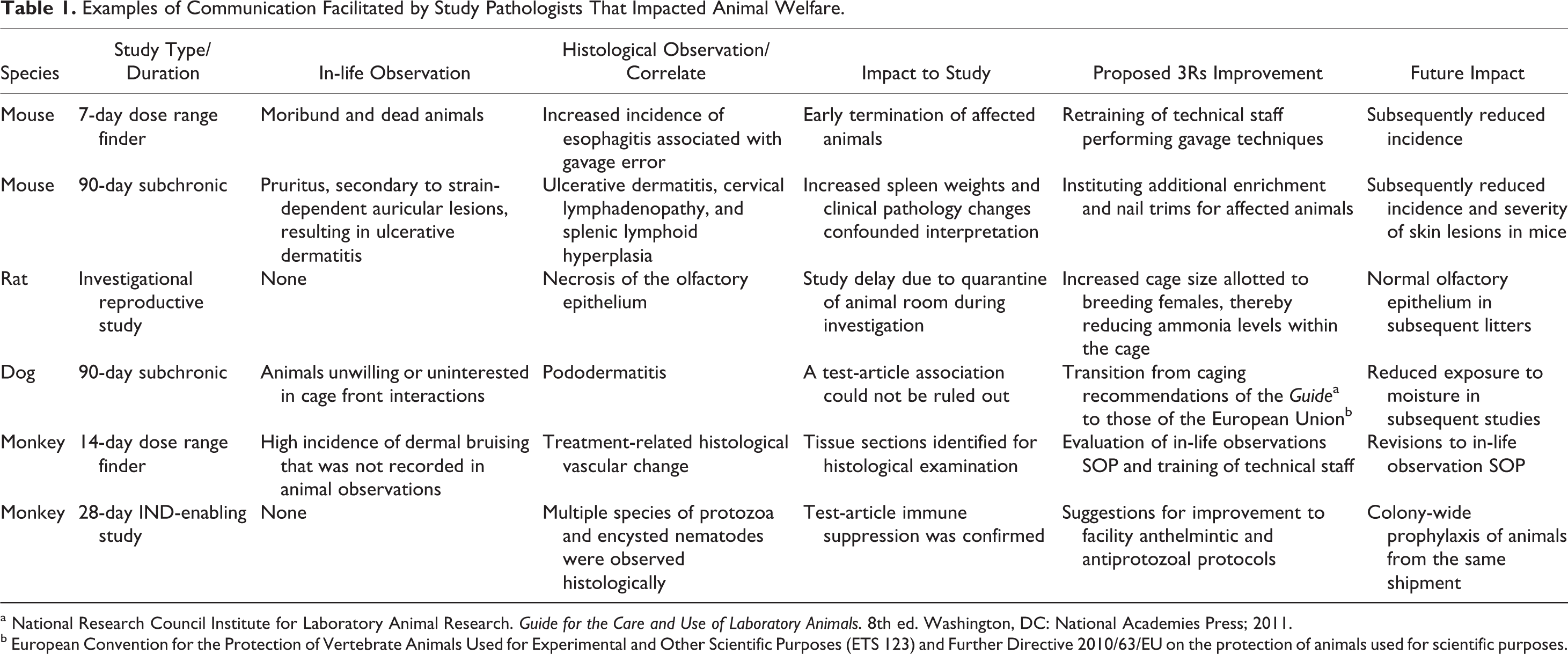
a National Research Council Institute for Laboratory Animal Research. Guide for the Care and Use of Laboratory Animals. 8th ed. Washington, DC: National Academies Press; 2011.
b European Convention for the Protection of Vertebrate Animals Used for Experimental and Other Scientific Purposes (ETS 123) and Further Directive 2010/63/EU on the protection of animals used for scientific purposes.
The pathologist holds a significant position of responsibility as a role model for necropsy processes and procedures. The veterinary pathologist is knowledgeable in humane euthanasia techniques and can advocate for improvements consistent with current American Veterinary Medical Association recommendations across species. When deviations to prescribed policies or best practices are observed, it is critical for the pathologist and/or any veterinarian involved to ensure that humane practices are being followed. The pathologist may be the only member of the study team to understand the potential impact of suboptimal in-life or euthanasia practices through gross or histological evaluation. Observation of lesions attributed to stress, suboptimal restraint, surgical- or anesthesia-related practices, bleeding or dosing techniques, or other husbandry- or technique-related injuries provide valuable information to study staff. Interpretation of findings that can be attributed to stress or suboptimal welfare, particularly in control animals, may facilitate advocacy for less invasive study procedures or improvements to housing and husbandry. Welfare improvements stemming from communication of pathology observations to in-life colleagues may directly reduce subsequent background and secondary lesions within tissue sections.
The pathologists’ involvement in communication of welfare concerns is enhanced by in-life observation of study animals. If the pathologist works within a laboratory setting, or had an opportunity to visit contract laboratory facilities, observations can facilitate discussions surrounding 3Rs practices. Observation of in-life activities in toxicology studies is not typically a requirement for the pathologist. Nonetheless, when visiting test facilities, it can be beneficial to take some time to informally tour the facility to observe animals, watch sample collection/euthanasia procedures, and interface with in-life personnel.
Toxicologic Pathologist’s Role in Influencing Regulatory Policy
Long before animal use in toxicology studies begins, regulatory scientists provide specific guidance for the framework of risk assessment and hazard identification. Regulatory bodies generally solicit feedback from multiple stakeholders and provide a period of formal review of new guidance to allow for comments and editorial suggestions to draft guidance documents. Guidance documents indirectly or explicitly form the basis for study design and may be influenced by the pathologists, either through provision of feedback on published drafts or through peer-reviewed publications.
A contemporary example of influencing draft guidance under review is the sensitivity of current practices for assessment of experimentally induced central nervous system (CNS) changes in toxicological studies. Regulatory bodies (ie, US Department of Health and Human Services FDA) have been presented with concerns regarding the adequacy of histomorphologic assessment of transient CNS changes, specifically neuronal necrosis. One proposed solution to improve detection sensitivity of transient necrotizing events is to increase study animal numbers to support interim necropsies during the course of the study. Pathologists can offer insight into alternative robust approaches and techniques (such as immunohistochemistry, stereology, fluorescence microscopy) for neurotoxicity risk assessment that could improve the sensitivity of detection without increasing animal use.
In another example, a working group of the Scientific and Regulatory Policy Committee of the STP was formed to review and provide feedback to the FDA’s draft Use of Histopathology and Its Associated Methodologies to Support Biomarker Qualification. 30 Among the feedback provided by the working group was a recommendation to allow organizations to leverage existing non-GLP (but otherwise scientifically rigorous) animal studies on a case-by-case basis to support biomarker qualification rather than a requirement for GLP status originally included in the draft proposal. This approach was ultimately incorporated into the final guidance 30 and has the potential to reduce overall animal use in biomarker qualification.
Where regulatory guidance is not available, pathologists have the responsibility to have a proactive role in the development of best practices. For example, in the years following the publication of ICH S9, Nonclinical Evaluation for Anticancer Pharmaceuticals, 31 the veterinary toxicologic pathology community identified a need to clarify use of recovery groups. To meet this need, a Position Paper was commissioned by the STP in support of judicious use of recovery animals, Best Practices on Recovery Studies: The Role of the Anatomic Pathologist. 12 This work was closely followed by publication of a Final Concepts Paper, S9: Q&A on Nonclinical Evaluation for anticancer pharmaceuticals, 11 which provided added clarity around selective implementation of recovery groups. Building on this effort, clinical pathologists published a related position paper, STP Best Practices for Evaluating Clinical Pathology in Pharmaceutical Recovery Studies. 32 The following year, the EMA published ICH S9 guideline on nonclinical evaluation for anticancer pharmaceuticals – questions and answers, 11 intended to facilitate the implementation of the S9 Guideline and to continue progress in the 3Rs.
Conclusion
Toxicologic pathologists are trained medical professionals with special expertise in diagnostics, research, and pathophysiology. Our scientific endeavors should be guided by a professional imperative to consider animal welfare in our work. Early involvement in the design of both the overall safety assessment program as well as specific study design can help integrate study end points judiciously and provide thoughtful direction for sample collection and preservation methods. In-life and follow-up communications between the pathologist, laboratory animal veterinarian(s), and study team can facilitate improvements in animal welfare and study data. We should continue to engage in review of regulatory guidance, advocating thoughtful and flexible approaches that balance the need for scientific rigor with prudent animal use. Although the job description of a specific pathologist may not include all areas of relevance discussed above, the research community understands these to be areas of influence for our profession. 33 Pathologists, therefore, have the knowledge, authority, and responsibility to consider animal welfare to ensure the best possible study outcomes.
With the advent of new technical fields and study approaches (eg, 3-dimensional microfluidic microphysiological systems and Tox21 34 ), pathologists have the opportunity to actively drive development of more predictive and resource-sparing methods, which will ultimately result in a reduction of animals and maximize the use of data from animals entering in vivo testing paradigms. With the goal of fostering active societal engagement, select references of particular relevance to toxicological pathology in support of the concepts described herein are summarized in Table 2. Many of the concepts in this publication were discussed in a recent webinar co-sponsored by the STP, British Toxicology Society, the Teratology Society and the American College of Toxicology 35 and efforts from this working group have culminated in creation of a Policy Statement on Working with Animals in Research recently adopted by the STP.
Key References for 3Rs Techniques.
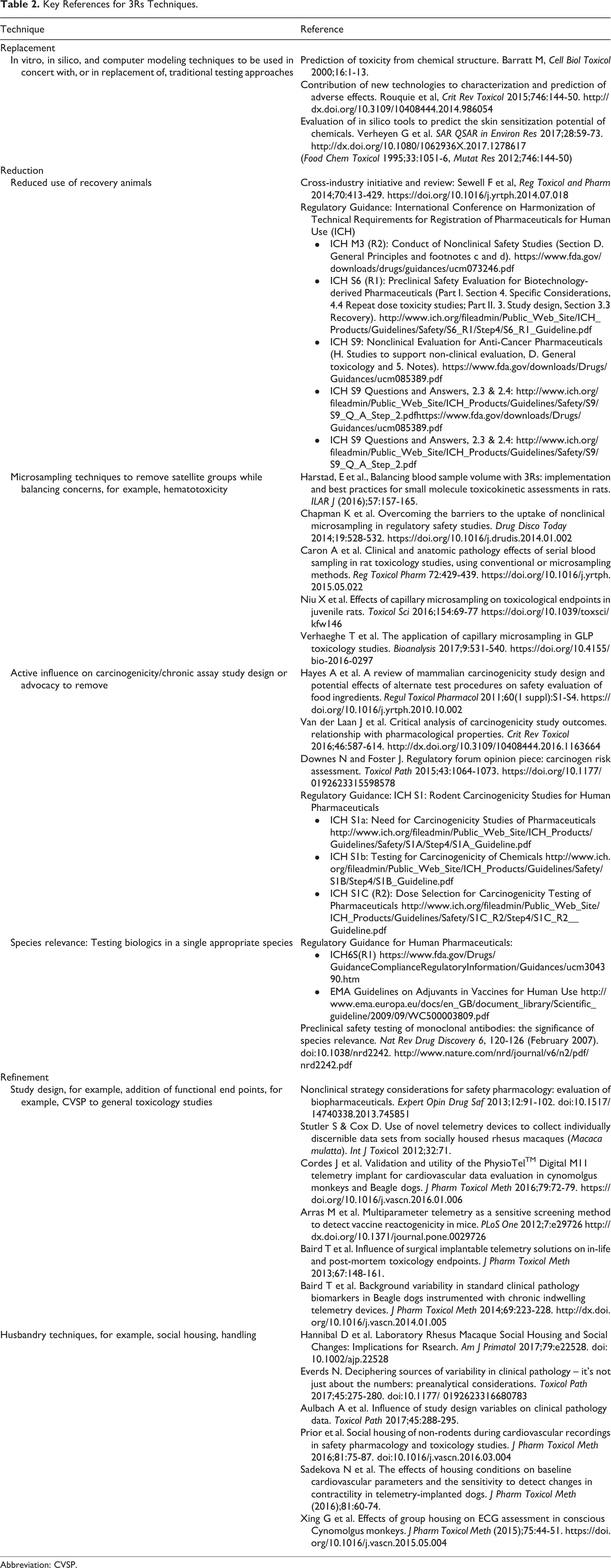
Abbreviation: CVSP.
Footnotes
Acknowledgments
The authors thank Lyn M. Wancket for her review and contributions. Critical comments and revisions were provided by John L. Vahle, the Scientific and Regulatory Policy Committee, and the Executive Committee of the STP.
Declaration of Conflicting Interests
The author(s) declared no potential conflicts of interest with respect to the research, authorship, and/or publication of this article.
Funding
The author(s) received no financial support for the research, authorship, and/or publication of this article.
