




Abstract
The recent Scientific Committee on Health, Environmental and Emerging Risks Final Opinion on “The need for nonhuman primates in biomedical research, production and testing of products and devices” (2017 SCHEER) highlights approaches that could significantly contribute to the replacement, reduction, and refinement of nonhuman primate (NHP) studies. Initiatives that have the potential to affect NHP welfare and/or their use are expected to be appropriate, fair, and objective and publicly disseminated information focused on NHPs in biomedical research, which includes toxicologic and pathologic research and testing, should be objectively evaluated by stakeholder scientists, researchers, and veterinarians. Thus, IQ Consortium member companies convened to develop an informed and objective response, focusing on identifying areas of agreement, potential gaps, or missing information in 2017 SCHEER. Overall, the authors agree that many positions in the 2017 SCHEER Opinion generally align with industry views on the use of NHPs in research and testing, including the ongoing need of NHPs in many areas of research. From the perspective of the IQ Consortium, there are several topics in the 2017 SCHEER that merit additional comment, attention, or research, as well as consideration in future opinions.
Keywords
Introduction
The European Commission’s Scientific Committee on Health, Environmental and Emerging Risks (SCHEER) Opinion on the need for nonhuman primates (NHPs) in biomedical research, production, and testing of products and devices 1 has been discussed, detailed, and reviewed in several recent excellent peer-reviewed publications. These review articles have considered the impact of the SCHEER report on research using NHPs in neuroscience, barriers, and possible solutions related to NHP testing and, overall, summarized the main findings and conclusions of the 2017 SCHEER Opinion 2 –4 issued as final in May 2017. 1 The authors of this commentary recommend review of the SCHEER report as well as the publications listed above for a more comprehensive assessment of the opinion and leading thoughts around the NHP use in research and testing.
In 2007, the Director General for the Environment of the European Parliament requested the Scientific Committee on Health and Environmental Risks to issue an opinion on the state of alternatives to NHP research to facilitate an informed debate during the negotiations of the European Parliament and the Council on the European Directive (Directive 86/609 replaced in 2010 with 2010/63/EU). That Opinion, issued in 2009, supported the European Commission’s view that there was no scientific reason to support a discontinuation in the use of NHPs in basic and applied research. The Scientific Committee on Health and Environmental Risks recommended that the position be reviewed regularly to consider and review the development of alternatives and the general progress of scientific methodology and testing related to NHPs, resulting in the updated report issued in 2017.
The 2017 Opinion examines in some detail several significant areas where NHPs are considered important models, including development of pharmaceutical products and medical devices, treatment and prevention of infectious disease, neuroscience, ophthalmology, and organ transplantation. This updated document, as did the previous 2009 Opinion, generally supports the ongoing need for NHPs in many areas of research. Yet although significantly greater in length, the 2017 Opinion presents little to no new information regarding the state of alternatives or viability of replacing NHPs in the future. In brief, the SCHEER working group was tasked with updating the opinion wherein they conducted a focused, informed, and factual analysis of the status of alternatives to NHPs and the available opportunities for applying all 3Rs of replacement, reduction, and refinement to NHP research and testing. The opinion addresses 6 primary topics (Table 1) as part of the mandate and highlights the many scientific approaches that could potentially contribute to the 3Rs of NHP studies and testing. Additional topics are discussed to detail scientific and regulatory barriers in adoption and development of NHP research alternatives with recommendations to overcome these challenges.
Primary Topics Addressed in The European Commission’s Scientific Committee on Health, Environmental and Emerging Risks (SCHEER) Opinion on the Need for Nonhuman Primates (NHPs) in Biomedical Research, Production, and Testing of Products and Devices. 1
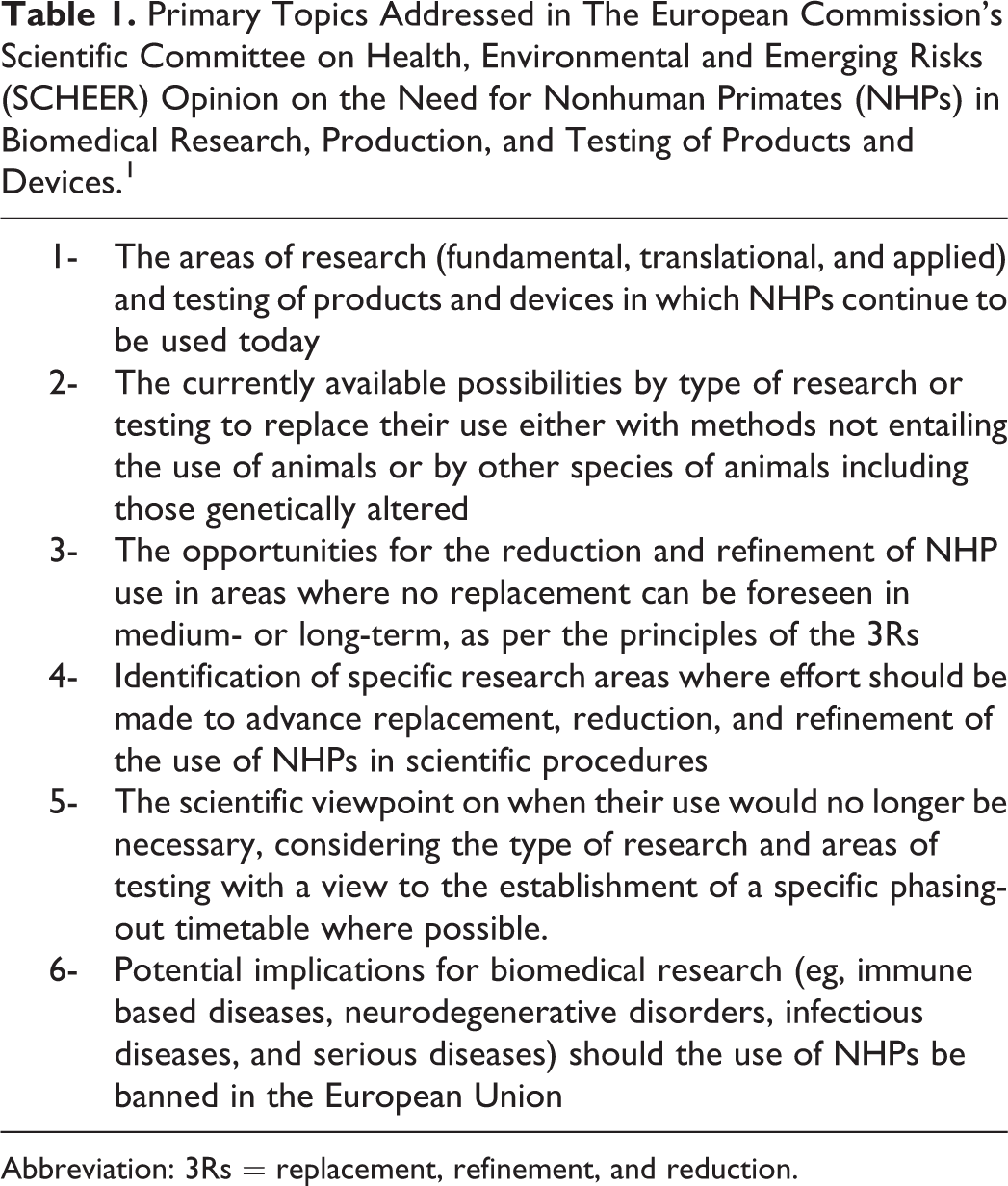
Abbreviation: 3Rs = replacement, refinement, and reduction.
The importance of the SCHEER analysis, as it relates to public and professional opinion on the scientific usefulness or limitations of NHP use in testing and research, warrants careful consideration, evaluation, and discussion. There continues to be discussion, publication, and positions made around the use of primates in research, and the general use of NHPs remains a controversial issue among individuals in both public and professional arenas and can be reviewed. 5 Additionally, advocates are requesting that future SCHEER position papers should point to the growing debate within the scientific community on whether NHP use is sufficiently evidence based to be a cornerstone of biomedical research and testing. 6 –8 However, scientists utilizing NHPs in biomedical research, including toxicology and pathology testing, are key stakeholders where it concerns the value, utility, and limitations of NHPs in translational and applied research and should be well represented across disciplines and regions where it concerns positions or opinions around the use of NHPs in research and testing. Specifically, NHPs have been used as a non-rodent animal model for preclinical toxicology and safety assessment based on several factors, 9,10 and the validity of the NHP is still considered to be relevant to many aspects of toxicology and safety testing. Per Epstein and Vermeire, 2 NHPs remain essential for the safety assessment of some classes of drugs and medical devices, which along with primate breeding and production, which constitutes approximately 75% of all NHP use.
Given NHPs are primarily used in (1) the development and safety testing of pharmaceuticals and medical devices, (2) treatment and prevention of infectious diseases, and (3) neuroscience, awareness of initiatives such as the SCHEER (and position responses to the SCHEER) is paramount to objective information being presented around the use of NHPs and being endorsed by key stakeholders and scientists. These data and information should also be presented in a fair and unbiased manner. Overall, the authors of this commentary, which represent a spectrum of scientists across the industry and subject areas including veterinary sciences, toxicology, laboratory animal resources and management, and scientific project management agree with Epstein and Vermeire, 2,11 that it is important to continue to analyze all areas of NHP use. An understanding of the contribution of NHPs to scientific knowledge and their translational utility to humans will help potentially reduce their use where appropriate. Stakeholder analyses also will provide the information necessary to help make informed decisions on the value of, as well as optimal use of, NHPs in research and testing.
With the above in mind, the International Consortium for Innovation and Quality in Pharmaceutical Development (IQ Consortium) member companies and subject-matter experts within these companies reviewed the current SCHEER opinion to facilitate and provide an informed and objective response to this report. The IQ Consortium (www.iqconsortium.org) is a not-for-profit organization of pharmaceutical and biotechnology companies with a mission of advancing science and technology to augment the capability of member companies to develop transformational solutions that benefit patients, regulators, and the broader research and development community. The following summarizes the conclusions, questions, and recommendations from that review.
Scientific Committee on Health, Environmental and Emerging Risks Positions and IQ Consortium Responses
Alignment
IQ Consortium members found themselves in significant agreement with the 2017 report in several areas. 11,12 These included (1) active application of the 3Rs in NHP research; (2) use of the highest standards of animal care and best practices in research; (3) use of integrated testing strategies, where feasible; (4) the top 5 areas of research where NHPs are most critical; (5) need for additional knowledge and insights in order to replace NHPs in drug safety testing; (6) reliance on the use of NHP research in order to advance medical science; and (7) the current impossibility of a timetable to stop use of NHPs in research.
Lack of Alignment
In addition, there are multiple areas of the report where IQ Consortium members were not aligned with the language, methodology, or conclusions put forward in the SCHEER Opinion. The following outlines some of the more significant areas where consideration of alternate perspectives would be appropriate if updates of this opinion are undertaken in coming years.
Panel membership and source material should be more representative of EU membership and the broader research community
It was the opinion of the authors that the opinion was overly represented by the United Kingdom and National Centre for the 3Rs (NC3Rs). In fact, 50% of the external panel members were employed in the United Kingdom. The NC3Rs was cited or mentioned no less than 35 times throughout the document, whereas other organizations representing the use of NHPs in research within the EU, such as the European Consensus Platform for Alternatives and the Norwegian 3R Centre (Norecopa, Oslo, Norway), were not mentioned or cited. The Universities Federation for Animals Welfare was cited only one time.
Overall, laboratory animal professionals who have key insights and understanding of the use of NHPs are not adequately represented in the SCHEER Opinion. For example, the Federation of Laboratory Animal Science Associations was mentioned only twice in citation of a working group and the Laboratory Animal Veterinary Association was not included.
There are concerns that calls for increased regulation of NHP use in research fail to recognize the need to optimize research efficiency by reducing ineffective regulatory burden while also assuring animal welfare and scientific integrity.
Recently, significant efforts have been undertaken to reevaluate and reduce ineffective regulatory requirements that impact research and to identify and reduce the cost of unnecessary administrative burden on research while maintaining the integrity and credibility of scientific findings and the protection of research animals. These include the following: In 2015, the National Academy of Sciences, a private, nonprofit organization of leading researchers in the United States, released detailed recommendations to optimize the balance of regulatory requirements with the need for efficient and effective research. 13 In 2016, the United States signed into law the 21st Century Cures Act, Public Law 114-255. 14 Under Section 2034 of the Act, Reducing Administrative Burden for Researchers, the NIH, US Department of Agriculture, and Food and Drug Administration (FDA) are directed to “review applicable regulations and policies for the care and use of laboratory animals and make revisions, as appropriate, to reduce administrative burden on investigators while maintaining the integrity and credibility of research finding and protection of research animals.” Specifically, the Congress is expected to “identify inconsistent, overlapping, unnecessarily duplicative regulations and policies with a focus on inspection and review requirements; take steps to reduce same; take actions, as appropriate, to improve coordination of regulations and policies with respect to research with laboratory animals.” 15 In 2017, The Federation of American Societies for Experimental Biology, the Association of American Medical Colleges, and the Council on Governmental Relations, with the assistance of the National Association for Biomedical Research, convened a workshop to provide actionable recommendations to aid in efforts to implement effective regulation in research. 16 Moreover, it has been proposed that regulatory burden has negatively impacted investment in animals, and the time and effort required in research. Resources used to comply with excessive regulatory burden would be better used to advance animal welfare and contribute to sound science. The IQ Consortium recommends that a future opinion from the SCHEER Committee consider strategic optimization of regulations for research to introduce new requirements only where necessary for animal welfare and scientific integrity and to reduce the regulatory burden where requirements are inconsistent, overlapping, or introduce administrative obstacles to research.
The call for European Centers of Excellence, although laudable in intent, is an inherently complex endeavor and risks exclusion of organizations conducting valuable and novel research, as well as stifling innovation and creativity.
Several questions arose regarding the implementation for Centers of Excellence: (1) what data exist to demonstrate that Centers of Excellence are beneficial to the advancement of science or would enhance the judicious use of NHP models; (2) creation of these centers hinges on determination of the locations and criteria for eligibility as Centers of Excellence. For example, would an EU panel be required to review all locations and approve sites allowed to conduct research with NHPs? and (3) How would European Centers of Excellence interact with the broader global research community?
The IQ Consortium supports a continued effort to improve research standards across the globe, with an emphasis on sound science and 3Rs principles. Any increase in barriers to collaboration should be avoided. Creation of European Centers of Excellence should be carefully scoped among regulatory, industry, and academic stakeholders in NHP research to enable the centers to effectively respond to needs in the research community, focus on improvements in science and animal welfare, and foster collaboration and innovation in NHP models with European research institutions and the global research community.
The denigration of research and animal care in other (non-EU) countries is unwarranted, inappropriate, and frequently in error
In a specific instance, the statement that NHPs are not standardly socially housed in the United States is incorrect and misleading. A recent review of NHP facility housing practices in the United States shows that the majority (≥84%) of NHPs used in research and testing in the United States are socially housed. 17
The Opinion cites a concern that EU scientists are moving research programs to countries where welfare or scientific standards would not be acceptable in Europe. A careful reading of the 2 references cited for this statement reveals a more nuanced perspective. The references, neither of which are scientific articles, and one of which is anonymous, reference research moving to China, but cite regulatory burden and cost as factors in relocation from Europe. At the same time, they speak highly of the quality of animal care and scientific support found at certain Chinese research institutions and note that many facilities have achieved or are striving for Association for Assessment and Accreditation of Laboratory Animal Care (AAALAC) accreditation. 18,19
Accreditation by AAALAC International is considered a gold standard for animal research programs by many research professionals. Facilities in 27 non-European countries have research facilities that have achieved AAALAC accreditation, including more than 130 facilities in Asia, with over 70 of those located in China. The authors of the Opinion appear to acknowledge the value of AAALAC accreditation but are critical that AAALAC does not promote a European housing standard for the rest of the world. It is the responsibility of the institution-seeking accreditation to identify which of the 3 primary standards 20 –22 is relevant as AAALAC does not develop or promote any regulation and remains primarily focused on performance standards. Claims to EU superiority in NHP housing and care appear to be based largely on EU legal requirements for larger housing. It is appropriate to acknowledge that there are more factors regarding primate use and care to consider than housing size requirements alone.
Detailed risk–benefit analysis for every use of NHPs, particularly in safety studies, may be unwarranted as long as regulatory and health authorities are mandating the use of the NHPs or are (rightfully) demanding improved translatability to humans. Barriers to implementing alternatives in the form of regulation and liability must be appropriately considered.
Current regulatory testing guidance from both the FDA and European Medicines Agency around submission supporting human clinical investigation of new drugs requires the evaluation of these entities in nonclinical species prior to human use. In addition, more recent guidance issued by both regulatory authorities emphasizes the requirement for in vivo evaluation in nonclinical species. 23 While these guidance documents do not specifically prescribe the use of NHPs, they also do not exclude NHP testing. There is also an increasing emphasis on the relevance of given species, including NHPs, for testing (eg, ICHS6), as well as the translation of the results obtained to humans. Given the phylogenetic similarities of NHPs and humans, there is a significant likelihood that NHPs will more frequently provide the greatest potential for translation. 24 Consequently, a risk–benefit analysis would be typically superseded by the regulatory imperative. In fact, pharmaceutical study sponsors report that they frequently request health authority reviewers to perform fewer and smaller NHP studies, requests which are denied by officials. In addition, since new chemical entities entering development may be directed against novel pharmacological targets, are of novel chemical structure, or are of unproven efficacy in humans, an objective risk–benefit assessment of safety studies is unlikely to be universally achievable.
Further, it should be noted that typically nonclinical safety studies are preceded by smaller range finding studies to characterize pharmacodynamics, exposure, and formulation to ensure the validity of subsequent safety studies. These studies not only require the use of the appropriate and relevant species but are also in keeping with the 3Rs principle of refinement by avoiding inadequate exposures in pivotal studies using larger numbers of animals. The basis for evaluating the utility of these range finding studies in a risk–benefit analysis is much different from that of the pivotal safety study and would be driven by the regulatory imperative. Although it is important to consider different models and methodologies in research and to substantiate decisions taken in studies, the IQ Consortium recommends that the SCHEER Committee focus on advocating a risk–benefit analysis for studies where refinement and reduction can be achieved.
Calling for transparency in research does not appear to take into account the significant concerns of intellectual property protection
The IQ Consortium recommends the SCHEER Committee provide further thoughts around transparency-related challenges or issues, such as the level of severity of experimental procedures, specific areas of research, origin of animals, generation, and first-time use. Sharing research data sometimes raise intellectual property (IP) questions in the minds of contributing researchers, their employers, their funders, and other researchers who seek to reuse research data. Key questions to be addressed might include the following: (1) Once scientific data are in the public domain, how do the legal rights to the data differ between the originator and the larger community when shared? (2) Who has these rights? and (3) How does one with these rights use them to share data in a way that permits or encourages productive downstream uses?
The literature is replete with calls, examples, and reasons for increased scientific transparency in the spirit of learning, validation, and reduction of unnecessary experimental reproduction. Although in general agreement, the IQ Consortium believes these primarily apply to the creation of new and innovative assays and discoveries and are less applicable to data generated during drug discovery and NHP safety studies. Advocates of scientific transparency often compare it to the changes in publishing of clinical data (ie, www.clinicaltrials.gov, CONSORT—Consolidated Standards of Reporting Trials in 1996). However, publication of nonclinical data in a similar manner lacks patent protection. 25 Several initiatives or guidelines have already been developed to model standards accepted in human clinical trials to reduce data bias, increase scientific rigor and integrity, and help design more efficient animal studies. These include:
Pharmaceutical companies have legitimate concerns regarding loss of property protection. Information collected and used outside the EU or United States carries more risk of counterfeit or lower quality copied products, which have the potential to negatively impact public health. Companies that delay development until all patent filings are complete could delay the introduction of beneficial products for years. Efforts to improve transparency within the research community should define data rights enable industry participation where concerns may exist over IP.
Limiting the use of NHPs to research supporting treatment of human disease may place wild NHP populations at risk of succumbing to emerging disease
Wild NHP populations are at high risk due to infectious diseases. Limiting or denying the use of captive NHP research subjects further complicates attempts at conservation and could lead to extinction. About one-third of the world’s gorillas and pandemic levels of chimpanzees in Africa have died of Ebola virus. Researchers are on the verge of developing an oral vaccine that could prevent further devastation to these populations. Regulations prohibiting the use of NHPs for research other than for human health could halt efforts to preserve these wild NHP populations. 30
Calling for improved and appropriate staff training is inconsistent with existing restrictions on the use of NHPs for training in the EU, which pose a challenge for developing staff with the necessary skills to conduct a full range of research at a high level. The IQ Consortium recommends additional thoughts and recommendations from the SCHEER Committee on how to improve NHP technician training while reducing overall use of NHPs.
Several questions arise regarding improved NHP technician training: How is training to be conducted (and under what curriculum[s])? Who will develop, accredit, and harmonize training programs? How will Continuing Professional Development be accredited and by what body? How will this be funded? Will harmonized training be considered mandatory or regulated (or optional)? Will harmonized training programs result in increased NHP use?
Per the 2017 SCHEER Report, EU Guidance to Member States on the minimum training requirements for those involved in the care and use of animals under Directive 2010/63/EU includes some species-specific learning outcomes. 31 Nonhuman primate–specific material has been provided as part of this training in some Member States for many years, with some courses being accredited by the competent authority or accrediting bodies on their behalf, similar to what is offered by the AALAS Learning Library. 32 However, a number of issues with the current training provision in the EU need to be addressed to deliver the best science and animal welfare and avoid perpetuation of obsolete practices and variation between laboratories. European Union has provided funding to EUPRIM-Net, a network of 9 European primate centers from 6 countries that was established as a Research Infrastructure in 2006 and has now just completed its second round of funding by the Commission (FP7-GA-262443). The primate centers’ infrastructures and expertise were integrated to provide critical services, training, and advice to scientific institutions in Europe conducting NHP research. Additionally, “Alternative methods for the use of NHPs in biomedical research” has provided a list with opportunities and priorities, where it concerns NHP alternatives. 33 From a biomedical research perspective, there are criteria that require (a) “selecting the most relevant (provide references) species” based on target expression, distribution, and pharmacological activity and (b) “when suitable/relevant alternatives are not available” based on lack of target expression and lack of cross reactivity to antibody-based therapeutics or available reagents. These criteria are appropriately used to justify the use of NHPs in research. There is a missed opportunity in the SCHEER report to identify areas where the appropriate use of NHP models has reduced the need for future animal work, such as antiviral research. Increased scientific scrutiny (eg, animal to human translational aspects, mechanism of action studies, pharmacology, and disease vs healthy) around using NHPs would provide additional substance to the discussion on NHPs in research rather than a focus on regulation, training, housing, and other factors.
Discussion and Conclusions
European law requires the EC to review the “Animal Protection Directive” with a focus on the use of NHPs and scientific advances which might help to reduce their use or render it obsolete. Therefore, the EC requested the SCHEER to review and update its 2009 Opinion on the need for NHPs in biomedical research, production, and testing of products and devices. The 2017 SCHEER Opinion addresses several issues present in or new to the 2009 Opinion and can be reviewed further.
The current commentary was based on the efforts of IQ Consortium member subject-matter experts to review the current SCHEER Opinion to provide an informed and objective response to this report, as well as provide conclusions, questions, and recommendations from that review. It was also an attempt to bring forward general thoughts around possible gaps and unclear or missing information. Overall, the authors found themselves in agreement with the 2017 report where it concerned application of the 3Rs, animal care and best practices, integrated testing strategies, critical areas of research, the need for additional information to support replacement in drug safety testing, their utility in advancing medical science, and the current impossibility of a timetable to stop NHP use in research and testing.
However, the members were generally not aligned on the following aspects of the 2017 Opinion report, including (1) panel membership and source material—which should be more representative of EU membership and the broader research community; (2) calls for increased regulation of NHPs—that might fail to optimize research efficiency by reducing ineffective regulatory burden while also assuring animal welfare and scientific integrity; (3) the call for European Centers of Excellence—a complex initiative and may limit novel research, innovation, and creativity based on limited membership; (4) reporting and presentation of research and animal care in other (non-EU) countries—this information should be more accurately presented; (5) detailed risk–benefit analysis recommendations for every use of NHPs—is considered unwarranted in every case given current health authority and regulatory requirements and barriers to implementation of alternatives; (6) calls for increased transparency in NHP research—which may not take into account IP protection; (7) limiting the use of NHPs to research supporting treatment of human disease—this may place wild NHP populations at risk of succumbing to emerging disease; and (8) although the authors are fully supportive of training and developing staff with the necessary skills to conduct a full range of NHP research at a high level, the opinion lacks clarity and focus in the call for improved and appropriate staff training and does not reconcile how that training could be achieved with current EU regulations and existing restrictions on the use of NHPs for training in the EU.
Overall, the authors of this commentary support the SCHEER Committee mission to examine and evaluate the value and need for research using NHPs, as well as a future where NHP use is no longer necessary to advance science and medicine. Nonhuman primates remain essential for nonclinical safety assessment, which constitutes approximately 75% of all NHP use. Therefore, it is the recommendation of the authors that additional stakeholders (industry, government and academic pathologists, toxicologists, veterinarians, and other scientists and professionals) provide thought leadership in future responses or updates to the SCHEER Opinion. Furthermore, the authors posit that the perspectives described herein, along with an increased exchange of scientific data, knowledge, and dialogue, will continue to contribute to the successful implementation of the 3Rs, animal welfare initiatives, as well as the thoughtful and ethical use of NHPs in scientifically sound research and testing. Moving forward, the members of the IQ Consortium will willingly partner with the committee and other stakeholders of NHP use to offer the consortium’s considerable expertise and experience to future efforts in this area.
Footnotes
Authors’ Note
All authors contributed equally to the drafting of this manuscript.
Declaration of Conflicting Interests
The author(s) declared no potential conflicts of interest with respect to the research, authorship, and/or publication of this article.
Funding
The author(s) received no financial support for the research, authorship, and/or publication of this article.
