




Abstract
Adverse toxicologic effects are categorized as chemical-based, on-target, or off-target effects. Chemical-based toxicity is defined as toxicity that is related to the physicochemical characteristics of a compound and its effects on cellular organelles, membranes, and/or metabolic pathways. On-target refers to exaggerated and adverse pharmacologic effects at the target of interest in the test system. Off-target refers to adverse effects as a result of modulation of other targets; these may be related biologically or totally unrelated to the target of interest. Both the risk assessment and development strategies used for xenobiotics are influenced by the understanding of the mechanism of toxicity. It is imperative that the toxicologic pathologist use the toxicologic and biologic data at hand and literature information on the target to form testable hypotheses related to whether a toxicity is chemical-based, on-target, or off-target. The objective of this session at the 2012 Society of Toxicologic Pathologists Symposium in Boston, Massachusetts, was to discuss chemical-based, on-target, and off-target-based effects and the scientific approaches used to aid in their human risk assessment.
Arguably, the most critical role of the toxicologic pathologist in the safety assessment process is that of subject matter expert in comparative mammalian physiology and pathology. The data sets from preclinical toxicology studies are complex. After the evaluation of the primary data set is complete, the interpretation of the data requires an integrated understanding of the animal model system as it relates to those individuals at exposure risk to the test agent. In the safety assessment process, the deciphering of the pathogenesis of the toxicologic observation offers an opportunity to identify safety biomarkers and more accurately predict human risk. Optimally, the hypothesis a toxicologic pathologist may propose and test as a result of this in vivo data set may be used to improve future safety assessments by contributing important information to our collaborators for the design of predictive in vitro and in silico testing approaches (Hartung 2009).
Adverse toxicologic effects are categorized as chemical-based, on-target (also referred to as target-related, exaggerated pharmacology or mechanism-based), or off-target effects; these latter two are generally only applicable to chemo- or biotherapeutics. Chemical-based toxicity is a subject of a different STP Symposium session but for the purposes of this mini review is defined as toxicity that is related to the physicochemical characteristics of a compound and its effects on cellular organelles, membranes, and/or metabolic pathways. On-target refers to exaggerated and adverse pharmacologic effects at the target of interest in the test system. Off-target refers to adverse effects as a result of modulation of other targets; these may be related biologically or totally unrelated to the target of interest. Both the risk assessment and the development strategies used for xenobiotics are influenced by the understanding of the mechanism of toxicity. For example, if the toxicity is off-target, medicinal chemists have a better opportunity to design away from the toxicity while maintaining the wanted pharmacologic, on-target effects. It is imperative that the toxicologic pathologist use the toxicologic and biologic data at hand and literature information on the target to form testable hypotheses related to whether a toxicity is chemical-based, on-target, or off-target. The objective of this session at the 2012 Society of Toxicologic Pathologists Symposium in Boston, Massachusetts, was to discuss chemical-based, on-target and off-target-based effects and the scientific approaches used to aid in their human risk assessment.
Introductory comments for this session emphasized the importance of an effective cross-functional effort when deciphering chemical-based, on-target, or off-target toxicologic effects. The toxicologic pathologist should not attempt to work in a vacuum when assessing the mechanism of study findings. Important tools and critical subject matter expertise exist across specific scientific disciplines within industry and academia. Important partners and colleagues include scientists in medicinal chemistry, formulation development, drug disposition, pharmacology, cell biology, molecular genomics, and bioinformatics to name a few. Some of the tools these partners have at their disposal are listed in Table 1 and were discussed as important levers for the science described by the platform presenters in this session.
A list of some tools that may facilitate on-target and off-target mechanistic studies.
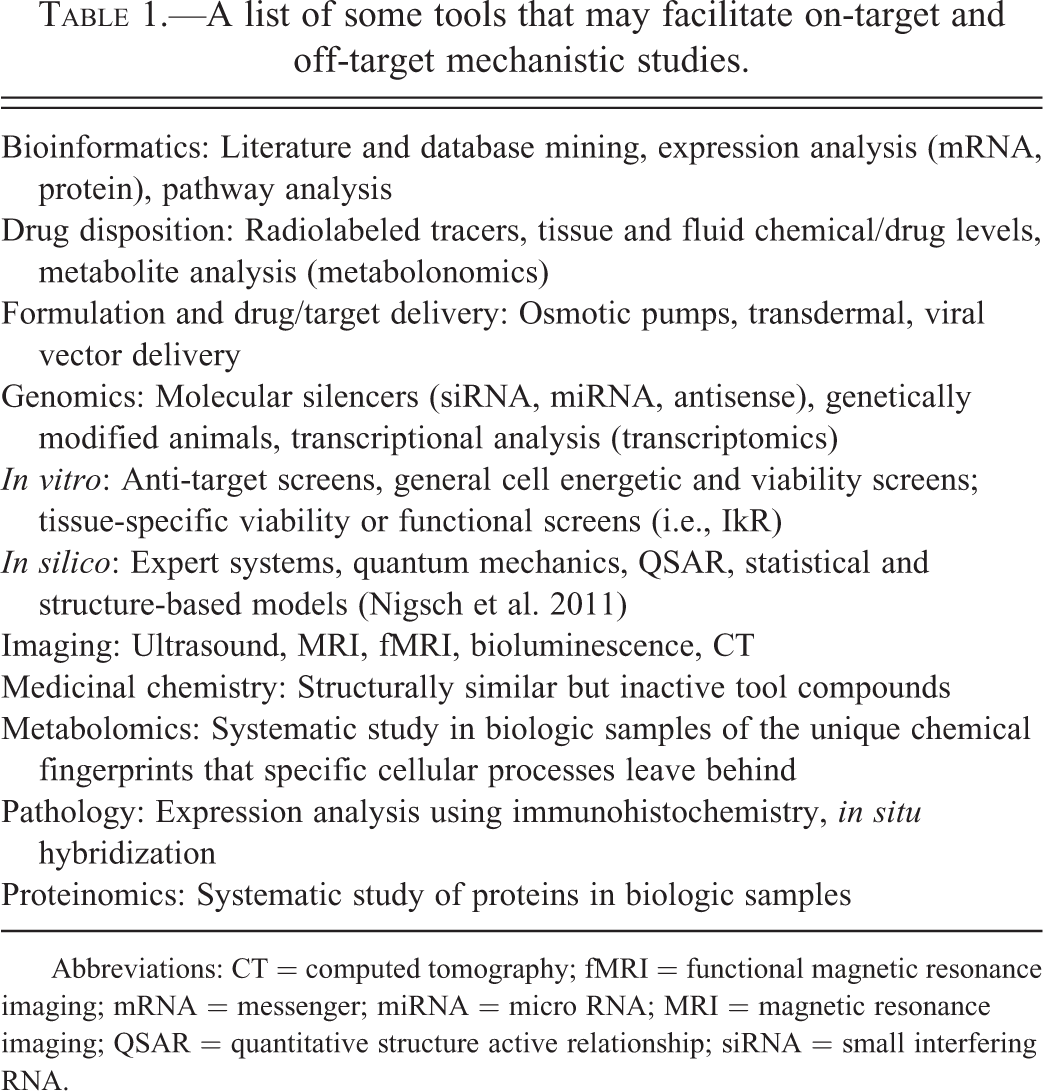
Abbreviations: CT = computed tomography; fMRI = functional magnetic resonance imaging; mRNA = messenger; miRNA = micro RNA; MRI = magnetic resonance imaging; QSAR = quantitative structure active relationship; siRNA = small interfering RNA.
The session platform presentations began with a discussion by Dr. Russell Thomas on using transcriptional microarray data in quantitative chemical risk assessment (Thomas et al. 2012; Wetmore et al. 2012). Dr. Thomas outlined two rodent studies using five (mouse study) or six (rat study) chemicals that had published risk assessments. In these studies, he compared the histological and transcriptional changes in the various target tissues evaluated. His laboratory was able to demonstrate a high level of correlation between transcriptional and apical (histologic) responses that were stable over time. These data provided a potential complementary approach for estimating non-cancer and cancer reference values in chemical risk assessment and demonstrated the importance of toxicogenomic approaches in the toxicologic pathologist’s toolkit.
Toxicogenomics is not new to the toxicologic pathologist and while it is a valuable tool, its potential impact has been hampered by a complex safety assessment scientific and regulatory environment (see review by Foster et al. 2007). For transcriptional studies supporting an investigational new drug (IND) application, the FDA suggests that these studies be included if one or more of the following criteria are met:
The test results are used for making decisions pertaining to a specific clinical trial or in an animal trial used to support safety.
A sponsor is using the test results to support scientific arguments pertaining to, for example, the pharmacologic mechanism of action, the selection of drug dosing and dosing schedule, or the safety and effectiveness of a drug.
Test results constitute a known valid biomarker for physiologic, pathophysiologic, pharmacologic, toxicologic, or clinical states or outcomes in humans, or the test is a known valid biomarker for a safety outcome in animal studies.
Criterion two is most germane to Dr. Thomas’s work, the focus of this session, and in our opinion is the most likely way toxicogenomics will impact safety assessment in the future. The data presented by Dr. Thomas are interesting and encouraging for the future of toxicogenomics. It is also in alignment with the work published by others. For example, in a review of 3 years of routine transcriptional profiling by Foster and colleagues at Bristol-Myers Squibb (BMS), transcriptional changes were evaluated for their ability to assess the pharmacologic mechanism of action or safety and effectiveness of a drug. In the BMS review, transcriptional changes were observed prior to changes for traditional study points for 60% of toxicities. Transcriptional data also provided mechanistic classification for an additional 30% of toxicities and potential transcriptional biomarkers for another 40% (Foster et al. 2007). Interestingly, in contrast to that reported by Dr. Thomas for chemical-based toxicities, transcriptional changes reported by the BMS group did not correlate with histopathologic findings.
The next presentation by Dr. John Sagartz described a toxicologic effect in the beagle dog that was suspected to be on-target or mechanism-based. p38α mitogen-activated protein kinase (MAPK) inhibitors are a class of agents under investigation for cancer and inflammatory diseases. Exposure to moderately selective p38α MAPK inhibitors in the beagle dog resulted in an acute toxicity syndrome consisting of clinical signs (decreased activity, diarrhea, and fever), lymphoid necrosis and depletion in the gut-associated lymphoid tissue (GALT), mesenteric lymph nodes and spleen, and linear colonic and cecal mucosal hemorrhages (Morris et al. 2010). Lymphocyte apoptosis and necrosis in the GALT was the earliest and most prominent histopathologic change observed, followed temporally by neutrophilic infiltration and acute inflammation of the lymph nodes and spleen and multifocal mucosal epithelial necrosis and linear hemorrhages in the colon and cecum. These effects were not observed in the mouse, rat, or cynomolgus monkey.
Dr. Sagartz demonstrated in a series of in vivo, in vitro, and immunohistochemical studies a direct and time-dependent relationship between the lymphoid and gastrointestinal toxicity and p38α MAPK inhibition in the beagle dog. The work he described combined classic pathology experimental approaches (histology, immunohistochemistry) with target cell expression (lymphocyte p38 Westerns), medicinal chemistry (use of active, but structurally different compounds), and cell biology (lymphocyte proliferation experiments). Sagartz et al. also used a logical series of experiments to interrogate downstream targets in the p38 MAPK pathway by studying effects of MK2 inhibitors in comparable in vitro and in vivo experiments. Taken together, Dr. Sagartz and colleagues describe an interesting on-target toxicity that was species-specific enabling the correct context to be placed on human clinical risk for these test agents.
Dr. Sagartz’s discussion highlights what can be one of the most challenging problems in safety assessment, building the weight of evidence for species specificity. When a toxicologic pathologist is first faced with a data set that suggests species specificity for a toxicity, there are several questions and approaches one may want to consider (Table 2). Dr. Sagartz answered several of the questions outlined in Table 2 to build a weight of evidence case for species specificity. His laboratory used standard in vivo toxicology, differential tissue target expression, and target organ (lymphocyte) studies. These experiments can be time consuming and costly and represent a situation where understanding whether the toxicity is chemical-based, on-target, or off-target may influence the amount of effort dedicated to this type of effort. For Dr. Sagartz and colleagues, because the data at hand suggested the toxicity in the beagle dog was on-target, it was critical for them to understand the likelihood for species specificity before they could safely enter human clinical studies. If the data had suggested a chemical-based or off-target mechanism, a more expedient approach may have been to use classic medicinal chemistry SAR and in vitro screening approaches to design away from the toxicity.
Questions to consider when building a weight of evidence for species specificity (literature examples).

In the third presentation, Dr. Stuart Levin described an off-target effect of the aldosterone receptor antagonist eplerenone (Inspra®). In toxicology studies with eplerenone, the expected pharmacological effects were demonstrated including dose-related increased serum aldosterone and hypertrophy of the adrenal zona glomerulosa, site of aldosterone synthesis. However, in the beagle dog, Levin and his colleagues observed dose-dependent prostatic atrophy as an unexpected and presumably off-target effect. Eplerenone caused reversible, prostate atrophy in dogs administered eplerenone orally at dosages ≥15 mg/kg/day for 13 weeks or longer (Eplerenone, 2009). Based on the knowledge of anti-androgen effects of a structurally similar tool compound (spirinolactone), Levin and colleagues hypothesized that prostrate changes were secondary to perturbation of androgen signaling in the dog.
Dr. Levin and his colleagues first used in vivo reproductive toxicology endpoints to show that the prostate effects had minimal functional sequel to male dog reproductive function, namely there were no compound-related effects on libido, semen protein content, sperm motility, daily sperm production, or epididymal sperm transit time in dogs given eplerenone. The Pfizer group in parallel to this work carried forward a series of in vitro pharmacology studies to demonstrate that prostate effects were due to eplerenone blockade of the androgen receptor in the dog. Dr. Levin’s approach provided an excellent example of hypothesis-driven experiments that were designed based on previous data with tool compounds (spirinolactone) as well as the positive results of partnering well with toxicology experts (e.g., reproductive toxicologists), physicians, and cell biologists. The data for Pfizer clearly demonstrated a clinical path forward for eplerenone based on the understanding of the dog prostate atrophy mechanism of action and provided an additional example of a species specific sensitivity in the dog.
In the fourth platform presentation, Dr. Nancy Everds described recent studies both in her laboratory and others that have demonstrated mAb binding of off-target platelet epitopes in a species-specific manner (Santostefiano et al. 2012; Rudmann et al. 2012). Platelets are overrepresented as unexpected targets of biotherapeutics, likely because they express a large number of activating receptors, including the largest pool of FcγRIIa (CD32) in circulation. Activation of FcγRIIa receptors by immune complexes or by crosslinking with an activating epitope may result in release of vasoactive mediators, intravascular aggregates and thrombi, cardiovascular collapse, activation of clotting cascades, and thrombosis and thromboemboli, along with decreased platelet counts and functionality. Dr. Everds described an elegant collection of experiments to characterize the mechanism of platelet effects caused by AMG X and mAbY.1 in work done at Amgen. Included in these experiments was the use of a variety of techniques such as classic clinical pathology and immunotoxicology assays, flow cytometry, immunocytochemistry, and histology.
AMG X caused marked thrombocytopenia, platelet activation, transient loss of consciousness, and reduced mean arterial pressure in cynomolgus monkeys at doses ≥15 mg/kg after the first intravenous administration (Santostefano et al. 2012). First, Everds and her colleagues provided evidence that the effect was off-target by showing that the pharmacological target was not expressed in platelets and that other mAbs against the same target failed to induce the in vivo platelet effects. In vitro, AMG X induced activation in platelets from multiple macaque species, but not in humans or baboons. AMG X bound directly to platelets of cynomolgus macaques and caused release of serotonin in vitro. Platelet activation required both recognition/binding of a platelet ligand with the Fab domain, and interaction of platelet FcγRIIa receptors with the Fc domain of AMG X.
In a second example, Everds described studies with monoclonal antibody Y.1 (mAbY.1) which is a fully human IgG2 mAb biotherapeutic against a cell-based target. In nonclinical studies, mAbY.1 caused dose-related profound thrombocytopenia (nadir ∼3,000 platelets/uL) with mild-to-marked decreases in red cell mass. Because other mAbs sharing the same Fc framework and similar biological activity against the intended target did not have the same hematotoxicity in vitro or in vivo, the mechanism was considered off-target. Everds described histologic changes that indicated mAbY.1 produced marked splenic hemophagocytosis. This was confirmed in vitro, where mAbY.1 induced phagocytosis of platelets with cynomolgus but not human peripheral blood monocytes. By modifying the Fc portion of mAbY.1, the in vivo response was attenuated and in vitro effect abrogated suggesting an Fc component to the pathogenesis. mAbY.1 did not bind to cynomolgus monkey peripheral blood or bone marrow cells directly. These data suggest that hemophagocytosis caused by mAbY.1 in cynomolgus monkeys occurred through a mechanism involving both the Fc and the complementarity determining region (CDR) of the mAb.
Dr. Nancy Everds published an excellent overview of the above cases as well as other potential on- or off-target effects of biotherapeutics (monoclonal antibodies, peptides) on circulating blood cells as part of this Supplement.
The final platform presentation of the day was by Dr. Tom Rosol describing on-target effects of GLP-1 agonists on thyroid C cells. Dr. Rosol reviewed the published carcinogenicity data for GLP-1 agonists in rodents as well as the mechanism of action work done to date by Nova Nordisk (Knudsen et al. 2010; Madsen et al. 2012). GLP-1 is an incretin hormone that has important effects on pancreatic islet physiology and is released after a meal in response to glucose elevations. In chronic rodent studies, GLP-1 agonists cause thyroid C-cell hyperplasia, adenomas, and carcinomas at clinically relevant doses. Rats are more sensitive than mice and no C-cell pathology has been observed in dog or monkey. GLP-1 receptors have the greatest expression in rodent C-cells and both the increased calcitonin and the C-cell hyperplasia caused by GLP-1 agonists is blocked in GLP-1R knockout mice. Calcitonin is a potential biomarker for C-cell mass and is monitored in humans given GLP-1 agonists. While the current evidence suggest that rodents are more sensitive than other species and humans for the GLP-1 agonist effects on C-cells, GLP-1 agonists as a platform carry a label warning for the risk of thyroid C-cell tumors.
The GLP-1 story is not yet complete. Despite initial evidence that rodent C-cell biology and GLP-1 sensitivity is different than humans, the regulatory agencies will be cautious (i.e., black box warning) because of the irreversible and serious (cancer) nature of the toxicity. There is no question that the work done by Nova Nordisk to date was effective in providing a path forward for this class of therapeutics. However, additional understanding of the mechanism of action of rodent C-cell proliferation is required to understand the relative risk to humans (Long 2010).
An open panel discussion ended the session. Most of the discussion was focused on what the best timing and level of experimental intervention should be when trying to predict a potential or study an observed off- or on-target toxicity. The general consensus was that the timing of the work and extent of the work for each case should be fit for purpose and based on a combination of factors including previous data for the chemical class and the target or pathway biology in animals or man; the dose response, reversibility, and type of toxicity observed in animal studies; and the risk:benefit assessment for the consumer or patient population.
Footnotes
The author(s) declared no potential conflicts of interest with respect to the research, authorship, and/or publication of this article.
The author(s) received no financial support for the research, authorship, and/or publication of this article.