




Abstract
A survey about time management in the workplace was distributed to obtain a sense of the level of job satisfaction among preclinical safety professionals in the current economic climate, and to encourage reflection upon how we manage time in our work environment. Roughly equal numbers of respondents (~32%) identified themselves as management or staff, and approximately 27% indicated that they are consultants. Though 45.2% of respondents indicated that time management is very challenging for the profession in general, only 36.7% find it very challenging for themselves. Ten percent of respondents view time management to be exceedingly challenging for themselves. Approximately 34% of respondents indicated that prioritization of tasks was the most challenging aspect of time management for them. Focusing on an individual task was the second most challenging aspect (26%), followed equally by procrastination and delegation of tasks (12.4%). Almost equal numbers of respondents said that they would (35.2%) or might (33.3%) undertake training to improve their time management skills. Almost equal numbers of participants responded “perhaps” (44.6%) or “yes” (44.2%) to the question of whether management personnel should be trained in time management.
Editorial
In February 2010, I sent out a survey to obtain a sense of the level of job satisfaction among preclinical safety professionals in the current economic climate, and to encourage reflection upon how we manage time in our work environment. I used “preclinical safety professionals” as a catchall term that included those of us who work with pharmaceuticals, industrial chemicals, and/or cosmetics; those who are lab animal specialists; and those who work in histology. I included scientific and managerial professionals in the survey. I used the Web-based survey tool called Survey Monkey (http://www.surveymonkey.com) to create, distribute, and analyze the survey.
The survey was not meant to be “scientific,” but rather, to be a snapshot of the sentiments of the industry at a given point in time. It was sent to persons working in North America, Europe, and Asia who are on one or more mailing lists of colleagues that I personally built or to which I have access because of membership in professional organizations. Potential respondents were given the option not to receive the survey prior to its distribution, and others had previously opted out of all surveys distributed through Survey Monkey. One potential respondent graciously opted out by indicating that part of his time management philosophy is not to fill out surveys!
The survey was sent to 561 persons. Two hundred eighty-nine (289) persons responded, for a 51.5% response rate. Out of the 289 respondents, 260 (90.0%) completed all questions asked. The survey was designed so that each question (with the exception of the demographics question) required answering. Therefore, the number of respondents per question decreased as the survey progressed, so that only 267 persons responded to all the questions about time management.
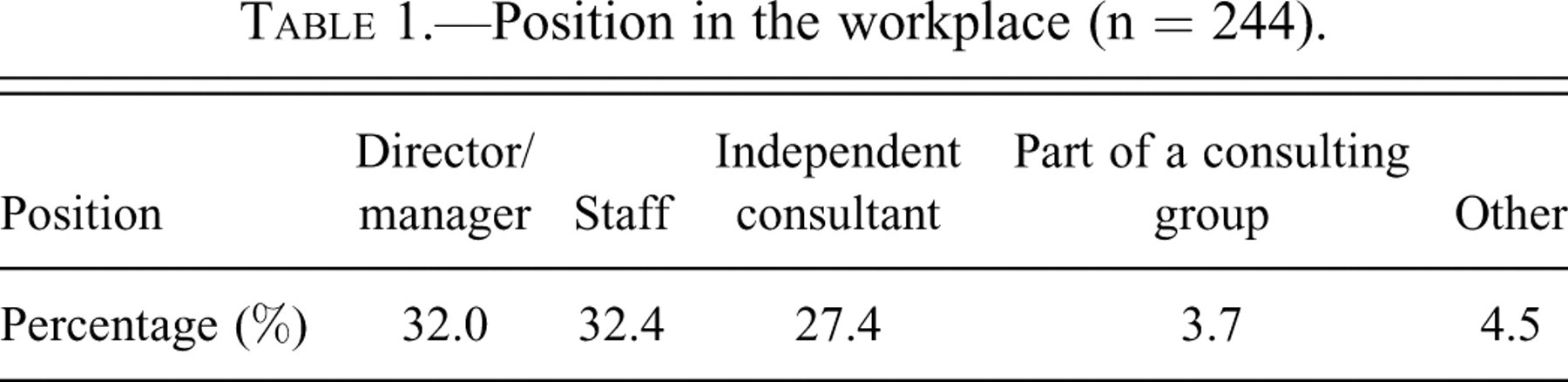
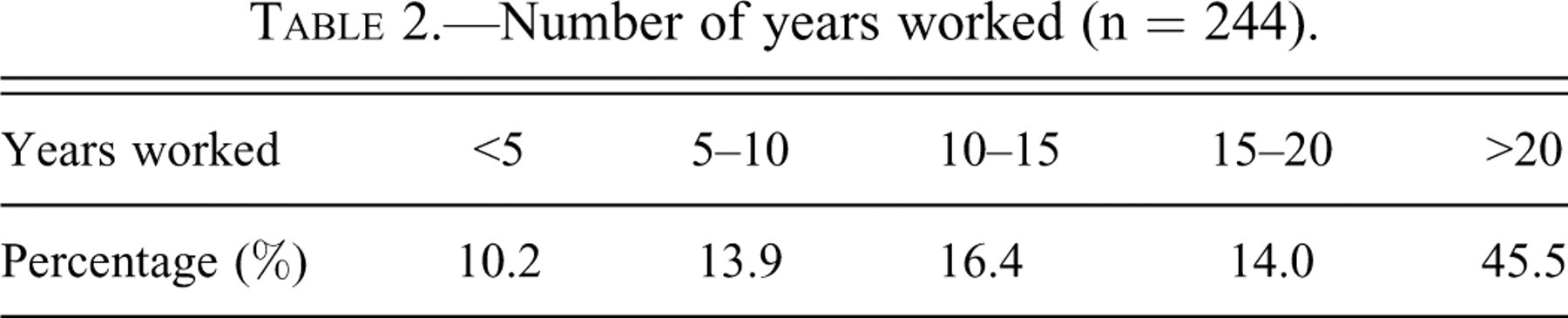
Of the above-mentioned 289 persons, 244 responded to supplemental questions designed to obtain additional demographic information for respondents (see Tables 1 and 2). Roughly equal numbers of respondents identified themselves as management or staff, and approximately 27% indicated that they are consultants. Over 45% of respondents indicated that they have worked in preclinical safety for over twenty years, with 14.0% reporting fifteen to twenty years, 16.4% reporting ten to fifteen years, 13.9% reporting five to ten years, and 10.2% reporting less than five years. These figures indicate that the sample of preclinical safety professionals surveyed is a mature one, but the sample is likely biased by my own experience level and the people I know because of my experience.
Position in the workplace (n = 244).
Number of years worked (n = 244).
Respondents were able to choose from a list of five responses for multiple-choice questions. The only exception was the question on time management training, for which one of three responses could be selected.
The initial results of the survey and the responses to the supplemental questions were posted on the Web, and participants in the survey had the chance to comment on them. The survey and the supplemental questions remained open for several additional weeks to allow last-minute submissions, and were closed just prior to the drafting of this article.
Almost fifty-two percent (51.9%) of respondents indicated that they view the field of preclinical safety assessment very favorably, and 46.7% believe that their colleagues do as well. Most participants (47.7%) responded that the world economic situation (recession) has unfavorably affected them in their current position. Though 45.2% of respondents indicated that time management is very challenging for the profession in general, only 36.7% find it very challenging for themselves. Ten percent (10%) of respondents view time management to be exceedingly challenging for themselves.
Almost forty-eight percent (47.7%) of respondents reported that they work eight to ten hours per day. Yet analysis of the responses submitted by a subset of respondents who work as consultants (n = 52) reported that 46.2% of them work only four to six hours a day. Several comments from consultants in this subgroup proposed reasons for this difference–most indicated that many members of the subgroup were working post-retirement, and therefore, not full-time. A couple of persons indicated that consultants were likely only counting billable hours as time worked, when in fact, they work many more hours on any given day. One person pointed out that for those who are not consultants, even if they are at their workplace eight to ten hours a day, it is unlikely that all of those hours are spent in productive work.
Most respondents indicated that the recession has not had a significant impact on their ability to manage time, with only 13.5% indicating a great effect, and a meager 1.1% indicating an overwhelming effect. But no individual response for this question received a clear majority: 24.0% of respondents said that the recession has had no effect on their time management; 28.7% indicated that the effect is negligible; and 32.7% said that it has affected them somewhat.
Regarding the effect of time management on job performance, the two greatest percentages of responses for the overall group were in the “somewhat” and “greatly” categories (see Table 3). The question, “Does your ability to manage time affect your feelings about your job?” evoked a similar response pattern. Just over 43% of respondents indicated that their ability to manage time affects their personal relationships somewhat, whereas almost 20% indicate a great effect. In contrast, roughly 33% of respondents indicated a negligible effect or no effect at all on relationships. Over 70% of participants indicated that external influences such as phone calls, e-mail, and meetings have somewhat of an effect or a great effect on their ability to accomplish tasks each day.
Time management at work and at home (n = 289).

Response patterns for the question about how often or infrequently respondents apply principles of time management were more varied than those from the “softer” questions discussed above. Procrastination is predominantly practiced sometimes (51.7%) or rarely (30.1%). Respondents prioritize their tasks frequently (54.6%) or always (32.3%), with only 0.7% indicating that they never or rarely do so. Respondents delegate tasks rarely (32.0%) to sometimes (30.1%), and they organize their workspaces sometimes (39.8%) to frequently (31.2%). A clear majority of respondents set goals frequently (51.7%) and are able to frequently focus on an individual task (57.6%) during their workday.
One of the questions posed in the supplemental survey asked respondents to identify their greatest challenge with regard to time management in the workplace (see Table 4). Approximately 34% indicated that prioritization of tasks was the most challenging aspect of time management for them. Focusing on an individual task was the second most challenging aspect, followed equally by procrastination and delegation of tasks.
Greatest challenge regarding time management (n = 242).

Twenty-one persons responded “Other” to the question about their greatest challenge regarding time management, and provided a written comment about what their challenges are. Here is a partial list of responses received (no editing of content performed): Interruptions and “crisis management” rolled-downward changes to priorities All of the above Too many pointless/wasteful meetings Finishing a task (both my problem and the fact that the sponsors ask for work to be done on a study that was completed months ago—hard to schedule these unexpected tasks) Nebulous tasks where you have to trade off what might be nice to know rather than what is necessary to know Accepting too much work in the first place Rigorous follow-up of the time spent on projects Total work volume—little scope for delegation since potential delegatees' time is already filled Getting my own work done is frequently interrupted when others need help or guidance Too much to do, too many promises (they are all do-able, just not ALL of them!), and finally… unwilling to just turn out a simple report… compelled to add photomics, slide-by slide descriptions, PowerPoint, data graphs, and spread sheets (which demand being translated from “pathology” to “common language”). A simple sentence could be all that’s needed… but unable to be that cutthroat with the observations and data
The majority of participants replied “sometimes” to most questions about negative feelings or experiences related to time management. Almost half (49.1%) indicated that they sometimes feel that they are not in control of their time (Figures 1 and 2), with 16.7% indicating that they frequently feel this way versus 25.7% who rarely feel this way. Regarding stress in the workplace, 40.9% indicated that their environment is sometimes stressful, whereas practically equal numbers find their environment rarely or frequently stressful (24.9% and 24.2%, respectively). Poor work/life balance is sometimes experienced by 40.9% of respondents and rarely experienced by 30.9% of respondents. Whereas 41.6% of respondents report that they rarely lack motivation, an equivalent number report sometimes or frequently feeling this way (31.2% and 10.0%, respectively). Many respondents feel that they could sometimes benefit from more support (43.9%), with roughly equal numbers indicating that they rarely (21.9%) or frequently (23.0%) feel this way. Finally, 46.5% of respondents feel that they could sometimes benefit from more focus, whereas 20.1% say that they rarely feel this way and 20.8% say that they frequently feel this way.

Tour d’Horloge, Conciergerie, Paris, France. Copyright Discover Paris! The oldest clock in Paris.

Cadran, Tour d’Horloge, Conciergerie, Paris, France. Copyright Discover Paris! This clock has neither hands nor mechanism. Is this a metaphor for time management in your workplace?
A clear majority of respondents indicated that they rarely miss deadlines, with an additional 26.2% indicating that they never miss deadlines. (One person indicated that he or she always misses deadlines!) Regarding overcommitment of one’s time, only 34% rarely or never do so. Just over forty-one percent of respondents reported that they sometimes evaluate how efficiently they use their time, with equal numbers of persons indicating that they frequently or rarely engage in this exercise. Most respondents rarely or sometimes adopt a perfectionist attitude for mundane tasks, whereas 20.2% say that they frequently do so. Many participants say that they sometimes confuse efficiency for productiveness, though many also say that they rarely confuse activity for productiveness. See Table 5 for a tabular summary of these results.
Various aspects of time management (n = 267).

Most respondents indicated that they frequently feel energized (48.7%), get enough sleep (39.0%), and enjoy time with family and friends (40.4%). Those indicating “sometimes” for these questions were 33.0%, 26.2%, and 40.1% of respondents, respectively. Concerning taking breaks throughout the workday, 37.8% reported that they sometimes do, 30.7% reported that they rarely do, and 23.2% reported that they frequently do. Almost thirty-one percent (30.7%) of respondents frequently exercise, followed by 29.2% that sometimes exercise and 23.6% that rarely do so. A large number of respondents indicated that they are sometimes able to do what they want to do with their time (42.7%), whereas 28.5% are frequently able to do so, and 21.0% are rarely able to do so.
As previously stated, respondents had to select one of only three possible responses for the questions on time management training: no, perhaps, or yes. A clear majority believes that colleagues might be willing to participate in training to improve their time management skills. Almost equal numbers of respondents said that they would or might undertake such training themselves (see Table 6). In contrast, 56.3% of the members of the consultant subgroup mentioned above indicated that they themselves would not undertake time management training. Comments about this difference addressed the fact that time management takes on an entirely different meaning in a home office compared to a corporate or laboratory environment. One person indicated that many consultants may have participated in time management training programs when they worked for companies, and might be interested in taking an advanced time management course, but not a general one.
Time management training (n = 267).
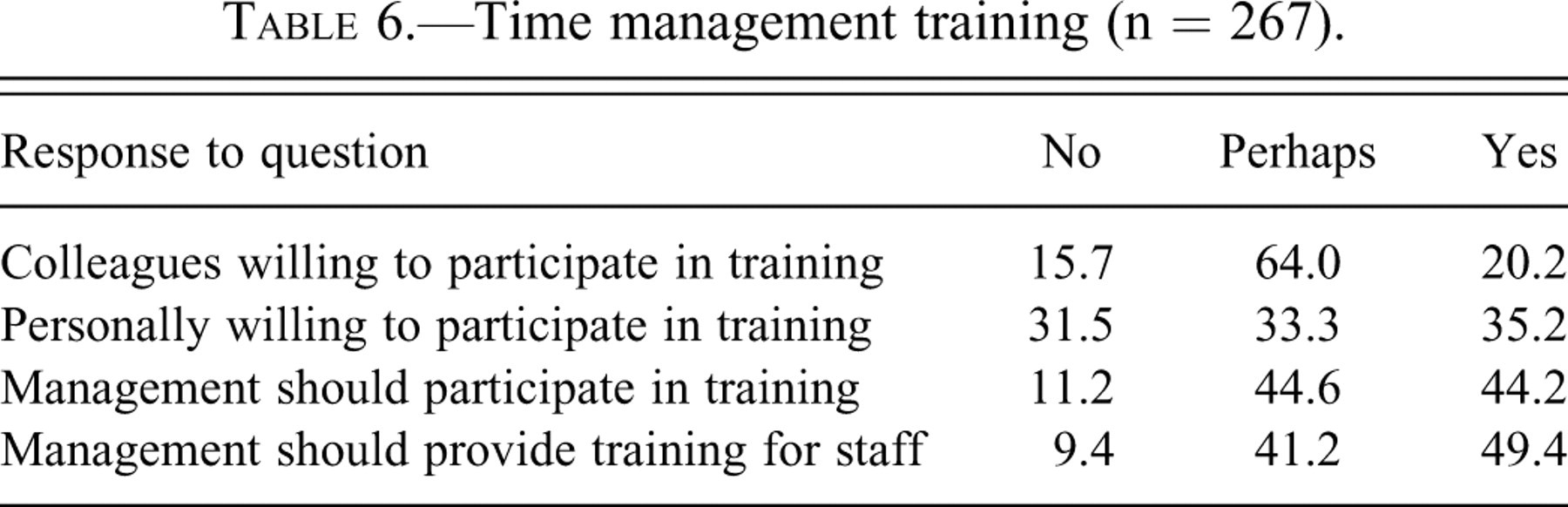
In response to the question about management-level personnel benefiting from time-management training, almost equal numbers of participants responded “perhaps” or “yes.” Close to half of the participants expressed a belief that management should provide time-management training for staff, whereas most of the remainder of the respondents indicated that perhaps this training should be provided for staff.
Although the main survey did not allow for open responses to any of the questions posed, I received comments from forty-two persons during or after its completion. Many people thanked me for having included them and indicated that they were interested in learning the results. Many asked me to write something that would discuss the differences observed between the consultant subgroup and the overall group of respondents. One person indicated that his company offers time-management training to its employees, but that those who could best use the training do not attend the sessions.
Overall, it would appear that we preclinical safety professionals are doing a reasonable job of managing our time. Yet most of us believe that training in the area would or might be of benefit to ourselves and to others in our workplaces. Prioritization of tasks is the number one challenge for participants in the survey, followed by the lack of ability to focus on an individual task.
Given the response rate to this informal survey and the number of unsolicited comments that I received about it, it seems safe to say that preclinical safety professionals are interested in time management. Consultants and preclinical safety organizations alike may benefit from a more rigorous assessment of how time management has an impact on their business, examining influences imposed by management (e.g., meetings, number of people to supervise, number of projects to manage) as well as those resulting from individual habits (e.g., tendency to procrastinate or to work efficiently but not productively). Without making time management an end unto itself, such evaluation, followed by implementation of measures to alter or eliminate negative influences in the workplace, should benefit everyone concerned—particularly the 10% of respondents who find time management to be exceedingly challenging.