



Abstract
Previous studies have established significant associations between parental self-efficacy, parenting stress, and child externalizing problems. However, the child-driven effects of externalizing problems on parental outcomes have been less explored, particularly in non-Western contexts. This study investigated how child externalizing problems influence parenting stress and parental self-efficacy among Hong Kong Chinese mothers, with parental emotion regulation as a moderator. Participants in this cross-sectional study included 176 mothers of preschoolers (M = 50.61 months; SD = 11.22). Findings indicated that child externalizing problems were associated with heightened parenting stress and reduced parental self-efficacy. Notably, maternal emotion regulation significantly moderated the relationship between externalizing problems and parental self-efficacy but not parenting stress. Mothers with better emotion regulation experienced a more pronounced decline in self-efficacy when faced with greater child externalizing problems, suggesting that emotionally regulated mothers may hold higher parenting expectations. This study highlights the effects of externalizing problems on parenting outcomes in a Chinese context, highlighting the need for culturally adapted parenting interventions that not only address child behavior management but also help parents, especially those with strong emotion regulation, reconcile self-efficacy beliefs with the challenges of raising children with behavioral difficulties. Implications and future directions are discussed.
Keywords
Introduction
The relationship between parental well-being, including aspects such as parental self-efficacy and parenting stress, and child behavior has been extensively researched. Parental self-efficacy is defined as the belief in the ability to effectively manage parenting tasks and foster positive child outcomes (Wittkowski et al., 2017). On the other hand, parenting stress refers to the discrepancy between perceived resources and demands of the parenting role (Deater-Deckard, 1998). Previous studies have identified significant associations between parental self-efficacy, parenting stress, and child externalizing problems. Specifically, parents who exhibit higher self-efficacy and experience lower levels of parenting stress tend to engage in a more authoritative form of parenting (Flannery et al., 2021; Mak et al., 2020) and demonstrate greater confidence in implementing effective parenting skills (Jones & Prinz, 2005), contributing to reduced maladaptive behaviors in children. While substantial research has focused on parental influences on child behavior, the child-driven effects of externalizing problems on parental well-being have received less attention.
The transactional model theory (Sameroff, 1975) explains how maladaptive behaviors in children and parents mutually influence each other. Children’s behaviors shape parental responses, which in turn, can mitigate or exacerbate further behaviors in children. Studies examining parenting stress and child behavior have largely corroborated such bidirectional relationships. Baker et al. (2003) identified a bidirectional relationship between behavioral problems at 36 months and increased parenting stress over the following year. Similarly, Neece et al. (2012) found reciprocal relationships between parenting stress and behavioral problems throughout early and middle childhood, suggesting that parenting stress and child behavior problems can escalate or deescalate each other over time. In a study of 176 mothers and their children with developmental disabilities, Woodman et al. (2015) found child-driven effects of externalizing problems on parenting stress from middle childhood to early adolescence (age 5-10 and age 10-15), but no parent-driven effects. Despite these findings concerning parenting stress, there is less clarity about how child-driven effects influence parental self-efficacy. Understanding these dynamics is particularly important during early childhood (i.e., ages two to six), a developmental period marked by tantrums and behavioral issues such as attention-deficiency, hyperactivity and oppositional behaviors (Metsäpelto et al., 2015; Pinquart, 2017). These childrearing challenges can negatively impact parental self-efficacy as parents grapple with how to effectively discipline their children. This study aims to address this gap by comprehensively examining child-driven effects on both parenting stress and parental self-efficacy.
Child Externalizing Behavior and Parental Well-Being
Extensive research highlights the parent-driven effects in the dynamic between parental well-being and child behavior. This effect is particularly evident in cultural contexts such as that in China, where children’s behavioral problems are often perceived as disrespectful, prompting more restrictive and authoritarian parenting practices when parents with lower self-efficacy believe they lack adequate knowledge and skills to deal with childrearing challenges (Kwok & Wong, 2000). Research in China indicates that parenting stress not only directly affects children’s externalizing behaviors but also operates indirectly via maternal psychological aggression, in which stressed mothers may become more critical and engage in harsher discipline (Liu & Wang, 2015). This exacerbated response may increase the likelihood of children developing issues such as aggression, anxiety, depression, and delinquency (Deater-Deckard, 1998). As a result, elevated parenting stress and low parental self-efficacy have been shown to lead to maladaptive parenting behaviors, which can further exacerbate children’s adjustment difficulties (Albanese et al., 2019; Jones & Prinz, 2005; Mak et al., 2020). Conversely, children with externalizing behaviors such as aggression or disruption significantly contribute to increased parenting stress and a reduction in parental self-efficacy. For instance, parents who perceive their children as more demanding often experience significantly higher stress levels (Kwok & Wong, 2000). Empirical studies also show that children’s behavioral issues contribute substantially to parental well-being, accounting for 57% of variance in parenting stress (Solem et al., 2011).
Parental Emotion Regulation as a Moderator
Parental emotion regulation may influence the relationship between child behaviors and parental well-being. Emotion regulation involves managing emotional responses to align with personal objectives (John & Gross, 2004). Effective emotion regulation helps parents feel less overwhelmed by their child’s externalizing problems and boosts their confidence in parenting (Deater-Deckard et al., 2016; Hu et al., 2019; Wang & Saudino, 2011). According to Gross (1998), the emotion regulatory process interacts with motivational and self-regulatory processes, which help individuals manipulate their emotions, including determining when and how to experience and express emotions. Poor emotion regulation can lead to difficulties in managing feelings and understanding others, resulting in family conflicts (Lazarus, 2006). Research indicates that strong emotion regulation among parents leads to better adjustment to their child’s developmental challenges and less stress (Deater-Deckard et al., 2016). Consequently, parents with poorer emotion regulation skills are likely to perceive parenting responsibilities as more stressful compared to their more emotionally regulated counterparts (Miklósi et al., 2013). There is limited research on how parental emotion regulation moderates the relationship between early externalizing problems and parenting stress and self-efficacy. It is possible that parental emotion regulation may serve as a buffer, influencing how parenting demands are experienced in the face of children’s challenging behaviors. For instance, parents with strong emotion regulation may view these behaviors as manageable, responding with patience and effective strategies, which lead to enhanced self-efficacy and lowered stress. In contrast, parents with weaker emotion regulation may feel overwhelmed, resulting in increased stress and diminished confidence. The purpose of this study is to investigate the role of parental emotion regulation as a moderator in the relationship between child externalizing problems, parenting stress, and parental self-efficacy.
The Present Study
Cultural contexts and beliefs shape perceptions of parenting demands and problematic child behaviors (Rubin & Chung, 2013). In Hong Kong, cultural dynamics greatly impact parenting stress, as traditional Chinese childrearing beliefs emphasize obedience and discipline (Chao, 1994). This can intensify parental stress as parents strive to ensure their children meet high expectations, fearing that failure could reflect poorly on their parenting adequacy, which can contribute to self-blame (Eaton et al., 2016; Wang, 2014). As such, Chinese parenting values self-regulation and respect for hierarchies (Shek & Sun, 2014). Additionally, mothers often take on primary caregiving roles. They provide emotional and physical support while managing daily routines and guiding children’s behavior (Chen et al., 2000), leading to heightened stress compared to fathers (Liu & Wang, 2015). The cultural importance of “saving face” exacerbates these stressors, as mothers feel pressure to ensure their children meet societal standards (Sung, 2010). When facing externalizing problems, mothers may hide negative emotions, further compounding stress and reducing self-efficacy (Kwok & Wong, 2000). This is particularly pronounced when children show significant behavioral issues and mothers struggle with emotion regulation (Chung et al., 2013; Siu et al., 2018). Thus, it is crucial to investigate how parental emotion regulation influences the relationship between child behaviors and parental well-being within the cultural context of Hong Kong. The present study aims to enhance understanding of the relationship between child behaviors and parental well-being, and the role of emotion regulation in moderating this relationship. Specifically, it examines: (1) the associations between child externalizing problems, parenting stress, and parental self-efficacy, hypothesizing that higher levels of externalizing problem are related to higher levels of parenting stress and lower levels of parental self-efficacy; (2) the moderating role of mothers’ emotion regulation in these relationships, with the hypothesis that mothers exhibiting a lesser degree of emotional control will experience greater parenting stress and decreased self-efficacy when their children exhibit high externalizing problems.
Methods
Participants
The study received ethical approval from The Education University of Hong Kong Institutional Review Board. Data were drawn from pre-intervention assessments of a positive parenting intervention, implemented by a local NGO. The NGO sent recruitment materials to local kindergartens under Hong Kong’s Pre-primary Education Voucher Scheme. From 40 volunteering kindergartens, 11 were randomly selected, with all parents at these schools invited to participate. Among 209 parents recruited, 179 (86%) provided written consent. Three participants were excluded due to >25% missing survey data, yielding a final sample of 176 mothers of preschoolers (86 boys, 90 girls; Mage = 50.61 months, SD = 11.22). Independent samples t-tests confirmed no baseline differences between participants in the intervention and control groups on the study variables: parental self-efficacy (t (174) = −1.41, p = .16), parenting stress (t (174) = −.65, p = .52), parental emotional lack of control (t (174) = −1.09, p = .28), and child externalizing problems (t (174) = −.75, p = .45). Therefore, the two groups are combined. The primary caregivers predominantly included mothers (154, 87.5%), followed by domestic helpers (10, 5.7%), grandparents (7, 4.0%), and fathers (5, 2.8%). Most mothers fell within the age range of 31–40 years (116, 65.9%), followed by those aged 21–30 years (34, 19.3%), and 41–50 years (25, 14.2%), with one mother aged 51 years or older (0.6%). Regarding education levels, 64.8% of mothers had attained secondary education, 18.8% held a higher diploma or associate degree, 10.7% held a university degree or higher, and 5.7% had completed primary education or below. Among the parents, 159 mothers were married (90.3%), while 11 (6.3%) were separated, divorced, or widowed, four (2.3%) were re-married or cohabiting, and two (1.1%) were single. Employment status indicated that 72.2% of mothers were housewives, while 12.5% worked full-time, 13.6% part-time, and 1.7% identified as unemployed or retired. The median monthly household income was HK$20,000 ($1 USD = $7.8 HKD), which was below the reported median income of $28,500 as indicated the Hong Kong census at the time of the study (Hong Kong Census and Statistics Department, 2019).
Procedure
A total of 11 kindergartens serving low-income families were invited to participate in the current study. Within each kindergarten, parents from two randomly selected upper kindergarten classes were invited to attend a parenting seminar held at their kindergarten. Following the seminar, researchers provided an overview of the purpose and content of the positive parenting program. At the conclusion of the seminar, researchers described the objectives of the study and distributed informational letters and consent forms to participants. Consent was obtained from participants, who then completed a battery of surveys in Traditional Chinese. These surveys gathered information regarding family background, children’s externalizing problems, parenting stress, parental self-efficacy, and parental emotion regulation. Participants did not receive any incentives for completing the questionnaire.
Measures
Child Externalizing Problem
Child externalizing problems were assessed using the 36-item Intensity Scale (IS) of the Eyberg Child Behaviour Inventory (ECBI; Eyberg & Ross, 1978), validated for use in Hong Kong (Leung et al., 2003). Mothers rated the frequency of their children’s disruptive behaviors on a 7-point scale (1 = never, 7 = always), with items like “act defiant when told to do something.” A higher sum score indicates greater levels of externalizing problems.
Parenting Stress
Parenting stress was evaluated using the 12-item Parental Distress Subscale (PD) of the Parenting Stress Index-Short From (PSI-SF; Abidin, 1990). The Chinese version has shown excellent reliability (e.g., Kwan et al., 2015). Respondents rated their parenting-related stress on a 5-point scale (1 = strongly disagree, 5 = strongly agree), with items such as “I feel trapped by my responsibilities as a parent.” Higher cumulative scores reflect greater parenting stress.
Parental Self-Efficacy
Parental self-efficacy was measured with the 10-item Parental Efficacy Subscale (PE) of the Parental Locus of Control Scale (PLOC; Campis et al., 1986). This subscale has been widely utilized in the Chinese context (e.g., Chen et al., 2021). Mothers rated their perceptions of self-efficacy on a 5-point scale (1 = strongly disagree, 5 = strongly agree), including items such as “what I do has little on my child’s behavior.” Higher scores indicate stronger parental self-efficacy.
Parental Emotion Regulation
Parental emotion regulation was assessed using the 5-item Emotional Lack of Control (ELC) subscale of the Parental Emotion Regulation Scale (PERS; Pereira et al., 2017). This scale evaluates parents’ management of negative emotions in parenting. The ELC subscale was used in other studies with good internal reliabilities (Holtrop et al., 2023; Pereira et al., 2021; Tao et al., 2023). Mothers rated their negative emotional responses on a 5-point scale (1 = never, 5 = always) with items like “I do get angry with my child due to stress from other issues.” Higher scores indicate greater emotional dysregulation, or lower emotional control. The Chinese version of the subscale was translated and back-translated by a team of bilingual graduate students for this study.
Data Analysis
All statistical analyses were conducted using IBM SPSS Statistics (Version 23.0) with the PROCESS macro (Version 4.1; Hayes, 2017). Preliminary analyses included descriptive statistics (e.g., means, standard deviations) and internal reliability assessments (Cronbach’s α) for all study variables. Bivariate Pearson correlations were computed to examine associations between child externalizing problems, parenting stress, parental self-efficacy, and demographic covariates (maternal age, education, child age, and gender). To test our primary hypotheses, we conducted two moderation analyses using PROCESS Model 1, which assessed whether maternal emotional lack of control moderated the relationships between child externalizing problems and (a) parenting stress and (b) parental self-efficacy. Both models controlled for demographic variables as covariates. The moderation model was implemented using 95% confidence intervals and 5,000 bootstrapping samples to ensure a reliable estimation of the indirect effects without assuming normally distributed data (Preacher & Hayes, 2008). Finally, we performed simple slopes analyses to examine interaction effects at low (−1 SD), mean, and high (+1 SD) levels of maternal emotional lack of control. All tests used two-tailed α = .05, and effect sizes (ΔR 2 ) were reported for interaction terms.
Results
Means, Standard Deviations, and Bivariate Correlations Among Main Study Variables (N = 176)
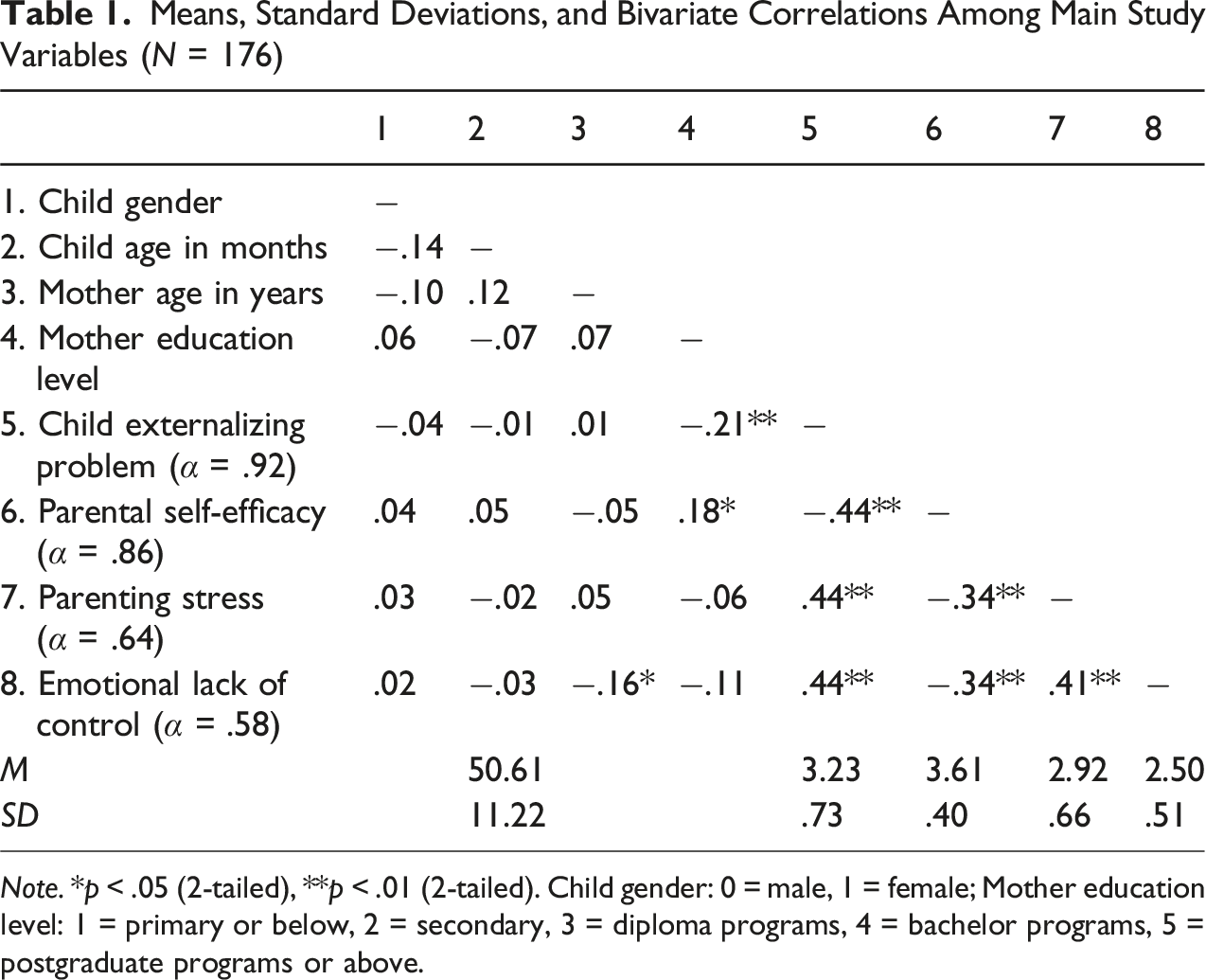
Note. *p < .05 (2-tailed), **p < .01 (2-tailed). Child gender: 0 = male, 1 = female; Mother education level: 1 = primary or below, 2 = secondary, 3 = diploma programs, 4 = bachelor programs, 5 = postgraduate programs or above.
Main and Interaction Effects of Child Externalizing Problems and Maternal Emotional Lack of Control on Parenting Outcomes (N = 176)
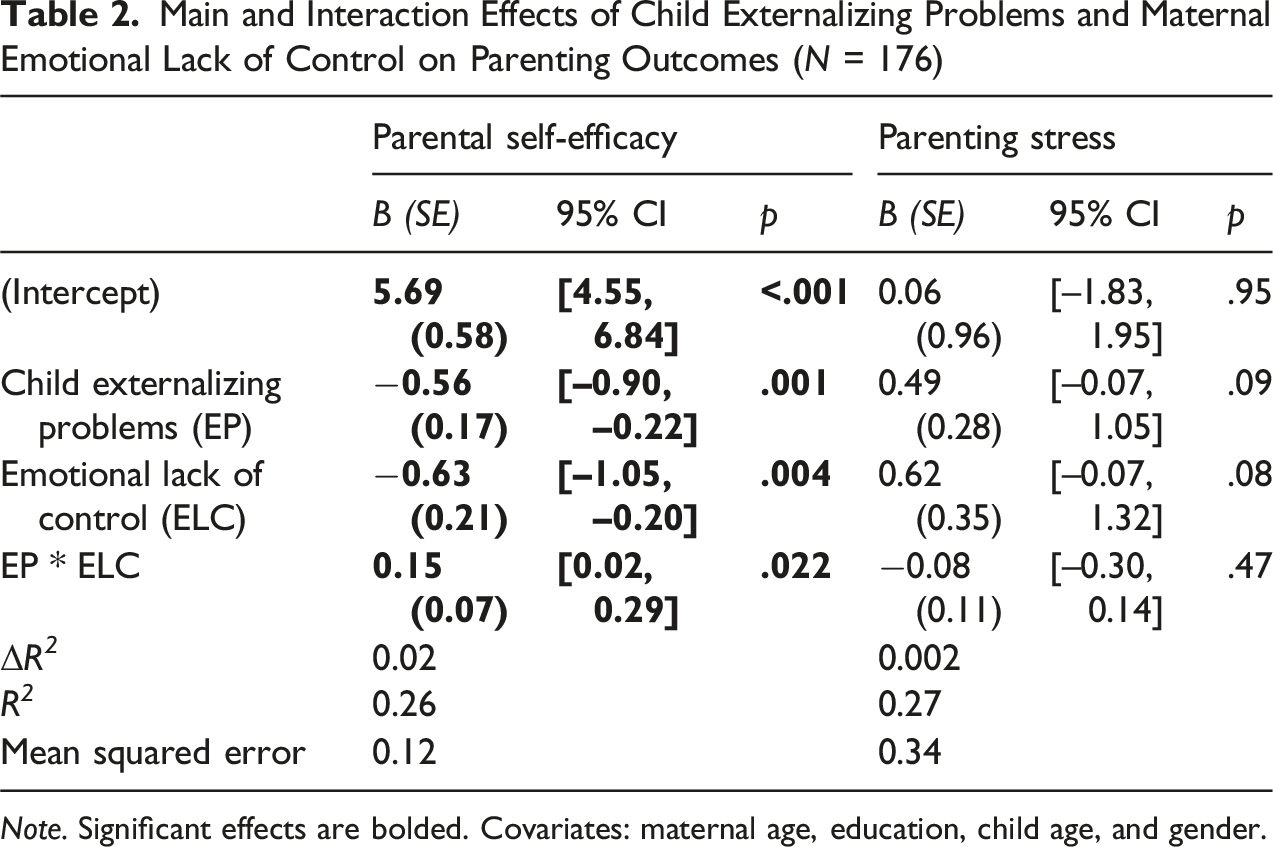
Note. Significant effects are bolded. Covariates: maternal age, education, child age, and gender.
The significant interaction for parental self-efficacy was further examined through a simple slopes analysis (Figure 1). The results revealed that higher child externalizing problems significantly predicted lower parental self-efficacy for mothers with stronger emotion regulation (low emotional lack of control: –1SD; B = −0.25, SE = 0.05, p < .001, 95% CI [–0.36, −0.15]), and for those with average emotion regulation (mean emotional lack of control; B = −0.18, SE = 0.04, p < .001, 95% CI [–0.26, −0.09]). However, for mothers with poorer emotion regulation (high emotional lack of control: +1 SD), the negative association was attenuated and no longer significant (B = −0.10, SE = 0.05, p = .076, 95% CI [–0.20, 0.01]). Simple slopes for the effect of child externalizing problems on parental self-efficacy at three levels of maternal emotional control (low = −1 SD, mean, high = +1 SD). Note. ELC = Emotional lack of control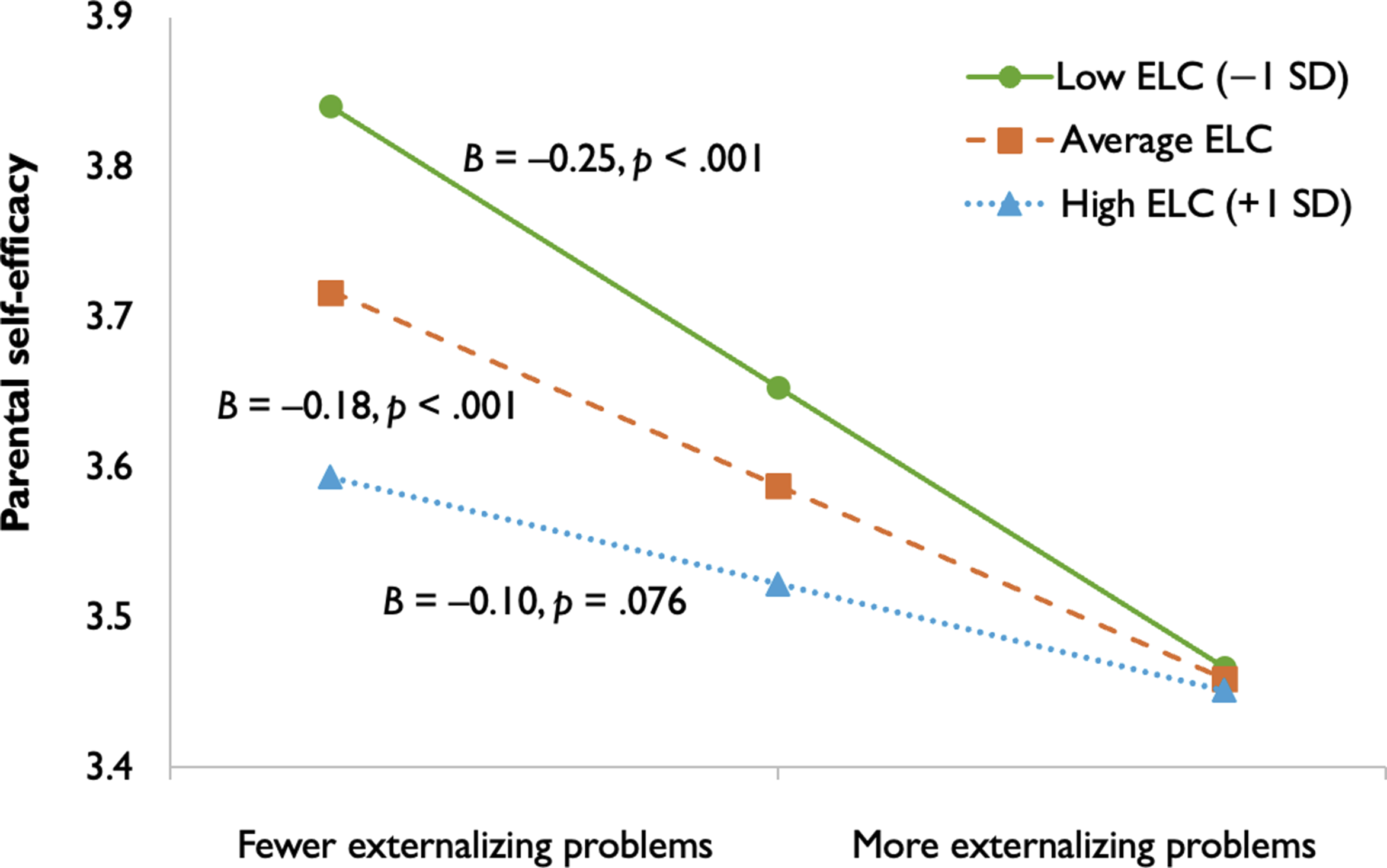
Discussion
The present study examined the relationship between child externalizing problems, parenting stress and parental self-efficacy, as well as the moderating role of emotion regulation among mothers of kindergarten-aged children in Hong Kong. Consistent with prior research, mothers of children with higher levels of externalizing problems reported increased parenting stress (Chung et al., 2013; Siu et al., 2018; Woodman et al., 2015). This study contributes to the existing literature by demonstrating that child externalizing problems also negatively affect parental self-efficacy. Specifically, the demanding nature of managing externalizing behaviors requires heightened parental attention and effort. The challenges of managing such behaviors can lead parents to feel vulnerable and perceive these difficulties as reflections of their parenting failures, further undermining their confidence and raising stress levels (Schulz et al., 2019). In the context of traditional Chinese culture, which emphasizes parenting responsibilities and social expectations, the effects of child externalizing problems on parental well-being may be intensified. The societal pressure for children to conform can stigmatize externalizing behaviors. Consequently, Hong Kong mothers may face heightened criticism, increasing parenting stress and feelings of inadequacy, especially when children do not meet high achievement standards (Hong & Liu, 2019).
Unexpectedly, while parental emotional lack of control moderated the relationship between child externalizing problems and parental self-efficacy, it did not have the same effect on parenting stress. According to Abidin’s (1995) model of parenting stress, three categories of determinant contribute to parenting stress: child factors (e.g., behavior problems), parent factors (e.g., physical health), and contextual factors (e.g., social support). One key reason for the absence of a moderation effect on parenting stress is that other factors have a greater impact than emotion regulation alone. For instance, research shows that social support, family cohesion and co-parenting support have substantial impact on parenting stress (Durtschi et al., 2017; Saisto et al., 2008; Theule et al., 2011). Parenting stress arises from the perceived resource deficits relative to parenting demands (Deater-Deckard, 1998). Therefore, even parents with strong emotion regulation skills may still experience increased stress if they lack an adequate support system or resources. Future research may explore the moderating role of other contextual factors on the relationship between child externalizing problems and parenting stress.
Interestingly, mothers exhibiting better emotion regulation experienced a more pronounced decline in self-efficacy when facing significant child externalizing issues, contrary to our hypothesis. This could be understood through Festinger’s Theory of Cognitive Dissonance (1957), which posits that individuals experience discomfort when their expectations do not align with reality. This sense of dissonance prompts changes in individuals’ attitudes, beliefs, as well as behaviors to eliminate the psychological discomfort. In addition, Aronson’s Self-consistency Theory (1968) suggests that individuals with a higher sense of competence are more likely to experience greater feelings of dissonance due to elevated performance expectations and standards. Thus, well-regulated mothers may hold high expectations for their parenting abilities, making perceived failures more impactful on their parental self-efficacy.
Overall, this study highlights the child-driven effects of externalizing problems on parenting stress and parental self-efficacy. Specifically, Hong Kong mothers are likely to experience greater parenting stress and lower parental self-efficacy when their children exhibit high levels of externalizing problems, with more emotionally regulated mothers paradoxically experiencing a sharper decline in self-efficacy. The findings underscore the need for targeted interventions aimed at supporting parents of children with externalizing behaviors, even for those identified as highly efficacious and emotionally regulated. It is crucial for such programs to consider the cultural context in which parents fulfill their parenting responsibilities, as addressing the social pressures that contribute to cognitive dissonance can help mitigate feelings of inadequacy. Overall, this study contributes to the growing body of literature by clarifying the complex role of emotion regulation in parenting. Future research should explore the influence of additional variables in the relationship between child behaviors and parenting stress.
Limitations and Future Directions
Despite the insights, the present study has limitations. First, data were collected at a single time point using self-report measures from mothers. This limited the ability to infer causality between variables and may introduce bias. Future studies should incorporate longitudinal designs and multiple data sources, such as teacher reports and direct observations, to strengthen causal conclusions and minimize bias. Additionally, recognizing the increasingly significant role of fathers in child development, particularly within contemporary Chinese culture (Lau, 2016), future studies should include fathers to provide a fuller understanding of how child externalizing problems affect parental well-being within family systems. Second, the sample was drawn from 11 kindergartens in Hong Kong, which may not represent all Chinese families or be generalizable to other cultural contexts. Future research should aim to replicate this study in diverse Chinese regions and non-Chinese settings to explore potential similarities or differences. Third, participants were recruited from parent seminars targeting low-income families, possibly limiting the findings’ applicability to other socioeconomic backgrounds. Future studies should include a more diverse socioeconomic range to enhance generalizability. Finally, the internal consistency for the maternal report of emotional lack of control (α = .58) was relatively low. This may have resulted from the subscale’s focus on conceptual breadth over internal consistency, given its five-item structure (Ryff & Keyes, 1995). Although prior studies have demonstrated good reliabilities (α = .91, Tao et al., 2023; α = .69, Pereira et al., 2021; α = .68, Holtrop et al., 2023), modifying the scale for enhanced internal consistency in future research would be beneficial.
Footnotes
Author Note
The authors confirm that this research is their original work and has not been published previously.
Acknowledgments
We wish to gratefully acknowledge the participating kindergarten programs and families who made this research possible. We also thank our research team members for their dedication to this project.

Ethical Consideration
The study was approved by The Education University of Hong Kong Institutional Review Board. Written informed consent was obtained from all participants.
Funding
The authors received no financial support for the research, authorship, and/or publication of this article.
Declaration of conflicting interests
The authors declared no potential conflicts of interest with respect to the research, authorship, and/or publication of this article.
Data Availability Statement
Data are available from the corresponding author upon request.