




Abstract
Dysfunctional beliefs from previous experiences and unrealistic expectations can lead to low remarital quality. This study assessed the factor structure of the Portuguese version of the Remarriage Belief Inventory (RMBI). Data were analyzed with 741 remarried individuals. Participants were recruited through a web-based survey (LimeSurvey software) between January 2019 and July 2020. Two independent researchers translated the RMBI, and retroversion was performed by an independent bilingual research. The Exploratory Factor Analysis (EFA) revealed seven dimensions (Adjustment, Finances, Priority, Partner, Success, Stepfamily, and Past) confirming the original seven-factor structure. Confirmatory Factor Analysis confirmed good fit of data (CFA) fit (χ2 (130) = 363.588, χ2/df = 2.79, p = .000; CFI = .93; GFI = .95; RMSEA = .05). Results revealed good internal consistency (α = 0.72). The RMBI also revealed good psychometric properties for construct validity, with measures of dyadic adjustment, stress, and social support. Implications and future research were discussed.
Keywords
Introduction
Commonly, people remarry after a divorce—about 40% (Ganong & Coleman, 2017). In 2019, a quarter of all Portuguese legal marriages had at least one divorced member (Pordata, 2019a). Cohabitation in Portugal (de facto unions without legal registration) has also become a frequent practice and increased 91% between 2001 and 2011 (Pordata, 2019b), which means there are likely a substantial number of Portuguese couples who are living in recoupled unions. Although remarriages are common worldwide (Beier, Hofacker, Marchese, & Rupp, 2010), their dynamic can lead to a unique set of relationship beliefs (Higginbotham, 2005), such as quick adjustment with “instant love” between stepfamily members. Certain beliefs, with unrealistic expectations, can trigger feelings of guilt and frustration (Coleman & Ganong, 1985).
Remarried individuals may idealize the new partner as someone who will be everything that their old problematic partner was not. This compensation myth, or perfectionism of the new partner, can lead to difficulties in the marital relationship (Hetherington & Kelly, 2002). On the other hand, remarried individuals may unconsciously assume that feelings toward the former partner have no influence on the current remarriage relationship (Bray & Kelly, 1998). Former partners may also share parentage of a child resulting in ongoing interactions (Papernow, 2013). Interaction with a former spouse may be a stressor and an instability factor for the remarried couple’s relationship (Crosbie-Burnett, 1988; Papernow, 2013). In addition, conflicts of loyalty may arise related to the belief that children’s needs have priority over the new partner’s needs. Beliefs about finances appear to be particularly important for stepcouples’ relationship quality. Despite the remarried belief about pooled finances, remarried individuals may want to control and manage their own financial resources individually (Coleman and Ganong, 1985). Different beliefs regarding financial management can lead to tension in stepcouples’ relationships.
Despite the importance of parent–child relationship, it is essential to consider the importance of the remarried couple relationship. It was from this relationship that the stepfamily emerged. Because of that, a meaningful remarital relationship is an integral part of a stable stepfamily (Papernow, 2013; Crosbie-Burnett, 1988). Remarriage beliefs have been associated with important psychosocial adjustment outcomes, such as social support and the quality of the dyadic relationship.
If remarriage individuals perceive their social support networks (e.g., family, friends) as great, the cultural stereotypes may not be supported (Higginbotham, 2005). This can lead to a more positive view about stepfamilies and contribute to a better adjustment. On the other hand, the absence of social support for remarried adults contributes to greater stress and higher divorce rates (Ganong, & Coleman, 2017). Satisfaction with social support is related to lower distress and has been a protective factor for adjustment to remarriage (Kurdek, 1991).
On the other hand, the presence of dysfunctional beliefs and unrealistic expectations is associated with marital adjustment difficulties and low marital quality (Higginbotham, & Agee, 2013). Endorsing remarriage beliefs becomes a risk factor for adjustment to the new family transition (Higginbotham, & Agee, 2013). When stepfamily members believe in quick adjustment through the development of instant love between their members, this puts stepfamilies under great strain, increasing stress symptoms (Baucom & Epstein, 1990; Ganong, & Coleman, 2017).
The Remarriage Belief Inventory (RMBI) (Higginbotham & Adler-Baeder, 2008) is an empirical validated questionnaire designed to measure individuals’ endorsement of beliefs about remarriage and stepfamilies. The design of RMBI is based on a multidimensional cognitive-development model of stepfamily adjustment (Fine & Kurdek, 1994). This model considers specific dysfunctional cognitions associated with stepfamily interrelated subsystems (e.g., stepfather–stepchild) (Fine & Kurdek, 1994); cognitions about what remarriage should be and how people and relationships are (Baucom & Epstein, 1990).
In this study, we explore the psychometric properties of the Portuguese version of the RMBI, in a sample of remarried individuals. We aimed to (a) identify the factor structure of Remarried Beliefs Inventory (Higginbotham & Adler-Baeder, 2008) using Confirmatory Factor Analysis (CFA), (b) asses internal consistency and test–retest reliability for the total score of RMBI and sub-scales, (c) obtain evidence regarding construct validity, and (d) analyze measurement invariance across gender of participants through multigroup analysis. The validated measure could aid Portuguese research about remarriage dynamics and risk for divorce. It may also assist premarital education, counseling, or therapy with Portuguese speaking individuals, preparing for, or living in, remarriages.
Methods
Participants
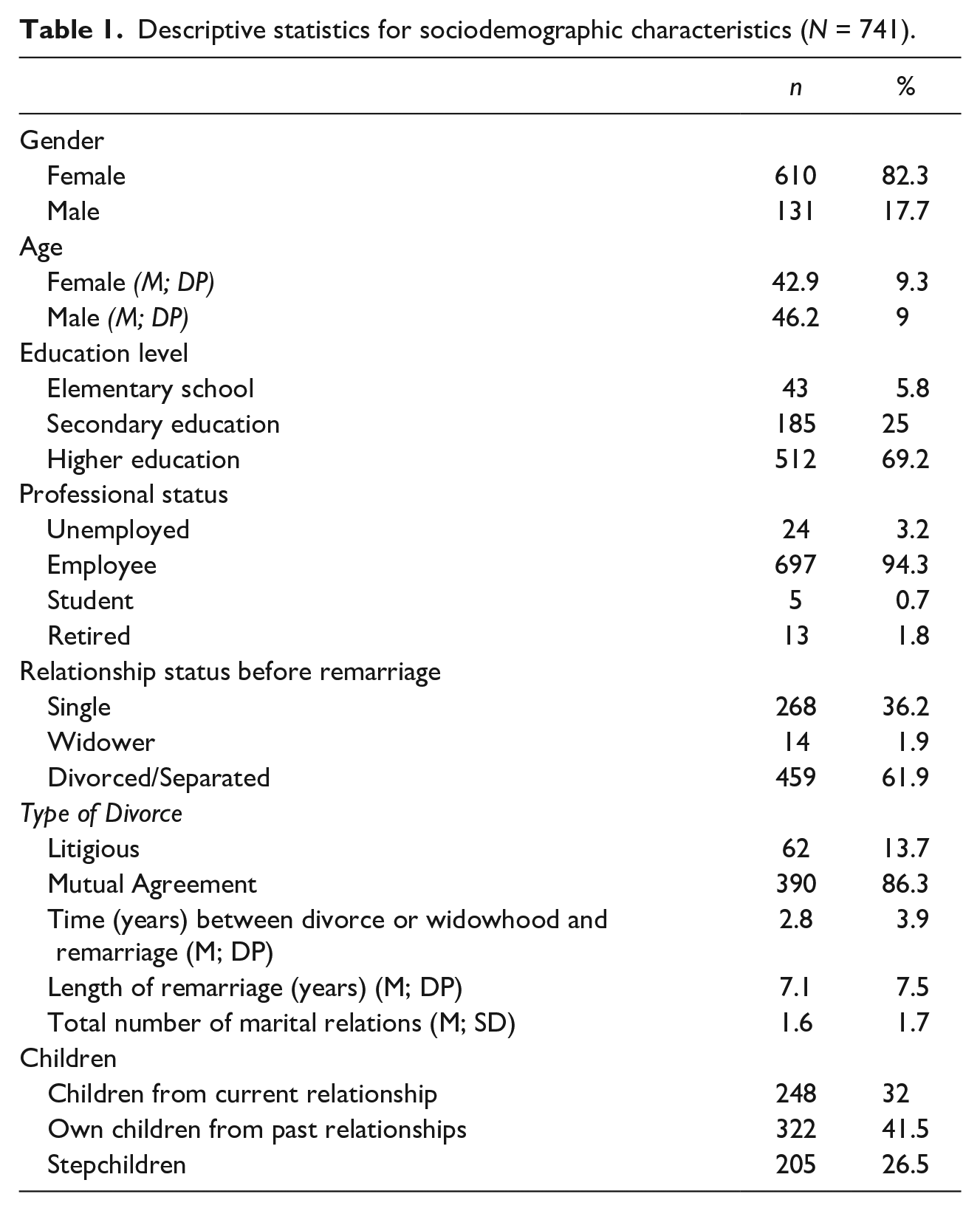
Data were analyzed from 741 remarried participants who responded to all RMBI items: 615 women (82.4%) and 131 men (17.6%). The inclusion criteria were (a) being in a heterosexual romantic relationship for at least 6 months and (b) at least one member of the couple being divorced/separated or widowed. Participants who did not cohabit with partner were excluded (n = 31). The mean age for women was 42.9 years (SD = 9.3) and for men was 46.2 years (SD = 9). The majority of participants (69.2%) had a university degree. The average length of remarriage was 7.1 years (SD = 7.5; see Table 1). Three hundred and thirty-eight participants provided contact information for a follow-assessment. Of these, 151 (44.6%) completed the RMBI 6 months later.
Descriptive statistics for sociodemographic characteristics (N = 741).
Procedures
Participants were recruited online between January 2019 and September 2020, through a web-based survey (LimeSurvey software) disseminated via leaflets or mailing lists through both public (e.g., Portuguese Institute of Registries and Notaries, University of Porto) and private entities (e.g., Portuguese Psychologists Association). A project website and Facebook page were also developed to help with dissemination. All participants gave consent to participate and were asked to indicate their partner’s email optionally to request their participation. To analyze test–retest reliability, participants who provided their e-mails received an invitation 6 months later to answer to the questionnaire one more time. The Ethics Committee of the Faculty of Psychology and Education Sciences University of Porto approved this study.
Translation of the RMBI
Translation of the Portuguese version of the RMBI was made with permission of the original authors. International Test Commission Guidelines (2017) were followed for the translation and adaptation processes. After translation by two independent researchers (native Portuguese speakers fluent in English), retroversion was made by an independent bilingual research. Then, the authors compared the two versions and the items were reviewed with consensus. Prior to public launch, a spoken reflection of the test instructions and item content was performed independently with three Portuguese remarried couples who did not participate in the study. Some grammatical changes were made to clarify the sentences’ meaning. After comparison and discussion, the final Portuguese version of RMBI was released.
Measures
Socio-demographic questionnaire was specifically developed for this study and included gender, date of birth, level of education, and professional status. Information on the remarital relationship included length of the relationship, pre-remarital status, type of divorce (when applicable), time spent between the previous and current relationships, and number of (step)children.
The RMBI was used to assess participants’ beliefs regarding remarriage and stepfamilies in general. It is composed of 22 items distributed among seven subscales: (1) adjustment to stepfamily comes quickly (4 items), (2) stepfamilies are second-class compared to families with both biological parents (2 items), (3) children are the priority over the stepcouple relationship (3 items), (4) past history and feelings should stay in the past (2 items), (5) the new partner is perfect and better than previous one (4 items), (6) remarriages’ success is slim (4 items), and (7) stepcouples’ finances should be pooled (3 items). Each dimension is rated on a Likert-type scale, ranging from definitely believe this is not true (1) to definitely believe this is true (5). Higher scores indicated stronger remarital beliefs. Confirmatory Factor Analysis for the original seven-factor model indicated a good fit of the data to the model with GFI of .93, CFI of .97, and RMSEA of .04 (Higginbotham, & Adler-Baeder, 2008). The Cronbach’s alpha for the total scale was .73 (for females) and .72 (for males). Female and male subscale alphas were respectfully .71 and .68 for the past, .65 and .68 for the stepfamily, .72 and .73 for the success, .66 and .58 for the priority, .76 and .72 for the partner, .77 and .74 for finances, and .77 and .78 for adjustment (Higginbotham & Agee, 2013).
The Revised Dyadic Adjustment Scale—DAS-R (Busby, Christensen, Crane, & Larson, 1995; Portuguese translation by Pereira, Moura-Ramos, Narciso, & Canavarro, 2017) assesses the quality of the dyadic relationship with three subscales: Consensus (items 1–6), Satisfaction (items 7–10), and Cohesion (items 11–14). All questions are rated on a Likert-type scale. Questions 1 through 6 are reverse coded starting at always agree (5) and decreasing to always disagree (0). Question 11 was also reverse coded starts with every day (4) and decreases to never (0). All other items are coded from all the time (0) to never (5). Higher scores indicate greater marital adjustment. Cronbach’s alpha of the overall scale was .90, with reliability scores of .81 for Consensus, .85 for Satisfaction, and .80 for Cohesion (Busby, et al., 1995). The reliability coefficient for this study was .89.
The Perceived Stress Scale—PSS (Cohen, Kamarck, & Mermelstein, 1983; Portuguese version, Pais et al., 2009) measures individuals’ perception of stress, ranging from never (0) to very often (4). Higher PSS scores are associated with higher levels of stress. The internal consistency of the scale in original version was .84 and in Portuguese version was .88. For this study was .86.
The Multidimensional Scale of Perceived Social Support—MSPSS (Zimet, Dahlem, Zimet, & Farley, 1988; Portuguese version, Carvalho, Pinto-Gouveia, Pimentel, Maia, & Mota-Pereira, 2011) measures the perception of social support received from partner, family, and friends. This measure is rated on a Likert-type scale, ranging from strongly disagree (1) to strongly agree (7). The internal consistency in original version was .91 (other significant), .87 (family), .85 (friends), and .88 (total measure). In Portuguese version, Cronbach alpha was .89 (partner), .92 (family), .91 (friends), and .92 for total measure. The reliability coefficient for this study was .94 (other significant), .94 (family), .95 (friends), and .93 for total measure.
Statistical Analyses
Statistical analysis was conducted using IBM SPSS Statistics 26.0 and AMOS 25.0 (IBM SPSS). Preliminary analysis considered kurtosis (<7) and skewness (<3) values to test normality (Marôco, 2018). Exploratory Factor Analyses were conducted using Principal Component Analysis and Varimax Rotation. Dimensions were retained according to Kaiser’s criterion (eigenvalue above of 1) and Horn’s parallel analysis (eigenvalues that exceed the corresponding values from the random data set) (Yong & Pearce, 2013). To access model fitness, a Confirmatory Factor Analysis (CFA) was performed. A Comparative Fit Index (CFI) value equal to or greater than .90 and a Root Mean Square Error of Approximation (RMSEA) value equal to or lower than .05 indicate a good fitting model (Marôco, 2014). The ratio of χ2/df was also analyzed with values less than 3 as good model fit (Hoe, 2008). Internal consistency was calculated by Cronbach’s alpha coefficient for the total score as well as all subscales. Pearson correlations were performed between the Portuguese version of RMBI and other measures (DAS-R, PSS, and MSPSS) to assess construct validity. Test–retest reliability was assessed using Interclass Correlation Coefficient (ICC). Values between 0.5 and 0.75 indicate moderate reliability, values between 0.75 and 0.9 indicate good reliability, and values greater than 0.90 indicate excellent reliability (Koo & Li, 2016). Convergent validity was analyzed using Average Variance Extracted (AVE) with values >0.5 indicating a good convergent validity (Hair, Black, Babin, Anderson, Tatham, 2006). Values <0.5 were also acceptable if composite reliability (CR) was >0.6 (Lam, 2012).
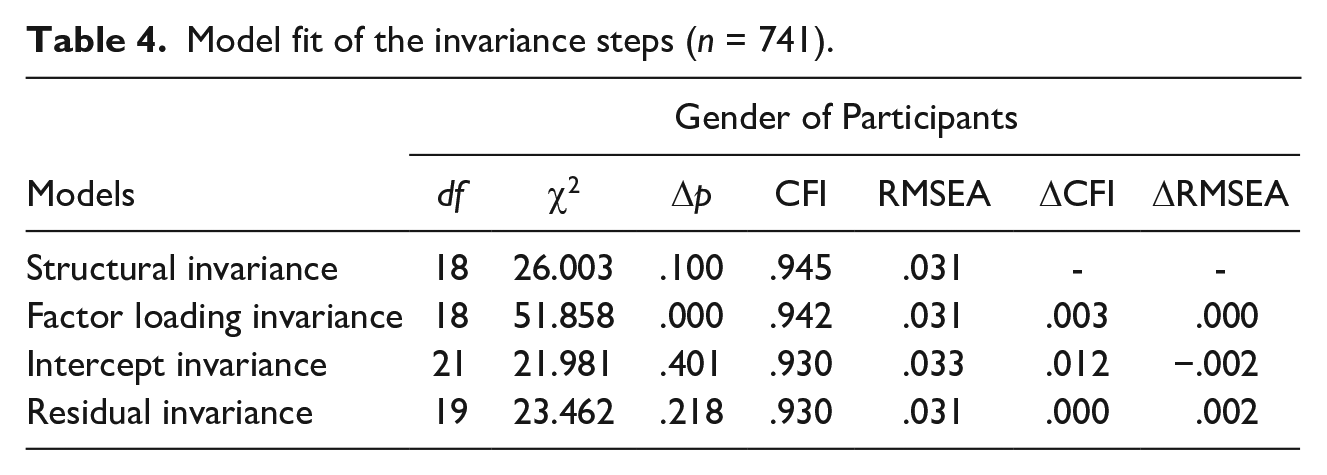
Measurement invariance among participants’ gender was tested through the analysis of structural invariance, factor loading invariance, intercept invariance, and residual invariance (Cheung and Lau, 2012). When Δp > .05 (not significant), the models are invariant; when Δp ≤ .05 (significant value), ΔCFI and ΔRMSEA need to be analyzed considering the criteria proposed by Cheung and Lau (2012): ΔCFI ≤0.01 and ΔRMSEA ≤0.015 indicate no significant differences between models and invariance can be established.
Results
Factor Analysis
A series of Exploratory Factor Analysis were performed to identify the optimal factor structure of the RMBI. This model was in accordance with theoretical model proposed by Higginbotham and Adler-Baeder (2008) that includes seven dimensions. Items 6, 7, and 18 were removed due to low factor loading (<.50) and decreasing reliability of the subscale. With the absence of these items, the CFI rose from 0.88 (moderate fit) to 0.93 (good fit). Our final model showed that factor loadings for the seven dimensions were moderate to high (see Figure 1). The CFA suggested one correlation between two errors (item 5–item 6) that improved the model fit. With this error’s correlation, the CFI rose from 0.92 to 0.93. The final model (Figure 1) presented a good fit to the data: χ2 (130) = 363.588, χ2/df = 2.79, p = .000; CFI = .93; GFI = .95; RMSEA = .05. The seven-factor structure with 19 items was confirmed for remarried Portuguese population.
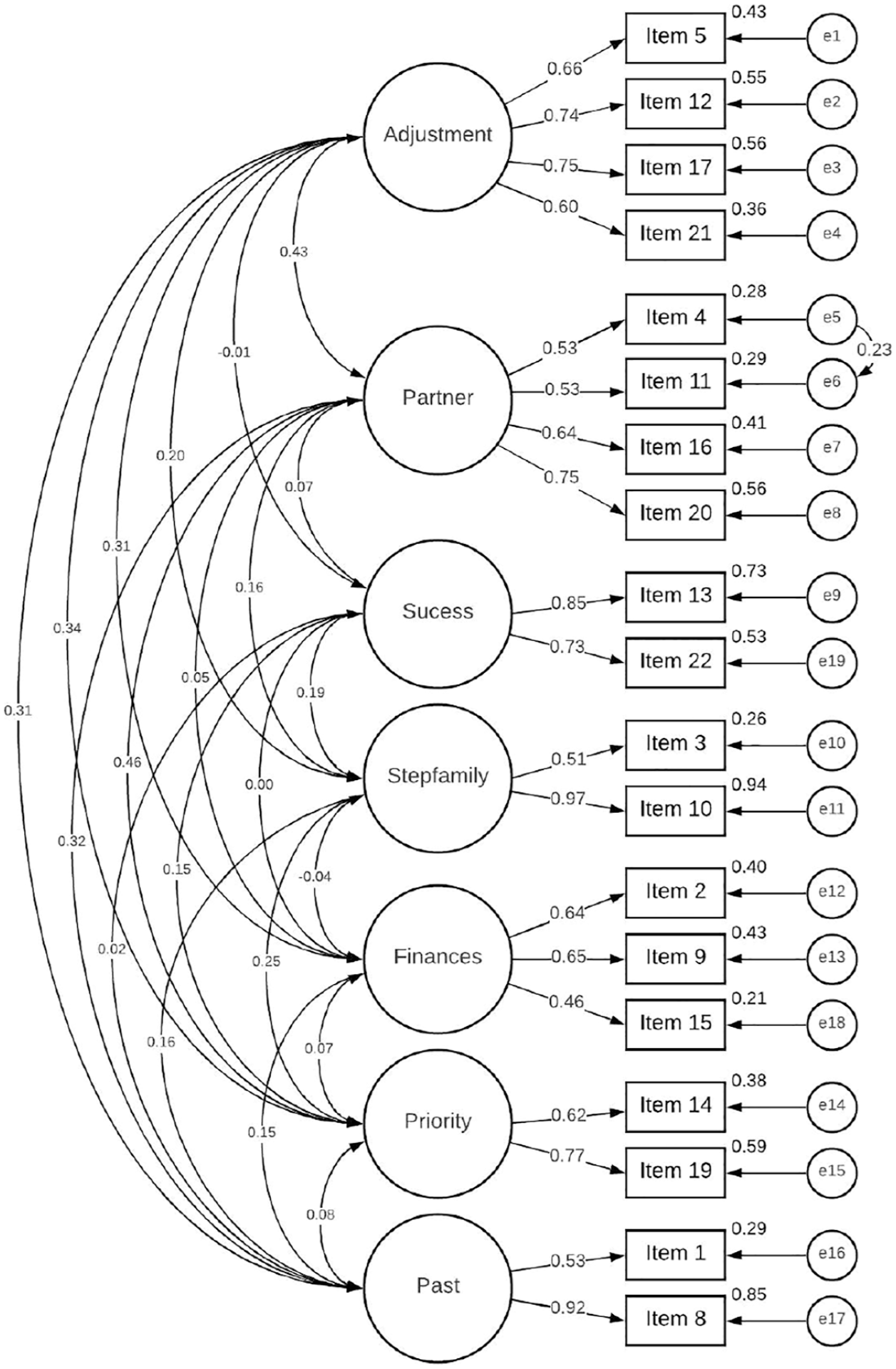
Final model.
Reliability
Descriptive statistics for RMBI total score, subscales, and items are presented in Table 2. No severe departures from normality were identified considering that skewness’ values ranged from −.99 to 1.34 and kurtosis’ values ranged from −1.43 to 1.01. No missing data were present.
Descriptive statistics for the Portuguese model of RMBI total score, subscales, and items (N = 741).
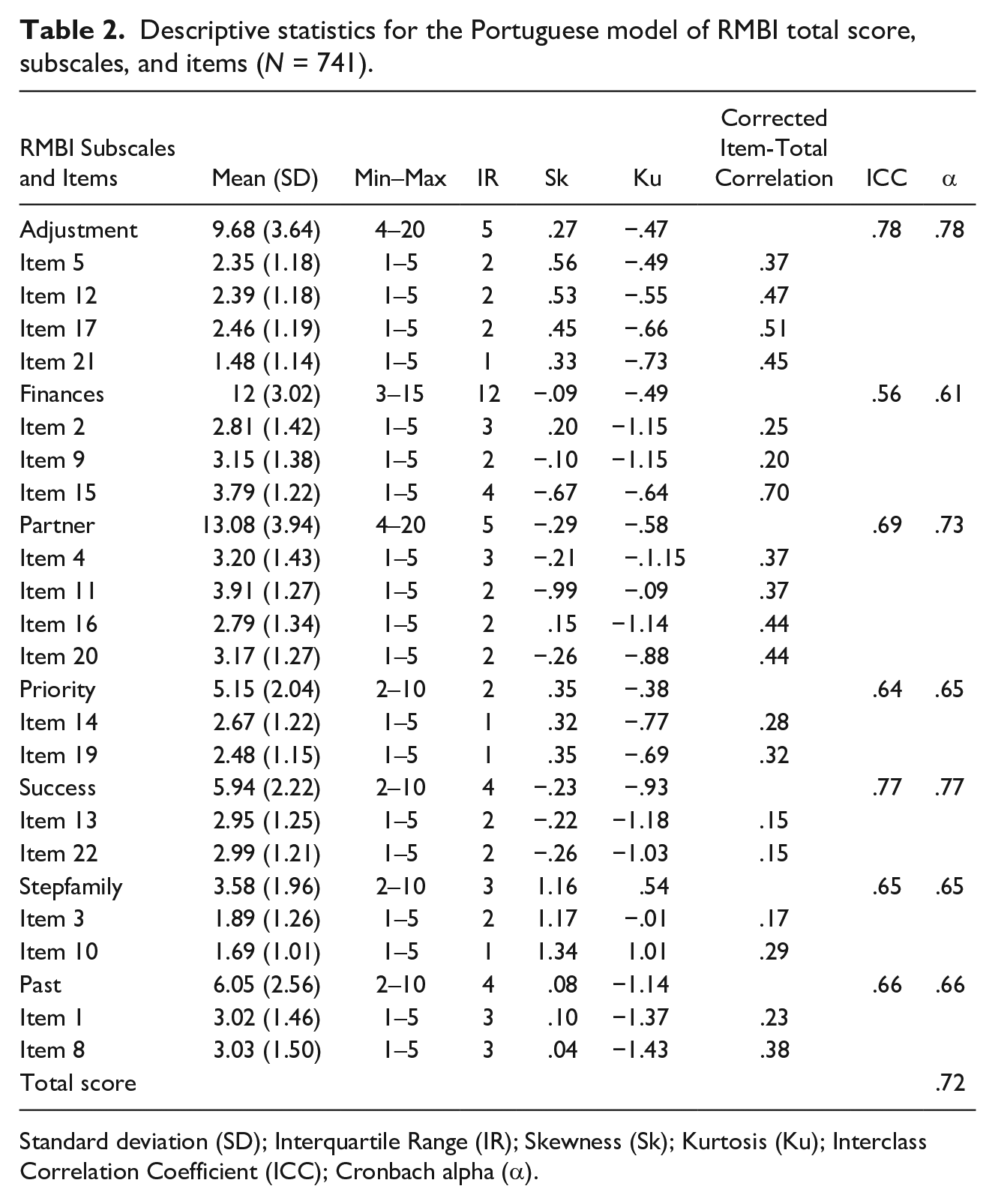
Standard deviation (SD); Interquartile Range (IR); Skewness (Sk); Kurtosis (Ku); Interclass Correlation Coefficient (ICC); Cronbach alpha (α).
Internal consistency was calculated by Cronbach’s alpha coefficient for the total score of the scale (α = .72) and for all subscales: adjustment (α = .78), partner (α = .73), success (α = .77), stepfamily (α = .65), finances (α = .61), priority (α = .65), and past (α = .66). Test–retest was assessed using ICC and demonstrated good reliability for adjustment (ICC = .78) and success (ICC = .77), and moderate reliability for partner (ICC = .69), stepfamily (ICC = .65), finances (ICC = .56), priority (ICC = .64), and past (ICC = .66).
Construct Validity
Bivariate correlations were used to measure associations between RMBI and DAS-R, PSS, and MSPSS to provide evidence about construct validity. In general, remarriage beliefs were negatively associated with marital adjustment and social support. While the beliefs that “stepfamily is second class,” “children are the priority,” and “remarriage’ success is slim” were positively associated with perceived stress and the belief that “stepcouples’ finances should be pooled” had a negative association with stress (Table 3).
Correlations between subscales of RMBI and marital adjustment, stress, and social support (N = 741).
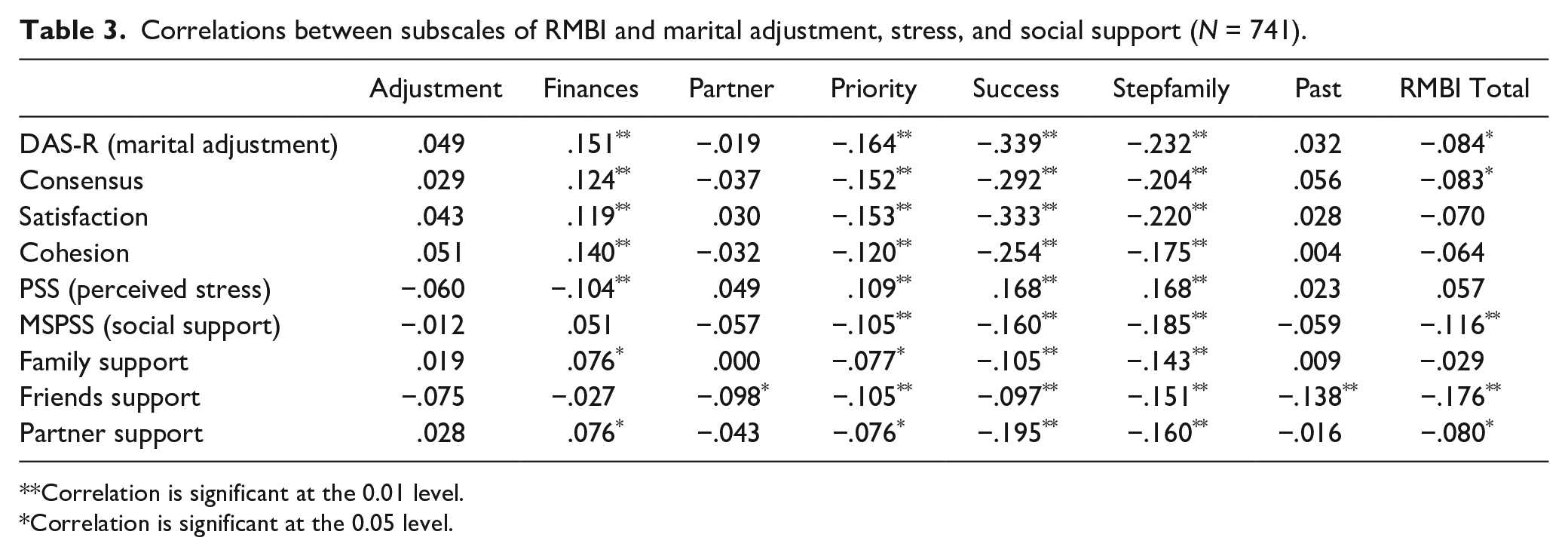
Correlation is significant at the 0.01 level.
Correlation is significant at the 0.05 level.
Convergent and Discriminant Validity
There was evidence that three constructs, success (AVE = .63), stepfamily (AVE = .60), and past (AVE = .57), had good convergent validity. In four constructs, adjustment (AVE = .47; CR = .78), partner (AVE = .38; CR = .71), priority (AVE = .49; CR = .65), and finances (AVE = .35; CR = .61), the measurement items had an acceptable degree of internal (convergent) validity.
Discriminant validity was analyzed using Maximum Shared Variance (MSV). For discriminant validity to be supported, AVE values should be greater than MSV values (Hair et al., 2006). All constructs met this criterion.
Measurement invariance
Residual invariance was found (ΔCFI = .000; ΔRMSEA = .002) indicating the Remarriage Belief Inventory can be used to analyze the differences between men and women related to remarriages beliefs (Table 4).
Model fit of the invariance steps (n = 741).
Discussion
The present study analyzed the psychometric properties of the Portuguese version of the RMBI, in a sample of remarried individuals. The RMBI represents the only self-report and empirical measure to assess remarriage beliefs on seven distinct constructs: (1) adjustment comes quickly, (2) stepfamily is second-class, (3) children are the priority, (4) past should stay in the past, (5) partner is perfect, (6) success is slim, and (7) finances should be pooled. So far, this measure has been validated in two countries (EUA and Poland; Higginbotham & Adler-Baeder, 2005; Kołodziej & Przybyła-Basista, 2014), including an American validation as a dyadic measure (Garneau, Adler-Baeder, & Higginbotham, 2013). This is the first study that analyzes test–retest reliability and measurement invariance among gender.
The results of the present study validate the original theoretical model proposed by Higginbotham and Adler-Baeder (2008) which includes seven distinct dimensions of remarriage beliefs. This structure was also confirmed in the Polish validation (Kołodziej & Przybyła-Basista, 2014). Similar to the Polish version (Kołodziej & Przybyła-Basista, 2014), the Portuguese version of RMBI (see Appendix A) was also shortened. CFA confirmed better adjustment parameters for the shorter version (19 items) and confirms that the RMBI tool assesses individuals’ beliefs of seven distinct aspects of remarriage. Discriminant validity was established, suggesting that the seven dimensions measure different aspects of the same underlying construct.
In general, the Portuguese version of the RMBI tool showed internal consistency, test–retest reliability, and validity, supporting its adequacy to assess remarriage beliefs among remarried Portuguese men and women. As with the original version, Cronbach’s alphas of the subscales range between moderate to good, indicating that the Portuguese version of RMBI is reliable. However, 3 items were eliminated—item 6 (People who have divorced are likely to divorce again), item 7 (Fulfilling the desires of a new spouse should come before fulfilling the desires of biological children), and item 18 (When a person enters a remarriage or stepfamily, it is likely that their new spouse will have some of the same flaws they saw in their previous spouse/partner). All these items showed a low item-dimension correlation of 0.47 (item 6 and item 18) and 0 (item 7). One hypothesis to justify the null value of factor loading for item 7 is that the item may not have been understood enough because its score is reversed. Moreover, this item has also shown low factor loadings in previous studies, having also been removed (Garneau, et al., 2015). With the absence of these three items, the CFI rose from 0.88 (moderate fit) to 0.93 (good fit). It seems that these items may not be good indicators to measure Portuguese remarried beliefs.
The tool demonstrated construct validity and the significant correlations between the RMBI dimensions and other measures of marital quality, perceived stress, and received social support. Results from this study indicated that the RMBI tool can be used as an indicator of quality of remarriage relationship and social support. Because of cultural stereotypes, stepfamilies may receive less support than first married families and this could contribute to marital maladjustment and divorce (Hadfield & Nixon, 2013; Ganong & Coleman, 2017). Consistent with these findings, this study showed that many of the RMBI dimensions are negatively associated with marital adjustment and social support. In accordance with the previous validation studies (Higginbotham & Adler-Baeder, 2008; Kołodziej & Przybyła-Basista, 2014), we found that “success is slim” had the strongest relationship with remarital adjustment. When participants believe that remarriage success is slim, they have low levels of marital satisfaction. However, more studies are needed, especially with longitudinal designs, in order to provide evidence of causality.
The results of this study showed a relation between marital adjustment and financial management—believing in pooled finances increase consensus, satisfaction, and cohesion in remarriage relationship. This study also demonstrates that partner support is higher for those who believed in pooled finances. Pooling financial resources seems to give the couple a sense of “unity,” increasing marital adjustment and satisfaction (Higginbotham & Agee, 2013). Besides that, communication is facilitated out of the necessity to cooperate (Fishman, 1983). As expected, many of the RMBI dimensions are positively associated with stress. Believing that stepfamily is second class and success is slim had the strongest relationship with stress symptoms. The cultural belief that stepfamilies are, in some way, unhappier and “inferior” to first married families has been documented in the literature (Claxton-Oldfield, 2000). It is also known that these unrealistic beliefs can lead to stressful stepfamily life (Bray & Kelly, 1998).
This study also establishes evidence regarding the invariance of the RMBI. For conducting cross-group comparisons, the measurement invariance is a prerequisite, but it is seldom tested (Cheung and Lau, 2012). This study demonstrated the absence of variation in the RMBI structure between men and women. This evidence of invariance is an important contribution for the robustness of RMBI by providing evidence of that the same constructs are being perceived equally by men and women, meaning that differences between groups effectively reflect the real differences between them (Cheung and Lau, 2012). Previous studies examined invariance findings regarding husband–wife dyads, with American couples varying slightly in their interpretation of items (Garneau, et al., 2015).
Study Limitations and Future Research
Despite the strengths, the current study presents some limitations that must be considered. The majority of participants were heterosexual remarried women, divorced, and had high levels of education. Future studies with more heterogeneous samples are needed (e.g., men, gay, and lesbian remarriages), as well as studies to examine the invariance of the RMBI across socioeconomic and education levels. Clinical information about the participants’ counseling status was missing, namely, if participants were currently undergoing psychotherapy, couple therapy, or family therapy processes. Future research should explore the moderating or and mediating effects between counseling status and endorsement in remarriage beliefs.
Conclusions and Implications
The RMBI may be used to assess remarriage beliefs among remarried Portuguese men and women. Furthermore, significant bivariate correlations indicated that the RMBI may be used as an indicator of quality of remarriage relationship, social support, and stress symptoms. Our findings will be important for marriage and family therapists to have more information about the beliefs and unrealistic expectations of stepparents, their relationships to their stepchildren, and the effects of both on stepfamily function. It is important to discuss these beliefs with remarried individuals to establish functional and realistic standards of thinking.
Footnotes
Appendix A
Portuguese version of RMBI
Inventário de Crenças sobre o Recasamento Pensando nas relações de recasamento e nas novas estruturas familiares em geral, por favor indique até que ponto acredita em cada uma das seguintes afirmações. (assinale uma opção em cada pergunta)
Declaration of Conflicting Interests
The author(s) declared no potential conflicts of interest with respect to the research, authorship, and/or publication of this article.
Funding
The author(s) disclosed receipt of the following financial support for the research, authorship, and/or publication of this article: This work was supported by Portuguese Science and Technology Foundation under the project PD/BD/143069/2018.
