




Abstract
While qualitative evidence has highlighted psychological benefits of visitation during incarceration, and quantitative evidence has linked visitation to better post-release outcomes for inmates, we know little about heterogeneity in visitation patterns and the factors shaping them. Using Danish administrative data on inmates incarcerated at least a year between 2004 and 2014 (N = 5,441), we first examine average frequency and duration of family visits across the first year of incarceration and then describe five distinct visitation patterns using latent class analysis. Finally, we investigate what predicts visitation patterns.
The findings highlight that (a) there is substantial heterogeneity in the patterns of family visitation and (b) both individual-level and institution-level factors partially predict this heterogeneity. Parenthood, high pre-incarceration income, and long sentences were associated with high levels of visitation and being placed far from home and transferred between facilities were associated with a higher risk of receiving low or decreasing levels of visitation.
Introduction
Incarceration is now a prominent feature of family life, especially in the United States, and to a lesser but not negligible extent in developed democracies more broadly. It is estimated that 45% of Americans have had an immediate family member incarcerated (Enns et al., 2019) and that one in four Black children have had a father imprisoned during childhood (Wildeman, 2009).
Most, although certainly not all, studies on the incarceration–family connection have considered one of three topics: (a) how family background shapes the risk of criminal activity or incarceration (e.g., Farrington et al., 2001; Gottfredson & Hirschi, 1990; Sampson et al., 2006), (b) how incarceration affects families (e.g., Arditti, 2012; Foster & Hagan, 2009; Murray & Farrington, 2008; Wakefield & Wildeman, 2013), or (c) how family ties shape reentry (e.g., Visher & Travis, 2003; Western et al., 2015). Yet the conditions under which family life play out during incarceration have only recently gained attention.
Visitation is an integral part of life for inmates and their family members. Qualitative studies poignantly illustrate the lengths some families go to spend time with an incarcerated family member, providing rich and detailed, but not population-representative, portraits of visitation experiences (e.g., Arditti, 2003; Christian, 2005; Comfort, 2008; Siegel, 2011; Tasca et al., 2016). Quantitative research, on the other hand, has primarily documented how visitation is associated with inmate misconduct (e.g., Cochran, 2012; Siennick et al., 2013) and reentry and recidivism (Bales & Mears, 2008; Duwe & Clark, 2011; Mears et al., 2012; Mitchell et al., 2016), with less attention to the detailed nature of how visitation patterns shift over time (but see Cochran, 2012, 2014; Hickert et al., 2018 for notable exceptions to this).
This article fills this important gap in research by considering patterns in family visitation in three dimensions: (a) frequency of visitation, (b) duration of visits, and (c) how visitation evolves over time. Particularly, the emphasis on duration is new to quantitative studies on visitation (despite its salience being well-documented in qualitative studies). The article also investigates which factors shape patterns of family visitation during incarceration in Denmark. Using Danish administrative data on inmates incarcerated for at least one year between 2004 and 2014 (N = 5,441), we first describe the average visitation patterns and then describe five distinct patterns of family visitation using latent class analysis. We then take advantage of the wide range of information held in the administrative data to predict latent class membership using sentence characteristics, facility information, previous criminal history, socioeconomic status, and demographics and family information.
We found that the number of weekly visits was stable across the first year of incarceration, but the average duration of visits increased markedly, indicating that duration was a dimension in which families learned to optimize, but these patterns masked substantial heterogeneity. We identified five latent classes of family visitation characterized by (a) low levels of family visitation, (b) medium level of family visitation, which escalated over time, (c) medium level of family visitation, which declined over time, (d) high level of family visitation prioritizing frequency, and (e) high level of family visitation prioritizing duration. Most inmates had visitation patterns characterized by low level (54%) or medium level but decreasing (22%) visitation.
The regression analysis highlighted a wide range of predictors of family visitation patterns. Specifically, we found that parenthood was consistently linked to high levels of visitation (either emphasizing frequency or duration), and that higher pre-incarceration income was linked to a higher frequency of visits. Longer sentences were associated with belonging to the latent classes that exhibited patterns of steadily increasing or consistently high visitation frequency, whereas individuals with more prior convictions were overrepresented in the groups receiving fewer visits (or no visits). Of institutional factors, (a) being placed far from home and transferred between correctional facilities were associated with a higher risk of experiencing low or decreasing levels of family visitation, (b) being placed primarily in jails was linked to the lower levels of visitation, and (c) being placed in an open prison was associated with receiving visits of longer duration.
Background
The Importance of Prison Visits
The scholarly work on prison visitation from an inmate perspective has mainly focused on how visitation relates to either prison misconduct or recidivism and reentry in general.
First, visitation is thought to have immediate effects on inmate misconduct by either alleviating the stresses and strains of incarcerations or enhancing them by reminding the inmate of what he/she is missing out on. Indeed, results are mixed, with some studies showing negative (Cochran, 2012) and positive (Siennick et al., 2013) associations between visitation and inmate misconduct. Second, visitation is thought to reduce recidivism and improve reentry through the maintenance of social ties, with most (but not all) studies finding prison visitation to be associated with lower recidivism (Bales & Mears, 2008; Duwe & Clark, 2011; Mears et al., 2012; Mitchell et al., 2016), although a recent study calls into question the causal nature of this relationship (Cochran et al., 2020). These strands of research highlight the importance of visitation and the salience of maintaining social ties for how well the incarcerated individual fares during and after incarceration.
However, prison visitation is also of great importance for the families of the incarcerated. Qualitative studies have highlighted how visiting an incarcerated family member is by no means easy. Visitation can involve long and costly travels that far exceed the allotted visitation time (Christian, 2005; Comfort, 2008; Siegel, 2011). Visitation is also intrinsically linked to exposure to the prison environment and to being subjected to the often arbitrary, inconsistent, and unpredictable visitation rules (Arditti, 2003; Comfort, 2008). Furthermore, the actual visitation is not always pleasant, with some visits being fraught with conflict (Tasca et al., 2016; Turanovic & Tasca, 2019). That some people go to great lengths to visit incarcerated family members points to the importance they place on the in-person contact that visitation offers. Many emphasize moral support, maintaining or building relationships with children, and of course spending time with a missed loved one as primary goals of prison visits (Christian, 2005; Comfort, 2008; Tasca et al., 2016). Visitation has been shown to be associated with better family relationships and more social support post release (Hickert et al., 2019; Mowen & Visher, 2016), highlighting how visitation can play a significant role in holding the family together during and after incarceration.
Visitation Patterns: Frequency, Evolution, and Duration
Of course, visitation is not simply a dichotomous indicator, and so we seek here to focus on describing the frequency, evolution, and duration of visits, all of which have been tied to either inmate outcomes or, more broadly, family well-being (Cochran & Mears, 2013). Higher frequency of visitation, for example, has consistently been linked to better outcomes for the incarcerated individual (Bales & Mears, 2008; Cochran, 2012; Cochran & Mears, 2013; Mears et al., 2012) and the family relationship (La Vigne et al., 2005) upon release. The evolution of visitation over time may also be relevant because visits that occur consistently across the incarceration may carry a different weight compared to visitation patterns characterized by gradual increases, gradual decreases, or abrupt secessions. Recent studies that examine heterogeneity in the longitudinal patterning of visitation have found sustained visitation to be most beneficial (Cochran, 2012, 2014; Hickert et al., 2018). Finally, we consider the duration of visitation, something that has received short shrift in quantitative research. Participants in Comfort’s (2008) study noted that “every minute is so valuable” (Comfort, 2008, p. 43); their behavior supports this, with many exposing themselves to long waits in order to obtain the longest possible time with their incarcerated loved ones.
What Shapes Visitation Patterns?
The literature described earlier highlights how family visitation could have positive impacts on reentry and family relationship post release and is also a highly valued experience from the point of view of the visiting family members, but as we will illustrate later, family visitation is far from being evenly distributed among inmates. As Cochran et al. (2017) indicate, visitation is one dimension that can create or enhance inequalities in punishment, and understanding who receives which patterns of family visits can both inform studies of the effect of visitation as well as help target programs seeking to reduce disparities in visitation.
Institutional variation could help drive heterogeneity in visitation. Both between and within countries, correctional facilities differ in the availability, frequency, and duration of visitation. Facilities also vary in the visitation services they provide—some may allow for overnight or conjugal visits—and the visitation environment may be more or less hospitable. Facilities also vary in how accessible they are to visitors who might have to travel long distances or have trouble finding transportation to and from the facility, and distance has repeatedly been touted as a key barrier to visitation (Clark & Duwe, 2016; Rubenstein et al., 2019). The number of transfers between correctional facilities that an inmate is subjected to could also matter because it is likely to cause some disturbance in set visitation patterns—at the very least because visitation permits tend to be facility-specific, leading to a delay in access for some period of time (generally about two weeks) after each transfer.
Another set of factors thought to shape visitation patterns are sentence characteristics and prior criminal history. Generally, they can matter for visitation in two ways—either because they matter for how the inmate is treated within the institutional setting or because they matter for the relationship with the family. Prior studies have shown that inmates convicted for sex offences or violence receive fewer visits, which is arguably due to families being less willing to provide support and resources when the crime is considered more egregious or stigmatized (Cochran et al., 2017; Connor & Tewksbury, 2015). Sentence length could also matter for the time and energy invested in visitation, but studies so far have found no relationship between sentence length and visit frequency (Cochran et al., 2017). Furthermore, prior studies have argued that repeated incarcerations are especially hard on family members and may lead to “visitation fatigue” (Cochran et al., 2017; Connor & Tewksbury, 2015; Rubenstein et al., 2019).
Demographic characteristics have also been shown to predict visitation patterns. Some argue that women have stronger social ties and are more involved in their children’s lives leading to higher levels of visitation (Cochran et al., 2017; Connor & Tewksbury, 2015; Derkzen et al., 2009). There is also evidence that older inmates receive fewer visits than younger inmates (Cochran et al., 2017), potentially due to an increased likelihood of severed family ties. Some argue that minority groups have more tight-knit family structures (Adams, 1992) leading to more visitation; others argue that they experience more barriers to visitation due to structural constraints (Christian, 2005). Prior studies suggest the latter (Cochran et al., 2017; Connor & Tewksbury, 2015). Finally, living in a city prior to incarceration could make visitation more likely; this is particularly true if visitors rely on public transportation or pre-organized “tours” (Christian, 2005).
Another factor expected to be highly salient for family visitation patterns is family structure. Having more family members would most likely increase the likelihood of family visitation simply by increasing the pool of potential visitors. In particular, visits from children and partners are quite common (Duwe & Clark, 2011; Mears et al., 2012).
Given the documented barriers to visitation (Christian, 2005; Siegel, 2011), it is very likely that the socioeconomic status of inmates and their families is of importance for the level of visitation that occurs during incarceration (as we implied earlier). Education, employment status, and income are likely reflective of the resources that the inmate and his family have at their disposal to overcome the challenges connected to visitation. Previous studies have shown higher levels of education and income to be associated with more visits (Connor & Tewksbury, 2015; Rubenstein et al., 2019).
In this article, we expand on prior studies on the predictors of visitation by (a) examining whether factors included in prior studies also serve as predictors in the Danish context in which studies on the patterning and predictors (and consequences) of visitation are very scarce, (b) including institutional characteristics pertaining to conditions of confinement not previously examined, and finally, (c) examining more detailed patterns of family visitation by simultaneously considering frequency, duration, and development over time of visitation.
Visitation in the Danish Context
By international standards, Denmark has a relatively mild penal regime. The incarceration rate is low (63 per 100,000 in Denmark compared to 655 per 100,000 in the United States, Walmsley, 2018), which reflects both the use of short sentences and a heavy reliance on non-custodial alternatives to incarceration (such as electronic monitoring, community service, or other types of probation). Additionally, there is strong emphasis on resocialization and normalization in the Danish prisons.
Although Denmark is a small country, the placement of prisons makes visitation costly and time-consuming. In principle, the Danish Prison and Probation Services aims to place inmates as close to their family as possible, but this is often not feasible, and spending four hours driving or in public transportation each way to some of the more rural prisons would not be uncommon for visitors. Visitors to prisons and jails in Denmark have to obtain visitation permits (which are facility-specific and may be withheld from visitors with certain types of criminal backgrounds) and will be searched for contraband upon entry (Kjær, 2012). Inmates in Denmark have the right (granted by law) to at least one visit per week lasting at least one hour but preferably two, which aligns with general visitation policies in the Netherlands (Hickert et al., 2019) and falls in the middle of the U.S. spectrum (Boudin et al., 2013).
Although facilities vary in the visitation conditions they provide (overnight family stays are, for example, only offered at certain facility types), the circumstances under which the visits unfold are generally more private than in many other countries. Within the Danish context, visits are not surveilled by prison staff (with exceptions for certain inmates), and most visits take place in private rooms, some of which have been renovated to make visiting children as comfortable as possible (Kjær, 2012; but see Smith & Jakobsen, 2010). Danish families may also face fewer financial barriers to visitation, given (comparatively) generous welfare benefits and government-subsidized transportation cost related to visitation for families with children (although the latter is rarely applied for; Smith & Jakobsen, 2010).
However, given that incarceration is relatively rare, those that do become incarcerated in Denmark may be more disadvantaged compared to inmates in other contexts, which could show in more marginalized social positions and more strained family relationships.
Data and Method
Data and Variables
We make use of novel administrative data on all incarcerations and visits from 2004 to 2014. The data were routinely collected by the Danish Prison and Probation Services for administrative purposes and were made accessible for research in a de-identified version by Statistics Denmark following a clearance process and approval by the Danish Data Protection Agency. By combining unique de-identified ID numbers with unique case numbers, we are able to track incarcerated individuals and their visits across all facilities they are moved to, all new sentences they receive, and all visits they receive. Additionally, the unique ID numbers allow us to link the data to a wide range of administrative registers also made accessible by Statistics Denmark on, for example, prior criminal justice contact, socioeconomic status, and demographic characteristics including family structure, thus leaving us with an extremely rich data set. 1
We restrict our analytical sample to include only incarceration spells that (a) start between 2004 and 2013, (b) take place in prisons or jails—meaning that we exclude spells in halfway house and deportation centers—and (c) last at least one year. The one-year cut-off allows us to examine how visitation patterns develop over time, as families potentially gain familiarity with the visitation system and generally adapt to the experience of having a family member incarcerated. However, this focus on the development and patterning of visitation comes at the cost of generalizability. A yearlong incarceration spell or more is comparatively long in the Danish context (~10% of all incarcerations in Denmark in this period) and tends to be reserved for serious offences. Consequently, our analytical sample holds a much larger share of individuals incarcerated for sexual offences (8.2%), homicide (4.5%), robbery (16.5%), and drug offences (30%) but is similar on all other measured characteristics to the general population of inmates. The analytical sample consists of 5,411 incarceration spells covering 5,039 individual inmates. Results for those incarcerated at least six months (N = 12,218) are available upon request. The latent classes are quite similar, although the visitation patterns appear more stable when only considering the first six months.
Family visits
As the visitation data provided by the Danish Prison and Probation Services include information on the time, place, and duration of the visit, along with the visitors’ relation to the inmate, we can create variables measuring the monthly number of visits and the average duration of visits per month. We only include visits by family members, which constitute approximately 75% of all visitors (the remaining visitors include friends and professionals or volunteers providing inmates with legal and other support).
Facility information
The incarceration data hold information on entry and release/transfer dates for all correctional facilities under the Danish Prison and Probation Services in which an inmate is incarcerated. We include a measure of the type of facility in which the inmate spends the most time during the first year of incarceration. The type of facilities consists of jails, closed prisons (reference category), open prisons, and psychiatric institutions (within the realm of Danish Prison and Probation Services). Closed prisons are the facilities that most closely resemble the prison facilities known from the United States and other parts of the Western world, whereas open prisons are characterized by minimal security measures and barriers to the outside, with some inmates even having the privilege to work or study outside the prison during the day. We also take advantage of geocoded data on prisons/jails and inmates’ residence to measure the shortest driving distance between the facility in which the inmate spends the most time and the inmate’s residence. We measure the distance in hours of traveling time, but for those that rely on public transportation, this measure is bound to be much lower than the actual traveling time. In approximately 30% of cases, however, the distance could not be calculated because of missing addresses and addresses that could not be geocoded. These cases are coded with a dummy variable for missing information on distance between the facility and the home. Finally, we also construct measures of the number of transfers between facilities within the first year of incarceration, and a measure of whether the incarceration spell includes pre-trial incarceration.
Sentence characteristics and prior criminal justice contact
Within the incarceration data, there is also information on the type of crime for which the inmate is incarcerated and the sentence length. Crime types include homicide, sex crimes, violence (reference category), robbery, drug crimes, property crime, vandalism, other penal offences, traffic offences, and Special Acts and other violations. We group sentence length into six categories: less than two years (reference category), two–three years, three–five years, and five years and above.
For prior criminal justice contact, we link our incarceration data with data on all registered convictions (supplied by The Danish National Police) and count the number of previous prison sentences, the number of previous convictions for Penal Act violations since 1980, and the number of previous convictions for Special Acts violations since 1992 (when changes in the registration of traffic fines occurred). Violations of the Penal Act include violence, property crime, and sexual offences among other things, whereas violations of the Special Acts include, for example, traffic, weapon, and relatively minor drug violations.
Demographic characteristics
By linking individuals to other administrative data, we can also obtain information on a wide range of demographic characteristics. We include measures for gender, age, whether the inmate is of immigrant background (i.e., immigrant or descendant of immigrants), and whether the inmate lived in a large city (one of the four major cities in Denmark) prior to incarceration. We also include measures of family structure registered on January 1st, the year of incarceration: whether the inmate lives alone (reference category), with a partner/spouse or with parents, and finally whether the inmate is a parent.
Socioeconomic status
We first categorize employment status (measured November 1st, the year prior to incarceration) using the following three categories: employed (reference category); in education; and either unemployed, outside the labor force, or missing employment status. We also include gross income the year prior to incarceration (10,000s DKK, 2015 level). Finally, we categorize highest level of education as primary or missing education (reference category), upper secondary education, and tertiary education.
Latent Class Analysis
Although we are interested in the average level of visitation for Danish inmates, we are also interested in heterogeneity in visitation across inmates and how observed characteristics of inmates and their conditions of confinement may shape this heterogeneity. Therefore, we use latent class analysis in which we identify latent or unobserved subgroups based on observed indicators/variables. This is done by defining a latent variable that accounts for the relationship between the observed variables by ensuring they are locally independent within each class of the latent variable (McCutcheon, 1987). The analysis fits a latent class model using maximum likelihood estimation and then estimates the class membership probability and item response probability (Porcu & Giambona, 2017).
We model the latent classes as a function of number of visits and average duration of visits for each of the first 12 months of incarceration (24 variables). Because these variables are continuous rather than categorical, what we estimate is technically a latent profile model, rather than a latent class model (McCutcheon, 1987), but overall, the estimation procedure and interpretation of the results are the same. As it is customary, we will estimate different models with varying number of latent classes and use goodness-of-fit measures and general interpretability of the latent classes to select the preferable model (Porcu & Giambona, 2017).
After determining which model is preferable, we estimate the proportion of individuals belonging to each latent class (based on the class membership probability) and the mean monthly number and duration of visits for each class to characterize the classes of visitation patterns. We then predict latent class membership using linear probability models (choosing one as the reference group) and the measures on facility information, sentence characteristics, prior criminal justice contact, demographic characteristics, and socioeconomic status described earlier to see which factors are related to which visitation patterns.
Results
Summary Statistics
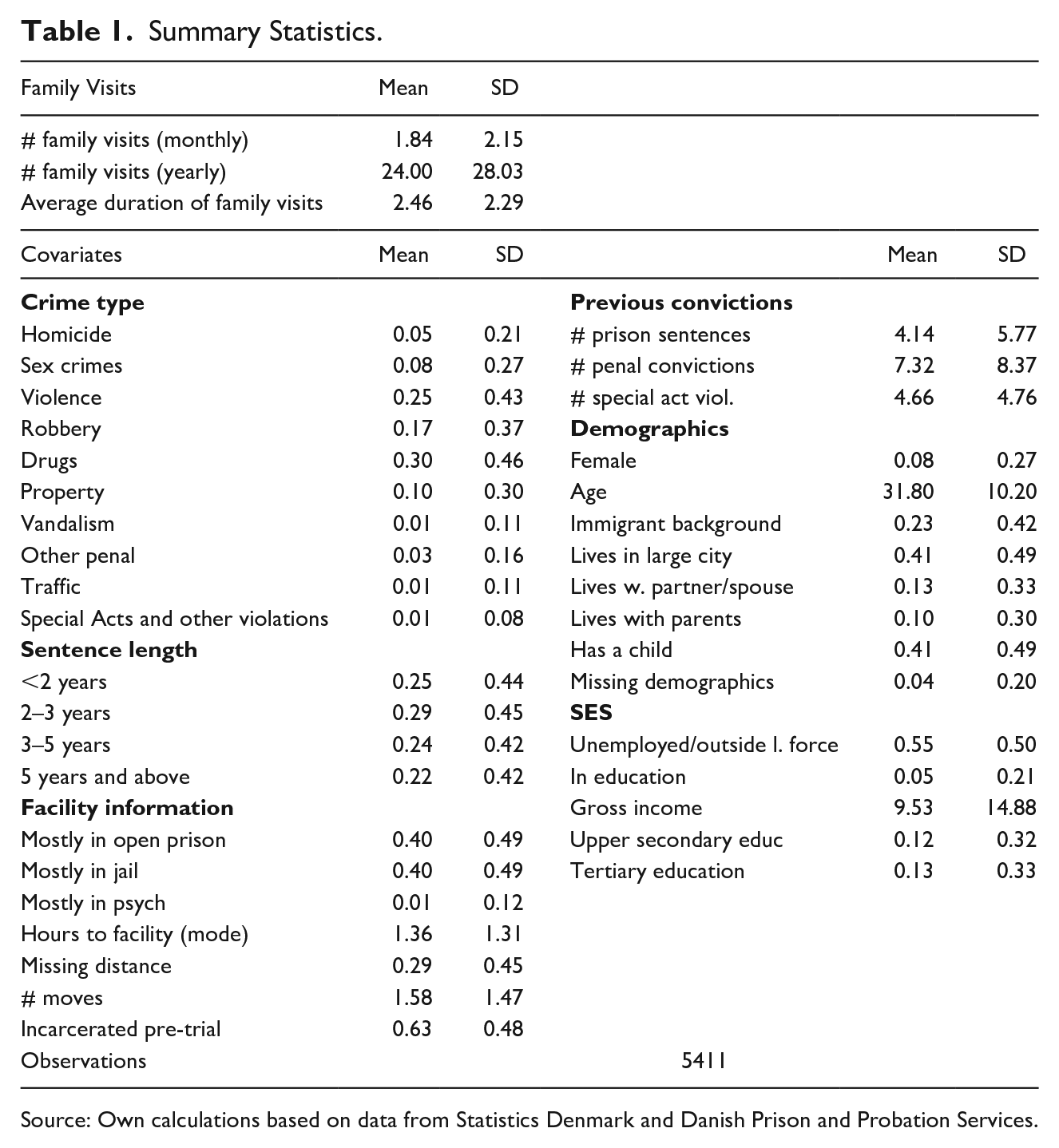
Table 1 shows the summary statistics of our analytical sample of 5,411 incarceration spells. On average, inmates received 1.8 family visits per month and they on average lasted approximately 2.5 hours. Most inmates were incarcerated on the account of drug offences (30%) or violent offences (25%). Eight percent and 5% were incarcerated for sex crimes and homicide, respectively, and 17% for robbery, which are rather large shares compared to all offenders who received prison sentences, of whom 2%, 0.2%, and 6%, respectively, were incarcerated for similar offences. When it comes to sentence length, 22% were serving a sentence of five years or more, but shorter sentences were more common with approximately 50% serving sentences of less than three years. The majority of inmates spent most of the year incarcerated in open prisons or jails (40% in each), and the average traveling time to the correctional facility was 1.36 hours. Inmates were on average transferred between facilities 1.6 times during the first year of incarceration, and as many as 63% started the incarceration spell detained pre-trial.
Summary Statistics.
Source: Own calculations based on data from Statistics Denmark and Danish Prison and Probation Services.
On average, inmates had received four prison sentences prior to the current incarceration and had been convicted of Penal Act violations and Special Acts violations seven and five times, respectively, which is similar to the average inmate receiving a prison sentence of any length. Of demographic characteristics, Table 1 shows that 8% were female, the mean age was 32 years, and a large share had immigrant background (23% compared to 13% in the general population). Forty-one percent were parents, but only 13% lived with a partner or spouse, and 41% lived in one of the four largest cities in Denmark. A large share was unemployed or outside the labor force and on social benefits (55%), only 25% had more than primary education, and the mean gross income was 95,000 DKK (approximately USD14,500). These summary statistics point to a disadvantaged group, but our analytical sample was not much worse off than the general population of incarcerated individuals. Instead our sample distinguished themselves by being incarcerated for much more serious offences with comparatively long sentences.
Average Visitation Patterns
A first look at visitation patterns (illustrated in Figure A-1 in the Online Supporting Material) tells us that the number of family visits showed a rather steep increase during the first few weeks of incarceration, which is consistent with family members waiting to be granted visitation permits. From there on, the development in the number of family visits was rather subtle: there was a slight increase up until three months into the incarceration, when it stabilized until six months into the incarceration (at 0.5 visits per week) and then declined slowly (to 0.4 visits a week). However, the trend in the duration of family visits was much clearer. There is a steady and substantial increase occurring from one month into to the incarceration all the way to the final weeks of the first year. During the first year, the average duration of visits doubled (from two to four hours). In combination, these patterns suggest that, whereas there might be limitations to how often family members can visit, the duration of visits might be a salient—and overlooked—dimension of family visitation that inmates and family members learn to optimize over time.
Identifying Latent Classes
The general patterns are, however, likely to mask heterogeneity in family visitation patterns, which is why we used latent class analysis to identify distinct patterns in family visitation across the three dimensions: frequency, duration, and evolution. We estimated latent class models with one through five classes, and their respective goodness-of-fit measures are reported in Table A-1 in the Online Supporting Material. Both the Akaike information criterion (AIC) and the Bayesian information criterion (BIC) decreased for every additional class, and we therefore chose to move forward with the five-class model which had the lowest values of AIC and BIC and therefore fitted the data the best. We ended our model search with the five-class model, because some classes were estimated to be quite small even with the five-class model, and because we would run the risk of adding detail at the cost of interpretability and distinctiveness of the classes by including even more latent classes.
Figure 1 plots the mean monthly frequency and duration of family visits for each class and illustrates five patterns of family visitation. The first class was characterized by very low levels of visitation. On average, inmates belonging to class 1 only received approximately 0.5 a visit a month of only half an hour on average, and this pattern was stable over time. Class 1 was by far the largest group in our data, with 54.8% of inmates assigned to this class (which is consistent with prior studies [Cochran, 2014; Hickert et al., 2018]).
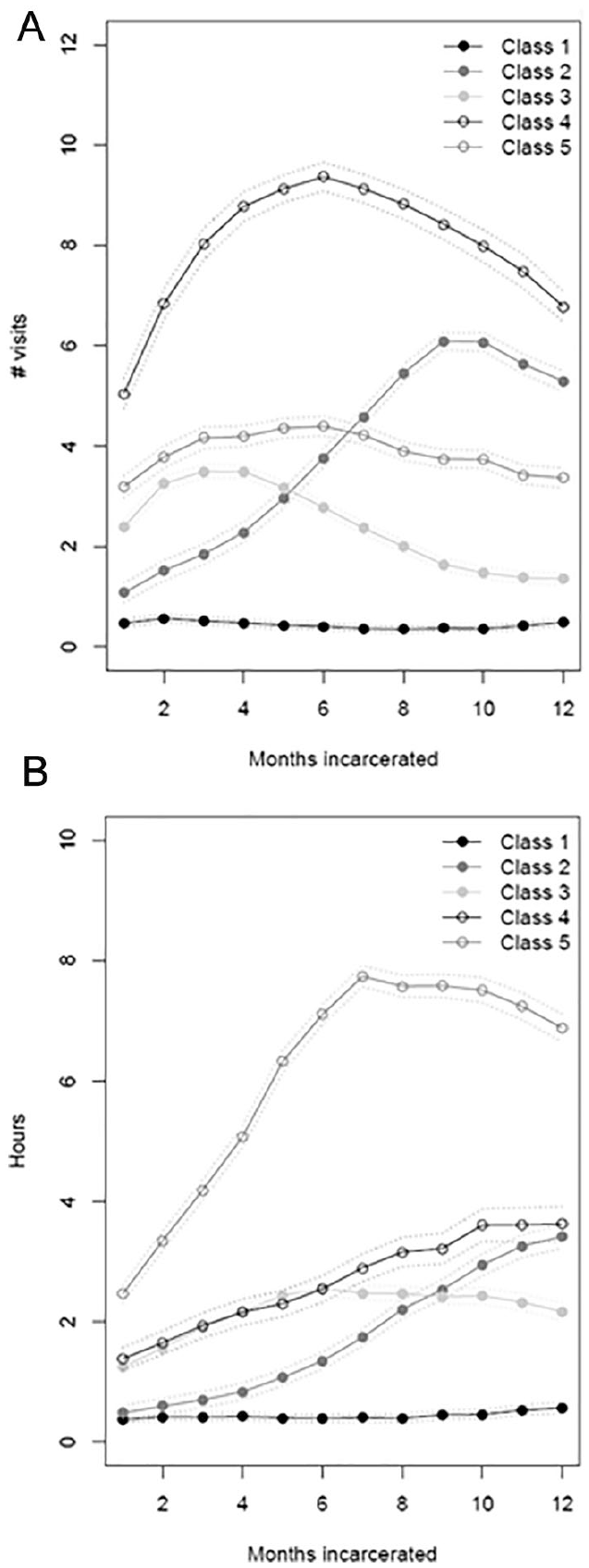
Latent classes: Monthly frequency and duration of family visits. (A) Number of family visits. (B) Duration of family visits.
Class 2 also started off with low levels of visitation, but quickly increased in terms of both the frequency and duration of visits. At the height of visitation frequency, this group received roughly six visits a month lasting almost three hours. The percentage of inmates who were assigned to this class was 10.8% exhibiting a medium level-increasing visitation pattern.
Our third class was also of medium-level visitation, but the development over time was quite different from class 2. First of all, class 3 started off with higher frequency (roughly two per month) and duration (roughly one hour), which both increased during the first few months (to 3.5 and 2, respectively), but from four months on, we saw a steady decline in the frequency of visits (to approximately one per month)—and that without much of an increase in duration, which remained at roughly two hours. We labeled this group medium-declining, and it was the second largest group in our data with 21.9% assigned to this class.
The fourth and fifth classes were both characterized by relatively high levels of visitation, but in two distinct ways—one prioritizing frequency and the other duration. Class 4 has very high frequency during the entire first year (ranging from five to nine visits per month and showing a concave pattern) and medium-level duration, which increased steadily over time (from one to three hours). Class 5, however, had a relatively stable visitation frequency (three to four visits per month) but extremely high duration of visits, which increased to almost eight hours at seven months into the incarceration, and then declined slightly. These two groups were the smallest with 4.6% of inmates belonging to class 4 (high level—high frequency) and 7.9% belonging to class 5 (high level—high duration).
These latent classes of family visitation patterns highlight substantial heterogeneity in family visitation patterns and that within the five-class model visitation frequency, duration, and development over time all appear to be salient dimensions in visitation patterns. The next question then becomes: what characterizes the individuals assigned to these classes, and what factors matter in predicting which type of family visitation pattern an inmate will experience.
Predicting Latent Class Membership
Figure 2 shows the coefficients from linear probability models regressing latent class membership on a wide range of characteristics of the inmate and the incarceration spell. We chose class 3—the medium-declining pattern of family visitation—as our reference class because this was the most common group among those showing some variation in visitation across time (results using class 1, which is the largest of the five classes, as reference category are available upon request), and because it allowed for comparison with classes of both lower and higher levels of family visitation. The regression coefficients shown in Figure 2 are all from standardized variables (with a mean of 0 and a standard deviation of 1), making it easier to assess the relative importance of each variable. Only coefficients that reach significance at the 5% level are reported in the figure—again to ease interpretability of the figure (the full regression models are reported in Table A-2 in the Online Supporting Material).
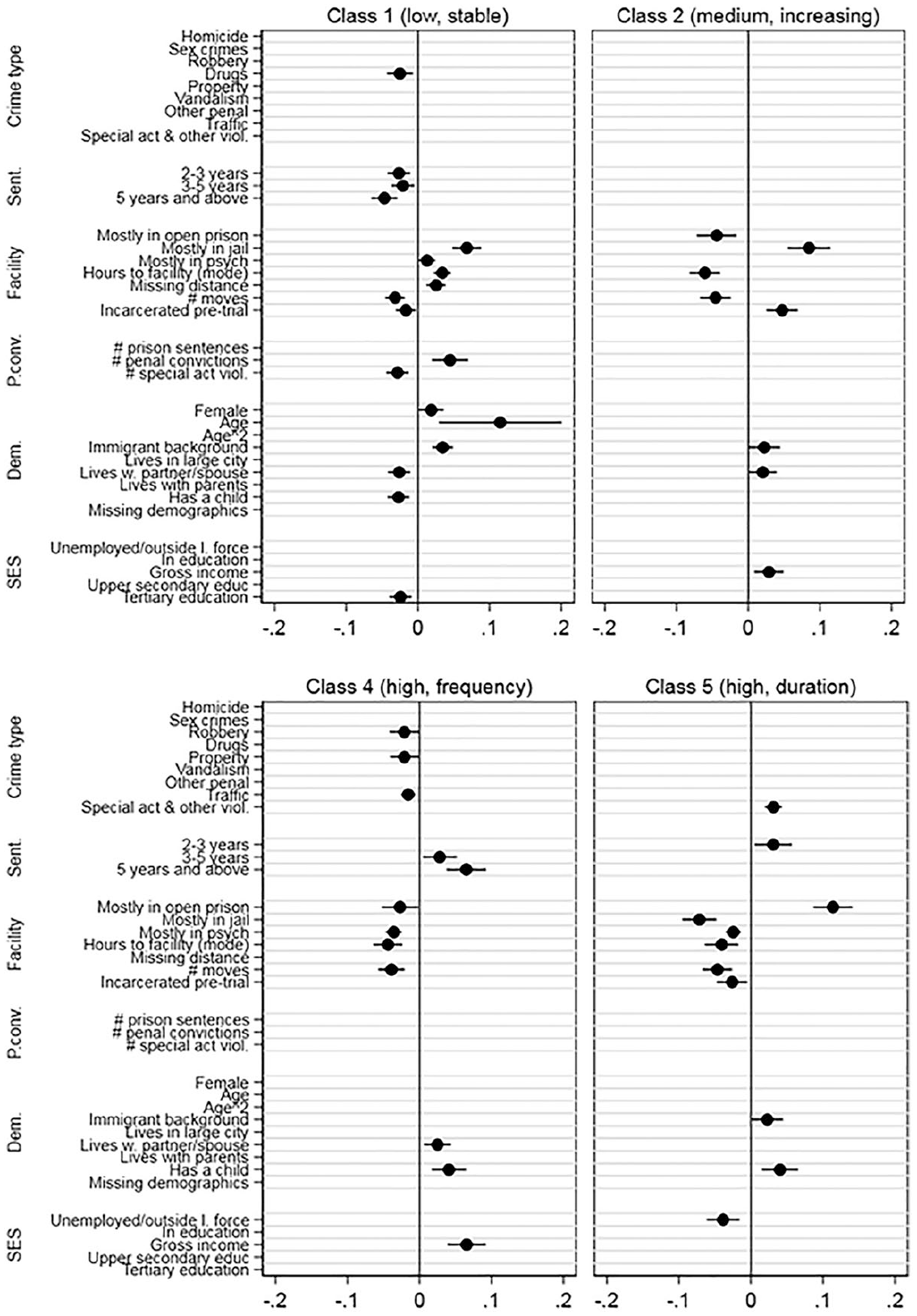
Coefficient plot: Predicting latent family visitation class membership (reference: class 3).
The first set of coefficients in Figure 2 pertains to the crime type for which the inmate was incarcerated. Crime type turned out to be a relatively weak predictor of patterns of family visitation. The standardized coefficients were generally small and rarely reached statistical significance. Comparing the high frequency class (class 4) with the medium, declining class (class 3), we see that those convicted of robbery and other property crime were less likely to receive frequent visits, but, across the board, crime type did not appear to matter much for the visitation patterns. Sentence length, on the other hand, played a more significant role. Those with longer sentences (>2 years) were less likely to receive low levels of visitation (class 1) but more likely to receive high levels of visitation (class 4 and 5) instead of the medium, declining pattern (class 3). It appeared as if those set to spend a very long time in prison had family members committed to developing or maintaining high frequency of visits.
Moreover, factors pertaining to the incarceration spell and the facility in which the inmate is incarcerated appeared to be relevant for family visitation patterns. Facility type was closely linked with visitation pattern. Spending most of the first year of incarceration in jail—relative to a closed prison—was associated with a higher risk of experiencing the low or medium-increasing visitation patterns (class 1 and 2) and lower likelihood of experiencing high levels of visitation (class 4 and 5), which is consistent with visitation being more restrictive in jails and during pre-trial incarceration. The visitation pattern with high duration of visits (class 5) appeared to be uniquely connected to the open prisons, whereas those who spent most of the first year in the psychiatric correctional facility were more likely to be in the low visitation group (class 1) and less likely to experience high levels of visitation (class 4 and 5).
Aside from facility type, a consistent finding was that shorter distances (measured as driving distance in hours) to the facility in which the inmate spent the most time were associated with more family visitation. Additionally, those with a missing or unlocatable address prior to incarceration were more at risk of receiving low levels of visitation. Across the board, experiencing transfers was associated with a lower likelihood of any other visitation pattern than the medium level-decreasing pattern (class 3), indicating that the decreasing pattern was uniquely connected to experiencing many transfers. Being incarcerated pre-trial was associated with a higher likelihood of being in the medium level-increasing class (class 2), which corresponds to pre-trial visitation being more restrictive.
The level of previous criminal justice contact was mainly a useful predictor when distinguishing the medium level-decreasing patterns (class 3) from the low levels of visitation (class 1). Having many prior penal convictions was associated with a higher risk of being in the low visitation group, indicating that prior criminal justice contact of these forms may have led family members to tire and abstain from visitation. An opposite (but weaker) pattern revealed itself for the number of prior Special Acts violations, which are generally of a less serious nature. Hence, although number of prior criminal justice involvements did matter for visitation patterns, it depended on the type of crime, with only the more serious penal violations increasing the risk of receiving very low levels of visitation.
In terms of demographic and socioeconomic characteristics measured prior to incarceration, we first see that age and gender were only significant, when distinguishing the low levels of visitation (class 1) from the medium declining (class 3). Females and older inmates had a higher risk of receiving the former pattern of visitation. The finding for age is consistent with prior studies, and the estimate was also by far the more important predictor judging by the size of the coefficients. Being of immigrant descent was associated with an increased likelihood of receiving stable or increasing patterns of visitation (class 1, 2, and 5) compared to the medium-declining patterns (class 3), which could support the hypothesis that family relationships are more tight-knit. Family structure in itself appeared to play a big role, and parenthood was associated with a higher likelihood of experiencing high levels of visitation (class 4 and 5) and a lower risk of receiving low levels of visitation (class 1).
SES generally appeared to have only a patchy relationship to visitation patterns, but there were some substantial associations worth noticing. First, being outside the labor force or unemployed—relative to being employed—was associated with a decreased risk of experiencing the high level–high duration visitation pattern (class 5). Second, having a tertiary education was associated with a lower risk of receiving low levels of visitation (class 1). Finally, having a higher income was associated with an increased likelihood of experiencing high frequency of visits (class 2 and 4), which is consistent with visitation being costly in terms of transportation and/or requiring the access to a car.
In sum, a great deal of factors mattered for the pattern of family visitation inmates experienced during the first year of incarceration, although institutional factors pertaining to the specific incarceration appeared to be the most consistent group of predictors. Some factors showed clear patterns across visitation types: shorter distances to the facility in which the inmate spent the most time was associated with more visitation (either in terms of frequency, duration, or increasing patterns); inmates spending a large part of the year incarcerated in jails were more likely to experience low or medium levels of visitation; experiencing many transfers was linked to a decreasing pattern opposed to stable or increasing patterns; having a higher pre-incarceration income was linked to higher frequency of visits and parenthood; and longer sentences were linked to high levels of visitation in general. Other factors were most informative when it comes to specific contrasts between the medium-declining class and others: older inmates were more likely to receive very low levels of visitation, as were those with many prior (penal) convictions, and having low labor market attachment was linked to a lower likelihood of receiving visitations of a long duration, whereas spending a large part of the year incarcerated in an open prison was linked to a higher likelihood of receiving the pattern characterized by long visitation.
Discussion and Conclusion
With incarceration being a prominent feature of family life for certain groups of especially the U.S. population, understanding how family life unfolds during incarceration becomes pertinent (e.g., Turney, 2015a, 2015b). Visitation is likely to play a significant role in the maintenance of family ties, which has been emphasized as crucial for reentry and recidivism (e.g., Bales & Mears, 2008; Mitchell et al., 2016; Mowen & Visher, 2016). This article has sought to understand patterns and heterogeneity in family visitation and the predictors likely to shape visitation patterns and family contact during incarceration in Denmark.
The findings of this article highlight two crucial points. First, the duration of visits may be an often overlooked but highly salient dimension of visitation. Although duration of visits has been emphasized by family members as important in qualitative studies (Comfort, 2008), this study is the first to address this aspect of visitation using quantitative data. The findings, showing that although the frequency of visits only decreased slightly over time, the duration was steadily increasing across the first year of incarceration, suggest that the duration of visits is a dimension that family members learn to optimize. Depending on the feasibility of expanding visitation programs, allowing for longer visits could be low-hanging fruit in terms of improving conditions for the maintenance of family ties during incarceration.
Second, there was great heterogeneity in the patterns of family visitation inmates received, and the five distinct visitation patterns we described with our latent class analysis were systematically linked to characteristics of the inmate and the conditions of his/her confinement. Institutional factors (both the type of and distance to correctional facility and the number of transfers) mattered a great deal, and inmates experiencing stable incarcerations in open or closed prisons close to home were more likely to receive relatively high levels of visitation. Offence type appeared to matter much less than expected, but sentence length and prior criminal justice contact were highly salient factors, with family members committing to a high frequency of visitation for the longer incarceration spells but appearing to “tire out” and decrease their visiting if the inmate had many prior criminal justice contacts. Parenthood was also associated with high levels of visitation, but it is noteworthy that income only appeared to increase the likelihood of receiving many visits and not long duration of visits, indicating that this is a dimension of visitation that does not hinge upon financial resources of the inmates and their families. Knowing which inmates may be at risk of low levels or decreasing family visitation during incarceration—and knowing which institutional factors heighten this risk—may help target visitation programs to those most at risk and, thus, alleviate potential inequalities in punishment brought on by disparities in family contact.
Finally, it should be noted that these results are based on a select sample of inmates in Denmark, which could challenge the generalizability of the results. First, the Danish context differs from the U.S. context, where most of our knowledge on the patterns and implications of prison visitation comes from, which adds to the novelty of the study. The incarceration rate is lower, and the welfare state more generous, which could serve to lessen barriers to visitation and democratize access to visitation. We did, however, find substantial heterogeneity in visitation patterns and a small socioeconomic gradient in visitation patterns, highlighting that even here visitation may serve to create or enhance inequalities in punishment. Second, results are based on a sample of inmates who received comparatively long sentences from the Danish perspective. The serious nature of their crimes could be tied to more substantial criminal records and potentially severed or weak family ties, which would limit how well our results transfer to other groups. Despite the selectiveness of the sample, we found few differences aside from crime type and sentence length between our analytical sample and the general population of inmates—neither when it comes to prior criminal justice contact and socioeconomic characteristics. As it is the case in so many other places, what most strongly characterized our sample is that the inmates constitute a highly disadvantaged group even prior to incarceration.
The results from this article provide important insights both into the evolution of visitation over time and into heterogeneity in how visitation evolves. The next generation of research in this area should seek to understand how these various patterns of visitation affect not only incarcerated and formerly incarcerated individuals, the group most often considered in this area, but also how these visitation patterns affect family members.
Supplemental Material
sj-pdf-1-jfi-10.1177_0192513X21991187 – Supplemental material for Family Visitation Patterns during Incarceration in Denmark
Supplemental material, sj-pdf-1-jfi-10.1177_0192513X21991187 for Family Visitation Patterns during Incarceration in Denmark by Anne Sofie Tegner Anker and Christopher Wildeman in Journal of Family Issues
Footnotes
Declaration of Conflicting Interests
The author(s) declared no potential conflicts of interest with respect to the research, authorship, and/or publication of this article.
Funding
The author(s) disclosed receipt of the following financial support for the research, authorship, and/or publication of this article: ROCKWOOL Foundation.

Supplemental Material
Supplemental material for this article is available online.
Note
References
Supplementary Material
Please find the following supplemental material available below.
For Open Access articles published under a Creative Commons License, all supplemental material carries the same license as the article it is associated with.
For non-Open Access articles published, all supplemental material carries a non-exclusive license, and permission requests for re-use of supplemental material or any part of supplemental material shall be sent directly to the copyright owner as specified in the copyright notice associated with the article.
