



Abstract
International migration of couples is rising. Still, there is little evidence on men’s and women’s domestic work hours before and after migration. This is despite the fact that domestic work provides deep insights into family life and, for migrants, is directly linked to integration. Therefore, this study examines how immigrant men and women change their domestic work hours following migration, using data from the German Socio-Economic Panel (SOEP). Our results show that domestic work hours increase for both genders after immigration. However, men are more responsible for running errands than women in the first years after migration. In the long term, the gender gaps return to the pre-migration state, with women shouldering a greater load than men. Accordingly, this study shows that migration only has a short-term impact on couples’ division of domestic work.
Today, around 272 million people do not live in their native country. Much of this emigration is motivated by individuals’ desire to be close to their loved ones (IOM, 2019). In 2018, 2.1 million individuals migrated to OECD countries, either accompanying or reunifying with a family member. At the time, this inflow accounted for 40% of all permanent migration to the OECD (OECD, 2019). Ultimately, these numbers exemplify that migration and its aftermath affect many relationships and family lives significantly.
Extensive previous scholarship shows that migration permanently imprints the working life and education of those affected, but to different degrees for men and women (Dustmann, 1994). Still, the significance of these gender-specific changes at the individual level for migrants’ family life is rarely studied. Specifically, there is a lack of evidence on how couples’ domestic work division responds to migration, even though domestic work is a key site for observing bargaining power, thus providing deep insights into family functioning (Gough & Killewald, 2011; Gupta, 2007). The division of domestic work is further especially noteworthy for immigrant families, as it is closely intertwined with the potential and time to integrate into one’s new home and society. Indeed, theoretical notions suggest that migration can shape couples’ division of labor by causing additional chores and shifts in individuals’ economic resources and cultural surroundings (Krieger, 2020; Read, 2004).
Still, empirical insights into mobility and domestic work are limited to analyses of residential relocations. Specifically, Vidal, Perales, & Baxter (2016) found that short- and long-distance relocations in Australia widen gaps in domestic work hours between husbands and wives. Yet, this evidence cannot necessarily be transferred to the reality of international migrants. Immigration exposes individuals to new social, legal, and cultural environments, where perceptions of gender and their manifestation in laws and institutions can substantially differ from migrants’ source countries (Blau, Kahn, & Papps, 2011). Further, each labor market places unique demands on job seekers, especially regarding language skills and educational qualifications (Dustmann, 1994). Due to these requirements, international migrants often first incur serious employment and earnings losses, which do not occur to the same extent after residential relocations (Krieger, 2020). Finally, moving to another country influences individuals’ likelihood to outsource work, first, by granting or restricting access to technologies and, second, by shifting their position within the income distribution, thereby affecting their ability to afford aid (Schneider & Hastings, 2017). Thus, international compared to internal migration can introduce unique dynamics to the mobility experience. This study’s goal is to explore these dynamics and their effect on couples’ division of domestic work. Therefore, it bridges the literature on domestic work and migration, aiming to provide new insights into the lives of couples both before and after migration.
To accomplish this, we use data on 502 heterosexual immigrant couples who arrived in Germany between 1994 and 2016 from the German Socio-Economic Panel (SOEP) (Giesselmann et al., 2019). Given that Germany is a major recipient of migrants from around the world and that it currently hosts the most immigrants in Europe (IOM, 2019), it constitutes a relevant test case. Using SOEP data has unique analytical benefits as it contains reports on respondents’ pre-migration time use, allowing for analyses of changes in domestic work across migration. Additionally, SOEP data provides separate accounts of time use for each partner as well as a rich set of (migrant-specific) covariates. Thus, we estimate gender-specific fixed effects regressions with respondents’ overall time spent on domestic labor and on three specific domestic tasks (errands, housework, and repairs) as dependent variables. In this way, we compare gender differences in domestic work hours before and after migration.
We start by providing a short overview of the German institutional context. In the following sections, we compile our theoretical framework, introduce the SOEP data and our analytic strategy before presenting our results. We finish with the discussion of the results.
Background: Immigration and Domestic Work in Germany
This study considers immigrants who entered Germany between 1994 and 2016. After the breakup of the Soviet Union at the beginning of the 1990s, migration to Germany was largely dominated by the arrival of ethnic German repatriates. Ethnic German repatriates are foreign-born immigrants of German descent who lived in the Eastern Bloc as ethnic minorities. The Federal Expellees Act granted them German citizenship and integrative help, including language classes and lessons on German history and culture (Kalter & Kogan, 2014). Other migrant groups received integrative assistance as of 2005 (Schneider, 2007). At that time and throughout the 2000s, most immigrants arrived from European Union members, employing its freedom of movement. However, migrants from third countries, most prominently from Turkey and Russia, also continued to arrive (Krieger, 2020).
Regardless of the geographic context, women spend more time on domestic work than men (Coltrane, 2000). Still, with their arrival in Germany, migrants enter a setting where being female is strongly associated with doing domestic work: in Germany, 70–80% of women, but only 30% of men, usually or always cook and clean (Hofäcker, Stoilova, & Riebling, 2013). This is even though Germany experienced drastic structural changes over the past decades, including the stark rise of female employment from 60% in 1992 to 80% in 2016. However, this rise is only marginally reflected in Germany’s gender domestic work gap: between 1992 and 2012, women reduced their time spent on cooking, cleaning, and laundry from a daily average of 3–2 hours, whereas men’s involvement only rose from 35 to 52 minutes per day over the same period (Samtleben, 2019). Among other things, these dynamics can be ascribed to Germany’s conservative, family-oriented welfare state, which is, for instance, characterized by a low supply of public childcare and tax benefits for couples in which one partner works reduced hours (Hofäcker et al., 2013). In fact, 22% of employed women in Germany work part-time, which is high in international comparison (OECD, 2018).
Theoretical Background
Couples’ Division of Domestic Work over the Life Course
Domestic work refers to unpaid work, which is typically carried out within the household or family. Although domestic work theoretically entails activities such as caring for and helping household members – that is, childcare or support for persons in need of care – it is often more narrowly defined in terms of tasks that every household confronts. Prominent examples include running errands, cleaning, cooking, or making repairs (Coltrane, 2000).
Neoclassical human capital theory sees the domestic work division of couples as the result of a recurring, rational process in which partners jointly choose an efficient allocation of their time to maximize household utility (Becker, 1985). Time is efficiently allocated when it reflects individuals’ productivity in paid versus unpaid work. If, for instance, one partner’s potential labor market earnings significantly exceed the other partner’s, it is efficient for the former to spend more time in the market than in the domestic sphere. Thus, according to neoclassical theory, the division of domestic work is gender-neutral in that it is solely governed by partners’ relative productivities (Coltrane, 2000; Dribe & Stanfors, 2009; Leopold & Skopek, 2015). However, neoclassical theory is frequently criticized for assuming that partners pursue maximizing their joint utility as a common goal (Bielby & Bielby, 1992). Bargaining theory relaxes this assumption by viewing household decisions as negotiations between partners with heterogeneous interests (Blood & Wolfe, 1965; Lundberg & Pollak, 1996). The theory further argues that the negotiation result will reflect the preferences of the partner with more bargaining power derived from economic resources such as earnings or education and their value in the event of non-cooperation or separation. Given that domestic work is commonly considered unpleasant, individuals with more bargaining power will usually have a preference for having their partners carry out the chores (Davis & Greenstein, 2004; Evertsson & Nermo, 2004, 2007). In the extreme case of economic dependence, individuals accept any division of domestic work their partner asks for (Blair & Lichter, 1991; Brines, 1994). Like the human capital approach, bargaining theory postulates that couples’ decision-making is guided by the resources partners bring into the relationship. Empirical insights support these gender-neutral ideas for specific moments in individuals’ lives (Bittman, England, Folbre, Sayer, & Matheson, 2003; Brayfield, 1992; Pittman & Blanchard, 1996).
In contrast, gender perspectives consider couples’ division of domestic work an expression of normative ideas of gender. Initially, gender perspectives primarily focused on socialization and the resulting internalized gender role ideologies regarding the implications of one’s sex (Bianchi, Milkie, Sayer, & Robinson, 2000; Greenstein, 2000). According to this view, traditional compared to egalitarian gender role ideologies will make wives feel more obliged to manage household chores by themselves (Bittman et al., 2003; Cunningham, 2005). More recently, West & Zimmerman’s (1987) “doing gender” approach replaced notions of socialization. The “doing gender” approach argues that individuals wish to appear as competent members of their sex and to avoid social rejection, thus making gender-appropriate behavior desirable in social interactions with others (Artis & Pavalko, 2003; Schneider, 2012; Voßemer & Heyne, 2019). This wish is particularly strong when interacting with the opposite rather than the same sex (Gupta, 2007). Hence, marriage and domestic work division constitute an important setting for “doing gender.” By doing most chores, wives can underline their femininity (Baxter, Hewitt, & Haynes, 2008; Sayer, 2005). Indeed, previous studies find ideas of gender to be linked to time spent on domestic work at different points in individuals’ lives (Blair & Lichter, 1991; Cunningham, 2005; Greenstein, 1996).
However, couples’ division of household chores at one point in time is not necessarily representative of their entire relationship history. Instead, changes in wives’ resources can, for example, reduce their time spent on domestic work (Evertsson & Nermo, 2007). Further, the division of domestic work responds to life events. Previous studies, for instance, find retirement (Leopold & Skopek, 2015) and unemployment (Gough & Killewald, 2011) to narrow the gender care gap, whereas cohabitation (Gupta, 1999), parenthood (Dribe & Stanfors, 2009; Kühhirt, 2012), and residential relocations (Vidal et al., 2016) aggravate unequal distributions. However, evidence on immigration to another country as a crucial life event is still missing.
International Migration and Couples’ Division of Domestic Work
Migration involves a number of additional household tasks that increase couples’ amount of housework in the short term: a new home needs furnishing, and administrative matters need to be looked into. Given migrants’ lack of cultural and linguistic knowledge, such tasks may take more time to accomplish than in the country of origin (Magdol, 2002; Vidal et al., 2016). This short-term increase in the amount of domestic work may further translate into the medium and long term: in their daily lives, many couples rely on their family’s help to manage chores. After migration, such social networks are no longer available, and financial resources might be too scarce to afford aid (Parrado, Flippen, & McQuiston, 2005). Previous research has shown that when couples’ housework suddenly rises, for instance, because a child becomes sick, it is wives who take on the additional hours (Hochschild, 1989). Based on these findings, it is likely that the shouldering of additional work in migrant families will mostly fall on women.
Migration can further increase the burden of domestic work that wives assume by diminishing their relative resources, thus increasing the share of household chores they are responsible for (Parrado et al., 2005). Immigrant men and women generally struggle to access host countries’ labor markets. This struggle is rooted in poor language skills, limited cultural knowledge, and restricted access to job-related information (Salikutluk, Giesecke, & Kroh, 2020). Beyond these general challenges, migrant women across the globe face additional disadvantages in host countries’ labor markets (Fleischmann & Höhne, 2013; Raijman & Semyonov, 1997). For instance, even 10 years after immigration, female migrants in Germany are less likely to be employed than males and are more likely to work part time (Salikutluk, Giesecke, & Kroh, 2016; Salikutluk et al., 2020), adversely affecting their economic position.
Next, migration exposes individuals to a new environment whose gender-related norms might deviate from source countries. Such exposure is assumed to have the potential to produce attitude changes in individuals, altering their ideas of gender-appropriate behavior (Reimers, 1985). Exposing wives who grew up in gender-conservative settings to a liberal, gender-egalitarian environment can shift their preferences from traditional to egalitarian divisions of domestic work and open re-negotiations on chore responsibilities (Hondagneu-Sotelo, 1992; Parrado & Flippen, 2005). Still, it is equally conceivable that the exposure to a new setting causes the opposite: feelings of foreignness and exclusion can instead intensify migrants’ desire to preserve their cultural heritage (Parrado & Flippen, 2005). Considering that in the past two decades, many migrants to Germany arrived from Poland, Russia, Romania, and Kazakhstan, where domestic work is as unevenly distributed between men and women as in Germany (Hofäcker et al., 2013), and Germany’s environment where institutions urge traditional family life, migrants can be expected to maintain or adopt traditional divisions of domestic work.
These arguments suggest that domestic work increases for migrant men and women after migration (Hypothesis 1). Considering migrant women’s vocational disadvantages and Germany’s institutions, the increase in domestic work is greater for migrant women than for men (Hypothesis 2). Yet, the increase in domestic work diminishes more for migrant women than for men with years since migration (Hypothesis 3), as the number of additional tasks, which women are expected to be mostly responsible for, successively decreases.
International Migration and Domestic Work Tasks
A second organizational feature of the domestic work division is the type of chores that each partner carries out. Typically, wives engage in cooking, cleaning, and running errands. On the other hand, husbands are more often responsible for repairs (Bianchi et al., 2000).
Yet, after migration, chores may be redistributed in a way that challenges these gender-stereotypical distributions. When immigrating to a country, the amount of each domestic activity—that is, of doing errands, housework, and repairs—increases substantially (Magdol, 2002). This large increase requires both partners to become more involved in gender-atypical chores than before. In the months after migration, wives might need to assist their husbands in arranging furniture, and husbands might take on housework. Still, in the long term, when couples have completed additional tasks caused by migration, their distribution of domestic activities should return to the pre-migration state. Hence, these theoretical arguments suggest that migrant men and women carry out more gender-atypical domestic tasks after migration (Hypothesis 4). Yet, this gender-atypical behavior does not persist into the medium or long term (Hypothesis 5).
Methods
Data and Sample
We use data from the German SOEP to test the hypotheses. The SOEP is an annual household panel survey first carried out in 1984. Its respondents are interviewed on a diverse set of topics, including employment, education, children, and health (Giesselmann et al., 2019). For this study, we extract information from five waves of the IAB-SOEP Survey of Migrants, spanning 2014 through 2018 (SOEP v.35, DOI: 10.5684/soep.iab-soep-mig.2018). We do not consider the initial wave (2013) of the IAB-SOEP Survey of Migrants because information on this study’s outcome measure was only collected starting in 2014. The IAB-SOEP Survey of Migrants is representative of first-generation migrants who moved to Germany between 1995 and 2013, as well as second-generation immigrants resident in Germany (Kroh, Kühne, Goebel, & Preu, 2015; Kühne & Kroh, 2017). In addition to the standard repertoire of SOEP instruments, respondents of the IAB-SOEP Survey of Migrants answer migrant-specific questionnaire items covering their migration routes and circumstances prior to emigration (Giesselmann et al., 2019). In answering these questions, respondents can choose from multiple languages, including German, English, Turkish, Romanian, and Polish. As of 2019, a total of 7661 individuals have responded to at least one wave.
Given this study’s research questions, we focus on heterosexual, first-generation immigrant couples whose relationship started before emigration and lasted at least until their first SOEP interview (N = 1442 respondents). Survey years in which couples are no longer liaised are dropped from the analysis. Couples in which either the husband or wife applied for asylum are excluded (N = 1172). This is because previous research shows that refugees’ experiences subsequent to immigration markedly differ from integration trajectories of other migrants (Kreisberg, 2019). We further restrict our sample to husbands and wives who were 18 years or older when migrating to Germany and are of working age (18–65 years old) when surveyed by the SOEP (N = 1164). To ensure proper recollection of pre-migration circumstances, we only consider couples who immigrated less than 20 years before their first SOEP interview (N = 1092). Finally, we do not allow for missing values on any variable for both partners and restrict the sample to couples with at least two observations per partner, one before and at least one after immigration (N = 1004). In this way, we are able to study transitions in couples’ division of labor across their immigration.
Number of Observations Per Individual and Couple.
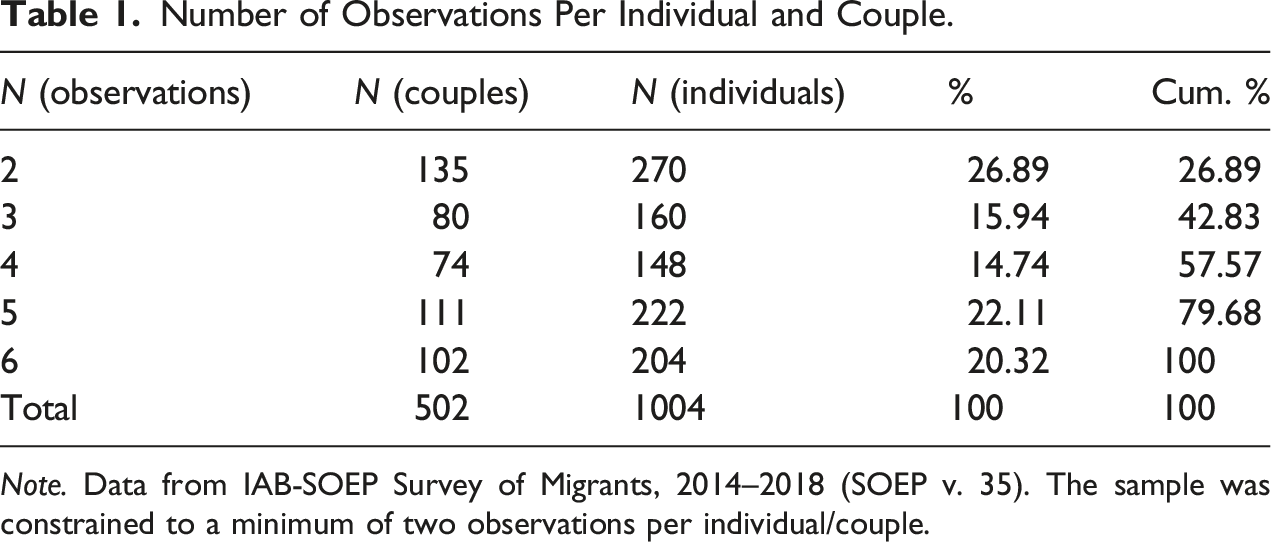
Note. Data from IAB-SOEP Survey of Migrants, 2014–2018 (SOEP v. 35). The sample was constrained to a minimum of two observations per individual/couple.
Measures
Outcome variables
Since 2014, respondents of the IAB-SOEP Survey of Migrants are surveyed on their time use on an average weekday. Weekdays generally reflect daily lives (Hook, 2017) and therefore are particularly relevant units of analysis. Respondents report the number of hours they usually spend on seven different everyday activities, including employment, education, and housework. A special feature of the survey is that first-time respondents provide details on their pre-migration time use. More specifically, the item reads: “How many hours do you spend on the following activities per day on an average working day? And what about 1 year before moving to Germany?” (Kantar Public, 2019, p. 106). Thus, interviewees report their time use before migration in retrospective. To construct the outcome measures, we combine this retrospective pre-migration information with individuals’ post-migration time use from years in which they participated in the SOEP survey.
The list of activities for which respondents indicate their time use includes three domestic tasks. These are (a) “Errands (shopping, trips to government agencies, etc.),” (b) “Housework (washing, cooking, and cleaning),” and (c) “Repairs on and around the house, car repairs, garden work.” To counter disproportionate effects of outliers, we first winsorize them by recoding values higher than the 95th percentile to that percentile (Gupta, 2007; Hook, 2017). In sensitivity analyses, we re-run regressions after trimming rather than winsorizing outliers. Next, we calculate a summary measure that records individuals’ absolute involvement in domestic tasks. We further consider individuals’ time use on each individual task. We generally focus on absolute hours in domestic work because we are interested in changes in household production due to migration. In sensitivity analyses, we validate our results with a relative measure, that is, the difference between wives’ and husbands’ hours spent on domestic labor.
Existing research consistently shows that stylized reports of time use are prone to over-reporting of time spent on household chores compared to time diary data. Rather than reflecting actual involvement in domestic tasks, survey items on time use appear to reflect perceptions of work (Juster, Ono, & Stafford, 2003; Kan, 2008). Thus, respondents’ accounts of absolute hours in this study should be carefully interpreted and, crucially, be understood as upper bounds (Kühhirt, 2012). In our analyses, fixed effects account for consistent over-reporting over time. Even if the degree of over-reporting varies over time, this would leave the estimates unbiased unless the measurement error is correlated with the migration event (Gough & Killewald, 2011). This could be the case when migrant respondents wish to appear particularly hard-working in front of their interviewers, over-reporting their domestic burdens and thus biasing our coefficients upward. Nevertheless, the reports on time use utilized in this study can provide valuable insights into the changes in couples’ division of work across their migration.
Explanatory variables
Mean Socio-Economic Characteristics of Sample Population.
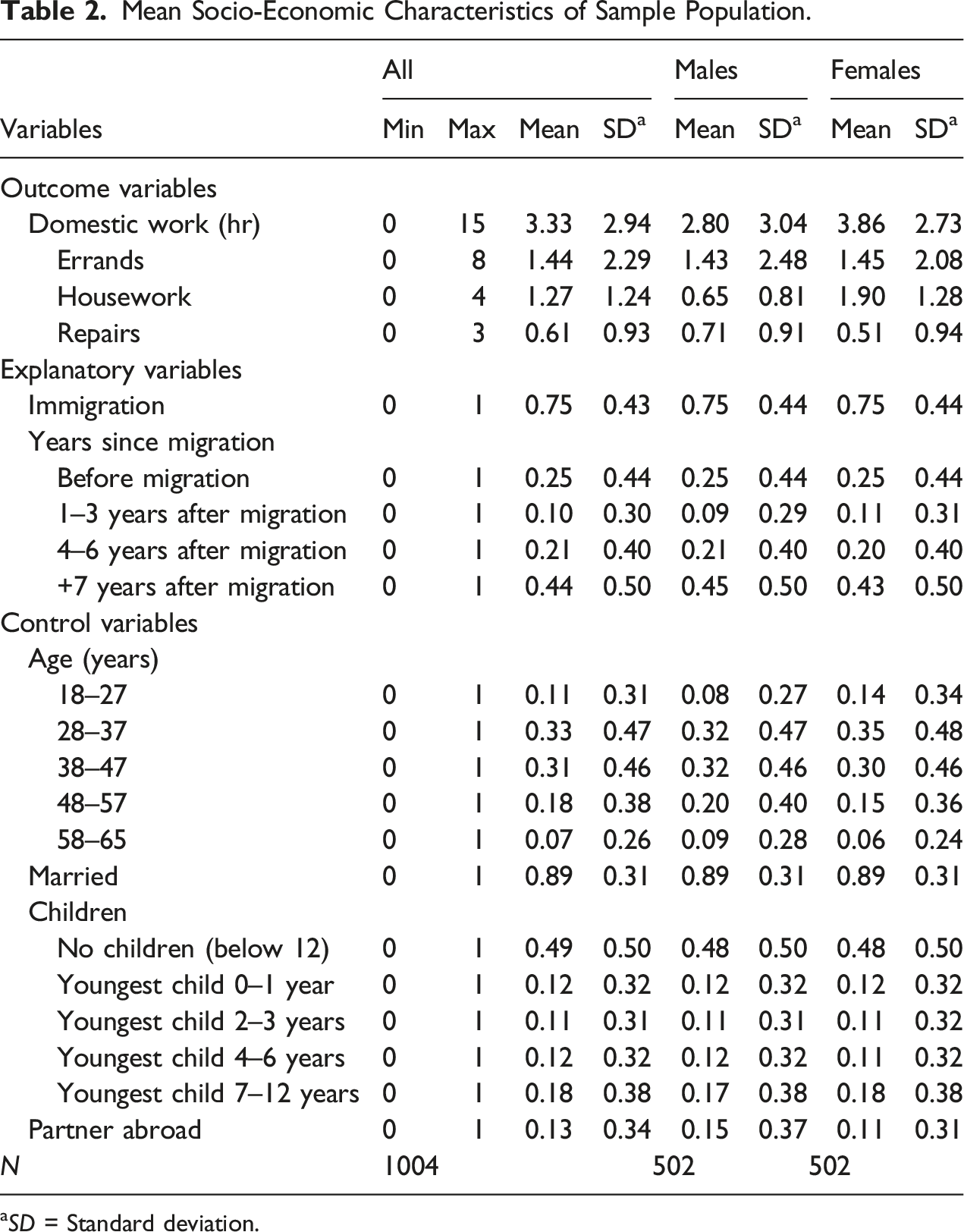
aSD = Standard deviation.
Control variables
As we use individual-level fixed effects regressions, we only include control variables that vary over time. We first include a categorical measure of respondents’ age (0 = 18–27 years [ref], 1 = 28–37 years, 2 = 38–47 years, 4 = 48–57 years, and 5 = 58–65 years) and their marital status (0 = unmarried and 1 = married). Further, we account for the presence and age of children by considering the age of the youngest child (0 = no children (below age 12) [ref], 1 = youngest child 0–1 year, 2 = youngest child 2–3 years, 3 = youngest child 4–6 years, and 4 = youngest child 7–12 years). We also include a dummy variable indicating whether both partners live in the same country in the survey year. In international migration, couples often do not emigrate jointly but sequentially (Krieger, 2020). To account for family reunification, we generate an indicator that we set to one in years in which partners do not reside in the same country and zero otherwise (0 = partner in the same country and 1 = partner abroad). We run a robustness check for excluding respondents with family reunification. Finally, we add survey year fixed effects to account for historical changes, for instance, in couples’ domestic work division. In a robustness check, we further include respondents’ employment hours.
Methods
We employ fixed effects regressions to study changes in couples’ division of housework across their immigration to Germany. Fixed effects models generally relate changes in the dependent variable to changes in independent variables. We specify our models as follows
Results
Figure 1 depicts the average hours spent on domestic work (tasks) before and after migration for men and women. In their home countries, women carried out more domestic work than men: on average, women spent 45 minutes more on various domestic activities than their partners. Following immigration to Germany, the amount of time spent on chores increased drastically for both genders. Strikingly, this increase was larger for men than for women, which led to an inversion of the gender domestic work gap. In sum, during the first 3 years following immigration, men invested, on average, 32 minutes more on domestic activities compared to their wives. After the initial years of arrival, the hours spent on chores decreased for all, although the reduction for men was larger than for women. Accordingly, after having lived in Germany for 7 years or longer, couples’ gender domestic work gap approximated its pre-migration state, amounting to around an hour and a half. Still, the time spent on domestic work by women almost doubled compared to before migration. Average hours of domestic work by year since migration. Note. Means displayed with 95% confidence intervals.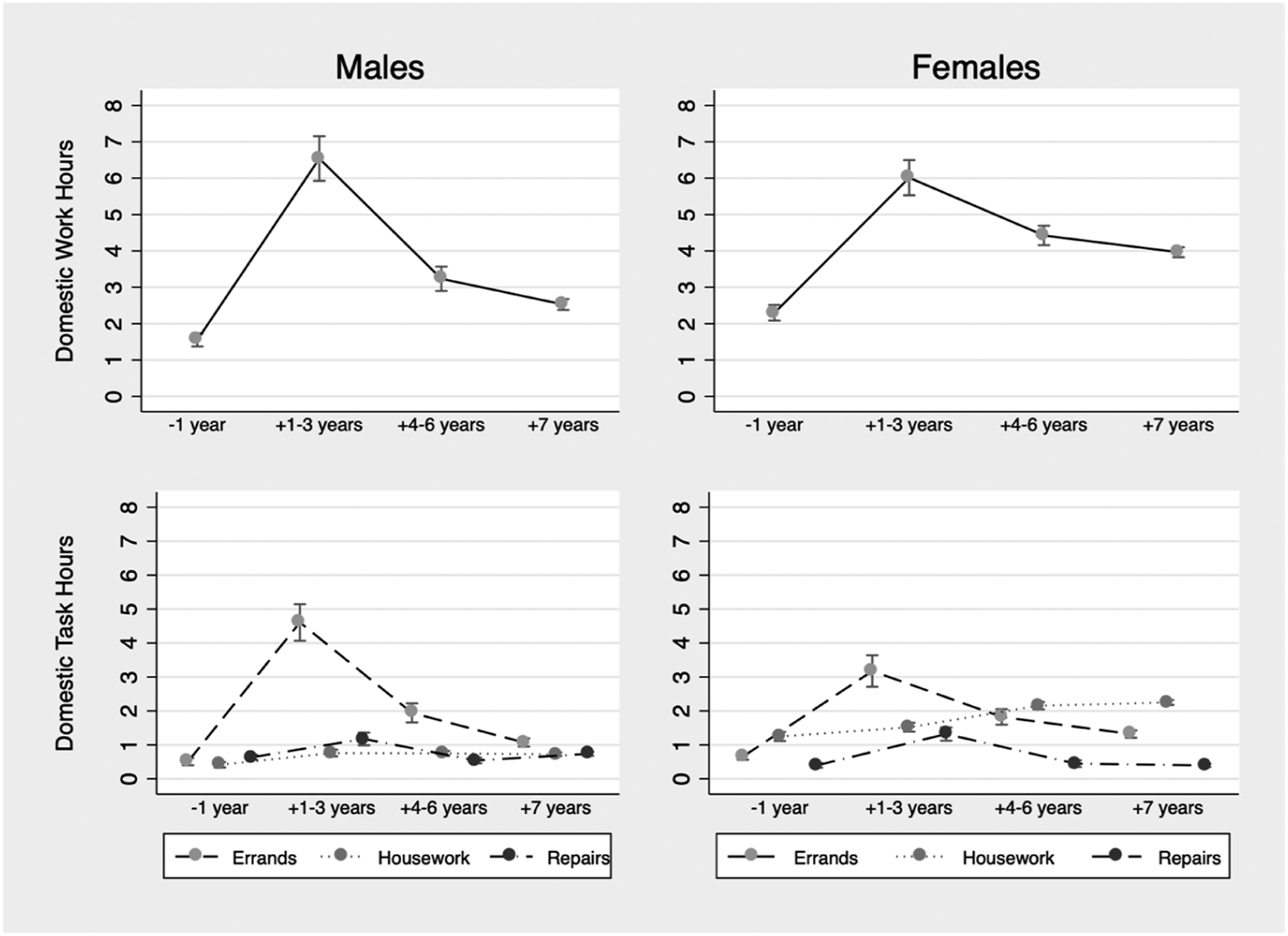
Figure 1 additionally shows respondents’ average time investments in three domestic chores (errands, housework, and repairs) both before and after immigrating to Germany, again, separately for men and women. Four features stand out. First, before migration, couples mostly adopted gender-typical divisions of domestic activities with women doing, on average, more errands and housework and men being more involved in repairs. Second, the patterns observed for aggregate domestic work (top panels in Figure 1) largely mirrored task-specific changes across migration: independent of their gender, respondents’ time spent on household tasks rose immediately following migration and slowly declined thereafter. An exception to this symmetry is the evolution of females’ time spent on housework, which continued to rise after their arrival in Germany (−1 year = 75 minutes; +1 to 3 years = 91 minutes; +4 to 6 years = 129 minutes; +7 years = 135 minutes). Third, gender gaps in errands and repairs inverted after compared to before migration. During the initial years in Germany, men spent more time on errands than women, who, in turn, carried out more hours of repairs than men. Whereas the gender gap for repairs is small (9 minutes) and statistically insignificant, men spent around an hour and a half more on running errands than women after immigration. In contrast, the gender gap in housework shows that this sphere is clearly assigned to women across migration. Still, it also narrowed subsequent to migration before widening again from the fourth year after immigration onward. Finally, fourth, couples’ division of domestic tasks returned to its pre-migration state in the long term, from the seventh year after their arrival.
Fixed Effects Regressions of Changes in Domestic Work Across Migration.
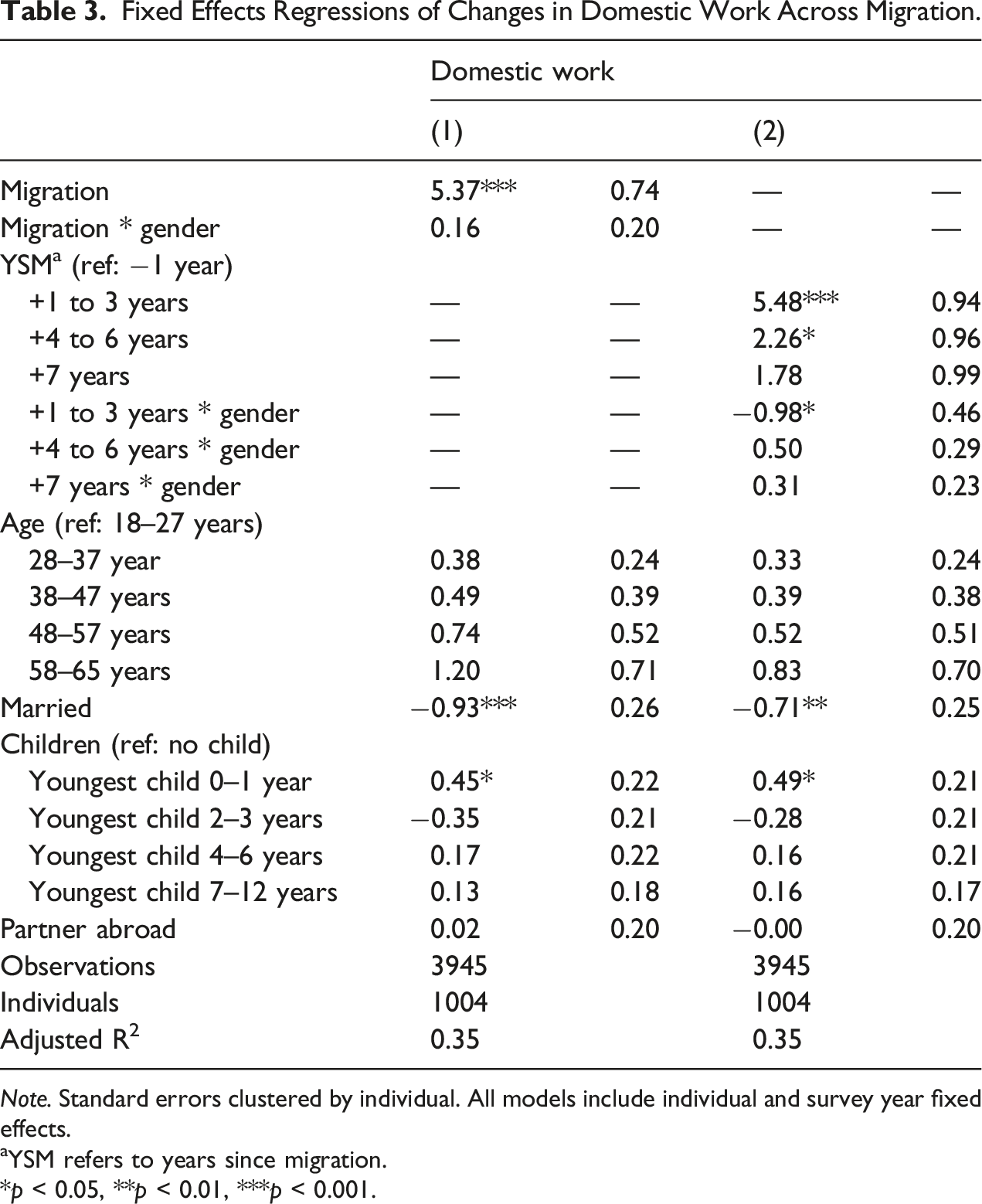
Note. Standard errors clustered by individual. All models include individual and survey year fixed effects.
aYSM refers to years since migration.
*p < 0.05, **p < 0.01, ***p < 0.001.
We estimated a set of robustness checks. The results hold when we (1) consider a relative measure of the division of domestic work, (2) exclude family reunification, (3) trim instead of winsorizing outliers, (4) control for employment hours, and (5) only consider pre-migration information provided up to 10 years after immigration (tables available upon request).
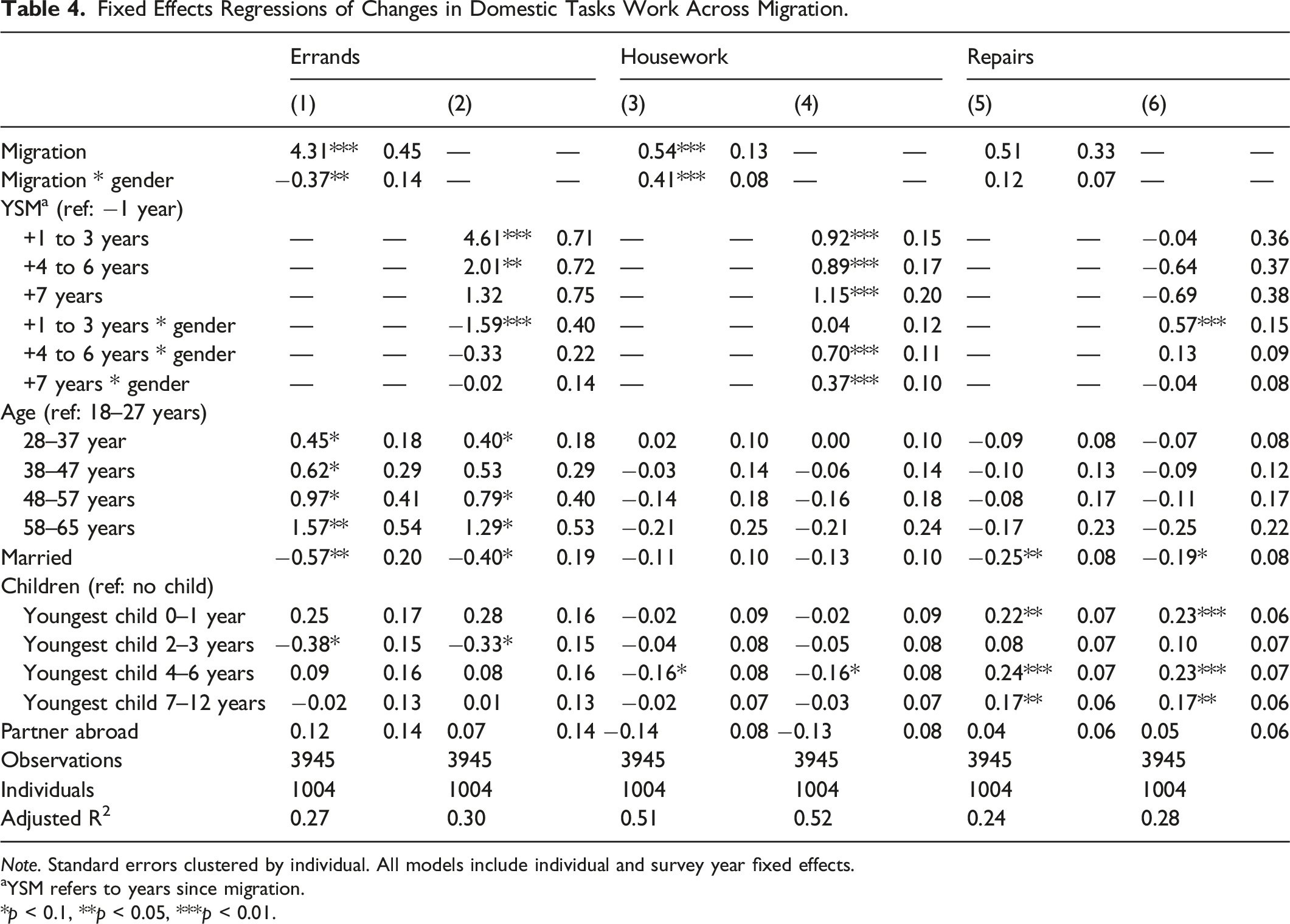
Fixed Effects Regressions of Changes in Domestic Tasks Work Across Migration.
Note. Standard errors clustered by individual. All models include individual and survey year fixed effects.
aYSM refers to years since migration.
*p < 0.1, **p < 0.05, ***p < 0.01.
Models 2, 4, and 6 display respondents’ time use in the short, medium, and long term following their arrival in Germany. First, Model 2 indicates that the burden of errands increased markedly in the short run and especially so for males. In the first 3 years after immigration, males spent 4 hours and 37 minutes on errands, whereas females invested around 3 hours. This difference is statistically significant and uncovers a gender-atypical pattern, which does, however, reverse in the long term, confirming our fourth and fifth hypotheses (H4 and H5). A similar pattern shows for repairs, in which women invested comparatively more time after immigration than men. Overall, for males, it shows that after migration they did fewer repairs than before their emigration. This pattern hints at the fact that the year before emigration was already subject to pre-migration adjustment patterns in which individuals prepared to move to Germany. Finally, the amount of housework slightly rose over time for migrant men and women, which contradicts our fourth and fifth hypotheses (H4 and H5).
Again, we find that these results are robust when we (1) consider a relative measure of domestic work division, (2) exclude family reunification, (3) trim outliers, (4) control for employment hours, and (5) only consider pre-migration information provided up to 10 years after immigration (tables available upon request).
Discussion
Today, migration is a common experience for couples and families around the world (IOM, 2019). Still, research mostly focuses on the significance of migration for individuals. In contrast, little is known about the effects of migration on family life. Specifically, there is no evidence on how migration affects couples’ division of chores. This is despite the fact that domestic work provides deep insights into family life and, for migrants, is directly linked to integration. Hence, this study tackles this gap in the academic literature by uniting theoretical arguments on couples’ domestic work and migration.
We have three key findings. First, we show that, with migration, couples’ volume of domestic work rose significantly, by almost 6 hours on an average weekday. Compared to previous insights on the effect of short- and long-distance residential relocations on time spent on housework in Australia (Vidal et al., 2016), this estimate is extensive, illustrating the disruptive nature of international migration for family life. Our results further reveal that the increase in domestic work is mostly felt immediately after immigration to Germany. In the medium to long term, the burden slowly eases until it insignificantly differs from the pre-migration state from the seventh year after immigration onward. This result is in line with empirical evidence on residential relocations and theoretical expectations: it points to the significant amount of additional domestic chores that arises due to migration but diminishes as couples and families slowly settle into their new lives. Accordingly, mobility, in contrast to other life-course events, such as retirement, influences couples only in the short term. Policies aiming to ease migrants’ lives should accordingly be specifically targeted to the months and years immediately after migration. Second, we find that men’s involvement in household work responds as forcefully to migration as the involvement of women. This clearly contradicts our hypotheses. Based on lower employment levels among migrant women and the German institutional setting, we argued that women would have less bargaining power and, thus, that migration would more severely increase their domestic work. Hence, conventional explanations of couples’ division of domestic labor cannot fully grasp the unique experience of migrating to another country. One possible explanation for this finding rooted in the migration literature is that men are more able to accomplish domestic chores in host countries due to having more contact with natives and, thus, greater language proficiency (Flippen, 2014). Men, who immigrate as principal migrants, are in frequent contact with the authorities and have often secured employment before immigrating. These two instances of contact with the native population allow men to acquire German language skills more quickly, further increasing their ability to run complex errands. In fact, third, our results indicate that the large increase in domestic work after migration is mostly due to errands, which increase more for migrant men than women. In contrast, housework and repairs only increase slightly after immigration, showing minor gender differences in terms of estimate size. Still, given this slight redistribution of tasks, the question arises how such developments impact relationship quality. This is an interesting avenue for future research.
The estimates in this study should generally be seen as conservative and, therefore, lower bounds for two reasons. First, the SOEP data only provides information on time use in the year prior to migration. Given that emigrating from one’s home country is a major event that involves numerous additional tasks, it can be expected that the number of chores was already heightened in the year before migration. Second, we do not observe couples directly after migration but only at their first SOEP interview, which, in our study, can be up to 20 years apart. In the meantime, couples, which were particularly unhappy with their division of chores after migration, might have already split up and are not considered in our study.
Nevertheless, this study tackles an overlooked topic in family and migration research and delivers evidence on couples’ division of domestic work following this life-changing decision. The findings demonstrate that, contrary to other dimensions of life, migration leaves a short-term but profound impact on partners’ time spent on domestic work.
Footnotes
Declaration of Conflicting Interests
The author(s) declared no potential conflicts of interest with respect to the research, authorship, and/or publication of this article.
Funding
The author(s) received no financial support for the research, authorship, and/or publication of this article.
