



Abstract
The present project contributes to the literature on firefighters and spousal relationships through consideration of life satisfaction, marital satisfaction, and couple conflict for a sample of Canadian firefighters. Thirty four firefighter/spouse dyads completed measures of satisfaction, mental health, and conflict. Our results showed that firefighters self-reported more hostility than their spouses, but that there was no significant difference between firefighters and spouses with respect to life of marital satisfaction. Firefighters and spouses also differed in expression of dissatisfaction, in that firefighters were more likely to express dissatisfaction through physical or indirect expressions of aggression, and spouses were more likely to express dissatisfaction through anger. Understanding alternative presentations of dissatisfaction may be helpful to both the spousal couple, in terms of understanding one another, and also in therapeutic relationships where emotional expression may be interpreted.
Introduction
Firefighters, along with police officers, emergency medical technicians and other first responders, are individuals trained to respond to crises and other emergency situations. Although various professions within the emergency services appear to share commonalities among distinct fields of activity, details of day-to-day routines and duties, responsibilities in the workplace, and skill sets required to perform the job differ according to each occupational group. Firefighters have a specific mandate to protect safety at the population and community level. Through performance of occupational duties, firefighters are often challenged to face and respond to crisis situations, shocking and traumatic realities, and life-threatening events. Their work requires contact and interaction with people in crisis and disturbing situations, with a substantial likelihood of being challenged by interactions that can be adversarial and unpredictable in nature. As a result, the ever-present threat resulting from the direct interaction with individuals facing emergency situations emphasizes the complexity and difficulty of this type of work (Griffin and Bernard, 2003; Wagner, McFee, and Martin, 2010).
Occupational Stress for Firefighting Work
The literature considers factors predicting stress and burnout among firefighters or police officers (Beaton, Murphy, Johnson, Pike, and Corneil, 1999; Carey, Al-Zaiti, Dean, Sessanna, and Finnell, 2011; Kim et al., 2019; Wagner et al., 2010), explores the impact of work-family conflict on the job satisfaction of firefighters (Moreno–Jiménez et al., 2009; Morman, Schrodt, & Adamson, 2019), discusses personality traits and mental health of firefighters and recruits (Heinrichs et al., 2005; Wagner, Pasca, and Crosina, 2016) and analyzes the response of organizations to the recommendations following a study about stress among firefighters (Murphy, Beaton, Pike, and Johnson, 1999; Rajabi et al., 2020). For example, in a dual-site longitudinal prospective study, Murphy et al. (1999) synthesized the main factors leading to stress in the case of firefighting work. Each of the following factors was directly correlated to stress and burnout: organization of departments, exposure to repetitive and frequent trauma, change in firefighter duties, changes in fire service demographics, and, due to the very hierarchical paramilitary structure of the fire departments, lack of control over and decision-making regarding how work is performed. However, Beaton et al. (1997) reported that social support at work was inversely correlated with stress symptomatology: the stronger the support and bonding at work, the lower the occupational stress perceived by the firefighters. This is not to say that only work environment and work characteristics have a role in determining the health and wellbeing of individuals working in the firefighting field; work-family interaction is another interface that may influence this relationship. The complex and psychologically demanding nature of firefighting, with long hours and/or lack of flexibility in scheduling work shifts, could contribute to conflict and distress at the family level.
Professional and Social Factors
Studies linking professional prestige and social and community integration demonstrate that work quality and social recognition are significant motivators for individuals to become actively involved in community work (Wickrama, Lorenz, Conger, Matthews, and Elder Jr., 1997). Firefighters’ service to the community is not only highly valued and appreciated, but also fully visible at the community level and to individual community members; firefighting work is often featured in the media, presented at charitable campaigns in supporting good causes not related to their line of work, and actively involved in educational and instructional activities advocating for diverse social issues regarding both adults and children (Miller, 1995). This positive image of the social status and professional prestige attached to the firefighting job may be among the main reasons for choosing a career as a firefighter. In addition, this community engagement may play a significant role in promoting wellbeing and overall satisfaction among these individuals (Wickrama et al., 1997).
Work and Home Stress
As work and its characteristics play a vital role in the way people perceive the quality of their lives, it is also important to discuss the interrelationship and overlap between work and non-work domains (Hammer, Saksvik, Nytrø, Torvatn, and Bayazit, 2004; Judge, Ilies, and Scott, 2006; Smith, DeJoy, Dyal, and Huang, 2019; Turner, Hershcovis, Reich, and Totterdell, 2014). The boundaries between the domains are permeable, allowing stress to spillover from one sphere into another. As such, family conflict can be created by excessive accumulation of stress at work due to over-challenging or unrewarding work, overwork, or lack of support in the workplace. Related work-family stress can then generate tension and discomfort at home, high levels of dissatisfaction with family, and less time fulfilling family roles. Conversely, satisfaction with job and work environment can create a positive climate at home resulting in quality family time and successfully fulfilling family roles (Kendall and Muenchberger, 2009; Moreno–Jiménez et al., 2009; Sironi, 2019).
Melzer (2002) supported the idea that dangerous male-dominated occupations, such as firefighting, have the potential to spill over and influence the level of dissatisfaction and conflict at the family level. Consequently, according to the situation, spouses would partake in the distress and dissatisfaction of firefighters, or, conversely, share the satisfaction of a rewarding job. Partaking in positive or negative work experiences, gives the couple the opportunity to provide beneficial support to each other (Judge et al., 2006; Marchand, Demers, and Durand, 2005), thus attenuating the impact of work-related stressors on overall satisfaction with job, life, and family. However, there are situations when it to pass the dissatisfaction and/or lack of fulfillment resulting from work issues may be passed on to family members and significant others, creating conflict at home and potentially hurtful actions towards an intimate partners or family members (Anderson and Lo, 2011; Burke, 1994; Jackson and Maslach, 1982; Judge et al., 2006); this spillover can create hardship on the couple, debilitating the marital relationship, and increasing adversity and alienation at the couple level.
Conceptual Framework
Numerous theories exist explaining the link between work-related stress factors and health. However, Social Ecology Theory, as proposed by Stokols (1992), is one of the frameworks used in occupational stress research. This theory focuses on both the person and the environment, and suggests that individual dispositions, resources, and characteristics shape perceptions of how employment influences health (Ettner and Grzywacz, 2001) by taking into consideration not only the workplace environment but also social, family/marital context, and individual characteristics. It provides the opportunity to analyze mutual associations and interactions between individual or collective behavior and the surrounding environment thus providing a comprehensive framework for understanding how individual characteristics, dispositions, and resources may influence the way employment is perceived as having a positive or negative impact on personal health, family interaction, and overall wellbeing.
Due to its multidimensional approach, this theoretical framework has recently gained popularity and has been employed in health promotion programs and health related practices used for both large scale preventative strategies of public health, as well as for individual level behavioral strategies. Current research suggests the importance of considering not only multiple dimensions when studying the fit between the individual and their environments, but also considering multiple levels related to individuals, groups, or organizations/communities, and also the characteristics of the situations in which they are involved on a day-to-day basis (Karasek and Theorell, 1990; Stokols, 1992). The model originates its view on three main assumptions.
The first assumption considers the fact that individuals are both influenced by their environments and have an influence on the way their environments evolve and change around them; there is a mutual influence between person and environment that needs to be taken into consideration when analyzing the relationships that exist among these elements. For instance, individuals who score high on the hostility trait may report poor health, poor family and social relationships, and poor coping skills. This can be a result of personal genetic characteristics but can also be attributed to the influences of the work environment, family relationship, educational, and social contexts. Similarly, stressful and highly demanding work environments can be altered to promote a healthier environment through individual and collective actions of the participants in that environment.
Secondly, a comprehensive analysis of health should include multidimensional and multilevel approaches considering individuals, environments, and the quality of the person-environment fit. In the case of individuals, such approaches should look into personal attributes, resources, skills, and abilities that will assist the individual to cope and adjust to their physical and social environment. For example, empirical evidence suggests that being happily partnered and being meaningfully employed may translate into better health and engagement in healthy lifestyle (Grzywacz and Fuqua, 2000). Happilypartnered people spend time with their family members, share ideas with their group, help and rely on each other when in need or crisis, and socialize more. This supportive milieu may have a positive influence on lifestyle choices, perception of satisfaction, and overall wellbeing. Similarly, taking into consideration individual traits, personality characteristics may play an important role in how health, satisfaction, and wellbeing are perceived by each individual. Research has demonstrated that extraversion fosters positive emotions and energy that may translate into positive perceptions of health, whereas neuroticism has been linked to negative perceptions of health (Ettner and Grzywacz, 2001; Gallo and Smith, 1998; Hart and Hope, 2004; Widiger and Oltmanns, 2017). However, it is expected that other environmental and social layers of interaction, such as a supportive family environment, would positively mitigate any negative effects due to personal characteristics and individual traits. At the organizational and work environment level, a multidimensional, multilevel approach will seek to analyze objective and subjective qualities of physical and social environments (e.g., high vs. low demand and control work environment, high vs. low risk, family-friendly vs. authoritarian work arrangements, organizational clarity and workplace support), their independent attributes (e.g., location, space arrangement, size, and noise), or their scale and proximity to individuals and groups. Nonetheless, organizational theorists argue that support in the workplace and family-friendly work environments are highly regarded and valued by workers and are conducive to a positive perception of health and wellbeing (Stokols, 1992). This is not to say that well-designed ergonomic workplaces promoting health and safety do not provide important characteristics in the work environment; however, these physical attributes may be overlooked and disregarded when the collective and interpersonal work relations are conducive to conflict and disengagement.
The social ecological analysis expands beyond the biopsychosocial model by considering the joint influence of multiple life domains and settings. Although the biopsychosocial framework recognizes the combined influence of genetic and psychosocial environment on wellbeing, the social ecology framework brings into light the importance of adding individual social and physical surroundings when analyzing health (Ettner and Grzywacz, 2001; McLaren and Hawe, 2005; Stokols, 2000; Wong, Na, Regan, and Whooley, et al., 2013).
Current Hypotheses
The present study asked the way in which firefighters and their significant others perceive the spousal relationship in relationship to work. Based upon the previously cited research by Judge et al. (2006), it was expected that spouses would report higher levels of dissatisfaction and domestic conflict when compared with their partners, and that firefighters and their spouses would express dissatisfaction in different ways. This research question would be investigated as a function of dyad type, linked through a socially significant relationship (i.e., spouse/firefighter).
Methods
Participants
Data for this study was collected as part of a larger study that included full-time paid-professional firefighters in the province of British Columbia, Canada. The initial sample included nine new recruits reporting less than 1 month’s work experience, resulting in a final sample size for the parent sample of 177. For the larger firefighter sample, data was collected during work hours with each participant asked to complete a demographic questionnaire, as well as several psychological, physical, and employment related measures. The completion of the battery of questionnaires lasted 1 hour and 15 minutes, on average.
During data collection visits, firefighters were invited to engage their romantic partners in the subsequent phase of the research, looking at how overall satisfaction and work stress might impact intimate relationships; the confidentiality of responses was emphasized. Supplementary data was subsequently collected from the spouses of firefighters (N = 39) for couples interested in participating, with 34 dyads (N = 34) providing complete data. After obtaining informed consent, spouses were provided with a survey package and were given the option of completing the surveys at their convenience, for subsequent collection by the researcher. Data was collected and analyzed as paired (dyad-level) data.
Measures
The demographic questionnaire asked for information regarding participant marital status, date of birth, ethnicity, education, employment status, occupation, and length of employment. Both firefighters and their spouses/partners participating in the project completed this questionnaire.
The Satisfaction with Life Scale (Diener, Emmons, Larsen, and Griffin, 1985) was included as a measure of how satisfied the participants were with their lives, overall. This short five item questionnaire asked the participants to mark, on a 7-point scale from 1 (“strongly disagree”) to 7 (“strongly agree”), how fully they supported various statements about their life satisfaction (α = 0.80 and test-retest reliability = 0.76–0.82; (Pavot and Diener, 1993).
The Aggression Questionnaire (Buss and Perry, 1992) α = 0.72–0.89), a self-administered questionnaire containing five aggression factors: Physical Aggression, Verbal Aggression, Anger, Hostility, and Indirect Aggression. This is a self-report questionnaire that provides a self-ranked reflection regarding personal feelings and expressions of agression.
The ENRICH Marital Scale (Fowers and Olson, 1993; Olson, Fournier, and Druckman, 1987) α = 0.86–0.90) was used to assess marital adjustment and satisfaction.
The Symptom Checklist-90-Revised© (Derogatis, 1994); α = 0.89) was used to evaluate levels of reported symptoms on nine different symptom scales (somatization, obsessive-compulsive, interpersonal sensitivity, depression, anxiety, hostility, phobic anxiety, paranoid ideation, and psychoticism). This scale is a 90-item scale that can be completed in 15 minutes.
Results
Participant Demographics
From the larger sample, firefighter ages ranged from 26 to 60 years (M = 41.22, SD = 8.3) with most were married or in a marital-like relationship (88.1%), with 6.8% reporting being separated/divorced and 4.5% single/never married. Most firefighters were born in Canada (98.9%), with only 2.3% declaring their ethnic background as “other” as compared to Caucasian. Responses showing the highest level of education achieved indicated that most of the fire rescue personnel had completed trades/technical education (24.3%), some university training (22%), college diploma (18%) or university degree (18.6%).
Spousal responses to a demographic questionnaire indicated that the majority of significant others were born in Canada (99%), with only 1% declaring their ethnic background as “other” in comparison to Caucasian. Responses showing the higher level of education achieved indicated that 27.5% of the spouses completed university, 22.5% graduated with a college diploma, with the rest completing trades/technical, high school or other training. The median number of children per couple was 2.02 with 50% of the couples reporting two children and 22.5% reporting three children per family. Spouses’ length of employment ranged from 1 to 34 years (M = 11.67, SD = 8.4) with an average of M = 34.62 hours worked per week. The age of spouses ranged from 29 to 58, with a mean of M = 41.38. The responses indicated all spouses were in their first marital relationship, and in heterosexual relationships with all spouses being female.
Hostility, Couple Satisfaction, Life Satisfaction, and Domestic Conflict
Hypotheses about differences or similarities in perceiving marital satisfaction and/or domestic conflict as a function of dyad type (spouse1/spouse2) were addressed by statistically comparing group differences. Prior to conducting the analyses, assumption testing was conducted. The assumption of sufficient sample size was tested following Tabachnick and Fidell (2005) recommendation; as such, in order to meet the assumption of sufficient sample size, a minimum of 20 sets of scores was required for each level of the independent variable (e.g., gender with two levels female and male with 34 cases for each group). There were no outliers identified in the data set; the Mahalanobis distance had a value of 13.31 that was lower than the maximum of 16.27. The assumption of multivariate normality was tested using the Shapiro Wilks test and indicated that, for the Couple Satisfaction and Life Satisfaction, there was a non-normal distribution. As such, data was transformed using a log10 function. After transformation, a normal distribution was observed for all dependent variables in terms of skewness and kurtosis. All values were between the acceptable parameters (skewness: between −3 and +3; kurtosis between −5 and +5). This does not violate the rules of normality as stated by Tabachnick and Fidell (2005). Finally, the assumption of absence of multicolinearity and singularity was not violated.
Inter-Correlations Between Conflict and Couple Satisfaction.
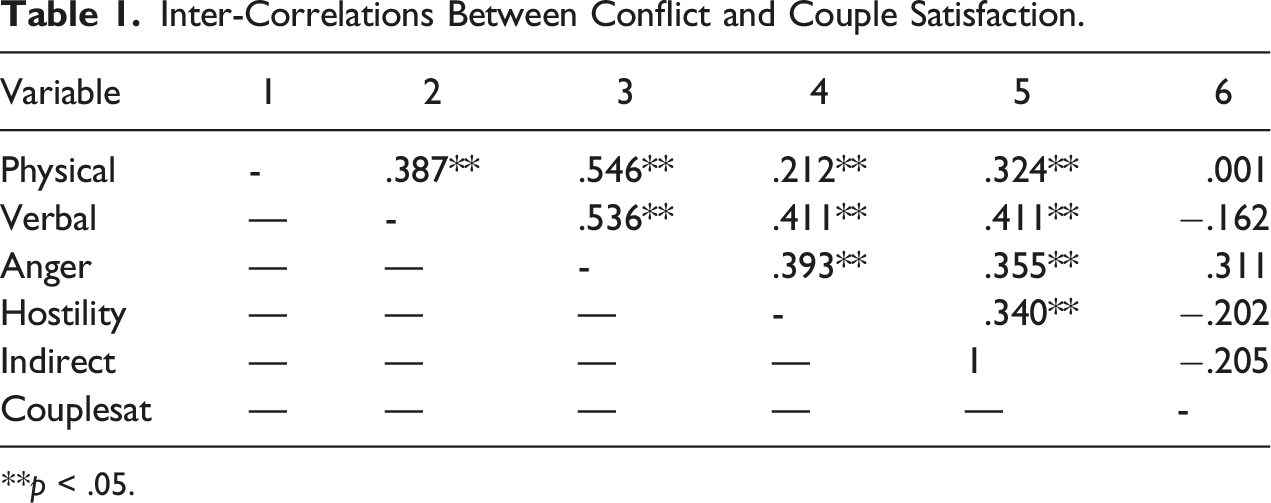
**p < .05.
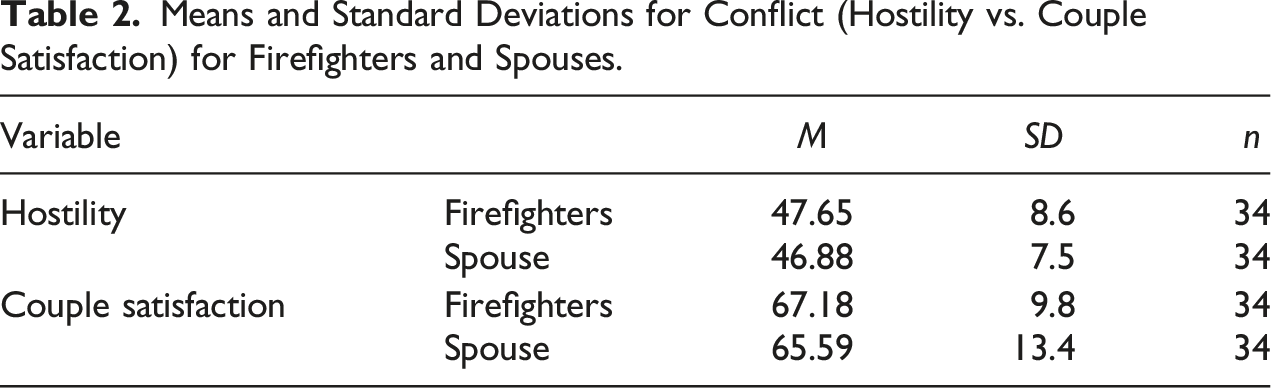
Means and Standard Deviations for Conflict (Hostility vs. Couple Satisfaction) for Firefighters and Spouses.
Means and Standard Deviations for Conflict (Hostility vs. Life Satisfaction) for Firefighters and Spouses.
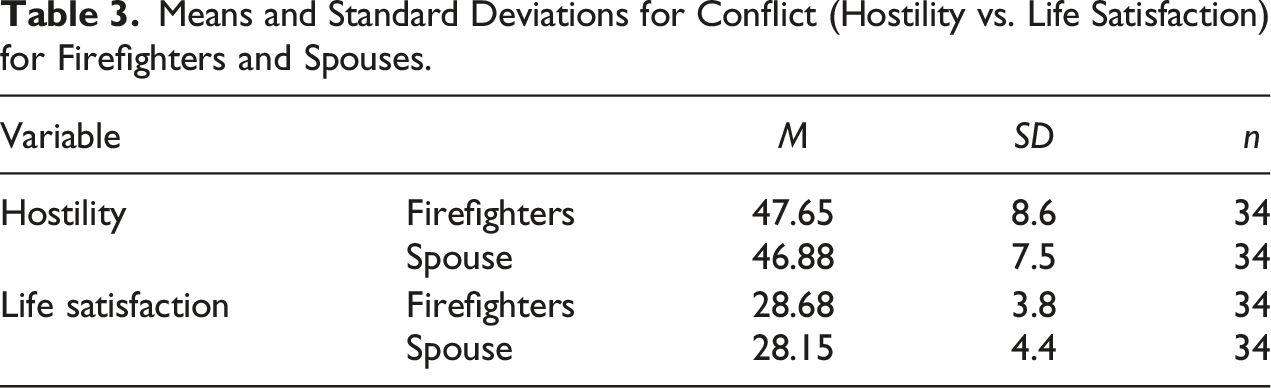
Further, a SPSS MANOVA was used to conduct the two-way between-subjects multivariate analysis of variance to compare the two groups with respect to their levels of perceived satisfaction with life and couple relationship. The independent variable for the analyses was Groups: firefighters and spouses. The first MANOVA was conducted on two dependent variables, life satisfaction and couple satisfaction, to identify significant differences between the two groups (firefighters vs. spouses) with regard to life satisfaction and couple satisfaction. With the use of the more conservative Pillai’s Trace criterion, due to the non-normal distribution detected for both dependent variables, the combined dependent variables were not significantly different by Group, (F [2, 65] = .182, p = .834). The results reflected no association between Group scores (firefighters vs. spouses) and the combined dependent variables. Therefore, the two groups did not differ in the way they perceive their satisfaction with life and their partner and marital relationship.
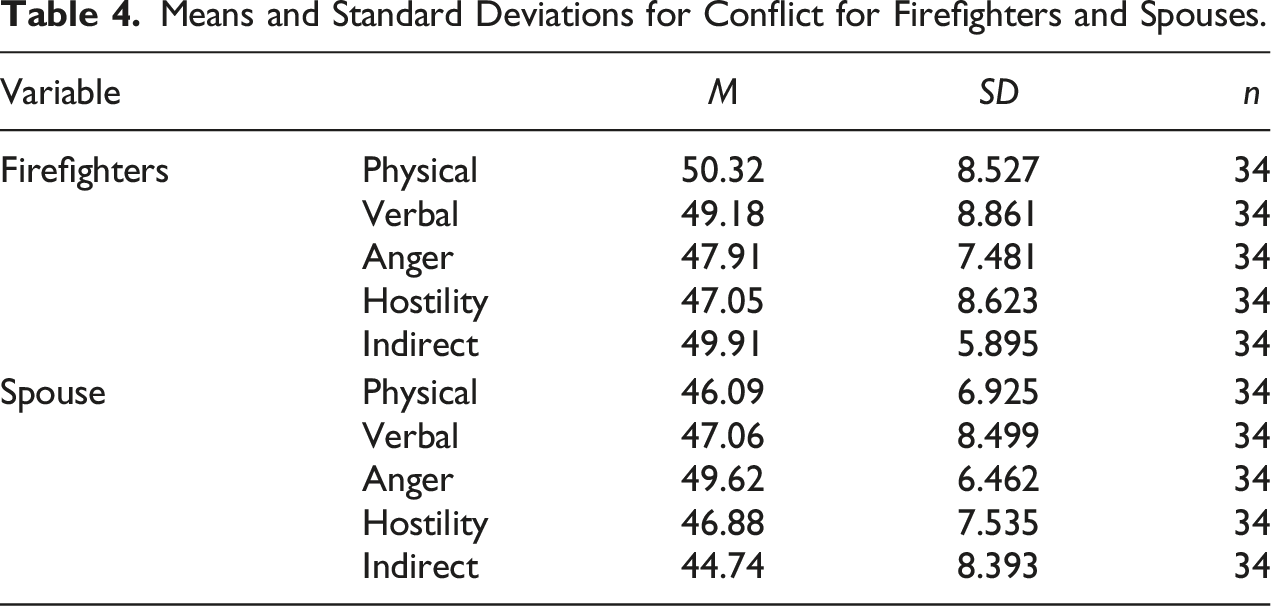
The second MANOVA was conducted on five dependent variables: physical aggression, verbal aggression, anger, hostility, and indirect aggression. There were no outliers in the data set. The assumption of multivariate normality was tested using Shapiro Wilks test and indicated that for the Physical, Verbal, Hostility and Indirect Aggression the assumption of normality was not violated, although for Anger, the test indicated a non-normal distribution. A normal distribution was observed for all dependent variables in terms of skewness and kurtosis. Finally, the assumption of absence of multicolinearity and singularity was not violated. With the use of the more conservative Pillai’s Trace criterion due to the non-normal distribution detected for Anger, the combined DVs were significantly affected by the Groups, (F [5, 62] = 5.393, p < .001). Firefighters had significantly higher scores on Physical Aggression, Verbal Aggression, Indirect Aggression, and Hostility, but not on Anger. The responses collected from spouses indicated significantly higher scores on Anger. Overall, the group differences were significantly higher on Indirect Aggression and Physical Aggression, followed by Anger. The results reflected a modest difference between Group scores (firefighters vs. spouses) and Physical Aggression, (F [1, 66] = 5.054, p < .005, partial η 2 = .071), as well as between Group scores (firefighters vs. spouses) and Indirect Aggression, (F [1, 66] = 8.661, p < .005, partial η 2 = .116).
Means and Standard Deviations for Conflict for Firefighters and Spouses.
Roy–Bargman Stepdown F—Tests.
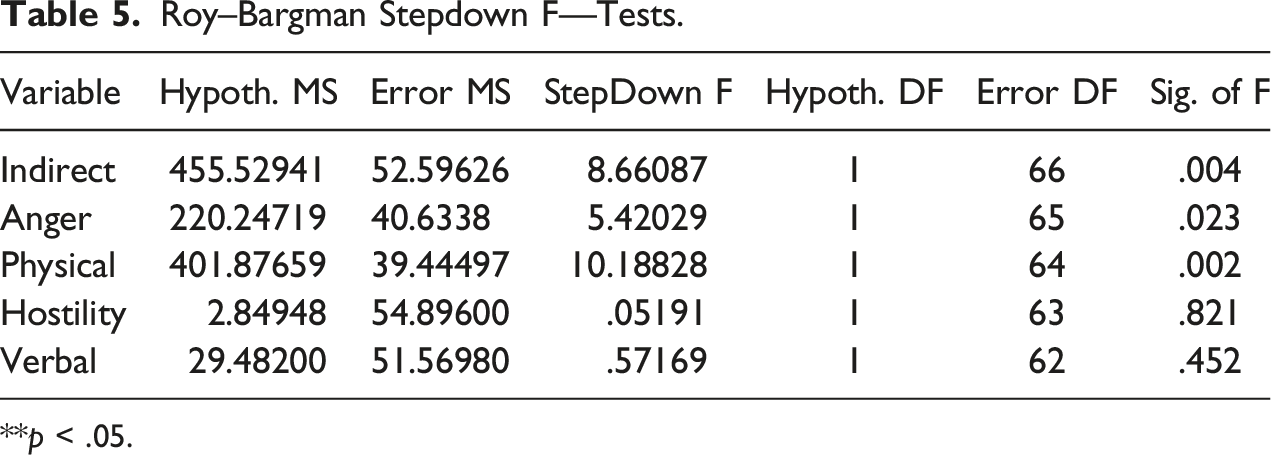
**p < .05.
Discussion
Hypotheses about couple satisfaction and domestic conflict as a function of dyad type were partially supported. For the first hypothesis, looking at the differences in levels of satisfaction with life and marital relationship, it was expected that spouses would report lower satisfaction levels when compared to their significant others. In contrast to our hypotheses, the results indicated that both groups reported high levels of satisfaction with life and marital relationships, with no significant differences in the levels of satisfaction with life and couple relationship between groups. These results confirm previous research on firefighters that indicated that spouses would work together as partners to balance the family responsibilities with the challenges of the firefighting shift schedule (Sommerfeld, Wagner, Harder, and Schmidt, 2017). Although some aspects of firefighting work may be challenging for the couple, such as adjusting roles and responsibilities around shift work, parenting, spending family time together, health and safety while on the job, or spillover effect from work to home, other aspects turn out to be very beneficial. For example, job and financial stability, strong professional status and recognition within the community, flexibility with child care arrangements, strong support network from the organization and other families of firefighters, are just a few of the benefits (Sommerfeld et al., 2017). In addition, in reasoning the results of our results, recent research has demonstrated that sharing positive events with others induces a state of happiness for those who share, as opposed to those who prefer to keep these events for themselves (Judge et al., 2006). When we translate this to the tight-knit firefighter group, sharing positive family stories with co-workers or positive work stories with family members will lead to positive spillover from family to work or work to family, which, in turn, will lead to increased satisfaction with work and family, thus confirming our results. However, due to the fact that spouses participating in our study were the ones invited by the firefighters, we might assume that only individuals confident with the status of their intimate relationship might have volunteered their spouse for the study. Therefore, our results should be interpreted with caution due to potential selection bias.
The second hypothesis analyzed the group differences in perceiving aggression and domestic conflict. Results indicated significant differences between the two groups—firefighters and their spouses—when all five variables (physical aggression, verbal aggression, anger, hostility, and indirect aggression) were entered into the equation at once. Not surprisingly, firefighters self-reported higher on indirect aggression, physical aggression, verbal aggression, and hostility; whereas, their partners self-rated higher on anger. These results are supported by the literature with males self-reporting higher on physical, verbal, and indirect aggression, but not on anger (Buss and Perry, 1992).
Further analyses indicated that firefighters and their spouses are more likely to use different ways to express aggression and, therefore, domestic conflict. As such, according to our results, indirect and physical expressions of aggression were often reported by firefighters in interpersonal transactions. Indirect aggression refers to the tendency to express frustration and irritation in actions that avoid direct confrontation, whereas physical aggression focuses on the use of physical expressions of anger and frustration (Fatima, 2019). Previous research hypothesizes that men may express more aggression than women, with explanations of biology, gender roles, and cultural and societal influences contributing to these differences (Bettencourt and Miller, 1996; Buss and Perry, 1992). However, previous research has demonstrated that, under provocation in intimate relationships, men and women behave equally in terms of aggressive behavior (Bettencourt and Miller, 1996; Graham and Wells, 2001). Further, the current results suggests that the effects are likely more nuanced than simple gender differences in amount of agression alone, and are potentially better explained by differences in expression of agression.
The results of the present study indicated that the gender difference was significantly larger for indirect aggression as opposed to physical aggression or verbal aggression as demonstrated by the empirical literature. In the case of the outcomes presented in this study, it appears that firefighters would be more likely to use indirect aggression in order to react to frustrations and irritability. As indicated by previous research, some of the indirect aggression actions expressing avoidance of conflict could be ignoring one’s partner, withholding affection, or intentionally embarrassing the partner in front of others (Buss and Perry, 1992). Due to the fact that this approach does not always resolve the conflict, individuals using this type of approach to express their negative emotions are more likely to suffer chronic frustration; hence, this might explain the elevated level of perceived hostility in firefighters. In order to further consider this possibility, one might look into the relationship that exists between firefighters and their support network. Although support originates from different sources, it seems that support from family and significant others is particularly valued by firefighters, with support from co-workers and organization coming on second (Sommerfeld et al., 2017). As such, in cases of domestic disagreement, due to the fact that firefighters greatly value their support network, they may be more likely to limit their frustration to indirect aggression, thus avoiding direct conflict with their spouses, rather than imposing their opinion through physical or verbal expression of aggression. This approach to conflictual situations prevents escalation and relationship deterioration, and likely helps to maintain the support network around the firefighter. By the same token, firefighters may be more likely to employ indirect aggression at work as well, thus maintaining good relationships within the sister/brotherhood, not altering the social support offered by their co-workers, in addition to following the workplace norms, and respecting the hierarchy. It has been argued that persons bound by strict societal norms may more consciously inhibit and/or regulate their aggression (Bettencourt and Miller, 1996; Hammer et al., 2004). The firefighting profession comes with strict norms, professional prestige, and a highly regarded social status. Thus, indirect aggression might seem the covert way to express aggression and deal with angry feelings while maintaining the good image at work and in the community.
On the other hand, the results of the present study indicated that spouses reported a tendency to express their frustration through anger, translated by negative emotions, irritability, and emotional lability. Although research suggests that this way of expressing aggression may be explained through social ecological models, and cultural and social influences (Bettencourt and Miller, 1996), the complex nature of firefighters’ family relationships and dynamics may also have a significant influence on the way spouses express their anger. In addition to the worries and fears for partner health and safety while on the job, the impact of shift work on spouses and on household dynamics would likely represent significant factors adding to the daily stress and frustration of spouses. Not being able to attend family events together as a couple due to work schedule or work commitments, or not having their partner share family responsibilities or spend less time fulfilling parenting roles, may trigger frustration and irritability that could be more likely to be vented through anger. However, the support from the organization and family or friends was mentioned in research as an alleviating factor for stress at the family level and contributed to spouse and family satisfaction (Sommerfeld et al., 2017).
Recommendations
Recommendations from the present findings suggest the need for expanding research on the uniqueness and significance of the social support of firefighters. Spousal support and the sister/brotherhood are presumed to play a very important role in mitigating the effects of the stressful work environment of firefighting. Future studies following a longitudinal design would be beneficial to investigate the importance of family and social support for firefighters.
Footnotes
Acknowledgments
The authors would like to gratefully acknowledge the union executive and management of the participant fire department for their ongoing support and engagement with this research. Also, we would like to very gratefully acknowledge the participation of the fire service members who shared their personal experience with us. Finally, we would like to acknowledge the contributions of Elyssa Krutop, Jessica Soderstrom, and Jennifer Tippett who worked with us on aspects of the research.
Declaration of Conflicting Interests
The author(s) declared no potential conflicts of interest with respect to the research, authorship, and/or publication of this article.
Funding
The author(s) disclosed receipt of the following financial support for the research, authorship, and/or publication of this article: This work was supported by the University of Northern British Columbia grant number Research Project Award.

Data Accessibility Statement
Data can be accessed through connecting with the corresponding author.