



Abstract
This study investigates the conceptual argument that constructive and explicit couple communication may reduce gender inequalities in couples’ division of family work. We focus on the transition to parenthood which for most couples in Germany results in a shift towards a more traditional division of labour. Using 314 first-time parents from the German Family Panel, we apply growth curve models to assess whether partners’ prenatal characteristics explain the division of housework and childcare around the time of childbirth and in the following years. After controlling for gender ideologies and economic resources, male partners’ frequency of positive communication is associated with greater father involvement in housework and childcare from the start. However, neither men’s nor women’s communication behaviours dampen the shift towards a more traditional division of housework and childcare in the first years after childbirth. The frequency of negative communication does not correlate with the division of family work.
Introduction
Childless couples tend to divide housework and paid work fairly equally (Bühlmann, Elcheroth, & Tettamanti, 2009; Grunow, Schulz, & Blossfeld, 2012). The majority of couples intends to maintain this division of work after the birth of their first child (Institut für Demoskopie Allesbach, 2019; Müller et al., 2013). However, in practice the transition to parenthood often increases gender inequalities (Kühhirt, 2012). Many mothers shift time from paid work to family work, that is, housework and childcare duties, whereas most fathers do not adapt their housework and employment time (Argyrous, Craig, & Rahman, 2017; Kühhirt, 2012). These gendered work arrangements tend to persist during the years after childbirth (Grunow et al., 2012; Kühhirt, 2012) and have long-term economic consequences for mothers (Bettio, Tinios, & Betti, 2013; Boll, 2016). Previous theoretical and empirical research mostly takes a gender perspective (e.g. Stets & Burke, 2000; West & Zimmerman, 1987) or focuses on economic resources (e.g. Becker, 1991; Gupta, 2007; Lundberg & Pollak, 1996) to explain the division of labour among couples. Studies find some support for the role of gender ideologies and little or mixed support for the role of absolute or relative economic resources in explaining the division of family work in Germany (Kühhirt, 2012; Nitsche & Grunow, 2016, 2018). Yet, it remains unclear why many couples who aspire to egalitarian gender arrangements and possess the necessary economic resources before childbirth do not maintain or achieve their desired division of labour after the birth of their first child (Grunow & Veltkamp, 2016). This study takes a closer look at additional types of resources related to couple’s relationship and communication behaviour to explain the division of family work when becoming parents.
Many theoretical and empirical works implicitly assume that partners negotiate the division of paid work and childcare when becoming parents (e.g. Grunow et al., 2012), but the actual negotiation or communication of partners itself is rarely empirically observed or measured. Qualitative Swedish studies by Evertsson and Nyman (2009) suggest that negotiations in everyday life take place rather rarely and implicitly due to established routines in work-family arrangements. More explicit discussions about the current division of labour occur when one partner is frustrated or when partners want to change their division of labour due to the birth of their first child (Wiesmann, 2010). In this study, we consider couples’ relationship and communication behaviour as an additional resource, which is likely to be used in negotiations about work-family divisions and thereby affects the outcome of work-family arrangements. A few qualitative and cross-sectional studies have begun to explore the role of one partner’s communication behaviour in explaining couples’ division of family work (e.g. Benjamin & Sullivan, 1999). We seek to contribute to the literature by taking a dyadic and longitudinal perspective to explore whether couples’ prenatal communication behaviour helps or hinders their development of a more egalitarian division of family work when becoming parents. Moreover, we consider both partners’ communication behaviour and examine a broader range of communication behaviours within couples, beyond the focus on positive interactions set by most previous studies. Furthermore, we explore how couples’ communication is linked to existing gender or economic approaches, as partners’ communication behaviour might complement or interact with their gender ideologies or economic resources. We use dyadic longitudinal data and base our analysis on 314 first-time parents from the German Family Panel.
Couples’ Communication Behaviour and the Division of Family Work
Conceptual Model and State of the Art
To explain couples’ involvement in family work, gender perspectives suggest that partners are guided by their interpretations of gender and parental roles (e.g. Stets & Burke, 2000; West & Zimmerman, 1987), whereas economic rational choice approaches stress the importance of partners’ economic resources in specialisation or power bargaining processes within the couple (e.g. Becker, 1991; Gupta, 2007; Lundberg & Pollak, 1996). Benjamin and Sullivan (Benjamin & Sullivan, 1999; Sullivan, 2006) introduced the notion of ‘relational resources’ as an additional form of resources explaining partners’ negotiations about the division of family work. They define relational resources as ‘interpersonal and emotional skills and resources that individuals bring to a relationship’ (Benjamin & Sullivan, 1999, p. 798). Examples of these skills include ‘change-directed negotiating skills, the ability to express thoughts and feelings more clearly and the controlled use of anger in conflictual situations’ (Benjamin & Sullivan, 1999, p. 798). The authors suggest that these relational skills paired with gender consciousness can introduce change in a couple’s communication and domestic division of labour. A small number of mainly cross-sectional studies provided mixed evidence on the effects of strategies intended to change the other partner’s contributions to housework or childcare. Benjamin and Sullivan (1999) found that British women’s relational resources are associated with a greater contribution to family work by the male partner. In contrast, a longitudinal study from the United States showed that American mothers’ willingness to express their desires clearly and directly had no direct effect on the division of housework or childcare (Mannino & Deutsch, 2007). In Mexican dual-earner families, strategies based on friendliness and helpfulness are perceived as most effective, whereas threats or ignoring are seen as ineffective or not helpful for having one’s partner contribute more to housework (González Alafita, 2008).
Looking at couples’ communication behaviour more broadly, qualitative studies from the United States, Germany and the Netherlands found that couples or families with more egalitarian relationship outcomes tend to negotiate more fairly, openly, actively and repeatedly in order to introduce change into their relationships (Knudson-Martin & Mahoney, 1998, 2005). Less egalitarian couples or families use more friendly and avoiding tactics and tend to place responsibility on the wife (Knudson-Martin & Mahoney, 1998, 2005). New parents with a more egalitarian division of labour engage in more explicit communication behaviours such as planning before childbirth, making concrete agreements in everyday life, discussing points of disagreement and communicating frustration about the division of labour (Böhm, Franz, & Matthiesen, 2016; Wiesmann, 2010). Parents with traditional work arrangements decide on their arrangements more implicitly, as they do not explicitly talk about them and simply take them for granted (Böhm et al., 2016; Wiesmann, 2010).
Another concept closely related to communication behaviour is emotion work. Emotion work or emotional support often refer to behaviours like listening and talking about the other person’s thoughts and feelings, expressing appreciation and encouragement and supporting one’s partner when they encounter problems (Erickson, 2005). Results from the United States and Germany show that women’s emotion work correlates with her lower share of housework, but has no effect on her relative involvement in childcare (Horne & Johnson, 2018; Stevens, Minnotte, Mannon, & Kiger, 2006). The same analyses reveal that men’s emotion work is associated with a more equal gender division of housework and childcare.
All in all, these qualitative and cross-sectional quantitative studies suggest that partners who engage in positive communication behaviour, such as explicit, constant, active and open negotiation and planning as well as emotional support for one another, exhibit a more egalitarian division of labour. Partners who engage in more negative communication behaviour like implicit communication, avoidance, blaming or threats tend to have a more traditional division of labour. To get closer to identifying causal relationships, our longitudinal research explores how both partners’ communication behaviour affects the division of family work across the transition to parenthood.
Hypotheses
Recent surveys show that the majority of German couples and families express support for equal sharing of family and paid work as the ideal division of labour in families (Institut für Demoskopie Allesbach, 2019; Müller et al., 2013), while in practice the division of work is becoming more gendered after the transition to parenthood (Grunow et al., 2012). We assume that positive prenatal communication constitutes an important resource that may facilitate the planning and negotiating towards an aspired more gender-equal division of family work. In particular, positive communication may lead to a better understanding of one’s partner and his or her needs, so that family tasks can be better planned, coordinated and divided between the partners (Carlson, Miller, & Rudd, 2020). We expect that couples who show a more frequent positive communication behaviour before the birth of their first child are more likely to initiate and successfully negotiate about family tasks. Therefore, they are more likely to divide family chores more equally between partners before the time of childbirth and during the following years. In detail, we expect to see a higher share of housework performed by men before the child’s birth and a higher share of childcare performed by men around the time of birth (Hypothesis 1a). Also, we expect such couples to better resist the prevalent traditionalisation of the division of family work after childbirth, leading to a slower decline in men’s share of housework and a faster increase in men’s share of childcare over time (Hypothesis 1b). By contrast, frequent prenatal negative communication such as withdrawal, verbal aggression and manipulation might hinder or discourage the planning, negotiation and coordination processes between partners. We assume that such couples are less likely to (successfully) engage in negotiations about family work and therefore more likely follow the prevalent patterns of gendered parental arrangements around the time of childbirth and during the following years. In detail, partners with more frequent negative prenatal communication are expected to show a lower share of housework performed by men before the birth of their first child and a lower share of childcare performed by men around the time of birth (Hypothesis 2a). Also, we expect that the traditionalisation of family work persists in the years after childbirth, leading to a faster decline in men’s share of housework and a slower increase in men’s share of childcare over time (Hypothesis 2b). It should be mentioned that women’s use of negative communication, in form of anger or open conflicts, can even lead to changes towards more egalitarian divisions of family work (Benjamin & Sullivan, 1999). As our empirical data focuses on withdrawal, verbally aggressive or manipulative negative communication behaviour, we assume the traditionalising consequences to outweigh potential contrary effects of change-provoking conflicts or discussions.
Even though the majority of German couples appears to support the ideal of a relatively gender-equal division of family work, a minority expresses agreement with traditional gender ideologies. For couples which hold egalitarian gender ideologies before childbirth, strong prenatal communication skills may help to maintain an egalitarian division of family work after becoming parents against more traditional social norms (Benjamin & Sullivan, 1999; Sullivan, 2006). For couples in which partners hold more traditional gender ideologies, positive or negative communication behaviour might not influence their division of family work unless change is desired. The empirical analysis will therefore test whether communication behaviour is less strongly related to a more gender-equal division of labour among couples with traditional gender ideologies. Furthermore, communication resources might also either support or substitute for the effects of partners’ higher economic resources. Strong prenatal communication skills might help women with a high prenatal relative income to bargain for a reduced involvement in family work (Mannino & Deutsch, 2007). Alternatively, these women may not need any negotiation skills as money gives them enough bargaining power or they directly outsource part of the family work (Gupta, 2007; Mannino & Deutsch, 2007). We also test these possible interdependencies with partners’ prenatal gender ideologies and relative income.
Data and Methods
Data
We use the first 10 waves of the German Panel Analysis of Intimate Relationships and Family Dynamics (pairfam, Release 10.0) (Brüderl et al., 2019). This panel study started in 2008 and randomly sampled three age cohorts of adults, adolescents and young adults (born in 1971–1973, 1981–1983 and 1991–1993; aged 35–37, 25–27 and 15–17 in the first wave) from the German population. About 4,000 participants were selected for each cohort, yielding a total of about 12,400 participants in the first wave. These participants represent the ‘anchor’ persons. One strengths is that also anchors’ current partners are regularly asked half of which actually take part in the partner survey (Brüderl et al., 2018). Selection into (non)response of the partners plays a minor role as it relates only to some extent to the couple’s relationship quality or degree of partnership institutionalisation (Schröder et al., 2012). More detailed information about the study can be found in (Huinink et al. 2011). Pairfam is well-suited, as it is the only quantitative longitudinal data set which includes regular reports from both partners on their communication and conflict behaviour, gender ideologies as well as their division of housework and childcare.
Sample
Descriptive Statistics.
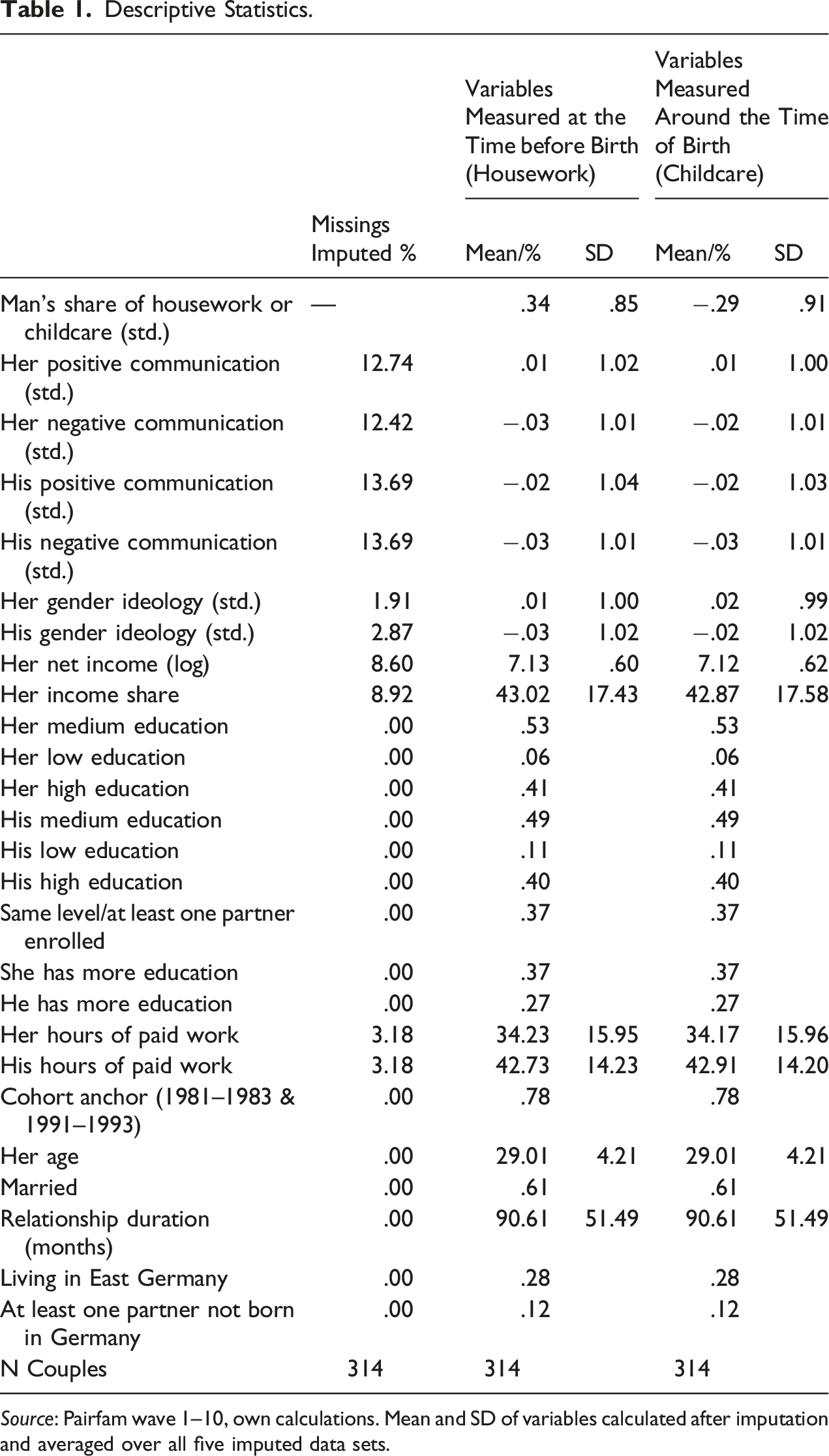
Source: Pairfam wave 1–10, own calculations. Mean and SD of variables calculated after imputation and averaged over all five imputed data sets.
Dependent Variables
Couples’ division of family work is measured in terms of two dependent variables, the share of housework and the share of childcare. Pairfam includes annual information on the partners’ share of housework, shopping, repairs, financial and administrative tasks as well as childcare, collected from both partners’ point of view. After recoding, higher values represent a higher proportion of family work performed by the man or a more egalitarian division of labour, respectively: 1 ‘(Almost) completely [by the woman]’, 2 ‘For the most part [by the woman]’, 3 ‘Split about 50/50’, 4 ‘For the most part [by the man]’ and 5 ‘(Almost) completely [by the man]’. The response ‘Only another person’ was coded as equal sharing and ‘Does not apply to our situation’ as missing value. For the share of housework, we built one latent factor. We combined two items on routine housework ‘housework (washing, cooking and cleaning)’ and ‘shopping’, which are the most gendered and frequently performed types of housework (Davis & Greenstein, 2013). To avoid over- or underestimating the amount of family work due to gendered responses, we included the two items from both partners’ views. Based on these four items and taking into account their ordinal level of measurement, we built one latent factor using exploratory factor analysis with polychoric correlations. All four items loaded higher than .35 on the first factor and Cronbach’s alpha exceeded .6 for all time points. On average, the couples start at a relatively equal division of housework before the birth of their first child. After childbirth, the mother’s share of housework increases and remains relatively constant during the following years (Figure 1). For the share of childcare, we calculated the mean of both partners’ responses to the question ‘Who is taking care of the children’. On average, women do most of the childcare immediately after the child is born. Fathers’ share increases slightly after the child’s first birthday and remains at this level during the following years (Figure 1). Both dependent variables are standardised on the basis of the final sample for ease of interpretation. Average division of housework (left) and childcare (right) among first-time parents.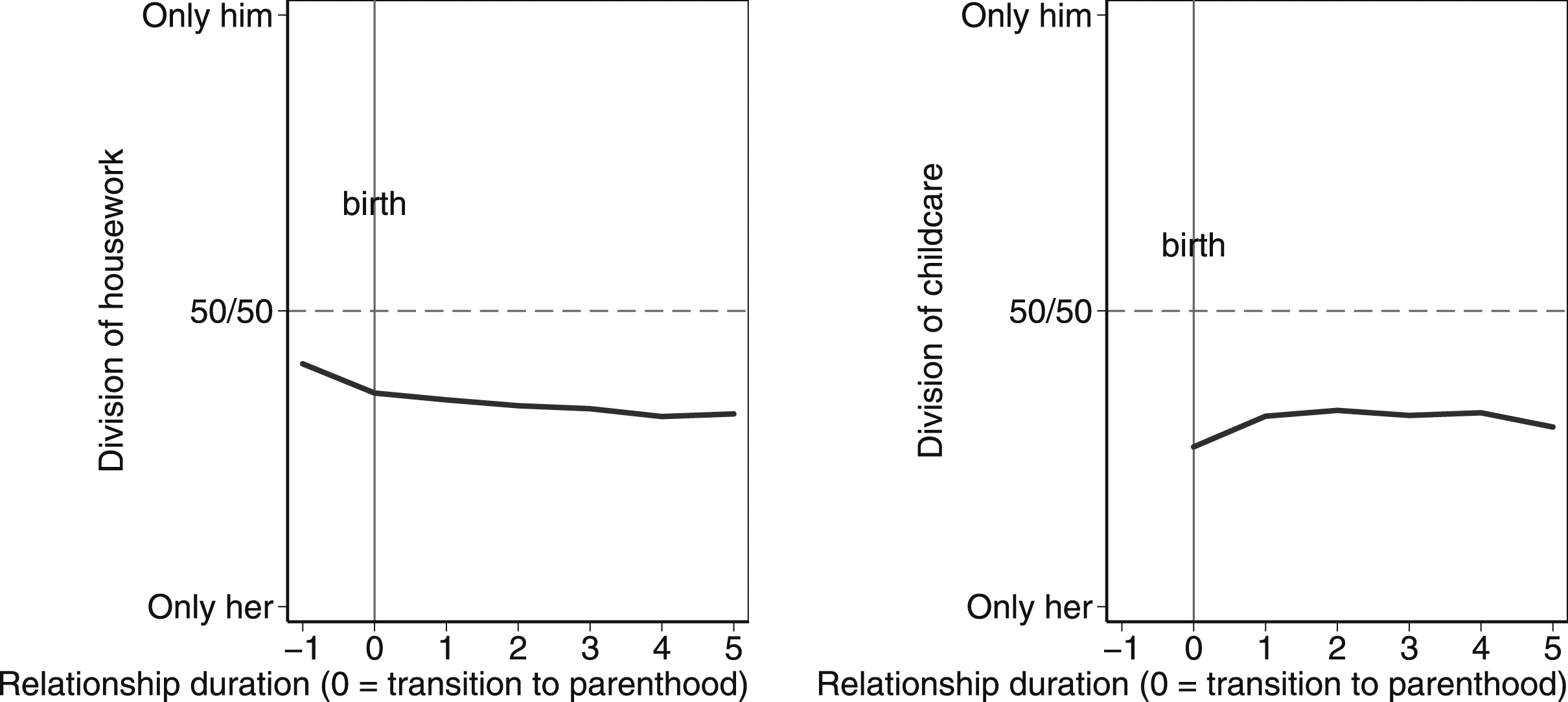
Explanatory Variables
All explanatory variables were measured at a time point before birth and held constant over time to reduce the risk of bias due to reverse causality effects between, for example, the division of family work and partner’s communication. In Table 1 the descriptive statistics from the dependent and independent variables are displayed. Our main explanatory variable is defined by the communication behaviour within the couple. We distinguish between a positive and a negative dimension rather than using one continuous scale. In total, we built four communication measures to capture woman’s and man’s positive and negative communication behaviour towards the respective other partner. Positive communication measures the frequency of ‘supportive dyadic coping’ when the partner is stressed as well as the frequency of ‘intimacy’, ‘appreciation’ and ‘constructive conflict communication’ towards one’s partner. An example of constructive conflict communication is to ‘listen and ask questions to understand [your partner] better’. For dyadic coping and constructive conflict communication partner’s self-reports and the other partner’s perceptions were available. We included both partners’ views to get a more objective picture of the woman’s and the man’s positive communication behaviour, respectively. The 12 exact items included in the communication measure are listed in the Supplemental Appendix (available in the online version of the article). Responses were coded on a 5-point scale from 1 ‘almost never or never’ to 5 ‘very frequently or always’. The 12 items were combined into one latent factor using exploratory factor analysis with polychoric correlations. All items loaded higher than .35 on the first factor and Cronbach’s alpha was above .7. Positive communication was operationalised similarly to the measurement of emotion work (Horne & Johnson, 2018). Negative communication measures the frequency of ‘angry interactions’ between partners as well as the frequency of ‘verbal aggression’, ‘withdrawal’ and ‘manipulation’ towards one’s partner during couples’ conflicts. An example of verbal aggression during conflict is to ‘insult or verbally abuse your partner’. For verbal aggression, withdrawal and manipulation each partner’s self-reports and the other partner’s perceptions were available. We included both partners’ views to measure man’s and woman’s negative communication behaviour, respectively. The 14 items in total are listed in the Supplemental Appendix (available in the online version of the article). Responses were recorded on a 5-point scale from 1 ‘almost never or never’ to 5 ‘very frequently or always’. The 14 items were combined into one latent factor using exploratory factor analysis with polychoric correlations. All items loaded higher than .35 on the first factor and Cronbach’s alpha was above .8. Higher values indicate a larger amount of positive or negative communication, respectively. All communication factors were standardised for ease of interpretation. In our sample, first-time parents experience only moderate changes in communication. Thus, we can use partners’ prenatal communication behaviours as predictors of their future communication.
We include the following prenatal control variables (similar to the studies by Nitsche & Grunow, 2016, 2018). We account for partner’s interpretation of gender roles. In pairfam, four questions refer to parents’ labour market participation, children’s well-being in connection with parents’ employment and the division of housework between partners. These items represent separate dimensions of the general concept of gender ideologies and do not have a sufficiently high Cronbach’s alpha (alpha < .5) to build a summary measure (see Nitsche & Grunow, 2018). Thus, we use the single item ‘Men should participate in housework to the same extent as women’ to represent men’s and women’s prenatal gender ideologies. The item was recorded on a 5-point scale from 1 ‘disagree completely’ to 5 ‘agree completely’ and is standardised for ease of interpretation. According to economic perspectives, partners’ absolute and relative economic resources are important to explain their involvement in family work (Gupta, 2007). Therefore, we include each woman’s share of the monthly household income before birth (ranging from 0% to 100%) and each woman’s absolute monthly net income before birth (logged). Partners’ prenatal education might measure further aspects of economic resources. Based on the CASMIN 1999 classification, we classified partners has having a lower secondary education as ‘low’, an upper secondary and non-tertiary post-secondary as ‘medium’ and a tertiary education as ‘high education’ on an absolute level. Respondents currently enrolled in education count as ‘high education’ as they are beyond the age of school graduation. We differentiate between couples where ‘her educational attainment is higher than his’, ‘his educational attainment is higher than hers’ and couples who hold a similar level of education or where at least one partner is enrolled in education. Also, longer working hours before birth might signal a stronger labour market attachment after childbirth. We control for women’s age and include an indicator for the three sampling cohorts which combines the two youngest cohorts, as only a few couples from the youngest cohort already became parents. We account for further couples characteristics such as marital status, relationship duration (in months) and distinguish between couples which live in the former West Germany in comparison to East Germany and couples in which both partners were born in Germany compared to couples in which at least one partner was not born in Germany.
Analytical Strategy
We apply growth curve models to analyse the development of family work across the transition to parenthood. The model is expressed as a two-level multi-level model to account for the clustered data, as observations are nested within couples. Level 1 represents the development of the division of family work within couples over time, which we hereafter refer to as the trajectory. Level 2 refers to differences between couples’ trajectories. The couples’ individual trajectories can be expressed by a mean intercept and mean slope and by couples’ variability around these group means. To obtain consistent estimates, it is essential to specify the mean trajectory and the residual structure of the model correctly (Rabe-Hesketh & Skrondal, 2012).
To specify the trajectory, we tested linear, polynomial and spline parametrisations of time. The model fit statistics and graphical representation of the average division of family work (see Figure 1) point to a quadratic time trend for housework and a cubic time trend for childcare. However, we choose a linear growth curve for both outcome variables as the main results do not differ strongly between the linear model and a more complex model with polynomial or spline parametrisations and the interpretation of linear time trends is more straightforward. Also, the linear models allow for the estimation of the random slope of the time trend which we are interested in to explain, whereas standard errors for the random slopes cannot be calculated for models with more complex time trends.
Regarding the residual structure, the inclusion of a random intercept and a random slope significantly improved the model fit. This means that couples do not follow the same trajectory; rather, significant differences and variation around the mean intercept and mean slope are present. Time-invariant predictors on the couple level (Level 2), such as partners’ prenatal communication behaviours, can be used as predictors of the mean intercepts (main effect) and the mean slopes (interaction with time slope) to assess whether they help explain differences between couples in the initial level or rate of change in family work. All models were calculated in Stata15 using the ‘mixed’ command for multiply imputed data. The variances and covariances were freely estimated using the unstructured variance-covariance matrix option.
Results
Main Findings
Couples with First Birth During the Panel: Multi-Level Models with Communication Predicting Intercept and Slope of Man’s Share of Housework and Childcare.
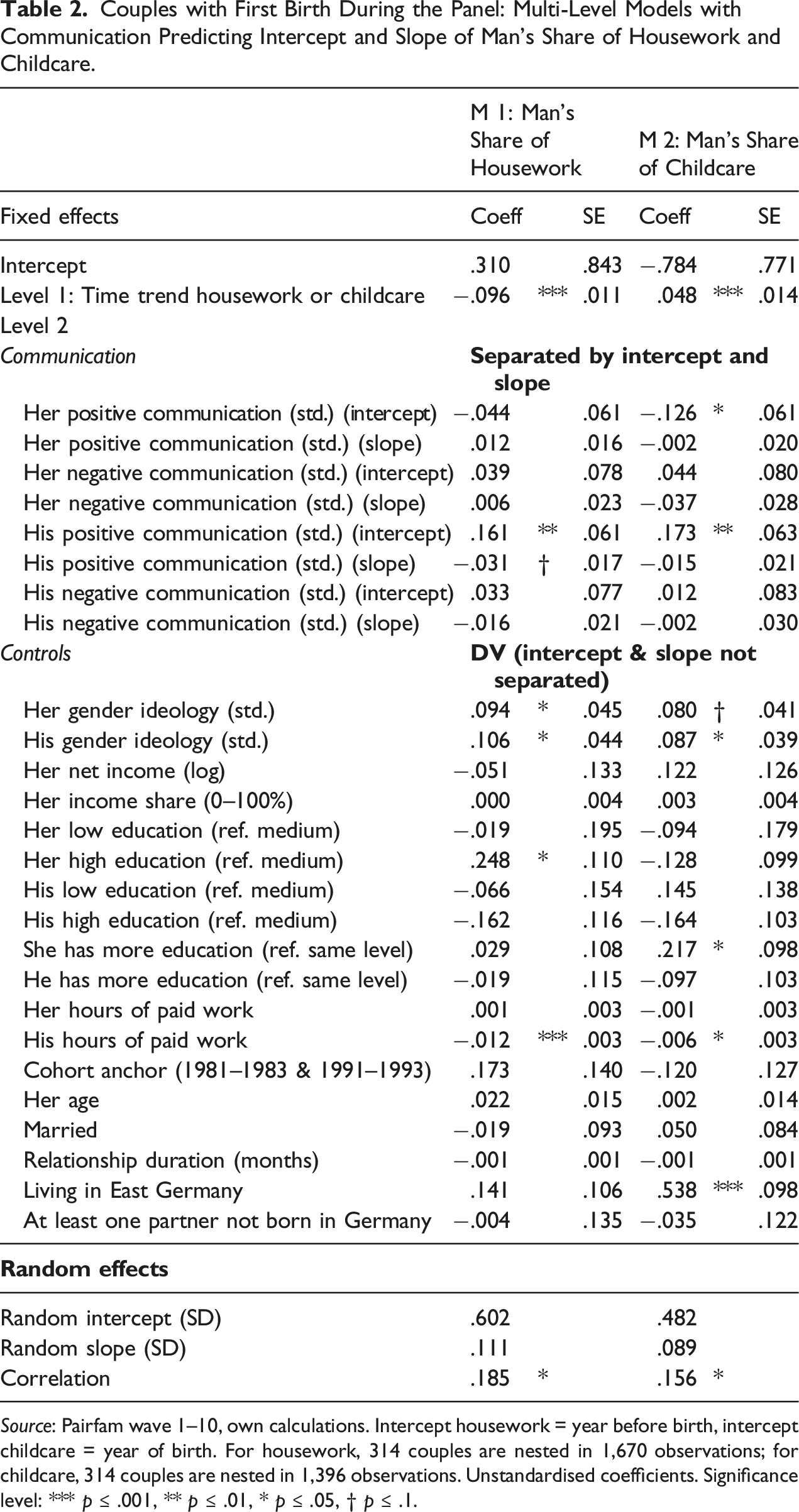
Source: Pairfam wave 1–10, own calculations. Intercept housework = year before birth, intercept childcare = year of birth. For housework, 314 couples are nested in 1,670 observations; for childcare, 314 couples are nested in 1,396 observations. Unstandardised coefficients. Significance level: *** p ≤ .001, ** p ≤ .01, * p ≤ .05, † p ≤ .1.
Regarding the division of housework, we expected that couples with more frequent positive communication before the birth of their first child exhibit a higher share of paternal housework during the time before birth (Hypothesis 1a) and a slower decline in the father’s share of housework over time (Hypothesis 1b). Model 1 shows that men who engage in more frequent prenatal positive communication do a significant higher share of housework during the time before childbirth. An increase of one SD in the frequency of paternal positive communication is associated with a .16 SD increase in the man’s initial share of housework before childbirth. Hypothesis 1a is supported for men. Unexpectedly, men who report more frequent positive communication before birth experience a steeper reduction in their share of housework following the transition to parenthood, contradicting Hypothesis 1b. This association is, however, only marginally significant. Women’s prenatal frequency of positive communication does not seem to play a significant role in how couples divide up housework before the time of birth or during the following years, contradicting Hypotheses 1a and 1b for women. Turning to negative communication, we expected that couples with more frequent prenatal negative communication would start out with a lower share of paternal housework at the time before birth (Hypothesis 2a) and that the father’s share of housework would decrease faster over time (Hypothesis 2b). Both Hypotheses 2a and 2b are rejected, more frequent negative communication between partners was not significantly associated with either the initial level or rate of change in housework for first-time parents.
Regarding the division of childcare duties, we expected that couples with more frequent positive communication before the birth of their first child exhibit a higher share of paternal childcare work around the time of birth (Hypothesis 1a) and a faster increase in the father’s share of childcare work over time (Hypothesis 1b). In Model 2, we do find significant correlations with the initial level of childcare, but the results differ by gender. In line with our expectations, more frequent prenatal positive communication behaviour by men is associated with a higher initial share of paternal childcare at birth. An increase of one SD in the man’s frequency of positive communication is associated with a .17 SD increase in his initial share of childcare. In contrast, a higher frequency of prenatal positive communication by the female partner is associated with a reduced share of paternal childcare around the time of birth. An increase of one SD in the frequency of female positive communication is associated with a .13 SD decrease in the father’s initial share of childcare. Hypothesis 1a is confirmed for men. No further effects of positive communication on the rate of change were found, contradicting Hypothesis 1b. Turning to negative communication, we expected that couples with more frequent negative prenatal communication would start out with a lower share of paternal childcare around the time of birth (Hypothesis 2a) and that the father’s share would increase less slowly over time (Hypothesis 2b). As for housework, we did not find any significant associations between the partners’ prenatal negative communication behaviour and the whole trajectory of childcare, rejecting Hypotheses 2a and 2b. Regarding the control variables, both partners’ prenatal egalitarian gender ideologies significantly and positively relate to the paternal share of housework and childcare. Absolute or relative economic resources and other prenatal couple characteristics play a minor role in explaining the development of family work over time.
In additional analyses, we tested whether couples’ positive communication behaviours were more strongly associated with a more gender-equal division of housework and childcare among couples with more egalitarian gender ideologies compared to couples where both partners held gender-traditional views. In only 1% of the sample both partners hold traditional gender ideologies, i.e., disagreed (or were undecided) about the statement that men should participate in housework to the same extent as women. Therefore, we split men’s and women’s gender ideologies along the median, respectively and then grouped the sample into two groups where both partners or at least the woman held traditional ideologies and where both partners or at least the man held egalitarian ideologies. Based on this binary variable we built a triple interaction with both partners’ communication measures and the time slope. Similarly, to analyse the interdependency with partners’ relative economic resources, we built a triple interaction of woman’s relative income with both partners’ communication behaviours and the time slope. These interaction terms were not significant at the 5%-level, indicating that partners’ prenatal communication affects couples’ division of family work independently of partners’ gender ideologies and economic resources.
Robustness Checks
We tested alternative specifications of the main analysis. The ratio of positive to negative communication (as suggested by Gottman, 1994) was not associated with the division of family work. The results for models including absolute positive and negative communication versus only absolute positive communication were very similar. We presented the models including both communication dimensions to control for the level of negative communication, even if it exerts no direct effect on the division of family work. Moreover, we additionally controlled for both partners’ relationship satisfaction, a concept closely related to couple communication (Gottman, 1994) and the associations with our communication measures did not substantially change. As the gender ideology items are skewed, we tested an alternative measure. Woman’s relative importance of education or career relative to other life domains (ranging from 0% to 100%) was associated with a higher male share of housework and childcare, while the importance the man places on paid work showed no associations. The effects of the male partners’ positive communication behaviour on the man’s share of housework and childcare remained similar to the main results in Table 2. The effects of male partner’s positive communication also remained similar and significant to the main results in Table 2, when additionally controlling for the gender ideology item that a pre-school child suffers when the mother works. The results for the additional analysis and robustness checks are available from the authors on request.
Discussion and Conclusion
This study examines the conceptual argument that couples’ more frequent positive prenatal communication may reduce gender inequalities in couples’ division of family work. Focussing on the transition to parenthood of couples in Germany, we find that more frequent positive prenatal communication by men is associated with a more egalitarian division of housework and childcare around the time of birth but does not reduce the shift towards a more traditional division of family work in the following years. The results that positive prenatal communication by the male partner correlates with a more egalitarian division of housework and childcare around the time of birth are in line with studies from the United States and Germany (Horne & Johnson, 2018; Stevens et al., 2006). Likewise, qualitative studies highlight open and friendly communication behaviour between partners as important to achieving a more egalitarian division of labour (Knudson-Martin & Mahoney, 1998, 2005). We did not detect any effect of women’s prenatal positive communication behaviour on the division of housework. These results are in line with a longitudinal US study (Mannino & Deutsch, 2007), while some international cross-sectional studies found positive associations (Benjamin & Sullivan, 1999; González Alafita, 2008). Moreover, we did not expect women’s positive prenatal communication to be negatively associated with men’s share of childcare around the time of birth. Previous studies found non-significant associations for the United States and Germany (Horne & Johnson, 2018; Mannino & Deutsch, 2007; Stevens et al., 2006) or positive associations for Britain (Benjamin & Sullivan, 1999). Our results show that in couples where both partners communicate more positively, both parents do more childcare. One explanation might be that such parents take care of their child together or take turns.
Contrary to our expectations, both partners’ negative prenatal communication does not seem to alter the division of family work across the transition to parenthood. Despite the fact that qualitative studies showed associations between negative communication behaviour and a more traditional division of labour (Böhm et al., 2016; Knudson-Martin & Mahoney, 1998, 2005; Wiesmann, 2010), we find no clear indication that negative communication behaviours by partners like withdrawal from conflict, aggression or manipulation make an egalitarian division of family work more difficult. On the other hand, we also find no clear hints that a certain level of conflict or anger might be used to alter domestic routines towards more egalitarian divisions of work (Benjamin & Sullivan, 1999). One explanation may be that these negative and positive effects might cancel each other out. Finally, almost no effect on the rate of change was found, so partners’ positive and negative communication behaviour before the birth of their first child do not seem to influence the development of family work over time. Our findings therefore cast doubt on the transformative potential of relational resources and communication behaviours in couples for promoting gender consciousness and a more gender-equal division of family work.
In accordance with previous German studies (Grunow et al., 2012; Nitsche & Grunow, 2016), partners’ gender ideologies and to a lesser extent economic resources remain important for explaining the parental division of family work among new parents. Our additional analyses, however, showed that partners’ communication behaviours relate to men’s involvement in family work independently of the partners’ gender ideologies and economic resources.
Several limitations of this study are worth noting. First, housework and childcare were measured as relative shares between partners and not in absolute number of hours. Thus, some changes in the absolute levels might not be detected and we cannot conclude whether more equal sharing is driven by the woman doing less or the man doing more family work. Second, our measures of positive and negative communication capture both partners’ relationship and conflict behaviour generally rather than specifically during negotiations about the division of family work. We assume that these communication behaviours are also applied during discussions about work-family arrangements. Third, the independent predictors were measured at a time before birth. So, findings for the initial level of housework are correlational, while predictors for the initial level of childcare can be interpreted more causally. Fourth, selection into certain work-family arrangements based on other unobserved stable characteristics may still be present. Finally, our results are only generalisable to young cohorts of heterosexual couples in a stable partnership in Germany. Further effects might have been detected if larger sample sizes were available.
Despite the limitations, our study makes an important contribution to the literature by providing the to-date most rigorous empirical investigation of the conceptual argument that couple communication and conflict resolution behaviours may facilitate greater gender equality in the division of family work. We apply growth curve models to follow couples who become parents in Germany over time and differentiate between the effects of communication on the division of family work around the time of childbirth and during the following years. Additionally, we partially control for reverse causality by holding prenatal predictors time-constant. Future studies should try to replicate our findings using absolute measures of partners’ housework and childcare. Furthermore, it would be valuable to explore the role of communication behaviour in same-sex couples as well as for the division of paid work including other gendered life course transitions, such as job changes and home moves of couples.
Supplemental Material
sj-pdf-1-jfi-10.1177_0192513X211055111 – Supplemental Material for Couples’ Communication Behaviour and the Gender Division of Family Work Across the Transition to Parenthood
Supplemental Material, sj-pdf-1-jfi-10.1177_0192513X211055111 for Couples’ Communication Behaviour and the Gender Division of Family Work Across the Transition to Parenthood by Silke Büchau, Pia S. Schober and Dominik Becker in Journal of Family Issues
Footnotes
Acknowledgements
This paper uses data from the German Family Panel pairfam, coordinated by Josef Brüderl, Sonja Drobnič, Karsten Hank, Bernhard Nauck, Franz Neyer and Sabine Walper. Pairfam is funded by the German Research Foundation (DFG) as a long-term project. This work was supported by the Baden-Württemberg State Postgraduate Fellowship Programme. It has benefited from presentations at the University of Tübingen (January 2020), the Stockholm University Social Policy Unit (April 2020) and the conference of the European Consortium of Sociological Research (July 2020). The authors want to especially thank Sandra Krapf, Marie Evertsson and the anonymous reviewers for their helpful comments. We also thank Keri Hartman, who assisted with proofreading.
Declaration of Conflicting Interests
The author(s) declared no potential conflicts of interest with respect to the research, authorship, and/or publication of this article.
Funding
The author(s) disclosed receipt of the following financial support for the research, authorship, and/or publication of this article: This article is finacially supported by Baden-Württemberg State Postgraduate Fellowship Programme.

Supplemental Material
Supplemental Material for the article is available online.
References
Supplementary Material
Please find the following supplemental material available below.
For Open Access articles published under a Creative Commons License, all supplemental material carries the same license as the article it is associated with.
For non-Open Access articles published, all supplemental material carries a non-exclusive license, and permission requests for re-use of supplemental material or any part of supplemental material shall be sent directly to the copyright owner as specified in the copyright notice associated with the article.
