



Abstract
This investigation concentrates on the association of intergenerational value similarity and adult children’s and parents’ subjective well-being, on the linkage between relationship quality and subjective well-being. Mediation effects of the relationship quality on the associations between value similarity and subjective well-being were focused. The sample consisted of 600 adult German children (53.8% women) and their parents. Dyadic correlations were constructed to determine the value similarity. In this study, the general value orientation and the family values were objects of research. We measured the subjective well-being with the Satisfaction with Life Scale and we used the Network of Relationships Inventory (NRI) to measure the relationship quality. Associations between subjective well-being and value similarity, and between subjective well-being and relationship quality, as well as mediation effects, were found. All effects depend on gender and perspective.
Keywords
Introduction
Because, values are important factors in human’s well-being, analyzing the relation between human values and well-being has become of interest in research recently. Not only are one’s own values related to subjective well-being but also are the value similarity to people in (close) social context (e.g. Schwartz & Sortheix, 2018). Feeling similar to persons one spends time with feels better than feeling different from them. People who are more similar to each other find each other more likeable (Karremans & Finkenauer, 2014). Spending time with likeable people is one essential aspect of subjective well-being. In conclusion, it is pleasant to be similar to persons of one’s own social context. Thus, the relation of the value similarity and subjective well-being is an important recent research topic. Studies in the last few years (e.g. Schwartz & Sortheix, 2018) have focused on the relation between value similarity of couples, fellow students, or people with the same socioeconomic status. However, until now there has been a lack of a very important context in human lives: the parent–child relationship. The family is one of the most relevant social contexts in life. Especially the parent–child relationship is an important relationship, which is one of the longest relationships and the most formative relationship in human life: for example, the parent–child relationship. The family, as a primary socialization context (Sabatier & Lannegrand-Willems, 2005), is responsible for relevant aspects and courses of development, including the development of value orientation. During the course of the research on the association between subjective well-being and value similarity, in a social context, it is unknown whether broader social contexts were focused, and the parent–child relationship as the main socialization context was ignored. Consequently, a study is needed which analyses the association of subjective well-being and value similarity to relatives, especially to parents and children.
Regarding the parent–child relationship, there are different phases. The phase of life when children have grown to be adults and do not depend financially on their parents anymore, and the parents do not depend on their children’s support, like in old age, is known as psychological interdependent (Baltes & Silverberg, 1994; Kagitcibasi, 2005). During this time, the relationship underlies special mechanisms, and can be characterized by self-dependent lives (Baltes & Silverberg, 1994). Although this is an interesting phase of life, research has only begun to pay attention to it.
However, little is known about this relationship and the linkage to subjective well-being, in particular, how parent–child value similarity in adulthood is linked to parents’ and children’s subjective well-being. It is assumed that the relationship quality mediates the relation between value similarity and subjective well-being in other relationships (Sortheix & Lönnqvist, 2015). So far, research has shown linkages between value similarity and relationship quality in the parent–child relationship during the phase of interdependence (Hoellger et al., 2021). In conclusion, relationship quality could be assumed to be a mediator, and should be explored.
This study addresses the following research questions: First, is the subjective well-being of adult children and parents linked to their value similarity? Second is the relation between value similarity and subjective well-being mediated by the satisfaction with the relationship, as an aspect of the quality of the relationship?
Next, this article presents the basic background about values and value similarity, followed by recent main results regarding the relation between value similarity and subjective well-being. Afterward, the importance of the parent–child relationship in adulthood and the resultant relevance of investigating the association of intergenerational value similarity in adulthood and subjective well-being will be shown. Before presenting this study, research findings suggesting generations and gender effects concerning the research questions will be given.
Values and Value Similarity
Values are involved in important human processes, for example, the selection and evaluation process of behavior and situations (Schwartz, 1992), and are defined as guiding principles in human lives (e.g., Kluckhohn, 1951; Rokeach, 1973). Several kinds of values, such as religious values, gender role attitudes (e.g., Min, Silverstein, & Lendon, 2012), family values (e.g., Padilla, McHale, Rovine, Updegraff, & Umaña–Taylor, 2016), or a general value orientation (Schwartz, 1992) can be differentiated. We focused on the general value orientation of Schwartz (1992), family values (Albert, 2007), and family differentiation (Manzi, Regalia, Pelucchi, & Fincham, 2012). The family values and family differentiation are of focus because of the family context. In addition, the general value orientation is of focus because of its importance as a higher-ordered value system (Schwartz, 1992). The general value orientation consists of 10 value types: Power, Achievement, Hedonism, Excitement, Self-Direction, Universalism, Benevolence, Tradition, Conformity, and Security. The importance of these value types varies individually (Schwartz, 1992).
The focused value similarity can be seen as the result of a value transmission process (Barni, Alfieri, Marta, & Rosnati, 2013). Value transmission is an important factor of the socialization process (e.g., Grusec, Goodnow, & Kuczynski, 2000), and is seen by the value acquisition model as two steps of internalization (Grusec & Goodnow, 1994). The two steps consist of the correct perception, of the values someone wants to transmit, and of the acceptance or rejection of the perceived values. However, value similarity is the result of the value transmission process, and is seen as an important factor of the socialization process.
Value Similarity and Well-Being
A theory of Sagiv and Schwartz (2000) assumed that value similarity could influence subjective well-being through three mechanisms: environmental affordances, social sanctions, and internal value conflict.
Environmental affordances aim that having similar (or congruent) values with people in the environment is conducive for goal-attainment. The mechanism social sanction is known to have similar values to people in the environment, and is related to more social support of the environment. By contrast, having non-similar values is related to disapproval or punishment of others, which is opposed to subjective well-being. The mechanism internal value conflict describes the conflict of internalizing values from the environment, which contradicts the existing value system, and could also undermine subjective well-being.
Recent studies (e.g., Schwartz & Sortheix, 2018; Khaptsova & Schwartz, 2016) focused on the association of value similarity (or congruence) and subjective well-being. These studies showed that value similarity to people in close and broad societal contexts is linked to subjective well-being. For example, students with greater value similarity to other students in the same discipline reported higher life satisfaction as well as higher positive affect and lower negative affect (Sortheix & Lönnqvist, 2015). In addition, value similarity went along with better interpersonal relationships. Consequently, the association of value similarity and subjective well-being was partially mediated by the relationship quality (Sortheix & Lönnqvist, 2015). In line with this result, people who have similar values to other people with similar sociodemographic characteristics, such as age, education, gender, and ethnicity, reported greater life satisfaction (Khaptsova & Schwartz, 2016). In addition, a greater value similarity to people of their community was associated with better psychological health (Sortheix, Olakivi & Helkama, 2013).
The association of value similarity and subjective well-being in closer relationships, such as marriage or parent–child relationships, are seldom part of research. The association of relationship satisfaction and value similarity between couples was tested for the different value types separately, but did not include investigating the similarity of the whole value profile (Leikas, Verkasalo, Ilmarinen, Vartiainen, & Lönnqvist, 2018). Women’s satisfaction was positively associated with similar hedonism values, and was negatively associated with similar conformity values. Men’s relationship satisfaction was positively linked to similarity in self-direction and in hedonism. We examined gender effects and pointed out that similarity in religiosity and political attitudes are more important for relationship quality than value similarity (Leikas et al., 2018).
However, having similar values to others is associated with subjective well-being, but it could depend on the person the value similarity is related to, or the social context in which values are shared. Interestingly, there is a lack of investigation into the association of subjective well-being and value similarity in one of the most important social contexts of life, the parent–child relationship, especially in adulthood. Next, the relevance of the parent–child relationship is pointed out.
Parent–Child Relationship
The parent–child relationship can be seen as the most important social relationship during adulthood (Fingerman, Sechrist, & Birditt, 2013). In 1980 and 1990s research of adult children–parent relationships was dominated by the solidarity theory. The solidarity theory points out positive qualities of the relationship linked to structural aspects. The theory focused on the linkages between emotional bonds, support exchanges, and contact. But no causal relations between these factors could be identified (Fingerman et al., 2013). Later research has continued to focus on these relations (Bengtson, 2001). In addition, more recent research (Lowenstein, 2007) underlined the importance of structural constraints, such as proximity, and value similarity. Lowenstein (2007) indicated that children and parents who were structurally similar, such as proximity or having the same gender, can benefit from an emotional bond or from similar values. The benefit of sharing values could go along with higher subjective well-being.
The importance of this relationship depends on the generation. Parents view their relationship to their children more positively than the children do. This is explained by the intergenerational stake hypothesis, which went along with the solidarity theory and argues that parents invest more in their relationship to their children than their children do (Giarrusso, Feng, & Bengtson, 2004). Children are seen by their parents as a continuation of themselves. In conclusion, parents experience more positive emotions in this relationship. For children independence from their parents is more important, so that children are more interested in increasing differences (Birditt, Hartnett, Fingerman, Zarid, & Antonucci, 2015). In line with these findings, middle-aged and older parents invest more in the relationship to their children, and parents perceive a greater closeness and more positive relationship quality compared to the children (Aquilino, 1999; Shapiro, 2004). This effect is not restricted by time (Giarrusso et al., 2004). Following research findings regarding shared values, or as a result, the value similarity in the parent–child relationship in adulthood will be presented.
Value Similarity in the Parent–Child Relationship
Like mentioned before, value transmission is an important factor of the socialization process (e.g., Grusec, Goodnow, & Kuczynski, 2000), and the family context is the first instance, in which value socialization takes place (Sabatier & Lannegrand-Willems, 2005). Furthermore, socialization is a lifelong process (Roest, Dubas, & Gerris, 2009) that also occurs in adulthood, and the value transmission can be seen as a bi-directional process. In conclusion, children transmit their values to their parents and parents transmit their values to their children (e.g., Pinquart & Silbereisen, 2004; Roest et al., 2009). Regarding the similarity of the general value orientation (Schwartz, 1992), moderate correlations between the values of adult children and their parents could be shown (Hoellger et al., 2021). The extent of the value similarity of children and their parents depends on gender. Adult daughters showed greater value similarity to their mothers than adult sons did to their mothers. In the father dyads, no significant differences were found (Hoellger et al., 2021). For parent–child relationships during adolescence or young adulthood, similar effects were found. In parent–daughter dyads, greater value similarity was found compared to parent–son dyads (Döring Makarova, Herzog, & Bardi, 2017), and the value similarity in mother–child dyads was greater than in father–child dyads (Boehnke, 2001; Döring et al., 2017). An explanation for these gender differences could be that females are more likely to take another point of view compared to males. In addition, females try to conform to their parents’ expectations more so than males do (Zentner & Renaud, 2007). Another explanation could be that males are more likely to explore nonfamilial environments, and by contrast, females are more interested in spending time close to their family (Zentner & Renaud, 2007). Furthermore, the sex role model of socialization could be another explanation (Acock & Bengtson, 1978; Hitlin & Piliavin, 2004). According to this model, males tend to identify more with their fathers, and daughters are more likely to identify with their mothers (Raley & Bianchi, 2006; Starrels, 1994).
Next to gender, there are several other aspects linked to value similarity. An important aspect is the parent–child relationship. Studies about the adolescent parent–child relationship showed that a better relationship quality goes along with higher value similarity (Albert & Ferring, 2012; Barni, Ranieri, Scabini, & Rosnati, 2011; Schwarz, Trommsdorff, Albert, & Mayer, 2005). Satisfaction with the relationship is associated with parent–child value similarity during adulthood (Hoellger et al., 2021). But this effect was not found in every dyad, or for every perspective. Mothers’ satisfaction with the relationship to their children was associated with the value similarity to sons and daughters. By contrast, fathers’ satisfaction with the relationship went along with higher value similarity to their sons, but not to daughters. Furthermore, the sons’ and daughters’ satisfaction with the relationship to the fathers was associated with value similarity, but the satisfaction with the relationship to the mothers did not relate to value similarity (Hoellger et al., 2021). The results of this study demonstrate that the linkage of value similarity and satisfaction with the relationship depends on gender and on the perspective.
Purpose of the Study
In previous studies (e.g., Khaptsova & Schwartz, 2016; Sortheix & Lönnqvist, 2015), connections between value similarity with significant others and subjective well-being were shown. So far, these studies focused on value similarity in romantic partnerships or value similarity to persons with the same socioeconomic status living in the same area, or fellow students. A study that analyzed the association between intergenerational value similarity between adult children and their parents is missing. In consequence, we focused on the connection between intergenerational value similarity and subjective well-being. Furthermore, previous studies focused on the connection of value similarity and subjective well-being regarding the general value orientation, but there is a lack of focus on family values. In particular, in the family context, similarity of these types of values could go along with subjective well-being. In addition, because previous studies demonstrated a linkage between intergenerational value similarity and relationship quality (satisfaction with the relationship; (Hoellger et al., 2021)), and also a connection between the quality of parent–child relationship and subjective well-being, the connection between value similarity and subjective well-being has to be analyzed, in addition to the positive connection of the relationship quality and subjective well-being. As well, for another context, it was shown that value similarity goes along with a better relationship, which partially mediated the linkage between value similarity and subjective well-being (Sortheix & Lönnqvist, 2015). We also assume that the importance of value similarity for subjective well-being depends on the perspective. In line with the intergenerational stake hypothesis, we expected that for parents, it could be more important that their children have similar values than it is for the children. In addition, gender differences were assumed regarding the importance of value similarity. Figure 1 presents the assumed model. Model for analyzing mediation effect of satisfaction with the relationship on the relation of value similarity and subjective well-being.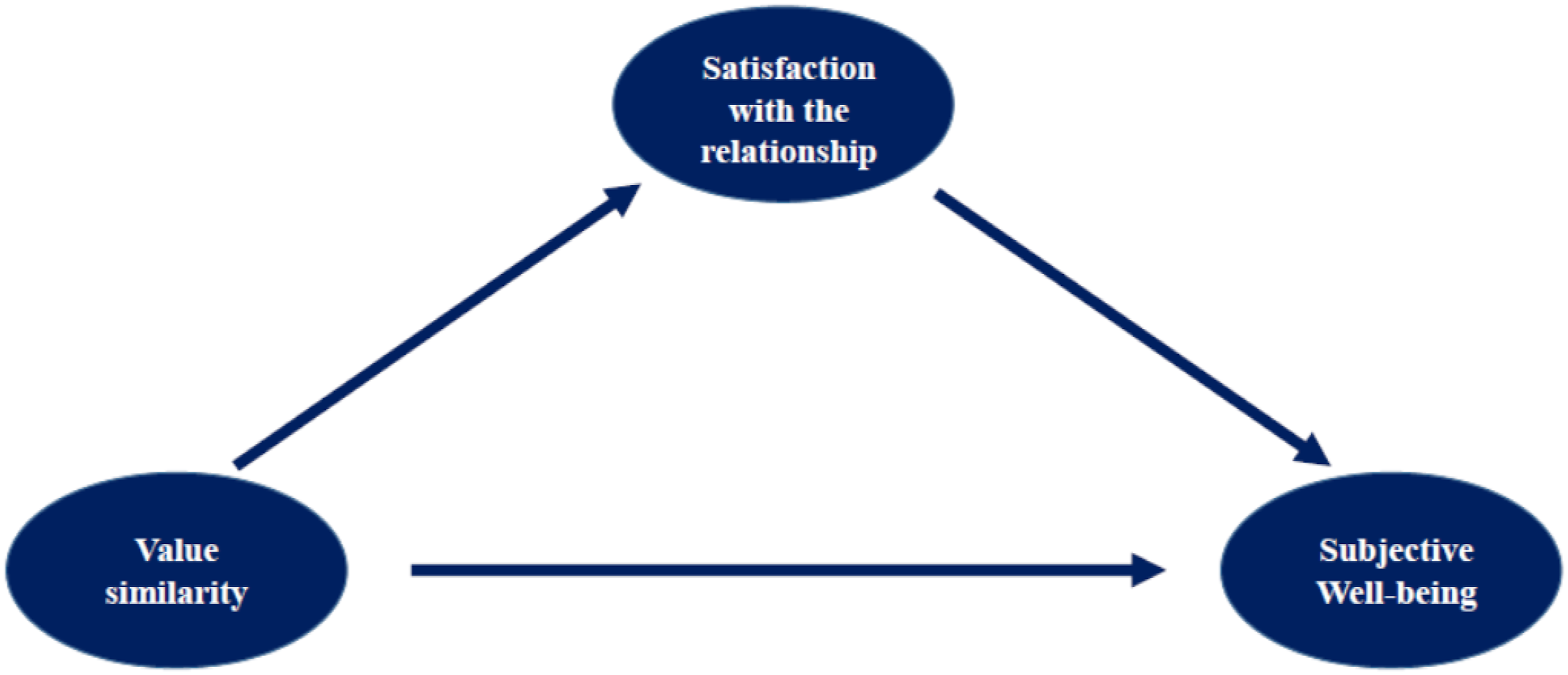
In same-gender dyads, a higher importance of connections between value similarity and subjective well-being of parents, such as relationship quality and well-being, were expected.
This study aimed to examine the following hypotheses: H1) Value similarity is associated with subjective well-being. H2) Satisfaction with the relationship is associated with subjective well-being. H3) The association between value similarity and subjective well-being is partially mediated by the relationship quality.
The value similarity of the general value orientation and the family values (also including the family differentiation) will be tested separately and parallel for gender and generations.
Method
Participants
In this study, 600 adult children with 542 of their mothers and 505 of their fathers took part. Overall, the sample included 1647 participants from Germany. Consequently, the sample consisted of 1047 dyads, which are of focus in this study. A total of 53.8% of the adult children were female. The adult children’s age ranged between 25 and 49 years (M = 33.86; SD = 6.06). The mothers were aged between 40 and 87 years (M = 61.06; SD = 7.29) and the fathers were aged between 40 and 90 years (M = 62.87; SD = 8.43). For this study, adult children were asked to take part with the parents they spent most of the time with, and they grew up with. Overall, 92.1% of the fathers and 98.2% of the mothers were the biological parent. Consequently, the fewest adult children took part with their stepparents, fosters parents, others, or did not answer this item.
A total of 543 adult children (90.5%), 454 mothers (79.3%), and 388 fathers (76.8%) were born in Germany. Most of the participating adult children lived in partnership (442, 74%) and a total of 241 (40.8%) had their own children. Regarding the parents, 88.9% (479) of the mothers and 94.6% (475) of the fathers reported to have a partner, and furthermore 83.2% of the mothers and 85.9% of the fathers were married. Most of the adult children (76.3%) attended school for 12 years or more. By contrast, 32.3% of the mothers (32.3%) and 40.0% of the fathers attend school for 12 years or more.
Procedure
This study was part of the greater research project “Interdependence in the relationship between adults and their parents.” The project was supported by a grant from the German Research Foundation (DFG). The recruiting of the participants took place in 2016 and 2017. For recruiting participants advertisements, such as newspapers, online platforms, and posters in local sports clubs or supermarkets, were used. In addition, via different online communities, the participation in this study was provided for all parts of Germany. Furthermore, some participants took part thanks to a snowball sampling, which was used for recruiting. The participation was voluntary. If anybody was interested in taking part in the study, they could contact us and got the questionnaires via post. In conclusion, participants worked on the questionnaires on their own in their chosen environment and could quit their participation at any time. For participating with both parents, the adult child received 40€. If not the complete triad (adult child, mother, and father) took part, every participant received 10€ for the participation. The questionnaires were given in paper–pencil format and were sent via post in both directions (to the participants and back). The family members could also send the questionnaires back to us separately. In addition, the contact details for the money transfer were enclosed in a separate envelope when returning the questionnaires. The unopened envelopes with the contact details were separated from the questionnaires immediately after receipt of the return. All the data collected were confidential and anonymous. All participants were informed about anonymity and trustability. For matching the data of adult children, mothers, and fathers a personal code was used, but data were not attributable to individual participants.
Instruments
All items of the questionnaires were in the German language. The participating adult children answered the items for each parent separately. In addition, both of the parents answered a questionnaire separately for their child.
General Value Orientation
A short version of the Schwartz’s Portrait Values Questionnaire (Held, Muller, Deutsch, Grzechnik, & Welzel, 2009), consisting of 10 items, was used to measure the general value orientation. Schwartz (1992) postulated the original value types. The original 10-value types were self-direction, stimulation, hedonism, achievement, power, security, conformity, tradition, benevolence, and universalism. This result is that one item assessed one value type (e.g., Sandy, Gosling, Schwartz, & Koelkebeck, 2017). The items had to be answered on a six-point Likert-type scale (from 1 = not resembling at all to 6 = completely resembling). Because the general value orientation was not unidimensional, no internal reliability was tested.
Family Values and Family Differentiation
For measuring family value orientation, the Family Value Scale (Albert, 2007) and the Family Differentiation Scale (Manzi et al., 2012) were used. Each scale included six items and they were answered on a six-point Likert scale (1= strongly disagree to 5= strongly agree). Due to calculating dyadic correlations, internal consistency was not analyzed because it is not a precondition for the dyadic correlation.
Relationship Quality
To measure the satisfaction with the relationship, the Network of Relationships Inventory (NRI, Furman & Buhrmester, 1992) was used. Satisfaction was measured by three items, which were a German adaption (e.g., Buhl 2009; Noack & Buhl, 2004a). The items had to be answered on a five-point Likert-type scale from 1 (little or none) to 5 (the most). Adult children and parents answered these questions, so that the satisfaction with the relationship was measured for all perspectives. The adult children had to answer these items for their mothers and their fathers separately. The scale of satisfaction (e.g., “How satisfied are you with the relationship to your mother/father/child?”) exhibited high internal consistency for all dyads (Cronbach’s as α > .93).
Subjective Well-Being
Subjective well-being was measured with the German version of satisfaction with life scale (Diener, Emmons, Larsen, & Griffin, 1985). This scale includes 5 items, which were answered on a seven-point Likert scale (1= strongly disagree to 7= strongly agree). The internal consistency of the satisfaction with life scales (e.g., “The conditions of my life are excellent.”) was high (Cronbach’s as α > .88).
Data Analysis
Value Similarity
For measuring value similarity, dyadic correlations were constructed. Dyadic correlations (q-correlation) are defined as the Pearson product–moment correlation between two scores’ sets within each dyad (Kenny & Winquist, 2001). The dyadic correlations were calculated separately for each dyad. Value similarity was assessed separately for general value orientation and family values. Value similarity of the general value orientation consisted of the dyadic correlation of the 10 items of the short version of Schwartz’s Portrait Values Questionnaire (Held et al., 2009). In addition, value similarity of family values consisted of the dyadic correlation of the six items of the scale of family values (Albert, 2007), and the six items of the family differentiation scale (Manzi et al., 2012).
Association of Value Similarity and Relationship Quality on Subjective Well-Being
Six separate regressions (daughter–parents, mother–daughter, father–daughter, son–parents, mother–son, and father–son regression) were calculated to predict well-being based on value similarity of the general value orientation, value similarity of the family values, and satisfaction with the relationship.
Mediation of the Relation Between Value Similarity and Subjective Well-Being
For calculating if value similarity is related to subjective well-being beside mediation effects of the relationship quality (satisfaction), 16 mediation analyses were used. Via PROCESS (Model 4, Hayes, 2017) mediation analyses were calculated for the different types of value similarity (general value orientation and family values), different dyads (daughter–mother, daughter–father, son–mother, and son–father), and perspectives (child and parent).
Results
Intercorrelations for Mother–Child and Father–Child Dyads.
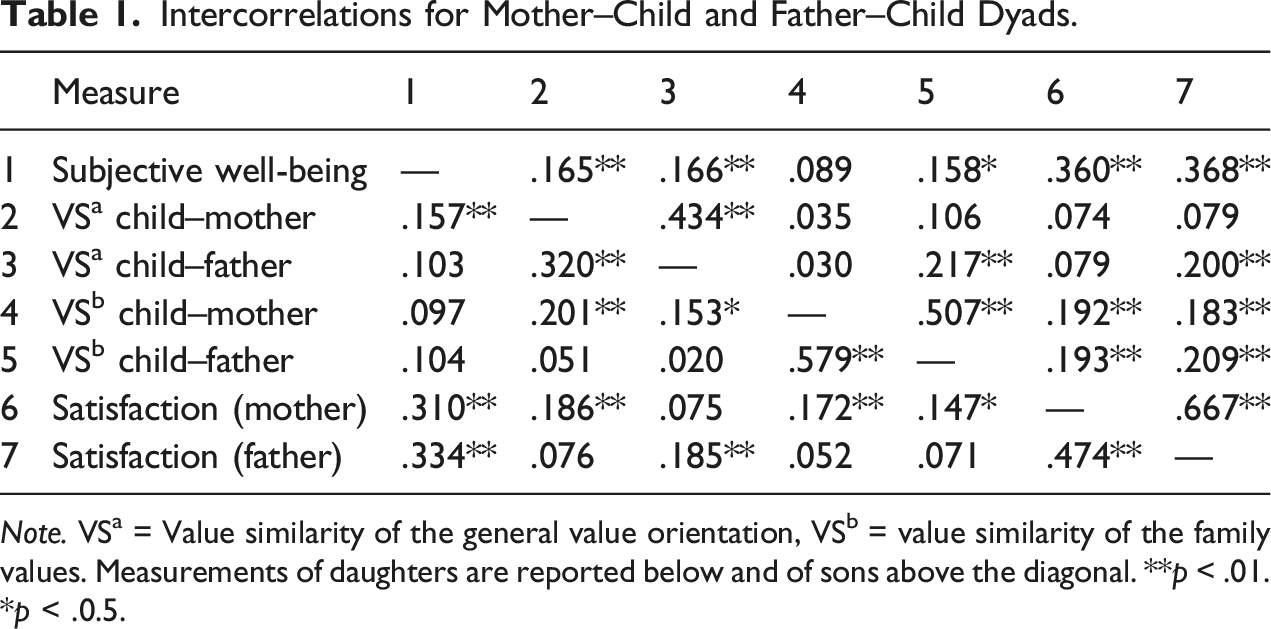
Note. VSa = Value similarity of the general value orientation, VSb = value similarity of the family values. Measurements of daughters are reported below and of sons above the diagonal. **p < .01. *p < .0.5.
Intercorrelations for Mother–Son and Mother–Daughter Dyads.
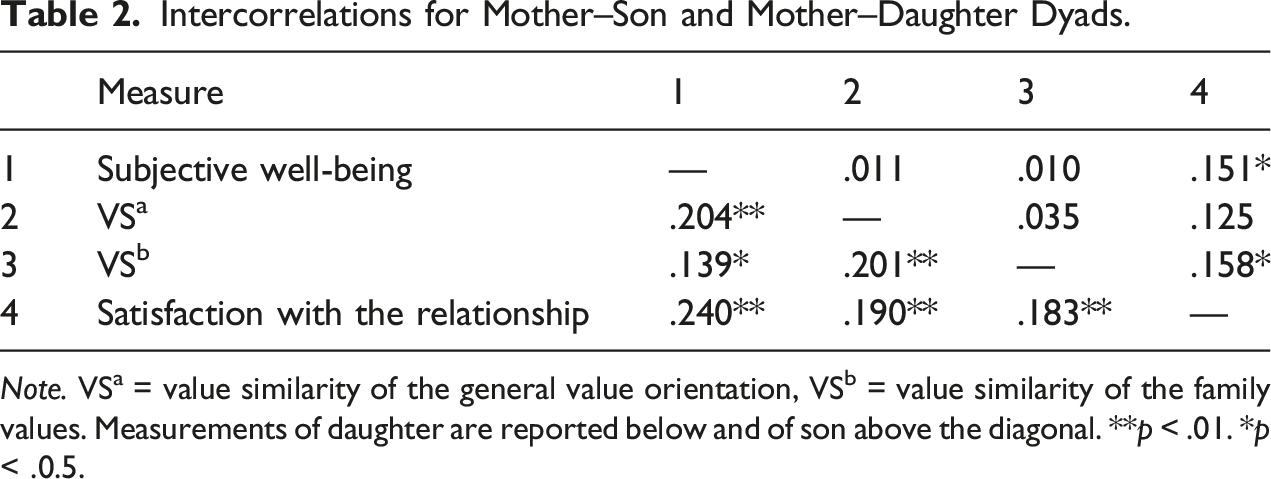
Note. VSa = value similarity of the general value orientation, VSb = value similarity of the family values. Measurements of daughter are reported below and of son above the diagonal. **p < .01. *p < .0.5.
Intercorrelations for Father–Son and Father–Daughter Dyads.
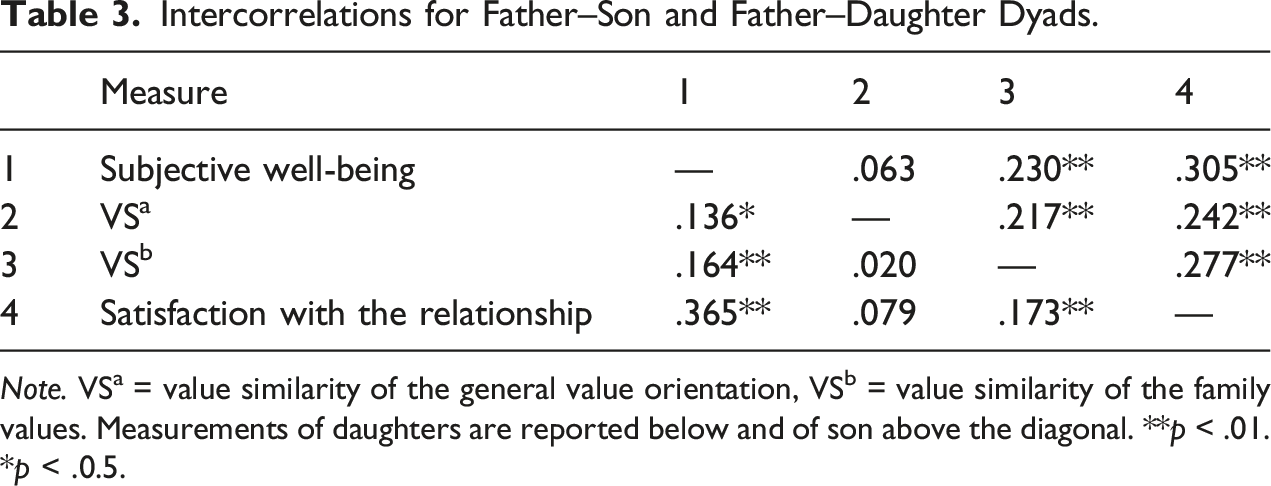
Note. VSa = value similarity of the general value orientation, VSb = value similarity of the family values. Measurements of daughters are reported below and of son above the diagonal. **p < .01. *p < .0.5.
H1: Association of Value Similarity and Subjective Well-Being
Regression: Children.
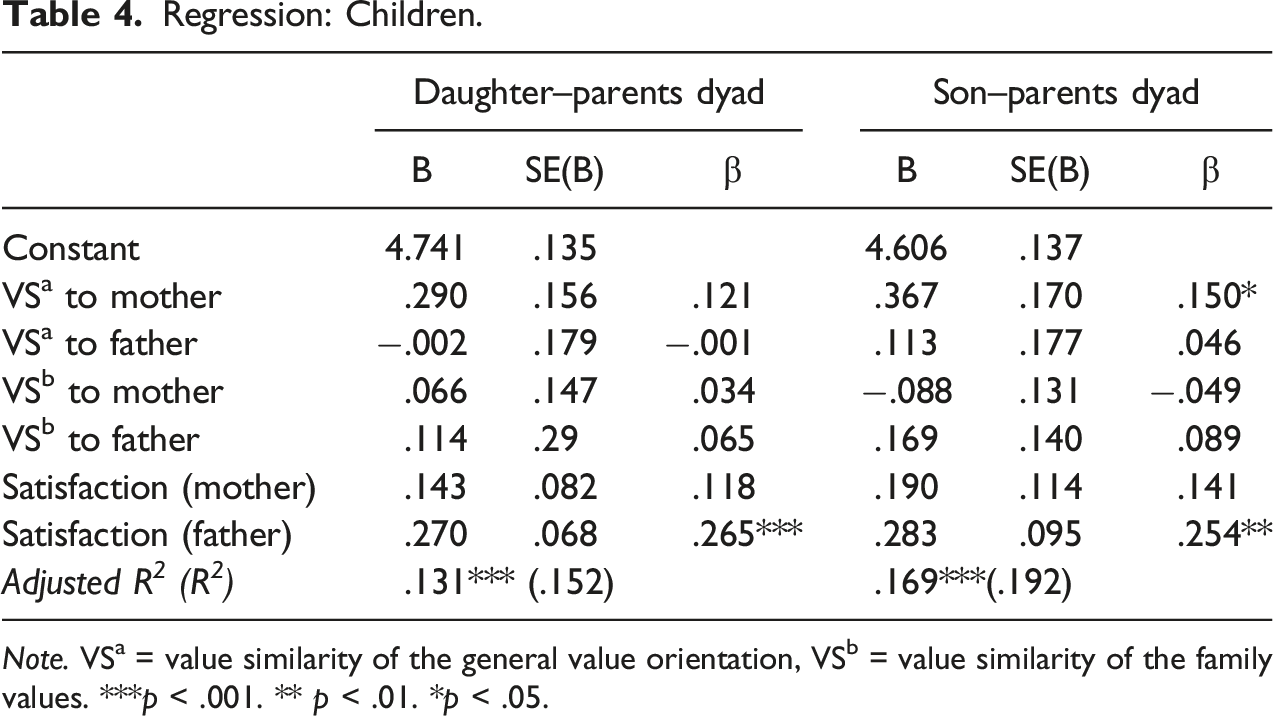
Note. VSa = value similarity of the general value orientation, VSb = value similarity of the family values. ***p < .001. ** p < .01. *p < .05.
Regression: Mothers.
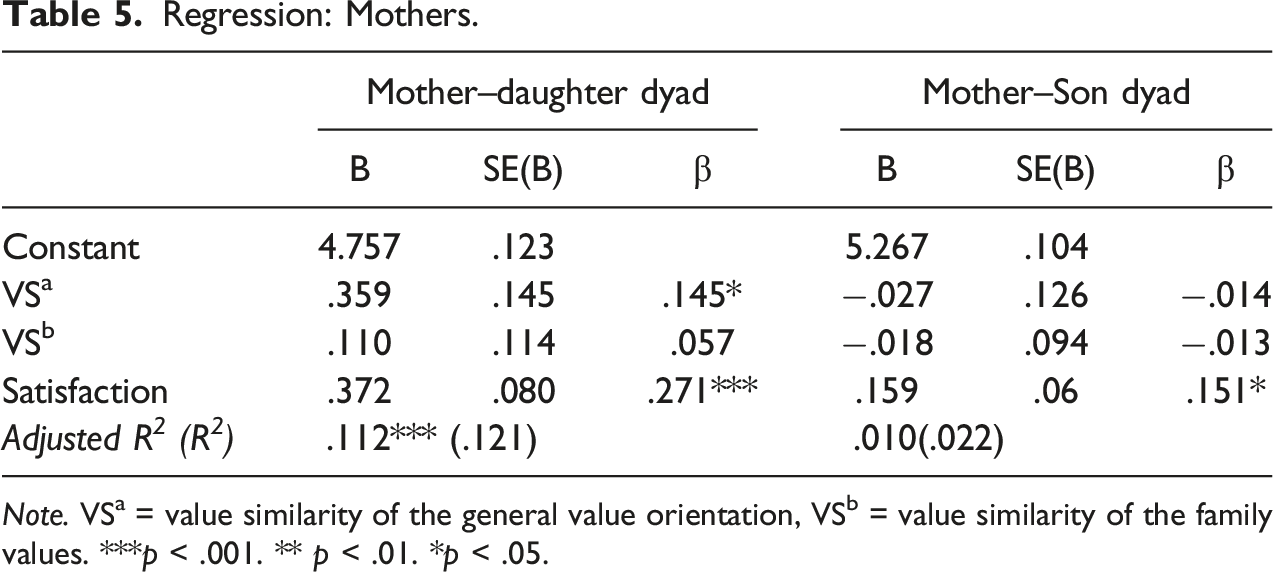
Note. VSa = value similarity of the general value orientation, VSb = value similarity of the family values. ***p < .001. ** p < .01. *p < .05.
Regression: Fathers.
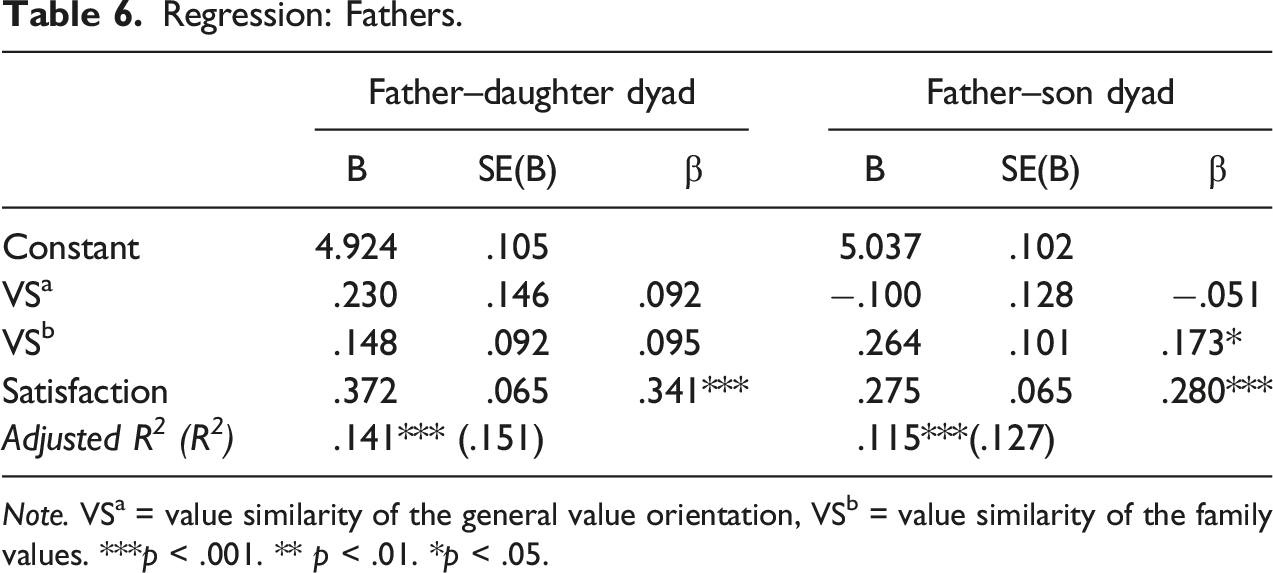
Note. VSa = value similarity of the general value orientation, VSb = value similarity of the family values. ***p < .001. ** p < .01. *p < .05.
H2: Association of Satisfaction with the Relationship and Subjective Well-Being
Adult daughters’, as well as adult sons’, subjective well-being was related to the satisfaction with the relationship to fathers (daughters: β = .265; sons: β = .254), but not to mothers. The subjective well-being of mothers was predicted by the satisfaction with the relationship to daughters (β = .271), and to their sons (β = .151). Fathers’ subjective well-being also was positively related to the satisfaction with the daughters’ (β = .341) and sons’ (β = .280) relationships.
H3: Mediation by Relationship Quality (Satisfaction with the Relationship) of the Relation of Value Similarity and Subjective Well-Being
Mediation Analysis: Children’s Well-Being.
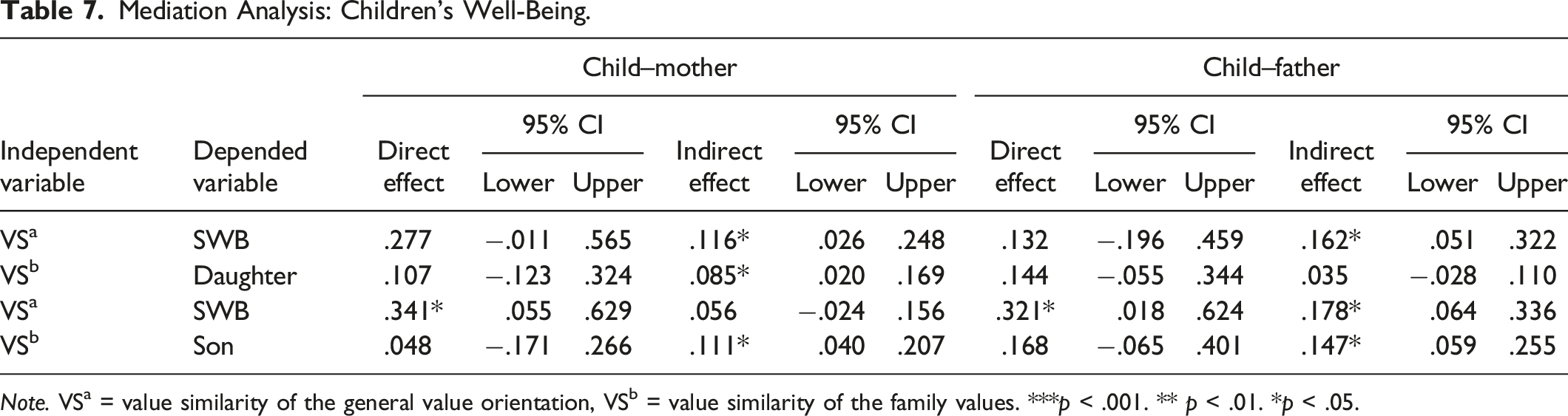
Note. VSa = value similarity of the general value orientation, VSb = value similarity of the family values. ***p < .001. ** p < .01. *p < .05.
The results show that the relation of daughters’ subjective well-being and daughters’ and mothers’ value similarity of the general value orientation is fully mediated by the daughters’ satisfaction with the relationship. Regarding the family value similarity, the relation is also fully mediated by satisfaction with the relationship. Also, in son–mother and son–father dyads, the relation of family value similarity and sons’ subjective well-being was fully mediated by the satisfaction with the relationships. Concerning the daughters–father dyads, no direct or indirect effects were found regarding the relation of family value similarity and subjective well-being of the daughters. The relation of the general value similarity of daughters and fathers, and subjective well-being of daughters, was fully mediated by the satisfaction with the relationship. In addition, we found that the relation of the general value similarity between sons’ and both of their parents’, and subjective well-being of sons, was partially mediated by the satisfaction with the relationships.
Mediation Analysis: Parents’ Well-Being.
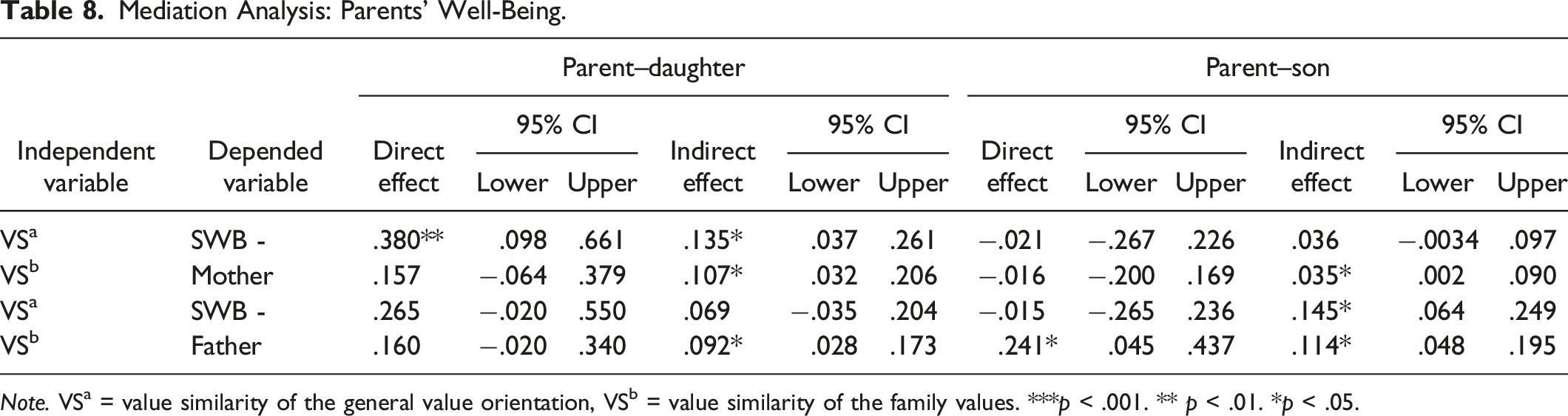
Note. VSa = value similarity of the general value orientation, VSb = value similarity of the family values. ***p < .001. ** p < .01. *p < .05.
The analyses show that the relation between mothers’ and daughters’ general value similarity and the subjective well-being of mothers was partially mediated by the mothers’ satisfaction with the relationship. The relations between family value similarity between daughters and their parents and the subjective well-being of mothers and fathers were fully mediated by the parents’ satisfaction with the relationship. No effects were found for the relation of sons’ and mothers’ general value similarity and the mothers’ subjective well-being. Same result was found for the relation of fathers’ and daughters’ general value similarity and the subjective well-being of fathers. The relation of mothers’ and sons’ family value similarity and mothers’ well-being was fully mediated by mothers’ satisfaction. Also fully mediated was the relation between fathers’ and sons’ general value similarity and fathers’ subjective well-being. Furthermore, the relation between fathers’ and sons’ family value similarity and fathers’ subjective well-being was partially mediated by fathers’ satisfaction with the relationship.
Discussion
Recent studies demonstrated the association between subjective well-being and value similarity in different social context, but the longest and important context was missing: the parent–child relationship. In conclusion, a study was needed to analyze the association between subjective well-being and intergenerational value similarity. Especially when the children have become adults, this is a fascinating time of the relationship, which underlies other mechanisms in contrast to the relationship in childhood. In adulthood, children and parents can be seen as interdependent, and show a high degree of individuality and connectedness (Baltes & Silverberg, 1994; Smollar & Youniss, 1989). Because the relationship is at eye level during this phase of life, it could be possible that both parts are more interested in sharing values and trying to benefit from each other, which could go along with higher subjective well-being.
In line with previous research (e.g., Khaptsova & Schwartz, 2016; Schwartz & Sortheix, 2018), which could show that subjective well-being is linked to value similarity in a broader social context, our study demonstrated that value similarity was associated with subjective well-being in the family context, but it depends on gender and generation. The subjective well-being of daughters is not directly linked to their value similarity to their parents, but subjective well-being is associated with satisfaction with the relationship to the fathers. We found indirect effects of value similarity regarding the general value orientation on subjective well-being. In conclusion, the association of subjective well-being of daughters, and value similarity (general value orientation), is fully mediated by the satisfaction with the relationship. By contrast, sons’ subjective well-being is associated with the value similarity to their mothers and to their fathers, beside effects of the satisfaction with the relationships. In other words, these associations are partially mediated, or son’s subjective well-being is linked to the satisfaction with the relationships to their parents and to the value similarity to both parents. But these associations concerned general value similarity and not value similarity of family values. Regarding the mothers’ subjective well-being, we found significant associations with the general value similarity to their daughters. This association was partially mediated by the satisfaction with the relationship. This is in line with previous research, which identifies the relationship as a partial mediator (Sortheix & Lönnqvist, 2015). In addition, associations of mothers’ subjective well-being and the family value similarity to sons and daughters regarding family values were fully mediated by satisfaction with the relationship. No effects were found regarding general value similarity to their sons. Fathers’ subjective well-being is linked to satisfaction with the relationship to their children, and to family value similarity to their sons. In conclusion, this association is partially mediated. Indirect effects were found for the association of fathers’ well-being and general value similarity to their sons, and family value similarity to their daughters.
All in all, value similarity to fathers and satisfaction with the relationship to their fathers seems to be more important for children, or especially for sons. For mothers’ subjective well-being, it seems to be more important to be equal to their daughters than to their sons, and in addition, the satisfaction with the relationship to sons and daughters seems to be important, but by trend more important to daughters. For fathers’ well-being, the satisfaction with the relationship to sons and daughters is important, besides having similar family values to sons. These findings do not follow a uniform way. In other words, no uniform tendencies, such as uniform generation or gender effect, could be detected. More associations between subjective well-being and value similarity were found in same-gender dyads than in mixed-gender dyads. This does not apply for daughters’ subjective well-being because no direct associations between subjective well-being and value similarity were found. The results of the daughters’ dyads could be explained by the intergenerational stake hypothesis (Giarrusso et al., 2004). Parents could invest more emotionality in the relationship to their daughters, and especially mothers could see their daughters as a continuation of themselves, so that value similarity between mothers and daughters is important for the mothers’ subjective well-being, but not for the daughters’ subjective well-being. For the parent–son dyads, it works the other way round. For sons’ subjective well-being, it is important to have a similar general value orientation to their mothers and their fathers, but for the parents’ subjective well-being, it is not important. Only for fathers’ subjective well-being it is important to have similar family values to their sons. These findings contradict the intergenerational stake hypothesis (Giarrusso et al., 2004).
The associations between the satisfaction with the relationship, as a part of relationship quality, and the subjective well-being, were also more presented in same-gender dyads. The daughters’ subjective well-being was again not linked to relationship quality in same-gender dyads, but were linked to the relationship quality to fathers. Thus, the satisfaction with the relationship to mothers seems not to be important for the children’s well-being.
Limitation and Proposed Future Research
This study provides another important step in the research of subjective well-being on the one hand, and value similarity and the parent–child relationship on the other hand. The results of this investigation gave insights into the uninvestigated association of subjective well-being and value similarity between adult children and their parents. Regarding this context, it would have been desirable to focus on the whole triads instead of the dyads separately. For example, the father–daughter dyad could be analyzed in combination with the mother–daughter dyad because both dyads, as a part of one family constellation, could influence each other. Furthermore, to get better insights into the processes and the causality, a longitudinal study would be preferable. However, we worked with a German sample, so that the interpretations are limited to Western societies. The German age-graded dynamics, such as individuality or connectedness, are more or less similar to the aged-graded dynamics of the United States (e.g., Furman & Buhrmester 1992; Laursen, Wilder, Noack, & Williams 2000; Noack & Buhl 2004b). But further cultural comparisons are missing. Consequently, future investigations could deal with cultural comparisons regarding associations of subjective well-being and intergenerational value similarity.
Conclusion
We could provide an addition to the previous recent studies which deal with the association between subjective well-being and value similarity. This investigation gives interesting insights into different important topics (subjective well-being, parent–child relationship in adulthood, and value similarity) and could connect these topics. Furthermore, we could underline partially the intergenerational stake hypothesis, as well as the solidarity theory. In addition, we could emphasize the importance of the parent–child relationship for human beings because subjective well-being is linked to relationship quality to the relatives in a way, and also associated with the value similarity for mothers, fathers, and sons. To conclude, it should also be mentioned that the results have practical relevance for psychotherapy. These findings suggest that it is necessary to consider the family of origin in psychotherapy to promote subjective well-being.
Footnotes
Author Note
Christian Hoellger, and Heike M. Buhl, Educational and Development Psychology, University of Paderborn; Sabrina Sommer, Educational-Psychological Assessment and Intervention, University of Paderborn.
Declaration of Conflicting Interests
The author(s) declared no potential conflicts of interest with respect to the research, authorship, and/or publication of this article.
Funding
Part of the project “Interdependence in the relationship between adults and their parents” and funded by the German Research Foundation (DFG).
