



Abstract
Sweden is among the countries with the highest share of single households in Europe, but not all are truly partnerless. We examine the potential vulnerability of individuals in living-apart-together relationships at age 30 and above, analyzing data from the Swedish GGS. We apply multinomial logistic regression. The results show that individuals engaging in LAT occupy an intermediate position in terms of socioeconomic resources (homeownership and economic situation), being less advantaged than co-residents but better-off than singles, especially men. We find no association between ill-health and living in a LAT arrangement. Having previous family experiences (unions with or without children) is positively associated with LAT, but childhood family composition does not matter. The majority of LAT individuals claim to be constrained to living-apart-together rather than LAT being their preferred alternative. Women and the elderly (aged 70+) are, however, more likely to engage in LAT by choice and appreciate their non-residential partnerships.
Rationale
With about one-fifth of the population living alone and close to 40% of all households consisting of only one person, Sweden is among the countries with the highest share of single households in Europe (Eurostat 2020). Living without a partner beyond young adulthood has often been associated with vulnerability in terms of health (Umberson & Montez, 2010), one’s socioeconomic position (Sandström & Karlsson, 2019), and access to social support (de Jong Gierveld, Dykstra, & Schenk, 2012), among others. Around one quarter of such “partnerless” individuals are, however, in committed relationships (Connidis, Borell, & Karlsson, 2017; Reimondos, Evans, & Gray, 2011). They have a stable intimate partner with whom they do not share a household, as also highlighted in the name of such non-traditional arrangements: living-apart-together (LAT). The low but non-negligible incidence of LAT unions at a level of, at most, 10% in the adult population across Europe, North America, and Australia (Liefbroer, Poortman, & Seltzer, 2015; Pasteels, Lyssens-Danneboom, & Mortelmans, 2017) is part of the de-standardization of family life courses, associated with postponed transitions, declining relationship stability, as well as parenthood and parenting becoming increasingly complex given growing numbers of separated, step, and blended families (see Oláh, Kotowska, & Richter, 2018 for an overview). Research on LAT thus contributes to a more informed understanding of family diversity and its implications for individuals and societies as the complexity of family biographies increases.
Given that LAT is most likely to be a transitional stage in the family formation process in young adulthood (Ayuso, 2019; Upton-Davis, 2012), we focus in this article on people in their thirties and beyond who can be expected to consider such partnership arrangements to be a more lasting state in their family career, related to choice or constraints (Ayuso, 2019; Liefbroer et al., 2015). In any case, LAT relationships are less institutionalized than even non-marital cohabitation, considering the rights and obligations of the partners toward each other (Bowman, 2017; Connidis et al., 2017). Nevertheless, living-apart-together is often the preferred option according to qualitative studies, as it provides a high level of autonomy, social and financial independence, and room for gender-egalitarian arrangements (Duncan, Carter, Phillips, Roseneil, & Stoilova, 2013; Karlsson & Borell, 2002; Upton-Davis, 2012). A question of considerable importance for policymaking, which we seek to shed more light on here, is then the potential vulnerability of individuals involved in such a non-traditional family configuration (the LATs) in the Swedish population, relative to co-residents and singles without stable intimate partners, given the lack of relevant studies based on recent large-scale data for Sweden.
State of the Art
The Concept of Vulnerability
Despite extensive literature on vulnerability in social policy, law, philosophy, and ethics, there is no common definition of this multifaceted concept (Brown, Ecclestone, & Emmel, 2017). For our purpose in this article, neither a focus on universal vulnerability advocated by Fineman (2008) nor the suggestion of Wrigley (2015) to simply use the concept as a linguistic marker for the need to give special attention to a person or a group given potential harm seems particularly useful. Instead, we rely on Goodin’s (1985) welfare consequentialist notion of vulnerability. According to that, vulnerability is relational and closely related to dependency, given reduced capacity to protect one’s own interest with respect to material as well as emotional well-being. The moral obligation to protect individuals and groups who are in a weak position is to be met primarily via the welfare state, which accentuates our quest for a better understanding of the potential vulnerability of individuals in such non-traditional family configurations as LAT. As an added nuance, we distinguish between inherent and situational vulnerability, based on its source, as outlined by Mackenzie, Rogers, and Dodds (2014). Inherent vulnerability is connected to sources seen as immanent to the human condition, whereas situational vulnerability is context specific.
What Do We Know About the Vulnerability of LATs?
A thorough review of literature reveals that an explicit focus on the vulnerability aspect is lacking in the extensive body of research on living-apart-together. We found only a few studies with such a specific focus; these addressed women’s agency, more specifically how physical, financial, and emotional vulnerabilities prompted women to engage in LAT in the UK, relying primarily on in-depth interviews (see Carter & Duncan, 2018; Duncan, 2015). However, a lack of explicit attention does not mean that previous research has no findings of relevance with respect to the potential vulnerability of individuals engaging in LAT in various contexts, even though for Sweden specifically, we found only small-scale qualitative studies examining this type of non-residential partnership (see Connidis et al., 2017 for overview).
To start with, the socioeconomic situation is an inherent source of vulnerability, and its various aspects are addressed in studies that include or focus on LAT. With regard to that, the overrepresentation of highly educated individuals in non-residential partnerships seems to be a rather consistent finding in literature (see Castro-Martín, Domínguez-Folgueras, & Martín-García, 2008 for Spain; Coulter & Hu, 2017 for the UK; Ermish & Seidler, 2009 for the UK and Germany; Liefbroer et al., 2015 for Eastern Europe; Reimondos et al., 2011 for Australia; Sthrom, Seltzer, Cochran, & Mays, 2009 for the US). This may be related to their liberal value orientation, but may also question vulnerability concerns with respect to such arrangements given the greater earning power of the more educated. Another aspect in this realm is labor market attachment, for which research findings are ambiguous, possibly because of the different age ranges and welfare systems analyzed in the various studies. Economic inactivity has been linked to both higher (see Régnier-Loilier, Beaujouan, & Villeneuve-Gokalp, 2009 for France) and lower propensity to LAT (see Coulter & Hu, 2017 for the UK), with no association found in a US study between being employed and various partnership statuses (Strohm et al., 2009). Furthermore, non-residential partnership allows for household income to remain below benefit eligibility thresholds (Coulter & Hu, 2017) making such arrangements especially appealing to those less well-off. At the same time, people with few socioeconomic resources have been found more likely to be single than living-apart-together (Liefbroer et al., 2015 for cross-national analysis). The latter finding, along with the frequently mentioned reason in qualitative studies of LAT protecting from asset depletion (Connidis et al., 2017; Upton-Davis, 2012), suggests that individuals in comfortable economic situations, who clearly do not see themselves as vulnerable, may be as likely to appreciate LAT as disadvantaged people. An especially valued asset is one’s home, but the link between living arrangements, including LAT and homeownership, is hardly addressed in research. A study on people aged 24–40 years in Germany, the Netherlands, and the UK found no differences in homeownership between LATs and singles, with the co-residents being the most likely to own their housing (Thomas & Mulder, 2016). A more recent US study showed similar results for middle-aged and older adults (Wu, 2019).
Second, inherent vulnerability also relates to the health status of individuals involved in LAT as compared to those in other living arrangements. A wide range of research has established that single living is associated with various negative health outcomes, such as higher disease load (Carr & Springer, 2010), substance abuse and mental health issues (Simon, 2014), and disability (Sandström et al., 2021a, 2021b), as singles lack the emotional and economic support provided by conjugal reciprocities in co-residential relationships. Selection mechanisms on the partner market can also play a role as individuals with ill-health tend to have a lower probability of finding a partner in the first place (Tumin, 2016) and have a higher probability of union disruption if they enter a relationship (Singleton, 2012), compared to healthy people. However, most of this research uses household composition or civil status as a proxy for the relationship status, not being able to distinguish between the truly single and those individuals who are in living-apart-together arrangements. It is thus unclear if and to what extent individuals in LAT relationships exhibit poorer health than co-residents, which would suggest vulnerability, while probably having fewer health problems than the truly partnerless (see Rapp & Stauder, 2020; Schneider, Rapp, Klein, & Eckhard, 2014; Ševčíková et al., 2021 for some first clues).
Third, the life course itself may also shape inherent vulnerability, highlighted in the principles of linked lives and earlier experiences influencing choices later in life (Elder, 1994; Settersten, 2015). Specific family experiences in childhood (e.g., parental breakup) and adulthood (previous partnerships, children) can affect decisions on whether to opt for such intermediary family arrangements as LAT. Growing up with a single parent may bring along feelings of vulnerability (Härkönen 2014), which in turn may reduce willingness to establish a joint household with a partner (see, e.g., Sthrom et al., 2009 for the US). LAT has been shown to be common also among people who experienced a breakup of their own relationship with or without children, or the death of a partner (see Connidis et al., 2017; Liefbroer et al., 2015). Such experiences, especially of a union dissolution, can lead to lower attachment security, hence resulting in perceived vulnerability with respect to future relationships (Diamond, Brimhall, & Elliott, 2018; Simonič & Rijavec Klobučar, 2017) and a need to protect resources (Connidis et al., 2017). Single mothers have been seen as especially likely to live-apart-together (Coulter & Hu, 2017), which suggests a gendered effect with respect to previous family experiences.
A strain of research, dominated by small-scale, mainly qualitative explorations in Sweden, the Netherlands, the UK, the US, and Australia have indeed suggested the reasons for LAT to be gendered, in particular that women choose LAT to “undo gender” (Benson & Coleman, 2016; de Jong Gierveld, 2002; Haskey & Lewis, 2006; Karlsson & Borell, 2002; Upton-Davis, 2012). Such claims have, however, been challenged based on survey evidence complemented with in-depth interviews in the UK (Duncan, 2015; Duncan, Carter, Phillips, Roseneil, & Stoilova, 2013, Duncan, Phillips, Carter, Roseneil, & Stoilova, 2014). Age is another important variable, with substantial empirical evidence showing it to matter for LAT (Ayuso, 2019; Pasteels et al., 2017). Linked to the life course approach, such partnerships have been seen to dominate in ages of young adulthood, especially prior to stable labor market establishment, as well as in older ages, then mostly for autonomy-related reasons (see, e.g., Duncan et al., 2013, 2014; Liefbroer et al., 2015; Upton-Davis, 2012).
Lastly, some studies provide insight into the situational vulnerability of individuals living-apart-together, based on their perceptions of preference for, or being constrained to, LAT (see Duncan & Phillips, 2010; Liefbroer et al., 2015). In as much as constraints are related to limitations of one’s agency and capabilities, that prevent people from pursuing a desired (co-residential) living arrangement, they are a good proxy for the vulnerability of the agent in question.
Given our conceptual ground and previous empirical findings, we aim to assess the relative vulnerability of LAT individuals compared to co-residents and actual singles across three different dimensions: i) socioeconomic resources ii); health status; and iii) experiences of union disruption. In addition, focusing only on respondents living-apart-together, we assess their agency in choosing LAT relationships as their living arrangement.
Data and Methods
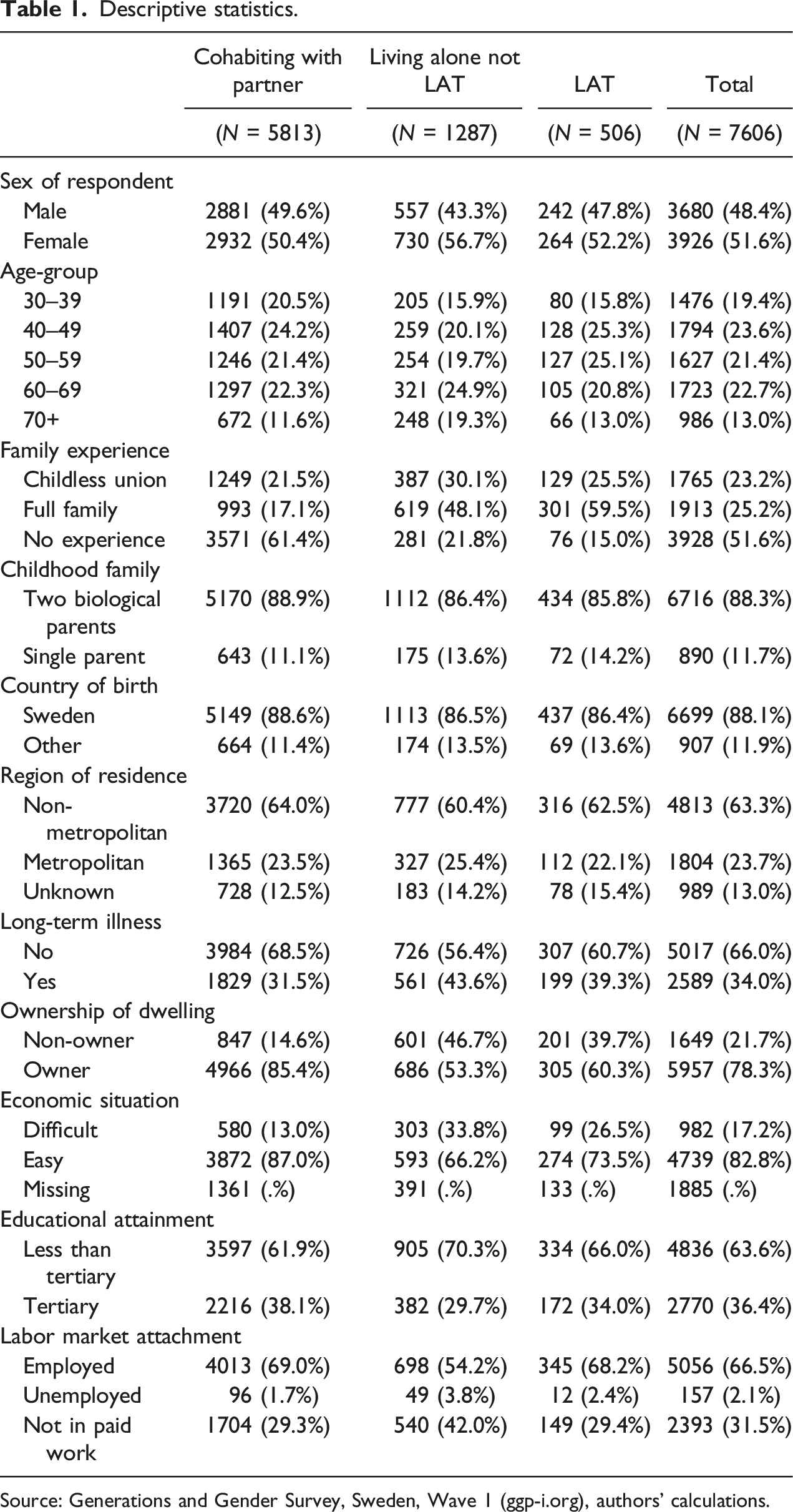
Descriptive statistics.
Source: Generations and Gender Survey, Sweden, Wave 1 (ggp-i.org), authors’ calculations.
We applied multinomial logistic regression as our analytical tool. The results are presented in the form of relative risk ratios of living in a LAT relationship compared to “co-residence with a partner” and “living alone not LAT” (i.e., not even having a non-resident partner). The final model was chosen by means of Akaike information criterion from a number of candidate models to ascertain the model specification that provided the best overall fit. Additionally, standard diagnostics for generalized linear models were performed to ensure the adequacy of the final model specification (Pregibon, 1980). We also estimated a binomial logistic regression model for respondents in non-residential partnerships only, to see who felt constrained to such living arrangements, rather than LAT being their preferred option.
Analytical Design: Variables and Models
Partnership status at the time of the interview is our dependent variable in assessing the vulnerability of LAT individuals relative to those in other living arrangements. We combined information about having an intimate partner while not sharing a home together (“yes” vs. “no”) and the household type (“living alone,” “single parent,” “living with parents,” “single parent living with parents,” “couple with no children,” “couple with children,” “couple with parents,” “couple with parents and children,” and “other”). Based on these, we distinguished between respondents living in a co-residential partnership regardless of marital status (5813), in a LAT relationship (506), and “alone,” that is, not having a partner but possibly co-residing with other family members (1287). With respect to LAT, we did not differentiate between respondents, reporting different-sex or same-sex partnerships. Unfortunately, it is not possible to see from the data whether the respondents classified as LAT are married to, or if they were married earlier to, their LAT partner at the time of the interview.
To shed more light on the potential vulnerability of individuals living-apart-together in Sweden, we focused on four aspects in this article. For the first, we assessed socioeconomic vulnerability based on four indicators: educational attainment, labor market attachment, dwelling ownership, and economic situation. To define the highest level of education attained, we relied on the International Standard Classification of Education, distinguishing between those with “less than tertiary” (ISCED 1–4) and those with “tertiary” (ISCED 5–6) education. For labor market engagement, we differentiated between being “employed,” “unemployed,” and “not in paid work” (students, retired, etc.) at the time of the interview. As a proxy for assets, we used information on whether respondents owned or rented their housing (“non-owner” vs. “owner”), while economic situation at the time of the interview was assessed as “difficult” versus “easy” based on their subjective ability to make ends meet.
Second, vulnerability regarding health status was accounted for based on the respondent’s perception of having a long-term illness (“yes” vs. “no”). Third, we assessed what we call partnership-related vulnerability, meaning first-hand experiences of family disruption at very young ages or in adulthood, based on childhood family composition and their own previous family experiences. The childhood family variable accounted for whether a respondent grew up in an intact family, that is, raised by his/her two biological parents at least up to age 15, or not (i.e., raised by single parent). For family experiences in adulthood, we distinguished between three categories: “childless union” (previous co-residential partnership but no children), “full family” (co-residential union and children from previous relationship), and “no experience” (neither co-residential partnership, nor children from previous relationship).
Fourth, we examined agency vulnerability (the term is borrowed from Kosko, 2013), meaning the risk of being limited in one’s ability to make crucial decisions that affects one’s own well-being. Focusing only on respondents in non-residential partnerships, we accounted for whether the living arrangement was related to preference or constraints, based on the question “Are you living apart because you (both) do not want to live together or are other circumstances preventing you from living together?”. We defined responses as indicating preference when either the respondent, or both the respondent and the LAT partner, wish to keep their own households. Any other answers were considered constraints.
Apart from our vulnerability indicators, the analyses included a number of additional control variables that have been found to be associated with LAT in previous studies. With respect to the demographic profile of LATs, we controlled for respondent’s sex and age. Age was categorized in 10-year age-groups starting with 30–39 years up to ages of 70 or older. We also controlled for the effects of factors which may be considered partly demographic or partly cultural, namely, country of birth and region of residence at the time of the interview. As for the former, we distinguished between being born in “Sweden” versus “another” country (see, e.g., Régnier-Loilier et al., 2009, for addressing similar aspects). With respect to region, some studies have suggested LAT being more prevalent in big cities (see Ermish & Siedler, 2009 for Germany); hence, we created a variable with categories “metropolitan” versus “non-metropolitan” areas, and defined a third category (“unknown”), where such information was not available in the dataset in order to sustain the size of the analytical sample (see Table 1 in the next section for a descriptive overview of the sample).
We ran two sets of models, as a fairly large proportion of respondents had missing responses on their economic situation. In the first set of models, we analyzed the full sample of 7606 cases not including the subjective ability to make ends meet. For a reduced sample, we added perceived economic situation to the model, based on the 5721 individuals (including 366 out of the 506 respondents in LAT relationships) that also answered this question.
Results
Descriptive Overview
The descriptive statistics (Table 1) reveal some interesting differences across partnership statuses. We find an overrepresentation of women among the singles in line with previous research (Sandström & Karlsson, 2019), which is explained primarily by women’s lower rates of re-partnering after a breakup or the death of a partner (Bernhardt & Goldscheider, 2002). Co-residents show a more youthful age pattern than individuals in other living arrangements, whereas the truly single have their highest share at ages of 60 years old and above compared to those in partnerships. Among the oldest respondents (ages of 70 plus), we find a higher share of LATs than of co-residents. Regarding country of birth and region of residence, we see hardly any differences in the distribution between partnership statuses.
With respect to socioeconomic vulnerability, the share of tertiary educated is over one-third in the co-resident group and the LATs, but less than 30% among the singles. The share of respondents not in paid work is highest among the truly partnerless, above 40%, but around 30% both among those who co-reside with a partner and the LATs. Almost 40% of respondents who live-apart-together and nearly half of the truly partnerless do not own their homes, compared to one-seventh of the co-resident group. Around one-fourth of the LATs and one-third of the singles assess their economic situation to be difficult, while only about one-eighth of the co-residents do so.
Regarding vulnerability related to health, nearly 40% of LATs and slightly more among singles report having a long-term illness compared to less than one-third of co-residents. As for partnership-related vulnerability, we find no differences for childhood family across living arrangements. Regarding previous family experience, respondents who live-apart-together stand out, as nearly 60% of them had a co-residential union with children before their current relationship, compared to less than half of the singles and around one-fifth of the co-residents. The LATs also show the smallest share of no previous family experience, with only about one-sixth of them in that category. Based on this descriptive overview, people who live-apart-together tend to occupy an intermediary position, with more disadvantages than the co-residents, but appearing somewhat better-off than the singles.
Multinomial Analysis
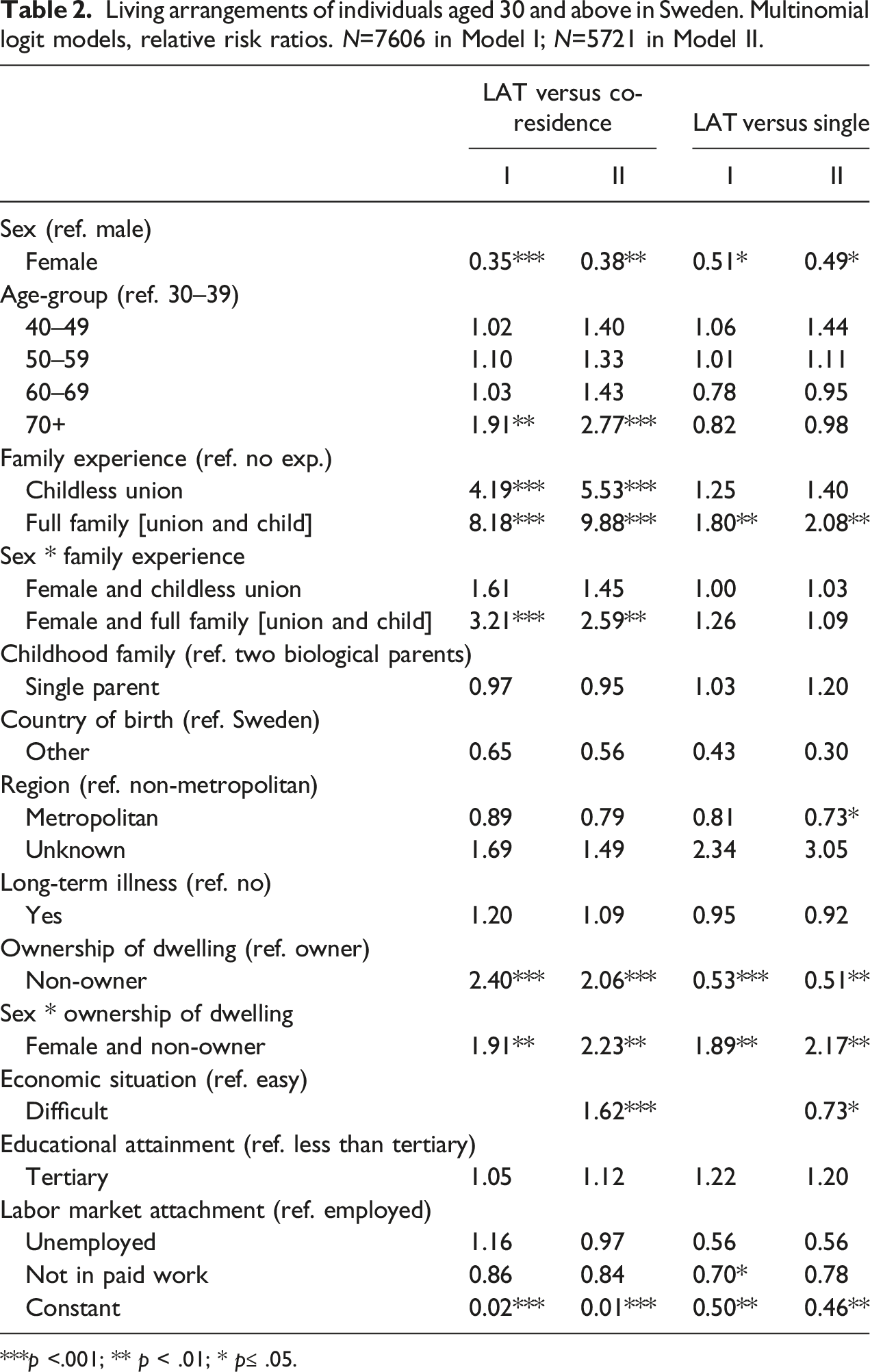
Living arrangements of individuals aged 30 and above in Sweden. Multinomial logit models, relative risk ratios. N=7606 in Model I; N=5721 in Model II.
***p <.001; ** p < .01; * p≤ .05.
The results indicate no clear age pattern for LAT compared to the single group. Vis-á-vis co-resident respondents, only the oldest age-group, that is, people in their seventies, stand out as being significantly more likely to be in a LAT relationship than those in their thirties, ceteris paribus (Models I and II). In contrast, region of residence shows a significant association with LAT compared to the truly partnerless, but not to the co-residents, when also economic situation is included in the model. Individuals in metropolitan areas seem less likely to live-apart-together than to be single, compared to non-metropolitan areas (Model II). Country of birth shows no link with any living arrangement.
As for our main interest in this article, that is, vulnerability, a nuanced picture emerges. For the first, with respect to socioeconomic vulnerability, we find no significant association for educational attainment with living-apart-together compared to other living arrangements (Models I and II). Neither is labor market attachment associated with LAT vis-á-vis co-residents, but individuals living-apart-together have a 30% lower relative risk of not being in paid work compared to singles (Model I) when economic situation is not accounted for. With respect to assets, LAT individuals are much more likely to rent their homes than individuals living with a partner, but compared to singles they are more likely to own their housing (Models I and II). The interaction between respondent’s sex and dwelling ownership reveals that women who live-apart-together have a more disadvantaged economic position than LAT men, being 1.91 times more likely not to be a homeowner. Also, they are 4.6 times more likely to rent their housing than their counterparts in co-residential unions (Model I). LAT men are 47% less likely than single men not to own their dwelling. Accounting for the interaction showing that LAT women are 1.89 times more likely to rent than men, we find no difference in the relative risk to own one’s housing (IRR: 1.00) between single women and women in LAT relationships (Model I). Hence, the more advantaged position for LATs compared to singles regarding homeownership only pertains to men and not to women. In Model II, we include subjective economic situation, restricting the analysis to respondents that answered this question. We find that individuals living-apart-together have a 62% higher relative risk to experience a difficult economic situation than an easy one via-á-vis co-residents, while their relative risk compared to the truly partnerless is 27% lower of having difficulties in making ends meet.
Second, we examined the potential vulnerability of individuals living-apart-together with respect to health status. We find no significant association with having long-term illness for LATs either compared to co-residents or to the truly partnerless (Models I and II) when measures of socioeconomic situation are included in the model.
Third, we find that partnership-related vulnerability in terms of having experienced a union breakup is strongly associated with living-apart-together, as indicated by previous family experience, but no link is seen with childhood family composition. Compared to the co-residents, LAT individuals are more than 8 times as likely to have full previous family experience, and 4 times as likely to have had a union but no children as to have no family experience. Vis-á-vis singles, LAT individuals have 80% higher relative risk of having experienced a previous union with children than lacking any family experience (Model I). Taken these findings together, children seem to reduce the probability for a parent to form a new co-residential union after a breakup, as also previous research on re-partnering in Sweden has suggested (see Bernhardt & Goldscheider, 2002), but they do not hinder parents from entering a non-residential intimate relationship.
Based on the literature indicating a male advantage in re-partnering (see Ivanova, Kalmijn, & Uunk, 2013; Raley & Sweeney, 2020 for overview of relevant studies), we have also tested for interaction between respondent’s sex and previous family experience. The results show that single mothers are significantly more likely to be in a LAT relationship than single fathers, whereas women having no previous family experience or a union without children are less likely than men to live-apart-together. Regarding the gender differences across various family experiences, it is important to note that significant differences notwithstanding, the practical implications are modest when we look at the differences in terms of average marginal effects (not shown). Single mothers are approximately 2% more likely to be in a LAT relationship than single fathers, while men with no family experience or having been in a childless union are about 2% more likely to LAT than their female counterparts. The most important difference is between parents and non-parents, as both men and women in a LAT relationship are more likely to have children from previous unions when we compare them both to co-residents and to singles.
LAT: Due to Preference or Constraints
An advantage of using GGS-data is that we have information on the subjective reasons for living-apart-together and thus on whether the respondents consider their LAT status to be the result of a choice or of constraints. Out of the 506 respondents in a LAT relationship, 499 answered the question whether this was a preferred living arrangement or if specific circumstances prevented them from moving in with their partner. 56.7% of them reported that they were “constrained to live apart by circumstances,” while 43.3% claimed that the non-residential union was their choice. This difference in the proportions is statistically significant (p > .0001). Although a substantial minority seems to live apart together due to preferences, it indicates that constraints toward co-residence matter more for such arrangements in Sweden. This can be interpreted as LAT individuals experiencing a lack of freedom of choice about their living arrangement, related to their agency vulnerability. It is unclear, however, if they are more dissatisfied with their living arrangement than singles and co-residents, as comparable questions on choice versus constraints were not asked to non-LAT individuals in the GGS.
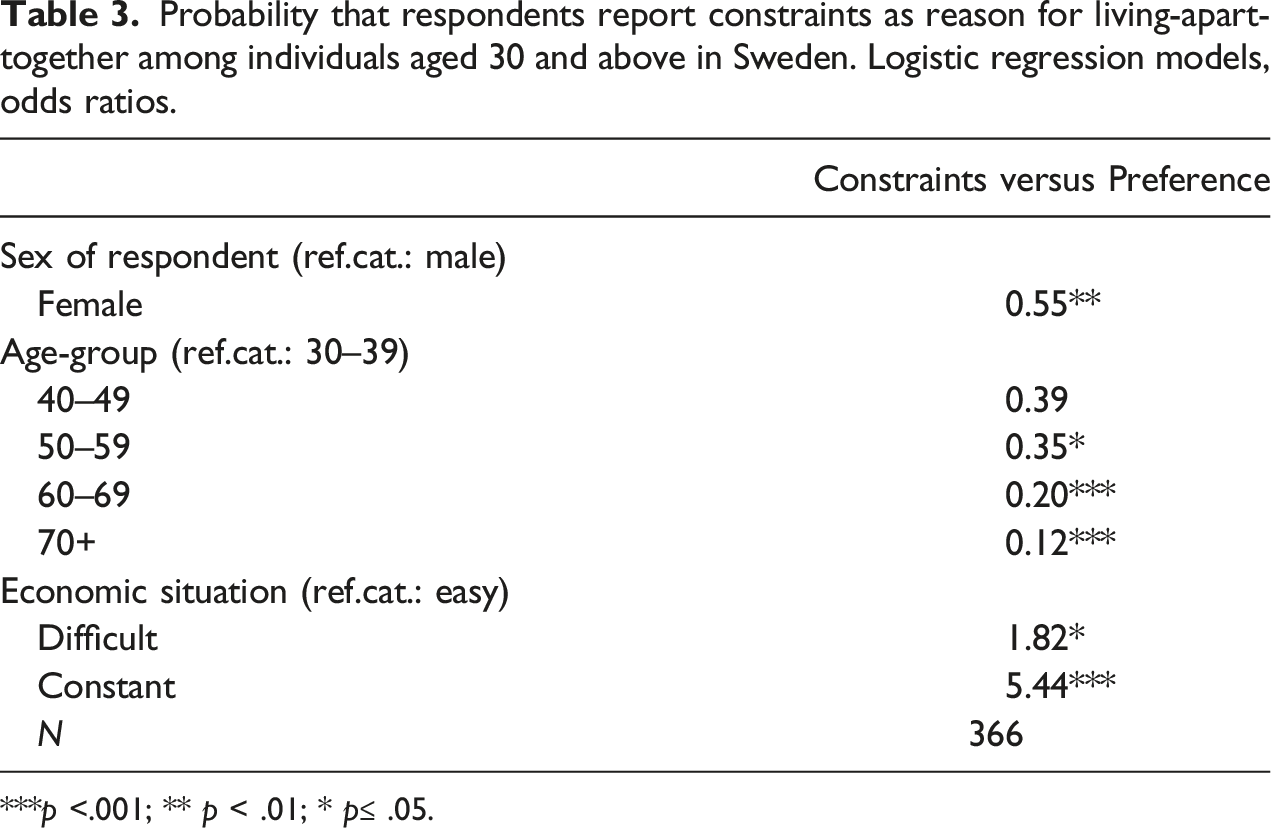
Probability that respondents report constraints as reason for living-apart-together among individuals aged 30 and above in Sweden. Logistic regression models, odds ratios.
***p <.001; ** p < .01; * p≤ .05.
In the survey, all respondents with a partner were asked when their relationship had started. Out of 506 respondents living-apart-together, 478 answered this question, making it possible to calculate a mean union duration of 6.2 years for all LAT relationships in our sample. However, the duration is strongly dependent on the age of the individual. The mean duration reported was 5.3 years for the 50–59 years old, 9.4 years for the 60–69 years old and 13.2 years for those aged 70 and above, compared to only 2.9 years among the respondents aged 30–49. Although these differences in relationship duration are mainly an effect of longer exposure to a relationship of any kind among older respondents, the sharp contrast between individuals below age 60 and those above may also be seen as indication of a difference in preferences and constraints between younger and older respondents engaging in LAT relationships. Those aged 60 and more have on average engaged in LAT for a much longer time than younger respondents (around twice as long), and they are likely to view their LAT relationship as a permanent arrangement that they may have grown to appreciate, rather than feeling constrained to it due to circumstances.
Lastly, we find that respondents in LAT relationships with a difficult economic situation have an 82% higher odds ratio of expressing constraints as the main reason for not sharing a household with their partner compared to those who find it easy to make ends meet. Respondents with favorable economic conditions are not incentivized to value the potential for resource and risk pooling that co-residence might offer, unlike individuals in a more difficult economic situation.
Discussion and Conclusions
Seeking to shed more light on the potential vulnerability of people in living-apart-together relationships vis-á-vis other living arrangements in contemporary Sweden, we found that LATs occupy an intermediate position, being less advantaged compared to co-residents but better-off than the truly partnerless. With respect to inherent vulnerability, LATs were seen to be more disadvantaged in their socioeconomic situation as well as partnership-related vulnerability than people who live with their partner, but no differences were seen related to their own health, compared either to co-residents or singles when socioeconomic measures were included in the model. We also found evidence concerning the situational vulnerability of particular groups regarding LAT. The picture that emerged is, however, quite nuanced.
For the first, socioeconomic vulnerability applies to individuals in LAT compared to co-residents only with respect to assets, more specifically with homeownership and the perceived ability to make ends meet. LATs are less likely to own their housing than co-residents, especially the women, while LAT men are more likely to be homeowners than singles, with no difference among women in that account. The latter finding may relate to the consistent male advantage in the gender income gap (Boye, Halldén, & Magnusson, 2017), in combination with the high share among LATs, unlike the co-residents, of having previous family experiences (union breakup, children) that are often linked to lower economic well-being (Härkönen, 2014). Regarding subjective economic situation, individuals that live-apart-together are more likely to find it difficult to make ends meet compared to those who live with a partner, but they consider themselves better-off than the truly partnerless. This is in line with the negative socioeconomic selection for not having a partner, as discussed above, and with the fact that previous family experiences and related economic challenges apply to only a small proportion of co-residents, unlike individuals in other living arrangements. We found no association with LAT for educational attainment. Limited SES differences in terms of education across living arrangements in Sweden may be explained by a relatively generous welfare system, limited social inequalities, and widely accepted post-materialistic values (Oláh & Bernhardt, 2008). Labor market attachment mattered only in terms of LAT individuals being less likely to not work for pay than the truly partnerless, due to a selection of the most disadvantaged primarily going into the latter living arrangement (Sandström & Karlsson, 2019).
Second, health status turned out not to be linked to LAT versus other living arrangements, somewhat surprisingly, when socioeconomic measures were included in the model. This indicates the lack of an additional impact of one’s own ill-health beyond socioeconomic vulnerability for living-apart-together. The intimate partner’s health status may be more important when opting for a LAT relationship instead of co-residence in order to reduce (future) care responsibilities (Duncan et al., 2014; Karlsson & Borell, 2002; Lewin 2017; Upton-Davis, 2012), but we have no information on that aspect in the dataset.
Third, the life course approach proved valuable in examining the vulnerability of LATs. We saw that only experiences in adulthood matter for partnership-related vulnerability regarding family constellations. We found no association between LAT and childhood family composition relative to other living arrangements in the Swedish context, as the likely disadvantages of not being raised by both parents are rather successfully mitigated by the widely available high quality public childcare and school systems without tuition even at the university level, universal welfare provisions, and joint custody promoting children’s contact with both parents upon family breakups (Ferrarini & Duvander, 2010; Oláh & Bernhardt, 2008). In contrast, we found strong associations with LAT based on their own family experience. Individuals who had previous partnerships and children with a former partner were more likely to live-apart-together than either to co-reside or be truly partnerless, in line with the literature (Liefbroer et al., 2015). Previous childless unions also prompted respondents to LAT rather than to live with their partner, indicating feelings of emotional or financial vulnerability and a desire for independence. Establishing a joint household brings along risks, as partition of joint property applies to the joint home, if a non-marital cohabitation ends, in line with the Cohabitation Act 2003:376, whereas the rights of children from a former partnership may be limited by the inheritance rights of a surviving spouse according to the Marriage Code 1987:230. Keeping residential autonomy helps to avoid such legal complications, while not being forced to refrain from intimate relationships altogether. Single mothers being especially likely to live-apart-together, also seen in the UK (Coulter & Hu, 2017), may also be related to the desire to protect the children from having to adapt to a new partner (Connidis et al., 2017; Upton-Davis, 2012). Our finding that agency vulnerability is less likely to apply to women that feel less constrained to live-apart-together does not necessarily contradict feelings of vulnerability shaping preferences for a non-residential union. That LAT allows for more gender-egalitarian arrangements is especially appreciated by women (Duncan et al., 2013) that shoulder the lion’s share of unpaid work in co-residential unions also in Sweden (Oláh & Bernhardt, 2008).
The results also showed that the elderly (age 70+) were more likely to LAT than to live with a partner. There may be several reasons for that. Physical limitations and health problems are more prevalent at higher ages; thus, a LAT relationship may be preferred to avoid the various strains that moving in with someone entails, including increased expectations to provide care to a partner with ill-health. Economic issues may also matter since many older retirees with low pensions receive a pension supplement for housing costs in Sweden (Pensionsmyndigheten, 2016), which may be reduced or lost in the case of co-residence. Such eventual inherent vulnerability does not translate, however, into situational (agency) vulnerability, as indicated by the finding that older individuals are more likely than younger ones to appreciate the residential autonomy provided by LAT, in line with previous research (Connidis et al., 2017; Upton-Davis, 2012).
While ours is the first study to systematically address, in its various aspects, the vulnerability of individuals who live-apart-together in contemporary Sweden, there are several limitations. First, we relied on cross-sectional data. Thus, regarding the subjective economic situation, we do not know whether financial problems emerged before the start of the LAT arrangement compelling people to that, or if not benefiting of shared support and resources co-residential couples usually enjoy, resulted in negative outcomes with respect to the ability to make ends meet. Another limitation is the lack of information in the data on the partner’s health which may be a more important reason opting for LAT than is own ill-health. Third, regarding partnership-related vulnerability for LAT in terms of previous family experiences prompting individuals, single mothers in particular, to such arrangement, and also old age increasing chances for a non-residential partnership rather than co-residence, we do not have access to detailed interview accounts that would further illuminate the related mechanisms. In any case, inherent vulnerabilities such as socioeconomic vulnerability with respect to assets and partnership-related vulnerability in terms of own previous family experiences are associated with LAT, especially for women. In contrast, agency vulnerability applies mainly to men and younger or middle-aged individuals that live-apart-together primarily due to constraints rather than by choice. Gendered agency with respect to LAT to the benefit of women is thus likely to be of relevance to uphold this non-traditional relationship type, as suggested in qualitative studies.
Footnotes
Acknowledgments
The authors are grateful for valuable comments to the anonymous reviewers and the participants of the session “Family Complexities” at the 21st Nordic Demographic Symposium, Reykjavik, Iceland, June 15, 2019.
Declaration of conflicting interests
The author(s) declared no potential conflicts of interest with respect to the research, authorship, and/or publication of this article.
Funding
The author(s) disclosed receipt of the following financial support for the research, authorship, and/or publication of this article: We thank for financial support to all authors via the research program Ageing well—individuals, families and households under changing demographic regimes in Sweden, from the Swedish Research Council for Health, Working life and Welfare (FORTE), grant number 2016-07115. In addition, support to Glenn Sandström via the project The power of one? The long-term increase in one-person households in Sweden, 1900-2017, from Marcus and Amalia Wallenberg Foundation (MAW 2019.0029) is gratefully acknowledged.
