




Abstract
The fertility influence of spousal intimate relationships is unknown. Drawing on the Giddens’s theory of transformation of intimacy, this study proposed a hypothesis that couples supporting egalitarian intimate relationships, with a greater risk profile attached to the relationship, and having less attachments to the external normative pressures shaping marital relations, are more likely to have low-fertility intentions and preferences. Using data from a self-administered pilot survey (n = 375 prospective grooms and brides) designed by the authors, and employing multivariate regression models, we found that the lower attachment to external social forces in mate selection was associated with the lower ideal number of children, and those with a greater spousal relational egalitarianism and a higher risk profile attached to their relationships preferred lower number of children and were less likely to intend to have children after marriage. The study sheds new light on the determinants of low fertility.
Introduction
A subreplacement fertility level (less than two children per woman) has spread all over the developed and some developing countries, including Iran in which the total fertility rate has remained under the replacement levels in the past two decades, ranging from 2.0 children per women in 2000 to 1.6 in 2011 and 1.7 in 2019 (Erfani & McQuillan, 2008; Erfani, 2013; Statistical Center of Iran, 2020a). The persistent below-replacement fertility has been a concern for countries with low fertility, as it accelerates population ageing and declining labor force, with the prospect of severe consequences for economic development. Therefore, understanding the causes of fertility decline has been of great importance to policy makers in these countries.
The vast literature on the determinants of fertility decline has generally agreed upon the fact that a decline in couples’ desired family size is an essential precondition for declining fertility, and a rise in contraceptive use to actualize the low desired family size is the main proximate determinants of fertility decline (Bongaarts & Casterline, 2018, p. 1). The emergence of desired small family size, leading to fertility decline, has been associated to socioeconomic development of societies (Kirt, 1996; Notestein, 1945), opportunity costs of childbearing for women (Kohler et al., 2002; Mills et al., 2005) resulting from the growth in female labor participation (Goldscheider et al., 2015) and gender inequality and inequity in the family gender roles and decision-making (Dommermuth et al., 2015; McDonald, 2000; Neyer et al., 2013), and the spread of individualism and emerging alternative forms of family formation, described as a “second demographic transition” (Lesthaeghe, 2014; Van de Kaa, 1987).
In fact, the existing fertility literature has largely related the below-replacement fertility to structural socioeconomic and cultural factors, while there is little knowledge on the fertility influence of transformation in the individual-level spousal intimate relationships, though both the structural factors and the transformations in intimacy are originated from modernization and shifts in cultural values and norms. Drawing on the theory of transformation of intimacy (Giddens, 1991), this study aims to address this gap in the literature by studying the fertility intentions and preferences of prospective brides and grooms in relation to their intimate relationships, based on data collected in a pilot survey conducted in the city of Tehran in Iran, where the total fertility rate is 1.3 children per woman (Statistical Center of Iran, 2020a).
Changes in the Family and Gender Relations in Iran
A global shift in the traditional familial values toward more refusal of authoritarian traits and individualization of moral norms and values, which occurred first in Europe (Lesthaeghe, 1995; Van de Kaa, 1987) and spread to North America (Lesthaeghe & Neidert, 2006), has now reached Asia (Atoh et al., 2004; Lesthaeghe, 2010, 2014). The emerging individualistic norms place less value on marriage and the family unit, and embrace alternate forms of family, including single parent, cohabitation, divorce, and childless family. Following this cultural transformation, diffused worldwide through globalization, the family life in many Asian countries, including Iran, have gone through drastic changes.
In Iran, the family and gender relations have been traditionally shaped and regulated based on religious doctrine and its notions, reflected in the Shiite Sharia law. During the past two decades, however, family and gender relations in Iran have undergone profound changes because of modernization and the growth of materialistic values and individualism (Ministry of Culture, 2001, 2003, 2015). Along with the declining fertility rates and increasing contraceptive use and abortion rates (Erfani, 2016; Erfani & McQuillan, 2008), the family size shrunk from 4.8 in 1996 to 3.3 persons in 2016 (Statistical Center of Iran, 2020b). Similarly, the percentage of single-child families (i.e., families in which women aged 45–49 had one child) in the country grew from 4.4% in 2006 to 7.8% in 2017, while this increasing trend has been sharper in the capital city of Tehran, ranging from 3.6% in 2009 to 11.9% in 2014 (Shojaei & Erfani, 2019). The recent generations also have been delaying marriage and family formation and spaced the first and second births longer. In fact, age at first marriage increased from 25.6 and 22.4 years in 1996 to 27.4 and 23 years in 2016 respectively for men and women (Statistical Center of Iran, 2020b). With the rise of age at marriage for women, it has become socially acceptable for women to be single into their late 20s and early 30s (Salehi-Isfahani & Egel, 2007, p. 35). Besides, women who entered into the birth risk of the first child before 1995 gave birth to their first child within 19 months after marriage, while women in the 2005–2015 calendar periods delayed childbearing on average by 35 months. Within the same period, the median length of second birth also increased from 43 to 81 months (Erfani et al., 2018, p. 468). With declining marriage rates, the divorce rates have been increasing, ranging from 3.2 divorces per 1,000 married populations in 1996 to 8.1 divorces in 2018 (National Organization for Civil Registration, 2018, pp. 88–89).
In addition to these demographic changes in the family structure and formation, a transformation in gender relations and marriage have been documented. For example, the mate selection which had traditionally been mainly arranged by parents in Iran, is currently based on the individual’s free choice that is usually endorsed by the parents. Recent studies showed that the exposure of Iranian people to the globalization mediums, such as the use of satellites, the internet, and travel to other countries has intensified the growth of free-choice mate selection among young generations (Mirmohammad Rezaei & Saroukhani, 2019). Moreover, the premarital sex and cohabitations and positive attitudes toward premarital dating and sexual encounters which have been rare before, are increasing, especially in urban centers and among more educated generations (Khalaj-Abadi Farahani & Cleland, 2015; Motamedi et al., 2016). According to a national study, 74.3% of high school students in Iran have ever had an outside marital sexual encounter in their life (Iran Parliament, 2014). Additionally, a new form of male–female relationship, which is known as “White Marriage”(ezdevaj-e sefid) in the public sphere has recently gained popularity among Iranian youth, where an unmarried couple live together under one roof (Rodziewicz, 2020). In this type of relationship, girls mostly seek a marriage opportunity and meeting their emotional, sexual, leisure and financial needs, while boys in addition to meeting their emotional and sexual needs want to delay marriage (Shar’ee Nezhad & Sa’eed Zokaee, 2015).
These changes in the family and gender relations in Iran indicate that although the Iranian family has maintained a high degree of continuity, it has been exposed to important transformations that can affect the young couples’ fertility intentions and preferences. This study aims to study the fertility effect of the emerging spousal pure relationships (PRs) among young generations in Iran.
Conceptual Model
As the consequence of modernity, as argued by Giddens (1991, 1992), the intimate relationship between individuals has been transformed from an “addictive” to a “pure” relationship. This transformation, which is identified as the first phase of a “gender revolution” (Goldscheider et al., 2015), is argued to be the result of a “structural shift in the relationship between men and women resulting from the rise in female labor force participation,” while men contribute less in housework and childcare, leading to a “considerable confusion about what men and women expect from each other” and “reducing couples’ willingness to commit to each other” and having children together (Goldscheider et al., 2015, p. 211).
As Giddens (1991) argues, an addictive relationship is secured through complementarity based on roles and duties recognized for each individual in the relationship by external agents (e.g., religion, family, community, and norms), whereas a PR in the modern societies is internally organized and maintained and is egalitarian and risky. This means that an individual enters an addictive relationship for ulterior motives such as forming a family or having children, while a person enters a PR solely for the sake of the relationship, where he/she faces a pluralism of possible life styles, and selects through a process of negotiation. In the case of childbearing, for example, a person in the PR views having children as a form of self-gratification rather than creating a family, and if childbearing risks the relationship, it will be delayed in order to achieve other gratifications. Therefore, these features of the PR largely discourage childbearing, as argued below.
The PR is internally organized and maintained by the couples themselves, and contrary to the addictive relationship it is not materially attached to external social phenomenon such as extended family, community, religion, or traditional roles, customs, and norms (Giddens, 1991, pp. 88–89). Moreover, the PR, as stated by Hall (2003), is more egalitarian, democratic, and flexible compared to addictive traditional forms of marital relationships. In addition, compared to traditional addictive relationships, a PR is more risky, unstable, and unpredictable, since the partners in the relationship routinely evaluate, define, and justify the features of their relationship in the absence of external social anchors through egalitarian and democratic negotiations (Giddens, 1992, 2000). This reflexive risk assessment is referred to as “risk profile” of the intimate PR (Giddens, 1991, pp. 109–143).
Giddens believes that these features of PRs together have transformed an intimate relationship into a “site” for self-actualization, where childbearing and fertility is not an intrinsic element of PRs. However, childbearing and rearing are mostly considered as an “externality” or possible threat to the relationship unless fertility behavior is viewed as contributing to the self-actualization of both couples. Thus, couples in a PR with a greater “risk profile” attached to it are more likely to view childbearing as an externality, increasing the risk of dissolution, and a hindrance to the partners’ self-actualization (Giddens, 1991, pp. 185–187). This is particularly a dominant view of individuals living in the contemporary modern societies in which childbearing and childrearing are largely perceived as risky activities (Jackson & Scott, 1999).
Therefore, this study hypothesizes that partners who have less attachments to the external normative pressures and factors, shaping marital relations, support a more egalitarian intimate relationship, and have a greater “risk profile” attached to their intimate relationships, are more likely to have below-replacement fertility intentions and preferences. This study aims to test this hypothesis using data from a survey conducted in the low-fertility context of Tehran.
Data and Methods
This study tested the proposed hypothesis by using data collected in the Intimate Relationship Survey, designed by the authors to measure the qualities of a PR and fertility intentions and preferences. The survey was conducted in a sample of 381 prospective brides and grooms who were about to marry and referred to six marriage counselling offices of the Ministry of Health, located in different districts of the city of Tehran during June–July 2016. From 381 selected samples, 375 questionnaires were completed, leading to a survey response rate of 98%. 1
In total, there are six marriage-counseling offices in the city of Tehran. The prospective brides and grooms need to refer to the counselling office that is closest to their permanent residence. The samples were selected randomly from the list of prospective brides and grooms who referred to the counselling offices. Though the brides and grooms could attend the counselling office together, but each one of selected samples completed one questionnaire by her/his self. A self-administered questionnaire was developed to measure the three qualities of PR argued before, as the key independent variables, and dependent variables in the hypothesis.
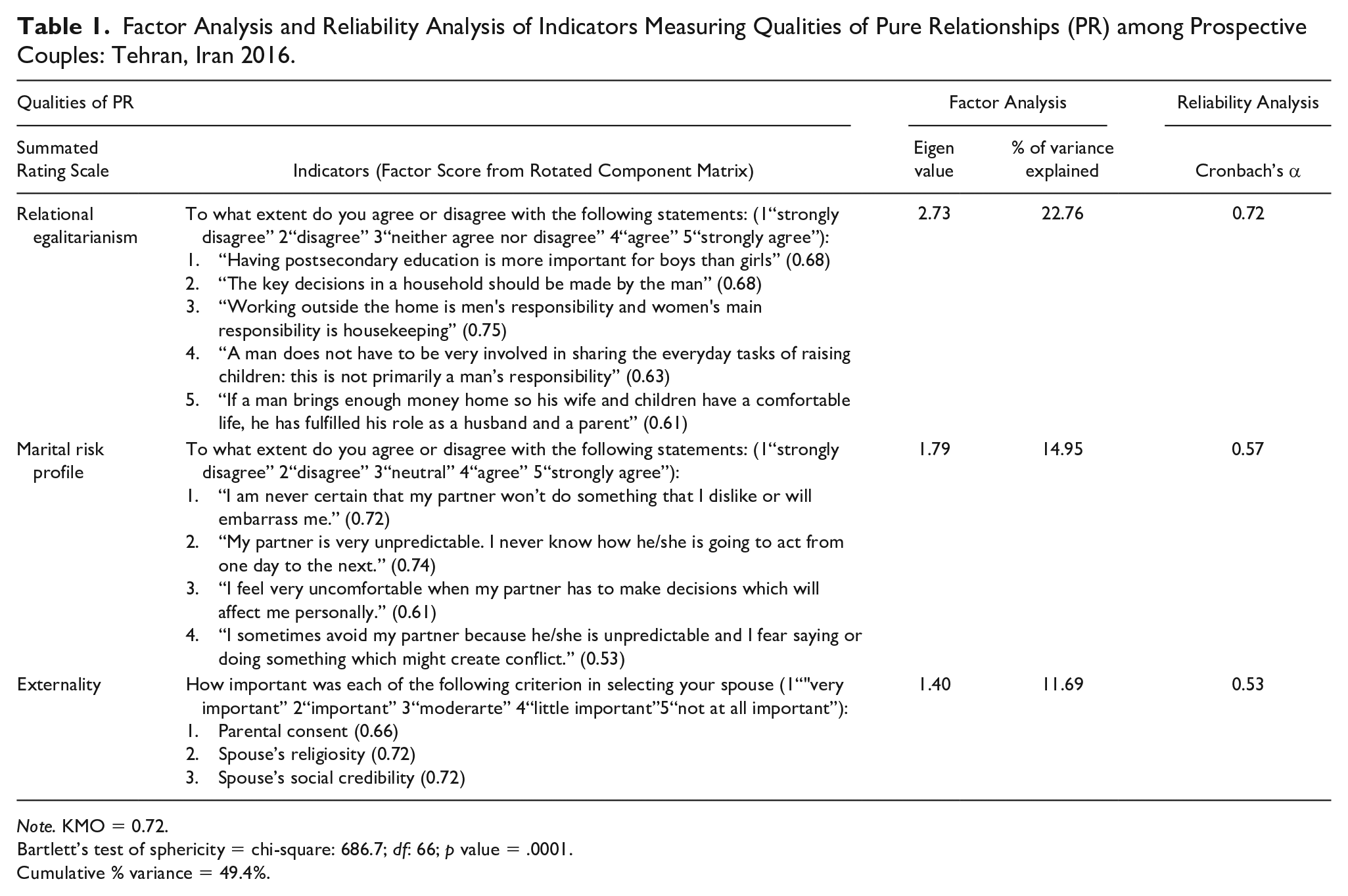
The key independent variables are the three features of PR introduced in the Conceptual Model. Table 1 illustrates 12 indicators measuring the three qualities of PR, and the results of reliability analysis and factor analysis of the indicators, using the extraction method of Principal Component Analysis and the rotation method of Varimax with Kaiser Normalization. Since this is a pilot study and three features of PR are all dimensions of the PR construct, an exploratory factor analysis was performed on all items shown in Table 1. The five items used to construct scale of relational egalitarianism in Table 1 were adopted from World Values Survey (Inglehart et al., 2014). Furthermore, the four items of marital risk profile were adopted from a list of items that were originally developed by Guerney (1977) to measure a scale of interpersonal relationship and later on were adopted and improved by Rempel et al. (1985) to construct a scale of trust in close relationship. The three items of externality were developed by the authors.
Factor Analysis and Reliability Analysis of Indicators Measuring Qualities of Pure Relationships (PR) among Prospective Couples: Tehran, Iran 2016.
Note. KMO = 0.72.
Bartlett’s test of sphericity = chi-square: 686.7; df: 66; p value = .0001.
Cumulative % variance = 49.4%.
Based on factor analysis of the 12 selected items, shown in Table 1, three weighted, standardized summated rating scales were extracted to measure relational egalitarianism, marital risk profile, and internality in a PR. Specifically, the relational egalitarianism concept was measured by five Likert attitude items, focusing on earning and caring roles of partners in the relationship. Since the brides and grooms did not have the experience of living together yet, “relational egalitarianism” in the PR was measured indirectly by gender roles attitudes. So, the more respondents favor egalitarian roles in the family, the greater they represent an intimate PR. The marital risk profile was measured by four Likert items, evaluating the predictability of the spouse’s behaviors in the relationship with the partner and the stability of spousal intimate marital relationships. Therefore, the higher the respondents’ marital risk profile, the greater they represent an intimate PR. To measure to what extent the marital relationship has been internally organized and maintained (free from external forces), respondents were asked to what extent their parents, the spouse’s religiosity and social credibility, as external factors, influenced their decision for selecting their spouse. Thus, the lower the respondents’ attachment to the external normative pressures and factors influenced their mate selection (i.e., the higher internality), the greater they represent an intimate PR.
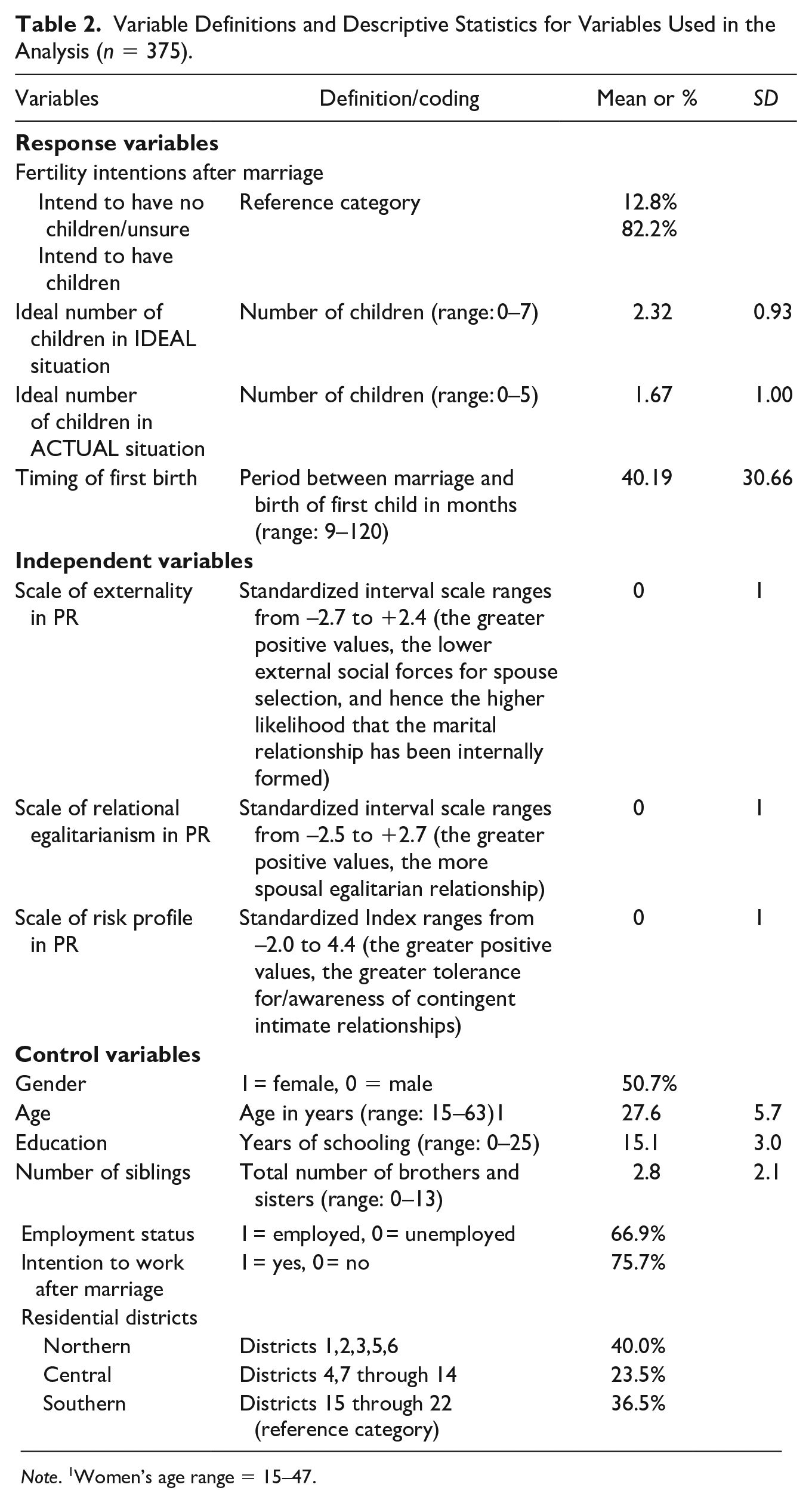
The distribution of the weighted summated rating scales and their interpretations are shown in Table 2. The statistics produced by reliability analysis (i.e., Cronbach’s α) and factor analysis (cumulative variance, eigenvalue, KMO and Bartlett test of sphericity) show reliability and validity for the three extracted latent factors measuring the three dimensions of PR. Based on the factor analysis results, overall about 50% of variability in the selected 12 items is explained by the three extracted factors. While the reliability of items measuring the feature of relational egalitarianism is acceptable (Cronbach’s α = 0.72), the internal consistency of the scales, measuring marital risk profile and externality are low and need to be improved in the future survey.
Variable Definitions and Descriptive Statistics for Variables Used in the Analysis (n = 375).
Note. 1Women’s age range = 15–47.
The dependent variables are fertility intentions and preferences. The fertility intention was measured by one question asking respondents whether they intend to have children after marriage. Because only thirteen respondents reported that they did not intend to have children after marriage, this category was merged with “unsure” category, and hence a binary dependent variable of fertility intention with two categories was constructed, as shown in Table 2. The fertility preference was measured by three questions regarding ideal number of children in IDEAL and ACTUAL situations, and preferred timing of the first birth. As to the ideal number of children in IDEAL and ACTUAL conditions, respondents in the survey were asked “Assuming ideal/actual living conditions, how many children would you like to have altogether?” The timing of first birth was asked only from those who “intended” to have children or were “unsure.” Specifically, they were asked “When do you intend to have your first child?”
Thirteen respondents who “did not intend” to have children were excluded from all analyses related to timing of births.
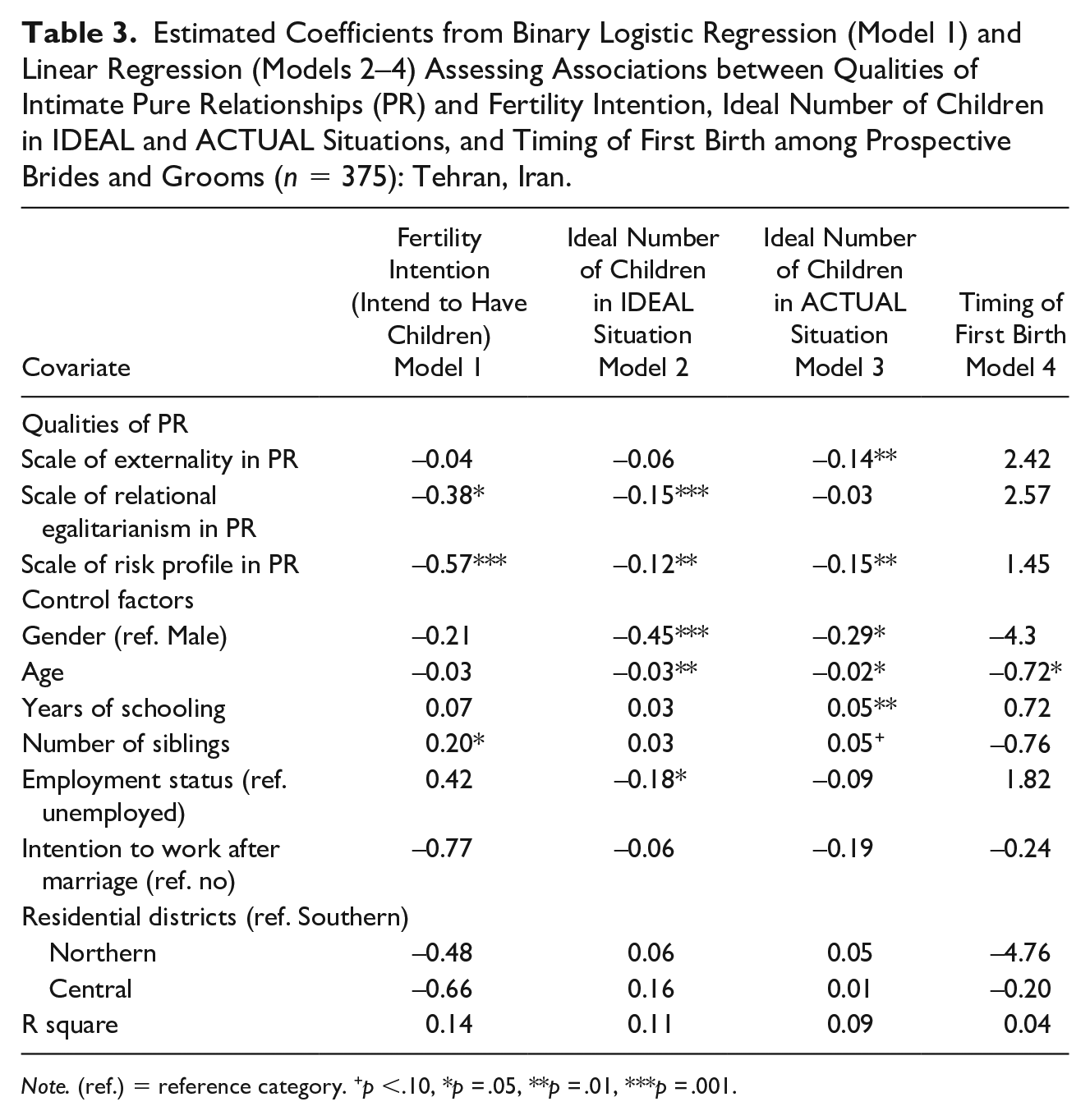
Since fertility intention was a binary variable and ideal number of children and timing of birth were continuous dependent variables, binary logistic and linear regression analysis models were respectively used to examine the net effect of three features of PRs on fertility intentions and preferences. To do so, the multivariate analyses presented in Table 3, were adjusted for the respondents’ background demographic characteristics, including gender, age, number of siblings, employment status, intention to work after marriage, and residential districts in the city of Tehran. Individuals having a higher socioeconomic status reside largely in the northern and partly in the central districts, whereas disadvantaged families live mainly in the southern districts. The definitions and coding of background variables are illustrated in Table 2.
Estimated Coefficients from Binary Logistic Regression (Model 1) and Linear Regression (Models 2–4) Assessing Associations between Qualities of Intimate Pure Relationships (PR) and Fertility Intention, Ideal Number of Children in IDEAL and ACTUAL Situations, and Timing of First Birth among Prospective Brides and Grooms (n = 375): Tehran, Iran.
Note. (ref.) = reference category. +p <.10, *p = .05, **p = .01, ***p = .001.
Results
Table 2 shows the definitions and descriptive statistics of the response, independent and control variables used in the analysis. The results indicate that 82% of respondents intend to have children after marriage, 80% of the respondents reported two or more children as the ideal number of children in “ideal” living situation (with the average of 2.3 children), while only 57% reported two or more children as an ideal number given the “actual” living conditions (with the mean of 1.67 children). More than half of respondents (54%) preferred to postpone childbearing after marriage for three years and above (with the average of 40 months).
Table 3 presents regression results of fertility intentions and preferences on the features of PR, adjusting for background variables. Overall, the directions of estimated regression coefficients, related to the three dimensions of PR in all four models, was in line with the proposed hypothesis. The externality dimension of PR was significantly associated with only the ideal number of children in “ideal” situations, where the lower the extent of external social forces in mate selection was associated with lower ideal number of children in “actual” living conditions, as expected. Regarding the relational egalitarianism, the multivariate results indicated that the greater spousal relational equalitarianism was associated with a lower likelihood of intending to have children after marriage and a lower ideal number of children in “ideal” living situations. The greater risk profile attached to the intimate relationship was significantly associated with the lower likelihood of intending to have children after marriage. In other words, individuals who felt a greater risk attached to their relationship with the partner were less likely to intend to have children after marriage. Also, the higher risk profile was significantly associated with lower ideal number of children in “ideal” and “actual” situations. The three dimensions of PR were not significant associated with the timing of childbearing.
Results associated with the background factors show that relative to grooms, brides were more likely to report a lower ideal number of children in actual and ideal living conditions. Moreover, those with higher number of siblings were more likely to intend to have children after marriage, employed vs. unemployed individuals reported lower ideal number of children in “ideal” situation, and age was negatively associated with ideal number of children in “ideal” and “actual” situations and the intended first birth internal.
Discussion
The existing fertility theories and studies attempting to explain the determinants of enduring below-replacement fertility rates, in developed and some developing countries, has largely pointed structural socioeconomic and cultural factors, and the fertility influence of recent transformation in intimate spousal relationships has not been studied. To the best of our knowledge, this study is the first research that aimed to address this gap in the literature by examining the relationship between the intimate spousal relationships and fertility intentions and preferences. Based on the theory of transformation of intimacy (Giddens, 1991), a conceptual model was developed and operationalized by indicators that were measured in a pilot survey conducted among a sample of population of prospective brides and grooms in the city of Tehran, Iran.
The model hypothesized that individuals whose intimate relationship was closer to a “pure” rather than an “addictive” spousal relationship were more inclined to intend to have no or one child, and report a below-replacement ideal number of children and intend to postpone childbearing after marriage for three or more years. The multivariate results of this study provided evidence in support of this hypothesis by linking three features of a PR to fertility intentions and preferences.
Results regarding the first feature of PR showed that individuals with less attachment to external social forces in selecting their partner were less likely to intend to have children after marriage and hence more likely to postpone the parenthood stage. In line with this finding, recent Iranian studies showed that when individuals feel less normative social pressures from peers and parents, for having children, they express a lower fertility intention for having a (another) children (Erfani, 2017). Similarly, European evidence from France, Germany, and Bulgaria indicated that heightened social pressure from parents, relatives, and friends increased the likelihood that a couple intends to have a second or third child (Balbo & Mills, 2011). Moreover, a recent study showed that individuals who were largely in a “family-remote” network (consisting of friends and acquaintances) rather than a “family-centered” network (including strong ties to members of the nuclear family) had the lowest transition rate to parenthood (Lois, 2016). This is because people in a family-remote network have a high proportion of weak ties with their family members and hence feel a low amount of social pressure to have children.
The relational egalitarian aspect of a PR, measured indirectly by gender roles attitudes, also was associated with below-replacement fertility intentions and preferences. In fact, those with a greater spousal relational egalitarianism were less likely to intend to have children after marriage and reported lower ideal number of children in “ideal” living situations. Similarly, Hall (2003) found that the egalitarian structure of a marital relationship increases the chances of having uncertain or below-replacement fertility goals and reduce the likelihood of having above-replacement childbearing intentions. These results can be interpreted to some extent by the “gender revolution” framework (Goldscheider et al., 2015), predicting that if men’s involvement in housework and childcare increases (i.e., the second half of the gender revolution), after rising female labor participation in the first half of the revolution, it is expected that fertility increases, as it happened in certain developed Nordic European countries, such as Norway. In the case of Iran, however, the country still appears to be at the beginning of the first half of the gender revolution (i.e., rising female employment).
Although Iranian women have equal access to higher education, their access to paid jobs is limited due to the scarcity of overall job opportunities in the country. The results of 2016 Iran population census indicates that although 47% of Iranian university students were female and 36% of young adult women aged 20–34 had postsecondary education, only 14% of women aged 15–64 (working-age population) were economically active (Statistical Centre of Iran, 2016). In such a context, instead of merely focusing on female economic participation and income as competitors to women’s reproduction, one should examine the impact of women’s “employment aspiration” on fertility intentions, as this study did so and found a negative relationship between employment aspiration and fertility intentions and preference, though not being statically significant (likely because of small sample size). Evidence shows that highly educated and unemployed brides in Iran are more likely to postpone childbearing and delay transition to the motherhood, with the aspiration of finding a job in the future (Erfani, 2014, p. 414). That is, it is the frustrated career aspiration among highly educated but unemployed women that competes with women’s reproduction. In addition, since most families in Iran follow a male-breadwinner family model due to the high female unemployment rate, women’s fertility intentions are assumed to be related to their spouses’ behaviors in terms of the gender division of housework. Therefore, we speculate that Iranian women, who perform the large share of domestic work (i.e., gender inequality) and are not satisfied with this unequal division of housework (i.e., gender inequity), are more likely to view childbearing as being detrimental to their personal life, and hence less likely to intend to have a (another) child in the near further. In fact, the impact of gender equality and equity on fertility should be examined altogether, as suggested by Neyer et al. (2013).
Multivariate results related to the fertility influence of the marital risk profile, as the third feature of a PR, showed that the intention to have children after marriage becomes weaker and the reported ideal number of children in “ideal” and “actual” situations decreases as the risk profile attached to their intimate spousal relationship rises. This may be because individuals in a PR with a higher risk profile may view having children an externality that can raise the risk of divorce and hinder a couple’s self-actualization, as argued by Giddens (1991, pp. 185–187). Not to mention that the interpersonal risk profile attached to the spousal relationship can be intensified by their socioeconomic and political living conditions. For example, Erfani and Shojaei (2019) showed that uncertainty about the country’s economic, political, and cultural situations was reported to be one of the key reasons for low fertility intention of married individuals living in the city of Tehran.
Consistent with recent evidence (Erfani & Shojaei, 2019), this study also found that women preferred to have lower number of children compared to men did. This is partly because women more than men view childbearing in conflict with their own personal life, plans, and interests, especially when the woman is employed and hence goes through a double-burden of earning and caring (Beaujot, 1999; Dommermuth et al., 2015). For instance, it was reported that Iranian female head coaches left their careers because of the conflicts of work and family (Boloorizadeh et al., 2013).
The findings of this study imply that the growing individualism is the base of transformation in intimate spousal relationships and low fertility, as individuals give priority to their “well-being and self-expression” (Van de Kaa, 1987, 2001, p. 294), choose their own partners and their desired form of relationship and number of children (Thornton, 2001), and make family and childbearing decisions based on their self-interests (Folbre, 2000). Consequently, if the government decides to employ any pronatalist measures to increase fertility in the country, it is absolutely necessary to bring into its calculation the recent cultural shifts to individualistic values and norms (Erfani, 2019) that affect partners’ childbearing intentions, preferences, and behaviors.
There are some limitations to our study. First, the study samples included brides and grooms who had not started living together at the time of the interview, so we had to measure their attitudes toward gender roles of spouses as a proxy for the feature of “relational egalitarianism” in the PR. Although many studies documenting the link between gender equality ad fertility intentions often employ gender role attitudes as indicators of gender equality (for example see Goldscheider et al., 2010; Miettinen et al., 2011), the egalitarian relationship between spouses need to be measured directly based on their contribution to housework and childcare through a study sample of couples who have the experience of living together for a while. This will be addressed in the future survey, an improved version of this pilot survey. Furthermore, even though the respondents’ gender, education, and employment were controlled in the multivariate analyses, the sample was too small to run any interactions between these demographic characteristics and the three features of the PR, especially with the respondents’ egalitarianism. This would be an important venue for future studies. Also, the low reliability of the measures of marital risk profile and externality of the PR is another limitation of this study, which will be improved by revising and editing the indicators of these measures in the further survey that will be conducted among married couples. Despite the limitations, the results of this pilot have paved the avenue for a future study that will be followed, and provided new insights into the reasons behind low fertility.
Footnotes
Author’s Note
The earlier drafts of this article were presented in the 2017 meeting of Canadian Population Society (Toronto), and 2018 European Population Conference (Brussel).
Declaration of Conflicting Interests
The authors declared the following potential conflicts of interest with respect to the research, authorship, and/or publication of this article: The authors have no conflicts of interest to declare. The pilot survey was granted ethical approval by Nipissing University’s Research Ethics Board in June 2016 (File No. 101072).
Funding
The authors disclosed receipt of the following financial support for the research, authorship, and/or publication of this article: Supports from Nipissing University’s Internal Research Grant (Ref. No. 100990) and an Insight Grant of The Social Sciences and Humanities Research Council of Canada (File Number: 435-2019-1265) are greatly appreciated.
