



Abstract
Political interest is key to explaining democratic outcomes such as political knowledge and participation, and its development has been particularly studied in the context of socialization processes during adolescence. Building on a theory of expression effects, this study highlights the relationship between political discussion and political interest among individuals age 15 and above. Based on a seven-year panel study in Norway (n = 10,695), we estimate the effects of political discussion on interest in politics and assess whether they are contingent on age. We find that as people discuss politics more, their political interest increases over time. These effects are strongest among young adults but remain important through adulthood, only disappearing at retirement age. Our findings expand knowledge about how different political experiences may shape political attitudes and opens new avenues for the study of fluctuations and inequalities in political engagement.
Introduction
Why are some people drawn to politics while others are not? For decades, this question has attracted the attention of scholars, who have focused on the importance of family background and socialization (Prior, 2010), psychological factors (Hidi and Renninger, 2006), genetic features (Jungkunz and Marx, 2025a; Klemmensen et al., 2012) and life-cycle events (Janmaat and Hoskins, 2021). Studies suggest that a disposition for being interested in politics usually develops during adolescence and early adulthood (Neundorf et al., 2013; Prior, 2010), but the literature is divided on whether such attitudes persist throughout life or change based on experiences and events (Neundorf et al., 2013; Shehata and Amnå, 2019).
In the most comprehensive examination to date, Prior argues that political experiences may stimulate political interest, especially when they are difficult to avoid, accidental, or unexpected. Such ‘inadvertent political encounters’ (Prior, 2019: 292) provide important opportunities to become interested in politics, even among people who tend to avoid it, thus overcoming problems of selectivity. In this study, we focus on political discussions with others as a political experience that can spur political interest throughout individuals’ lifespan. While previous research has demonstrated that political discussion within the family and other social networks can breed political interest (Lee et al., 2013; Shehata and Amnå, 2019), we offer novel insights into how political interest emerges, evolves and shifts with political discussion in different age groups. Understanding how political interest rises or falls is important to shed light on the cycles of political mobilization characterizing the present age, as well as the long-standing challenges of unequal participation and political apathy.
Theoretically, we start from the insight that expressing one’s opinions may elicit emotional and cognitive processes that may enhance political involvement (Pingree, 2007). Accordingly, research has emphasized political discussion’s positive association with political participation (Boulianne, 2011; de Zúñiga et al., 2021) and with political self-concepts such as political interest (Holt et al., 2013; Lane et al., 2019; Lee et al., 2013; Moeller et al., 2018; Shehata and Amnå, 2019; Torcal and Maldonado, 2014). Nevertheless, comprehensive evidence on the association between discussion and interest over time is still scarce.
To fill this gap, we leverage a four-wave panel survey of a sample representative of the Norwegian voting-age population, interviewed between 2011 and 2018. This unique dataset enables us to assess whether political discussion influences political interest and vice versa, taking a wide range of other factors into account. We examine the relationship between political discussion and interest in politics in two ways. First, to estimate effects more reliably than cross-sectional analyses allow, we take advantage of the panel structure of the data and minimize confounding factors by estimating models with fixed effects (FE) and controls for time-varying covariates such as media consumption. While our main approach relies on regression models (Angrist and Pischke, 2009), we complement it with a structural equations approach (Allison et al., 2017) that allows us to account for prior levels of political interest when examining discussion effects. Second, we use models with interactions to assess how the effect of discussion on interest varies across age groups, exploring whether the benefits of discussion are confined to young people, who are in a life stage particularly conducive to political socialization, or extend more broadly to all age groups.
Our results show that discussing politics increases citizens’ levels of political interest over time. Thus, not only does political interest affect discussion, as demonstrated by many previous studies (Schmitt-Beck and Neumann, 2023; Van Deth and Elff, 2004; Verba et al., 1995) − discussing politics also enhances political interest. Furthermore, the effects of political discussion occur throughout most of the lifespan but are strongest among the youngest respondents and decline as age increases, becoming nonsignificant among the oldest groups. While this finding corroborates previous research on the crucial role of adolescence for the development of political values and attitudes (e.g. Janmaat and Hoskins, 2021; Jungkunz and Marx, 2025b; Neundorf et al., 2013; Prior, 2010; Shehata and Amnå, 2019), it also suggests that political discussion contributes to the development and maintenance of civic attitudes throughout individuals’ whole life up until retirement.
In sum, this study offers new and robust evidence that political discussion can enhance political interest, although the reverse effect is stronger. Our findings contribute to ongoing explorations of the antecedents of political engagement across the lifespan (Jungkunz and Marx, 2025b; Prior, 2010, 2019), and, specifically, the role of citizens’ political discussion (Pingree, 2007; Shah, 2016). Furthermore, they inform normative debates on the role of citizens’ everyday political talk as a mainspring of democracy (Parkinson and Mansbridge, 2012).
Political discussion and political interest
Political interest has been defined as ‘a citizen’s willingness to pay attention to political phenomena at the possible expense of other topics’ (Lupia and Philpot, 2005: 1122). This willingness often entails an enduring disposition that may lead to repeated engagement in politics over time (Hidi and Renninger, 2006). However, such dispositional interest is unevenly distributed in any population. The literature has foregrounded various social factors that play a role in spurring interest in politics during different phases of adolescence and early adulthood, such as parental influence (Janmaat and Hoskins, 2021; Jungkunz and Marx, 2025a; Neundorf et al., 2013; Shehata and Amnå, 2019) and broader social networks, both online and offline (Lee et al., 2013). The transition from adolescence to early adulthood, when individuals take on increasing responsibilities, is key to developing and consolidating political interest (Neundorf et al., 2013; Van Deth, 1989).
Research indicates that political interest becomes more stable with age, eventually emerging as a highly enduring trait in adults (Prior, 2019: 291). One reason for this stability may be selectivity, as those holding a dispositional political interest seek out encounters with politics, in turn reinforcing their interest. By contrast, the uninterested avoid politics, thus missing opportunities to develop an interest. However, exposure to politics − such as attending political events or meeting a politically engaged partner − can ignite interest even among the uninterested (Prior, 2019: 321).
Scholars have long debated how exposure to political information through mass and digital media influences political dispositions, attitudes and behaviours (Bennett and Iyengar, 2008). The impact of informational uses of social media has been extensively explored, showing positive effects on various forms of political involvement, including interest (Moeller et al., 2018; Oser and Boulianne, 2020). Although political experiences on social media are liable to selectivity, they also entail opportunities for inadvertent exposure (Vaccari and Valeriani, 2021).
A different line of research argues that the act of discussing politics may enhance political involvement (Lane et al., 2019; Shah, 2016; Shehata and Amnå, 2019). Pingree (2007) theorized three pathways through which political expression may trigger cognitive and emotional processes that, in turn, may stimulate political interest. ‘Expectation effects’ occur when a person anticipates having to express an opinion, which in turn leads them to pay attention to information relevant for formulating it. ‘Composition effects’ are related to the generation of a message, which involves extracting knowledge from memory and turning it into language, a process that may result in novel combinations of information and, thus, new ideas. Finally, ‘message release effects’ include the experience of how others receive a message one has shared. Pingree (2007) argues that these effects likely become stronger when people expect to face counterarguments and to provide reasons in support of their statements. Both these conditions are likely present in political discussions.
Expression-related effects can be theoretically linked to short-term and long-term increases in political interest, leading individuals to engage more actively with politics than they would otherwise (Pingree, 2007), and potentially counteracting information avoidance among the uninterested (Prior, 2019: 33). The cognitive processes involved in expressing opinions may be rewarding in themselves and result in experiences of cognitive self-efficacy. Over time, citizens may perceive a sense of coping − the feeling of being able to understand a subject − which, in turn, enhances the motivation to pursue complex activities such as engaging in politics (Prior, 2019). Finally, expression may elicit feelings of being heard, understood and acknowledged, which may encourage individuals to repeat such experiences and, eventually, identify as politically interested.
Various cross-sectional studies offer suggestive evidence of links between political discussion and political interest (Holt et al., 2013; Moeller et al., 2018; Torcal and Maldonado, 2014). Such findings are corroborated by a four-year longitudinal study among Swedish adolescents, showing that political discussion with parents is associated with increases in political interest (Shehata and Amnå, 2019). Using panel survey data from adult respondents during the United States 2016 presidential elections, Lane et al. (2019) found that individuals who were more motivated to engage in political self-presentation on social media also reported higher levels of interest in politics, political self-efficacy, and perceived participation. Importantly, however, as the authors note, the short time span of their longitudinal study (about six weeks) did not allow them to establish whether these effects lasted over time (Lane et al., 2019).
Since theory posits that political discussion can enhance interest in politics and research tentatively supports this, we hypothesize that political discussion is positively associated with interest in politics (H1), including among different age groups and over time.
Age groups differences
If political talk can enhance political interest, does the strength of this relationship vary among different age groups? This question taps into longstanding debates concerning the plasticity or persistence of political attitudes through the lifespan (Neundorf et al., 2013). As evidence exists for both positions (Kinder and Sears, 1985; Prior, 2019), we reason that the impact of political discussion on interest may be especially strong among younger citizens, but persist in later life stages.
First, younger citizens should be disproportionately prone to discussion effects because they are more strongly affected by the experiences, events and transformations that characterize their early political encounters, and may then coalesce into long-lasting patterns of thought and action (Mannheim, 1952). For instance, Milkman (2017) argued that the availability of digital technologies and the dramatic worsening of labour conditions after the 2008 financial crisis triggered lasting changes in values and orientations to action among youth, sparking a wave of progressive social movements.
Second, the process of political socialization, which entails the development of political values, attitudes and behaviours among youth (Gimpel et al., 2003), shapes democratic norms and attitudes, such as interest in politics. Political discussion facilitates the developing of political interest through the key agencies of political socialization, such as family, schools, peer groups and the media (Owen, 2008). Hence, various studies show the importance of parents and families for nurturing an interest in politics (Jennings and Niemi, 1968; Jungkunz and Marx, 2022, 2025a, 2025b; Shehata and Amnå, 2019). Accordingly, Dostie-Goulet (2009) finds that political discussion with family, friends and teachers helps teenagers develop political interest, and Lee et al. (2013) show that face-to-face political discussion and online political expression channel the positive influence of classroom discussion and exposure to news on civic and political participation among youth.
Third, digital media have provided new avenues for political discussion and expression, which appeal particularly to younger people. In a comprehensive meta-analysis, Boulianne and Theocharis (2020) found that digital media use has a positive relationship with political participation among youth, with online political discussion emerging as especially influential (see also de Zúñiga et al., 2021). Young people who have yet to develop a political interest may approach these environments without expecting to discuss politics, but may still end up doing so by engaging in non-political talk that spills over into political topics (Ekström and Östman, 2015). Finally, the forms of self-driven and event-centred political discussion facilitated by digital media are consistent with an ‘actualizing’ style of citizenship, centred on personalized, informal and expressive practices that are more appealing for younger people (Bennett et al., 2011; Dalton, 2008).
In sum, political discussion, in both face-to-face and digital spaces, may be better placed to boost political interest among younger citizens, who are still developing it, than among older ones. Hence, we hypothesize that the positive relationship between political discussion and interest in politics becomes weaker as age increases (H2).
Research design
Our analysis draws on the survey programme Social Media in the Public Sphere (SMIPS), a multi-wave panel study conducted in Norway. We use the four SMIPS waves in which political interest was measured (years: 2011, 2014, 2016 and 2018). This unique longitudinal data spanning nearly a decade enable us to assess more extended patterns than most existing studies. In each wave, a sample of approximately 5,000 respondents was drawn from the KANTAR TNS web panel, which is largely representative of the Norwegian population over 15 years of age. Following the initial 2011 wave, the survey company first re-invited all previous respondents from earlier waves and then ‘topped up’ the sample by inviting new respondents. To examine changes within individuals over time, we exclude respondents who only participated in one wave. Our four-wave sample thus comprises 10,695 total observations, with 5,412 individuals interviewed in two waves, 3,867 in three waves, and 1,416 in all four waves.
These data contain a rich set of measures that allow us to explore the role of political discussion into detail. Below, we describe the key variables employed in the analysis. Table A1 in the Online Supplementary Material (SM) file provides descriptive statistics and question wordings for all variables.
Political interest is measured by the question ‘How interested are you in politics and social issues?’ with responses on a 4-point scale from 0 (‘not interested at all’) to 3 (‘very interested’). Respondents could also answer ‘I don’t know,’ in which case they were excluded from the analysis. Although multiple measures of the same construct are often recommended in survey-based research, Prior (2019: 41) convincingly shows that political interest approximates a one-dimensional construct, robust to minor differences in question wording. Hence, a single measure can capture much of the variation in interest in politics, which is why established international survey-based research programmes such as the World Value Survey and the American National Election Studies rely on single questions, whose wordings are very similar to our own, to measure it.
In our dataset, the overall mean (M) of political interest is 1.95, and the standard deviation (SD) is 0.68. At the individual level, the data show both stability and variation within individuals over time. While 65% of respondents had a constant level of political interest over time, 35% reported a change in political interest at least once across the survey waves they participated in. Among respondents who participated in all four waves, 51% reported different levels of interest in at least two waves. That levels of political interest changed over time highlights the importance of examining the sources of such variation − and justifies our use of unit FE, as discussed below.
Political discussion is captured with an index that measures the frequency with which respondents talk about politics across different social contexts. In a five-item battery, respondents indicated how often they discuss political or societal issues with family, friends, colleagues/fellow students, members of organizations, and people on the Internet (response scale ranging from 0 ‘never’ to 3 ‘daily’). To calculate the index, we averaged responses to each item and then standardized the resulting values with M = 0 and SD = 1. While internal reliability is not expected of a composite based on a formative index – for example, one can discuss politics often with family members without ever doing so with colleagues – Cronbach’s alpha across these five items is 0.64, suggesting that the index reflects an individual’s underlying propensity to engage in political discussions across different contexts. The conclusions drawn from our main models do not change if we use the individual items as independent variables instead of the index (see Online SM file, Table A3). In the SM, Figure A1 shows the within-individual range over time on the discussion index and political interest.
Age is measured as a continuous variable (number of years), ranging from 15 to 91 (M = 51, SD = 17). We use this variable, and a categorical age group variable, to examine whether the effects of political discussion and expression are contingent on how old the respondents are. Naturally, in a multi-year panel, age will increase over time and push up the overall mean. The average age in the initial 2011 wave was 46, which corresponds to the concurrent mean in the Norwegian population aged over 15.
The analyses include a range of control variables to account for factors that may confound the relationship between discussion and interest. Besides age, we include sociodemographic characteristics such as education, income and region of residence. Since we estimate unit FE, including these controls mainly increases the precision of the estimated discussion effects (as their within-person variation is limited). To isolate discussion effects from a general inclination to be outspoken, we also control for respondents’ tendency to share their opinions on the Internet. Lastly, as media consumption is correlated with both political discussion and interest, we include measures of time spent daily on television, radio, print media, online media and social media. 1
Our analytical strategy takes advantage of the panel structure of the data to effectively rule out factors (beyond the control variables) that could confound the relationship between discussion and interest. It is well-known that conventional ordinary least squares (OLS) regression likely produces biased estimates for observational panel data (Wooldridge, 2010). Thus, in the first part of the analysis, we adopt a within-individual strategy to estimate discussion effects.
First, we descriptively plot the relationship between within-individual changes in political discussion and political interest from one survey wave to the next (from t−1 to t0). To account for people’s existing political interest, we run separate analyses between respondents with low (0−1) and high (2−3) levels of interest (at t−1).
Then, we specify FE models with and without the control variables discussed above, clustering standard errors by each individual. Since everyone is ‘held constant’ in the FE model, all time-invariant differences (e.g., family background, childhood socialization, genetics and personality traits) are accounted for by design. We (partly) account for existing levels of political interest by re-running the model separately for respondents with high and low levels of interest.
While these models provide a stronger basis for causal inference than simple OLS models would, FE models are sensitive to bias from omitted time-varying variables, particularly prior levels of the dependent variable (Plümper and Troeger, 2019). Although splitting the sample by earlier interest levels addresses this issue to some extent, to effectively reduce bias, people’s ‘prior history’ of political interest needs to be included in the model (Beck and Katz, 2011). As lagged dependent variables (LDVs) in FE models create their own biases (Angrist and Pischke, 2009; Nickell, 1981), we depart from the regression model framework and use a structural equations approach (Bollen and Brand, 2010; Thomas et al., 2021). Specifically, we employ a Maximum Likelihood Dynamic Panel Model (ML-DPM) because of its flexible model assumptions, which allow combining FEs and LDVs in one model (see Allison et al., 2017; Leszczensky and Wolbring, 2022; Moeller et al., 2018).
In the last part of the analysis, we examined whether the effects of political discussion on political interest are contingent on age by adding an interaction term between political discussion and age to our FE regression models, which are best suited to estimate interaction effects. In modelling age as a moderator, we consider both linear and non-linear effects.
Results
As described above, we first examine whether political discussion affects political interest, then assess the role of age as a moderator of this relationship.
Does political discussion affect political interest?
Figure 1 shows how changes in political discussion between two waves are related to changes in political interest, with respondents split between those with low and high levels of pre-existing interest. For both groups, we see a positive association between discussion and interest. Regardless of the initial level of political interest, an increase in the discussion index from one period to the next is accompanied by an increase in interest, and vice versa, as indicated by the dashed lines based on local polynomial smoothing. Although the change in interest may look slightly larger among respondents with lower pre-existing levels of interest – who in principle have more ‘room’ to grow in their propensity to engage with politics than those already more interested – the correlations are very similar in both groups (0.21 and 0.19, respectively), and this small difference disappears when we control for relevant confounders (see below).
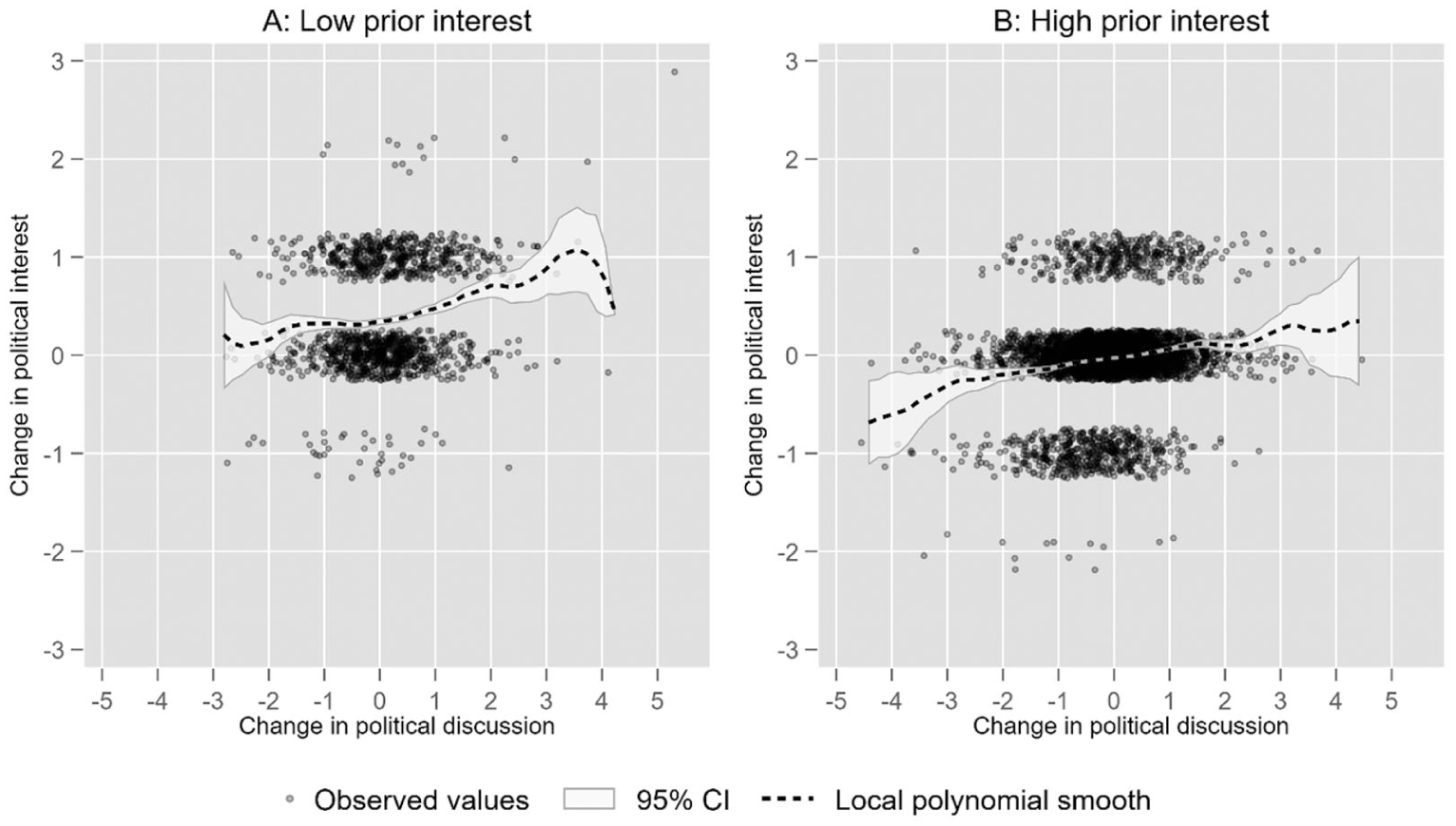
The association between changes in political discussion and interest by prior interest levels. Changes are measured from t−1 to t0, and interest levels are measured at t−1. Dots are observed values (jittered). Dashed lines are local polynomial smooths and shaded areas their 95% confidence intervals. The correlations are 0.21 for low-interested (a) and 0.19 for high-interested (b). n = 6,005.
Table 1 reports our estimates of the discussion−interest relationship based on FE models (see Online SM, Table A2 for full results). In Model 1, the positive and significant coefficient for political discussion confirms that an increase in discussion is associated with a rise in interest. Model 2, which includes the control variables, shows that this effect is unchanged when accounting for an individual’s media consumption, which is known to influence political interest (Holt et al., 2013; Moeller et al., 2018). Our main relationship of interest is also robust to the inclusion of online opinion sharing as a control, suggesting that discussion shapes interest above and beyond individuals’ propensity to speak up about their views. Models 3 and 4 are run on samples split between respondents with low and high levels of interest in the previous wave and return nearly identical coefficients for political discussion. The predicted effect sizes are modest but substantively important. For example, Model 1 predicts a 4.3 percentage points increase (or one-fifth of a SD) in political interest as the discussion index increases by one SD. The results in Table 1 thus support H1.
The effect of political discussion on political interest (fixed effects models).
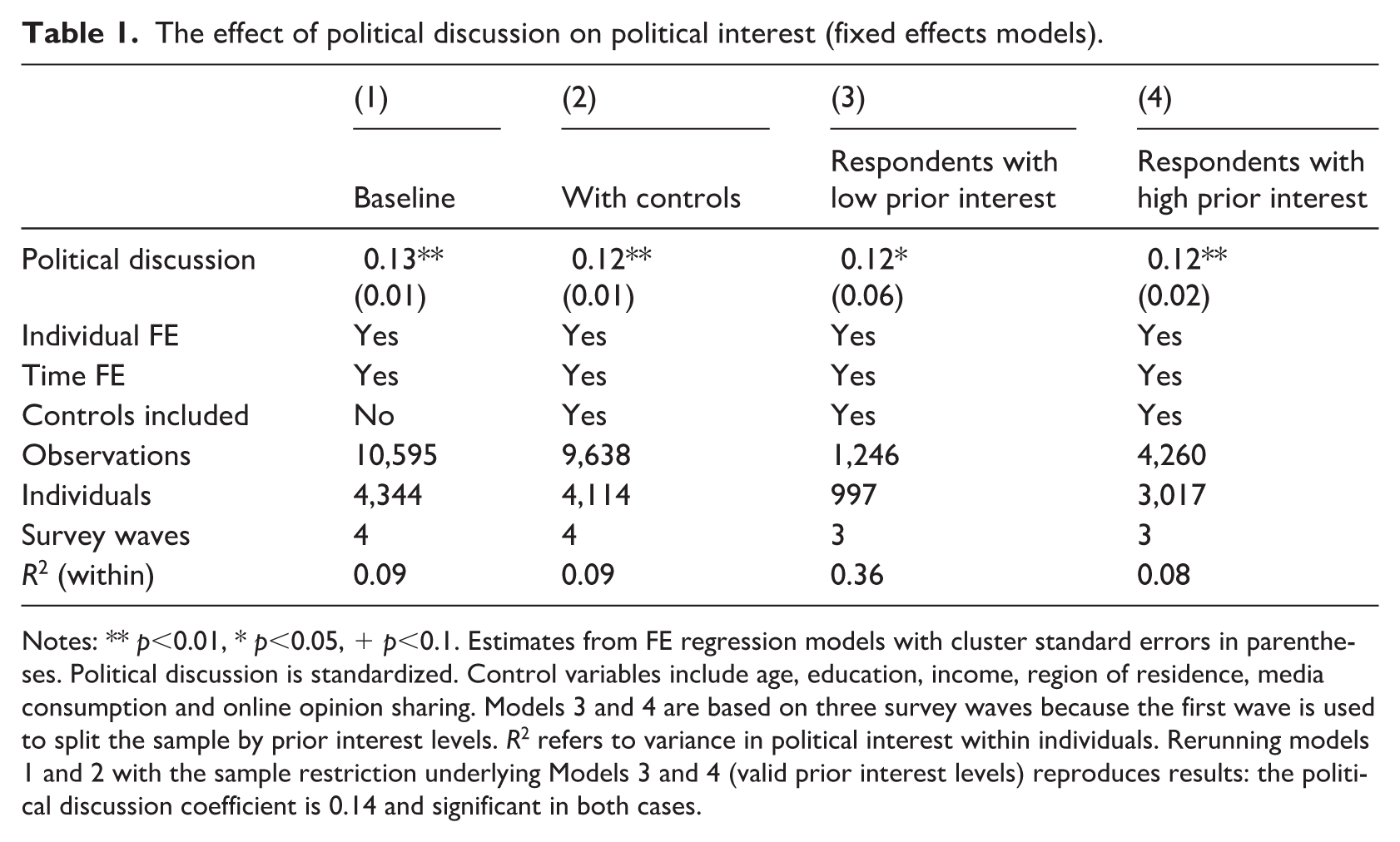
Notes: ** p<0.01, * p<0.05, + p<0.1. Estimates from FE regression models with cluster standard errors in parentheses. Political discussion is standardized. Control variables include age, education, income, region of residence, media consumption and online opinion sharing. Models 3 and 4 are based on three survey waves because the first wave is used to split the sample by prior interest levels. R2 refers to variance in political interest within individuals. Rerunning models 1 and 2 with the sample restriction underlying Models 3 and 4 (valid prior interest levels) reproduces results: the political discussion coefficient is 0.14 and significant in both cases.
We tested the robustness of our main findings in two ways. First, we ran models featuring each of the items that constitute the discussion index (see Online SM file, Table A3). The results are consistent with those presented here, though it is worth noting that discussions with friends or family yield stronger effects than discussions with colleagues, members of organizations, and other people on the Internet.
Second, to reap the benefits of models with both unit FE and a LDV, Table 2 presents the results from structural equations modelling, using the ML-DPM approach proposed by Allison et al. (2017) and sometimes called the ‘fixed effects dynamic panel model’ (Thomas et al., 2021). Model 1 predicts political interest from discussion and previous interest levels (without controls since they do not impact results). The estimated effect of 0.13 is virtually identical to the one reported in Table 1.
Dynamic panel data model with fixed effects (structural equations approach).
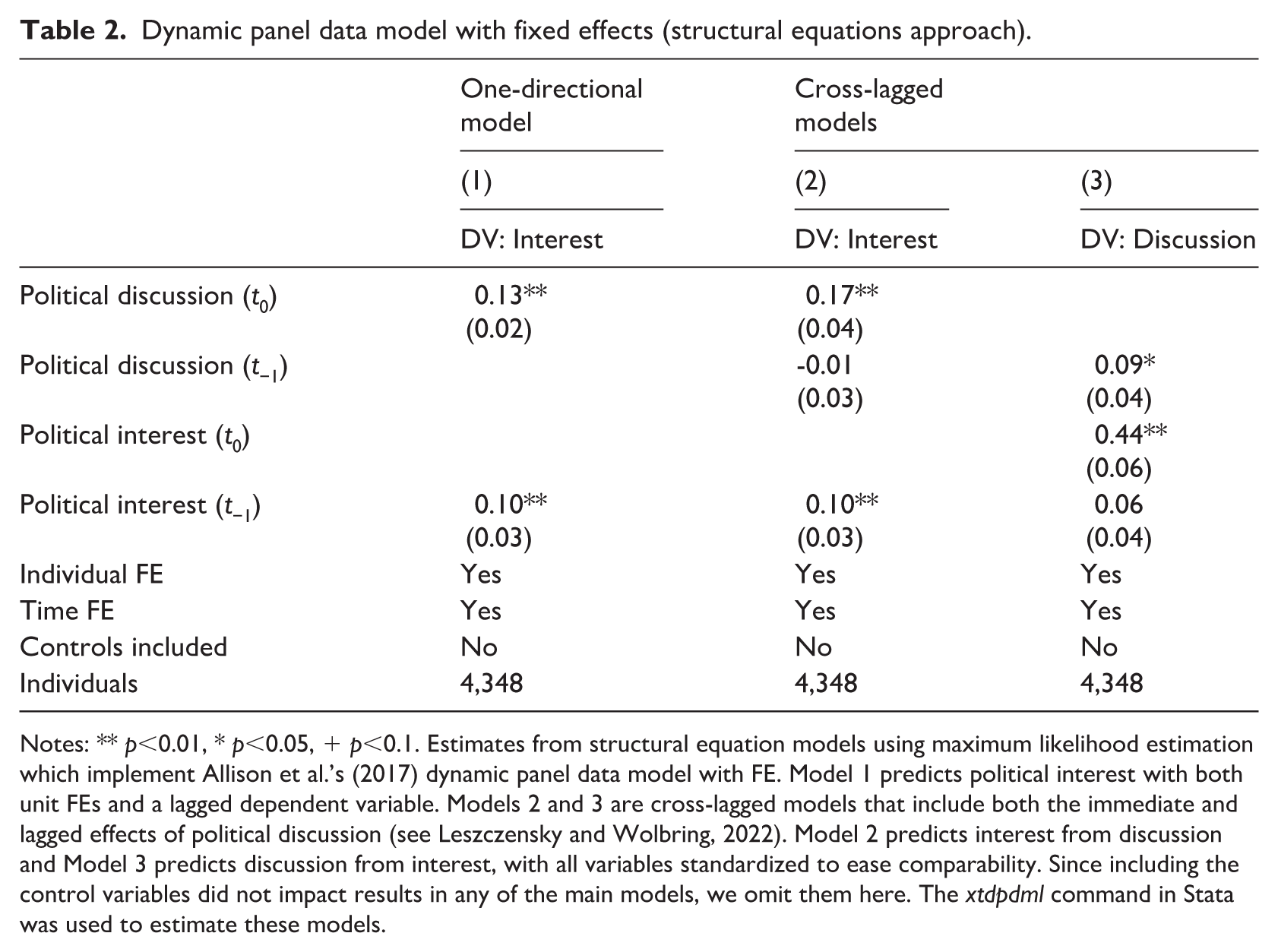
Notes: ** p<0.01, * p<0.05, + p<0.1. Estimates from structural equation models using maximum likelihood estimation which implement Allison et al.’s (2017) dynamic panel data model with FE. Model 1 predicts political interest with both unit FEs and a lagged dependent variable. Models 2 and 3 are cross-lagged models that include both the immediate and lagged effects of political discussion (see Leszczensky and Wolbring, 2022). Model 2 predicts interest from discussion and Model 3 predicts discussion from interest, with all variables standardized to ease comparability. Since including the control variables did not impact results in any of the main models, we omit them here. The xtdpdml command in Stata was used to estimate these models.
In Models 2 and 3, we further use the ML-DPM to estimate cross-lagged models with two aims: to contextualize the effects of political discussion on interest by comparing them to the reverse effects of political interest on discussion; and to explore whether the effects tend to be lagged or more immediate (i.e., both Xt0 and Xt−1 are included, following Leszczensky and Wolbring, 2022). 2 Unsurprisingly, political interest is not only a consequence of discussion, as Model 2 and our other results show, but it also influences it, as Model 3 suggests. A change of 1 SD in political discussion results in a 0.17 SD change in political interest, whereas a 1 SD change in political interest results in a larger change of 0.44 SD in political discussion. These findings support the view that interest boosts engagement but also show that engagement itself can stimulate interest. Furthermore, in both models, the effects are more immediate than lagged (i.e., the t−1 versions of the explanatory variables are not significant). These additional analyses further support H1.
Are the effects of political discussion on interest contingent on age?
To assess the moderating role of age (H2), Figure 2 shows how the estimated effect on political interest of a SD increase in the political discussion index varies with respondents’ age, based on our FE regression models (see Online Table A5 in the SM file for full results). In panel A, age is treated as continuous and its moderating effect is therefore estimated as linear, whereas in panel B we split participants into ten age groups (one for each age decile) and estimate distinct discussion effects for each group. The results suggest that age is indeed an important moderator of the effect of discussion on interest. As indicated by the downward-sloping effect line in panel A, interest changes as a function of discussion more markedly among younger than older people. This interaction is significant at the 0.01-level. Specifically, while the underlying model predicts a notable change in political interest among the youngest respondents as the discussion index increases by one SD, the effect weakens with age and is indistinguishable from zero among the oldest respondents (77 years or older). Thus, although older people’s levels of interest are less responsive to changes in discussion than younger people’s, the effect can be detected throughout most of the observed age span. However, as panel B shows, the relationship between discussion and interest is clearly strongest in the early years of adulthood. While the discussion effect drops markedly from the youngest group (aged 15−25) to the second group (aged 26−34), and again to those aged 35−41, changes ebb and flow among the middle categories, before dropping among the older groups such that the effect becomes nonsignificant among respondents aged 72 and above. Thus, while H2 is supported, age most strongly moderates the relationship between discussion and interest at younger stages of individuals’ lifespan.
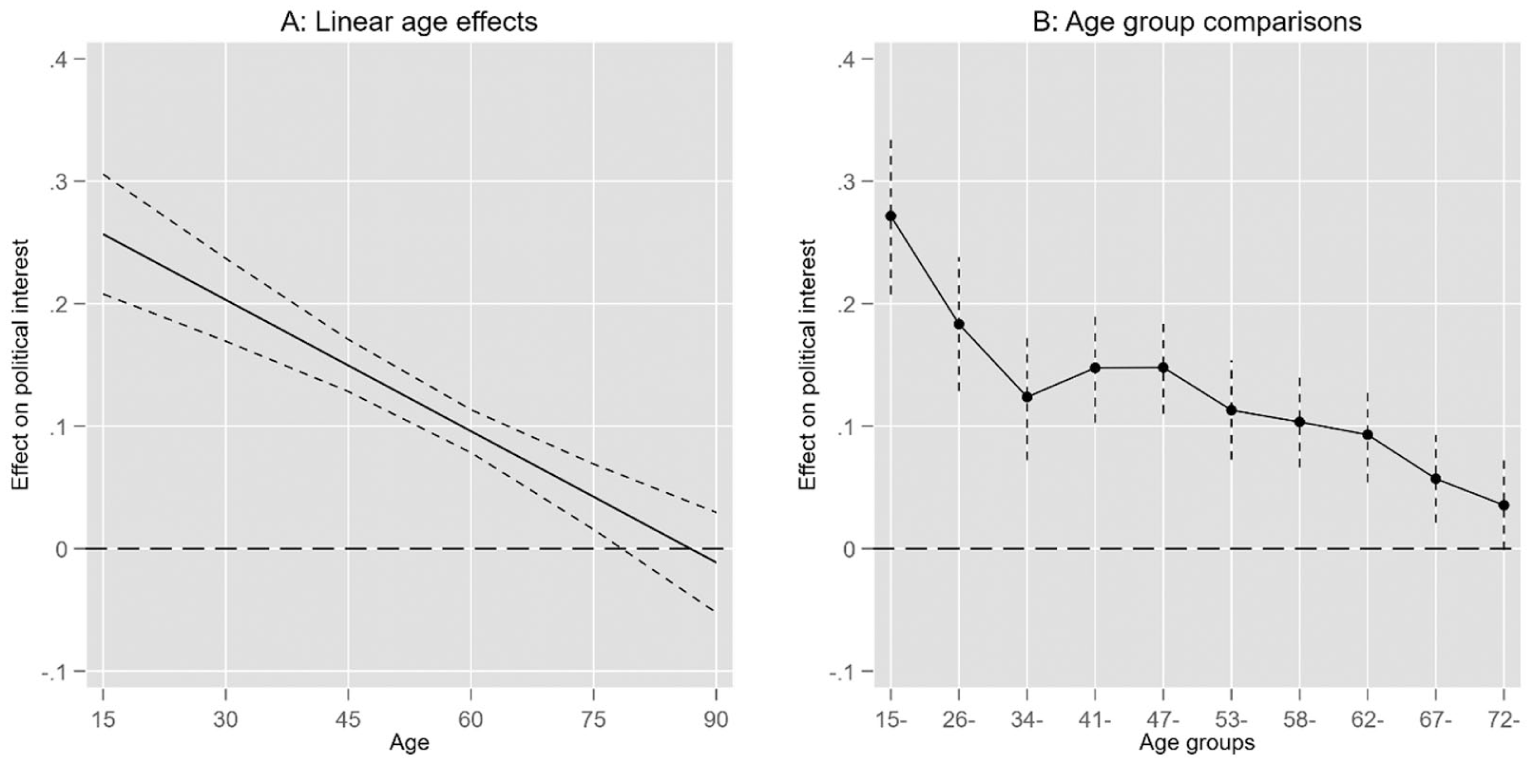
The effect of discussion on interest depending on respondents’ age. Solid lines (and dots) are the marginal effects and dashed lines (and bars) are 95% confidence intervals. Panel A shows the interaction between discussion and a continuous measure of age, while Panel B shows the interaction between discussion and a 10-catetegory age group variable (categories are deciles). The estimates are from fixed effects models (see Online Table A5 for full results).
To further substantiate the role of age in moderating discussion effects, we considered whether it may be due to ceiling effects. If older respondents are already highly interested in politics, there may not be much room for their interest to grow even if they increasingly engage in political discussion. Age is certainly related to political interest: the mean age of respondents who say they are ‘not interested at all’ in politics is 37 years, while it is 55 years among ‘very interested’ respondents. However, 73% of respondents aged 67 or more did not claim to be ‘very interested,’ hence their levels of interest could still increase if stimulated. In sum, the relationship between discussion and interest does not decline with age simply because older respondents cannot become any more interested. 3
Limitations and suggestions for future research
Before highlighting the main implications of our study, we acknowledge some of its key limitations and suggest how they could be addressed by future research.
First, we relied on an observational research design that cannot demonstrate causality. Although the longitudinal structure of the data allows more credible effect estimates than cross-sectional data, we cannot rule out all potential selection biases. Indeed, the risk of identifying spurious relationships, and thus biased causal estimates, has been emphasized for both FE models (Plümper and Troeger, 2019) and cross-lagged panel models (Hamaker et al., 2015; Lucas, 2023). We combined a variety of modelling approaches to reduce these risks, an approach that could bolster the robustness of causal interpretations in future research. Experimental research would be best positioned to carefully assess causality, even though manipulating variables such as political discussion realistically, and across all contexts where it occurs, is challenging.
Second, we relied on survey self-reports, which are imperfect indicators of individuals’ attitudes and behaviours. This limitation is exacerbated by the fact that both constructs were measured in the same questionnaire. When two variables are collected from the same respondent at the same time, their association may partly reflect common source bias − systematic error shared across measures due to features of the respondent, the questions, or the survey context (Meier and O’Toole, 2013). Future research should employ data sources and designs that reduce reliance on single-respondent, same-survey measures. Studies using behavioural measures of discussion, for example, via social media data, would thus complement our study in important ways. Nevertheless, according to Prior (2019), political interest is distinct from other political attitudes because it is easily accessible to survey respondents, hence answers to questions measuring it should be rather precise. Moreover, unobtrusively obtaining data from social media interactions has become increasingly challenging due to platforms’ restrictions on researcher access (De Vreese and Tromble, 2023).
Third, we employed measures of political discussion that combine interactions across various face-to-face and digital environments. On the one hand, this approach has enabled us to test general theories about the overall effects of political discussion on political interest in different conversational settings. On the other hand, we cannot account for the fact that each context and channel involves specific networks, norms and affordances, with potentially distinctive implications for the development of political interest. We hope that future research disentangles the impact of different offline and online conversational contexts, such as the role of contradiction and cross-cutting networks (Matthes et al., 2019; Mutz, 2002; Torcal and Maldonado, 2014).
Fourth, our measure of political interest does not distinguish between momentary, situational interest and longer-term, dispositional interest. Whether we conceive political interest as situational or dispositional has important analytical implications, particularly in gauging whether political talk has long-term or short-term effects. According to Prior (2019), it is difficult to capture this distinction through survey questions, and the best indicator of dispositional interest is its stability over time. Research needs to measure this distinction in more fine-grained ways, ideally through both innovative question wording and longitudinal designs with shorter intervals between waves.
Fifth, it is likely that young adults are under-represented in our data. While this is a general problem in panel surveys (Fladmoe and Bergh, 2022; Olson and Witt, 2011), it is critical for a study of age effects, as political interest develops and stabilizes mostly during adolescence (Janmaat and Hoskins, 2021; Prior, 2010) but could also be triggered as part of entering adulthood (Neundorf et al., 2013). Given this limitation, our study is not ideally positioned to shed light on such nuances.
Sixth, we studied a single Western democracy − Norway − which, among other things, enjoys higher-than-average levels of satisfaction for democracy, social trust, political interest and participation among the public. Hence, our results may not automatically generalize to other democracies, and even less so to non-democratic regimes. Comparative research would help corroborate our findings and identify relevant differences related to countries’ systemic characteristics.
Finally, we foregrounded the relationship between political discussion and political interest as our most novel contribution, but, as our results show, the relationship runs more strongly in the opposite direction, from interest to discussion. By jointly examining both pathways, we added nuance and precision to existing knowledge about these relationships, confirming the centrality of political interest as a key attitudinal predictor of citizens’ political behaviour. For this reason, understanding how political interest develops over time is crucial, and we hope this study has contributed to that effort.
Discussion and conclusion
As political interest explains a host of important democratic behaviours, investigating how citizens’ interpersonal communication may contribute to it is crucial. In this study, we analysed panel data to show that political discussion can enhance political interest over time. The effects are not limited to specific contexts, as the index we used combines political discussion with various groups and results did not change when we considered them separately. Further, although the strength of the relationship between political talk and interest declines with age – with the strongest effects among young adults and little to no impact among those above retirement age – discussion enhances interest for most adult life.
Our study adds to the body of research on how political interest emerges from socialization processes in the family, among peers and at school, during adolescence or in early adulthood (Janmaat and Hoskins, 2021; Jungkunz and Marx, 2025b; Neundorf et al., 2013). The results support the theoretical assumption that political talk can promote different forms of political involvement, including political interest (Pingree, 2007), which has also been demonstrated in some earlier works focusing on adolescents (Shehata and Amnå, 2019) or over shorter timespans (Lane et al., 2019). Our analysis highlights the importance of interpersonal communication for the development of political attitudes and behaviours alongside exposure to political information (Shah, 2016). It further supports Prior’s (2019) finding that acting politically can trigger political interest throughout the lifespan.
One important contribution of our study has been to clarify the relationship between discussion and interest more rigorously and robustly than in most previous research. We tested various specifications of panel models that account for individuals’ stable traits, their prior levels of political interest, and time-varying factors such as media consumption and propensity to express one’s opinion. This approach has reduced the risk of biased effect estimates and enabled a more precise assessment of the impact of discussion on interest over time. The finding that discussion effects occur equally among those with high and low initial political interest suggests that these effects are not limited to citizens with specific levels of engagement, which invites further exploration.
Our results do not question prior work that has treated political interest as a predictor of political discussion, as well as other forms of engagement. Indeed, as is the case with the relationship between political information and participation in general (Moeller et al., 2018; Oser and Boulianne, 2020), we found that the relationship between political discussion and interest is bidirectional, and in fact, the effects of interest on discussion appear to be stronger than the effects of discussion on interest. Nevertheless, our finding that political discussion is not only a consequence of preexisting political interest but can help spark and maintain such interest over time has relevant implications. For example, citizens not socialized to be highly interested in politics may become more interested if they find opportunities to talk about politics as adults.
An important caveat to this positive interpretation is our finding that the effects of political discussion on interest decrease with age. On the one hand, our study adds to the large body of research that has shown that political interest mostly develops during adolescence (Janmaat and Hoskins, 2021; Jungkunz and Marx, 2025b; Prior, 2010, 2019) and that political discussion plays a role in this process (Holt et al., 2013; Shehata and Amnå, 2019). On the other hand, our findings foreground political discussion as a mechanism for enhancing political interest in adulthood and call for further studies that cover individuals’ whole adult lifespan and are sensitive to variations across the life cycle. While factors such as family, early socialization and education may be paramount (Prior, 2019), more dynamic aspects, such as engagement in different forms of political talk and the subsequent thoughts and activities arising from these conversations, are also of scholarly and democratic interest − particularly as digital media have multiplied the opportunities for these interactions in citizens’ everyday lives (Shah, 2016). For young people, social media may however constitute a double-edged sword, on the one hand creating possibilities for expression and discussion, on the other hand facilitating a withdrawal from social activities (Dredge and Schreurs, 2020). Furthermore, it is worth noting that the strongest effects we found involved discussions with family and friends, not online conversations.
Political interest can be characterized as ‘the civic foundation of a country’ (Prior, 2019: 360), as it goes hand in hand with most citizen behaviours relevant to the health of a democracy and provides a stable and comprehensive indicator of political involvement. Thus, it is essential to uncover the processes and mechanisms that nurture this civic foundation of democratic governance. In this study, we have shown that political discussion plays a role in strengthening political interest across an individual’s life, but particularly in young adulthood. Not all political discussion may be good for democracy, but political discussion nurtures interested citizens who may contribute to democracy as a result.
Supplemental Material
sj-docx-1-ips-10.1177_01925121261425446 – Supplemental material for The road to citizenship: How discussing politics shapes political interest across the lifespan
Supplemental material, sj-docx-1-ips-10.1177_01925121261425446 for The road to citizenship: How discussing politics shapes political interest across the lifespan by Kari Steen-Johnsen, Mads Thau and Cristian Vaccari in International Political Science Review
Footnotes
Acknowledgements
The authors thank the editor and the anonymous reviewers for highly helpful and constructive feedback that helped advance and situate the argument of the paper. A previous draft was presented at the 2022 annual meeting of the American Political Science Association, in a panel hosted by the Information Technology & Politics division, and we are very thankful for the thoughtful discussion and feedback we received on that occasion.
Funding
The authors disclosed receipt of the following financial support for the research, authorship, and/or publication of this article: The study was funded by the Research Council of Norway, grant no. 281194.

Supplemental material
Supplemental material for this article is available online.