



Abstract
The two electoral systems most often used for presidential elections are plurality and majority runoff. Majority runoff is more costly due to the necessity of holding a second round. However, a cited advantage of this system is that voters can vote sincerely in the first round, whereas they need to vote strategically under plurality. In this paper, I provide the first systematic test of this conjecture using an original assemblage of surveys that contain the variables necessary to capture strategic voting in presidential elections (43 elections in 19 countries between 1988 and 2021, n = 63,387). The results show that there is no less strategic desertion in the first round of majority runoff compared to plurality. This finding has important implications for the debate over the best electoral system for presidential elections.
Introduction
The vast majority of presidential elections 1 worldwide are organized under either plurality or majority runoff systems (Bormann and Golder, 2022). Under the plurality rule, the candidate who receives the most votes is elected. The majority runoff system operates similarly, with the exception that if no candidate achieves an absolute majority of votes, a second round is organized. This second round takes place two weeks after the initial round and involves the two candidates that came on top of the first round. As a result, the majority runoff system ensures that the winning candidate garners the support of an absolute majority of voters in the second round.
Several studies have examined the advantages and disadvantages of majority runoff in comparison to plurality for presidential elections. This topic is crucial as organizing a second round incurs economic costs, which are only justifiable if the electoral system brings substantial benefits. On the one hand, majority runoff offers advantages by avoiding situations where the president is elected by only a minority of the population, which could undermine their popular legitimacy (Jones, 1993). This rule reduces the risk of conflicts among different segments of the population (Shugart and Carey, 1992). It also facilitates the construction of an inclusive democracy by: making it harder for an ideologically extreme candidate to win; integrating excluded parties into electoral competition; and preventing dominance of unrepresentative cartel parties (McClintock, 2018).
On the other hand, majority runoff also has disadvantages. It can introduce instability into the democratic process by creating political uncertainty during the period between the rounds (Birch, 2003) or when results are reversed in the second round compared to the first one (Pérez-Liñán, 2006). Moreover, Dettrey and Schwindt-Bayer (2009) demonstrate that majority runoff diminishes voter participation, likely due to voter fatigue. Furthermore, plurality prevents the proliferation of parties and decreases the risk of an executive−legislative gridlock, which can lead to democratic breakdown (Linz, 1990).
One key argument in favour of majority runoff is that in the first round voters feel free to vote sincerely for their most preferred candidate (Cox, 1997; Duverger, 1954; Martinelli, 2002; Piketty, 2000; Riker, 1982). In the second round they can decide which candidate they find acceptable (Blais, 2004). This does not occur in plurality elections as voters only have one opportunity to express their choices. Duverger (1954) laws predict the presence of a psychological factor in plurality elections according to which voters do not want to waste their vote on a weaker candidate that has no chance of winning and thus strategically rally to either of the top two contenders. This difference should lead to a minimal sense of satisfaction with the voting system. This is because voters may feel frustrated if they cannot express their true preference and feel obliged to vote strategically. This distinction partly explains why we observe a greater dispersion of votes among multiple candidates in the first round of majority runoff compared to plurality (Shugart and Taagepera, 1994).
However, this argument has been debated, as formal theorists argue that there is as much incentive for a voter to cast a strategic vote under plurality as in the first round of majority runoff (Blais, 2004; Bouton, 2013; Cox, 1997). Scholars contend that there is a possibility that one ‘major’ candidate may not qualify for the second round. This is exemplified by the case of the left-wing candidate Jospin in the 2002 presidential election in France. The extreme-right candidate Le Pen received more votes than Jospin in the first round because left-wing voters dispersed their votes among multiple left-wing candidates. Theorists argue that voters should also vote strategically in the first round of majority runoff to prevent such a situation (Bouton, 2013). Another example of strategic voting in the first round of majority runoff occurs when supporters of the front-runner vote for a less preferred candidate to influence who will face the front-runner in the second round (Bouton and Gratton, 2015). These theoretical studies suggest that Duverger’s (1954) law and classic claims are in fact context dependent. They align with the specific context of Western European countries in the mid-20th century. During that time, the political system in France revolved around a left-wing and right-wing bloc of parties. Consequently, it was clear that if a second round occurred, it would involve a centre-left and centre-right candidate, while other candidates would be eliminated after the first round. In such a scenario, it made sense for voters to vote sincerely in the first round, as they had a degree of certainty regarding the candidates who would advance to the second round. However, this condition is specific to certain place (Western Europe, primarily France) and time (20th century before electoral dealignment, Dalton and Wattenberg, 2000). In other parts of the world and different historical periods, it is less clear which candidate will qualify for the second round.
To the best of my knowledge, there is no study that compares strategic voting in plurality and majority runoff systems using survey data. In this paper, I focus on presidential elections as case studies for such a comparison for several reasons. 2 Firstly, these elections are the most common context in which these two electoral systems are used (Bormann and Golder, 2022). Secondly, (semi-)presidential elections are often perceived as more decisive than parliamentary elections (Golder et al., 2017). Consequently, voters have greater incentives to vote strategically. Thirdly, given that presidential elections are highly visible in the media, voters are more likely to follow the campaign and be aware of the candidates leading in the polls. This is key for identifying who among these candidates are viable and who are not, which is a crucial condition to be able to cast a strategic vote (Blais and Nadeau, 1996). Furthermore, in most presidential elections, there are no districts, and viability is not dependent on where voters cast their votes, which makes it easier to calculate.
In this paper, I provide the first comparative test of the effect of the electoral system, specifically plurality versus majority runoff, on strategic voting in presidential elections using survey data. To accomplish this, I compiled a unique collection of presidential election surveys that include the necessary questions to identify voters who strategically abandon their preferred candidates (Blais and Nadeau, 1996). The dataset includes 43 presidential elections in 19 countries between 1988 and 2021, with a total of 63,387 respondents. 3
I then conduct a multilevel linear probability ordinary least squares (OLS) regression. My findings contradict classic claims by demonstrating that there is no less strategic desertion of minor candidates in the first round of majority runoff compared to plurality. These findings hold significant implications for selecting appropriate electoral systems for presidential elections.
Strategic voting in presidential elections in theoretical and empirical literature
Strategic voting can take different forms. It also differs depending on the electoral rules. I focus on a specific form of strategic voting in presidential elections with majority runoff and plurality rules. The most common form of strategic voting, especially under these electoral rules, is strategic desertion. I follow the definition of strategic voting used by Blais et al. (2001, 2011) and Bol and Verthé (2021). This involves abandoning one’s favourite party when they have no chance of winning and then voting for another party with better prospects (Bol and Verthé, 2021) to influence the election outcome (Blais et al., 2011). This is the specific form of strategic voting that I focus on in this paper. In other words, I use a definition of strategic voting where: (a) a voter abandons their favourite party because the party has little chance of winning; to (b) vote for a party or candidate with more prospective of winning; and to (c) maximize her chances to affect the final electoral outcome.
Prominent scholars such as Duverger (1954), Cox (1997), Downs (1957), Riker (1982), Martinelli (2002) or Payne et al. (2002) explain crucial distinctions in casting a strategic vote between plurality and the first round of majority runoff electoral systems. For instance, Cox argues that voting should be more strategic in plurality because voting strategically in the first round of majority runoff is more complex and requires more information and sophistication. Riker and Martinelli defend the idea that since voters can coordinate in the second round against a minority candidate, they can vote sincerely in the first round. Other scholars, such as Payne et al. (2002) explain that voters feel freer to express their honest preferences in the first round, since they have a second opportunity to choose among the two viable candidates. Downs suggests that voters vote for a party that has more chances of winning even if it is not their first choice. For Downs it would be irrational to vote for a party with no chance of winning (Downs, 1957).
Strategic desertion lies at the core of Duverger (1954) work on electoral systems and their impact on party systems. According to ‘Duverger’s law,’ a plurality electoral system should theoretically result in a party system dominated by two parties, while a two-round majority electoral system (also known as majority runoff) should theoretically lead to a multi-party system tempered by alliances that typically form during the two rounds. This theoretical prediction is driven by two mechanisms.
Firstly, both electoral rules mechanically favour larger parties. In both cases, only parties that secure a plurality or majority of votes are elected, thereby systematically excluding smaller parties from representation. Secondly, voters, aware of the mechanical effects of electoral systems, adjust their voting behaviour and strategically abandon smaller parties in favour of larger ones. To avoid wasting their vote, they tend to avoid parties who have little chance of winning, and support parties deemed viable instead. The cumulative impact of these strategic desertions gives rise to the psychological effect of electoral systems. Duverger (1954) claims that voters vote with their ‘heart’ (sincerely) in the first round, knowing they can vote with their ‘head’ (strategically) in the second round.
This research agrees that the presence of a second round in majority runoff allows voters to freely support their preferred party in the first round. Voters are indeed aware that they can influence the election outcome in the second round. On the contrary, under plurality, voters are compelled to vote strategically from the first round as there is no second round. This implies that there should be more instances of strategic desertion and voters should feel more frustrated with their vote under plurality compared to majority runoff. This leads to my core hypothesis:
H1: There is a higher rate of strategic desertion in presidential elections conducted under the plurality system compared to the first round of those conducted under the majority runoff system.
Note however that the null hypothesis, suggesting no difference between the two electoral systems, is also plausible. More recent theoretical studies argue against the existence of differences between the two electoral systems in terms of strategic voting (Bouton and Gratton, 2015). A voter in the first round of majority runoff can affect the outcome of the election by deciding who, between the second and third candidates, will make it to the second round (Cox, 1997). Even under majority runoff, there is still a possibility that one’s strategic choice, the candidate or party they would have voted for if they voted strategically, may not qualify for the second round. For instance, in the 2002 French presidential election left-wing votes were dispersed among numerous left-wing candidates in the first round, resulting in none of them advancing to the second round. As a result, left-wing voters were left with a choice between a centre-right and extreme-right candidate in the second round. Similar scenarios unfolded in Chile in 2005 and Colombia in 2015, where opposition votes were divided among multiple candidates, ultimately harming their chances. Consequently, according to these theoretical studies, strategic desertion should be equally likely in the first round of majority runoff as it is under plurality.
Empirical studies utilize survey data to study the occurrence of strategic desertions under both plurality systems (Álvarez et al., 2006; Eggers and Vivyan, 2020) and majority runoff systems (Blais, 2004; Plutowski et al., 2021). However, no study has employed this method to directly compare the two electoral systems in this regard. The existing studies either rely on aggregated electoral results or voting experiments.
The first group conducts large cross-country comparisons or focuses on single countries where some regions use one electoral system while others use the other, such as Brazil (Fujiwara, 2011; Jones, 1993, 1999). These studies find that the number of candidates tends to be smaller under plurality compared to the first round of majority runoff, and votes are more concentrated around a few candidates. These findings suggest that there is indeed more strategic voting under plurality. However, due to the absence of individual voter data, these studies struggle to disentangle the portion of the psychological effect attributed to voters voting strategically from that resulting from parties strategically forming coalitions before the election. Consequently, the measurement of strategic voting lacks precision.
The second group relies on experiments in which the authors simulate elections between subjects in a laboratory setting using payoffs in case of victory and fictitious candidates (Blais et al., 2011). These experiments reveal that there is not a substantial difference in subjects’ voting behaviour under both electoral rules. Subjects are equally likely to strategically abandon the candidate that maximizes their payoff under the plurality system as they are to do so under the majority runoff system (Bouton et al., 2022). However, a concern with such experiments is that, since they rely on abstract designs their results may not be generalizable to real-life political elections (Bol, 2019).
To provide new insights on the topic, this paper proposes a test of the hypothesis using individual survey data. This approach offers the advantage of precisely identifying strategic voters while ensuring a high degree of external validity.
Case selection and data
I constructed an original dataset that consolidates the available survey data for presidential elections worldwide, adhering to a set of specific criteria. As mentioned above, there are different forms of strategic voting. For this paper, I focus on the most common one, which consists of deserting non-viable candidates for a viable one. To estimate this, I used the measure of strategic voting proposed by Blais and Nadeau (1996). The first criterion is that the survey must include variables that capture preferences for different presidential candidates (e.g., How much do you support candidate X?’) and the choice of vote (e.g., ‘Which candidate did you vote for in the latest presidential election?’). According to the authors this measure of strategic voting is the most appropriate as voters come to a decision on how to vote based on their preferences among the parties, on the probability of each party winning the election (viability, see below), and vote choice.
I also included surveys that contain variables capturing preferences and votes for (coalition) parties when each of these parties is linked to a specific presidential candidate. However, as the focus is on presidential elections where candidates, rather than parties, compete, I prioritized variables related to candidates when available and used those related to parties to fill gaps. 4
Second, I only included surveys in which the preference and vote choice questions were asked for candidates that are not viable (see below for the operationalization of viability). I indeed need such information to identify whether respondents desert their favourite option when this option is not viable.
Third, I excluded surveys in which one of the main candidates was missing from the preference and vote choice questions. I consider the main candidate to be one who received at least 20% of the votes in the first or only round of the presidential election. Surveys that do not cover one of the main candidates were excluded, as including them would compromise the accuracy of measuring strategic voting, as many voters would be unable to report their preferred candidate.
Finally, I only incorporated surveys in which the vote choice question covered the first round of the election (in the case of majority runoff). The first round is where strategic voting can occur due to the presence of multiple candidates. Strategic voting is not applicable in the second round of majority runoff because there are only two candidates, and both are viable.
Specifically, I merged all nationally representative surveys that meet these criteria from the Comparative Study of Electoral Systems, the Comparative National Elections Project, the Leibniz Institute for Social Sciences, and the Brazilian Center for Studies on Public Opinion. The final dataset comprises 43 presidential elections from 19 countries spanning the period between 1988 and 2021. Out of these elections, 14 relied on a plurality system, while 31 relied on a majority runoff system. Importantly, all these surveys were conducted after the presidential election, usually four to eight weeks after the election.
Dependent, independent and control variables
As referred to before, a crucial variable for identifying strategic voters is one that captures respondents’ preferences for presidential candidates (or their party). Some surveys ask respondents to rate their liking for each candidate on a scale of 0 to 10, while others use a scale of 1 to 5 for evaluation purposes. I rescaled all response categories from 0 to 1. Subsequently, I determined each respondent’s favourite candidate by identifying the one with the highest rating among those they agreed to rate. It is important to note that respondents can have more than one favourite candidate if they assign the highest rating to multiple candidates. 5 Additionally, I remove respondents from the dataset who responded ‘don’t know’ to all preference questions since I am unable to identify a favourite candidate for them.
Another important variable is one that captures vote choice in the most recent presidential election. I matched responses to this question with the preference variable mentioned above to determine whether respondents voted for their favourite candidates. I excluded respondents from the dataset who abstained from voting, those who could not recall the candidate they voted for, and those who voted for an unidentified candidate. I also excluded respondents who reported voting for a candidate that did not participate in the election. This occasionally occurs in surveys where a candidate withdrew at the last minute due to a pre-electoral coalition or candidates who did not participate because they ran as part of a coalition where their party was not leading.
As I am interested in a form of strategic voting which consists of deserting non-viable candidates for a viable one, I initially determined whether the respondent is a potential strategic voter (1 if potential strategic voter, 0 otherwise). I define potential strategic voters as those whose favourite candidate is not viable (Daoust and Bol, 2020).
The literature on strategic voting uses various measures of viability (Bol and Verthé, 2021). In this paper, I adopted the classic approach, which relies on actual electoral results, 6 and considers the M+ 1 rule to define viable candidates. According to this rule, no more than M +1 candidates can be viable. M refers to the district magnitude, which is the number of elected candidates. Under plurality, there are two viable candidates in every presidential election given that there is one candidate elected after the election. In the first round of majority runoff, there are three viable candidates given that two candidates advance to the second round (Cox, 1997). 7 Based on this criterion, I define potential strategic voters as individuals who support a candidate that is NOT among the top two (plurality) or three candidates (majority runoff).
Subsequently, I constructed a variable to capture whether the respondent is a strategic voter (1 if strategic voter, 0 otherwise): among the sample of potential strategic voters (non-viable supporters) strategic voters are those individuals who choose not to vote for their favourite candidate and instead vote for their favourite VIABLE candidate.
There are three types of democratic regimes: parliamentarian; presidential; and semi-presidential. While in parliamentarian the executive authority consists of a prime minister and cabinet arising out from the legislative assembly and the executive is subject to dismissal via no confidence voted by the majority of the assembly, (Shugart, 2005), a presidential democracy is one in which the government does not depend on a legislative majority to exist (Cheibub et al., 2010). In a semi-presidential democracy, a president is popularly elected, has considerable constitutional authority, and there are also a prime minister and cabinet subject to the confidence of the assembly majority (Duverger, 1954).
This is why some authors refer to this form of government as a legitimate dual executive. Depending on the authority prominence, semi-presidential democracy identifies as premier−presidential and president−parliamentary. Whether a country should be classified as parliamentary, presidential, or semi-presidential depends on who is the real head of government (Blondel, 2013). In my dataset, I include all (semi-) and presidential elections where the president is elected by suffrage, her survival does not depend on the Parliament, and the president is the most powerful head of government. To account for the different dynamics among these governments, I include it as control variable.
The independent variable is whether the electoral system is majority runoff or not (0 for plurality, 1 for majority runoff). By plurality, I refer to a system in which there is a single round, and the candidate with the most votes wins. In contrast, by majority runoff, I mean a system with two rounds. If a candidate receives an absolute majority of the votes in the first round, they are elected. If not, a second round takes place a few weeks later with only the two candidates who received the most votes in the first round. In this second round, the candidate with the most votes wins. 8 I only consider the first round of majority runoff elections since there are only two candidates in the second round, and both are viable.
To better evaluate my hypotheses, I conduct multivariate analysis that includes individual and election-level control variables. At the individual level, I include socio-demographic variables: age; gender; and education level. I rescale these variables from 0 to 1 to ensure comparability across surveys. I also control for the strength of partisan preferences, as partisans are less likely to abandon their favourite party due to expressive benefits (Daoust and Bol, 2020). To capture this variable, I calculate the difference in how much the respondent likes their favourite candidate compared to how much they like their favourite VIABLE candidate. Additionally, I control for ‘distance from contention,’ which measures the difference in vote share between the respondent’s favourite candidate and the vote share of their favourite viable candidate. When the respondent’s favourite candidate is close in terms of votes, they may believe that there is still a chance of success and thus be reluctant to abandon them.
At the election level, I include: gross domestic product per capita (as wealthier countries tend to have greater access to information, including electoral polls); population size (as smaller populations increase the chances of an individual vote making a difference); democratic level (lower democratic scores may lead respondents to believe that their vote does not matter, reducing the incentive for strategic voting); the number of presidential elections since the last authoritarian regime (more familiarity with elections make it easier for respondents to coordinate around few viable candidates); compulsory voting (voters who are compelled to vote may spend less time considering how to make their vote count); whether the presidential election was held simultaneously with another election and the number of days between the presidential election and the last legislative election (coattail effects and potential contamination between presidential and local elections); the number of candidates included in the preference and vote questions (more candidates often lead to increased strategic voting); and the cumulative vote shares of these candidates (more voters represented by the candidates in the survey may contribute to increased strategic voting).
Additionally, I include two variables to capture the integrity and quality of the election. I also include a variable for party institutionalization. If same parties routinely compete or same parties advance to the second round, then voters should have a clearer sense of which candidates are likely to be viable. All these variables were constructed from the Varieties of Democracy (V-DEM) dataset. I also incorporate a variable capturing the competitiveness of the election. When an election is closely contested between viable candidates, there is a greater incentive to abandon a nonviable candidate in favour of one of these viable candidates. For this variable, I calculate the difference in vote share between the top two candidates in plurality elections, and the difference between the second and third candidates in majority runoff elections (as these are the two candidates who qualify for the second round). I also include a variable to account for re-election as whether a president is eligible for re-election may have impact on patterns of competition in presidential races (Jones, 2018: 288). I also control semi-presidential governments as the political dynamic differs compared to the one in pure presidential elections (Passarelli and Bergman, 2023).
Results
I first conduct some bivariate analysis. Table A2 in the Online Appendix reports proportions of (potential) strategic voters among potential strategic voters across elections and electoral systems. The overall proportion of potential strategic voters is 12.3%, and within this group, around 32.42% end up voting strategically. Interestingly, Table A2 reveals substantial variation in the proportion of potential strategic voters between countries. This variation ranges from 0% in Mozambique in 2004 to 32.13 in Peru in 2021. While some of the variation seems to be due to specific electoral contexts, it is mostly explained by the number of competing candidates and the size of their support base (hence the importance of controlling for these variables in the multivariate analysis below). For example, in Mozambique in 2004, the two main candidates collectively received over 95% of the votes.
Figure 1 displays the proportion of strategic voters among potential strategic voters in majority runoff and plurality elections (for details, see Table A2 in the Online Appendix). It shows that the average proportion of strategic voters in majority runoff elections (30.70%) is smaller than in plurality elections (36.24%), and a t-test reveals that this difference is not statistically significant even at level p < 0.1. This suggests that there is no more strategic voting under plurality than under majority runoff. However, multivariate analysis is necessary to confirm this finding.
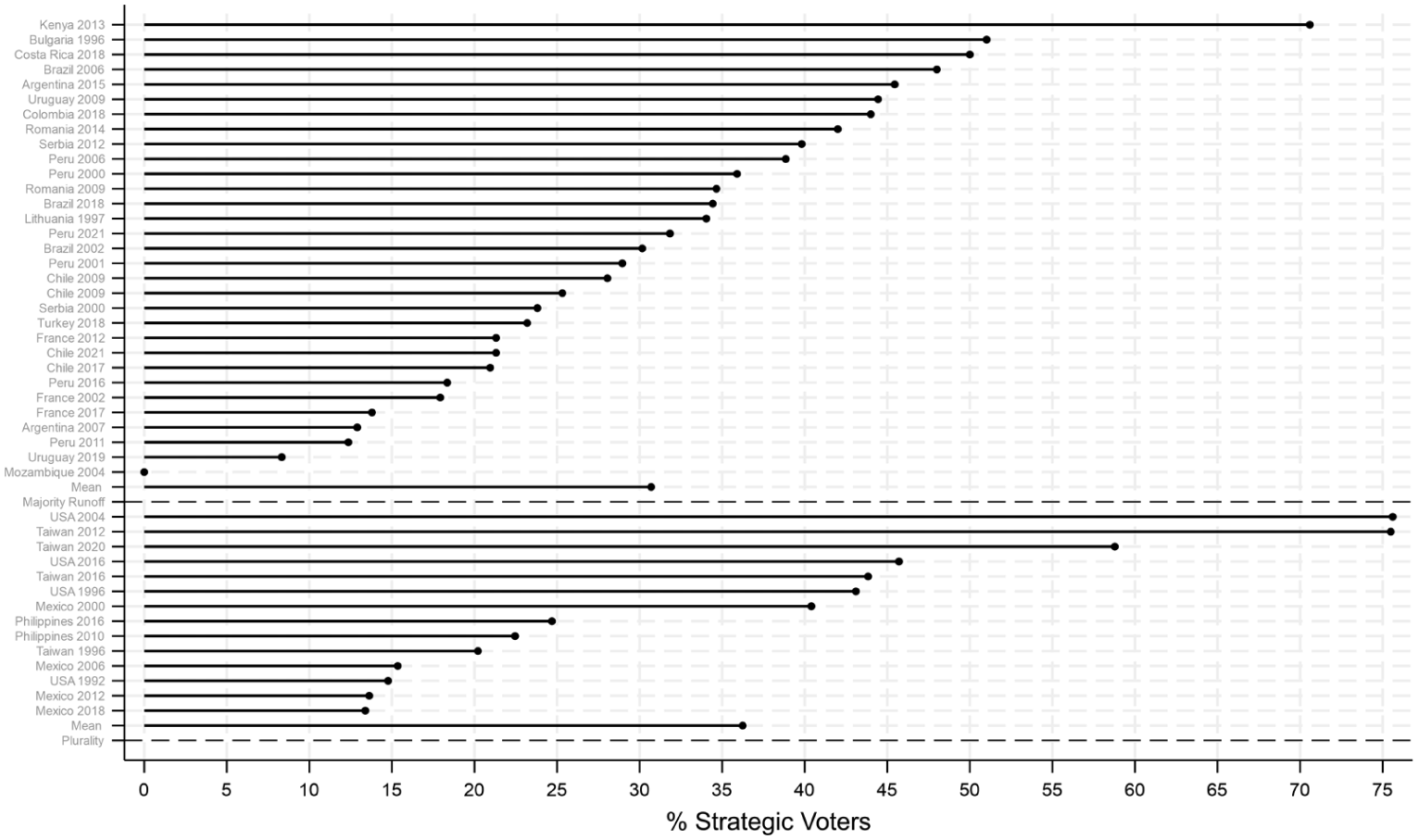
Percentages of strategic voters among potential strategic voters.
Secondly, I conduct multivariate analysis. Table 1 presents the results of multilevel linear probability OLS regressions predicting (potential) strategic voters. 9 I first conduct my analysis with the whole sample (n = 63,387). Then, I replicate the analysis only with potential strategic voters (n = 8,014). I also present the analysis for potential strategic voters. If the results show differences among the samples, this could suggest that voters may be more likely to cast a strategic vote under one system or not because they are more motivated to vote tactically when they are non-viable supporters. For all models, I use the following specifications: (a) without control variables; (b) controlling for exogenous variables to the electoral system (I remove distance from contention, strengths of partisanship and number of candidates); and (c) I include all the individual and election-level variables.
Multilevel ordinary least squares (OLS) regressions predicting (potential) strategic voting.
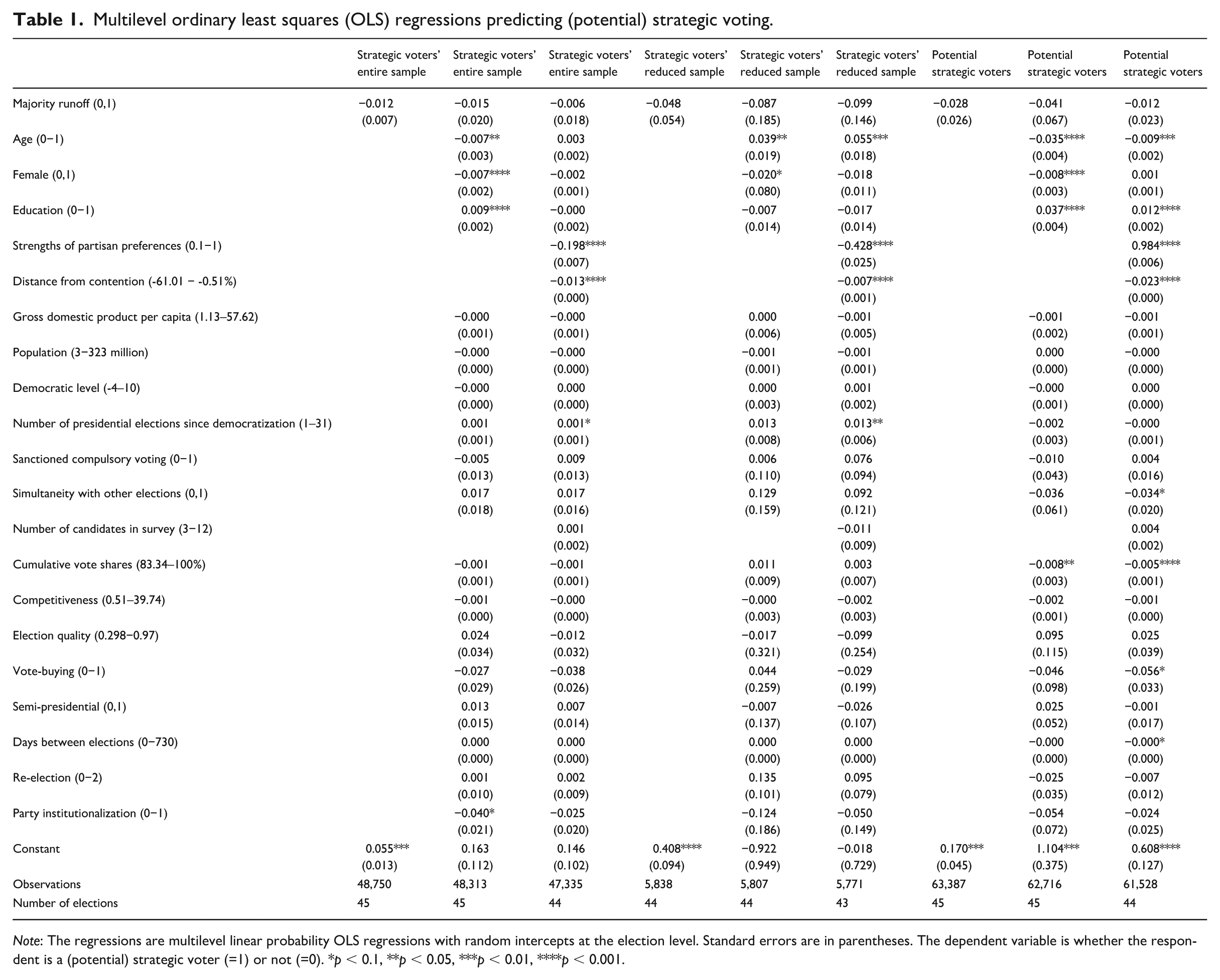
Note: The regressions are multilevel linear probability OLS regressions with random intercepts at the election level. Standard errors are in parentheses. The dependent variable is whether the respondent is a (potential) strategic voter (=1) or not (=0). *p < 0.1, **p < 0.05, ***p < 0.01, ****p < 0.001.
Results in Table 1 indicate that there is no effect of the electoral system on strategic voting. This means that strategic voting is not more prevalent in plurality in either the whole sample (first three columns) or for non-viable supporters (columns 4, 5 and 6). These results hold without control variables, excluding exogenous to the electoral system variables and including all individual and election variables. Results are similarly consistent with potential strategic voters. The electoral formula has no impact on the probability of being or not a potential strategic voter. In terms of control variables, I find that, consistent with other studies, age (positive effect), strength of partisan preferences (negative effect), and distance from contention (negative effect) (Eggers and Vivyan, 2020) are the strongest predictors of strategic voting. As for the potential strategic voters’ sample, the results suggest that the strengths of partisanship is a strong predictor in a positive and substantial way: the possibility of being a potential strategic voter (non-viable supporter) increases among high partisans.
To provide a clearer visualization of the difference between majority runoff and plurality, Figure 2 displays the predicted values of the dependent variable for these two systems in the reduced sample, as calculated from Table 1. It demonstrates that the predicted probability of casting a strategic vote under plurality is approximately 37%, compared to 25% for runoff. The probability of casting a tactical vote is relatively similar between the two electoral systems. However, this difference is not statistically significant even at p < 0.1%.
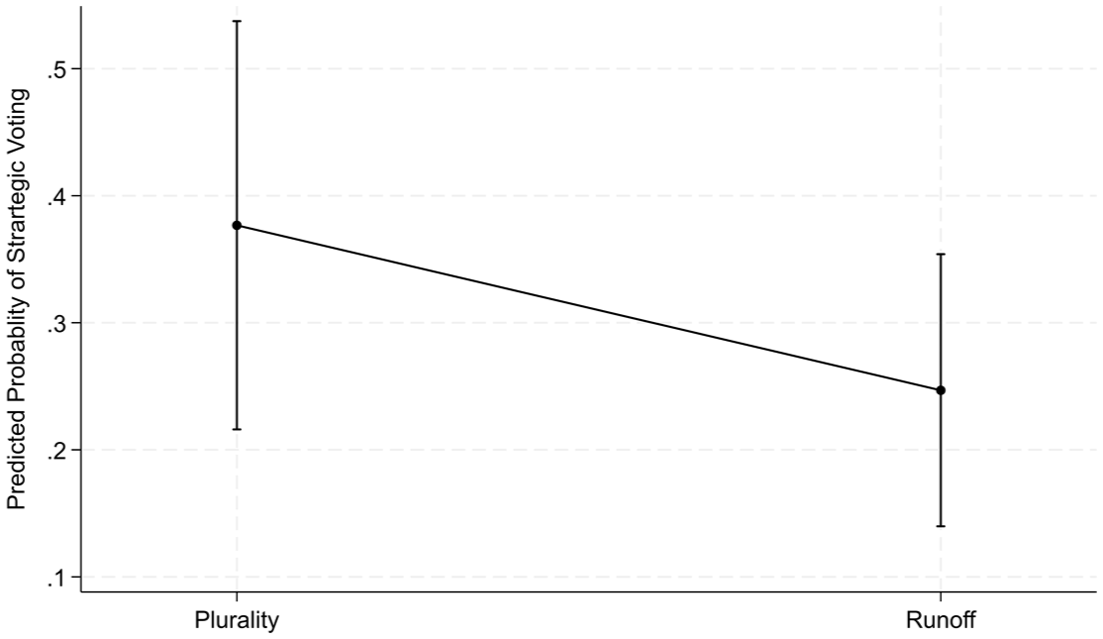
Differences in strategic voting under plurality and majority runoff for potential strategic voters.
To assess the robustness of the results, I conduct a series of supplementary tests. Table A5 in the Online Appendix reproduces the regressions from Table 1, but with some modifications to the sample. Firstly, I exclude three countries (Argentina, Costa Rica and United States) that use an electoral system that cannot be precisely categorized as majority runoff. Secondly, I remove elections from the sample in which the favourite candidate is determined based on questions related to parties rather than directly related to candidates. 10
Thirdly, I apply weights to the samples using official electoral results. Fourthly, I exclude the two ‘Western’ countries (France and the United States) from the sample. Fifthly, I remove elections that were not conducted democratically from the sample, that is, those elections with a quality variable from V-DEM that falls two standard deviations or more below the mean. 11 Sixthly, I restrict the sample to elections in which the survey was conducted 30 days or less after Election Day (for majority runoff, I consider Election Day of the first round). In case the survey was conducted later, there is a risk that many respondents changed their preferences. 12 Finally, I removed the elections where the score of the second and third parties was too close (5% margin victory) 13 suggesting that in those elections, voters could not identify which parties were viable.
In Table A6 in the Online Appendix, I modify the regression specifications. Firstly, I employ logit regression instead of an OLS specification. Secondly, I introduce random intercepts at the country level rather than at the election level. Thirdly, I incorporate robust standard errors in the main OLS regression.
In Table A7 in the Online Appendix, I replicate the regressions from Table 1 but with changes to some variables. Firstly, in certain elections, candidates may form pre-electoral coalitions. I recalculate the preference variable by considering the respondents’ preference for a candidate as the average of their preferences for all candidates/parties within the coalition. Secondly, instead of using actual vote share to measure the viability of competing candidates, I utilize the predictions from the latest polls released before the election. 14 Thirdly, I adopt the alternative operationalization of the viability concept by considering that there are two viable candidates instead of three in majority runoff elections (see Table A3 in the Online Appendix).
Table A8 in the Online Appendix shows the result of an OLS regression where my dependent variable is the type of electoral system, and the independent variables are sociodemographic of age, gender, and education. The main objective is to illustrate that potential strategic voters are not the same across electoral systems.
Figure 3 illustrates the results of the supplementary tests. These findings confirm the results of Table 1, which demonstrate the absence of effects of the electoral system on the probability of casting a strategic vote among potential strategic voters. In the 13 additional tests, the coefficient is not statistically significant even at a level of p < 0.1.
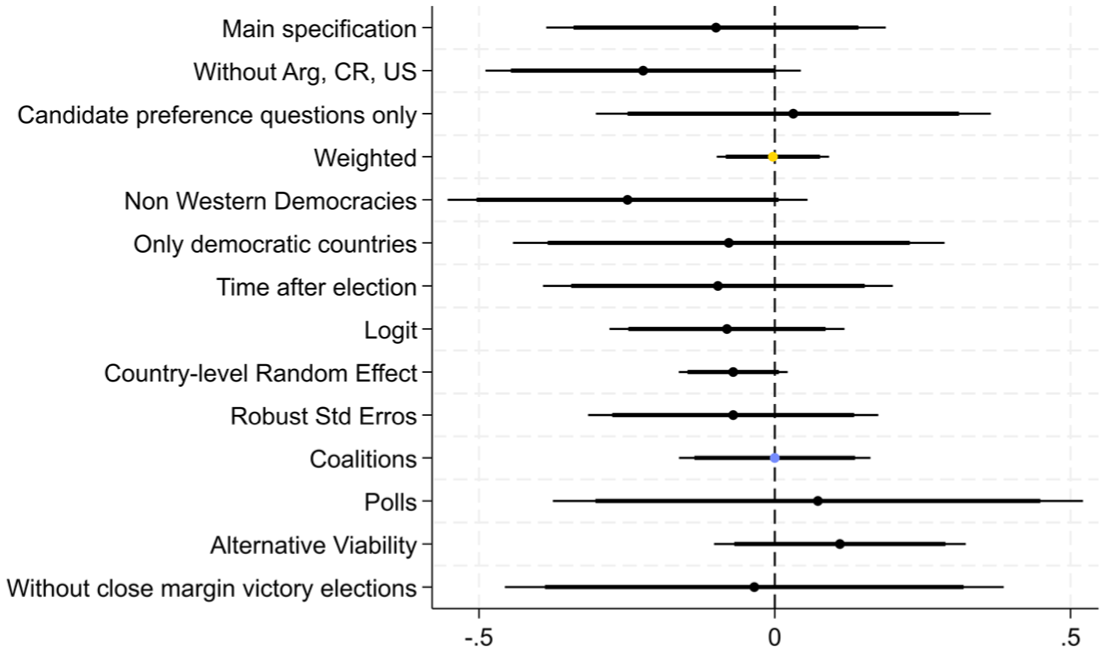
Results of robustness test: strategic voting for potential strategic voters under plurality and runoff.
Conclusion
In this paper, I conduct a test of the classic claim that there is more strategic voting under plurality than under majority runoff. Plurality elections aim to reduce the number of participants and incentivize strategic voting, but may lead to minority governments. Conversely, majority runoff tends to encourage sincere voting and produce more legitimate winners, but may also create instability between elections and entail additional costs. I compile survey dataset that covers 43 presidential elections in 19 countries between 1988 and 2021, with several respondents reaching 63,387. As far as I know, this is the first test of its kind, as previous studies have relied on either aggregated electoral results (e.g., Shugart and Carey, 1992) or experimental data (e.g., Blais et al., 2011). Each of these approaches has limitations in terms of precision (aggregated electoral results) or external validity (experiment), which I address through the survey approach. The results indicate that there is no less strategic desertion in the first round of majority runoff compared to plurality.
These findings have three implications for the literature. First, while each electoral system used for presidential elections has its advantages and disadvantages, the ability for voters to vote with their preferred candidate in the first round of majority runoff elections is often highlighted as a key advantage of this electoral system. They do not have to face the frustration of not voting for their favourite party to avoid wasting their vote. This paper contributes to the literature that seeks to identify the best electoral system for presidential elections by showing that the perceived advantage of majority runoff is not supported empirically: people do vote strategically in the first round as there is a possibility that one of the ‘major’ candidates, which could be their favourite viable option, does not qualify for the second round.
Second, this paper demonstrates that the classic claim, which suggests that there is less strategic voting under majority runoff compared to plurality, does not hold beyond the original case study (France in the mid-20th century). This argument appears to be context-dependent and specific to a political system centred around left-wing and right-wing blocs, where it was clear to all voters that one candidate from each bloc would advance to the second round. Outside this specific context, there is indeed as much strategic voting under both electoral systems.
Third, the findings of this paper suggest that the observed difference in the number of competing candidates between the two electoral systems (Shugart and Carey, 1992) is most likely due to differences in candidate and party strategies. It appears that those who are uncertain about their chances of success are more likely to participate in elections under majority runoff than under plurality, which may be attributed to the dynamics of the two-round system that allows for coalition formation between rounds when the relative popularity of competing candidates and parties is known (Duverger, 1954). In any case, the effect of electoral systems on candidate/parties in presidential elections is driven by the behaviour and strategies of political elites rather than citizens.
Supplemental Material
sj-docx-1-ips-10.1177_01925121251392623 – Supplemental material for Is there more strategic voting under plurality or majority runoff? Survey evidence from presidential elections worldwide
Supplemental material, sj-docx-1-ips-10.1177_01925121251392623 for Is there more strategic voting under plurality or majority runoff? Survey evidence from presidential elections worldwide by Gabriela Aguirre Fernández in International Political Science Review
Footnotes
Acknowledgements
I express my more sincere gratitude to Damien Bol and Sarah Birch who have provided constructive and thoughtful feedback and guidance, and without whom this article would not have been possible. I thank the anonymous five reviewers for their thoughtful and insightful comments on the article. I also thank participants in International Political Science Association Buenos Aires and Korea. and Elections, Public Opinion and Parties, Exeter for their brilliant suggestions in the article.
Declaration of conflicting interests
The author declared no potential conflicts of interest with respect to the research, authorship, and/or publication of this article.
Funding
The author received no financial support for the research, authorship and/or publication of this article.

Data Availability Statement
The data used for the article are publicly accessible. I am glad to share Stata do- and data files with anyone wishing to replicate the findings.
Supplemental material
Supplemental material for this article is available online.
Notes
Author biography
References
Supplementary Material
Please find the following supplemental material available below.
For Open Access articles published under a Creative Commons License, all supplemental material carries the same license as the article it is associated with.
For non-Open Access articles published, all supplemental material carries a non-exclusive license, and permission requests for re-use of supplemental material or any part of supplemental material shall be sent directly to the copyright owner as specified in the copyright notice associated with the article.
