




Abstract
Although extensive research has analyzed the factors that moderate economic self-interest—the relationship between individuals’ income positions and their preferences for redistribution—there is little crossnational research that analyzes the role of political parties. This article argues that political parties play a considerable moderating role in (de-)activating economic self-interest based on the polarization they display in their economic and cultural positions. By combining the World/European Values Survey, the World Income Inequality Database, and the Comparative Manifesto Project datasets, the analyses estimate the moderating effect of party polarization on economic self-interest. The results suggest that economic polarization enhances self-interest for the poor (respondents below the mean income), even when controlling for income inequality, but not for the rich. Moreover, cultural polarization also appears to reinforce self-interest for the poor, rather than supplanting it. The findings have important implications regarding ability for political parties to activate issues among the public.
Keywords
Introduction
The declining salience of the economic cleavage in advanced democracies is one of the most noteworthy political trends observed in recent decades (Franklin, 1992; Bartolini, 2000; Kriesi et al., 2006, 2008; Best, 2011; Goldberg, 2020). As a result, much of the research in this area has aimed to identify the explanations for this decline, which has generally taken either a demand-side approach (i.e., voter preferences) or a supply-side approach (i.e., party positions). On the one hand, the demand-side approach implies that the positions of political parties are ultimately determined by the electorate: voters have become less divided in their economic preferences due to rising affluence and the fragmentation of the labor market (Nisbet, 1959; Dahrendorf, 1959; Zweig, 1961; Lipset, 1964; Kitschelt, 1994; Clark and Lipset, 2001) as well as the emergence of new divides based on education, cultural issues and European integration (Kriesi et al., 2006, 2008; Hooghe and Marks, 2018). On the other hand, the supply-side approach implies that political parties have substantial agency to operate independently from public opinion. Supply-side explanations note that political parties, by converging in their economic positions, have constricted the range of options that voters have to choose from (Evans, 1999; Jansen et al., 2013; Evans and De Graaf, 2013; Evans and Tilley, 2012, 2017). However, one possibility that has been overlooked in previous studies is that political parties influence voters’ preferences: that the convergence of political parties on economic issues could contribute to the declining salience of the economic cleavage by making voters less divided over economic issues. This article aims to fill this gap in the literature by exploring the moderating effect of party polarization on economic self-interest.
Can political parties (de-)activate economic self-interest among the public? In other words, if parties differentiate themselves more on economic issues, do the economic conditions of voters become more closely associated with their preferences for redistribution? This question lies at the intersect of two important areas of political research, namely the determinants of preferences for redistribution (e.g., Meltzer and Richard, 1981; Alesina & Giuliano, 2011; Rueda, 2018) and the role of political parties in shaping public opinion (e.g., Zaller, 1992; Abramowitz, 2010; Moral and Best, 2022). Economic self-interest is the extent to which people’s preferences for redistribution are determined by their income position (Dimick et al., 2016). A large body of research has shed light on how preferences for redistribution are determined by individual-level factors, particularly income position (Dion and Birchfield, 2010; Schmidt-Catran, 2016; Sealey, 2018) and other signifiers of socio-economic status that reflect risk and insurance (Iversen and Soskice, 2001; Rehm, 2009; 2016). Although this relationship is a well-established finding in the literature (Bean and Papadakis, 1998; Corneo and Gruner, 2000; Fong, 2001; Gilens, 2005; Finseraas, 2009; Alesina and Giuliano, 2011; Dimick et al., 2016; Rueda, 2018), economic self-interest varies substantially between and within countries (Lubker, 2007; Dion and Birchfield, 2010).
To explain this, scholars have mostly looked at the moderating effects of macro-economic factors such as levels of development and inequality (Dion and Birchfield, 2010; Schmidt-Catran, 2016; Rueda & Stegmueller, 2016; Andersen et al., 2021). Still, the role of political parties in this area has often been overlooked. The ability of political elites to shape the agenda and public opinion is well-documented in a long and extensive literature (Key, 1961; Sartori, 1969; Zaller, 1992; Evans and De Graaf, 2013; Geer, 1996; Lachat, 2008; Medina, 2015; Moral and Best, 2022), but there has not yet been a cross-national examination of the role that political parties have in moderating economic self-interest. This is particularly pertinent to the declining salience of the economic cleavage in advanced democracies that has been noted by scholars, as it points to the agency that parties have in shaping the political landscape.
This article aims to help fill this gap and investigate the role that political parties have in activating economic self-interest from a comparative perspective. First, I begin by developing expectations on the moderating effect of party polarization on economic self-interest. Self-interest is the main theoretical driver of individual preferences in the redistribution literature (Romer, 1975; Meltzer and Richard, 1981; Dimick et al., 2016). Economic self-interest is reflected in the strength of the relationship between individuals’ income position and their preferences for redistribution: the poor support more, the rich support less. But this relationship varies substantially across countries (Dion & Bichfield, 2010; Lübker, 2007, Andersen et al., 2021). One possible explanation for this is the role that political parties play in shaping public opinion. A wealth of scholarship has demonstrated that citizens take their political cues from political parties and develop policy preferences that match those of their preferred party (Zaller, 1992; Saunders and Abramowitz, 2004; Abramowitz, 2010; Moral, 2017).
Second, I employ an original and comprehensive dataset that merges cross-national surveys and studies to analyse the moderating effect of party polarization on the relationship between income position and preferences for redistribution. The dataset used combines the Integrated Values Survey (IVS)–both the World Values Survey and the European Values Survey–with the World Income Inequality Database (WIID) and the Comparative Manifesto Project (CMP). Altogether, the joint dataset includes 293,771 respondents in 271 surveys from 51 countries between 1990 and 2020.
Finally, the moderating effect of party polarization on economic self-interest is estimated by conducting OLS regression analyses. To control for the problem of reverse causality (i.e., the effect of economic self-interest on party polarization), the analysis employs mixed-effects models that account for time-invariant country-level factors that condition economic self-interest (e.g., cultural, historical, etc.) and includes income inequality to account for time-varying macro-social shifts that could spill over into public opinion. Moreover, the analyses are replicated using subsamples based on whether respondents are above or below the mean income in their country, since this determines if they can expect to gain or lose from redistribution, which can shape how they view redistributive policies.
The results show clear asymmetries between the rich and poor in how party polarization affects economic self-interest. Economic polarization enhances self-interest for the poor, but not for the rich. Since economic polarization has generally declined, this suggests that parties have contributed to the declining salience of economic issues among the public, predominantly by moderating left-wing voters. Meanwhile, cultural polarization also appears to enhance self-interest for the poor, while weakening it for the rich. This suggests that the advent of cultural issues may actually not be supplanting the economic cleavage, but rather reinforcing it, at least for lower-income voters. These findings hold important implications for the broader topic of elite influence over public opinion, indicating that parties have a meaningful capacity to activate and deactivate issues among the public.
The following section conceptualizes economic self-interest and discusses the moderating role of party polarization. I then describe the research design and dataset used to estimate the moderating effect of party polarization in economic and cultural issues.
Theory and hypotheses
Self-interest
Material self-interest serves as the most common basis for understanding individuals’ preferences for redistribution. This approach views individuals as primarily motivated by what they get out of redistribution: the more they gain, the more they support it, and the more they lose, the less they support it. The principles behind this idea can be traced back to rational choice theory (Downs, 1957) and social choice theory (Arrow, 1974; Arrow and Debreu, 1954). The most popular version of this approach is the theoretical model proposed by Romer (1975) and developed by Meltzer and Richard (1981), which assumes that voters seek to maximize their income.
The purpose of redistribution is to ameliorate income disparities through tax and transfer programs that have a net cost to the rich and a net benefit to the poor. In this article, I use the terms rich and poor not to refer to an individual’s raw income, but to their income position, which determines how much an individual can expect to gain or lose if incomes are equalized. In this sense, the rich are those with incomes above their country’s mean and the poor are those below the mean. Based on pure self-interest, the rich would want a tax rate of zero in order to keep all their income. Conversely, the poor would want a 100% tax rate so that all incomes were equal. Nonetheless, tax and transfer programs can have deadweight costs (e.g., economic stagnation) and distortionary costs (e.g., the progressivity of tax brackets), which is why preferences are generally expected to be proportionally related to income position.
The first hypothesis outlines the presence of economic self-interest: the relationship between individuals’ income position and their preferences for redistribution. The stronger this relation is, the more self-interest there is. Indeed, support for redistribution is lower among the rich than the poor, as numerous studies have confirmed (Alesina and Giuliano, 2011; Bean and Papadakis, 1998; Corneo and Gruner, 2000; Cruces et al., 2013; Finseraas, 2009; Fong, 2001; Gilens, 2005; Rueda, 2018).
Income position decreases support for redistribution. Although this relationship generally holds, its strength varies substantially across countries, and people often hold preferences that do not reflect their narrow individual self-interest. Studies have attributed this variation to culture, inequality and economic development (Lübker, 2007; Dion and Birchfield, 2010; Beramendi and Rehm, 2016; Andersen et al., 2021). Most of these explanations focus on historical and macro-economic factors for which political agents have little control over, especially if they are not in government. But political leaders do have agency over their parties’ positions, which may shape public opinion and, by extension, people’s self-interest.
Party convergence on the economy
Party polarization is determined by various factors, which can broadly be grouped by level of analysis. At the macro-level, party polarization is determined by the polarization of the electorate. This follows the demand-side logic of electoral politics: parties are responsive to changes in public opinion, so if the public becomes more polarized, then parties will follow in turn (e.g., Budge et al., 2012). Many studies have provided evidence for party responsiveness to changes in voter preferences (Adams et al., 2004, 2006; McDonald and Budge, 2005; Ezrow and Xezonakis, 2011; Ezrow et al., 2014), although this effect does not appear to extend to party polarization (Moral and Best, 2022). At the meso-level, party polarization is often attributed to institutional factors, such as the proportionality of the electoral system (Downs, 1957; Cox, 1990; Calvo and Hellwig, 2011; Dow, 2011), whether parties are in government or in opposition (Bawn and Somer-Topcu, 2012), and coalition expectations (Curini and Hino, 2012). At the micro-level, party polarization can be influenced by the strategic decisions of political leaders, who exert contingent agency (Meguid, 2005; Enyedi, 2005). 1 Overall, party polarization is determined by a confluence of factors that are likely to be highly interactive.
Ideological convergence among parties—especially on economic issues between mainstream parties—has been noted by political researchers (Oskarson, 2005; Elff, 2009; Evans and Tilley, 2012; Grant, 2021). The decline in economic polarization is a result of growing consensus around the role of government in the economy between parties on the left and the right. On the one hand, left-wing parties have moderated their positions. One reason for this is Wagner’s Law: as countries develop economically, government spending tends to increase (Oxley, 1994; Islam, 2001; Akitoby et al., 2006; Afonso and Alves, 2017). Increased government spending can have a ceiling effect on the economic positions of left-wing parties, since there is less room to expand state-intervention in the economy. Another reason for this decline is the composition of the electorate. As countries develop, middle-class educated professionals make up a larger segment of the electorate. This has induced many center-left parties to broaden their appeal away from working class voters in favour of the more affluent middle class (Nisbet, 1959; Dahrendorf, 1959; Lipset, 1964; Kitschelt, 1994; Nieuwbeerta et al., 2000; Clark and Lipset, 2001; Evans and Tilley 2017).
On the other hand, right-wing parties have also moderated their economic positions because higher-income constituencies, who form the traditional right-wing voting bloc, have a “mixed loyalty” toward government spending (Gonthier, 2019: p. 152). As the state grows in its size and scope, they start to view government spending more favourably because they increasingly see themselves as recipients and consumers of social policies (Papadakis and Bean, 1993), and “they consume and also often are employed in the public sector” (Gonthier, 2019: p.150). Once state functions expand, higher earners want to maintain high-quality services in order to prevent social policies from being confined to the poor and becoming “poor services” (Rothstein, 2010). Higher earners also tend to favour forward-looking public investments (e.g., in education, health and infrastructures) that benefit the whole of society as much as their own interests (Mau, 2015).
Party polarization and public opinion
While political parties are typically viewed as reflecting citizens’ policy preferences (e.g., Lawson, 1980; Dalton et al., 2002), they can also play an active role in shaping public opinion. Much of the now-classic scholarship on public opinion highlights the ability of political leaders to activate (or de-activate) issues to make them more (or less) salient among voters (Key, 1961; Sartori, 1969; Zaller, 1992; Geer, 1996). Early on, Key (1961) noted the ability of political leaders to activate public opinion on latent issues. Sartori was one of the first to point out explicitly that political actors have substantial agency in shaping political divides: “As long as we take for granted that cleavages are reflected in, not produced by, the political system itself, we necessarily neglect to ask to what extent conflicts and cleavages may either be channelled, deflected and repressed or, vice versa, activated and reinforced, precisely by the operations and operators of the political system” (1969, p. 209).
Regarding the economic cleavage, declining party polarization has been used to explain lower rates of class voting (Evans, 1999; Evans and Tilley, 2012; Evans and De Graaf, 2013) and lower turnout among the working class (Evans and Tilley, 2017). This research demonstrates that when parties converge in their economic positions, people are less likely to vote based on their economic status because the differences in the options they are presented with are not clear enough. This article extends this argument, suggesting that this effect spills over to public opinion. Not only can parties reduce the salience of a cleavage by diluting the options presented to voters, but they can also affect public opinion itself. Previous research has demonstrated the influence that party polarization can have on public opinion (Abramowitz, 2010; Druckman et al., 2013; Hetherington, 2001; Iyengar et al., 2012; Layman and Carsey, 2002; Hillygus and Jackman, 2003; Jensen and Thomsen, 2013; Medina, 2015). This mechanism can also help explain the declining salience of economic attitudes.
There are several reasons why party polarization can be expected to activate issues among public opinion. First, political parties can enhance or diminish the salience of an issue by providing voters with information and cues on what to think and what to think about. If parties differentiate themselves more (less) around an issue, citizens are likely to adopt more (less) extreme views on them, thus enhancing (diminishing) their salience. Voters tend to take cues from their preferred party on issues because gathering information about politics and policies is costly (Zaller, 1992; Ray, 2003; Steenbergen et al., 2007). Furthermore, Lenz (2012) suggests that voters tend to adopt the policy preferences of their preferred candidates even for non-policy reasons. In the United States, rising levels of public polarization have been attributed to increased party polarization, especially for informed citizens (Layman and Carsey, 2002a, 2002b; Carsey and Layman, 2006; Layman et al., 2006). Studies of the United Kingdom have found modest convergence among the public, but people who perceived convergence among parties followed suit (Adams et al., 2011; Adams etal., 2012). In a recent study of 19 advanced democracies, Moral and Best (2022) find that citizens, especially informed and engaged ones, follow political parties as they become more or less polarized (and that this effect does not occur the other way around).
Second, party polarization can enhance the ideological consistency of citizens. Studies on voting behavior show that when parties stake out clear and distinct positions, citizens are more likely to cast ballots on ideological terms (Dalton, 2008; Fazekas and Méder, 2013; Freire et al., 2008; Lachat, 2008; Pardos-Prado and Dinas, 2010). For example, a recent study by Riera and Pastor (2022) found that populist parties that join coalition governments as junior partners tend to lose more votes when there is low intra-cabinet conflict, suggesting that populist voters become disillusioned with their party if it loses its populist ethos once in government. This is consistent with the notion that parties can sharpen ideological differences among the public by acting out their beliefs. Moreover, some studies have noted that public opinion tends to be more polarized when people’s views on similar issues are more consistent (Baldassarri and Gelman, 2008; Abramowitz and Saunders, 2008; Jensen and Thomsen, 2013). Consequently, if parties can enhance the ideological consistency of voters in certain areas by displaying clearer differences, this can increase their salience among the public. For example, Jensen and Thomsen (2013) find that attitudes on immigration are more associated with ideology in Denmark than in Sweden because Swedish parties, unlike Danish ones, refrained from taking opposing sides on immigration.
Third, party polarization can lead to sorting—similar groups adopting more similar attitudes—which in turn enhances the relationship between social divisions and attitudinal ones. When parties display clearer ideological differences on a certain issue, citizens can perceive these differences more easily (Knutsen and Kumlin, 2005; Lachat, 2008; Levendusky, 2009; Garner and Palmer, 2011; Thornton, 2013). This allows voters to make more informed—and likely policy-driven—decisions (Zingher and Flynn, 2018) and strengthens their partisan attachments (Hetherington, 2001; Bafumi and Shapiro, 2009). Moreover, parties can probably cue citizens more effectively when they are more polarized, since polarization “changes the clarity of the cues elites send to voters” (Levendusky, 2009, p. 114). As Lachat (2008, p. 688) states: “polarisation allows voters to make more sophisticated decisions at a lower cognitive cost.”
The main proposition of this article is that these arguments on party polarization extend to people’s preferences for redistribution. When political parties differentiate their economic positions more, it enhances the awareness of citizens about economic issues and cues them to take more salient positions for themselves. Therefore, when political parties are highly polarized around economic issues, the effect of income position on preferences for redistribution is expected to be stronger.
The effect of income position on support for redistribution is stronger when party polarization on economic issues is high. Mirroring the declining trend of economic salience, scholars have observed that parties have become increasingly divided over cultural issues, especially in Western democracies (Kitschelt, 1994; Kriesi et al., 2008; Oesch and Rennwald, 2018; Inglehart and Norris, 2016). One of the earliest examinations cultural positions using survey data was conducted by Inglehart (1977, 1990), who found that people in advanced industrial societies were increasingly aligned along issues that cut across economic positions, such as same-sex marriage, abortion, drug policy and immigration. The rise of this cultural divide has been attributed to the diversification of the labour market (Kitschelt 1994), globalization (Kriesi et al. 2008), intergenerational shifts (Inglehart and Norris, 2016), and rising education (Allardt 1968; Knutsen 2004; Stubager 2009, 2010). The advent of a cultural divide may also influence people’s economic attitudes, but the nature of this impact is not obvious. On the one hand, growing cultural polarization could supplant the economic cleavage. Political issues must compete to be part of the agenda, so the advent of new issues supplants older ones (Katz and Mair 1995; Meguid 2005; Bornschier 2007). On the other hand, it is also possible that the cultural and economic cleavages actually reinforce one another. In other words, higher polarization over cultural issues may spillover to the economic realm. For example, Marks and Wilson (2000) have argued that the new divides over European integration have been assimilated into pre-existing economic divides. In fact, some studies that looked at the relation between social class and economic attitudes did not find evidence of convergence in individuals' positions (Kriesi et al. 2008: p. 266; Evans and De Graaf 2013: p. 396). In line with this, Houtman et al. (2009) have argued that “class is not dead, but has been buried alive under the increasing weight of cultural politics”. Still, the question of whether cultural shifts spillover to changes on economic attitudes overall is largely absent in the literature. As De Graaf and Evans (1996: p. 614) point out, cultural issues “often have been conceptualized as, to a large degree, an orthogonal dimension of core political values that have no necessary implications for the political centrality of long-standing disputes over economic redistribution”. The third hypothesis posits these two possibilities: that cultural polarization may hinder economic self-interest because it supplants the economic cleavage, or that it may actually strengthen economic self-interest because it reinforces the economic cleavage.
Data and methodology
Sample
To test the hypotheses, this study uses the Integrated Values Survey (IVS; the combination of the World Values Survey and the European Values Survey), a pooled cross-sectional time-series dataset of cross-national surveys of weighted random representative samples of about 1,500 respondents starting from 1981. This dataset includes attitudinal and socio-demographic data that allows for a comparative analysis on the relationship between people’s economic attitudes and their income position. The final sample without missing data consists of 293,771 respondents in 252 surveys from 51 countries.
Support for redistribution
The dependent variable in the analysis is individual-level support for redistribution, measured by the reverse of the ‘Income Equality’ question from the IVS survey (Item E035). The item uses a ten-point scale whereby 1 indicates support for less redistribution and 10 indicates support for more redistribution. The item is worded as follows:
2
How would you place your views on this scale? (1) We need larger income differences as incentives. (10) Incomes should be made more equal.
This question has been used as the outcome variable in numerous studies (Ansell and Samuels, 2010; Pepinsky and Welborne, 2011; Hayward and Kemmelmeier, 2011; Iglesias et al., 2013), as have other questions representing specific economic issues like business ownership (Bjornskov and Paldam, 2012) and individual responsibility to provide (Sealey, 2018; Andersen et al., 2021). Moreover, ten-point scale survey questions such as this have been found to be more useful than five-point scales because they have higher convergent and discriminant validity while maintaining similar means (Coelho and Esteves, 2007).
Income distance
Income position is the position that an individual holds in an income distribution. The measurements used in the literature have been quite varied, but can be broadly classified into three main groups: ordinal measures (e.g., Fong 2001; Gilens 2005; Rehm 2009; Alesina and Giuliano 2011; Loveless and Whitefield 2011), rank measures (e.g., Bean and Papadakis, 1998; Cruces et al., 2013; Beramendi and Rehm, 2016; Schmidt-Catran, 2016; Andersen et al., 2021), and mean-centred measures (e.g., Corneo and Gruner 2000; Dion and Birchfield 2010; Dimick et al. 2016; Rueda 2018). Ordinal measures are based on grouping individuals by their raw income into ordinal scales (e.g., $0–9,999, $10,000–19,999, etc.). Rank measures are based on individuals’ rank within the income distribution, which are typically grouped into tiles (e.g., deciles, quintiles, quartiles, etc.). Mean-centred measures are based on the distance between an individual’s income and the mean income of their country.
Income distance is the difference between a person’s income and the mean. It is based on respondents’ household income and their country’s mean income, which is equivalent to GDP per capita. For example, a person with an income of $20,000 in a country where the mean income is $40,000 would have an income distance of -$20,000, while a person with an income of $50,000 would be +$10,000. Moreover, income distance can be transformed to conform to a certain scale, as Dion and Birchfield (2010) do based on the standard deviation of incomes for each country-year. These independent variables require operationalising respondents’ household income and country-year GDP per capita. This is done by combining the IVS survey data with the WIID, which collects yearly country data on the income distribution of countries as well as GDP per capita in 2017 PPP (purchasing power parity) and Gini estimates (see Gradín, 2021) from different sources.
The operationalization of household income for IVS respondents consists of two steps. First, the income percentile respondents is estimated using the ‘Scale of Incomes’ question of the IVS (Item X047), which has country-specific household income scales labelled by national currency adapted to 10 categories (10% lowest to 10% highest income category) and is worded as follows: Here is a scale of incomes and we would like to know in what group your family is, counting all wages, salaries, pensions, and other income that comes in. Just give me the number of the group your household falls into, after taxes and other deductions: (1) First step, (10) Tenth step.
Despite the item’s limitations in terms of measuring raw income, it has internal validity when used as a distributional measure of income position within surveys (Donnelly and Pop-Eleches, 2018). Each respondent is assigned a percentile value (1–100) based on their rank with respect to the rest of the respondents from the same country-year survey, similar to previous research (Fairbrother, 2013). This maximises the variance of respondents’ income percentile without biasing the variable.
Second, respondents’ income percentile values are matched with the WIID dataset. The WIID uses the Shorrocks-Wan approach (Shorrocks and Wan, 2008) to produce synthetic distributions at the percentile level that offer comparable estimates of the net household income for each percentile group by country and year (see Gradín, 2021; Appendix A). Therefore, matching IVS survey data with the WIID dataset by income percentile provides a reliable and comparable estimate for how much money each respondent makes.
Once individual household income is operationalised, the income distance can be obtained based on the mean income of their corresponding country and year. Income distance is calculated as individuals’ income minus the mean income, as shown in equation (1).

Party polarization
Party polarization is obtained using the Comparative Manifesto Project (CMP) dataset (Volkens et al., 2021). The CMP is one of the most widely-used datasets that measures party positions, consisting of hand-coded estimations for 54 policy areas of party manifestos on 51 countries. 3 Party positions on a wide array of issues are measured by human coders carrying out content analysis of ‘quasi-sentences’ based on a common pre-established classification scheme. For each party in each election, the CMP offers the frequency of rhetoric on specific political issues, reflecting the extent to which parties are dedicated to that position.
Assessments of the CMP suggest that it has high validity as a measure of party positions. Evans and De Graaf (2013) offer a comprehensive assessment of the CMP, outlining is main advantages, which can be summarised as (1) objectivity (measures are based on party manifestos); (2) accuracy (estimates measure preferences rather than party behaviour); (3) comparability (measures are based on the same classification scheme across countries and time); and (4) validity (Budge, et al., 1987, 2001; Budge and Pennings, 2007; Volkens et al., 2009). More narrow assessment of the economic items from the CMP also suggest high validity as a dimension (Horn et al., 2017). This has also been the case with items on immigration, for which Carvalho and Ruedin (2020) find high consistency compared to expert surveys. Some scholars have critiqued that the CMP data is better at determining the salience of issues than party positions on the issues (Benoit and Laver, 2006). This is not too concerning for the purpose of this article, since it is focused on the salience of issues rather than the position of specific parties. For this, the CMP is uniquely suited, as “the main information” obtained from the data is “the relative emphasis parties give to the different messages they wish to transmit to electors” (Klingemann et al., 2006, 116).
The data from the CMP is used to estimate economic/cultural polarization among political parties as a proxy for the extent to which they display contrasting positions to the electorate. Following the theoretical mechanism explained previously, when parties display more polarized economic positions, this will activate economic issues among the public, thus enhancing their self-interest regarding redistributive preferences. The calculation of party polarization consists of two steps. First, the positions of parties are measured based on various items relating to economic and cultural issues.
4
Economic items include items on the following policy areas: free market, market regulation, economic planning, controlled economy, economic orthodoxy, equality and welfare state expansion. Cultural items include the following: traditional morality, multiculturalism, underprivileged minority groups, freedom and human rights, law and order, prioritizing economic growth, environmental protection, and technology and infrastructure. Other studies have constructed similar scales for parties’ economic positions with the CMP database (e.g., Pontusson and Rueda, 2010; Tavits and Potter, 2015; Loxbo et al., 2021; Polacko, 2022). Second, polarization is calculated using the index proposed by Dalton (2008) to the economic and cultural positions of each party in a respective election year, as shown in equation (3):

Controls
Various socio-demographic measures are used as controls in the analyses due to the possible endogeneity they might create between income and preferences for redistribution: religiosity, gender and age. A previous study of WVS data showed that support for redistribution is associated with older and female respondents (Alesina and Giuliano, 2011). Moreover, religiosity has been linked to less support for redistribution in numerous studies (Guiso et al., 2006; Brammer et al., 2007; Renneboog and Spaenjers, 2012). The IVS includes questions for these variables. Gender (Item X001) is coded as a categorical variable: Male and Female. Age (Item X003) is coded as a continuous variable. Religious attendance (Item F028) is coded as the reverse of the 8-point scale from the IVS (more indicating higher religiosity).
The analysis also controls for income inequality to address the possibility of endogeneity. In other words, party positions can cause changes in inequality, which can in turn affect levels of self-interest. In theory, if people are self-interested, redistributive preferences should be determined by income distance, independently of inequality, because that is what determines the net utility of income equalization. Yet inequality does increase support for redistribution (Kenworthy and Pontusson, 2005; Dion and Birchfield 2010; Mérola and Helgason 2016; Schmidt-Catran 2016; Sealey 2018; Rueda 2018; Rueda and Stegmueller 2016, pp. 109–114), implying that inequality enhances self-interest among the poor and altruism among the rich. On this latter point, many scholars have noted that the rich view redistribution as a ‘luxury good’ they are more open to paying for as they become more affluent (Durr 1993; Stevenson 2001; Rapoport and Vidal 2007; Rueda 2018; Mérola and Helgason 2016). This view is summarised by Rapoport and Vidal (2007, p. 1231), who write that “once individuals have satisfied their own physiological constraint in the course of economic development, they devote resources to shaping their altruistic preferences, increasing their social degree of altruism above its natural level”. Consistent with this, studies have found that inequality increases support for redistribution among the rich (Dimick et al., 2016; Rueda and Stegmueller, 2016). Income inequality is measured using the Gini coefficient, which is also obtained from the WIID dataset.
Analysis
The main analysis centres on a series of ordinary least squares regression models with mixed-effects predicting individuals’ support for redistribution. The models assess the independent effects of each component while controlling for confounding variables. Since the data has a multilevel structure (individual respondents are nested in country-year surveys nested in countries), the analyses use mixed-effects models containing both fixed and random effects to address potential complications (clustering, nonconstant variance, underestimation of standard errors, etc.). This type of model has been proposed for studies of pooled cross-sectional time-series datasets (Bell et al., 2019) and has been employed in similar studies (Fairbrother, 2013, 2016; Rueda, 2018; Schmidt-Catran, 2016; Sealey, 2018).
The models include random effects for country. This implies that the effects of country are drawn from a common normal distribution with estimated variance. The random effects include random intercepts and random slopes for the effects of the explanatory variable (i.e., income distance). Random intercepts capture systemic differences in attitudes between countries and country-years. A country’s region and the majority religion influence public views on social policies (Dion and Birchfield, 2010; Andersen et al., 2021). Cultural attitudes towards fairness and equality also play an important role. People are less likely to support redistribution when they believe that income disparities are meritocratically deserved (Trump, 2018; Mijs, 2021). This is explained by system justification, the “process by which existing social arrangements are legitimized, even at the expense of personal and group interest” (Jost and Banaji 1994: p. 2). People develop beliefs that justify the system they encounter because it serves a psychologically palliative function. Second, random slopes capture systemic differences in the relation between attitudes and income distance. Historical background can also be a potential source of endogeneity between public opinion and social policy. For example, countries with communist legacies have been associated with economic stagnation (Benjamin and Kautsky, 1968; Crafts and Toniolo, 2010; Harrison, 2012) and weaker economic-based political cleavages (Gijsberts and Nieuwbeerta, 2000; Rohrschneider and Whitefield, 2009; Saarts, 2016). Including random effects for country and country-year accounts for potential sources of endogeneity such as these. In essence, the models attempt to explain variance in over-time patterns in economic self-inerest within countries based on party polarization.
Results
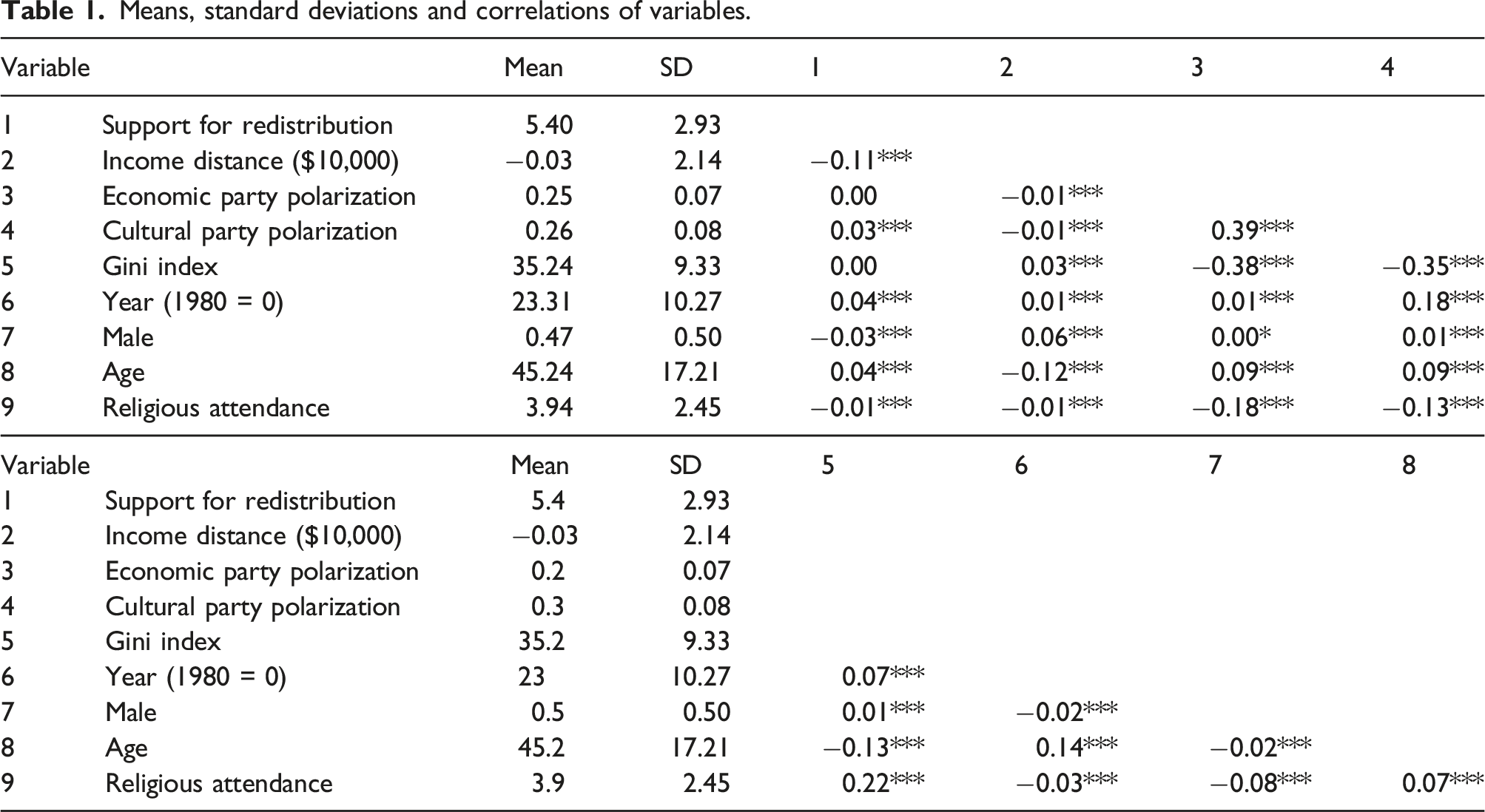
Means, standard deviations and correlations of variables.
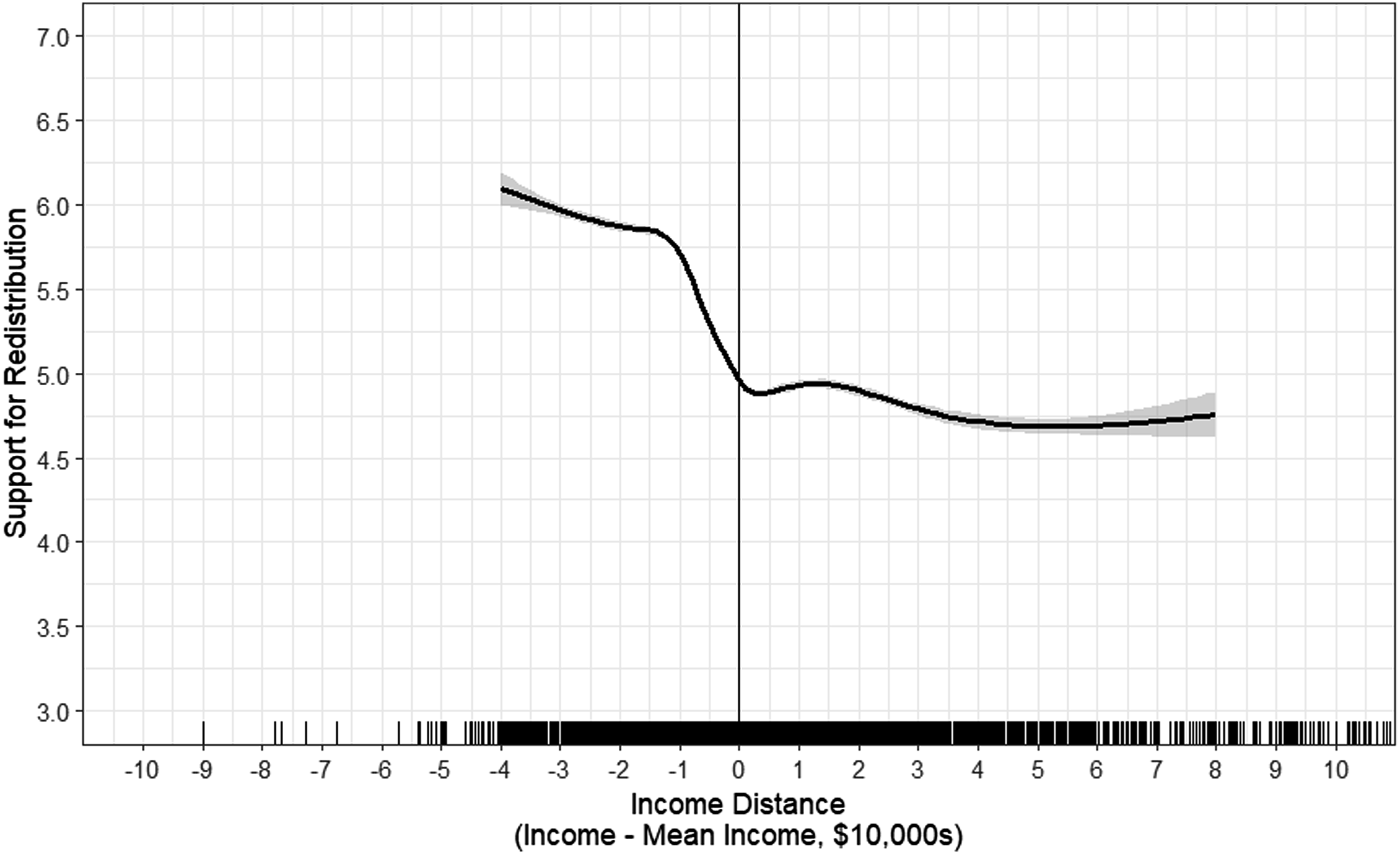
General additive model of support for redistribution in the IVS based on income distance.
Figure 2 displays pooled OLS time trends of party polarization on economic and cultural issues. These provide preliminary evidence of the declining salience of economic issues due to party convergence and the rising salience of cultural ones. Although the data availability varies by year between countries, the trend shows that parties have generally become less polarized on economic issues and more polarized over culture in recent decades.
6
Most cases with long-term data available have seen considerable decline in economic polarization such as Australia, Ireland, Norway, Sweden and the United Kingdom.
7
Still, some other countries have experienced smaller declines and even an uptick in economic polarization, like Switzerland and Japan.
8
The country-level trends in polarization hint towards a floor effect, given that many of the countries that start off with some of the lowest levels of polarization experienced the highest rates of increase observed, like Cyprus and Moldova. Meanwhile, cultural polarization has generally increased in most countries, most notably in Australia, Belgium, Denmark, Switzerland, Mexico, the Netherlands, Sweden, New Zealand, Turkey and the United States. Pooled OLS trend line of economic and cultrual party polarization from CMP.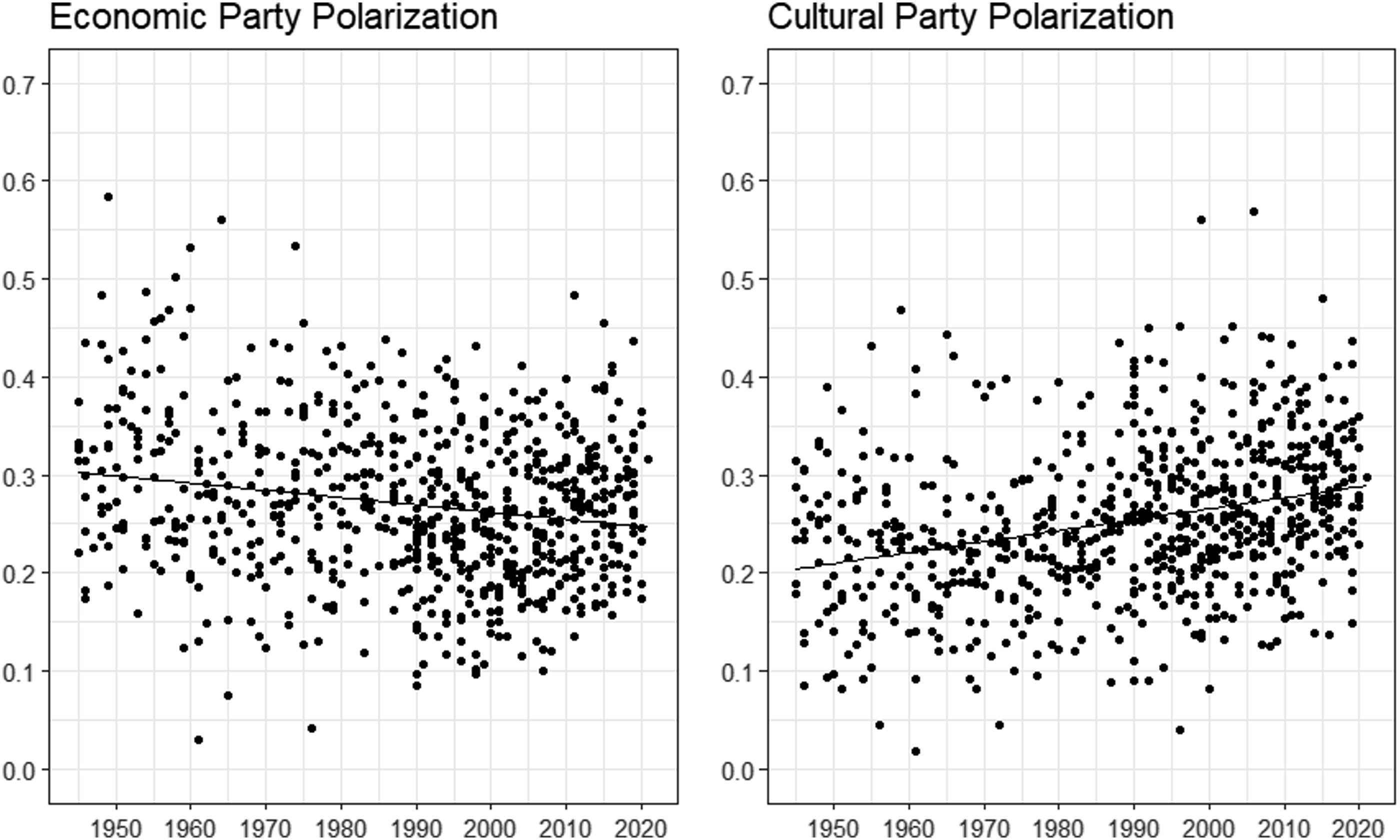
Standardized coefficients of mixed-effects models predicting support for redistribution. Sample at-large.
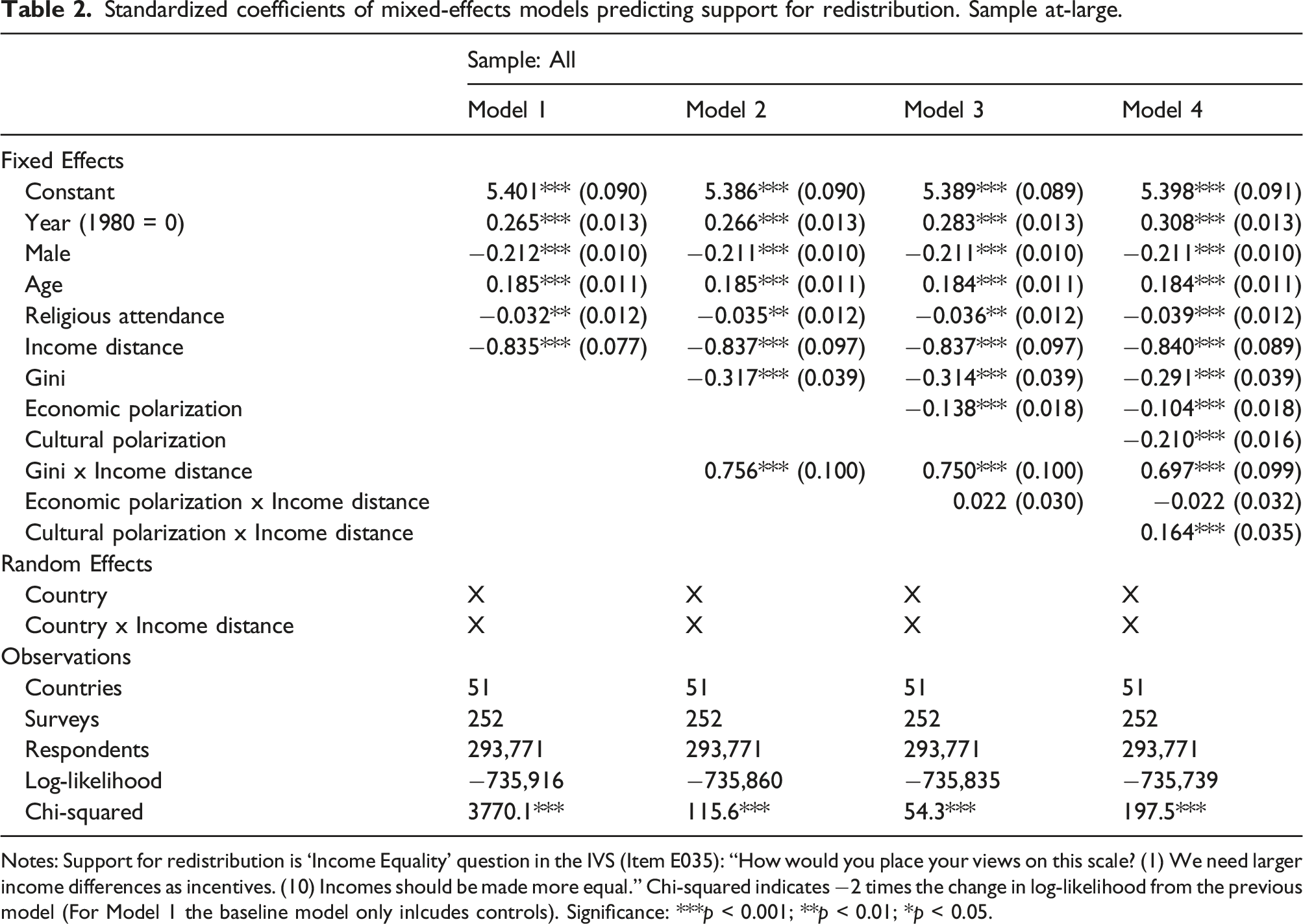
Notes: Support for redistribution is ‘Income Equality’ question in the IVS (Item E035): “How would you place your views on this scale? (1) We need larger income differences as incentives. (10) Incomes should be made more equal.” Chi-squared indicates −2 times the change in log-likelihood from the previous model (For Model 1 the baseline model only inlcudes controls). Significance: ***p < 0.001; **p < 0.01; *p < 0.05.
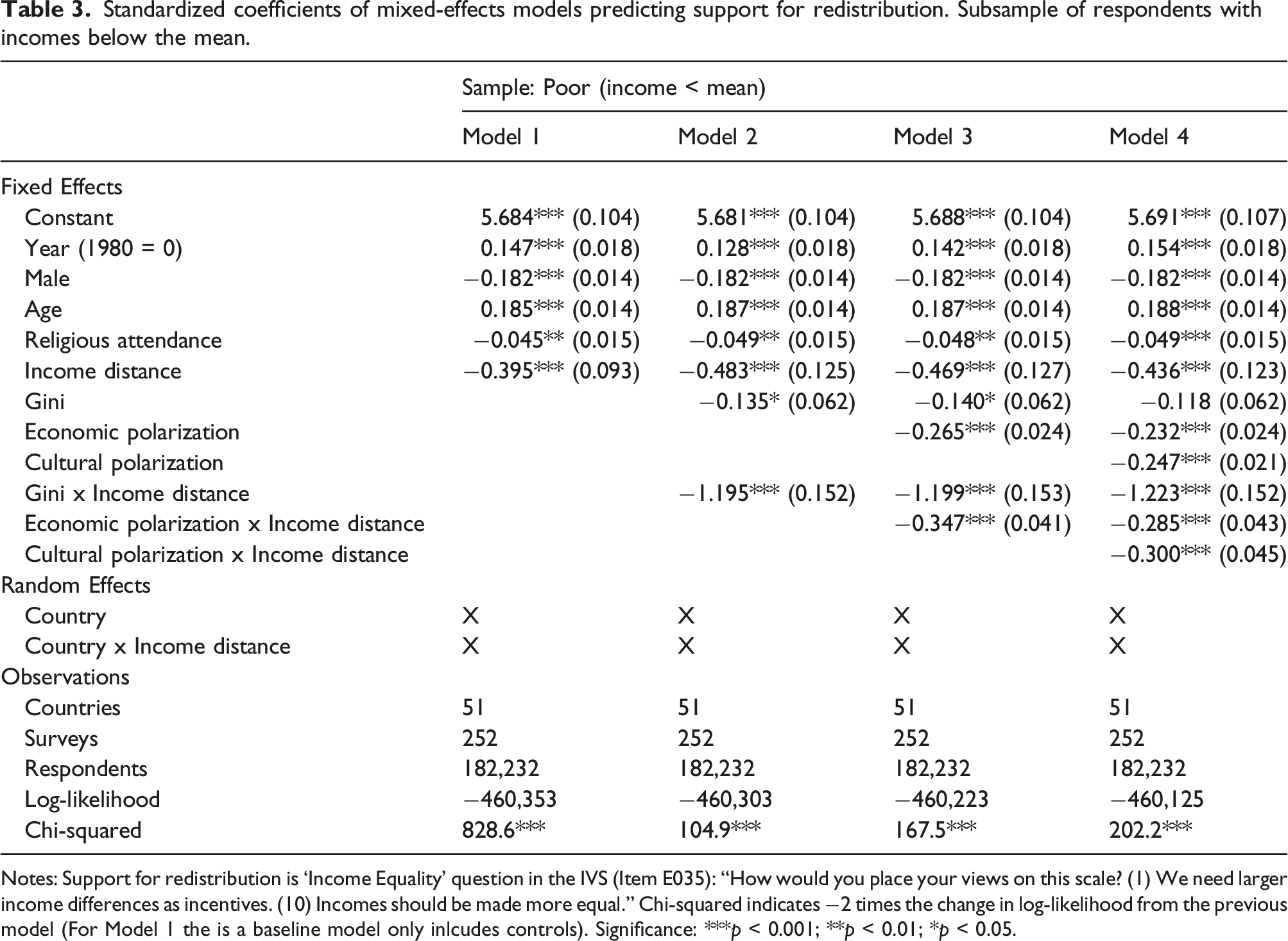
Standardized coefficients of mixed-effects models predicting support for redistribution. Subsample of respondents with incomes below the mean.
Notes: Support for redistribution is ‘Income Equality’ question in the IVS (Item E035): “How would you place your views on this scale? (1) We need larger income differences as incentives. (10) Incomes should be made more equal.” Chi-squared indicates −2 times the change in log-likelihood from the previous model (For Model 1 the is a baseline model only inlcudes controls). Significance: ***p < 0.001; **p < 0.01; *p < 0.05.
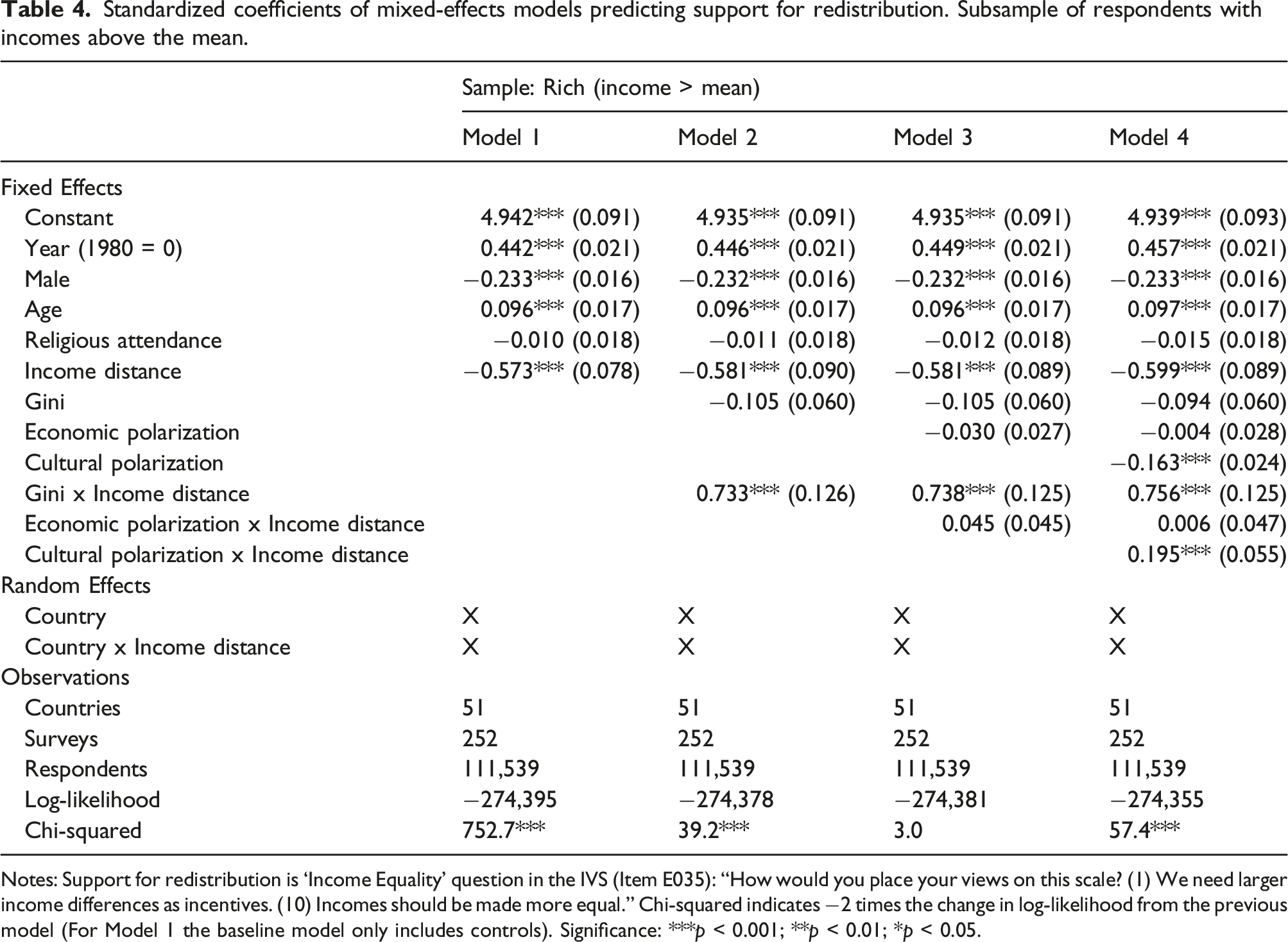
Standardized coefficients of mixed-effects models predicting support for redistribution. Subsample of respondents with incomes above the mean.
Notes: Support for redistribution is ‘Income Equality’ question in the IVS (Item E035): “How would you place your views on this scale? (1) We need larger income differences as incentives. (10) Incomes should be made more equal.” Chi-squared indicates −2 times the change in log-likelihood from the previous model (For Model 1 the baseline model only includes controls). Significance: ***p < 0.001; **p < 0.01; *p < 0.05.
The basic principle of self-interest, outlined in Hypothesis 1, is confirmed by Model 1. Income distance has a significant negative effect on support for redistribution for the sample at-large (β = −0.835, p < 0.001). A +$10,000 rise in income compared to the mean is associated with an estimated 0.20-point drop in support for redistribution. As shown in Model 1 in Tables 3 and 4, income distance has a significant negative effect for both the poor (β = −0.395, p < 0.001) and the rich (β = −0.573, p < 0.001). The non-standardized coefficients show that the poor actually display more self-interest in their preferences than the rich, with the marginal effect of income distance being −0.22 and −0.12, respectively.
Meanwhile, Model 2 indicates that inequality has an asymmetric moderating effect on self-interest, having a significant negative interaction for the poor (β = −1.195, p < 0.001) and a significant positive interaction for the rich (β = 0.733, p < 0.001). This suggests that inequality enhances the economic self-interest of the poor while making the rich more altruistic.
The moderating effect of economic polarization displays a similar asymmetry. Model 3 shows that economic polarization has a significant negative interacted effect for the poor (β = −0.347, p < 0.001), but not for the sample at-large (β = 0.022, p > 0.05) or for the rich (β = 0.045, p > 0.05). To illustrate these effects, the marginal effect of income distance is estimated by setting economic polarization to chosen values while holding all other variables to the mean. Figure 3 presents the marginal effect of $10,000 in income distance for the poor and the rich based on levels of economic and cultural polarization.10 For the poor, economic polarization enhances the estimated marginal effect of income distance, dropping from −0.10 (non-significant) to −0.46. Meanwhile, for the rich, economic polarization does not moderate the marginal effect, which remains at −0.12. Estimated marginal effect of income distance based on economic party polarization (Model 3) and cultural party polarization (Model 4).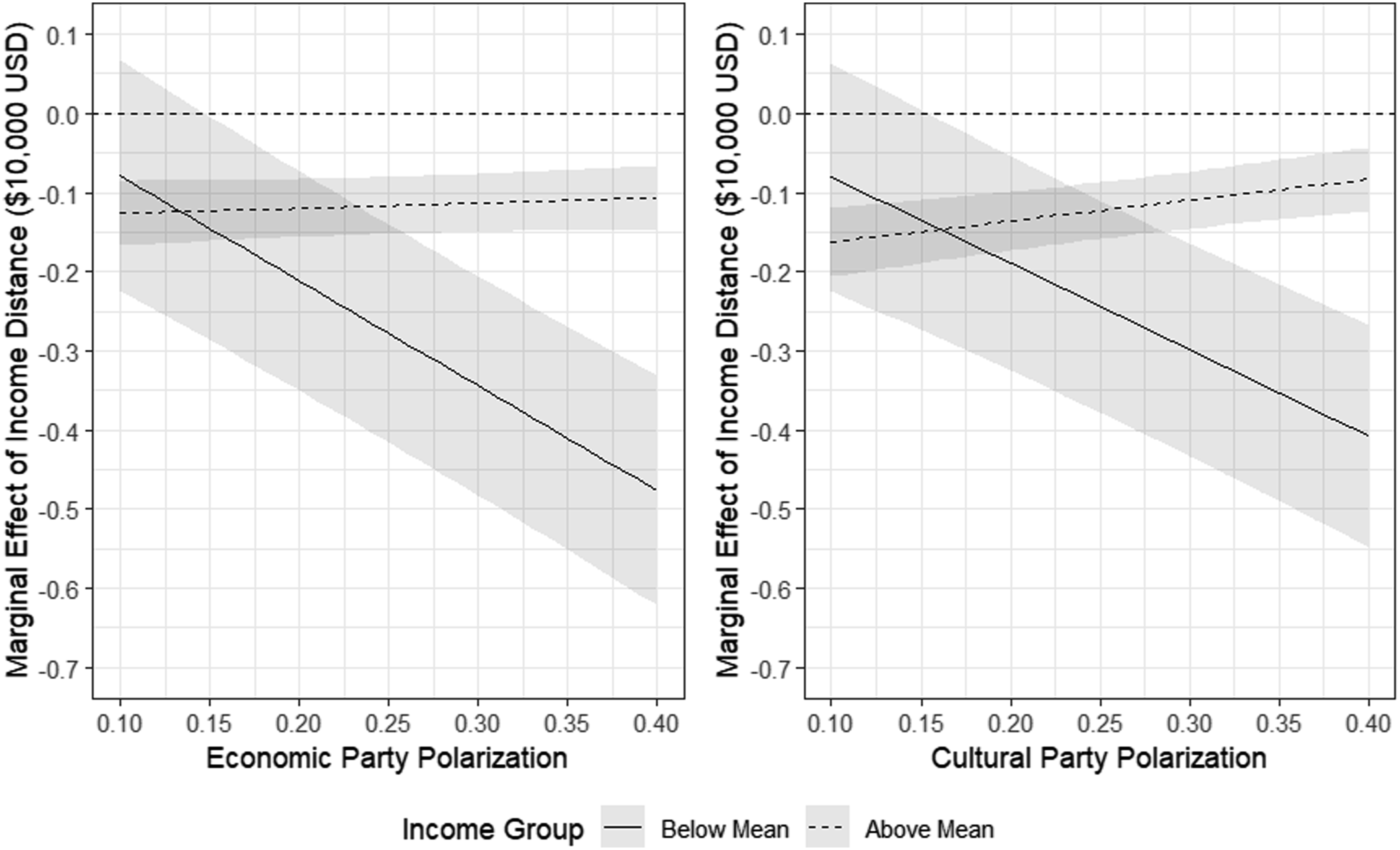
The moderating effect of cultural polarization, included in Model 4, is shown to be significantly positive for the sample at-large (β = 0.164, p < 0.001) and the rich (β = 0.195, p < 0.001), but significantly negative for the poor (β = −0.300, p < 0.001). This indicates that cultural polarization enhances self-interest for the poor, but weakens it for the rich. For the poor, cultural polarization enhances that marginal effect from −0.14 to −0.37, while for the rich, it weakens the marginal effect from −0.16 to −0.09.
To summarise the findings, the models in Tables 2–4 provide support for the main hypothesis, suggesting that economic polarization among parties moderates self-interest, but this moderating effect varies depending on whether respondents are below or above the mean income, and thus whether they can expect to gain or lose from redistribution. Economic polarization appears to enhance self-interest for the poor but not for the rich. Meanwhile, cultural polarization also enhances self-interest for the poor, and in fact weakens it for the rich.
Discussion
This article seeks to investigate the role that political parties have in activating (or de-activating) economic issues among the public. Previous research on preferences for redistribution has mainly focused on macro-economic factors such as development or inequality as moderators of support for redistribution. This, however, overlooks the active role that parties have in setting the agenda. An extensive literature has examined how political parties shape public opinion, particularly voting behaviour and aggregate attitudinal polarization. This article contributes to these literatures by examining the role that political parties have in activating people’s economic self-interest. The findings are consistent with previous research that has underscored the influence that political leaders have over public opinion.
The results replicate the common relationship between income position and support for redistribution, which reflects economic self-interest, and examine the moderating effect of party polarization. When political parties are more polarized over economic issues, respondents below the mean income display more economic self-interest. Economic polarization is associated with more self-interest for the poor, but not for the rich. This suggests that there is an asymmetry in the role that political leaders have over economic attitudes: they have more capacity to activate or de-activate left-wing economic attitudes. The article also explores the role that cultural polarization plays over economic self-interest, and whether it can supplant the economic cleavage or reinforce it. Here again, there appears to be an asymmetry: cultural polarization enhances self-interest for the poor and weakens it for the rich. This goes against the common notion that cultural issues serve to demobilize economically left-wing movements. Based on these results, cultural polarization should not act as a wedge against left-wing politics, but rather appears to help facilitate it.
Although the effect shown in the results are robust, the empirical analyses have a number of limitations that should be noted here. First, although the generalizability of the findings is strengthened by a sample that includes 51 countries varying across cultures and levels of development, the robustness of the results is limited by the frequency of the surveys and the availability of party data. Future research could make use of datasets that survey countries more frequently to obtain more robust results, even if they are more limited in the scope of their sample, like the European Social Survey.
Second, and relatedly, the reliance of observational data limits the ability to develop a full causal identification strategy. To address the problem of reciprocal causality (i.e., economic self-interest driving party polarization), the models accounted for country-level random effects and the effect of Gini. Still, it is possible that the effects found here do not only reflect the influence of party polarization public opinion, but that they also reflect changes in public opinion that parties respond to. In other words, political parties may anticipate changes in public opinion that go on to influence their positions. Other causal identification strategies making use of larger data could account for potential endogeneity between economic self-interest, party polarization and income inequality.
Third, although the models account for variations in economic self-interest based on country differences and income inequality, there may be more systematic differences indicating that they have a moderating effect. In other words, factors such as culture and inequality may determine the latent potential for parties to activate economic self-interest.
Fourth, the effect of party polarization does not tell us about the effect that a particular party may have. In other words, the analysis cannot determine whether changes in economic self-interest are driven by parties on the left or right. This presents an interesting avenue for future research to assess whose self-interest gets activated (rich/poor) and why (parties shifting left/right).
Finally, this article does not delve into the question of economic voting, which is the next relevant step in the causal chain. Assuming that more materially self-interested voters are more likely to vote according to their economic conditions, this would imply that party polarization drives economic voting. This is an empirical question that future research should address. If so, it would imply that parties can potentially carve out a segment of the electorate by unilaterally mobilising it based on economic self-interest. This question is especially pertinent to the impact of cultural issues, since they appear to enhance self-interest for the poor, although they might still weaken economic voting by taking away attention from economic issues.
These findings have important implications for the study of polarization and the salience of economic issues. First, the descriptive evidence presented supports the trend of declining salience of economic issues. Many countries have experienced a decline in economic party polarization, especially when viewing long-term trends. Still, there are some exceptions that have seen a resurgence, like in Switzerland and Japan. Thus, proclamations that class politics is dead may be premature. Secondly, while political parties are typically viewed as being responsive to public opinion, this article finds evidence that parties play an active agent role in shaping public opinion, showing that party polarization can strengthen economic self-interest among lower-income earners. Although party polarization is an aggregate concept, a party that is sizeable enough can unilaterally change it to a large extent by shifting their position.
These findings are consistent with previous studies that have found that the economic cleavage has declined in salience, and they contribute an explanation based on the often-overlooked role that political parties have in shaping public opinion. The results suggest that political parties have the ability to activate economic self-interest among the poor. This means that party convergence has contributed to the decline of the economic cleavage in advanced democracies, but it also implies that they have the agency to reverse this decline.
Supplemental Material
Supplemental Material - Activating Self-Interest: The Role of Party Polarization in Preferences for Redistribution
Supplemental Material for Activating Self-Interest: The Role of Party Polarization in Preferences for Redistribution by Marco Alexander Pastor Mayo in Party Politics
Footnotes
Declaration of conflicting interests
The author(s) declared no potential conflicts of interest with respect to the research, authorship, and/or publication of this article.
Funding
The author(s) received no financial support for the research, authorship, and/or publication of this article.

Supplemental Material
Supplemental material for this article is available online.
Notes
Author biography
References
Supplementary Material
Please find the following supplemental material available below.
For Open Access articles published under a Creative Commons License, all supplemental material carries the same license as the article it is associated with.
For non-Open Access articles published, all supplemental material carries a non-exclusive license, and permission requests for re-use of supplemental material or any part of supplemental material shall be sent directly to the copyright owner as specified in the copyright notice associated with the article.
