




Abstract
This article re-examines the relationship between democracy and semi-presidential regimes. While numerous scholars have traced the effects of semi-presidential regimes on democracy, few have addressed the risk of reverse causality, namely, that democracy influences the establishment of semi-presidential regimes. This article uses statistical analyses to test whether the level of democracy in a country affects its choice of semi-presidential regime subtype: a premier–presidential or a president–parliamentary. Including all semi-presidential regimes from 1919 until 2015 and controlling for other conditions such as colonial legacy, the level of development and regime diffusion, our results confirm the hypothesis. The higher the level of democracy – the higher the probability of a premier–presidential regime. Our results underline that democracy is a highly influential cause of the type of semi-presidential regime chosen, a conclusion that places a question mark on the self-evident use of the semi-presidential subtypes as an independent variable.
Keywords
Introduction
At the end of his scholarship, Robert Elgie formulated a conclusion with potentially far-reaching consequences for the field to which he contributed greatly: studies of semi-presidential regimes have not taken the risk of reverse causality seriously enough. In fact, the main bulk of the empirical studies part of the semi-presidential field has tested the regime’s effects on democratization or essential democratic functions related to the strength of the president and the sustainability and capacity of the government (Åberg and Sedelius, 2020; Elgie, 2016). Often through comparing the two subtypes of premier–presidential regimes and president–parliamentary regimes, the semi-presidential regime has been found to affect levels of democratic performance in the sense that premier–presidential regimes favour higher levels of democracy (Elgie et al., 2011; Sedelius and Linde, 2018; Shugart and Carey, 1992). If, instead, institutions result from the preferences of those who founded them, then semi-presidential regimes may be ‘the expressions of the preferences that were hardwired into institutional structures at the time they were chosen’ rather than independent causes of various types of outcomes (Elgie and Moestrup, 2016: 208).
The first cases of semi-presidential regimes developed in Europe in 1919, but most current semi-presidential regimes appeared alongside two later historical processes: the de-colonialization of Africa; and the collapse of the Soviet Union (Wu, 2011). These processes form a general pattern of regime distribution in which the premier–presidential regime is most common in the Western and Central parts of Europe, whereas the president–parliamentary regime is the common choice in the post-Soviet region as well as in Africa. Premier–presidential regimes are situated in regions with higher levels of democracy (Elgie et al., 2011; Sedelius and Linde, 2018; Shugart and Carey, 1992), a fact that may illuminate that premier–presidential regimes promote democracy. However, we cannot exclude a reverse relation: that democracy influences the establishment of these regimes. In fact, the few comparative studies of how semi-presidential regimes came to be have studied the common set of semi-presidential regimes rather than the two subtypes (Åberg and Denk, 2020; Jung and Deering, 2015) and not included democracy as the potential cause of the establishment of a premier–presidential regime or president–parliamentary regime.
Therefore, this article tests whether the countries with premier–presidential regimes were more democratic to begin with and whether the level of democracy immediately before the establishment of a semi-presidential regime influenced the type of semi-presidential regime established. In this article, we, therefore, ask: Does the level of democracy affect the type of semi-presidential regime established?
This article aims to provide knowledge on (level of) democracy as an influencer of the choice of a particular form of semi-presidentialism. We develop and test the hypothesis that the level of democracy affects the probability of setting up a semi-presidential regime subtype. As we assume a reverse relation between semi-presidential regimes and democracy, we expect that premier–presidential regimes, which are associated with higher levels of democratic performance, are usually established in more democratic countries. Furthermore, we expect that even when potential effects of control variables have been accounted for, a higher level of democracy increases the probability that a premier–presidential regime is established. We test this hypothesis with statistical analyses that include most semi-presidential cases. As our results support the hypothesis, studies of the effects of semi-presidential regimes on democracy should caution against this reverse causality; that premier–presidential regimes are more democratic, to begin with. However, we aim not to test if the democracy level at the time of establishment has long-term effects on the democracy level. Such a question would require a different methodological setup. Nevertheless, our analyses provide deeper knowledge about the complex relationship between democracy and semi-presidential regimes.
The article is structured in six sections. After this introduction, we define our dependent variables: the semi-presidential regime and its two subtypes (premier–presidential and president–parliamentary regimes). In the third section, we present the rationale for the hypothesis that the level of democracy affects the probability of establishing one of the two subtypes. The fourth section presents the research design, measurement of variables, control variables, their theoretical background and some methodological considerations. The empirical analyses are found in the fifth section, which also discusses the empirical results. In the last section, we focus on the contributions of the study and questions for further research.
Definitions of semi-presidential systems
A semi-presidential regime distributes political power and functions among the executive–legislative organs in a unique way (Shugart and Carey, 1992). Historically, presidential and parliamentary regimes appeared earlier and were more common than semi-presidential regimes. In presidential systems, a popularly elected president appoints the government, and both the president and the parliament serve for fixed terms (Shugart and Carey, 1992). With this institutional arrangement, a presidential regime is a regime of separated powers, both in origin (election) and in the survival of parliament and the president (Schleiter and Morgan-Jones, 2009). A parliamentary regime is an institutional arrangement of fused origin and survival (Shugart and Carey, 1992; Strøm, 2000) in which only the legislature is popularly elected, and the executive is accountable to the parliamentary majority (Strøm et al., 2003).
In terms of the origin of the executive and legislature, the semi-presidential regime resembles the dual elections of presidential regimes. In terms of survival, the government is put in a similar position to that within a parliamentary regime; its survival depends on the confidence of the parliament. However, the survival of the president is separated from the influence of the parliament. In its combination of origin and survival, semi-presidentialism is, therefore, unique. As in the early definition of Duverger (1980: 166), semi-presidentialism is a government system of three elements: ‘(1) the president of the republic is elected by universal suffrage; (2) he possesses quite considerable powers; (3) he has opposite him, however, a prime minister and ministers who possess executive and governmental power and can stay in office only if the parliament does not show its opposition to them.’
Duverger’s definition left scholars with the difficult task of deciding whether a country should qualify as semi-presidential. In particular, the passage stating that the president should possess ‘quite considerable powers’ caused diverging case samples. To avoid that, Elgie (1999: 13) formulated the commonly accepted definition of semi-presidentialism as ‘the situation where a constitution makes provision for both a directly elected fixed-term president and a prime minister and cabinet who are collectively responsible to the legislature.’
While the latter definition facilitated case identification, it also produced a set of semi-presidential cases with vast differences in intra-executive relations (Elgie, 2016) and the level of presidential powers (Åberg and Sedelius, 2020). Elgie (2016) thus concluded that with such deviations, there is simply ‘little to be gained from operationalizing semi-presidentialism as an explanatory variable when there is such extreme variation within the set of semi-presidential countries’ (p. 52). To explore this variety, scholars have increasingly added measures of distinction. Some scholars have added the level of presidential powers (Doyle and Elgie, 2016; Siaroff, 2003), while others have used the subtype definitions introduced by Shugart and Carey (1992). One subtype is the premier–presidential regime, in which ‘the president selects the prime minister who heads the cabinet, but the authority to dismiss the cabinet rests exclusively with the assembly majority’ (Shugart, 2005: 333). While the authority pattern of premier–presidential regimes makes the prime minister and cabinet ‘exclusively accountable to the assembly majority,’ the government of a president–parliamentary regime is accountable to both the president and the parliament (Shugart, 2005: 333). As a result, the power of the president–parliamentary regime centres on the president and places the government in an ‘uncertain and dependent position’ (Sedelius and Linde, 2018: 139). As the two subtypes capture key aspects of authority patterns, they have enabled scholars to form a more coherent set of countries and, through that, the ability to test new hypotheses. In general, the level of democracy and the extent of the democratic survival of premier–presidential regimes exceed those of president–parliamentary regimes (Elgie et al., 2011; Moestrup, 2007; Sedelius and Linde, 2018).
Despite the many studies on semi-presidential regimes and their focus on the democratic credentials of the two subtypes, we still know little about the reasons for establishing either of them. Thus, the reasons for establishing one type of semi-presidentialism may differ from those behind establishing the other. This lack of knowledge extends to the risk that the subtype deemed most democratic may also be the subtype established in more democratic countries.
Uncertainty and democracy: Related explanations for semi-presidential regimes
Among the field of semi-presidential studies, studies debating the definition of these regimes and studies examining their effects on democracy or democratic functioning have been the most frequent (Elgie, 2016). Only a few studies have focused on the reasons for the establishment of semi-presidential regimes. As in the larger field of institutional studies, there is a group of studies treating institutional establishment as a matter of strategic choice. These studies focus on the role of the bargaining political elites (Frye, 1997; Geddes, 1996; Jung and Deering, 2015) and assume that ‘political actors seek to maximize their individual political power by securing office and by designing institutions that will allow them to exercise their power to the greatest extent possible’ (Frye, 1997: 532).
Institutions are sticky. The occasions of substantial institutional reorientation are, therefore, exceptions to the rule and often concurrent with circumstances such as a democratic transition, an economic recession, or a state-building process (Blount et al., 2012). Such circumstances, termed ‘critical junctures,’ offer extraordinary opportunities for institutional reorientation, but are also characterized by extraordinary uncertainty (Åberg and Denk, 2020; Jung and Deering, 2015). Therefore, the elite actors involved must manage the uncertainty that both enables them to restructure core institutions and obscure their ability to foresee the future effects of their actions.
Although presidential regimes are generally considered regimes of checks and balances where power is distributed among the core actors, it is the ‘winner-takes-all’ logic of presidential elections that has framed the expectations of how uncertainty influences regime-type establishment. The ‘winner-takes-all’ logic makes presidential regimes preferred when a candidate with a strong bargaining position expects to win future presidential elections (Frye, 1997). Such an actor is likely to prefer a presidential regime. As Jung and Deering (2015: 63) point out, ‘[a]s the winner of presidential elections can form a government and rule the country for a fixed term without including losers in governmental decision-making, the value of victory is greater in presidentialism than in parliamentarism.’ When levels of uncertainty are high, elite actors rather ‘hedge their bets’ and opt for a regime with opportunities for the opposition to influence future executive politics, as within a parliamentary regime (Jung and Deering, 2015). Forming expectations of regime-type choice based on the level of uncertainty is, therefore, quite a straightforward business when it comes to the establishment of presidential or parliamentary regimes.
While research on parliamentary and presidential systems has found a correlation between uncertainty and the type of government system (Jung and Deering, 2015; Linz, 1990; Mainwaring and Shugart, 1997), it has not managed to identify the same correlation between uncertainty and semi-presidential regimes (Jung and Deering, 2015). Semi-presidential regimes are seemingly established regardless of contextual uncertainty.
There are at least a couple of possible explanations for such results. First, semi-presidentialism unites traits of presidential regimes and parliamentary regimes as it combines the dual elections of presidential regimes with the government being accountable to the parliament, as in parliamentary regimes. Therefore, the logic that separates presidential and parliamentary regimes may not apply. The second and more likely reason is that the two semi-presidential subtypes are formed out of competing logic. Frye (1997) explains that what matters is the combination of ‘the degree of uncertainty over the electoral outcomes’ and the ‘bargaining power of the electoral favourite at the time of the writing of rules’ (p. 533). Due to the power of the president of the president–parliamentary regime who appoints the government, influences government survival (together with the parliament), and has the power to dissolve parliament (Sedelius and Linde, 2018; Shugart and Carey, 1992), a president–parliamentary regime should form when influential actors face little uncertainty and expect to control the future presidential seat. As in presidential regimes, the presidential election in a president–parliamentary regime is a winner-takes-all game to an extent not matched by premier–presidential regimes. In premier–presidential regimes, the government’s survival depends on the parliament, making the presidential position less elevated. That is, a premier–presidential regime is more likely when uncertainty is high for those with the highest level of bargaining power. Expecting uncertainty to have similar effects on the formation of both subtypes may therefore disguise the effect of uncertainty, making it appear as if uncertainty had no effects on the semi-presidential establishment.
For example, the president–parliamentary regime of Russia was established in 1993, when Russia had just come out of the crisis in which the parliament had been dissolved. President Yeltsin had strengthened his position and faced no real contenders for the presidency. In that, ‘President Yeltsin used his great bargaining power and the negligible uncertainty of the outcome to craft the specific and residual powers of the office to his liking’ (Frye, 1997: 544). At the other end of the spectrum is Estonia, which established a presidential regime with low levels of presidential powers in 1992. At the time, Estonia had two rival parliaments: the Estonian Supreme Council; and the Estonian Congress. Rüütel, head of the reformed Communist Party had the highest expectations of winning the presidential prize but was not the preferred candidate of the majority in the Constituent Assembly formed. As the majority of actors influencing the new constitution faced strong uncertainty about their future position and feared a strong president, the president was given low powers (Frye, 1997). In both cases, the particular level of uncertainty for the actor/-s with the highest bargaining powers affected the regime established.
The uncertainty perspective has been criticized for its narrow focus on actor motivation. From the angle of normative institutional studies or historical institutional studies, elite actor preferences are related to previous experiences of democracy and to the norms formed through democratic rule (Peters, 2012). At the same time, actor experiences and preferences may interplay with institutional requites. As Geddes points out, democratization in Latin America followed the military rule of the 1960s and 1970s. As military rule lasted for ‘only’ two decades, organizations and activists could go underground only to rise in a ‘phoenixlike’ manner when circumstances changed (Geddes, 1996: 31). As the older and more democratic constitutions had often survived, these could be revived rather than invented (Geddes, 1996). In contrast, communist rule lasted more than four decades and had more thorough effects. When the Soviet Union started to crumble, domestic experience with democratic institutions was virtually absent among the elites, and party opposition had to form from a rather blank slate. This may both have increased the level of uncertainty and the preferences of the political elites.
In general, we should expect elites who have experienced functioning democracy to be more inclined towards democratic regimes than elites without such experience and elites part of a previously established opposition to have a higher capacity to demand a regime in which the parliamentary actors have a stronger position (Jung and Deering, 2015). In fact, a parliamentary opposition manifest in the constituent assembly is the most likely actor to counter attempts of the electoral favourite to form the future regime to his or her liking. Higher levels of democracy are thus likely to interact with more elite actors who are willing and able to promote a regime with more powers invested in the parliament, such as in the premier–presidential subtype. In sum, we expect premier–presidential regimes to be more common in countries with higher degrees of democracy. From this, we formulate the following hypothesis:
Higher levels of democracy promote the establishment of a premier–presidential rather than a president–parliamentary regime.
Previous studies have concluded that premier–presidential regimes result in higher levels of democratic performance than president–parliamentary regimes (Moestrup, 2007; Sedelius and Linde, 2018). If Elgie’s (2016) postulate is true, we should study the context before the establishment of the regime and not only the subsequent developments. Therefore, we expect premier–presidential regimes to be established in more democratic contexts than would president–parliamentary regimes. With this assumption, we test the reverse relation and study what causes semi-presidential regime establishment, focusing on the influence of democracy.
Research design: materials and methods
We test our hypothesis with statistical analyses. In the first analysis, we explore the general assumption that the level of democracy is higher in countries setting up premier–presidential regimes than in countries forming president–parliamentary regimes. Second, our analyses test the significance of the democratic level in logistic regression analyses that include other potential reasons for regime establishment, such as democratization, diffusion from the common region, colonial legacies, coups and economic levels.
To measure the dependent variable, we use a dataset including cases of the establishment of semi-presidential regime subtypes from 1918 to 2015, including the first semi-presidential regimes founded in the Weimar Republic and Finland in 1919. To identify cases of semi-presidential regimes, we use the database that Elgie (2018) developed based on the definition of semi-presidential regimes as ‘the situation where a constitution makes provision for both a directly elected fixed-term president and a prime minister and cabinet who are collectively responsible to the legislature’ (Elgie, 1999: 13). 1 A semi-presidential regime is established as one of the two subtypes. Therefore, the dependent variables of the hypothesis and first set of analyses are the two subtypes of premier–presidentialism and president-parliamentarism. 2 Premier–presidential regimes are defined as regimes in which ‘the president selects the prime minister who heads the cabinet, but the authority to dismiss the cabinet rests exclusively with the assembly majority,’ and president–parliamentary regimes as those in which the prime minister and cabinet are ‘exclusively accountable to the assembly majority’ (Shugart, 2005: 333). Premier–presidential regimes are coded as 1 and president–parliamentary regimes as 0. The dataset includes 83 observations of semi-presidential regime establishment, of which 37 are premier–presidential regimes and 46 president–parliamentary. 3 The analyses include cases where semi-presidential regimes replace another type of political regime and not cases where one semi-presidential regime subtype replaces the other. However, some countries have established a semi-presidential regime on several occasions and have, hence, more than one observation in the dataset.
The independent variable of the hypothesis is the level of democracy. To measure it, we use two indices of democracy developed by the V-Dem Institute (Coppedge et al., 2020). First, the index of electoral democracy builds on the seminal conceptualization of polyarchy developed by Dahl (1998), which has since served as the conventional variable for the democracy part of empirical studies. The index includes indicators of inclusive suffrage, clean elections, elected officials, freedom of association, freedom of expression and alternative information. Second, the liberal democracy index is an extension of the electoral democracy index, adding the dimension of whether rule is executed in the common interest (Fukyama, 2014), a quality not captured by electoral democracy. It adds to the indicators of electoral democracy the protection of individual rights against both state oppression and unrestricted majority rule. Both indices range from 0 (lowest level of democracy) to 100 (highest level of democracy) (Coppedge et al., 2020). Moreover, previous studies on democracy and semi-presidential regimes have not stated clearly whether they refer to electoral or liberal democracy, which also motivates the use of two democracy indices. We regard, therefore, the use of the two variables as a robustness test if the results change when the concept and measurement of democracy alters.
We use logistic regression to test the effect of democracy levels on the establishment of a semi-presidential regime subtype. In the regression models, the variables are lagged with one year as a basic control of the direction of the relationship. Using one-year lagged variables is based on the assumption that temporally close constitutional decisions have more impact than more distant ones. Longer lag can be motivated by the assumption that it takes a longer time for the effects of democracy level to materialize, but tests with more than two-year lagged variables indicate that the democracy variable becomes non-significant (see Table A2 in the Online Appendix).
The models also include two sets of control variables (see Table A3 in the Online Appendix for descriptive analysis). To avoid overloading the models, the low number of cases only permits a limited selection of control variables. The first group of control variables captures the potential confounders of democracy level that are well known in the field of democratization. Of the myriad variables used in democratization studies, we selected the two most frequently used (Gassebner et al., 2013; Rød et al., 2020). We use gross domestic product per capita (logged with base 10) as an indicator of socioeconomic modernization and change in the democracy level to control for democratization or democratic backsliding.
Recent studies on regime-type establishment emphasize that several types of influences may form part of the establishment process (Åberg, 2020; Jung and Deering, 2015). These studies emphasize the decision-making elites’ central role (Frye, 1997; Geddes, 1996) but also the regional patterns of regime establishment that point to the potential role of external and historical influences. First, studies on semi-presidential regimes have emphasized the importance of heritage, which refers to long-term structural, cultural and institutional conditions that are already present in a country at the start of a transition period (Bunce and Wolchik, 2000; Kitschelt, 1999; Pop-Eleches, 2007). Such perspectives claim that heritage affects the preferences of political actors in a way that constrains their knowledge and preferences (Congleton and Yoo, 2018; Pop-Eleches, 2007). Studies on semi-presidential regimes have underlined the influence of two types of heritages: colonial; and Soviet. The literature on colonial heritage related to semi-presidential regime establishment outlines that both France and Portugal had premier–presidential regimes when their former colonies established their new regimes, making premier–presidential regimes more common in this group of countries. 4 On the contrary, countries with a pre-Second World War history of being part of the Soviet Union tended to establish president–parliamentary regimes (Amorim Neto and Costa Lobo, 2014; Hale, 2015; Wu, 2011). We, therefore, created a variable that codes post-Soviet countries as 1, previous French or Portuguese colonies as −1 and other countries as 0. 5
Second, regional patterns of establishment demonstrate that regime types may spread between proximate countries (Åberg and Denk, 2020; Jung and Deering, 2015). Research on regime diffusion has tested the tendency of a regime to spread between countries that are part of a common network (Åberg and Denk, 2020; Brinks and Coppedge, 2006; Gleditsch and Ward, 2006; Jung and Deering, 2015). 6 The more common a regime type in the network (the higher the regime type density), the higher the probability that a state in the network follows the other countries and implements this regime type (Cranmer et al., 2020; Goldring and Greitens, 2019). Regime diffusion may thus explain why some countries established premier–presidential regimes while others introduced president–parliamentary regimes. To control for regime-type diffusion, we measure the share of premier–presidential regimes among surrounding countries in the region. 7
Third, the choice of regime type is also expected to reflect a country’s uncertainty level. Mainly, the level of uncertainty is expected to affect actors’ preferences and strategies (Frye, 1997; Geddes, 1996; Jung and Deering, 2015). For example, a coup d’état, together with a significant decrease in democracy, increases uncertainty. 8 High uncertainty obstructs elite actors’ attempts to foresee the effects of their choices; therefore, higher uncertainty is expected to make a premier–presidential regime more likely as the presidential elections are not winner-takes-all events with high risks for the participating elites. The winner-takes-all presidential elections of the president–parliamentary regimes are instead preferred by elite actors who expect to win the presidential seat amid low levels of uncertainty.
Fourth, studies on regime changes suggest that countries with a strong military or a military regime are more likely to establish a presidential regime (Cheibub, 2007). Militaries with strong political power seem to prefer a concentration of presidential powers, giving the military a more direct connection to political power through the centralization of authority in the presidential office (Linz, 1994). In line with this conclusion, we expect countries with politically powerful militaries to be more likely to adopt president–parliamentary regimes than premier–presidential regimes. We measure military–political power with the military dimension index from the V-Dem Database to test this expectation. This measurement indicates the extent to which the power base of the chief executive is determined by the military through: (a) appointment of the chief executive through a coup, rebellion or by the military; and (b) dismissal of the chief executive by the military (Teorell and Lindberg, 2019). As the included cases are concentrated to the end intervals of the scale (around 0 or 1), we have created a variable with two categories (weak and strong military power) with 0.5 as the threshold. This threshold indicates that the military influences at least one of the aspects. 9
Empirical analyses and results
The semi-presidential regime is a relatively new form of executive–legislative setup. With some early exceptions, such as the Weimar Republic and Finland, both established in 1919, the bulk of current semi-presidential regimes formed as part of the third wave of democracy. As seen in Figure 1, the many new semi-presidential regimes include both subtypes, but president–parliamentary regimes proliferated faster at first, while premier–presidential ones multiplied faster at a later stage (see Table A4 in the Online Appendix). This article aims to explore whether the level of democracy explains why some countries introduced a premier–presidential regime while others established a president–parliamentary regime.
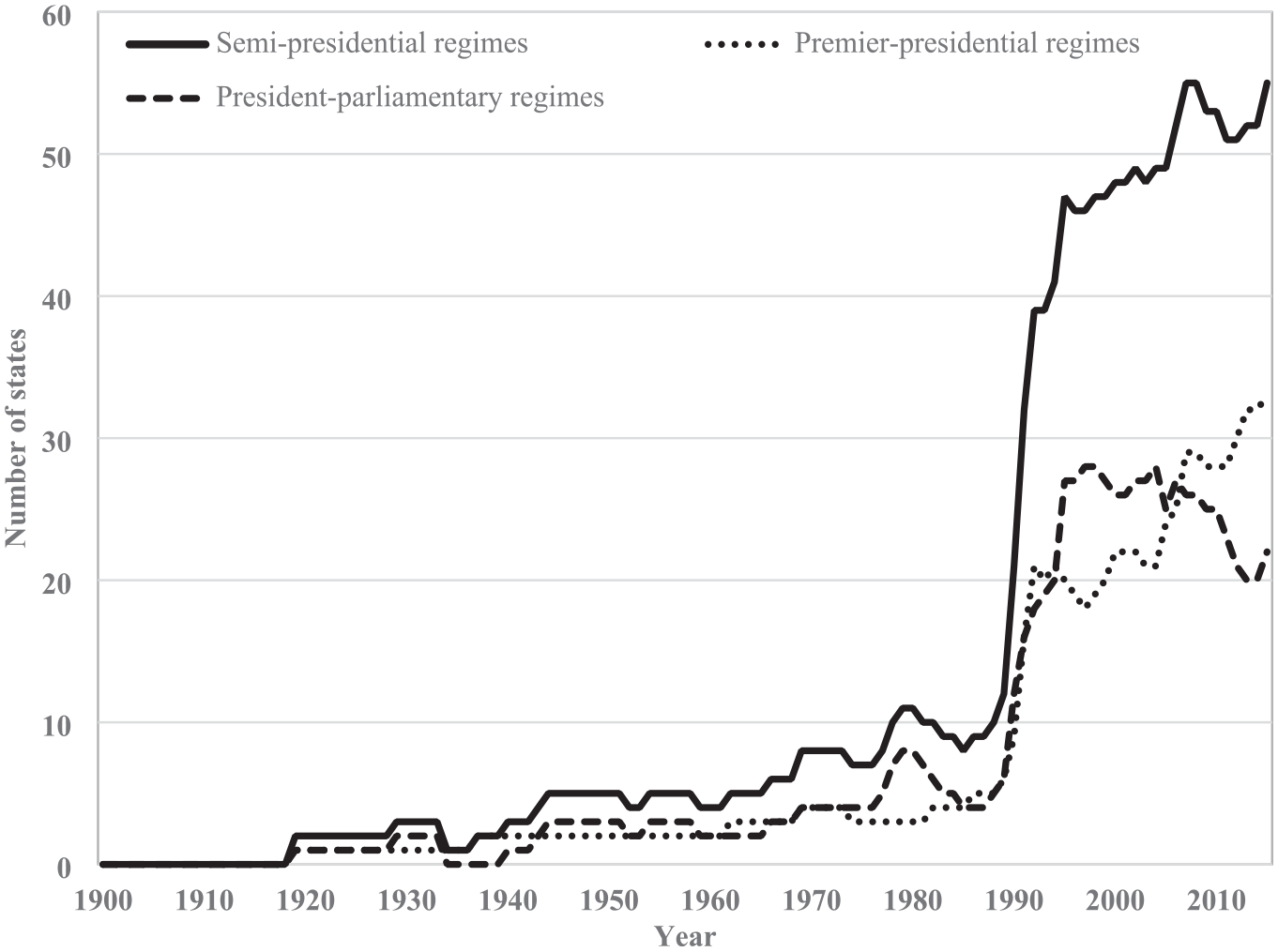
The number of semi-presidential regimes in the world, 1900–2015.
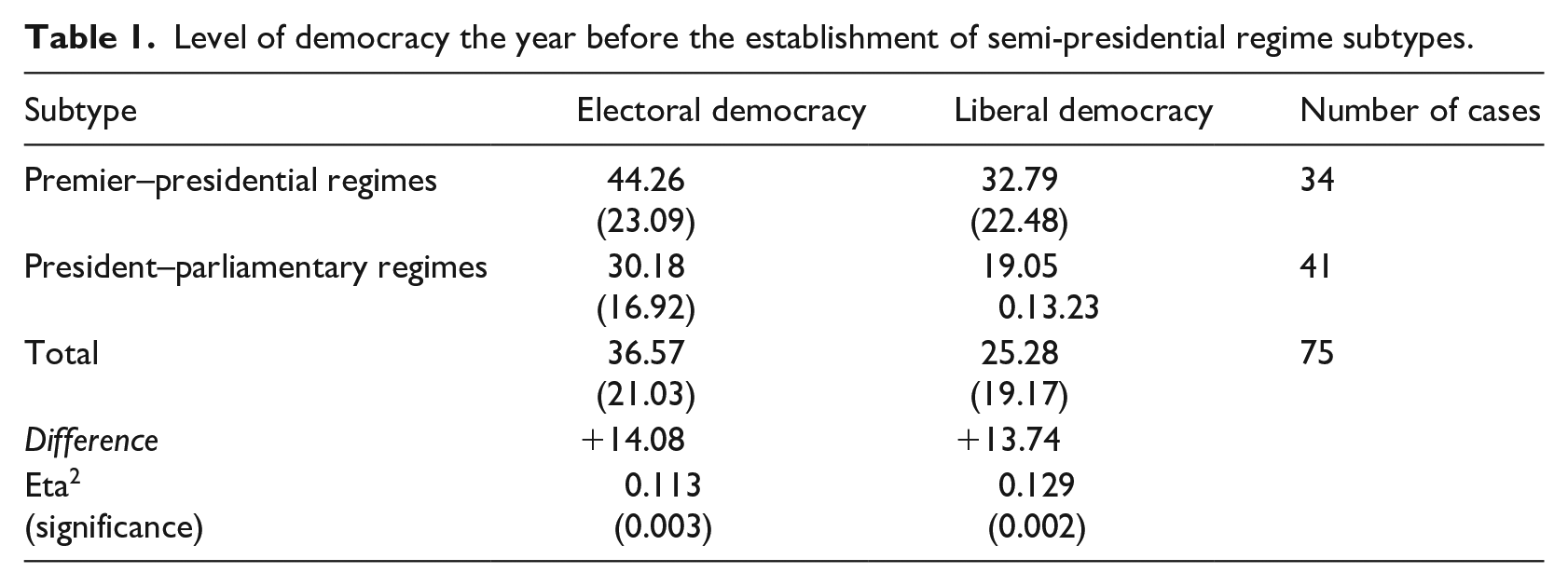
As a first step, we conduct a descriptive analysis of the level of democracy at the time of regime establishment (Table 1). If democracy is part of the causes of regime subtype establishment, the original levels of democracy of each subtype provide a first glimpse of such a relationship. The correlation analysis indicates that premier–presidential regimes tend to be established in countries with higher levels of democracy than countries establishing a president–parliamentary regime. As expected, the year before a new premier–presidential regime is established, the mean levels of both electoral and liberal democracy are higher than in a country establishing a president–parliamentary regime. However, for both subtypes, the levels of democracy are on the lower part of the scale, indicating that semi-presidential regimes are generally established in countries with lower levels of democracy.
Level of democracy the year before the establishment of semi-presidential regime subtypes.
However, a simple correlation analysis does not establish significant relations between dependent and independent variables. In the next step, we use logistic regression analyses to test the effects of democracy on the establishment of semi-presidential regime subtypes, controlling for the influence of a selected number of conditions (Table 2). 10 These analyses display common results for electoral and liberal democracy. The likelihood of subtype establishment is significantly affected by the level of democracy. A higher level of democracy increases the probability that a semi-presidential regime is designed as a premier–presidential one. The regression coefficients indicate that the magnitude of the effect of democracy level on the probability is substantial, as the odds ratio is 1.054 for electoral democracy and 1.058 for liberal democracy.
Logistic regression analyses.
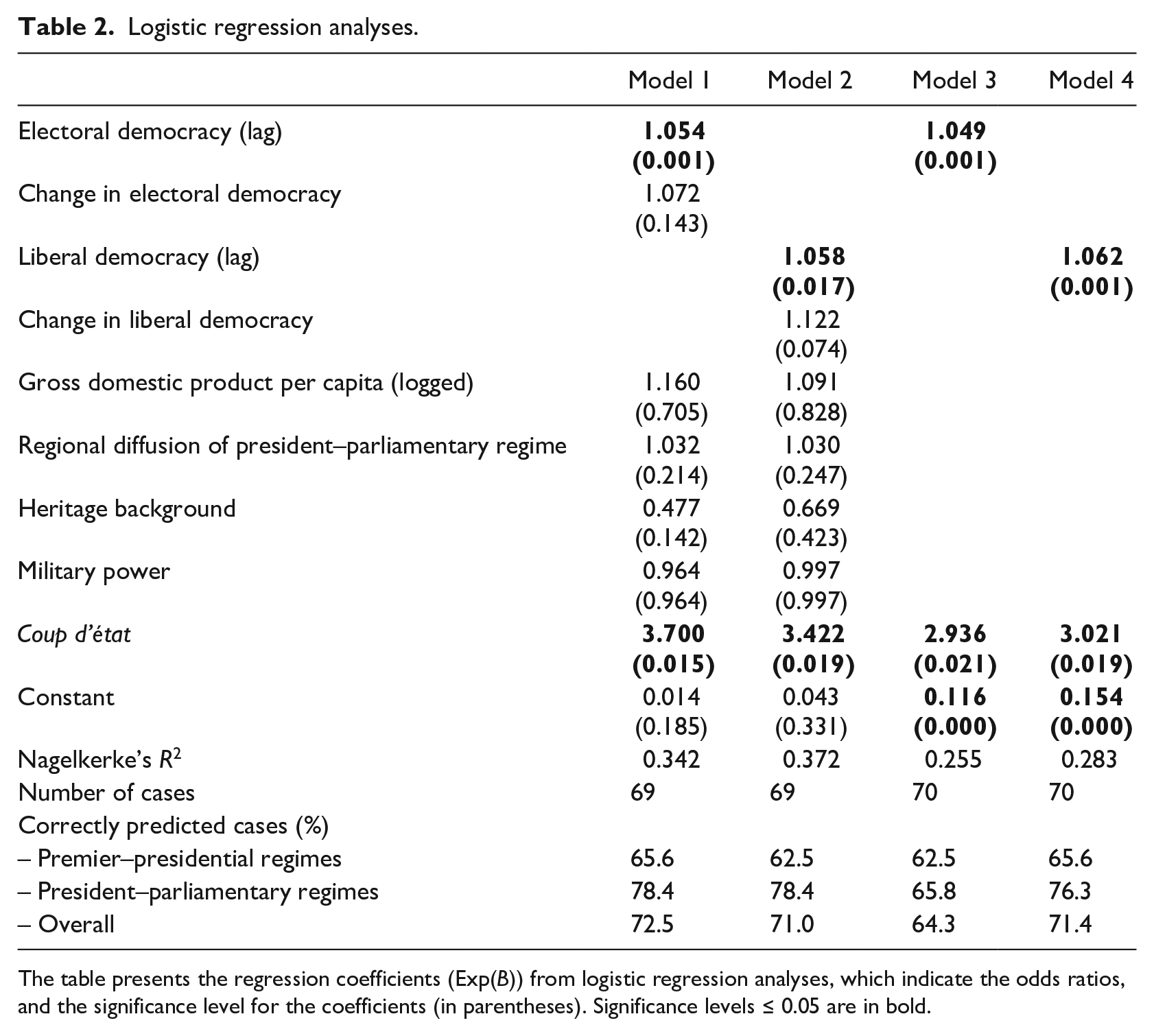
The table presents the regression coefficients (Exp(B)) from logistic regression analyses, which indicate the odds ratios, and the significance level for the coefficients (in parentheses). Significance levels ≤ 0.05 are in bold.
However, the high number of variables in relation to the low number of cases can create problems with overloaded analyses and overfitted models. To test if the results are stable, control variables are grouped into three blocks based on theoretical background: democratization; instability; and semi-presidential regimes (Tables A6 and A7 in the Online Appendix). First, the models include the democracy level and variables from each separated block (Models 1–3), and subsequent models combine the democracy level with variables from two blocks (Models 4–6). The results indicate the same pattern as Models 1 and 2 in Table 2. The democracy level and a coup d’état affect the likelihood of subtype establishment to a significant degree while all other control variables lack significance. Models 3 and 4 (in Table 2) include democracy level and coups d’état to explore their effects when all other variables are excluded. The result is the same: both variables affect the establishment of the subtype. Similar results appear when liberal democracy replaces electoral democracy. The odds ratio is 1.049 for electoral democracy (Model 3) and 1.062 for liberal democracy (Model 4). 11 However, the coefficients of Nagelkerke’s R2 and the shares of correct predicted cases decrease when the analyses use fewer control variables, which indicates some degree of over-fitness for models including all control variables.
Figure 2 displays the predicted probability of establishing a premier–presidential regime based on democracy level. As the first graph shows, the expected probability increases with higher levels of electoral democracy, but the confidence interval indicates considerable variation. The average marginal effect of electoral democracy on the probability of a premier–presidential regime is 0.0095. For liberal democracy, the expected probability has a similar positive pattern but with a higher average marginal effect of 0.0115. 12 These results indicate that the democracy level positively affects the probability of a premier–presidential regime. As an illustration of the difference, the expected probability of a premier–presidential regime is above 0.5 when the level of electoral democracy reaches 40 and when the level of liberal democracy exceeds 28.
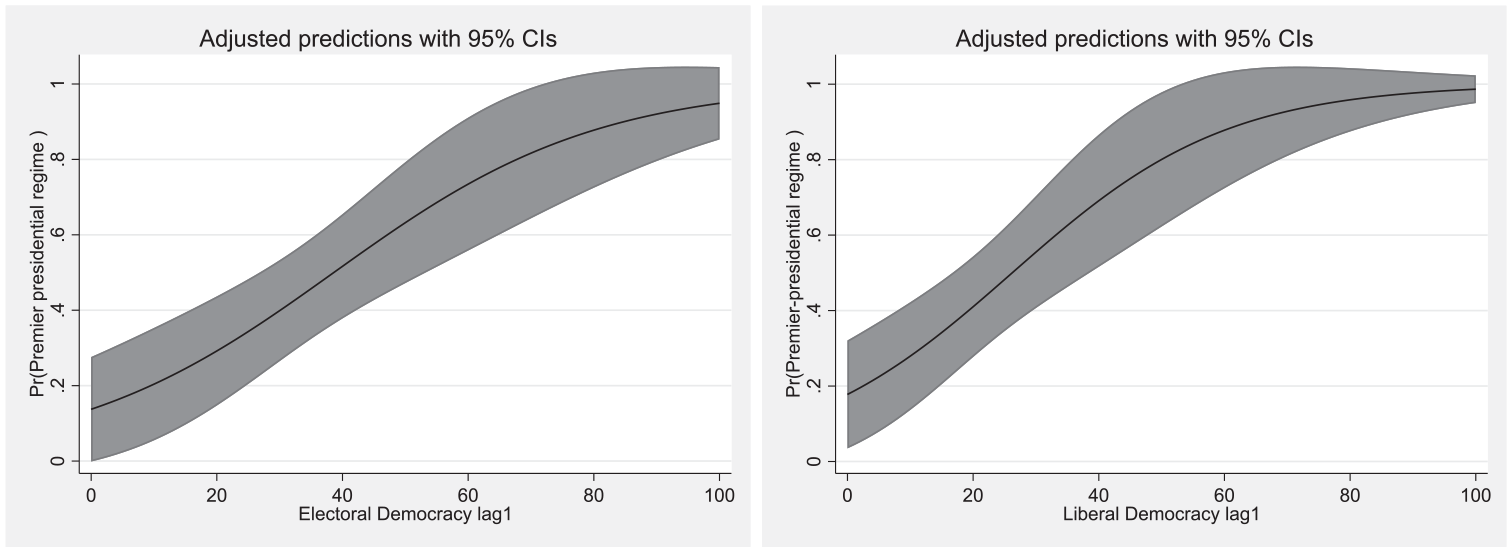
Predicted probabilities.
Furthermore, among the control variables, only the occurrence of coups d’état displays significant effects. As the effects are positive, the results indicate that the establishment of premier–presidential regimes is more likely when a coup d’état plays out at the time of establishment. That is, results strengthen the expectations of the transitional bargaining perspective in that premier–presidential regimes relate to higher levels of uncertainty. However, formulating a more robust conclusion about coups d’état as a cause requires more elaborate analyses with a primary focus on this variable. Apart from coups d’état, none of the control variables has significant effects. Neither change in democracy level, regional diffusion of regime subtype, heritage, nor economic level affect the likelihood of establishing the semi-presidential regime subtypes. These results suggest that even when controlling for the effects of commonly influential variables (such as the level of development, colonial or Soviet heritage, or regime-type diffusion from surrounding countries), the level of democracy affects which one of the semi-presidential regime subtypes is established. In historical terms, most current semi-presidential regimes appeared alongside two later historical processes: the de-colonialization of Africa; and the collapse of the Soviet Union. The premier–presidential regime is most common in the Western and Central parts of Europe, whereas the president–parliamentary regime is the common choice in the post-Soviet region as well as in Africa (Wu, 2011). Even so, our results highlight that these processes have no significant effects on the establishment of the two subtypes. The two semi-presidential regime subtypes are established in different contextual settings, that is, in terms of both uncertainty and democracy levels.
Although the share of correctly predicted cases is higher for president–parliamentary regimes than premier–presidential regimes, the share is also generally high for both subtypes. Two groups of cases illustrate the general pattern: a higher level of democracy increases the probability of a premier–presidential regime. The cases in the first group had a low level of democracy when they established a semi-presidential regime, which, according to the regression model, results in a low probability of the premier–presidential regime. In line with the result, countries such as Belarus (1996), Burundi (1991) and Mauretania (1991) all established president–parliamentary regimes. The second group includes cases with a high level of democracy at the time of establishing a semi-presidential regime, such as the Czech Republic (2012), France (1962) and Lithuania (1992). As expected, they established premier–presidential regimes. However, some cases deviate from the general pattern. In some cases, based on their level of democracy, we would expect these countries to have established a president–parliamentary regime. Still, in fact, they established a premier–presidential regime (i.e., the Democratic Republic of the Congo, 1980, 1992 and 1995, and Togo, 1992) or vice versa (i.e., Senegal, 1991 and Tanzania, 1995). The reasons for such deviations are yet to be found.
As Figure 1 illustrates, the number of semi-presidential regimes increased from 1990. Cases established from 1990 and onwards dominate the group of semi-presidential regimes (73.5%). The dominance is even higher in the analyses (79.7%). This opens up questions on whether the model works in a similar way throughout the period. As the number of cases is low, using the alternative of a split design to test for period effects is impossible. For example, there are only 22 cases of establishment before 1990 and 14 cases in the regression analyses. Instead, we have tested for correlations between residuals and time. The results indicate no significant correlations between residuals or time measured as period (before and after 1990) and year, indicating that models work similarly over time (see Table A8 in the Online Appendix). Moreover, we have also tested whether there are differences in the share of predicted cases. The analyses indicate that the share of correctly predicted cases is similar across the periods (see Table A9 in the Online Appendix) and does not correlate with years. Even though there are no differences in residuals or correct prediction, the bias in the composition of cases gives reasons for being cautious with the conclusions.
In sum, the results strengthen the credibility of our hypothesis: democracy affects the type of semi-presidential regime chosen. First, the level of democracy affects the likelihood of subtype establishment and in the expected direction. Higher levels of electoral democracy and liberal democracy increase the likelihood that a country establishes a premier–presidential regime rather than a president–parliamentary regime. 13
A theoretically founded interpretation of the results is that the level of democracy affects the elites. As stated above, Frye (1997) argues that uncertainty influences regime establishment through a combination of the distribution of bargaining powers among the elites and the preferences of elites. In a nutshell, uncertainty matters through the level of uncertainty for the actor/actors with the highest bargaining powers. Therefore, one interpretation of our results is that the level of democracy affects the ability of established political actors to circumvent attempts to form a ‘winner-takes-all’ regime type. Another interpretation is that the level of uncertainty affects regime-type preferences (whether the elites are willing to form a regime type of concentrated or diffused powers) (see Frye, 1997). In countries with higher levels of democracy, attempts of the likely future president and the president’s party to foster a ‘winner-takes-all’ regime are more likely to meet resistance from other parties or an established opposition. This may be because democracy forms a more diverse set of elites or because these elites incorporate stronger preferences for a more even distribution of powers (as in the premier–presidential regime). Our results indicate that democracy affects the decision-making elites, not how it does so (through institutional possibilities or preference formation).
The conclusion that higher levels of democracy at the time of establishment have a positive effect on the probability of a premier–presidential system complements previous studies that have concluded that premier–presidential regimes correlate with higher levels of democracy on a general level (e.g., Sedelius and Linde, 2018). Taken together, the conclusion generates expectations of a chain between the democracy level, subtype establishment and the subsequent level of democracy, which Figure 3 illustrates. However, bringing the conclusions together gives only an initial (and weak) indication of a chain in which the level of democracy at the time of regime establishment has effects on the level of democracy over time. A more robust conclusion requires further methodological and theoretical work for an empirical test of the whole chain. This is a matter left to future study. 14

Expected relationship between democracy and semi-presidential subtype.
Conclusion
This article draws attention to democracy as a cause of the establishment of the two semi-presidential subtypes. Previously, studies of semi-presidentialism have mainly focused on the semi-presidential subtypes as a cause for the level and survival of democracy (Åberg and Sedelius, 2020; Elgie, 2016; Schleiter and Morgan-Jones, 2009) or for differences between their effects (Elgie et al., 2011; Sedelius and Linde, 2018; Shugart and Carey, 1992). 15 Few studies have examined the reasons for semi-presidential establishment and even fewer have looked for reverse causality in the relation between semi-presidential regimes and democracy. There is thus a serious risk that the influence of democracy on the choice of a semi-presidential regime has gone unnoticed. Therefore, this article traces the potential effects of democracy on institutional establishment, as in the semi-presidential subtypes.
Our empirical analyses show that original levels of democracy differ significantly between the two subtypes. The mean level of democracy is higher in premier–presidential regimes than in president–parliamentary ones. Even when controlling for the effects of a few selected variables, the regression analyses indicate that the level of democracy affects the probability of establishment. Therefore, we argue that not only do the original levels of democracy differ between the two subtypes, but the level of democracy has a significant influence on the choice of regime subtype. Our results provide new knowledge on what causes semi-presidential regimes and contribute to the discussion on the relationship between semi-presidentialism and democracy. Instead of a self-evident treatment of semi-presidential regime subtypes as a potential cause of democratic levels or survival, this study suggests that the establishment of a semi-presidential subtype should also be treated as an outcome of the level of democracy at the time of establishment.
A crucial question raised through the results of this study concerns the effects of semi-presidential regimes. If we include the level of democracy as a cause of semi-presidential subtypes, do the effects of semi-presidential regimes on democracy remain? To answer this question, we need a more complex model than the ones used previously or in this article. For example, we need to analyse interdependence over time between democracy and semi-presidential regimes and control for temporal autocorrelation. Although this design is more challenging, we expect such analyses to make significant empirical and theoretical contributions to the research field. A major contribution of this study is the indication that such studies are much needed.
Another contribution of the study is the finding that the only control variable with significant effects is the incidence of a coup d’état. Other conditions that have been prominent in studies on semi-presidential regimes, such as a democratization process, the level of development, the type of regime in the region and colonial or Soviet heritage, lack significant effects on the establishment of semi-presidential subtypes when analyses include democracy level. When levels of democracy are included, all controls except for the level of uncertainty, display less than significant results. In all, the level of democracy seems to influence the ability of political elites to circumvent attempts to form a power-concentrating regime such as the president–parliamentary one whereas high levels of uncertainty make such a winner-takes-all regime less preferred.
Although our analyses provide empirical contributions to the research on semi-presidential regimes, a number of cases such as the premier–presidential regimes established in the Democratic Republic of the Congo (1980, 1992 and 1995) and Togo (1992), or the president–parliamentary regimes established in Senegal (1991) and Tanzania (1995) cannot be explained by our models. First, our analyses provide limited knowledge on how different levels of democracy affect the preferences and strategies of actors in their decisions regarding political regimes. Studies that explore how democracy levels affect actors’ preferences and choice of action would make valuable contributions to the research field. Such contributions would increase our knowledge on the cases that established a semi-presidential regime according to the general pattern, but also on deviating cases. Second, the indices of democracy level aim to measure the complexity of democracy on an aggregated level. However, as democracy indices are composite measures of several sets of political institutions, the indices can be disaggregated to measure different aspects of democracy. Thus, one question to be answered is whether the different types of democratic institutions (e.g., party system, elections system and political competition) have different effects on the choice of semi-presidential regime. For example, does the democratization of institutions related to freedom have a higher impact than the democratization of elections on which semi-presidential regime subtype actors establish? Are the effects of the level of democracy, as is our tentative interpretation, an indicator of a mature party system or an established parliamentary opposition? Third, as the analyses revealed the influence of democracy level on the establishment of semi-presidential regimes, a remaining task is to integrate these results with previous research on the effects of semi-presidential regimes. To further explore the reverse causality in the relationship between democracy and semi-presidential regimes, we call for further studies that test the effects of semi-presidential regimes controlling for democracy as a cause of semi-presidential regimes. Finally, although we concentrate on the risk of reverse causality in this article, Elgie’s (2016) postulate extends beyond the potential influence of democracy on semi-presidential regime establishment. Therefore, future research should also control for the potential effects of democratic functioning such as government efficiency and stability (Sedelius and Linde, 2018).
Supplemental Material
sj-docx-1-ips-10.1177_01925121241281943 – Supplemental material for Democracy as a cause of semi-presidential regimes: On reverse causality between democracy and semi-presidential establishment
Supplemental material, sj-docx-1-ips-10.1177_01925121241281943 for Democracy as a cause of semi-presidential regimes: On reverse causality between democracy and semi-presidential establishment by Jenny Åberg and Thomas Denk in International Political Science Review
Footnotes
Acknowledgements
The authors thank the editor and three anonymous reviewers for their constructive comments that have improved the article in several ways.
Funding
The authors received no financial support for the research, authorship, and/or publication of this article.

Supplemental material
Supplemental material for this article is available online.
Notes
Author biographies
References
Supplementary Material
Please find the following supplemental material available below.
For Open Access articles published under a Creative Commons License, all supplemental material carries the same license as the article it is associated with.
For non-Open Access articles published, all supplemental material carries a non-exclusive license, and permission requests for re-use of supplemental material or any part of supplemental material shall be sent directly to the copyright owner as specified in the copyright notice associated with the article.
