




Abstract
We assess gender gaps in attitudes to several important and distinct policy areas, including economic left–right issues, gender equality, immigration, environmentalism and traditional ‘moral issues’. Drawing on comprehensive survey data from 14 established democracies in Western Europe, we document that women have more progressive attitudes than men do on all the five attitudinal dimensions that we consider. These patterns are similar (albeit not identical) across West European countries, despite cross-country differences in political cultures and systems. We also elaborate on potential implications of our findings for other political outcomes of interest, including voting behaviour and the functioning of representative democracy, and point to avenues for future research in detailing the mechanisms that contribute to the observed gender gaps.
Introduction
In this article, we study how gender shapes political attitudes among citizens in established democracies. We address the following questions: Are gender gaps in political attitudes mostly idiosyncratic or are there systematic patterns across countries or attitudinal dimensions? Women voters may hold more progressive attitudes on, say, questions of gender equality (Campbell and Erzeel, 2018), but are they consistently more progressive also on other key dimensions of politics in modern democracies? And, if so, how large are the gender gaps? Likewise, studies have carefully documented gender gaps in individual countries such as the United States (Norrander and Wilcox, 2008); Do we find more or less consistent patterns in other developed democracies?
We assess gender gaps along several, distinct attitudinal dimensions, using data from the 2017 European Values Survey (EVS) (European Values Survey, 2020a) and covering 14 West European countries. We focus on gender gaps in political attitudes along the five prominent policy dimensions in present-day West European politics: the economic left–right dimension (state involvement in the economy and redistribution); moral traditionalism; immigration; gender equality; and the environment. We document an important and surprisingly similar relationship, both across countries and policy dimensions: women typically (but not always) hold more progressive attitudes than men. 1
There is a large literature on gender gaps in political attitudes, broadly defined, including studies on attitudes towards the welfare state or public spending (Kellstedt et al., 2010), political knowledge and interest (Dassonneville and McAllister, 2018) and even policy area salience (Yildirim, 2022). However, important questions of scope conditions and generalizability – across policy dimensions and countries/political systems – remain insufficiently answered in the current literature. Even among established democracies, gender differences in political attitudes may be contingent on particularities of countries’ political histories, party systems, labour market characteristics, family structures, or predominant gender norms (e.g., Emmenegger and Manow, 2014). Moreover, studies on particular countries or policy dimensions often appear in different sub-literatures, which makes it harder to form a more complete overview on the extent and systematic nature of attitudinal gender gaps. Hence, we contribute to the literature by providing a comprehensive study based on up-to-date data that assesses the extent to which attitudinal gender gaps appear systematically across countries and policy areas, with attitudes measured in a consistent way across policy areas using high-quality, multi-item measures.
While mapping such gender differences across Western Europe is an important endeavour in itself, we also hope to spur empirically informed theorizing and thereby even indirectly pave the ground for future empirical studies into why and how gender differences in attitudes arise and persist. Documenting and describing gender gaps in political attitudes might also help researchers to better theorize and more accurately model the mechanisms through which gender influences political behavioural outcomes such as voting for green or radical right parties. The patterns described here may also inform questions of normative importance. Insofar as women and men have systematically different political attitudes, measures that mitigate biases in political representation could also entail that their preferences are more equally reflected in legislated policies (and improved representation of women can also play several other important functions; see, for example, Mansbridge, 1999; Phillips, 1995). Related, if policymakers are more attuned to male voter preferences (Reher, 2018), and male voters hold less progressive political attitudes across the board, this could have systematic implications for which policies are being legislated.
Previous studies
The literature on gender and politics is vast. Many existing studies focus, more specifically, on modern gender gaps in vote choice and ideological self-placement (typically on a unidimensional left–right scale). These studies often find that women, on average, currently lean more to the left and interpret these results against the historical backdrop that women tended to vote more conservative than men, at least until 1980 (e.g., Inglehart and Norris, 2000, 2003). The temporal dynamics of such changing gender gaps have been thoroughly documented for voting (Giger, 2009; Harsgor, 2018; Shorrocks, 2018) and for left–right self-placement (Dassonneville, 2021). The perhaps most widespread explanation for the changing gender gap in left support is that societal changes, notably economic development and modernization, have led to different gender roles and economic interests than previously, and different societal roles and positions for women in general (e.g., Abendschön and Steinmetz, 2014: 318–319). One such prominent change contributing to changing gender gaps is increased female labour force participation (Giger, 2009). Another societal change, which we return to below, is related to secularization: to the extent that religion contributes to conservatism and women are more religious, women may be more conservative than men in religious societies. Insofar as secularization has reduced religiosity levels and, related, the importance of churches in social and political life, this may have contributed to the observed change in gender gaps, for instance in voting behaviour. Specifically, Shorrocks (2018) argues that religiosity is a key conditioning variable because it has kept older women from acting on their more left-wing economic preferences than older men, while less religious younger women (who also are more left-wing in their economic attitudes) are ‘free to act’ on these preferences and vote for left-wing parties.
Since vote choice and left–right self-placement are widely studied, but also because they are context-specific (the meaning of self-placement on the left, for instance, may vary across political systems and cultures), we find it important to complement the above-referred to studies by focusing instead on individuals’ placement on different attitudinal dimensions. These are relatively broad dimensions pertaining to comprehensive policy areas, such as redistribution and state-involvement in the economy, the environment and immigration, and in the empirical analysis we consider gender gaps in these and other attitudinal dimensions.
The previous literature on this latter topic is, to some extent, also focused on political behaviour, as attitudinal differences are proposed and tested as one key explanation for differences in, for example, voting behaviour. And, studies addressing attitudinal gender gaps have typically studied gender gaps along one or two such broader dimensions (see, for example, Campbell and Erzeel, 2018; Dassonneville, 2021) or documented several gender gaps within one country (e.g., Campbell and Shorrocks, 2021; Norrander and Wilcox, 2008; Oskarson and Ahlbom, 2021). This leaves important questions of scope conditions and generalizability – across policy dimensions and countries/political systems – unanswered. Gender differences in political attitudes may very well be contingent on different country-specific features (see, for example, Emmenegger and Manow, 2014). Hence, we believe that there is room for a comprehensive study, based on up-to-date data, that assesses the extent to which attitudinal gender gaps appear systematically across countries and policy areas. Even a careful survey of the existing literature, comparing studies on different policy dimensions and countries, will run into issues when trying to draw clear, general descriptive conclusions; comparisons across studies are made difficult by variability in measurements (and measurement quality) between studies of different countries and policy domains. Hence, we propose that the analysis contained in this paper contributes to our understanding of attitudinal gender gaps also by comparing consistent, high-quality, multi-item measures of our policy dimensions, as detailed in the next section.
Data and design
Our focus on generalizability and scope conditions points towards the benefits of conducting analyses on global samples. Yet, by focusing on West European countries, we strike a balance between generalizability and studying political systems where the main political questions are similar enough to compare in a meaningful manner (and where high-quality data exist). The most pertinent questions of redistribution or inclinations to prioritize environmental protection over economic development, for example, could be very different in relatively wealthy, post-industrial societies compared to less wealthy, pre-industrial ones. Without in-depth contextual knowledge, it becomes harder to interpret cross-country differences in gender gaps on redistribution or environmental questions. Simultaneously, the 14 West European democracies that we study do, indeed, represent a mix of electoral-systems and party-systems. They have also differed historically in gender norms and gender gaps in, for example, labour market participation (García-Mainar et al., 2011) or political representation (Stockemer, 2008). Hence, the consistent results reported below are more notable than if we were to find similar gender gaps across a few similar neighbouring countries, such as the Scandinavian or Iberian ones. Still, we must note that restricting our study to Western Europe limits the generalizability of the findings, and future studies considering similar patterns should look beyond this region to assess the wider applicability of our findings.
We draw on high-quality survey data from the most recent EVS round, collected in 2017–2020 (European Values Survey, 2020a). Except for Belgium, Ireland, Luxembourg and Malta, which are not covered in this EVS round, our 14 countries include all states with >100,000 inhabitants in Western Europe.
The most important benefit of using EVS is that it incorporates a wide array of items on political attitudes, allowing us to form indices of key attitudinal dimensions with higher reliability than single-item measures. We employ five indices to capture five distinct political–attitudinal dimensions that are recognizable across West European countries: economic left–right; immigration orientation; moral traditionalism; environment versus growth; and gender (in)equality. These indices were developed by factor analyses on diverse EVS indicators and validated by Kenny and Langsæther (2023), who, for instance, demonstrate that the indices correlate with party choice in the expected manner. All indices are transformed to range from 0–10. Lower values always indicate more progressive, or ‘leftist’ views, and higher values more ‘rightist’ views. We also include analyses of respondents’ self-placement on a general left–right scale. Online Appendix A contains descriptive statistics and more information on the indices and indicators.
To capture economic left–right attitudes, we use an index based on questions tapping into state versus individual responsibility to provide for oneself, the right of unemployed to refuse a job, attitudes to competition, income inequality and government ownership. Our second index captures immigration orientations through questions asking whether immigrants take jobs away from nationals, increase crime problems, strain the welfare system and whether they should maintain their own customs or not. Our third index on environmentalism attitudes uses items asking respondents whether: they would give up part of their income to prevent pollution; feel it is too hard to do much about the environment; consider other things more important than protecting the environment; find it relevant to take individual action for the environment; consider claims about environmental threats exaggerated; and prioritize environmental protection over economic growth/jobs. Our fourth index captures moral traditionalism. Respondents were asked to what extent they consider homosexuality, abortion, euthanasia and divorce as justifiable. Our fifth and final index taps into gender equality attitudes. Respondents were asked whether: a child suffers with a working mother; women want to prioritize home and children over employment; the family suffers when a woman works full-time; a woman’s job is to look after the home; higher education is more important for boys; men make better political leaders and business executives; and men have a stronger right to employment when jobs are scarce.
Since our goal is to consider the extent to which gender differences are idiosyncratic or similar across countries, we run our benchmark specification for each country individually. We present pooled specifications including country-fixed effects in Online Appendix Table B.16. They corroborate the sizeable and systematic gender gaps in Western Europe across dimensions, although results are insignificant at conventional levels for immigration (where there is somewhat more cross-country variation than for other dimensions). Since we may interpret the indices used as dependent variables as metric, we use ordinary least squares (OLS). The samples are probability samples, and we weight observations by calibration weights on age, gender, education and region to reduce bias due to non-response (as recommended by European Values Survey, 2020b).
We do not include any controls in our benchmark. This is intentional. We are here interested in describing the total effect of gender on political attitudes and want to include any relevant indirect effects that stem from women and men having different incomes, educational backgrounds and even life expectancies. If we, for example, control for women systematically having different career patterns and incomes than men (Iversen and Rosenbluth, 2006), we risk blocking a relevant channel through which gender influences political attitudes. This is another reason why much of the vast literature on determinants of political attitudes does not satisfyingly answer our research question: gender is typically included as a control in models containing many (predominantly) causally posterior variables, meaning its coefficient cannot be interpreted as the total effect of gender (cf. Keele et al., 2020).
Granted, gender, as reported in surveys, may certainly be measured with error or be endogenous for several respondents (e.g., Bittner and Goodyear-Grant, 2017; Flores et al., 2016), and perhaps even be affected by political attitudes for some individuals. Yet, for the purpose of our statistical study, we treat gender as exogenous (as a categorical sex variable) and thus interpret the uncontrolled coefficient as the total effect of gender on political attitudes. However, we note that results are similar when controlling for age (see Online Appendix C). Controlling for other individual-level factors, such as education or occupational status (e.g., public sector job vs private sector job) would, as noted, introduce post-treatment bias in the estimates of the total effect of gender that we assess here. Yet, in Online Appendix H, we extend our set-up in mediation analyses, exploring the extent to which plausible candidates for mechanisms (women living longer and women making different educational and occupational choices than men) can help explain the gender gaps that we document. In this analysis, we find evidence indicating that these mechanisms – except for the economic left–right dimension – explain a nontrivial share (typically 1/6 to 2/5) of the different attitudinal gender gaps, although for all dimensions, more than half of the gender gaps remain unaccounted for by these mechanisms. We refer to Online Appendix H for extended discussions of results as well as several caveats with this analysis.
Analysis
Figure 1 displays coefficient plots from our benchmark with gender as independent and left–right self-placement and each of the five attitudinal indices as dependent variables, run separately for 14 West European countries. The plots show OLS coefficients for gender, which also can be interpreted as marginal effects of gender, surrounded by 95% confidence intervals. Negative coefficients reflect that women, on average, hold more progressive political attitudes than men. That is, women are more left-leaning in economic questions (top-middle plot), hold more pro-immigration attitudes (top-right), hold less traditional moral values (bottom-left), prioritize the environment (bottom-middle) and hold a stronger preference for gender equality (bottom-right). 2
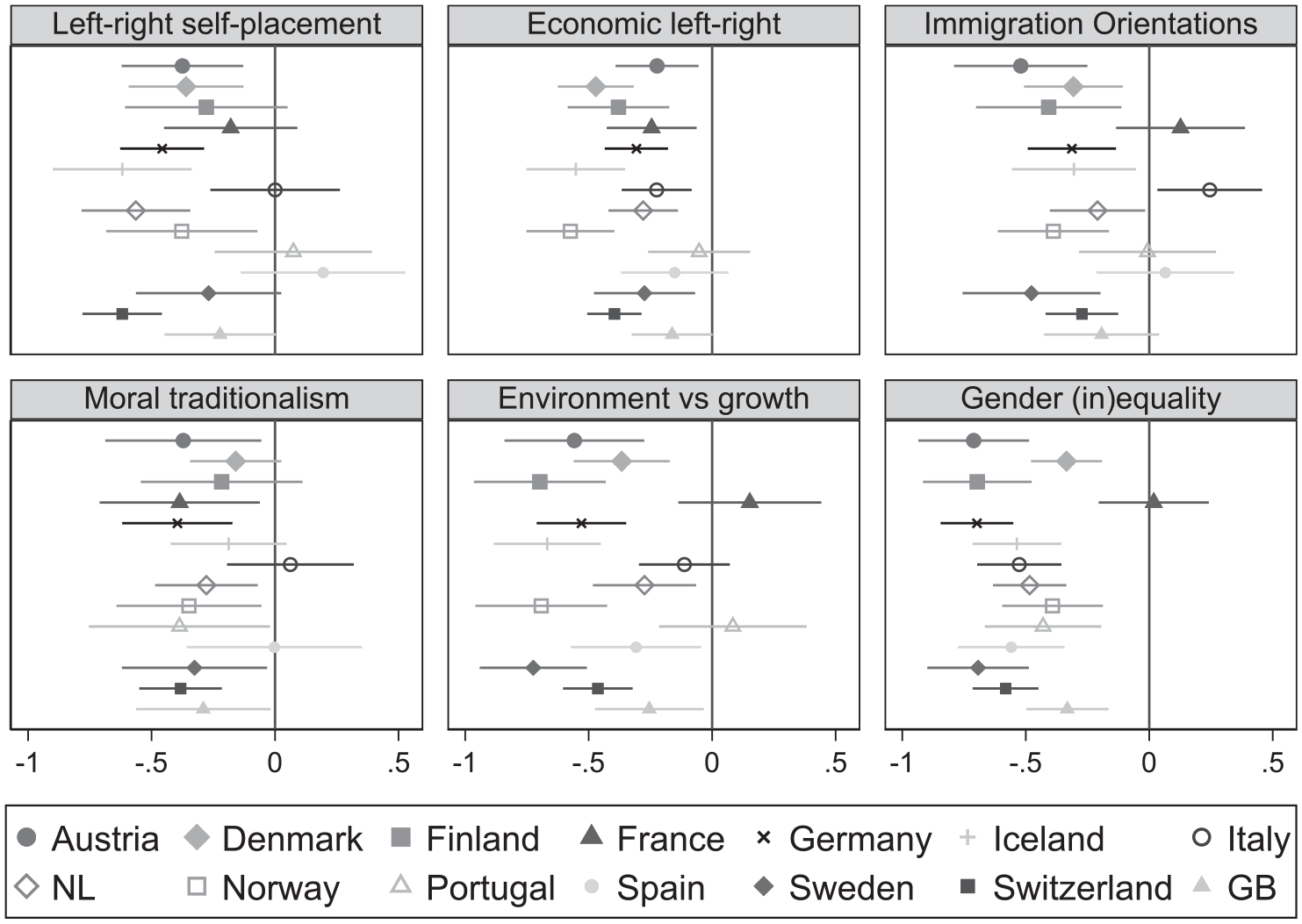
Coefficients on gender with 95% confidence intervals for five attitudinal dimensions, by country. Negative coefficient implies that women hold more progressive values. Plot created using coefplot (Jann, 2014).
The top-left plot of Figure 1 replicates the finding from previous studies (e.g., Dassonneville, 2021) that women tend towards identifying as more left-wing than men in most countries today (average coefficient −0.29, average t-value −2.55). Yet, the relationship is statistically insignificant at the conventional 0.05-threshold in several countries, including the Southern European countries of Italy, Portugal and Spain (see also Emmenegger and Manow, 2014). These mixed results could, for example, stem from different scale interpretations, with citizens of some countries mainly thinking about left–right placement on the traditional economic dimension and on immigration in others (see, for example, Knutsen, 1995). More generally, by considering general left–right self-placement, we lose nuance about the attitudinal differences between men and women.
Hence, we analyse the five more specific attitudinal dimensions. Briefly summarized, we find that women systematically hold more progressive attitudes than men, although the size and robustness of the relationship varies somewhat by dimension. The relationship is particularly visible and consistent across countries on gender inequality (average coefficient −0.50, average t-value −5.43; 13/14 countries display significant relationships at 0.05-level). The coefficients, on average, correspond to almost 1/3 standard deviation on the dependent variable (see Online Table B.17 for similar normalizations for all analyses). The relationship is also non-trivial and consistent for the economic left–right dimension (average coefficient −0.31, average t-value −3.70, 11/14 countries significant at 0.05). For moral traditionalism, coefficients are typically smaller, but very consistent across countries (average coefficient −0.26, average t-value −02.00, 9/14 countries significant at 0.05). Coefficients vary more in size for environmentalism (average coefficient −0.39, average t-value −3.52, 11/14 countries significant at 0.05) and immigration orientation (average coefficient −0.21, average t-value −1.84, 10/14 countries significant at 0.05). Yet, the gender coefficients are still quite substantial across the board and typically negative and significant. 3
Online Appendix Table A.15 reports all coefficients and t-values. Among the 84 estimated gender coefficients, only one – immigration, Italy – is positive and statistically significant at 0.05. Otherwise, women are about equally progressive or, most commonly, more progressive than men – be it in terms of economic ideology, immigration orientations, moral traditionalism, environmentalism, or gender equality attitudes. The cross-country consistency is noteworthy.
Before delving into the country-specific results, we do want to connect with the previously discussed literature on temporally changing gender gaps and the generational aspects contributing to these dynamics. While we cannot draw on extensive time series for our five indices, we assess another implication of the argument that generational replacement expectedly contributes to changing gender gaps in Online Appendix C, by considering how age moderates the various relationships that we study.
Indeed, we find indications of generational differences across some but not all five dimensions. Younger women are, generally, much more progressive than younger men across attitudinal dimensions, whereas the picture is more mixed for older citizens. While both younger men and women tend to be more progressive than their older counterparts, the age differences are much larger for women, thus explaining much of the overall gender gaps. This seems compatible with recent analyses of parent–offspring dyads suggesting that (Swiss and German) women in the offspring generation are more leftist than their parents, whereas there are smaller generational differences among men (van Ditmars, 2023: 12). In a few of our cases, we find that younger men are located to the right of older men, also contributing to the increasing gender differences. Our results also seem to be in line with previous work analysing sexism, more specifically. Building on theories about group threat, modern sexism, and envious prejudice, Off et al. (2022) find that perceived increases in competition, for instance in the labour market, between men and women have led to a ‘backlash’ (i.e., increased sexism) among young men. One could imagine and speculate that similar processes may be at work, for instance related to immigration attitudes among men, following increased competition from immigrant populations in recent decades.
Regarding country differences, gender has a negative and significant (at 0.05) coefficient for all five attitudinal indices in six countries (Austria, Germany, Netherlands, Norway, Sweden and Switzerland). In another three countries (Denmark, Finland and Iceland), negative and significant gender gaps appear for four dimensions. The United Kingdom has significant and negative gender gaps for three dimensions.
Only four countries display significant gender gaps on fewer than three dimensions – all four are Southern European, Catholic countries. In Portugal, women are significantly more morally liberal and pro-gender equality than men, but do not differ from men on economic left–right attitudes, immigration orientations, or environmentalism. Spanish women are more environmentalist and pro-gender equality than Spanish men, but do not differ on economic attitudes, immigration orientations, or moral traditionalism. French women are significantly more left-leaning on economic questions and morally more liberal, but do not differ from men on immigration, environmentalism, or gender equality. Finally, Italian women are also significantly more left-leaning on economic questions and gender equality, but are no different from Italian men in terms of environmentalism or moral traditionalism, and are more sceptical of immigration than Italian men.
This pattern follows previous studies on related outcomes such as left–right self-placement and vote choice; one potential explanation pertains to higher degrees of religiosity than in Northern Protestant countries, and religiosity enhances conservative voting behaviour and even certain conservative attitudes (Emmenegger and Manow, 2014). 4
To further assess this notion, we checked whether the magnitude of gender gaps relate to levels of religiosity. Online Appendix F provides, first, two tests with individual-level interactions between gender and religiosity (measured first as self-reported religiosity and then as active churchgoing). We do not find evidence of systematically higher gender gaps among religious people. However, it may be that the cultural context rather than individual religiosity matters for gender gaps in political attitudes. To assess this possibility, we ran multilevel models with cross-level interactions between (individual-level) gender and religiosity at the country level. These models indicate that more religious societies, generally, have smaller gender gaps in political attitudes. This result adds to previous findings that Catholic countries have smaller gender gaps in left-wing voting (Abendschön and Steinmetz, 2014). We highlight that our finding is only descriptive, and that other factors correlated with religiosity levels may induce the observed correlation. Nevertheless, it is an interesting empirical pattern.
In Online Appendix E, we explore interactions between gender and country-level economic conditions. More specifically, we assess to what extent and how the different attitudinal gender gaps may depend on income level (measured as gross domestic product (GDP) per capita), size of the public sector (public spending/GDP) and type of welfare state (separating between Liberal, Corporatist and Social Democratic welfare state type; see, for example, Esping-Andersen, 1990). In brief, results are more mixed for the latter two variables, with some estimates showing larger gender gaps in high-spending countries than low-spending ones and in Liberal welfare states than in Corporatist ones. In contrast, the interaction with GDP per capita is more consistent across attitudinal dimensions; gender gaps are typically larger in wealthier countries. As discussed in in the ‘Previous studies’ section, one common explanation for changing gender gaps in, for example, voting behaviour over time is that economic development has led to transformations of labour markets and gender roles pertaining to, inter alia, education and worklife participation for women (see, for example, Abendschön and Steinmetz, 2014 as well as our mediation analysis in Online Appendix H). Our cross-sectional results are in line with the notion that economic development also contributes to changing gender gaps in attitudes, leading to women being substantially more progressive than men in the most developed countries. Yet, as we detail in Online Appendix F, our interaction results are only indicative and should be interpreted with utmost care, given the limited number of countries included and the possibility of other macro-variables confounding our estimated relationships.
To sum up the main results from our analyses across 14 countries and five attitudinal dimensions, West European women are generally more progressive than men, and this pattern appears across countries and policy areas. While the pattern is consistent overall, Catholic, Southern European countries tend to have fewer gender gaps in attitudes than Protestant, Northern European ones. The cross-country consistency is also somewhat less clear for the immigration dimension than for the other attitudinal dimensions.
Discussion and conclusion
We have provided an up-to-date documentation of a consistent gender gap in political attitudes – across five salient policy dimensions – in 14 West European countries. Drawing on comparable data and multi-item measurements from around 23,000 EVS respondents, we find that women are generally more ‘progressive’. In most of the studied countries, women hold more leftist economic views, prioritize the environment over economic concerns, are more pro-immigration, put greater emphasis on gender equality and hold less traditionalist moral views than men. The gender gaps tend to be more important for younger generations.
The purpose of this research report is descriptive, and we did not aim to theorize and explain why women in West European countries more often hold progressive attitudes. Still, we hope and believe our findings may inform and help spur further theorizing into these important questions.
First, the relatively, but not entirely, similar patterns across West European countries point towards questions of generalizability to other geographical areas. Our finding that gaps are more consistent across policy areas in Northern European and Protestant countries than in Southern and Catholic ones might indicate that historical or cultural factors can influence gender gaps in political attitudes, although this proposition needs further empirical examination. Future research could elaborate on this proposition by studying very different geographical contexts. For instance, one could employ a similar approach to ours, but using the World Values Survey. Yet, when doing so, it would be paramount to ensure that the meanings of the political issues studied are comparable across countries. One could also study differences across historical contexts. For instance, Kellstedt et al. (2010) found that for spending preferences, the American gender gap in policy liberalism varied greatly across 1976–2004.
Second, the consistency of the ‘progressive gender gap’ across policy dimensions calls for future theorizing – going beyond theorizing gender differences in restricted (albeit important) policy areas such as redistribution or immigration. This consistency, across widely different topics and spheres of politics, calls for the development of general theories with broad applicability.
Further, we hope that our findings inform studies investigating the link between gender and other outcomes. Differences in political attitudes are typically viewed as a key mediator by scholars assessing gender gaps in various political outcomes, including party identification, voting behaviour, democratic norms and protests. To exemplify, one widely studied gender gap concerns the overrepresentation of men in Radical Right electorates. Many interesting explanations have been proposed (see, e.g., Coffé, 2018), among them gender differences in immigration attitudes and authoritarian values. Yet, Harteveld et al. (2015), for example, report that women are at least as nativist as men, and that they are similar in left–right position, concluding that there is little room for a mediating role for these attitudes. In contrast, our findings suggest that women are, indeed, systematically less in agreement with key Radical Right policies, at least in Western Europe. 5 Women are typically more positive to immigration, but also to environmentalism, gender equality and moral liberalism. The combination of these attitudes is a potent antidote to a Radical Right vote, and it might also explain why women are overrepresented in Green electorates (Langsæther, 2023: ch. 3), insofar as these parties often champion consistently less or consistently more progressive policies across policy areas. Even small differences in attitudes between men and women on individual policy areas, when all pointing in the same direction across areas, may amount to large gender gaps in voting.
Attitudinal differences between men and women could have implications also for political representation and participation. Women are underrepresented descriptively in parliaments and cabinets (e.g., Claveria, 2014). Insofar as women politicians are better at representing women’s concerns (e.g., Mechkova and Carlitz, 2020), this could lead to a substantive underrepresentation of the more progressive views held by women. However, women in many Western democracies today participate in national elections to a similar or even higher degree than men do (Dalton, 2020: 70–71; Smets and van Ham, 2013). Thus, electoral mechanisms may offset the potential representation issues at the national level. Indeed, existing research tends to show that women’s policy preferences are at least as well represented as those of men, although the congruence gaps may depend on party characteristics (Griffin et al., 2012) or the specific policy area (Dingler et al., 2019). Regardless, studying gender differences in political attitudes across time and space is informative for monitoring a key aspect of democratic functioning, namely the equal representation of men and women’s policy preferences.
Supplemental Material
sj-docx-2-ips-10.1177_0734371X241282103 – Supplemental material for Are women more progressive than men? Attitudinal gender gaps in West European democracies
Supplemental material, sj-docx-2-ips-10.1177_0734371X241282103 for Are women more progressive than men? Attitudinal gender gaps in West European democracies by Peter Egge Langsæther and Carl Henrik Knutsen in International Political Science Review
Supplemental Material
sj-rtf-1-ips-10.1177_0734371X241282103 – Supplemental material for Are women more progressive than men? Attitudinal gender gaps in West European democracies
Supplemental material, sj-rtf-1-ips-10.1177_0734371X241282103 for Are women more progressive than men? Attitudinal gender gaps in West European democracies by Peter Egge Langsæther and Carl Henrik Knutsen in International Political Science Review
Footnotes
Acknowledgements
We thank the International Political Science Review Editors and three anonymous reviewers, as well as Ruth Dasonneville, Ingvild Zinober, Liran Harsgor and panel participants at the European Political Science Association 2022 Annual Conference in Prague as well as the Tuesday seminar at the Department of Political Science, University of Oslo for their helpful comments.
Funding
The authors received no financial support for the research, authorship, and/or publication of this article.

Supplemental material
Supplemental material for this article is available online.