




Abstract
Rhetorical entrapment plays a key – but often overlooked – role in the theory and practice of international relations. In this article, we develop a new pathway and mechanisms of rhetorical entrapment. Our key argument is that current literature has focused too much on normative forms of rhetorical entrapment. Although insightful, this misses empirical forms of rhetorical entrapment. Drawing on Habermasian theory, we suggest that normative and empirical validity claims give rise to alternate pathways and mechanisms of rhetorical entrapment: the normative pathway encapsulates framing, identity and legitimacy; whereas the empirical pathway is mediated by information, reputation and trust. To explore this theoretical argument, we engage in a plausibility probe of international investment agreement negotiations. Drawing upon in-depth interviews with various state negotiators, we find that empirical rhetorical entrapment is pervasive. We document this pathway and mechanisms. We conclude by developing the broader causal and normative implications of our argument.
Keywords
Introduction
Much work in studies of the European Union (EU) and international relations (IR) underscores the importance of rhetorical entrapment (Schimmelfennig, 2001). Rhetorical entrapment comprises several elements. It begins with an actor making a claim that commits them to a certain position. When the claimant deviates from that position, other actors may hold them accountable to the initial claim. The claimant then needs either to offer reasons for their deviation, revert to the initial position or incur costs for maintaining an inconsistency.
Although the literature on the causal importance of rhetorical entrapment is well established (Elster, 1982; Seymour, 2014), most discussions have focused on normative frames and their implications. Drawing on Habermasian speech act theory, we argue that a second – different – pathway of rhetorical entrapment exists which is focused on the consistency of empirical claims rather than normative positions. In short, normative rhetorical entrapment relies upon framing battles, identity and legitimacy; empirical rhetorical entrapment works through information battles, reputation and trust. We suggest that our alternate pathway can be used to make causal inferences, not relying on subjective motivations, but by tracing outcomes from rhetorical statements (cf. Krebs and Jackson, 2007).
To explore the utility of this pathway we engage in a plausibility probe of rhetorical entrapment in international investment agreement (IIA) negotiations. The study relies on more than 60 in-depth interviews with IIA negotiators from 35 different countries. In our probe, we find that empirical rhetorical entrapment is a core element of how negotiators engage with one another. More importantly, the negotiators report that settling informational terrain, potential reputational costs and intersubjective trust are at stake when employing (empirical) rhetorical entrapment as a negotiating tactic.
The article proceeds as follows. First, we outline the conceptual foundations of rhetorical entrapment. Second, deploying Habermas’ distinction between types of validity claims, we delineate two alternate pathways, and systematize normative and empirical variants of rhetorical entrapment. Third, we give a background to IIA negotiations and document our method and data collection. Fourth, we present our plausibility probe, showing how negotiators use different arguments to rhetorically entrap each other in IIA negotiations. Finally, we conclude by discussing how our findings matter for negotiation outcomes and the broader implications for international politics.
Rhetorical entrapment: conceptual foundations and literature
Rhetorical entrapment: conceptual foundations
Rhetorical entrapment occurs when actors in social life make claims about the world. Any such claim commits that actor to a position. At later stages, the same actor can be held accountable to those initial claims by others, with attempts to deviate from their own claims requiring redress. This leads to one of two options. First, the claimant can provide a justification for why their position has changed, such as conceding that their initial claim was wrong or the learning of new information. Second, the claimant can persist with that inconsistency. However, in this latter instance, the claimant will be pressured by others to recognize that inconsistency is problematic. The claimant then needs to revert to the initial position or incur social costs for failing to remediate their change.
The necessity of justifying changes or reverting one’s position is due to the relationship between sincerity and the value of one’s own words: unexplained contradictions will cause others to value one’s words less in future interactions. If those issuing claims want their explanations to be taken seriously, they must establish credibility over time. Without temporal credibility, their words lose meaning as others assume a claimant is insincere or acting in bad faith. 1 Work in social psychology shows that statements have an anchoring effect and that changing positions undermines a claimants’ own aims (Hartmann and Rad, 2020). Building upon this, we argue that rhetorical entrapment is an important part of how actors interact in political life.
Rhetorical entrapment: literature
The literature on rhetorical entrapment is broad and employs different terminologies to discuss the same or similar phenomena (rhetorical action and rhetorical coercion, most directly) and it is related to other literatures (on hypocrisy, ‘double-standards’ and naming-and-shaming. These studies focus – almost exclusively – on normative aspects of entrapment.
Early work on rhetorical entrapment by Elster (1982) sought to understand how statements tied actors to positions in ways that altered political decision-making. He applied this to debates over constitution-making in France and the United States and found the ‘civilizing force of hypocrisy’ was deemed a crucial explanatory mechanism. The debates concerned a plethora of previously stated norms such as the appropriate size of states or the virtues of balance of power (Elster, 1982: 395). Later work by Schimmelfennig (2001) on rhetorical action demonstrated convincingly that enlargement in the EU was about the inducement of members to act in line with their liberal democratic membership norms. Schimmelfennig traced this tendency to the importance of sincerity to legitimate social actions.
Krebs and Jackson (2007: 57) focus on how public language and normative principles are deployed in (public) debate, and the causal impact of language. Their model suggests that actors put claims to their opponents, and debates then ensue over the correct (normative) frame to apply and potential implications that follow from a given viewpoint. Utterances can then be employed to limit the space of viable counter-responses, rhetorically ‘coercing’ interlocutors to accepting reasoning or a position that they would otherwise avoid. Although conceptually broader than rhetorical entrapment, their model shows that claims commit actors to positions that are hard to backtrack from when inconsistency between claims, frames and implications becomes clear. Their key example examines citizenship rights after military service. Much subsequent work follows these seminal pieces on rhetorical entrapment: Lin and Katada (2020) focus on how domestic reformers can entrap others into supporting international organization (IO) membership by framing accession as a matter of international status. Bower (2020) examines the strategic deployment of rhetorical entrapment using norms in anti-personnel landmine bans.
The literature on rhetorical entrapment also relates closely to work on (organized) hypocrisy, ‘double-talk’ and naming-and-shaming in world politics. Lipson (2007), in a seminal piece, shows how organized hypocrisy – internal organizational commitments that are at odds with their normative environmental or output policy decisions – occurs when claimants point out inconsistencies. 2 Lipson (2007: 10) – following Brunson before him – points out that when organized hypocrisy lies between organizational commitments and policy outputs, counter-coupling occurs in which talk is used to justify decisions even without taking alternate action. This talk is a result of pressure generated through mechanisms of rhetorical entrapment. 3 In a similar vein, Finnemore (2009: 83) notes that unipole leaders experience backlash when creating and institutionalizing rules that they subsequently violate. Continuing in the face of hypocrisy can erode the legitimacy of both the unipole and the world order they have constituted. Relatedly, Headley (2015) argues that the normative power of Europe is increasingly contested by Russia on the grounds that its actions do not align with previously stated values. Finally, IR literature convincingly demonstrates how states employ naming-and-shaming tactics when others violate norms to which they have previously committed (Koliev and Lebovic, 2018). Katzenstein (1996), for example, focuses on how naming-and-shaming can be employed to pressure governments to change their laws to fall in line with recognized human rights norms.
What these studies have in common is that their focus is on the normative dimension of rhetorical entrapment. This focus, we believe, misses a second dimension of rhetorical entrapment that is focused on empirical claims.
Rhetorical entrapment: building the pathways
Rhetorical entrapment: normative and empirical validity claims
To develop the concept of rhetorical entrapment – and bring clarity to the extant literature – we turn to Habermas’ work on validity claims. According to Habermas (1984), social interactions involve a process of argumentation in which actors make commitments, seek understanding and take joint decisions. Social cooperation involves communicative action whereby interlocutors strive towards achieving mutual understanding. Actors make claims about how to understand the world, and about how to act in concert (Habermas, 1984: 306). As such, social cooperation relies upon intersubjective reason-giving: practical reasoning through the swapping of validity claims about how to engage in joint action.
According to Habermas, following others in the philosophy of language such as Austin and Searle, validity claims are assessed against standards of rightness (i.e. attachment to shared norms) and truth (i.e. empirical accuracy) and stand as illocutionary acts through which reason-giving becomes accessible. 4 This process, which is the core of communicative action, does not presuppose that agreement is reached on which joint action should follow (in a perlocutionary sense). What this does entail is that exchanging validity claims opens the claimant up to counterpoints, and that good reasons for their utterance can be adduced if confronted by others. It is the offering of reasons through validity claims that is essential for understanding how rhetorical entrapment can occur: claims presuppose reasons, and the utterance of a claim opens the speaker to counter-claims to probe the underlying reasoning.
There is not space to assess the wider theory of communicative action within which Habermas embeds validity claims. However, a few points are important. First, communicative action offers a linguistic basis for social action that, in turn, enables instrumental and strategic action that many suggest is key for rhetorical entrapment (Risse, 2000; Schimmelfennig, 2001). This does not mean that rhetorical entrapment entails persuasion as we would expect in an ideal speech situation or that coercion must be absent from all steps in rhetorical entrapment efforts – as is required under communicative action theoretically. 5 Rather, the foundational process of exchanging validity claims opens space for rhetorical entrapment irrespective of an agent’s motivation for joint action because mutual reasons can only be understood freely between agents.
Second, we recognize that interlocutors will often mix normative and empirical claims simultaneously. As such, the distinction between normative and empirical claims is best seen as a continuum, with utterances blending both and falling closer to or further from either end of the spectrum concerning the type of validity claim being proffered. 6 Our key point, following Habermas, is that empirical and normative claims are analytically distinct as ideal types, with implications for the mechanisms and pathways through which rhetorical entrapment unfolds (Habermas, 1984: 306; 2003: 229). 7
Finally, this point relates closely to the Humean debate surrounding the contrast between facts and values: a distinction which has broken down in recent years (Putnam, 2004). We again recognize that this distinction is tenuous in social life, as empirical statements still fall within a normative context and actors grapple with issues of inductive risk (Fjørtoft, 2024). However, this concession does not mean that within many interactions – where much of the context is set – empirical and normative claims cannot both be at play to lesser or greater degrees. 8 This simply puts a premium on explicating which mechanisms in a pathway of rhetorical entrapment occur following from the distinction when it can be observed. 9
Our focus, then, is upon the types of validity claims within rhetorical entrapment processes. From this point, we have two aims. First, theoretically, we seek to establish a theoretical connection between the types of validity claims offered and the pathways of rhetorical entrapment. Second, empirically, we depict these pathways in practice (with a focus on the empirical pathway). We follow Krebs and Jackson who argue that social scientists should not use intentions as a starting point for causality when it comes to rhetoric(al entrapment). Instead, starting with claims and studying process allows for causal connections to be examined, as our plausibility probe of IIA negotiations illustrates.
Rhetorical entrapment: pathways and examples
Based on the above Habermasian distinction, our claim is that rhetorical entrapment may encompass either (or both) normative or empirical claims. The question then becomes: how does the type of validity claim matter for rhetorical entrapment processes? In this section we outline the concept of rhetorical entrapment, develop both pathways in tandem with existing literature and highlight some examples.
First, let us then formalize the model of rhetorical entrapment: actors make claims to positions that act as commitments. If they deviate later, they can be held accountable for the original statement. Deviation requires either an explanation justifying the move, or actors can be pressured into reversion. If they do neither, they lose credibility. Now we need to disentangle normative from empirical claim-making as the pathways vary.
The normative model of rhetorical entrapment is commonly applied. Here an actor (A) makes a normative claim (C1) about how to act in the world. C1 includes what is fair, right, just and/or other normatively compelling claims. Others (O) receive this claim, but if A deviates in a subsequent claim (C2), a framing contest between A and O ensues over what are the appropriate norms to apply. If the norms embedded in C1 are violated in C2, and A fails to remedy their latter position, their identity must shift in line with the new norms they are espousing. Ultimately, this pathway causes A to lose legitimacy if there is incongruence between their claimed norms in C1 and C2 without justification. A lack of legitimacy means losing status as a valid member of the community as identify shifts.
Rhetorical entrapment 1: Normative pathway
C1 by A → O reception → C2 by A → Framing Contest → Acceptance/Rejection by A → Impacting Identity → Gain/Loss of Legitimacy
We can extract this model from extant literature. One oft-cited example is the case of EU accession in which state leaders were tied to claims of liberal norms resulting in major political alterations. When claimants offered a normative frame concerning how EU membership should be delineated, it was ‘collective identity’ and ‘a general commitment to the community and a general interest in upholding and disseminating its values and norms’ that ultimately led to entrapment and membership expansion (Schimmelfennig, 2001: 62). The pathway is also clearly outlined by Krebs and Jackson (2007: 44–45 when they stipulate that rhetorical coercion works through a framing battle with a policy implication. This, in turn, can cause counter-claims to be successful as claimants are ‘continually striving to legitimate their positions’ as members of a social community.
A similar strand of work focuses on transnational activists seeking policy change. In the field of human rights, non-governmental organizations (NGOs) often seek to hold local governments directly accountable for their past commitments and statements (Koliev and Lebovic, 2018). These claims are pitched as normative frames that, over time, become contestable when other frames tie a claimant’s hands. Shaming works as identity and legitimacy are seen as crucial resources for operating in the world. From these literatures we can ascertain that framing battle, identity and legitimacy matter when normative validity claims form the basis for rhetorical entrapment efforts.
The empirical model of rhetorical entrapment unfolds differently. Here A makes empirical claims about how the world works (C1), meaning what facts will apply to different actions. This includes claims about what benefits are likely to follow from specific policies, the existence and function of laws surrounding ratification processes, and so on. If A then deviates from this empirical stance in a subsequent claim (C2), an ‘information contest’ will unfold. In this step, both A and O will debate whether conditions have changed so that the facts surrounding C1 do not apply anymore: if new empirical evidence has come to light, the institutional rules have changed, and so on. If the facts employed in C1 do still apply to C2, and A cannot therefore explain why the context is different, A will lose reputational standing if they fail to remedy their position. Ultimately, this pathway does not illegitimate them or their position, but it causes a loss of trust.
Rhetorical entrapment 2: Empirical pathway
C1 by A → O reception → C2 by A → Information Contest → Acceptance/Rejection by A → Impacting Reputation → Gain/Loss of Trust
This empirical pathway is less discussed in the literature. As such, it is more difficult to parse out from existing work (thus marking it as our theoretical contribution). Yet we can glean the mechanisms from related fields in IR. For instance, an example of empirical rhetorical entrapment comes from the theory audience costs: in some instances, heads of government make statements about their hard lines for warfare (i.e. actions from opposing states that will trigger militarization) or the strength of their domestic armaments (Fearon, 1994; Kertzer and Brutger, 2016). 10 Making these claims is viewed as a credible commitment by others, and backing down from them would be costly to the reputation of the leader. If a leader backs down, then they need to offer reasons for why information concerning the context has changed (the other state now has more armaments, for instance). Failing this, a loss of trust between audiences (other state leaders or their public) results, but not to their legitimacy: they still retain the right to rule and will be viewed as the authoritative leader. As Kertzer and Brutger (2016: 239) note, in audience cost theory, ‘reputation and trust are inextricably linked since institutional environments that incentivize the building of the former facilitate the emergence of the latter’.
Finally, the empirical pathway also seems to play out in the day-to-day life of actors in world politics. Technical negotiators and bureaucrats often deal in empirical claims with one another. These are statements of facts about their red lines, the applicability of certain laws, and causal consequences of policy choices. If an opposing negotiator can show that a provision was accepted previously, the onus is on the claimant to show why old information is no longer applicable. Unable to do so, and refusing to amend the position, causes a loss of reputation and eventually trust between negotiators. Importantly, this pathway does not reduce to simply being ‘caught out’ for lying. 11 Empirical conditions can also be understood in different ways, and causal connections can be subject to debates from different epistemic viewpoints. The key to this pathway is that A and O try to uncover that shared terrain.
The remainder of this article is dedicated to substantiating this final claim. We accept that the typology is best viewed as a heuristic or spectrum: in the real world, actors blend normative and empirical claims, and draw on different, overlapping social contexts to give substance to their utterances. But this is all the more reason to disentangle these elements and seek to establish different causal chains here and in future research.
IIA negotiations and rhetorical entrapment
To begin to understand how rhetorical entrapment works in practice, we conduct a plausibility probe of IIA negotiations (Levy, 2008). IIAs are interstate treaties that establish the rules of protection applicable to investors from one state party to the agreement when they invest in other parties’ jurisdiction. IIAs contain a range of substantive investment protection standards, but the most groundbreaking feature of IIAs is investor–state dispute settlement (ISDS), which allows foreign investors to bypass national courts and bring claims against their host states on issues of treaty compliance directly before panels of international arbitrators. The fact that IIAs with ISDS give foreign investors – and foreign investors only – direct right of legal standing has been called the ‘most revolutionary aspect of the international law relating to foreign investment in the past century’ (Simmons, 2014: 17). To date, over 3000 IIAs have been finalized, 12 and around 1300 ISDS cases have been brought under IIAs. 13 In spite of rising criticism against IIAs (Abebe and Ginsburg, 2019) and ISDS (Langford et al., 2017), states continue to conclude such agreements.
Case selection: IIA negotiations
There are several reasons why we believe IIA negotiations present a good arena for observing empirical rhetorical entrapment. First, even though most IIAs are negotiated based on boilerplate treaties called ‘models’ (Berge and Stiansen, 2023), previous studies indicate that meaningful interaction between the negotiating parties is taking place (St John, 2018). Finalized IIAs also vary in both form and content (Berge, 2020), and powerful states are often found to diverge from their model treaties in negotiations with less powerful states (Allee and Peinhardt, 2010).
Second, there are idiosyncratic aspects of the structure and process of IIA negotiations that make such negotiations a likely candidate for the use of rhetorical entrapment. Over the last 30 years, myriad ongoing IIA negotiations are occurring simultaneously. That means many states have been engaged in making claims about similar issues in parallel IIA negotiations. This creates ample space for state negotiators to catch one another in inconsistent claims-making behaviour both between rounds of specific negotiation tracks and across different negotiations. 14 Many states that are active in IIA negotiations are also key members of regional organizations – the EU being the most prominent one – where coalition members exchange experiences from negotiations with the same parties en passant.
Finally, the terrain of IIAs is largely set by governments prior to negotiations. That is, negotiators go in with a clear mandate. This means that normative and empirical claims can still be tabled without constantly lapsing into deeper structural concerns. 15 It may also create some selection bias in our case selection, but, as we do not make any claims as to the generalizability of our findings in this paper, we believe that IIA negotiations offer a useful environment for undertaking a plausibility probe of rhetorical entrapment (Levy, 2008). Future research should examine rhetorical entrapment in international negotiations concerning other issue areas.
Research design
To investigate rhetorical entrapment in IIA negotiations, we rely on data from in-depth interviews with 63 IIA negotiators from 35 different countries carried out between 2018 and 2020. To understand negotiation dynamics, we relied on a combination of convenience and snowball sampling (Martin, 2013: 113). Our sample includes negotiators from a wide variety of states, both in structural terms and in terms of exposure to IIA negotiations and ISDS claims. 16 This within-sample variation allows us to examine rhetorical dynamics from alternative sides of the (negotiating) table to understand the variations in how and when rhetorical entrapment is used in the negotiation setting.
The interviews were crafted to capture thick descriptions of IIA negotiations. We designed a semi-structured interview guide, starting with a set of ‘grand tour’ questions (Martin, 2013), before moving on to open-ended questions about specific stages of the negotiation process. The questions were designed to encourage a description of processes and interaction between negotiators (Berry, 2002). 17 The interviews were non-exhaustive: we did not prime our informants to discuss rhetorical entrapment. Any reference to entrapping others or being entrapped in negotiations is instead brought up by the informants themselves, without any directed probe on the part of the interviewer (Martin, 2013: 119).
For descriptive purposes, we discuss negotiations as a policy cycle. This allows us to capture internal dynamics of a negotiation, while also looking for references to claims beyond that isolated forum. We can then use these interactions to see when and how rhetorical entrapment is occurring. We structured the interview guide according to the three stages of negotiations: pre-negotiations, problem-solving and closing (Zartman and Berman, 1982). The interviewees describe the entire process of IIA negotiations, from when the decision to negotiate is taken until negotiations are finalized or abandoned.
We transcribed each interview in full before analysing them for content. First, we read through each interview transcript, marking every reference to rhetorical entrapment, in line with our theory section. 18 Second, we organized each individual reference to rhetorical entrapment to one of the negotiating stages. Third, we re-read all text snippets within each negotiating stage to code for normative or empirical rhetorical entrapment. Rhetorical entrapment was defined as any instance in which a claimant was questioned on their negotiation position with reference to previous statements or claims.
Rhetorical entrapment in practice: description, analysis and results
In this section we discuss the findings from our plausibility probe. Overall, the analysis suggests that empirical rhetorical entrapment is an important motor in IIA negotiations, and that it has an impact on the mechanisms of information, reputation and trust between negotiators.
We seek to substantiate our two pathways in what follows. Future research should investigate the precise scope conditions under which each pathway occurs. The point of the analysis is to suggest that empirical rhetorical entrapment is reliant upon different mechanisms and outcomes from the normative ones commonly focused on in the literature.
Description: rhetorical entrapment and the policy cycle
Of 63 interviewees, slightly over half made some reference to rhetorical entrapment. In the context of our non-exhaustive interview protocol, we believe that this is a strong indication of how pervasive rhetorical entrapment is in IIA negotiations (as interviewees had to raise the topic themselves using language covered in our coding scheme). We also find that empirical rhetorical entrapment is much more pervasive than normative rhetorical entrapment in IIA negotiations. This is likely because negotiators come to the table when certain structural conditions are already met, as discussed above, and it is the technical (often empirical) points that need to be negotiated upon. We now focus on the policy cycle of negotiations.
In the pre-negotiation phase, negotiators do background research on their counterparts, often looking to figure out what claims the other has made in previous negotiations or other ongoing negotiations. The findings from this work are deployed in the problem-solving phase, where negotiators employ previous claims to hold one another accountable. Throughout the problem-solving period, back-and-forth efforts at probing claim consistency take place. We documented myriad efforts to leverage inconsistent claims against opposing negotiators, wherein justified amendments – or concessions – were demanded. This led – in some cases – to losses in credibility, reputation and trust between negotiators. We find strong evidence that negotiators use empirical rhetorical entrapment in the problem-solving phase. Table 1 documents some key arguments that negotiators discussed, and how they relate to the different dimensions of our rhetorical entrapment pathways. Overall, we find that the probing function of rhetorical entrapment allows negotiators to examine the reasoning, consistency and credibility of each other’s claims through our pathways identified above.
Examples of rhetorical entrapment: normative and empirical.
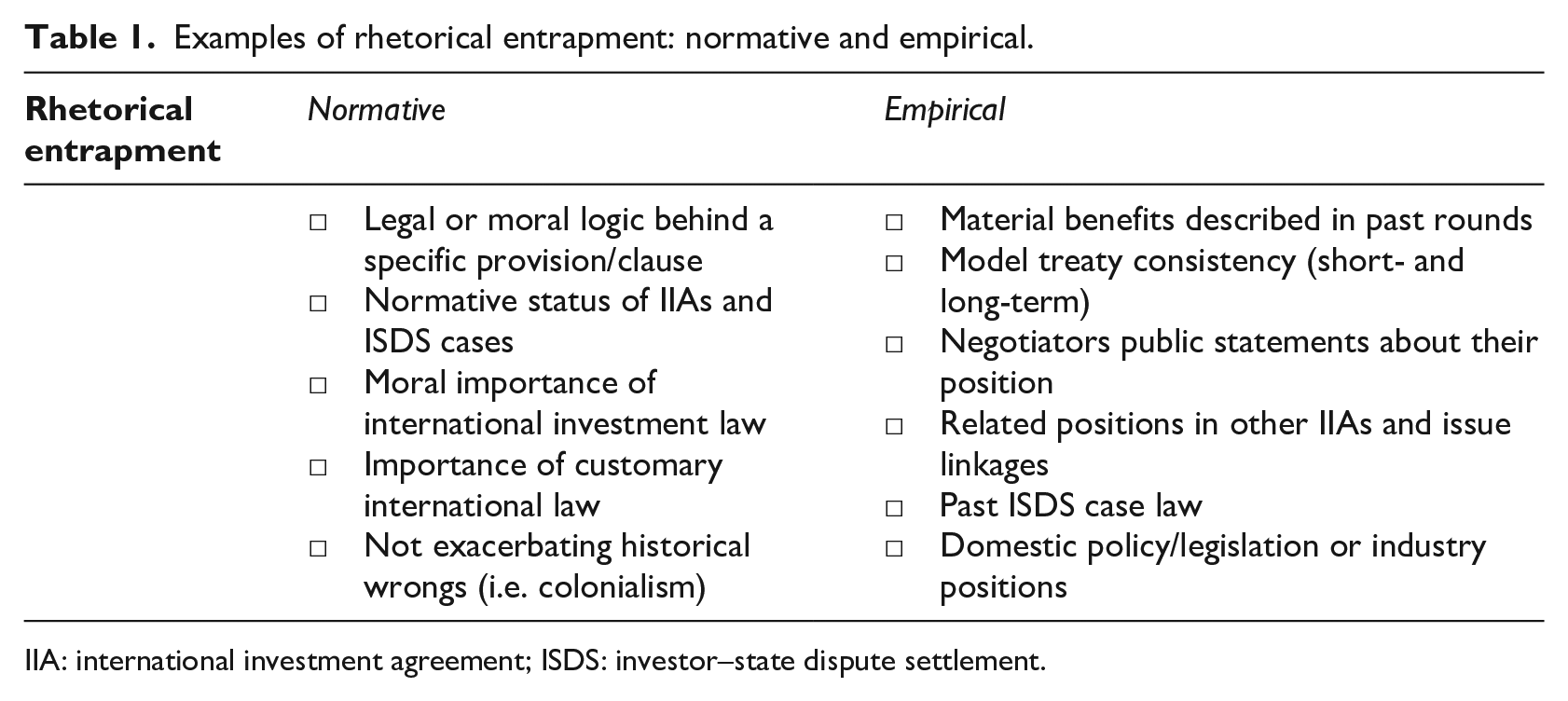
IIA: international investment agreement; ISDS: investor–state dispute settlement.
Analysis: rhetorical entrapment and developing the typology
Before we outline in-depth results from our coding, we show some examples of the kinds of claims that were subjected to rhetorical entrapment on both the normative and empirical side. In our analysis, we looked for moments in which negotiators referenced the importance of understanding a counterpart’s previous commitments, as well as corresponding empirical or normative claim. Following our basic model, we looked for efforts in which the audience, or others (O), check the consistency of claims of the claimant (C) across time. Throughout our coding, we separated between normative and empirical variants and provided thick descriptions/quotes of how this unfolds. 19 A stylized set of examples is listed in Table 1.
In the final section, we show that empirical rhetorical entrapment efforts led to information battles, impacted debates over reputational standing, and – in some instances – losses of trust when adequate reason-giving/amendments were not present. It should also be noted that the process of engaging in rhetorical entrapment, although widespread, can become murky. For instance, sometimes O tries to hold C to account for something C’s government has committed to (C1), relying on the inference that C is either implicitly or tacitly committed to C1 given their role as a delegate. We count these as attempts at rhetorical entrapment but note that the success of these attempts hinges largely on whether C has directly tied themselves to C1.
Results: rhetorical entrapment – normative and empirical
We find support for our distinction with regard to the normative and empirical pathways and the ways in which rhetorical entrapment plays out. To follow the structure of the theory section, we first focus on the presence of normative rhetorical entrapment in our data, before we move on to the empirical pathways. We seek to outline the mechanisms of both pathways as we follow the policy cycle. The strongest findings were on the empirical dimension and preliminarily substantiate our theoretical claims.
Normative rhetorical entrapment
We find some evidence that actors sometimes seek to rhetorically entrap concerning normative claims through framing battles, identity and legitimation. This involves O holding C to account for claims about the normative validity of specific negotiating points, the broader appropriateness of the investment treaty regime, the rightfulness of surrounding international law, and historical inequalities.
This occurs through framing battles. For instance, quotes from a Lithuanian negotiator help to show that normative claims can be invoked in the process of rhetorical entrapment on specific clauses. This negotiator stated that their background research entails examining what kind of ‘agreements the other party already has signed’, to work out the core moral-legal frames to which they were committed.
Although it is often difficult to separate out empirical claims from normative ones in terms of provisions and the wider system, especially in the space of law, negotiators still work hard to understand the underlying normative reasons for a provision. For instance, an EU negotiator told us: [W]e just have a number of arguments that are just based on kinds of mixed cases. [. . .] We have, for instance, used part of our current model text on legal performance requirements, that are often considered very far reaching by our partners, but here for us it is really important to explain why we are doing this.
This quote referenced the type of protections their government wishes to offer in an IIA negotiation and the normative rationale behind it (here highlighting a frame with both the reasoning for certain provisions and the normative status in the negotiation generally). Interestingly, this kind of robust justification employed consistently is a tactic to avoid being entrapped by others by having a red thread within and across negotiations.
Other negotiators talk about normative efforts to entrap drawing on claims related to frames embedded in the wider IIA infrastructure. A Mexican negotiator stated that a key tactic for them was tracking down policy blogs and academic work published by negotiators to work out ‘what they really thought about investment’. This quote is not about their government mandate or past empirical claims, but specifically about their normative attachment to specific clauses and the IIA regime: the underlying legal or moral logic behind their claim.
Negotiators from Peru and New Zealand broaden this out even further in efforts to rhetorically entrap other opponents for their past claims and commitments to generate specific implications. The Peruvian negotiator told us that on issues of health and the environment, they would use these ‘social concerns’ to hold other negotiators to account for past statements. The negotiator from New Zealand noted that, in negotiations, it is crucial to think about how legal arguments ‘resonate with the underlying concerns of what [your party] is trying to achieve’, otherwise new statements that are contradictory are found wanting. Likewise, and related to the wider investment regime, a Slovakian negotiator told us: ‘We are kind of using those arguments from the cases in the [IIA] negotiations with third parties, other countries I mean. Because they ask us, what was behind the provisions?’ What is at stake here is identity: what kinds of normative convictions are flowing from the stated normative claim and whether a negotiator is in line with their stated (original) claims (as their identity would suggest).
Finally, some negotiators pointed to claims made in support of international law and the importance of rectifying past inequalities and hierarchies. A Mexican negotiator, while renegotiating an IIA with Spain, pointed to the fact that ISDS cases won by Spain and the United States had reinforced hierarchies and stymied development; principles these countries claim to favour. A Chilean official, for example, noted that ‘when you make arguments about what you think is right, and you cannot back them up, your counterpart will not accept future arguments at face value’. This quote is key: negotiators’ actions are in part anticipatory. To the extent that they use normative arguments, they anticipate probes and attempts at rhetorical entrapment by their counterparts. Ultimately, in all these cases, negotiators were pointing at past normative claims from opposing negotiators and seeking to hold them to justificatory account. Failure to provide credible explanations or shift position results in a loss of perceived identity as a norm-holder in that negotiation and undermines the legitimacy of their rhetorical efforts and the system of IIAs as a whole.
Empirical rhetorical entrapment
Although we find some evidence of rhetorical entrapment on normative claims, empirical rhetorical entrapment is much more prevalent in IIA negotiations. This is our strongest empirical finding. Many of our interviewees referred to the notion that – as negotiations start/restart and model agreements are exchanged – it is vital to look at empirical claims by their counterpart. This occurs across distinct levels: within negotiations, across negotiation rounds, across model treaties, in wider debates about IIAs, past ISDS justifications and domestic policy positions/laws.
To start with, rhetorical entrapment is observable within the negotiations and across prior rounds as part of an information battle. Negotiators examine how past negotiating positions provided by their counterparts in previous rounds were stated, as well as how past positions in other IIA negotiations were outlaid. For instance, a negotiator from Colombia stated: Attempts to use [prior practice] as leverage are not very well received because no country wants to be tied down to previous treaties when they are reforming their treaties. What is more efficient is when you can leverage what the other side has said during a negotiation.
Negotiators from Canada supported this view: ‘[L]istening closely allows you to identify inconsistencies in the arguments of the other party. That is very useful in protracted negotiations.’ These claims, from our interviewees, generally concerned information: what kinds of red lines could be accepted by their respective governments. If an earlier position was amended in subsequent negotiating rounds, this became a cause of justificatory demands. Rhetorical entrapment in this sense works by stretching through time linking different parts of the policy cycle. Then, during negotiations, deviations from past rounds and the attenuated positions can be called out, demanding clarification or justification for why new information bears weight so that C1 is no longer relevant.
Further evidence from our interviews suggest that negotiators confront myriad other claims during processes of empirical rhetorical entrapment. This step entails negotiators looking at statements made by negotiators outside formal rounds, by government officials to whom negotiations are (tacitly) tied, and, in broader empirical contexts, about the importance of IIAs and foreign direct investment. Negotiators from a wide range of states made this point in our interviews. For instance, a Canadian negotiator noted: A way to keep things moving forward is to be really well informed about what the other side has agreed to in other contexts. Sometimes the other side will take a position that, well, we can never do this, or we cannot agree to that kind of language. But if you can come forward with ‘well actually you did exactly that with another country two years ago’, that tends to change the discussion. So, being informed about what the other side has done can be a chip to move things forward.
A Japanese negotiator made a similar point: First, we check all of [the counterpart’s] investment treaties. This is the first step. What they have accepted, even just once. It gives us a hint of their red lines. The other thing we do is to check all ISDS cases where the negotiating partner is involved. Because, if they win one case, this success story will give them strong effect, because then clearly, they want to follow this success story.
These are forms of empirical entrapment tactics employed in which negotiators attempt to sharpen informational disagreements and use the empirical positions of their counterparts – made in government statements, other issue areas or government policy – to entrap one another. As a negotiator from Montenegro explained: ‘Pre-negotiation begins also with broad empirical issue, such as: What is the background of this country? With whom this country has already signed agreements? [. . .] Also, what is the legislation of this country?’
Other negotiators went further and stressed the importance of looking at commitments in regional agreements (Mexico), the Organisation for Economic Co-operation and Development (OECD) (Slovakia), EU institutions (the Netherlands) and other IOs (Canada, United States). Moreover, some – such as negotiators from Canada, Switzerland and the United States – pointed out the importance of studying recent ISDS cases to determine what empirical arguments about the effects of certain clauses in IIAs are being made by other parts of their counterpart’s government (as the ministry handling IIA negotiations is generally separated from the ministry defending states in ISDS cases).
Our data also rendered evident how important it is to study domestic legal arrangements and industry preferences. Several negotiators told us that by knowing (for instance) the ratification process of their counterpart, they were able to rhetorically entrap other negotiators who contradicted factual claims about their domestic legal process to which they were directly and legally committed. This again follows a linear process. It entails checking domestic legal architecture, previous statements and case law in the preliminary stages of background. Then, negotiators use this information as a source of rhetorical entrapment for leverage. This means that different aspects of rhetorical entrapment – as a deliberative process – occur at different moments in the policy cycle of negotiations.
Finally, although informants in semi-structured interviews tend to ‘present themselves in the most favorable light’ (Martin, 2013: 117), and as such are less likely to admit to being at fault and backtracking in negotiations, our data highlights how officials respond to being entrapped in negotiations. Some hinted at the anticipatory effect of empirical entrapment. A negotiator from Chile noted: ‘[Y]ou need to be able to react at the [negotiating] table, and not be taken aback.’ Similarly, a negotiator from Israel noted that in IIA negotiations, both sides know that to a certain extent their ‘hands are tied under their negotiating history’.
Other negotiators discussed what happens when one party has no follow-up justification to being entrapped on empirical claims. A Brazilian official, for example, noted that in one specific instance, they were told by a party they were negotiating with that they could not engage in negotiations of a specific protection clause because it ran counter to one or more domestic legal provisions the counter-party was bound by. The Brazilian official checked that claim and found that it was not true. He underlined how the subsequent interaction and lack of justification by the other party ‘created a huge problem in the negotiation’ for reputation at the table. Similarly, an EU official described how the strong transparency obligations in the EU–Singapore IIA from 2019 came about after a back-and-forth where Singapore first refused to accept the obligation favoured by the EU, but then reverted and accepted this logic after the EU noted how Singapore had agreed to similar levels of transparency in its 2003 IIA with the United States. Several respondents stated that refusal to concede when entrapped was viewed as a reputational issue of credibility.
Finally, information battles and reputational gains/losses have an impact upon trust between negotiators. Instead of viewing their counterparts as illegitimate (actors without appropriate social standing), they lost trust in them and the process. Inversely, many negotiators saw rhetorical entrapment not as a combative exercise, but as one of mutual trust-building (as Singapore, above, emphasized).
Many interviewees stressed that when counterparts were caught bluffing and failing to explain or revert their position, it significantly hampered negotiation trust. As a Bosnian and Herzegovinian negotiator told us, efforts to bluff on a position – and to refuse to change when rhetorically entrapped by their own past statements – means ‘you lose trust and the whole process gets intoxicated [sic] and it really becomes uncomfortable and nasty’. This occurred for empirical claims in particular. Again, this stresses that the types of claim stake are important in understanding which pathway of rhetorical entrapment is operating.
This is an interesting finding because the literature on international cooperation treats trust in different ways depending on the theoretical starting point. Rationalists tend to see trust as hard to attain, requiring long shadows of the future – in which expectations are set and the rules of the game are structured – (preferably) institutional incentives that tie hands (making blanket trust less important). Constructivists alternatively see trust as a manifestation of socialization (and shared identities). Our findings suggest that empirical rhetorical entrapment offers a mode of trust-building. During negotiations, actors can study the positions of others, check their validity and determine the credibility of those positions. By extension they can probe their counterparts and their positions. The nature of the policy cycle then operates to build trust in the credibility of others, making bluffing less likely and information/reputation more robust. Most negotiators stated that they rarely bluff on their ‘red lines’ (though with qualitative data this is difficult to assess).
Conclusion
In conclusion, we make three points. First, theoretically, we have developed a new pathway of how rhetorical entrapment plays out focusing on the types of claims at play: normative versus empirical. We determined that both normative and empirical claims are discernible and follow different pathways for rhetorical entrapment. Normative rhetorical entrapment entails framing contestation, identity and legitimacy; empirical variants necessitate information battles, reputation and trust. Although the literature tends to focus on normative variants, there is much slippage in the terminology used and the precise mechanisms remain unclear. Although the precise scope conditions determining which pathways play out and when they are successful stand as future research, our plausibility probe establishes this as a potentially fruitful line of analysis.
Second, empirically, our analysis of interviews shows that rhetorical entrapment does occur in international negotiations, at least in this issue area. Empirical efforts are more prevalent than normative ones, and we substantiate the key mechanisms in our pathway. Many IIA negotiators note the importance of knowing their counterparts’ position, and their interpretation of legal rules can be employed to generate leverage at the table. In doing so, the paper brings new qualitative data to bear on the literature concerning the determinants of international investment negotiations. Although some work has occurred in this space, especially showing how some macro-level variables correlate with – perhaps even explain – negotiation outcomes, this paper suggests that what occurs at the table is also important. Negotiators must work hard to entrap one another, gaining traction through this process. Examining how quantitative data might complement or correct qualitative findings focused on causal mechanisms is important future research. Similarly, expanding this analysis to other issue areas will show the limits and potential of (empirical) rhetorical entrapment. Moreover, the development of these distinct pathways has enabled us to show what IIA negotiators think of rhetorical entrapment as a means of building credibility and trust with one another. Given the importance of trust to international cooperation, working out how this mechanism unfolds – and the impact on negotiation outcomes – remains crucial.
Finally, although beyond the scope of this study, it would be interesting to unpack the normativity of rhetorical entrapment. When is it a legitimate tactic? Does it equalize power imbalances between weak and powerful states? Under which conditions does it ameliorate or exacerbate democratic deficits in world politics? These questions would tap into wider discussions about the legitimacy of international negotiations/organizations and their transparency and accountability.
Supplemental Material
sj-docx-1-ips-10.1177_01925121241260431 – Supplemental material for Rhetorical entrapment in international negotiations: A new pathway and mechanisms
Supplemental material, sj-docx-1-ips-10.1177_01925121241260431 for Rhetorical entrapment in international negotiations: A new pathway and mechanisms by Tarald Gulseth Berge and Jonathan W Kuyper in International Political Science Review
Supplemental Material
sj-docx-2-ips-10.1177_01925121241260431 – Supplemental material for Rhetorical entrapment in international negotiations: A new pathway and mechanisms
Supplemental material, sj-docx-2-ips-10.1177_01925121241260431 for Rhetorical entrapment in international negotiations: A new pathway and mechanisms by Tarald Gulseth Berge and Jonathan W Kuyper in International Political Science Review
Supplemental Material
sj-docx-3-ips-10.1177_01925121241260431 – Supplemental material for Rhetorical entrapment in international negotiations: A new pathway and mechanisms
Supplemental material, sj-docx-3-ips-10.1177_01925121241260431 for Rhetorical entrapment in international negotiations: A new pathway and mechanisms by Tarald Gulseth Berge and Jonathan W Kuyper in International Political Science Review
Footnotes
Acknowledgements
The authors would like to thank participants at the department seminar series at the Department of Political Science at the University of Oslo as well as participants at a seminar series organized by the Department of Business, Strategy and Political Sciences at the University of South-Eastern Norway for insightful questions and comments. An initial version of the article was also presented at the International Studies Associate Annual Convention in 2021. We are very grateful to two reviewers and the editors of this journal for their helpful feedback.
Funding
The authors disclosed receipt of the following financial support for the research, authorship and/or publication of this article: We would like to thank Riksbanken Jubileumsfond (P16-0242:1) and the Research Council of Norway through its Centres of Excellence funding scheme (Project No. 223274) for funding that enabled the initial interviews. We also thank the Department of Political Science for research funding for data analysis.

Supplemental material
Supplemental material for this article is available online.
Notes
Author biographies
References
Supplementary Material
Please find the following supplemental material available below.
For Open Access articles published under a Creative Commons License, all supplemental material carries the same license as the article it is associated with.
For non-Open Access articles published, all supplemental material carries a non-exclusive license, and permission requests for re-use of supplemental material or any part of supplemental material shall be sent directly to the copyright owner as specified in the copyright notice associated with the article.
