



Abstract
The growing presence of technocrats in contemporary governments has emerged as a relevant phenomenon worldwide. Italy, once known as a paradigmatic case of party government and now identified as the promised land of technocracy, constitutes a crucial case to test the major short-term (critical junctures) and long-term (complexity of policy-making; party decline) factors identified to explain this phenomenon. Our analysis is based on two innovative tools: a new dataset updated to the current back-to-politics Meloni Italian government, including all the cases of the ‘technocratic decade’ (2010s); and a new typology combining partisanship and expertise, which allows us to overcome dichotomous categorizations equating technocrats and non-partisans. This more accurate and updated picture of minister profiles in Italy unveils unexpected dynamics and allows us to reassess both previous findings on the Italian case and the explanatory power of the tested theories on the growing diffusion of technocrats in contemporary governments.
Introduction
The growing relevance of technocratic ministers and the corresponding reduction in the partyness of governments have recently emerged as a broad tendency in several regional settings, identifying technocracy as a form of ruling alternative to the party government model. As Table 1 shows, the technocratic challenge is particularly relevant in Italy, where the proportion of technocrats has increased exponentially, making it possible to label the 2010s as the ‘technocratic decade’, in Italy more than in any other European democracy. Hence, selecting as a case study a country that was a paradigmatic example of party government and now represents the promised land of technocracy allows us to contribute in several relevant ways to the consolidating literature on the diffusion and growing relevance of technocrats in contemporary governments.
Governments and technocratic ministers in Italy since 1992.
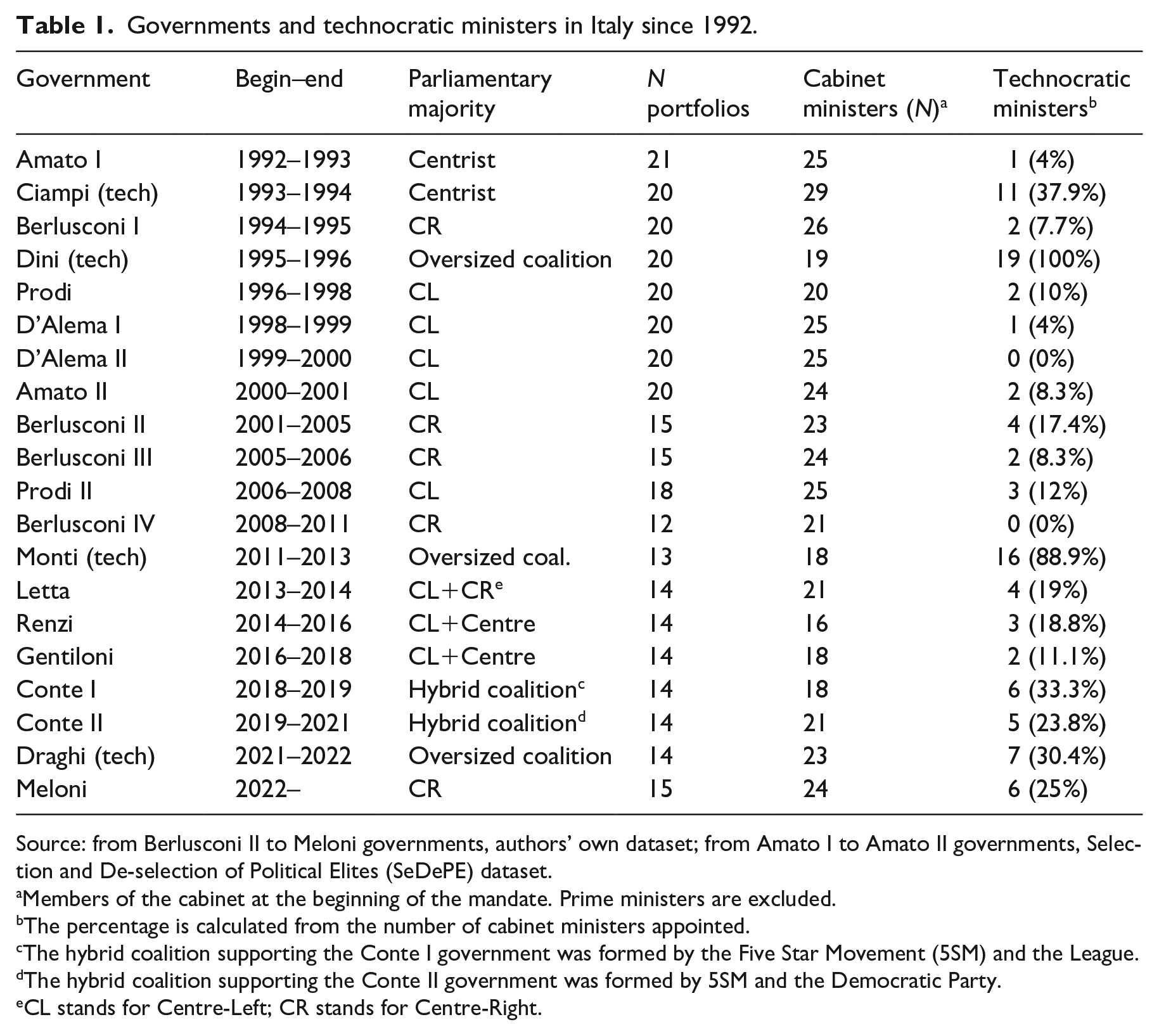
Source: from Berlusconi II to Meloni governments, authors’ own dataset; from Amato I to Amato II governments, Selection and De-selection of Political Elites (SeDePE) dataset.
Members of the cabinet at the beginning of the mandate. Prime ministers are excluded.
The percentage is calculated from the number of cabinet ministers appointed.
The hybrid coalition supporting the Conte I government was formed by the Five Star Movement (5SM) and the League.
The hybrid coalition supporting the Conte II government was formed by 5SM and the Democratic Party.
CL stands for Centre-Left; CR stands for Centre-Right.
In this article we raise two research questions. First (RQ 1), what are the patterns of technocrats’ recruitment in Italy during the last two decades? Here, a fresh dataset and a new typology allow us to provide a more accurate picture of Italian minister profiles in general, and technocrats in particular. Second (RQ 2), what explains the recruitment of technocratic ministers in Italy during the last two decades? Here, technocrats represent the dependent variable: two groups of non-alternative explanations of the increasing selection of technocrats (short-term factors – that is, critical junctures; and long-term non-conjunctural factors – that is, party decline, policy-making complexity) will be tested on the Italian case and reassessed according to our findings.
To deal with our RQs we rely on two innovative tools. First, a new dataset about the 12 Italian governments established since 2001 (252 ministers), which represents a crucial update since it covers the entire technocratic decade, unlike previous datasets. A new typology of ministers profiles integrating both partisanship and expertise dimensions represents our second critical tool, since it allows us to rely on more precise identification of technocratic ministers: for example, it goes beyond dichotomous categorizations, which equate technocrats and non-partisans, that still dominate the literature.
Building on a consolidated literature (i.e. Verzichelli and Cotta, 2018), we use these tools and a specific focus on the technocratic decade to revise previous consolidated findings regarding the Italian case, and also offer more generalizable suggestions to the literature on this topic. First, our data provide a clearer picture of Italian minister profiles and a more precise assessment of the presence of technocrats in recent Italian governments, which are now: (a) selected by all types of government; (b) diffused in all kinds of portfolios; and (c) not limited to governments formed to address critical events. Second, our data suggest that the need for greater legitimacy in a context of party decline stands out among the causal factors explaining the growing presence and relevance of technocrats in Italy during the last two decades, particularly the technocratic one.
Ministers’ selection in Italy: the growing technocratic challenge
Comparative analyses of ministerial elites have often highlighted the peculiarities of the Italian case. Studies focusing on the golden age of Christian democracy (Dogan, 1989; Zuckerman, 1979) revealed a connection between ministerial appointments and personal electoral legitimacy (measured by preference votes received in parliamentary elections) or the geographical balance in the distribution of ministers (Dogan, 1989). During the First Republic (1948–1992), the hey-day of party government in Italy, the processes of government formation and minister selection constituted a post-election game dominated by party leaders who agreed on informal coalition agreements, policy platforms, portfolio allocation and the names of future ministers: parliamentary career constituted the fundamental requirement to be selected as a ministers 1 (Verzichelli and Cotta, 2018), and just a handful of technocrats were selected during this period.
The crisis of the First Republic at the beginning of the 1990s led to significant changes. In terms of the party system, the existing ruling parties disappeared and new ones emerged. Despite high fragmentation, between 1994 and 2013, the party system became bipolar (Verzichelli and Cotta, 2000), with the right-wing coalition dominated by Silvio Berlusconi and a more fragmented left coalition later dominated by the Democratic Party. The rise of the Five Star Movement (5SM) led to a tri-polarization of the Italian party system during the last three general elections (2013, 2018, 2022). Moreover, the system’s polarization also increased due to the collapse of Berlusconi’s Forza Italia, to the advantage, first, of populist Matteo Salvini’s Lega, and then the far-right Fratelli d’Italia.
Regarding ministers’ selection, in the first part of the Second Republic (1990s and 2000s), it became customary to announce the names of the prospective prime minister (PM) before the elections. In some cases, a team of potential ministers was announced before the vote (Verzichelli, 2009). However, the selection of Italian ministers remained a post-election game. In 2013 and 2018, the tri-polarization of the party system led to the lack of a clear winner, which, as during the First Republic, moved back to the post-electoral phase the definition of parliamentary majorities, policy platforms and the candidate PM. The last general elections (2022) led to a situation presenting significant similarities to the 2000s: the centre-right coalition emerged as the clear winner, with an astonishing performance by Fratelli d’Italia (26%), whose leader, Giorgia Meloni, made history by becoming Italy’s first female PM. However, no relevant changes were adopted regarding rules and praxes of minister selection.
Several studies have focused on government formation, ministerial selection and minister profiles during the Second Republic (Cotta and Verzichelli, 2002; Martocchia Diodati and Verzichelli, 2017; Pasquino and Valbruzzi, 2012; Verzichelli, 2006, 2009; Verzichelli and Cotta, 2018). Analyzing the process of ministers’ selection from the Italian unification period to the beginning of the 21st century, Cotta and Verzichelli (2002) show several diachronic changes in the profiles of Italian ministers, including an increase in their education level and significant shifts in their social backgrounds.
Verzichelli and Cotta (2018) focus on a long-term evaluation of the selection of non-partisan (technocratic) ministers and a diachronic comparison between the First Republic (1948–1992) and the Second Republic (1992–2014). The following findings emerge from this study. Inspired by a definition of non-partisan ministers based on the absence of parliamentary/political experience, a typology of minister profiles was proposed, where ‘pure technocrats’ represented those ministers with no political or public office experience. The number of ‘pure technocrats’ started to increase in the last decade of the First Republic and rose more rapidly during the Second Republic, reaching 29.8% of all ministers and growing even in core-executive positions. This analysis shows more non-partisans in minority governments during the First Republic, and oversized and centre-left governments during the Second Republic and in caretaker governments during the whole period. Overall, the comparative analysis stressed an enlargement of the ‘pool of ministrables’, with significant consequences for the party government in Italy. However, the presence of pure technocrats tended to be limited to specific types of government (i.e. caretaker governments), specific ministerial positions (i.e. finance minister) or critical junctures. Verzichelli and Cotta identify five main causal factors at work: (a) the decline of political parties and the party government model; (b) the impact of macro-institutional variables (i.e. the President of the Republic); (c) the ‘presidentialization of government’; (d) the growing policy-making complexity; (e) the role of supranational arenas/institutions (i.e. the EU).
The study showed that all these factors were significant in Italy, with some more dominant when each government was considered.
We aim to build upon this literature, disentangling the general explanation of non-partisanship by increasing the differentiation within the minister profiles concept through the new typology that considers expertise along with partisanship. Moreover, we enlarge the scope of previous analyses, considering also the six Italian governments formed since 2014, which constitute the bulk of the technocratic decade and, hence, represent the most important period in which to investigate the causes of the greater presence and relevance of technocrats in Italy. The inclusion of these governments will also allow us to assess the beginning of a new political cycle due to the back-to-politics Meloni government formed in 2022.
Theoretical framework
To address our RQs we perform both a comprehensive and longitudinal analysis of the last 12 Italian governments (252 ministers). This study relies on a new typology (Figure 1) based on two dimensions: partisanship and expertise (Camerlo, 2019). The former is not defined according to simple party membership: the link with a political party has to be continuous and exclusive, as the time spent in the same party (at least five years) constitutes a crucial prerequisite to acquiring partisan skills/resources that bind a member to a party; moreover, the notion of partisanship here rests also on the presence of a party that can assure and encourage party cohesion: it should be a well-organized party (Cotta, 2000: 58). A more precise distinction between partisans and non-partisans emerges from the operationalization of partisanship adopted in this study (membership of at least five years in a structured party). 2
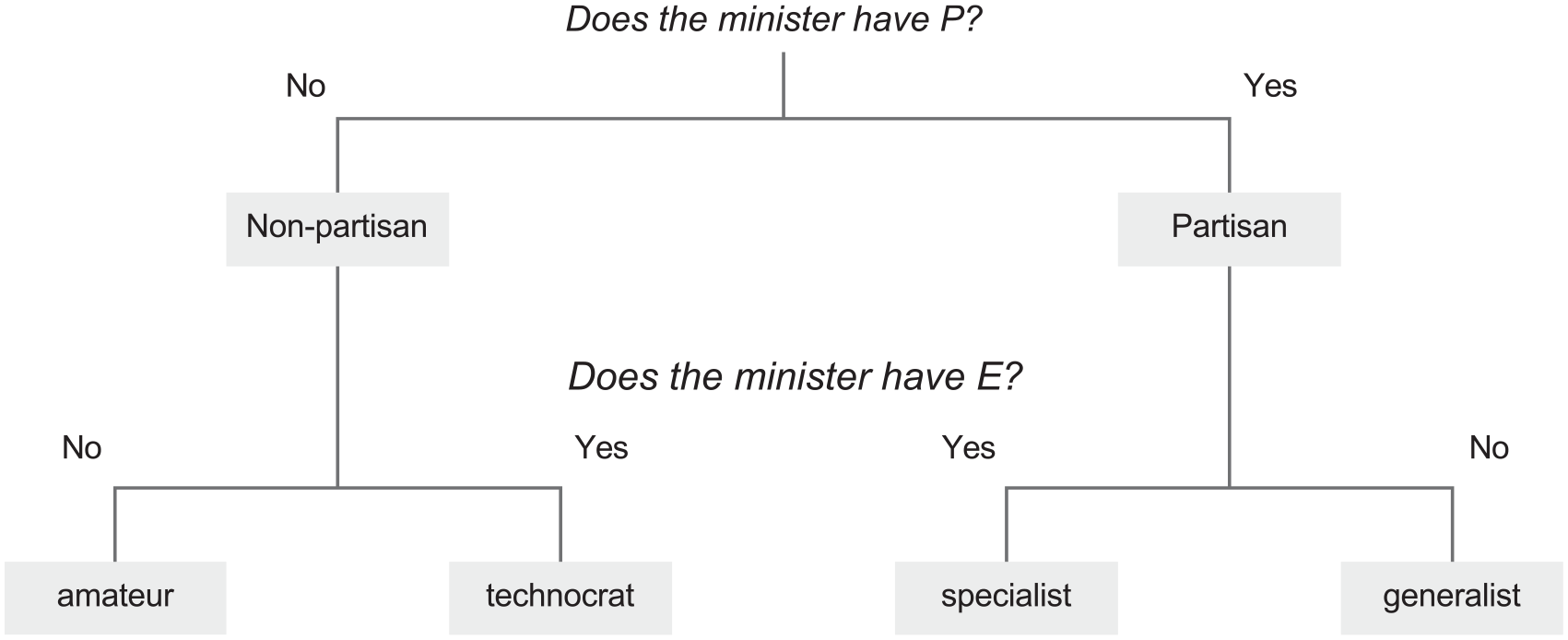
Minister profile typology.
Expertise is considered here as the possession of technical skills related to the portfolio. In terms of sources of expertise, the literature has focused on education and experience: the diffuse image of the standard technocrat is a highly educated person with considerable experience in her/his field. For each minister, we collected data on level of education (i.e. undergraduate degree, PhD), also assessing if it was related to the minister’s portfolio. To measure different kinds of experience, we collected data on the whole professional career of each minister, including private and public sector jobs. We also considered the details of intra-party career and elected positions: for example, serving in the economic department of a political party or being a member of the parliamentary committee on economic issues was considered a professional experience related to the finance portfolio. In our coding system, professional experience was privileged over education: for example, when only one source of expertise was present, five years of related professional experience were sufficient to identify an expert minister, while only a PhD in a field related to the portfolio was required to code the minister as an expert. We should stress that in our dataset ambiguous cases were rare and most ministers classified as experts had a long related professional experience, often combined with related education.
In the following section, we discuss the major explanations of the increasing selection of technocratic ministers. We focus on the distinction between short-term explanations and long-term non-conjunctural factors. Recently, the literature has devoted more attention to the former, focusing on the impact of critical junctures. Here, the literature on technocracy has often concentrated its attention on crisis situations, identified as unexpected events that create a high level of uncertainty and constitute a threat to the primary goals of an organization: the most studied example of this kind of crisis situation is the 2008 financial crisis, which shows the role of the economic dimension. However, phenomena that do not have economic origins (i.e. political earthquakes, a health crisis such as a world pandemic) may fall within the aforementioned definition of crisis, and trigger technocratic appointments. The basic argument of this literature is that political parties cope with complex scenarios abdicating to some of their prerogatives of élite selectorate (Alexiadou and Gunaydin, 2019; Wratil and Pastorella, 2017). Several explanations of this process have been proposed: the need for greater policy expertise (Alexiadou and Gunaydin, 2019; Bertsou and Caramani, 2020); the need for a more efficient approach to policy-making (Kaplan, 2017); a greater policy commitment (Alexiadou and Gunaydin, 2019); and easier allocation of blame and quicker firing of ministers (Camerlo and Pérez-Liñán, 2015; Wratil and Pastorella, 2017). Other scholars have focused on the formateur’s role, dealing with institutional features such as the presidential/semi-presidential nature of the political system (Amorim Neto and Samuels, 2010; Amorim Neto and Strøm, 2006; Camerlo and Martínez-Gallardo, 2018; Camerlo and Pérez-Liñán, 2015). According to this approach, strong formateurs manage agency loss risks by appointing technocrats who have personal connections to them and can ensure loyalty.
Since in the Italian case only Berlusconi 3 (particularly in 2001 and 2008) and, to some extent, Meloni (2022) may qualify as full formateurs, we focus only on critical junctures. Regarding Italy, the last two decades are split into the following periods, based on two major crisis situations identified through negative peaks in Italian gross domestic product (GDP) growth, the 2008 financial crisis (−5.3% in 2009) and the COVID-19 pandemic (−9% in 2020): (a) before the 2008 crisis (2001–2008); (b) recession period (2008–2013); 4 (c) after the 2008 crisis (2013–2020); (d) COVID-19 pandemic crisis (2020–2022); (e) after pandemic crisis (2022–).
Hence, we specify our RQ 2 as follows (RQ 2.1): in the last two decades, did the presence of technocratic ministers in Italy increase during, and due to crisis situations?
Another strand of literature dealing with the increasing selection of technocrats focuses on long-term non-conjunctural factors, which require technical expertise that partymen cannot provide (Costa Pinto et al., 2018; Roberts, 2017). For example, the vincolo esterno (external constraint) derived by the process of European integration has been thoroughly debated (Dyson and Featherstone, 1996): the increasing policy-making complexity generated by European Union (EU) integration has led to a greater demand for technical expertise in the policy areas most influenced by the EU. Another example regards the transformation from a world of ‘big government’ to increasing policy demands under limited resources, which, as in the case of welfare systems, require complex reforms which would require expertise and cost-benefits analyses.
Another long-term factor concerns party decline and the crisis of the party government model. Here, selecting technocrats has less to do with the need for technical expertise and more to do with strategies of political parties to address their long-term decline. For example, selecting technocrats may constitute a coping mechanism used by political parties in situations of weakened links between parties and citizens to dilute responsibility or regain legitimacy (Mair, 2008; Strøm, 2003).
While the critical junctures argument focuses on the growing presence of technocrats during crises, the aforementioned literature also (or mainly) studies the evolution of this phenomenon in non-crisis periods. Hence, beyond specific critical junctures, we could expect, according to the growing policy-making complexity argument, that the increased selection of technocrats would be limited to those portfolios where technical expertise is more needed. Regarding the party decline argument, we should expect an increase of technocrats not limited to technical portfolios since the need for policy expertise could not be the main reason for their selection. Here, we further specify our RQ 2 (RQ 2.2): in the last two decades, has the presence of technocratic ministers in Italy increased over time due to long-term non-conjunctural factors? If so, is this increase limited to technical portfolios?
To identify technical portfolios, we rely on a classification of policy areas distinguishing portfolios in charge of economic policies (i.e. Economy, Economic Developments, Regional Affairs, Agriculture), social policies (i.e. Education, Health, Culture), macro policies (i.e. Defense, Interior, Justice, Foreign Affairs) and coordinating functions (i.e. Relations with the Parliament, Planning): technical portfolios are those in charge of economic and social policies.
Our empirical analysis is based on a brand-new dataset of Italian ministers’ profiles including 12 governments (2001–2023) and 252 ministers. 5 The dataset focuses on ministers’ personal/professional experience, integrating several known indicators related to: (a) links to political parties (i.e. duration); (b) education (i.e. area, level); (c) professional positions (i.e. type: private, party and/or public office positions; duration); (d) links to organized groups (i.e. unions, religious, military); (e) loyalty to the PM, etc. The data were extracted either from official government websites or from secondary sources. In this research, we only draw on the information related to partisanship and expertise from this extensive dataset. Partial data covering the pre-2001 phase was obtained from the Selection and De-selection of Political Elites (SeDePE) project. Since our research focuses on ministers at the time of government formation, we have excluded those appointed successively. Although our primary focus is on the technocratic profile, we adopted a block or comprehensive research strategy that encompasses all four profiles, and, when necessary, also includes the expert profile, which is comprised of both technocrats and specialist ministers (see Figure 1 above).
Minister profiles in Italy: a comprehensive analysis
In this section, we propose a comprehensive analysis of ministerial personnel from the past two decades which allows us to deal with RQ 1 and assesses the added value of the four-types typology.
In Figure 2, we compare the classical approach used by the literature on minister profiles with the four-types typology adopted in this article. This scholarship has often used non-partisan and technocrat as synonyms, considering ministers with no link to political parties as technocrats by default and partisan ministers as lacking technical/policy expertise. Our data provide some support for this thesis, since most non-partisans are technocrats (78.2%) and most partisans are generalist politicians with no related expertise (59.2%). However, the difference in the values of experts (technocrat and specialist profiles combined) (52.2%) and non-partisans (30.6%) makes clear that the two categories do not fully overlap and that this gap is meaningful both quantitatively and qualitatively. Thanks to the four-types typology, we can stress important variations within and among these profiles, and highlight the unexpected relevance of often overlooked types (amateur and specialist). In fact, it is significant that expertise is equally distributed between partisan and non-partisan profiles: slightly more than half of the Italian ministers possessing related expertise (54.1%) also had a strong link to a political party (specialist profile). Moreover, around a fifth of non-partisan ministers (21.8%) could not be classified as expert (amateur profile).
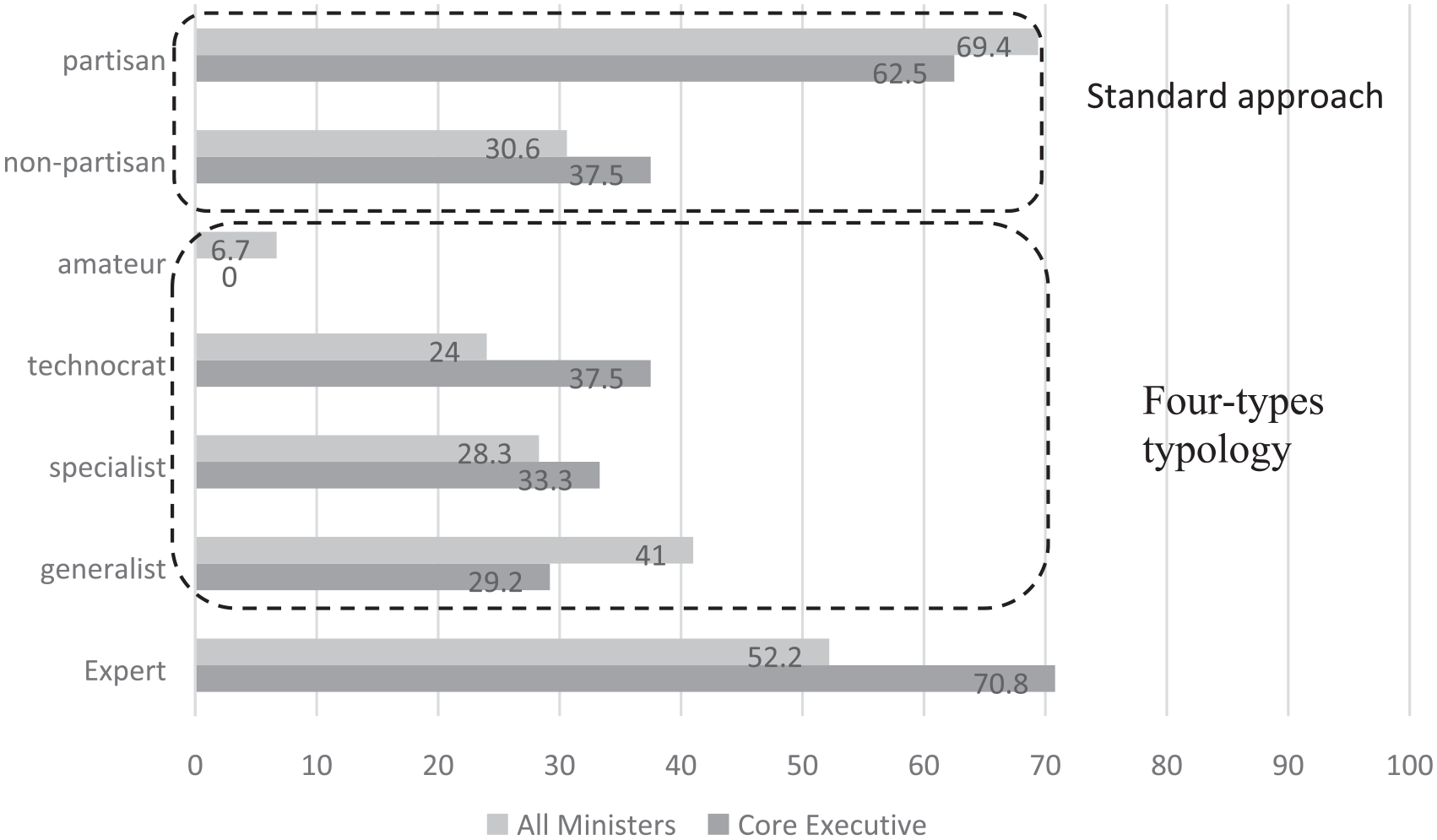
Ministers’ profiles in Italy, 2001–2023.
Data regarding core portfolios 6 support the usefulness of the four-types typology as well. In fact, the standard approach highlights a majority of partisan ministers, although a smaller majority if compared to the full sample. However, if we disaggregate them, technocrats become the largest profile (37.5%) in these key portfolios, and a dominance of experts (technocrats plus specialists) (70.8%) emerges.
Figure 3 shows the distribution of ministers in our sample according to a classification distinguishing economic, social, macro and coordination portfolios, while also considering the finance/economy ministry alone, given its importance in the literature.
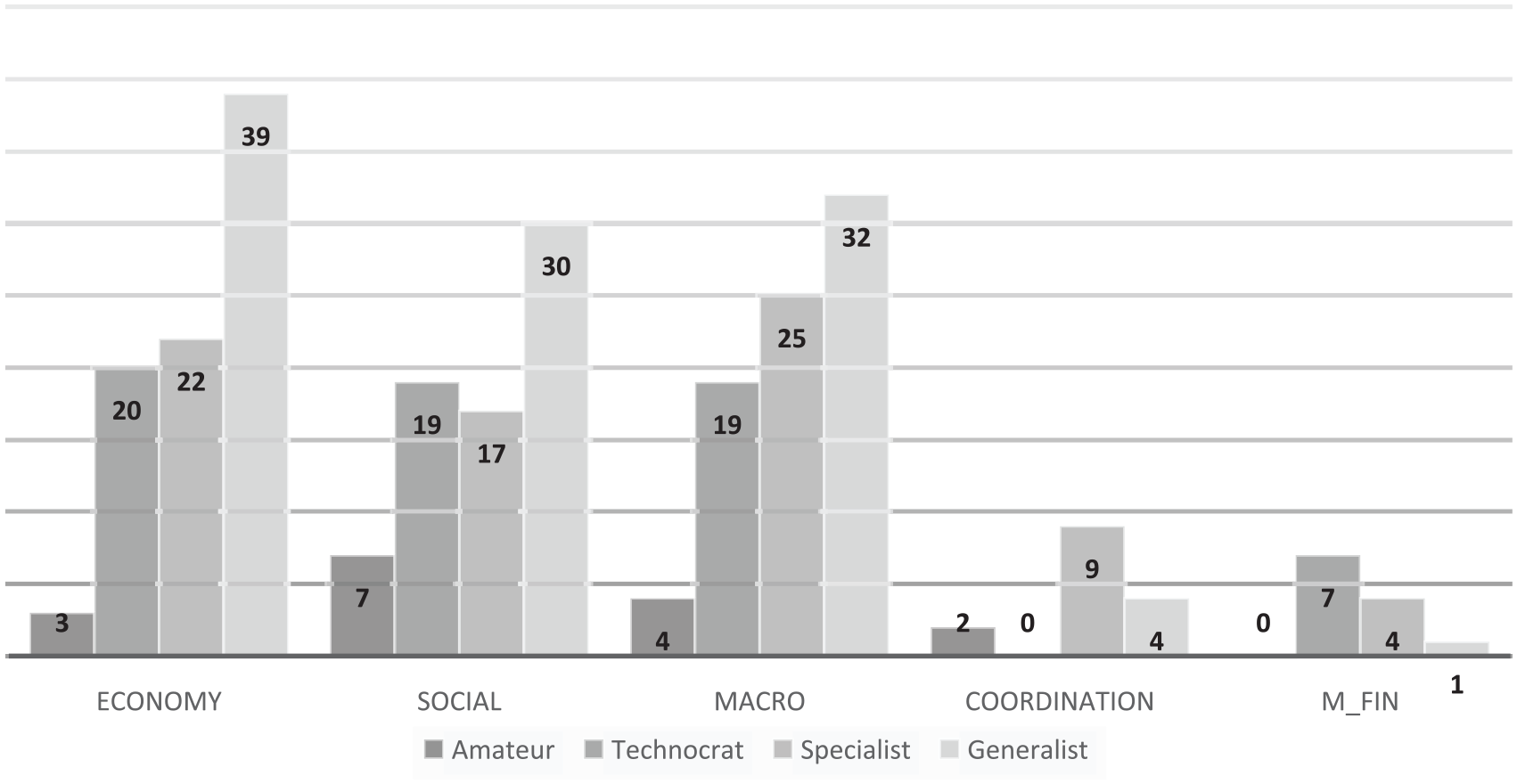
Minister profiles by portfolio area, 2001–2023 (absolute values).
The systematic account of the expertise dimension provides a more accurate picture of minister profiles in these policy areas. In fact, according to the classic approach, partisan ministers would represent the majority in all policy areas. However, the four-types typology allows us to stress several relevant points. First, the most political area of coordination is, as expected, the one where technocrats have the least impact. However, expertise is still required since specialists dominate. Second, macro portfolios, which include several core-ministries, present a plurality of generalist partisans (without expertise). Still, if the two profiles of expert ministers are considered together, they reach a majority of 55%, meaning that expertise represents an important factor for the selection of these ministers even when a partisan is selected (specialist profile). Third, a similar pattern also emerges in economic and social portfolios, though, surprisingly, with a smaller predominance of experts over generalists: perhaps the fact that those are mostly expenditure portfolios has led generalists to maintain a strong plurality. Finally, consistent with the literature (Hallerberg and Wehner, 2018), which stresses the growing need to cope with policy complexity and reassure stock markets, the finance portfolio is dominated by technocrats (58.3%) and almost fully controlled by experts (91.6%).
Minister profiles in Italy: a longitudinal analysis
Figures 4 and 5 and Table 2 introduce a longitudinal perspective through which we address our explanatory RQs: the critical junctures represented by the 2008 financial crisis and the COVID-19 pandemic (2020–2022) allow us to identify five periods mentioned in the previous section.
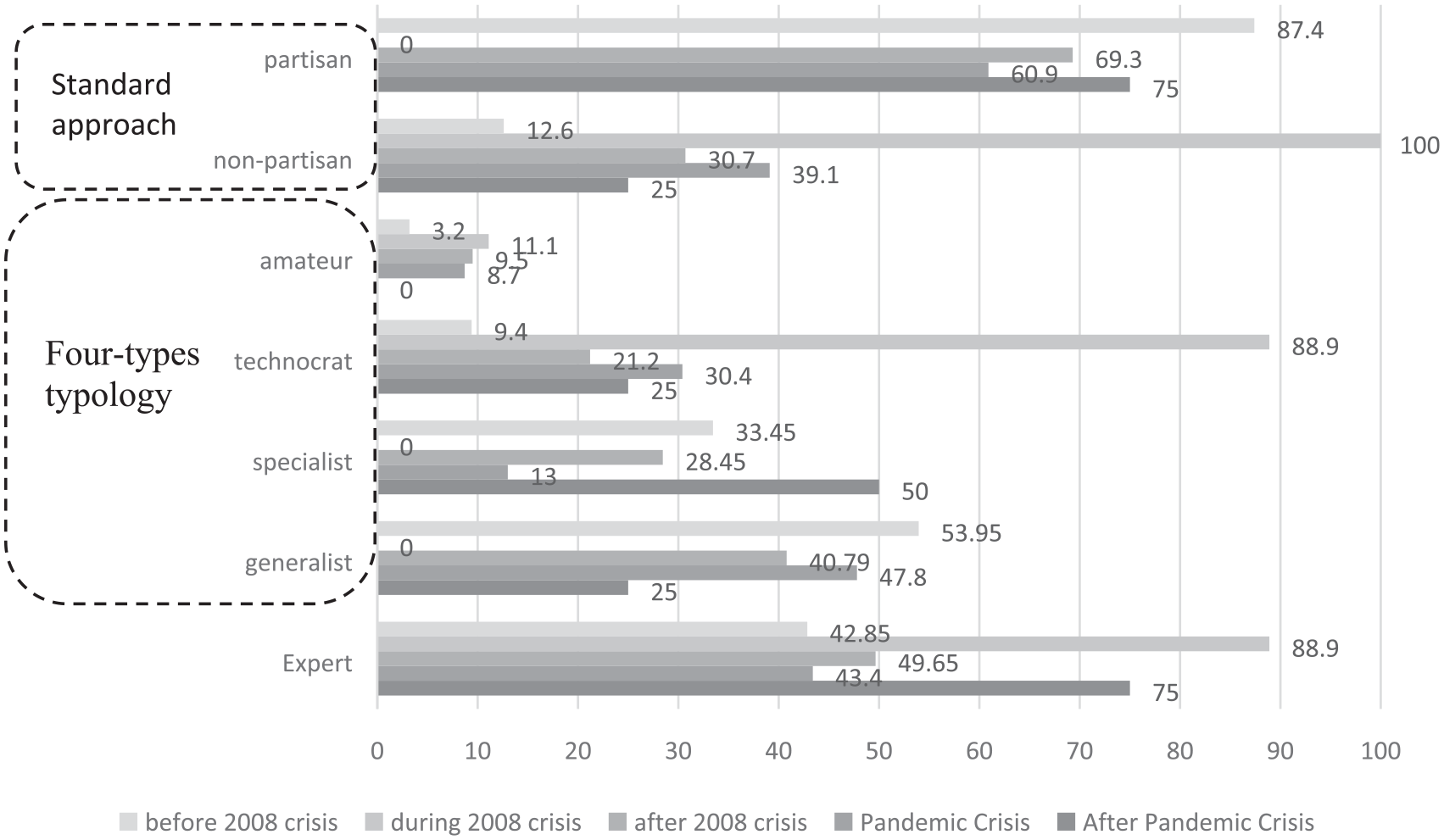
Minister profiles in five sub-periods (%).
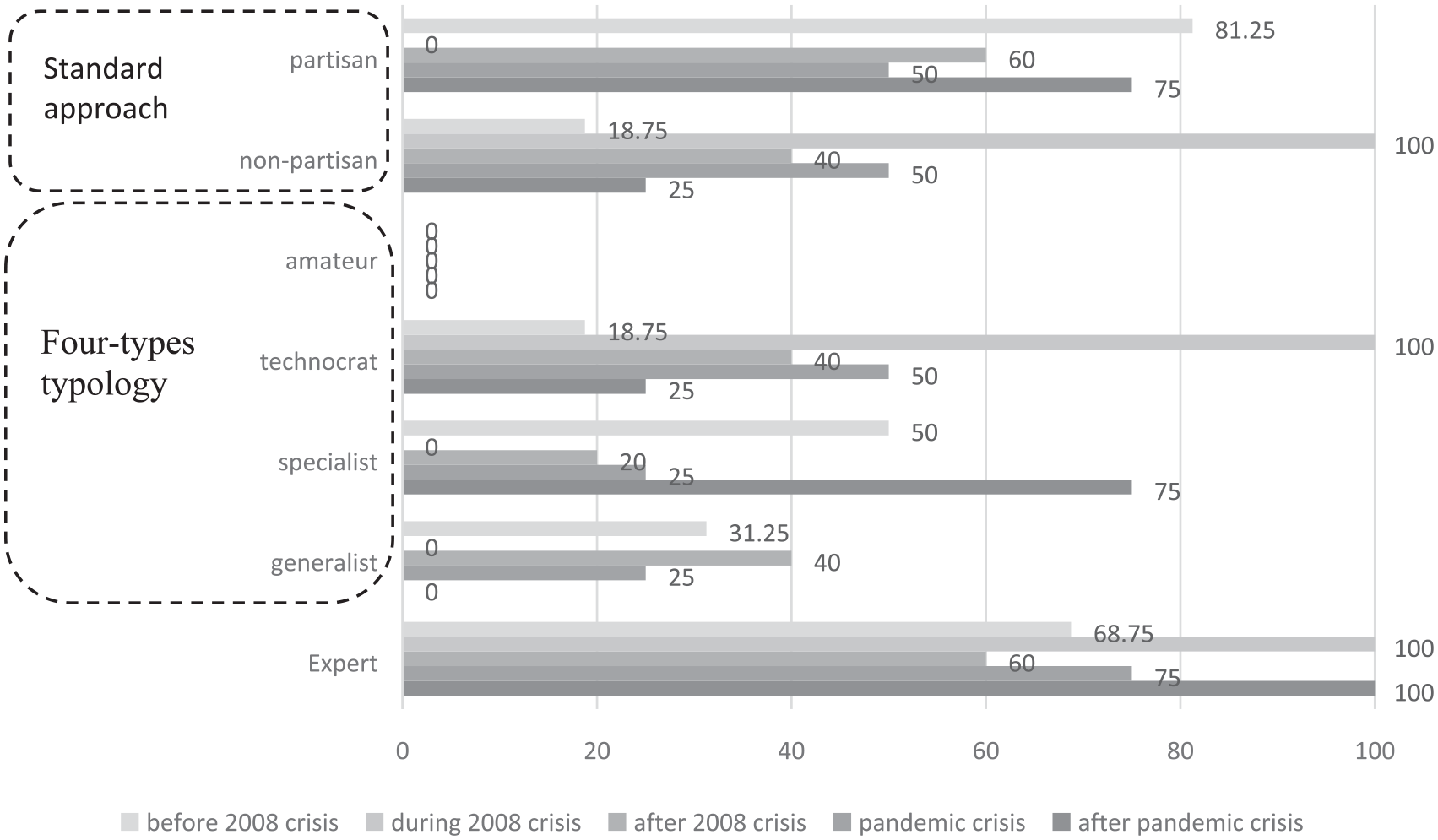
Core-executive ministers in five sub-periods (%).
Minister profiles by portfolio areas in five sub-periods (%).
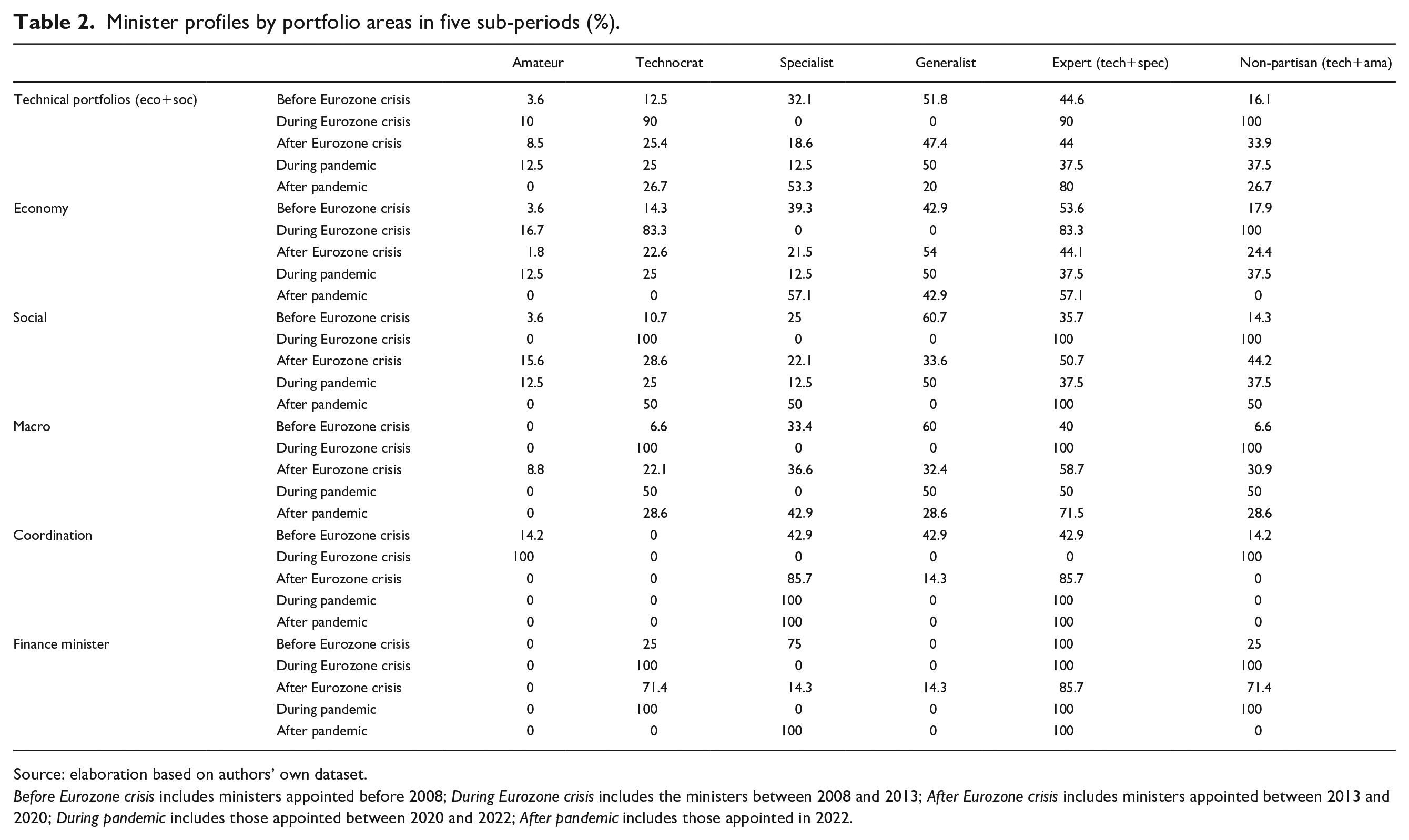
Source: elaboration based on authors’ own dataset.
Before Eurozone crisis includes ministers appointed before 2008; During Eurozone crisis includes the ministers between 2008 and 2013; After Eurozone crisis includes ministers appointed between 2013 and 2020; During pandemic includes those appointed between 2020 and 2022; After pandemic includes those appointed in 2022.
Figures 4 and 5 address RQ 2.1 regarding the causal link between the selection of technocratic ministers and short-term factors such as those emphasized by the critical juncture argument. The consolidated idea that critical junctures like economic and/or political crises trigger the selection of technocrats (Alexiadou and Gunaydin, 2019; Bertsou and Caramani, 2020; Costa Pinto et al., 2018) applies to the Italian case. The consequences of the 2008 financial crisis and the failure of the Berlusconi IV government led to the Monti technocratic government (2011–2013). Similar processes had appeared after the turbulence of the 1990s, when the Dini (technocratic) and Ciampi (technocratic-led) governments were formed. The Draghi (technocratic-led) executive (2021–2022), established in response to the COVID-19 crisis, follows the same pattern, albeit with the peculiarity of being formed to manage redistributive policies resulting from the EU recovery plan.
In this case, there are no significant differences between the two distinct analyses run following the standard approach and the four-types typology: the two crisis governments formed by Monti and Draghi included, respectively, 100% and 39.1% non-partisan ministers according to the former, while the latter indicated the presence of 88.9% and 30.4% technocrats. However, other relevant points emerge. First, the technocratic profile shows an astonishing increase from the phase before the 2008 crisis to the phase after, passing from an average of 9.4% to 21.2%. Before the 2008 financial crisis, their presence is episodic, with the Berlusconi IV government selecting no technocrats. The phase after the 2008 crisis shows the consolidation of this profile. A further distinction in the crisis period after 2008 can be highlighted, with oversized coalition governments (Letta, Renzi, Gentiloni, 2013–2018) composed of traditional parties showing an average of 16.4% of technocrats, while the populist governments including the newcomer 5SM (Conte I and II, 2018–2021) reach an astonishing average of 28.55%: this high percentage of technocrats in governments where new strong parties are present constitutes a powerful indicator of the connection between party decline and the growing selection of technocrats. The percentage of technocrats selected by the pandemic crisis government (Draghi 2021–2022) (30.4%) is coherent with its technocratic-led nature, while the back-to-politics Meloni government formed in 2022 includes, counterintuitively, a significant number of technocrats (25%). Second, the standard approach highlights a decline of over 20% of partisan ministers from the period before the 2008 crisis to the period after, followed by a coherent further decline of 12.1% during the pandemic crisis and by a 18.8% increase with the back-to-politics government. However, the four-types typology reveals several significant aspects hidden by these numbers. For example, if we consider the two profiles that possess expertise (specialists and technocrats) combined, they significantly surpass the generalists after the 2008 crisis (49.65% to 40.79%), becoming the largest group of ministers. In this regard, the pandemic and post-pandemic periods show counterintuitive outcomes: while the technocratic-led Draghi government shows a moderate lead of generalists over experts (47.8% to 43.4%), in the back-to-politics Meloni government experts dominate over generalists (75% to 25%). However, we should also highlight the opposite tendency within the expert profile, with the dominance of specialists before the 2008 crisis (three-to-one ratio) disappearing after the crisis when we have a more balanced distribution between specialists (28.45%) and technocrats (21.2%): this tendency to substitute the expertise provided by party members with non-partisan experts, which represents a powerful sign of party decline, is coherently present in the Draghi government (13% to 30.4%) and absent in the back-to-politics Meloni government (50% to 25%).
Figure 5 allows us to test the critical junctures argument considering the subset of core-executive portfolios. Here, most of the tendencies which emerged in the full sample are confirmed. However, an important element needs to be highlighted. Expertise is crucial for the selection of core-executive ministers in all phases considered and, as Figure 5 shows, this finding emerges only if the four-types typology is applied. As in the full sample, there is a radical change in the kind of expertise between the period before the 2008 crisis, where specialists dominate, and the following phases, which show the exponential rise of technocrats. The only exception is the Meloni government (2022–), which selected twice as many specialists as technocrats and may signal the beginning of a new political cycle.
The longitudinal evolution of minister profiles in different portfolio areas (Table 2) allows us to address RQ 2.2 regarding the link between the growing selection of technocrats and long-term non-conjunctural factors. More specifically, if an increase in technocrats outside crisis situations is detected, it should be limited to technical portfolios to fully support the policy-making complexity argument: if their increase occurs in even non-technical portfolios, then the party decline argument should also be considered and thoroughly investigated.
The first row of Table 2 presents the figures for technical ministries including economic and social portfolios. The data reveal a rising trend of technocrats in technical portfolios during our period of analysis, which supports the growing complexity of the policy-making argument considered in RQ 2.2. However, Table 2 also demonstrates that technocrats are not only diffused in all portfolio areas, except for coordination ministries, where expertise is relevant since specialists have become dominant, but the percentage by which they increase is even more pronounced in non-technical portfolios. This finding does not rule out the growing policy-making complexity argument, which was relevant both in our period of analysis and, perhaps, even more in previous decades. However, it prompts us to consider the party decline argument.
Party decline is not a new phenomenon in Italy. However, it is undeniable that political parties faced a particularly acute crisis during the period under analysis. In this sense, the 2000s were different from the 2010s. In the former, in a context of party decline there were also signs indicating a slowdown trend: for example, the completion of the institutionalization of Berlusconi’s party, which allowed the centre-right coalition to govern for most of the decade.
The 2010s (our technocratic decade) marked a period of acute crisis for Italian political parties. The Monti government represents a case of party abdication determined by the Berlusconi IV government’s inability to address the consequences of the 2008 crisis. The same (partial) party abdication explains the formation of the Draghi government, which is astonishing since its goal was to implement redistributive rather than retrenchment policies. Additionally, the rise of the populist 5SM constitutes the most emblematic symbol of party decline: it tripolarized the party system in 2013 and won the 2018 elections, becoming Italy’s leading party and the pivotal actor in the governments formed between 2018 and 2022.
Our data allow us to link this acute crisis of political parties to the increase in the selection of technocrats in Italy during our period of analysis. First, as already stressed above, Table 2 demonstrates how technocrats during the 2010s are appointed even in less-technical policy areas (and experts often represent the first profile): this finding supports the idea that selecting technocrats may also represent a coping mechanism of political parties for dealing with their legitimacy crisis. Second, the Conte I government formed by populist parties (5SM and Lega) emerges as the one which selected the most technocrats in the most policy areas (macro, social, technical): this stresses the role played in these processes by the rise of new parties, which is a crucial indicator of party decline. Third, if we look at the aggregate expert profile during the 2010s, data show that in technical portfolios the substitution of expertise provided by party members (specialists) with that provided by non-partisans (technocrats) is more pronounced in comparison to the full sample (see Figure 4), stressing once more the connection between party decline and the selection of technocrats. To those points we can add two more considerations that account for a reduction in the role played by the need for technical expertise in selecting technocrats:
1. Table 2 demonstrates how the expert profile in technical portfolios does not show an incremental trend over time but remains basically stable.
2. In a very technical policy area such as economy, due to the decline in specialists, expert ministers even decrease during our period of analysis.
Conclusion: the beginning of a new cycle?
In this article, the adoption of innovative tools (a fresh dataset and a new typology) allowed us to address our RQs regarding the growing presence and relevance of technocratic ministers in Italy during the last two decades. Thanks to the new dataset, which is the only one to fully cover the last decade, we updated and revised the conclusions of previous studies on this topic (e.g. Verzichelli and Cotta, 2018). These analyses, which cover only up to the beginning of the 2010s, rightfully stressed how during the 1990s and the 2000s (see Table 1) the presence of technocratic ministers tended to be limited to: (a) specific types of government (i.e. caretaker governments); (b) specific portfolios (i.e. finance minister); or (c) particular junctures related to critical events (Verzichelli and Cotta, 2018). The relevance of fully covering the technocratic decade emerges from the fact that, according to our findings, technocratic ministers in Italy are now: (a) selected by governments of all types; (b) appointed in various portfolio areas; and (c) not limited to governments formed to deal with critical events.
The adoption of the four-types typology, which systematically considers the expertise dimension along with partisanship, allows us to provide a more accurate picture of minister profiles in Italy, accounting also for such overlooked profiles as specialists and amateurs. For example, our data show how the role of expertise in the selection of Italian ministers is far more significant than previous studies had indicated, with the aggregated expert profile (technocrats and specialists) emerging as the most prevalent in almost all the classes examined in this research.
Regarding the explanatory RQ, our research allowed us to test on the crucial Italian case the major explanations formulated by the literature. RQ 2.1 deals with short-term factors and focuses on the critical juncture argument, according to which political parties select more technocrats as a strategy to deal with critical scenarios. Our data support such a proposition: the Monti technocratic government represented a reaction to the Berlusconi IV government’s inability to address the consequences of the 2008 financial crisis, while the Draghi technocratic-led executive was formed to assure both domestic and international actors of the efficient management of the post-COVID EU recovery program.
RQ 2.2 deals with long-term non-conjunctural factors such as the growing complexity of policy-making and party decline, which should stimulate a gradual increase in the selection of technocrats either to deal with the increasing need for technical expertise or to face the legitimacy crisis of political parties. Our data support this proposition, with party decline becoming more significant during the technocratic decade. As we detail below, we do not claim that party decline has always and only been addressed through the selection of technocratic ministers or that selecting technocrats has only been triggered by party decline. What we do claim is that, as our data suggest, the growing selection of technocrats during the technocratic decade served, to a good extent, as a coping mechanism for political parties to address their legitimacy crisis.
Thanks to a deeper interpretation of our data, we propose a reassessment of the explanatory power of the theories considered, and advance a comprehensive explanation of the growing presence and relevance of technocratic ministers in the Italian case, especially during the technocratic decade, but one which can also offer more generalizable suggestions to the literature on this topic.
In the Italian case, long-term factors, in particular party decline, seem to show the strongest explanatory power of the phenomenon of technocratic selection: if critical junctures qualify as a more proximate cause of the greater selection of technocrats, party decline shows both a direct impact on the increase in technocrats and an indirect influence on short-term factors. Moreover, among long-term factors, party decline seems to have had, at least during the technocratic decade, a stronger impact when compared with the growing complexity of policy-making. Our findings support these claims. First, the longitudinal tendencies observed in all profiles can be linked to party decline. In fact, the decrease in partisans, the exponential rise in technocrats and amateurs, the dominant position of experts and the substitution of expert partisans (specialists) with experts without partisan linkages (technocrats), which is even more evident in core-executive portfolios, are all factors that corroborate the proposition grounded on the idea of party decline.
Second, our data stress the role of a crucial indicator of party decline on the growing selection of technocrats: the rise of new parties. Berlusconi’s Forza Italia emerged as a reaction to the Italian party system crisis and selected a higher percentage of technocrats in 2001 (17.8%) if compared with the non-technocratic governments of the 1990s formed by established parties. However, the more Forza Italia became institutionalized, the less technocrats have been selected (0% in the last Berlusconi government). The rise of 5SM, the most emblematic symbol of party decline during the technocratic decade, led to the same outcome: all governments, including 5MS, presented a very high percentage of technocrats. Here, the lack of experience and a professional elite often resulted in new parties struggling with low levels of legitimacy when they assumed power. To address this issue, they selected technocrats to assure key actors of the government’s efficiency and effectiveness.
Third, critical junctures are a phenomenon that may lead, and in Italy did lead, to a greater selection of technocratic ministers. However, this is neither the only nor the natural coping mechanism adopted by political elites to deal with critical scenarios, as they usually rely on other institutionalized mechanisms like new elections or grand-coalition governments. To oversimplify, stronger political parties rely more on institutionalized coping mechanisms, while weaker parties tend to abdicate responsibility and delegate to technocrats to address crises. Italy provides both examples: during the 1970s, Italian political parties dealt with financial crises and domestic terrorism forming governments of ‘national solidarity’, while all technocratic governments formed since the 1990s were the result of party abdication with respect to critical events.
Finally, among long-term factors, our data stress the prominence of party decline over the growing complexity of policy-making, at least in our period of analysis. For example, the diffusion of technocrats beyond technical portfolios, or the decrease of expert ministers in a very technical area such as economy, allow us to conclude that the growing selection of technocrats in Italy, at least during the technocratic decade, was not primarily triggered by the increasing need for technical expertise.
In conclusion, our findings stress the role of a critical factor driving the selection of technocratic ministers in Italy: the need for greater legitimacy in a context of party decline. Since the 1990s, and to a lesser extent in the 1970s and 1980s, Italian political parties have experienced low levels of legitimacy, reaching critical levels during the ‘technocratic decade’. Italian political parties have frequently used the selection of technocrats as a coping mechanism to address their low level of legitimacy with both domestic (i.e. President of the Republic, interest groups, electorate) and international (i.e. EU, international markets) actors. This is evident in the formation of all technocratic governments since the early 1990s, all of which were examples of party abdication since political parties were too weak and delegitimized to deal with several acute crises. It is even more evident during the technocratic decade, when the Monti government may be seen as a response to the delegitimation and weakness of Italian political parties, which proved to be incapable of managing the consequences of the 2008 financial crisis: stronger parties would likely have pursued more institutionalized solutions. Moreover, the relevant percentage of technocrats in the governments formed after 2013 with a bipolar support (Letta, Renzi, Gentiloni) may mark parties’ attempt to regain legitimacy after their abdication at the time of the formation of the Monti government. Furthermore, the high presence of technocrats in governments including the newcomer 5SM (Conte I and II) can be considered a strategy to increase the governments’ low level of legitimacy, due to its lack of experience, before national and international actors. Finally, party decline and the need for stronger legitimacy coalesce perfectly in the formation of the Draghi technocratic-led government since, for the first time, political parties (partially) abdicated their role of ministerial selectorate to allow the formation of a technocratic-led government to implement redistributive rather than retrenchment policies. Moreover, the solution of the technocratic-led executive (with such broadly acclaimed personality) can be seen as a tool implemented by weak parties to assure the EU that Italy would have properly managed the EU recovery fund.
The formation of the Meloni government (2022–) may have interesting consequences. After numerous heterogeneous coalition governments, and a technocratic-led executive, several features stress the back-to-politics nature of this government, which may signal the beginning of a new political cycle. In fact, the Meloni government is based on a pre-electoral, homogeneous centre-right coalition led by a professional politician who selected three-quarters of her cabinet among long-time party members. The application of the four-types typology allows us to strengthen this perspective. For example, the distribution within the expert profile shows a clear dominance of specialists (50%) over technocrats (25%), which contrasts with the trend of substituting the expertise provided by party members with that of technocrats indicated by our longitudinal analysis. Moreover, most of the selected technocrats were close to ruling parties: for example, the Interior Minister Matteo Piantedosi was chief of staff of the Lega’s leader Salvini when he occupied the same position in the Conte I government. However, the four-types typology allows us to stress another set of interesting, and to some extent contradictory, peculiarities. For example, the Meloni government still selected a significant number of technocrats, ranking second (behind the Conte I government) in our sample among the non-technocratic governments. Moreover, and more importantly, in terms of selection of expert ministers, it ranks second in our sample, behind only the fully technocratic Monti government. In our view, this is consistent with the perspective stressed above regarding the constant need for greater legitimacy of Italian parties as one of the most relevant factors driving the selection of technocratic and expert ministers in Italy. Since the Meloni government has been described as the most right-wing Italian executive in decades, as a populist Eurosceptic government representing a danger for the Italian democracy and the EU, as taking ambiguous positions regarding the Ukraine war, and as lacking the capacity to effectively manage the EU recovery program, the selection of so many expert ministers may be considered a tool to increase the government’s legitimacy before crucial actors. In other words, if the Meloni government can indeed be viewed as a back-to-politics executive, it remains to be seen if it will represent the end of the technocratic decade and the beginning of a new political cycle, given the presence of similar, albeit less pronounced, features associated with the decline of political parties and the party government model.
Supplemental Material
sj-docx-1-ips-10.1177_01925121231216438 – Supplemental material for Behind the technocratic challenge: Old and new alternatives to party government in Italy
Supplemental material, sj-docx-1-ips-10.1177_01925121231216438 for Behind the technocratic challenge: Old and new alternatives to party government in Italy by Antonino Castaldo and Luca Verzichelli in International Political Science Review
Research Data
sj-xlsx-2-ips-10.1177_01925121231216438 – Supplemental material for Behind the technocratic challenge: Old and new alternatives to party government in Italy
sj-xlsx-2-ips-10.1177_01925121231216438 for Behind the technocratic challenge: Old and new alternatives to party government in Italy by Antonino Castaldo and Luca Verzichelli in International Political Science Review
Footnotes
Acknowledgements
We would like to thank the three anonymous reviewers for their helpful comments that allowed us to improve an earlier draft of this research.
Funding
The author(s) disclosed receipt of the following financial support for the research, authorship, and/or publication of this article: The work was supported by the Fundação para a Ciência e a Tecnologia [SFRH/BPD/101442/2014, UID/SIC/50013/2013]

Supplemental material
Supplemental material for this article is available online.
Notes
Author biographies
References
Supplementary Material
Please find the following supplemental material available below.
For Open Access articles published under a Creative Commons License, all supplemental material carries the same license as the article it is associated with.
For non-Open Access articles published, all supplemental material carries a non-exclusive license, and permission requests for re-use of supplemental material or any part of supplemental material shall be sent directly to the copyright owner as specified in the copyright notice associated with the article.
